INTRODUCTION
Many human languages make use of grammatical gender, such that each noun in the language is assigned either one of two or three genders (masculine, feminine and sometimes neuter). For example, both silla (Spanish) and stuhl (German) mean ‘chair’, yet with respect to grammatical gender, the former is feminine while the latter is masculine. Adult psycholinguistic research suggests that native speakers of gendered languages are sensitive to morphophonological patterns of gender agreement between nouns and modifiers such as adjectives and determiners. For example, when Spanish speakers are presented with a picture of an object (‘table’, mesa – feminine, singular) they are faster to produce the pictured object's label and its gender congruous determiner (la – feminine, singular) when the determiner distractor superimposed on the picture is identical to the form of the pictured noun's determiner than when their features diverge (las – feminine, plural or los – masculine, plural; Alario, Ayora, Costa & Melinger, Reference Alario, Ayora, Costa and Melinger2008).
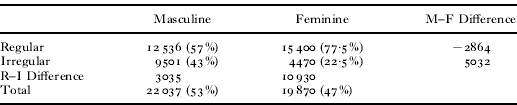
This pattern of results is almost certainly due to the very high regularity that exists between Spanish gender and Spanish morphology. For example, 77·5% of feminine nouns end in -a while 57% of masculine nouns end in -o (Teschner & Russell, Reference Teschner and Russell1984). Some 78% of Spanish nouns conform to the regular pattern whereby nouns ending in -a are preceded by the definite determiner la and nouns ending in -o are preceded by the definite determiner el (Moreno-Sandoval & Goñi-Mendoyo, Reference Moreno-Sandoval and Goñi-Mendoyo2002). There is evidence that adult Spanish speakers are not only sensitive to the regularity present in these morphophonological patterns but that they are able to predict from the determiner the gender of the upcoming noun. For example, using ERP (event-related potential) methodology, Wicha, Bates, Moreno and Kutas (Reference Wicha, Bates, Moreno and Kutas2003) demonstrated that Spanish speakers show differential response patterns when reading a gender-marked determiner that is incongruent with the gender of the noun pictured compared to response patterns with gender congruous articles. The regularity of the correspondence between Spanish gender and Spanish morphology together with the predictable pattern between noun gender and determiner form raises an interesting question about young children learning Spanish. Is the correlation of noun and determiner morphophonological forms available to Spanish learners from early on? This question was the main focus of the research presented here.
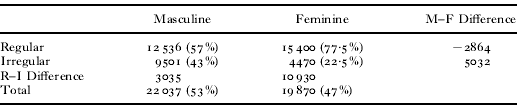
A second observation about the statistics of the Spanish gender system is that masculine and feminine nouns differ in both frequency and regularity. Although Spanish masculine nouns outnumber Spanish feminine nouns by 6%, the phonology of Spanish feminine nouns is much more regular and predictive of the determiner that precedes them. While feminine regular nouns (those ending in -a) far outnumber feminine irregular nouns, this difference is much smaller for masculine nouns. Additionally, feminine regular nouns outnumber masculine regular nouns by 10%. This distributional pattern creates an asymmetry with respect to conditional probabilities across genders, resulting in a higher forward transitional probability of word-final phoneme -a given the feminine determiner la (0·77) compared to the transitional probability of -o given el (0·56). Table 1 presents a breakdown of these patterns across the nominal gender system based on an inverse dictionary analysis of Spanish nouns (Teschner & Russell, Reference Teschner and Russell1984) and shows the distribution of regular and irregular features across the Spanish lexicon. Given the asymmetry in predictability of feminine vs. masculine determiner–noun morphophonology, we additionally asked whether children learning Spanish show evidence of being sensitive to this asymmetry. Because la predicts nouns ending in -a both more frequently and more reliably than el predicts nouns ending in -o, we might expect to see an advantage in gender marking for Spanish noun phrases of the la -a form over noun phrases of the el -o form.
Distribution of regular and irregular nouns for both masculine and feminine genders based on Teschner & Russell (Reference Teschner and Russell1984). Percentages shown reflect the asymmetrical relationship between regular and irregular nouns across the Spanish gender system
There is growing evidence that infants and young children are sensitive to the morphophonological properties of their input language(s) from the earliest stages. For example, Shady (Reference Shady1996) found that infants aged 10·5 months listened longer to passages in which grammatical determiners preceded nouns than when either other morphemes (e.g. was) or nonsense syllables preceded them. In a similar experiment using ERP methodology, Shafer, Shucard, Shucard and Gerken (Reference Shafer, Shucard, Shucard and Gerken1998) found that infants aged 1 ; 0 showed different patterns of responding when nouns were preceded by grammatical determiners than nonsense syllables. Because it is unlikely that the infants in either study understood all or even most of the nouns in the passages, the results suggest that infants in the first year of life are able to track the co-occurrence pattern of highly frequent morphemes (like a and the in English), prosodically marked phrase edges, etc. Other studies explicitly addressed whether young children are able to track morphophonological co-occurrence patterns within an utterance. Santelmann and Jusczyk (Reference Santelmann and Jusczyk1998) found that infants aged 1 ; 6 listened longer to passages containing sentences like “Grandmother is singing” than sentences like “Grandmother can singing”. Gómez (Reference Gómez2005) showed that infants aged 1 ; 6 could learn similar dependencies between non-adjacent syllables in an artificial grammar presented in the lab. Such dependencies are similar to the ones between Spanish determiners and noun endings.
Turning specifically to Spanish learners' ability to track morphophonological correlations, Spanish-learning children between the ages of 2 ; 10 and 3 ; 6 who participated in an eye-tracking procedure were shown pairs of pictures representing objects the labels of which shared the same gender (la pelota, ‘the ball’ – feminine, la galleta, ‘the cookie’ – feminine) or had different genders (la pelota, ‘the ball’ – feminine, el zapato, ‘the shoe’ – masculine) and prompted to find one of the depicted objects. Children were quicker to orient to the prompted referent in when the picture labels had different genders, suggesting that they were able to use the determiner form to anticipate the following noun (Lew-Williams & Fernald, Reference Lew-Williams and Fernald2007). In another study, Spanish-speaking children presented with pictures of novel creatures accompanied by various cues to gender (semantic, syntactic, morphophonological) showed greater accuracy with syntactic and morphophonological cues over semantic cues to gender (Pérez-Pereira, Reference Pérez-Pereira1991).
There is also some evidence for our prediction that, due to the greater predictability between Spanish feminine determiners and noun morphophonology, feminine noun phrases are accurately produced earlier. For example, a longitudinal case study of a monolingual child's noun phrase production between 1 ; 07 and 2 ; 01 showed that at all but one brief period between 1 ; 11 and 2 ; 01, María's production of masculine nouns outnumbered her production of feminine nouns. However, María demonstrated greater accuracy with feminine forms earlier than she did with masculine forms, producing more determiners with feminine words than with masculine words at all stages except between 1 ; 09 and 1 ; 10 (López-Ornat, Reference López-Ornat, Perez-Leroux and Glass1997). Even at the earliest stages, María consistently produced the vocalic form /a/ preceding feminine nouns, whereas, with masculine nouns, prevocalic forms were shown to demonstrate greater variability with /e/, /o/ or /u/ produced in prenominal position. Overall she omitted vocalic forms preceding masculine nouns with greater frequency than she did with feminine nouns (Mariscal, Reference Mariscal and Pérez Pereira1996). In a more recent longitudinal study, a similar pattern was demonstrated in the speech of four monolingual Spanish-speaking children between the ages of 1 ; 04 and 2 ; 01. As with María, the four children overall produced more masculine nouns than feminine nouns; however, they tended to produce determiners and filler or prevocalic forms more frequently with feminine nouns than they did with masculine nouns at the early stages of noun phrase production (Mariscal, Reference Mariscal2009). These data suggest that the Spanish-speaking child is sensitive to the fine-grained statistics of Spanish noun phrase morphophonology.
The child's hypothesized sensitivity to the regularity of determiner–noun dependencies has been replicated within a connectionist associative network in computer simulation. The network was fed machine-coded phonemic representations of noun phrases transcribed from actual caretaker speech directed to a monolingual Spanish-speaking child between ages 1 ; 7 and 2 ; 11. It was able to detect the determiner–noun patterns that it was given as input and extract those generalizations to produce correct determiner–noun sequences for phonemically coded nouns it had not previously been exposed to. It was able to produce gendered noun phrases based exclusively on morphophonological surface features and their co-occurrence patterns. The accuracy with which the network learned to produce noun phrases reflected the asymmetrical relationship between regular and irregular nouns across the gender system. Although the training set represented an equal number of masculine and feminine words, there were many more regular feminine nouns than regular masculine nouns and almost twice as many irregular masculine nouns than irregular feminine nouns. The network, like the child, showed an early advantage in the production of feminine forms, demonstrating greater accuracy from the start in producing determiners with regular feminine nouns than with regular masculine nouns. Accuracy in determiner production with feminine nouns quickly reached 100% by the third training epoch. Thus, using only phonological information from real child-directed speech, the network was shown to eventually approximate the noun phrase production of an actual child at age 2 ; 11 (Smith, Nix, Davey, Lopéz-Ornat & Messer, Reference Smith, Nix, Davey, López-Ornat and Messer2003).Footnote 1
Although all of the studies reviewed in this section suggest that young children can track the relation between morphophonological elements in an utterance, no study has asked specifically whether children can apply their knowledge of morphophonological patterns to new words. In studies using known words, it is possible that children used the form of the determiner to predict a particular set of known nouns, and not to predict nouns ending in -a after la and -o after el. Thus, the main goal of the child production experiment presented here was to ask whether children are sensitive to the la noun-a and el noun-o relation, regardless of whether or not they know the nouns. A parallel adult experiment was also performed in order to provide a comparison to the child study.
Before turning to the experiments, we need to consider the fact that our participants were Spanish–English bilinguals. Our rationale for selecting bilingual children was largely practical. As noted above, monolingual Spanish-learning children achieve accurate production of feminine noun phrases by about two years. Therefore, because one of the dependent measures of interest is determiner omissions, we needed children at a stage of language production who would still make some omissions. However, pilot data suggested that children at two years were often unwilling to repeat any/many non-words in our experimental setting. Therefore, we turned to Spanish–English bilinguals, who were on average older than monolinguals exhibiting the same level of determiner production. Given this participant group, how similar to monolingual Spanish learners can we expect children to be who are learning Spanish as one of two languages? There is evidence that the bilingual child follows a developmental trajectory that mirrors that of the monolingual child even when the structure of the two languages diverges. For example, Kupisch (Reference Kupisch2007) found similar patterns of determiner production for Italian–German bilingual children (both balanced and unbalanced) compared to monolingual children of both languages. The bilingual children, however, were shown to be somewhat slower to begin producing determiners in Italian relative to monolingual Italian children. A similar pattern has been shown for Spanish–English bilingual children (Bedore & Peña, Reference Bedore and Peña2008). In a longitudinal study, Barreña (Reference Barreña, Perez-Leroux and Glass1997) recorded and analyzed the pattern of noun phrase production for a Spanish–Basque bilingual child in both of his respective languages between the ages of 1 ; 6 and 3 ; 6. When compared to monolingual children for each language, the bilingual child's speech generally mirrored the patterns shown for monolingual Basque and Spanish children at each stage of development, although bilinguals demonstrated a longer period of errors than monolingual children. Thus, the existing data appear to support our conjecture that older Spanish–English bilinguals, who are more likely to complete our experimental session, can be expected to demonstrate similar patterns of determiner production and omission as younger Spanish-learning monolinguals.
The two experiments reported here, one with Spanish–English bilingual children and one with bilingual adults, asked whether speakers show evidence of sensitivity to the relation between the Spanish determiners el and la and the morphophonology of the noun (ending in -o or -a) and, if they are, whether they are more accurate for the more predictable feminine forms than the less regular masculine forms. In both experiments, participants were asked to repeat Spanish noun phrases that varied on three dimensions. First, half of the nouns were actual words of Spanish, and half were non-words that obeyed Spanish phonotactics. Second, half of the real and invented nouns were masculine (ending in -o) and half were feminine (ending in -a). Finally, half of the determiners were masculine (el) and half were feminine (la). The combination of noun gender and determiner gender meant that half of the noun phrases exhibited morphophonological congruence between the determiner and noun, such that, if the determiner was el the noun ended in -o, and if the determiner was la, the noun ended in -a. We reasoned that if a speaker could predict aspects of the noun form (the final vowel) from the preceding determiner, congruent noun phrases should be easier to produce than incongruent noun phrases, regardless of whether the noun in question was known to the speaker or not. In contrast, if a speaker cannot or does not use the determiner to predict the form of the following noun, we should only see a congruity effect for words. Based on many previous studies with adults, we predicted that they would show an overall speed advantage for words over non-words, regardless of gender congruity (e.g. Forster & Chambers, Reference Forster and Chambers1973). In addition to asking whether adults and children would show gender congruity effects for words and non-words alike, we also wanted to know whether the two groups of participants would be influenced by more fine-grained statistical patterns across the gender system and therefore show greater accuracy/efficiency with feminine congruent noun phrases compared to performance with masculine congruent noun phrases.
EXPERIMENT 1: CHILDREN
Experiment 1 with Spanish–English bilingual children addressed the question of whether children are able to exploit surface morphophonological features to produce noun phrases and whether, additionally, the way in which they do so reflects differential statistics of Spanish feminine vs. masculine noun phrases. If children are sensitive to the correlation between determiner and noun forms, they should more easily produce congruent noun phrases than incongruent noun phrases, regardless of whether the noun is known or not. If children are sensitive to the asymmetrical distribution of regular and irregular nouns across genders, they should additionally find it easier to produce noun phrases exhibiting feminine morphophonological patterns than those exhibiting masculine morphophonology.
METHODS
Participants
A total of 30 Spanish–English bilingual children ranging in age from 2 ; 0 to 4 ; 0 were recruited for the study. The data for 12 children were not included in the analyses. Some of these children either did not complete the task (n=11) or no data were available regarding language background and vocabulary size for Spanish and English (n=1). The remaining 18 children included in the analyses were between 2 ; 0 and 4 ; 0 with a mean age of 2 ; 11. The group consisted of 6 girls and 12 boys. Parental report indicated that all of the children were exposed to one or more native speakers of Spanish on a weekly basis ranging from 20 hours to 70 hours with an average of 49·19 hours per week for the group. English exposure ranged from 7 to 65 hours per week with an average weekly exposure of 33·27 hours for the group. English was reported to be the primary language spoken in the household for 5 of the children and Spanish for 7 of the children. Both English and Spanish were reported to be spoken in the household for 6 of the 18 children. Spanish was reported to be the native language for both parents for 9 out of 18 of the children, and Spanish was reported to be the native language for one of the parents and for 2 out of 18 of the children. English was reported to be the native language of both parents for 7 out of 18 of the children, and English was reported to be the native language of one parent for 2 out of 18 of the children. Spanish was reported to be spoken by at least one parent for 17 out of 18 children. All of the children were additionally reported to be exposed to Spanish via audio/video, television and or computer programs on a weekly basis. Seventeen of the 18 children were reported to be exposed to both Spanish and English via multimedia on a weekly basis. Vocabulary size in both English and Spanish was assessed for all children based on the MacArthur-Bates Communicative Development Inventory: Words and Sentences. The CDI is a developmentally normed test of productive vocabulary and sentence complexity that has been standardized for both English and Spanish (Fenson et al., Reference Fenson, Dale, Reznick, Thal, Bates, Hartung, Pethick and Reilly1993; Jackson-Maldonado, Thal, Marchman, Bates & Gutierrez-Clellen, Reference Jackson-Maldonado, Thal, Marchman, Bates and Gutierrez-Clellen1993). One child's Spanish vocabulary checklist was not returned and one child's English vocabulary checklist was incomplete. Vocabulary scores as measured by the MacArthur-Bates Communicative Development Inventory: Words and Sentences ranged between 6 and 680 words for English with a mean score of 312·06 and between 16 and 675 words for Spanish with a mean score of 325·94. Thus, as a group, children were quite similar in their vocabularies in Spanish and English. Additionally, language background for each child was measured based on parental report on a language background survey designed to assess the child's exposure to both Spanish and English on a weekly basis.
Materials
In order to elicit noun phrases, children listened to and repeated a total of 32 items presented in two counterbalanced lists. Each list consisted of 16 words and 16 non-words presented in either a gender congruous or gender incongruous condition such that on half of the items the word or non-word was presented in a matching syntactic frame preceded by the gender congruous determiner (el perro/el tupo) and on half of the items the word or non-word was presented in an incongruent syntactic frame preceded by the gender incongruous determiner (la perro/la tupo). The lists were counterbalanced for gender such that an equal number of feminine and masculine words and non-words appeared in each list. The words and non-words were also balanced with respect to marking: all of the nouns exhibited regular systematic gender morphophonology such that the word-final phoneme /o/ corresponded with masculine gender or the word-final phoneme /a/ corresponded with feminine gender.
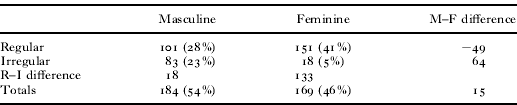
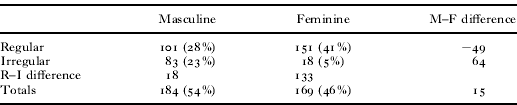
Because the same noun phrases were to be used in both the adult and child experiments, we wanted to be sure that the distributional statistics of Spanish noun phrases taken from an adult dictionary applied to words that Spanish-learning children should know. To that end, we calculated the comparable statistics to those shown in Table 1 from the MacArthur Communicative Development parental checklist, developmentally normed for Spanish. Analysis of the nouns understood and produced by Spanish-speaking children between the ages of 1 ; 4 and 2 ; 6 reveals a pattern similar to that of the adult distribution. Table 2 shows the resulting analysis of the CDI developmentally normed vocabulary checklist based on a total of 353 nouns. As can be seen in Table 2, children, like adults, produce slightly more masculine nouns than feminine nouns. As in the adult corpus, the difference between regular and irregular nouns is greater for feminine versus masculine with children producing more regular nouns overall than irregular nouns. For masculine nouns, this difference is very small. The distribution of the majority of nouns produced by both the child and adult Spanish speaker demonstrates a regular pattern whereby el corresponds with word-final phoneme /o/ and la corresponds with word-final phoneme /a/.
Distribution of regular and irregular nouns for both masculine and feminine genders based on an analysis of all nouns included on the Spanish CDI, developmentally normed for monolingual Spanish-speaking children. Percentages shown reflect the asymmetrical relationship between regular and irregular nouns across the Spanish gender system
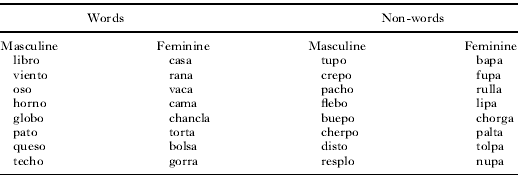
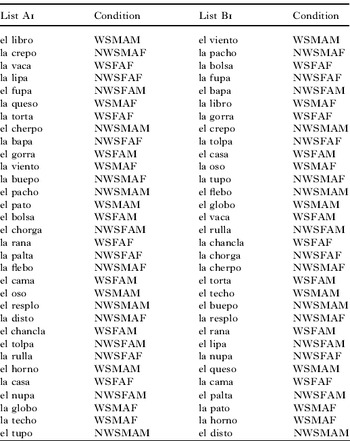
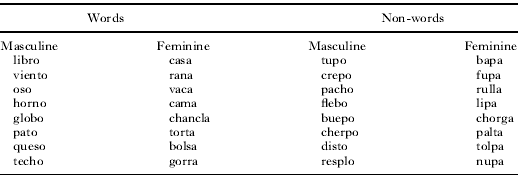
The test words were non-human nouns drawn from the Spanish version of the MacArthur CDI developmentally normed vocabulary checklist, and no words with English cognates were included. Non-words were created based on nouns from the MacArthur CDI Spanish version and were formed by changing the onset plus one other phoneme of the existing two-syllable Spanish word. All words and non-words were two syllables in length with stress falling on the penultimate syllable, the most common stress pattern in Spanish. Prosodically, each Det+Noun/Non-word combination exhibited the pattern weak–strong–weak, the stress pattern said to facilitate determiner production for young Spanish-speaking children (Restrepo & Gutierrez-Clellan, Reference Restrepo and Gutierrez-Clellen2001). The complete list of words and non-words is shown in Table 3.
Experimental items: words and non-words
The lists were counterbalanced such that if a word or non-word appeared in the determiner/noun congruous condition in List A, it appeared in the incongruous syntactic frame in List B. To control for possible ordering effects, the presentation of items for both List A and List B was reversed, thereby creating List A1, List A2, List B1 and List B2. Items in each list were semi-randomized such that no more than two items from a condition appeared consecutively. The complete list of items can be found in the Appendix. The stimuli were recorded by a native speaker of Spanish who speaks a dialect of Spanish typical of this area. All recordings were made in a soundproof room using a headset USB microphone and Sound Studio, an acoustic recording and analysis software package. The digitized stimuli were normalized for amplitude using the same software. In order to eliminate the possibility that ungrammatical phrases would have different acoustic properties than grammatical phrases and that child or adult responses might be influenced by these subtle acoustic differences, all phrases were created by splicing a masculine or feminine determiner onto the same set of nouns. The determiners spliced onto the test words were taken from grammatical noun phrases matching the test phrases for number of syllables and stress placement as well as first two phonemes. Two practice items were also included in this set and consisted of real words with ambiguous gender marking, each preceded by a gender ambiguous modifier.
Procedure
Each experimental session was preceded by a brief play session. Once the child was comfortable, the researcher used a puppet to introduce the child to the experimental cartoon creature, Pombo, and to subsequently familiarize the child with the elicited imitation task. Following familiarization and play, the child, accompanied by the parent, was encouraged to find Pombo's identical twin hiding in the toddler testing room. The stimuli were then presented to the child in an elicited imitation task while seated at a toddler-sized table in front of an LCD flat screen using DMDX software for stimulus presentation (Forster & Forster, Reference Forster and Forster2003). Each auditory stimulus was synchronized with the appearance of Pombo on the screen. A practice session preceded the test item presentation to orient the child to the computerized task. Children were instructed as follows: “Say exactly what Pombo says, even if it sounds funny.” Instructions and prompting were given in varying degrees of both Spanish and English, depending on the child's proficiency in Spanish. Following each repetition of the target, a reward screen appeared. When the child was distracted or fussy, the presentation of the item was repeated. Each child was given a non-functional computer mouse to encourage active participation in the task.
RESULTS
Data coding
Experimental sessions were recorded and the data transcribed for quantitative analysis. Each child's response was analyzed with respect to accuracy in determiner production relative to the target stimulus. Responses were retranscribed by a native speaker of Spanish, and the two transcriptions yielded a high rate of agreement, 93%, between the coders. Where there was disagreement, those items were independently transcribed by a third person and a consensus was reached. Individual responses were coded with the following categories for well-formedness with respect to repetition of the target stimulus, specifically the determiner: Switch (determiner gender switched to something other than the stimulus presented, target – el vaca, child – ga vaca) and Omission (only the noun produced, target – el bolsa, child – bolsa). Instances where the child changed a non-word to a real word or the child repeated the incorrect stimulus because a sibling repeated it for the child were excluded from the analysis as were all other partial, unintelligible responses and instances where no response was given (target – la casa, child – queca queca). A filler syllable is here defined as one or more phonemes produced in determiner position, preceding the noun. A filler syllable containing a vowel indicative of gender marking such as the vowel /a/ in lieu of the feminine determiner la or the vowel /e/ in lieu of the masculine determiner el was considered a scorable gender-marked response. Systematic variations from the target utterance such as the replacement of the onset /l/ in la casa with the onset /y/ produced as ya casa were scored as correct full determiners.
Children's language abilities
Data from the MacArthur-Bates Communicative Development Inventory: Words and Sentences for both Spanish and English were collected via parental report and compiled using the CDI scoring program version 4.1 for Mac OS X. The number of words produced in English and Spanish out of a possible 680 on each survey was calculated and used to measure vocabulary size for each child in each language.
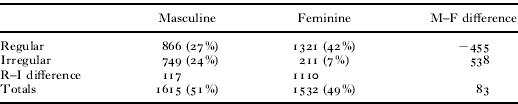
Data for 17 of the 18 children who participated in the experiment were available for analysis of the distributional patterns present in the Spanish nouns that this particular group of children is reported to produce. The 17 children included in this analysis produced a total of 3,147 Spanish nouns. The distribution of regular and irregular nouns across genders is shown in Table 4. The percentages are based on the total number of nouns produced by the entire group.
Analysis of regular and irregular nouns across genders for the total number of Spanish nouns produced by 17 out of 18 children per parental report on CDI. Percentages shown reflect the asymmetrical relationship between regular and irregular nouns across the Spanish gender system
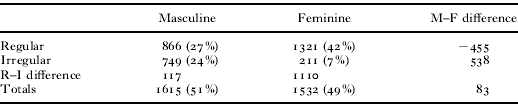
Comparison of the patterns shown for the bilingual children participating in the experiment (Table 4) with those of monolingual Spanish-speaking children (Table 2) revealed a very similar pattern of results. Interestingly, despite the varying degrees of difference between Spanish and English vocabulary size reported for the 17 bilingual children, the overall pattern shows that they are sensitive to the grammatical gender and distributional patterns of the language in much the same way as monolingual children exposed only to Spanish, as reflected in the nouns they produce. Before comparing the results of the child experiment with those of the adult experiment, the cumulative results of the child experiment will first be summarized and discussed in the next section.
Production of determiner gender switches
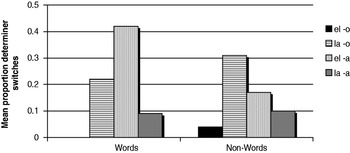
The total number of responses where the child produced a determiner in each condition for each subject was used to form a ratio of determiners switched in gender produced to the total number of determiners produced by the child in each condition. Those children who produced at least one determiner gender switch were included in the analysis.Footnote 2 Only one child made no determiner gender switches at all and was thus excluded from the analysis. Data for a total of 17 children, 11 boys and 6 girls, were included in the analysis ranging in age from 2 ; 0 to 4 ; 0 with a mean age of 3 ; 4. One child's Spanish CDI checklist was never returned and one child's English CDI checklist was never returned. Spanish vocabulary size for the remaining children as measured by the CDI checklist ranged from 16 to 514 with a mean score of 340·62, and English vocabulary size ranged from 6 to 680 with a mean score of 323·25. The resulting means for determiner gender switches for all eight conditions are shown in Figure 1.
Children's mean proportion determiner gender switches for gender congruent (el -o, la -a, solid bars) and incongruent (el -a, la -o, striped bars) noun phrases in which nouns were words or non-words (n=17). Note that no switches were made for masculine congruent words.

The gender switch data were analyzed using a Lexical Status (word, non-word)×Noun (masculine, feminine)×Determiner (masculine, feminine) ANOVA.Footnote 3 Recall that our main prediction was that children's production should be affected by determiner–noun congruity. A significant two-way interaction between Noun and Determiner (F(1,16)=16·31, p=0·001) supports that prediction: children made more gender switches when genders of the determiner and noun were incongruent (thereby making a correction) than when these cues were gender congruent (thereby making an error). Only 6 of the 17 children made a gender switch that resulted in an error. Importantly, the Noun×Determiner interaction was not qualified by a further interaction with Lexical Status (F(1,16)=3·15, n.s.). That is, as predicted, if children are sensitive to Spanish morphophonological patterns, they showed an effect of determiner–noun congruity, regardless of whether the noun was known to them or not.
One unanticipated effect was a two-way interaction between Lexical Status and Noun approached significance (F(1,16)=4·49, p=0·05), such that children switched the gender of the determiner more often with feminine nouns, whereas with non-words children made more determiner gender switches with masculine nouns. We will return to this result in the ‘General discussion and conclusion’ section.
Determiner omissions
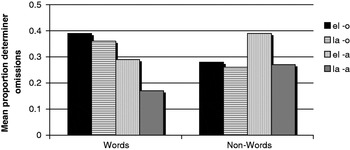
The total number of coded responses for each item in each condition was used to form a ratio of the total number of responses lacking a determiner to the total number of utterances the child produced. Determiner production is known to increase as a function of age, thus a ceiling effect was observed for determiner production with some of the older children. Therefore, only the data for those children with at least one omission were included in the analysis of this dependent measure, resulting in a total of 15 children, 9 boys and 6 girls ranging in age from 2 ; 0 to 4 ; 0 with a mean age of 2 ; 8. Spanish vocabulary size as measured by the CDI checklist ranged from 16 to 675 with a mean score of 308·57, and English vocabulary size ranged from 8 to 679 with a mean score of 263·80. The resulting means for determiner omissions can be seen in Figure 2.
Children's mean proportion determiner omission rate for gender congruent (el -o, la -a, solid bars) and incongruent (el -a, la -o, striped bars) noun phrases in which nouns were words or non-words (n=15).

As with the determiner switch data, we performed a Lexical Status (word, non-word)×Noun (masculine, feminine)×Determiner (masculine, feminine) ANOVA on the determiner omissions data. Again, our main prediction was that children's production should be affected by determiner–noun congruity. The two-way interaction between Noun and Determiner (the gender congruity effect) approached significance (F(1,14)=3·84, p=0·07).Footnote 4 Mirroring the determiner switch data, children made fewer determiner omissions when the gender of the determiner was congruent with the gender of the noun than when these cues were conflicting. Crucially the two-way interaction was not further qualified by a three-way interaction involving Lexical Status (F(1,14)=0·01, n.s.). Again, children appeared to be sensitive to determiner–noun congruity, regardless of whether the noun was known to them or not.
The main effect of Determiner approached significance (F(1,14)=3·90, p=0·06), such that children omitted more masculine determiners than feminine determiners. This finding is consistent with the observation that determiner–noun form correlations are stronger for feminine than for masculine noun phrases.
Finally, as in the analysis of determiner switches, there was a significant, albeit unpredicted, interaction between Lexical Status and Noun (F(1,14)=4·82, p=0·04). For words, children omitted determiners more frequently with masculine nouns than with feminine nouns, whereas for non-words children omitted determiners more frequently with feminine nouns than with masculine nouns. We discuss this interaction and the parallel one for determiner switches in the ‘General discussion and conclusion’ section.
To briefly summarize, the child data support our main predictions: for both the determiner switch and determiner omission measures, there were significant or nearly significant interactions between Noun and Determiner. That is, children were sensitive to the morphophonological congruency of the elements of the noun phrase, and they showed this sensitivity regardless of whether the noun was a real Spanish word or not. In addition, as predicted, children demonstrated more accuracy with the more regular feminine gender system, producing feminine determiners more frequently than masculine determiners. One unexpected finding was that, for both dependent measures, there was a significant or near significant interaction between Lexical Status and Noun.
EXPERIMENT 2: ADULTS
Experiment 2 tested Spanish–English bilingual adults using a speeded response version of the elicited imitation paradigm used with children in order to tap online processing required for noun phrase production, specifically the relative contribution of lexical status, congruity and gender. The adult test group also provided a basis of comparison for the patterns of performance shown in the child experiment.
METHODS
Participants
A total of 15 adult Spanish–English bilinguals participated in the study. The purpose of the adult Spanish–English bilingual test group was to parallel the child group as much as possible with respect to language contact situation; thus, all of the adults included in the study were currently living in the US and used both Spanish and English on a daily basis.
In order to establish a baseline against which the child data could be compared, all participants met the criteria of not having been exposed to a language other than Spanish prior to age 10 years. This cut-off was chosen because, despite ample evidence that the gender agreement paradigm is mostly acquired by age 3 ; 0, there is also evidence that the system is still vulnerable to attrition after that point, especially in a language contact situation (Anderson, Reference Anderson1999; Montrul, Reference Montrul2002; Montrul & Potowski, Reference Montrul and Potowski2007). Children born in a Spanish-speaking country who move to the US after age 3 ; 0 have been shown to demonstrate an increase in gender agreement errors over time and in particular upon entering school (Anderson, Reference Anderson1999). This has also been shown to be true for simultaneous bilinguals (Montrul, Reference Montrul2002). The age 10 years cut-off ensured that the participants had attended school in a Spanish-dominant environment and thus should minimize the influence of English or any subsequent language on the gender agreement system.
Language exposure and experience were assessed via self-report on a language background survey. The group consisted of 6 females and 9 males who were either enrolled in graduate programs at the University of Arizona or were members of the community. On average, participants learned to speak a language other than Spanish at age 15.
Materials
All materials were the same as those used for the child experiment.
Procedure
Each experimental session was preceded by a brief instructional session. The researcher used a puppet to introduce participants to the experimental cartoon creature, Pombo, and to subsequently familiarize them with the elicited imitation task. Adults were explicitly told that they would hear simple Spanish noun phrases containing either real Spanish words or non-words and that these items would be preceded by either a gender matching or a gender mismatching determiner. They were instructed to repeat what Pombo says as quickly as possible. The speeded response format was included to minimize conscious processing of stimuli that could potentially lead to reanalysis and modification of the target, especially in the incongruent conditions. Following the instructional phase, adults were taken to the toddler testing room. The stimuli were then presented to adults in an elicited imitation task while seated at a toddler-sized table in front of an LCD flat screen using DMDX software for stimulus presentation (Forster & Forster, Reference Forster and Forster2003). Each auditory stimulus was synchronized with the appearance of Pombo on the screen. A practice session preceded the test item presentation to orient the adult to the computerized task. Adults were reminded to say what Pombo says as quickly as possible. All instructions were given in Spanish. Following each repetition of the target, a reward screen appeared consisting of a smiling made-up cartoon creature synchronized with applause. Each item was presented only once for the adults.
RESULTS
Experimental sessions were recorded and the data transcribed for quantitative analysis. Productions were retranscribed by a native speaker of Spanish for accuracy and 100% agreement was shown between coders. Each adult's response was analyzed with respect to accuracy relative to the target stimulus; however, unlike the analysis of the child data, items where the adult modified the utterance either by correcting the gender of the determiner or by producing the incorrect noun were excluded from the analysis. The only dependent measure in the adult study was response time. Naming latencies were measured from the end of the target word to the onset of the adult's utterance and all measurements were independently analyzed by a separate data coder. A high rate of agreement was shown with an average difference between coders of 58·13ms. The digital sound files were amplified and normalized using sound editing software and measurements were made using visible formant activity.
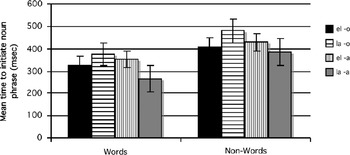
Mean naming latencies for each condition for each participant were calculated and the data were analyzed with a Lexical Status (word, non-word)×Noun (masculine, feminine)×Determiner (masculine, feminine) ANOVA. The resulting mean response times can be seen in Figure 3.
Adults' mean naming latencies (in msec) and standard errors for gender congruent (el -o, la -a, solid bars) and incongruent (el -a, la -o, striped bars) noun phrases in which nouns were words or non-words (n=15).

Our main prediction for the adult latency data was the same as for the child determiner production data: a determiner–noun congruency effect. The significant Noun×Determiner interaction supported this prediction (F(1,14)=13·32, p=0·003). Adults were faster to initiate repetition of the stimulus in conditions where the determiner and noun were gender congruent than they were in conditions where the determiner and noun were gender incongruent. Importantly, the Determiner–Noun congruency effect did not interact with Lexical Status, indicating that, as predicted from previous research, adults were not only sensitive to morphophonological patterns across the gender system but were additionally able to apply their knowledge of these statistics to the production of determiner–noun sequences that were unknown. We also predicted that adults, like children, would be sensitive to the greater predictability of determiner–noun patterns for feminine noun phrases. This prediction supported by a main effect of Noun (F(1,14)=17·35, p=0·001), showing that participants produced phrases containing feminine nouns faster than those with masculine nouns. Thus, the results from Experiment 2 are consistent with those of previous studies that demonstrate that Spanish-speaking adults are sensitive to the regularity of determiner–noun co-occurrence patterns and use this knowledge to make predictions about the gender of nouns. Finally, the ANOVA showed a main effect of Lexical Status (F(1,14)=9.75, p=0·007). As in previous studies with adults, phrases containing real words were produced faster than those containing non-words.
General discussion and conclusion
Our main question was whether Spanish-learning children and Spanish-speaking adults are sufficiently sensitive to the morphophonological gender system of Spanish to be more accurate and efficient in producing noun phrases in which the determiner and noun agreed in gender and, importantly, if they would do so for nouns that they do not know. The answer appears to be ‘yes’ – both children and adults showed a determiner–noun congruency effect, producing noun phrases exhibiting morphophonological agreement more accurately and efficiently than phrases in which the determiner and noun did not agree in gender. This effect held for both real Spanish words and non-words. To our knowledge, this is the first study to demonstrate a congruency effect for non-words in Spanish-learning children.
Our second question was whether Spanish-learning children and Spanish-speaking adults would demonstrate sensitivity to the greater regularity of the Spanish feminine gender system. Again, the answer appears to be ‘yes’ – for determiner omissions, children omitted masculine determiners more frequently than feminine determiners. It is important to note that the more frequent inclusion of la than el in this imitation study is consistent with the patterns of production observed in the spontaneous speech of monolingual Spanish-speaking children. Although it is possible that children in our study and in spontaneous speech omit el more frequently than la because the former violates the more universally preferred CV syllable shape, the adult latency data suggest that the omission data may reflect at least partially the greater regularity of feminine than masculine gender marking. Adults were faster to produce noun phrases in which the noun ended in -a than -o. The fact that the noun itself, and not the determiner, shows a bias in favor of the feminine gender system rules out the syllable structure of the determiner as the cause, at least for adults.
In addition to the predicted effects of determiner–noun congruity and an advantage for feminine noun phrases, both dependent measures in the child study revealed an unanticipated Lexical Status×Noun interaction that appeared in both dependent measures in the child study. This interaction did not appear in the adult study. For determiner switches, children switched the gender of the determiner more often with feminine words but more often with masculine non-words. For determiner omissions, children omitted determiners more frequently with masculine words than with feminine words, whereas for non-words children omitted determiners more frequently with feminine nouns than with masculine nouns. Although these patterns appear to be the opposite, this appearance reflects the fact that switches generally reflect corrections, while omissions reflect errors. That is, children made both more corrections and fewer errors for feminine words than masculine words when the noun was a real word. The basis of this pattern of results may reflect the fact that our child participants knew more Spanish words ending in -a (as reflected in parental report, Table 4). If real words ending in -a were easier for the children to produce, they might be expected to make fewer determiner omissions and more corrections than if the noun ended in -o. This is the pattern that they showed. Recall that adults showed a similar pattern of ease of production for nouns ending in -a. However, they showed the same faster naming times for such nouns regardless of whether they occurred in words or non-words. It is not clear at this point why children would find it easier to produce masculine noun phrases when the nouns are novel, although whatever effect there is appears to be carried by a single non-word condition for both dependent measures (la -o for switches and el -a for omissions). Perhaps children are in the process of acquiring more new masculine words than feminine words, or perhaps due to frequency or other factors, masculine noun phrases constitute a sort of default, which is used for unknown words. We will continue to look for a more satisfying answer in future research.
In summary, the data from both adults and children support previous claims that Spanish speakers use the highly predictive morphophonology of Spanish to produce gendered nouns and their corresponding gender marked determiners. Our data also augment these claims by demonstrating that the regularity of the Spanish la -a combination gives that combination an advantage in Spanish noun phrase production.
The sensitivity to the morphophonological patterns of Spanish that we observed in our child data can also be seen in the longitudinal studies with monolingual Spanish-speaking children that we described in the ‘Introduction’. At the earliest stages of development, children in these studies are shown to begin to combine feminine determiners or filler-like vowel forms with feminine words prior to using determiners with masculine words and to produce more variable prevocalic forms with masculine nouns compared to feminine nouns (López-Ornat, Reference López-Ornat, Perez-Leroux and Glass1997; Mariscal, Reference Mariscal and Pérez Pereira1996; Reference Mariscal1997).
The bilingual child data not only mirror monolingual child performance shown in previous studies of accuracy in the production of noun phrases, but also demonstrate similarities with respect to vocabulary structure, in particular the distributional patterns across genders (Table 2 and Table 4). This same pattern is also observable in the adult corpus (Table 1). Monolingual and bilingual children as well as adult Spanish speakers produce overall more masculine than feminine nouns; however, they produce more feminine regular nouns (nouns ending in -a) than masculine regular nouns (nouns ending in -o) and twice as many masculine irregular nouns as feminine irregular nouns. It is this asymmetry between irregular nouns across genders that is reported to support a developmental shift from early accuracy with feminine forms to later accuracy with masculine forms for monolingual children. Interestingly, the pattern of results shown for both populations in this study also mirrors the early advantage of feminine forms shown by a computational model driven solely by the detection of regularity and frequency of surface morphonological patterns found in child-directed speech.
The results of the two studies reported is consistent with the growing literature suggesting that children's early productions not only reflect their knowledge of the grammar of their language, but also their sensitivity to the statistics of their input. They provide an important first link between Spanish-speaking bilingual child and adult performance patterns. Generally, children are most accurate in producing those forms that adults, who are nearly always accurate, produce most quickly. Thus, noun phrases in which the determiner and noun are congruent in their gender marking, and particularly feminine congruent noun phrases, showed a production advantage for both children and adults. Therefore, even though the adults in our study presumably have tacit knowledge of the grammar of Spanish, their performance still reveals sensitivity to fine-grained differences in the statistics of grammatical forms in that language. One apparent exception to the child:accuracy:: adult:speed analogy is adults' shorter response latencies for phrases containing real words. No similar main effect of lexical status was observed in children's productions. It is possible that our measure of child production might not have been sensitive enough to reveal an effect of lexical status. Alternatively, the entire developmental pattern might suggest that, while both children and adults are similarly sensitive to the formal properties of language that allow them to handle new utterances, adults gain additional speed and efficiency by depending on stored utterances, the most reliable of which are particular lexical items.
To conclude, our findings underscore the importance of input statistics in language learning and processing, extending research with English-speaking adults and children in the domain of artificial grammar learning to online production processing for a lesser-studied population. The data not only provide evidence of the use of morphophonological surface cues to more complex non-adjacent dependencies by children and adults, but also demonstrate the influence of asymmetries with respect to regularity across the language.
APPENDIX: COMPLETE ITEM LISTS

note: Counterbalanced item lists are coded for condition – Word, Noun Masculine, Determiner Masculine (WNMDM), Word, Noun Masculine, Determiner Feminine (WNMDF), Word, Noun Feminine, Determiner Masculine (WNFDM), Word, Noun Feminine, Determiner Feminine (WNFDF), Non-word, Noun Masculine, Determiner Masculine (NWNMDM), Non-word, Noun Masculine, Determiner Feminine (NWNMDF), Non-word, Noun Feminine, Determiner Masculine (NWNFDM), and Non-word, Noun Feminine, Determiner Feminine (NWNFDF).