Introduction
Benzodiazepines (BZDs) are among the most frequently prescribed medications in developed countries for anxiety disorders. 1-5 Benzodiazepine prescription rates have increased over the past decade in the United States, most notably in primary care settings. 6-8 However, several clinical guidelines do not recommend BZDs as a first-line treatment for anxiety disorders. 9-12 Benzodiazepines are commonly misused and/or inappropriately prescribed (e.g., duration, dose, and co-prescription) leading to the exacerbation of existing psychiatric disorders (e.g., depression and anxiety).Reference Panes, Fourrier-Réglat and Verdoux 13 , Reference Soyka 14
Medical use of BZDs are associated with several adverse risks, including, but not limited to, cognitive impairment, increased propensity for falls, premature labor, abuse liability, and lethality overdose (magnified by opioid co-prescription).Reference Olfson, King and Schoenbaum 6 , Reference Soric, Paxos and Dugan 11 , Reference Jessell, Stanhope and Manuel 12 , Reference Johnson and Streltzer 15 , Reference Osler and Jørgensen 16 Furthermore, prolonged use of BZDs has been known to induce withdrawal symptoms and problems of discontinuation.Reference Sirdifield, Anthierens and Creupelandt 17 , Reference Ait-Daoud, Hamby and Sharma 18 The common and increasing prescription rates of BZDs invites the need to identify factors that may potentially influence their prescription.
Available literature indicates that sociodemographic factors may influence diagnostic patterns and/or the prescription behavior of BZDs. 19-22 Potential sociodemographic factors include, but are not limited to, gender, employment status, education level, age, and income. 23-25 However, the influence of gender on the prescription patterns of pharmacologic agents in psychiatry has been insufficiently characterized. Accordingly, it is unknown whether a gender-by-gender interaction exists with respect to prescriber–patient dyads. Herein, we aim to evaluate the influence of prescriber and patient gender on the prescription of BZDs using data derived from the Florida Medicaid Managed Medical Assistance (MMA) Program.
Methods
Study design and data source
A total of 125 463 cases were included in this cross-sectional study. This data was derived from the MMA Program based on the following sources: Florida Medicaid Recipient Enrollment Data, Florida Medicaid Recipient Eligibility Files, Florida Medicaid Plan Data, Professional and Institutional Claims Data, Pharmacy Encounter Data, and National Provider Registry, from January 1, 2018 to December 31, 2018. Moreover, the International Statistical Classification of Disease and Related Health Problems-10 (ICD-10) was used to define the behavioral health categories of serious mental illness (SMI) and anxiety (ICD-10 codes F40-F43). Serious mental illness includes major depressive disorder, bipolar disorders, and schizophrenia disorder.
Participants
Recipients included in this analysis were ages 18 to 64, inclusive, dually eligible, and must have been enrolled in the MMA program for at least 1 day. Recipients either had a SMI, or no SMI and anxiety. Children, adolescents and elderly recipients (i.e., 65 or older) were excluded.
Study outcomes
The main outcome of interest was the prescription rate of BZDs. The units of analysis were defined as the proportion of patients prescribed a BZD, the proportion of prescribers who prescribed a BZD and non-BZD, and the proportion of BZDs prescribed per prescriber gender and patient gender. The proportion of patients prescribed a BZD was defined as the number of patients with a BZD prescription between January 1, 2018 and December 31, 2018. The proportion of prescribers who prescribed a BZD was defined as the number of prescribers who prescribed a BZD between January 1, 2018 and December 31, 2018. In addition to gender, BZD prescription rate was stratified based on the patient’s behavioral health status (i.e., SMI, or non-SMI and anxiety). However, potential predictors of BZD rate, such as race and age, were not accounted for in this analysis.
Statistical methods
We evaluated the effects of recipient gender, prescriber gender, and their interaction on the proportion of patients prescribed a BZD. Relative risk and their 95% confidence intervals (CI) were reported. Additionally, we stratified patients by diagnosis (i.e., SMI, and non-SMI and anxiety) and by receipt of a BZD (i.e., office claim and recipient). Descriptive results are presented as percentages for categorical variables. Relative risk and confidence intervals were calculated using the Statistical Package for Social Sciences program. The main and interaction effects were performed using two-way ANOVA.
Results
Sample characteristics
A total of 125 463 recipients (n = 125 463) with office claims for an anxiety or BZD prescription from their provider were included in this cross-sectional study. Of the 125 463 cases, 40 677 (32.4%) cases consisted of recipients with a BZD prescription and 84 786 (67.6%) cases represented prescriptions for a non-BZD agent. Overall, 99 532 (79.3%) cases represented prescriptions for female patients and 53 130 (42.3%) cases were prescribed by female prescribers.
Benzodiazepine prescription rate
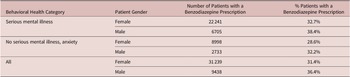
Approximately 31.4% (n = 31 239) of female patients were prescribed a BZD, whereas 36.4% (n = 9438) of male patients were prescribed a BZD (Table 1). The relative risk of female patients compared to male patients prescribed a BZD was 0.862, 95% CI [0.847, 0.878]. The relative risk of male patients compared to female patients prescribed a BZD was 1.16, 95% CI [1.14, 1.18].
Difference in Benzodiazepine Prescription Rate by Patient Gender and Behavioral Health Status

Male prescribers prescribed a BZD in 27 539 (38.1%) cases and a non-BZD in 44 794 (61.9%) cases. In comparison, female prescribers prescribed a BZD in 13 138 (24.7%) cases and a non-BZD in 39 992 (75.3%) cases. The relative risk of male prescribers compared to female prescribers prescribing a BZD (vs. non-BZD) was 1.540, 95% CI [1.513, 1.567].
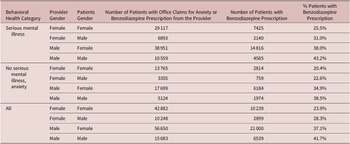
We compared whether male prescribers compared to female prescribers prescribe BZDs more frequently to female patients than to male patients. Of the 56 650 female patients assessed by a male prescriber (n = 6162), 21 000 (37.1%) were prescribed a BZD, whereas 6539 (41.7%) of the 15 683 male patients assessed by a male prescriber were prescribed a BZD (Table 2). Among female prescribers (n = 3370), 10 239 (23.9%) of female patients were prescribed a BZD, while 2899 (28.3%) of male patients were prescribed a BZD (Table 2). The relative risk of prescribing a BZD (vs. non-BZD) was 0.889, 95% CI [0.870, 0.908] among male prescribers and 0.844, 95% CI [0.815, 0.874] among female prescribers. The rate ratio of male prescribers to female prescribers was 1.053.
Data on Benzodiazepine Prescription Recipient Rate by Patient Behavioral Health Status, Patient Gender and Prescriber Gender

Two-way ANOVA was conducted to examine the effects of patient and prescriber gender on BZD prescription. The interaction effect between patient and prescriber genders was not statistically significant, F(1, 125 459) = 0.105, P = 0.745, partial η 2 < 0.001. The main effects of patient and prescriber gender were significant, F(1, 125 459) = 188.232, P < 0.001, partial η 2 = 0.001 and F(1, 125 459) = 349.704, P < 0.001, partial η 2 = 0.013, respectively.
Additional two-way ANOVA was conducted to examine the effects of patient and prescriber gender on BZD prescription for recipients with a SMI, and non-SMI and anxiety. The interaction effect between patient and prescriber gender was not statistically significant for SMI patients F(1, 39 939) = 1.571, P > 0.001, partial η 2 < 0.001. The interaction effect between patient and prescriber gender was also not statistically significant for non-SMI and anxiety patients, F(1, 855 516) = 0.186, P > 0.001, partial η 2 < 0.001.
Discussion
Herein, our data suggest that a relationship between prescriber gender and BZD prescription behavior may exist. We observe that male prescribers were more likely to prescribe BZDs to their patients regardless of patient gender, and male patients were more likely to be prescribed a BZD regardless of prescriber gender. In addition, our findings also suggest that the interaction effect between gender and BZD is significant only for the combined prescription of BZD due to SMI, and non-SMI and anxiety. The interaction between gender and BZD prescription rate was not significant for SMI, and non-SMI and anxiety, respectively. Available evidence supports the findings of our analysis, wherein male prescribers are more likely to recommend pharmacologic treatments when compared to female prescribers who are more likely to recommend psychosocial treatments.Reference Bjørner and Laerum 21 , Reference Roter, Hall and Aoki 26 However, there is limited evidence explaining this disparity in BZD prescription patterns, and more specifically, describing the prescription behavior of male prescribers.
A potential hypothesis explaining the differential BZD prescriptions as a function of prescriber and patient gender may be related to stigma and stereotypes of mental illness. More specifically, culture may moderate the effect of gender on professional help-seeking.Reference Nam, Chu and Lee 19 This phenomenon may explain the gender differences in BZD prescribing patterns. For example, male prescribers and/or male patients may conceptualize mental illness and/or its treatment differently than female prescribers resulting in different treatment considerations.Reference Nam, Chu and Lee 19 Additionally, evidence suggests that male patients may express greater preference for pharmacologic agents (e.g., BZDs), rather than manual-based psychotherapy and/or non-pharmacologic interventions, whereas the converse is observed in female patients.Reference Pattyn, Verhaeghe and Bracke 27 , Reference Cooperstock and Lennard 28 Taken together, males generally endorse negative attitudes towards treatment seeking (e.g., therapy), and are relatively more likely to engage in longitudinal mental health interventions. 29-32 Female prescribers are much more likely to engage in conversations about emotional wellbeing versus biomedical information.Reference Roter, Hall and Aoki 26 , Reference Cooperstock and Lennard 28 , Reference Hall, Roter and Blanch-Hartigan 33 , Reference Bernstein and Kane 34
It is noted, however, that a majority of studies suggest a potential relationship between patient and prescriber gender on BZD prescription rates, wherein female patients are disproportionately prescribed BZDs compared to male patients.Reference Morabia, Fabre and Dunand 25 , Reference Hirschtritt, Palzes, Kline-Simon, Kroenke, Campbell and Sterling 35 Extant literature reports that this disparity may be due in part to the large prevalence of depressive and anxiety disorders among females compared to males, and accordingly, greater prescription rates of opioids among this population.Reference Olfson, King and Schoenbaum 6 , 36–38 A nonmutually exclusive hypothesis is that gender stereotypes of psychopathology exist, and are different between male and female prescribers. It may be more likely that male prescribers have a gender-biased, and stereotyped conceptualization of emotional expression in female patients.Reference McIntyre, Chen and Lee 39 For example, in a Taiwanese sample, male prescribers may be more likely to conceptualize female patients as having a greater susceptibility to affective dysregulation and/or may be more likely to benefit from pharmacologic treatment.Reference McIntyre, Chen and Lee 39 However, the foregoing relationship was not supported by our findings. It is possible that the divergent finding is due to differences across countries, cultures and settings with respect to gender bias and prescription behavior. Further research that aims to identify the role of factors (e.g., age, race, income, education, psychiatric disorders, and comorbidities) on gender-based BZD prescription behavior is warranted.
Moreover, further research is needed to explore the effect of culture on BZD prescription patterns. The effect of culture on BZD prescription is two-fold. First, extant literature suggests that some cultures (e.g., Chinese, Malay, and Indian) are less likely to seek professional care, thereby reducing prescription rates.Reference Nam, Chu and Lee 19 This disparity in health-seeking attitudes is attributed to stigma, religion (e.g., traditional healers) and education.Reference Nam, Chu and Lee 19 , Reference McIntyre, Chen and Lee 40 , Reference Gulliver, Griffiths and Christensen 41 Second, it is well demonstrated that BZD prescription patterns are dependent on race. For instance, White populations are more likely to receive a BZD when compared to Black, Latino, and Asian populations. 40–45 Previous studies indicate that healthcare providers are less likely to prescribe to racial minorities due to a preconceived bias that minorities are at greater risk for misuse, noncompliance and substance abuse.Reference Cook, Creedon and Wang 42
While BZDs are efficacious for treating symptoms of generalized anxiety disorder, they need to be prescribed and taken with limitations to avoid fatal outcomes. 46-49 Polysubstance abuse is common among BZD misuse.Reference Schmitz 50 When taken in conjunction with primary drugs of abuse (e.g., opioids and alcohol), the interaction can induce and exacerbate respiratory depression.Reference Schmitz 50
Hence, the significance of gender interaction vis-a-vis BZD prescription has important implications regarding attitudes toward help-seeking behaviors, biases in mental healthcare, and concordance with best practices and health outcomes. The impetus for this analysis was to improve best practices for prescribers in primary care and psychiatric settings to ensure all treatment interventions are presented to the patient without the notion of prescriber-biased care. Decreasing the prevalence of unnecessary BZD prescriptions may reduce the risk of BZD abuse and/or dependence.
Conclusion
In conclusion, the results of our preliminary analysis indicate that prescriber and patient gender may influence BZD prescribing behavior. However, a limitation of this study is that it is a post hoc retrospective analysis. We did not adjust for other factors that may affect the prescription of BZDs (e.g., patient economics, patient preferences, diagnosis, etc.,). Furthermore, demographic data, with respect to prescribers and patients, were not available for this dataset. Hitherto, it is unclear whether the database population is representative of the general population introducing the potential for selection bias. Additionally, it is not possible to determine whether characteristics relating to prescriber age and/or specialization may affect prescription patterns of BZDs. Also, we did not look at select agents of BZDs but rather BZDs as a class. As such, we were unable to evaluate whether this BZD relationship extends or is particular to any specific psychotropic agent. In addition, since BZD dosage was not stratified for, it may have effects on BZD prescription trends.
Moreover, no information was available regarding differences in clinical characteristics between patients with SMI, and non-SMI and anxiety. Further clarity between the two diagnoses could be used to control for a primary diagnosis (e.g., bipolar disorder and schizophrenia) or be used to conduct a random effects model to determine the extent to which the type, severity and/or prevalence of a disorder affects the interaction between patient and/or prescriber gender and BZD prescription rate.
We used a Medicaid dataset which may not be representative and/or translate into non-Medicaid populations. Populations in the Florida Medicaid dataset who were included in this analysis are in a low-income bracket, may rely on Supplemental Security Income, and/or have physical disabilities. Given the reduced variability of socioeconomic status of Florida Medicaid recipients, the results from this analysis are likely less applicable to a general population. On the other hand, the strength of this analysis is that it uses a large dataset wherein prescriber behavior is well-characterized and the Medicaid claim system is more complete. Moreover, patient information and diagnoses are codified. Future research should aim to replicate these findings and ascertain factors (e.g., demographic data, patient economics, and BZD drug classes) that may bias male prescribers toward differential BZD prescription rates when compared to female prescribers.
Funding
No funding was received for this study.
Disclosures
Yena Lee has received salary support from the Global Alliance for Chronic Diseases/Canadian Institutes of Health Research (CIHR)/National Natural Science Foundation of China’s Mental Health Team Grant and the CIHR Frederick Banting and Charles Best Canada Graduate Scholarship; personal fees from Champignon Brands.
Joshua D. Rosenblat has received research grant support from the Canadian Cancer Society, Canadian Psychiatric Association, American Psychiatric Association, American Society of Psychopharmacology, University of Toronto, University Health Network Centre for Mental Health, Joseph M. West Family Memorial Fund and Timeposters Fellowship and industry funding for speaker/consultation/research fees from Janssen, Allergan, Lundbeck, Sunovion and COMPASS. He is the medical director of a private clinic providing intravenous ketamine infusions and intranasal esketamine for depression.
Roger S. McIntyre has received research grant support from Chronic Diseases/Canadian Institutes of Health Research/National Natural Science Foundation of China’s Mental Health Team Grant; speaker/consultation fees from Lundbeck, Janssen, Purdue, Pfizer, Otsuka, Allergan, Takeda, Neurocrine, Sunovion, Minerva, Intra-Cellular, Abbvie; a shareholder and CEO of Champignon Brands.
Leanna M.W. Lui, Orly Lipsitz, Nelson B. Rodrigues, Hartej Gill, Jifeng Ma, Linas Wilkialis, Jocelyn K. Tamura, Ashley Siegel, David Chen-Li, Rodrigo B. Mansur, and Marie A. McPherson declare no competing interests.