INTRODUCTION
Observing how language develops across different languages remains one of the key methods of investigating theories of linguistic acquisition (Slobin, Reference Slobin and Brown2006). In recent years, cross-linguistic studies have used consistent methodologies in order to compare and contrast aspects of language acquisition which can be considered ‘universal’ with those that are language-specific. One method of collecting rich data from large samples is through parent report. When compared to direct assessment, parent report has been noted to measure overall vocabulary size comprehensively, and has been shown to be a valid, reliable and cost-effective method for assessing a range of communicative skills in infants and toddlers (Fenson, Marchman, Thal, Dale, Reznick & Bates, Reference Fenson, Marchman, Thal, Dale, Reznick and Bates2007). Perhaps the most widely researched parent checklists are the MacArthur-Bates Communicative Development Inventories (CDIs; Fenson et al., Reference Fenson, Marchman, Thal, Dale, Reznick and Bates2007). Moreover, as the CDIs have now been adapted to over forty languages (Bleses et al., Reference Bleses, Vach, Slott, Wehberg, Thomsen and Madsen2008), broad comparative cross-linguistic research is possible.
All adaptations of the CDI need to incorporate language-specific features, and not simply translate the original English test. For example, the adaptation of the CDI to Irish had to include an additional vocabulary category for ‘prepositional pronouns’, which are central to the language (Doyle, Reference Doyle, Kirk and Ó Baoill2001). In Irish, when personal pronouns are the object of a preposition, they combine to form a conjugated system of prepositional pronouns marked for person, gender and number. So, for example, when the complement of the preposition do ‘to’ is a pronoun, one of the following forms will be used: dom, duit, dó, di, dúinn, daoibh, dóibh (‘to me’, ‘to you’, ‘to him’, etc.). Prepositional pronouns are an important component of phrasal verbs which are used frequently and early in Irish language acquisition (Hickey, Reference Hickey1992). Notwithstanding such differences, cross-linguistic investigation using the CDI to compare the broad acquisition of word categories is possible. Most comparisons use the vocabulary categories ‘nouns’, ‘predicates’, ‘social’ and ‘closed-class’ words, (such as the analysis by Caselli et al., Reference Caselli, Bates, Casadio, Fenson, Fenson and Sanderl1995) aggregated across the more numerous semantically based categories which typically make up the CDI vocabulary section. The relative rate of emergence of these word classes has been widely studied to investigate variations in how children learn words. One commonly reported finding is the earlier emergence of nouns, from which the inference is drawn that nouns are ‘easier’ to learn than verbs (Gentner, Reference Gentner and Kuczaj1982). This observation has not only emerged from studies of SVO languages such as English, where nouns are in more salient positions, but also from studies of languages with less-restricted word order, including Italian (Caselli, Casadio & Bates, Reference Caselli, Casadio, Bates and Tomasello2001) and Hebrew (Maital, Dromi, Sagi & Bornstein, Reference Maital, Dromi, Sagi and Bornstein2000), strengthening the claims that there is a ‘universal noun bias’. However, studies of children acquiring languages where verbs are more salient, either for their sentence position or for other reasons, have challenged this argument, and provide evidence that verbs can emerge just as early as, or even earlier than, nouns. These include studies of Korean, which has an SOV sentence structure and allows omission of subjects and objects, meaning that verbs are often the only content word in sentences spoken to young children (Kim, McGregor & Thompson, Reference Kim, McGregor and Thompson2000). Verbs are also acquired early in Mandarin and Cantonese, which, although they have an SVO word order, also allow frequent omission of the subject or object in appropriate discourse contexts (Tardif, Reference Tardif, Hirsh-Pasek and Golinkoff2006) and have no grammatical inflections that might be used by children to distinguish between nouns and verbs.
Irish might also be argued to favour verbs over nouns in the input. For example, the Munster dialect of the language (as studied here) uses a synthetic verb form, where the subject is marked by a person suffix on the verb, making even single-word (verb) sentences possible. For example the verb clois, ‘to hear’ becomes cloisim (‘hear-I’) ‘I hear’ (Ó Siadhail, Reference Ó Siadhail1989). In addition, Irish has no ‘yes/no’ equivalent as in English. Instead, the response to a question such as that in (1a) is either a repetition (1b) or negation (1c) of the verb used in the question:
(1a)
An itheann tú feoil?Q-particle eat(PRES) you meat‘Do you eat meat?’
(1b) ithim eat-I ‘I eat.’
(1c) ní ithim NEG eat-I ‘I don't eat.’
Furthermore, Ó Siadhail (Reference Ó Siadhail1989) maintains that the verb is far more predictable than the noun in Irish in terms of its phonetic shape and grammatical function. Although both are subjected to initial mutations, which are morphophonological changes on the initial segment of the word, verbs inflect only for tense and person whereas nouns inflect for vocative, gender, number, genitive, comparative and diminutive forms. Finally, Irish has a basic VSO word order in sentences, arguably placing verbs in a salient position. Despite these arguments, other researchers have claimed that Irish is actually a noun-centred language (Stenson, Reference Stenson1981) and a study of Irish word-order acquisition noted that children had a high proportion of subject- (i.e. noun-) initial sentences due to frequent omission of the verb ‘to be’(Hickey, Reference Hickey1990a). This perspective would clearly not lead to a prediction of verb advantage.
Another aspect of vocabulary acquisition that can be examined from CDI data is the relative differences in the emergence of grammatical function or closed-class items. Studies of vocabulary development across many languages have demonstrated that closed-class items are relatively rare until children have acquired about 400 words (Bates, Dale & Thal, Reference Bates, Dale, Thal, Fletcher and MacWhinney1995). This has led to the argument that the development of grammatical function words may require the presence of a certain critical mass of nouns, verbs and other content words to bootstrap closed-class development (Marchman & Bates, Reference Marchman and Bates1994). Once again, Irish can inform us about this aspect of early vocabulary development, as it has a relatively rich system of closed-class items, including the aforementioned system of prepositional pronouns, which tend to be learned early in Irish, albeit in formulaic phrases (Hickey, Reference Hickey1993). Irish also has a semantically rich system of prepositions which are specified from the perspective and starting point of the speaker, whereas in English they only signal an absolute direction from the mover's point of view. This results in three items in Irish corresponding to the English word up, including suas which is used in the sense of ‘going up’, thuas in the sense of ‘being up’ and aníos when coming ‘up from down below’. Moreover, Irish distinguishes between prepositions of location (istigh ‘inside’, amuigh ‘outside’) and those of motion (isteach ‘going-in’, amach ‘going-out’). Finally, an adaptation of the Language Assessment Remediation and Screening Procedure (LARSP) to Irish (ILARSP; Hickey, Reference Hickey1990b) noted that the complexity of closed-class items makes the word-level analysis far more detailed in Irish. Having a rich system of grammatical function words could lead to an earlier emergence relative to content words than has been observed in other languages.
To summarize, the structure and nature of Irish leads us to predict that verbs could have an advantage over nouns in acquisition and that closed-class words may emerge at an earlier point of content word accumulation than in other languages. We tested these predictions against the Irish adaptation of the CDI: Words and Sentences.
METHOD
Assessment tool
The Irish adaptation of the CDI: Words and Sentences was used in the study to measure expressive vocabulary and a number of aspects of morphosyntax. The Irish vocabulary checklist contains 843 words organised into 23 semantic categories. To allow for the language contact situation, a second column for English-equivalent lexical items is included so that parents can indicate whether their child can say an item in Irish, English or bilingually. Verbs are listed in the imperative, as this is considered to be closest to the root form of the verb (Ó Siadhail, Reference Ó Siadhail1989). Further information on the adaptation is available in O'Toole and Fletcher (Reference O'Toole and Fletcher2008).
Participants
The Gaeltacht regions of Ireland are those where Irish is considered the majority language and it was from these areas that the sample was drawn. As the aim of the study was to focus on the acquisition of Irish as a first or majority language, one of the selection criteria for inclusion in the study was that Irish had to be spoken in the home at least 60 percent of the time (based on parental estimation from a background questionnaire), allowing for inevitable, incidental exposure to English. Children were excluded if they had a significant illness, were more than six weeks premature or had speech, language and/or developmental difficulties.
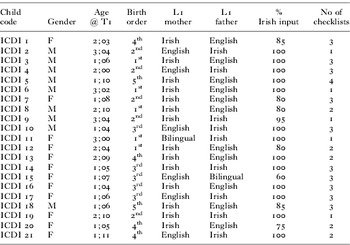
Table 1 summarizes the background information regarding the twenty-one children (twelve girls and nine boys) constituting the opportunistic sample for this study. The age provided is the age at the first assessment. Where possible, the children were seen at six-monthly intervals until they reached 3 ; 04 in order to collect longitudinal information. Thus, five children were seen on one occasion, five on two occasions, ten completed three checklists and one child was seen on four occasions. In total, forty-nine checklists were completed, the results of which will be outlined below.
Background information for all participants

Procedure
The children and parents were visited in their own homes where the Irish Communication Development Inventory (ICDI) was completed by one parent with assistance from the first author. In general, the checklist took between 10 and 30 minutes to complete, depending on the amount of words the child could say.
Data analysis
For data analysis the vocabulary content was divided into four major categories consisting of common nouns (from the categories ‘animals’, ‘toys’, ‘food and drink’, ‘clothing’, ‘body parts’, ‘small household objects’ and ‘furniture and rooms’); predicates (‘action words’ and ‘descriptive words’); social terms (‘animal noises/sound effects’, ‘people’ and ‘games, routines and phrases’) and closed-class items (‘pronouns’, ‘prepositional pronouns’, ‘prepositions’, ‘question words’, ‘quantifiers and articles’, ‘helping verbs’ (modals/auxiliaries) and ‘connecting words’). This was in line with previous research using CDI data for English and Italian, where ‘words about time’, ‘outside things’ and ‘places to go’ were omitted from the analysis as it was ambiguous whether lexical items in these categories were actually nouns or grammatical items (Caselli et al., Reference Caselli, Bates, Casadio, Fenson, Fenson and Sanderl1995).
RESULTS
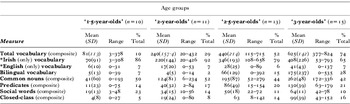
Table 2 summarizes the vocabulary scores achieved across the various age ranges. Children were divided into age groups of ‘1·5-year-olds’ (ranging from 1 ; 04 to 1 ; 09); ‘2-year-olds’ (1 ; 10 to 2 ; 03); ‘2·5-year-olds’ (2 ; 04 to 2 ; 09) and ‘3-year-olds’ (2 ; 10 to 3 ; 04). Due to the longitudinal nature of the study, a single child's vocabulary scores could appear in more than one age group. The ‘total vocabulary’ score was calculated as the composite number of words reported by the parent in English only, Irish only and bilingually (translational equivalents).
Vocabulary development across the ages from the ICDI (n=49)

* This is the composite vocabulary score which represents conceptual vocabulary, excluding all the words the child only knew in English (‘Total Irish’) or only knew in Irish (‘Total English’).
As can be seen in Table 2, the children were using only a small percentage of the total vocabulary at 1 ; 06 (10%), but by 3 ; 0 were using up to 75% of the 843 words on the checklist. The language contact situation that the children find themselves in is reflected in the fact that when the words known in both Irish and English were examined, they knew over one-quarter (28%) of their total vocabulary in both languages by three years.
As previous research has noted that observing language development over age profiles obscures some of the more interesting aspects of vocabulary development including stylistic variations (D'Odorico & Fasolo, Reference D'Odorico and Fasolo2007), further analysis was carried out by grouping children based on their total vocabulary sizes. If the children were reported to know a lexical item only in English, it was removed from the analysis, because it was the development of Irish vocabulary that was of interest. Overall, the children knew less than 7% of their total vocabulary items in English only and so this omission did not represent a substantial number of words. All translational equivalents remained in the analysis, and total vocabulary scores were adjusted as relevant. The children were divided into eight vocabulary groups as follows: (1) 1–50 words (n=7); (2) 51–100 words (n=4); (3) 101–200 words (n=6); (4) 201–300 words (n=3); (5) 301–400 words (n=6); (6) 401–500 words (n=7); (7) 501–600 words (n=8); (8) >600 words (n=8).
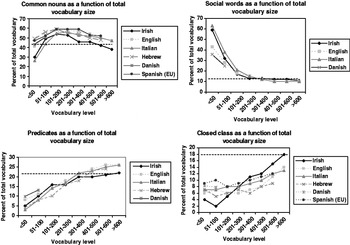
The data for each vocabulary group were analyzed to determine the mean percentage of each of the four word types (common nouns, predicates, social terms, closed-class items) out of the total vocabulary size. These percentages for Irish were compared with percentages for other languages where comparable CDI-based studies were available. Results are shown in Figure 1.
Mean proportion of common nouns, predicates, social and closed-class words out of total vocabulary levels compared across languages (the dotted line indicates the checklist ceiling).

Overall, as we see in Figure 1, there is an early predominance of common nouns, a slow growth of predicates, a sharp non-linear drop in the proportion of social words and limited closed-class growth until the later vocabulary levels across most languages. For Irish, common nouns represent around 30% of the words the children say with less than 50 words, and then this sharply increases to more that 50% of available vocabulary at 100–200 words, before it begins to decline to less than 40% at 500–600 words. However, apart from the first vocabulary level, common nouns represent the highest vocabulary category for all ages. By contrast, predicates represent a limited proportion of overall vocabulary initially, but start to rise after the 200-word point in proportion to common nouns. Social words represent the largest vocabulary category when the children have 50 words or less in Irish, but this undergoes a sharp decline at 200 words where it then levels off. One difference in Irish vocabulary development that can be seen is that closed-class items appear to make up a slightly larger proportion of overall vocabulary items when the children have over 400 words in comparison with other languages.
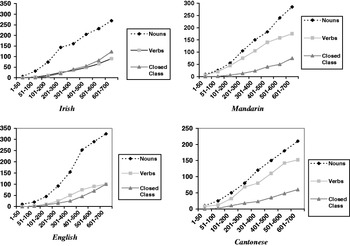
From the relatively high proportion of nouns compared to predicates found in the Irish data, it appears that the hypothesized potential for a verb advantage in Irish was not substantiated. To confirm this finding an analysis of growth using only verbs rather than all predicates was carried out, and compared to data for growth of nouns and closed-class items. In contrast with the previous analysis based on percentage use of each word type out of the total number of vocabulary items, this analysis tracked raw numbers of each word type (i.e. verbs, nouns, closed-class items) across the eight vocabulary-size groups. The results are shown in Figure 2. For comparison, data are also provided for three other languages for which similar analyses were reported based on CDI data: English (Fenson et al., Reference Fenson, Marchman, Thal, Dale, Reznick and Bates2007), Mandarin and Cantonese (Tardif, Fletcher, Liang & Kaciroti, Reference Tardif, Fletcher, Liang and Kaciroti2009).
Comparison of mean number of nouns, verbs and closed-class items as a function of vocabulary size.

Focusing on the acquisition of verbs, we see that for Mandarin and Cantonese, although nouns made up the largest vocabulary category in parent-report measures, verbs grew in a highly similar linear fashion and were just as likely to be used as were nouns, particularly when children had fewer than 200 words. For Irish and English, verbs follow a much slower trajectory in comparison to nouns, and are relatively rare in smaller vocabularies. The difference in the Irish trajectory in Figure 1 is that it appears that the predominance of nouns is not as pronounced as for English, particularly in the later stages, although this difference cannot be tested statistically here, as raw scores from the studies used for comparison are not available. In addition, there does appear to be a relative paucity of verbs for Irish and closed-class items show a relative advantage, a profile that is not observed in the other languages.
DISCUSSION
The pattern of early lexical development observed across languages seems to fit the pattern described by Caselli et al. (Reference Caselli, Casadio, Bates and Tomasello2001), which begins with an early preference for routine and social words, moves to ‘reference’ with an increase in common nouns, is followed by an emphasis on ‘predication’, and culminates in an increased emphasis on grammatical function words. Although considerations must be given to the fact that comparisons are purely descriptive and that further validation would need larger sample sizes, interesting cross-linguistic differences emerged. For example, although nouns made up the largest category for the Irish-speaking children, after the 300-word mark the dominance of nouns was lower than that observed in English, Italian (Caselli et al., Reference Caselli, Casadio, Bates and Tomasello2001) or Hebrew (Maital et al., Reference Maital, Dromi, Sagi and Bornstein2000) and decreased to just 38% when the children had more than 600 words (below the checklist ceiling of 41%). This could indicate that there is a ‘weaker’ version of the noun bias in Irish compared to that observed in English, as was also noted in the acquisition of German (Kauschke & Hofmeister, Reference Kauschke and Hofmeister2002) and French (Bassano, Reference Bassano2000). Moreover, we did not see a ‘verb advantage’ for the Irish-speaking children, who in fact demonstrated lower proportions of verbs and adjectives in their vocabulary after 400 words when compared to children speaking other languages. In English, Italian and Hebrew, closed-class words had a rather flat growth trajectory and although slightly steeper growth is seen in the Spanish data (Mariscal, Gallego & López Ornat, Reference Mariscal, Gallego and López Ornat2007), closed-class items never comprised more than 14% of total vocabulary in any of these languages. However, in Irish, once children had more than 50 words, closed-class items grew in a steadily rising fashion, and seemed to occupy a larger proportion of the total vocabulary, particularly after 400 words. Although it has been argued that a critical mass of content words is necessary before grammatical function words develop, (Marchman & Bates, Reference Marchman and Bates1994), it may be that a smaller ‘mass’ is needed for Irish than in other languages.
Explanations for variations in the acquisition of word classes across languages consider the phonological, morphological, semantic and/or syntactic characteristics that separate nouns, verbs, function words and other word types (Smiley & Huttenlocher, Reference Smiley, Huttenlocher, Merriman and Tomasello1995). These aspects were explored in relation to the profile of vocabulary acquisition observed in Irish. First, morphological transparency in noun marking has been linked to advances in overall vocabulary acquisition in Mandarin (Tardif, Reference Tardif, Hirsh-Pasek and Golinkoff2006). In contrast, Irish noun morphology makes substantial changes to the noun stem. For example, in the genitive, cat /kɑ /; ‘cat’ becomes cluas an chait /kluəs n χitʲ/; (‘ear the cat’=‘the cat's ear’). This complexity could be linked to the weaker version of the ‘noun bias’ in Irish than observed in other languages, particularly English, which has relatively simpler noun morphology, marking nouns only for possessive and plural structures (Bornstein et al., Reference Bornstein, Cote, Maital, Painter, Park and Pascual2004).
Semantic features have also been noted to influence the timing and sequence of the emergence of vocabulary categories and may explain the relative shortage of verbs and advantage of closed-class items noted for Irish. For example, in Korean verbs are semantically rich and specify change of location and motion within the verb (e.g. kkita ‘put in/on tightly’; nehta ‘put in loosely’) (Choi, Reference Choi and Slobin1997). The richness of the verbal semantic system in Korean (also observed in Mandarin) has been linked to the finding that children acquire as many verbs as nouns in early vocabulary acquisition (Tardif, Reference Tardif, Hirsh-Pasek and Golinkoff2006). In contrast, Irish verbs have been described as semantically weak, due to an abundance of ‘phrasal verbs’ where a semantically light verb such as cuir ‘put’, or lig ‘let’, combines with a particle (generally a directional adverb, or a prepositional pronoun) to specify meaning (Doyle, Reference Doyle, Kirk and Ó Baoill2001). Examples include cuir+fút (‘put under-you’=‘live/stay’), cuir+ort (‘put on-you’=‘get dressed’) and cuir+chuig (‘put to’=‘send’). This could affect the diversity and extent of a verb category in Irish, as observed for English which has a similar set of light verbs used phrasally (Tardif, Shatz & Naigles, Reference Tardif, Shatz and Naigles1997).
The relative advantage in the acquisition of closed-class items in Irish, on the other hand, may also be linked to semantics. Although there are similarities between Irish and English in the use of particles in verbal phrases, it is interesting to note that this did not lead to a similar ‘closed-class advantage’ in English. This may partly be due to the fact that it is largely prepositional pronouns that are used in these verbal phrases in Irish such as in the phrases:
(2) tá teach agam is maith liombe-PRES house at-me be-PRES good with-me‘I have a house’ ‘I like’
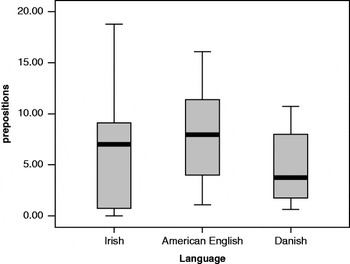
As previously noted, prepositional pronouns were noted to be learned early in Irish (Hickey, Reference Hickey1993) and prepositions were noted to be semantically rich. Thus, while languages such as Korean and Spanish specify deixis within a motion event or verb (Choi, Reference Choi and Slobin1997), Irish uses prepositions for this function. For example, directional prepositions in Irish specify location and motion relative to the speaker/listener perspective, so that the location of the speaker is indicated by a specific preposition, generally those beginning with th (as in thuas ‘up’). Prepositions that indicate direction or movement towards the speakers beginning with s (as in suas (going) ‘up’), and those that indicate movement away from the speaker are prefixed with an (e.g. aníos ‘up’ (from below)). It appears that the semantic space is ‘carved up’ differently by languages, which has an influence on the acquisition of syntactic categories (Choi, Reference Choi and Slobin1997). In order to explore whether this pattern is significantly different from that observed in other languages, the online database of cross-linguistic norms based on CDI data (CLEX) was consulted as it had age-based norms for American English (Dale & Fenson, Reference Dale and Fenson1996) and Danish (Bleses et al., Reference Bleses, Vach, Slott, Wehberg, Thomsen and Madsen2008) speaking children. The database contains information whereby the mean prepositional scores for all children in the age range 1 ; 4 to 2 ; 6 included in the other studies can be compared to those found for the Irish-speaking children and the results are contained in the box plot in Figure 3.
Box plot comparing mean preposition scores for Irish-, English- and Danish-speaking children.

The median scores for the American-English speakers were slightly higher than those observed for Irish and Danish, although a one-way ANOVA indicated that the difference between the languages was not significant. Nonetheless, the range for the Irish speakers is larger than that observed in other languages, and most children are in the 75th percentile range when compared to American-English- and Danish-speaking children (who, in contrast, mostly fall towards below the 50th percentile). It seems as if, in Irish, prepositions and prepositional pronouns are a governing factor in ‘carving up’ the semantic space associated with verbs, leading to an advantage in the acquisition of closed-class words in early child language.
Another factor that affects the order of word acquisition is saliency or position within the utterance. Previous studies have noted that words that appear at the beginning or end of an utterance are more salient and are likely to be acquired earlier than those occurring in medial utterance positions (Gentner & Boroditsky, Reference Gentner, Boroditsky, Bowerman and Leivenson2001). Therefore, in SVO languages such as English, nouns are more likely in initial and final position and are thus learned earlier when compared to pro-drop languages such as Italian and Mandarin, where verbs are equally or more likely than nouns to appear in initial or final position. The issue of utterance position leads to the hypothesis that Irish, with its VSO word order, places verbs in a more salient sentence-initial position, leading to an earlier development of verbs. However, the data revealed that this was not the case. It may be relevant that the verb used in the initial position is often the auxiliary verb tá ‘to be’ as used in progressive and past participle structures in the word order VSVn (verbal noun). For example:
(3) Tá Mamaí ag glanadhbe Mummy at clean(Vn)‘Mummy is cleaning.’
Hickey (Reference Hickey1990a) noted that children often omit this initial auxiliary verb in sentences, resulting in more nouns in sentence-initial position than would be expected in a strict VSO language. Moreover, Irish has a second verb to express ‘to be’ − the copula is, which generally indicates inherent qualities between a subject and noun or pronoun complement, such as identification or classification. It can be explicit (e.g. 4), or implicit (e.g. 5).
(4) Is múinteoir í Áine
COP (a)teacher she Áine
‘Áine is a teacher.’
(5) Sin madra
(COP) (a) dog
‘That is a dog.’
It is possible that parents would also omit the copula in their language input to children, so in order to explore this pattern, spontaneous language samples from ten parents interacting with children across the entire age range of 1 ; 4 to 3 ; 4 were analyzed to observe how many of the sentences involved auxiliary and copula initial verbs, and in how many of these sentences these forms were deleted. For each sample, 100 utterances were selected, and the number of copula and auxiliary initial sentences was calculated, as well as the number of sentences that omitted these verb forms: 161, or 16% of sentences, were of the copula or auxiliary initial sentence types, the large majority of sentences being question forms. Of the 161 sentences identified, parents deleted the initial auxiliary or copula 39% of the time. This means that children are not exposed to as many verb-initial sentences in Irish as might be expected from its overall constituent structure. As recent research on early language acquisition of Irish found that children's early multiword speech is directly related to the frequency of lexically based patterns in the speech of their caregivers (Cameron-Faulkner & Hickey, Reference Cameron-Faulkner and Hickey2008), this may be linked to the lack of a verb advantage observed.
Finally, the role of pragmatics has also been associated with the timing and sequence of the emergence of word classes across languages. For example, English-speaking parents have been observed to focus on eliciting nouns in the ‘naming game’ and ‘test questioning’ associated with their culture while Japanese-speaking mothers focus on kinship, and Korean parents are more focused on eliciting actions from their children (Choi, Reference Choi and Slobin1997). It is quite likely that the ‘naming game’ is a feature of Western culture, which may contribute to the predominance of nouns observed in Irish. Moreover, the argument that verbs are used to answer yes/no questions in Irish (due to the absence of words for ‘yes’ and ‘no’), did not hold in the input. Due to the close contact with English, the loan words yea and no have infiltrated the language, and are more likely to be used by young children as a response to a yes/no question, further diluting the role of the verb in the language.
Goodman, Dale and Li (Reference Goodman, Dale and Li2008) hold that many factors will ultimately affect the order of acquisition of word classes, and include the role of semantics, syntactic complexity, informational load, use in joint attention context and ease of perception of the word referent. While conclusions on the basis of this study need to be tentative, it does appear that there are differences emerging at the level of word category acquisition between Irish and other languages described via parent report, and that factors internal to the structure of Irish can be invoked to account for them.