Introduction
The scene was a brightly lit stage in the newly renovated event center of a five-star hotel located in the heart of Victoria Island, Lagos. Chidinma, a singer who had just won the third season of Project Fame West Africa, a reality television music talent show, made her entrance as an announcer proclaimed the start of the “hottest competition in all of Africa.” Chidinma’s soulful rendition of the Nigerian national anthem officially kicked off the start of the 2010 Most Beautiful Girl in Nigeria (MBGN) beauty competition. About a dozen dancers then took the stage to perform a choreographed jazz dance number replete with pirouettes, developpé leg extensions, and stylized walks, while the two MCs for the evening, a man and woman, strutted onto the stage. They made some welcoming remarks, and then a different dance troupe whirled onto the stage in large concentric dance patterns to drumbeats. The thirty contestants, dressed in “traditional” attire, made their way down the two long glass stairways that flanked the stage, swaying to the percussive dance beats. First the contestants from the West, then from the East, next from the South-South, and finally from the North performed group dances in succession. Each contestant from the respective regional groups glided up to the microphone, introduced herself and the state she was representing, and ended with a motto or greeting in a local dialect before ceding the microphone to the next contestant.
Throughout the show, the hosts reminded the audience of the goals for the night—to pick a queen worthy of the instant transformation through newfound stardom, cash prizes, and untold career opportunities that winning the contest would confer. They specified that the winner would serve as a role model for the nation through her charity work and would represent Nigeria in international competitions abroad. About halfway through the show the male host announced the next segment by cautioning the audience to “brace [them]selves, it’s about to get hot” and advising wives to “slap handcuffs on [their] husbands” in anticipation of the contestants’ entrance in violet metallic bikinis. The host told the audience to pay attention to “how well she carries the swimsuit. It’s not about the clothes, it’s about the hanger.” Each of the thirty contestants sashayed on stage while their names, body measurements, and pictures flashed onstage.
The host’s playful warning about the bikini segment and subsequent statement instructing the audience not to get distracted by the bikini itself but to focus on the contestants’ bodies and carriage positioned women’s bodies front and center onstage. His banter also situated the bikini as a possible moral threat, yet his directions to focus on contestants’ composure served as a corrective measure to implore the audience not to lose sight of the pageant’s integrity. While designating a woman’s body a “hanger” and emphasizing its ability to make male observers “hot” or unfaithful to their wives might seem objectifying, the pageant participants I interviewed and interacted with conceptualized the place of the bikini and, more generally, women’s bodies in personal, domestic, and international frames in ways that bolstered their respectability along with that of Nigeria itself. As public performances, beauty pageants feature women’s bodily displays to showcase larger power struggles over ideals of gender and nation (Banet-Weiser Reference Banet-Weiser1999; Cohen et al. 1996; Clowes Reference Clowes2001). Women’s bodies stand in for larger national claims and personal contestations. Nira Yuval-Davis (Reference Yuval-Davis1997) argues that constructions of the nation draw from specific ideals of femininity and masculinity to biologically, culturally, and politically reproduce its symbolic boundaries. These projects position femininity as a guardian of national communities. Women’s bodies in particular, through dress, comportment, and appearance, signal disputed national values.
Through the concept of embodied respectability, which focuses on visual representations of women’s bodies and their literal embodied practices to strategically highlight propriety, social acceptance, and reputability at a personal level and through imaginings of the nation, pageant officials, beauty contestants, and fans alike shift and question varied notions of beauty, status, and difference. Pageant owners and staff use the cultural politics of embodied respectability to craft narratives that position Nigeria as centrally important domestically and internationally. Pageant contestants deftly maneuver within these complex meanings to position their own bodies as socially relevant. This article analyzes the bikini, and women’s bodies in Nigerian pageantry more broadly, as an embodied symbol and aesthetic practice that crystalizes hopes and anxieties about personal and national respectability, which are simultaneously consolidated and contested on local and global stages.
Women’s Bodies and the Nation
Nationalism, which focuses in part on a communal sense of what brings people together as a community, occupies a tenuous place in the Nigerian public imaginary. Nigeria’s fragile nationalism has been called into question due to its contentious ethnopolitics (for example, threats from rebel groups such as Niger Delta militants in the southeast and Boko Haram insurgents in the northeast), flawed governance, and endemic corruption (Adebanwi & Obadare Reference Adebanwi and Obadare2010; Adunbi 2001; Smith Reference Smith2007). Countering Benedict Anderson’s (Reference Anderson1983) classic definition of nationalism as an imagined community, Michael Watts (Reference Watts2003) defines Nigeria as an “unimagined community” built on “the very fictions of the nation.” Scholarship on contemporary nationalism in Nigeria emphasizes the difficulty of building a coherent nation due to ethnic conflicts, regional power struggles, and religious divisions (Falola & Heaton Reference Falola and Heaton2008).
Nigerian nationalism balances ameliorating social divisions within the nation while self-consciously navigating its position in the international arena. Mainstream beauty pageants in Nigeria focus on women’s bodies as heteronormative feminized national ideals. While scholars have documented and identified the long struggles over national identity in Nigeria (Adebanwi & Obadare Reference Adebanwi and Obadare2010; Apter Reference Apter2005; Watts Reference Watts2003), we have only begun to scratch the surface of how national boundaries are drawn, interpreted, and disputed through gendered bodies, particularly in conjunction with class, ethnoreligion, and sexuality (Matebeni Reference Matebeni2016; Ogunyankin 2016; Tamale Reference Tamale2014). The gendered nationalism literature positions women’s bodies as central platforms to understand how the nation is simultaneously strengthened and disputed through domestic and international framings (McClintock Reference McClintock1991; Moran Reference Moran, Cohen, Wilk and Stoeltje1996; Yuval-Davis Reference Yuval-Davis1997). Pageants illustrate some of these larger power struggles over social meanings, invoking both personal and collective identities.
In terms of personal subjectivity, scholars have emphasized the importance of complicating agency, in conversation with a larger feminist critique that primarily views beauty contests as reinforcing the sexualized objectification of women’s bodies (Arnfred Reference Arnfred2015; Banet-Weiser Reference Banet-Weiser1999; Cohen et al. 1996; Craig 2002; Oyěwùmí Reference Oyěwùmí2005). Juliet Gilbert (Reference Gilbert2015) argues that contestants of the Carnival Calabar Queen (CCQ) contest gain some personal success through developing patronage networks, although they still must navigate economic insecurity, patriarchy, and gerontocracy in urban Nigeria. Sabrina Billings’s (Reference Billings2013) work on Tanzanian beauty pageants connects linguistic politics to pageantry, highlighting how contestants use English in competitions to position themselves as elite and cosmopolitan, hoping to eke out successful lives amid structural inequalities.
Critically, pageants make disputed communal ideals visible. Dorothea E. Schulz’s (Reference Schulz2000) research on Miss ORTM in Mali showcases how state elites used the contest to mold urban feminine ideals in terms of body size, regional preferences, and class status that exclude the majority of Malian women and ignore regional swaths of the country, pinpointing broader national concerns about inclusion. Lynn Thomas’s (Reference Thomas2006) historical analysis of a beauty contest in the Black South African newspaper Bantu World points to how contestants’ cosmopolitan looks were developed through cosmetic use, clothing choices, and body postures, which sparked larger discussions about racial uplift or racial betrayal that reviled lower-class Black South Africans and rejected the imitation of non-Blacks.
A common theme that runs through beauty pageant scholarship is a focus on how pageants consolidate and challenge boundaries of respectability through morality, chastity, and admiration. For example, Gilbert (Reference Gilbert2015) notes that the CCQ beauty queens craft feminine selves as God-fearing, caring, and hopeful for the nation. Thomas (Reference Thomas2006) focuses on racial respectability in interwar South Africa through debates over women’s bodies. In the 1950s and 1960s, aspiring urban elites in Namibia utilized beauty pageants to showcase “respectable” lifestyles and to consolidate their class identities within restricted social mobility (Henrichsen Reference Henrichsen1997). Carolyn Beherman (Reference Behrman and Eicher1995), in her work on beauty contests in Swaziland, argues that images of beauty queens communicated complex gender and ethnic dynamics during a time of rapid change and global pressures. These symbols were unified by a focus on dignity, grace, and desirability. Since beauty pageants are exemplars of the tensions between local and global cultural flows (Cohen et al. Reference Cohen, Wilk and Stoeltje1995), varied stakeholders use a tactic I call embodied respectability to project honor, virtue, and status on both domestic and international stages. This strategy is one that filters the varied physical and figurative dimensions of women’s bodies in particular—bodily appearance, conduct, movement, and grooming—onto broader debates about public and private boundaries of propriety, appropriateness, and suitability.
These respectability politics are drawn through embodied categories and practices (Dosekun Reference Dosekun, Elias, Gill and Scharff2017; Higginbotham Reference Higginbotham1993; Mama Reference Mama1998). Jean Allman’s (Reference Allman2004) work on fashion in Africa argues that “modifications of the body through clothing have been used both to constitute and challenge power in Africa and its Diaspora” (1). The swimwear segment of beauty competitions has often been at the center of controversy, drawing protracted clashes between feminist activists, religious groups, and corporate sponsors globally. The 1968 protest against the Miss America pageant focused on the objectification of women, best exemplified by the enactment of the swimsuit competition (Banet-Weiser Reference Banet-Weiser1999). In 2018, nearly a century after the first Miss America pageant, officials scrapped the swimwear portion of the contest to refocus the organization’s priorities on female achievement (Haag & Buckley Reference Haag and Buckley2018). In 1996, amid protests and religious objections in India over the hosting of the Miss World competition, the swimwear segment was moved to the Seychelles (Oza 2011). In 2017, public officials banned beauty pageants from Guinea after the swimwear section of the pageant sparked outrage on social media, especially over the prime minister’s attendance at the pageant, who was accused of “encouraging prostitution” (Spencer & Chothia Reference Spencer and Chothia2017). As these examples illustrate, fashion choices such as the bikini can serve as battlegrounds that mingle cultural, political, and commercial interests, igniting debates about bodily display, public space, and respectability politics (Mougoué Reference Mougoué2016; Lutwama-Rukundo Reference Lutwama-Rukundo2016).
Contextualizing Nigerian Pageantry
The first national pageant in Nigeria, Miss Nigeria, began in 1957 as a photo competition sponsored by the Daily Times of Nigeria newspaper. Since then, the Nigerian beauty pageant industry has grown exponentially; there are an estimated one thousand beauty pageants organized in the country annually. Nigerian beauty pageants are public spectacles tied to private entrepreneurship, charity initiatives, and tourism campaigns. Historically, Miss Nigeria has included a maillot swimsuit segment as part of the competition in some years but not others. It shuttered in 2004 due to the declining financial viability of its main sponsor, the Daily Times, but then returned in 2010 with no swimsuit competition.
MBGN has always included bikinis as a segment in the show and as an integral part of the audition process (see Figure 1). MBGN began in 1986 and has crowned a queen almost every year since. Under the catchphrase of “Let’s make all your dreams come true,” it is considered the nation’s premier pageant. MBGN sends contestants abroad to major international competitions such as Miss World and Miss Universe. Silverbird Productions, a multimedia conglomerate based in Nigeria which owns shopping malls, radio stations, and a television network, runs the contest. The 2010 competition began with entry auditions in Port Harcourt, Benin, Abuja, and Lagos; seventy-six semifinalists competed in Lagos thereafter, and judges selected thirty contestants to compete in the grand finale, which was also held in Lagos. The thirty contestants were randomly assigned, regardless of their actual states of residence, to represent thirty out of Nigeria’s thirty-six states—all but the most “core Sharia” states.
Contestants at the Most Beautiful Girl in Nigeria contest during the bikini segment. Photo from BellaNaija.com.

The organizers of the Queen Nigeria competition made the decision to ban bikinis from its show (see Figure 2) when it began in 2008 as a joint venture between a privately-run events management firm and TV Enterprises, the commercial arm of the government-owned Nigerian Television Authority (NTA). NTA is the largest broadcast network in Sub-Saharan Africa, with more than one hundred stations covering all states in the country. Queen Nigeria is organized around a state-tier system; to be eligible for state-level competitions, contestants must live in the state, have been born in the state, or be an indigene of the state (i.e., be able to trace their ancestry to an ethnic group from the state). In 2009 there were state-level competitions in eighteen states, the winners of which competed at the national finale, which was held in Jos, Plateau State.
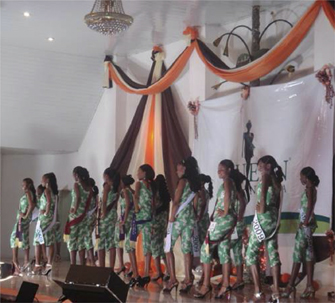
Contestants at the Queen Nigeria contest during the opening dance number in casual dress. Photo by Author.

This article draws from a larger research project involving nearly a year of ethnographic fieldwork in 2009–2010 with forty-eight contestants and twenty organizers of two contemporary national beauty competitions, whom I identify using pseudonyms. I also collected hundreds of newspaper clippings, watched hours of television broadcasts, scoured social media posts, and compiled advertisements about the wider Nigerian beauty pageant industry. For my ethnographic observations, I worked as an unpaid intern and chaperone for the Queen Nigeria and the Most Beautiful Girl in Nigeria beauty pageants. For both contests, I was granted access to observe the screening process of selecting contestants, rehearsals, preliminary competitions, the show, and the winner’s reign. Combining interviews, ethnographic data, and textual analysis of archival materials allows me to delve into the bikini as both embodied practice and aesthetic symbol.
Embodied Nationalism and Glocalization
Queen Nigeria’s tagline used in all promotional materials, “True Nigerian Queen,” evokes cultural authenticity—an attempt to retain unique heritage in the face of rapid globalization with the aim of reflecting a worldview that accurately depicts the everyday life of Nigeria’s heterogeneous population through a “unity in diversity” mantra. For example, contestants must prepare and serve regional dishes to judges in a cooking competition. Organizers view this component as a recognizable element of Nigerian domesticity and womanhood. MBGN embodies a stance I call global belonging, that is, emphasizing acceptance of Nigeria as a worldwide trendsetter beyond its national boundaries. This position highlights the country’s global relevance to the international political economy and cultural politics. For example, by integrating a modeling competition into the finale, MBGN seeks to highlight its connections to a global industry. Through including international experts annually flown in from South Africa and the United States, they stress the need to inculcate globally important skills such as professionalism, confidence, and competitiveness. Moreover, by angling to win major international pageants like Miss World and Miss Universe, MBGN showed its desire to propel the country into the international arena by fulfilling and surpassing world standards of beauty (Balogun Reference Balogun2012). The controversy over bikini segments—and the two pageants’ different approaches to dealing with that debate—reflects the broader social discourse regarding Nigeria’s national identity.
While the owners of Queen Nigeria and MBGN remained committed to maintaining their diametrically opposed framings in ways that pit dichotomous ideas of the nation against each other, there are moments where their framings overlap and distinctions fall apart. Both pageants are engaged in larger struggles over cultural authenticity and global belonging, since they are mutually constitutive categories. These framings share a recognition of Western hegemony and a desire to pivot toward recognition of the importance of countries such as Nigeria, with their shifting demographics, lifestyles, and aesthetics. Moreover, both tactics reflect an understanding of women’s bodies as powerful sites where the complex boundaries of the nation play out.
When I first learned about the controversies over whether swimsuits should be included in Nigerian beauty competitions, I expected that contestants’ motives and decisions would mirror these same divisions in a clear-cut way, with each contestant reflecting one or the other point of view. My initial assumption was far too simplistic. Contestants had a much more adaptable position. One Queen Nigeria contestant, Yinka, at first seemed a counterexample, as she shared her thoughts on Queen Nigeria’s omission of the segment:
You don’t have to make the girls wear bikinis to show their physique. Other wears [attires] are good to show their physique but bikini no. Not in Nigeria. In the outside world, it is allowed even outside [in public, off the beach] you can wear it, but in Nigeria no. If you go back to Nigeria’s roots they will say, don’t have your body exposed, don’t wear this don’t wear that. In the Nigerian circle, bikini is out of question and in Queen Nigeria not wearing it is good. It doesn’t really depict African culture to wear bikinis.
Yinka was a college student with a carefree manner, so when I asked if she would be open to wearing a bikini in other competitions, I was not entirely surprised she was flexible. “Yes, I can wear it in other competitions but in Queen Nigeria that is how they want it. They don’t want it to happen and that is it,” she explained. Another Queen Nigeria contestant, Priscilla, also repeated the common view among Queen Nigeria organizers that bikini segments are un-African, but later shared that she had participated in, and won, a Miss Bikini competition in Nigeria and would as a result be participating in a bikini contest abroad representing Nigeria. Like other contestants, their awareness and willingness to wear a bikini in other competitions while being fully cognizant of why the Queen Nigeria contest has no such segment shows how expectations of bodily display are not just about individual desires but also connect to gendered public space at various levels—local, national, and international.
Contestants often did not consider the issue of whether to participate in pageants with bikini segments to be a significant dilemma. Some said they felt self-conscious in a bikini in front of a large audience or nervous about what their relatives might think, but few seemed to have seriously considered avoiding pageants with such segments all together. They saw participating in many different pageants as the best way to gain economic mobility, positive attention, and to serve charitable causes. Five Queen Nigeria pageant participants also appeared at the 2010 MBGN audition just a few weeks later, and many others I spoke with had either auditioned for MBGN at some point or were open to doing so in the future. Ignoring the distinction between the pageants’ treatment of their bodies was a way to maximize their chances of winning at least one. This stands in contrast to the pageant owners’ focus on constructing specific and at times incompatible ideas about the nation. Nor were contestants ignorant of these specific ideas. Rather, they readily adapted to the changing demands of each pageant, showing a keen awareness of the organizers’ variable expectations.
Moreover, both pageants include what they call a “traditional” segment in their shows, which utilize a standardized vocabulary. In them, contestants wear similar attire: headwraps, coral beading, hand-loomed fabric, and headpieces adorned with cowrie shells. They hold accessories such as handcrafted baskets and scepters made of wood and horse tails. Contestants usually rent or borrow this apparel, as most do not own anything suitable for this segment. Every state in Nigeria retains a discernable ethnic identity or set of ethnic identities that neatly correspond to “traditional” costumes, music, dances, and gestures such as these, and traditional segments are similar to other embodied ceremonial enactments of “ethnicity” (Comaroff & Comaroff Reference Comaroff and Comaroff2009). During dance practice, in the course of preparing for the contestants’ introductions, Ngozi, MBGN’s assistant choreographer, told contestants: “Look, this is carnival. This is traditional. This is Africa! Bring that joy from the carnival into your Introduction. Don’t try to be cool.” She struck a stereotypical beauty pageant pose—right hand on her hip, tossing her hair with her other hand, and cocking her head to the side. “You can do that in the evening [gown] section.” The traditional segment was a time for the contestants to let their hair down, be loud and boisterous, and help present a “culturally authentic” image of Nigeria to the audience.
MBGN contestants also must wear a national costume when competing in international pageants; these ethnic costumes are typically designed by Nigerian couturiers. When I asked one such designer how he settled on a final look for contestants who would be competing abroad, he said that he often focused on including “ethnic touches” by incorporating indigenous fabrics and dramatic accessories such as raffia, wooden buttons, and bright colors. But at the same time, he was careful to choose a design that would be considered “contemporary.” MBGN contestants, he reasoned, should have enough “ethnic color” to represent the nation, but not to stand out as so “ethnic” that they did not belong on the global stage. He explained:
It is important so that they will not look out of place, because they are going to the world stage where everybody will be present. They need to look very trendy. They [need to] represent the beauty of the ethnic color, which is significant in such an event where everybody comes in with the best of the best of her country.
The designer noted it was important for contestants not to feel embarrassed by a costume that was too “traditional.” MBGN’s embodied performance of cultural authenticity—through attire and body movements—was consolidated on local and international levels, in which global belonging also played a central part in how cultural authenticity was understood.
Queen Nigeria participants also have global aspirations and imagine their audience to be international. NTA, one of the main sponsors, transmits the show on NTA International, which targets Nigerians living abroad. Mr. Samuel Gold, one of Queen Nigeria’s main organizers, explained his ultimate vision of creating a pan-African “Queen Afrique” beauty competition that would include other contestants from countries like South Africa, Liberia, and Benin, since he felt that it was necessary for Queen Nigeria winners to go on to compete in international contests. He felt that existing international contests were too “westernized.” Yet he hoped that Queen Afrique could go beyond the continent:
Look, we can originate our own [pageant] from Africa and [take it] from Africa to the rest of the world…. If we are able to kickstart the idea of Queen Afrique, who says one day will not come that Queen Afrique becomes part of the international angle beyond African women…. The whole world is in a global village. We cannot be an island to ourselves; there is so much to achieve out there [outside of Nigeria] in terms of economics, in terms of experience, in terms of excitement.
Mr. Gold suggested that Nigeria cannot remain isolated if it seeks to remain competitive, but he envisioned the country as a global center, hosting contestants from around the world in international competitions. He speculated that Queen Nigeria would attract more contestants if the winner competed internationally. Yinka noted the limitations of Queen Nigeria: “You can’t just be a local champion in Nigeria…. You have to go out there [beyond Nigeria] and do other competitions and see people better than you. Competition continues, it never stops in this world.”
For Yinka, just being “Queen Nigeria” would be “stagnant.” Like Mr. Gold, she drew on the global belonging narrative as a key element that beauty contests should offer. These examples illustrate how cultural authenticity and global belonging were fused together in both pageants. Although working from different angles, both framings work to position Nigeria as an important and respectable nation. The concept of glocalization, which stresses the interconnections and simultaneity between global and local processes (Robertson Reference Roberston, Featherstone, Lash and Robertson1995), allows us to make sense of these framings as connected strategies.
“Half-Naked Before Strangers”: Bikinis and Public Femininity
In a news article, a reporter asked an MBGN beauty queen how she felt about being “half naked before strangers,” to which the contestant “confess[ed]” that “at first I was nervous. But later, the nervousness left.” She credited her “mother and God” with giving her the courage for the segment (Ogbonna Reference Ogbonna2011). Pointing to her mother and God as sources of courage served to prop up her gendered propriety in the face of the journalist’s insinuations about the bikini segment. Will, Queen Nigeria’s choreographer, described the aim of the pageant as finding “the perfect Nigerian lady who can speak for women [in] general.” Both pageant owners and contestants position beauty queens as national representatives who as moral and upstanding citizens mark the boundaries of respectable womanhood, bolstering the nationalist visions of the pageant owners.
In Nigeria, dominant ideas about women’s respectability, shaped by class, regional location, and ethnoreligious distinctions, govern comportment and gendered embodiment. Nigerian beauty queens are expected to act as wholesome role models who signal class mobility and sexual mores for other Nigerian girls and women. Contestants are required to be single, childless, and between the ages of eighteen and twenty-six. They are to uphold certain ideals that are seen as reflecting well on the country as a whole. These contests prime a focus on women’s bodies as projections of national ideals and emblems of national progress. Christina, a makeup artist who worked with Queen Nigeria contestants, said that Nigerian beauty pageants are “tools to beautify the country…to tell the outside world that Nigerians are not corrupt, we’re good people, very lovable, have respect and sincerely we want to have more people in our country. Pageantry has really gone a long way in branding Nigeria.” Though MBGN and Queen Nigeria use different tactics with regard to women’s bodily display—one focused on covering and the other on confidence—they both focus on using respectability as a means of securing Nigeria’s place on regional and global stages with the hope of attracting foreign investment and tourism.
Throughout my fieldwork, those who opposed including bikinis in Nigerian pageantry often expressed their disapproval by equating them with nudity or nothing more than “bra and [under]pants,” suggesting that bikinis were basically lingerie and therefore out of place in pageants’ public performance of femininity. Those critical of bikinis described them as “skimpy display,” “indecent exposure,” “too revealing,” “near-naked,” “exposing too much,” and “unclad.” They described swimsuit events as the greatest obstacle to nationwide acceptance of beauty competitions, suggesting that Queen Nigeria would attract a wider audience because it has no such event. They said that bikinis were not useful ways of determining or defining physical beauty. Lovett, a Queen Nigeria organizer, described the bikini segments of other pageants as the “nudity” section, and emphasized that Queen Nigeria signaled its respect for African culture by omitting such a segment. In keeping with this, Bibi Bakare-Yusuf’s (Reference Bakare-Yusuf and Tamale2011) study of contemporary attempts to outlaw revealing clothing in Nigeria highlights the idea that displays of female skin in public spaces signal national vulnerability.
Many other pageants specifically brand themselves as “no bikini” pageants. Supporters of the Miss University Africa pageant, sponsored by Bayelsa’s state government, also emphasized that it did not include a bikini event. The former first lady of Bayelsa state, Alayingi Sylva, told a newspaper reporter that her critics had a misconception of pageants as a show of women’s nakedness. She said, “[It] is not [a] bikini pageant, where they expose their bodies as it is done in other pageants. There is a strong sense of decency involved here and what we do is, try to bring out the positive aspects of beauty pageantry, by imploring them to see the need for decency, regardless of their physical beauty and equipping them to be able to showcase their inner strength, talents and brilliance” (Okhomina Reference Okhomina2010). According to the news report, Mrs. Sylva described the event as a way of reaching out to the young people of Bayelsa to develop programs geared toward education and employment. Another news account focused on the Miss Nigeria competition stated:
The chic traditional hue of the beauty queens on parade was an important iteration of what it takes to be a model Nigerian woman. There were no bikinis or leanings towards the commerce of nakedness. There was a lot of culture and a breathtaking display of brilliant couture. “Nigerians don’t go naked,” Anosike said. “We go fully dressed.” (Elusoji Reference Elusoji2015)
The reference to “the commerce of nakedness” suggests that pageants such as MBGN treat women’s bodies as commodities to be bought and sold. Meanwhile, the reference to being “fully dressed” implies both modesty and the reputation Nigerians have for ostentatious fashion selections. Similarly, a news account about the Miss African Diamond beauty contest, another no-bikini pageant, quoted the organizers, “The bikini-type of beauty pageants that Africans are fast getting used to is not part of our culture. True African women demonstrate high dignity and as such, cannot expose their body for a billion dollars in the public…beauty pageant[s] organised around Europe and America, which has now imported to Africa [forget] that nudity and pornography are alien in Africa” (This Day 2014). Not including bikinis in the show counteracted the “alien” nature of the cultural import; the organizers suggested their pageants could be considered authentically African. This rhetoric thus elevated Nigerian women over women in the West, using respectability to signal Nigeria’s ability to resist wholesale adoption of Western-derived norms by maintaining Nigerian values and customs.
Some organizers, on the other hand, felt that there was a possibility of using bikini-inclusive pageants to Africanize their events. Speaking to a reporter about Miss Bikini Nigeria, pageant organizer Seyi Hunter said that the pageants’ bikinis would use African prints and design silhouettes that would best fit Nigerian bodies. This organizer noted:
It’s about injecting the African culture into an European or global culture…. We are trying to change this foreign culture that we have borrowed, to suit us.… We want to promote decency. The bikini culture is the beach culture all over the world, now we are injecting the African culture into it. We are taking away the amoral sides of it and making it look African. We want to change our orientation about bikinis. (Ebirim Reference Ebirim2015)
Hunter describes bikinis here as a sartorial component that demonstrates cosmopolitanism. They invoke, she argues, a global contemporary form of leisure—being on the beach—that can easily be “injected” with African culture. Like organizers whose pageants eschew bikini segments, she emphasizes “decency,” implying it is not incompatible with a bikini segment. Another organizer of the same pageant agreed: “Bikinis can be worn tastefully without promoting obscenity. We want to explore how bikinis can be worn to suit our culture. Models will be wearing them the African way. We hope to change the bikini culture to suit our ‘Africaness’” (Ebirim Reference Ebirim2015).
Covering and Confidence
In addition to eschewing swimsuit events, describing them as overly sexually suggestive, Queen Nigeria polices the amount of skin contestants show in public by inspecting their costumes and attire prior to the final show to make sure they are not too revealing. During excursions to visit public officials and sponsors, contestants are instructed to cover up with a shawl if they are wearing clothes organizers deem too tight-fitting or skimpy. Through these measures, organizers seek to establish a fully national brand for the pageant, sensitized to a broad audience of ordinary Nigerians, and reflecting the country’s ethnic and religious diversity. They often referenced Nigeria’s religious conservativeness as the cultural element that remains antithetical to including bikinis. Doro, a Queen Nigeria organizer, explained:
Our girls don’t wear bikinis because of our culture here. We are very religious people and we see [modesty] as [part of the] sentiment [of] Nigeria…. So, when we have a pageant, the girls have to come out in decent attires.
This reference to decency maintains ideas about how embodiment communicates expectations of moral respectability that are deeply connected to the Nigerian nation. The public consternation about bikinis was viewed as a major stumbling block in allowing pageants to gain greater acceptance throughout the country. They could reconcile ethnic and religious diversity with a perspective that beauty pageants would have wider appeal if bathing suits were not included. As Lovett mused, “Some people are sensitive about their daughters being exposed. Especially in the North where you will see people covered from head to toe.” By barring bikinis from the show, Lovett claimed, Queen Nigeria can attract those who normally would not enter a beauty competition and assuage some of the sensitivities some felt about bodily display in pageantry. The North, usually equated with Islam and heightened conservativeness, is especially viewed as the geopolitical region that would express the most concern about bodily display and is represented as a monolith that “cover[ed] from head to toe.” For those who advocate banning bikinis, keeping contestants covered serves to increase the contestants’ self-respect, while also providing an important acknowledgement of national respectability.
Will emphasized how Queen Nigeria was different from other pageants by stating, “[Queen Nigeria] girls don’t go on bikinis; they don’t expose their God-given gift. It is just basically your creativity, your talent, your hobbies, your intelligence, [and] your beauty that is being celebrated.” By characterizing the bikini as a way of “exposing God-given gifts” Will communicated the idea that the attire is inappropriate in a public setting, and that the pageant means to celebrate beauty in a way that highlights other attributes. Bikinis invite intrusion into an intimate “gift” through bodily display. In spite of his views of what is appropriate for Queen Nigeria, Will did not entirely object to bikini segments; on the contrary. He had dreams of starting his own entertainment production company and producing a pageant, marketed very differently from Queen Nigeria, that would include a bikini event. When Ifeoma, a contestant, asked him about the wallpaper on his laptop, which showed three women in bikinis, he said that they were Miss World contestants. “And in my own pageant you would have to wear bikinis! You’d have to open it up and show it!” he teased. With international aspirations and a desire to attract attention, Will viewed bikini contests as a key element of his own business. Another conversation showed some of Will’s personal ambivalence; he said that if he ever had a daughter he would not permit her to “go out and parade out front in a bikini for the nation to see.”
MBGN organizers were scornful of such statements. An MBGN organizer, Mr. Tim, stated:
They just think it is demeaning to have women in bikinis. So every woman that [wears] bikinis to swim at the pool or at the beach is demeaning herself? And they said oh it is not in our culture, and I was like swimming is not in your culture?… Do they think women should wear wrapper[s] to the beach?
He suggested that everyone wears swimwear to the beach, including in Africa. Yet in defending the bikini segment MBGN organizers generally emphasized the global stage. They described the bikini contest as a way for judges to gauge contestants’ conformance to international beauty standards. Oris, an MBGN staff member, described the swimsuit segment as a critical component of measuring beauty. How else, he suggested, would judges ensure they didn’t choose contestants who had “imperfections” such as stretch marks, large scars, or uneven body proportions? During the live broadcast, MBGN’s hosts informed the viewers that the swimwear was important to see contestants’ skin tone, attitude, and posing ability. “There are many types of beauty and you can just see it and know what you’re looking for,” Oris explained. “The bikini is absolutely necessary because it allows you to see the shape.” However, a few minutes later when I asked if he would allow his daughter to appear in a bikini in a beauty competition, he shook his head vigorously. His meaning was clear: Never.
MBGN selects five winners who hold different titles and participate in various international competitions. While judges look for slim and tall contestants for all five titles, they tweak their standards for each. Organizers explained to me an intentional tactic based on their evaluations of different pageants’ bodily preferences. They send participants to Miss World who fit a “girl next door type,” who were shorter and shapelier with lighter skin, and a “high fashion model type” who are taller, thinner, and darker-skinned candidates to Miss Universe. In my review of Nigerian delegates in the past twelve years (when this strategy began), I found this pattern of sending lighter-skinned contestants to Miss World and darker-skinned contestants to Miss Universe holds consistent for all but three years. In terms of body shape, I compared the body measurements for the years 2005–2010. Miss World contestants were on average a little over an inch shorter (5′9″ vs. 5′10″ tall) and had bust and waist measurements that were 1.2 and 1.5 inches larger compared to Miss Universe delegates. However, Miss Universe candidates had on average hip measurements that were about a quarter of an inch bigger than their Miss World counterparts. Through analysis of comments on social media sites, I have gleaned that these factors (e.g., skin tone, height, weight) are noticed by fans, but only the most die-hard fans seem aware of the specific types of “looks” that international pageants favor. For example, the public message board of missosology, a website for beauty pageant fans, discussed the 2017 MBGN competition. One user with the handle Noraya notes, “I think ugochi would do better at miss universe and miss Imo could have been selected for miss world but the organisers know something we outsiders don’t.” Another user with the screenname “Night Malaga” notes, “She has this doll aura that Morley [owners of Miss World] loves to see in her pageant. Nice face!” Another user states, “Miss KEBBI - Uju Chimezie for Miss Universe. This one is so amazing for Trump’s pageant [U.S. President Donald Trump used to own Miss Universe]. Covergirl face and gorgeous high fashion lips.”
Women who auditioned to be contestants in MBGN were almost immediately instructed to change into a bikini and five-inch stiletto heels. Screeners frankly inspected their bodies as each in turn introduced herself and took what one organizer termed a “Barbie turn” (a slow, 360-degree spin). During the television broadcast, which included a “fun tape” of the contestants frolicking, dancing, and posing for pictures in bikinis at a private beach, a voiceover states, “at the beach party, our thirty delegates made us wonder if we had recruited actors from a Baywatch scene. My oh my did they bring it!” By invoking the global icon of a Barbie doll and the television show Baywatch, which at its peak was syndicated in more than 142 countries, MBGN organizers signaled the public display of contestants’ bodies in their promotion of an upscale lifestyle and connection to worldwide fashion and pop culture trends. MBGN organizers stressed that this audition process, while initially putting contestants on the spot, allowed them to select the most “confident” women for the pageant.
Those who favored bikini competitions viewed their addition as a means of measuring confidence, a necessary skill to be successful in the international beauty pageant circuit. For example, during a photo shoot, which included a pose in their bikinis near the pool of a five-star hotel, one of the contestants was wearing a pair of jeans over her bikini bottoms. One of the chaperones instructed her to remove the jeans, and the contestant began to walk away, saying that she was too shy. “You can’t be shy and be in this competition. You’ll be on stage in a bikini,” the chaperone admonished. The ability to be comfortable on a public stage that would broadcast her bikini-clad image on national television was critical. Confidence indicated readiness to undergo the public scrutiny associated with the spotlight. A contestant who had clearly absorbed this point of view shrugged when I asked her how she felt about having to pose in a bikini. “We are putting on a bikini, a bra and pant, but some people don’t have the courage to wear it. It’s not everyone that has the confidence to wear it and showcase themselves like that.”
The bikini segment was a prominent portion of the MBGN finale, with contestants striking uniform poses in matching MBGN-provided two-piece bathing suits with their hands on their hips in choreographed line formations. Gina, the African American beauty coach who worked with MBGN contestants, spoke constantly of contestants’ need to build their self-confidence in order to best represent Nigeria and go toe-to-toe with other beauty queens around the world. During the professional training contestants received during rehearsals, they were instructed to display broad smiles, direct eye contact, assertive voices, and bold body movements, in order to convey self-awareness, competence, and decisiveness. Frederick, a judge who works as a model, emphasized confidence in describing what he was looking for in selecting a finalist:
I was looking for someone who would definitely go a long way, who had the zeal, who possessed that swag [local slang for swagger]…[someone who] spoke well, pulled out a good presentation and body movement, cat-walk, positioning and confidence.
When I asked him to tell me more about why confidence was important, he made a direct connection to the chances of succeeding in international competitions. He and other pageant organizers stressed that confidence was a skill that could be taught. Frederick described a gradual change in how a beauty queen walks and talks. Yet some women could not acquire these skills. He described one contestant who was trembling and nervous, despite extensive coaching, saying that he would not have selected her even though she was beautiful because, “If she can’t even stand in our midst here at home, then trust me it’s going to be a problem [in other countries]. It’s going to be a billion people there…Countries [around the world] send the best girls, they don’t just send [random] people around the world, they send the best girls.” This emphasis on confidence implies that contestants use their face, bodies, and voices to perform affective labor for the nation since as representatives, contestants’ self-confidence embodied feelings of national certainty. One contestant put it another way, stressing that beauty contests helped in “promoting that we, African women, are beautiful. We could go anywhere and represent ourselves in any part of the world with all confidence.” Contestants’ confidence indicated they were prepared to compete with others in an international competition in a way that would ultimately reflect favorably on Nigeria’s reputation. Though these pageants draw on different tactics—covering and confidence—that on the face pit divergent images of Nigeria against each other, they share an aim of positioning Nigeria as an important nation on both domestic and international stages, by emphasizing the nation’s respectability. In doing so, they seek to gain recognition of Nigeria’s equality on the world stage with other nations.
Consumptive Femininity
Ebun, Faith, and Doyin, three contestants for different national pageants working with the same pageant coach, were discussing other contestants they had seen come to screenings in bikinis that revealed stretch marks. Doyin admitted, “I have stretch marks, but I know how to hide them.” She then went on to talk about how she had witnessed someone audition for MBGN in a G-string. Faith and Ebun’s mouths gaped open and they shook their heads, muttering that it was “disgusting.” Faith asked, “So her ass was just hanging out?” and Doyin nodded her head to confirm. Ebun interjected, “Some of these girls have started sleeping around at such a young age and it is so obvious because you see it on their bodies. Their laps [thighs] and hips have spread. I always remember that I have to keep my policy.” Faith complained, “Oh and some of them will be smelling.” A look of revulsion spread on their faces. Faith then asked what to do if you were on your period while wearing a bikini. Ebun replied that you could just “double the pants,” meaning wear two pairs of bikini bottoms to prevent stains showing in public. Doyin suggested a tampon. In this exchange, the contestants used bikinis to situate varied markers of decorum. In doing so, they emphasized the work contestants performed to draw appropriate boundaries of self-respect and belonging through the body while participating in bikini segments.
As Mary Douglas (1966:41) notes, purity and pollution are two sides of the same coin, in which dirt and contagion expose a “systematic ordering of ideas” about social constraints and classification schemes. In the conversation detailed above, possible pollution through smelliness, imperfections, soiling, and even bodily changes were contained through concealment, asserting virtuous principles, and policing the bodies of others. These narratives about (meta)physical states highlight marginal and central social elements, and how they are moralized in specific ways. For example, contestants crafted boundaries of suitable femininity through invoking specific hygiene habits as a distancing maneuver to assert their social positioning as urban cosmopolitan subjects. Smelly contestants did not know how to use proper products, such as tampons (which are difficult and expensive to get outside of major urban centers in Nigeria), perfume, and deodorant. As such, cleanliness and smelliness are embodied categories that suggest particular lifestyles.
As Timothy Burke (Reference Burke1996) argues, bodily goods like toiletries, lotions, and shampoos “work on or through the body [to] function in one of the most intensely contentious aspects of modern identity” (4). Hygiene products are used to build personal identities, social bodies, and the bounds of femininity. Scholars like Anne McClintock (Reference McClintock1991), Lynn Thomas (Reference Thomas2006), and Sanyu Mojola (Reference Mojola2014) have also argued that such products are important to understanding broader issues such as racial capitalism, gendered sexuality, and consumer culture. In particular, they have developed the idea of consumptive femininity, in which products such as cosmetics, soaps, and clothing mark idealized gendered norms that are class-bound through purchasing power. In sum, contestants use their bodies while gauging the bodies of others as a means of building boundaries around appropriate forms of femininity and highlighting how they fit them.
Securing the Bottom Line
Both MBGN and Queen Nigeria have educational requirements. The Most Beautiful Girl in Nigeria must have a secondary school certificate, and Queen Nigeria requires contestants to be current college students or college graduates. Entry forms cost 5000 naira (about USD35), which serves as an additional barrier to the poor. Contestants often invest hundreds of thousands of naira to cover travel costs to audition, purchase wardrobe and styling items, and pay for private coaching. The majority of contestants are from working- and middle-class backgrounds, and participants largely view these pageants as venues for upward mobility into elite social circles.
Contestants often engage in a financial calculus as they navigate the industry. Ebun, a Queen Nigeria contestant, described becoming comfortable in a bikini as a process. She referenced money in relation to her willingness to wear a bikini: “I am willing to wear a bikini, but not for nothing.” She had auditioned for MBGN three years earlier, when she was just seventeen (violating the age cutoff), and she said she had been uncomfortable in her bikini. She pointed out that while others could “show off” she felt awkward. The memory was visibly uncomfortable to her, and she squirmed and covered up her chest with her arms. Yet she said that since gaining more experience in other competitions and working with a pageant coach she planned to “go for” MBGN next year because she felt it would help her start an acting career. Like many others, she saw the bikini as a way to showcase her poise and gain a possible material benefit. Contestants were mindful of the prize money a pageant offered. Ebun, the daughter of a single mother who sometimes struggled financially, saw her pageant career as part of a program to gain financial independence. Thus, although she said she still did not feel very confident about appearing in a bikini, she would participate in a bikini segment if she felt it would translate into personal economic success. Contestants thoughtfully weighed the social consequences and material benefits of participating in pageants that would require them to don bikinis.
Organizers also framed their discussions of bikinis in ways that drew on economic advantages. MBGN bought matching bikinis for the contestants for both a photo shoot and the show. These and the sashes that they all would wear throughout rehearsals and in the finale were the only clothing items for which contestants did not have to pay. Organizers explained that it was critical to have a uniform look, and that since contestants come from a variety of economic means (typically working-class or middle-class), not all contestants would easily have the resources to buy the right quality swimwear—an unreasonable statement, given the investment contestants make in gowns and cosmetics. Yet it suggests that high-quality swimwear connotes normative ideas about leisure and status. Ideas linking bikinis to leisure and status may reflect practices in the country. My own observations visiting Nigerian public beaches at least a dozen times in the past decade reveal that beachgoers rarely wear bikinis, though this is somewhat changing. Women wear t-shirts, shorts, jeans, tank tops, and cover-ups. Bikinis are more common at private beaches and exclusive swimming pools. As such, the bikini connotes having the resources to access elite spaces.
Many organizers felt that the bikini segment was a crucial part of the entertainment value of MBGN and that it gave the show a type of cachet that would attract an elite audience to the live event and interest trendsetting viewers of the televised broadcast. However, Emeka, a news reporter at Silverbird Television, disagreed. She said that people should focus on beauty queens as ambassadors of their country, but instead the common emphasis is placed on “women parading around in swimsuits.” At the same time, she acknowledged, “Look, I’m a feminist, but the bottom line is that beauty pageants are a business and whatever it takes to make money, whether it be women in swimsuits, then that’s what it takes.” Emeka’s self-identification as a feminist served as shorthand to indicate that she was well aware of criticisms against pageants. She also viewed pageants as largely empowering for women. She had competed in a couple of beauty pageants herself when she was living in the United States and attending college. Including bikinis was a way of increasing business that would augment “the bottom line,” in part by drawing in a well-to-do audience.
By contrast, Queen Nigeria organizers suggested that including bikinis would prevent them from attracting an affluent audience. They argued that high-ranking officials would be unwilling to participate in an event if they knew that swimsuits would be included. “You can’t bring girls wearing bikinis in front of the First Lady, it looks disrespectful,” said Mr. Gold. Organizers generally couched their concerns within a broader narrative of respectability in terms of maintaining family values and prestige. By not including bikinis, pageant organizers felt that they could appeal to a diverse audience in terms of class such that both ordinary and elite members of the Nigerian populace would feel comfortable being involved in and watching the pageant.
These controversies over what draws in an affluent audience point to varied definitions and expectations about well-heeled spectators. For Queen Nigeria organizers, political elites are ideal pageant boosters, who must associate with cross-class constituencies. As a result, they are viewed as more cautious about associating with potentially provocative events. MBGN organizers believe economic elites are more open-minded, and bikinis are viewed as posh, eye-catching, and even sensible. In reality, there is a great deal of overlap in the class identities of their audiences; viewers must have access to a television and both pageants charge live audience members N5000 and up for tickets. Moreover, both pageants seek politicians, A-list celebrities, and high-powered business leaders as sponsors and invited dignitaries to their shows. While the bikini highlighted some divisions, pageants all use women’s bodies on public stages to attract elite audiences and consolidate status. Both pageants’ approaches to bikinis reflect the centrality of respectability. Women’s bodies are also linked in these events to class politics, as a means to convey varied understandings of economic mobility, visibility, success, and commodification.
Conclusion
Debates about the place of bikinis in Nigerian beauty pageants engendered crosscutting discussions about embodied respectability that was consolidated and contested at the personal and national levels. Beauty contestants are not merely passive subjects, but rather agents capable of rejecting and transforming ideologies about the bikini, beauty, and public behavior. These contestants show a keen awareness of the symbolic leverage their bodies offer, working within a constrained system that allows them to use their bodies to gain economic mobility, put their best face forward, and regulate their own bodies as well as the bodies of others. My respondents’ ideas reflect and constitute a broader context in which these dominant narratives about Nigeria already circulate to position the country as a contender on local and global stages. On pageant stages, the nation becomes connected to gendered respectability, which is constructed through ideas about class distinctions and social positioning. In analyzing the bikini both as an aesthetic symbol and an embodied practice, this article discusses how gendered bodies forge not only self-identity but also collective ideas about the nation that are worked out through differing opinions about women’s bodies.
Acknowledgments
I wish to thank the editors of the African Studies Review, anonymous reviewers, guest editor Jacqueline-Bethel Mougoué, and my colleagues Ana-Maurine Lara and Margaret Rhee for their invaluable advice on previous drafts which undoubtedly strengthened this article.