INTRODUCTION
It is widely accepted that firms need to develop product innovation as a response to competition in today’s business environment (Clausen, Korneliussen, & Madsen, Reference Clausen, Korneliussen and Madsen2013; Gesing, Antons, Piening, Rese, & Salge, Reference Gesing, Antons, Piening, Rese and Salge2015). Product innovation can be defined as the introduction to market of a product that is new to customers or focal firms (Hull & Covin, Reference Hull and Covin2010; Song & Chen, Reference Song and Chen2014). Extant research on product innovation highlights that firms would follow different approaches to innovation (Clausen, Korneliussen, & Madsen, Reference Clausen, Korneliussen and Madsen2013; Mata & Woerter, Reference Mata and Woerter2013; Wu, Su, & Wang, Reference Wu, Su and Wang2013), such that product innovation could be achieved not only through internal development activities (the internal innovation mode) but also via collaborative activities with external partners (the cooperative innovation mode) (Lengnick-Hall, Reference Lengnick-Hall1992; Zhang & Baden-Fuller, Reference Zhang and Baden-Fuller2010; Ganotakis & Love, Reference Ganotakis and Love2012; Roper & Arvanitis, Reference Roper and Arvanitis2012). As a consequence, heterogeneity across firms in their innovation modes would vary in their degrees of risk, management, and performance outcomes, which yield attention that should be paid on firms’ choice of their innovation modes (Nelson, Reference Nelson1991; Grimpe & Kaiser, Reference Grimpe and Kaiser2010; Mata & Woerter, Reference Mata and Woerter2013).
Most of existing research has focused on the performance implications of differing innovation modes (Lokshin, Belderbos, & Carree, Reference Lokshin, Belderbos and Carree2008; Ganotakis & Love, Reference Ganotakis and Love2012; Hagedoorn & Wang, Reference Hagedoorn and Wang2012; Roper & Arvanitis, Reference Roper and Arvanitis2012; Denicolai, Ramirez, & Tidd, Reference Denicolai, Ramirez and Tidd2016), while little is known about what causes firms to choose among the two modes of innovation (Hull & Covin, Reference Hull and Covin2010; Wu, Su, & Wang, Reference Wu, Su and Wang2013). Limited research has pointed out that innovation mode choice can be explained by organizational characteristic factors such as learning, human capital, cross-functional research and development teams (Hull & Covin, Reference Hull and Covin2010; Wu, Su, & Wang, Reference Wu, Su and Wang2013; Zhang & Tang, Reference Zhang and Tang2017). However, organizational control, as a typical organizational characteristic, having a significant influence on resource deployment and shaping the way in which innovation problems are framed, understood, and ultimately handled (Hitt, Hoskisson, Johnson, & Moesel, Reference Hitt, Hoskisson, Johnson and Moesel1996; Schilke & Lumineau, Reference Schilke and Lumineau2016), has received scant empirical scrutiny on its role in innovation mode choice. As Felin and Zenger (Reference Felin and Zenger2014) suggest, distinct control forms can effectively govern internal/external innovation by managing and organizing problem-solving associated with differing innovation modes. In practice, IBM employs more distributed controls to pursue innovation with partners from all over the world by providing freedom structures and flexibility mechanisms for cooperating with multiple partners to contribute to innovation (den Hartigh, Ortt, van de Kaa, & Stolwijk, Reference den Hartigh, Ortt, van de Kaa and Stolwijk2016).
Organizational controls can be divided into strategic control and financial control (Hoskisson & Hitt, Reference Hoskisson and Hitt1988; Hitt et al., Reference Hitt, Hoskisson, Johnson and Moesel1996; Li, Li, Liu, & Wang, Reference Li, Li, Liu and Wang2005). Strategic control refers to the use of long term and strategically relevant criteria to direct actions that have a long-term impact on firms’ performance (Hitt et al., Reference Hitt, Hoskisson, Johnson and Moesel1996; Yi, Liu, He, & Li, Reference Yi, Liu, He and Li2012). Financial control is defined as a set of short term and objective criteria to encourage the realization of established goals, which typically do not require an understanding of means-end relationships or ongoing behavioral surveillance (Ouchi, Reference Ouchi1977; Li, Li, Liu, & Barnes, Reference Li, Li, Liu and Barnes2011; Kreutzer, Walter, & Cardinal, Reference Kreutzer, Walter and Cardinal2015). Though previous research has confirmed that both strategic and financial controls are necessary and effective control mechanisms, scholars have contended two divergent rationales to explain how organizational controls address the challenges associated with different innovation modes (Davila, Reference Davila2000; Yi et al., Reference Yi, Liu, He and Li2012). Following an information infrastructure rationale, the research has argued that uncertainty associated with innovation is related to the usefulness of broad-scope and timely information (Chong & Chong, Reference Chong and Chong1997). As top managers face an increasing need to rely on information obtained from subordinates, strategic controls are necessary to encourage frequent communication (Yi et al., Reference Yi, Liu, He and Li2012). Besides, the controlees under the strategic control are intrinsically driven (Shen, Gao, & Yang, Reference Shen, Gao and Yang2017). Under a rationale of reducing goal divergence, financial controls are emphasized to ensure the achievement of goals regardless of means-end relationships (Li et al., Reference Li, Li, Liu and Barnes2011). And the controlees are extrinsically driven, as well as required to be largely independent (Kreutzer, Walter, & Cardinal, Reference Kreutzer, Walter and Cardinal2015).
On the one hand, as the rationales for providing information and reducing goal divergence rest upon fundamentally different and contradictory foundations – that is, long-term performance and short-term outcomes; adaptability and alignment; innovative and controlling, respectively, some scholars have treated strategic and financial controls as substitutes (e.g., Ouchi, Reference Ouchi1977; Hitt et al., Reference Hitt, Hoskisson, Johnson and Moesel1996), and have maintained the choice between the two controls due to considerable tensions or contradictions. On the other hand, more scholars have instead explicitly acknowledged the interrelations and recognized the need to simultaneously use differing organizational controls to foster enterprise innovativeness (Cardinal, Reference Cardinal2001; Ylinen & Gullkvist, Reference Ylinen and Gullkvist2014; Kreutzer, Walter, & Cardinal, Reference Kreutzer, Walter and Cardinal2015). However, the extant research has focused either on the contradictions or interrelations between differing controls (e.g., Hitt et al., Reference Hitt, Hoskisson, Johnson and Moesel1996; Tiwana, Reference Tiwana2010; Li et al., Reference Li, Li, Liu and Barnes2011; Ylinen & Gullkvist, Reference Ylinen and Gullkvist2014; Kreutzer, Walter, & Cardinal, Reference Kreutzer, Walter and Cardinal2015). For example, Akroyd and Maguire (Reference Akroyd and Maguire2011) focus on the competing roles of management controls (in their case, reducing uncertainty and promoting goal congruence) and examine the ways in which management control is enacted in a product development setting. Tiwana (Reference Tiwana2010) uses a contingency approach to explore whether the formal and informal controls are complements or substitutes. Few studies have identified the coexistence of the contradictions and interrelations between the two controls, and explored how to simultaneously use such contradictory but interrelated controls. Following Koppenjan, Veeneman, Van der Voort, Ten Heuvelhof, and Leijten (Reference Koppenjan, Veeneman, Van der Voort, Ten Heuvelhof and Leijten2011) call for firms to combine differing controls while recognizing the paradoxical nature of the tension between them, Bedford (Reference Bedford2015) explores Simons’ management control systems from the perspective of ambidexterity, and reports that both the combined and balance use of management control systems contribute to managing exploratory and exploitative innovation. However, Bedford (Reference Bedford2015) considers only variations in the emphasis on the characteristics of innovation. As such, it is unclear as to whether the same control patterns are equally effective across different innovation modes, such as the internal and cooperative approaches to innovation.
Building on the ambidexterity literature, we attempt to fill the above gap and argue that organizational ambidexterity is an important perspective from which to offer an explanation of organizational controls, because it enables firms to simultaneously employ both strategic and financial controls – despite the contradictions that exist between them. To explore the primary research question of how to simultaneously use contradictory but interrelated controls to influence innovation modes, we first explain the contradictions and interrelations between strategic and financial controls, and develop an ambidextrous perspective on organizational controls. We then identify the following two dimensions of ambidexterity for organizational controls: (1) the combined dimension, which focuses on the synergy between strategic and financial controls and pertains to their combined magnitude; and (2) the balance dimension, which maintains a close relative match between strategic and financial controls and considers their relative magnitude. Furthermore, we examine the influences of the individual, combined, and balance use of organizational controls on the two innovation modes (internal innovation mode and cooperative innovation mode).
This study intends to make three main contributions. First, it contributes to the literature on organizational control by identifying the coexistence of contradictions and interrelations between strategic and financial controls, and examining how to simultaneously use contradictory but interrelated controls, going beyond the ‘either–or’ approach (a complementary or substitute approach) advanced by most prior work. By theorizing and providing empirical support for the argument that ambidextrous organizational controls could be employed through the combined and/or balance use in innovation, this article provides a new insight for organizational control literature regarding how to employ contradictory but interrelated controls in managing innovation mode choice. Second, our study contributes to the ambidexterity literature by extending the application of ambidexterity, and advancing understanding of the two dimensions of ambidexterity in the context of organizational controls. In particular, we provide empirical evidence that the combined and balance dimensions of ambidexterity for controls are identified as two distinct mechanisms through which organizational controls influence innovation mode choice, answering a call in prior ambidexterity studies to examine how ambidexterity can be applied in different contexts and to address new ambidextrous issues (Hahn, Pinkse, Preuss, & Figge, Reference Hahn, Pinkse, Preuss and Figge2016; Curtis & Sweeney, Reference Curtis and Sweeney2017). Third, this article contributes to the innovation mode literature by highlighting that the ambidextrous organizational control plays an important role in explaining innovation mode choice. This is particularly important because research on innovation mode has primarily focused on the performance implications of differing innovation modes, and much less on what causes firms to choose among different innovation modes (Hull & Covin, Reference Hull and Covin2010; Wu, Su, & Wang, Reference Wu, Su and Wang2013). Explanation from an ambidexterity perspective of organizational control contributes to our understanding of how and why particular innovation-generating activities are selected and configured.
The remainder of this paper is organized as follows. In the next section, the extant research is reviewed and hypotheses are developed. The methods and results are then presented in the subsequent sections. Lastly, the conclusion and the implications for research and management are discussed.
THEORETICAL BACKGROUND AND HYPOTHESES
Contradictions and interrelations between strategic and financial controls
Contradictions
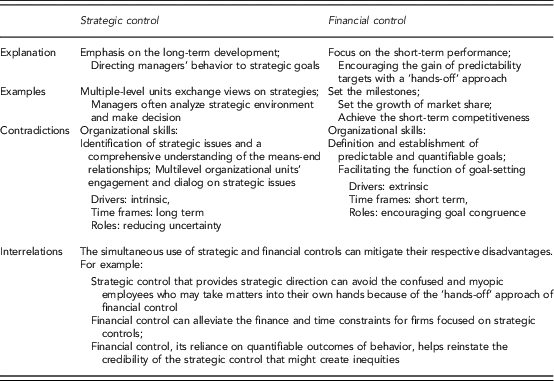
The theoretical argument has supported that organizing paradoxes surface as complex control systems create competing processes, frames, and roles to achieve desired outcomes (cf. Andriopoulos & Lewis, Reference Andriopoulos and Lewis2009; Smith & Lewis, Reference Smith and Lewis2011). Following an information infrastructure rationale, strategic controls direct managers’ planning or behaviors toward long-term strategic goals (Hill & Jones, Reference Hill and Jones2004; Li, Liu, & Zhao, Reference Li, Liu and Zhao2006) and prioritize those innovative issues that are more likely to have long-term benefits. Central here is the ability of firms to identify strategic issues and understand the means-end relationships for all the behaviors they direct (Li et al., Reference Li, Li, Liu and Barnes2011; Shen, Gao, & Yang, Reference Shen, Gao and Yang2017). They encourage innovative activities by establishing innovation-enabling mechanisms (e.g., rewarding for long-term consequence, encouraging knowledge search) (Hitt et al., Reference Hitt, Hoskisson, Johnson and Moesel1996; Yi et al., Reference Yi, Liu, He and Li2012; Shen, Gao, & Yang, Reference Shen, Gao and Yang2017), and foster flexible dialog and knowledge sharing between multilevel organizational units (Ndegwa, Reference Ndegwa2013; Shen, Gao, & Yang, Reference Shen, Gao and Yang2017). In contrast, under a rationale of reducing goal divergence, financial controls define the objective targets (e.g., milestones, budget, and expected level of performance) (Di Tullio & Staples, Reference Di Tullio and Staples2013; Liu, Reference Liu2015), and emphasize their short-term benefits (Li et al., Reference Li, Li, Liu and Barnes2011; Kreutzer, Walter, & Cardinal, Reference Kreutzer, Walter and Cardinal2015). Financial controls may incentivize the controlees to emphasize the extent to which output targets are achieved (Hitt et al., Reference Hitt, Hoskisson, Johnson and Moesel1996; Kownatzki, Walter, Floyd, & Lechner, Reference Kownatzki, Walter, Floyd and Lechner2013), and encourage goal congruence by facilitating the alignment of controlees with organizational objectives (Li et al., Reference Li, Li, Liu and Wang2005; Su, Baird, & Schoch, Reference Su, Baird and Schoch2013). Central here is the ability of firms to establish predictable and quantifiable goals (Yi et al., Reference Yi, Liu, He and Li2012; Shen, Gao, & Yang, Reference Shen, Gao and Yang2017) and to exert the function of goal-setting so as to foster motivation, engagement, and commitment (Kreutzer, Walter, & Cardinal, Reference Kreutzer, Walter and Cardinal2015). Overall, strategic and financial controls are oppositional with regard to organizational skills (identifying the strategic issues and understanding of the means-end relationships vs. establishing the short-term targets and facilitating the function of goal-setting), drivers (intrinsic vs. extrinsic), time frames (long term vs. short term), and roles (reducing uncertainty vs. encouraging goal congruence). These contradictions are illustrated in Table 1.
A comparison between strategic and financial controls

Interrelations
Despite their fundamental differences, strategic, and financial controls are also interrelated. Some recent research has acknowledged the interrelations between different control types and suggested the joint use of opposing control types (Cardinal, Reference Cardinal2001; Mundy, Reference Mundy2010; Ylinen & Gullkvist, Reference Ylinen and Gullkvist2014). For instance, Yi et al. (Reference Yi, Liu, He and Li2012) argue that firms emphasizing strategic controls may be confronted with information asymmetries and difficulties in observing managers’ behavior, and that supplementing strategic controls with financial controls reliance on quantifiable outcomes of behaviors may help them to check and evaluate the behaviors of managers. Kreutzer, Walter, and Cardinal (Reference Kreutzer, Walter and Cardinal2015) posit that firms’ focus on financial controls may lead to a disconnect between managers and employees because of its ‘hands-off’ approach, such that complementing financial controls with strategic controls can facilitate information communication, as well as knowledge exchanging between managers and employees. Bedford (Reference Bedford2015) suggests that it is necessary to use the different control levers in combination to encourage managers to simultaneously address demands for both innovativeness and predictable goal achievement. Hence, a combination of strategic and financial controls can offer a more complete explanation of why and how they address innovation problems. These interrelations are illustrated in Table 1.
In conclusion, we contend that firms that recognize and accept the coexistence of the contradictory forces of differing controls are more likely to employ strategic and financial controls simultaneously to facilitate innovation. We therefore argue that organizational ambidexterity – that is, ‘the ability to perform differing and often competing, strategic acts at the same time’ (Simsek, Heavey, Veiga, & Souder, Reference Simsek, Heavey, Veiga and Souder2009: 865) – represents a critical perspective for exploring how to simultaneously use contradictory but interrelated controls. In the following, we develop an ambidextrous perspective on organizational controls and unpack the mechanisms we expect to influence innovation modes.
The explanation and examples of organizational controls are also shown in Table 1.
An ambidextrous perspective on organizational controls
The literature on organizational ambidexterity that has theorized about ‘how organizations address conflicting demands or trade-off situations’ (Cao, Mohan, Ramesh, & Sarkar, Reference Cao, Mohan, Ramesh and Sarkar2013: 119) is of particular relevance to the question of how to simultaneously use different controls. The underlying idea of ambidexterity pertains to firms’ ability to simultaneously pursue contradictory but interrelated activities, wherein those that succeed at embracing such tensions will be more successful (Cao et al., Reference Cao, Mohan, Ramesh and Sarkar2013; Hahn et al., Reference Hahn, Pinkse, Preuss and Figge2016). This idea is also presented in the paradox and duality views. The paradox perspective describes conflicting yet interrelated elements across a range of organizational phenomena, and argues that long-term sustainability requires continuous efforts to manage the tensions (Lewis, Reference Lewis2000; Smith & Lewis, Reference Smith and Lewis2011). The dualistic view uses duality to denote the twofold character of an object without separation, and maintains that duality makes it possible for organizations to merge the paradoxical tensions (e.g., merging routine with novelty, narrowness with openness) (Farjoun, Reference Farjoun2010).
Going beyond the traditional discussion in the context of exploration and exploitation (He & Wong, Reference He and Wong2004; Cao, Gedajlovic, & Zhang, Reference Cao, Gedajlovic and Zhang2009), researchers have applied the notion of ambidexterity in a range of contexts, such as corporate social performance (Hahn et al., Reference Hahn, Pinkse, Preuss and Figge2016), service and sales (Sok, Sok, & De Luca, Reference Sok, Sok and De Luca2016), and control or governance mechanisms (Ylinen & Gullkvist, Reference Ylinen and Gullkvist2012; Bedford, Reference Bedford2015; Chi, Zhao, George, Li, & Zhai, Reference Chi, Zhao, George, Li and Zhai2017). Common to all these applications is the importance of identifying the coexistence of contradictions and interrelations between two activities, and how to concurrently pursue such activities. Firms that adopt organizational control mechanisms to address management problems are also confronted with the challenge of how to employ the contradictory but interrelated strategic and financial controls simultaneously. As shown above, strategic and financial controls are oppositional with regard to organizational skills, drivers, time frames, and the roles they play, in addition to being interrelated by mitigating their respective disadvantages, which are in conformity with the ambidextrous characteristics. In this case, it is important to explore how to simultaneously use strategic and financial controls in an ambidextrous manner.
Researchers have accepted the relevance of ambidexterity for organizational controls or governance mechanisms in recent research (Ylinen & Gullkvist, Reference Ylinen and Gullkvist2012; Cao et al., Reference Cao, Mohan, Ramesh and Sarkar2013; Bedford, Reference Bedford2015; Chi et al., Reference Chi, Zhao, George, Li and Zhai2017), but few have empirically explored the impact of organizational controls on innovation modes from the perspective of ambidexterity. For example, Chi et al. (Reference Chi, Zhao, George, Li and Zhai2017) identify the balancing (balance dimension) and complementing (combined dimension) governance strategies based on the broad notion of ambidexterity, and report that firms with the two dimensions of governance strategies can help increase relational performance. However, they focus only on performance that dominates in the ambidexterity literature, and fail to further explore whether those firms that pursue ambidextrous governance strategies can be driven to make innovation-related choices. We argue that ambidextrous controls can also be important for the choice of innovation modes. This insight has been confirmed by studies of the determinants of innovation. For example, Bedford (Reference Bedford2015) reports that both the combined and balance use of management control systems contribute to generating the dynamic tension necessary for managing contradictory innovation modes (in his case, exploratory and exploitative innovation). However, he fails to explain whether the same control patterns are equally effective across internal and external approaches to innovation, such as the internal and cooperative innovation modes.
The current study extends these streams of research by explaining the contradictions and interrelations between strategic and financial controls, and focusing on the innovation modes – in our case, the internal and cooperative innovation modes. Following Cao, Gedajlovic, and Zhang (Reference Cao, Gedajlovic and Zhang2009) and Bedford (Reference Bedford2015), we distinguish between two dimensions of ambidexterity for organizational controls – combined use (focused on the absolute magnitude of a firm’s strategic and financial controls) and balance use (considering their relative magnitude). The remainder of this section examines how the individual, combined, and balance use of strategic and financial controls influence innovation modes.
The individual effects of organizational controls
Innovation can be pursued through the internal innovation mode or the cooperative innovation mode, both of which can be applied as a vehicle and/or means for innovation (Zhang & Baden-Fuller, Reference Zhang and Baden-Fuller2010; Ganotakis & Love, Reference Ganotakis and Love2012). Internal innovation, such as internal research and development, is a process of using an organization’s own resources and capabilities to develop new products (Hull & Covin, Reference Hull and Covin2010; Li et al., Reference Li, Li, Liu and Barnes2011), while cooperative innovation is defined as ‘new products developed by a firm in concert with one or more outside entities, where the firm relies on both its own resources and capabilities and those of its partners’ (Hull & Covin, Reference Hull and Covin2010: 99).
For firms focusing on strategic controls, the long-term orientation and a norm of risk-taking mechanism are more akin to those that support the internal innovation mode than those that enable the cooperative innovation mode. As Hitt et al. (Reference Hitt, Hoskisson, Johnson and Moesel1996) point out, firms that emphasize strategic control place more emphasis on their long-term performance and support those activities that are proven to yield the long-term competitive advantage (Hoskisson & Hitt, Reference Hoskisson and Hitt1988), which constitutes the effective mechanisms to facilitate internal innovation. This is because internal innovation is more widely expected to have the long-term performance and competitive advantage. It employs unique and path-dependent knowledge that is difficult for competitors to imitate, compared with that obtained from external partners through the cooperative innovation mode (Barney, Reference Barney1991; Kogut & Zander, Reference Kogut and Zander1992). Moreover, norms of the risk-taking mechanism can be established by using strategic control (Hitt et al., Reference Hitt, Hoskisson, Johnson and Moesel1996; Yi et al., Reference Yi, Liu, He and Li2012). Internal innovation is generally associated with higher risks and uncertainties compared with cooperative innovation that involves the sharing of risk with partners and diversified information support (Li, Lee, Li, & Liu, Reference Li, Lee, Li and Liu2010). By using strategic control, not only does exposure to the risk-taking environment greatly encourage managers to be more willing to undertake risky activities (Yi et al., Reference Yi, Liu, He and Li2012), but also the willingness to communicate information about changes of the external environment would facilitate a reduction in the uncertainty that accompanies internal innovation (Thomas & Ambrosini, Reference Thomas and Ambrosini2015; Shen, Gao, & Yang, Reference Shen, Gao and Yang2017). In contrast, because of the embedded risks and outcome uncertainty within the nature of innovation activity itself, such a risk-taking mechanism of strategic controls functions less effectively to reduce the relationship risks (e.g., opportunistic behavior of partners, risk of knowledge appropriation) that dominate in cooperative innovation.
For firms focusing on financial controls, the alignment with performance objectives and the ‘hands-off’ approach are more akin to those that support cooperative innovation mode than those that enable internal innovation mode. First, firms under financial controls will take actions to achieve objective or short-term criteria by reducing or postponing long-term investments, such as internal research and development based on the long-term payback therefrom (Li et al., Reference Li, Li, Liu and Wang2005, Reference Li, Li, Liu and Barnes2011; Kreutzer, Walter, & Cardinal, Reference Kreutzer, Walter and Cardinal2015). Conversely, in industries where innovation is the key to achieve and maintain competitive advantages, firms that emphasize financial controls may still search for other ways to bring innovation to their firms, such as by resorting to cooperative partners to attain the desired innovation outcomes that come with less risk and more certain payoffs (Hitt et al., Reference Hitt, Hoskisson, Johnson and Moesel1996; Mata & Woerter, Reference Mata and Woerter2013). As cooperative innovation is a means of speeding up innovation (Fukugawa, Reference Fukugawa2006), firms focusing on financial controls are more likely to identify and search for cooperative partners that have developed and introduced new products to the market, in order to incorporate these new products or processes into their firms (Hitt et al., Reference Hitt, Hoskisson, Johnson and Moesel1996). In addition, as valuable resources and capabilities are those that directly result in the desired innovative output (Dyer & Singh, Reference Dyer and Singh1998; Hull & Covin, Reference Hull and Covin2010), the presence of superior financial performance not only renders a firm more visible as a potential innovation collaboration partner, but also makes it more likely to attract valuable partners (Ahuja, Reference Ahuja2000). Second, as a tool for encouraging goal congruence, financial control is characterized by the establishment of clear and coherent goals. As such, financial control would not only be better applied when the environment is less complex and the performance criteria can be specified in advance, but also more likely to foster the focus, engagement, and commitment of partners that lead to a good performance appraisal (Turner & Makhija, Reference Turner and Makhija2006; Chuang, Jackson, & Jiang, Reference Chuang, Jackson and Jiang2016; Smets, Langerak, & Tatikonda, Reference Smets, Langerak and Tatikonda2016). Third, as a ‘hands-off’ approach (Yi et al., Reference Yi, Liu, He and Li2012; Thomas & Ambrosini, Reference Thomas and Ambrosini2015), financial control can demonstrate a sense of mutual trust and confidence in achieving desired outcomes (Kreutzer, Walter, & Cardinal, Reference Kreutzer, Walter and Cardinal2015), and thereby encourages all members to actively engage in cooperative behavior. This argument is in line with Smets, Langerak, and Tatikonda notation that ‘output control places social pressure on the managers and their teams to achieve such positive outcomes because they do not want to violate the other team’s trust by letting them down, thereby increasing the likelihood of compliance and cooperative behavior to the project plan’ (Reference Smets, Langerak and Tatikonda2016: 249). Therefore, we propose:
Hypothesis 1: Strategic control has a stronger positive effect on the internal innovation than on the cooperative innovation mode.
Hypothesis 2: Financial control has a stronger positive effect on the cooperative innovation than on the internal innovation mode.
The combined effect of strategic and financial controls
Several empirical studies have evidenced that performance can be enhanced by simultaneously employing distinct control types (e.g., Ylinen & Gullkvist, Reference Ylinen and Gullkvist2014; Kreutzer, Walter, & Cardinal, Reference Kreutzer, Walter and Cardinal2015; Liu, Reference Liu2015; Smets, Langerak, & Tatikonda, Reference Smets, Langerak and Tatikonda2016). Some organizational control researchers have also argued that the combination of different controls may lead to synergistic or conflicting effects on different product innovation outcomes (Tiwana, Reference Tiwana2010; Bedford, Reference Bedford2015). The notion that different control types may act as complements or substitutes when influencing differing innovation outcomes raises the question of how the concurrent pursuit of strategic and financial controls affects differing innovation modes (Rijsdijk & van den Ende, Reference Rijsdijk and van den Ende2011).
Central to the conceptualization of combined use is the idea that strategic and financial controls are not necessarily in fundamental competition. We argue that the combined use of strategic and financial controls will benefit internal innovation. There are three reasons to support this argument. First, Eldridge, van Iwaarden, van der Wiele, and Williams (Reference Eldridge, van Iwaarden, van der Wiele and Williams2013) argue that the effectiveness of strategic controls in internal innovation is based upon a comprehensive understanding of the causal mechanisms for all the strategic activities they supervise. However, observing behavior is otherwise difficult or costly because of information asymmetries (Yi et al., Reference Yi, Liu, He and Li2012). In addition, managers may lack a comprehensive understanding of the means-end relationships for all the activities (Kreutzer, Walter, & Cardinal, Reference Kreutzer, Walter and Cardinal2015; Shen, Gao, & Yang, Reference Shen, Gao and Yang2017), especially when the internal innovation activities involve the acquisition and sharing of more tacit knowledge. They may also not have the time or resources to develop such an understanding (Li et al., Reference Li, Li, Liu and Wang2005; Kreutzer, Walter, & Cardinal, Reference Kreutzer, Walter and Cardinal2015). Complementing strategic with financial control, however, appears to mitigate these concerns. This is because financial outcomes are, to some degree, a function of managerial behaviors (Hoskisson & Hitt, Reference Hoskisson and Hitt1988; Hitt et al., Reference Hitt, Hoskisson, Johnson and Moesel1996), and the setting of outcome-related milestones can provide some insights as the feedback on managers’ behavior, and help check the performance of managers. In this respect, complementing strategic with financial control may help managers to supervise behaviors and allow them to conserve their time and other resources (Ouchi, Reference Ouchi1977; Anderson & Oliver, Reference Anderson and Oliver1987). Besides, the achievement of certain necessary financial targets can be guaranteed for the long-term development of firms (Yi et al., Reference Yi, Liu, He and Li2012) and be conducive to reducing the additional cost resulting from continuous activity surveillance. Second, the subjectivity and intuition inherent in the strategic control make it difficult to compare performance across different innovation-related efforts, and may introduce biases and inequities into the oversight of efforts (Evans, Landry, Li, & Zou, Reference Evans, Landry, Li and Zou2007), thereby decreasing the persuasiveness of subjective evaluation criteria. Supplementing strategic with financial control, and its reliance on objective behavioral outcomes, may help to reinstate the credibility of strategic control by being more responsive to the inequities that might be created by strategic controls. Finally, with strategic controls, firms emphasize the delineating of acceptable behavior or the setting of boundary conditions for what constitutes legitimate behavior (Kreutzer, Walter, & Cardinal, Reference Kreutzer, Walter and Cardinal2015; Shen, Gao, & Yang, Reference Shen, Gao and Yang2017), resulting in an increased risk of rigid behavior boundaries and a lack of discretion over how to behave (Sitkin, Sutcliffe, & Schroeder, Reference Sitkin, Sutcliffe and Schroeder1994). These unintended consequences can be mitigated by complementing strategic control with financial control’s advantages of according members accepted levels of discretion and providing a focus on innovation-related efforts (Kreutzer, Walter, & Cardinal, Reference Kreutzer, Walter and Cardinal2015).
In the ambidexterity view, the combined dimension has been emphasized to pertain to firms’ capacity to concurrently pursue high levels of strategic and financial controls (cf. Cao, Gedajlovic, & Zhang, Reference Cao, Gedajlovic and Zhang2009). In essence, it concerns a firm’s efforts to increase the combined magnitude of both strategic and financial controls. However, for firms specializing in cooperative innovation, the joint use of high levels of strategic and financial controls may be less effective. As discussed earlier, the use of financial control encourages both partners to actively devote efforts to the desired performance by fostering commitment and facilitating mutual trust (Turner & Makhija, Reference Turner and Makhija2006; Chuang, Jackson, & Jiang, Reference Chuang, Jackson and Jiang2016; Smets, Langerak, & Tatikonda, Reference Smets, Langerak and Tatikonda2016). In this case, the presence of high-level strategic control could be interpreted as a lack of trust, resulting in increased tension between cooperative members, which would discourage the ‘hands-off’ function of financial controls (Kreutzer, Walter, & Cardinal, Reference Kreutzer, Walter and Cardinal2015; Walter, Walter, & Müller, Reference Walter, Walter and Müller2015). This is because strategic control enforces the direction of activities and supervises how they should be performed (Chiang & Hung, Reference Chiang and Hung2014). Compared to internal innovation, the weaker formal authority over the controlees and the difficulty of monitoring them in cooperative innovation make strategic controls more challenging and costly (Tiwana & Keil, Reference Tiwana and Keil2007). Even if the focal firms can continue to engage in surveillance of the partners, the partners in the cooperation relationship are more sensitive to such surveillance and are more inclined to perceive it as signaling distrust, thereby encouraging, rather than discouraging, opportunistic behaviors (Heide, Wathne, & Rokkan, Reference Heide, Wathne and Rokkan2007; Gesing et al., Reference Gesing, Antons, Piening, Rese and Salge2015). Therefore, the role of financial controls in cooperative innovation is likely to become ineffective in the presence of strategic controls.
Research has also suggested that outcome-based rewards increase innovation performance due to the clear and specific predetermined outcomes (Poskela & Martinsuo, Reference Poskela and Martinsuo2009). However, due to the absence of natural inter-firm informational conduits (Tiwana & Keil, Reference Tiwana and Keil2007), the differing and sometimes discrepant strategic targets between partners may trigger a divergent understanding of the firm’s prescribed long-term goals (Capaldo, Reference Capaldo2014). Thus, supplementing financial with strategic control may cause ambiguous output requirements and weaken the effectiveness of the desired goals of financial controls. Besides, they may also challenge the reliability of financial controls, resulting in conflicts that hamper the execution and completion of innovation (Chen, Damanpour, & Reilly, Reference Chen, Damanpour and Reilly2010), thereby impairing the function of financial controls that encourage efforts to attain a set of desired outcomes.
The above discussion leads to the following hypotheses:
Hypothesis 3: There is a positive combined effect of strategic and financial controls on the internal innovation mode.
Hypothesis 4: There is a negative combined effect of strategic and financial controls on the cooperative innovation mode.
The balance effect of strategic and financial controls
The above hypotheses reflect the absolute magnitude of using opposing but interdependent organizational controls. An additional consideration is the relative emphasis given to each control, which constitutes the balance between strategic and financial controls. Following Bedford’s (Reference Bedford2015) recognition that the concept of balance between organizational controls has not yet been clearly addressed, we endeavor to fill this gap by investigating the balance effect on innovation modes.
The balance dimension focuses on a harmonious use of strategic and financial controls (cf. Cao et al., Reference Cao, Mohan, Ramesh and Sarkar2013; Liu, Borman, & Gao, Reference Liu, Borman and Gao2014; Chi et al., Reference Chi, Zhao, George, Li and Zhai2017). The nature of this dimension is to mitigate the potential risks of an exclusive reliance on strategic or financial control. Specifically, for internal innovation, by placing greater emphasis on strategic control relative to financial control, firms may be susceptible to the increased risk of low credibility that is created by the bias and inequities inherent in strategic control, in addition to the increased risk of rigid behavior boundaries, which may inhibit experimentation efforts and discourage the searching for new opportunities when existing boundaries need to be breached (Evans et al., Reference Evans, Landry, Li and Zou2007; Kreutzer, Walter, & Cardinal, Reference Kreutzer, Walter and Cardinal2015). Conversely, when a firm overemphasizes financial control to the exclusion of strategic control, it increases its risk of becoming overly focused on activities with immediate payoffs, to the detriment of long-term results, which can harm the organization in the long run (Cardinal, Reference Cardinal2001; Kownatzki et al., Reference Kownatzki, Walter, Floyd and Lechner2013; Kreutzer, Walter, & Cardinal, Reference Kreutzer, Walter and Cardinal2015). For cooperative innovation, as we discussed earlier, firms that increasingly rely on or resort to high-level strategic control may diminish mutual trust and encourage defensive opportunistic behaviors (Heide, Wathne, & Rokkan, Reference Heide, Wathne and Rokkan2007). Conversely, placing a relatively greater emphasis on financial control where strategic direction is lacking may lead to confused, demotivated partners who take matters into their own hands (e.g., by manipulating financial data to enhance their reported performance), which can potentially result in detrimental consequences for cooperative innovation. In summary, as Bedford notes, ‘while the simultaneous and intensive use of controls that represent positive and negative forces help to create the necessary tension to manage competing demands, an imbalance between jointly activated levers disrupts this capability, leading to unintended consequences that negatively impact the performance of ambidextrous firms’ (Reference Bedford2015: 18). Overall, we posit:
Hypothesis 5: A balance between strategic and financial control is positively related to the internal innovation mode.
Hypothesis 6: A balance between strategic and financial control is positively related to the cooperative innovation mode.
METHODOLOGY
Sample and data collection
To test the hypotheses developed above, we chose China as the empirical context. To achieve the transformation from ‘Made in China’ to ‘Created in China,’ China constantly implements a set of innovation-enabling policies, such as the strategic move of Innovation Driven Development Strategy and China Manufacturing 2025, which foster a favorable environment for innovation. Recognizing this fact, Chinese firms have been encouraged to engage in innovative activities and explore the innovation-related issues (Kim, Im, & Slater, Reference Kim, Im and Slater2013). Besides, Chinese firms typically operate in the innovative environment characterized by a high degree of uncertainty and imperfection, and need to cope with the control problems of innovation activities (Shen, Gao, & Yang, Reference Shen, Gao and Yang2017). Therefore, China, as the largest emerging country, can present an ideal research context to comprehensively investigate the research question of this study. Specifically, we identified the innovation-intensive industries as the main focus of this study, such as IT, medicine, and telecommunications. Following the latest criteria of National Industry Classification in China, the innovation-intensive industries refer to the industries that depend much more on knowledge or technology elements than others such as labor and material.
A questionnaire survey was conducted to collect the data used in this study. Following the literature, we developed the questionnaire in English and used a back-translation method to translate it into Chinese to ensure conceptual equivalence and accuracy. To ensure that instruments were more fitted in Chinese practical context, we also conducted a presurvey with two firms at the Xi’an High-tech zone and these responses were excluded from the final study. During the process, the respondents answered all the questionnaire items and provided feedback on the design and wording of the questionnaire. Several items and sentence structure were revised based on the feedback before finalizing the questionnaire. To make sure the respondents were knowledgeable and hold the accurate information, we made great efforts to contract the middle-level managers who were familiar with the strategies and control mechanisms, as well as the process of specific innovation activities.
To conduct this survey, we got firm lists from the local government departments and randomly selected 500 firms. Then we contacted these firms by phone to explain our research project and solicit their participation. Of these, 251 firms agreed to participate in our survey, and 201 surveys were returned. After data collection, we then screened the questionnaires based on three criteria: (1) the questionnaires with missing or incomplete information was invalid; (2) the questionnaires that more than 70% of the items were rated the same were invalid; and (3) the questionnaires that the items were rated self-contradictory were invalid. Finally, we were left with 182 questionnaires, with a valid return rate of 72.51% (182/251).
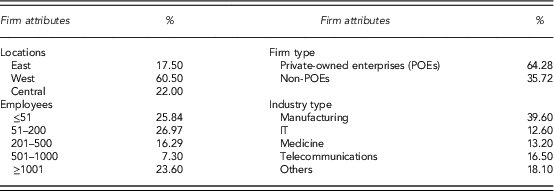
A profile of the responding firms is provided in Table 2. As can be seen from the Table 2, concerning industry, responding firms operated in the manufacturing (39.6%), IT (12.6%), medicine (13.2%), telecommunications (16.5%), and other industries (18.1%) (it follows the latest National Industry Classification in China). The sample firms were randomly located in the East (17.5%), the West (60.5%), and the Central (22%), of which the economic development regions could represent the geographic, economic, and development diversities in China (Li et al., Reference Li, Li, Liu and Barnes2011). More, we compared early and late respondents in terms of the key attributes of respondents and nonrespondents. These comparisons did not reveal any significant differences (p>.05), and indicated no problems related to nonresponse bias.
The profile of responding firms and respondents

This study undertook two procedures recommended by Podsakoff, MacKenzie, Lee, and Podsakoff (Reference Podsakoff, MacKenzie, Lee and Podsakoff2003) to examine the severity of common method bias. First, we conducted the Harman’s one-factor test. Four factors were drawn out, and the largest factor explained 26.55%, which indicated little threat of common method variance. Second, this study further used a confirmatory factor analysis approach to test common method variance (Sabherwal & Becerra-Fernandez, Reference Sabherwal and Becerra-Fernandez2005; Wei, Yi, & Guo, Reference Wei, Yi and Guo2014). A model positing that a single factor underlay all the variables was assessed by linking all items of the dependent and independent factors to a single factor. This model did not fit the data well and was not acceptable (χ2/degrees of freedom=2.992, root mean square error of approximation=0.105, comparative fit index=0.793, non-normed fit index=0.741, incremental fit index=0.798, and goodness-of-fit index=0.857). When all items were assigned to their theoretical factors, the model fitted the data well (χ2/degrees of freedom=1.645, root mean square error of approximation=0.060, comparative fit index=0.938, non-normed fit index=0.916, incremental fit index=0.941, and goodness-of-fit index=0.919). Therefore, the confirmatory factor analysis test showed that no serious threat of common method bias existed (Sabherwal & Becerra-Fernandez, Reference Sabherwal and Becerra-Fernandez2005).
Measures
All of the constructs were drawn and adapted from existing studies and measured with multi-item scales. Each item was assessed on 5-point Likert scales ranging from 1=‘strongly disagree’ to 5=‘strongly agree.’ A list of all the measures is provided in the Appendix.
Innovation modes
The internal innovation mode was measured based on and modified from scales in the research of Yli-Renko, Autio, and Sapienza (Reference Yli-Renko, Autio and Sapienza2001) and Li et al. (Reference Li, Lee, Li and Liu2010). The four items of this construct described the extent to which the firm’s innovation was derived from internal resources and capabilities. The cooperative innovation mode refers to innovation through collaborative activities with external partners, where the firm relies on both its own resources and capabilities and those of its partners. Previous studies have conceptualized inter-organization cooperation as a firm’s belief in a cooperative relationship to achieve goals (Baker, Simpson, & Siguaw, Reference Baker, Simpson and Siguaw1999). This suggests that cooperation will provide a firm with heterogeneous resources and benefits (Johnson, Reference Johnson1999). Three scale items examined the extent to which respondents perceived a cooperative relationship as being important to their firms and preferred to develop innovative activities with outside partners (Ajzen & Madden, Reference Ajzen and Madden1986; Zhang, Shu, Jiang, & Malter, Reference Zhang, Shu, Jiang and Malter2010). As a cooperation relationship should result in goal achievement for the other firm (Lado, Boyd, & Hanlon, Reference Lado, Boyd and Hanlon1997), we also employed another item to examine the extent to which an alliance can benefit the partner firm based on the research of Zhang et al. (Reference Zhang, Shu, Jiang and Malter2010).
Organizational controls
We followed prior studies in measuring strategic control (Hitt et al., Reference Hitt, Hoskisson, Johnson and Moesel1996; Li, Liu, & Zhao, Reference Li, Liu and Zhao2006) and financial control (Hoskisson & Hitt, Reference Hoskisson and Hitt1988; Hill & Jones, Reference Hill and Jones2004; Li, Liu, & Zhao, Reference Li, Liu and Zhao2006). We measured strategic control by indicating the importance of long-term development and that firms placed greater emphasis on the information sharing in order to evaluate business unit strategy. Financial control was operationalized in terms of the short-term performance targets that firms placed greater emphasis on.
Combined use of organizational controls concerns a firm’s combined magnitude of strategic and financial control. We multiplied strategic and financial control to operationalize this construct. This same measure has been used previously by Cao, Gedajlovic, and Zhang (Reference Cao, Gedajlovic and Zhang2009). Bedford (Reference Bedford2015) also uses a similar operational approach for the combined use of control levels. We tried to reduce the potential multicollinearity due to the interaction terms by mean-centering strategic and financial control variables included in the interaction terms (Aiken & West, Reference Aiken and West1991). The maximum value of the variance inflation factor (for each model shown in Table 4 was 1.86, which was well below the cutoff of 10, suggesting that multicollinearity was not a significant issue in this study.
Balance use of organizational controls relates to the balance, or relative magnitudes of strategic and financial controls. Following Cao, Gedajlovic, and Zhang (Reference Cao, Gedajlovic and Zhang2009), we used the absolute difference between strategic and financial control to operationalize this construct. To facilitate interpretation, we reversed this measure by subtracting the difference score from 5 so that a higher value indicated greater balance organizational controls.
Control variables
Factors that could potentially influence innovation modes were controlled in order to overcome challenges to omitted variable bias. Here, firm size, firm type, competitive intensity, innovation risk, and prior performance were used. Firm size has been found to significantly affect firms’ innovation mode preference (Damanpour, Reference Damanpour1991; Hull & Covin, Reference Hull and Covin2010) and was coded as by the National Bureau of Statistics of China, where 1=‘less than 51 employees’ (very small firm), 2=‘51–200 employees’ (small firm), 3=‘201–500 employees’ (medium-sized firm), 4=‘501–1000 employees’ (large firm), and 5=‘more than 1000 employees’ (very large firm) (Li et al., Reference Li, Lee, Li and Liu2010). Firm type is associated with the relative levels of research and development intensity and innovation outcomes of the firm (Hoskisson, Hitt, Johnson, & Grossman, Reference Hoskisson, Hitt, Johnson and Grossman2002). We used dummy variables to measure firm type, coding ‘1’ for private-owned enterprises and ‘0’ for nonprivate-owned enterprises. Competitive intensity is an important factor affecting innovation (Yi et al., Reference Yi, Liu, He and Li2012), as the extent of external competition is expected to add pressure to a firm’s need to engage in innovative activities. Following suggestions in Dess, Ireland, and Hitt (Reference Dess, Ireland and Hitt1990) and Yi et al. (Reference Yi, Liu, He and Li2012), this study controlled competitive intensity measured by one 5-point scale indicating the extent of competition in a certain industry. We measured innovation risk as the extent to which the uncertainty associated with product innovation in terms of resources, technology, and market. Finally, prior performance was assessed by asking informants to judge their firms’ relative prior performance, compared with that of their major competitors in the past three years. We adapted the scale of Zhou, Yim, and Tse (Reference Zhou, Yim and Tse2005) that included sales growth, profit growth, market share growth, return on sales, and return on asset.
Data analysis
Composite reliability assessed the inter-item consistency, which was operationalized by measuring the internal consistency of the scales and calculating the Cronbach’s α (Li et al., Reference Li, Li, Liu and Barnes2011). In this study, the Cronbach’s α values of all the factors exceeded 0.70 except the financial control. It could also suggest a good indicator reliability, as suggested by Nunnally (Reference Nunnally1978) and followed by Li et al. (Reference Li, Lee, Li and Liu2010), lower values were permissible (a>0.60). A factor loading of indicators on latent constructs greater than 0.7 implies that the indicator shares more variance with its construct, which is an indication of construct validity (Li, Liu, & Zhao, Reference Li, Liu and Zhao2006). Among all items loadings, only two were below this threshold, which could also imply close relationships between the items and their respective constructs. It is supported by the study of Li et al. (Reference Li, Li, Liu and Barnes2011) that the factor loading of similar item associated with top managers’ salary for measuring financial control is also below 0.6. In addition, an average variance extracted demonstrates that the construct as a whole shares more variance with its indicators should be greater than 0.50 (Chin, Reference Chin1998). This was true for all according to the calculations, as all surpassed the recommended threshold.
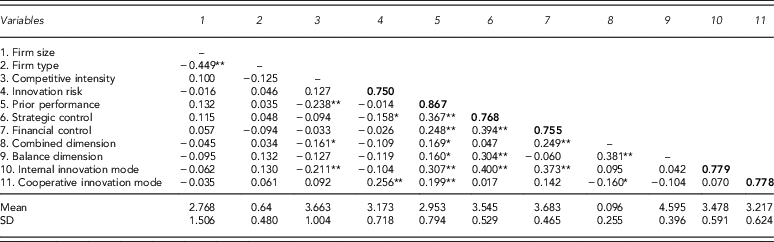
We further checked for discriminant validity by comparing the average variance extracted of each construct (within-construct variance) and the squared correlations between constructs (between-construct variance) (Fornell & Larcker, Reference Fornell and Larcker1981). Table 3 presents the means, standard deviations, the correlations between different constructs in the lower left, off-diagonal elements of the matrix, and the square root of the average variance extracted value calculated for each of the constructs along the diagonal. As it is shown in Table 3, the square root of the average variance extracted for each construct on the diagonal was significantly greater than the correlation coefficients in the same horizontal and vertical lines, which supported the discriminant validity among the constructs.
Means, standard deviations and correlations

Notes. The correlation coefficients are two-tailed tested; Diagonal elements (in bold) are square roots of the AVE values.
N=182; *p<.05; **p<.01.
RESULTS
We tested our hypotheses with the optimal scaling regression model. Followed by the studies of Chen, Li, and Liu (Reference Chen, Li and Liu2015) and Yi, Li, Hitt, Liu, and Wei (Reference Yi, Li, Hitt, Liu and Wei2016), as all multi-item measures of independent variables were based on 5-point Likert scales, from 1=‘strongly disagree’ to 5=‘strongly agree,’ optimal scaling regression is more suitable to deal with these ordinal categorical variables. In addition, optimal scaling regression can iterate to find a best-regression model after using nonlinear transformation methods to transfer original categorical variables (Ma, Pang, Chen, Chi, & Li, Reference Ma, Pang, Chen, Chi and Li2014). Therefore, based on our survey method and our final sample, optimal scaling regression is the most efficient approach in this study.
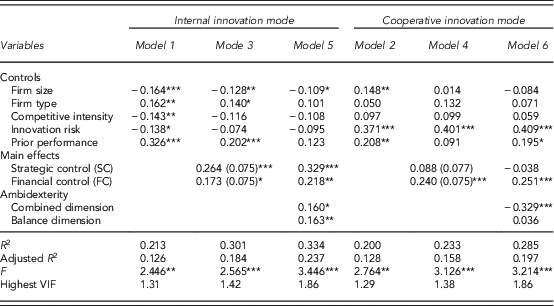
The results of regression analyses are shown in Table 4. Hypothesis 1 suggests that strategic control has a stronger positive effect on the internal innovation mode than the cooperative one. As shown in Model 3 and Model 4 of Table 4, strategic control positively related to internal innovation mode (β=0.264, p=.000), but had a nonsignificant effect on cooperative innovation mode (β=0.088, p>.1). To determine whether a significant difference exists between the regression coefficients, we conducted an additional Z test based on the research method by Hitt, Ahlstrom, Dacin, Levitas, and Svobodina (Reference Hitt, Ahlstrom, Dacin, Levitas and Svobodina2004), and found a significant difference between the two coefficients (Z=4.40, p<.001), in support of Hypothesis 1.
Test of hypotheses

Notes. Two-tailed tested; standard errors in parenthesis.
VIF=variance inflation factor.
N=182; *p<.05; **p<.01; ***p<.001.
In Hypothesis 2, we posit that financial control has a stronger positive effect on the cooperative innovation mode than the internal one. As Table 4 shows, the relationships between financial control and innovation modes were significant both for the internal innovation mode (β=0.173, p=.023) and the cooperative innovation mode (β=0.240, p=.000). Further Z test showed a significant difference between the two coefficients (Z=2.23, p=.026), in support of Hypothesis 2.
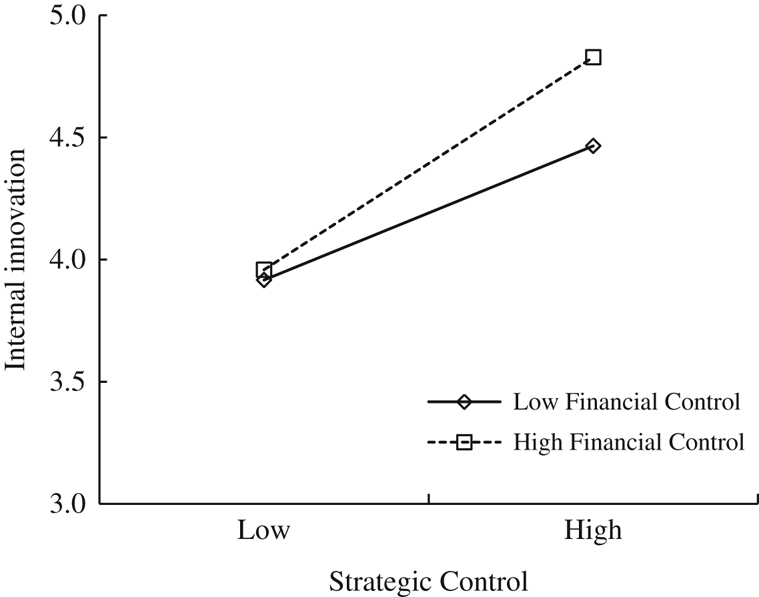
Hypothesis 3 and Hypothesis 5 predict the positive combined and balance effect of strategic and financial controls on internal innovation mode, respectively. Following Cao, Gedajlovic, and Zhang (Reference Cao, Gedajlovic and Zhang2009) and Bedford (Reference Bedford2015), we estimated Model 5 the most conservative model shown in Table 4, which included the effects of both combined and balance dimension. Model 5 shows that the coefficients for combined dimension (β=0.160, p=.04) and for the balance dimension (β=0.163, p=.001) were positive and significant, providing strong support for Hypothesis 3 and Hypothesis 5. Furthermore, to illustrate the nature of the interaction, we followed Aiken and West (Reference Aiken and West1991) to depict the pattern of the interactions in Figure 1, and tested simple slopes of the regression lines corresponding to all possible combinations of low (1 SD below the mean) and high (1 SD above the mean) levels of independent and moderator variables. The simple slope for strategic control with low financial control was not significantly different from 0 (t=2.33, p=.060), while for high financial control, it was positive and significantly different from 0 (t=2.89, p=.020), providing strong support for Hypothesis 3.
Two-way interaction between strategic and financial control in the internal innovation mode

Regarding the effects of combined and balance dimensions on the cooperative innovation mode, the results of Model 6 in Table 4 revealed that the interaction of strategic and financial control was negative and significant for the cooperative innovation mode (β=−0.329, p=.000), providing support for Hypothesis 4. However, as shown in Model 6 of Table 4, the balance dimension had a positive but not significantly effect on the cooperative innovation (β=0.036, p>.05). Hypothesis 6 was not supported. To illustrate the nature of the interactions, we also plotted the results in Figure 2 and tested simple slopes of the regression lines as aforementioned. The simple slope for financial control with low strategic control was significantly different from 0 (t=2.35, p=.043), while for high strategic control, was not significantly different from 0 (t=0.49, p=.595). These results provided additional support for Hypothesis 4.
Two-way interaction between strategic and financial control in the cooperative innovation mode

DISCUSSION
Motivated by a key recognition of the ambidextrous characteristic of organizational controls, and an observation that the intersection of the organizational control and the ambidexterity literatures has been remarkably underexplored to date, this study uses an ambidexterity perspective to examine the influences of the individual, combined, and balance use of organizational controls on differing innovation modes, to explain factors that contribute to innovation mode choice. The empirical results reveal that strategic control has a greater effect on internal than on cooperative innovation, while financial control has a stronger effect on cooperative than on internal innovation. Moreover, both the combined and balance dimensions enable internal innovation, while the combined dimension is negatively related to cooperative innovation, and the result does not support the expected positive relationship between the balance dimension and cooperative innovation. In the next section, the theoretical and practical implications are further examined.
Theoretical implications
Our study offers several theoretical implications. First, previous scholarly debate on organizational controls is divided between the proponents of a contingency or substitute approach, which advocates one type of control over the other, and the proponents of a complement view, in which the simultaneous use of different control types can achieve complementary or synergy effects (e.g., Hitt et al., Reference Hitt, Hoskisson, Johnson and Moesel1996; Li et al., Reference Li, Li, Liu and Wang2005; Yi et al., Reference Yi, Liu, He and Li2012; Ylinen & Gullkvist, Reference Ylinen and Gullkvist2014; Kreutzer, Walter, & Cardinal, Reference Kreutzer, Walter and Cardinal2015; Shen, Gao, & Yang, Reference Shen, Gao and Yang2017). Our study steps further by identifying and elucidating the coexistence of contradictions and interrelations between strategic and financial controls. Prior studies on the effectiveness of organizational controls that have generally taken an ‘either–or’ approach have limited the ability to explain how to employ contradictory yet interrelated controls. Our study echoes that of Koppenjan et al. (Reference Koppenjan, Veeneman, Van der Voort, Ten Heuvelhof and Leijten2011), who argue that firms need to combine differing controls while recognizing the paradoxical nature of the tension between them, and proposes that organizational ambidexterity is an important theoretical lens since it enables firms to concurrently employ conflicting yet interrelated strategic and financial controls. In this regard, we empirically verify the theoretical effectiveness of the dualistic view proposed by Farjoun (Reference Farjoun2010), who argues that firms need to focus on identified specific paradoxical tensions between differing elements (e.g., controls), their management, and their impact. Moreover, our finding that ambidextrous organizational controls could be employed through both the combined and balance use in innovation corresponds with and extends the recent works of Bedford (Reference Bedford2015) and Chi et al. (Reference Chi, Zhao, George, Li and Zhai2017). Our study therefore provides a new insight for the organizational control literature regarding how to employ contradictory yet interrelated controls in managing innovation mode choice.
Second, our findings provide some implications for the ambidexterity literature by affirming the role of ambidextrous organizational controls in facilitating differing innovation modes. Attention within the organizational ambidexterity literature has been placed mainly on operational or strategic ambidexterity, such as exploitation and exploration (e.g., He & Wong, Reference He and Wong2004; Cao, Gedajlovic, & Zhang, Reference Cao, Gedajlovic and Zhang2009). This often-cited exploration/exploitation ambidexterity has been extended by a stream of research based on a broader conceptualization of ambidexterity, which commonly discusses how ambidexterity can be applied in different contexts where firms are under pressure to pursue seemingly contradictory activities at the same time. However, the intersection of the ambidexterity literature and organizational control literature has been remarkably underexplored to date. To explain how the ambidexterity perspective can be applied in the organizational control field, our study follows Curtis and Sweeney (Reference Curtis and Sweeney2017), who call for studies that pay much greater attention to how the ambidexterity perspective addresses organizational control problems. Our finding that the combined and balance dimensions of ambidexterity for controls are identified as two distinct mechanisms through which organizational controls influence innovation mode choice, supports, and complements. Hahn et al. (Reference Hahn, Pinkse, Preuss and Figge2016) and Sok, Sok, and De Luca (Reference Sok, Sok and De Luca2016), who find that the broader notion of ambidexterity can be applied and discussed in different contexts, such as corporate social performance, and service and sales. This finding also empirically supports Ylinen and Gullkvist (Reference Ylinen and Gullkvist2012) and Cao et al. (Reference Cao, Mohan, Ramesh and Sarkar2013), who argue that the distinction between the two dimensions of ambidexterity (the combined and balance dimensions) can also be applied more widely in the context of organizational control. In this respect, our study offers a better understanding of the two dimensions of ambidexterity in the context of organizational controls. The combined dimension enables a supplementary fit between strategic and financial controls that increases the synergy effects of controls on internal innovation, while the balance dimension enables a harmonious use of strategic and financial controls that increases the effect on internal innovation by mitigating the potential risks of overemphasizing strategic or financial control.
Finally, this study also has important implications for the innovation mode literature. It extends the antecedents of the innovation mode by shedding light on previously neglected issues concerning organizational control mechanisms. In addition to antecedents of the innovation mode, such as learning capabilities and technological parity, knowledge, specific human capital, and information structure (e.g., Hull & Covin, Reference Hull and Covin2010; Li et al., Reference Li, Li, Liu and Barnes2011; Wu, Su, & Wang, Reference Wu, Su and Wang2013), we highlight that organizational control plays an important role in explaining innovation mode choice. Most of the existing research on organizational controls that has focused on explaining financial or innovation performance (e.g., Li, Liu, & Zhao, Reference Li, Liu and Zhao2006; Ylinen & Gullkvist, Reference Ylinen and Gullkvist2014), few studies have examined how organizational controls influence the internal and cooperative innovation modes. Our research, in comparison, emphasizes how to deal with ambidextrous organizational controls for managing differing innovation modes, and adds to the nascent stream of research that contends that innovation activities can be successfully realized if firms can explicitly accept the tensions inherent in organizational controls (e.g., Bedford, Reference Bedford2015). Our finding that the combined dimension facilitates internal innovation and discourages cooperative innovation corresponds with the research of Liu, Borman, and Gao, who argue that it is necessary ‘to understand how the choice of particular control modes affects the functioning of other control modes and thus outcomes, and make choices of control modes based on both the context and the interaction effects’ (Reference Liu, Borman and Gao2014: 94). However, we did not find evidence of the balance dimension encouraging cooperative innovation. A possible explanation we can resort to is the framework presented by Bedford, who argues that ‘although the two systems may be interrelated in an organization, the effect on performance of one system is not necessarily conditional on the other as they are often spatially and temporally separated’ (Reference Bedford2015: 25). Our study also responds to Hull and Covin’s (Reference Hull and Covin2010) call for empirical research to explore the antecedents of innovation modes, as there is a possibility that the choice of different modes may be driven by some common antecedents. Thus, this study contributes to the innovation mode literature by advancing understanding of how and why particular innovation-generating activities are selected and configured.
Practical implications
One important managerial implication of this study is the suggestion that managers should accept the tension inherent in organizational controls, and recognize the coexistence of the contradictions and interrelations between different organizational controls. Therefore, when managers select a set of control methods to address the managerial problems that they actually confront, they need to look beyond the application of a single control type, and identify how to deal with the contradictory yet interrelated organizational controls. Our study provides theoretical guidance and operational methods for managers to deal with control integration issues. Another significant managerial implication of this study is that an ambidextrous perspective on organizational control helps managers to effectively shape the ways in which innovation problems are framed, understood, and ultimately handled, which creates an environment that is conducive to the appropriate innovation mode. For Chinese firms in the period of economic transition, innovation is vital to achieve and sustain competitive advantage. However, the complexity and uncertainty within the environment in which Chinese firms operate render them likely to resort to a complex control system for managing innovation. We found that firms focusing on the combined and balance use of strategic and financial controls were able to successfully execute internal innovation. The adoption of complementing and balancing control mechanisms enables firms to maximize the benefits of strategic and financial controls, as well as avoiding the risks of overemphasizing one control, which can match the condition of internal innovation. Therefore, managers should be aware of the fact that it will be a matter of discerning what control mechanisms are effective and appropriate to the firm specializing in one of the innovation modes.
Limitations and directions for future research
This study has several limitations to note, and which also suggest directions for further research. First, the theorizing and findings of this study seemingly stop short of explaining why incidences of the combined and balance use of differing organizational controls vary across firms. Further research on the question examined by our study (namely, how to simultaneously use strategic and financial controls in innovation modes) is still needed in order to incorporate certain contingency factors, such as environmental factors (e.g., environmental uncertainty or dynamism and organizational cultures) (Büschgens, Bausch, & Balkin, Reference Büschgens, Bausch and Balkin2013; Kreutzer, Walter, & Cardinal, Reference Kreutzer, Walter and Cardinal2015). Second, the study focuses on only two innovation modes, as the firms we surveyed engaged mainly in these two innovation activities. A more fine-grained approach to innovation modes that include innovation activities by adding fully developed new products from an outside entity might capture the nuances of innovation activities (Lengnick-Hall, Reference Lengnick-Hall1992; Karim & Mitchell, Reference Karim and Mitchell2004; Hull & Covin, Reference Hull and Covin2010; Lengnick-Hall, Reference Lengnick-Hall1992). Finally, this study may suffer from a limitation in the generalizability of its results. The sampled firms we chose operated in innovation-intensive industries. In particular, it is questionable whether the results obtained here would also hold in other industries where innovation is not extensively employed. Besides, due to the limit of energy and time, sample firms in this study were mainly located in the West region, which may also exists the limitation of generalizing our findings. In future research, the possibility of results being affected by specific sample bias will diminish if researchers can study firms among diverse industries and wider regions.
Acknowledgements
None.
Financial Support
This research was supported by grants from the National Natural Science Foundation of China with the project numbers 71572139 and 71704056.
Conflicts of Interest
None.
APPENDIX MEASUREMENT ITEMS, FACTOR LOADINGS, CRONBACH’S α, AVE, AND CR

About the Authors
Ting Wang is a doctor degree candidate in School of Management, Xi’an Jiaotong University. Her research interests include corporation governance mechanism, competition, knowledge, as well as technological innovation in emerging economy research context. E-mail: wt19880721@126.com
Jianjun Yang is a professor at Xi’an Jiaotong University in China. He is experienced in teaching courses such as corporate governance, technological innovation, organization design, and strategic management. His current research focuses on the areas of inter-organization relationship, knowledge management, and technological innovation. He has published in Asia Pacific Journal of Management, Technological Forecast and Social Change. E-mail: jjyang@mail.xjtu.edu.cn
Feng Zhang has graduated from Xi’an Jiaotong University of China and is an assistant professor in the School of Business Administration, South China University of Technology in China. His research focuses on inter-organizational relationship, knowledge, technological innovation, as well as on green management. He has published in Journal of Product Innovation Management, Technological Forecast and Social Change, and Nankai Business Review International. E-mail: halszhangfeng@163.com