It is a common observation that second language (L2) learners from a large variety of native language (L1) backgrounds will produce epenthetic vowels after word-final syllables with coda obstruents, such as in productions of the word code: /cod/→/codi/.Footnote 1 Although previous investigations in L2 acquisition have examined vowel epenthesis in production, the current study examines the perceptual reflex of this, that L2 learners also report hearing such vowels in L1 productions.
The current study specifically examines the relationship between syllable counting and the perception of postvocalic word-final consonants in English by Korean learners of English, with the goal of testing two types of models of epenthesis: first, that the imposition of vowels in the interlanguage is functionally connected to licensing L2 consonant contrasts appearing in positions that are proscribed in the L1 and, second, that the imposition of the vowels is simply due to perceptual misinterpretation of consonant releases in the L2 as indicating an additional syllable nucleus. Additionally, the results of the current study will be extended to the extensive previous literature on epenthesis in L2 production and will examine the general hypothesis that both indicate a common underlying cause in the developing L2 system.
Epenthesis in Production
Previous production studies have shown that the relevant L1s typically have more restrictions on postvocalic final consonants than do languages such as English. Thus, speakers of languages that disallow postvocalic final obstruents—such as Chinese (Abrahamsson, Reference Abrahamsson2003; Anderson, Reference Anderson, Ioup and Weinberger1987; Broselow, Chen, & Wang, Reference Broselow, Chen and Wang1998; Hansen, Reference Hansen2001; Weinberger, Reference Weinberger, Ioup and Weinberger1987) and Japanese (Erickson, Tajima, & Nagao, Reference Erickson, Tajima and Nagao2000; Hancin-Bhatt & Bhatt, Reference Hancin-Bhatt and Bhatt1997)—exhibit epenthesis. However, the phenomenon is also found with speakers of L1s that merely restrict the range of obstruents in coda position, like Cantonese (Tarone, Reference Tarone1980), Vietnamese (Benson, Reference Benson1988), Amoy (Pennington & Ku, Reference Pennington and Ku1993), Spanish (Hancin-Bhatt & Bhatt, Reference Hancin-Bhatt and Bhatt1997), Brazilian Portuguese (Bettoni-Techio, Rauber, & Koerich, Reference Bettoni-Techio, Rauber and Koerich2007; Cardoso, 2005), and Korean (Goad & Kang, Reference Goad, Kang, Liceras, Zobl and Goodluck2003).
Not only is this phenomenon very widespread, but it has also been demonstrated to be particularly destructive to intelligibility. Tsukada and colleagues (Reference Tsukada, Birdsong, Mack, Sung, Bialystok and Flege2004), for example, show that the reduction of coda consonants negatively affects intelligibility in single-word utterances. However, even more striking is what happens in connected speech. Tajima, Port, and Dalby (Reference Tajima, Port and Dalby1997) examined the effect of warping the durational structure of the speech of inexperienced Chinese learners of English to match that of L1 English speakers and, conversely, of warping the durational structure of L1 speakers to match that of the Chinese learners. When the warped sentences were presented to L1 listeners, results showed significant increments in the intelligibility of the L2 speech with the L1 durational patterns, and significant decrements in the intelligibility of the L1 speech with the durational patterns from the L2 speakers. Careful analyses of the errors reduced or induced by the two warping processes showed that a good share of these effects were due to the addition or removal of epenthetic segments. The addition of epenthetic vowels in running speech tended to induce listeners to add function words or morphological markers. For example, the word sequence . . . shelled egg . . . was variously transcribed with three-syllable sequences such as . . . should I ask . . . or . . . should have lacked . . . . Such parsings would further cascade throughout the rest of the sentence, which greatly impeded intelligibility. Thus, far from being just an interesting problem for phonological analyses, epenthesis is a significant aspect of the functionality of a L2 learner’s capabilities.
Studies of vowel epenthesis in learners have pointed out that these processes cannot be attributed simply to the transfer of such processes, because the relevant L1s typically do not have epenthesis processes in their morphophonologies, nor are these processes part of the target language grammars (Broselow et al., Reference Broselow, Chen and Wang1998). In fact, Benson (Reference Benson1988) documented the presence of epenthesis after voiceless stops in English by Vietnamese learners, even for consonants that Vietnamese allows in postvocalic position. Thus, epenthetic vowels appear to reflect some constructive processes in the ongoing development of an interlanguage system. Proposed models differ widely but point to two aspects of relevant languages. First, the L1s always have more restrictive inventories of obstruent contrasts in postvocalic final position than are found in the L2. For example, languages such as Cantonese and Amoy do allow postvocalic stops but do not allow fricatives and do not allow laryngeal contrasts on the stops. In a similar manner, Korean allows a full range of postvocalic obstruents but has neutralization processes that reduce these contrasts to plain stops when morphological and cliticization processes do not provide a following vowel. Second, possibly related to these postvocalic restrictions, the relevant L1s often do not exhibit consonant releases in the phonetic production of postvocalic obstruents, even though the L2s do exhibit at least variable audible releasing.
Factors Affecting the Occurrence of Epenthesis
A number of factors heavily affect the incidence of epenthesis. The most noted of these is the level of experience of the L2 learner. Abrahamsson (Reference Abrahamsson2003), building on previous work by Sato (Reference Sato1984), Osburne (Reference Osburne1996), and Hansen (Reference Hansen2001), performed an extensive examination of the prevalence of epenthesis after postvocalic consonants in the speech of Chinese learners of Swedish over a two-year period and found more instances of consonant deletion in earlier periods of the acquisition processes and epenthesis occurring more frequently during the middle of the sampling period. The phenomenon has also been found to be sensitive to the elicitation technique used to gather the speech sample, being more prevalent in more formal settings (Cardoso, Reference Cardoso, Dekydtspotter, Sprouse and Liljestrand2004; Tarone, Reference Tarone1980). Detey and Nespoulous (Reference Detey and Nespoulous2008) provided further data from metalinguistic tasks that suggest a possible link to orthographic representation.
Epenthesis rates are also highly sensitive to the identity of phonetic material in the following context, and to the particular consonant found in the coda (Tarone, Reference Tarone1980). Erickson and colleagues (Reference Erickson, Tajima and Nagao2000) found that epenthesis in speakers of L1 Japanese is more common with stops than fricatives, and more common with labials than coronals. Hansen (Reference Hansen2001) also found more epenthesis with labials than coronals in Chinese learners of English. Studies of Brazilian Portuguese have persistently shown more epenthesis with voiced than voiceless stops (Baptista & Silva Filho, Reference Baptista, Silva Filho, Baptista and Watkins2006; Bettoni-Techio et al., Reference Bettoni-Techio, Rauber and Koerich2007; Koerich, Reference Koerich, Baptista and Watkins2006), as did Goad and Kang’s (Reference Goad, Kang, Liceras, Zobl and Goodluck2003) Korean L1 data and Erickson et al.’s (Reference Erickson, Tajima and Nagao2000) Japanese L1 data; however, such voicing differences were not found for Chinese learners of English by Broselow et al. (Reference Broselow, Chen and Wang1998) or Hansen (Reference Hansen2001).
Epenthesis in Perception
Epenthesis is a matter not just of production but also in evidence in the perceptual system. Listeners with L1s that have restricted coda structures tend to report hearing epenthetic vowels after the coda consonants in a L2 where L1 listeners do not. For example, Lim (Reference Lim2003) asked Korean learners of English to transcribe English words with word-final coda consonants using the Korean orthography. Because the Korean writing system assembles consonant and vowel symbols into syllabic characters, it requires writers to syllabify the input words. This study yielded extensive evidence that not only do Korean learners produce vocalizations after word-final coda consonants but they also tend to hear them in the L1 productions. Additionally, Dupoux, Kakehi, Hirose, Pallier, and Mehler (Reference Dupoux, Kakehi, Hirose, Pallier and Mehler1998) found that Japanese listeners failed to distinguish forms with and without vowels in the locations where epenthesis occurs. Finally, Bettoni-Techio et al. (Reference Bettoni-Techio, Rauber and Koerich2007) have explicitly linked the production and perception phenomena and have found that segmental conditions that favor production epenthesis are exactly those segmental conditions in which L2 learners are deaf to the presence of the epenthetic vowel.
Epenthesis as Functional Reparsing
Abrahamsson (Reference Abrahamsson2003) laid out a functionalist model to explain epenthetic development in terms of phonetic and functional development, as done previously by Weinberger (Reference Weinberger, Ioup and Weinberger1987). According to such a model, the suite of postvocalic final obstruents in a language such as English presents a problem for L2 learners on two fronts. First, the phonetic skills needed to produce the obstruents in question are not existent in the L1. Even though the skills necessary for producing various segments in a prevocalic word-final context may be in place in the L1, these segments in the postvocalic position are sufficiently different from those in the prevocalic position to necessitate novel skills. Additionally, coordinating the obstruent with the vocalic context also requires a novel skill. Correlational analyses by de Jong, Hao, and Park (Reference de Jong, Hao and Park2009) bore this out; advancement in the accuracy of producing a prevocalic consonant does not necessarily go with advancement of producing that consonant in a postvocalic position. These problems in the phonetic encoding skills create deletions and epentheses.
Second, learners also need to recognize the impact that having a larger number of contrasts in postvocalic position will have on the recoverability of lexical items, and to internalize these facts in their encoding system. Coping with issues of recoverability will tend to push the learners away from deletions, which are prevalent in earlier stages, in the direction of epentheses, in which the identity of the postvocalic consonant is better encoded in the output speech. It is important to note that, given the results of Tajima et al. (Reference Tajima, Port and Dalby1997), these increases in lexical recoverability come with a potential cost in sentential intelligibility. Eventual development of phonetic skills will remove the impetus for epenthesis, because the identity of the postvocalic consonant is properly encoded in the postvocalic location in later stages of development. This general model explains not only the developmental trajectories in longitudinal data but also why it is that no-obstruent-coda languages like Mandarin pattern like neutralized-coda languages like Korean; both languages have a reduced contrast load in the postvocalic position and hence present a functional challenge to the learner.
It is interesting to point out that the general thrust of these functionalist analyses is similar to those of a number of optimality theoretic (OT) analyses that have been offered over the last dozen years (e.g., Broselow et al., Reference Broselow, Chen and Wang1998; Fleischhacker, Reference Fleischhacker2001; Hancin-Bhatt, Reference Hancin-Bhatt2000; Hancin-Bhatt & Bhatt, 1997; Steele, Reference Steele, Dekydtspotter, Sprouse and Liljestrand2004). Although the formal representations and exact constraints differ, the general structure of these OT analyses pits markedness constraints that restrict the form of productions in the learner’s system against faithfulness constraints with respect to the linguistic specifications of the particular lexical items in the L2. Because the relevant L1s are more restrictive on postvocalic material, the markedness constraints are more in evidence in the learner’s initial conditions. These constraints, however, mitigate the expression of lexical material (see Weinberger’s functional issues) and so mismatch the L2. Deletion and epenthesis are two ways in which lexical material can still be expressed without violating markedness constraints, although with penalties. Deletion expresses the overall syllabic count of the L2 items but loses the consonantal material. Epenthesis expresses the consonantal material (now in an onset position) but loses the syllabic count (having to create an additional syllable to do so). A general message of such models, then, is that epenthesis is motivated by the expression of consonantal contrasts.
Although the functional nature of epenthesis in production seems intuitive (i.e., vowel insertion would help encode the final consonant’s identity), it is perhaps not as intuitive in the perceptual domain. The idea would be that L1s with sparse contrasts in postvocalic word-final position require little in terms of low-level attention to vowel offsets, and hence the identification of material encoded in this portion of the signal is a persistent problem for L2 learners from these L1s. Data suggestive of this effect have been found in previous analyses of very different aspects of the same Korean learners of English examined in the current study (de Jong, Silbert, & Park, Reference de Jong, Silbert and Park2009); Koreans exhibit more perceptual errors in categorizing postvocalic word-final consonants than prevocalic consonants. Positing an additional vowel, then, might reflect the strategy of adding an additional attentional site, which should aid in interpreting the postvocalic consonant (see other recent treatments of attentional control in phonetic learning: Guion & Pederson, Reference Guion, Pederson, Bohn and Munro2007; Pederson & Guion-Anderson, Reference Pederson and Guion-Anderson2010). Thus, if epenthesis is a strategy to relieve the problems of not having a place that licenses coda contrasts, then epenthesis should help the perception of coda contrasts. That is to say, decrements in the accuracy of producing or identifying the number of vowels in an utterance are expected to pay off in increments in the production or perception of consonant identity in coda position. Along these lines, Park and de Jong (Reference Park and de Jong2006), in a preliminary analysis of the data analyzed in this study, suggested that there may be a prioritization of the prosodic interpretation of the signal in something that can be described as a two-stage model of identification. That is, for such a model to be operationalized in the learners, they must first parse the input into appropriate prosodic frames and then, once the parsing has occurred, identify which particular segments appear in the various locations indicated by the prosodic frames.
Epenthesis as Perceptual Misanalysis
Differing from such contrast-driven approaches, various researchers (Goad & Kang, Reference Goad, Kang, Liceras, Zobl and Goodluck2003; Kim-Renaud, Reference Kim-Renaud1977; Malécot, Reference Malécot1958; Silverman, Reference Silverman1996, and, in a general cross-language perception model, Peperkamp, Vendelin, & Nakamura, Reference Peperkamp, Vendelin and Nakamura2008) have suggested that this mismatch in syllable counting with learners of English indicates a difference in the prosodic parsing of the signal, independent from the interpretation of consonant contrasts.Footnote 2 The reason L2 learners mismatch listeners who are native to the L2 in syllable counting lies in the learners’ interpretation of consonant releases; any cluster of acoustic energy from the release of a consonant, especially an obstruent, gets interpreted by L2 learners as constituting an additional syllable head. Goad and Brannen (Reference Goad, Brannen, van de Weijer, van Heuven and van der Hulst2003) and Goad and Kang (Reference Goad, Kang, Liceras, Zobl and Goodluck2003) developed a formalization of the target structures that points out a three-way contrast between items with a nucleus following the consonant: items in which the consonant is a coda to the previous syllable, and items in which the consonant is not attached to the previous vowel but is also not followed by a vocalic nucleus. In their analysis, L1 English speakers treat final consonants as unattached to the previous vowel, but not followed by a vocalic nucleus. L1 Korean speakers then analyze final consonants as codas to the previous vowel and thus have to repair final consonants in English by positing a following vocalic nucleus. The important aspect of this approach is that it captures a distinction between L1 English and Korean-English L2 as consisting in the strength of the release, and aspiration noise as indicating a filled or unfilled nucleus.
In favor of seeing epenthesis as arising from interpretation of consonant releases, Lim (Reference Lim2003) found that stress on a final syllable tended to increase the likelihood of an audible release of a final stop. In a follow-up study of isolated productions by a native English speaker, he found similarly that stressed final syllables were more often produced with a release than were unstressed final syllables. Similarly, Peperkamp et al. (Reference Peperkamp, Vendelin and Nakamura2008) found syllabic parsing of Japanese listeners to French and English stimuli with a final nasal to differ in syllable counts; French stimuli with audibly stronger releases of the final nasal tended to be mapped onto Japanese forms with an extra syllable.
This sort of acoustically driven explanation would then predict that this prosodic parsing will depend on the identity of the segment in the coda and thus will interact with segmental identification. Perceptual epenthesis should rely on some combination of segment-specific production factors that favor the emission of audible releases and segment-specific auditory factors that favor the detectability of the acoustic energy in the release. Studies of the production of epenthetic vowels by L2 speakers of English have found such segmental dependencies. Erickson et al. (Reference Erickson, Tajima and Nagao2000) found that the likelihood of a L1 English listener to report having heard an epenthetic vowel depended on which coda consonant was being produced. They found that words with final labial obstruents were more likely to exhibit epenthesis than words with coronals, and that words with final stops were more likely to exhibit epenthesis than words with fricatives. These patterns are not necessarily expected on the basis of auditory salience. Although it is possible to argue that the release of a stop is more likely to be identified as a separate acoustic event than that of a fricative, due to a gap in the signal between the vowel and the noise, it is by no means obvious that labial releases would be more salient than coronal releases.
It should be noted that such models of syllabic perception would not predict a dependence of segmental perception on syllabic perception. If syllabic perception and consonant identification are independent processes, there is no necessary reliance of segmental perception on syllabic parsing.
THE CURRENT STUDY
This study, then, examines these two general models of perceptual epenthesis with respect to a corpus of perceptual responses gathered from Korean learners of English listening to English word-final consonants. This study examines word-final consonants in particular because such cases are the most common targets of previous analyses; it is very likely that word-internal syllable-final consonants will behave differently, due to both the structure of word-internal consonant sequences in L1 Korean and the greater commonality of word-final releasing. Two tasks were used. The first, which probed occurrence of perceptual epenthesis, had listeners count the number of syllables in a stimulus. The second, which probed the perception of the consonant triggering the epenthesis, had listeners categorize the word-final segment.
The first model is that perceptual epenthesis is the result of a phonological system that induces epenthetic vowels as syllabic heads in order to license coda consonants in onset positions. If perceptual epenthesis is a strategy to enhance the perception of obstruent contrasts, there should be a negative relationship between syllable counting and segmental accuracy, with lower accuracy in syllable counting corresponding to greater segmental accuracy. Alternatively, if syllable counting is simply based on the indiscriminate detection of consonant noise, a correlation between accuracy on the two tasks would not be expected. It is also possible that there is a positive relationship between the two types of accuracy, with greater syllable counting accuracy corresponding to greater segmental accuracy, if syllable counting and segmental identification are actually just two aspects of the same perceptual process.
The second model of perceptual epenthesis—that it is due to the misperception of consonant releases as indicating the presence of a second syllable—would lead to the hypothesis that perceptual epenthesis is, like the production epenthesis in earlier studies, segmentally dependent. In particular, articulations that are more likely to produce noisy sounds, fricatives and coronals, are more likely to elicit the perception of an additional vocalic nucleus. On the surface, such models would not predict segmental accuracy to be dependent on syllable counting accuracy.
METHODOLOGY
Stimuli
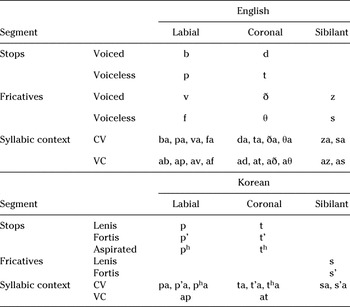
Four Midwestern American English speakers (2 males and 2 females) in their late twenties produced nonsense monosyllabic English words that consisted of American English anterior obstruents combined with the low vowel /a/.Footnote 3 The 10 obstruents /p b f v θ ð t d s z/ were chosen to represent a coherent subsection of the English obstruent system that includes differences in voicing, manner, and place previously noted to yield differences in epenthesis production. The obstruents were placed in syllable-initial and syllable-final positions and yielded 20 target stimuli (10 consonants × 2 syllabic locations) for each of the four speakers (20 target stimuli × 4 talkers = 80 tokens). The English corpus used for the experiment is presented in Table 1. Other consonants (/r, l, w, j, h/) were included in the corpus, and all of the consonants were additionally placed as singletons in intervocalic positions for the purpose of other investigations. However, the current study analyzes only the perceptual data from the corpus described in Table 1.
Linguistic corpus and corresponding Korean segments

Note
CV = consonant-vowel; VC stands for vowel-consonant.
Table 1 also includes Korean segments corresponding to the target segments. Korean has a three-way laryngeal contrast in stops in onset position, whereby the difference between the aspirated and unaspirated stops corresponds to the difference between onset voiceless (aspirated) and voiced stops in English. This contrast is neutralized in final position to a (unreleased) plain voiceless stop. Korean does not have nonsibilant anterior consonants, so the manner contrast in English is novel. Korean does have a sibilant-stop contrast in onset position, but this, like the laryngeal contrasts, is neutralized in final position to a voiceless (unreleased) stop.
The stimuli were recorded in a sound-attenuated recording room of the Linguistics Department at Indiana University, using an Electro Voice (Model RE50) standing microphone and a TASCAM DA-30 MKII DAT recorder. The recordings were transferred from DAT to an Apple G4 in the Linguistic Speech Lab at Indiana University for editing. In the process, each stimulus was examined spectrographically and was found to exhibit either frication noise or a release transient after the stop closure.
Listeners
Twenty L1 Korean speakers (5 males and 15 females; 15 from Seoul-Kyeonggi area and 5 from other areas) were recruited from the undergraduate student population in Kyonggi University, Suwon (near Seoul), Korea. All were in their mid twenties (between 23 and 28 years old, mean age = 24.35). Each participant was recruited from basic-level English classes, and all identified themselves as English majors. At the beginning of the protocol, the listeners were asked on a questionnaire as to their residential history, the number and identity of languages spoken, their evaluation of their own abilities in the languages spoken, and whether they had traveled for more than three months in an English-speaking country. No participant had resided for more than three months in an English-speaking country prior to the experiment nor self-evaluated as being highly proficient in English, except five participants. Based on their experience with English classes in primary and secondary school in Korea, this would mean that they had extensive experience with written English and, hence, familiarity with the English writing system. However, commensurate experience with English spoken by L1 speakers is rare, so most of the listeners would probably be classified as inexperienced learners, with respect to L1 English spoken productions. Analyses presented in this study indicate the presence of a broad range of perception abilities among the learners, which was useful for examining relationships between perceptual epenthesis rates and identification accuracy across the individuals. All the participants were paid for participating in the experiment.
Procedures
The experiment consisted of two tasks, a syllable counting task and a segment identification task, each collecting 1,600 data points (10 consonants × 4 talkers × 2 syllabic positions × 20 listeners). The syllable counting and the segment identification tasks were conducted on different days in blocks of 10 participants. They participated in the segment identification task first and returned to do the syllable counting task on a different day. Stimuli were presented with a 3.5 s interstimulus interval, through two ceiling-mounted loudspeakers (Model: Atlantis AS-B6) connected to a PC in a quiet classroom in Kyonggi University, located in Suwon, Korea. The participants did five trials for practice before each task, and Korean proctors were also present during the experiments to answer any questions regarding the task procedure and to reduce miscommunication due to the use of English instructions.
In the syllable counting task, the listeners were asked to decide, on presentation of each stimulus, how many syllables the stimulus had, and to choose a number on an integer scale from 1 to 3 syllables or more. This is an indirect way of asking where a target segment is parsed under the assumption that syllable counting is related to the number of vocalic segments in a stimulus and so reflects vowel epenthesis. For example, if a listener chooses 1 after listening to /av/, it would mean that the coda segment /v/ was parsed at its original syllable final position. In contrast, if another listener chooses the 2 for the same stimulus /av/, it would mean that the listener perceived two vocalic segments, and hence the coda /v/ was parsed in intervocalic position between the vowel /a/ and an epenthesized vowel. This interpretation is based on the previous results of Lim (Reference Lim2003), who had Korean subjects transcribe English productions in the Korean orthography. The Korean orthography assembles consonants and vowels into syllabic units by placing onset and coda consonant graphemes differently with respect to vowel graphemes. Lim (Reference Lim2003) found that the Korean transcribers consistently placed intervocalic consonants in the onset position with the following vowel. The syllable counting task typically took listeners approximately 20 min, although it was grouped and counterbalanced with a stress location task in the same session. Overall, the session took approximately 45 min. The corpus also included an equal number of disyllabic stimuli with the consonants in the medial position; there were even numbers of monosyllabic and disyllabic stimuli.
In the segment identification task, the listeners were asked to choose the consonant they heard from a list of 15 alternatives presented in Roman orthography. Following the typical practice in the teaching of English in Korean schools, dental fricatives were represented with International Phonetic Alphabet (IPA) characters. To ensure the listeners’ familiarity with these IPA characters, experimenters reviewed these characters prior to administering the task. Each alternative was presented with a key word exemplifying the symbol on the top of the answer sheet, and several example words in different prosodic locations were also provided and explained before the task. The option of a write-in response (e.g., other: ___) was also provided for cases in which the listeners could not find any matching consonant in the given alternatives. Having had extensive training in the English writing system, the listeners had no problems interpreting the task. Blank responses or other were quite rare, occurring 57 out of 1,600 times (3.6%) in the corpus analyzed in this study. Answer sheets for the tasks are shown in the Appendix.
Analysis
Listener responses in each task were coded as binary variables. In the analysis of the syllable counting task, the proportion of correct counting of the consonant-vowel (CV) and vowel-consonant (VC) stimuli was examined. If a listener chose 1 syllable after listening to the monosyllabic stimulus, it was counted as correct. In contrast, other responses, such as 2 syllables or 3 syllables, were counted as incorrect.
The proportion of correct identification of particular contrasts in the VC and CV stimuli was compared in the analysis of the segment identification task. Korean exhibits neutralization rules for both laryngeal and manner contrasts, which yielded two possible tests for a relationship between epenthesis and segmental accuracy. In this analysis, only the listeners’ matches in identification of the relevant contrast were considered, regardless of errors in other contrasts. For example, when considering laryngeal contrasts, their place or manner identification was not coded. Thus, if a listener chose b or v for the stimulus /ab/, v as well as b was counted as correct. However, if p was chosen in this case, it was counted as incorrect, because b and p contrast in laryngeal specification. Manner accuracy is slightly more complicated. Confusions between sibilant and nonsibilant fricatives (e.g., /θ/ and /s/) were counted as manner errors as well as confusions between stops and fricatives, because mismatches in this feature without mismatches in place or laryngeal contrasts yield the wrong segment identification.
Analyses of perceptual variation across individuals in de Jong, Silbert, and Park (Reference de Jong, Silbert and Park2009) indicated that laryngeal and manner identification skills develop independently, such that listeners who are exceptionally accurate with laryngeal contrasts may or may not be exceptionally accurate with manner contrast. These analyses have suggested that perceptual skills should be evaluated on a feature-by-feature basis. Further evidence for this approach was found in the current data set as well. In general, the majority of incorrect responses among the targets (87%) involved a mismatch in only one contrast—that is, laryngeal errors tended to preserve manner and place specifications, and manner errors tended to preserve laryngeal and place specifications. Cases in which listeners wrote in candidates generally involved the use of Korean characters or sometimes were just left blank. Such cases were rare and were counted as errors in responses.
The primary analyses correlated syllable counting accuracy with segmental categorization accuracy. Analyses divided the data in two ways. To examine the model of epenthesis as a functional strategy for segmental identification, the relationship between the perception of different segments and syllable counting was measured in two ways. First, each stimulus was treated as the token of analysis, with correlations calculated across stimuli. Second, the listener was used as the token of analysis, looking for correlations between syllable counting accuracy and segmental identification accuracy across individuals. To examine the model of epenthesis as misinterpretation of consonantal releases, differences in syllable counting for different consonants were examined to determine what features tend to encourage the perception of epenthetic vowels. Finally, the relationship between segments and individuals was examined by grouping listeners by degree of average likelihood to hear epenthetic vowels into two groups, and by examining the patterns of segmental conditions on epenthesis for the two groups. This grouping was necessary because there are not enough observations to reliably estimate the rates of identification and epenthesis for every segment for every listener. If epenthesis is part of a functional strategy, the segmental conditions would be expected to appear most clearly in listeners with high rates of epenthesis. If perceptual epenthesis is due to misinterpretation of consonantal releases, the same segmental conditions would be expected to appear in all of the listeners.
RESULTS
Perceptual Epenthesis
The Korean participants often counted VC stimuli as having two syllables (42.8%) even though such two-syllable counting occurred in only 3% of responses to the CV stimuli. Thus, the learners probed here very robustly exhibited perceptual epenthesis after coda obstruents and reported an extra syllable nearly half of the time.
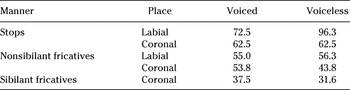
These epenthetic responses were strongly conditioned by which segment was in the coda, as outlined in Table 2. To determine the generalizability of these differences, one-way repeated-measures ANOVAs were run with accuracy as the dependent variable. There was no overall difference between voiced and voiceless segments F (1, 19) = 0.59, p > .05. On the contrary, there were systematic and large differences in epenthesis rate for other factors; coronal nonsibilant fricatives and stops exhibited greater epenthesis rates than the equivalent labials F (1, 19) = 24.485, p < .001. There was also an effect of manner class F (2, 38) = 24.291, p < .001, whereby sibilant fricatives elicited higher rates than nonsibilants t(19) = 2.901, p = .010, and nonsibilant fricatives elicited higher rates than stops t(19) = 5.542, p < .001.
Syllable counting accuracy percentages for different segments in postvocalic final position

Positional Effects on Accuracy
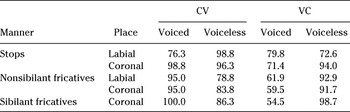
In general, the listeners were more accurate in identifying the laryngeal specifications of the CV stimuli than those of the VC stimuli. The average listener’s accuracy rate for laryngeal identification for the CV stimuli was 89.6% and that for the VC stimuli was 75.9%, which was significantly different in a paired-samples t test t(19) = 4.968, p < .001. Thus, there was ample evidence in the current data that postvocalic final consonants presented additional difficulty. This occurred despite the high rate of epenthesis. The mean laryngeal accuracy for individual consonants is given in Table 3. Like the analysis of laryngeal accuracy, analyses of manner accuracy found a coda deficit, whereby listeners were less accurate with manner contrasts in the coda than in the onset position. The average listener’s accuracy rate for onset position was 83.8%, whereas that for coda position was 75.3%, a difference that was statistically significant t(19) = 4.867, p < .001.
Laryngeal accuracy percentages for segments in different prosodic positions

Correlation of Epenthesis and Identification
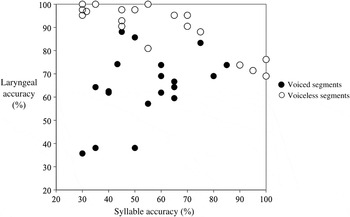
Laryngeal Identification.Even though there is an evident decrement in perceiving laryngeal contrasts in coda position in the current data, it is possible that these deficits are mitigated by epenthesis. To examine this possibility, correlations between epenthesis and identification were examined across the 40 stimuli. The appropriate data are plotted in Figure 1.
Accuracy of laryngeal identification as a function of syllable counting accuracy for each token.

Here, there is a ready observation that overall laryngeal accuracy did not correlate with syllable counting accuracy across the stimuli. Even though there was a large range of accuracy in counting syllables, from 30% to nearly 100%, this variation did not correlate with the wide range of accuracies in judging laryngeal specifications in the segments r 2 = 0.009, t(38) = −0.580, p > .05. Thus, the trend across the different segments does not indicate any particular advantage accrued by perceptual epenthesis.
This is not to say, however, that laryngeal judgments are unrelated to epenthesis. What does correlate with epenthesis rate is the difference in accuracy between voiced and voiceless segments. In Figure 1, there is a readily apparent difference between voiced segments (coded with filled symbols) and voiceless segments (coded with hollow symbols). As rates of epenthesis decrease (to the right), the accuracy rates for voiced segments increase (yielding a marginally significant correlation across voiced tokens, r 2 = 0.195, t(19) = 2.090, p = .05) and the accuracies for voiceless segments decrease (yielding a very strong and significant correlation across voiceless tokens, r 2 = 0.706, t(19) = −6.578, p < .001).
To understand this pattern, it is important to bear in mind that accuracy in identifying a segment arises from two possible sources, as is discussed in the literature on signal detection theory (reviewed in Macmillan & Creelman, Reference Macmillan and Creelman2005). It can be due to acuity in discriminating the segment from others, or it can be due to bias toward that response, a tendency to label anything as being that segment. Because the data in Figure 1 are opposing responses, an increase in bias toward one response will increase accuracy for that response at the expense of the other. Because increased accuracy with voiceless segments corresponds to decreased accuracy with voiced segments (to the left), this suggests that the actual relationship between syllable counting accuracy and segmental accuracy is a decrease in the overall bias toward the voiceless categories. This means that with more epenthetic responses (to the left in Figure 1) comes a stronger overall likelihood of calling the segment voiceless, regardless of whether the segment is voiced or voiceless.
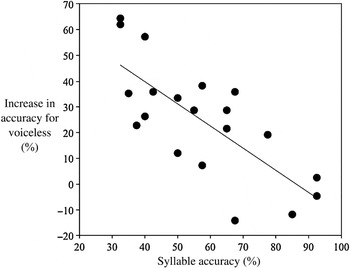
To quantify this interpretation of the data, the difference in accuracy for each voiceless segment was correlated to the matched voiced segment produced by the same talker against the listeners’ syllable accuracy for those tokens. The results of this analysis are plotted in Figure 2. Here, the decreasing bias with increased syllable accuracy is quite obvious, yielding a strong negative correlation r 2 = 0.556, t(19) = −4.748, p < .001.
Difference in voicing accuracy between voiceless consonants and matched voiced consonants plotted as a function of syllable counting accuracy.

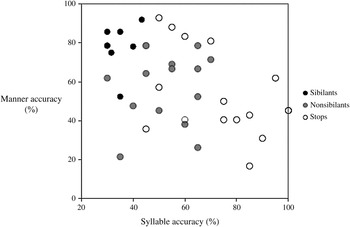
Manner Identification.The correlation between syllable counting and manner accuracy is shown in Figure 3. Unlike the case with laryngeal perception, there was a significant correlation, and this correlation was negative. More accurate syllable counting tended to occur with less accurate manner accuracy, r 2 = 0.200, t(38) = −3.079, p = .004, as would be expected if perceptual epenthesis aids in the perception of neutralized contrasts. Further examination of how this correlation came about can be done by splitting the different manners from one another, as indicated by the shading of the tokens in Figure 3. Some of the correlation is due to the fact that identification of sibilants is exceptionally high (filled tokens lying mostly to the top of the figure), and these sibilants tend to strongly induce perceptual epenthesis. Another part of the correlation appears to be similarly due to the high accuracy with /t/, coupled with relatively high rates of perceptual epenthesis (the four hollow tokens at the top, center of the figure). There was no correlation within each of the major manner classes (sibilants, r 2 = 0.041, t(6) = 0.503, p > .05; nonsibilant fricatives, r 2 = 0.005, t(15) = 0.268, p > .05; stops, r 2 = 0.200, t(15) = −1.874, p > .05), so the overall correlation found here appears to be largely due to relationships between different manner classes.
Manner accuracy for each stimulus plotted as a function of syllable counting accuracy.

Individual Differences
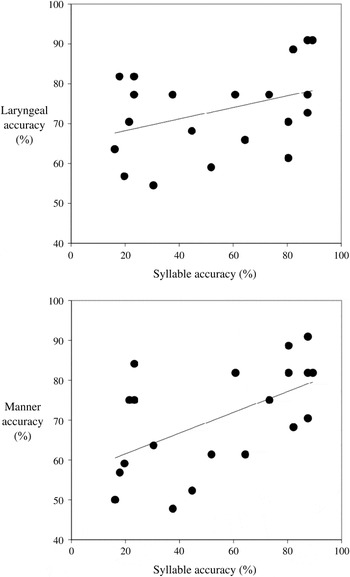
Because previous models of epenthesis are generally taken to be descriptions of individual learner systems, rather than characterizations of relations within the languages, it is appropriate to test such models by attempting to demonstrate relations between syllable counting and segmental accuracy across individuals. Laryngeal (top) and manner (bottom) accuracy for each individual are plotted as a function of syllable counting accuracy in Figure 4. There is a persistent positive correlation across the listeners between segmental and syllable counting accuracy; individuals who tend to exhibit perceptual epenthesis tend to be less accurate in both laryngeal (r 2 = 0.141, t(19) = 1.719, p > .05) and manner (r 2 = 0.308, t(19) = 2.834, p = .011) identification, although only the manner correlation is significant.
Laryngeal (top panel) and manner (bottom panel) accuracy plotted against syllable counting accuracy. Each token indicates averages for each individual listener.

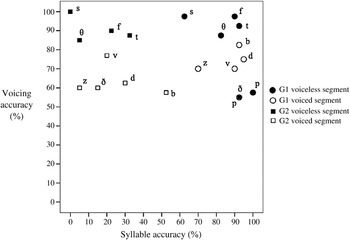
The relationship between the accuracy of different segments and syllable counting accuracy is noted in Figure 4. To examine how this relationship relates to the individual differences just noted, the listeners were pooled into two groups (labeled G1 and G2) on the basis of their likelihood of hearing an epenthetic vowel. Then, voicing accuracies for the two groups were plotted together, as shown in Figure 5. Here, G1 plots laryngeal and syllable accuracy for the 10 listeners with the least overall tendency to report an extra syllable, and G2 plots values for the 10 listeners with the greatest overall tendency.
Laryngeal accuracy for each segment plotted against syllable counting accuracy. Individuals have been divided into two groups (G1 and G2), based on their likelihood of counting syllables with coda singletons as two syllables.

The voicing patterns noted in Figure 5 are apparent in the data here for both groups. The square tokens to the left show a neat, orderly pairing of voiced and voiceless segments, with /s/, /θ/, /f/, and /t/ above /z/, /ð/, /v/, and /d/, respectively. This pattern reflects the results mentioned previously, in which the voicing of the segment does not affect the prevalence of epenthesis, and the general bias toward voiceless responses. Beyond this, it is possible to note little overlap between the listener groups. With the exception of /p/, which yielded low epenthesis rates in both groups, all of the segments tended to group together, which indicates that listeners who were likely to perceive an extra syllable were likely to do so with most of the segments. In a similar manner, listeners with less epenthesis exhibited this tendency for all of the segments.
However, it is important to note that, even though there is little overlap, the same structure appears in the data for both groups. Sibilants tend to induce perceptual epenthesis the most, nonsibilant fricatives more so than stops, and coronals more so than labials. Additionally, the patterns of voicing identification found in the high-epenthesis group tend to be the same as those found in the low-epenthesis group. This overall patterning indicates a general independence of the segmental identification patterns and the degree to which listeners tended to count a second syllable.
DISCUSSION
Tested Models of Epenthesis
Like previous studies of similar groups, which found a strong tendency for epenthesis in the productions of L2 learners, the current results indicate a corresponding perceptual epenthesis. Second language learners do not just produce epenthetic vowels; such structures also appear to be a part of their L2 perceptual system, and so seem to be general to their overall phonological system.
However, a model that treats perceptual epenthesis as a repair strategy for identifying coda consonants is not well supported by the current results. A higher rate of perceptual epenthesis for each segment does not correspond to increases in voicing accuracy for that segment. Cross-listener analyses support the same point; listeners or groups of listeners who tend to epenthesize are not more accurate than those who tend not to. In fact, a weak pattern in the opposite direction is found, in which listeners who are more accurate at counting syllables also tend to be more accurate at identifying coda consonants. The one piece of data in the current results that indicates a positive relationship between epenthesis and identification accuracy concerns manner accuracy, in which sibilants and coronal stops both tend to exhibit higher manner accuracy and more epenthesis. This pattern for manner accuracy, however, is not reflected in the cross-listener analysis at all; the opposite pattern is found.
However, it is not the case that patterns of epenthesis are unrelated to the segmental material. Perceptual epenthesis, like production epenthesis, is strongly dependent on the actual consonant in the coda. The particular pattern, one in which sibilants and coronals favor epenthesis, supports the general contention that perceptual epenthesis is related to the interpretation of the consonant release as indicative of the presence of an additional vowel. The segments that encourage epenthesis the most are those that are most likely to give rise to saliently audible noise. Fricatives, especially sibilants, by their very nature have noise components, and constrictions in the coronal region tend to create higher-amplitude noise than do labial constrictions (for reasons discussed in Stevens, Reference Stevens2000). Thus, the very robust pattern of fricatives and coronals that favors epenthesis is reasonably explained as the result of L2 Korean listeners tending to interpret audible noisy components in the postvocalic region as indicating an additional syllable nucleus.
Variation across the listeners, then, is largely just variation in their likelihood to hear noise as indicating an additional nucleus and is not apparently due to a systematically different interpretation of certain segments in coda position. If this is the case, then the positive correlation between laryngeal and manner accuracy and syllable counting accuracy would probably indicate overall differences between listeners in terms of their perceptual abilities—that is, the listeners who tend to be better at syllable counting also tend to be better at other perceptual skills. Such a conclusion is not as obvious as it might seem, though, because previous analyses of the segmental accuracy of these data have shown that laryngeal and manner accuracy do not correlate across the listeners (see de Jong, Silbert, & Park, Reference de Jong, Silbert and Park2009). Development of different perceptual skills appears to be specific to certain identification skills, making the correlation between syllable counting and manner accuracy somewhat surprising. This suggests that these positive correlations indicate more than just overall perceptual acuity; they suggest a positive linkage between the perception of segmental and prosodic features.
The nature of this linkage is indicated by the two segment-syllable relationships found in the data. The negative relationship between bias toward voiceless responses and syllable count accuracy indicates that, as segments are interpreted as the onset of a (n epenthetic) syllable, there is a strong tendency to identify those segments as being voiceless. In other words, whatever epenthetic vowel is perceived is perceived as being voiceless. This observation makes sense taking into consideration the fact that languages such as Korean and Japanese often exhibit the devoicing of vowels in the context of voiceless consonants (Jun & Beckman, Reference Jun and Beckman1994). Thus, if such a situation occurs at the end of an utterance, the vowel can be realized in the Korean (or Japanese) L1 as merely the presence of noise, very similar, in fact, to the English production of a fricative in final position. Here, the presence of noise in postvocalic position must be indicative not just of the presence of a second syllable, but also jointly as the presence of a voiceless consonant at its beginning.Footnote 4 These results suggest a model in which listeners identify segment and prosodic context in an integrated fashion and make judgments about segment and context on the basis of this integrated percept. This would also explain why it is that sibilants and coronal stops not only are more accurately identified with respect to manner but also at the same time are most likely to elicit perceptions of epenthesis. The more salient noise both indicates the presence of a unit of acoustic energy and jointly acts as a clear cue to the manner of the consonant.
Relations between Production and Perception Epenthesis
As for the question of how perceptual and productive epenthesis relate to each other, although it is the case that both phenomena do exist, some fairly striking differences are noted when the two phenomena are examined more closely. For example, the segmental effects on epenthesis found here and those found in previous studies of production epenthesis—for example, Erickson et al.’s (Reference Erickson, Tajima and Nagao2000) study of L2 English productions of L1 Japanese speakers—are exactly backwards. Erickson et al. found labial consonants and stops to favor the production of epenthetic vowels, whereas this study found coronal consonants and fricatives to favor the perception of epenthetic vowels. These patterns present a challenge for interpreting both production and perception epenthesis as indicating a single underlying cause, because the patterns for the two are clearly related to each other but are not the same. How is it possible that the segments most likely to exhibit perceptual epenthesis are exactly those least likely to exhibit epenthesis in production?
It is possible that the reason for these complementary patterns lies in the typical methodology used in production studies. Virtually all of the previous studies of production epenthesis in L2 learners utilize transcriptional criteria to determine whether or not epenthesis occurred. It is interesting to note that most of these studies performed validation of the transcriptions either by a second transcriber or by a retranscription of the same data by the same transcriber, and thus, this transcriptional approach can yield very stable results. However, using transcribers means that production studies are also perception studies, and one difference between them and studies of L2 perception like the current one is that, in these L2 production studies, L1 listeners are listening to L2 speakers, whereas in the current study, L2 listeners are listening to L1 speakers. Because the perception-production pairings are backwards in the two kinds of studies, it is not surprising that the segmental factors would be opposite each other.
Consonants with particularly salient release characteristics are more likely to be perceived by L2 learners as containing an extra syllable. However, in production studies, consonants with particularly salient release characteristics are most susceptible for having transcribers ascribe the same evidence to the coda consonant itself. Thus, in the extreme case of /s/, L2 listeners hear frication as evidence for an excrescent syllable, whereas L1 transcribers hear the frication noise in L2 productions as merely an indicator of the coda consonant. In labial stops, by contrast, L1 English productions have very little acoustic energy in the release of the consonant, providing very poor support for positing an additional syllable by L2 listeners. However, when L2 speakers produce English labial stops with an appreciable release, L1 English transcribers will tend not to ascribe the release to the coda consonant but to pick up on it as evidence for epenthesis. This sort of explanation for the various study results does not require a differentiation of the production and perception system in the learners, but it does require an explicit model of not only the system of the learner but also the system of the speaker of the language being learned, and how they mismatch each other.
Summary of Proposed Model
The present results suggest an overall model of syllabic position in L2 perception wherein listeners jointly interpret the details of segments and the syllabic position from an integrated percept; that is, when confronted with novel syllabic structures in the L2, listeners need to be able to identify the larger meaningful form indicated by the utterance, and both syllabic form and segmental identity are part of this target structure. Perceptual epenthesis, then, appears to be the result of L2 productions having elements due to coda stops that in the L1 can only be interpreted as indicating an additional syllable. Tasks that tap into this perceptual process—whether segmental identification on one hand or prosodic tasks such as syllable counting on the other hand—need to be seen as probes that index different aspects of this same process, and not as indicators of two different levels of processing, contra the model in Park and de Jong (Reference Park and de Jong2006).
Concerning what perceptual and production epenthesis indicate about the emerging phonological system of the L2 learners, it is apparent that both the previously noted production epenthesis and the perceptual epenthesis examined here should be seen as indicators of a general property of the learners’ phonological systems. The relevant L1s differ from English in having a preponderance of lexical information structured around CV sequences. This characterization of the Korean initial state has been previously suggested by Lim (Reference Lim2003). In a number of task results in Lim’s work (including syllabification tasks, transcription, and syllable counting), the Korean learners showed a strong CV-based structure influence. Such findings also agree with Lee and Goldrick’s (Reference Lee and Goldrick2008) examination of lexical structure in Korean short-term memory experiments, and in different tasks by Yoon and Derwing (Reference Yoon and Derwing2001). Lee and Goldrick’s study is particularly relevant because it explicitly compares English and Korean, finding a strongly body-based (CV) structure in Korean and strong evidence for a rime structure (VC) in English. They investigated the presence of gradient phonotactic restrictions between a vowel and previous and following consonants, and they found strong evidence for constraints between a vowel and the previous consonant in Korean, but between a vowel and a following consonant in English. These differences in patterning were also reflected in behavioral experiments in which subjects were asked to repeat strings of nonsense syllables. In these experiments, errors in Korean speakers tended to retain CV sequences, whereas errors in English speakers tended to retain VC sequences, which indicated a strong tendency to treat CV structures (minus a following coda consonant) as a unit. Grimes (Reference Grimes2010) replicated the distributional analyses in a study of Hungarian and found it to be different from both Korean and English. This once again indicates that the CV patterning in Korean is to be seen not as just a more constrained—or less marked (Tarone, Reference Tarone1972, Reference Tarone and Eliasson1984)—version of English or Hungarian, but rather as a differently structured lexical system that is particularly focused on CV groupings.
That epenthesis appears in both production and perception tasks suggests that it is a general property of the developing systems, such that the L2 system is also being structured similarly—that is, it is due to transfer of the overall structure of the L1 lexicon. On the production side, previous models, such as that presented in Abrahamsson (Reference Abrahamsson2003), have indicated the development of skills for producing context-particular segments and coordinating them with a previous vowel as well as the development of overall strategies affecting articulation in different elicitation situations. Producing coda obstruents not in the L1 is a skill that tends either toward underexpression of the coda consonant, and yields deletions in transcriptional analyses, or toward overexpression, yielding epentheses or other similar notations in transcriptional analyses. These production patterns would generally match perceptual results found here, such that items with coda consonants are expected to have acoustic nuclei that correspond to release structures, and so listeners tend to interpret the signal as indicative of such nuclei. Perceptual tasks, such as those reported here, ask listeners to act on such integrated percepts, yielding both syllable counting and voicing judgments that are often at variance with those reported by L1 listeners.
CONCLUSION
The overall conclusion to be drawn from the current study is twofold. First, perceptual responses that are at variance with those of L1 speakers in one regard are not shown to be functionally compensatory in some other sense. Perceptual epenthesis does not help in segmental identification. Just as production epenthesis—although perhaps helping with recoverability in a specific production task (see Tsukada et al., Reference Tsukada, Birdsong, Mack, Sung, Bialystok and Flege2004)—is generally detrimental to intelligibility in more normal communicative settings (e.g., Tajima et al., Reference Tajima, Port and Dalby1997), so here, evidence does not support the contention that perceptual epenthesis is a functional repair strategy.
Second, production and perceptual epenthesis do go hand in hand, and both indicate a general property of the developing interlanguage of these learners. However, this does not mean that the particular data from production and perception studies indicate the same thing. The patterns of production epenthesis in previous studies do not just indicate the structure of the learners’ systems but, more accurately, reflect the structure of the relations between the learners’ system and the L1 listeners who interpret their productions. This observation, far from denigrating the usefulness of transcription data, emphasizes the importance of understanding the developing interlanguage system of the learner not only in terms of the abstract structure of the grammatical system itself but also in how it interacts with the systems of L1 and L2 interlocutors. These results, of course, are based only on the study of a single L1-L2 pair and thus call for further examination of perceptual epenthesis matched to studies of production epenthesis with other languages.
APPENDIX
TASK 1. SYLLABLE COUNTING
Instructions
You will hear a series of items spoken by native speakers of English. For each item, you will hear a number followed by a nonsense word. For each nonsense word, please identify the number of syllables you hear by circling the appropriate number in the first column. If you do not find the appropriate number, you may write the appropriate number in the space marked other ().
Number of Syllables
1. 1 2 3 other ( )
TASK 2. SEGMENT IDENTIFICATION
Instructions
You will hear a series of one or two syllable nonsense words with numbers interspersed. For each nonsense word, please identify the consonant you hear by circling the appropriate symbol. If you do not find a symbol for the consonant that you hear, you may write the appropriate English consonant in the space marked other ( ). Examples of each symbol are as follows.

Keyword: tell dog thin that fall vase sit zip pin ball rain law hall wood yes
1. t d θ ð f v s z p b r l h w y other ( )