Background
The antibacterial pipeline is sparsely populated with only 41 candidates currently under clinical development.1 Whereas this does not sound sparse, the reality is that, based on known attrition rates, more than 90% of these candidates will fail. Comparatively in 2015 there were 836 oncology drug and vaccine candidates under clinical development.2 Not only is the pipeline sparse but it is also only marginally aligned with unmet public health need. The World Health Organization (WHO) published a pathogen priority list (PPL) of antibiotic-resistant pathogens to guide research, discovery, and development of new antibiotics based upon global needs.Reference Tacconelli, Carrara, Savoldi, Harbarth, Mendel-son, Monnet and Ouellette3 The list represents three priority levels: critical, high, and medium priority. Only 16 out of the 41 antibacterial candidates under clinical development are targeting WHO priority pathogens considered “critical” or “high,” and these 16 are highly concentrated around a few pathogens, predominantly Staphylococcus aureus. Six of the priority pathogens currently have not a single antibacterial candidate in the clinical pipeline.
The preclinical pipeline is less transparent. Based upon recent applications to the joint US-UK initiative Combating Antibiotic Resistant Bacteria (CARB-X4), we know that there are at least 50 small molecule candidates being developed targeting “critical” or “high” priority Gram-negative pathogens.Reference Theuretzbacher, Savic, Årdal and Outterson5 These are also highly clustered towards the critical pathogens and two of the high priority pathogens. Four high priority pathogens have either no products in preclinical development or only one product, which implies that with known attrition rates, there will likely be no antibiotic addressing these pathogens in the next 10 years or so.
This clustering of attention regarding specific pathogens demonstrates that some pathogens are more interesting to developers than others, most probably depending on the country where developing companies operate and where pathogens occur. For example, there are effective public health measures for both clarithromycin-resistant Helicobacter pylori and fluoroquinolone-resistant Campylobacter, making treatments for these infections more common in countries with weaker healthcare systems. Also, fluoroquinolone-resistant Salmonellae occur predominantly in India. These kinds of pathogens are not a priority focus for European and US companies, and particularly not by smaller firms that stand for most of the antibiotic R&D activity,Reference Theuretzbacher6 because these developers focus primarily on pathogens problematic in their domestic markets.
If antibacterial innovation is deemed necessary across the entire WHO PPL to address threats globally, new incentives need to be put in place to identify and remedy gaps in both the preclinical and clinical pipelines. DRIVE-AB (a consortium of 16 public sector partners and seven pharmaceutical companies supported by the European Innovative Medicines Initiative (IMI) which aims to transform the way policy-makers stimulate antibiotic innovation and to ensure that these new antibiotics are used sustainably and available equitably) recommends an incentive called ‘pipeline coordinators’ designed to ensure that these important gaps are filled.7
The purpose of this paper is to identify additional tools, and especially new financial tools, to expand the arsenals of pipeline coordinators. The paper is organized as follows: After describing our methods, we consider the general features of pipeline coordinators and the current activities of selected ones. Then, we propose an expansion of their toolbox to also include (1) equity funding, (2) milestone-based rewards, (3) forgivable loans and (4) specialized advice and brokering services.
Methods
A pipeline coordinator was one of the 35 models intended to incentivize antibiotic R&D, as identified by the DRIVE-AB project. This model can assume several shapes in terms of scope, activities and available tools. In this paper, we consider the possible pipeline coordinator features which have evolved as a result of continuous discussions involving both DRIVE-AB project members and external stakeholders in the period 2015-17. We ground our analyses on several interviews conducted with experts and stake-holders from the antibiotic field (representing small and large antibiotic developers, academic institutions, health authorities, payers, funding institutions, governmental and inter-governmental bodies, and medical practitioners). We also had extensive discussions with the representatives of organizations already conducting pipeline coordination: the Combatting Antibiotic-Resistant Bacteria Biopharmaceutical Accelerator (CARB-X8), the Global Antibiotic Research and Development Partnership (GARDP9), and the United States' Biomedical Advanced Research and Development Authority (BARDA10).
Moreover, group interviews involved either the same type of stakeholders (e.g., small and medium sized enterprises, SMEs) or mixed groups (e.g., academic scientists and large pharma representatives). Finally, we relied on about 20 workshops and roundtable discussions in the period 2015-17, which included internal DRIVE-AB project participants, but on occasions were also open to external parties, such as the European Investment Bank. The particular additional tools for pipeline coordinators presented in this paper evolved from discussions conducted between January and May 2017.
Pipeline Coordinators
A pipeline coordinator is a governmental or nonprofit organization that closely tracks the antibacterial pipeline (or subsets thereof), identifies gaps, and actively supports R&D projects to fill these gaps. The difference between a pipeline coordinator and a traditional grant funding organization is the active involvement of a pipeline coordinator in the management of a selected portfolio of R&D projects, the ability to finance identified gaps (using both direct invitations to identified organizations and open calls for proposals), and the use of multiple forms of financing. The latter can potentially include, next to traditional grants, also more innovative financial tools such as forgivable loans, milestone payments, and equity investments.
A pipeline coordinator combines push (paying for R&D) and pull (paying for outcomes) incentives to achieve desirable results.Reference Renwick, Brogan and Mossialos11 For example, a pipeline coordinator may pay the R&D costs of an interesting candidate within a gap area (a push incentive), and it may facilitate an out-license agreementReference So, Gupta, Brahmachari, Chopra, Munos, Nathan, Outterson, Paccaud, Payne, Peeling, Spigelman and Weigelt12 to ensure global availability of an antibiotic (a pull incentive). It may also help SMEs acquiring equity capital, especially during the late preclinical research leading up to the start of Phase I clinical trials (the so-called “valley of death”Reference Markham13), and provide brokering services for SMEs who are interested in selling their candidates, but seldom find such support.Reference Zorzet14
Composing a Pipeline Coordinator from a Menu of Options
There are three aspects important to the design of a pipeline coordinator, namely: technical/scientific competence, proactive and precise portfolio management, and an ability to use a range of technical and financial tools. In particular, a pipeline coordinator can be designed by considering and combining different “levels” of the six dimensions shown in Table 1.
Six Dimensions of Relevance for Designing a Pipeline Coordinator

Depending on the objectives of the specific coordinator, its resources and scope, each of these parameters would be adjusted to deliver the appropriate level of support to develop a portfolio of priority antibiotics.
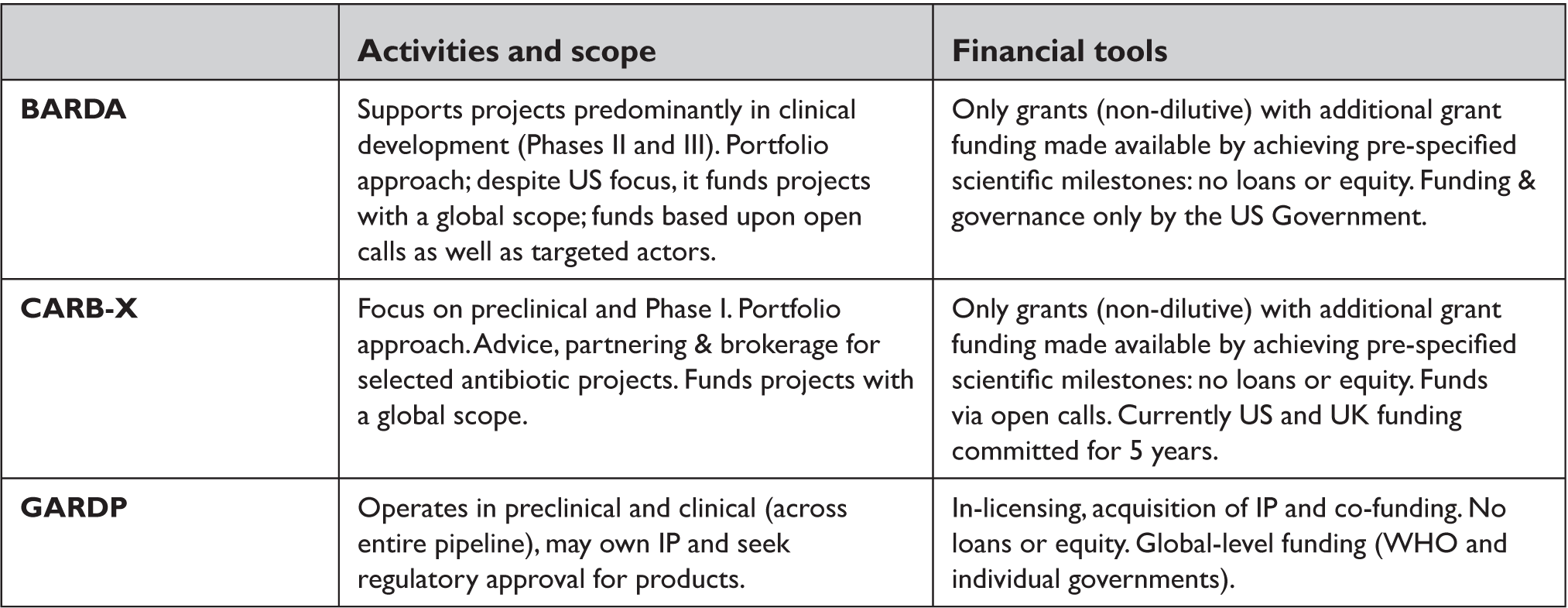
There are clearly many possible combinations of the six dimensions, ranging from a fully vertically integrated pipeline coordinator with full ownership of intellectual property (IP) to a lightweight version dealing only with advice and intermediation over just a few R&D activities. Several pipeline coordinators are already in place and tackling specific areas of the abovementioned functions (see Table 2 for an overview).
Activities and Financial Tools Utilized by Three Pipeline Coordinators

CARB-X targets the preclinical space (for all WHO priority pathogens as well as diagnostics), BARDA targets the clinical development space for all US priority pathogens, and GARDP has focused on two therapeutic areas (neonatal sepsis and sexually transmitted infections caused by Neisseria gonorrhoeae) across all R&D phases. Only GARDP is set up to in-license and potentially generate IP of the antibiotics it supports and to employ flexible financing models, such as out-licensing and co-ownership and co-funding of selected projects.
Expanding Pipeline Coordinators' Toolbox
Considering the activities and financial tools of existing pipeline coordinators in Table 2 reveals that they are currently utilizing mostly milestone-based R&D grants as well as engaging in advisory services. Our analysis identified additional, unexploited tools that could be of benefit to pipeline coordinators.
These particular tools are not proposed here as stand-alone incentives, but as components in the tool-box available to pipeline coordinators with a possibility to combine for a greater effect. They need to be tailored to each, specific R&D project and recipient, based upon substantial insights and in-depth assessments of the particular project.
Equity Funding
An increasingly important role in antibiotic R&D is played by small- and medium-sized enterprises (SMEs).Reference Deak, Outterson, Powers and Kesselheim15 This is, however, a group of developers that are encountering problems in attracting investments by private venture capitalists (VCs).16 SMEs typically perform R&D up to Phase I clinical trials, meaning that the antibiotics are at least five years from market with an over 90% chance of failure. Additionally a company will often have a lean scientific portfolio focusing on one or two antibiotic candidates. Due to the presence of older, effective generic antibiotics, new antibiotics do not offer the possible return on investments of other therapeutic areas. New antibiotics are unlikely to become “blockbuster” drugs (selling more than USD 1 billion per year), especially because of the increasing focus to conserve them to hinder the development of resistance. The time horizons and risk profile for early stage antibiotics are unattractive to traditional VCs. Yet few large companies operate within early R&D phases, meaning that underfunding SMEs will result in few new antibiotics coming to market.
Risk diversification and lower cost of capital can enable a pipeline coordinator to provide loans at lower costs for borrowers and at lower risk for the lender, since it may spread the risks over numerous antibiotic and biomedical projects. Therefore, a potential advantage and impact of this financial structure is to allow antibiotic projects which normally face difficulties in obtaining financing from banks to obtain it and proceed along the pipeline. In this sense, a pipeline coordinator reduces a typical obstacle to funding antibiotic R&D for smaller developers such as SMEs.
VCs often invest in companies in exchange for a percentage equity. This is beneficial for cash-strapped companies with few assets but their intellectual capital. These same companies may also be interested in exiting the market after demonstrating the initial scientific viability of the antibiotic candidate (i.e., at the end of Phase I clinical trials). Public equity funding could be a useful tool to finance promising SMEs by a public sector entity that is willing to take greater risk than the private sector due to the societal value of the new antibiotics.
Equity funding by a public or not-for-profit pipeline coordinator not only makes such investments possible, but also enables investing in antibiotic projects at lower cost than private actors. In particular, if the European Investment Bank (EIB17) and the European Investment Fund (EIF18) were involved in this mechanism, they could borrow at lower costs and have lower profit requirements than private VCs and large pharmaceutical companies.Reference Outterson19 More precisely, EIF's “Innov-Fin Venture Capital” is a new mechanism that can take up to 25% of shares and invest up to Euro 50 million in each VC fund it selects.20 Pipeline coordinators may create or engage a VC fund in which EIF could invest directly, and for which they could in turn hand-pick antibiotic projects for investment. Relying on a public source of capital such as EIF/EIB, the return requirements of such a fund can be set at lower levels than private funds.
Even small differences in required profits, and thereby in the overall cost of capital used in investment calculations such as return on investment (ROI) or net present value (NPV), can be sufficient to bring an antibiotic project over the financial threshold of acceptance.Reference Okhravi, Callegari, Kronlid, McKeever, Baraldi and Brogan21 Namely, projects funded by entities with lower profit requirements may eventually meet or surpass the private investors' financial targets to go ahead.22 This is particularly relevant in the antibiotic field where profitability is low,23 which prevents many antibiotic projects from meeting the financial thresholds of traditional investors.
Most importantly, the risk acceptance of the pipeline coordinator is unchanged. They are still funding scientifically promising antibiotic candidates. The only difference is that rather than funding with grants (with no potential payback), they utilize equity which can offer ROI. As an investor they can also be more active in corporate decision-making in regards to how the product is marketed (according to sustainable use principles) and ensure that the global markets with the greatest need are served.
Favorable and Forgivable Loans
The financial structure centered on pipeline coordinators can lower the borrowing costs of small antibiotic firms compared to typical bank transactions. For instance, EIB's InnovFin has a specialized lending facility for infectious diseases,24 with loanable amounts of Euro 7.5-75 million per company, covering up to 50% of project costs and with 7 years to loan maturity. EIB's InnovFin can also provide borrowers with guarantees25 that cover various percentages of a loan or other favorable terms which may convince other banks to lend money to SMEs.
Therefore, such a structure may even make getting a loan a possibility for small antibiotic developers who would otherwise be seen as too risky by a commercial bank. Risk diversification and lower cost of capital can enable a pipeline coordinator to provide loans at lower costs for borrowers and at lower risk for the lender, since it may spread the risks over numerous antibiotic and biomedical projects. Therefore, a potential advantage and impact of this financial structure is to allow antibiotic projects which normally face difficulties in obtaining financing from banks to obtain it and proceed along the pipeline. In this sense, a pipeline coordinator reduces a typical obstacle to funding antibiotic R&D for smaller developers such as SMEs.
There is also an even more substantial type of financial support that pipeline coordinators can make available to antibiotic developers, namely ‘forgivable’ loans (For a scheme based on forgivable loans, see this reference note.26) Currently applied in various development areas such as new energy production or film-making, forgivable loans usually need to be repaid only if the endeavor they finance turns out to be successful. In this form, a forgivable loan that does not need to be repaid in case of development failure corresponds to a grant,Reference Mossialos27 whereby the funder carries the risk, like for other push mechanisms.
However, a forgivable loan can be designed with such terms that make the borrower carry the risk of failure, transforming it thus into a pull mechanism: this would be the case if the lender (and the pipeline coordinator) forgave the loan only if the developer successfully accomplished certain tasks. A forgivable loan of this kind would operate basically as a milestone-based reward because the corresponding debt will be lifted off the developer's balance sheet upon fulfilling the condition that makes the lender forgive the loan: this condition might be for instance successful completion of Phase I clinical trials within a certain timeframe. An important difference of this kind of forgivable loan compared to traditional milestone-based rewards, addressed in the next section, is that it would provide developers lacking financial means with a much-needed cash injection prior to reaching any milestone.
Milestone-Based Rewards
Milestone-based funding is both a financing and management control tool typically used by private VCs to fund and monitor the SMEs they invest in.Reference Hourd and Williams28 Moreover, milestone-based rewards occur also in R&D collaborations where a funding party, e.g., a larger pharmaceutical firm, rewards an R&D developer when it reaches predefined technical deliverables.Reference Savva and Scholtes29
Even if they do not directly address SMEs' problem of lack of financials through immediate cash inflows,Reference Baraldi, Ciabuschi, Leach, Morel and Waluszewski30 milestone-based rewards, also known as “milestone prizes,” can be particularly attractive to smaller companies as they essentially provide early reimbursement of their R&D costs.31 Configured as “incremental monetary rewards paid at various stages of the development process,”32 payments tied to the achievement of milestones were explicitly pointed out by the SMEs involved in DRIVE-AB discussions as a particularly attractive public incentive for them.33 More precisely, as expressed by representatives of the European association of antimicrobial SMEs BEAM Alliance, milestone-based rewards with payments superior to the sustained R&D costs would not only help finance coming R&D stages,34 but also create a profit which increases the value of the company, thereby making it easier to attract VCs. This kind of milestone-based reward can accordingly be viewed as a mechanism that anticipates the effects of later pull mechanisms, which according to several SME representatives is too far away in the future to really help SMEs in early R&D stages.
Pipeline coordinators currently utilize milestone-based grants, where subsequent funding is enabled by achieving pre-specified milestones. SMEs would like to see these expanded to larger value amounts enabling the SME to “exit,” i.e., sell the IP to a pipeline coordinator or another developer. Yet, as they are government or non-profit agencies, this may absorb too much of the coordinator's capital. A better option is to assist the SME with locating interested developers and assisting with the IP transfer.
Specialized Advice and Brokering
Providing specialized advice to antibiotic developers can alleviate a number of common SME challenges. Timely advice can reduce regulatory costs and support decisions on continuing antibiotic development35 based on, for instance, better interpretation of toxicity data, which is an expertise often missing in SMEs.36 DRIVE-AB's stakeholder discussion with SMEs indicate clearly that they moreover find it difficult to locate or engage clinical research organizations (CROs), have problematic relations with universities' technology transfer offices (TTOs), and lack adequate in vitro and in vivo development models.37
Thus, through its brokering function, a pipeline coordinator can help address several problems faced by antibiotic SMEs: (a) fostering those missing interactions between actors affecting development all the way from discovery to commercializationReference Freeman, Carroll and Hannan38 and (b) connecting small firms to the facilities they often lack, such as adequate research laboratories.Reference Friedman and Alper39
Similar to the financial benefit discussed above, a pipeline coordinator can also benefit from the large-scale effect of having a broad portfolio. Assisting several SMEs will build expertise, continuously expand its network of contacts and enable learning effects and specialization to improve the quality of the service provided and the number of contacts being brokered.
In sum, the specialized advice and brokering function of a pipeline coordinator can help alleviate a number of obstacles by providing support tailored to the problems often faced by such actors. A pipeline coordinator would also reduce the risk of its own portfolio by: (1) lowering of financial thresholds to increase the number of projects that can move forward at each stage of development, and (2) exploiting a positive feedback effect as the portfolio expands and existing projects are managed in a more efficient way and rely on a stronger external network.
Conclusions
Pipeline coordinators are important entities to ensure a robust and comprehensive antibacterial pipeline. BARDA, CARB-X, and GARDP are all examples of pipeline coordinators already making significant progress in filling gaps within the antibiotic pipeline. Since BARDA is a US government agency, its funding priorities are decided at that level, making other countries uninterested or unable to invest additional funds in BARDA.
The G20 group of countries recently launched the AMR R&D Hub40 aiming to maximize the impact of new and existing antimicrobial R&D to address the global threat of antimicrobial resistant infections. One of the Hub's tasks will be to highlight important gaps in the pipeline and orient and stimulate the provision of adequate financing. However, the Hub operates at a political level and there is still need for organizations which intervene at the operational level. Pipeline coordinators will be important actors in filling this gap — feeding in their operational gap analyses to the Hub so that prioritization and actual financing of relevant projects can occur.
This paper suggests that the toolbox of pipeline coordinators could be beneficially expanded by adding four new tools: (1) equity funding, (2) favorable terms and forgivable loans, (3) milestone-based rewards, and (4) advice and brokering services for SMEs.