Management Implications
Bromus tectorum (downy brome, cheatgrass) is an invasive winter annual grass that infests cropping, forage, and rangeland in North America. Common management techniques such as herbicides do not affect the vast seedbank associated with B. tectorum invasion, and control is often site specific due to environmental conditions or genetic variation of the target population that makes it difficult to manage large areas. Pyrenophora semeniperda, a soilborne fungal pathogen, has been investigated as a biological control for B. tectorum, as it can infect and kill seeds within the seedbank. Consequently, B. tectorum propagule pressure will be reduced, making it easier for land managers to control B. tectorum populations. However, P. semeniperda infection is affected by temperature and may also depend upon the source location of B. tectorum seeds. In our laboratory experiment, we exposed B. tectorum seed from three different locations (range, crop, subalpine) with different mean seed weights to P. semeniperda at varying temperatures. We found that seed location and temperature influenced infection and germination. Lightweight seeds from the range and subalpine seed locations were more susceptible to infection, and infection increased across temperatures. In contrast, lightweight seeds had lower germination, and germination was highest at lower temperatures. Overall, seed weight may act as a simple measure of susceptibility to P. semeniperda, thus allowing field practitioners a relatively easy way to assess whether P. semeniperda may contribute to their management strategies. Land managers should use a P. semeniperda strain that is endemic to the treatment area when temperatures are favorable for disease. Land managers interested in P. semeniperda should investigate how it interacts with other management techniques such as herbicides and revegetation.
Introduction
Downy brome (Bromus tectorum L., syn. cheatgrass) is a widespread invasive annual grass in western North America, where it infests millions of hectares of cropping, forage, and rangeland systems (Mack Reference Mack1981; Rice Reference Rice, Duncan and Clark2005). The range of B. tectorum is expected to expand with increasing temperatures (Bradley Reference Bradley2009), compounding its invasion and impacts. As a winter annual, B. tectorum typically germinates and emerges in the fall, after it has lost primary dormancy as a result of warm summer temperatures (Hawkins et al. Reference Hawkins, Allen and Meyer2017). However, seeds will not germinate if conditions are unfavorable and instead may enter secondary dormancy, induced by low winter temperatures and moderate water stress, and germinate in the spring once precipitation arrives (Hawkins et al. Reference Hawkins, Allen and Meyer2017). This spring germination, combined with its fall germination, allows B. tectorum to outcompete perennial species for soil moisture (Kulmatiski et al. Reference Kulmatiski, Beard and Stark2006).
Given the vast distribution of some invasive species, including B. tectorum, and the associated cost of control with herbicides or other methods, biological control is an attractive management option (Seastedt Reference Seastedt2015). Pyrenophora semeniperda (Brittlebank and Adam) Shoemaker (Ascomycotina: Pyrenomycetes), a soilborne fungal pathogen, has been used for biological control of B. tectorum (Beckstead et al. Reference Beckstead, Meyer, Molder and Smith2007, Reference Beckstead, Meyer, Connolly, Huck and Street2010; Ehlert et al. Reference Ehlert, Mangold and Engel2014; Meyer et al. Reference Meyer, Quinney, Nelson and Weaver2007, Reference Meyer, Beckstead, Allen and Smith2008a, Reference Meyer, Nelson, Clement and Beckstead2008b, Reference Meyer, Clement and Beckstead2017). Pyrenophora semeniperda conidia in soil are carried via germination tubes to grass inflorescences, where they infect developing ovaries during anthesis (Medd et al. Reference Medd, Murray and Pickering2003). Infected mature host grass seeds disperse to the ground, where P. semeniperda remains as mycelium for the rest of the summer. The fungus prevents seeds from germinating by consuming starch resources within the ovary. Pyrenophora semeniperda kills the seeds by producing phytotoxic secondary metabolites such as cytochalasin B, which interferes with cytokinesis (Masi et al. Reference Masi, Evidente, Meyer, Nicholson and Muñoz2014a, Reference Masi, Meyer, Cimmino, Andolfi and Evidente2014b). Consequently, P. semeniperda infection has been linked to how quickly host seeds capitalize on their seed reserves (Beckstead et al. Reference Beckstead, Meyer, Molder and Smith2007). Seed embryos that germinate quickly can effectively outcompete P. semeniperda for starch resources within the ovary, while slow-germinating and dormant seeds are more susceptible to mortality. Thus, P. semeniperda infection may be dictated by seed weight, as heavier seeds will have more starch resources within the ovary.
Pyrenophora semeniperda infection varies by temperature (Campbell et al. Reference Campbell, Medd and Brown2003; Campbell and Medd Reference Campbell and Medd2003). The rate of P. semeniperda sporulation was highest at 23/19 C (12-h light/12-h dark photoperiods) in a laboratory setting (Campbell et al. Reference Campbell, Medd and Brown2003).
Hydrothermal time models have been used to understand the effects of temperature and water potential on the disease development of P. semeniperda (Barth et al. Reference Barth, Meyer, Beckstead and Allen2015) as well as seed dormancy status and germination potential of B. tectorum (Hawkins et al. Reference Hawkins, Allen and Meyer2017; Meyer and Allen Reference Meyer and Allen2009). Differences among B. tectorum populations have been considered in previous P. semeniperda work, including studies on water potential and dormancy (Finch et al. Reference Finch, Allen and Meyer2013). Compared with light-seeded species, heavy-seeded species are less vulnerable to fungal pathogens (Crist and Friese Reference Crist and Friese1993), have higher germination and emergence, and produce larger and more vigorous seedlings (Black Reference Black1956; Harper and Obeid Reference Harper and Obeid1967; Schaal Reference Schaal1980). Seed weight as it relates to available seed reserves may influence P. semeniperda infection on B. tectorum. Thus, our objective was to gain a preliminary understanding of the effect of P. semeniperda on three different B. tectorum populations with different mean seed weights across varying temperatures.
Materials and Methods
Bromus Tectorum Seed Locations
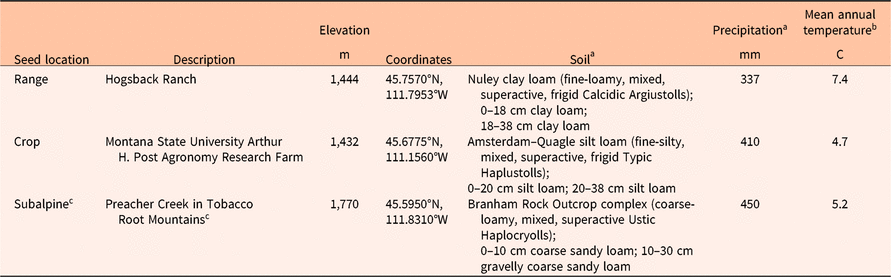
Bromus tectorum seeds were collected in August 2015 from three locations (range, crop, subalpine) that had established B. tectorum infestations (Table 1). The rangeland location was 26 km northwest of Dillon, MT. The cropping location was at Montana State University’s Arthur H. Post Agronomy Research Farm, 8.8 km west of Bozeman, MT. The subalpine location was 10.4 km northwest of Norris, MT. To determine differences in mean seed weight across locations, three samples of 100 seeds from each seed location were dried (50 C for 72 h) (ISTA 2018) and weighed to the nearest 0.01 g.
Information for the range, crop, and subalpine Bromus tectorum seed locations used in this study.

a USDA-NRCS 2016.
b WRCC 2016.
c Information on subalpine seed location obtained from Seipel et al. (Reference Seipel, Rew, Taylor, Maxwell and Lehnhoff2016).
Pyrenophora semeniperda Inoculum Preparation
An isolate of P. semeniperda was obtained from a sagebrush steppe system 17.4 km southwest of Nephi, UT (39.613524°N, 112.002022°W) (S Meyer, personal communication) in the form of air-dried conidia. Air-dried conidia were placed on petri dishes containing modified alphacel medium (Stewart Reference Stewart2009). Four 40-W cool-white and four 40-W black light fluorescent tubes were positioned 40 cm above the petri dishes to provide a 12-h near-visible ultraviolet (320 to 420 nm) photoperiod, and the petri dishes were maintained at room temperature (20 C). The petri dishes were checked for contaminants every 2 to 3 d, and an X-Acto® knife dipped in ethanol and flame sterilized was used to remove bacterial contaminants. After 12 d, conidia were harvested from petri dishes by rinsing the surfaces with 5 ml of sterile deionized water and gently scraping them with a rubber-tipped glass stirring rod. Additional water was used, as needed, and the conidia suspension was poured into a sterile glass jar. A hemocytometer was used to quantify conidia concentration, and sterile deionized water was added until a 5,000 conidia ml−1 concentration was achieved for the inoculum (Beckstead et al. Reference Beckstead, Meyer, Molder and Smith2007). Inoculum was stored at 5 C until seed inoculation, approximately 60 d after preparation.
Experimental Design
The experiment was conducted on a thermo-gradient table at Montana State University that had six parallel aluminum plates (101.6-cm long by 15.2-cm wide by 1.0-cm thick). Temperature was controlled with a 200-W fluid-loop chiller and a 260-W fluid heater at opposite ends of the table, resulting in a 19 C temperature gradient. The experiment consisted of two P. semeniperda treatments (inoculated, noninoculated [control]), three B. tectorum seed locations (range, crop, subalpine), and four table temperatures (20.9 ,17.2 ,13.0), and 24.6 C [± 0.1 C]). All treatments were replicated six times in a randomized block design. Due to the size of the thermo-gradient table, three replicates (1 to 3) were conducted from October 23, 2015, to November 22, 2015 (30 d), and another three replicates (4 to 6) were conducted from January 21, 2016, to February 20, 2016 (30 d).
Pyrenophora semeniperda Inoculum Application and Data Collection
Before inoculation, all B. tectorum seeds were surface sterilized by submerging them for 60 s in 70% ethanol, 60 s in 10% bleach, 60 s in 70% ethanol, and rinsing with sterile deionized water for 30 s (Stewart Reference Stewart2009). Bromus tectorum seed inoculation with P. semeniperda was conducted by placing five seeds in a petri dish (35 by 11 mm) with 1 ml inoculum, and control seeds received an equivalent amount of sterile deionized water. All seeds were placed on a shaker table for 14 h at 50 rpm to allow for adsorption of P. semeniperda inoculum.
Five inoculated and five control B. tectorum seeds from each seed location were placed in individual petri dishes containing autoclaved filter paper (32-mm diameter) that was wetted with 1 ml of sterile deionized water. Petri dishes were sealed with Parafilm® (Bemis, Oshkosh, WI) to prevent the filter paper from drying out. Filter paper was rewetted with 1 ml of sterile deionized water as needed. Pyrenophora semeniperda infection and B. tectorum germination were recorded at day 30. Infection was based on the presence of P. semeniperda stromata (i.e., black finger-like appendages) emerging from the seed, and seeds were considered germinated if a radicle greater than 1 mm was present.
Statistical Analysis
Three ANOVAs were performed. First, an ANOVA was conducted to evaluate whether seed weight differed among B. tectorum seed locations, with seed location (range, crop, subalpine) as the model predictor and seed weight as the response variable. Second, an ANOVA was performed to evaluate whether P. semeniperda infection at day 30 was influenced by B. tectorum seed location and temperature, using a subset of data of only the inoculated treatment, as there was no infection present in the control. Bromus tectorum seed location, temperature, and their interaction were predictor variables, and the response variable was infection counts, which were logit transformed to meet assumptions of normality. Replicates were included as the error term. Third, an ANOVA was performed to evaluate whether B. tectorum germination at day 30 was affected by seed location, temperature, P. semeniperda, and their interactions. The response variable was germination counts, which were logit transformed to meet assumptions of normality. Replicates were included as the error term. All analyses were performed using R software (R Core Team 2017). When significant models were found, means were separated using least squared means (LSD) (α < 0.05).
Results and Discussion
Bromus tectorum Seed Weight
Seed weight differed among B. tectorum seed locations (P < 0.01). The subalpine seed location had the lowest 100 seed weight (mean ± SE, 191.7 ± 4.3 mg), while the crop seed location had the highest seed weight (299.3 ± 2.2 mg). The range seed location had an intermediate seed weight (224.3 ± 1.5 mg).
Pyrenophora semeniperda Infection
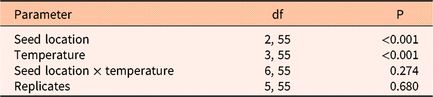
Differences in P. semeniperda infection rates varied by seed location (P < 0.001; Table 2) and temperature (P < 0.001; Table 2). Averaged across temperatures, the heavier B. tectorum seeds from the crop seed location were less susceptible to P. semeniperda infection (40.0 ± 4.8%). The range and subalpine seed locations had higher and similar infection rates (65.0 ± 4.4% and 69.2 ± 6.1%, respectively). Averaged across seed locations, infection rates increased from 13 C (41.1 ± 4.7%) to 17 C (51.1 ± 6.5%) and was higher at 25 C (73.3 ± 6.0%). The infection rate at 21 C was intermediate (66.7 ± 6.7%).
P-values from an ANOVA to test for the effects of Bromus tectorum seed location, temperature, and replicates on seed infection by Pyrenophora semeniperda.

Our results indicate that differences in P. semeniperda infection rates among B. tectorum seed locations did not vary by temperature (P = 0.274; Table 2). Instead, seed from different locations responded similarly across temperatures, and infection across seed locations was highest at 21 and 25 C (intermediate but relatively warm soil temperatures of 70 and 77 F).
Our experimental design did not allow us to isolate genetic, environmental, and/or physiological effects or their interactions on the response of B. tectorum seed from different locations to temperature and P. semeniperda. Despite this, we found that B. tectorum seed weight was correlated with P. semeniperda infection. Heavier seeds (i.e., from the crop seed location) were less susceptible to P. semeniperda infection compared with lightweight seeds (i.e., from the range and subalpine seed locations). These results suggest that differences in intraspecific seed weights across populations could have consequences for P. semeniperda infection and its application for biological control of B. tectorum. Heavier B. tectorum seed weight improved survival and performance in a field study conducted by Leger et al. (Reference Leger, Espeland, Merrill and Meyer2009), who also concluded that seed size was inherited. Thus, heavier B. tectorum seeds may be more resilient to the phytotoxic secondary metabolites produced by P. semeniperda (Masi et al. Reference Masi, Evidente, Meyer, Nicholson and Muñoz2014a, Reference Masi, Meyer, Cimmino, Andolfi and Evidente2014b). Our results, combined with this previous research, suggest that seed weight may act as a simple measure of B. tectorum seed susceptibility to P. semeniperda, thus allowing field practitioners a relatively easy way to assess whether P. semeniperda may contribute to their site-specific management strategies.
Our results demonstrate that temperature influences susceptibility of B. tectorum seeds to P. semeniperda infection. The temperature optima of P. semeniperda and B. tectorum may overlap (Elton Reference Elton2001) in such a way that B. tectorum exists in a stressed state and P. semeniperda can flourish. The experimental temperatures we tested (13 to 25 C) are within the range of soil temperatures B. tectorum experiences during the fall months in Montana, such as September and October, when soil temperatures in 2016 ranged from 7 to 24 C (Western Regional Climate Center, Central Agricultural Research Center station, Moccasin, MT). Bromus tectorum seeds generally germinate on or near the soil surface (<2 cm) in the fall months, and fewer seedlings emerge as burial depth increases from 2 to 10 cm (Hulbert Reference Hulbert1955). Pyrenophora semeniperda infection would be felt by dormant seeds at similar soil depth throughout the winter and into the spring. Seed burial greater than 2 cm is likely to occur in cropping systems that use tillage. Consequently, B. tectorum seeds in cropping systems would experience lower soil temperatures and lower P. semeniperda infection. Using P. semeniperda for B. tectorum control may be possible, provided further research pinpoints site-specific environmental conditions that allow P. semeniperda to flourish and gain control of B. tectorum infestations. Understanding interactions between abiotic (temperature) and biotic (B. tectorum seed location) factors could give field practitioners the opportunity to align B. tectorum management strategies like herbicide applications with P. semeniperda outbreaks to maximize B. tectorum control.
Bromus tectorum Germination
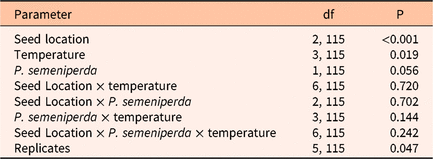
Differences in germination rates varied by seed location (P < 0.001; Table 3) and temperature (P = 0.019; Table 3). Averaged across temperature and P. semeniperda treatment, the seed from the range location had the lowest germination rate (5.8 ± 1.9%), increasing for seed from the subalpine and crop locations (28.8 ± 3.8% and 45.4 ± 4.2%, respectively). Unlike infection, germination was similar and lowest at 21 C (22.8 ± 4.4%) and 25 C (19.4 ± 4.6%) and higher at 13 C (30.6 ± 5.0%) and 17 C (33.9 ± 4.8%), averaged across seed location and P. semeniperda treatment. Inoculation with P. semeniperda had a marginal effect on germination (P = 0.056; Table 3), decreasing germination (23.1 ± 3.0%) compared with the noninoculated control (30.3 ± 3.6%). Replicates had a small effect on germination (P = 0.047; Table 3), with low germination in Replicate 4 (15.8 ± 4.8%) compared with Replicates 1 and 3 (33.3 ± 7.1% and 35.0 ± 6.6%, respectively)—all other replicates had intermediate levels of germination.
P-values from an ANOVA to test for the effects of Bromus tectorum seed location, temperature, Pyrenophora semeniperda, and replicates on seed germination.

Germination differed by seed location and was particularly low for seed from the range location. Lower B. tectorum germination is not unheard of under laboratory and greenhouse conditions when investigating contrasting habitats. Recently harvested B. tectorum seeds incubated at varying temperatures had 10% to 90% germination across seeds collected from three semiarid habitats (Allen et al. Reference Allen, Meyer and Beckstead1995). Slow germination was also a characteristic among recently harvested B. tectorum seeds from five populations (Beckstead et al. Reference Beckstead, Meyer and Allen1996). These studies and Allen and Meyer (Reference Allen and Meyer2002) demonstrate that B. tectorum germination increases under laboratory and greenhouse conditions as time in storage (20 C) increases. Again, our experimental design did not allow us to isolate genetic, environmental, and physiological effects or their interactions on the response of B. tectorum from three different locations to temperature and P. semeniperda. However, these studies suggest that germination responses in B. tectorum habitats (i.e., seed locations) might have both genetic and environmental components (Beckstead et al. Reference Beckstead, Meyer and Allen1996).
Temperature is a significant factor in the rate of P. semeniperda growth, sporulation, and aggressiveness and the rate of B. tectorum seed germination after being inoculated with P. semeniperda. In our experiment, temperature influenced P. semeniperda infection and B. tectorum germination. Laboratory research has found an optimal temperature for P. semeniperda growth to be 23 C (Campbell et al. Reference Campbell, Medd and Brown2003), but the temperature at which P. semeniperda loses efficacy has not been reported. Bromus tectorum can germinate at just above freezing (5 C) (Evans and Young Reference Evans and Young1972), but germination is inhibited above 30 C (Harris Reference Harris1976). Thus, testing more temperatures below 25 C may further clarify the relationship between P. semeniperda and B. tectorum.
The development of alternative management strategies for B. tectorum that incorporate biological control with P. semeniperda has been underway for some time (Beckstead et al. Reference Beckstead, Meyer, Molder and Smith2007, Reference Beckstead, Meyer, Connolly, Huck and Street2010; Ehlert Reference Ehlert2013; Ehlert et al. Reference Ehlert, Mangold and Engel2014; Meyer et al. Reference Meyer, Quinney, Nelson and Weaver2007, Reference Meyer, Beckstead, Allen and Smith2008a, Reference Meyer, Nelson, Clement and Beckstead2008b). Further advancement is needed as climate change affects B. tectorum distribution (Bradley Reference Bradley2009; Bradley et al. Reference Bradley, Blumenthal, Wilcove and Ziska2010; Concilio et al. Reference Concilio, Loik and Belnap2013; Taylor et al. Reference Taylor, Brummer, Rew, Lavin and Maxwell2014; Zelikova et al. Reference Zelikova, Hufbauer, Reed, Wertin, Fettig and Belnap2013) and the efficacy of current control methods (Hellmann et al. Reference Hellmann, Byers, Bierwagen and Dukes2008). Our results indicate that P. semeniperda infection increased and B. tectorum germination decreased with increasing temperature, and B. tectorum seed from different locations experienced varying levels of infection and germination. However, our conclusions are limited because of the single inoculum source and lack of replication across seed locations. Despite these limitations, this study provides further insight into temperature optima of P. semeniperda infection and consequent effects on B. tectorum and supplies information on how a simple measure (i.e., seed weight) can serve as a starting point for elucidating whether or not a location infested with B. tectorum is likely to experience P. semeniperda infection.
Author ORCIDs
Krista A. Ehlert 0000-0002-6423-8670
Acknowledgments
The authors would like to thank Lisa Rew for lending her temperature-gradient table for this research. The authors gratefully acknowledge Montana State University’s Undergraduate Scholars Program for providing funding to support this research. No conflicts of interest have been declared.