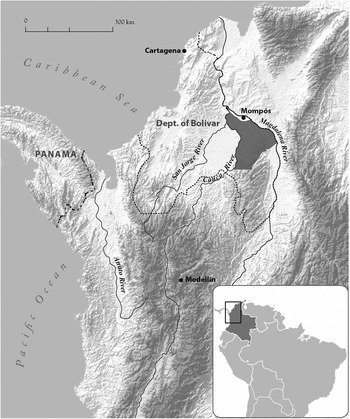
In 1909, a group of entrepreneurs from Utah purchased an enormous property in the Caribbean region of Colombia (Figure 1). Roughly measuring six hundred thousand hectares, and encompassing five municipalities in the Department of Bolivar, the Tierras de Loba (Lands of Loba) was the country’s largest privately owned estate.Footnote 1 Sandwiched between the Magdalena and Cauca rivers, south of the colonial city of Mompós, much of the property lay within a geological depression subject to extensive flooding in the rainy winter months. In the dry season, however, lush pasturage covered a vast network of seasonal savannas, convincing Joseph J. Cannon that it could become one of the finest cattle ranches in the world.Footnote 2 Moreover, exuberant vegetation heralded its agricultural potential, valuable forests blanketed the extensive uplands, and signs of mineral wealth lay underground. Given the apprehension about a looming scarcity of natural resources—Teddy Roosevelt forewarned of a “timber famine”Footnote 3 —the Americans claimed that the Lands of Loba was “no speculation.”Footnote 4 Cannon surmised that it could eventually be worth $59 million (or over one billion in today’s dollars).Footnote 5 In 1917, Utah mining magnate Jesse Knight acquired the property and created the American-Colombian Corporation to oversee its development; some twenty years later, Laurance and Nelson Rockefeller purchased a controlling interest. Yet none of the development plans gained traction and, by 1959, Nelson finally conceded that the company was a lost cause. His hand was partially forced by the tens of thousands of peasants who claimed property rights within the Lands of Loba: removing them would be a Sisyphean task and buying them out was too expensive. The Americans’ failure was not a foregone conclusion, however. Over the same period, Colombian ranchers successfully extended their territorial control, turning the Caribbean lowlands into the country’s center of beef production. The story of the American-Colombian Corporation thus raises two overarching questions (in addition to several specific ones). Why were the Americans unable to maintain their grip over the Lands of Loba and successfully exploit its abundant resources? And what can their fiasco teach us about the challenges of landed investments by free-standing companies?
The Lands of Loba.
Source: Map created by the author. Location of the Lands of Loba from Figure 1 in A. Burchardt, F. S. Johnson, and R. P. Russell, “Memorandum Re Visit to Las Tierras de Loba, Property of American Colombian Corporation, State of Bolivar, Colombia, March 25/April 1, 1952,” Folder 8, Box 1, Record Group 4, Rockefeller Family Archives, Rockefeller Archive Center.

In responding to these questions, I highlight three aspects of this story. First, the directors of the American-Colombian Corporation misread the natural environment. While they expected to harness the region’s exuberant ecological productivity, they instead encountered the difficulties of tropical ranching. Business historians are often keenly aware that nature matters, at least in terms of the material conditions of production. This case also demonstrates how perceptions of nature can influence investment decisions. Second, the promoters likewise miscalculated the challenges of Colombia’s business environment. On the one hand, the political nature of property rights, the ambiguities in Colombian law, and the overlapping claims of “squatters” debilitated their title. This frustrated the firm’s efforts to raise capital, which limited its capacity to establish dominion by raising cattle. On the other hand, its persistent embryonic nature, along with the country’s fractured political landscape, undermined the state’s willingness to uphold the Americans’ property rights and suppress local resistance. Last, the enterprise fell victim to its own speculative ambitions. Rising land values and natural resource scarcity convinced the American investors to purchase the Lands of Loba. Yet they did not have the means to demonstrate its potential and secure their property rights. The resulting vulnerability was exacerbated by the company’s enormous territorial pretensions. While the size of the estate made the venture attractive, it also made the property exceedingly difficult to control. As a consequence, the company had trouble raising capital and its position remained precarious. By dreaming big, the owners of the American-Colombian Corporation invited failure. Let me unpack these topics.
The Nature of Free-Standing Companies
The American-Colombian Corporation was part of a wave of land grabbing in the Global South during the late nineteenth and early twentieth centuries.Footnote 6 By 1913, the overseas landholdings of British companies listed on the London Stock Exchange surpassed 71 million hectares, nearly a threefold increase since 1885. The geographic focus of these holdings had also shifted: almost three-quarters were located in the future developing world, compared to just 15 percent three decades earlier.Footnote 7 Americans also participated in this global frenzy, although they usually invested closer to home. They embarked on a vast buying spree in Mexico, acquiring 53 million hectares, or more than one-third of the country’s territory, by 1910.Footnote 8 By this time, American companies also owned 1.7 million hectares in Cuba, or about 10 percent of its land base.Footnote 9 Within a few years, the United Fruit Company, Percival Farquhar’s Brazil, Land and Cattle Company, and the International Products Company each owned about one-half million hectares, respectively, around the Caribbean, in Mato Grosso, Brazil, and in the quebracho forests and savannas of Paraguay.Footnote 10 It is difficult to estimate the overall territorial footprint of American foreign investment since the aggregated data tracks capital flows rather than acreage. Nonetheless, by 1914, U.S. interests in Latin American agriculture (not including Mexico and Cuba) almost doubled those in Mexico, suggesting American landholding south of the border was extensive.Footnote 11
While American multinationals, such as the National Sugar Refining Company, American Chicle Company, and the Ford Motor Company, invested in Latin American agriculture, free-standing companies, like the American-Colombian Corporation, also played a significant role. Mira Wilkins coined the term free-standing company to differentiate the predominant form that British foreign direct investment took before 1914 from the “American model” of multinational.Footnote 12 The latter began operations at home, building up technical and managerial know-how before expanding abroad. Free-standing companies, by contrast, were new enterprises founded primarily in wealthy countries to undertake specific business opportunities in capital-poor ones. Floating shares in well-developed equity markets was an efficient way to raise capital and provided an acceptable structure for metropolitan investors to participate in distant business enterprises that promised relatively high rates of return.Footnote 13 Although free-standing companies were most significant in Britain, they also arose in Western Europe and North America.Footnote 14 “Traditional” multinationals may have dominated U.S. foreign direct investment in absolute terms, but droves of American entrepreneurs created free-standing companies to profit from the upsurge of demand for tropical commodities and other natural resources.Footnote 15 Most of these concerns remain unknown due to the limited scale of their operations and their ephemerality.
Wilkins explains the “high mortality rates” of free-standing companies as a consequence of their limited business expertise.Footnote 16 For example, just 14 percent of British promoters of overseas mining ventures had previous experience in the domestic industry.Footnote 17 While distance, poor knowledge of local conditions, and fraud also played roles, the “fundamental difficulty,” Wilkins argues, was that free-standing companies “had no real home office to draw on to make the required decisions.”Footnote 18 Well-developed service sectors, which offered a range of expert advice, permitted the existence of lean governance structures. However, for firms without “substantial internalization of administration and technical abilities,” such outsourcing turned out to be an insufficient remedy.Footnote 19
Not all business historians concur with Wilkins’s assessment. Some think that she exaggerated the rate of failure, either by overemphasizing high-risk sectors, like mining, or ignoring the “lots of good reasons” why they might fold.Footnote 20 Some of these reasons include the natural lifecycle of free-standing companies, which tended to concentrate on individual ventures or property development, political instability, and unfavorable legal structures.Footnote 21 Others suggest that many free-standing companies internalized the skills needed to survive and developed adequate means to manage their distant ventures.Footnote 22 Moreover, numerous free-standing companies were less autonomous than the name implies. The practice of linking nominally independent firms within business groups, along with interlocking directorates, enabled individual companies to draw on broader market information and expertise than their lean governance structures would suggest.Footnote 23
Yet much of the literature on free-standing companies tends to sidestep the question of failure at the level of the firm. One tendency is to analyze their misfortunes at the sectoral level, pointing to the secular decline of business lines rather than internal deficiencies.Footnote 24 Another line of inquiry attributes the downturn of the form at the national scale to have been a function of rising accumulation in host countries.Footnote 25 Even Corley, who examines the issue at the firm level, ends up naturalizing failure by suggesting that the high mortality rate of free-standing companies was just a function of their recent formation: few “tadpoles,” no matter the nature of the firm, survive to adulthood.Footnote 26
The history of the American-Colombian Corporation revives the question of failure, but points to the challenges of the “external” environment and the speculative nature of free-standing companies.Footnote 27 In particular, it highlights the influence of ideas about nature, the ambiguities of property rights, and the exercise of power within host societies.
While Rosen and Sellers prompted business historians to ask “explicit questions about the role of environmental factors,” there has been relatively little interest in the “culturally rooted dimensions of knowledge” within their “ecocultural” approach.Footnote 28 Exceptions exist, such Jones and Mowatt’s analysis of how New Zealand’s “clean and green” image discouraged the development of an organic food industry; or Martin’s study of how the United Fruit Company resignified the languid tropics to sell the Caribbean as a revitalizing escape from the hectic demands of modern society.Footnote 29 Most attention, however, has focused on pollution and its regulation; or, more recently, green capitalism and flows of environmental knowledge.Footnote 30 Yet perceptions of nature, such as shifting ideas about the tropics, also influenced investment decisions.Footnote 31 In the case of the American-Colombian Corporation, discourses about natural resource scarcity recycled long-held notions of tropical bounty to generate rose-colored appraisals of the Lands of Loba.
More sober assessments about the inherent potential of the tropics may have undermined the American-Colombian Corporation’s efforts to raise capital, but uncertainty about the strength of its property claims posed a greater challenge. This should come as no surprise given the importance of clear property rights to business and economic development. Yet property rights, as Katherine Vedery has pointed out, can sometimes be “fuzzy.”Footnote 32 The Americans were reluctant to confirm their title before the courts due to fear of lingering anti-Yankee sentiment, which stemmed from the U.S.-backed separation of Panama in 1903.Footnote 33 They also discovered that the Lands of Loba was subject to overlapping claims from thousands of residents on the estate. In other words, their title was politically vulnerable while squatters’ rights proved to be more robust. The key insight, well-established in the legal community, is that “property is not a thing but a power relationship.”Footnote 34 Where the rule of law is weak, the social basis of property rights makes them especially malleable. It also encourages claimants to pursue land rights in multiple spheres. To this end, the Americans raised cattle, cultivated the support of government officials, and tried to “buy” the trust of local communities.
Despite its political sway, the American-Colombian Corporation was not, contra Orlando Fals-Borda, a classic “imperialist company” that took advantage of colluding elites and threatened “armed invasion.”Footnote 35 Within Colombia its power was limited, which frustrated the firm’s attempts to exert greater territorial control; and the U.S. government paid little heed to its tribulations. While debates about informal imperialism tend to focus on the influence of foreign companies at the national level, the American-Colombian Corporation exercised more clout at local and regional levels, where the cooperation of officials was often critical. Yet even at these scales, numerous politicians and other elites were noncommittal or antagonistic, in part the product of a fractured political landscape. The relative weakness of the American-Colombian Corporation contrasts with the widespread view that landed elites exercised an iron grip over rural Colombia.Footnote 36 Instead of an anomaly, however, the Americans’ wavering influence better captures the complexities of power in the countryside. Building on Richard John’s call for business historians to pay more attention to the social context in which firms operate, this account shows how case studies can contribute to social history more broadly.Footnote 37
The failure of the American-Colombian Corporation was also rooted in the speculative nature of free-standing companies. While the potential for fraud was prevalent, perhaps more significant was the subterfuge, or what Anna Tsing calls the “spectacle” inherent to many frontier investments.Footnote 38 Forced to raise capital before the viability of a venture was proven, promoters might be tempted to exaggerate a company’s prospects simply to ensure it got off the ground. Given the risks associated with free-standing companies, many investors worried about overcommitting, which ensured that some firms remained undercapitalized and vulnerable.Footnote 39 Furthermore, free-standing companies were often more willing to enter agricultural production than multinational enterprises, which frequently thought it best left to local producers.Footnote 40 International Harvester, for example, dominated the Yucatan sisal market by contracting with Mexican plantation owners, thereby avoiding the political risks and hassles of direct production.Footnote 41 Similarly, American beef packers did not integrate backward into stock raising after taking control of Argentina’s meat-packing industry.Footnote 42 When multinationals did operate plantations, the decision was often rooted in the need to tightly coordinate production and processing, ensure careful handling of delicate products, or internalize asset specificity and the costs of developing frontier regions.Footnote 43 By contrast, free-standing companies might ignore the added risks of direct production when market demand appeared sufficiently strong. In the case of the American-Colombian Corporation, the size of the property added to the perception of its upside potential. Beyond the profits from raising cattle, logging, and agriculture, company directors bet on rising real estate values. In the end, however, what made the venture so attractive also proved to be its downfall: the Lands of Loba was too big to adequately develop and control.
Last, this story is part of a larger effort by business historians to reevaluate Latin American entrepreneurial capacity. As Carlos Dávila and María Inés Barbero note, a key concern for scholars and officials into the 1970s was the degree to which Latin American elites were capable of leading the national drive toward modernization.Footnote 44 This was especially true in the countryside, where the legacy of large estates and a greater appetite for status rather than risk-taking appeared to stymie agricultural output and productivity growth. To many mid-twentieth-century observers, the weak entrepreneurial inclination was one cause of the region’s underdevelopment. By the 1980s, however, structural change and the growth of private companies pushed business historians to more carefully examine the formation of Latin American bourgeoisies and the character of their firms. Such efforts have highlighted how traits once seen as backward—such as the emphasis on family firms, diversification, landed estates, and rent-seeking—were often responses to the uncertainties and opportunities of domestic business conditions.Footnote 45 Simply put, entrepreneurialism was more prevalent than previously imagined, even in the countryside. Historians Samuel Amaral and Eduardo Posada-Carbó helped forge a new narrative around cattle ranching in Argentina and Colombia that stressed micro-economic decision making.Footnote 46 More generally, economic historian Adolfo Meisel describes a “new vision” of past entrepreneurs from Colombia’s Caribbean coast—which other historians have extended to the country at large—that emphasizes their technical and commercial skills, cosmopolitanism, willingness to pool resources, “sharp sense of economic opportunity and capacity to assume risk.”Footnote 47 Curiously, at the moment that business historians began to reassess Latin American entrepreneurship, scholars concerned about the expansion of ranching into the region’s humid forests breathed new life into the older narrative that held the main function of ranching to be territorial control.Footnote 48 While the story of the American-Colombian Corporation confirms the use of cattle to reinforce land claims, it also demonstrates the limits of this strategy: as ranchers pushed into forested regions, the cost and labor of developing pastures complicated the monopolizing impulse, underscoring the need to treat ranching as a business enterprise.
The Rise and Fall of the American-Colombian Corporation
In 1908, Utah-native Joel Ricks spent six months in Colombia as part of his project to reconstruct ancient Mormon geography.Footnote 49 Traveling in the footsteps of the Brigham Young Academy South American Expedition, whose leader, Benjamin Cluff, bet his worldly fortunes on a rubber plantation in Mexico, Ricks was also alert for business opportunities.Footnote 50 With increasing foreign interest in Colombia’s natural resources, conversations on the paddle steamers that plied the Magdalena River often turned to questions of real estate. Francisco Vásquez likely saw Ricks as a potential buyer for his ranch, El Palmar. What intrigued the American, however, was the possibility of acquiring the enormous property in which El Palmar was located. Just three months after returning home, Ricks departed again for Colombia. This time he traveled with Walter Cluff, Benjamin’s younger brother, and with the backing of Leslie Snow, Joseph Cannon, and several other prominent members of the Church of Latter Day Saints. They were not interested in founding a Mormon colony, as in northern Mexico, but in making a fortune in timber, livestock, and tropical agriculture. With a favorable legal opinion regarding the validity of the title, Ricks and Cluff purchased the rights to about half of the outstanding shares in the undivided estate.Footnote 51
Back home, the partners incorporated the Colombia Land and Investment Company and began selling shares to raise capital. Through Sloan & Cutler, a Salt Lake City brokerage firm, they initially offered fifty-thousand shares (out of total one million) at a 50 percent discount off their par value of one dollar.Footnote 52 In the context of an imminent “lumber famine,” this was “the chance of a life time”: a share in two million acres of “the most fertile accessible land in the world, covered with . . . precious woods of incalculable value.”Footnote 53 “Formed by men of known standing in this State,” and backed by an enthusiastic endorsement from a former U.S. minister to Colombia, the company promised “enormous profits” as “one of the great lumber sellers of the globe.”Footnote 54
The Colombia Land Investment Company, however, was propped up by the “spectacle” or hype inherent to many investments in remote frontier regions.Footnote 55 The directors failed to mention that they had only managed to purchase half of the original estate; and instead of an “unassailable title,” in 1909 the minister of public works declared that the Lands of Loba had reverted to the public domain.Footnote 56 This declaration emboldened long-established communities on the property to reject the company’s land claims. The U.S. consul in Barranquilla even warned that “if anyone attempted to collect rent on [company] land … he would probably never get out alive.”Footnote 57 Similarly, the directors’ assessment of their timber resources was a wild guess. “We saw large and beautiful trees,” Cannon later acknowledged, and presumed they had “great value.”Footnote 58 However, claiming the existence of clear property rights and valuable resources was critical to the company’s ability to raise the capital needed to purchase the rest of the estate and demonstrate its potential. The initial discrepancies between the promotional literature and realities on the ground were a fleeting deceit designed to ensure the success of, they imagined, a sure-fire venture.
Raising capital was harder than company directors had anticipated, especially in the shallow financial markets of the intermountain West. By early 1911 the company had raised less than 15 percent of its initial goal of $25,000. Most of these funds came from small investors in Utah who promised to be fully paid-in by the end of the year. On the edge of insolvency, the principal owners agreed to increase their own investment. Cannon fretted about the size of his assessment, but recognized that the injection of capital would enable the company to solidify its property rights and confirm the value of its resources, both of which were essential to selling the Lands of Loba or raising capital to develop it. Purchasing the outstanding shares for twenty cents each also allowed the directors to rechristen the firm as the Magdalena Land Company.
In 1913, the company hired Hyrum Harris, a Mormon lawyer with experience in Mexico, to confirm the validity of its property rights. Harris spent six months in Colombia tracing the title back to the original 1637 land grant. This helped convince the new minister of public works, Simón Araújo, to declare that the Lands of Loba had not, in fact, reverted to the public domain.Footnote 59 While this declaration did not substantiate the Americans’ rights—only the courts could decide that—it removed the most glaring challenge to their presence. The next step, Harris suggested, was to convince the few thousand “squatters” (or peasant homesteaders, depending on one’s perspective) to recognize the company’s property rights.Footnote 60 Cannon acknowledged that this “human problem” required “careful handling,” but he viewed their potential labor as an “immense asset.”Footnote 61
The directors of the Magdalena Land Company next sought to demonstrate the property’s promise. They hired Hugh Curran, a forester from Yale University with nearly a decade of experience in the tropics, to assess the value of the company’s timber resources. After spending several months on the property in 1916, Curran estimated that its forests contained six billion board feet of timber, 16 percent of what the United States produced in 1915.Footnote 62 With standing timber close to water transport and good supplies of cheap labor, this was “the best proposition he ha[d] ever seen.”Footnote 63 Curran had also “never seen such fertile land” and suggested that its agricultural potential was even greater.Footnote 64 He and Cannon dreamed about the progress they could generate—complete with “beautiful Japanese houses”—by turning the Lands of Loba into “the largest and most profitable farm in the world.”Footnote 65 The directors, however, first planned to develop the cattle business. They hired Ignacio Uribe, a graduate of Cornell University’s veterinary program (and a cousin of Rafael Uribe Uribe, famed leader of the Liberal Party),Footnote 66 to assist their endeavor and write a report. Uribe called ranching one of the most “attractive and safest” investments in Colombia and extolled its prospects on the Lands of Loba. The existing natural grasslands could easily carry twenty-five thousand head of cattle, and carving new pastures out of upland forest could increase the stocking rate fourfold.Footnote 67
Even with favorable reports, raising capital was challenging. Although the directors continued to rely on personal networks, they expanded their scope to include western stockmen, southern timber interests, Pittsburgh oil money, and New York financiers. Selling the proposition by correspondence was laborious and expensive, since promising clients still wanted face-to-face meetings. While real estate brokers and investment bankers extended their reach and reduced upfront expenses, they demanded a large cut. Selling small lots of shares was equally difficult. Without a track record and not listed on any stock exchange or curbside market, it was the job of gifted salesmen to convince potential investors that the company’s prospects outweighed the risks. The company subcontracted this work to brokers, including the Magdalena Land Sales Company, set up by Cannon with three family members and Guy Van Alstyne (who “had been so successful [selling shares] with the National”).Footnote 68 The Magdalena Land Sales Company centered its operations in Pittsburgh, where Van Alstyne was trying to break into the oil business. The handful of salesmen sent to accompany him worked partly on the company’s account and partly on commission. However, without “local men of influence on board,” sales were disappointing.Footnote 69
The most promising deal came from an unlikely source: the Iron City Trades Council, an association of Pittsburgh-based trade unions. The council wanted to offer its members the opportunity to purchase farmsteads for retirement. After a deal with a Texas land company fell through, Van Alstyne interested the council in the Lands of Loba, which was considerably cheaper. Cannon was thrilled: solvent White men accustomed to hard work “would make the land blossom.”Footnote 70 Selling a one-tenth stake would also provide the company with enough capital to buy the rest of the property and start the cattle business. Cannon raised $1,999 to invite the current and past presidents to visit the property in March 1916.Footnote 71 Unfortunately, they were unimpressed (or possibly horrified by the predominately Black and mixed-race population) and quickly turned home.Footnote 72
Although the Trades Council deal fell through, returning to Colombia increased Cannon’s enthusiasm in the project. Under pressure from skeptical partners, he intensified his letter-writing campaign. “You may never have thought of investing in South America,” Cannon wrote to Edward Woods, head of Equitable Life Assurance’s largest agency, but with a “paternal directing force”—and building on Progressive-era tropes of efficiency and improvement —“we can have not only a large financial return but also a great garden in the heart of a poorly cultivated country.”Footnote 73 Cannon’s efforts did not bear fruit. His attempt to transform the “two to four thousands families [some ten to twenty thousand people] living as squatters” into “a little army of workers” might have seemed dubious.Footnote 74 The Mexican Revolution and growing prospects of war with Germany also unnerved investors.Footnote 75 Yet as the Magdalena Land Company once again stood on the verge of insolvency, a deep-pocketed investor stepped forward.
In June 1917, Jesse Knight took over the company, which he restructured as the American-Colombian Corporation. At age seventy-two, Knight had years of experience running large-scale mining, industrial, agricultural, and livestock operations in western North America.Footnote 76 Not one to shy away from big, speculative investments, Knight likely envisioned America’s resource frontier shifting south where land was cheaper. With six billion board feet of merchantable timber, as well as luxuriant grasses, rich soils, and encouraging mineral prospects, the Lands of Loba, at less than ten cents per acre, seemed a bargain.
Knight’s first course of action, after purchasing the outstanding shares in the estate, was to build up the cattle business. He eventually planned to produce sugar and log the property, but ranching was the easiest and least risky of the possible endeavors. With strong demand for beef and seemingly low production costs, the potential profits were also promising.Footnote 77 The Americans initially intended to export to the Canal Zone, but ultimately they wanted to enter the Eastern U.S. market, where the price of finished cattle was double that in Colombia. How they envisaged shipping their cattle is unclear, but their plans appear to have been contingent on the construction of the country’s first meat-packing plant at the Caribbean port of Coveñas. (This plant never opened because Colombian beef, it turned out, was not competitive on global markets.)Footnote 78 Cannon, who agreed to live in Colombia as general manager, hoped to see twenty-thousand head or more of cattle grazing on company lands before long.
Cannon’s principal strategy was to entice local families into sharecropping arrangements. Most families living on the Lands of Loba were peasants who annually cleared a few hectares out of the forest to farm. They were primarily Black or mulatto, many the descendants of enslaved people who panned for gold, farmed, and worked as ranch hands for one of the few ennobled families of Colombia’s Caribbean coast. Others descended from free peasant families, although they owed (and disputed) rent for the land they farmed. Over the nineteenth century, new families of homesteaders settled the backwoods and streams of the Lands of Loba, also disputing demands for rent. Some residents developed sizable herds of cattle, which they grazed on the “communal” seasonal floodplains.Footnote 79 The American-Colombian Corporation offered to provide these peasant-ranchers with cattle (or money to buy cattle), which they would raise in exchange for one-third of the profits. This system promised to resolve the problems of oversight and, more significantly, consolidate the company’s property rights. In addition to agreeing to recognize the Americans’ title, sharecroppers enabled the company to distribute its cattle around the vast estate, helping it “gain undisputed physical possession of the property.”Footnote 80 Cannon also hoped that the scheme would “draw into friendship and business squatters who now look at us with suspicion.”Footnote 81
Difficulties soon arose. Rising livestock prices and a falling exchange rate frustrated Cannon’s ability to rapidly stock the land. More critically, the sharecroppers did not always buy cattle with the money advanced to them, rarely repaid their other debts, and treated company cattle poorly or “lost” them.Footnote 82 “I am of course aware of the irresponsibility of these men,” Cannon admitted. But with a strong paternalistic disposition, he stood by his scheme: “Time will teach us how . . . to encourage the contractor to live up to his obligations but I think the theory is right and believe the practice has been on the whole better than if we had employed the available labor to take care of our cattle and do our work.”Footnote 83 In the short run, however, the sharecropping system neither generated profits nor allayed the enmity that pervaded local communities.
These troubles undermined Knight’s confidence in the project. While he put the American-Colombian Corporation on firmer financial footing, his own Knight Investment Company was highly leveraged, and he could not develop the Lands of Loba on his own. Although he had capitalized the firm at $100,000, by July 1918 he had ploughed $150,000 into the endeavor. Knight often relied on such stockholder assessments, judging corporations unwilling to issue levies to be “almost worthless.”Footnote 84 In this case, there was little opposition since the Knight family held 90 percent of the shares. Instead of selling unissued stock, Knight sought to finance the project by selling a large stake in the privately held company. Yet a year after taking it over, he had to admit “money was very hard to raise.”Footnote 85 The outlook improved the following year. As American oil prospectors swarmed the country, Knight sold a 10 percent interest to the Kansas-based Emerald Oil Company for $100,000.Footnote 86 The infusion of cash helped Cannon enlarge the company herd from three hundred to one thousand head and import twenty-eight Hereford bulls.Footnote 87 Ranching, however, is a capital-intensive endeavor. To stock the property with five thousand head before year’s end, as Cannon hoped to do, would have required twice as much as Emerald Oil had invested.
Unable to raise additional capital, and in desperate need of funds to keep his other investments afloat, Knight grew weary of the South American venture. He called Cannon home in mid-1920 to help drum up interest. Yet in the midst of a postwar depression, potential investors were skittish. By November Knight had decided to unload the property, giving Cannon a three-month option to broker a deal.Footnote 88 Cannon raised $3,000 to travel to New York, where he pitched the proposal to a wide range of interests.Footnote 89 While the Carib Syndicate, an American oil company operating in Colombia, and the International Products Company, which was building a meat-packing plant at Coveñas, southwest of Cartagena, expressed interest, Cannon could not close a deal.Footnote 90 By February 1921, the situation had turned dire: the board ordered Samuel Haskell, the Salt Lake City native left in charge of operations, to slash expenses even if it meant losing their pastures to forest regrowth.Footnote 91 The following month, Jesse Knight died of a stroke.
As the directors of the Knight Investment Company settled its affairs, they reaffirmed the decision to sell the Lands of Loba. They kept Haskell, his German assistant, Albert Gabriel, and three Colombian lawyers on payroll to manage and defend the property, but scraped all expansion plans. Yet no buyer stepped forward even as economic conditions improved. The presumed scarcity of global beef supplies—Britain’s Lord Harcourt had warned of a possible beef “famine”Footnote 92 —did not materialize, and the American-Colombian Corporation continued to hemorrhage cash rather than turn a profit. When Haskell resigned in 1924 to join an oil company, the board sent Lester Magnum, Knight’s son-in-law, to stem the losses and demonstrate the property’s potential.
Magnum opted for direct management instead of Cannon’s sharecropping strategy. Distributing company cattle among sharecroppers may have helped to demonstrate possession, but the system operated at a loss. The Lands of Loba could become “one of the most beautiful and productive cattle ranches . . . in the world,” Magnum thought, but there was a risk: by consolidating operations on its own pastures, the company could lose control of the property before it had a chance to sell it.Footnote 93 This convinced Magnum to confirm their title in court, the strategy Cannon had avoided. But before he could bring the case before a judge, Magnum contracted typhoid and was ordered home in early 1926.Footnote 94 Gabriel stayed on to manage the property, but within a year he resigned to start another cattle venture. Unable to find a suitable replacement, the board decided to sell their cattle and lease the pastures to Gabriel in exchange for keeping the property taxes current.Footnote 95 Without a clear title or proven track record, the asking price for the Lands of Loba tumbled from $1.25 million to $250,000.Footnote 96
In 1936, Jesse H. Knight—the elder Knight’s grandson—thought he could earn the 40 percent commission offered by the Knight Investment Company, which entered receivership following the crash of 1929, to broker a deal for its Colombian property. However, with the backing of Harold Marsh, a senior partner in his law firm, and James Johnston, president of the Washington Stock Exchange, the young Knight decided to buy the property instead.Footnote 97 Like their predecessors, the trio saw the potential for ranching, agriculture, timber, and oil, but they did not have enough capital to develop the property themselves. This time around they had less trouble finding well-heeled investors. In 1940, Laurance and Nelson Rockefeller purchased a majority stake in the American-Colombian Corporation.
As in the past, the first endeavor of the new owners was to build up the cattle herd.Footnote 98 They also experimented with rubber, rice, and pineapple. But when Knight was drafted into the Navy, the Rockefellers decided to retrench and sell off the company’s cattle. Knight protested, arguing that the ranching operation was on the verge of becoming self-sustaining; additionally, raising cattle was “one of the best means . . . to show dominion and the exercise of possession over one’s property.”Footnote 99 The Rockefellers partially consented, leaving about three hundred head in the care of Gabriel, who subsequently “lost” half of them, generating a debt the board knew it could never collect.Footnote 100
By the time Knight was discharged from the military in 1946, Laurance Rockefeller had grown dubious about the prospects for ranching. Seasonal flooding required expensive upland pastures, and the possibility of upgrading the native breed was stymied by the threat of rustling.Footnote 101 Even Knight had to admit that “floods, pilferage, disease, and the [poor] quality of the grass” posed serious obstacles.Footnote 102 The board also lost faith in the agricultural potential of the Lands of Loba after new studies revealed the soils to be less fertile than initially imagined, and that a levee system to control the annual flooding would be “prohibitively expensive.”Footnote 103 As a result, the board decided to sell off the cattle, abandon its agricultural plans, and concentrate on leasing the oil and mineral rights.Footnote 104
In the meantime, the challenges to the company’s property rights became more glaring. While the municipal council of Mompós and an indigenous group both claimed land rights within the estate, the most serious threat was the “squatter” problem.Footnote 105 In 1943, a lawyer reported: “the Company may hold title to these lands, but in the populated portions thereof it will be impossible for it to exercise its rights of title, due to the time the homesteaders have been practicing acts of possession.”Footnote 106 By then, estimates of the local population varied from twenty-five thousand to fifty thousand (the result of population growth and in-migration). While purchasing the “improvement” rights to individual farmsteads was negligible, cumulatively it represented a significant investment. Then there was “the problem of physically removing them. These people would not want to move and if they were moved, the police job to keep them from returning would be practically impossible.”Footnote 107
To make matters worse, in 1952 Colombia’s Supreme Court ruled that the property’s subsoil rights belonged to the nation.Footnote 108 With dim prospects for any profitable enterprise, Laurance Rockefeller sold his shares for a loss. Nelson Rockefeller held on to his, hoping to recoup his investment.Footnote 109 Jesse Knight increased his stake, betting that the timber resources would prove valuable.Footnote 110 Yet the company still had no working capital and, given the political instability during the 1950s, a period known as La Violencia, foreign investors steered clear. In 1957, Francisco Urrutia, Colombia’s former ambassador to the United Nations, led a group of Colombians interested in taking a stake in the property. In exchange for a 50 percent share, they offered to pay the back taxes (owed since 1952), assume the legal expenses of a long-shot attempt to recover the subsoil rights, and subdivide the Lands of Loba into cattle ranches and rice farms. But Urrutia soon realized that there were too many settlers to buy out. He also decided against selling them the titles to their farms because the legal expenses of partitioning the estate would have exceeded the proceeds. Instead, Urrutia and Knight decided to offer part of the property to the national government, which was debating a land reform law, in order to solidify their claims over the remaining land or trade it for public lands in a more promising part of Colombia.Footnote 111 Their new company, Tierras de Loba, Limited, fared no better, however. Instead, it marked the end of the American-Colombian Corporation and its dreams of tropical riches.
Examining Failure in the Chimerical Tropics
The drawn-out debacle of the American-Colombian Corporation raises three interrelated questions (in addition to the overarching queries noted in the introduction). Why were the Americans so enchanted by the Lands of Loba? What undermined their property rights? And why did they have such trouble establishing dominion? Each of these questions, in turn, serves as a springboard to reflect on perceptions of nature, the social embeddedness of property rights, and the power of foreign investors.
Northerners have long been fascinated by the latent potential of the equatorial zone in which Colombia lies. From the beginnings of European exploration and conquest, a persistent trope has framed the tropics as a land of plenty. Blessed by remarkable soil fertility and bathed by the warmth of perpetual summers, tropical nature was bountiful. Nineteenth-century travelers, like Isaac Holton, even wondered how the rules of political economy applied “in a land where starvation is impossible.”Footnote 112 Yet as growing numbers of Euro-Americans suffered from tropical diseases and battled the exuberant vegetation, an equally old, but darker, narrative of intransigence, moral uncertainty, and danger circulated with greater vigor.Footnote 113 Historian of science David Arnold considers these divergent views to be two sides of the same discourse of tropicality, which operates by “othering” the tropics—or establishing its intrinsic difference from temperate climes—thereby justifying foreign intervention and control.Footnote 114
Perceptions of tropical nature also affected business decisions. Mesmerized by the booming demand for primary products, early twentieth-century speculators resuscitated the fading faith in its productive potential to justify far-flung, speculative ventures. “Enormous profits have always been made, and will always be made, in Tropical Agriculture,” proclaimed the Mexican Development and Construction Company, which incorporated in Wisconsin to sell shares in a rubber plantation in Mexico.Footnote 115 The free-standing company thus provided a mechanism to pursue El Doradian dreams.
The American investors in the Lands of Loba also believed their property to be “unsurpassed in fertility.”Footnote 116 To Cannon, an aspiring writer with a Romantic streak, the lush vegetation clearly indicated that it was “exceedingly fertile.”Footnote 117 Curran thought that corn yields could double those of the United States.Footnote 118 And compared to the arid U.S. West, the Colombian “low lands produce an almost unbelievable amount of forage.”Footnote 119 “Nowhere can the cattle industry be conducted more cheaply and safely than on the Lands of Loba,” the company proclaimed.Footnote 120 In this they were not alone, as numerous industry observers predicted Colombia would become a second Argentina.Footnote 121 Treasury Secretary Jorge Ancízar even predicted that the country’s “very fertile lands . . . [could] easily accommodate 100,000,000” head of cattle.Footnote 122 Whatever doubts the Americans may have had were brushed aside by a chauvinistic faith in the supremacy of their own abilities: our “practical methods” makes us “superior in most ways,” Cannon explained.Footnote 123 “With intelligent breeding and care,” something native stockmen did not practice, ranching “naturally promise[s] wonderful returns.”Footnote 124
This faith in the productive potential of the land, and themselves, made the Americans slow to realize the difficulties of tropical ranching. They initially blamed their sharecroppers for the limited success upgrading their herd with Hereford bulls:
It is almost hopeless to tell . . . these people that the bulls should have corn, that they should sleep under shelter when possible . . . that they need to have dip baths, etc. It is also like shooting at the moon, to tell them that when a cow has a good Hereford calf, she shouldn’t be milked dry at every milking, that the calf should . . . also be given a little care and attention.Footnote 125
The low fertility rate of the imported bulls, however, was probably just a function of the unrelenting heat, which reduced their libidos.Footnote 126 More significantly, the abundant tropical forage was deceiving: although the grass “looked lush and good,” Jesse H. Knight admitted, it “tended to become coarse and hence rejected by the animals.”Footnote 127 The stocking rate was thus lower than originally imagined, and it depended on the creation of upland pastures, which were expensive and a chore to “keep [free] of the jungle growth.”Footnote 128 With relatively high operating costs, compounded by the difficulty of raising productivity, Colombian beef remained uncompetitive internationally.Footnote 129 The country did not become a second Argentina.
Ambiguous Property Rights
Since knowledge about the tribulations of tropical ranching circulated slowly, it was primarily uncertainty about the company’s property rights that unnerved potential investors. Negotiations with the Emerald Oil Company almost broke down over this issue. “[N]owhere . . . did we ever assume to guarantee titles to the Company’s property,” Magnum adamantly affirmed, and “it would be utter folly to guarantee titles to property in Latin America.”Footnote 130 While the comment smacks of American chauvinism, it also described realities on the ground, where the primacy of property titles was tempered by history, law, and social relations.
The Americans’ initial preoccupation was to obtain a clean title by purchasing all existing shares in the Lands of Loba. “Without this,” wrote attorney Jonas Hoover, “your holdings cannot be offered to capitalists.”Footnote 131 Yet even after acquiring rights to more than 100 percent of the estate (a consequence of competing theories of how it had been inherited), doubts lingered. Deficient record keeping (at best scattered through public notary archives) and ill-defined boundaries (based on natural landmarks) were sources of apprehension and conflict. Many peasant settlers were dispossessed in the turbulent wake of such confusion. “[I]t is extremely rare to find a square inch of Colombian territory where, once some colono [homesteader] develops an economic interest in it, the colonial title doesn’t appear so that someone else claims the land as private property,” lamented Colombian Supreme Court Justice Eduardo Zuleta Ángel in 1935.Footnote 132 Since rural investors, American oil companies, and even the Colombian state confronted similar problems, historian Marco Palacios suggests the country paid “a high price for the lack of a modern cadaster and a reliable notary and land registry system.”Footnote 133
A second concern centered on the validity of the title. On the one hand, although Harris traced it back to a royal land grant, and Colombian lawyers considered it sound, the Americans never confirmed the title in court. Anxious that anti-American sentiment might lead to an unfavorable ruling, Cannon opted to demonstrate “physical possession and use,” which Knight’s son recalled were almost as important as “the abstract of title itself.”Footnote 134 This decision was also informed by the ambiguities of property law in Colombia, where titles could sow doubt and de facto possession was often the norm. In the absence of an effective land registry, false titles proliferated, enabling landed elites to claim much larger extensions of the public domain than “homesteading” laws allowed. In an attempt to claw back usurped public lands, in 1926 the Supreme Court threw doubt on property titles by presuming all rural land in Colombia to be owned by the state unless landowners proved their proprietorship to be legally valid.Footnote 135 The 1909 proclamation by the minister of public works that the Lands of Loba had reverted to the public domain similarly shows that property rights were not as sacrosanct as frequently imagined.Footnote 136 This ruling, based on Article 879 of the Civil Code, which claimed all unexploited lands to be part of the public domain, also suggests that the notion of the social function of property, formalized in 1936, had circulated since the late nineteenth century.
On the other hand, the concept of prescription, or acquiring property rights through sustained use, has long been central to frontier colonization and popular consciousness.Footnote 137 Since the colonial period, such contingent land rights (they disappeared after a period of disuse) existed alongside titled estates. Law 61 of 1874 reaffirmed the de facto acquisition of property rights to public lands by using them to farm or raise livestock. While legislators envisioned these rights of posesión (possession) to be a steppingstone to full title, in practice few settlers, large or small, formalized their land rights.Footnote 138 Designed partly as a measure to defend peasant colonos, this unmediated way to claim property rights became a means by which elites appropriated much of the frontier.Footnote 139 Land rights thus rested, to a significant degree, on de facto territorial control as well as the extra-legal power to enforce those claims. While titles usually provided stronger rights, in practice it was important to reinforce them in multiple spheres. The American-Colombian Corporation, therefore, lobbied state officials, cajoled “squatters,” and deployed cattle to occupy as much land as possible.
This latter strategy exemplified a widespread notion in Latin America that “the social function of ranching” was to monopolize land.”Footnote 140 Too often, however, this function has been imagined in the abstract: territorial control without considering where a herd would graze.Footnote 141 By contrast, the history of the American-Colombian Corporation demonstrates the material and financial realities that complicated bovine-based land claims. To physically occupy the Lands of Loba would have required at least one hundred thousand head of cattle in addition to tens of thousands of hectares of upland pasture.Footnote 142 Yet without clear property rights, the company had trouble raising the capital necessary to effectively possess the land with cattle. Generally, few ranchers were wealthy enough to use livestock simply as a tool of territorial domination; cattle could perform this function, but only if raising them did not lose money. Instead of assuming that it was “the other things that cattle do besides grow meat” that made them so important, more attention needs to be paid to the business of beef in Latin American history.Footnote 143
In the end, the most serious threat was posed by thousands of “squatters.” Some claimed property rights through adverse possession, arguing that the prior owners had long ago abandoned their claims.Footnote 144 Others relied on the rights of possession gained through direct exploitation—the so-called mejoras (improvements) such as crops, clearings, planted grass and trees, and investments of labor and capital, which Law 48 of 1882 recognized on private property, not just public lands. Thus, the law separated property rights in land from improvements and the products of that land. Tenants gained rights to the cacao trees they planted, for instance, even though their landlords continued to own the ground in which the trees grew.Footnote 145 Although landowners could evict tenants (or colonos who unknowingly settled on their property), the law required that the latter first be indemnified for any improvements. This meant that property owners could effectively lose control over portions of their estates if they were unable to purchase the mejoras of tenants and “squatters.”Footnote 146
While the American-Colombian Corporation tried to spin its “squatter” problem into an asset—a large, pliable labor pool—most residents on the Lands of Loba resolutely resisted the Americans’ pretensions through political pressure, sabotage, and open threats. Cannon downplayed the discord in a mostly unsuccessful effort to convince potential investors that their property rights were indisputable. Meanwhile, his wife may have exaggerated the tensions, estimating that, in March 1920, “1000 armed men, armed with guns and machetes (huge ‘butcher’ knives) and women with their skirts full of rocks” threatened to kill a mayor and burn down his house.Footnote 147 Yet the antagonism was real. Less than a month later, a mob from San Martin de Loba, having failed to stop company workers from clearing land three leagues away, marched “to the alcalde [mayor] and told him he must stop the work.” After he refused, “they gathered on the plaza and threatened to find out whether his blood was red like Colombians or blue like the Yankees. . . . Then the people appear to have gone wild and vented their feelings in yells and threats.”Footnote 148 The escalation of local tensions raises a final question: Why did the Americans have such trouble containing the protests and establishing dominion? It also provides an opportunity to examine the exercise of power in the Colombian countryside more broadly.
Questions of Power
To Colombian sociologist Orlando Fals-Borda, the American-Colombian Corporation was a quintessential “imperialist company.” In the Lands of Loba, he claims, the Americans “proceeded with naked aggression,” pressuring residents to recognize their land claims and violently enclosing access to communal resources.Footnote 149 By taking “advantage of the veniality of Colombian authorities,” and paying for police protection, they “put the apparatus of the Colombian state to defend their private interests.”Footnote 150 When that did not work, they threatened “armed invasion by the United States.”Footnote 151
This portrait is part of a broad tendency that stresses the role of foreign companies in the construction of neocolonialist relations. Some scholars emphasize how financial interests encouraged overt political pressure: through gunboats, State Department arm-twisting, and behind-the-scenes intrigue.Footnote 152 Others stress the insidious mechanisms of informal imperialism in which a comprador elite, whose prosperity depended on foreign trade, “normally worked . . . to preserve the local political conditions needed” to sustain it.Footnote 153 A third line of inquiry focuses on how the cultural influence of foreign companies and their products bolstered hegemonic power.Footnote 154
Nonetheless, as the debates about informal imperialism have shown, the degree of foreign influence and collusion has often been overstated.Footnote 155 Initiating the critique, D. C. M. Platt argues that the power of Britain’s mercantile interests was limited and that the Foreign Office was rarely “prepared to back commercial or financial enterprises outside the empire.”Footnote 156 Although less adamant, Alan Knight has suggested that even the U.S. government was “prepared to throw U.S. companies to the nationalist wolves.”Footnote 157
Foreigners also found that local elites and officials were not nearly as collaborative as they would have liked. “What is clear,” writes Catherine LeGrand, “is that many studies of capitalism have fetishized large foreign firms, incorrectly according them a kind of omnipotence.”Footnote 158 Such criticism has prompted business historians of Latin America to take a more nuanced approach to the varied tactics with which foreign investors negotiated their way through the complexities of host society and politics.
The American-Colombian Corporation cultivated political connections to promote its interests. Sometimes managers offered gifts: a machete or Ingersoll watch for local officials, a pair of Hereford-Creole calves for President Pedro Nel Ospina.Footnote 159 They paid off friendly local officials and kept well-connected politicians-cum-lawyers on retainer.Footnote 160 Local elites also recognized shared interests or hoped the company’s success would bring “countless advantages” to the region.Footnote 161 Such support was indispensable to the Americans. Close ties to the governor of the Department of Bolivar, for instance, enabled the company to influence mayoral appointments, which was key to sustaining its land claims, resolving labor disputes, and silencing critics.Footnote 162
The Americans’ influence was limited, however. While friendly mayors might pressure small groups of disgruntled peasants, they had less control over larger social movements. Likewise, the local police often “lack[ed] energy [and] confidence.”Footnote 163 The departmental force was stronger but was stationed in Cartagena, a few days away, and landowners were required to cover its expenses if deployed. While this undermined most pretense of impartiality, it also limited the ease with which elites could appropriate the coercive power of the state. The cost of maintaining outside forces added up quickly, and the restoration of “order” was often only temporary. As soon as the troops withdrew, Haskell complained, the “rebels” return from the “woods” to “impede the continuation of our work.”Footnote 164
The American-Colombian Corporation’s troubles were not just a function of a weak state. Despite having friends in high places, company managers often faced antagonistic office-holders. In 1925, Magnum complained how a prefecto (prefect), “a rank enemy of ours,” had revoked the arrest orders for various “law breakers,” writing that “justice cannot be expected from present officials.”Footnote 165 Appeals to the governor often brought reassurances of a “stiff note” or “a special commission (at our expense) to investigate and act.”Footnote 166 But Magnum grew dubious of these promises, stressing “[m]ore waste of time & money.”Footnote 167 Part of the problem was the ever-shifting political landscape: between 1909 and 1960, the governorship of Bolivar changed hands forty-nine times. This meant that the American-Colombian Corporation was not always assured of finding its “friends” in positions of power.
Furthermore, even friendly connections did not operate at the Americans’ beck and call. Given the prevalence of anti-American sentiment, most politicians sought to maintain their independence even though they might feign (and sometimes offer) support.Footnote 168 Unable to influence local affairs, in 1925 Magnum decided to try his luck in Bogotá. Initially he felt confident, writing that “with the friends at court that I now have. . . . [f]or the first time . . . I sense a feeling of security, regarding the future of our titles.”Footnote 169 Subsequently, he began to have doubts, lamenting that “[t]his is truly the land of ‘tomorrow.’”Footnote 170 Five months later, he awkwardly tried to remain positive “despite all these delays and excuses.”Footnote 171
While some local elites at least appeared to collaborate, others were openly hostile. The Americans’ presence likely antagonized many since they too stood to lose land rights. Nonetheless, the rise of pro- and anti-Canonista factions was partly the result of preexisting tensions. Senator Manuel Dávila Flórez had a long-standing feud with the Ribón family, from whom the Americans had purchased much of the Lands of Loba. Consequently, Cannon reported, he “issued a pamphlet against the title [which] has been the basis of all opposition.”Footnote 172 Even with the support of prominent elites, such divisions made it impossible for the American-Colombian Corporation to control municipal councils, which limited its influence locally.
Despite their troubles, the Americans only once called on the U.S. government for assistance. Not only did they doubt that the State Department “would do anything effective,” but also they worried that such pressure could backfire.Footnote 173 However, when the Colombian government granted a forestry concession on company property, Cannon appealed to the secretary of state. He was pleased to hear that the head of the U.S. legation, Hoffman Philip, had “paid an informal call on President [Marco Fidel] Suárez, and also to the Minister of Foreign Relations. Both of these dignataries [sic] assured Mr. Philip that they had our interests at heart.”Footnote 174 If real, their sincerity was ineffective. The minister of industry may have been more honest when he told the municipal council of Barranco de Loba that “the government continues to act with utmost care and concern to resolve the serious problem of the Lands of Loba; this Ministry is taking steps . . . to defend these lands as property of the Nation.”Footnote 175
While one case tells us little about informal imperialism, it does shine a light on the exercise of power in rural Colombia. Landed elites, like foreign companies, have often been imagined as omnipotent or even as demigods.Footnote 176 Yet, despite the unrelenting expansion of cattle ranching, hindsight has exaggerated the ease with which ranchers established territorial control. Ranchers from the Caribbean region were often powerful, but they also faced inter-elite competition, antagonistic officials, and peasant resistance. Rather than a smoothly flowing hierarchy of dependent political relations stretching from the local level to the national level, as imagined by the literature on clientelism, fractures permeated the exercise of power.Footnote 177 For example, in 1923 Bernardo Ospina complained about foot-dragging by local officials when called upon to address a “squatter” problem on President Ospina’s cattle estate: “[W]e could resolve everything if the authorities acted promptly and supported us quickly and efficaciously, but just the opposite occurs.”Footnote 178 In spite of the seeming ubiquity of violence in the Colombian countryside, as well as in its historiography, these cases underscore the importance of paying attention to its absence as well. The enclosure of the frontier cannot be reduced solely to a brutal land grab.Footnote 179 Instead, the confluence of strategies and struggles between foreign firms and landed elites suggests that histories of foreign investment have the potential to enrich our understanding of local power dynamics more generally.
Conclusions
Why did the American-Colombian Corporation flounder for so long before losing control of the estate that inspired its formation? The literature on free-standing companies often points to managerial inexperience or the high failure rate typical of new enterprises. Both are plausible, but in this case they are unsatisfactory. The latter sidesteps the question while the former would have to explain why company directors could successfully manage analogous operations closer to home but not in Colombia. While the focus on internal limitations is important, this study draws attention to the external environment in which free-standing companies operated and their speculative nature.
For one, company directors misjudged the untapped wealth supposedly hidden within the Lands of Loba and exaggerated their ability to extract it. In the context of supposed imminent resource scarcity, recycled discourses of tropical fecundity (combined with excessive confidence in Yankee ingenuity) clouded their judgment about the opportunities and risks. While Rosen and Sellers have pushed business historians to pay greater attention to the management of environmental degradation, this case shows how perceptions of nature can influence investment decisions.Footnote 180 It was not just misguided Americans who were seduced by the tropics; many Colombians seconded Luis Montoya, minister of agriculture and commerce, when he claimed that “nature herself” has revealed the livestock industry to lead “our economic upsurge.”Footnote 181
Second, the material realities of tropical nature also played a role in the American-Colombian Corporation’s downfall. Counter to expectations, cattle did not mature or multiply quickly on the abundant forage; and the heat and disease, along with traditional ranching practices, stymied efforts to upgrade the herd with fast-maturing, European breeds. This was a widespread problem: from Malaysia to Mexico, the directors of land-based free-standing companies found “nature could not be disciplined into a docile field hand.”Footnote 182 While Colombian ranchers faced similar challenges, they operated with lower expectations. To them, ranching promised safe more than high returns. Slowly building their operations, rather than overselling their prospects to potentially skittish foreign investors, was central to their resilience. As a corollary, the materiality of tropical ranching, especially the need to convert upland forest into pasture, underscores the limitations of using cattle as a tool of territorial domination.
Third, the history of the American-Colombian Corporation highlights the challenges of establishing an enterprise in a foreign land. The ambiguities surrounding property rights could make capital hard to raise. (The dispersed geography of American financial markets may have also made this task more onerous, suggesting a divergence from the English experience.) While most studies of free-standing companies examine their progress postcapitalization, this case highlights the limbo in which many fledging concerns may have remained. Often, managerial inexperience was less relevant than what Casson calls “property development” skills.Footnote 183 Moreover, although American-Colombian Corporation managers wielded influence, it was partial, contingent, and contested. With limited clout, the trickle-down benefits of informal imperialism were modest and largely offset by the sway of anti-American rhetoric. Some free-standing companies, like the Cuba Company, benefited from their close relationship with American officials. Here, as Noel Maurer points out, an alignment of interests was critical.Footnote 184 Yet size was also relevant. The Cuba Company convinced municipal governments to grant it rights-of-way over public land by threatening to layoff thousands of workers.Footnote 185 In Colombia, the sway of the United Fruit Company was sufficient for the central government to send the army to repress striking workers in 1928.Footnote 186 As the American-Colombian Corporation was more dream than reality, politicians were less willing to defend it. Without a local power base, and facing thousands of disgruntled peasants, the company could not resolve its land claims through violence. Because local elites faced similarly fractured political landscapes, histories of foreign investment can be a promising window through which to examine the exercise of power in host societies more generally.
Nonetheless, the American-Colombian Corporation’s plan to raise cattle was not misguided. Ranching in the tropics can be profitable; by the early twentieth century, the Caribbean region had become the country’s preeminent center of stock raising. Why did Colombian ranchers succeed when the Americans did not? Foreignness is unconvincing since company managers gained experience living in the country, hired local overseers, cultivated the support of politicians, and established control over specific areas of the estate. Instead, it was the immensity of the property that made the Lands of Loba both appealing and difficult to control.Footnote 187 In this sense, the American free-standing company was highly speculative. Not only did the directors bet on raising cattle (or cutting timber) cheaply, in addition to rising land values, they did so on a massive scale. In the early twentieth century, a ten-thousand-hectare ranch was considered large in Colombia’s Caribbean region. Only a few properties were bigger, and almost nothing came close to the nearly six hundred thousand hectares claimed by the Americans. Its size, on top of the need to convert vast areas of upland forest into pasture, made the prospect of establishing territorial control through cattle a monumental and costly undertaking. Unclear property rights and thousands of squatters made raising capital difficult. Subsequently, doubts about tropical ranching discouraged sufficient investment. As a result, the American-Colombian Corporation effectively controlled only a small portion of its estate. Despite its feeble dominion, the company’s property rights deterred another significant group: other large cattle ranchers. This created an anomalous situation in which the mostly peasant communities in the Lands of Loba were able to avoid, at least into the 1960s, the denser networks of ranchers elsewhere in the Caribbean lowlands that progressively monopolized most of the land. The Americans, however, were not interested in a modest cattle estate, which neither held the same promise nor warranted the troubles of distant oversight. By dreaming big, they set themselves up for failure.