Day surgery has grown significantly in recent years in the United Kingdom, driven by increasing costs of inpatient care and the trend toward primary and community care. In 2002, £68 million was made available to expand day surgery in the United Kingdom (7). Developments in anesthetic drugs have underpinned the recent growth in day surgery and have been driven by the search for ever-better profiles of safety, side effects, and recovery. The newer anesthetic agents are perceived to be the more costly, and the clinical literature is, at best, equivocal about the relative effectiveness of these agents (12;13). Because costs of health-care resources, time to recovery, and side effects also differ, it has been suggested that the higher price of the more expensive agents may be offset by reductions in recovery and discharge time. Reduced side-effect rates, such as postoperative nausea and vomiting (PONV), are suggested to reduce overall costs or increase patient turnover (6).
The expensive nature of a hospital stay incorporating a surgical procedure that requires anesthesia makes it an important cost driver in costing studies and economic evaluations where anesthesia and surgery may be part of the process of care. As the anesthetic process depends primarily upon anesthetic drugs, drug budgets are an easily identifiable area for short-term savings, because the costs are easily quantified and there are often cheaper alternative drugs. However, anesthetic drug cost minimization may end up costing a hospital more elsewhere in the system. To test whether total costs are increased or reduced by choices of anesthetic technique or agent, it is necessary to identify the true cost of the anesthetic process. The use of patient-based (bottom-up) costs, rather than average (top-down) costs or charges is required if differences between anesthetic techniques are to be identified.
SOURCE OF COSTING DATA
A large prospective costing study was conducted as part of a randomized controlled trial (RCT), the Cost Effectiveness Study in Anaesthesia (CESA; 10). This study assessed alternative anesthetic agents and associated techniques of delivery in adult and pediatric populations undergoing day surgery in two National Health Service (NHS) Trusts in northwest England. A randomized design was used, with active comparisons, and a protocol that deviated from usual practice as little as possible (10). The comparators in the adult population reflected two main models of practice (propofol followed by isoflurane or sevoflurane) and two emerging models of practice in the United Kingdom (total intravenous or total inhalational anesthesia). The comparators in the pediatric study reflected two main models of practice (total inhalational anesthesia or propofol followed by halothane).
CESA RCT: THE PATIENTS
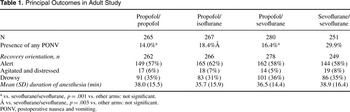
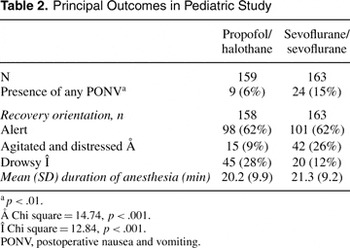
Adult patients were recruited from general, orthopedic, and gynecological day surgery lists. Pediatric patients were recruited from general and ear, nose, and throat day surgery lists. The recruitment rate was 73 percent for the adult study and 75 percent for the pediatric study. Ninety-five adults and twenty-five children were withdrawn from the study after randomization. The remaining 1,063 adult patients and 322 pediatric patients remained in the study until discharge from hospital. Fifteen percent of these adult patients and 19 percent of these pediatric patients were then lost to follow-up seven days after discharge. Patient details collected were name, hospital number, date of birth, sex, weight, telephone number, surgical procedure, American Society of Anesthesiologists category, smoking status, and name of general practitioner. Tables 1 and 2 summarize key primary outcomes. In this study, we present the results from the prospective, patient-based costing study.
DESIGN OF COSTING STUDY
Perspective
The perspective of the study included the NHS in terms of the direct costs of providing anesthesia and anesthesia related follow-up care. The perspective of the patient or parent was also included, such that nonmedical direct costs incurred by them up to day 7 postdischarge were collected.
Time Horizon
Resource use was measured and valued from admission to day 7 after discharge. This time horizon was selected because previous work suggests that anesthetic sequelae from day surgery resolve within four to seven days.
Sample Size
The study was powered to detect a reduction in the undesirable clinical event, PONV, due to large amounts of knowledge available about this parameter. No power calculations were performed to determine the sample size necessary to detect a statistical difference in resource use or costs, because there were no prior data of sufficient quality or relevance upon which to base this calculation.
Resource Use Estimation
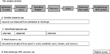
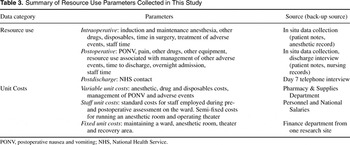
The costs for each event were estimated for each patient in the trial. Figure 1 summarizes the day surgery process and the methods used to collect different categories of resource use. Table 3 lists the resource use and unit cost data collected in the study. The costs were calculated as resource use multiplied by the unit cost of the specific resource. Resource use was divided into perioperative (anesthetic room and theater data) postoperative (recovery room and ward data) and postdischarge data. Predischarge resource use was recorded through observation by dedicated nurse researchers. Variable, semi-fixed, and fixed costs were identified and valued separately. Postdischarge NHS resource use and patients' resource use was reported by patients and parents during a telephone interview around day 7.
The stages of the day surgery process and the sources ofresource use data for each stage. NHS, National Health Service.
Variable Costs
Variable costs collected were anesthetic use, all drug use during anesthesia, PONV, and adverse event management, anesthetic room, theater, recovery room, ward, and postdischarge NHS resource use.
Drugs and Disposables
The name, form, strength, and quantity of all drugs, including “take-home” drugs, given to each patient throughout the day case episode were recorded. Changes in fresh gas (oxygen or nitrous oxide) flows and volatile anesthetic concentrations, made by the anesthetist, to prevent or react to adverse events were recorded. Drug doses, routine events (such as use of a laryngeal mask) and adverse events were recorded by dedicated nurse researchers as they occurred, during the hospital admission period. Disposable equipment and fluids associated with their administration were incorporated into the overall “cost per dose.” Standard use of disposable equipment was assumed for a specific drug and its administration dose to reduce the data collection burden.
Adverse Events
The variable costs associated with the management of adverse events were collected for the anesthetic room, theater, recovery, and the ward. The type of adverse event and the quantity of resources used to manage each adverse event were recorded. All disposable equipment used during adverse events, including PONV, was recorded prospectively as standard use could not be assumed. Only anesthetic-related adverse events were included, surgical adverse events being excluded. Categorization of adverse events was ratified by anesthetists in the research team and on the scientific advisory group.
Drug Wastage
Good clinical practice demands that ampoules or vials of parenteral drugs are used for only one patient and then any remaining drug is discarded, so drug resource use was calculated assuming whole vials or ampoules were used for each dose, thus incorporating wastage costs.
Generic Versus Brand Unit Costs
During the trial, propofol became available as a generic preparation, leading to a significant reduction in unit costs. For the purposes of the costing study, the unit cost for generic propofol was used for all patients, as use of the least cost preparation of a drug is standard practice in the United Kingdom. However, total intravenous anesthesia (one of the adult randomization arms) requires the use of a propofol preparation not available as a generic version (Diprivan), so this arm used brand propofol unit costs.
Measurement of Volatile Drug Use
The acquisition costs of volatile anesthetics can differ from one another by a factor of 100, so accurate resource data were required. The vaporizers used to administer volatile anesthetics are calibrated to show the percentage concentration of vapor delivered to the breathing system rather than the volume of liquid agent delivered in milliliters. It is not possible to calculate volatile anesthetic use by measurement of volume changes in the original container, although previous studies have attempted to estimate the cost of volatile agents by this method (6). The Dion algebraic approximation was used to calculate the amount of volatile agent used (see Appendix) (9).
Postdischarge NHS Resource Use
Posthospital resource use was collected by a telephone interview with the patient or patient's parent or guardian at seven days after discharge. If the patients were not contacted by telephone, they were lost to follow-up. Posthospital resource use was categorized into that incurred from the NHS perspective, such as general practitioner visits, and that incurred from the patient's perspective, such as purchase of over-the-counter medication.
Semi-Fixed Costs
Semi-fixed costs were defined as those where the quantity of resources used is determined by organizational requirements together with the need for them to provide care for individual patients (for example, staff time). Data on staff activities that might be affected by the type of anesthetic used, such as time in the anesthetic room, were obtained by observational methods. Nonparticipant observation was used to collect data on staff resource use in the anesthetic room and operating theater for a subgroup of the total study population (n=194). The type and grade of NHS staff and time spent working in the anesthetic room and operating theater was noted for each patient in the subgroup. Standard staff activities, such as admission and discharge of patients, were estimated from interviews with relevant staff. Interviews with four members of staff were used to collect estimates of staff activities associated with the day surgery episode, that time associated with patients' admission and discharge, transfer between theater and the ward and monitoring postoperatively in recovery and on the ward. Semi-fixed costs were derived from these estimates.
All staff unit costs were for the year 2000 and the average salary excluding an “out of hours” element for each grade of NHS staff was used. The average salary per minute was calculated by assuming doctors' work forty hours per week for forty-one weeks a year (98,400 minutes) and nurses or theater staff work 37.5 hours per week for forty-two weeks a year (94,500 minutes). A unit cost of zero was assumed for porters, because the cost for their salary is included in the fixed cost attributed to each department in the NHS Trust. Students are not paid by the NHS Trust and so a unit cost of zero was assumed in accordance with the study perspective. Unit costs (average salary per minute including employer's contributions) for the relevant type and grade of NHS staff were multiplied by working time to calculate the total semi-fixed cost for each patient (1;14). Mean semi-fixed costs per minute were derived for the adult and pediatric study from these subgroups and applied to the whole sample. The semi-fixed costs for each patient were calculated by adding these costs to mean observed staff costs from the anesthetic room and operating theater.
Observed Semi-Fixed Costs: Anesthetic Room and Operating Theater Staff Costs
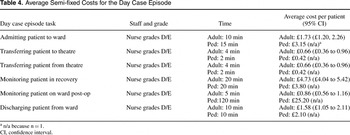
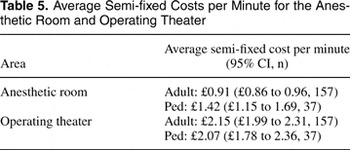
Differences in working practices in terms of skill mix were observed in the subsample (n=194) of day case procedures between the three hospital sites, but this finding did not translate into notable differences (95 percent confidence intervals overlap) in the average semi-fixed costs. There were differences in the semi-fixed costs per minute for adult and pediatric practice. The average semi-fixed costs per minute of providing care in the anesthetic room and in the operating theater are summarized in Table 4.
Reported Semi-Fixed Costs: Other Staff Costs
Table 5 summarizes estimated time and, thus, costs associated with other standard staff activities. The most notable difference between adult and pediatric level of care for a day case episode occurred during postoperative monitoring on the ward. Pediatric patients had dedicated care from one nurse for two hours; but one nurse would be expected to care for more than one adult patient.
Fixed Costs
Fixed resource use associated with maintaining an anesthetic room, operating theater, and ward for day case procedures was included for each arm of the study. The fixed cost per day case was estimated for three sections (ward, theater, anesthetic room) of the day case episode. Finance departments from the NHS Trusts provided information on the components and allocation of the day case fixed costs for the ward, anesthetic room, and operating theater that were allocated to the anesthetic budget. These were then used to estimate the fixed cost per hour related to a day case episode for each section. The components of the fixed costs were classified by the finance department as direct costs, for example staff and equipment; and indirect or overhead costs, for example, domestic services and estates and energy. Staff costs were accounted for in the calculation of semi-fixed costs. To avoid double counting, the staff costs were subtracted from the total figure for fixed costs. Fixed costs for the ward were derived to be £7.20 per patient/hour and £1.80 per patient/hour for the anesthetic room and theaters.
Source of Unit Costs
The unit costs were obtained from the two NHS Trusts in the study. In practice, there was no difference between the unit costs from the two NHS Trusts. All costs were calculated for the year 2000 and reported in UK sterling (£).
Total Costs
The total cost was the sum of all costs incurred on behalf of the patient, from the perspective of the NHS, including postdischarge costs. Costs incurred by the patient were reported separately.
COST ANALYSIS
The analysis included cost estimates for all patients who remained in the study until hospital discharge. A small proportion of patients did not complete follow-up postdischarge, but their characteristics did not differ from those who did complete follow-up, so they were assumed to generate equivalent postdischarge costs to the NHS. The objective of the statistical analysis was to test whether there were statistically significant differences in between groups in the costs. Typically, these variables have positively skewed distributions. The main options for statistical analysis were (i) standard nonparametric methods, (ii) data transformation, (iii) standard parametric methods, or (iv) nonparametric bootstrapping.
Nonparametric statistical tests were considered inappropriate because they do not test differences in arithmetic means (2). The arithmetic mean is considered to be the most relevant measure for health-care policy decisions, which should be based on information about the distribution of the costs of treating a patient group, as well as the average cost. Similarly, data transformation to achieve approximate normality does not result in a comparison of arithmetic means. Bootstrapping compares arithmetic means, while avoiding distributional assumptions. This technique is most useful where the sample size is small to medium. Work carried out to compare the performance of bootstrapping with parametric t-tests has shown the t-test to be “remarkably robust to non-normality” (2). This robustness requires the sample size to be large enough for the central limit theorem to act sufficiently, or for the sample size and skewness to be similar in the groups under comparison (16). It is suggested that, in trials like this study, large enough to influence health-care policy, standard t-test based approaches will be robust and give results very similar to the bootstrap (2). When sample distributions were examined, the skewness in the samples was found to be sufficiently low to indicate normality for the sampling distribution of the mean (4). The increased research resource use associated with collecting a larger sample of cost data meant that parametric tests could be applied. The t-test was used for the pediatric study, and analysis of variance (ANOVA) was used for multiple group comparisons in the adult study. The advantage of this statistical analysis being used for cost variables is its relative transparency compared with bootstrapping, and its increased specificity compared with nonparametric statistical tests.
RESULTS
Costs
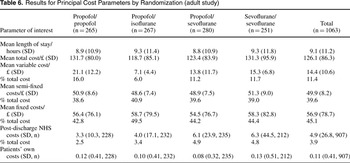
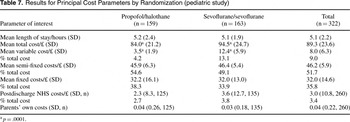
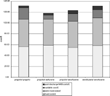
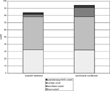
Adult and pediatric costs are reported in Tables 6 and 7, respectively. Figures 2 and 3, respectively, illustrate the proportion of fixed, semi-fixed, variable, and postdischarge NHS costs for adults and children. Statistically significant differences were found only between variable costs, which accounted for 11.4 percent and 9.0 percent of adult and pediatric costs, respectively.
Proportion of fixed, semi-fixed, variable, and postdischargeNHS costs (adult study). NHS, National Health Service.
Proportion of fixed, semi-fixed, variable, and postdischarge NHScosts (pediatric study). NHS, National Health Service.
Total Costs
No statistically significant differences in total costs were found between randomization arms (ANOVA: F (3, 1059), 1.41; p=.2387) in the adult study. In children, sevoflurane/sevoflurane had significantly higher total costs, due to higher variable costs than propofol/halothane.
Fixed Costs
Fixed costs for the ward were £7.20 per patient per hour and £1.80 per patient per hour for the anesthetic room and theaters. The fixed costs per hour for these sections of hospital facilities were used to calculate the total cost in each arm of the adult and pediatric study, respectively. There were no differences in length of stay, thus, no difference in fixed costs in the adult or pediatric study.
Semi-Fixed Costs
The average semi-fixed cost was calculated for adult and pediatric patients using a composite of costs obtained by interview and by observation. Observational studies found no difference between the anesthetic arms in terms of staff input, thus, no difference in semi-fixed costs was found.
Variable Costs
Statistically significant differences in variable costs were found between randomization arms (ANOVA: F (3, 1059), 95.24; p=.0001). Statistically significant differences were found between propofol/propofol all other arms, and propofol/isoflurane and all other arms (Tukey's honest significance difference test, p<.01).
Post Discharge and Patients' Own Costs
Postdischarge NHS costs and patients' own costs were minimal and did not differ between randomization arms.
Differences Between Surgical Groups
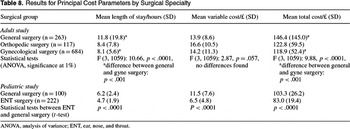
There were differences between mean total costs for different surgical groups due to differences in length of stay, rather than due to variable cost differences. For both adults and children, general surgery is associated with a longer length of stay than other surgical specialties included in the study. These results are summarized in Table 8.
DISCUSSION
This study examined whether differences in clinical impact of different anesthetic agents in day surgery led to differences in patient costs. No difference in total costs was demonstrated in adults, but a difference was demonstrated in the pediatric study, attributable to differences in variable costs. Importantly, no difference in length of stay and, thus, fixed costs was demonstrated between arms for adults or children, such that the use of any of these regimens cannot contribute to changing patient throughput. Also, no difference was demonstrated between arms for staff costs. Therefore, no difference was observed for over 80 percent of costs. This study does show that there are statistically significant differences in variable costs between different anesthetic regimens in both adult and pediatric day surgery, which accounted for 9.0 percent and 11.4 percent of total costs, respectively.
In this study, great effort was made to accurately and precisely identify resource use and unit costs, using as standardized an approach as possible. Because of the extra effort made in this costing study, we have been able to identify cost differences that may not have been apparent if top-down or other more approximate estimation methods had been used.
Results from this study important for decision-makers are that there are differences in variable costs between arms, indicating that choice of different anesthetic agents will translate into budget differences. Claims that the newer anesthetic agents cancel out their increased acquisition costs by a reduced incidence of side effects are not supported by this study. Also, claims that shorter recovery times with different anesthetic agents increase patient turnover are not supported, as this study shows no difference in length of stay between anesthetic agents. Indeed, other work carried out in this area suggests that the organization of day surgery services (such as optimizing theater efficiency, reduction of late cancellations, and nonattendance) and integration into the remainder of surgical services are the main factors influencing patient turnover, rather than choice of anesthetic (8;15).
The data obtained in this study were associated with a high resource use. Approximately 2.5 whole time equivalent research staff were required to collect the data over a sixteen-month period. The highly technical nature of the interventions required that research staff had substantial knowledge of anesthesia. The derivation of detailed patient-specific costs absorbs scarce research resources. This finding is because most anesthesia management and accounting systems do not provide information of sufficient quality or detail to differentiate between anesthetic methods. An economic evaluation may overburden a study with detailed data collection, data collection must be designed efficiently. This can be achieved by identifying key cost-generating events, which requires prior understanding of the procedures or treatments involved in the intervention. This approach enables minimization of data collection at the same time as maximizing the precision of costs and, thus, the ability to detect any patient-level differences. Key cost-generating events can be identified in advance through review of published studies and pretrial and pilot testing (11). The key cost-generating events in this study appear to be length of stay, staff input, and surgical group, rather than anesthetic technique.
Unfortunately, costing studies vary greatly in methodological quality. There is often difficulty in separating anesthetic costs from surgical costs. Accounting systems have historically placed anesthesia within surgery. This method includes the resource use specifically associated with anesthesia, such as anesthetists and other anesthesia-related staff, anesthetics, anesthetic equipment and management of intraoperative and postoperative anesthesia-related events (such as PONV, pain, and delayed wakening). The separate handling of this information is particularly pertinent within the context of economic evaluations of anesthetic techniques. It is extremely difficult to compare the results of one anesthesia costing study with another, due to the lack of a standard framework that dictates which costs should be included and how they should be measured. Standardized costing frameworks have been recommended by other researchers (17;18), and debate is required in anesthesia costing to increase generalizability across studies.
POLICY IMPLICATIONS
This study collected highly detailed resource use data regarding different agents for anesthesia in day surgery and showed that small changes in transient clinical outcomes such as PONV do not have an effect on overall patient costs. Inadequate or incomplete costing information can lead to inappropriate recommendations or decisions being made (3). The quality of the stochastic data set generated in this study enables statistical inference to be made, including measures of uncertainty. Decision-makers are much more likely to use these data in policy decision making, confirming the importance of robustly designed costing studies in anesthesia (5). It is important that key cost-generating events are identified before study design, if possible, to reduce the amount of data collection required. Future studies assessing costs in anesthesia should concentrate on factors affecting length of stay and staff input, rather than the marginal effect of using different anesthetics.
APPENDIX: OBTAINING ESTIMATES OF ANESTHETICS USED
Weighing the vaporizer containing the volatile anesthetic before and after anesthesia is the most accurate way to calculate the quantity of anesthetic volatile used (9). However, this process is logistically demanding and time consuming and was considered on these grounds to be inappropriate for the large numbers of patients recruited to the current study. The Dion formula was developed and used in several studies to estimate the quantity and cost of volatile anesthetics administered using machines with no system to allow re-breathing of the vapors (9). The Dion formula estimates the quantity and cost of volatile anesthetic used as follows: cost=PFTMC/2412 d, where P=vaporizer concentration (%); M=molecular weight (g); F=fresh gas flow (lminute−1); T=duration of anesthesia (minute); C=cost per ml (£ml−1); d=density (gml−1).
This calculation requires information on the concentrations and flow rates used throughout the induction and maintenance of anesthesia. Concentrations and flow rates of the anesthetic and its carrier gas were recorded by researchers at regular intervals: one-minute intervals in the anesthetic room; one-minute intervals for the first ten minutes, then two-minute intervals for a further ten minutes, and then five-minute intervals in the operating theater to when maintenance of anesthesia ends and the vaporizer is turned off.
This study was funded by the National Coordinating Centre for Health Technology Assessment (NCCHTA). The views expressed are those of the authors and not necessarily those of NCCHTA. The project grant number is HTA 96/15/05. We thank Dr. Stirling Bryan, Professor Francis Creed, Dr. Chris Roberts, and Dr. John Sear for their contribution to the Cost Effectiveness Study in Anaesthesia (CESA) Scientific Advisory Group. We also acknowledge the kind support and help of the anesthetists, anesthetic staff, operating theater staff, surgeons, ward staff, and the medical secretaries from the two National Health Service Trusts who took part in this study. We also extend our thanks to all the patients and parents or guardians, who made this project possible by agreeing to take part themselves, or allowing their children to take part. We thank the anonymous reviewer, whose thoughtful assessment of our study has improved significantly its focus and readability.