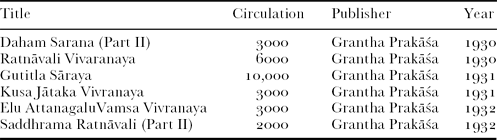
Introduction Historical and intellectual background
The Buddhist revivalists of late nineteenth century Sri Lanka were concerned to reform Sinhala Buddhist culture, and in this campaign, religion was the main target of the reform.Footnote 1 An important outcome of this revival was the rise of pirivenas (Buddhist oriental colleges) as modern centres of oriental learning and scholarly activity.Footnote 2 The growth of pirivena education marked a widespread resurgence of oriental languages through a vigorous interest in the classical literature of Sinhala, Pali and Sanskrit.Footnote 3 During the early twentieth century, the pirivena-educated scholars concentrated more on linguistic activity than on religious movements, thus paving the way for a scholarly interest in language matters. These scholars were, however, separate from the English-educated groups who were the products of missionary education. Some of them even ‘self-consciously rejected the study of Western literature as being anti-national’.Footnote 4 Accordingly, they placed a high value on ancient Sinhala literature (twelfth to fifteenth centuries), and these scholars campaigned for the restoration of the classical norms of written Sinhala. The increasing numbers of erudite monks and lay scholars who were passed out by the Paramadhammacetiya (1849), Vidōydaya (1873) and Vidyālankāra (1876) and other pirivenas, produced scholarly editions of almost all the major classical works in Sinhala literature.Footnote 5 The appearance of a large number of printed editions of ancient Sinhala texts had a vibrant effect on the linguistic culture. The awareness of the ‘greatness’ of one's own culture and language seems to play some part in the revitalization and development of languages, especially those that have ‘classical traditions’ of language and culture. This awareness of classical literary and linguistic traditions, in turn, provided an environment that was conducive to the rise of reformist ideas connected with language.
Politically, too, the country was undergoing rapid socio-political changes during the first three decades of the twentieth century, due to the implementation of various political and constitutional reforms. The most notable event was the implementation of the Donoughmore Constitution that granted universal suffrage in 1931.Footnote 6 The following years saw an increasing understanding of the problems related to government language policy and educational reform. The idea that people should be governed by and through their ‘own language’ (swabhāshā) gained momentum. The middle-class was expanding in a new economic and intellectual environment; social, political and labour movements became organized.Footnote 7 Moreover, the expansion of formal school education led to a significant increase in literacy in the vernaculars and, in particular, it led to the emergence of a sizeable reading public in Sinhala.Footnote 8 There was a growing interest in the use of the Sinhala language in newspapers, journals, schools, textbooks and novels. More importantly, government sponsorship of the publication of school reading books and other textbooks, helped to increase the use of Sinhala. Perhaps the most important contribution to the spread of Sinhala during the second and third decades of the century was its increased use as a ‘print language’.Footnote 9 The growth in the number of printing presses and publishing houses after the 1920s in urban cities like Colombo catered for the needs of the newly literate public and gave impetus to various scholarly movements and linguistic work.Footnote 10
Sinhala national identity has usually been articulated using linguistic and religious symbols.Footnote 11 As will be shown in this paper, during the 1920s and 1930s, the connections between language and nation became increasingly close and the nationalist ideology became linked to language. The emergence of language movements prompted local elites to conceive their own ‘national language’ (jātika bhāshāva)—in contrast with the colonizer's language. This is not to suggest that religion was unimportant to the Sinhalese and Tamil communities at this time.Footnote 12 In this era of political and constitutional reform both Sinhalese and Tamil language loyalists believed that language was more important than religion for individual and national identity; new ways of imagining the community, which were associated with language, came to forefront. With the expansion of Sinhala journalism and publishing, the issues related to Sinhala grammar and usage became important topics for many Sinhala writers and editors to discuss. Having been educated in pirivenas, most of the editors of the Sinhala (Buddhist) newspapers and periodicals became concerned about the new usages appearing in Sinhala writings. The question of using the Sinhala language ‘correctly’ became an important topic. For instance they complained about current language usage and advocated a return to ‘correct’ forms.Footnote 13 By thus admitting the importance of classical norms in language, they provided an impetus for the growing movement for Sinhala language reform. Various linguistic movements developed, pointing out the need for ‘language reform’Footnote 14 as a prerequisite for political independence.
It was against this background that Munidasa Cumaratunga (1887–1944), the most important figure in the Sinhala literary scene during the 1930s and 1940s, launched a movement for the reform and purification of the Sinhala language.Footnote 15 As a language reformer Cumaratunga carried out various language planning activities without any recourse to governmental support. The changes brought about by this movement are inseparable from the contemporary socio-political situation and will therefore be discussed in this context here. As we will see this language movement laid the intellectual foundations for the politicization of the Sinhala language in the 1940s and 1950s. According to Annamalai, language movements, like other social movements, bring not only linguistic but also social change.Footnote 16 In discussing the issue of language loyalty or ‘language devotion’ in Tamil India, which arose around the same time (1930s), Sumathi Ramaswamy has shown how language can inspire speakers to devote themselves zealously to its cause. She notes that language can be transformed into ‘an object of devotion in the course of the social mobilization and political empowerment of its speakers’.Footnote 17 Cumaratunga's discourse on the purification of the Sinhala language thus provides the scope for a discussion of language loyalty under the conditions of colonialism and the context of socio-political change.
In this paper I shall provide a detailed account of the Sinhala language purism in the 1930s, and re-evaluate the impact of the Hela movement of Munidasa Cumaratunga. Cumaratunga was a language loyalist and the foremost grammarian of the twentieth century, for the renovation of Sinhala language. His ideas on language were mainly expounded in the prefaces to his editions of ancient Sinhala texts, grammatical works and editorials. This paper explores Cumaratunga's discourse on linguistic purism, its ideological foundations and the means by which he organized his puristic intervention. One of the major concerns Cumaratunga had was to keep language ‘pure’ and ‘correct’. This puristic streak strengthened during the 1940s when the reforms for national independence reached their height, and continued well into the 1960s. At the same time, Cumaratunga had a powerful ideological influence on the language situation of the period. By focusing particularly on the Hela ideology which promoted the linguistic authenticity of the Sinhalese, this paper examines the link between Cumaratunga's language reform activities and the struggle for independence.
Sociolinguist, K. N. O Dharmadasa, recognizes Cumaratunga's significance as ‘the ideological pinnacle of Sinhalese language nationalism’ in twentieth-century Sri Lanka.Footnote 18 Another linguist, A. K. Gunasena, has discussed Cumaratunga's puristic interventions from a linguistic point of view and recognizes his purism as the second stage in nativistic efforts.Footnote 19 Below, I shall argue differently, however, exploring Cumaratunga's perceptions of language. In particular, linguistic purism as a type of language reform which aimed at the formation of the ethno-linguistic uniqueness of the Sinhalese, and critique to challenge the contemporary scholarly establishments and national political leadership. I shall examine the development of Cumaratunga's thinking on language reform from a philosophy of linguistic correction to a much broader programme of ideological intervention which linked the language (Sinhala) and national identity with ideologies of a glorious past. We can identify two main periods in Cumaratunga's efforts to achieve linguistic purism. The first phase approximately encompasses the years 1930 to 1938. During this period he concentrated mainly on the ‘linguistic correctness’ of the Sinhala language. The second phase, which lasted from 1939 to 1944, was marked by a clearly articulated purist ideology called Hela (pure Sinhala), a quest for authentic linguistic usage as opposed to the Indo-Aryan linguistic discourse which had an Indic orientation.Footnote 20
In order to assess the significance of Cumaratunga's role in Sinhala language purism in the 1930s and 1940s, the notion of the term linguistic purism must be made clear from the outset. In sociolinguistics, ‘purism’ is defined as an attitude to language which labels certain elements as ‘pure’, and therefore desirable, and others as ‘impure’, and therefore undesirable.Footnote 21 Discussing language purism as a type of ‘language correction’, Neustupný argues that ‘purism is one of many corrective processes directed towards culture’.Footnote 22 In addition, language purists and puristic movements are nationalistic, thus they often try to keep the symbol of national identity free from outside influence. Linguist George Thomas suggests that there are various types of purism: for example, elitist purism, which scorns non-standard and regional usages, and archaising purism, which locates the purest, truest expressions of the language in the remote past. He also mentions another type, xenophobic purism, which seeks to purge the language of foreign elements.Footnote 23 In this sense, purism is a nativistic activity dedicated to the removal of foreign influences (mostly lexical but also grammatical) or the adherence to the classical forms and lexicon of a language. Thomas also says that purism is ‘an attitude towards language’, and ‘puristic attitudes are closely linked with other cultural values’.Footnote 24 It seems clear that judgements concerning the ‘correctness’ and ‘purity’ of language are social rather than purely linguistic. As will be shown below, the puristic discourse of Cumaratunga was socio-politically inspired to a large extent and cannot be divorced from the social, political and cultural context of the period.
Cumaratunga was born on 25 July 1887, the son of an Ayurvedic physician in Dikhena, a remote village in the southern district of Matara. He had his primary education in a pirivena and an English education at St Thomas’ College, Matara. He started his career as a Sinhala teacher (1909–1917), and was later promoted to the post of Inspector of Anglo-Vernacular schools (1917–1922) in the Department of Education. Subsequently, he became principal of the Teacher Training Colleges at Nittambuwa (1927) in Western province and at Balapitiya (1929) in Southern province. He died at the relatively early age of 57, on 2 March 1944, four years before the country gained political independence.
As pointed out by many scholars, Cumaratunga's linguistic policy was best known for its linguistic purism.Footnote 25 A popular goal in language reform and revival movements is the purification of language. However, in different contexts, this purification means different things. In the eighteenth century, the ‘revivalist’ movement of scholar monk Velivita Saranankara (1698–1778) paved the way for the resuscitation of classical literary genres. The main motive of Saranankara's revival was to reinstate the pure doctrine of Buddhism and the orthodox Buddhist order. Therefore, religion was the principal domain in which the concept of purity operated. Before Cumaratunga, in the mid-nineteenth century, bilingual scholars like James de Alwis (1823–1878), had expressed the need to preserve the ‘original purity’ of the Sinhala language and the neglect of the study of ancient Sinhala grammar.Footnote 26 His notion of purity of language focused on the influence of the colonial encounter; it was also disseminated through the English language.
The need for language reform, 1930–1940
Cumaratunga started his literary career in an era of socio-cultural and political reform. The second and third decades of the twentieth century offered conditions which were favourable to puristic and reformist attitudes towards the Sinhala language. The growth of publications in Sinhala (mainly periodicals and newspapers), the expansion of vernacular education, and the emergence of pirivena scholars who had mastered the classical languages (Sanskrit and Pali) created a suitable environment for scholarly activities. The publication of a large number of critical editions of ancient Sinhala classical texts had a considerable impact on the literary scene of the day. Several Sinhalese scholars who taught Sinhala in schools or pirivenas compiled grammar books.Footnote 27 With the expansion of print Sinhala, new forms of literature like the novel, short story and school textbooks emerged, and there was much discussion about the best linguistic style for prose writing.Footnote 28 Due to the absence of clear language norms for written usage, various writers expressed their views on grammatical rules. Consequently, the Sinhala language became an important topic for discussions of language reform ideas in scholarly circles.
In this context Cumaratunga argued that language reform was necessary for Sinhala in order to safeguard the intrinsic purity of the language. His reform of Sinhala grammar went hand in hand with his efforts to recover and revive ancient Sinhala literary works. Like many other pirivena scholars of the day, he started his literary career by preparing commentaries and editing Sinhala classical texts (both prose and verse), beginning in 1922. In all, he edited 28 Sinhala classical texts, the majority of which were prescribed to be used in public examinations at the time.Footnote 29 He hoped that, through studying these classical works, students would gradually become familiar with correct usage. His goal was to maintain the ‘purity’ of the classical texts. His editorial work revealed the grammatical rules of ‘classical’ Sinhala to the reader and emphasized the literary prestige of those works. In his edition to the classical Sinhala poem, Muvadev dā vata, he stated: ‘those who want to learn the correct and pure usage of the language, should study these works with great fervour’.Footnote 30 In his critical commentaries to the classical works, he discussed various grammatical rules in Sinhala. He also tried to reform the modern written language according to usage in the Sinhala classics, such as Amāvatura (twelfth century) and Saddharma Ratnāvaliya (thirteenth century). In his preface to Parevi Sandeśa Vivaranya, Cumaratunga observed:
Language is like water. Learned men are like filters. Impurities from the outside get mixed up with water. However, before being used for drinking, the water is strained and the impurities are filtered out and discarded. In language, too, coarse and uncivilized usages seep in. Scholars examine and discard them.Footnote 31
Like many other purists, Cumaratunga believed that there was a ‘vintage year when language achieved a measure of excellence which we should all strive to maintain’.Footnote 32 In formulating the norms of ‘correct’ Sinhala, he looked back at the ancient works and matched modern usage with the writings of the ‘best authors’ of classical literature. The classical literary language was the yardstick against which he measured the purity of linguistic usage; the language of the classical works was considered ‘correct’ Sinhala. For example, he pointed out certain phonological and morphological features that were peculiar to ancient Sinhala usage which he wanted to be reintroduced. One of these features was the use of the grapheme ‘ ’(pronounced /æ/) in certain places instead of the contemporary usage of the grapheme ‘
 ’(pronounced /a/).Footnote 33 In fact he believed that the ‘best’ Sinhala is inevitably that of the past.Footnote 34
As stated previously, the idea of reforming the language was prevalent in varying degrees from the beginning of the twentieth century. However, one can also argue that the ideology of Western linguistic purism of the early eighteenth and nineteenth-centuries also influenced Cumaratunga's linguistic policy with regard to usage and grammar.Footnote 35 In the 1920s and 1930s, the idea of linguistic correctness was part of English teaching in schools. As school inspector of Anglo-vernacular schools, Cumaratunga may have been influenced by such prescriptive ideas as ‘corruption’ (dūshita) and ‘vulgar’ (ashista). Cumaratunga's views on the purity of language resemble the early eighteenth-century puristic grammatical discourse of English.Footnote 36 Like other Western purists, Cumaratunga, viewed any language change negatively as ‘language decay’ (parihāniya), or as language pollution/corruption (dūshita), and this motivated him to launch a programme for language reform.
The aim of Cumaratunga's linguistic reform efforts was to purify the language. However, the concept of ‘linguistic correctness’ has always been a basic notion in the Sinhala and Sanskrit grammatical tradition.Footnote 37 For example, the thirteenth century Sinhala grammar for poetical works, the Sidat Saňgarāva, stressed the value of ‘learned usage’ (se piyonan, or chekha prayoga). The pirivena scholars of the early twentieth century also recognized the ‘correctness’ of language according to the notion of Sidat Saňgarāva, or Sanskrit grammars. Indeed, the pirivena scholars adopted the grammatical rules of this treatise as the model for written Sinhala. Like his contemporaries, Cumaratunga accepted the value of ‘learned usage’ in his 1935 commentary to the Sidat Saňgarāva. He stated, ‘those who are anxious about the purity of language must persevere and become involved in the pursuit of scholastic usage. Grammar is the law laid down pertaining to the scholastic device’.Footnote 38
As a grammarian, Cumaratunga was more interested in the refinement of the written language. His notion of linguistic purity was based on the grammatical correctness of the written language. He thus promoted the ‘purity’ of the written language at the expense of the spoken language, considering the literary language inherently ‘purer’ and more ‘correct’ than all other forms of the language.Footnote 39 Such arguments were frequently put forward to safeguard the written language from the flux and variance that is found in the spoken form. He once observed: ‘We too are not unaware of language change. But that does not imply that Sinhalese should be a ‘wild language’ (vädi basa). We approve of language change that tends towards civilized usage’.Footnote 40 Cumaratunga therefore, considered colloquial or spoken usage to be ‘vulgar’ (grāmya or aśishta) and abandoned it for written usage.Footnote 41
Linguistic correctness, ‘good language’ and civilized society
As a language reformer Cumaratunga paid special attention to the state of the Sinhala language and called for remedial measures. In 1935, he observed: ‘At present the Sinhala language is like a dense forest. Those who wish to cross it clear their own paths’.Footnote 42 In order to reform the Sinhala language, Cumaratunga made a special effort to constrain what he considered ‘bad language’ (dubasa) and to encourage what he considered ‘good language’ (subasa).Footnote 43 The promotion of ‘good language’ was an important component of Cumaratunga's language reform programme, and one which he considered a prerequisite for the Sinhalese people's struggle for freedom. From the beginning of his career, Cumaratunga stressed the important link between language and nation. He stated: ‘A language that is devoid of innate strength and devoid of rules denotes a nation that is devoid of a spirit of loftiness’.Footnote 44 For Cumaratunga, the state of the language was a metaphor for the state of the nation. His campaign for the ‘purity’ of Sinhala language gained momentum in the 1930s and the early 1940s when the national movement for independence entered its most critical phase. Giving special attention to the status of Sinhala language, he wrote in 1936:
Signs are appearing that Sinhala is becoming the most uncivilized language. . . With a civilized people what becomes civilized first is their language. . . Need it be said that people who use an uncivilized language are themselves uncivilized? The time has come for us to correct this.Footnote 45
Cumaratunga used the metaphors of law and society to define the relationship of grammar to language. He often complained about ‘linguistic decline’, and in 1938, in his grammar of the Sinhala language, he observed: ‘Just like a society without laws, a language without them would plunge into confusion. The Sinhala language is facing disaster. A course of action to prevent this is immediately called for’.Footnote 46
One of the principal points on which Cumaratunga laid repeated stress during the 1930s was the link between ‘civilized language’ and ‘civilized society’. The central theme of his argument was that the terms for the two, sishta bhāshāva and sishta samājaya respectively, are related. Cumaratunga sums up this attitude as follows: ‘Grammar is the legal treatise that determines the correct usage of language. A civilized society is protected by social laws. Likewise, a civilized language is protected by linguistic laws, called grammar. Footnote 47 This quotation shows the important role that grammatical ‘laws’ play in protecting ‘correct’ usage. He believed that ‘correct language’ is preserved by the educated, who use it, and that the approved language is associated with the ‘civilized’ society. The following quotation clearly shows his mission: ‘The national language ought to be given its proper place. The refined sentiments of the masses must be gradually developed. A base, corrupted, inelegant and insipid language will produce a mean and miserable mentality’.Footnote 48 To him, therefore, ‘correct’ or ‘grammatical’ Sinhala was a means towards social and political progress. Later on he linked this idea with the concept of the nation: ‘just think of what might happen to a nation if the law is not respected. The same thing will happen to the language if the law of words is not respected’.Footnote 49 We can summarize Cumaratunga's view on the relationship between language, society and grammar in the following way:

He firmly believed that by maintaining a proper order in language, order in society could be established. In other words, Cumaratunga reiterated the need for ‘social discipline’ as well as ‘linguistic discipline’.Footnote 50 His notion of linguistic correctness was intimately linked with the social norms of the speech community.
In this connection Cumaratunga recognized the value of the educational system for raising the status of language.Footnote 51 In a preface to one classical work, he noted the state of language teaching in schools: ‘If there is any subject that suffers the most unjust treatment at the hands of both the teachers and the taught it is the Sinhalese language’.Footnote 52 During the 1930s, British officials held high offices in government. Cumaratunga pointed out that the high officials in the Education Department possessed no knowledge of the languages of the land, and were therefore not fit to approve or prescribe textbooks. He noted that the Director of Education was unable to speak one word of any local language.Footnote 53 Cumaratunga criticized the policies of the colonial Department of Education saying: ‘the Department has done and are [sic] still doing everything possible to make the language lawless, graceless, powerless and worthless’.Footnote 54 He asked for government intervention to safeguard the ‘correct language’ in schools. In 1940, Cumaratunga articulated the ‘lamentable state of affairs’, in an ‘open appeal’ to the Minister of Education, C. W. W. Kannangara:
What have you got to do? You have only to get the Department to issue an order that henceforth the language used by both teachers and taught must be scrupulously correct. I am perfectly sure, Sir that you will have, within a week, correct language used in all the schools.Footnote 55
Challenge to pirivenas and historical linguistic scholarship
At the beginning of the twentieth century, Sanskrit and Pali played an important role in the intellectual life of pirivena scholars. Many displayed erudition in Pali and Sanskrit; command over these languages was a matter of pride.Footnote 56 Accordingly, an admiration and fascination for these languages and the literature written in them formed the central part of the curriculum in pirivena education. The pirivena scholars also urged that Pali be taught in Sinhalese schools.Footnote 57 When pirivena grammarians wanted to standardize Sinhala, they looked to Sanskrit or Pali models to codify grammar rules. As a result, Pali and Sanskrit grammatical rules continued to influence the grammatical description of Sinhala. The pirivena scholarship also considered Pali and Sanskrit as the ‘mother languages’ (mātru bhāshā) of Sinhala, and expressed the evolution of Sinhala in relation to those languages.Footnote 58 In reaction to this scholarly tradition, Cumaratunga stressed the merits of Sinhala grammatical features over those of the Pali and Sanskrit. He stated, in his critical elucidation to the Sidat Saňgarāva, that ‘it is by scrutinising Sinhala usage that a grammar for Sinhala has to be supplied, not by scrutinising Sanskrit and Pali grammars’.Footnote 59 He was thus criticizing the scholars of the pirivena institutions for basing their study of Sinhala in the Sidat Saňgarāva and on Pali and Sanskrit.
In the field of language reform, Cumaratunga stressed the need for a new Sinhala grammar which would establish the grammatical rules for Sinhala. He thought that Sinhala should have its own linguistic rules rather than using those of Pali and Sanskrit: ‘What we have to do is not attempt to see how far the grammatical analysis conforms to this language or that, but to discover the system that best suits our own language’.Footnote 60 He criticized the ‘handbook’ of Sinhala grammar—the thirteenth century Sidat Saňgarāva—as an unsuitable grammar for the Sinhala language. This criticism became controversial because at that time the Sidat Saňgarāva was an established text in the teaching of Sinhala grammar.Footnote 61 All the pirivenas considered it an authoritative grammar for Sinhala and, with the expansion of vernacular education, had a pedagogic importance for the teaching of Sinhala grammar according to the grammatical rules of the Sidat Saňgarāva. Footnote 62
Around the 1930s, systematic historical studies of the Sinhala language, carried out by European Orientalists and local scholars, helped to identify the ‘Indo-Aryan’ linguistic character of the Sinhala language. There had been a growing body of linguistic scholarship discussing the differing degrees of resemblance among different Indian languages. More importantly, the German Orientalist Wilhelm Geiger's (1856–1943) writings on the Sinhala language also had a pioneering influence on this historical linguistic scholarship. In 1931, Geiger was invited to direct the work of the Sinhala Etymological Dictionary Project. Work on the Sinhala dictionary proceeded slowly and its first part appeared only in 1935. This work laid the foundation for the study of Sinhala from a historical linguistic perspective. In the introduction of this dictionary, Geiger and D. B. Jayatilaka (1868–1944) provided a periodization of the evolution of the Sinhala language—beginning from the third or fourth centuries to the thirteenth century—which gained general acceptance among language scholars.Footnote 63 This laid the foundations for the study of Sinhala from a historical perspective, and the editors of the Sinhala Dictionary stated, ‘it is an indisputable fact that the Sinhalese Language is one of the Modern Indo-Aryan Vernaculars and stands in a line with Gujarati, Marathi, Bengali, Hindustani etc’.Footnote 64 More importantly, the publication of Geiger's, A Grammar of the Sinhalese Language in 1938, was considered to be a pioneer effort in the study of the historical aspects of the Sinhala language. These studies made a significant contribution towards expanding the domains of Indo-Aryan linguistic research on Sinhala. As a comparative philologist, Geiger attempted to trace the etymology of every Sinhala word to its Sanskrit, Pali or Prakrit origin, but Cumaratunga challenged him saying that Sinhala, like many other languages, possesses a stock of words of purely indigenous origin. Cumaratunga rejected the contemporary philological studies of Sinhala by scholars such as Geiger, who was one of the advisors on the compilation of the Sinhala etymological dictionary.Footnote 65 In his open letter to C. H. Collins, Chairman of the Managing Committee of the Sinhala Dictionary, Cumaratunga commented: ‘Professor Geiger, the great authority on the Dictionary, does not know Sinhalese’. He noted that Geiger's ‘great grammar. . .clearly shows how lamentably defective his knowledge of Comparative Philology is so far at least as it deals with the Sinhalese language’.Footnote 66
To counter Geiger, Cumaratunga published a new grammar for the Sinhala language in 1938, Vyākarana Vivaranaya (An Exposition of Grammar), in which he set out the ‘authentic’ grammatical rules and structure of Sinhala. He concentrated more on the structure of Sinhala than on the etymology, because he saw etymology as a part of Comparative Philology, providing the resemblances of vocabulary to other Indian languages. In the preface to his work, Cumaratunga laid down a policy for Sinhala grammarians, and asserted the value of linguistic usage over etymology in the compilation of grammar.
Most Sinhalese grammarians have adopted the grammars of other languages as a criterion for the grammar of their own language. The standard they adopted was the grammar of Sanskrit or Pali. Since they tried to force Sinhala into the mould of Sanskrit and Pali grammar, their grammatical treatises tended to obscure the intrinsic structure of Sinhala to a very great extent. . .Where a certain grammatical feature exists in Sinhala usage, the fact that it is present or absent in other great languages is no cause for perturbation to us. The usages exclusive to Sinhala appear the most valuable to us.Footnote 67
It is clear from this discussion that Cumaratunga's intention was to demonstrate the uniqueness of Sinhala and its independence from other Indian languages—mainly Sanskrit and Pali. In making this his goal, he rejected the dominant linguistic scholarship of the time, which focused on the history of the language and assumed it was derived from Pali and Sanskrit. This was a turning point in Cumaratunga's career. By this time he had become a well-known personality in the Sinhala literary scene. The following discussion explains how his ideas of reforming Sinhala became connected with the question of linguistic authenticity and political freedom of the Sinhalese in the late 1930s.
The campaign for ‘Pure Sinhala’ and the Genesis of the Hela Movement, 1939–1944
As noted earlier, most Sinhala writers in the first few decades of the twentieth century—especially the pirivena-educated monks—used a Miśra Sinhala (mixed Sinhala) style that was full of Sanskrit and Pali borrowings. They advocated a ‘policy of deliberate and large-scale ‘Sanskritization’ of the language’ which came to a climax in the early twentieth century.Footnote 68 The pirivena scholars believed that ‘the Sinhala language could be raised to a more dignified status’ by employing high sounding Sanskrit phraseology and this was the language style revived in the late nineteenth century by the scholar monks of the classicist tradition.Footnote 69 The rural intelligentsia, who received their education in pirivenas, unwittingly became slavish imitators of Sanskrit. The pirivena scholars believed that a knowledge of Sanskrit and Pali was essential to have a good command of the Sinhala language.Footnote 70 Moreover, by the end of the 1920s, most literary writers and the Sinhala reading public showed their preference for ‘mixed Sinhala,’ and this became the most accepted or standard style for prose writing. For example, the most popular Sinhala novels of this period, such as W. A. Silva's Lakshmi (1922), historical novel Avicāra Samaya (1936), and Martin Wickremasinghe's historical romance Rōhini (1929), were written in a Sanskritized style.
Cumaratunga too had adopted the contemporary mixed Sinhala style in his writings at the beginning of his literary career. Some years later, however, he opposed the excessive use of the Sanskritic lexis and advocated the use of ‘pure Sinhala’ (Hela) vocabulary.Footnote 71 The years 1939–1944 were the climax of Cumaratunga's enthusiasm for ‘pure Sinhala’ and hostility to Sanskrit words. In 1939, he declared:
Since recent times we have been committing a great mistake; that is, leaning towards Sanskrit as much as possible. In the same manner as it is considered prestigious today to lean towards English, those who lived sometime ago thought it very important to lean towards Sanskrit. . .Now we have a duty to perform, that is, to do our best to liberate the Sinhala language.Footnote 72
This view lay behind Cumaratunga's conscious rejection of the Sanskritized forms of Sinhala prose, and gave rise to the ideals of ‘pure’ Sinhala (Hela language) that were oriented to the past. He emphatically asserted that the Hela, which is devoid of Sanskrit and Pali, is the only ‘pure’ or’ genuine’ form of Sinhala. In 1941, he declared:
What is English to us? What is Sanskrit to us? What is Pali to us? We should make a point of expressing our emotions and feelings in idiomatic and flowery language. Only then will we find that the Sinhala language, race, and the country will be on an upswing.Footnote 73
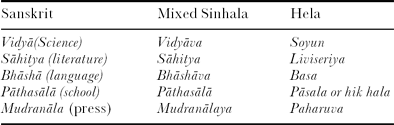
As this quote suggests Cumaratunga's criticism focused on the three dominant languages of the time—English, as a language of the colonial government, and Sanskrit and Pali as classical languages in the pirivena educational system. During the years 1939 to 1944, there was a linguistic shift in his style of prose—from mixed Sinhala to pure Sinhala (śhuddha Sinhala or Hela).Footnote 74 An important consequence of this shift was that Cumaratunga adopted Hela (pure Sinhala) words rather than Sanskrit forms. He outlined some principles for the coining of new Sinhala terms based on Hela roots. The following table shows a small section of words in Hela with their equivalents in mixed Sinhala and Sanskrit.
As the examples in Table 2 show, most Hela words were quite different from their mixed Sinhala equivalent. Cumaratunga attempted to create almost a new variety of Sinhala prose—Hela basa or Elu, completely devoid of Sanskrit and Pali words. His desire was to show that the Sinhala language was an independent language rather than hybridized by excessive borrowings from, or mixing with, other languages. Therefore, he condemned the Sanskrit etymology of Sinhala words.Footnote 75
Some Hela words and their equivalents in Mixed Sinhala and Sanskrit
Soon after the appearance of Hela usage, the linguistic scene became more complicated in several ways. Many contemporary writers found Hela to be more archaic, outdated and incomprehensible than mixed Sinhala. Although Hela was not acceptable to many writers, Cumaratunga and his ardent followers tried to impose it on them as a ‘pure’, ‘genuine’ form of Sinhala. We can describe this linguistic policy of de-Sanskritizatation of Sinhala as an effort to ‘indigenize’ the vocabulary of language, but on the other hand it was a reaction to the dominant pirivena and philological linguistic scholarship. However, this fondness for pure Sinhala usage was criticized by many contemporary writers as an ‘obsession or madness’.Footnote 76 The writers who adopted Hela words became an anti-Sanskritic group of purists estranged from the main linguistic stream.
It is also important to point out that in the 1930s pirivena scholars (mainly Buddhist monks) and oriental scholars in the Ceylon University College (1921) dominated the academic profession. At the same time, they were involved in government sponsored linguistic projects such as Geiger's Sinhala Etymological Dictionary.Footnote 77 In 1935, D. B. Jayatilaka, leader of the State Council and Editor-in-Chief of the Sinhala Dictionary, had a close association with monks of the Vidyālankāra Pirivena. Footnote 78 The Ceylon University College, and academic associations, including the Ceylon Branch of the Royal Asiatic Society, also took an active interest in these activities. In Ceylon University College, the local languages of Sinhala and Tamil, as well as the classical languages of the country, Pali and Sanskrit, all came under one department of study. Cumaratunga was not invited to help with the dictionary nor was he even consulted in its preparation or to teach Sinhala in the oriental section at University College. He had strongly criticized the established literati, saying that ‘the pundits of the temple and the university have created a language of their own which is at once debased, insipid and inelegant’.Footnote 79 In an editorial to The Helio entitled ‘Doctoring to Death’, Cumaratunga stated:
Oh, our beautiful language! Its grammar is to go back to the grandmother, its style is to be stilled, its spelling is to be expelled and its space is to be spaded. The ‘doctors’ see nothing wrong in doing so. We have no word in the matter, for we are not ‘doctors’.Footnote 80
Thus we can argue that Cumaratunga'a linguistic policy involved attacking the dominant oriental scholarship of the day. In fact, he adopted this policy in response to Geiger's philological works, which considered Sanskrit and Pali essential to the study of Sinhala. Through the elimination of Sanskrit, Pali and Tamil words (and also other foreign words) he tried to distinguish Sinhala from other Indian languages (particularly Sanskrit and Pali), and to emphasize the ‘genuine’ and ‘unique’ features of Sinhala.Footnote 81 There was a growing linguistic consciousness among Sinhalese speakers, at this time concerning their linguistic affinity to other Indo-Aryan languages. The University College carried out Indo-Aryan scholarship under the guidance of reputed oriental scholars. In this context Cumaratunga attempted to show that Sinhala developed separately from other Indic languages.Footnote 82 Cumaratunga and his followers were thus attempting to construct a new theory concerning the origin of Sinhala in response to contemporary historical linguistic scholarship.
With the growth of language loyalty in the mid-1930s, Cumaratunga's puristic attitudes and interventions became more clamorous. As a leading literary figure he was well aware of the reforming role that newspapers could play in language. He restarted the defunct newspaper Lak Mini Pahana in 1934, and edited it until 1936. This newspaper demonstrated a strong commitment to language reform, adopting firm editorial policies on language. In the first editorial of Lak Mini Pahana, Cumaratunga stated that ‘its main business is to make room for anyone to express his opinion in a refined, elegant language that will be beneficial to the society at large’.Footnote 83 A notable feature of his journalism was enthusiasm in the promotion of ‘correct’ language. Although it promoted elegant, correct language, it did not use Hela. Thus Lak Mini Pahana encouraged students to write correct language and to make use of it as a vibrant vehicle to convey their ideas and feelings. In order to publicize his linguistic views, Cumaratunga also started a Sinhala journal in 1939, which he called Subasa (Good Language). With the publication of Subasa, Sinhala language reform activities and the campaign for purism reached their peak. Various issues related to written usage in Sinhala were discussed in the journal, and a large stock of pure Sinhala words were presented and their use encouraged.
There was also a nationalistic motivation behind these purification efforts.Footnote 84 Cumaratunga was seeking to construct an indigenous Hela identity on the basis of the Hela language (Hela basa). Almost simultaneously with the publication of Subasa, Cumaratunga's linguistic ideas crystallized into a new ideology, known as Hela ideology, the central theme of which was the creation of a new linguistic identity. This identity was based solely on the Hela language (hela basa), but it was also used to designate the Hela race or people (hela räsa),Footnote 85 the Hela land (hela desa), the music and so on. In 1941, Cumaratunga said: ‘Let all be Hela in nationality, caste, language and religion. . .Let our aim be one, that is, to work as one for the welfare of our country, our nation and our language’.Footnote 86 Cumaratunga had rejected the Mahāvamsa story about the Vijayan colonization in the island, and upheld the idea of an independent Hela civilization, using the term ‘Heladiva’ (Island of the Hela) to denote the country. The Hela language was promoted and based on the idea of an ethnically pure race—the Hela. Cumaratunga preferred the term Hela (which he called Helese in English) rather than Sinhala. In other words, the revival of the Hela language constituted a vital component in the building of the new Hela (or pure Sinhala) national identity.
Ideologically, the promotion of the Hela notion posited a parallel but counter discourse to the dominant construction of Sinhala as an Indo-Aryan language. Cumaratunga emphasized the unique features of the Sinhala language and distanced it from other languages, mainly Pali and Sanskrit. He publicly stated:
Know that the Sinhalese language is not a daughter of any language now in existence. Her idiom is her own. Her grammar is her own. The Helese people. . .must realize that their beautiful language is not the same as the debased jargon now in use among ignoramuses whose names have been variously appendaged. They must begin to feel proud of their language by finding its singularities which they must uphold and cherish.Footnote 87
Like the leaders of the Turkish language movement in the 1930s, Cumaratunga maintained the superiority and uniqueness of Sinhala over other languages.Footnote 88 In fact, he went one step further and argued that Indian languages were all derived from Hela, declaring that ‘the Helese language is older than the oldest Indian languages’Footnote 89 Even Pali was considered a language created by the Hela people.Footnote 90 The followers of Cumaratunga also used the Hela ideology to claim the superiority of Sinhala over other languages.Footnote 91 This theory that Hela was the mother of all languages set out to create an authentic linguistic identity by distinguishing the Sinhala language from other Indian languages.Footnote 92
It has been pointed out with regard to nationalism that language is the ‘authenticating device for finding, claiming and utilizing one's inheritance’.Footnote 93 Cumaratunga tried to purify the Sinhala language to shape it into an adequate symbol of national identity. This linguistic effort to reconstruct the authentic uniqueness of the nationality—the Hela identity—inspired feelings of patriotism in the Sinhalese people and inculcated a sense that they had a ‘unique’ national identity. In this way, the Hela movement was thus concerned not merely with purifying the language, but was also a political movement, which identified one authentic language (Hela basa) with one authentic people (Hela räsa). Cumaratunga's search for an authentic linguistic heritage shows the primacy of the language-national identity link pre-independence.
Some of the activities of the Hela movement were aimed at changing contemporary linguistic practices of the Sinhalese community. For instance, the Sinhalisation of proper names became an important feature of the Hela movement. During the 1920s Dharmapala's powerful impact led many to adopt traditional Ārya Sinhala names (mainly Sanskrit) instead of English or Portuguese names. Going against the prevalent tendency to adopt Ārya Sinhala names in this period, Cumaratunga suggested the Hela version of Sanskrit and English names. During the latter part of his career, Cumaratunga changed his Sanskrit-based name of ‘Cumaratunga Munidasa’ to a Hela name: ‘Cumaratungu Munidas’. The followers of the Hela movement also adopted Hela versions of their personal names and, by extension, also changed the names of towns, streets, and place names.Footnote 94 Cumaratunga also adopted a policy of writing the initials of a name according to Sinhala letters. His followers, subsequently, rejected the Western style of writing initials, and adopted the Sinhala style.Footnote 95
This Hela movement first gained the support of the Sinhala language loyalists because of its ethno-nationalistic implications. However, like many other puristic movements, it failed to gain the support of Sinhala scholars.Footnote 96 This was due in part to Cumaratunga's vehement attack on the pirivena scholars and the university, both of which were firmly established in the Sinhala linguistic sphere. Scholars and many public figures withheld support, also because of Cumaratunga's puristic ideas about language. As a result, Cumaratunga's purification efforts were hampered by inadequate institutional and popular support. In the early 1940s, when purism had gained ground in the Sinhala literary scene, many scholars defended purism. Most of them were Sinhala newspaper editors and pirivena scholars who had adopted contemporary mixed Sinhala usage.Footnote 97 In response, Cumaratunga and his followers criticized current literary works solely on the basis of grammatical mistakes. For example, the journal Subasa carried numerous articles attacking Martin Wickremasinghe (1890–1976), the well-known novelist and writer at that time, as a ‘corruptor of the Sinhala language’ by pointing out faults in his grammar, syntax and idiom.Footnote 98 As a journalist and creative writer Wickremasinghe emphasized the need for a simple language that could be easily understood by the masses, in order to disseminate new ideas and information. Writing an article to the Subasa, another leading Hela activist, Jayantha Weerasekera (1895–1949) stated that contemporary Sinhala journalists and novelists who opposed Hela were ‘enemies of the Sinhala language’.Footnote 99
Cumaratunga was more interested in language as a maker of ethnicity than religion. He recognized the symbolic or ‘iconic’ value of language for national identity and firmly believed in the power of language as an instrument for moulding the national consciousness of his countrymen.Footnote 100 The myth that Hela language is inherently associated with Hela civilization served as a strong link between language and national identity. Thus we can argue that Hela ideology was a ‘purer’ version of Sinhalese nationalism than Ārya Sinhala because it recognized the centrality of Hela language. In this period, especially up to the 1930s, Sinhala Buddhist nationalist leaders like Anagarika Dharmapala (1864–1933) and Piyadasa Sirisena (1875–1946) attempted to instil the values of the ethno-religious trinity of rata (country), jātiya (nation), and āgama (religion) in the people through their speeches and publications. For example, Dharamapla stressed the affinity between Sanskrit, Pali and Sinhala, as ‘Aryan’ languages, and popularized the idea of an Aryan language (Ārya bhāshā) and Aryan race (Ārya jātiya).Footnote 101 Cumaratunga, however, tended to rely on language rather than on religion as a symbol of the community. By downplaying Buddhism as an element of Sinhalese ethnic identity, he focused on the Sinhala language as a tool to achieve political independence. In place of the popular slogan ‘country, nation and religion’, he adopted another trinity of ‘language, race and country’ (basa, räsa, desa), placing ‘language’ first as the foremost element. In his view, language transcended religious differences among the Sinhalese—particularly between Buddhist and Christian. In this way Cumaratunga was able to get the support of Sinhalese Christians for the Hela movement. He recognized basa, räsa, desa (language, race and country) as the ‘Hela Triple Gem’ (Hela Teruvana).Footnote 102 The trend of putting language before religion in constructing national identity reflects the growing importance of the language factor in Sinhala nationalism and politics in the late 1930s.
Through these efforts Cumaratunga attempted to build a nation of Sinhalese (Helese) based on language. He said: ‘The only genuine language of the land is Sinhalese. There is no other spot under the sun where the Sinhalese language [is] in use. Ceylon must see that her national language is carefully and constantly preserved and properly nurtured’.Footnote 103 Cumaratunga's identification of language as the prime identity component of an ethnic group is central to his idea of an ‘imagined nation’. He declared: ‘In order to uplift a nation, the first step that should be taken is the improvement of its language’.Footnote 104 Going further, he argued that independence in the sphere of language was a prerequisite for political independence. Cumaratunga was the first to connect the Sinhala language with political independence and the first to recognize that linguistic independence is intimately tied to national independence. He pointed out: ‘Whatever anyone may say we will never obtain freedom if we despoil our own language. Begin therefore with our own language’.Footnote 105 It is interesting to note here that similar views were expressed in the Tamil linguistic sphere in South India at this time. For example, in 1924, the Tamil scholar Kalyanasundaram declared: ‘The nation in which the mother tongue does not flourish will never achieve freedom. . .The first step towards freedom is respect for the mother tongue’.Footnote 106 Speaking at a Youth Congress session in Jaffna, in 1929, he called on the youth to labour hard to restore the Tamil language to its original glory.Footnote 107
The decade of the 1930s marked the beginning of major political developments that altered the language situation. With the introduction of universal suffrage in 1931, 17 years before independence, the post-1931 period saw a rapid transformation of the country's political system in the transfer of responsibility over large and important areas of government activity to local politicians.Footnote 108 The local political leadership were forced to speak to the people in their own language, and elite-mass linkages became visible in linguistic matters. The question of language became a politically significant one for elite politicians and there was a public interest and debate about the use of local languages in government activities and in education. Cumaratunga held the view that before a language could attain official status and be used as a medium of instruction, it should be idiomatic, elegant, grammatical and correct. As a Sinhala language advocate, he campaigned on behalf of the use of Sinhala in government activities and education, and argued for the purity of Sinhala usage.Footnote 109 In 1940, in his ‘open appeal’ to the Minister of Education, he expressed the desire for Sinhala to be used, whilst also indicating its need for improvement:
We clamour for Court proceedings in the Sinhala language. We long to listen to Sinhala speeches in the State Council. In short we want Sinhala to be made the state language at least in the Sinhalese provinces. But how many of us pay any attention to the language itself, its form, its purity, its forcefulness, its elegance?Footnote 110
As a language loyalist he sought to rescue Sinhala from its subordinate status as a language of a colonized people.Footnote 111 In one of his Lak Mini Pahana editorials, Cumaratunga explained his objection to the use of the term ‘vernacular’ to denote the Sinhalese people's language, pointing out that it conveys the image of an inferior local language in contrast to the language spoken by the dominant colonial power. He advocated that the word Sinhala be used instead of ‘vernacular’, which has the meaning of ‘debase language’ (the language of the slaves). In support of his view that it should be called ‘Sinhala’, he said: ‘if our country is Sinhalese, the nation is Sinhalese, and if the language is Sinhalese, is there any other name that is far more suitable?’Footnote 112
Establishment of the Hela Havula
Unlike many other contemporary scholars, Cumaratunga had a large number of disciples and followers, the majority of whom were his own pupils.Footnote 113 In an effort to promote Sinhala, Cumaratunga founded in 1941 one of the most dynamic language associations of the time, the Hela Havula, (Pure Sinhala or Hela Fraternity).Footnote 114 The purpose of this organization was to bring together a group of like-minded individuals: the Sinhala language loyalists of his time. At the inauguration of the Hela Havula, Cumaratunga pointed out:
A country with an undeveloped language will not develop. . .This is a small country. The Sinhalese are a small nation. It is a defeatist mentality to say that in a small country there is hardly any room for development. . .Let us get together, form a society, and set up branch societies throughout the island, in order to make known to the people the work that we propose to do.Footnote 115
The Hela Havula soon became a puristically motivated language association to which a considerable portion of the Sinhalese-educated youth—mainly Sinhala school teachers —were attracted.Footnote 116 It conducted open meetings, held public lectures, and published the journal Subasa. Although it was an organized language movement in character, one can argue it was also as an ideological movement for the purity of Sinhala.
According to Paul Brass, language movements are closely related to concerns about economic advancement, social status, and political power.Footnote 117 As a language association, Hela Havula attempted to formulate specific objectives in language politics, and its activities were linked to the developments of the contemporary Sinhala linguistic and literary culture. Cumaratunga's puristic activities gained further momentum with the establishment of Hela Havula. The three values of basa, räsa, desa (language, race, and country) were used as the organization's main slogan and the adoption of ‘pure Sinhala’ or Hela was seen as the first step in the struggle for independence. This was the main language association active in the language politics of the period, and most of its leaders, for example, Cumaratunga, Jayantha Weerasekera had links with the national leaders of the Ceylon National Congress (founded in 1919) and Sinhala Maha Sabhā (founded in 1934). It is interesting to note that Cumaratunga was a member of the Sinhala Maha Sabhā, which mobilized Sinhalese masses under the dynamic leadership of S. W. R. D. Bandaranaike (1899–1959) from the mid-1930s. Later, Cumaratunga was not happy about the Sinhala Maha Sabh's policy, particularly with regard to the language. In one of its meetings in 1936, Bandaranaike moved that the name Sinhala Maha Sabhā (The Great Association of the Sinhalese) be replaced by Swadeśiya Maha Sabhā (The Great Association of the Indigenes) in order to gain the support of other communities. On this occasion Cumaratunga defended the retention of the word Sinhala, and the motion was defeated.Footnote 118
Until the 1940s, the issue of language was discussed in the legislature within the confines of education policy. It was now that the topic of ‘official language’ (rājya bhāshā) became a matter of political concern, for instance in the political agenda of the State Council of Ceylon. By this time, the Sinhala language loyalists had had a definite impact on the national language question. In 1941, ten years after the adoption of the universal adult franchise, Cumaratunga wrote in his periodical:
Let us take a new policy at the next general elections. Let us say beforehand that we shall not give our vote to anyone who does not promise to speak exclusively in Sinhala in the Council. Let us determine to put this into practice as well. . .[and] see if our hopes will not be fulfilled.Footnote 119
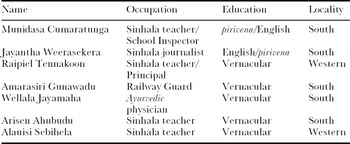
The deputy leader of the Hela Havula, Weerasekera, became the Joint Secretary of the Ceylon National Congress in 1943, with J. R. Jayewardene (1906–1996), who was the first Sinhalese politician who proposed a resolution to make Sinhala the sole official language in 1943. Some of the movement's members were associated with the Left movement of the 1930s.Footnote 120Hela Havula also represented the ideas of the Sinhala-speaking middle class intelligentsia —especially Sinhala school-teachers, principals and notaries. It had branches in some parts of the country, mainly in the Southern and Western provinces. The leaders and most of its members became emotionally and intellectually devoted to the promotion of pure Sinhala. Many of them tried to promote the Hela Havula in their schools and teacher training colleges.Footnote 121 There is evidence, for example, that some of the most important personalities in the movement came from the Southern province—the locality of Cumaratunga (see Table 3).
Educational and occupational background of Hela Havula leaders and their locality

Cumaratunga campaigned in Sinhala as well as in English, but most of the Hela Havula members were Sinhala monolinguals. At this time, the English language dominated the administration of the country, and there was a demand for ‘more’ and ‘better’ English in the educational system. In 1941, the same year when Hela Havula was founded, Cumaratunga launched the journal, The Helio, in order to propagate his ideas in English medium. ‘Sinhalese, more Sinhalese and better Sinhalese’ was the slogan of this journal. In the first editorial, Cumaratunga explained: ‘Our aim is to give a push, a vigorous push to the Hela (Sinhalese) language. Why is it in English? Because the great majority of those who have the power to allow or disallow a real push for it understand English better than any other language.Footnote 122 At this time most of the Principals of Colleges and Head Masters of English schools paid very little attention to teaching the mother tongue in their institutions, causing Cumaratunga to complain: ‘What they seem to want is to make English our national language’.Footnote 123 In 1941, Cumaratunga stated:
Our patient is our mother tongue. She is being deliberately neglected, abused, degraded, starved, spoiled and poisoned. Her own children have already forgotten the fact that she was their own mother. . .Let us revive our own mother and receive her own blessing.Footnote 124
On one occasion, writing in an open letter to Dr Ivor Jennings (1903–1965), Principal of the Ceylon University College, Cumaratunga said with great humility: ‘It is very seldom that I write even a letter in English, not because I despise that language, but because I am more concerned with my own language. There is a world to look after the English language, but the Sinhalese language is helpless’.Footnote 125 Comparing Sinhala with the Tamil language Cumaratunga said ‘. . .the [Sinhala] language is that of a small nation of a few million people’ and pointed out that in ‘South India there are millions and millions of people to safeguard the Tamil language’.Footnote 126 In connection with the establishment of the University of Ceylon in 1942, Cumaratunga stressed the task of the University with regard to the ‘preservation and cultivation’ of the Sinhala language.Footnote 127
In the early 1940s, the Hela Havula, aroused interest in the Sinhala language and sharpened language-loyalty attitudes. It produced a brand of scholars with a profound knowledge of the Sinhala language who became emotionally and intellectually devoted to the promotion of Sinhala in later years.Footnote 128 Unlike the contemporary Indian language movements, the Hela Havula never transformed into a political association.Footnote 129 The failure of Cumaratunga's efforts to popularise the Hela identity of the Sinhala language can largely be explained by two facts: the Indo-Aryan identity of Sinhala was firmly established by this time, and pirivena scholars dominated the linguistic scholarship. However, the Hela movement created a strong sentimental and cultural attachment to the language, especially among the Sinhalese-educated youth. It also created a favourable sociolinguistic environment for the politicization of language loyalty in the early 1940s. Cumaratunga died in March 1944, but by that time the official language question had achieved political significance.Footnote 130 After the untimely demise of Cumaratunga, Weerasekera became the leader of the Hela movement and continued Cumaratunga's campaign to declare Sinhala alone as the official language.
Conclusion
In the first two decades of the twentieth century, several changes occurred in the linguistic and political spheres, some of which reflected a growing interest in language usage and resulted in a demand for raising the status of Sinhala. Scholars became increasingly concerned with the notions of linguistic correction, purism and reform, with language seen as the main determinant of national identity. In this context, I have examined the language policies and practices advocated by the Hela movement of Munidasa Cumaratunga, and the call for language reform involving the creation of a ‘pure’ form of Sinhala, uncontaminated by foreign influences. Purity of language was not a new concept for Sinhala but, as I have shown, the notion of purity that was propagated by Cumaratunga in the 1930s and 1940s was closely associated with other linguistic practices and socio-political developments of the day. As the case of Cumaratunga indicates, his language purism was not undertaken for the mere love of language. I have argued that Cumaratunga's language movement was essentially a revolt against the dominant language practices and ideologies of the colonial government, political leadership, the pirivena and the contemporary literary elite of the time.
This paper has attempted to suggest that the role played by Cumaratunga had important implications for the politicization of the Sinhala language and making it an issue in national affairs is concerned. He highlighted the role of Sinhala as a unique ‘national language’ and launched a campaign to make Sinhala a politically significant issue. As we have already seen, Cumaratunga's views about language usage were not only based on genuine linguistic worries, but also reflected deeper and more general social judgements. His discourse about ‘correct’ and ‘civilized’ language emerged in an era of socio-political reform, and these ideas became an integral part of the social and cultural transformations that have taken place during the 1930s and 1940s. Cumaratunga's linguistic thought—mainly his Hela ideology—promoted the ethnolinguistic uniqueness of the Sinhalese community and made a decisive impact on the development of a linguistic consciousness. For Cumaratunga, language was nationalism's main ideological site and was used as the main tool to create Sinhala national identity. The purging of foreign elements in language was carried out in order to distinguish Sinhala from its neighbours and reinforce its status as an authentic language. This new attention to language created unprecedented awareness of the Sinhala language that fostered its politicization. The battle between Sinhala and other languages began, and Sinhala continues to be dominant in the national language movement. I have argued that the concept of Hela, which asserted the superiority of Sinhala over other languages, served as the ideological basis for the language politics of the 1940s. The politicization of Sinhala language-loyalty laid the foundations for the idea of Sinhala as the ‘national language’ of the Sinhalese nation. This process can be summarized as follows: language loyalty > promotion of the own language > identifying the language as ‘corrupt’ > movement for the purification of language > official recognition of the own language > empowerment of the formerly powerless language.Footnote 131 These developments in linguistic culture provided a context for the demand for the people's own language (swabhāshā) which marked the genesis of the national/official language movement in the 1940s.