Introduction
War captivity is one of the most traumatic human experiences and usually follows active combat. Captivity entails terror, torture, solitary confinement, and a systematic deprivation of basic physical and emotional needs (Herman, Reference Herman1992). Unlike a single traumatic event (e.g. a motor vehicle accident), captivity involves a series of repeated and prolonged traumatic events that the prisoners of war (POWs) cannot avoid.
Although post-traumatic stress disorder (PTSD) has become the most conspicuous diagnosis for traumatized individuals, it does not take into account the complexity of adaptation to trauma. It has been suggested that, following repeated abuse in captivity, victims tend to develop not only PTSD but also a unique form of post-traumatic sequela that penetrates and consumes their personality, often referred to as complex PTSD or disorders of extreme stress not otherwise specified (DESNOS) (Terr, Reference Terr1991; Herman, Reference Herman1992; Van der Kolk & Bessel, Reference Van der Kolk and Yehuda2002). According to Herman (Reference Herman1992) ‘prolonged captivity disrupts all human relationships and … the survivor oscillates between intense attachment and terrified withdrawal.’ Such alterations of personality are related to attachment orientations, a systematic pattern of relational expectations, emotions and behaviors that reflects a person's mental representations (‘working models’) of self and others (Brennan et al. Reference Brennan, Clark, Shaver, Simpson and Rholes1998). One dimension refers to attachment-related anxiety, which is concerned with the extent to which an individual worries that their partner will not be available in times of need and wishes intensely for proximity to and care from their partner. The second dimension is attachment-related avoidance. This refers to the extent to which an individual does not trust the good intensions of others and wants to keep themselves emotionally distant (Mikulincer & Shaver, Reference Mikulincer and Shaver2007). Both attachment anxiety and avoidance are conceptualized as attachment injuries that lead to serious problems in emotion regulation and are implicated in PTSD following war captivity (Zakin et al. Reference Zakin, Solomon and Neria2003).
Most attachment researchers, while acknowledging that attachment orientations may alter under certain life circumstances, have treated these orientations as relatively stable traits or dispositions (Mikulincer & Shaver, Reference Mikulincer and Shaver2007). However, other researchers have shown that although there is evidence for stability in attachment orientations, change is common in both children and adults (Fraley et al. Reference Fraley, Fazzari, Bonanno and Dekel2006), particularly in response to adversity (Davila & Cobb, Reference Davila, Cobb, Rholes and Simpson2004). Bowlby (Reference Bowlby1973) argued explicitly that for attachment patterns to remain functional, they must be able to incorporate new information about the self and others in response to changing life circumstances. Therefore, attachment orientations must remain flexible and open to change over time (Kobak & Hazan, Reference Kobak and Hazan1991; Collins & Read, Reference Collins, Read, Perlman and Bartholomew1994). To the best of our knowledge, no study has examined the stability of ex-POWs' attachment orientations over time and the association between changes in attachment orientations and the course of PTSD.
This prospective study aimed to assess the longitudinal course of changes in post-traumatic symptoms and attachment orientations over a 12-year period. As the effect of aging on heightened attachment avoidance and PTSD severity has been well documented (e.g. Opp, Reference Opp1987; Diehl et al. Reference Diehl, Elnick, Bourbeau and Labouvie-Vief1998; Schnurr et al. Reference Schnurr, Lunney, Sengupta and Spiro2005), and our participants were passing through mid-life or early old-age at the time of the study, this factor was also taken into account. Our main research questions were: (1) whether age-related changes in attachment orientations and PTSD are exacerbated among ex-POWs who survive complex trauma, and (2) whether and how changes in PTSD symptom severity over the study period are related to changes in attachment orientations.
Method
Participants
The sample consisted of 209 Israeli veterans of the 1973 Yom Kippur War divided into two groups (103 ex-POWs and 106 controls) who participated in two waves of measurements, in 1991 and 2003 (for details see Solomon et al. Reference Solomon, Neria, Ohry, Waysman and Ginzburg1994). The group consisting of POWs (103 out of a total of 240) had been captured by the Egyptians and the Syrians and had been subjected to intense isolation and systematic torture, consisting of the infliction of severe physical pain and great mental pressure. Mental pressure was applied by a range of techniques, including frightening the prisoner with numerous threats (of death, mutilation, or killing family and friends), exhausting him through inadequate food, extremes of heat or cold, prolonged standing or deprivation of exercise, and prolonged interrogations. POWs were humiliated verbally and by interfering with their personal hygiene and natural bodily functions.
The control group was assembled from combat soldiers who fought on the same fronts as the POWs. They were sampled from Israel Defense Forces (IDF) computerized files that provide information about veterans' rank, military role and location during the 1973 Yom Kippur War. They were matched to the ex-POWs on personal and military background (e.g. age and education, as well as rank and assignment during the war).
Measures and procedure
The study comprised two waves of measurement, in 1991 and 2003. In 1991, participants filled out a battery of questionnaires in a medical center. Veterans who were unable to attend were administered the questionnaires at home. In 2003, questionnaires were administered in the participants' homes or other locations of their choice. In both waves, before filling out the questionnaires, participants were asked to sign informed consent forms and were assured that the data would remain confidential. The same questionnaires were completed in the two waves of measurement and their order was randomized between participants to avoid any potential order effect. The response rates for the ex-POWs were 75.5% in the first measurement and 71.5% in the second measurement. The corresponding response rates for the controls were 70.6% and 74%.
PTSD symptoms were measured using the PTSD Inventory (Solomon et al. Reference Solomon, Neria, Ohry, Waysman and Ginzburg1994). This is a self-report scale that was initially based on DSM-III-R criteria, which was the standard of practice at the beginning of the study (APA, 1987). The inventory consists of items corresponding to the PTSD symptoms listed in DSM-III-R (APA, 1987). To conform to the updated definition of PTSD, both the 1991 and 2003 data were analyzed in accordance with the new DSM-IV (APA, 1994) symptom clusters. Internal consistency was high (Cronbach's α=0.87 for 1991 and 0.95 for 2003). High convergence validity compared with diagnoses based on structured clinical interviews was found at Time 1 (Solomon et al. Reference Solomon, Benbenishty, Neria, Abramowitz, Ginzburg and Ohry1993).
To assess changes in attachment orientations between the two waves of measurements, participants were asked to complete a questionnaire (Mikulincer et al. Reference Mikulincer, Florian and Tolmacz1990) on attachment avoidance and attachment anxiety. Items were constructed based on Hazan & Shaver's (Reference Hazan and Shaver1987) prototypical descriptions of attachment orientations and were very similar to the Experience in Close Relationships Scale (Brennan et al. Reference Brennan, Clark, Shaver, Simpson and Rholes1998). Participants were asked to think about their close relationships, without focusing on a specific partner, and to rate the extent to which each item described themselves in these relationships. Previous studies have found this scale to be reliable, valid, and correlated with other adult attachment scales (e.g. Mikulincer & Florian, Reference Mikulincer and Florian2000).
Results
Changes in PTSD over time
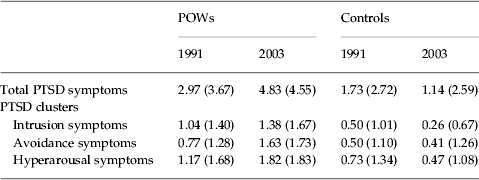
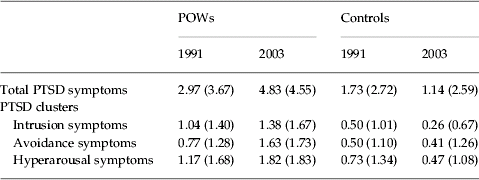
To examine changes in PTSD symptoms between the two waves of measurement and in the two study groups, we conducted a two-way analysis of variance (ANOVA) with group (ex-POWs, controls) and time of measurement (Time 1, Time 2) as factors. Time of measurement was treated as a within-subject repeated factor. The dependent variables were the total number of PTSD symptoms endorsed by a participant and the number of symptoms in each of the intrusion, avoidance and hyperarousal clusters. Table 1 presents relevant means and standard deviations for these analyses.
PTSD scores according to study group and time of measurement
PTSD, Post-traumatic stress disorder; POW, prisoner of war.
Values are given as mean (standard deviation).
The ANOVA conducted on the total number of PTSD symptoms revealed significant main effects for group [F(1, 207)=37.40, p<0.01] and time [F(1, 207)=5.98, p<0.01]. Ex-POWs endorsed more PTSD symptoms than control participants at both waves of measurement (Table 1). In addition, the number of PTSD symptoms increased from Time 1 to Time 2. These two main effects, however, were qualified by a significant time×group interaction [F(1, 207)=22.09, p<0.001]. To locate the source of the interaction, t tests using the Bonferroni correction were performed. These tests showed a significant increase in the number of PTSD symptoms between Time 1 and Time 2 among ex-POWs [t(101)=4.77, p<0.05] but no significant change among control participants [t(104)=1.61].
For the intrusion cluster, the ANOVA revealed a significant main effect for group [F(1, 207)=33.06, p<0.01] and a significant time×group interaction [F(1, 207)=9.33, p<0.01]. t tests using the Bonferroni correction revealed a significant increase in the number of intrusion symptoms over time among ex-POWs [t(101)=2.52, p<0.05] but no significant change among control participants [t(104)=1.75]. For the avoidance cluster, the ANOVA revealed significant main effects for group [F(1, 207)=26.47, p<0.01] and time [F(1, 207)=10.35, p<0.01], as well as a significant interaction for time×group [F(1, 207)=16.04, p<0.001]. t tests using the Bonferroni correction revealed a significant increase in the number of avoidance symptoms over time among ex-POWs [t(101)=5.04, p<0.001] but no significant change among control participants [t(104)=0.56]. The ANOVA conducted on the hyperarousal cluster revealed only a significant main effect for group [F(1, 207)=26.25, p<0.01] and a significant time×group interaction [F(1, 207)=15.44, p<0.01]. t tests using the Bonferroni correction revealed a significant increase in the number of PTSD hyperarousal symptoms over time among ex-POWs [t(101)=3.95, p<0.001] but no significant change among control participants [t(104)=1.56]. Similar findings were obtained in statistical analyses that compared POWs only to those controls who endorsed at least two PTSD symptoms at Time 1.
Changes in attachment orientations over time
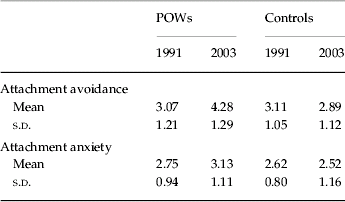
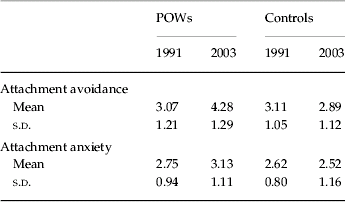
To examine changes in attachment orientations between the two waves of measurement in each of the two study groups, we conducted two-way ANOVAs with group (ex-POWs, controls) and time of measurement (Time 1, Time 2) as factors. Time of measurement was treated as a within-subject repeated factor. The dependent variables were scores of attachment anxiety and avoidance. Table 2 presents relevant means and standard deviations for these analyses.
Attachment orientations according to study group and time of measurement
POW, Prisoner of war; s.d., standard deviation.
The ANOVA conducted on attachment avoidance revealed a significant main effect for time of measurement [F(1, 201)=22.47, p<0.01] and a significant time×group interaction [F(1, 201)=59.71, p<0.001]. To locate the source of the interaction, t tests using the Bonferroni correction were performed. These tests revealed a significant increase in attachment avoidance between Time 1 and Time 2 among ex-POWs [t(96)=8.62, p<0.05] but no significant change among control participants [t(103)=2.14].
The ANOVA conducted on attachment anxiety revealed no significant main effects for group or time of measurement; however, the interaction for group and time was significant [F(1, 201)=8.58, p<0.001]. t tests using the Bonferroni correction showed a significant increase in attachment anxiety between Time 1 and Time 2 among ex-POWs [t(96)=3.19, p<0.01] but no significant change among control participants [t(103)=0.86].
Concurrent and prospective associations between attachment orientations and PTSD
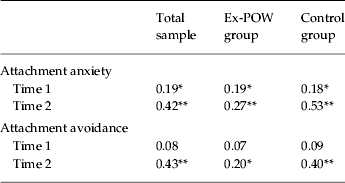
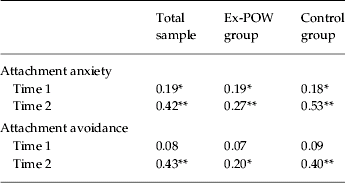
To examine the concurrent associations between attachment orientations and PTSD, we computed Pearson correlations between the three variables (attachment anxiety, attachment avoidance and PTSD symptoms) separately for each wave of measurement. Table 3 shows that PTSD symptoms were significantly associated with attachment anxiety at both Time 1 and Time 2. The greater the number of endorsed PTSD symptoms, the greater the attachment anxiety. PTSD was also significantly associated with attachment avoidance at Time 2, but not at Time 1 (Table 3). The greater the number of endorsed PTSD symptoms, the greater the attachment avoidance at Time 2. That is, attachment insecurities along the anxiety and avoidance dimensions seem to be psychological correlates of PTSD. Importantly, this pattern of associations was replicated in both the control and the ex-POW groups (Table 3).
Concurrent Pearson correlations between total number of PTSD symptoms and attachment orientations according to study group and time of measurement
PTSD, Post-traumatic stress disorder; POW, prisoner of war.
* p<0.05, ** p<0.01.
Beyond examining the concurrent associations between PTSD and attachment orientations, we wanted to examine whether PTSD at Time 1 is predictive of changes in attachment orientations at Time 2 and whether attachment orientations at Time 1 are predictive of changes in PTSD at Time 2. For this reason, we conducted two types of analyses. First, we conducted two cross-lagged correlations comparing the prospective associations between attachment orientations and PTSD. One cross-lagged correlation examined the association between PTSD and attachment avoidance and the other examined the association between PTSD and attachment anxiety. A comparison of the cross-lagged correlation between attachment avoidance at Time 1 and PTSD at Time 2 and the correlation between PTSD at Time 1 and attachment avoidance at Time 2 revealed a significant difference (z=3.47, p<0.001). Specifically, the prospective association going from PTSD at Time 1 to attachment avoidance at Time 2 was significantly stronger (r=0.24, p<0.05) than the prospective association going from attachment avoidance at Time 1 to PTSD at Time 2 (r=−0.07). Similar results were obtained for attachment anxiety. A comparison of the cross-lagged correlation between attachment anxiety at Time 1 and PTSD at Time 2 and the correlation between PTSD at Time 1 and attachment anxiety at Time 2 revealed a significant difference (z=2.71, p<0.001). The prospective association going from PTSD at Time 1 to attachment anxiety at Time 2 was significantly stronger (r=0.30, p<0.01) than the prospective association going from attachment anxiety at Time 1 to PTSD at Time 2 (r=0.07).
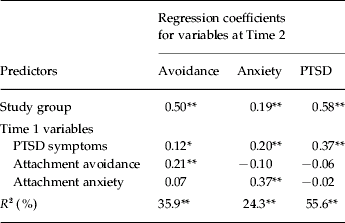
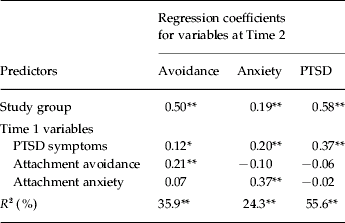
Second, we conducted three multiple regressions for attachment avoidance, attachment anxiety and PTSD at Time 2 as the dependent variables. In each of these regressions the predictors were study group (a dummy variable comparing ex-POWs and control participants), the number of PTSD symptoms, and the scores of attachment anxiety and avoidance at Time 1. Table 4 presents the relevant standardized regression coefficients (β) and changes in R 2 for each of the regressions. As shown, PTSD at Time 1 made significant unique contributions to the prediction of both attachment anxiety and avoidance at Time 2 (β=0.50 for avoidance, β=0.19 for anxiety, all p's<0.01), beyond what was expected from attachment scores at Time 1. However, attachment avoidance and anxiety at Time 1 did not contribute significantly to the total number of PTSD symptoms at Time 2 beyond what was expected from PTSD at Time 1 (β=−0.06 and −0.02).
Standardized regression coefficients and percentage of explained variance for attachment orientations and PTSD at Time 2 as predicted by study group and variables at Time 1
PTSD, Post-traumatic stress disorder.
* p<0.05, ** p<0.01.
Discussion
This study reveals that even three decades after their release from captivity, ex-POWs continue to report more PTSD symptoms than control veterans. Furthermore, whereas controls show no notable change in the number of PTSD symptoms they report over time, ex-POWs show a significant increase in intrusion, avoidance and hyperarousal symptoms. These findings once again demonstrate the potent pathogenic effects of war captivity that often follow highly traumatic combat experiences (Ursano et al. Reference Ursano, Rundell, Fragala, Larson, Wain, Brandt, Beach, Ursano and Norwood1996), and cumulative damage of multiple traumas (Herman, Reference Herman1992).
The heightened levels of PTSD in ex-POWs 30 years after their release and the increase in their PTSD symptoms from Time 1 to Time 2 may be explained in several ways. The first possibility relates to the aging process. During the second wave of measurement, participants were in their late fifties to early sixties. It has previously been suggested that suppressed traumatic memories often rise to the foreground as a consequence of changes experienced during aging. These changes include stressful life events (e.g. loss of family members), as well as a tendency to re-evaluate one's life (Schnurr et al. Reference Schnurr, Lunney, Sengupta and Spiro2005).
A second possibility is that the heightened levels of PTSD among ex-POWs at Time 2 is due to the unremitting threat of war and terror in Israel. Research has consistently indicated that the recovery environment plays an important role in the maintenance and reactivation of PTSD symptoms (e.g. Brewin et al. Reference Brewin, Dalglish and Joseph1996). In our study the second wave of measurement took place at the height of the second intifada, when terror attacks took place almost daily, affecting the entire state of Israel. Such constant threat inevitably causes distress, and may even reactivate symptoms in previously traumatized individuals (Long et al. Reference Long, Chamberlain and Vincent1994). Ex-POWs who are highly sensitized to any reminders of their war experience may be especially vulnerable to these events.
This study also revealed that, whereas attachment avoidance and anxiety remained stable or decreased in prevalence among the control veterans, they increased among the ex-POWs over time. There are several possible explanations, based on various psychological models, for these changes in attachment orientations over time.
First, the social-cognitive model (Baldwin et al. Reference Baldwin, Keelan, Fehr, Enns and Koh-Rangarajoo1996) posits that changes in attachment orientations may reflect activation of different parts of the attachment hierarchy. Several studies have demonstrated that various types of attachment-relevant information can be made more or less salient and consequently influence thought, feeling and behavior, leading to fluctuations in the self-report of attachment orientations (Mikulincer & Shaver, Reference Mikulincer and Shaver2007). It is possible that captivity may have changed the salience and accessibility of POWs' relational schema, during and in response to assessment, making insecure representations more central, salient and accessible.
Second, as suggested by Davila & Cobb (Reference Davila, Cobb, Rholes and Simpson2004), vulnerable people (in this case, ex-POW) may be more prone to changes in attachment orientations as they have developed non-coherent and unstable models of the self and others. They are thus more likely to report different patterns of attachment at different times.
Third, the ‘life stress model’ (Diehl et al. Reference Diehl, Elnick, Bourbeau and Labouvie-Vief1998) suggests that changes in attachment orientations are the result of changes in life events or circumstances, and that the stability of attachment orientations among people who have experienced negative life events (in this case captivity) is lower than among people who have not experienced such events (e.g. Waters et al. Reference Waters, Hamilton and Weinfield2000).
Nevertheless, regardless of the theoretical reason for the instability of attachment in the ex-POW group, this finding demonstrates the impact of war captivity, and clearly indicates that complex traumas are capable of modifying attachment orientations. This finding is in line with previous findings (Pozgain et al. Reference Pozgain, Mandic, Filakovic and Antolovic-Pozgain2003) that show that the psychological trauma of war can lead to significant personality changes, including high impulsivity and low empathy.
Our findings also indicate that increases in PTSD symptoms over time are associated with parallel increases in attachment avoidance and anxiety. Although only a few studies had examined the relationship between changes in attachment orientations and PTSD levels, many studies have reported positive correlations between attachment insecurities along the anxiety and avoidance dimensions and problems in mental health (e.g. Zakin et al. Reference Zakin, Solomon and Neria2003). The most common explanation of these correlational findings is that attachment anxiety and avoidance disrupt the process of coping with traumatic events and increase the risk of developing PTSD and other emotional and functioning difficulties (Mikulincer & Shaver, Reference Mikulincer and Shaver2007). Our findings, however, show an increase in attachment anxiety and avoidance over time, suggesting that attachment insecurities are not only a psychological antecedent of PTSD but also may be affected by its distress and psychopathology. Indeed, our findings clearly indicate that the level of PTSD symptoms at Time 1 is a significant predictor of subsequent increases in attachment anxiety and avoidance over time.
This finding cannot be easily explained by adult attachment theory (Mikulincer & Shaver). According to this theory, attachment insecurities are a risk factor for the emergence and increase of PTSD symptoms and not the reverse. As a result, this finding is a major novelty of the current prospective study. It seems that traumatic events and post-traumatic responses cause changes in people's resources and resiliency and then deteriorate their sense of attachment security. Moreover, this finding further emphasizes a marked instability of attachment style, which defies much attachment theory.
Clinical observations have suggested that repeated and prolonged trauma may lead to major personality changes, including significant changes in relationships and identity (Terr, Reference Terr1991; Herman, Reference Herman1992). Similarly, harsh and dramatic experiences, such as war captivity, may alter individuals' basic trust in others in a way that undermines their ability to maintain secure attachments in the future. Hence, even survivors who have had secure attachments may become more anxious, and tend to defensively avoid interpersonal contact following exposure to trauma. In our view, this deterioration of secure attachment would result in negative changes in ex-POWs' social lives, such as decreases in the amount and quality of social network or increased divorce rates. Unfortunately, we did not collect data on these negative social outcomes, which are markers of attachment insecurities. Further research should attempt to collect such data beyond assessing self-reports of attachment orientations. Moreover, further research should assess changes in ex-POWs' neuroticism and trait anxiety in order to examine whether the effects of trauma and post-traumatic responses are specific to attachment-system functioning or tend to be generalized to broader personality traits.
Alternatively, if attachment orientations are seen as cognitive schema, similar to other world assumption schemes (Janoff-Bulman, Reference Janoff-Bulman1992), they are malleable, depending on mental state. An individual's beliefs concerning his or her personal relationships with others could be viewed as dynamic cognitions that can be easily altered in the face of negative interpersonal experiences (e.g. captivity). Similar changes in world assumptions have been reported following trauma. For example, studies have found that victims of deliberately inflicted man-made traumatic events hold more negative assumptions after the events than people exposed to natural disasters or accidents (e.g. Wickie & Marwit, Reference Wickie and Marwit2000). These findings suggest that even if one's assumptions prior to the exposure to trauma are positive, they may become negative afterwards. Moreover, it is possible that attachment insecurities also play an important role in maintaining PTSD symptoms. Therefore, treatment focused on improving attachment security could synergize with other cognitive therapies in treating PTSD.
Nevertheless, both alternatives agree that survivors of intentional, human-inflicted victimization are inevitably confronted with issues concerning the trustworthiness of others and are bound to question and doubt others. Neither of these perspectives, however, explain why changes in attachment orientations were still found so many years after the war had ended. Similar to the changes in PTSD, this finding may be attributed to the aging process. As noted, many of the ex-POWs were passing through mid-life at the time of the second wave of measurement. The increase in attachment avoidance identified among ex-POWs is in line with previous studies showing more self-reliance and less sociability among aging individuals (e.g. Zhang & Labouvie-Vief, Reference Zhang and Labouvie-Vief2004). This may be particularly true among the psychologically vulnerable, such as the traumatized ex-POWs.
Like other prospective field studies, the current study suffers from several limitations. First, the sample had an attrition rate of nearly 30%, although this rate is not surprising in light of the long follow-up. Second, we used self-report measures that, although commonly used in trauma studies, may suffer from report biases.
Despite these limitations, the findings of the current study make an important contribution to our clinical knowledge of changes in attachment orientations and their association with the course of PTSD over time among traumatized individuals. Future studies should consider conducting the initial measurement soon after the occurrence of the traumatic event to capture early changes in personality. It would also be ideal to obtain data on participants' characteristics prior to the traumatic event, in order to make causal inferences possible.
Acknowledgements
We thank Danny Horesh for his assistance in the preparation of the manuscript, and Leanna Rutherford for her comprehensive editing of the text. This study was supported by a research grant given by the Israeli Science Academy (2003).
Declaration of Interest
None.