INTRODUCTION
Commercial aquaculture of Seriola quinqueradiata (Carangidae) was first established in Japan during the 1930s. Japan now cultivates 4 Seriola species including S. quinqueradiata, S. dumerili, S. lalandi and S. rivoliana, the combined production of which regularly exceeds 150 000 tonnes per annum and is worth an estimated $US 1.2 billion dollars (FAO, 2001). Of particular concern to the Japanese Seriola industry are 4 monogenean parasite species: Heteraxine heterocerca and Zeuxapta seriolae (Polyopisthocotylea: Heteraxinidae) which infect the gills of their hosts and Benedenia seriolae and Neobenedenia girellae (Monopisthocotylea: Capsalidae) which infect the skin of their hosts. There is a difference of opinion between Ogawa et al. (Reference Ogawa, Bondad-Reantaso, Fukudome and Wakabayashi1995) and Whittington and Horton (Reference Whittington and Horton1996) about whether N. girellae is a valid species. Due to their direct life cycles, monogeneans can proliferate quickly in culture systems if they are not managed appropriately. Monogenean parasites infecting cultivated fish are costly to the industry because they can reduce fish growth rates (Mansell et al. Reference Mansell, Powell, Ernst and Nowak2005), lead to secondary infections (Egusa, Reference Egusa1983) and high infection intensities can contribute to fish mortality (Ernst et al. Reference Ernst, Whittington, Corneillie and Talbot2002; Grau et al. Reference Grau, Crespo, Pastor, Gonzalez and Carbonell2003; Montero and Crespo, Reference Montero and Crespo2004). These parasite-associated costs can be reduced by implementation of sound parasite management strategies, which rely on a good understanding of parasite and host biology.
Few studies have investigated egg-laying rhythms in Monogenea and only 2 cases are documented. Macdonald and Jones (Reference Macdonald and Jones1978) demonstrated that Diplozoon homoion gracile (Diplozoidae), a gill parasite of southern barbel (Barbus meridionalis), displays a nocturnal egg-laying rhythm. A more defined egg-laying rhythm was reported for Z. seriolae, a gill parasite of S. lalandi, where 71·6% of daily egg production was released during the first 3 h period after dark (Mooney et al. Reference Mooney, Ernst and Whittington2006). This in vivo study sought to investigate the egg-laying patterns and egg production rates of H. heterocerca and B. seriolae infecting cultured S. quinqueradiata in Japan.
MATERIALS AND METHODS
Maintenance of fish and parasites
Specimens of Seriola quinqueradiata parasitized by mature Heteraxine heterocerca and Benedenia seriolae were collected in October 2004 from sea cages at a commercial yellowtail farm off Kamiura, Oita Prefecture, Kyushu, Japan. Fish were collected 1 day before the experiment began and transported to onshore aquaria facilities. Three fish (approximately 300 mm fork length) were placed individually into separate 45 litre opaque tanks (500×330×290 mm) filled with 30 litres of seawater filtered using a 10 μm bag filter, and were aerated. Tanks containing fish were then placed within a single 500-L water bath located outdoors away from direct sunlight. Circulation of water through the water bath at 300 L/h maintained water temperatures in the experimental tanks containing the fish at 23·8±0·1°C. Salinity was constant at 35 ppt. The times of sunrise and sunset in Oita Prefecture during the 3 days of this experiment were 06.00 h and 18.30 h respectively. An attempt to replicate sudden onset of ‘dawn’ and ‘dusk’ for comparison with Mooney et al. (Reference Mooney, Ernst and Whittington2006) was made using transparent and opaque lids to regulate the light cycle (light on 06.00 h, light off 18.00 h). At 06.00 h a transparent lid was placed on top of each tank and at 18.00 h each lid was replaced with an opaque lid. These lids also served to prevent the escape of fish and loss of parasite eggs.
Collection of parasite eggs
Starting at 12.00 h on day 1 and then every 3 h for 3 consecutive days, each fish was transferred by hand to a second tank containing 10 μm-filtered seawater and aerated. Eggs laid by both parasite species infecting each fish during the preceding 3 h period were collected by filtering seawater from each tank through a 63 μm mesh sieve as described by Mooney et al. (Reference Mooney, Ernst and Whittington2006). Dimensions of H. heterocerca eggs measured in the present study were 119 (112–125) μm long by 59 (53–63) μm wide (n=50). Eggs of B. seriolae have a tetrahedral side length of 144 (130–150) μm (n=6) (Kearn et al. Reference Kearn, Ogawa and Maeno1992a). Tests indicated that a 63 μm mesh sieve retained all eggs from each parasite species. Collected eggs were poured into a sample container and fixed in a weak (1–2%) formalin solution sufficient to preserve these small eggs for subsequent sample processing. Immediately after the conclusion of this experiment, each fish was treated individually to remove all H. heterocerca and B. seriolae. Fish were first bathed in dechlorinated freshwater for 5 min to remove all B. seriolae (see Chambers and Ernst, Reference Chambers and Ernst2005), and then in 15 ppm praziquantel for 15 min, a dose known to remove all mature H. heterocerca (unpublished data). All parasites removed were collected by filtering the bath water from both treatments for each fish through a 63 μm mesh sieve. Parasites were preserved in a weak formalin solution for later examination.
Parasite age determinations
The haptor of the polyopisthocotylean H. heterocerca is asymmetrical. The ‘major’ row is longer and has larger and more numerous clamps than the ‘minor’ row. Among polyopisthocotyleans, clamp number is recognized as a better indicator of age than parasite length (Thoney, Reference Thoney1986, Reference Thoney1988). The length of the anterior hamulus, usually the largest and most conspicuous of the haptoral sclerites of capsalid monogeneans, has been shown to be a useful indicator of parasite age due to their continual growth (Kearn, Reference Kearn1964, Reference Kearn1990; Whittington and Ernst, Reference Whittington and Ernst2002). Parasite age was determined by counting clamp number along major and minor clamp rows for H. heterocerca and by measuring the total length (TL) and anterior hamulus length (AHL) for B. seriolae. Specimens of H. heterocerca and B. seriolae were considered to be mature when the vitellarium was present. Any eggs observed in utero in mature H. heterocerca were removed by dissection and counted.
Statistical analysis
One-way ANOVA was used to detect significant differences in the mean percentage of the daily egg output released in each 3 h period, clamp number along the major and minor clamp rows of H. heterocerca and the TL and AHL of B. seriolae recovered from each fish. If a significant difference existed, Tukey's HSD test was used for post-hoc analysis.
RESULTS
Egg-laying patterns
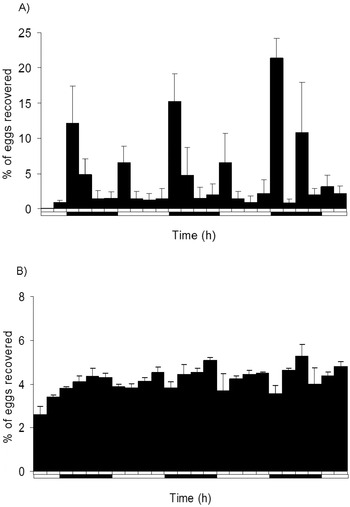
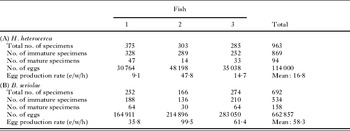
A total of 114 000 Heteraxine heterocerca eggs and 662 857 Benedenia seriolae eggs was collected in vivo over 3 days from 3 Seriola quinqueradiata (Table 1). A marked difference was observed between the daily egg-laying patterns of H. heterocerca (Fig. 1A) and B. seriolae (Fig. 1B). The egg-laying pattern for each parasite species was similar for each of the 3 consecutive days of the experiment and on each of the 3 fish specimens. A significant peak in H. heterocerca egg-laying was observed during the first 3 h period of darkness on days 1, 2 and 3, which accounted for 12·1, 15·2 and 21·4% of the total egg output, respectively (Fig. 1A). On days 1 and 2, two non-significant secondary peaks were also observed beginning at 21.00 h and 06.00 h which accounted for 4·9 and 6·6% of the total egg output, respectively, on day 1 and 4·8 and 6·6%, respectively, on day 2 (Fig. 1A). On day 3 a non-significant secondary peak was observed during darkness beginning at 00.00 h and accounted for 10·9% of the total egg output (Fig. 1A). In contrast, B. seriolae released eggs regularly during each 3 h sample period, whether exposed to illumination or darkness, fluctuating between 2·6 and 5·3% of the total egg output over the same 3 day period (Fig. 1B).
The number of eggs, expressed as a percentage of the total number of eggs recovered from (A) Heteraxine heterocerca and (B) Benedenia seriolae, collected in vivo at 3 h intervals over 3 consecutive days from 3 specimens of Seriola quinqueradiata. Parasites and fish were exposed to alternating periods of illumination and darkness (LD 12:12; light on 06:00, light off 18:00) and maintained at 23·8±0·1°C and 35 ppt salinity. Horizontal panels indicate periods of illumination (white) and darkness (black). Error bars indicate standard error.

The number of parasite specimens and eggs of (A) Heteraxine heterocerca and (B) Benedenia seriolae collected from 3 Seriola quinqueradiata at the conclusion of the 3 day experiment and their in vivo egg production rates expressed as eggs/worm/h (e/w/h)
(Parasites and fish were maintained at 23·8±0·1°C and 35 ppt salinity and exposed to LD 12:12.)

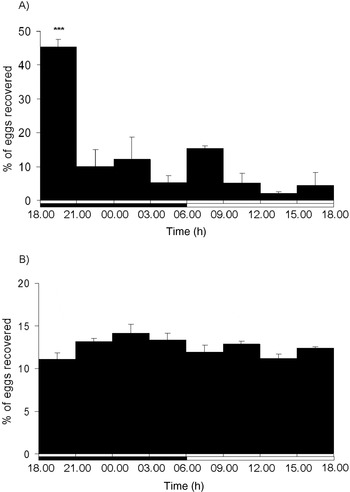
The contrasting egg-laying patterns for H. heterocerca and B. seriolae are clearer when egg data are expressed as a percentage of the total number of eggs recovered every 3 h and plotted over a single 24 h period (Fig. 2). Egg laying by H. heterocerca occurred throughout the 24 h period but is mostly nocturnal with 72·9% of daily egg output released during periods of darkness. Furthermore, 45·4 (42·5–49·9)% of daily egg output was released during the 3 h period immediately after dark which is significantly different (P<0·001) from egg output during any other 3 h period during the day (Fig. 2A). Egg release by H. heterocerca during the other 3 h time periods was relatively low and fluctuated between 2·1% of the daily egg output during the 3 h period following 12.00 h and 15.4% of the daily egg output during the 3 h period following 06.00 h (Fig. 2A). The egg-laying pattern for B. seriolae was consistent over the 24 h period with egg output during each 3 h period showing minor variation between 11·1 and 14·1% of the daily egg output (Fig. 2B).
Daily pattern of egg release in vivo for (A) Heteraxine heterocerca and (B) Benedenia seriolae at 3 h intervals over 3 consecutive days from 3 specimens of Seriola quinqueradiata. Eggs recovered during each 3 h time-period over the 3 day experiment are presented as a percentage of the total number of eggs recovered and plotted over a single 24 h period. Parasites and fish were exposed to alternating periods of illumination and darkness (LD 12:12; light on 06:00 h, light off 18:00 h) and maintained at 23·8±0·1°C and 35 ppt salinity. Horizontal panels indicate periods of illumination (white) and darkness (black). Error bars indicate standard error. *** Indicates significance difference (P<0·001) in mean percentage of the daily egg output for a 3 h period.

Egg production rates of parasites
In total, 94 mature and 869 immature H. heterocerca and 158 mature and 534 immature B. seriolae were removed from 3 S. quinqueradiata at the end of the experiment (Table 1). A mean egg production rate (calculated by dividing the total number of eggs collected by the total number of mature worms recovered) of 16·8 (range: 9·1–47·8) and 58·3 (range: 35·8–99·5) eggs/worm/h (e/w/h) was achieved by H. heterocerca and B. seriolae respectively at 23·8±0·1°C and 35 ppt salinity (Table 1).
Of the 94 mature H. heterocerca recovered, 14 contained eggs (range 4 to 934; median 79) in their uterus. Eggs extracted from the uteri were ovoid and from the base of each egg protrudes a single filament that is entwined with other filaments such that each egg was attached to a filamentous core and resembled an ‘egg-string’. On no occasion was more than 1 egg found in the female reproductive system of the 158 mature B. seriolae specimens.
Parasite age determinations
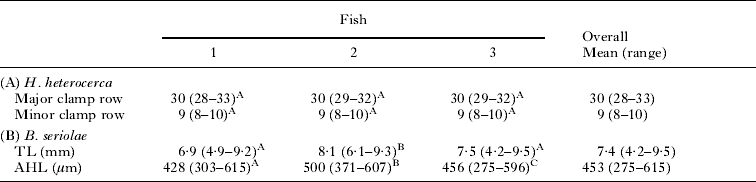
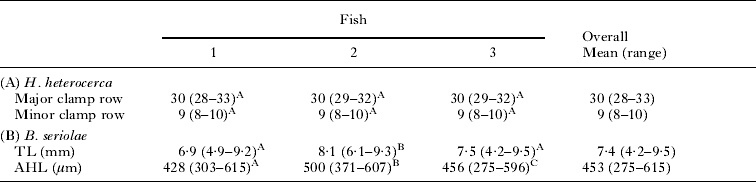
Clamp number along the major and minor clamp row of all 94 mature H. heterocerca varied little: mean of 30 (range 28–33) clamps along the major row and 9 (8–10) clamps along the minor row (Table 2). The infrapopulations of mature H. heterocerca did not differ significantly in the number of clamps along major and minor clamp rows. The TL and AHL of 158 mature B. seriolae ranged from 4·2 to 9·5 mm and from 275 to 615 μm respectively (Table 2). The infrapopulations of mature B. seriolae differed significantly in TL and AHL (Table 2).
(A) The mean number of haptoral clamps (range presented in parentheses) along the major and minor rows of mature Heteraxine heterocerca specimens and (B) the mean total length (TL) and anterior hamulus length (AHL) of mature Benedenia seriolae specimens removed from 3 Seriola quinqueradiata at the conclusion of the 3 day experiment
(Letters in superscript indicate Tukey's groupings for each fish (P<0·05).)
DISCUSSION
The egg-laying patterns for the polyopisthocotylean Heteraxine heterocerca and the monopisthocotylean Benedenia seriolae parasitizing the same host, Seriola quinqueradiata, have been determined when exposed to alternating periods of illumination and darkness (LD 12:12) and maintained at 23·8±0·1°C and 35 ppt salinity. An egg-laying rhythm was observed for H. heterocerca, but not for B. seriolae. The egg-laying rhythm for H. heterocerca is defined by a peak in egg release that occurs during the first 3 h period after dark and accounts for almost half of daily egg production. This rhythm is similar to that displayed by Zeuxapta seriolae parasitizing S. lalandi where almost 75% of the daily egg production was released during the first 3 h period following dusk (Mooney et al. Reference Mooney, Ernst and Whittington2006). These egg-laying rhythms displayed by H. heterocerca and Z. seriolae have only been demonstrated when the respective parasite was exposed to an abrupt change in light intensity. Future studies that expose these parasites to a more natural and gradual increase and decrease in light intensity associated with dawn and dusk respectively and, to a reversed light regime would help elucidate whether these rhythms are endogenous or exogenous.
Most published data on egg production rates have been determined in vitro. However, egg production rates from parasites removed from their host declines progressively with an increase in time off the host. Whittington (Reference Whittington1997) suggested that starvation of parasites may contribute to this decline but other factors may also be involved. Therefore, egg output of parasites determined by in vitro studies may not reflect the natural situation. This study provides egg production data for H. heterocerca and B. seriolae determined in vivo and therefore is more likely to reflect conditions experienced by parasites infecting fish in the wild and in sea-cage aquaculture. Harada and Akazaki (Reference Harada and Akazaki1971) observed in vitro that individual H. heterocerca specimens released 111 to 627 eggs at a time at 10–15°C. However, the egg production rate could not be determined from this study because the duration over which eggs had accumulated in the uterus of each specimen before their release was not documented. Our study has determined that H. heterocerca can store up to 934 eggs in the uterus of a single specimen and, on average, can produce 16·8 eggs/worm/h (e/w/h) at 23·8°C. A slightly higher rate (21·6 e/w/h) was achieved for Z. seriolae parasitizing S. lalandi when assessed in vivo even though water temperature was almost 6°C cooler, at 18°C (Mooney et al. Reference Mooney, Ernst and Whittington2006). These in vivo egg production rates are 2–3 times higher than the in vitro rates of 12·9 e/w/h at 17·5°C and 8·6 e/w/h at 21°C recorded for Z. seriolae from S. lalandi by Tubbs et al. (Reference Tubbs, Poortenaar, Sewell and Diggles2004).
Similarly, in vitro assessments of B. seriolae egg production rates appear to underestimate the capacity of B. seriolae to produce eggs in vivo. Tubbs et al. (Reference Tubbs, Poortenaar, Sewell and Diggles2004) reported in vitro egg production rates of 45·9 and 61·4 e/w/d at 21°C and 17°C respectively for B. seriolae (mean TL 6·6 mm) collected from S. lalandi. In another in vitro study, Kearn et al. (Reference Kearn, Ogawa and Maeno1992a) found that a single B. seriolae (TL 7·2 mm) collected from S. quinqueradiata produced 27 eggs in 1 h at 20°C. In comparison, our in vivo study conducted at water temperatures several degrees higher (23·8°C) reports an average egg production rate for B. seriolae (mean TL 7·4 mm) of 58·3 e/w/h which is more than double the in vitro egg production rate reported by Kearn et al. (Reference Kearn, Ogawa and Maeno1992a) and 22 times the maximum hourly egg production rate reported by Tubbs et al. (Reference Tubbs, Poortenaar, Sewell and Diggles2004).
Egg output between each H. heterocerca infrapopulation and between each B. seriolae infrapopulation was significantly different. Jackson and Tinsley (Reference Jackson and Tinsley1988) identified many factors that could influence egg output in Protopolystoma xenopodis (Polystomatidae) including temperature, parasite age, parasite burden, variation in individual parasite egg production, host health, host age, host reproductive and immune status and conditions of host maintenance (light regimes, feeding times and host density). Most animals have ‘preferred’ environmental conditions for optimal performance and may experience a decrease in performance away from these optima. Temperature and salinity are 2 important environmental parameters affecting many biological processes including egg production of aquatic invertebrates such as Monogenea. For example, in vivo egg output for Neoheterobothrium hirame (Diclidophoridae) parasitizing Japanese flounder (Paralichthys olivaceus) increased as temperatures increased from 10 to 20°C. As temperature was further elevated to 25°C, egg output steadied and some eggs appeared abnormal (Tsutsumi et al. Reference Tsutsumi, Mushiake, Mori, Arimoto, Yoshinaga and Ogawa2002). In vitro egg output of Polylabroides multispinosus (Microcotylidae) parasitizing Acanthopagrus australis peaked at 30 ppt salinity and was successively lower when maintained at salinities of 20, 35, 10 and 5 ppt (Diggles et al. Reference Diggles, Roubal and Lester1993). However, temperature and salinity do not explain the variation in egg output observed in the present study since each host and their infrapopulation of H. heterocerca and B. seriolae were exposed to the same environmental conditions.
Parasite age can influence egg production rates with older (larger) parasites able to produce more eggs per unit time than younger (smaller) parasites. At 12°C, Entobdella soleae (Capsalidae) specimens with an AHL of 550–600 μm (TL 5 mm) produced approximately 30 e/w/d in vitro, but larger specimens with an AHL exceeding 650 μm (TL 6 mm) produced greater than 60 eggs per day (Kearn, Reference Kearn1985). At 27–30°C, Neobenedenia girellae (Capsalidae) specimens (TL range 2·1–2·9 mm) parasitizing Paralichthys olivaceus produced 12·2 e/w/h in vitro, but larger adults (TL range 3·9–5·2 mm) produced almost 3 times as many eggs at a rate of 35·4 e/w/h (Bondad-Reantaso et al. Reference Bondad-Reantaso, Ogawa, Fukudome and Wakabayashi1995). This appears to occur because the time taken to manufacture a single egg is faster in larger parasites (Kearn, Reference Kearn1985). Parasite age is unlikely to explain the observed difference in egg output between infrapopulations of H. heterocerca on each host, but may explain some of the difference in egg output between infrapopulations of B. seriolae.
Jackson and Tinsley (Reference Jackson and Tinsley1988) outlined how density-dependent effects like competition for food and space can influence egg output. Egg production rates from individual specimens of Protopolystoma xenopodis reduced significantly when the host toad, Xenopus laevis, was infected with more parasites. This natural individual variation may explain, in part, the observed negative correlation between the infection intensity of mature H. heterocerca and B. seriolae and the respective egg output from each fish.
Fish with high parasite infection intensities may become unhealthy and suffer from tissue damage, emaciation, anaemia and in extreme cases, mortality. The sanguinivorous parasite Heterobothrium okamotoi (Diclidophoridae) consumes greater quantities of host (Takifugu rubripes) blood as it develops and grows and when mature, a single specimen can consume 0·69 μl over 12 h (Ogawa et al. Reference Ogawa, Yasuzaki and Yoshinaga2005). High infection intensities of this parasite species are associated with host anaemia, which is characterized by low haematocrit and haemoglobin levels (Ogawa and Inouye, Reference Ogawa and Inouye1997). Infection intensity of Z. seriolae was also negatively associated with haematocrit and haemoglobin levels in S. dumerili (see Montero and Crespo, Reference Montero and Crespo2004) and S. lalandi (see Mansell et al. Reference Mansell, Powell, Ernst and Nowak2005) respectively. Host anaemia in X. laevis was suggested to have lowered egg output in P. xenopodis (Jackson, Reference Jackson1983, Reference Jackson1984). In the present study infection intensity of H. heterocerca was different on each host and therefore each host may have suffered anaemia to a different degree, which may explain some of the difference in egg output between each host. Equally, malnourishment of B. seriolae may also have contributed to the difference in egg output between each infrapopulation. Fish from sea-cages that had been experimentally infected with high intensities of B. seriolae were observed to have a lower coverage of mucus and epidermal tissue, the primary food source of this species.
Egg-laying rhythms are displayed by H. heterocerca, Z. seriolae and Diplozoon homoion gracile. Of these 3 species, H. heterocerca and Z. seriolae can store large numbers of eggs in utero (up to 934 and 1015 eggs, respectively). The coordinated release of large numbers of eggs at a specific time can produce a distinct egg-laying rhythm like those displayed by these 2 heteraxinid species. In contrast, D. homoion gracile releases eggs singly, and by altering its egg production rate is able to release eggs rhythmically (Macdonald and Jones, Reference Macdonald and Jones1978). All 3 monogenean species that display an egg-laying rhythm also display a corresponding egg-hatching rhythm. However, not all species that display an egg-hatching rhythm display an egg-laying rhythm. Two species, Entobdella soleae (Capsalidae) and Discocotyle sagittata (Discocotylidae), have very precise egg-hatching rhythms but do not display an egg-laying rhythm (Kearn, Reference Kearn1973; Gannicott and Tinsley, Reference Gannicott and Tinsley1997). Is this an artefact of the small number of species investigated for an egg-laying rhythm, or, may an egg-laying rhythm only benefit monogenean species that also display a corresponding egg-hatching rhythm? For instance, a large mass of eggs released synchronously, perhaps associated with a specific host behaviour, may accumulate in areas where hosts are locally abundant. Such an egg-laying rhythm may only be effective if complemented with a comparable egg-hatching rhythm so that emerging larvae may be concentrated spatially and temporally in areas frequented by the host species. It is conceivable that H. heterocerca utilizes this infection strategy since it has been shown that the egg-laying rhythm reported in the present study and the egg-hatching rhythm reported by Kearn et al. (Reference Kearn, Ogawa and Maeno1992b) are similar. At this stage it is unclear what host behavioural trait these rhythms are associated with. Kohbara et al. (Reference Kohbara, Hidaka, Furiyama, Yamashita, Ichikawa, Furukawa, Aida, Sánchez-Vázquez and Tabata2000) demonstrated that S. quinqueradiata displays a nocturnal feeding pattern when maintained in tanks located outdoors and exposed to natural illumination and, a diurnal feeding pattern when maintained in tanks indoors and exposed to fluorescent illumination. Oxygen consumption by hatchery reared Seriola lalandi peaks at dawn and dusk before declining to a minimum during the night (personal communication). Macdonald and Jones (Reference Macdonald and Jones1978) associated the nocturnal egg-laying and egg-hatching rhythms of D. homoion gracile with the activity level of the host, the southern barbel, which is least active at night.
The infection process for B. seriolae is likely to differ from that of H. heterocerca because B. seriolae does not display an egg-laying rhythm (present study) and its egg-hatching rhythm is diurnal rather than nocturnal (Kearn et al. Reference Kearn, Ogawa and Maeno1992b). However, B. seriolae occurs at high prevalence and intensity in wild and farmed Seriola spp. in Australia, Japan and New Zealand (Ogawa and Yokoyama, Reference Ogawa and Yokoyama1998; Ernst et al. Reference Ernst, Whittington, Corneillie and Talbot2002; Sharp et al. Reference Sharp, Poortenaar, Diggles and Willis2003; Chambers and Ernst, Reference Chambers and Ernst2005), indicating that its infection strategies are also successful despite the absence of an egg-laying rhythm. Different aspects of the biology of each of these parasite species may explain why H. heterocerca and B. seriolae display different egg-laying and egg-hatching rhythms and therefore rely on different infection strategies to infect the same host species. Some biological characteristics of these species are remarkably different.
The initial invasion site. Oncomiracidia of H. heterocerca and B. seriolae attach to the gills and skin respectively. The initial invasion site was suggested to account for their different egg-hatching rhythms. Kearn et al. (Reference Kearn, Ogawa and Maeno1992b) speculated that oncomiracidia of H. heterocerca are possibly drawn in by gill-ventilating currents and attach directly to gill filaments. The high gill ventilating rate of an active host may be expected to increase infection success by passing more larva-laden water across the gills. On the other hand, a stationary or slow moving host may be an easier target for the slow swimming B. seriolae larvae that attach directly to the skin.
Egg morphology. H. heterocerca has smaller ovoid eggs that are joined together to form an egg-string and are stored in the uterus before being released rhythmically, while B. seriolae has larger tetrahedral eggs that are released singly and without rhythm. These different larval invasion and egg morphology characteristics may account for the contrasting egg-laying patterns displayed by each species. Eggs of H. heterocerca that are released as part of an egg-string are more likely to sink faster than an individual egg (Whittington and Kearn, Reference Whittington and Kearn1988) and are more likely to entangle with structures and substrates which could limit their dispersal. The combination of limited dispersal and an egg-laying rhythm could create a local abundance of eggs in areas regularly frequented by hosts. In contrast, eggs of B. seriolae are released singly and continuously without a rhythm which results in eggs being released throughout the entire range of an infected host. These characteristics are more likely to promote broad dispersal of the egg which could be advantageous if the host was also dispersed during the mornings when B. seriolae eggs are known to hatch rhythmically (Kearn et al. Reference Kearn, Ogawa and Maeno1992b).
We thank South Sea Food, Oita Prefecture, Kyushu, Japan for supplying fish, Erik Vis and Lance Hubbert of Yamaha Nutreco Aquatech (YNA) Japan, Dr Clinton Chambers for technical assistance and Dr Kate Hutson and Miles Wise for discussion regarding host behaviour. This study was funded by an Australian Research Council grant (LP0211375; 2002–2005) awarded to I.D.W. and I.E. and supported by industry partners YNA, Skretting Australia and the South Australian Marine Finfish Farmers Association.