Colonel Decius Wadsworth thought that the United States needed more guns. “It would not be prudent,” he advised, “to remain dependent on foreign countries for articles intimately connected with security. Measures ought to be taken so we can wage a vigorous war.” It was 1817, and the United States’ experience in the War of 1812 still weighed heavily on the chief of ordnance. The United States had achieved a stalemate against the world's most formidable military power, but had the war lasted any longer, American troops would have run out of munitions. This was a serious concern for a new nation whose “peace” with Britain was by no means an end to war.Footnote 1
Enter the Ordnance Department, which was established during the War of 1812 to manage the nation's weapon supply. Twenty years after historian Merritt Roe Smith called attention to the dearth of scholarship on the “exploits of the Ordnance Department,” there are still other “exploits” left to explore.Footnote 2 In the years following the War of 1812, it shored up military and executive power, even as Congress drastically reduced the military by slashing the numbers of regular troops and officers and cutting several branches of the War Department, including the light dragoons, the naval militia, and the hospital department, and temporarily removing Ordnance's status as an independent bureau. Examining the “exploits” of the Ordnance Department allows us to see how the structures of governance permitted federalized arms production in a nation generally wary of federal military buildup. This essay homes in on the intersection of weapon technology, the Ordnance Department, and governance during the decades of ostensible “peace” in between the War of 1812 and the Mexican American War. During the 1810s and 1820s, in particular, officials in the War Department engaged in military state building, an administrative process by which individual bureaucrats worked around legislative limitations to make the production of standardized military firearms a routine function of the federal government. This brand of state building transcended partisanship and contributed to the development of executive autonomy. Although this development foreshadowed Progressive Era trends toward expertise-based bureaucracies, Ordnance officers’ authority to make these decisions stemmed from a particular confluence of security imperatives, nonpartisanship, and entrepreneurial initiatives. It was precisely because lawmakers expressed diverging thoughts on military power that Ordnance officers were able to determine the nation's military capacity. The connection between war and early American state building was forged in executive efforts to bolster the armaments industry.
The Early American State and Military Power
As the War of 1812 winded down, army officer Thomas Sidney Jesup complained of an “obnoxious law” in Connecticut that banned federal recruiting agents from certain public spaces.Footnote 3 His complaint highlights the tension in early national history and scholarship over the relative strength of the federal state and military.Footnote 4 The Constitution laid the foundation for ample military power, but many Americans were wary of centralized government and a professional military. As a result, the states retained some control over the militia, and there were frequent efforts to reduce the size of the regular army, even during war. American historians and political scientists, for their part, continue to debate whether and where the federal government was “strong” or “weak.” Military historians extending from Samuel Watson and William H. Bergmann back to Francis Paul Prucha have depicted the administration related to the military as the strongest iteration of federal power, while Max M. Edling has emphasized the fiscal-military aspect of the state.Footnote 5 Even as historians and political scientists recognize the significance of the early American state and the military's place within it, they also acknowledge the political and ideological opposition to federal military power during the first decades of the nineteenth century, as post-independence fears of a standing army and the ideals of settler colonialism clashed with the Constitution's framework for executive control over the nation's military capacity.Footnote 6
The Constitution granted Congress the power to establish executive positions, but left individual appointments and instructions to the president and department heads. The War Department was established in 1789 as one of the three original offices of the executive branch, along with the State and Treasury Departments. Throughout the nation's first few decades, the executive branch, whose number of employees increased at nearly twice the rate of the general population's, oversaw military and naval affairs, diplomacy, customs, Indian affairs, patents, postal service, monetary policy, science and exploration, and infrastructure projects. Many of these duties shifted from office to office, which often carried out their duties according to “the exigencies which may arise,” rather than formulaic instructions. Lax oversight and long tenures meant that most executive appointees exercised a fair degree of administrative discretion.Footnote 7
This discretion, however, varied. Daniel P. Carpenter's The Forging of Bureaucratic Autonomy reveals how and why certain executive departments achieved political independence—which he defines as the ability to change the agenda of lawmakers—by establishing reputations for unique and effective services. Although Carpenter identifies the Progressive Era as the birth of this bureaucratic independence, this autonomy can be found earlier, especially in the War and Navy departments, which suggests that this development was uneven and was tied to security concerns. The Patent Office, too, had autonomy, but this was more a reflection of congressional neglect than perceived expertise, and even with this autonomy, historians have pointed to the challenges officials faced in carrying out government business owing to policy inefficiencies and challenges from outside actors.Footnote 8 Whereas Carpenter associates much of nineteenth-century bureaucracy with clerical administration, ordnance officials were usually long-term military officers, not rotating spoils appointees. Nor were they necessarily coalition builders like the late nineteenth-century Post Office and Department of Agriculture bureaucrats he studies. Long-standing anti-militarism and fears of centralized military power meant that the Ordnance Department generated opposition that exceeded what a more universally accepted office like the Post Office experienced.Footnote 9 Between 1808 and 1848, defense absorbed anywhere between 30 and 80 percent of total federal expenditures, which made the associated departments ready targets when Congress looked for ways to reduce spending.Footnote 10 This was particularly true for the War Department, which was bigger and more expensive than other executive departments.Footnote 11
What they had in common with later autonomous bureaus, however, was leadership by entrepreneurial bureaucrats. Historians have often pointed to Secretary of War John C. Calhoun, who professionalized the department and unilaterally codified the Bureau of Indian Affairs in 1824.Footnote 12 In 1818, the Senate requested that Calhoun plan a reorganization of the army. The bill he proposed centralized all staff responsibilities in Washington. It added a surgeon general, a judge advocate general, and a quartermaster general, who, along with other bureau chiefs, were accountable directly to the Secretary of War. Calhoun was a tireless advocate of the national military apparatus and carefully guarded its reputation. For example, he warned General Winfield Scott against publishing an exchange with (then) General Andrew Jackson that might spark “those who are opposed to the government to seize on this and wield it against our military establishment.”Footnote 13
Calhoun's efforts, however, were not the only sources of War Department growth and autonomy. We must also consider how his subordinates, especially in the Ordnance Department, shored up military strength by capitalizing on their security expertise. Their autonomy preceded Calhoun's and was linked to their military credentials. In the face of wartime exigencies, executive officials convinced Congress to replace the department's civilian staff with military officers to better manage the production and distribution of supplies.Footnote 14 Improved military administration made it possible for the United States to defeat Britain and portions of the Shawnee and Creek confederations by 1815. This was especially true in the case of weapons management. When the Ordnance Department gained independence during the War of 1812, and military officers replaced civilian purveyors, the military no longer had to cope with a haphazard system of contractors and irregular firearms. Ordnance officers’ expertise in weapons supply enabled them to sustain the concerted efforts by Congress following the War of 1812 to reduce the size and expense of the military establishment.Footnote 15
Ordnance officials ushered in an expansion of executive power that preceded the shifts associated with the martial prerogatives of Presidents Andrew Jackson and James Polk.Footnote 16 Their power came not from a bellicose president, but from their individual initiatives and their perceived qualifications to meet the nation's security needs, regardless of party politics. Decius Wadsworth (1768–1821) was an officer in the Artillerist and Engineer Corps and superintendent of West Point before he became the Ordnance Department's first chief; his successor, George Bomford (1780–1848), was a military officer from New York who served as lieutenant in the Engineer Corps and as staff major before his tenure as chief of Ordnance. Both men's tenures spanned multiple presidential administrations. These bureau chiefs grew the arms industry in the 1810s and 1820s by deploying military and technological expertise to convince Congress, regardless of party dominance, that attempts to curb military spending on ordnance and ordnance personnel would have detrimental consequences.Footnote 17
Although historians of technology have long acknowledged the role of War Department bureaus in shaping technological innovation and standardization, especially the federal directives and resources that culminated in interchangeability and the “American system of manufactures” in the 1850s, they have not paid much attention to what these technological improvements in arms production meant for state building.Footnote 18 The Ordnance Department's management of technological development allows us to see broader shifts in governmental configurations of power, particularly between the legislative and executive branches with regards to the military establishment.Footnote 19 Its achievement of executive autonomy in the realm of firearms production highlights specifically the importance of arms buildup for executive state building, regardless of general antipathy to militarism.Footnote 20 In 1818, when Congress solicited a report from the War Department on reducing the military establishment, the department singled out the Ordnance Department, “whose duties are connected with the permanent preparation and defence of the country; and have so little reference to the existing military establishment, that, if the army were reduced to a single regiment, no reduction could safely be made.”Footnote 21 The statement reflected the bias of the Secretary of War in bolstering one of his bureaus, but because of the increasing assertiveness and expertise of the Ordnance Department in administering arms production, Congress would eventually accept it. It was precisely because lawmakers expressed diverging thoughts on military power that Ordnance officers’ executive decisions made a difference for the nation's military capacity from the 1810s through the 1830s. In the process, they bolstered centralized executive power.Footnote 22
Ordnance, Firearms, and Congress
Arms production required federal intervention in the early republic. Despite the U.S. Second Amendment heritage and a 1792 law that required militia to arm themselves, the individual states did not produce enough weapons for their soldiers. Before guns became popular commodities in the latter part of the nineteenth century, the Ordnance Department expanded gunsmithing from a specialized craft to a standardized industry.Footnote 23 They did so despite the fact that congressional acts often tried to mitigate the power military men had over national security, for example, by delegating some military production to private manufacturers and appointing civilians, rather than army officers, as superintendents of the federal armories throughout much of the nation's early history.
In the two decades following the ratification of the Constitution, which gave Congress the power to support armies and provide arms for the militia, lawmakers made decisions about how to “create a system of supplying the nation” with arms. Their debates centered on who should be responsible for gun production and distribution, and featured such arguments as “it would be very inconvenient for the United States to become the retailers of arms [to the militia],” and “[why should] the General Government be put to the trouble and expense of providing arms for the state governments.”Footnote 24 Yet, private initiative was insufficient to provide for national security. Labor was expensive, and consumer demand did not warrant a heavy capital investment in the enlargement of arms factories. Most families only purchased one gun for their households, if that.Footnote 25 The private merchant ships and occasional privateering and filibustering expeditions that needed weapons on board did not provide reliable demand, either. The Boston Directory, for example, listed only four gunsmiths in 1800. Each spent about a month of labor on each weapon and often forged the barrel, assembled the gunstock, and completed the grinding and filing tasks themselves. The guns they produced for civilians were more suited for hunting than they were for military use. Anemic private initiative prompted lawmakers to exercise their constitutional prerogatives, even as many were apprehensive about a federal government that completely controlled arms supply. In 1794, Congress passed a bill to create and staff two federal armories, allotting $22,865 for construction expenses and $143,640 for the purchase of additional arms and ammunition. Arms produced by the federal armories would go to the regular army, and questions remained about how best to supply the militia.
In 1808, Congress passed the Act for Arming the Militia, which reflected a compromise between those who wished to expand the national armories and those who wished to allow states to supply themselves. Under this law, the federal government provided the funds for supplying arms to the various state militia, but private manufacturers, rather than the federal armories, had to produce them. Maine-born arms manufacturer John Hancock Hall went into debt making guns for civilians and subsequently turned to government contracting. From the 1810s onward, manufacturers like Nathan Starr understood that the operation of a “large and expensive factory” depended on “steady encouragement from the government.”Footnote 26 The act pledged $200,000 per year for this purpose, a sum that provided the militias with about 15,000 stands of arms annually.Footnote 27
The act passed 54–33, after a debate that roughly tracked party and regional lines.Footnote 28 Republicans tended to oppose a standing military and federal control of the nation's arms supplies, but southerners in particular supported federal funds for state militias. Northern Federalists usually championed strong federal powers, yet opposed arming southern militias.
The War of 1812 brought to the fore national tension over military capability. As conflict with Great Britain escalated and the standing army increased from 5,700 to 35,000 men, pro-war partisans began publishing statistics to prove to the populace that the United States owned and produced sufficient munitions for war.Footnote 29 The numbers of muskets manufactured at the Springfield Armory hit all-time highs of 12,020 and 10,140 in 1811 and 1812, respectively, up from about 5,000 in the previous years. During the war, debates ranged from anti-war Virginian John Randolph's objection to the financial burden of war to Joseph Kent of Maryland's acknowledgment that “however commendable economy may be in every other situation of life, in war it is inadmissible.”Footnote 30 Randolph's anti-war argument lost out, but Kent's recommendation for ample spending fared little better. Arms production dropped during the second year of war, and the Springfield Armory output hovered between 6,000 and 9,000 until 1817.Footnote 31 One reason for its increase came from the directives of the Ordnance Department.
Congress established the Ordnance Department as an independent bureau shortly before the United States declared war on Great Britain in 1812. Struggles to equip the army during the war helped Chief of Ordnance Decius Wadsworth convince Congress to expand the Ordnance Department because it was understaffed to “discharge its duties.”Footnote 32 In 1815, Congress passed the “Act for the better regulation of the Ordnance Department,” which expanded the size of the Ordnance Department and granted the colonel of the department autonomy in establishing military depots, appointing master armors, coordinating supply, and overseeing the inspection of all arms provided for the army and militia.Footnote 33 The armories maintained their civilian superintendent but were subordinate to the orders of the Ordnance Department, whose chiefs were military officers accustomed to army governance rather than legislative deliberation.
Following the war, there was not monolithic partisan congressional antipathy or support for the Ordnance Department specifically or the military generally. Individual members of Congress expressed differing views on the military, but in general they attempted to reduce military spending and often tried to minimize the autonomy they gave the department, even as they recognized its importance. The War Department, however, was able to push against the opposition that did exist because of a nonpartisan military agenda that succeeded on national security grounds.Footnote 34 It was precisely because lawmakers expressed diverging thoughts on military power that Ordnance officers’ executive decisions made a difference for the nation's military capacity.
Ordnance officers exhibited a unified commitment to standardize, expand, and improve the nation's supply of small arms. As soon as Wadsworth started his post as head of the Ordnance Department, he lobbied for more money and power. He pushed back against persistent arguments that favored the militia over federal military control, arguing that Ordnance did a better job managing supplies “essential to protection and defense” than did militia officers. In the face of peacetime policies and appropriations, Wadsworth advocated that the government “incur some expense, to ensure the faithful, judicious, and economical expenditure” of “this branch of the service.”Footnote 35 The number Springfield produced jumped to 13,015 in 1817 and remained there for the ensuing decades, sometimes reaching as high as 16,000 muskets. Weapons were also gaining significance beyond the battlefield. Ordnance officials used guns to attract new soldiers at army rendezvous, and city officials proudly displayed ordnance stores during President James Monroe's inaugural national tour.Footnote 36 Even after the federal armories increased their combined output to about 25,000 small arms annually, Wadsworth argued that this was too few to keep military troops armed, even in “peace.”Footnote 37 More specifically, he worried that as the nation's expanding population pushed westward, arming the frontier would become increasingly difficult. As it was, the land west of the Appalachian Mountains absorbed over one-third of the nation's firearms in the 1810s. Wadsworth's proposed solution was a western armory where he said labor was cheaper and the government would not need to pay for extensive transportation.Footnote 38
Wadsworth's claims about the viability of a western armory labor reflected his desire to expand arms production more than was necessary. In general, he exaggerated the nation's weaponry shortcomings. Even as the military shrank following war with Britain, arms production increased. It seems that his argument for a new armory was a way to reframe the debate about military power around armory location, especially as congressmen received pushback from their constituents against any expansion of military power. Their letters acknowledged the odiousness of having to support an army, even as they assured their voters that any support they offered for the maintenance of an armed force resulted only from dire security concerns.Footnote 39 Army officers in general tended to speak of a monolithic Congress that wanted nothing more than to reduce their numbers. They blamed Congress for being too slow to legislate a troop increase during the War of 1812, and following the war, they complained about military cuts. Brevet Brigadier General John Walbach, for example, wrote that the U.S. army had been poised for “equal footing with any other army in the world,” until recent legislation threatened to destroy its status by downsizing the army and slashing the officer corps.Footnote 40
One way to check the peacetime reduction was to focus on arms production. Historian Ken Alder has argued that the gun in Napoleonic France embodied the authority of the state by signifying the power of government bureaucrats to overcome political struggle in their regulation of weapon uniformity.Footnote 41 In the United States, the gun's significance as such depended on Ordnance officers’ ability to challenge postwar military contraction. Members of the military establishment recognized that however much Congress trimmed the military, “it is in peace that arms must be fabricated and every munition prepared.”Footnote 42 It was during peace that the government should devote its resources to the quantity and quality of its munitions. Unlike members of Congress, for whom wartime shortcomings faded from memory, military officers like Wadsworth remained haunted by war. Reports from federal arsenals during the war lambasted the poor quality of American arms. Many stands came with “bayonets too weak in the neck that cracked a little, and several locks which pulled off too uncommonly hard.” One inspector of arms for the Connecticut militia “could not pass them out” because they were so defective.Footnote 43
These sorts of reports prompted Wadsworth to determine the “best means to be devised and adopted for bringing the manufacture of arms to a uniform standard and pattern in all of their parts.” Wadsworth implemented a relentless timeline for achieving uniformity, requiring the national armories to produce pattern muskets by 1815 and begin full-scale production of the “Model 1816” the following year.Footnote 44 Wadsworth was more attuned to the realities of combat experience than the civilian superintendents of the federal armories, which made him especially aware of the practical implications of improper caliber size. When the superintendent of the Springfield Armory sent him a pistol barrel for inspection, Wadsworth informed him it was too large and would “recoil from too much violence.” Historian Merritt Roe Smith has detailed the ways in which Wadsworth and his successor, George Bomford, achieved interchangeability in cooperation with armory superintendents and individual contractors.Footnote 45 What is particularly noteworthy is how they achieved it. The Ordnance Department's aggressive pursuit of interchangeability and management of federal resources created networks of labor and technology that spread to the private sector, eventually influencing notable private arms makers like Samuel Colt.Footnote 46
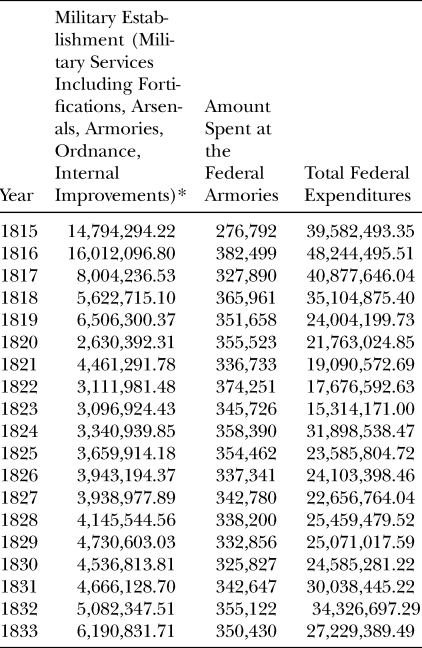
Ordnance chiefs’ actions stemmed from a concern with real and perceived threats to supply. Each time Wadsworth spoke before members of Congress, he reminded them that the nation's arms supply was dangerously low at the end of the war. At the close of 1814, fewer than 20,000 stands of arms remained in the federal arsenals, down from 200,000 at the start of the war; had the conflict continued, the United States would have faced major problems. Despite these inadequacies, Congress regularly challenged the financial support for guns with calls to reduce the military budget. After the General Orders of May 7, 1815, reduced the size of the army, congressmen continued to press for cuts to the resources for armaments. Some appropriations were fixed; others were open to negotiation. The 1808 Militia Act, which stipulated that the federal government spend $200,000 every year on arms for the militia, held steady until the Civil War, despite the addition of new states to the Union. There was a lot more room for clashes related to small arms production at the national armories. The two federal armories received roughly the same amount each year—around $200,000—but this only applied to the “ordinary” expenditures associated with the “fabrication of arms.” Additional costs related to damages, construction, and new machinery were not covered and had to be negotiated. Although these costs were necessary to maintain an ample supply of weapons, many congressmen thought ordnance appropriations were excessive. In 1816 the House Committee on Ways and Means reported on “the enormous amount ($1,065,224) for ordnance and ordnance stores, arsenals, etc.,” and deemed it “extravagant, under the present circumstances entirely too large, and calculated unnecessarily to burthen the people without an adequate object.”Footnote 47 The annual expenses at the two federal armories totaled about 1–2 percent of the federal budget (Table 1).
Annual Federal Expenditures

Notes. This table shows federal expenditures from the end of the War of 1812 to the year following the reestablishment of the Ordnance Department as an independent bureau. All numbers are in U.S. dollars, as reported to Congress by the Treasury and War Departments.
*This excludes the Indian Department and pension payments, the two biggest costs of the War Department. Until 1829, these costs were listed separately from “Military Services.”
Source. American State Papers, “Receipts and Expenditures, 1789–1829,” House of Representatives, April 12, 1830, 21st Congress, 1st Sess., no. 90; “Annual Expenditures from 1816–1834,” House of Representatives, January 5, 1836, 24th Congress, 1st Sess., no. 39; “Ordnance and Ordnance Stores, House of Representatives, January 5, 1836, 24th Congress, 1st Sess., no. 44.
Beginning in 1816, the War Department was required to present to Congress the quarterly returns of all armories and arsenals. Wadsworth, however, instructed the superintendent of the Springfield Armory, Roswell Lee, in preparing his statement of materials on hand at the armory, to account only for an amount that would appear to fit within the prescribed budget.Footnote 48 He told Lee to include recent purchases for supplies like musket stocks on the next return, a process that could go on indefinitely and thus allow ordnance officials to obscure actual expenditures. Another way to conceal expenses was to pull money from different accounts. In December 1818, the two federal armories’ funds had “long since exhausted.” Rather than waste time applying for “special appropriations,” Wadsworth suggested that Lee transfer money from the arsenal fund, which was reserved for the storage and maintenance of federal arms supplies. The funds for all of the nation's arsenals were about half of those just for the Springfield Armory and were not intended to be spent on the manufacture of new arms, but Wadsworth saw this as the best use of the money. Here, Wadsworth used his executive powers to determine how arms appropriations would be spent.Footnote 49
In 1818, Wadsworth instructed the superintendent of the Springfield Armory to avoid reduction in the armory's output, even if it meant exceeding the $199,834 Congress had provided for the production of arms that year. Wadsworth insisted that the armory produce at least 12,000 stands of arms, regardless of financial considerations. The debt, he said, could be made up later. These orders were in line with a department culture of act-first, account-later logic. Calhoun, for example, issued orders to “increase the product of the national armory” before receiving funds from Congress. He told Wadsworth to request new contracts for 5,000 barrels and rods, the benefit of which he “expected … to be fully understood at the next session of Congress and measures taken to make it effectual.” This was a never-ending game that the department played with Congress. Although Wadsworth took his orders from Calhoun, he also knew what to do if gun supplies were not “understood” by Congress, and many of his actions were self-directed. Wadsworth even recommended to Calhoun that the War Department “let the appropriations rather exceed, what is judged strictly necessary, until they shall be found by experience fully adequate to the annual expense.”Footnote 50
When the Ordnance Department did overspend, either intentionally or because of unexpected costs, it looked to the private market to refill its coffers. These sales highlight both unilateral action on the part of the Ordnance Department and the limited civilian demand for small arms in the early nineteenth century. Following the War of 1812, the federal armory at Springfield produced at least a small surplus of arms each year, but until 1825, there were no laws to explain what to do with this surplus. Wadsworth instructed the superintendent to recoup losses by finding buyers for any guns not sent to federal arsenals.Footnote 51 The superintendent shipped surplus to selling agents and auction houses in Philadelphia and New York. Domestic markets for guns, however, were still limited. The superintendent, in fact, looked for additional outlets in the new state of Mississippi, but found that rifles only sold at low prices and that a “more advantageous sale could not be forced.” A more promising market for guns existed in South America during the independence wars of the 1810s. The Napoleonic Wars left South American patriots scrambling to find new sources of weapons, and under Wadsworth's direction, the United States stepped in to fill that void. This arrangement was not without controversy. Although no international law prevented the United States from providing guns to rebel governments, to do so was tantamount to recognizing the independence of Spain's colonies—a politically controversial issue. Even as popular support for South American independence ran high, U.S. lawmakers feared the diplomatic ramifications of aiding colonial rebellions. War Department officials hoped Congress would “declare in favor of the South American patriots,” but in the meantime, they arranged for the sale of federal arms in Argentina. One of Wadsworth's subordinates in the Ordnance Department connected the Springfield superintendent with a Philadelphia merchant named William Cramond. They agreed that Cramond would purchase more than 16,000 guns from the United States and sell them in Buenos Aires. The Ordnance Department netted $109,137 for the sale— more than 50 percent of Springfield's annual budget.Footnote 52
The sale of arms to colonial rebels was symptomatic of the Ordnance Department's general disregard for political restrictions in the service of military strength. As political scientist Ira Katznelson has argued, legislative checks did not allow the United States to transcend European militarism. In fact, in the words of one Congressman, “it would seem that the Executive branch of the government, together with the military, claims the right to make war at pleasure, without the sanction of Congress.” He was not entirely wrong. In one of the most famous instances of military unconstitutionality, during the Seminole War, General Andrew Jackson seized a Spanish fort in East Florida without authorization from Congress. The following year, Calhoun ordered bureau chiefs to prepare for field operations in Florida, “pending the decision by Congress.”Footnote 53
Their consistent efforts to work around or ahead of Congress, though, did not go completely unchecked. As historian David S. Heidler reminds us, however egregious the overreach of executive prerogative appeared as President James Monroe and Secretary of State John Quincy Adams condoned Jackson's unauthorized military aggression in Florida, Congress did exercise its power to deliberate on the legality of Jackson's actions. Although nothing punitive resulted from its investigation, lawmakers eventually curbed Jackson's power as general when they reduced the military.Footnote 54 The Act to Reduce and Fix the Military Peace Establishment of the United States of March 2, 1821, shed officers and costs from the bureaus of the War Department.Footnote 55 The law abolished the offices of judge advocate and adjutant- and inspector-general and drastically reduced the quartermaster's department. These cuts were in part the response to the actions of Jackson, but also to general dissatisfaction with military initiatives.
The War Department's budget faced particular scrutiny because by the end of the 1810s, annual War Department expenses had doubled what they had been earlier in the decade, despite stagnation in the size of the army.Footnote 56 Wadsworth often “suspected an attempt at the next session of Congress would be made to reduce rather than increase the national armories,” but, as evidenced by his instructions to armory superintendents, did not change the armories’ spending habits.Footnote 57 Even in the lean years of 1819 and 1820, when Congress slashed the War Department budget in half, the Ordnance Department did not cut expenses.Footnote 58 The Springfield Armory spent $172,937 and $172,643 in 1818 and 1819 and $179,335 in 1820; Harpers Ferry cut back only slightly, from $193,024 in 1818 to $179,015 and $176,188 in 1819 and 1820.Footnote 59 At the same time as War Department officials “complained of the small appropriations,” they reassured their gun manufacturers that they would be paid well.Footnote 60
Ordnance officers’ disregard for federal budgets generated enough suspicion such that even after Ordnance lost its status as an independent bureau, Congress issued several resolutions throughout 1822 calling for “certain information respecting the expenditures in the Ordnance department.” Representative Romulus Saunders (NC) explained the rationale for these resolutions: His examination of Ordnance accounts over the past few years “showed that something like a check should be put upon the expenditure of that department,” and that “some of the expenditures would strike this House with astonishment.”Footnote 61 Congressmen were in agreement about the need for a more thorough review of the department's finances, but disagreed over which committee should assume the laborious task of going through the “very voluminous” expenditures. John Floyd of Virginia, however, believed that because “here was an expenditure, to a vast amount, in one of the departments … that any committee to whom the subject should be referred, would come to the same conclusion.” Congress voted 99–67 to form a select committee for the investigation, rather than tasking the standing Committee on the Expenditures of the War Department.Footnote 62
On the one hand, Congress's ability to eradicate the Ordnance Department's sovereignty and scrutinize its finances proved that the system of checks and balances worked. On the other hand, it was increasingly untenable to “check” Ordnance, illustrated by the fact that Ordnance expenditures increased from 1822 to 1824.Footnote 63 This was partly because congressional debates on military issues often created legislative gridlock. Before discussing the substance of a bill for the reduction of the military, for example, members of the Senate became bogged down in a debate over whether the preamble to a bill should be cut from the bill itself. The preamble explained the reason for the bill, which some argued broke with recent precedent, while others found it necessary to publicize the intentions of the Senate executive committee, whose proceedings were secret.Footnote 64 This debate had little to do with the issue on the table. When extraneous political concerns influenced military legislation, it bolstered implicitly the case for executive discretion over military functions.
Fewer “checks” also reflected the efforts of ordnance officials who continued Wadsworth's assertive management of resources, after Ordnance merged with the Corps of Artillery. After one of the main workshops at the Springfield Armory burned down, for example, former ordnance officers who now worked for Artillery pushed for additional funds to rebuild it.Footnote 65 Wadsworth's successor, George Bomford, maintained Wadsworth's precedent of shrewdly maximizing financial resources. When there were surplus funds, Bomford instructed Lee to spend them quickly, before they dried up.Footnote 66 Just as Wadsworth had engineered account statements to make them more palatable to Congress, so too did Bomford and his subordinates. One officer instructed Lee to fill out his expense form so that “it gives at the same time the means of accounting for any difference between the report and the paymasters account.”Footnote 67 Bomford was especially skilled at making the bureau seem deferential to Congress and its operations too financially and technologically sophisticated for lawmakers to understand. He instructed Lee to avoid debt so that when the armories needed credit, Congress would be less likely to question their request. He also advised one of the Ordnance captains to scale back plans for a new building at Springfield because he feared the presentation of the plans would invite a rejection of the whole proposal.Footnote 68 At the same time, however, Bomford presented expenditures in too abstruse a way for Congress to comprehend. In a postscript to one report to Congress, he wrote, “In some of those years, the expenditures and the products of the armory appear to be disproportionate. This has arisen partly by the purchase of a greater or a less quantity of stock and materials in a year than was consumed within it, and partly by the pay't of debts in one year, which had been contracted in the year preceding.”Footnote 69 Because Bomford successfully managed the bureau's relationship with Congress, armory superintendents knew that they could rely on him to find them additional funds.Footnote 70 Bomford's subordinates assured these superintendents that “you will have the full amount allotted and if you desire it probably a few thousand more.”Footnote 71
While historians and some contemporary observers maintained that the Ordnance Department deteriorated in the 1820s because of mismanagement at the hands of artillerists, these criticisms detract from the fact that Bomford maintained the department's functionality and continued to exercise autonomous decision making.Footnote 72 For example, although one of the purposes of the Militia Act of 1808 was to protect individual states’ militia powers, Bomford made decisions about what to do with certain arms without consulting state authorities, citing as his reason, “it could not be foreseen what description of arms would be chosen by the state authorities.”Footnote 73 Perhaps the best expression of Ordnance's efficacy and Congress's resistance to it was Representative Joseph Vance's (OH) comment during congressional debates over ordnance spending that “it had rather been necessary to hold a tight rein over those gentlemen, who are always sufficiently ready in devising ways and means to apply the resources of the country.”
However “devious” Bomford's spending might have appeared to congressmen, throughout the 1820s, there existed a general understanding that Ordnance was effective. In 1823, President James Monroe reflected on the achievements of the Ordnance Department, remarking that “the money appropriated for the use of the Ordnance Department had been regularly and economically applied. The fabrication of arms at the national armories, and by contract with the Department, had been gradually improving in quality and cheapness.”Footnote 74 Even congressmen who wanted to cut military spending, like Joseph Vance, recognized the significance of ordnance officers’ expertise. In a discussion over whether to reorganize the Ordnance Department, Vance said they had tried employing fewer ordnance officers, but this was insufficient to “preserve the public property from loss.” Three years later, in a discussion over reshuffling army officers, Vance argued more forcefully for the significance of ordnance expertise. He said replacing ordnance officers with inexperienced men from other branches of the military would be detrimental because they were responsible for more than $12 million worth of public property and distributed more than a million dollars’ worth per year.Footnote 75 President Andrew Jackson reiterated this argument when he addressed Congress on the importance of the Ordnance Department in “providing and preserving arms,” especially in comparison to the number of arms in Britain's and France's arsenals. Jackson said it was “evident that our stock of small arms should at all times be large,” but he left it “for Congress to determine.”Footnote 76
Congress declined to increase appropriations that year, but granted the Ordnance Department its independence from the Corps of Artillery. It ultimately decided that the merger of the two bureaus “had been tried, and had not succeeded.”Footnote 77 The Ordnance bill passed the House 101 to 66, after a lengthy protest that reflected the persistence of anxiety about military power. This anxiety transcended sectionalism and party lines. Representative Dutee J. Pearce (RI) summed up legislators’ general suspicion of those in the military establishment when he cautioned that “even in these piping times of peace, it behooves us to have a care lest the military steal a march of us.” Richard Coke, Jr. (VA) focused more specifically on the dangers posed by a federal government that controlled weapon production. He argued that men fought best with the weapons to which they were most accustomed and opposed any plan to “supersede the use of squirrel guns and fowling pieces generally in the hands of yeomanry of the country, by arms of uniform caliber.” His support of familiarity over standardization was challenged by Wiley Thompson (GA), one of the most vocal proponents of the plan to reestablish the independence of the Ordnance Department. Wiley argued that even “unparalleled gallantry would become an easy prey to a well equipped and well disciplined foe,” if using weapons of “a variety of calibres.”Footnote 78
Thompson was in the majority of representatives who had come to believe that standardized weapon production was “military science” and was best left to the “expertise” of ordnance officers. Standardization had in fact become a selling point. Even though Coke argued for the advantages of “squirrel guns,” many Americans sought out government-standardized weapons. Advertisements for surplus federal arms boasted that they had been inspected for quality by the U.S. Ordnance Department. This link would strengthen following the Mexican American War when legendary arms maker Samuel Colt, who benefitted from federally subsidized improvements in arms manufacturing and sold firearms to the military on contract, used soldier testimony when marketing his weapons to civilians. The quality of federally subsidized arms became so well known that as early as the 1820s, the British Parliament sent a committee to examine the gun-making machinery at the Springfield Armory.Footnote 79
While expertise and standardization were important, men like Pearce and Coke ultimately lost the debate because of national security concerns. Woven into the arguments over the bill were fears of “Indian incursion, or an insurrection of a darker hue.”Footnote 80 In the preceding year, armed federal troops had been called out in Arkansas, Illinois, and Missouri to police Native Americans, and in Louisiana to guard against a suspected revolt among African Americans. Most significant for the popular imagination, federal troops and arms had been used to quell the “Southampton Insurrection,” led by an enslaved African American named Nat Turner, as well as the “excitement” the rebellion sparked in Delaware, Maryland, and North Carolina. Amid the heated tariff debates of the early 1830s, Nat Turner's rebellion came up regarding what sorts of “domestic violence” or “insurrections” deserved federal protection. In his acknowledgment of arguments about the relative severity of the insurrection, U.S. Representative John Patton (VA) noted that “we have been indebted for our security, while a colony, to the protection afforded by our mother country, and since, by the Union.” Without a robust arms supply, federal protection was impossible. So, too, was protection from the celebrated state militia, who were armed by the federal government per the Militia Act of 1808. When white communities issued alarms over suspected slave uprisings, these militia implored the state government for more firearms.Footnote 81 In light of fears of security threats on the frontier and on slave plantations, a greater number of arms went to militiamen in frontier and southern states, such as Ohio and Virginia, than to other states with comparable populations.Footnote 82
Additionally, throughout the 1820s and 1830s, federal officials began to speak about the relationship between guns and Indian defense.Footnote 83 As the national political message out of Washington increasingly conflated Indian relations and firearms productions, the War Department began to strategize about how to manufacture weapons for the particularities of warfare against Natives in different regions across the continent.Footnote 84 In 1829, the department requested a report from General W. H. Ashley—who had overseen both defeat and victory against the Arikara in the mid-Missouri River plains in the early 1820s—about the “military force best calculated for the protection of our Western frontier.” In his letter to Washington, Ashley assessed the weapons best suited for different situations. For prairies, he recommended rifles, which were “admirably well constructed for general use, but more particularly for the prairies, where severe winds and rains prevail at certain seasons of the year. The sabre will be found useful, and almost indispensable in operations against Indians mounted on horseback,” and for “the Indians in the vicinity of the Rocky mountains … artillery would be found convenient.”Footnote 85 Ashley's report revealed the importance of different types of ordnance for the different arenas of warfare that were so essential to early national development.
These sorts of security issues were precisely why the Ordnance Department was able to expand its autonomy and why congressional debates reflected a begrudged acceptance of the nation's commitment to guns “well fabricated and preserved and in sufficient abundance.”Footnote 86 In the debates over whether the restore Ordnance's independence, a common refrain was the fact that “the amount of arms now belonging to this country was very great now.”Footnote 87 This meant both that the Ordnance Department had been effective and that the department's oversight was necessary to maintain these arms. As military officers advocated to Congress: “In the frequent overhauling of ordnance and ordnance stores with a view to their preservation … in a department which has nearly 13 millions of property, these examinations are indispensable.”Footnote 88
Ordnance's ultimate reestablishment as an independent bureau in 1832 proved Congress's recognition of the importance of bureau autonomy for the management of the nation's arms supply. By the 1830s, Ordnance had become associated with national defense, and lawmakers’ attempts to regulate the department faltered in the face of arguments about protection. The federal government not only subsidized and standardized the construction of firearms, but it also regulated their safety. In the 1830s, as Congress reevaluated the balance between private and public production for the military, lawmakers asked military officers to conduct a series of experiments to compare the safety and effectiveness of firearms manufactured at both the federal armories and those of private contractors. During the first round of tests in 1837, the officers preferred the standard U.S. musket and decided there was “risk to the national safety by adopting new inventions without being convinced of their superiority.”Footnote 89 Congress deferred, accepting what military officers already advocated: “Ordnance officers ought to have an intimate knowledge, practical and scientific of the principled construction of these arms, of the materials … of which they are composed, of the method and means of their preservation, and of the various cause of injury to which they are liable.”Footnote 90 U.S. Representative Henry A. S. Dearborn (MA) reflected on the confluence of Ordnance autonomy and weapon security when he argued that Ordnance expertise was necessary for “the attainment of perfection in arms and … to make [our own military establishment] the ornament as well as the defense of their country.”Footnote 91
A decade after Ordnance regained its independence, the department completed vying for military control over the nation's arms supply, albeit briefly. Although Ordnance oversaw the federal armories, its day-to-day operations had always been in the hands of civilian superintendents. In 1841, Ordnance officers convinced Secretary of War John Bell that the federal armories should be solely in their charge.Footnote 92 This had nothing to do with quality concerns as it had with the Corps of Artillery. Indeed, Bomford's successor, George Talcott, praised the arms made at the armories when they operated under civilian superintendency, as “decidedly superior to any arms of foreign manufacture.”Footnote 93 Yet, he and others still wanted complete autonomy over weapon manufacture. Congress opposed Bell's recommendation at first, but after officials bombarded them with data to strengthen their case, they relented. In 1842, military officers from the Ordnance Department replaced the civilian superintendents at the federal armories. According to Representative Willis A. Gorman (IN), congressmen regretted this decision because “military discipline is proper and necessary among men trained for the purposes of war. It is wholly unsuited to a civil establishment.”Footnote 94
Congressmen, however, were not unanimously opposed to military control of the armory, and the fight continued. The minority of the Special Committee presented a report with petitions in favor of the military superintendent.Footnote 95 This report included testimony from former civil superintendent's son Edward Lee, who said that there was little difference between the impact of his father or a military administrator on arms production, but that he thought “that a military officer is less liable to be influenced by cliques or parties.”Footnote 96 Lee's remark reflected the benefit that autonomy offered Ordnance to overcome the pressures of partisanship.
Regardless, both sides recognized the importance of arms. When the Committee on Military Affairs put forth a bill to restore the armories’ civil superintendencies, its argument rested on the fact that more guns had been manufactured during the civilian management of the 1830s than during the ten years following.Footnote 97 This increase reflected the demands of the Second Creek and Seminole Wars, but as lawmakers sought to reassert control over Ordnance administration, legislators subscribed to Wadsworth's old arguments about the importance of supply.Footnote 98 When Congress restored civilian control in 1853, it may have seemed a victory for Congress, but it was only a return to the way things had been done since the formation of the Ordnance Department in 1812.
The space Wadsworth and Bomford had carved out for regulatory power within the War Department remained intact. Frictions between military aims and legislative priorities would do nothing to reduce the budget or size of the Ordnance. Looking back on the history of the Ordnance Department in the 1870s, Brigadier General Stephen Vincent Benet celebrated the act of 1832 as a revival of the department's success in the late 1810s. As its size and power increased throughout the ensuing decades and in the aftermath of the Civil War, Benet remarked that “the war of the rebellion affords a full vindication of the wisdom of maintaining the department as a separate organization.” “How,” he mused, “could any other administrative branch discharge these duties?”Footnote 99
As the first military official to oversee this administrative branch, Wadsworth helped usher in a new era in American state making. At the same time as he ramped up federal arms supply and quality, he overstepped the checks imposed on the powers of the nation's military apparatus. Federal legislators attempted to curb the power of the Ordnance Department in the wake of Wadsworth's tenure, only to realize that national weapon production fared best when Ordnance operated as an independent bureau. In the years following the War of 1812, Wadsworth and Bomford employed public resources and federal power to make standardized arms buildup a regular feature of the peacetime military establishment. Their dismissal of congressional stipulations revealed an executive branch that was subtly powerful and that used this power to bolster the country's military apparatus. Their combined three decades regulating national ordnance manufacturing helped establish the small arms industry on sound footing and made possible an American state that was always “well prepared to take the field.”Footnote 100
Although War Department officials would continue to view Congress as hostile to their interests, lawmakers realized that national security rested too heavily on the power of these individuals to interfere with their duties. Indeed, the nation's “free institutions may delay, but [would not] prevent, the occurrence of war.”Footnote 101 As the old uneasiness about a standing army faded, and the United States waged war against Native Americans, Mexico, and eventually its own citizens, the tensions between those who declared war and those who executed war persisted. These tensions, however, were rarely strong enough to prevent the United States from taking up arms.