Introduction
Trypophloeus klimeschi Eggers (Coleoptera: Curculionidae: Scolytinae) is a newly recorded species in China that can be devastating to stands of Populus alba var. pyramidalis Bunge (Salicaceae) (Cao et al. Reference Cao, Luo, Wang and Zhang2004). T. klimeschi is native to the Kyrgyz Republic, which borders Xinjiang Province of China (Eggers Reference Eggers1915). After an outbreak in 2003 in Xinjiang Province, T. klimeschi spread rapidly to adjacent areas and is now found in Dunhuang (Eggers Reference Eggers1915; Cao et al. Reference Cao, Luo, Wang and Zhang2004). T. klimeschi first invades branch shoots and then gradually spreads to the main trunk. Eggs are deposited in the phloem under the bark where larvae feed, then pupate, and emerge as adults to search for a new host tree. T. klimeschi typically has two generations per year and mature larvae overwinter. First-generation adults emerge from late-May to late-June and second-generation adults emerge in August (Cao et al. Reference Cao, Luo, Wang and Zhang2004; Gao et al. Reference Gao, Gao, Hao, Dai and Chen2018b). Based on a prior long-term field investigation, T. klimeschi infestation exhibits strong species specificity to P. alba var. pyramidalis, and the extent of injury differs with age of P. alba var. pyramidalis (Gao et al. Reference Gao, Dai, Gao, Wang and Chen2018a). This host specificity indicates that there are some specific host volatile substances that attract T. klimeschi (Gao et al. Reference Gao, Gao, Hao, Dai and Chen2018b).
The widespread outbreak of this beetle has caused enormous economic, ecological, and social losses in the northwestern shelter forest of China. P. alba var. pyramidalis are the preferred afforestation tree species for greening and shelterbelts in the North China Plain, especially in the “Three-North Area.” Moreover, P. alba var. pyramidalis, the common poplar species in China, is extremely essential to massive reforestation efforts. Many new stands of P. alba var. pyramidalis in the “Three-North Shelterbelt” provide a continuous corridor for the spread of T. klimeschi from the northwestern to the eastern region of China.
Plant volatile compounds play a key role in host detection and recognition for herbivorous insects (Wood Reference Wood1982; Bruce et al. Reference Bruce, Wadhams and Woodcock2005; Gray et al. Reference Gray, Runyon, Jenkins and Giunta2015). Almost all species of insects use chemical odours emitted by hosts to determine whether they are suitable for their own use (Visser Reference Visser1986; Bruce et al. Reference Bruce, Wadhams and Woodcock2005). During selection and colonisation process within a given forest ecosystem, different bark beetles move through and accurately select specific host trees that greatly reduce the threat (Chen Reference Chen2003), because efficient searching allows energy to be allocated to reproduction and reduces the exposure of a searching individual to hazards such as predation, desiccation, or inclement weather. The recognition of host plants by these olfactory signals could occur by using either species-specific compounds or ratios with blends of both species-specific and common compounds (Schneider Reference Schneider1987; Visser and Yan Reference Visser and Yan1995). While numerous researchers have surveyed the chemical ecology of Curculionidae (Pitman et al. Reference Pitman, Vité, Kinzer and Fentiman1969; Payne Reference Payne1975; Dickens and Payne Reference Dickens and Payne1977; Dickens et al. Reference Dickens, Payne, Ryker and Rudinsky1985; Whitehead Reference Whitehead1986; Delorme and Payne Reference Delorme and Payne1990; Shepherd et al. Reference Shepherd, Huber, Seybold and Fettig2007), the semiochemistry of T. klimeschi has not previously been investigated. Until now, there has been no effective method for monitoring T. klimeschi, and nothing is known about potential chemical attractants for trapping. Therefore, we studied on T. klimeschi to identify compounds from the host tree that might mediate host identification by this species and provide chemical baits for its management.
In a previous study (Gao et al. Reference Gao, Dai, Gao, Wang and Chen2018a), we analysed the main volatile compounds of the host P. alba var. pyramidalis for different physiological characteristics in addition to compounds from three other nonhosts (P. alba Linnaeus, Populus tomentosa Carrière, and the hybrid Populus dakuanensis Hsu) including leaf and bark separately by solid-phase microextraction coupled with thermal desorption and gas chromatography-mass spectrometry. T. klimeschi caused varying levels of injury depending on the age of P. alba var. pyramidalis, and other poplar species in the area were not selected. In a comparative analysis of the different physiological status of P. alba var. pyramidalis and other nonhost poplar volatile substances, we found that levels of some compounds were higher in susceptible P. alba var. pyramidalis and other compounds were unique compounds to this host. Results showed that 2-hydroxybenzaldehyde (identified in leaf and bark), nonanal (identified in leaf), 2-methylbutanal (identified in leaf), decanal (identified in leaf), methyl benzoate (identified in leaf), methyl salicylate (identified in leaf), geraniol (identified in leaf), and (Z)-3-hexen-1-ol benzoate (identified in bark) might act as attractants for T. klimeschi (Gao et al. Reference Gao, Dai, Gao, Wang and Chen2018a). Similar volatile compounds have been determined to be relevant to the behaviour of bark beetles. Hexanol and its isomers and linalool have an attractive effect on Tomicus piniperda (Linnaeus) and Ips typographus (Linnaeus) (Coleoptera: Curculionidae) (Schlyter et al. Reference Schlyter, Löfqvist and Jakus1994). Ips typographus antennae responded strongly to (Z)-3-hexen-1-ol, 1-hexanol, and (E)-2-hexen-1-ol, but not to aldehydes or acetates in coupled gas chromatography electroantennographic detection analyses (Zhang et al. Reference Zhang, Birgersson, Zhu, Löfstedt, Löfqvist and Schlyter1999). Nonanal, benzyl alcohol, benzaldehyde, and hexanol are known to be volatile compounds in the bark of Populus tremuloides Michaux, which are antennally active to Dendroctonus ponderosae Hopkins (Coleoptera: Curculionidae) (Borden et al. Reference Borden, Wilson, Gries, Chong, Pierce and Gries1998). Trypodendron lineatum can readily attack the base of trees killed by bark beetles or fire and may use green leaf alcohols (1-hexanol, (E)-2-hexen-1-ol, (Z)-2-hexen-1-ol, and (Z)-3-hexen-1-ol) to detect and avoid the vertical silhouettes of nonhost angiosperms such as Populus trichocarpa Torrey and Gray and P. tremuloides (Borden et al. Reference Borden, Chong, Savoie and Wilson1997). (E)-2-hexen-1-ol, hexanal, (E)-2-hexenal, (Z)-3-hexen-1-ol, and 1-hexanol were found to synergise the attractant effect of insect pheromones on Scolytus multistriatus (J.C. Dickens, United States Department of Agriculture 2002 patent 6 413 508).
To identify the host volatile compounds that may be olfactorily perceived by T. klimeschi, we first used electroantennogram analysis of extracts of special volatile compounds released from the host tree species. Although electroantennogram analysis is a valuable tool for investigating insect responses to possible semiochemicals, care must be taken when interpreting electroantennogram responses as they relate to behavioural and field studies (Whitehead Reference Whitehead1986). Further, we investigated whether T. klimeschi exhibits behavioural responses to those volatile compounds through laboratory olfactometer trials. Finally, we performed trapping experiments in the field with the goal of identifying component lures for monitoring and trapping T. klimeschi throughout its range. These potential attractive semiochemicals could act as a monitoring and mass-trapping tool in integrated pest management programmes against this serious stem-boring pest of poplars in China.
Materials and methods
Insects
P. alba var. pyramidalis invaded by T. klimeschi were taken from the shelterbelt of Dunhuang city (40°06′50.61″N, 94°36′10.24″E), Gansu Province, China, in May 2017. Dunhuang is in the northwest of Gansu Province, which has a temperate continental climate with the Gobi Desert as the main landform. Logs of P. alba var. pyramidalis were placed in a nylon plastic net (bore diameter ≤ 0.8 mm) in the laboratory and watered twice every day to keep the surfaces of the logs moist. We collected adult beetles every day as they emerged from the logs, sorted them by sex (according to the morphological observations, the salient feature distinguishing male and female adults is that the elytron of the males has granules and three sharp corners on interstria 5 near the tail at the declivity of the left and right elytron; but the females do not have these features). Active beetles were used in the electroantennogram experiment and laboratory olfactometer trials deposited in clean Petri dishes (College of Forestry, Northwest A&F University, Yangling, Shaanxi, China).
Synthetic chemicals
Nonanal (96% purity; Shanghai Yuanye Bio-Technology Company, Shanghai, China), 2-methylbutanal (95% purity; TCI (Shanghai) Development Company, Shanghai, China), decanal (97% purity; TCI (Shanghai) Development Company), 2-hydroxybenzaldehyde (98% purity; TCI (Shanghai) Development Company), (Z)-3-hexen-1-ol benzoate (98% purity; TCI (Shanghai) Development Company), methyl benzoate (99% purity; TCI (Shanghai) Development Company), methyl salicylate (99% purity; TCI (Shanghai) Development Company), and geraniol (98% purity; Shanghai Yuanye Bio-Technology Company) were selected as semiochemicals to be detected. These selected chemicals were used in electroantennogram assays, laboratory bioassays, and field trials.
Electroantennogram assays
Ag–AgCl glass capillary electrodes filled with Ringer’s solution were used for electroantennogram recordings (Barbosa Reference Barbosa1975). Due to the antennae length and difficulty of removing them without causing serious damage, we left them attached to the heads of the insects. A glass capillary (0.2 mm in diameter; Harvard Apparatus, Holliston, Massachusetts, United States of America) connected to a reference electrode (RPS-1 single endpoint pole; Syntech, Hilversum, The Netherlands) was inserted into the base of the head of an isolated beetle and another glass capillary attached to a recording electrode was connected to the antennal tip, without cutting off any terminal antennomeres. We carried out the experiment immediately after collecting insects that emerged from the logs in one day. Adults were introduced into a separate holding tube and were not been exposed to any test odours for approximately 30 minutes before each trial. Each beetle was tested with only one compound. The remaining steps in the electroantennogram procedure were performed according to previous studies (Dickens et al. Reference Dickens, Payne, Ryker and Rudinsky1985; Whitehead Reference Whitehead1986; Delorme and Payne Reference Delorme and Payne1990; Shepherd et al. Reference Shepherd, Huber, Seybold and Fettig2007). Twenty microlitres of test compound was applied to a piece of filter paper in the Pasteur pipette, which was inserted into the small hole in the wall of a steel tube (15 mm in diameter and 15 cm long). The steel tube was connected to a stimulus air controller (model CS-05b; Syntech) to transmit a constant flow of moist air at a rate of 40 mL/minute. The open end of the steel tube was positioned 1 cm from the tested antenna, and during stimulation, a stream of air was delivered at 20 mL/minute for a duration of 0.2 seconds via Pasteur pipette into the main airflow. The intervals between odorous stimuli were at least one minute to allow the antenna to recover (Delorme and Payne Reference Delorme and Payne1990), and each solution was tested from the lowest concentration to the highest concentration (0.01, 0.1, 1, and 10 μg/μL) (Zhang et al. Reference Zhang, Chen, Ma and Tian2010). Preliminary response screening tests were carried out; hexanol was used as the standard stimulus. Hexanol was detected from the lowest concentration to the highest concentration (0.01, 0.1, 1, 10, and 100 μg/μL) to establish a standard for the other treatments. The control (20 μL hexane) and standard (20 μL hexanol at dose of 1 μg/μL) treatments were tested before and after each round of serial stimulations. Five male beetles and five female beetles were tested for each volatile compound.
Laboratory olfactometer trials
To confirm the screening of the antennal responses, a glass Y-tube (15 cm main arm, 10 cm side arm, and 15 mm diameter with a 75° side arm inside angle) was used with a 400 mL/minute airflow through the main arm. Incoming air was filtered through activated charcoal and humidified with doubly distilled, deionised water. The eight volatile compounds were dissolved in hexane to make serial dilutions at four concentrations (0.01, 0.1, 1, and 10 μg/μL). One test set included one volatile compound at four concentrations (0.01, 0.1, 1, and 10 μg/μL). Eight test sets were completed in total. In every test, one chamber contained filter paper that was treated with hexane, and another contained filter paper treated with one of the volatile compounds diluted in hexane.
The adults were introduced into a separate holding tube and were not been exposed to any test odours approximately 30 minutes before each trial. Each beetle was tested with only one compound. Twenty microlitres of test solution was applied to a strip of filter paper and was allowed to evaporate for 30 seconds before being placed into one arm of the Y-tube. During the experiment, a beetle was given 10 minutes to make a choice after being released into the Y-tube; only beetles that moved 5 cm or more past the junction of the Y-tube were considered responsive and recorded. To prevent directional bias, the two different side arms of the Y-tube including treatments solutions were reversed after every test. The Y-tube was replaced after each treatment, thoroughly cleaned with alcohol, and allowed to air dry. Tests were conducted at 23–25 °C and a relative humidity of 65–70%, with illumination provided by overhead fluorescent lights. For each different concentration test set, at least 90 females and 90 males were tested.
Field trials
To further evaluate the behavioural responses of T. klimeschi to olfactory stimulants identified in the electroantennogram analysis and Y-tube studies, we performed trapping experiments in the field. Field trapping experiments with nonanal, 2-methylbutanal, decanal, 2-hydroxybenzaldehyde, (Z)-3-hexen-1-ol benzoate, methyl benzoate, methyl salicylate, and geraniol were conducted from 29 May to 26 June 2017 at the shelterbelt of Dunhuang city (40°06′50.61″N, 94°36′10.24″E), Gansu Province, China. The shelterbelt in the west and north side of the base of the oilfield is in a band-like arrangement. In the west, there are four lines of shelterbelt, each of which contains 35 tree plots and each tree plot is 50 m by 15 m. In the north, there are two lines of shelterbelt. Each shelterbelt contains 30 tree plots and each tree plot is 45 m by 15 m. P. alba var. pyramidalis is the main tree species with small numbers of P. alba, P. tomentosa, and P. dakuanensis. Within the forest area, a total of 120 traps were suspended, including eight compound treatments with 12 replicates per treatment, 12 solvent controls, and 12 blank controls ([eight treatments + solvent controls + blank controls] × 12 repetitions = 120). For the treatments, eight volatile compounds were dissolved in solvent hexane. The traps used in this study consisted of six identical black plastic funnels aligned vertically over a cup similar to those commonly used to collect bark beetles (Lindgren Reference Lindgren1983). Multiple funnel traps (Sino-Czech Trading Company, Beijing, China) were suspended from a manila rope tied between two host trees in the forest edge and positioned more than 1 m from the closest host tree and above the ground. The traps were spaced at least 30 m apart (see field trapping schematic in Supplementary Fig. 1). The compound treatments were released from the wall of a 15 mL slow-release polyethylene vial (Sino-Czech Trading Company) at a release speed of 200 mg/day. Liquid paraffin was used as a killing agent in the cups. Trapped T. klimeschi were collected weekly, counted, sexed, and then stored in 70% ethanol.
Statistical analyses
All the test data were analysed using SPSS software (SPSS version 20.0; SPSS, Chicago, Illinois, United States of America). Duncan’s multiple analysis was used to compare the electroantennogram responses of female and male adults to volatile compounds, and a pairwise t-test was used to compare the differences in the electroantennogram responses between female and male adults. About 1 μg/μL hexanol was used as a standard to offset the decline in sensitivity of the antennae during the experiment as well as individual differences in the test insects, whose responses could be normalised. The normalised value could be used directly to compare the responses from different preparations. Electroantennogram responses were corrected for solvent and other background effects by subtracting the average electroantennogram responses to the hexane control recorded before and after each sample, and the response to a particular test stimulus was represented as a percentage of the mean of the two responses to the standard closest in time to the test stimulus in time (Payne et al. Reference Payne, Andryszak, Wieser, Dixon, Ibrahim and Coers1988; Pope et al. Reference Pope, Campbell, Hardie and Wadhams2004; Germinara et al. Reference Germinara, Cristofaro and Rotundo2009). Consequently, comparisons among responses were relative (Sen et al. Reference Sen, Raina, Joseph and Tungikar2005). A chi-square test was used to compare the responses to different compounds in the olfactometer bioassays. For the field trapping experiments, Duncan’s multiple analysis was used to determine significant differences among the treatments. A pairwise t-test was conducted to detect if the quantities of trapped female and male T. klimeschi were significantly affected by the treatment sets.
Results
Electroantennogram assays
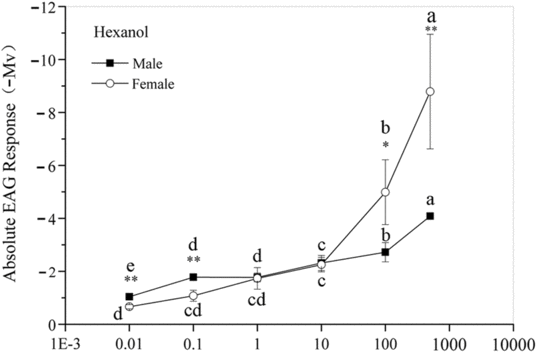
Effect of hexanol dose on the electroantennogram response. This treatment was used to detect the potential hexanol saturation concentration for T. klimeschi and to establish a standard for other treatments. A typical dose-dependent response curve was found in both sexes for hexanol with stimulation with ascending concentrations (Fig. 1). The results indicated a significant antennal reaction to hexanol at 0.01 μg/μL, and as the concentration increased, the electroantennogram response value of T. klimeschi began to increase significantly (F male = 128.987, dfmale = 5, P male < 0.001; F female = 44.901, dffemale = 5, P female < 0.001). Although hexanol can cause significant electrophysiological reactions in both sexes at the concentration of 0.01 and 0.1 μg/μL, the male-induced response was significantly greater than that of the female-induced response (t 0.01 μg/μL = 13.860, df0.01 μg/μL = 4, t 0.1 μg/μL = 8.814, df0.1 μg/μL = 4, P < 0.001). However, at the hexanol concentration of 100 μg/μL and above, female-induced response was greater than male-induced response (t 100 μg/μL = 3.194, df100 μg/μL = 4, t 500 μg/μL = 4.882, df500 μg/μL = 4, P < 0.05). Based on the dose–response curve, 1 μg/μL hexanol could induce a moderate response, with an average amplitude of 1.8 ± 0.3 mV for all tested insects (t 1 μg/μL = 0.159, df1 μg/μL = 4, P > 0.05). Therefore, 1 μg/μL hexanol was selected as the standard.
Electroantennogram (EAG) absolute response (mean ± standard error) of Trypophloeus klimeschi to hexanol. Error bars represent standard errors of five replicates. Asterisks denote a significant difference between males and females at the same concentration (t-test; * P ≤ 0.05; ** P ≤ 0.001). Different small letters indicated significant difference between different concentrations for the parameter (analysis of variance; P ≤ 0.001).

Relationship between volatiles concentration and electroantennogram response
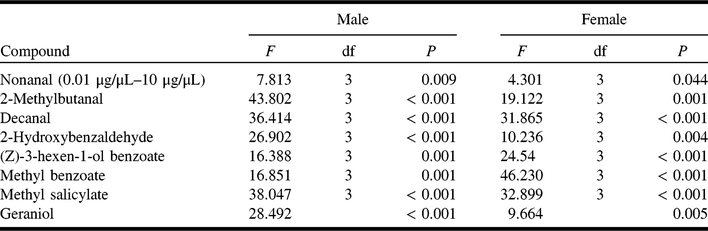
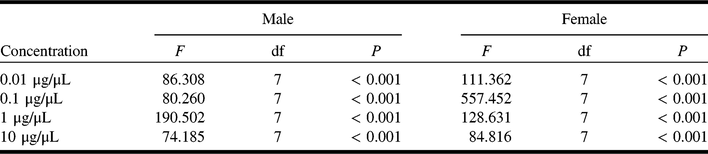
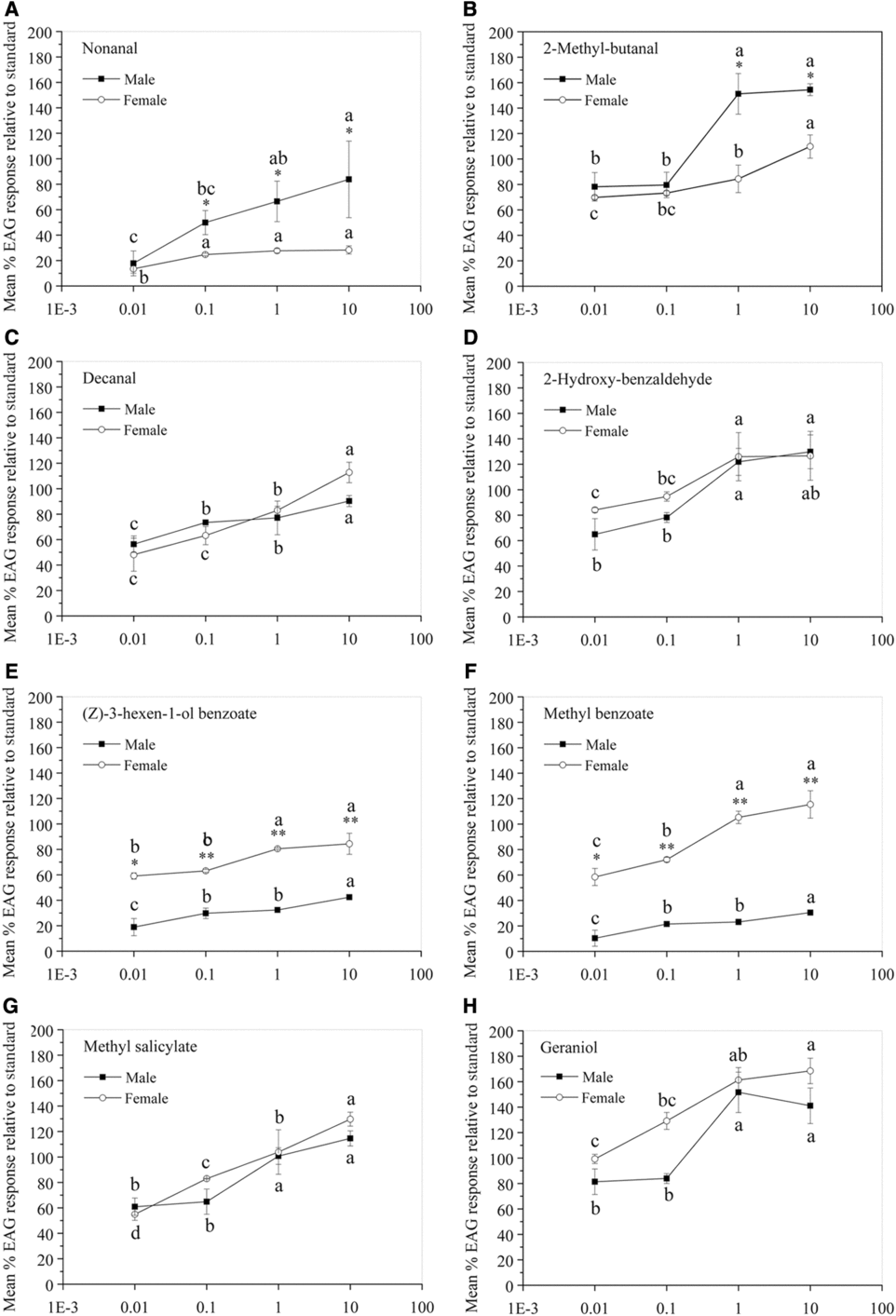
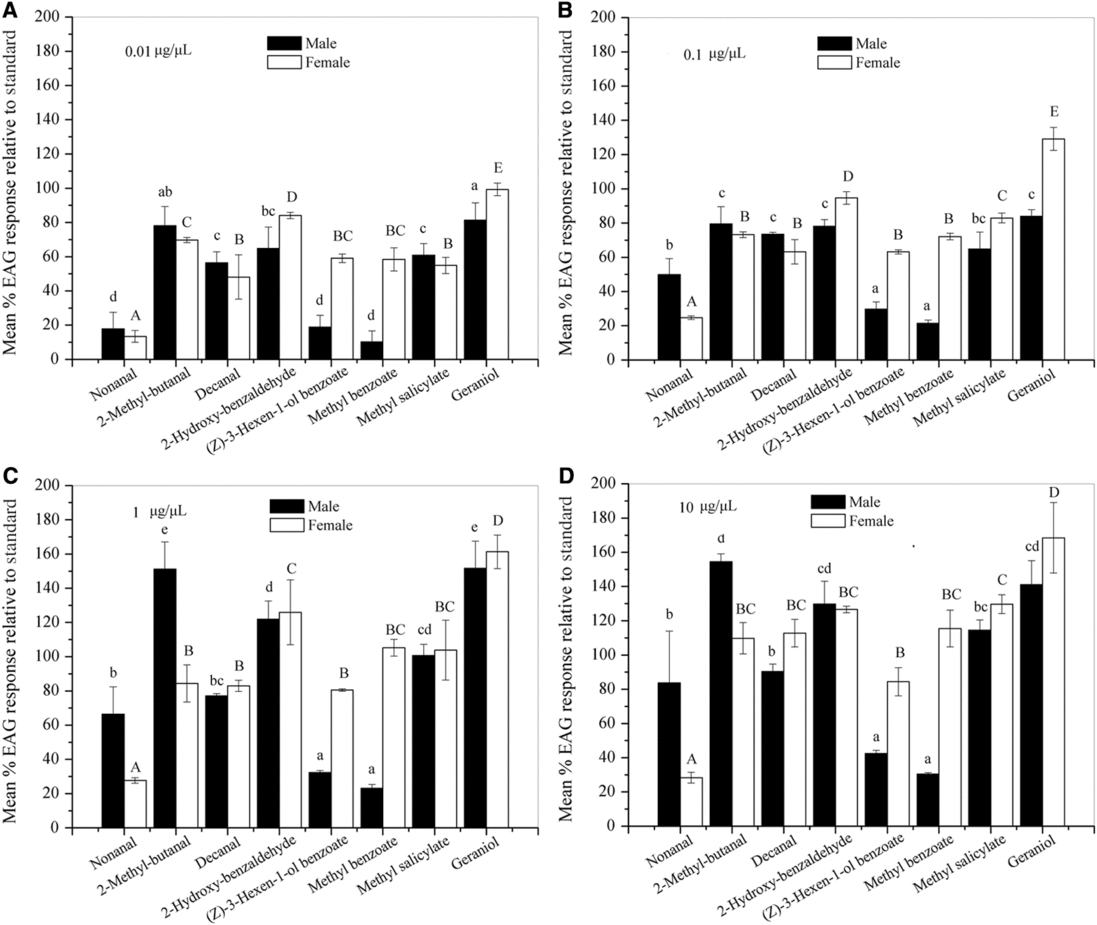
As seen from Figure 2, there was a general increase in response with increase in concentration. Response of both males and females was significantly greater at the highest concentration, relative to the lowest concentrations (Table 1). Overall, Duncan’s multiple analysis indicates that there were significant differences in electroantennogram responses between the tested chemical samples (Table 2) (Fig. 3). 2-Hydroxybenzaldehyde and geraniol caused the largest electroantennogram reactions for females and 2-methylbutanal caused the largest electroantennogram reactions for males, while the reactions of females from nonanal and the reactions of males from (Z)-3-hexen-1-ol benzoate and methyl benzoate were minimal.
Statistical analysis of response of Trypophloeus klimeschi to volatile compounds with increase in concentration by Duncan’s multiple analysis.

Statistical analysis of response of Trypophloeus klimeschi to different volatile compounds within a given concentration by Duncan’s multiple analysis.

Electroantennogram (EAG) response (mean ± standard error) of Trypophloeus klimeschi to nonanal, 2-methylbutanal, decanal, 2-hydroxybenzaldehyde, (Z)-3-hexen-1-ol benzoate, methyl benzoate, methyl salicylate, and geraniol. Error bars represent standard errors of five replicates. Asterisks denote a significant difference between males and females at the same concentration (t test; *P ≤ 0.05; **P ≤ 0.001). Different lowercase letters above the fold indicate significant differences between different concentrations for the parameter (analysis of variance; P ≤ 0.05). A, nonanal; B, 2-methylbutanal; C, decanal; D, 2-hydroxybenzaldehyde; E, (Z)-3-hexen-1-ol benzoate; F, methyl benzoate; G, methyl salicylate; H, geraniol.

Relative mean electroantennogram response (mean ± standard error) of nonanal, 2-methylbutanal, decanal, 2-hydroxybenzaldehyde, (Z)-3-hexen-1-ol benzoate, methyl benzoate, methyl salicylate, and geraniol to male and female Trypophloeus klimeschi at four different concentrations. A, at the concentration of 0.01 μg/μL; B, at the concentration of 0.1 μg/μL; C, at the concentration of 1 μg/μL; D, at the concentration of 10 μg/μL. Error bars represent standard errors of five replicates. Within a given concentration, differences in male and female response among compounds are shown with different letters; uppercase letters associated with females and lowercase letters with males (analysis of variance: P ≤ 0.001).

Sexual dimorphism in electroantennogram response
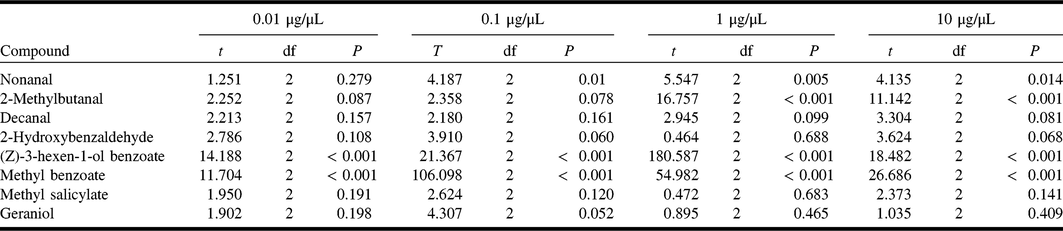
Analysis of the response data for the same compound showed significant differences between males and females for the following four compounds: nonanal, 2-methylbutanal, (Z)-3-hexen-1-ol benzoate, and methyl benzoate (Fig. 2); no significant gender difference was found for the other four compounds. Males showed a stronger response to nonanal and 2-methylbutanal (Table 3) at the concentration of 0.1 μg/μL and above, while females showed a stronger response to (Z)-3-hexen-1-ol benzoate and methyl benzoate at all concentrations (Table 3).
Statistical analysis of the difference between males and females for different volatile compounds within a given concentration by t-test.

Laboratory olfactometer trials
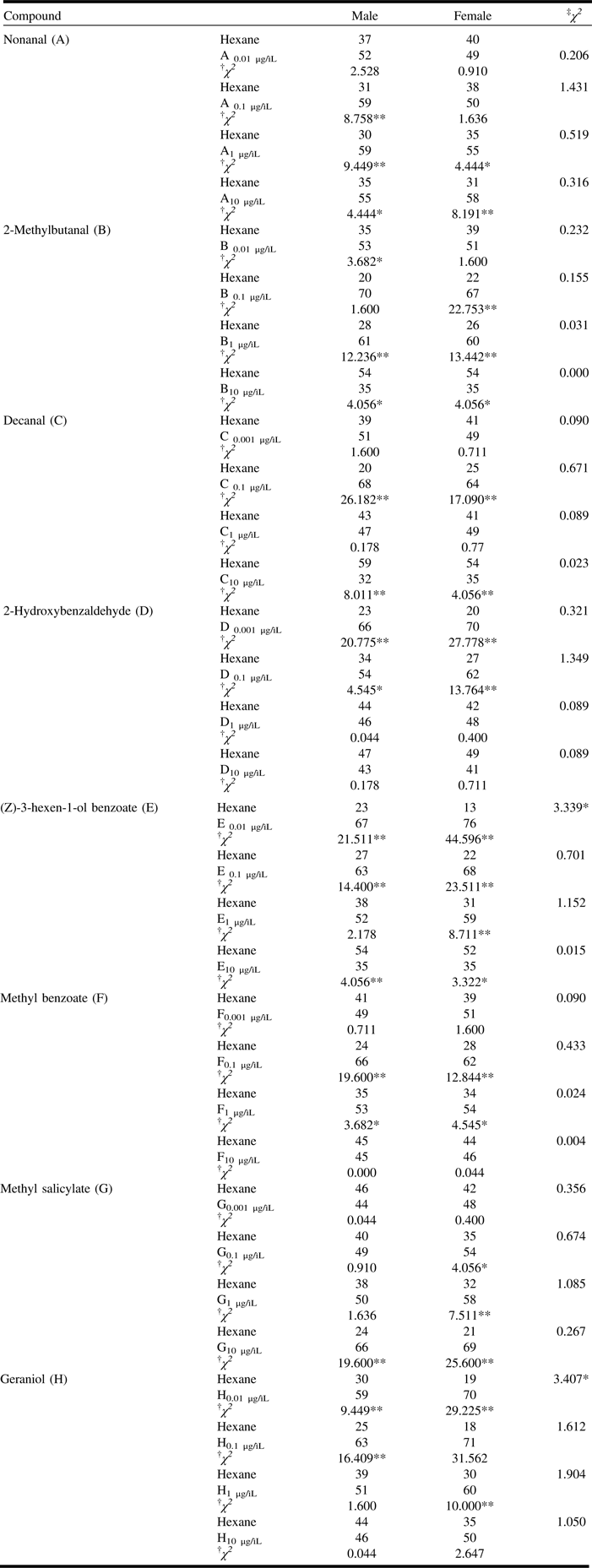
As shown in Table 4, the percentages of walking female and male T. klimeschi responding to the different volatile compounds in the Y-olfactometer were not significantly different, except for (Z)-3-hexen-1-ol benzoate and geraniol at the concentration of 0.01 μg/μL. Thus, data for males and females were pooled for further analysis. Walking T. klimeschi were attracted to all eight compounds at low concentration (≤ 1 μg/μL). However, when a high concentration (10 μg/μL) was reached, T. klimeschi showed aversion to these compounds, except for nonanal. However, there were differences in the rates of attraction among these eight compounds. At the concentration of 0.01 μg/μL, walking T. klimeschi were significantly attracted to 2-methylbutanal, 2-hydroxybenzaldehyde, (Z)-3-hexen-1-ol benzoate, and geraniol, and females were much more sensitive to (Z)-3-hexen-1-ol benzoate and geraniol than males. Trypophloeus klimeschi was significantly attracted to all eight compounds at the concentration of 0.1 μg/μL. At the concentration of 1 μg/μL, T. klimeschi were significantly attracted to all compounds with the exception of decanal and 2-hydroxybenzaldehyde. At a high concentration of 10 μg/μL, T. klimeschi showed significant aversion to nonanal, 2-methylbutanal, decanal, (Z)-3-hexen-1-ol benzoate, and methyl salicylate, while the other three compounds were not active at the tested dosage.
Attraction of male and female Trypophloeus klimeschi to various concentrations of nonanal (A), 2-methylbutanal (B), decanal (C), 2-hydroxybenzaldehyde (D), (Z)-3-hexen-1-ol-benzoate (E), methyl benzoate (F), methyl salicylate (G), and geraniol (H) in Y-tube assays*. Hexane was used as a solvent control and 20 μL of each concentration was used in the trials.

*Table entries represent the numbers of T. klimeschi of each sex that responded to either the control or treatment stimulus; hexane was the solvent control. The †χ2 values in the rows indicate the difference between the treatment and the hexane solvent control. The ‡χ 2 values in the columns indicate the difference between males and females. Asterisks indicate significant differences (*P ≤ 0.05, **P ≤ 0.001, chi-squared test).
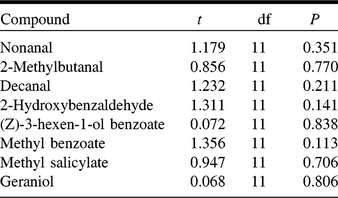
Statistical analysis of difference between males and females for different volatile compounds in the trapping experiments by t-test.

Field trials
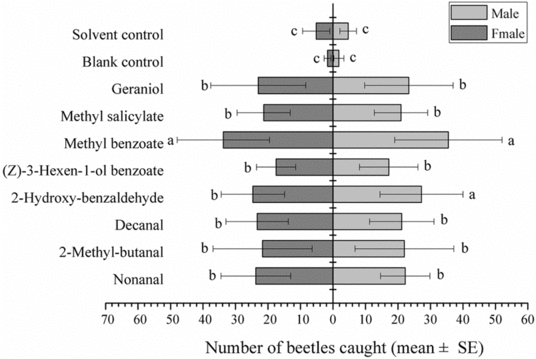
In the trapping experiments, no significant interactions were detected between sex and treatment (Table 5). The presence of single compounds (nonanal, 2-methylbutanal, decanal, 2-hydroxy-benzaldehyde, (Z)-3-hexen-1-ol benzoate, methyl benzoate, methyl salicylate, and geraniol) in baits significantly affected catches of T. klimeschi (F female = 8.582, dffemale = 9, P female < 0.001; F male = 12.883, dfmale = 9, P male < 0.001). Baits composed of each volatile compound alone were attractive to T. klimeschi and in numbers significantly greater than the control. The methyl benzoate baited trap caught significantly more males and females than traps baited with other compounds (Fig. 4). Numbers of female and male T. klimeschi caught in each funnel trap baited are listed in Supplementary Table 1.
Total numbers (mean ± standard error) of Trypophloeus klimeschi caught in each funnel trap baited with nonanal, 2-methylbutanal, decanal, 2-hydroxybenzaldehyde, (Z)-3-hexen-1-ol benzoate, methyl benzoate, methyl salicylate, and geraniol. The test was replicated 12 times. The solvent control was hexane, and the blank control was an empty vial. Within each treatment, bars with different letters are significantly different at P ≤ 0.001 (analysis of variance).

Discussion
In this study, we detected electrophysiological and behavioural activity in T. klimeschi in response to eight host volatile compounds: nonanal, 2-methylbutanal, decanal, 2-hydroxybenzaldehyde, (Z)-3-hexen-1-ol benzoate, methyl benzoate, methyl salicylate, and geraniol. Our results provide evidence that these eight compounds may function as attractants and might play a key role in host selection by T. klimeschi. In this study, the electroantennogram responses of female and male antennae differed for some compounds, and this result was consistent with previous research. For example, the electroantennogram responses of Bruchophagus roddi (Gussakovsky) (Hymenoptera: Eurytomidae) to 39 volatile compounds released from various alfalfa (Medicago sativa Linnaeus; Fabaceae) flowers demonstrated that females and males have significant responses to most volatiles and that the sensitivity of the females to volatile substances is significantly higher than that of males (Light et al. Reference Light, Kamm and Buttery1992). The electroantennogram responses of adult Dendroctonus valens LeConte to volatile compounds of Pinus tabuliformis Carrière (Pinaceae) also differed between females and males (Erbilgin et al. Reference Erbilgin, Mori, Sun, Stein, Owen and Merrill2007). One study found that female Lygus lucorum Meyer-Dür (Hemiptera: Miridae) were more sensitive to plant volatiles than males, while males were more sensitive to sex pheromones (Chen et al. Reference Chen, Su, Ge and Su2010). The electroantennogram responses of the female and male adults of Xylotrechus rusticus (Linnaeus) (Coleoptera: Cerambycidae) to the volatile odours in their host tree were also different, and the intensity of the reaction was related to the concentration of the plant volatile compounds (Shepherd and Sullivan Reference Shepherd and Sullivan2013). In our study, different electroantennogram responses of adult T. klimeschi indicate that the sensitivity of male and female adults to various volatile compounds in P. alba var. pyramidalis is different. There were significant differences between males and females for different compounds. This suggests that the antennae of female and male T. klimeschi adults might differ in the type and number of receptors or in physiological functioning.
The laboratory bioassays confirmed the results of the electrophysiological response experiments and provided further evidence that 2-hydroxybenzaldehyde, nonanal, decanal, methyl benzoate, methyl salicylate, geraniol, (Z)-3-hexen-1-ol benzoate, and 2-methylbutanal act on the host selection behaviour of T. klimeschi. At low concentration (≤ 1 μg/μL), T. klimeschi exhibited attraction to all eight compounds, but when a high concentration (10 μg/μL) was reached, the insect showed significant aversion to 2-methylbutanal, decanal, and (Z)-3-hexen-1-ol benzoate. In this study, both sexes exhibited similar responses to the tested compounds in the Y-tube selection, even though the electroantennogram responses of female and male antennae were different for some compounds. The results were the same as those from studies of Dendroctonus rufipennis Kirby (Huber and Borden Reference Huber and Borden2003), D. valens (Miao et al. Reference Miao, Zhang, Wang, Guo and Sun2004), and Tomicus minor (Hartig) (Coleoptera: Curculionidae) (Yang et al. Reference Yang, Wang, Yang and Yang2015). There are likely some differences in the structure of male and female antennal receptors but both sexes must be able to distinguish between host and nonhost trees to accurately locate a tree that is under attack. Additional research is required to fully understand the underlying mechanism.
Efforts to control these damaging insects often involve sanitation harvesting. Field trapping is a potential tactic, but it is not always successful because of a lack of highly effective attractants. A growing number of studies of Scolytinae species have examined the effects of host tree semiochemicals or insect pheromones to find a more specific way to monitor or control pests (Huber and Borden Reference Huber and Borden2003; Yang et al. Reference Yang, Wang, Yang and Yang2015; Zhao et al. Reference Zhao, Dai, Sun, Danyang and Chen2017). Our field investigations revealed that methyl benzoate is significantly attractive to both sexes, suggesting that this compound may mediate host location. A previous study reported that methyl benzoate was structurally similar to methyl salicylate (Zhao et al. Reference Zhao, Guan, Ferrer, Engle, Chern and Ronald2010), but in our study, methyl benzoate was superior to methyl salicylate. Methyl benzoate has not been previously reported as attractive to Coleoptera but methyl salicylate has been reported as a component of the blend emitted by damaged potato plants (Solanum tuberosum Linnaeus; Solanaceae) that is attractive to Leptinotarsa decemlineata (Say) (Coleoptera: Chrysomelidae) (Dickens Reference Dickens2015).
Many insect species have also been reported to be attracted to these volatile compounds. These compounds include selected compounds from wilted leaves of Populus nigra Linnaeus such as 2-hydroxybenzaldehyde and benzaldehyde. They showed increasing attractiveness to Helicoverpa armigera (Hübner) (Lepidoptera: Noctuidae) compared to the attraction of pheromone alone in the wind tunnel bioassay (Deng et al. Reference Deng, Huang, Wei and Du2004). Nonanal, benzaldehyde, and hexanol are known to be volatile compounds of P. tremuloides bark to which D. ponderosae is antennally reactive (Borden et al. Reference Borden, Wilson, Gries, Chong, Pierce and Gries1998). Electroantennograms from the antennae of Scolytus rugulosus (Müller) (Coleoptera: Curculionidae) recorded the strongest response to 2-ethyl-butanal and nonanal (Sui et al. Reference Sui, Xu and Tian2012). Previous tests of specific plant volatiles as attractant to insects in the field have highlighted the lures of green leaf volatiles (J.C. Dickens, United States Department of Agriculture 2002 patent 6 413 508; James and Grasswitz Reference James and Grasswitz2005; Zhu et al. Reference Zhu, Obrycki, Ochieng, Baker, Pickett and Smiley2005; Yu et al. Reference Yu, Zhang, Wu, Gao and Guo2008) and methyl salicylate (Hatano et al. Reference Hatano, Kunert and Weisser2008; Blande et al. Reference Blande, Korjus and Holopainen2010).
Conclusion
In summary, electrophysiological and behavioural experiments conducted in the laboratory as well as the field trapping indicate that these eight plant volatiles such as nonanal, 2-methylbutanal, decanal, 2-hydroxy-benzaldehyde, (Z)-3-hexen-1-ol benzoate, methyl benzoate, methyl salicylate, and geraniol are attractive to T. klimeschi when compared with solvent and blank controls. The methyl benzoate bait was superior to other baits. These results could have important implications for the development of an effective semiochemical-based management tool for T. klimeschi. However, further work is needed to completely clarify the biological activities and characterise the ecological significance of these host plant semiochemicals at different mixing ratios and evaluate their use for tree protection.
Supplementary material
To view supplementary material for this article, please visit https://doi.org/10.4039/tce.2018.64
Acknowledgements
We acknowledge the financial support of the National Key Research and Development Program of China (2017YFD0600104) and the Natural Science Basic Research Plan in Shaanxi Province of China (2017ZDJC-03).
Author contributions
Guanqun Gao and Hui Chen conceived and designed the experiments, Guanqun Gao performed the experiments, Guanqun Gao and Lulu Dai analysed the data, Jing Gao and Jiaxing Wang contributed reagents/materials/analytical tools, and Guanqun Gao wrote the paper.