


1. INTRODUCTION
The interaction of a charged particles beam with a plasma is an important subject of relevance for many fields of physics, such as inertial confinement fusion (ICF) driven by ion or electron beams (Deutsch, Reference Deutsch1986, Reference Deutsch1995; Deutsch & Fromy, Reference Deutsch and Fromy2001; D'Avanzo et al., Reference D'Avanzo, Lontano and Bortignon1993; Couillaud et al., Reference Couillaud, Deicas, Nardin, Beuve, Guihaume, Renaud, Cukier, Deutsch and Maynard1994; Hoffmann, Reference Hoffmann2008), high energy density physics (Tahir et al., Reference Tahir, Deutsch, Fortov, Gryaznov, Hoffmann, Kulish, Lomonosov, Mintsev, Ni, Nikolaev, Piriz, Shilkin, Spiller, Shutov, Temporal, Ternovoi, Udrea and Varentsov2005; Nellis, Reference Nellis2006), and related astrophysical phenomena (Piran, Reference Piran2005). This interaction is also relevant, among others, for the fast ignition scenario (FIS) (Tabak et al., Reference Tabak, Hammer, Glinsky, Kruer, Wilks, Woodworth, Campbell, Perry and Mason1994; Deutsch et al., Reference Deutsch, Furukawa, Mima, Murakami and Nishihara1996), where the precompressed deuterium-tritium (DT) core of a fusion target is to be ignited by a laser-generated relativistic electron beam. In addition, a promising ICF scheme has been recently proposed (Stöckl et al., Reference Stöckl, Frankenheim, Roth, Suß, Wetzler, Seelig, Kulish, Dornik, Laux, Spiller, Stetter, Stöwe, Jacoby and Hoffmann1996; Roth et al., Reference Roth, Cowan, Key, Hatchett, Brown, Fountain, Johnson, Pennington, Snavely, Wilks, Yasuike, Ruhl, Pegoraro, Bulanov, Campbell, Perry and Powell2001), in which the plasma target is irradiated simultaneously by intense laser and ion beams. Within this scheme several experiments (Roth et al., Reference Roth, Stöckll, Süß, Iwase, Gericke, Bock, Hoffmann, Geissel and Seelig2000; Oguri et al., Reference Oguri, Tsubuku, Sakumi, Shibata, Sato, Nishigori, Hasegawa and Ogawa2000; Frank et al., Reference Frank, Blažević, Grande, Harres, Heßling, Hoffmann, Knobloch-Maas, Kuznetsov, Nürnberg, Pelka, Schaumann, Schiwietz, Schökel, Schollmeier, Schumacher, Schütrumpf, Vatulin, Vinokurov and Roth2010, Reference Frank, Blažević, Bagnoud, Basko, Börner, Cayzak, Kraus, Heßling, Hoffmann, Ortner, Otten, Pelka, Pepler, Schumacher, Tauschwitz and Roth2013; Hoffmann et al., Reference Hoffmann, Tahir, Udrea, Rosmej, Meister, Varentsov, Roth, Schaumann, Frank, Blažević, Ling, Hug, Menzel, Hessling, Harres, Günther, El-Moussati, Schumacher and Imran2010) have been performed to investigate the interactions of heavy ion and laser beams with plasma or solid targets. An important aspect of these experiments is the energy loss measurements for the ions in a wide-range of plasma parameters. It is expected in such experiments that the ion propagation would be essentially affected by the parametric excitation of the plasma target by means of laser irradiation. This effect has been supported recently by particle-in-cell numerical simulations (Hu et al., Reference Hu, Song, Mišković and Wang2011).
Motivated by the experimental achievements mentioned above, in this paper we present a study of the effects of intense radiation field (RF) on the interaction of projectile particles with an electron plasma. Previously this has been a subject of great activity, starting with the pioneering work of Tavdgiridze, Aliev, and Gorbunov (Tavdgiridze & Tsintsadze, Reference Tavdgiridze and Tsintsadze1970; Aliev et al., Reference Aliev, Gorbunov and Ramazashvili1971). More recently the need of the comprehensive analysis of the complexity of the beam-matter interaction in the presence of strong laser fields has stimulated a number of theoretical studies. Arista et al. (Reference Arista, Galvão and Miranda1989) and Nersisyan and Akopyan (Reference Nersisyan and Akopyan1999) have developed a time-dependent Hamiltonian formulation to describe the effect of a strong laser field on energy losses of swift ions moving in a degenerate electron gas. It has been shown that the energy loss is reduced for ions at intermediate velocities, but is increased for slow ions, due to a resonance process of plasmon excitation in the target assisted by a photon absorption (Arista et al., Reference Arista, Galvão and Miranda1989). For plasma targets, on the other hand, it has been obtained that the energy loss is reduced in the presence of a laser field when the projectile velocity is smaller than the electron thermal velocity (Arista et al., Reference Arista, Galvão and Miranda1990; Nersisyan & Deutsch, Reference Nersisyan and Deutsch2011). Moreover, the reduction of the energy loss rate increases with decreasing the angle between the projectile velocity and the polarization vector of the laser field (Nersisyan & Deutsch, Reference Nersisyan and Deutsch2011). Next, an interesting effect has been obtained by Akopyan et al. (Reference Akopyan, Nersisyan and Matevosyan1997) considering the oscillatory motion of the light projectile particles in the laser field. In this case, the energy loss depends on the projectile charge sign and mass and, therefore, results in a different stopping powers for electrons and positrons. In recent years, special attention has also been paid to the regimes of high intensities of the laser field when the quiver velocity of the plasma electron exceeds the projectile velocity (Nersisyan & Akopyan, Reference Nersisyan and Akopyan1999; Nersisyan & Deutsch, Reference Nersisyan and Deutsch2011). It has been shown that the projectile particles can be even accelerated in a plasma due to the parametric effects excited by an intense laser field. Furthermore, Wang et al. (Reference Wang, Song, Wang and Mišković2002, Reference Wang, Wang, Hu, Gao, Wang, Yao, Zhong, Cheng, Yang, Liu and Xu2012) have studied the influence of a high-intensity laser field on the Coulomb explosion and stopping power for a swift H3+ cluster ion in a plasma target. They have demonstrated that the laser field affects the correlation between the ions and contributes to weaken the wake effect as compared to the laser-free case.
All papers mentioned above deal with a nonrelativistic projectile particles interacting with a laser irradiated plasma. In the present paper, we study more general configurations thus considering the interaction of relativistic particles with an electron plasma. Our objective is then to study some aspects of the energy loss of relativistic particles which have not been considered previously. As an important motivation of the present paper is the research on the topic of the FIS for inertial confinement fusion (Deutsch et al., Reference Deutsch, Furukawa, Mima, Murakami and Nishihara1996; Tabak et al., Reference Tabak, Hammer, Glinsky, Kruer, Wilks, Woodworth, Campbell, Perry and Mason1994) which involves the interaction of a laser-generated relativistic electron beam (REB) with a plasma. Although the concept of the FIS implies an overdense plasma and the propagation of a relativistic electron beam from the border of a precompressed target to the dense core occurs without crossing the laser beam, the target plasma is assumed to be parametrically excited by the RF through high-harmonics generation. In this situation, the presence of the RF as well as the relativistic effects of the beam can dramatically change the main features of the standard stopping capabilities of the plasma.
The plan of the paper is as follows. In Section 2, we outline the theoretical formalism for the electromagnetic response of a plasma due to the motion of a relativistic charged particles beam in a plasma in the presence of an intense RF. The stopping of the relativistic beam is formulated in Section 3. In this section, we calculate the effects of the RF on the mean energy loss (stopping power) of the test particle considering two somewhat distinct cases with a weak (Section 3.1) and intense (Section 3.2) radiation field as well as a wide range for the test particle energies, extending from nonrelativistic up to the ultrarelativistic energies. The dynamics of the electron plasma is treated by a system of fluid equations which results in a high-frequency approximation for the dielectric response function. The results are summarized in Section 4.
2. SOLUTION OF THE BASIC EQUATIONS
The whole interaction process of the relativistic charged particles beam with plasma involves the energy loss and the charge states of the projectile particle and — as an additional aspect — the ionization and recombination of the projectile driven by the RF and the collisions with the plasma particles. A complete description of the interaction of the beam requires a simultaneous treatment of all these effects including, in particular, in the case of the structured particles the effect of the charge equilibration on the energy loss process. In this paper, we do not discuss the charge state evolution of the projectiles under study, but concentrate on the RF effects on the energy loss process assuming an equilibrium charge state of the projectile particle with an effective charge Ze. This is motivated by the fact that the charge equilibration occurs in time scales, which are usually much smaller than the time of passage of the beam through target. In addition, the effects mentioned above are not important in the case of the relativistic electron beams.
The problem is formulated using the hydrodynamic model of the plasma and includes the effects of the RF in a self-consistent way. The external RF is treated in the long-wavelength limit, and the plasma electrons are considered nonrelativistic. These are good approximations provided that (1) the wavelength of the RF λ0 = 2πc/ω0 is much larger than the Debye screening length λD = v th/ωp (with v th the thermal velocity of the electrons and ωp the plasma frequency), and (2) the “quiver velocity” of the electrons in the RF v E = eE 0/mω0 (where E0 is the amplitude of the RF) is much smaller than the speed of light c. These conditions can be alternatively written as (1) ω0/ωp≪ 2πc/v th, and (2) 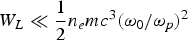 $W_L \ll {{1 \over 2}}n_e mc^3 \lpar {\rm \omega} _0 /{\rm \omega} _p \rpar ^2$, where W L = cE 02/8π is the intensity of the RF. As an estimate in the case of a dense plasma, with electron density n e = 1022 cm−3, we get
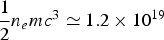 ${{1 \over 2}}n_e mc^3 \simeq 1.2 \times 10^{19}$ W/cm2. Thus the conditions (1) and (2) are well above the values obtained with currently available high-power sources of the RF, and these approximations are well justified.
The response of the plasma to the incoming relativistic beam is governed by the hydrodynamic equations for the density n(r, t) and the velocity v(r, t) of the plasma electrons as well as by the Maxwell equations for the electromagnetic fields. Thus,
 $$\displaystyle{{\partial n} \over {\partial t}} + \nabla \lpar n \cdot {\bf v}\rpar = 0\comma$$
 $$\displaystyle{{\partial {\bf v}} \over {\partial t}} + \lpar {\bf v} \cdot \nabla \rpar {\bf v} = - \displaystyle{e \over m}\left[{{\bf E}_0 \lpar t\rpar + {\bf E} + \displaystyle{1 \over c}\left[{{\bf v} \times {\bf B}} \right]} \right]\comma$$
where E0(t) = E0 sin(ω0t) is the RF, and E and B are the self-consistent electromagnetic fields which are determined by the Maxwell equations,
 $$\nabla \times {\bf E} = - \displaystyle{1 \over c}\displaystyle{{\partial {\bf B}} \over {\partial t}}\comma \; \quad \quad \nabla \times {\bf B} = \displaystyle{{4{\rm {\rm \pi} }} \over c}\left({{\bf j}_0 + {\bf j}} \right)+ \displaystyle{1 \over c}\displaystyle{{\partial {\bf E}} \over {\partial t}}\comma$$
 $$\nabla \cdot {\bf E} = - 4{\rm {\rm \pi} }e\,\left({n - n_e } \right)+ 4{\rm {\rm \pi} }{\rm \rho} _0 \comma \; \quad \quad \nabla \cdot {\bf B} = 0.$$
Here j = −en v is the induced current density, ρ0 and j0 are the charge and current densities for the beam, respectively, n e is the equilibrium plasma density in an unperturbed state. As mentioned above we consider a relativistic beam of charged particles and, therefore, the influence of the RF E0(t) on the beam is ignored.
Consider now the solution of Eqs. (1)–(4) for the beam-plasma system in the presence of the high-frequency RF. In an unperturbed state (i.e., neglecting the self-consistent electromagnetic fields E and B in Eq. (2) and assuming the homogeneous initial state), the plasma velocity satisfies the equation 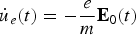 ${\dot u}_e \lpar t\rpar = - {{e \over m}}{\bf E}_0 \lpar t\rpar$ which yields the equilibrium velocity for the plasma electrons, ue(t) = vE cos(ω0t). Here vE = e E0/mω0 and a = e E0/mω02 are the quiver velocity and the oscillation amplitude of the plasma electrons, respectively, driven by the RF.
Next we consider the linearized hydrodynamic and Maxwell's equations for the plasma and electromagnetic fields, respectively. For sufficiently small perturbations, we assume v(r, t) = ue(t) + δv(r, t), n(r, t) = n e + δn(r, t), (with δn ≪ n e and δv ≪ u e). Thus, introducing the Fourier transforms δn(k, t), δv(k, t), E(k, t), and B(k, t) with respect to the coordinate r, the linearized hydrodynamic equations read
 $$\left[{\displaystyle{\partial \over {\partial t}} + i\left({{\bf k} \cdot {\bf u}_e \lpar t\rpar } \right)} \right]{\rm \delta} n\lpar {\bf k}\comma \; t\rpar = - in_e \left({{\bf k} \cdot {\rm \delta} {\bf v}\lpar {\bf k}\comma \; t\rpar } \right)\comma$$
 $$\left[{\displaystyle{\partial \over {\partial t}} + i\left({{\bf k} \cdot {\bf u}_e \lpar t\rpar } \right)} \right]{\rm \delta} {\bf v}\lpar {\bf k}\comma \; t\rpar = - \displaystyle{e \over m}\left[{{\bf E}\lpar {\bf k}\comma \; t\rpar + \displaystyle{1 \over c}\left[{{\bf u}_e \lpar t\rpar \times {\bf B}\lpar {\bf k}\comma \; t\rpar } \right]} \right].$$
In order to solve Eqs. (5) and (6) it is convenient to introduce instead of the Fourier transform P(k, t) a new unknown function  $\widetilde{{\bf P}}\lpar {\bf k}\comma \; t\rpar $ via the relation (Nersisyan & Deutsch, Reference Nersisyan and Deutsch2012)
 $$\widetilde{{\bf P}}\lpar {\bf k}\comma \; t\rpar = {\bf P}\lpar {\bf k}\comma \; t\rpar e^{i{\rm \zeta} sin\lpar {\rm \omega} _0 t\rpar } \comma$$
where ζ = k · a, P(k, t) represents one of the quantities δn(k, t), δv(k, t), E(k, t), and B(k, t). Substituting this relation for the quantities δn(k, t), δv(k, t), E(k, t), and B(k, t) into Eqs. (5) and (6) it is easy to see that the obtained equation for the unknown function  $\widetilde{{\bf P}}\lpar {\bf k}\comma \; t\rpar $ constitutes an equation with periodic coefficients (Nersisyan & Deutsch, Reference Nersisyan and Deutsch2012). Therefore, we introduce the decompositions
 $${\bf P}\lpar {\bf k}\comma \; t\rpar = \vint_{ - \infty }^\infty \, d{\rm \omega} e^{ - i{\rm \omega} t} \sum\limits_{\ell = - \infty }^\infty \, {\bf P}_\ell \lpar {\bf k}\comma \; {\rm \omega} \rpar e^{ - i\ell {\rm \omega} _0 t} \comma$$
 $$\widetilde{{\bf P}}\lpar {\bf k}\comma \; t\rpar = \vint_{ - \infty }^\infty \, d{\rm \omega} e^{ - i{\rm \omega} t} \sum\limits_{\ell = - \infty }^\infty \, \mathop {\widetilde{{\bf P}}}\nolimits_\ell \lpar {\bf k}\comma \; {\rm \omega} \rpar e^{ - i\ell {\rm \omega} _0 t}\comma$$
where Pℓ(k, ω) and  $\mathop {\widetilde{{\bf P}}}_\ell \lpar {\bf k}\comma \; {\rm \omega}\rpar $ are the corresponding amplitudes of the ℓth harmonic. It is also useful to find the connection between these amplitudes. This can be done using the Fourier series representation of the exponential function
 $e^{{\rm i}\zeta \sin(\omega_0t)} $ as well as the summation formula
 $\sum\nolimits_{r = - \infty }^\infty \, J_r \lpar {\rm \zeta} \rpar J_{r + \ell } \lpar {\rm \zeta} \rpar = {\rm \delta} _{\ell 0}$ for the Bessel functions (Gradshteyn & Rizhik, Reference Gradshteyn and Rizhik1980) which yields
 $$\mathop {\widetilde{{\bf P}}}\nolimits_\ell \lpar {\bf k}\comma \; {\rm \omega} \rpar = \sum\limits_{s = - \infty }^\infty \, J_{s - \ell } \lpar {\rm \zeta} \rpar {\bf P}_s \lpar {\bf k}\comma \; {\rm \omega} \rpar \comma$$
 $${\bf P}_\ell \lpar {\bf k}\comma \; {\rm \omega} \rpar = \sum\limits_{s = - \infty }^\infty \, J_{\ell - s} \lpar {\rm \zeta} \rpar \mathop {\widetilde{{\bf P}}}\nolimits_s \lpar {\bf k}\comma \; {\rm \omega} \rpar .$$
Here J ℓ is the Bessel function of the first kind and of the ℓth order. Using these results from Eqs. (5) and (6) it is straightforward to obtain
 $${\rm \delta} \mathop {\tilde n}\nolimits_\ell \lpar {\bf k}\comma \; {\rm \omega} \rpar = \displaystyle{{n_e } \over {\Omega _\ell }}\left({{\bf k} \cdot {\rm \delta} \mathop {{\tilde{\bf v}}}\nolimits_\ell \lpar {\bf k}\comma \; {\rm \omega} \rpar } \right)\comma$$
 $${\rm \delta} \mathop {{\tilde {\bf v}}}\nolimits_\ell \lpar {\bf k}\comma \; {\rm \omega} \rpar = - \displaystyle{{ie} \over {m\Omega _\ell }}\mathop {\widetilde{{\bf E}}}\nolimits_\ell \lpar {\bf k}\comma \; {\rm \omega} \rpar \comma$$
where Ωℓ = ω+ ℓω0 and we have neglected the term of the order of v E/c (see the last term in Eq. (6)) according to the approximation (2). Using the transformation formulas (10) and (11) from the system of Eqs. (12) and (13) it is easy to obtain
 $${\rm \delta} n_\ell \lpar {\bf k}\comma \; {\rm \omega} \rpar = - \displaystyle{{in_e e} \over m}\sum\limits_{s\comma r = - \infty }^\infty \, \displaystyle{1 \over {\Omega _r^2 }}J_{\ell - r} \lpar {\rm \zeta} \rpar J_{s - r} \lpar {\rm \zeta} \rpar \left({{\bf k} \cdot {\bf E}_s \lpar {\bf k}\comma \; {\rm \omega} \rpar } \right)\comma$$
 $${\rm \delta} {\bf v}_\ell \lpar {\bf k}\comma \; {\rm \omega} \rpar = - \displaystyle{{ie} \over m}\sum\limits_{s\comma r = - \infty }^\infty \, \displaystyle{1 \over {\Omega _r }}J_{\ell - r} \lpar {\rm \zeta} \rpar J_{s - r} \lpar {\rm \zeta} \rpar {\bf E}_s \lpar {\bf k}\comma \; {\rm \omega} \rpar .$$
Next let us evaluate the induced current density which is given by δj = −e[n eδv + ue(t)δn] in the coordinate space. Employing Eqs. (8), (9), (14), and (15) for the Fourier transform of the induced current density we obtain
 $$\eqalign{ {\rm \delta} {\bf j}_\ell \lpar {\bf k}\comma \; {\rm \omega} \rpar & = - e\left\{{n_e {\rm \delta} {\bf v}_\ell \lpar {\bf k}\comma \; {\rm \omega} \rpar + \displaystyle{{{\bf v}_E } \over 2}\left[{{\rm \delta} n_{\ell + 1} \lpar {\bf k}\comma \; {\rm \omega} \rpar + {\rm \delta} n_{\ell - 1} \lpar {\bf k}\comma \; {\rm \omega} \rpar } \right]} \right\}\cr & = \displaystyle{{i{\rm \omega} _p^2 } \over {4{\rm {\rm \pi} }}}\sum\limits_{s\comma r = - \infty }^\infty \, \displaystyle{1 \over {\Omega _r }}J_{\ell - r} \lpar {\rm \zeta} \rpar J_{s - r} \lpar {\rm \zeta} \rpar\cr &\quad\times \left[{{\bf E}_s \lpar {\bf k}\comma \; {\rm \omega} \rpar + \displaystyle{{\lpar \ell - r\rpar {\rm \omega} _0 } \over {\Omega _r }}\displaystyle{{\bf a} \over {\rm \zeta} }\left({{\bf k} \cdot {\bf E}_s \lpar {\bf k}\comma \; {\rm \omega} \rpar } \right)} \right]\comma} \lpar 16\rpar$$
where ωp2 = 4πn ee 2/m is the plasma frequency.
From the Maxwell equations we express the magnetic field through the electric field. In terms of the amplitudes of the ℓth harmonics [see definition given by Eqs. (8) and (9)] the electric field is determined by the system of equations
 $$\left({k^2 - \displaystyle{{\Omega _\ell ^2 } \over {c^2 }}} \right){\bf E}_\ell \lpar {\bf k}\comma \; {\rm \omega} \rpar - {\bf k}\left({{\bf k} \cdot {\bf E}_\ell \lpar {\bf k}\comma \; {\rm \omega} \rpar } \right)= \displaystyle{{4{\rm {\rm \pi} }i\Omega _\ell } \over {c^2 }}\left[{{\rm \delta} _{\ell 0} {\bf j}_0 \lpar {\bf k}\comma \; {\rm \omega} \rpar + {\rm \delta} {\bf j}_\ell \lpar {\bf k}\comma \; {\rm \omega} \rpar } \right]\comma$$
 $$\left({{\bf k} \cdot {\bf E}_\ell \lpar {\bf k}\comma \; {\rm \omega} \rpar } \right)= 4{\rm {\rm \pi} }i\left[{e{\rm \delta} n_\ell \lpar {\bf k}\comma \; {\rm \omega} \rpar - {\rm \delta} _{\ell 0} {\rm \rho} _0 \lpar {\bf k}\comma \; {\rm \omega} \rpar } \right].$$
Here j0(k, ω) and ρ0(k, ω) are the ordinary Fourier transforms of the current and charge densities of the beam, respectively. Note that the ℓth harmonics of these quantities are given by δℓ0j0(k, ω) and δℓ0ρ0(k, ω). Also the longitudinal part of the electric field is determined by the Poisson equation (18).
Insertion of Eq. (16) into Eq. (17) results in
 $$\eqalign{&\left[{k^2 - \displaystyle{{\Omega _\ell ^2 } \over {c^2 }}{\rm \varepsilon} \lpar \Omega _\ell \rpar } \right]{\bf E}_\ell \lpar {\bf k}\comma \; {\rm \omega} \rpar - {\bf k}\lpar {\bf k} \cdot {\bf E}_\ell \lpar {\bf k}\comma \; {\rm \omega} \rpar \rpar \cr & = - \displaystyle{{{\rm \omega} _p^2 } \over {c^2 }}\sum\limits_{s\comma r = - \infty }^\infty \, \displaystyle{{\lpar \ell - r\rpar {\rm \omega} _0 } \over {\Omega _r }}J_{\ell - r} \lpar {\rm \zeta} \rpar J_{s - r} \lpar {\rm \zeta} \rpar \cr & \quad \left[{{\bf E}_s \lpar {\bf k}\comma \; {\rm \omega} \rpar + \displaystyle{{\Omega _\ell } \over {\Omega _r }}\displaystyle{{\bf a} \over {\rm \zeta} }\left({{\bf k} \cdot {\bf E}_s \lpar {\bf k}\comma \; {\rm \omega} \rpar } \right)} \right]\cr & + \displaystyle{{4{\rm {\rm \pi} }i\Omega _\ell } \over {c^2 }}{\rm \delta} _{\ell 0} {\bf j}_0 \lpar {\bf k}\comma \; {\rm \omega} \rpar \comma \; }$$
where ε(ω) = 1 − ωp2/ω2 is the longitudinal dielectric function of a plasma. The obtained expression (19) completely determines the electromagnetic response in the beam-plasma system in the presence of the RF. The resulting equation represents a coupled and infinite system of linear equations for the quantities Eℓ(k, ω) (with ℓ = 0, ± 1, ±2,…). The (infinite) determinant of this system determines the dispersion equation for the electromagnetic plasma modes in the presence of the RF. It should be also emphasized that the hydrodynamic description of a plasma is justified at high frequencies when |ω + ℓω0| ≫ kv th. In particular, this condition requires that the velocity of the projectile particle should exceed the thermal velocity v th of the plasma electrons.
Eq. (19) can be further simplified excluding there the longitudinal part (k · Eℓ) of the electric field by means of the Poisson equation (18) together with the induced charge density, Eq. (14). In the first step we multiply both sides of Eq. (18) by J ℓ−q(ζ)J m−q(ζ) and sum up over the harmonic numbers ℓ and q. Using the summation formula involving two Bessel functions (see above Eq. (10)) this results in
 $$\sum\limits_{s\comma r = - \infty }^\infty \, {\rm \varepsilon} \lpar \Omega _r \rpar J_{\ell - r} \lpar {\rm \zeta} \rpar J_{s - r} \lpar {\rm \zeta} \rpar \left({{\bf k} \cdot {\bf E}_s \lpar {\bf k}\comma \; {\rm \omega} \rpar } \right)= - 4{\rm {\rm \pi} }i{\rm \delta} _{\ell 0} {\rm \rho} _0 \lpar {\bf k}\comma \; {\rm \omega} \rpar .$$
Similarly repeating the first step for the latter expression for the longitudinal electric field one finally obtains
 $$\left({{\bf k} \cdot {\bf E}_\ell \lpar {\bf k}\comma \; {\rm \omega} \rpar } \right)= - 4{\rm {\rm \pi} }i{\rm \rho} _0 \lpar {\bf k}\comma \; {\rm \omega} \rpar \sum\limits_{r = - \infty }^\infty \, \displaystyle{{\lpar - 1\rpar ^r } \over {{\rm \varepsilon} \lpar \Omega _r \rpar }}J_{\ell - r} \lpar {\rm \zeta} \rpar J_r \lpar {\rm \zeta} \rpar .$$
This expression has been previously obtained and studied by many authors (Tavdgiridze & Tsintsadze, Reference Tavdgiridze and Tsintsadze1970; Aliev et al., Reference Aliev, Gorbunov and Ramazashvili1971; Arista et al., Reference Arista, Galvão and Miranda1989, Reference Arista, Galvão and Miranda1990; Akopyan et al., Reference Akopyan, Nersisyan and Matevosyan1997; Nersisyan & Akopyan, Reference Nersisyan and Akopyan1999; Nersisyan & Deutsch, Reference Nersisyan and Deutsch2011) assuming nonrelativistic beam of charged particles. Thus, inserting Eq. (21) into Eq. (19) we finally obtain
 $$\eqalign{&\left[{k^2 - \displaystyle{{\Omega _\ell ^2 } \over {c^2 }}{\rm \varepsilon} \lpar \Omega _\ell \rpar } \right]{\bf E}_\ell \lpar {\bf k}\comma \; {\rm \omega} \rpar = \displaystyle{{4{\rm {\rm \pi} }i{\rm \omega} } \over {c^2 }}{\rm \delta} _{\ell 0} {\bf j}_0 \left({{\bf k}\comma \; {\rm \omega} } \right)\cr & - \displaystyle{{{\rm \omega} _p^2 } \over {c^2 }}\sum\limits_{s\comma r = - \infty }^\infty \, \displaystyle{{\lpar \ell - r\rpar {\rm \omega} _0 } \over {\Omega _r }}J_{\ell - r} \lpar {\rm \zeta} \rpar J_{s - r} \lpar {\rm \zeta} \rpar {\bf E}_s \lpar {\bf k}\comma \; {\rm \omega} \rpar \cr &- 4{\rm {\rm \pi} }i{\rm \rho} _0 \lpar {\bf k}\comma \; {\rm \omega} \rpar \sum\limits_{r = - \infty }^\infty \, \lpar - 1\rpar ^r \displaystyle{{{\rm \chi} _{\ell r} \lpar {\bf k}\comma \; {\rm \omega} \rpar } \over {{\rm \varepsilon} \lpar \Omega _r \rpar }}J_{\ell - r} \lpar {\rm \zeta} \rpar J_r \lpar {\rm \zeta} \rpar \comma \; }$$
where we have introduced the vector quantity
 $${\rm \chi} _{\ell r} \lpar {\bf k}\comma \; {\rm \omega} \rpar = {\bf k} - \lpar \ell - r\rpar {\rm \omega} _0 \Omega _\ell \left[{1 - {\rm \varepsilon} \lpar \Omega _r \rpar } \right]\displaystyle{{\bf a} \over {c^2 {\rm \zeta} }}.$$
As mentioned above Eq. (19) as well as its equivalent Eq. (22) represent an infinite system of the coupled linear equations for the amplitudes Eℓ(k,ω) which, in general, do not allow an analytic solution. Next, we will make an ad hoc assumption neglecting the second term in the right-hand side of Eq. (22) which contains an infinite sum over the harmonics Es. In this case the solution of Eq. (22) is trivial and it is given by
 $$\eqalign{&{\bf E}_\ell \lpar {\bf k}\comma \; {\rm \omega} \rpar = \displaystyle{{4{\rm {\rm \pi} }i} \over {k^2 - \lpar \Omega _\ell ^2 /c^2 \rpar {\rm \varepsilon} \lpar \Omega _\ell \rpar }}\left[{\displaystyle{{\rm \omega} \over {c^2 }}{\rm \delta} _{\ell 0} {\bf j}_0 \lpar {\bf k}\comma \; {\rm \omega} \rpar } \right. \cr & \left. { - {\rm \rho} _0 \lpar {\bf k}\comma \; {\rm \omega} \rpar \sum\limits_{r = - \infty }^\infty \, \lpar - 1\rpar ^r \displaystyle{{{\rm \chi} _{\ell r} \lpar {\bf k}\comma \; {\rm \omega} \rpar } \over {{\rm \varepsilon} \lpar \Omega _r \rpar }}J_{\ell - r} \lpar {\rm \zeta} \rpar J_r \lpar {\rm \zeta} \rpar } \right].}$$
Now let us examine the physical consequences of the neglect of the second term in Eq. (22). For this purpose we insert the last expression into the second term of the right-hand side of Eq. (22). Then it is straightforward to see that this term corresponds to the Čerenkov radiation (or absorbtion) in a plasma by a moving charged particles beam. Note that this effect is absent in the field-free case since the physical conditions of the Čerenkov radiation cannot be fulfilled in this case. Thus the RF essentially changes the dispersion properties of the plasma and the Čerenkov effect becomes now possible. In particular, an inspection of a general expression (22) shows that in a long wavelength limit the emission of the transverse electromagnetic waves occurs at the frequencies ωℓ = ℓω0β/(1 − β) for ℓ ⩾ 1 (emission), and at ω = |ℓ|ω0β/(1 + β) for ℓ ⩽ − 1 (absorbtion), where β = u/c and u are the relativistic factor and the velocity of the beam, respectively. Moreover, the ratio of the neglected term, related to the Čerenkov effect, to the contribution given by Eq. (24) is of the order of (ωp/ω0)(v E/u)2 < 1 and the neglect of the second term in Eq. (22) is justified at the high-frequencies of the RF (ω0 >> ωp). In the next sections the further calculations will be done using the approximate expression (24).
Before closing this section let us consider briefly some limiting cases of Eq. (24). For instance, in the electrostatic limit (assuming that c → ∞) from Eq. (24) one obtains
 $${\bf E}_\ell \lpar {\bf k}\comma \; {\rm \omega} \rpar = - \displaystyle{{4{\rm \pi} i{\bf k}} \over {k^2 }}{\rm \rho} _0 \lpar {\bf k}\comma \; {\rm \omega} \rpar \sum\limits_{r = - \infty }^\infty {\displaystyle{{\lpar \! -\! \!1\rpar ^r } \over {{\rm \varepsilon} \lpar \Omega _r \rpar }}} J_{\ell - r} \lpar {\rm \zeta} \rpar J_r \lpar {\rm \zeta} \rpar \comma$$
which confirms Eq. (21). In the limit of the vanishing radiation field with a → 0, Eq. (24) yields Eℓ(k, ω) = E(k, ω)δℓ0, where
 $${\bf E}\lpar {\bf k}\comma \; {\rm \omega} \rpar = \displaystyle{{4{\rm \pi} i} \over {k^2 - \lpar {\rm \omega} ^2 /c^2 \rpar {\rm \varepsilon} \lpar {\rm \omega} \rpar }}\left[{\displaystyle{{\rm \omega} \over {c^2 }}{\bf j}_0 \lpar {\bf k}\comma \; {\rm \omega} \rpar - \displaystyle{{\bf k} \over {{\rm \varepsilon} \lpar {\rm \omega} \rpar }}{\rm \rho} _0 \lpar {\bf k}\comma \; {\rm \omega} \rpar } \right].$$
It is seen that in the last expression E(k, ω) is the Fourier transform of the electric field created in a medium by an external charge with the density ρ0(k, ω) and current j0(k, ω) (Alexandrov et al., Reference Alexandrov, Bogdankevich and Rukhadze1984).
3. STOPPING POWER
With the basic results presented in the previous Sec. 2, we now take up the main topic of this paper, namely the investigation of the stopping power of a relativistic charged particle beam in a plasma irradiated by an intense laser field. For further progress the charge and current densities of the beam in Eq. (24) should be specified. Furthermore, we will assume that these quantities are given functions of the coordinates and time. In particular, for a beam of charged particles having a total charge Ze and moving with a constant velocity u, the charge and current densities are determined by ρ0(r,t) = ZeQ(r − ut) and j0(r, t) = uρ0(r, t), respectively. Here Q(r) is the spatial distribution of the charge in the beam with the normalization ∫Q(r)dr = 1. Accordingly, the Fourier transforms of these quantities are ρ0(k, ω) = [Ze/(2π)3]Q(k)δ(ω − k · u), j0 (k,ω) = uρ0(k,ω), and Q(k) is the Fourier transform of the distribution Q(r) (form-factor of the beam). Note that Q(k) is normalized in a such way that Q(k = 0) = 1. In particular, for the Gaussian beam with a charge distribution Q(r) = (π3/2L ‖L⊥2)−1 exp(−z 2/L ‖2) exp(−r ⊥2/L ⊥2), we obtain Q(k) = exp(−k ‖2L ‖2/4)exp(−k ⊥2L ⊥2/4). Here L ‖ and L ⊥ are the characteristic sizes of the beam along and transverse to the direction of motion, respectively.
From Eqs. (8) and (24) it is straightforward to calculate the time average (with respect to the period 2π/ω0 of the laser field) of the stopping field acting on the beam. Then, the averaged stopping power (SP) of the beam becomes
 $$\eqalign{& S \equiv - \displaystyle{1 \over u}\vint \left\langle {{\rm \rho} _0 \lpar {\bf r}\comma \; t\rpar \left({{\bf u} \cdot {\bf E}\lpar {\bf r}\comma \; t\rpar } \right)} \right\rangle d{\bf r} \cr & = \displaystyle{{2Z^2 e^2 } \over {\lpar 2{\rm {\rm \pi} }\rpar ^2 u}}{\rm Im}\vint \vert Q\lpar {\bf k}\rpar \vert ^2 d{\bf k}\vint_{ - \infty }^\infty \, {\rm \delta} \lpar {\rm \omega} - {\bf k} \cdot {\bf u}\rpar \displaystyle{{{\rm \omega} d{\rm \omega} } \over {D\lpar k\comma \; {\rm \omega} \rpar }} \cr & \times \left\{{{\rm \beta} ^2 - \sum\limits_{\ell = - \infty }^\infty \, \displaystyle{{J_\ell ^2 \lpar {\rm \zeta} \rpar } \over {{\rm \varepsilon} \lpar \Omega _\ell \rpar }}\left[{1 + \ell {\rm \omega} _0 \left[{1 - {\rm \varepsilon} \lpar \Omega _\ell \rpar } \right]\displaystyle{{\lpar {\bf u} \cdot {\bf a}\rpar } \over {c^2 {\rm \zeta} }}} \right]} \right\}\comma \; }$$
where D(k, ω) = k 2 − (ω2/c 2)ε(ω) and β = u/c is the relativistic factor of the beam. In Eq. (27) the symbol 〈…〉 denotes an average with respect to the period of the laser field. Hence, the SP depends on the beam velocity u, the frequency ω0 and the intensity W L = cE 02/8π of the RF (the intensity dependence is given through the quiver amplitude a). Moreover, since the vector k in Eq. (27) is integrated over the angular variables, S becomes also a function of the angle ϑ between the velocity u, and the direction of RF polarization, represented by a. In addition, it is well known that within classical description an upper cut-off parameter k max = 1/r min (where r min is the effective minimum impact parameter or the distance of closest approach) must be introduced in Eq. (27) to avoid the logarithmic divergence at large k. This divergence corresponds to the incapability of the classical perturbation theory to treat close encounters between the projectile particles and the plasma electrons properly. For r min, we use the effective minimum impact parameter excluding hard Coulomb collisions with a scattering angle larger than π/2. The resulting cut-off parameter k max ≃ m(u 2 + v th2)/|Z|e 2 is well known for energy loss calculations (see, e.g., Zwicknagel et al. (Reference Zwicknagel, Toepffer and Reinhard1999); Nersisyan et al. (Reference Nersisyan, Toepffer and Zwicknagel2007) and references therein). Here v th is the thermal velocity of the electrons. In particular, at high-velocities this cut-off parameter reads as k max ≃ mu 2/|Z|e 2. When, however, u > 2|Z|e2/ħ, the de Broglie wavelength exceeds the classical distance of closest approach. Under these circumstances we choose k max = 2mu/ħ.
Equation (27) contains two types of the contributions. The first one is proportional to the imaginary part of the inverse of the longitudinal dielectric function ε(Ωℓ) and is the energy loss of the beam due to the excitations of the longitudinal plasma modes. The second contribution comes from the imaginary part of [D(k,ω)]−1, where D(k,ω) has been introduced above and determines the energy loss of the beam due to the excitations of the transverse plasma modes. Therefore, due to the resonant nature of the integral in Eq. (27), we may replace the imaginary parts of the functions [ε(Ωℓ)]−1 and [D(k,ω)]−1 using the property of the Dirac δ function. However, as discussed in the preceding section, the terms containing the factor δ(D(k, ω)) with zero harmonic number (ℓ = 0) correspond to the usual Čerenkov effect which is absent here. Neglecting such terms we finally arrive at
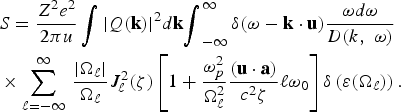 $$\eqalign{& S = \displaystyle{{Z^2 e^2 } \over {2{\rm {\rm \pi} }u}}\vint \vert Q\lpar {\bf k}\rpar \vert ^2 d{\bf k}{\displaystyle\vint}_{ - \infty }^\infty \, {\rm \delta} \lpar {\rm \omega} - {\bf k} \cdot {\bf u}\rpar \displaystyle{{{\rm \omega} d{\rm \omega} } \over {D\lpar k\comma \; {\rm \omega} \rpar }} \cr & \times \sum\limits_{\ell = - \infty }^\infty \, \displaystyle{{\vert \Omega _\ell \vert } \over {\Omega _\ell }}J_\ell ^2 \lpar {\rm \zeta} \rpar \left[{1 + \displaystyle{{{\rm \omega} _p^2 } \over {\Omega _\ell ^2 }}\displaystyle{{\lpar {\bf u} \cdot {\bf a}\rpar } \over {c^2 {\rm \zeta} }}\ell {\rm \omega} _0 } \right]{\rm \delta} \left({{\rm \varepsilon} \lpar \Omega _\ell \rpar } \right).}$$
By comparison, the SP in the absence of the RF is given by (Nersisyan & Akopyan, Reference Nersisyan and Akopyan1999; Nersisyan & Deutsch, Reference Nersisyan and Deutsch2011)
 $$S_0 = \displaystyle{{Z^2 e^2 } \over {2{\rm {\rm \pi} }u}}\vint \vert Q\lpar {\bf k}\rpar \vert ^2 \displaystyle{{d{\bf k}} \over {k^2 }}\vint_{ - \infty }^\infty \, {\rm \delta} \lpar {\rm \omega} - {\bf k} \cdot {\bf u}\rpar {\rm \delta}\, \left({{\rm \varepsilon} \lpar {\rm \omega} \rpar } \right)\vert {\rm \omega} \vert d{\rm \omega}$$
which after straightforward integration for the point-like particles (with Q(k) = 1) yields
 $$S_0 = \displaystyle{{Z^2 e^2 {\rm \omega} _p^2 } \over {2u^2 }}{\rm ln}\left({1 + \displaystyle{{k_{\rm max}^2 u^2 } \over {{\rm \omega} _p^2 }}} \right)\simeq \displaystyle{{Z^2 e^2 {\rm \omega} _p^2 } \over {u^2 }}{\rm ln}\displaystyle{{k_{\rm max} u} \over {{\rm \omega} _p }}.$$
In the presence of the RF, the SP S 0 is modified and is given by the ℓ = 0 term in Eq. (28) (“no photon” SP). It is evident that the RF decreases the SP S 0 by a factor of J 02(ζ) < 1. Finally, we would like to mention that the relativistic effects in Eq. (28) are given by the second term in the square brackets and by the dispersion function D(k, ω). In a nonrelativistic limit (β → 0) the former vanishes while the latter is replaced by D(k, ω) → k 2.
To illustrate the features of the stopping of the relativistic charged particles in a laser-irradiated plasma, we consider below two examples when the intensity of the RF is small but the angle between the vectors u and a is arbitrary (Sec. 3.1). In the second example we assume that the polarization vector E0 of the RF is parallel to the beam velocity u (Sec.3. 2).
3.1. Stopping power at weak intensities of the RF
In this section we consider the case of a weak radiation field (v E ≪ u) at arbitrary angle ϑ between the velocity u of the beam and the direction of polarization of the RF a. Assuming a point-like test particle (with Q(k) = 1), in Eq. (28) we keep only the quadratic terms with respect to the quantity a (or vE) and for the stopping power S we obtain
 $$\eqalign{& S = S_0 + \displaystyle{{Z^2 e^2 } \over {8{\rm {\rm \pi} }u}}\vint_{ - \infty }^\infty \, {\rm \omega} d{\rm \omega} \vint {\rm \delta} \lpar {\rm \omega} - {\bf k} \cdot {\bf u}\rpar \lpar {\bf k} \cdot {\bf a}\rpar d{\bf k} \cr & \times \left\{{\displaystyle{{\vert \Omega _1 \vert } \over {\Omega _1 }}\displaystyle{{{\rm \delta} \left({{\rm \varepsilon} \lpar \Omega _1 \rpar } \right)} \over {D\lpar k\comma \; {\rm \omega} \rpar }}\left[{\lpar {\bf k} \cdot {\bf a}\rpar + \displaystyle{{{\rm \omega} _p^2 } \over {\Omega _1^2 }}\displaystyle{{\lpar {\bf u} \cdot {\bf v}_E \rpar } \over {c^2 }}} \right]}\right.\cr & \left. + \displaystyle{{\vert \Omega _{ - 1} \vert } \over {\Omega _{ - 1} }}\displaystyle{{{\rm \delta} \left({{\rm \varepsilon} \lpar \Omega _{ - 1} \rpar } \right)} \over {D\lpar k\comma \; {\rm \omega} \rpar }}\left[{\lpar {\bf k} \cdot {\bf a}\rpar - \displaystyle{{{\rm \omega} _p^2 } \over {\Omega _{ - 1}^2 }}\displaystyle{{\lpar {\bf u} \cdot {\bf v}_E \rpar } \over {c^2 {\rm \zeta} }}} \right]\right.\cr & \left. {- \displaystyle{{2\vert {\rm \omega} \vert } \over {\rm \omega} }\displaystyle{{\lpar {\bf k} \cdot {\bf a}\rpar } \over {k^2 }}{\rm \delta} \left({{\rm \varepsilon} \lpar {\rm \omega} \rpar } \right)} \right\}\comma}$$
where Ω±1 = ω ± ω0 and S 0 is the field-free SP given by Eq. (30). The remaining terms are proportional to the intensity of the radiation field (~a 2). Note that due to the isotropy of the dielectric function ε(ω) as well as the dispersion function D(k, ω) the angular integrations in Eq. (31) can be easily done. This results in
 $${S = S_0 + \displaystyle{{Z^2 e^2 {\rm \omega} _p^2 {\rm \alpha}^2 } \over {16u^2 }}\left[{\Phi _1 \lpar {\rm \nu} \rpar \left({3\cos^2 {\rm \vartheta} - 1} \right)+ 2{\rm \beta} ^2 \Phi _2 \lpar {\rm \nu} \rpar \cos^2 {\rm \vartheta} } \right]\comma}$$
where α = v E/u is the scaled quiver velocity and two functions have been introduced as follows
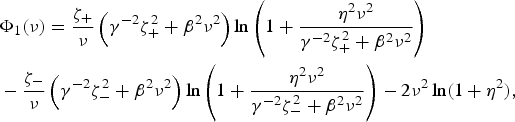 $$\eqalign{& \Phi _1 \lpar {\rm \nu} \rpar = \displaystyle{{{\rm \zeta} _ + } \over {\rm \nu} }\left({{\rm {\rm \gamma} }^{ - 2} {\rm \zeta} _ + ^2 + {\rm \beta} ^2 {\rm \nu} ^2 } \right)\ln\left({1 + \displaystyle{{{\rm \eta} ^2 {\rm \nu} ^2 } \over {{\rm {\rm \gamma} }^{ - 2} {\rm \zeta} _ + ^2 + {\rm \beta} ^2 {\rm \nu} ^2 }}} \right)\cr & - \displaystyle{{{\rm \zeta} _ - } \over {\rm \nu} }\left({{\rm {\rm \gamma} }^{ - 2} {\rm \zeta} _ - ^2 + {\rm \beta} ^2 {\rm \nu} ^2 } \right)\ln\left({1 + \displaystyle{{{\rm \eta} ^2 {\rm \nu} ^2 } \over {{\rm {\rm \gamma} }^{ - 2} {\rm \zeta} _ - ^2 + {\rm \beta} ^2 {\rm \nu} ^2 }}} \right)- 2{\rm \nu} ^2 \ln\lpar 1 + {\rm \eta} ^2 \rpar \comma}$$
 $$\Phi _2 \lpar {\rm \nu} \rpar = {\rm \zeta} _ + \ln\left({1 + \displaystyle{{{\rm \eta} ^2 {\rm \nu} ^2 } \over {{\rm {\rm \gamma} }^{ - 2} {\rm \zeta} _ + ^2 + {\rm \beta} ^2 {\rm \nu} ^2 }}} \right)+ {\rm \zeta} _ - \ln\left({1 + \displaystyle{{{\rm \eta} ^2 {\rm \nu} ^2 } \over {{\rm {\rm \gamma} }^{ - 2} {\rm \zeta} _ - ^2 + {\rm \beta} ^2 {\rm \nu} ^2 }}} \right)$$
with η = k maxu/ωp, ν = ωp/ω0 < 1, ζ± = 1 ± ν. Also γ is the relativistic factor of the beam with γ−2 = 1 − β2. In particular, in the case of the ultrarelativistic beam with γ ≫ ω0/ωp from Eqs. (33) and (34) we obtain
 $$\Phi _1 \lpar {\rm \nu} \rpar = \displaystyle{6 \over {{\rm {\rm \gamma} }^2 }}\left[{\ln\lpar 1 + {\rm \eta} ^2 \rpar - \displaystyle{{{\rm \eta} ^2 } \over {{\rm \eta} ^2 + 1}}} \right]\comma$$
 $$\Phi _2 \lpar {\rm \nu} \rpar = 2 \ln\lpar 1 + {\rm \eta} ^2 \rpar \comma$$
and in Eq. (32) the additional energy loss of the beam (i.e. the term of Eq. (32) proportional to ~α2) is mainly determined by the function Φ2(ν).
Consider next the angular distribution of the SP at low-intensities of the RF. Figure 1 shows the dimensionless quantity P(ϑ) = [S(ϑ) − S 0]/S 0 (the relative deviation of S from S 0) as a function of the angle ϑ for the scaled laser intensity v E /c = 10−2 and for ω0 = 5ωp, Z = 1, A = c/ωpr e =1.88 × 10⁷, where r e = e 2/mc 2 is the electron classical radius. The quantity A corresponds to the density of the plasma n e = 1022 cm−3. In addition, left and right panels of Fig. 1 demonstrate P(ϑ) for the stopping of the nonrelativistic (with β = 0.05 and β = 0.1) and relativistic (with β = 0.8, β = 0.9 and β = 0.9999) charged particles, respectively. At nonrelativistic velocities the second term in Eq. (32) can be neglected and the angular distribution of the quantity P(ϑ) has a quadrupole nature (the angular average of P(ϑ) vanishes). At  $0 \le {\rm \vartheta} \le {\rm \vartheta} _0 = \arccos\lpar 1/\sqrt 3 \rpar $ the excitation of the waves with the frequencies ω0 ± ωp leads to additional energy loss. At ϑ0 ≤ ϑ≤ π/2 the energy loss changes the sign and the total energy loss decreases. When the particle moves at ϑ = ϑ0 with respect to the polarization vector a the radiation field has no any influence on the SP. At the relativistic velocities (Fig. 1, right panel) the field-free SP S 0 as well as the relative deviation P(ϑ) are strongly reduced and the critical angle ϑ0, which now depends on the factor β, is shifted towards higher values. Finally, at ultrarelativistic velocities (Fig. 1, dotted line in the right panel), P(ϑ) is positive for arbitrary ϑ and the radiation field systematically increases the energy loss of the particle (see also Eq. (32) with Eqs. (35) and (36)).
(Color online) The dimensionless quantity P(ϑ) (in percents) vs the angle ϑ (in rad) for the intensity parameter of the laser field v E /c = 10−2 and for ω0 = 5ωp. Left and right panels demonstrate the quantity P(ϑ) for the stopping of the nonrelativistic and relativistic charged particles, respectively, at various values of the relativistic factor β. Left panel, β = 0.05 (solid line) and β = 0.1 (dashed line). Right panel, β = 0.8 (solid line), β = 0.9 (dashed line), and β = 0.9999 (dotted line).

3.2. Stopping power at parallel (u ‖ a) configuration
Let us now investigate the influence of the radiation field on the stopping process of the relativistic charged particle when its velocity u is parallel to a. It is expected that the effect of the RF is maximal in this case. In the case of the point-like particles after straightforward integrations in Eq. (28) we arrive at
 $$\eqalign{& S = \displaystyle{{Z^2 e^2 {\rm \omega} _p {\rm \omega} _0 } \over {2u^2 }}\sum\limits_{\ell = - \infty }^\infty \, \left({{\rm \nu} + \ell {\rm {\rm \gamma} }^{ - 2} } \right)J_\ell ^2 \left({{\rm \alpha} \lpar (\ell + {\rm \nu} \rpar) } \right)\cr & \quad {\rm ln}\left[{1 + \displaystyle{{{\rm \eta} ^2 {\rm \nu} ^2 } \over {{\rm {\rm \gamma} }^{ - 2} \lpar \ell + {\rm \nu} \rpar ^2 + {\rm \beta} ^2 {\rm \nu} ^2 }}} \right].}$$
We have used here the same notations as in Sec. 3.1. From Eq. (37) it is seen that “no photon” SP (the term with ℓ = 0) oscillates with the intensity of the laser field. However, the radiation field suppresses the excitation of the plasma modes and this term by a factor of J 02 (αν) is smaller than the field-free SP S 0. As follows from Eq. (37) at high-intensities of the RF the “no photon” SP vanishes when αν = (v E/u)(ωp/ω0) ≃ μn with n = 1, 2, …, where μn are the zeros of the Bessel function J 0 (μn) = 0 (μ1 = 2.4, μ2 = 5.52, …). Then the energy loss of the charged particle is mainly determined by other terms in Eq. (1) and is stipulated by excitation of plasma waves with the combinational frequencies ℓω0 ± ωp.
In the case of the ultrarelativistic charged particle (with γ ≫ ω0/ωp) Eq. (37) gets essentially simplified. In this equation neglecting the small corrections proportional to γ−2 we obtain
 $$S = \displaystyle{{Z^2 e^2 {\rm \omega} _p^2 } \over {2c^2 }}ln\lpar 1 + {\rm \eta} ^2 \rpar \sum\limits_{\ell = - \infty }^\infty \, J_\ell ^2 \left({{\rm \alpha} \lpar (\ell + {\rm \nu} \rpar) } \right)\comma$$
with α = v E/c. Equation (38) can be further simplified neglecting the small quantity ν = ωp/ω0 in the argument of the Bessel function. The remaining infinite sum is evaluated in Appendix A [see Eq. (48)] which results in
 $$S \simeq \displaystyle{{Z^2 e^2 {\rm \omega} _p^2 } \over {2c^2 }}{\rm ln}\lpar 1 + {\rm \eta} ^2 \rpar \displaystyle{1 \over {\sqrt {1 - {\rm \alpha} ^2 } }}.$$
Thus, in the case of the ultrarelativistic charged particles the energy loss of the beam essentially increases with the intensity of the RF. Let us recall, however, that Eq. (39) is only valid below relativistic intensities of the RF when α ≲ 1. For treating precisely the resonance in Eq. (39) at α = 1 we should go beyond the present long-wavelength approximation of the laser field. Figure 2 demonstrates the quantity R(α) = S(α)/S 0 for three distinct values of the laser frequency ω0 as a function of the RF intensity α = v E/c, where the SP is given by Eq. (38) for an ultrarelativistic projectile particle. Note that the quantity R(α) is independent on the plasma density n e. It is seen that the SP is indeed not sensitive to the variation of the laser frequency and the approximation (39) is justified at α ≲1.
(Color online) The ratio R(α) = S(α)/S 0 for an ultrarelativistic projectile particle as a function of dimensionless intensity of the RF α at ω0 = 2ωp (solid line), ω0 = 5ωp (dashed line), ω0 = 10ωp (dotted line).
Next let us examine an interesting regime of the high-intensities of the RF when αν > 1. It is clear that such a regime requires nonrelativistic velocities of the charged particles beam. Thus, at αν > 1 we consider here the relativistic effects as small corrections to the corresponding nonrelativistic expressions. Using the asymptotic behavior of the Bessel function (Gradshteyn & Rizhik, Reference Gradshteyn and Rizhik1980) in a general Eq. (37) it is straightforward to obtain
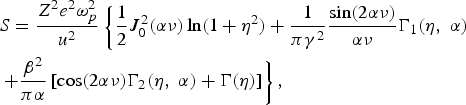 $$\eqalign{& S = \displaystyle{{Z^2 e^2 {\rm \omega} _p^2 } \over {u^2 }}\left\{{\displaystyle{1 \over 2}J_0^2 \lpar {\rm \alpha}\nu \rpar \ln \lpar 1 + {\rm \eta} ^2 \rpar + \displaystyle{1 \over {{\rm \pi} {\rm {\rm \gamma} }^2 }}\displaystyle{{\sin \lpar 2{\rm \alpha}\nu \rpar } \over {{\rm \alpha}\nu }}\Gamma _1 \lpar {\rm \eta} \comma \; {\rm \alpha}\rpar } \right. \cr & \left. { + \displaystyle{{{\rm \beta} ^2 } \over {{\rm \pi} {\rm \alpha}}}\left[{{\rm cos}\lpar 2{\rm \alpha}\nu \rpar \Gamma _2 \lpar {\rm \eta} \comma \; {\rm \alpha}\rpar + \Gamma \lpar {\rm \eta} \rpar } \right]} \right\}\comma}$$
where we have introduced the following quantities
 $$\Gamma _1 \lpar {\rm \eta} \comma \; {\rm \alpha}\rpar = \sum\limits_{\ell = 1}^\infty {\lpar \!- 1\rpar ^\ell } \ln \left({1 + \displaystyle{{{\rm \eta} ^2 {\rm \nu} ^2 } \over {{\rm {\rm \gamma} }^{ - 2} \ell ^2 + {\rm \beta} ^2 {\rm \nu} ^2 }}} \right)\cos \lpar 2{\rm \alpha}\ell \rpar \comma$$
 $$\Gamma _2 \lpar {\rm \eta} \comma \; {\rm \alpha}\rpar = \sum\limits_{\ell = 1}^\infty {\displaystyle{{\lpar \!- 1\rpar ^\ell } \over \ell }} \ln \left({1 + \displaystyle{{{\rm \eta} ^2 {\rm \nu} ^2 } \over {{\rm {\rm \gamma} }^{ - 2} \ell ^2 + {\rm \beta} ^2 {\rm \nu} ^2 }}} \right)\sin \lpar 2{\rm \alpha}\ell \rpar \comma$$
 $$\Gamma \lpar {\rm \eta} \rpar = \sum\limits_{\ell = 1}^\infty {\displaystyle{1 \over \ell }} \ln \left({1 + \displaystyle{{{\rm \eta} ^2 {\rm \nu} ^2 } \over {{\rm {\rm \gamma} }^{ - 2} \ell ^2 + {\rm \beta} ^2 {\rm \nu} ^2 }}} \right).$$
In Appendix we have found some approximate analytical expressions for these functions. Recalling that γ−2 = 1 − β2 the relativistic corrections (~β2) can be easily deduced from Eq. (40).
Let us consider briefly two particular cases. When 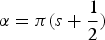 ${\rm \alpha = \rm \pi} \lpar s + {1 \over 2}\rpar$ (where s = 0,1,…) all terms in Eq. (41) have a positive sign and the function Γ1 (η, α) in Eq. (40) is maximal in this case due to the constructive interference of the excited waves with the frequencies ℓω0 ± ωp. Note that the relativistic correction given by Γ2(η, α) vanishes in this case. From Eq. (53) it follows that
 $p\lpar {\rm \alpha} \rpar = {1 \over 2}$ and Eq. (54) can be evaluated explicitly. The result reads
 $$\Gamma _1 \lpar {\rm \eta} \comma \; {\rm \alpha} \rpar = {\rm ln}\left\{{\displaystyle{{A\lpar 0\rpar } \over {A\lpar {\rm \eta} \rpar }}\displaystyle{{{\rm sinh}\lsqb {\rm \pi} {\rm \gamma} \; A\lpar {\rm \eta} \rpar \rsqb } \over {{\rm sinh}\lsqb {\rm \pi} {\rm \gamma} \; A\lpar 0\rpar \rsqb }}} \right\}\comma$$
where 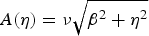 $A\lpar {\rm \eta} \rpar = {\rm \nu} \sqrt {{\rm \beta} ^2 + {\rm \eta} ^2 }$, A(0) = βν.
In the second regime when α = π(s + 1), p(α) = 0 and the relativistic corrections given by Γ2 again vanishes, Γ2(η, α) = 0. Equation (54) then yields a negative contribution to the energy loss (40) with
 $${\Gamma _1}\lpar {\rm \eta} \comma \; {\rm \alpha} \rpar = - {\rm ln}\left\{{\displaystyle{{A\lpar {\rm \eta} \rpar } \over {A\lpar 0\rpar }}\displaystyle{{{\rm tanh}\lsqb {1 \over 2}{\rm \pi} {\rm \gamma} A\lpar 0\rpar \rsqb } \over {{\rm tanh}\lsqb {1 \over 2}{\rm \pi} {\rm \gamma} A\lpar {\rm \eta} \rpar \rsqb }}} \right\}\lt 0.$$
The function Γ1(η, α) is minimal in this case since the different harmonics cancel effectively each other. However, it should be emphasized that the contribution of the term containing the function Γ1(η, α) to the SP (40) can either be positive or negative depending on the dimensionless quantity αν. Moreover, the absolute value of this contribution decreases with the parameter αν.
The results of the numerical evaluation of the SP given by a general Eq. (37) are shown in Figs. 3–5 both for nonrelativistic and relativistic projectiles, where the ratios R(α) = S(α)/S 0 and R(γ) = S(γ)/S 0 are plotted as the functions of the RF intensity α = v E/u = 0.855W L1/2λ0/β (Figs. 3 and 4) and the relativistic factor γ of the electron beam (Fig. 5), respectively. Here W L and λ0 are measured in units 1018 W/cm2 and μm, respectively. Also in Figs. 3 and 4 the parameter α varies in the interval 0 ≲ α < 1/β to ensure the applicability of the long-wavelength approximation of the laser field. From Fig. 3 it is seen that the SP of a nonrelativistic particle exhibits a strong oscillations. Furthermore, it may exceed the field-free SP and change the sign due to plasma irradiation by intense (α > 1) laser field. These properties of a nonrelativistic SP have been obtained previously for a classical plasma (Nersisyan & Akopyan, Reference Nersisyan and Akopyan1999) as well as for a fully degenerated plasma (Nersisyan & Deutsch, Reference Nersisyan and Deutsch2011). The effect of the acceleration of the projectile particle shown in Fig. 3 occurs at v E/u ≃ μℓ/ν (with ℓ = 1, 2,…) when the “no photon” SP nearly vanishes. It should be noted that in the laser irradiated plasma a parametric instability is expected (Nersisyan & Deutsch, Reference Nersisyan and Deutsch2012) with an increment increasing with the intensity of the radiation field. This restricts the possible acceleration time of the incident particle. The similar behavior of the SP is demonstrated in the right panel of Fig. 3, where however the plasma density is n e = 1024 cm−3 and two orders of magnitude exceeds the value adopted in the left panel of Fig. 3. We note that although the ratio R(α) is reduced with a plasma density, the field-free SP given by Eq. (30) is proportional to n e which in turn results in a strong enhancement of the SP S(α) = S 0R(α) with a plasma density.
(Color online) (Left panel) the ratio R(α) = S(α)/S 0 as a function of dimensionless quantity α at n e = 1022 cm−3, β = 10−2, ω0 = 2ωp (solid line), ω0 = 5ωp (dashed line), ω0 = 10ωp (dotted line). (Right panel) same as in the left panel but for n e = 1024 cm−3.
(Color online) (Left panel) the ratio R(α) = S(α)/S 0 as a function of dimensionless quantity α at β = 0.2, ω0 = 2ω p (solid line), ω0 = 5ωp (dashed line), ω0 = 10ωp (dotted line). (Right panel) same as in the left panel but for β = 0.5.
(Color online) (Left panel) the ratio R(γ) = S(γ)/S 0 as a function of the relativistic factor γ of the electron beam at ω0 = 5ωp, v E/c = 0.2 (solid line), v E/c = 0.5 (dashed line), v E/c = 0.8 (dotted line). (Right panel) same as in the left panel but for ω0 = 10ωp.
Next, in Fig. 4, we consider weakly relativistic regimes of the electron beam with β = 0.2 (left panel) and β = 0.5 (right panel). At smaller intensities of the RF, 0 < α ≲ 1, the SP is described qualitatively by Eq. (39) and reaches its maximum at α ≃ 1 (or at v E ≃ u). This is because the electrons are driven by the laser field in the direction of the beam with nearly same velocity u effectively enhancing the amplitude of the excited waves. The minimum or two maxima of the SP at α ≃ 3π/2 in the left panel of Fig. 4 are formed due to the constructive interference of the excited harmonics as discussed above (see Eq. (44)). The other minima of the SP at α ≃ π in the left panel of Fig. 4 are formed due to the destructive interference of the excited harmonics (see Eq. (45)). Let us note that at α ~ 1 the effect of the enhancement of the SP of the test particle moving in a laser irradiated plasma is intensified at smaller frequency of the laser field ω0 = 2ωp (see Figs. 3 and 4) while at higher intensities, α > 1, the quantity R(α) increases with the frequency ω0.
Finally, in Fig. 5, the quantity R(γ) is shown as a function of the electron beam energy at various intensities of the laser field given here by a dimensionless parameter v E/c. It is seen that at the moderate energies of the electron beam the SP strongly increases with the laser intensity as has been also demonstrated in Figs. 3 and 4. Comparing two panels of Fig. 5 we may conclude that the position of the maximum of the SP depends only on the intensity of the RF, γmax~v E/c, while the maximum value of the SP is scaled as R max~(v E/c)(ωp/ω0)1/2 and is sensitive to both the intensity and frequency of the RF. Furthermore, with increasing the relativistic factor γ of the electron beam one asymptotically arrives at the ultrarelativistic regime described by Eqs. (38) and (39). Interestingly this occurs at the moderate energies of the electron beam with γ ≳ 4 which, in particular, pertain to the FIS relativistic electron beam in the typical 1- to 2-MeV energy range of practical interest.
4. CONCLUSIONS
In this paper, we have investigated the energy loss of a relativistic charged particles beam moving in a laser irradiated plasma, where the laser field has been treated in the long-wavelength approximation. The dynamics of the beam-plasma system in the presence of the RF is studied by the linearized fluid and Maxwell equations for the plasma particles and the electromagnetic fields, respectively. The full electromagnetic response of the system is derived involving all harmonics of the RF. It has been shown that, in general, the excited longitudinal and transversal modes are parametrically coupled due to the presence of the RF. As a result, the Čerenkov radiation by the charged particles beam, which is absent in a plasma in the field-free case, becomes possible. However, in contrast to the usual Čerenkov effect in a laser-free medium, the spectrum of the radiation in the present case is discrete and the emitted frequencies are localized around the harmonics of the RF depending essentially on the energy of the incoming beam. In particular, at ultrarelativistic energies of the beam emitted frequencies are shifted towards higher harmonics of the RF.
In the course of our study, we have derived a general expression for the SP, which has been also simplified in the limit of a low-intensity laser field. As in the field-free case, the SP in a laser irradiated plasma is completely determined by the dielectric function of the plasma which in the present context is given by the hydrodynamic approximation. Explicit calculations have been done for two particular cases assuming (i) a low-intensity laser field but arbitrary orientation of the laser polarization vector E0 with respect to the charged particles beam velocity u, and (ii) an arbitrary (but nonrelativistic) intensity of the laser field when E0 is parallel to u. In the case (i) it has been shown that the RF increases the SP for small angles between the velocity of the beam and E0 while decreasing it at large angles. Furthermore, the relative deviation of the SP from the field-free value is strongly reduced with increasing the beam energy. In the case (ii) and at high-intensities of the RF two extrem regimes have been distinguished when the excited harmonics cancel effectively each other reducing strongly the energy loss or increasing it due to the constructive interference. As in the previous nonrelativistic treatments (Nersisyan & Akopyan, Reference Nersisyan and Akopyan1999; Nersisyan & Deutsch, Reference Nersisyan and Deutsch2011) an acceleration of the projectile particle is expected at high-intensities of the RF when the quiver velocity of the plasma electrons exceeds the beam velocity u. Special attention has been paid to the relativistic effects of the beam. We have demonstrated that in general the energy loss increases with the beam energy forming a maximum at moderate relativistic factors γ ≲ 2 which, however, are shifted towards higher energies of the beam with the laser intensity. In addition, the enhancement of the SP is more pronounced when the laser frequency approaches the plasma frequency in agreement with PIC simulations (Hu et al., Reference Hu, Song, Mišković and Wang2011). Finally, it has been also shown that the SP of the ultrarelativistic electron beam increases systematically with the intensity of the RF exceeding essentially the field-free SP.
Going beyond the present model, which is based on several approximations, we can envisage a number of improvements. In particular, a simple possibility qualitatively involving relativistic intensities of the laser field is to replace the quiver velocity v E → V E by its relativistic counterpart V E, where V E = v E[1 + (v E/c)2]−1/2. The latter approximation can be easily obtained from a single-particle dynamics in a plane RF. In the course of our study we have also neglected the Čerenkov radiation which might be important in the total balance of the energy loss process. However, in a general Eq. (22) this effect is well separated by its spectral characteristics and can be treated independently. We intend to address this issue in our forthcoming investigations.
ACKNOWLEDGMENTS
The work of H.B.N. has been supported by the State Committee of Science of the Armenian Ministry of Higher Education and Science (Project No. 13-1C200).
Appendix: Evaluation of the functions introduced in the text
In this Appendix we evaluate the infinite sum containing the square of the Bessel functions and involved in Eq. (38). Also we will derive some analytical expressions for the functions Γ1(η, α) and Γ2(η, α) introduced in Sec. 3.2 [see Eqs. (41) and (42)].
Our starting point is the Neumann's formula (Bateman & Erdélyi, Reference Bateman and Erdelyi1953)
 $$J_\ell ^2 \lpar z\rpar = \displaystyle{2 \over {\rm \pi} }\vint_0^{{\rm \pi} /2} \, J_{2\ell } \lpar 2z\;{\rm cost}\rpar dt.$$
Using this expression as well as the known relation (Gradshteyn & Rizhik, Reference Gradshteyn and Rizhik1980)
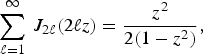 $$\sum\limits_{\ell = 1}^\infty \, J_{2\ell } \lpar 2\ell z\rpar = \displaystyle{{z^2 } \over {2\lpar 1 - z^2 \rpar }}\comma$$
the desired summation can be performed easily
 $$\sum\limits_{\ell = 1}^\infty \, J_\ell ^2 \lpar {\rm \alpha} \ell \rpar = \displaystyle{1 \over {\rm \pi} }\vint_0^{{\rm \pi} /2} \, \displaystyle{{dt} \over {1 - {\rm \alpha} ^2 {\rm cos}^2 t}} - \displaystyle{1 \over 2} = \displaystyle{1 \over 2}\left({\displaystyle{1 \over {\sqrt {1 - {\rm \alpha} ^2 } }} - 1} \right).$$
The latter formula is valid at α < 1.
Next we derive approximate but very accurate expressions for the functions Γ1 (η, α) and Γ2 (η, α) which determine the SP in Eq. (40). For that purpose consider the following two functions
 $$G_1 \lpar a\comma \; b\rpar = \sum\limits_{\ell = 1}^\infty \, \lpar - 1\rpar ^\ell {\rm ln}\left({1 + \displaystyle{{a^2 } \over {\ell ^2 + b^2 }}} \right){\rm cos}\lpar 2{\rm \alpha} \ell \rpar \comma$$
 $$G_2 \lpar a\comma \; b\rpar = \sum\limits_{\ell = 1}^\infty \, \displaystyle{{\lpar - 1\rpar ^\ell } \over \ell }\ln\left({1 + \displaystyle{{a^2 } \over {\ell ^2 + b^2 }}} \right){\rm sin}\lpar 2{\rm \alpha} \ell \rpar \comma$$
where a > 0 and b > 0 are some arbitrary positive variables. Note that Γ1;2 (η, α) = G 1;2(a, b) at a = ηγν and b = βγν. Consider the derivatives of these functions with respect to the variable a. Using the known summation formulas involving the trigonometric functions (Gradshteyn & Rizhik, Reference Gradshteyn and Rizhik1980) we arrive at
 $$\eqalign{& \displaystyle{\partial \over {\partial a}}G_1 \lpar a\comma \; b\rpar = 2a\sum\limits_{\ell = 1}^\infty \, \lpar \!-\! 1\rpar ^\ell \displaystyle{{{\rm cos}\lpar 2{\rm \alpha} \ell \rpar } \over {\ell ^2 + u^2 }} \cr & \quad = \displaystyle{{{\rm \pi} a} \over u}\left\{{\displaystyle{{{\rm cosh}\lsqb 2{\rm \pi} up\lpar {\rm \alpha} \rpar \rsqb } \over {{\rm sinh}\lpar {\rm \pi} u\rpar }} - \displaystyle{1 \over {{\rm \pi} u}}} \right\}\comma}$$
 $$\eqalign{&\displaystyle{\partial \over {\partial a}}G_2 \lpar a\comma \; b\rpar = 2a\sum\limits_{\ell = 1}^\infty \, \displaystyle{{\lpar \! -\! 1\rpar ^\ell } \over \ell }\displaystyle{{{\rm sin}\lpar 2{\rm \alpha} \ell \rpar } \over {\ell ^2 + u^2 }} \cr & \quad = \displaystyle{{{\rm \pi} a} \over {u^2 }}{\rm cos}\left[{{\rm \pi} q\lpar {\rm \alpha} \rpar } \right]\left\{{\displaystyle{{{\rm sinh}\left[{2{\rm \pi} up\lpar {\rm \alpha} \rpar } \right]} \over {{\rm sinh}\lpar {\rm \pi} u\rpar }} - 2p\lpar {\rm \alpha} \rpar } \right\}}$$
with u = (a2 + b 2)1/2, q(α) = E[M(α/π) + 1/2], and
 $$\,p\lpar {\rm \alpha} \rpar = \left\{{\matrix{ {M\left({\displaystyle{{\rm \alpha} \over {\rm \pi} }} \right)\semicolon \; } & {0 \le M\left({\displaystyle{{\rm \alpha} \over {\rm \pi} }} \right)\le \displaystyle{1 \over 2}} \cr {1 - M\left({\displaystyle{{\rm \alpha} \over {\rm \pi} }} \right)\semicolon \; } & {\displaystyle{1 \over 2} \le M\left({\displaystyle{{\rm \alpha} \over {\rm \pi} }} \right)\lt 1} \cr } } \right.\comma$$
where M(z) and E(z) are the fractional and integer parts of z, respectively. Consequently, from Eqs. (51) and (52) we obtain
 $$G_1 \lpar a\comma \; b\rpar = G_1 \lpar a_0 \comma \; b\rpar + \vint_{{\rm \pi} u_0 }^{{\rm \pi} u} \, \displaystyle{{{\rm cosh}\lsqb 2xp\lpar {\rm \alpha} \rpar \rsqb } \over {{\rm sinh}\lpar x\rpar }}dx - ln\displaystyle{u \over {u_0 }}\comma$$
 $$\eqalign{& G_2 \lpar a\comma \; b\rpar = G_2 \lpar a_0 \comma \; b\rpar + {\rm \pi} {\rm cos}\lsqb {\rm \pi} q\lpar {\rm \alpha} \rpar \rsqb \cr & \quad \left\{{\vint_{{\rm \pi} u_0 }^{{\rm \pi} u} \, \displaystyle{{{\rm sinh}\lsqb 2xp\lpar {\rm \alpha} \rpar \rsqb } \over {{\rm sinh}\lpar x\rpar }}\displaystyle{{dx} \over x} -\! 2p\lpar {\rm \alpha} \rpar {\rm ln}\displaystyle{u \over {u_0 }}} \right\}.}$$
Here u 0 = (a 02 + b 2)1/2 and a 0 > 0 is an arbitrary initial value of a. Thus, the infinite sums in Eqs. (41) and (42) have been represented in the equivalent integral forms with finite integration limits. Assuming that b > 1 let us apply Eqs. (54) and (55) in a particular case with a 0 = 0. Taking into account the initial conditions (see Eqs. (49) and (50)) G 1(0, b) = G 2(0, b) = 0 from Eqs. (54) and (55) we obtain
 $$G_1 \lpar a\comma \; b\rpar = - {\rm ln}\displaystyle{u \over b} + \vint_{{\rm \pi} b}^{{\rm \pi} u} \, \displaystyle{{{\rm cosh}\lsqb 2xp\lpar {\rm \alpha} \rpar \rsqb } \over {{\rm sinh}\lpar x\rpar }}dx\comma$$
 $$G_2 \lpar a\comma \; b\rpar = {\rm \pi} {\rm cos}\lsqb {\rm \pi} q\lpar {\rm \alpha} \rpar \rsqb \left\{{\vint_{{\rm \pi} b}^{{\rm \pi} u} \, \displaystyle{{{\rm sinh}\lsqb 2xp\lpar {\rm \alpha} \rpar \rsqb } \over {{\rm sinh}\lpar x\rpar }}\displaystyle{{dx} \over x} - 2p\lpar {\rm \alpha} \rpar {\rm ln}\displaystyle{u \over b}} \right\}.$$
For further progress we note that at b > 1 the hyperbolic functions in Eqs. (56) and (57) can be replaced by an exponential function, sinh(πx) ≃ e πx/2, which yield the following approximations for the functions G 1(a, b) and G 2(a, b)
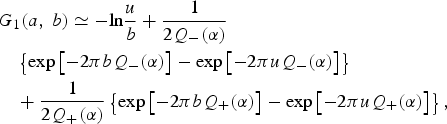 $$\eqalign{& G_1 \lpar a\comma \; b\rpar \simeq - {\rm ln}\displaystyle{u \over b} + \displaystyle{1 \over {2Q_ - \lpar {\rm \alpha} \rpar }} \cr & \quad \left\{{{\rm exp}\left[{ - 2{\rm \pi} bQ_ - \lpar {\rm \alpha} \rpar } \right]- {\rm exp}\left[{ - 2{\rm \pi} uQ_ - \lpar {\rm \alpha} \rpar } \right]} \right\} \cr & \quad + \displaystyle{1 \over {2Q_ + \lpar {\rm \alpha} \rpar }}\left\{{{\rm exp}\left[{ - 2{\rm \pi} bQ_ + \lpar {\rm \alpha} \rpar } \right]- {\rm exp}\left[{ - 2{\rm \pi} uQ_ + \lpar {\rm \alpha} \rpar } \right]} \right\}\comma}$$
 $$\eqalign{& G_2 \lpar a\comma \; b\rpar \simeq {\rm \pi} {\rm cos}\lsqb {\rm \pi} q\lpar {\rm \alpha} \rpar \rsqb \left\{{E_1 \left[{2{\rm \pi} uQ_ + \lpar {\rm \alpha} \rpar } \right]- E_1 \left[{2{\rm \pi} uQ_ - \lpar {\rm \alpha} \rpar } \right]} \right. \cr & \quad \left. { + E_1 \left[{2{\rm \pi} bQ_ - \lpar {\rm \alpha} \rpar } \right]- E_1 \left[{2{\rm \pi} bQ_ + \lpar {\rm \alpha} \rpar } \right]- 2p\lpar {\rm \alpha} \rpar {\rm ln}\displaystyle{u \over b}} \right\}\comma}$$
where E 1(z) is the exponential integral function and  $Q_ \pm \lpar {\rm \alpha} \rpar = {\textstyle{1 \over 2}} \pm p\lpar {\rm \alpha} \rpar$.
Let us now consider the opposite case of small b < 1. Then at ℓ ≥ 2 we may neglect the variable b in Eqs. (49) and (50) and represent these expressions in the approximate form
 $$\eqalign{& G_1 \lpar a\comma \; b\rpar \simeq G_1 \lpar a\comma \; 0\rpar + {\rm ln}\,\left({1 + \displaystyle{{a^2 b^2 } \over {1 + a^2 + b^2 }}} \right){\rm cos}\lpar 2{\rm \alpha} \rpar \cr & \quad - {\rm ln}\,\left({1 + \displaystyle{{a^2 b^2 /4} \over {4 + a^2 + b^2 }}} \right){\rm cos}\lpar 4{\rm \alpha} \rpar \comma}$$
 $$\eqalign{& G_2 \lpar a\comma \; b\rpar \simeq G_2 \lpar a\comma \; 0\rpar + {\rm ln}\,\left({1 + \displaystyle{{a^2 b^2 } \over {1 + a^2 + b^2 }}} \right){\rm sin}\lpar 2{\rm \alpha} \rpar \cr & \quad - \displaystyle{1 \over 2}{\rm ln}\,\left({1 + \displaystyle{{a^2 b^2 /4} \over {4 + a^2 + b^2 }}} \right){\rm sin}\lpar 4{\rm \alpha} \rpar .}$$
Here G 1;2(a, 0) are the functions G 1;2(a, b) at b = 0 and are evaluated in a similar way as approximate Eqs. (58) and (59). For that purpose consider again Eqs. (54) and (55) with a 0 = 1 and b = 0, that is
 $$G_1 \lpar a\comma \; 0\rpar = G_1 \lpar 1\comma \; 0\rpar + \vint_{\rm \pi} ^{{\rm \pi} a} \, \displaystyle{{{\rm cosh}\lsqb 2xp\lpar {\rm \alpha} \rpar \rsqb } \over {{\rm sinh}\lpar x\rpar }}dx - {\rm ln}\; a\comma$$
 $$\eqalign{& G_2 \lpar a\comma \; 0\rpar = G_2 \lpar 1\comma \; 0\rpar + {\rm \pi} \;{\rm cos}\;\lsqb {\rm \pi} q\lpar {\rm \alpha} \rpar \rsqb \cr & \quad \left\{{\vint_{\rm \pi} ^{{\rm \pi} a} \, \displaystyle{{{\rm sinh}\lsqb 2xp\lpar {\rm \alpha} \rpar \rsqb } \over {{\rm sinh}\lpar x\rpar }}\displaystyle{{dx} \over x} - 2p\lpar {\rm \alpha} \rpar {\rm ln}\;a} \right\}.}$$
In the latter expressions replacing the hyperbolic sine functions by the exponential functions we arrive at the following approximate formulas for the quantities G 1(a, 0) and G 2(a, 0)
 $$\eqalign{& G_1 \lpar a\comma \; 0\rpar \simeq G_1 \lpar 1\comma \; 0\rpar + \displaystyle{1 \over {2Q_ - \lpar {\rm \alpha} \rpar }}\left\{{{\rm exp}\left[{ - 2{\rm \pi} Q_ - \lpar {\rm \alpha} \rpar } \right]- {\rm exp}\left[{ - 2{\rm \pi} aQ_ - \lpar {\rm \alpha} \rpar } \right]} \right\}\cr & \quad + \displaystyle{1 \over {2Q_ + \lpar {\rm \alpha} \rpar }}\left\{{{\rm exp}\left[{ - 2{\rm \pi} Q_ + \lpar {\rm \alpha} \rpar } \right]- {\rm exp}\left[{ - 2{\rm \pi} aQ_ + \lpar {\rm \alpha} \rpar } \right]} \right\}- {\rm ln}\;a\comma \; }$$
 $$\eqalign{& G_2 \lpar a\comma \; 0\rpar \simeq G_2 \lpar 1\comma \; 0\rpar + {\rm \pi} {\rm cos}\left[{{\rm \pi} q\lpar {\rm \alpha} \rpar } \right]\cr & \quad \left\{{{E_1}\left[{2{\rm \pi} {Q_ - }\lpar {\rm \alpha} \rpar } \right]- {E_1}\left[{2{\rm \pi} {Q_ + }\lpar {\rm \alpha} \rpar } \right]} \right. \cr & \left. { + {E_1}\left[{2{\rm \pi} a{Q_ + }\lpar {\rm \alpha} \rpar } \right]- {E_1}\left[{2{\rm \pi} a{Q_ - }\lpar {\rm \alpha} \rpar } \right]- 2p\lpar {\rm \alpha} \rpar {\rm ln}\; a} \right\}.} $$
Finally, for the quantities G 1(1, 0) and G 2(1, 0) it follows from Eqs. (49) and (50) that (Gradshteyn & Rizhik, Reference Gradshteyn and Rizhik1980)
 $$G_1 \lpar 1\comma \; 0\rpar \simeq C_1 {\rm cos}\lpar 2{\rm \alpha} \rpar - C_2 {\rm cos}\lpar 4{\rm \alpha} \rpar + {\rm \pi} ^2 \left[{\,{\rm p}^2 \lpar {\rm \alpha} \rpar - \displaystyle{1 \over {12}}} \right]\comma$$
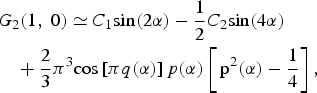 $$\eqalign{& G_2 \lpar 1\comma \; 0\rpar \simeq C_1 {\rm sin}\lpar 2{\rm \alpha} \rpar - \displaystyle{1 \over 2}C_2 {\rm sin}\lpar 4{\rm \alpha} \rpar \cr & \quad + \displaystyle{2 \over 3}{\rm \pi} ^3 {\rm cos}\left[{{\rm \pi} q\lpar {\rm \alpha} \rpar } \right]p\lpar {\rm \alpha} \rpar \left[{\,{\rm p}^2 \lpar {\rm \alpha} \rpar - \displaystyle{1 \over 4}} \right]\comma}$$
where C1 = 1 − ln 2, C 2 = 1/4 − ln(5/4). For approximate evaluation of the quantities G 1(1,0) and G 2(1,0) we have used the expansion ln(1 + ℓ−2) ≃ ℓ−2 at ℓ ≥ 3 for the logarithmic function. Then at b < 1 the final analytical expressions for G 1(a,b) and G 2(a,b) are obtained from Eqs. (60), (64), (66) and (61), (65), (67), respectively. The relative accuracy of the derived approximations is less than 10−3 in a wide range of the parameters.



