1. Introduction
Characterization of the last dinosaur assemblages before the Cretaceous–Paleogene (K–Pg) boundary is pivotal to understanding their extinction patterns. Unfortunately, documenting the fossil record of the latest dinosaurs has proved to be difficult as there are few regions in the world containing continental rocks of late Maastrichtian age and complete stratigraphic sections encompassing the K–Pg boundary. The western interior of North America complies with these conditions exemplarily and is thus the best sampled of the areas used to support the hypothesis of extinction caused by the bolide impact (Brusatte et al. Reference Brusatte, Butler, Barrett, Carrano, Evans, Lloyd, Mannion, Norell, Peppe, Upchurch and Williamson2015). In addition, new discoveries in recent decades indicate that other palaeogeographic land masses far from the impact zone may also provide data on dinosaur diversity and their extinction. Southwestern Europe, with c. 500 fossil sites (many of them placed in the upper Maastrichtian), is one of the best regions for documenting the dinosaur assemblages and the way in which they faced the environmental disruptions occurring at the end of the Cretaceous (Csiki-Sava et al. Reference Csiki-Sava, Buffetaut, Osi, Perea-Suberbiola and Brusatte2015; Vila, Sellés & Brusatte, Reference Vila, Sellés and Brusatte2016). In the present-day region of the southern Pyrenees, dozens of items of evidence indicate the persistence of various dinosaur clades in the final few hundred thousand years of the latest Maastrichtian (i.e. in the lower part of magnetochron C29r). These include isolated bones, tracks and trackways, as well as scattered eggshells (Pereda-Suberbiola, Ruiz-Omeñaca & Company, Reference Pereda-Suberbiola, Ruiz-Omeñaca, Company and Pérez-Lorente2003; Vila et al. Reference Vila, Oms, Fondevilla, Gaete, Galobart, Riera and Canudo2013; Blanco, Méndez & Marmi, Reference Blanco, Méndez and Marmi2015; Sellés et al. Reference Sellés, Marmi, Llácer and Blanco2015; Canudo et al. Reference Canudo, Oms, Vila, Galobart, Fondevilla, Puértolas-Pascual, Sellés, Cruzado-Caballero, Dinarès-Turrell, Vicens, Castanera, Company, Burrel, Estrada, Marmi and Blanco2016).
Here, we expand this record by describing two skin impressions from a new locality in the Tremp Formation (Catalonia, Spain). The discovery of dinosaur skin impressions in the region represents a new Late Cretaceous evidence of dinosaur integument traces in Europe and one of the youngest cases recorded in the world. The taxonomic attribution of the new material is also discussed.
2. Geological setting
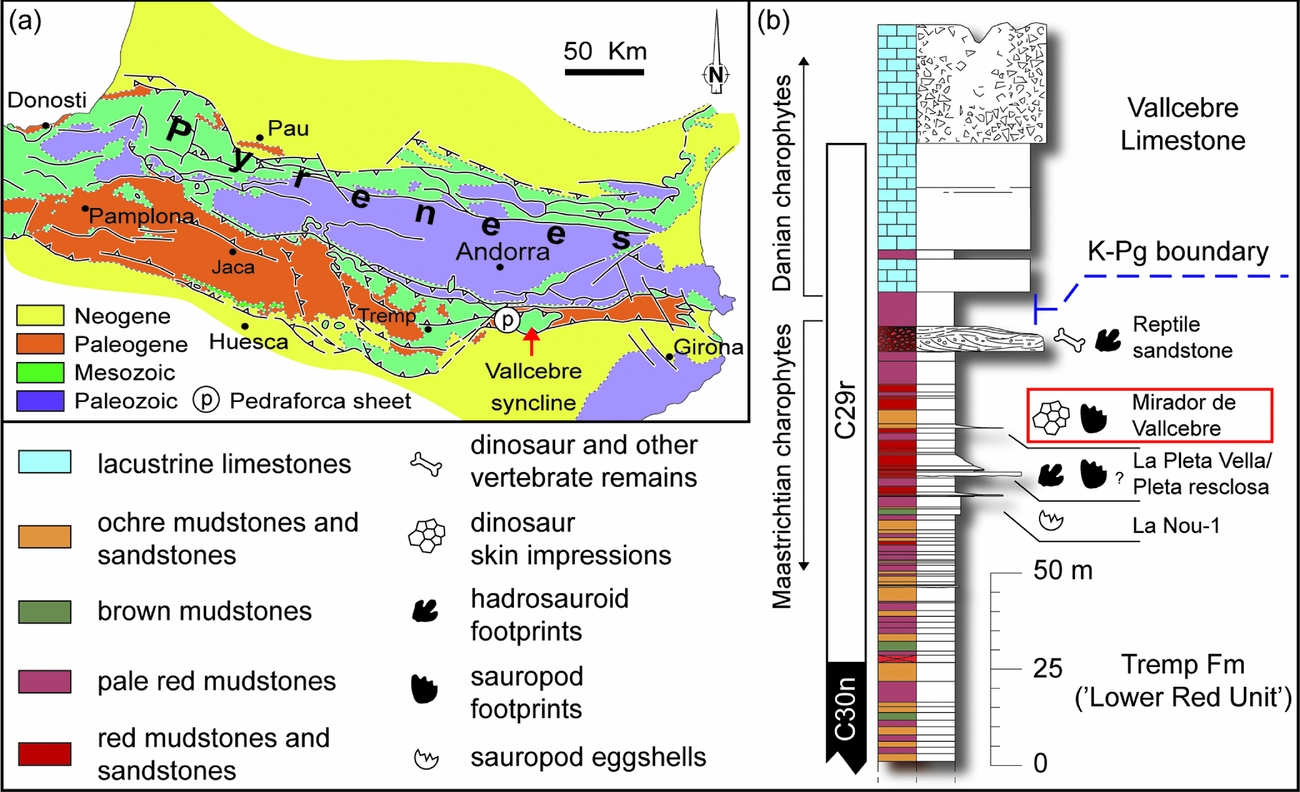
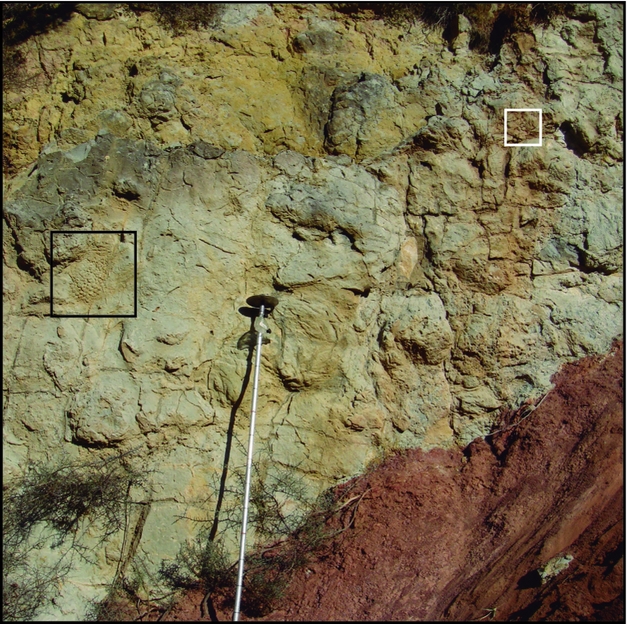
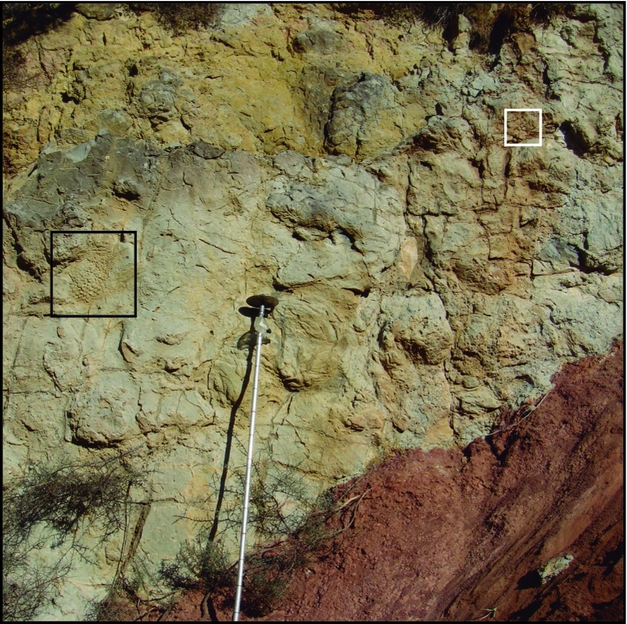
The new dinosaur skin impressions are found in the Mirador de Vallcebre locality, in the uppermost levels of the ‘Lower Red Unit’ of the Tremp Formation (sensu Rosell, Linares & Llompart, Reference Rosell, Linares and Llompart2001). In the Vallcebre syncline (Fig. 1a), this unit is represented by coastal plains and fluvial to alluvial environments, and is dated as Maastrichtian on the basis of magnetostratigraphy and biostratigraphy (Oms et al. Reference Oms, Dinarès-Turell, Vicens, Estrada, Vila, Galobart and Bravo2007; Vicente et al. Reference Vicente, Martín-Closas, Arz and Oms2015). In specific terms, the site is located in chron C29r, 30 m below the Cretaceous–Paleogene (K–Pg) boundary and just below the ‘Reptile Sandstone’ unit (Fig. 1b), a conspicuous coarse sandstone level that yields the uppermost (and last) dinosaur remains from the S Pyrenean area (both body fossils and tracks; Pereda-Suberbiola, Ruiz-Omeñaca & Company, Reference Pereda-Suberbiola, Ruiz-Omeñaca, Company and Pérez-Lorente2003; Vila et al. Reference Vila, Oms, Fondevilla, Gaete, Galobart, Riera and Canudo2013; Blanco, Méndez & Marmi, Reference Blanco, Méndez and Marmi2015; Sellés et al. Reference Sellés, Marmi, Llácer and Blanco2015). The new fossil evidence here described occurs at the base of a vertical 1.5 m thick lithosome of coarse- to fine-grained sandstones (Fig. 2), located within ochre and red mudstones (Figs 1, 2). This layer is laterally exposed around 100 m, but is partially covered in some areas. The base of the layer is highly bioturbated. Hence, invertebrate burrows in the form of horizontal tubes are broadly developed. Other load structures are spread throughout the base of the layer. The attribution of these natural casts to dinosaur tracks is supported by their general shape and the finding of at least one true sauropod track in the same layer (see below). No desiccation structures have been identified in the layer. In addition, two skin impressions laterally separated by 1.5 m have been found.
Geological setting of the Mirador de Vallcebre site. (a) Geological map of the Pyrenean area, modified from Riera et al. (Reference Riera, Oms, Gaete and Galobart2009). (b) Stratigraphic and palaeontological succession across the K–Pg boundary in the Vallcebre syncline, modified from Oms et al. (Reference Oms, Dinarès-Turell, Vicens, Estrada, Vila, Galobart and Bravo2007). The red arrow indicates the location of the studied site in the Vallcebre syncline.

3. Methods
Each specimen was photographed in the field and measured and characterized according to the descriptive categories and nomenclature proposed by Kim et al. (Reference Kim, Kim, Lockley and Seo2010) and Romano & Whyte (Reference Romano and Whyte2012). In order to preserve the information in the traces from erosion or vandalism, we prepared two moulds that are housed at the Institut Català de Paleontologia ‘Miquel Crusafont’ (IPS-93596 and IPS-93597). The moulds were made with a two-component polyaddition silicone Harduplex® 23SH, acrylic resin (Acrystal Prima®) and glass-fibre. Once in the laboratory, a cast of each mould was produced with the same acrylic resin embedding the glass-fibre mat. A natural cast of a footprint was collected (MMCERCS-1340; Fig. 3).
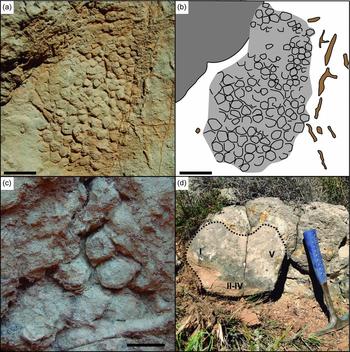
Dinosaur skin impressions and sauropod track of the Mirador de Vallcebre locality. (a) Close-up view of the large skin impression; scale bar equals 5 cm. (b) Drawing of the scale pattern of (a). The skin impression is represented in soft grey, invertebrate burrows appear in brown and the load structure that likely represents an undetermined dinosaur track is represented in a dark grey tone; scale bar equals 5 cm. (c) Close-up view of the small skin impression; scale bar equals 2 cm. (d) Detail of a titanosaurian track (MMCERCS-1340) from the same stratigraphic level, located westward from the skin impressions. This natural cast was collected.

4. Results
The two skin impressions occur as moderately to well-preserved convex hyporeliefs (natural casts), preserved as the infilling of traces produced in the underlying muddy substrate (Fig. 3a–c). The larger skin trace is 26 cm along its longer axis and 15 cm in width and is in contact with a sub-rounded load structure (Figs 2, 3a, b). The impression is not uniform, showing a decrease in the scale size from medium (mean diameter of 16 mm) to small (mean diameter of 11 mm) towards the top of the mark. In the centre of the impression the scales are poorly delimited (Fig. 3a, b). The scales are sub-rounded to irregular, pentagonal and hexagonal polygons, and exhibit no ornamentation other than a smooth, mounded surface. Exceptionally, a few scales exhibit an irregular surface. Towards the bottom and the left borders, the scales have a progressively more flattened shape, and their edges are blurred. The scales are separated by c. 2–4 mm from neighbouring scales, but those situated at the top are closer. The pentagonal and hexagonal contours of the scales confer a rosette arrangement, each scale being surrounded by five or six scales. This is clearly visible in the smaller ones at the top. Finally, the scale depths range from shallow (1 mm or less) in the border areas of the skin patch to deep (up to 4 mm) in the central part.
The smaller skin patch is located 1.5 m away from the larger one, and consists of only seven scales of 14–19 mm diameter (Fig. 3c). Of these, only three, those situated in the central part of the impression, are well preserved. They exhibit a similar shape to those described above. Hence, the scales are sub-rounded to pentagonal with smooth surfaces. In contrast to the other impression, this one appears isolated from any load structure.
A natural cast that exhibits a crescent shape is preserved in the same sandstone body where the skin patches are found (but laterally separated 80 m; Fig. 3d). No clear claw marks or striations can be distinguished in the cast. This structure is 30 cm long and 23 cm wide. By contrast, the rest of the load structures found in the same layer show no distinctive features other than sub-rounded shapes.
5. Discussion and conclusions
The crescent shape observed in the natural cast detached from the sandstone body is typical of sauropod manus impressions. The manus presents an anteriorly convex and posteriorly concave shape. The general shape and size resemble those of the titanosaurian manus prints described in the nearby Fumanya tracksites (Vila, Oms & Galobart, Reference Vila, Oms and Galobart2005), although the latter are stratigraphically much lower. More specifically, the outline of the studied cast is remarkably coincident with that of the manus print reported in figure 7 of Vila, Oms & Galobart (Reference Vila, Oms and Galobart2005); therefore, we could estimate the position of digits (Fig. 3d) and conclude that it corresponds to a right manus. According to the presence of this dinosaur track, the other load structures present in the sandstone body are regarded as poorly preserved dinosaur tracks.
Certain trace fossils or sedimentary artefacts resemble skin impressions, leading to some misinterpretations in the past (Kim et al. Reference Kim, Kim, Lockley and Seo2010). An alternative interpretation of the Mirador de Vallcebre impressions as other biogenic traces such as graphoglyptids (e.g. Paleodictyon and Squamodictyon) is rejected because such trace fossils produce convex tubes instead of the smooth mounds described here. Moreover, graphoglyptids exhibit more uniform and regular patterns than the impressions from Mirador de Vallcebre and often occur in deep marine sediments (Seilacher, Reference Seilacher2007). Similarly, non-biogenic polygonal structures such as mud cracks generate positive ridges when preserved as a cast, resulting in a different structure from our proposed skin impressions. Other sedimentary structures such as raindrops would be preserved as positive irregular casts, not resembling the polygonal pattern observed in the studied specimens.
In contrast, the general pattern of the Mirador de Vallcebre impressions resembles that of the dinosaur skin impressions reported in the literature. This kind of fossil usually occurs in association with other evidence such as footprints and bone remains, and this allows direct correlation between the mark and its producer or indicates the post-mortem dismemberment of dinosaur carcasses (Czerkas, Reference Czerkas1994). When the integument is recorded as isolated patches, as in the Mirador de Vallcebre locality, recognition of a putative candidate depends on comparison of the scale patterns and inferences about the dinosaur faunal context of a region or formation. Hitherto, examples of tubercled, non-overlapping scale impressions are known broadly in different clades, especially in herbivorous dinosaurs. Examples of this kind of fossil imprint are reported in sauropods (e.g. Czerkas, Reference Czerkas1994; Platt & Hasiotis, Reference Platt and Hasiotis2006; Romano & Whyte, Reference Romano and Whyte2012), ceratopsids (Czerkas, Reference Czerkas, Currie and Padian1997), thyreophorans (Christiansen & Tschopp, Reference Christiansen and Tschopp2010) and ornithopods (Bell, Reference Bell, Eberth and Evans2014 and references therein). Regarding theropods, skin integuments have also been preserved (Currie, Badamgarav & Koppelhus, Reference Currie, Badamgarav and Koppelhus2003), in addition to fossil feathers. Further, the sauropod skin impression record includes integuments from embryos (Chiappe et al. Reference Chiappe, Coria, Dingus, Jackson, Chinsamy and Fox1998). The North American record yields the majority of the dinosaur skin reports (Bell, Reference Bell, Eberth and Evans2014), but some examples are described in Europe, Asia and South America, spanning a temporal range from the Jurassic to the Late Cretaceous. Regarding Europe, dinosaur sites containing skin impressions are reported from the Jurassic to the Late Cretaceous of Portugal and Spain (García-Ramos, Lires & Piñuela, Reference García Ramos, Lires and Piñuela2002; Lockley et al. Reference Lockley, García Ramos, Piñuela and Avanzini2008; Mateus & Milàn, Reference Mateus and Milàn2010; Vila et al. Reference Vila, Oms, Fondevilla, Gaete, Galobart, Riera and Canudo2013; Navarrete et al. Reference Navarrete, Liesa, Castanera, Soria, Rodríguez-López and Canudo2014).
In the upper Maastrichtian of the southern Pyrenees, skin impressions have only been reported as striae or scale scratch lines on the margins of some hadrosauroid track casts (Vila et al. Reference Vila, Oms, Fondevilla, Gaete, Galobart, Riera and Canudo2013). The new, well-preserved skin impressions of the Mirador de Vallcebre site show non-overlapping scales which are similar to those described in dinosaurs. The most likely candidates for these imprints are restricted to hadrosauroids, titanosaurian sauropods and small dromaeosaurid theropods, which compose the dinosaur faunas of the region based on fossil bones, eggs, and tracks (Vila, Sellés & Brusatte, Reference Vila, Sellés and Brusatte2016). In a first step, we can rule out the possibility of theropods as plausible producers by considering the large size of the individual scales of the Mirador de Vallcebre specimens. Hadrosauroids have a wide record of integument impressions, exhibiting a huge range of skin patterns (see Bell, Reference Bell, Eberth and Evans2014 for an extensive review). The exceptionally well-preserved hadrosauroid ‘mummies’ from the Late Cretaceous of North America reveal that scale size and morphology can vary considerably between species as well as within the same individual. Bell (Reference Bell2012) differentiated two types of scales within hadrosauroid skin. The smaller ones, representing most of the integumentary surface, are referred to basement scales, whereas sporadic larger scales superimposed upon the former are referred to feature scales. In general, hadrosauroid basement scales are rounded to polygonal, and in some cases they appear ornamented with striations and corrugations. Although the polygonal pattern described in some hadrosauroid integuments (especially those positive hyporeliefs reported in Gates & Farke, Reference Gates and Farke2009 and Herrero & Farke, Reference Herrero and Farke2010) is similar to that described here, there are important differences in scale sizes. Hadrosauroid basement scales have an average size from 1 to 10 mm (Bell, Reference Bell2012, Reference Bell, Eberth and Evans2014), and are thus smaller than those described in the Pyrenean locality. Exceptionally, the diameter of polygonal basement scales located in the forearms and hindlimbs of some specimens of Brachylophosaurus canadensis (10 mm; Murphy, Trexler & Thompson, Reference Murphy, Trexler, Thompson and Carpenter2007), cf. Edmontosaurus (10 mm; Manning et al. Reference Manning, Morris, McMahon, Jones, Gize, Macquaker, Wolff, Thompson, Marshall, Taylor, Lyson, Gaskell, Reamtong, Sellers, van Dongen, Buckley and Wogelius2009) and Corythosaurus sp. (18 mm; Sternberg, Reference Sternberg1935), is larger. Considering that the Pyrenean hadrosauroids are of small to moderate size compared to those forms of North America (Vila et al. Reference Vila, Oms, Fondevilla, Gaete, Galobart, Riera and Canudo2013), smaller scales would be expected for this dinosaur group in the study area. Hence, the attribution of the Mirador de Vallcebre skin impressions to hadrosauroid species with large scales is inconclusive.
First discovered in 1852 (Czerkas, Reference Czerkas, Currie and Padian1997; Upchurch, Mannion & Taylor, Reference Upchurch, Mannion and Taylor2015), sauropod skin impressions are rare compared to the rich integument record of hadrosauroids. There is considerable variability in the size of sauropod scales (Romano & Whyte, Reference Romano and Whyte2012), but in general terms they are larger than those from hadrosauroids, reaching up to 25–30 mm in some cases (del Valle Giménez, Reference del Valle Giménez2007). The mixture of irregular, pentagonal and hexagonal polygonal scales arranged in rosettes, with lateral size variation, is a common feature of such skin impressions (e.g. Czerkas, Reference Czerkas1994; del Valle Giménez, Reference del Valle Giménez2007; Romano & Whyte, Reference Romano and Whyte2012). Such characteristics also appear in the Mirador de Vallcebre material. The shape and pattern of the skin impressions here described (polygonal, non-overlapping scales) are very similar to those reported by Currie, Badamgarav & Koppelhus (Reference Currie, Badamgarav and Koppelhus2003), Lockley et al. (Reference Lockley, Houck, Yang, Matsukawa, Lim, García Ramos, Piñuela and Avanzini2006, Reference Lockley, García Ramos, Piñuela and Avanzini2008), Mateus & Milàn (Reference Mateus and Milàn2010) and Upchurch, Mannion & Taylor (Reference Upchurch, Mannion and Taylor2015) for various traces attributed to sauropods. They also resemble the integument traces preserved in a diplodocid sauropod track cast from the Morrison Formation (Platt & Hasiotis, Reference Platt and Hasiotis2006, fig. 7b, c). In terms of size, the scales from the Mirador de Vallcebre locality are larger than those of the Jurassic specimens from the United States (Platt & Hasiotis, Reference Platt and Hasiotis2006), of similar size to those from Korea and Mongolia (Currie, Badamgarav & Koppelhus, Reference Currie, Badamgarav and Koppelhus2003; Lockley et al. Reference Lockley, Houck, Yang, Matsukawa, Lim, García Ramos, Piñuela and Avanzini2006) and smaller than those from Portugal and Spain (Lockley et al. Reference Lockley, García Ramos, Piñuela and Avanzini2008; Mateus & Milàn, Reference Mateus and Milàn2010). However, such texture and size variability might reflect different patterns from various parts of the animal's body and from different ages (Romano & Whyte, Reference Romano and Whyte2012). Some examples from Spain (Lockley et al. Reference Lockley, García Ramos, Piñuela and Avanzini2008) and Korea (Kim et al. Reference Kim, Kim, Lockley and Seo2010) display flattened scales, but this could be an artefact of preservation, given the fact that the Mirador de Vallcebre scales also appear flattened at the borders of the impression. Czerkas (Reference Czerkas, Currie and Padian1997) and Foster & Hunt-Foster (Reference Foster and Hunt-Foster2011) described complex sauropod scales with small tubercled ornamentation. The irregular surfaces observed in some scales in the Mirador de Vallcebre patches could correspond to this feature or, more likely, to poor preservation. With the present data, we refer the Mirador de Vallcebre material to sauropod skin impressions on the basis of the scale arrangement, shape and size, and the presence of titanosaurian sauropod footprints in the same sandstone layer.
The skin impressions are found with a clear association with tracks, as evidenced by the load structures interpreted as footprints in the bedding plane (Fig. 2). Thus, the skin impressions would have been formed during the trampling activity of the dinosaurs and would correspond to the contact of parts of the dinosaur body (limbs, tail, belly, etc.) with the substrate, probably producing resting-like impressions.
As with fossil tracks, the in situ character of the skin impressions at the Mirador de Vallcebre locality proves unequivocally the presence of the producer within a restricted temporal and spatial context, and corroborates the persistence of the clade until the very end of the Maastrichtian. Thus, these skin impressions represent a valuable tool for analysing the last occurrences of the sauropod clade before the K–Pg extinction event. More particularly, they can be tentatively assigned to titanosaurian sauropods, which are the only group of sauropods known in the Late Cretaceous of Europe (Vila et al. Reference Vila, Galobart, Canudo, Le Loeuff, Dinarès-Turell, Riera, Oms, Tortosa and Gaete2012). Other titanosaurian occurrences from the uppermost Maastrichtian of the region, such as disarticulated bones (Sellés et al. Reference Sellés, Marmi, Llácer and Blanco2015), tracks (Vila et al. Reference Vila, Oms, Fondevilla, Gaete, Galobart, Riera and Canudo2013) and eggshells (Sellés & Vila, Reference Sellés and Vila2015), are in agreement with this assignment (Fig. 1b).
In a European context, the Mirador de Vallcebre impressions represent one of the few Late Cretaceous skin impressions reported to date. Being located within chron C29r (latest Maastrichtian), these probable sauropod integuments represent some of the youngest (and last) in situ remains of this dinosaur clade. Together with the hadrosauroid skin impressions of the Maastrichtian Lance Formation of North America (Lockley, Nadon & Currie, Reference Lockley, Nadon and Currie2003), the new impressions represent the youngest record of this category worldwide.
Acknowledgements
The Departament de Cultura de la Generalitat de Catalunya issued the permission for the studied locality. We would like to express our gratitude to M. Roigé, who participated in the discovery of the skin impressions presented here. This paper is a contribution to the projects CGL 2011-30069-C02-01,02/BTE funded by the Ministerio de Ciencia e Innovación and the project ‘Dinàmica ecològica de la darrera extinció en massa: el Pirineu com a laboratori fòssil’ 20014/100927 funded by the Departament de Cultura de la Generalitat de Catalunya. V. Fondevilla acknowledges support from the Ministerio de Economía y Competitividad (FPI grant, BES-2012-052366). Rupert Glasgow revised the English grammar. Finally, we acknowledge the valuable comments of the anonymous reviewers and the editor Paul Upchurch that improved the manuscript.