


A Purse Full of Silver
On June 2, 1862, nineteen-year-old Sarah Morgan Dawson fled Baton Rouge as Union troops advanced into southern Louisiana.Footnote 1 She packed hurriedly, like thousands of other displaced civilians caught in the upheaval of the U.S. Civil War. She carried approximately $1,700 in Confederate paper notes and a small quantity of Mexican silver pesos (dollars).
Confederate notes had a rapidly depreciating value as their issuing government had an uncertain future. The Mexican silver coins did not. Minted hundreds of miles away and long familiar throughout the Gulf of Mexico and the Atlantic world, Mexican pesos continued to circulate regardless of which army occupied a particular town or which flag flew over a customs house. Political authority could collapse; the coins still passed from hand to hand.
Dawson was acting upon practical knowledge shared by merchants, planters, sailors, shopkeepers, bankers, and refugees across the nineteenth-century Atlantic economy. Mexican silver pesos retained value and traveled farther than governments because they could settle obligations across political jurisdictions. Why?
Why did Mexican silver remain acceptable in places where local paper currencies suddenly became suspect? What institutions sustained the circulation of metallic money across borders, wars, and changing sovereignties? And how were international payments organized before the emergence of the modern banking systems through which historians usually explain nineteenth-century finance? Those questions lie at the heart of this essay.
International trade has always depended upon movement. Commodities crossed oceans. Migrants crossed frontiers. Information traveled through letters and newspapers carried by boats, horses, and railroads. Yet none of these movements could be sustained unless value itself also moved. Each shipment of cotton, every cargo of manufactured goods, every sovereign loan, and every remittance ultimately required a means of settling obligations between people separated by geography, language, and political authority.
Many scholars have devoted enormous attention to the institutions that eventually came to dominate this process. Economic historians have long examined national monetary regimes and balance-of-payments adjustments, and the instruments and institutions associated with long-distance trade and finance.Footnote 2 Business and financial historians have examined the organization and internationalization strategies of merchant houses, Atlantic partnerships, and U.S. banks.Footnote 3 International political economists and global historians have demonstrated that territorially homogeneous national currencies were a relatively recent historical development; earlier monetary systems instead accommodated multiple monies, overlapping exchange practices, and complementary monetary circuits operating across different spatial scales.Footnote 4 Historians of U.S. capitalism have emphasized the relationship between finance, slavery, commodities, and empire.Footnote 5 Together these literatures have profoundly enriched our understanding of nineteenth-century capitalism. Yet they also leave a deceptively simple historical question only partially answered. How were international payments organized before these institutions assumed the forms we now recognize?
One way of approaching that question from an unexpected direction is to begin not with banks or monetary legislation but with metallic coins themselves—specifically, the circulation of Mexican silver and Californian gold through the New Orleans specie market during the age of international bimetallism. Following those monies ultimately revealed something larger than a market for precious metals. It uncovered the institutional arrangements that linked Mexican mining districts with New Orleans and London into what may be described as a Gulf-London payment corridor: a regional system through which merchant-financial firms organized international payments before correspondent banking became the dominant organizational form for cross-border settlement.
This inquiry grew out of a seemingly straightforward question: how did Mexican silver reach New Orleans? Answering that question gradually transformed the project itself. It begins with the monies themselves; it then follows their movement across space, the merchants who organized those movements, and the institutional arrangements that transformed countless individual transactions into a coherent international payment system. In doing so, it argues that merchant finance constituted the principal institutional arrangement through which international payments operated under international bimetallism. By the mid-nineteenth century, London functioned as the global payment center, while New Orleans emerged as the regional payment center for the Gulf economy. Merchant-financial firms linked these centers by coordinating bills of exchange, specie movements, and commercial credit. Reconstructing the New Orleans specie market before the U.S. Civil War also offers a new perspective on the historical foundations of international financial integration.
Coins: Seeing the Material World
Every historical investigation begins with traces. In this case, that evidence consisted of coins. The nineteenth-century Atlantic economy was not organized around a single universally accepted money. Instead, merchants operated within a remarkably plural monetary environment in which different metallic monies circulated simultaneously, often performing distinct economic functions.
New Orleans functioned as a regional payment center where multiple monetary worlds converged. Mexican pesos circulated alongside U.S. gold eagles, British sovereigns, French francs, and numerous other currencies.Footnote 6 Bills of exchange and commercial credit further expanded this monetary landscape, allowing merchants to settle transactions without the immediate physical movement of specie and bullion while still relying on Mexican pesos and other metallic coins as the ultimate settlement assets in Atlantic commerce.
For historians of the early United States, Mexican silver has long occupied a familiar place. Spanish American pesos circulated widely from the colonial period onward and remained legal tender in the United States until 1857.Footnote 7 They appear in legislation, mint reports, bank balance sheets, notarial records, archaeological excavations, and numismatic collections. Their importance as money has therefore never been in doubt. What has remained far less clear is how these coins moved.
Most scholarship has understandably examined specie from the perspective of monetary and financial systems: coinage legislation, legal tender, mint policies, banking reserves, or aggregate imports and exports. Those approaches illuminate the institutional framework within which metallic money circulated. They reveal comparatively little about the commercial mechanisms through which individual shipments traveled from mining districts to mints and ports, from ports to merchants’ offices, and from merchants to international markets.
Following monies therefore requires treating coins not merely as monetary objects but as historical traces. Every coin that arrived in New Orleans had previously followed a route. It had passed through ports, traveled aboard specific vessels, and been consigned to identifiable merchants. Each movement implied relationships among miners, mint officials, commission merchants, shippers, insurers, exchange dealers, and financiers.
Coins themselves could not explain those relationships. They merely revealed that such relationships existed. The obvious next question therefore becomes geographical. Where did these monies move? Once coins begin to move, geography enters the story.
Flows: Seeing Movement
Official trade statistics suggest a relatively straightforward picture of nineteenth-century specie movements. Nations imported and exported precious metals; annual totals recorded those transactions; aggregate series permit long-run comparisons.Footnote 8 Such statistics remain indispensable for understanding the international economy, yet they also flatten the very movements that made international payments possible. Routes disappear behind national totals. Ports become invisible within country-level aggregates. Above all, the intermediaries who organized individual shipments vanish entirely.
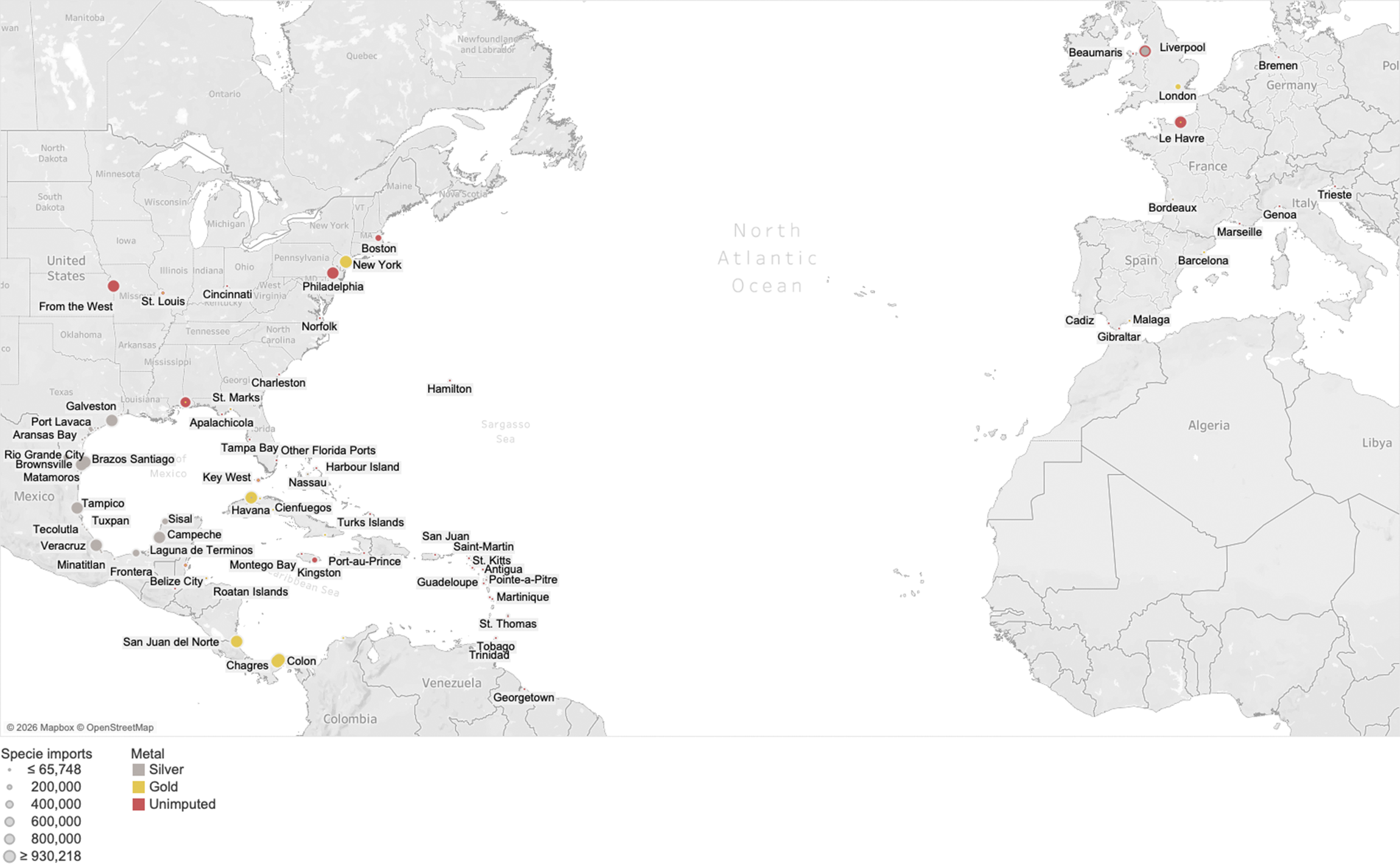
Rather than viewing monetary geography as a hierarchy of nation-states, shipment-level data reveal a hierarchy of payment centers connected by merchant-financial networks. Specie did not radiate evenly across national territories: it circulated through highly concentrated commercial corridors. Mexican mining districts connected to Gulf ports. Gulf ports connected to New Orleans. New Orleans connected to New York, Havana, Liverpool, London, and, increasingly after 1849, California, via Central America. Taken together, these routes formed a monetary geography that only partially overlapped with political geography (see Figure 1).
Ports exporting gold and silver to New Orleans, January 1839–June 1861.
Note: Circle sizes represent graduated value classes. Values range from $65,748 for Aransas Bay to a top category beginning at $930,218; ports above that threshold, including Brazos Santiago, share the largest symbol size. The map accounts for $106,201,480 in nominal U.S. dollars. Unimputed metal refers to entries in the New Orleans Price-Current that do not report the type of metal.
Source: Author’s reconstruction from the New Orleans Specie Imports (NOSI) dataset.

Figure 1. Long description
Map of the Atlantic world showing the ports that exported specie to New Orleans between January 1839 and June 1861. Ports are represented by graduated circles whose size indicates the total nominal value of specie shipped to New Orleans. Circle colors distinguish silver (gray), gold (yellow), and unimputed metal (red). The largest concentrations of shipments originate in the Gulf of Mexico, especially northern Mexico and the Texas borderlands. Brazos Santiago is the largest single source of specie, followed by other Gulf ports including Matamoros, Veracruz, Tampico, and Havana. Additional exporting ports appear along the U.S. Atlantic coast (such as New York), the Caribbean, Central America, and western Europe, including Liverpool, London, Le Havre, Bordeaux, Cádiz, and Barcelona. The figure illustrates that specie movements were concentrated in a limited number of commercial corridors linking Mexico, the Gulf of Mexico, New Orleans, and the principal Atlantic financial and trading centers.
No place illustrates this more clearly than Brazos Santiago. Absent from many historical narratives altogether, this small Texas port emerged as the single largest source of specie entering New Orleans from its early days as a military depot during the Mexican-American War (1846–1848) until the U.S. naval blockade of the Crescent City in 1861. Its prominence initially seems puzzling. Brazos Santiago possessed no significant silver mines. It produced none of the precious metal that passed through it. Yet precisely because it occupied the mouth of the Rio Grande, it became the principal maritime outlet for silver arriving from northern Mexico through a combination of legal commerce and contraband in the U.S.-Mexico borderlands.Footnote 9
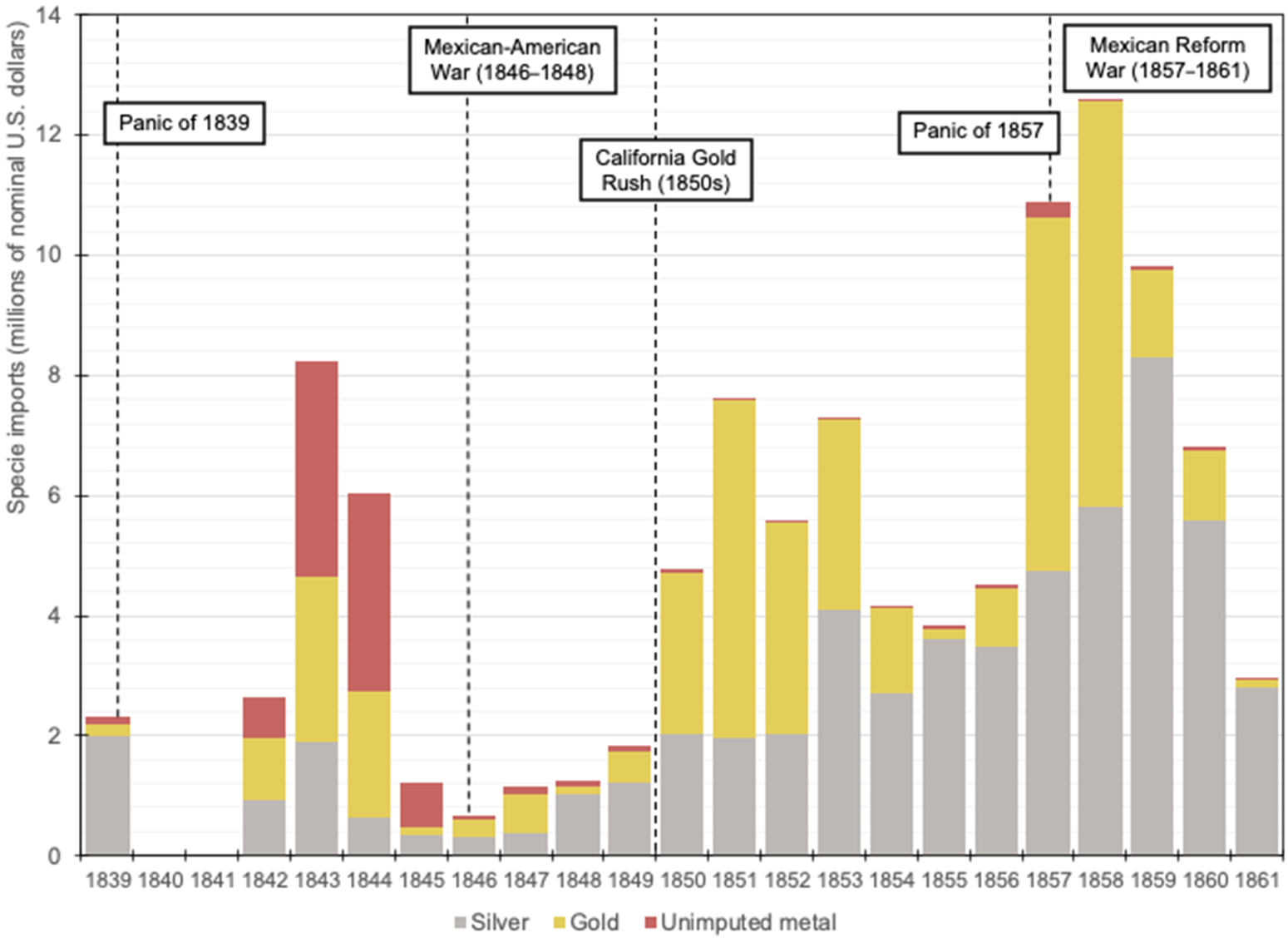
Figure 2 illustrates the annual evolution of these reconstructed imports. National statistics classify most post-1846 silver shipments as movements originating from the United States. Their monetary history, however, began in Mexico. Recovering that geography fundamentally changes how we understand the circulation of metallic money. The relevant commercial space was not bounded by national frontiers. It was organized around routes, ports, merchant houses, and shipping connections that crossed those frontiers continuously. Following monies therefore reveals a geography defined less by states than by commerce.
Annual specie imports into New Orleans, January 1839–June 1861.
Note: Data are annual totals; 1861 covers January–June. Because the NOSI dataset does not include shipment records for 1840 and 1841, those years are not represented in the series. Values are in millions of nominal U.S. dollars. Unimputed metal refers to entries in the New Orleans Price-Current that do not report the type of metal.
Source: Author’s reconstruction from the New Orleans Specie Imports (NOSI) dataset.

Figure 2. Long description
Stacked bar chart of specie imports into New Orleans from 1839 to 1861. The y-axis shows specie imports in millions of nominal U.S. dollars, from 0 to 14. The x-axis shows years from 1839 to 1861. A legend identifies three categories: silver (gray), gold (yellow), and unimputed metal (red). Vertical dashed lines mark the Panic of 1839, the Mexican-American War (1846–1848), the California Gold Rush (1850s), the Panic of 1857, and the Mexican Reform War (1857–1861). Imports are relatively low in the early years of the series, then rise sharply in 1843–1844, when unimputed metal makes up a large share. Imports fall again from 1845 to 1849. After 1850, gold becomes the dominant component in several years, especially in the early and late 1850s. Imports surge again in 1857–1858, reaching their highest level in 1858, before declining in 1859–1861, when silver again accounts for most of the total.
Once that geography becomes visible, another question naturally emerges. Who organized these remarkable movements of value across the nineteenth-century Atlantic world?
Merchants: Seeing People
Following monies across the Gulf of Mexico eventually transforms a geographical problem into a human one. Coins did not choose their own routes. Steamships did not decide their cargoes. Ports did not spontaneously become centers of international exchange. Each remittance represented a series of decisions made by identifiable men acting within commercial relationships that stretched across the Atlantic world. The circulation of specie therefore cannot be understood simply by reconstructing where metallic monies moved. It also requires identifying who moved them and why.
One of the most striking discoveries to emerge from this inquiry is that the principal recipients of gold and silver were rarely banks. Instead, they were overwhelmingly merchant firms and commercial partnerships. The specie market was populated by commission merchants, cotton factors, exchange dealers, merchant bankers, shipping agents, and correspondents whose businesses routinely crossed the conventional boundaries separating commerce from finance.Footnote 10 Some specialized in importing European manufactures. Others exported cotton, sugar, tobacco, or molasses. Still others represented foreign banking houses. Almost all performed multiple functions simultaneously.
The specie market therefore directs attention to a commercial community that has remained surprisingly fragmented in the historiography. Individual firms appear in studies of cotton, slavery, banking, or foreign trade, yet rarely are they examined collectively as participants in a common payment system. Reconstructing shipment-level evidence makes it possible to view these actors together for the first time and to recover the relationships that connected them.
Their diversity is immediately striking. Merchants speaking Spanish, French, English, and German negotiated transactions that linked mining districts in northern Mexico, cotton and sugar plantations in the U.S. South, financial houses in London and Paris, and commercial ports throughout the Gulf of Mexico and the Caribbean. Spaniards linked New Orleans to commercial circuits extending through Veracruz, Havana, Cádiz, and Mexico City. German merchants maintained close ties with Hamburg and the Gulf trade. French and French-Jewish firms cultivated relationships reaching Paris and the great banking houses of continental Europe. Anglo-American merchants occupied different commercial niches associated more closely with private banking, transportation, railroads, and the expanding economy of the U.S. Northeast. Instead of forming a homogeneous merchant elite, these firms occupied distinct yet overlapping commercial worlds whose boundaries were often defined by language, family, reputation, and long-standing correspondent relationships.
No figure better illustrates this complexity than the Louisianan Creole Edmond Jean Forstall. Historians have generally remembered Forstall as a conservative banker who advocated unusually high specie reserves following the financial crises of the 1830s.Footnote 11 Yet reconstructing the specie market reveals a much broader role. Forstall appears simultaneously as merchant, financier, and agent of Baring Brothers of London and Hope & Co. of Amsterdam. His activities linked Mexican silver producers, Gulf merchants, New Orleans banks, and London financiers into a single commercial network. Rather than treating banking and international commerce as separate spheres, Forstall’s career demonstrates how deeply intertwined they remained during the age of international bimetallism.
James Robb offers a revealing contrast. This Anglo-American private banker likewise occupied the intersection of commerce and finance, yet his business developed along different lines. More closely connected to private banking, transportation, and the expanding U.S. economy, Robb’s commercial world increasingly revolved around gold.Footnote 12 The contrast between Robb and Forstall does not simply illustrate different personalities or business strategies; it also reveals how two enslavers occupied distinct positions within the broader organization of nineteenth-century U.S. and international payments.
Other figures reinforce this pattern. Each biography demonstrates that merchant careers rarely remained confined to a single occupation. Merchants became bankers. Bankers became planters. Commission merchants became financiers. Their businesses evolved as opportunities emerged across increasingly interconnected markets. Taken together, these careers suggest that the circulation of metallic monies depended less on isolated transactions than on durable relationships. Trust reduced information costs. Kinship facilitated long-distance business dealings and the management of ventures and investments. Reputation substituted for formal regulation. Commercial experience enabled merchants to navigate multiple legal systems, currencies, and political jurisdictions simultaneously. What shipment records initially present as movements of silver and gold gradually emerge as the visible traces of far more durable social and commercial relationships.
At this point, however, another question becomes unavoidable. If individual merchants occupied such diverse commercial worlds, what held those worlds together? What transformed thousands of separate commercial decisions into a functioning international payment system? Answering those questions requires moving beyond merchants themselves toward the institutional arrangements within which they operated.
Merchant Finance: Seeing Invisible Institutions
The answer lies not in any single firm, but in the institutional world that those firms collectively inhabited. Modern readers often distinguish sharply between merchants and bankers. However, entrepreneurial roles frequently overlapped, and specialization emerged only gradually. Taken together, these concurrent activities are described here as merchant finance: the institutional arrangement through which merchant-financial firms financed trade, discounted bills of exchange, procured specie, and transmitted market information under international bimetallism.Footnote 13
Merchant finance did not eliminate uncertainty: it managed it. It therefore represented a sophisticated institutional arrangement adapted to a world in which international commerce expanded more rapidly than domestic banking systems. Merchant-financial firms connected producers, shippers, insurers, brokers, correspondents, and financial houses through relationships capable of moving both information and value across considerable distances.Footnote 14
The importance of these arrangements becomes especially clear through a letter written in December 1851. That year, Acting Treasury Secretary William L. Hodge addressed a detailed questionnaire to the Mexican legation in Washington.Footnote 15 He wished to know how much silver Mexico produced, where it originated, how much gold remained mixed within it, through which ports it was exported, who controlled its production, and how the U.S. Mint and its branches might obtain silver directly.
The questions themselves are remarkable. More revealing still is the fact that the Mexican government never answered them. The failure was not bureaucratic negligence alone. Neither government possessed the information necessary to reconstruct the commodity chain of Mexican silver pesos. The relevant knowledge remained dispersed among merchants, mining companies, mints, shipping firms, customs officers, and commercial newspapers.
The archival challenge facing historians is remarkably similar to the one Hodge confronted in 1851. International payment systems rarely survive as coherent archives; they must be reconstructed from the traces they leave behind. Merchant correspondence records individual firms. Customs records capture mercantile activity at ports. Banking archives illuminate financial institutions. Some coins, bills of exchange, and newspapers survive. The payment system itself does not.
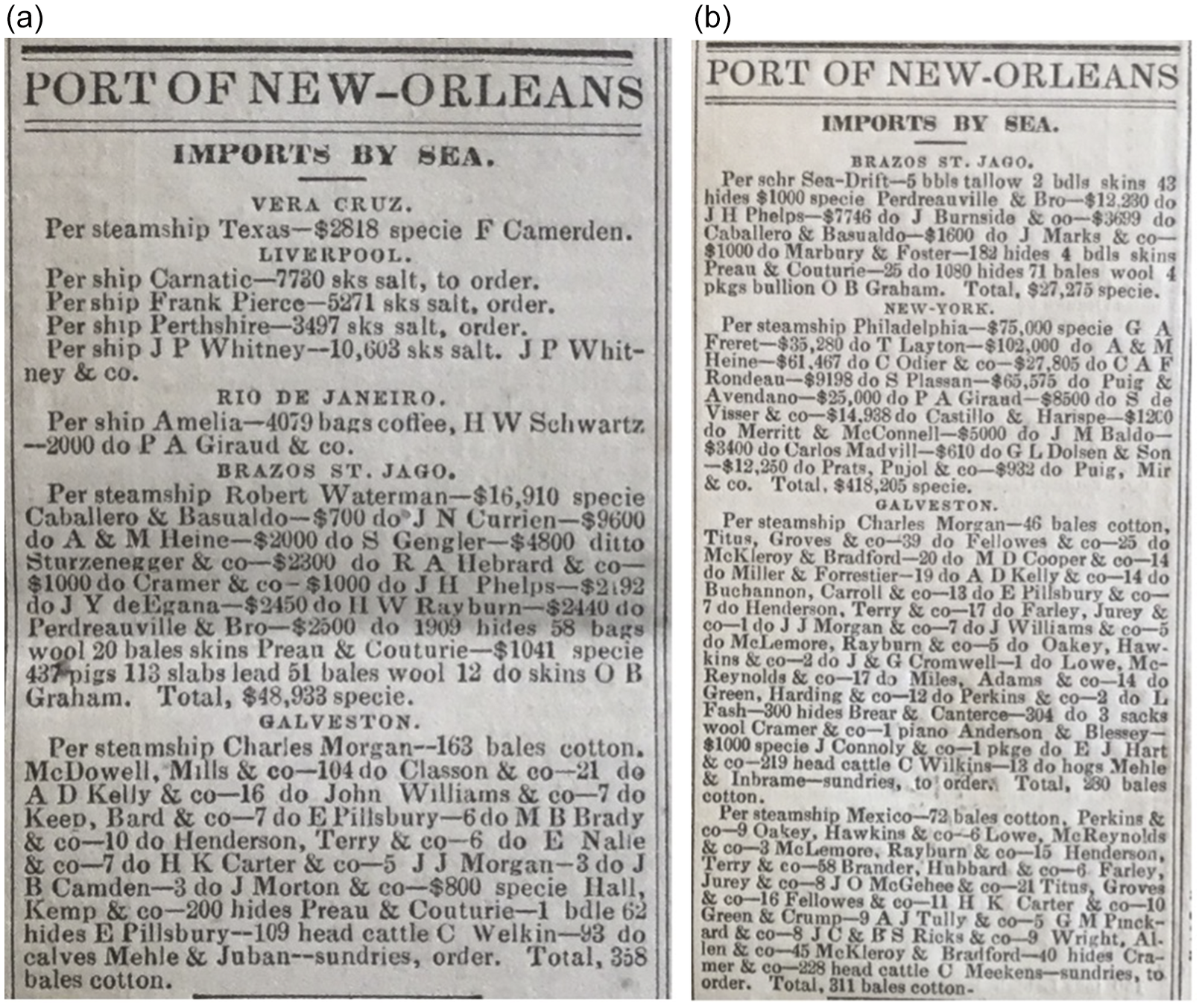
Reconstructing that system therefore required assembling evidence that had never previously been brought together. Many of the dispersed traces upon which this study relies became accessible through the rapid digitization of newspapers, archival collections, and genealogical databases, making it possible to recover transnational business relationships that would have been difficult to observe only a decade earlier. The most important source proved to be the New Orleans Price-Current. More than a commercial newspaper, it functioned as the Gulf economy’s principal information platform, reporting commodity prices, shipping intelligence, bills of exchange discounts, the value of domestic banknotes and foreign currencies, political developments, and, crucially, detailed reports of specie and commodity arrivals to the port (see Figure 3). In many respects, it was the nineteenth-century equivalent of a Bloomberg terminal, allowing merchants to monitor business and politics across the Atlantic from a single publication.
The “Imports by Sea” section of the New Orleans Price-Current, October 3 (a) and November 11 (b), 1857.
Source: New Orleans Price-Current, volume 29, Rare Book Division, New York Public Library.

Figure 3. Long description
Two reproductions of the "Imports by Sea" section from the New Orleans Price-Current, showing issues published on October 3 (panel a) and November 11 (panel b), 1857. Each panel consists of a newspaper column organized by port of origin. Entries list arriving vessels together with their cargoes, including cotton, coffee, salt, hides, wool, and specie, and identify the merchants or firms receiving each shipment. Specie shipments are reported as dollar amounts consigned to named merchants, while commodity shipments are reported by quantity and consignee. The October issue includes arrivals from Veracruz, Liverpool, Rio de Janeiro, Brazos Santiago, and Galveston. The November issue includes arrivals from Brazos Santiago, New York, and Galveston. The figure illustrates the level of commercial detail published in the New Orleans Price-Current, which served as a key source for reconstructing the New Orleans Specie Imports (NOSI) dataset and the merchant-financial networks examined in this study.
Systematically digitizing these reports produced the New Orleans Specie Imports (NOSI) dataset, the first comprehensive shipment-level reconstruction of specie imports into the early U.S. economy. Covering more than 10,000 shipments valued at over $106 million between 1839 and 1861, NOSI records not only the value and type of specie but also ports of origin, vessels, dates, and, in many cases, the merchants receiving each shipment.Footnote 16 Rather than merely producing aggregate series of specie movements, the dataset reconstructs the microstructure of an international payment system one shipment at a time.
No single method could reveal that system. Archival research supplied institutional context. Historical datasets revealed patterns that remain invisible in isolated archival collections. GIS reconstructed the spatial organization of specie movements and the broader Atlantic monetary geography. Prosopography connected individual merchants across multiple sources, while social network analysis illuminated relationships difficult to perceive through narrative evidence alone. These methods are not themselves the argument. Like the Price-Current, they function as windows onto an otherwise invisible institutional world.
Reconstructing thousands of individual remittances transforms the New Orleans specie market from a collection of separate commercial exchanges into a coherent international payment system linking mines, mints, ports, merchant houses, commodity markets, and financial centers across the Atlantic economy. Only then does the final historical question become possible: how did that payment system actually operate?
International Payments: Seeing the System
The New Orleans specie market was not simply a place where specie changed hands. It functioned as the principal regional payment center through which merchant-financial firms coordinated the settlement of obligations generated by Atlantic commerce. Every shipment represented the discharge of obligations created elsewhere. Every arrival of silver or gold reflected a wider web of commodity exchanges, financial claims, and merchant relationships extending across the Atlantic economy. Rather than understanding specie imports as isolated movements of metallic money, they emerge as the visible traces of a much larger institutional order.
Merchant houses selected among alternative settlement instruments (bills on London, Mexican silver, commercial credit) according to commercial balances, exchange conditions, transport costs, political uncertainty, the availability of credit, and their international networks of commercial partners and correspondents. New Orleans’s importance lay in arbitrage between the London bill market and the Gulf specie market. The specie market therefore formed one component of a broader international payment system through which merchant finance organized long-distance commerce under international bimetallism.
One of the most striking findings to emerge from reconstructing the New Orleans payment system is that its merchant community was far from homogeneous. The firms receiving large quantities of Mexican silver were not simply the same firms receiving large quantities of gold. Instead, merchant-financial firms occupied different positions within the payment system, reflecting distinct commercial specializations and monetary functions.
Two merchant communities inhabited the same city while participating in different monetary worlds.
The first—the “silver barons”—consisted largely of Louisiana Creoles, Spaniards, and other foreign-born merchants whose commercial relationships extended through Mexico, the Caribbean, and continental Europe. Figures such as Edmond J. Forstall repeatedly appear at the center of Mexican silver remittances. Their businesses depended upon maintaining durable relationships with mining districts, Gulf ports, merchant correspondents, and European financial houses. For these firms, silver remained the principal medium through which international obligations could be settled across multiple monetary jurisdictions.
The second—the “gold princes”—occupied a different commercial world. Firms associated with James Robb and other Anglo-American merchants became increasingly connected to domestic finance and railroads in the United States. Gold assumed greater prominence within their commercial operations, while their financial horizons increasingly reflected the ascendant British-American financial world rather than the older monetary geography linking Mexico to the Atlantic economy.
These categories should not be understood as rigid typologies or simply as ethnic groupings. Rather, they reveal how different merchant-financial communities performed complementary functions within a highly differentiated international payment system. They inherited and developed distinct commercial cultures, correspondent relationships, business practices, and networks of trust that shaped both the instruments they employed and the markets in which they specialized.Footnote 17 Together, however, they formed complementary components of the same merchant-financial order that sustained cross-border payments under international bimetallism.
Understanding these merchant-financial communities also clarifies why contemporaries such as steamship businessman William C. Templeton described New Orleans as the “natural depot” for Mexican specie.Footnote 18 Geography undoubtedly mattered. Situated at the mouth of the Mississippi River, the city connected the cotton- and sugar-producing slave economy of the lower Mississippi Valley to the Gulf of Mexico, the Caribbean, the North Atlantic, and, after 1848, California, via Central America. It became one of the principal redistribution points for Mexican silver and Californian gold within the Atlantic economy.Footnote 19
Geography created opportunity. Merchant finance transformed that opportunity into payment and institutional centrality. Commercial information converged there. Commodity markets generated payment obligations there. Bills of exchange were negotiated there. European merchant banks maintained correspondents and agents there. Specie accumulated there. Shipping routes, commercial credit, and networks of trust reinforced one another. Together these elements produced one of the nineteenth century’s most sophisticated systems for coordinating international payments.
The resilience of that system became especially apparent during periods of political disruption. The Texas Revolution (1835–1836), the Mexican-American War, the California Gold Rush of the 1850s, and the Mexican Reform War (1857–1861) each altered established commercial routes and monetary conditions. Yet merchant-financial firms repeatedly adapted. Routes shifted. Correspondent relationships evolved. Settlement practices changed. The organization of international payments endured. New Orleans’s significance therefore rested not simply on its geographical position but on the adaptability and resilience its merchant-financial community displayed in reorganizing business relationships under changing political and monetary conditions.
Reconstructing the New Orleans specie market therefore reveals considerably more than the circulation of precious metals. It reveals one institutional solution to the enduring problem of organizing international payments before modern banking.
The question therefore becomes larger still. What role did merchant finance play in the broader historical process of international financial integration?
Financial Integration: Seeing the Historical Process
The answer lies well beyond New Orleans and the Gulf of Mexico. Following Mexican silver ultimately demonstrates that merchant finance connected mining districts in northern Mexico, sugar and cotton cultivated by enslaved people throughout the lower Mississippi Valley, British manufactures, and European financial houses into a single commercial order.
Mexican silver therefore did considerably more than circulate: it functioned as the Atlantic economy’s ultimate settlement asset, while New Orleans organized access to that asset through its role as a regional payment center.Footnote 20 International financial integration thus appears not as the automatic consequence of expanding trade but as an institutional achievement requiring continuous coordination among a myriad of commercial actors. The cross-border circulation of value before modern banking depended neither exclusively upon states nor exclusively upon markets, but upon institutional arrangements created and maintained by merchants operating across political boundaries.
Placing merchant finance at the center of the analysis brings business history, banking history, monetary history, and the history of U.S. capitalism together within a common explanatory framework. In doing so, it offers a new perspective on the historical foundations of international financial integration.
From Queen Silver to Emperor Gold
When Sarah Morgan Dawson carried a handful of Mexican silver pesos as she fled Baton Rouge, she acted within a monetary world already approaching its end. She could not have known that the institutions which had sustained the circulation of those coins across the Atlantic economy were themselves beginning to change. Yet her instinct to preserve silver reflected more than confidence in a precious metal. It reflected confidence in a commercial order that had long organized international payments through merchant-financial relationships extending far beyond the political boundaries of the U.S. Civil War. The historical significance of New Orleans lay in serving as the principal regional payment center through which the Gulf economy connected to the world’s leading financial market.
The disappearance of that world and the widespread adoption of the international gold standard cannot be explained simply through changing relative prices between gold and silver. Nor can it be understood solely through watershed political events such as the French indemnity to Germany after 1871 or the U.S. Coinage Act of 1873. International monetary standards changed, but so too did the institutions through which cross-border payments were coordinated.
The merchant-financial firms that had coordinated specie movements under international bimetallism gradually relinquished many of those functions to increasingly specialized banking institutions. Correspondent banking expanded. Commercial banking became more integrated. National and central banks assumed responsibilities that merchants had once exercised through private correspondence, commercial reputation, and long-standing business relationships. Modern payment infrastructures did not emerge in isolation; they institutionalized many of the information channels, settlement practices, and networks of trust already developed under merchant finance.
From this perspective, the transition from Queen Silver to Emperor Gold represented more than the triumph of one monetary standard over another. It marked the gradual institutionalization of international payments through banks and banking networks. Merchant finance did not simply disappear; many of its practices, relationships, and organizational forms survived by becoming embedded within increasingly specialized correspondent banking networks that would characterize the first era of modern financial globalization.
Seen in this way, the history of international payments becomes simultaneously a history of organizational change. Merchant-financial firms, correspondent banks, multinational banks, and central banks did not solve different problems; they represented successive organizational solutions to the enduring challenge of coordinating the cross-border movement of value under changing domestic monetary regimes and international monetary standards.
The New Orleans specie market therefore captures far more than the operation of a regional payment center within commodity-money systems. It preserves a rare view of one historical payment system at the moment when it reached its greatest maturity, just before its gradual transformation into the institutional architecture of modern banking.
Following monies also required following evidence. The international payment system reconstructed here survived not as a single archive, but as fragments dispersed across merchant correspondence, commercial newspapers, government records, and countless individual transactions. Reassembling those fragments made it possible to recover an economic structure that contemporaries inhabited but never documented as a whole.
What began as an investigation into the circulation of Mexican silver ultimately became an inquiry into the historical organization of international payments. Following monies first revealed routes. Then merchants. Then merchant finance. Finally, it revealed the payment system itself. The institutions and the monies changed, but the historical question did not. How do societies organize the movement of value across distance?
The nineteenth century answered that question through merchant finance under international bimetallism. Later generations answered it through correspondent banking and increasingly complex payment infrastructures. The institutional arrangements evolved, but the underlying challenge remained remarkably constant. Following monies reveals not merely where value moved; it shows how successive generations created, transformed, and institutionalized the arrangements that made the cross-border movement of value possible.
Acknowledgments
I dedicate this essay to Carlos Marichal, whose scholarship has profoundly shaped my understanding of global financial history. His comments and suggestions on an earlier version of this essay greatly improved the manuscript, and I am also grateful for his support throughout the development of this project. I owe particular thanks to Andrew Popp for his extraordinary patience, encouragement, and editorial support. When personal circumstances prevented me from completing the essay for its originally intended issue of Enterprise & Society, he continued to support the project and kept open the possibility of its eventual publication. I am also deeply grateful to my Ph.D. advisors, David Weiman and Betsy Blackmar, and to the members of my examination committee, Alan Dye, Susie Pak, and Richard Sylla, for their mentorship, support, and advice during my doctoral studies. I am likewise grateful to Bernardo Bátiz, Mario Cerutti, Gustavo Del Ángel, Richard John, Jane Knodell, Sandra Kuntz, Richard Salvucci, and Catherine Schenk for providing references, data, and feedback on work in progress. The usual caveats apply. The research underlying this essay was supported by Columbia University, the National Council for Science and Technology of Mexico (CONACYT), the Mercatus Center at George Mason University, the European Research Council (ERC), and the Business History Conference.

 Open access

