INTRODUCTION
Although the recent political instability brought by the Arab Spring shook the framework of the Middle East; some monarchs were able to hold on to their thrones breaking records for the highest years in power per incumbent (Aarts and Thomassen Reference Aarts and Thomassen2008). Scholars have theorized that the factors contributing to the survival of monarchs can be attributed to a strong coercive apparatus willing and able to suppress dissent (Bellin Reference Bellin2004, Reference Bellin2012), increased skill in governance (Heydemann Reference Heydemann2007; Wedeen Reference Wedeen2015), rule by hereditary succession (Brownlee, Masoud, and Reynolds Reference Brownlee, Masoud and Reynolds2015), and the development of oil-rich welfare states (Beblawi Reference Beblawi and Luciani1990). In light of these factors, the Sheikhs and Emirs of the Persian Gulf felt the need to go beyond financial appeasement to ensure political survival and trust in an increasingly insecure region (Beblawi Reference Beblawi and Luciani1990; Migdal Reference Migdal1994, Reference Migdal, Atul and Shue1988; Jamal Reference Jamal2007; Smith Reference Smith2007). They did so through a state-crafted policy cowing their populace into fearing an internal enemy using sectarianism and identity politics and thus increasing trust and legitimacy in the government (Jamal Reference Jamal2007; Matthiesen Reference Matthiesen2013; Hashemi and Postel Reference Hashemi and Postel2017). In the Kingdom of Saudi Arabia, state-led sectarianism has been used to ensure legitimacy and the maintenance of the status quo throughout the existence of the kingdom (Wehrey et al. Reference Wehrey, Karasik, Nader, Ghez and Hansell2009; Al-Rasheed Reference Al-Rasheed, Hasehmi and Postel2017). Although the Al-Sauds predominantly relied on the traditional rentier model for legitimacy which included financial munificence in return for legitimacy; sectarianism became the new mode of maintenance of the status quo. It is used as a state-constructed counter-revolution tactic employed to exaggerate religious differences between its citizenry and prevent the mass mobilization of non-sectarian politics against the government. Through religious discourse and practices, sectarianism in the Saudi context involved not only politicizing religious differences, rather a careful craft of state policies creating a rift between the majority Sunnis and the minority Shi‘a populations in the kingdom. This rift that caused a significant amount of conflict in the region and most recently during the Arab spring, perpetuated scholars to redirect their attention to the origins of it. Some have blamed sectarianism on a century-old religious rift due to the nature of the historical development of Islam (Huntington Reference Huntington1996), while others have found evidence linking sectarianism to the state in which it has been used as a tool to incite fear of a securitized minority (Buzan, Wæver, and de Wilde Reference Buzan, Wæver and de Wilde1998) and, thus, distract the majority from any political mobilization (Hashemi Reference Hashemi2015).
In the presence of such literature, there remains a significant gap addressing the concrete mechanism of state-based incitement of sectarian exclusion among religious groups in the Middle East, and more specifically in the Gulf. Few scholars have concentrated their research on the blatant state trends of sectarianism in the kingdom of Saudi Arabia and even fewer have examined it from the context of empirical data from the kingdom. In an effort to fill this lacuna in the literature, we attempt to examine the extent to which the state's policies have affected the sentiments of the population in Saudi Arabia by perpetuating incitement of sectarianism, creating feelings of intolerance. We further measure whether such sentiments are heightened during times of perceived economic downturn. This is done through a linear regression model used to examine data from Saudi Arabia, an understudied example of sectarianism, with a population consisting primarily of Sunni Muslims and a minority of Shi'a Muslims. To understand whether sectarianism is a statemotivated or religiously driven; the model tests, both, the role of religiosity in forming intolerant sentiments among the majority population as well as the mechanism of state-led incitement of intolerance. Using data from the oil-rich state of Saudi Arabia, we concentrate on a snapshot in time during the onset of the socio-political upheaval brought by the Arab Spring through data collected by the fourth wave of the Arab Barometer (Jamal et al. Reference Jamal, Tessler, Al-Sayed, al-Salahi, Mizlini, Shikaki and Habr2011). To our knowledge, this is the only public opinion data available, to date, from the kingdom.
HISTORICAL BACKGROUND AND RELEVANT LITERATURE
To this day, the kingdom of Saudi Arabia has a shaping power over the region. As the largest sovereign state in the Middle East and the fifth-largest state in Asia, Saudi Arabia spans an area of approximately 830,000 square miles. Although its economy is almost entirely dependent on oil, it is considered an “energy superpower” and has a gross domestic product (GDP) worth over 740 billion dollars. With a total worth of US $34.4 trillion, Saudi Arabia has the second most valuable natural resources in the world (Halbouty Reference Halbouty2003; Ashwan, Salam, and Mouselhy Reference Ashwan, Salam and Mouselhy2012; Al-Mawali Reference Al-Mawali2015). The oil and gas sector alone accounts for half of its GDP and about 70% of its export earnings. Much of its population lives off of the proceeds from extracting its natural resources, whether through subsidies on water and electric bills, health care, and school to a portion of individuals receiving unearned income from the state (Beblawi Reference Beblawi and Luciani1990; Niblock and Malik Reference Niblock and Malik2007). Demographically, however, the kingdom's concentration and status of minorities mirror that of other Gulf countries in the region. The 15% minority Shi'a population have faced social, political, and economic exclusion since the development of the modern state. Shi'a securitization has come to characterize the state and its Wahhabi identity (Matthiesen Reference Matthiesen2012). Its demographic makeup and treatment of minorities is similar to that of other Gulf countries in the region. The 15% minority Shi‘a population in the Saudi kingdom have faced social, political, and economic exclusion as early as the development of the modern state (Matthiesen Reference Matthiesen2012).
Religion and Political Tolerance
Some orientalist scholars have blamed this scapegoat tendency on a century-old rift between Sunnis and Shi‘as insisting that the instability is a result of the struggle between both groups in deciding who would maintain leadership after the death of the prophet Mohammed in seventh century Arabia (Huntington Reference Huntington1996; Masters Reference Masters2001). Contemporary scholars tend to point to a lack of evidence in support of such orientalist arguments. For example, Armstrong (Reference Armstrong2000) argued that Sunnis and Shi'a lived peacefully for centuries making it common for members of both the sects to pray at the same mosques, marry among each other, and live in neighboring quarters (Armstrong Reference Armstrong2000; Chen Reference Chen2017). Others regard the rift to be a modern phenomenon associated with the building of the modern state in the Middle East. More specifically scholars such as Makdisi (Reference Makdisi2000), who studied the development of sectarian identity in Lebanon, finds that sectarianism, or sectarian exclusion, is a modern development. The understanding that religion may push forth intolerant sentiment within a society has been a common understanding within traditional scholarship on religion and political tolerance (Erskine and Siegel Reference Erskine and Siegel1975; Filsinger Reference Filsinger1976; Nunn, Crockett, and Williams Reference Nunn, Crockett and Williams1978; Corbett Reference Corbett1982; Smidt and Penning Reference Smidt and Penning1982; Beatty and Walter Reference Beatty and Walter1984). Religion has a significant role in the worldview and “eternal” membership of a group. Thus, according to Ysseldyk, Matheson, and Ani (Reference Ysseldyk, Matheson and Ani2010), religious group membership provides a shared ontological experience that may provide positive promotion of well-being as well as equally negative sentiments when the religious identity itself is threatened in a society (Ysseldyk, Matheson, and Ani Reference Ysseldyk, Matheson and Ani2010). With respect to religion and intolerance, modern scholarship, however, establishes the contrary. Eisenstein (Reference Eisenstein2006), in a study measuring religiosity and political tolerance in the United States, finds an insignificant relationship between religion and political intolerance (Eisenstein Reference Eisenstein2006). In fact, according to Pettigrew and Tropp (Reference Pettigrew and Tropp2006) any possible conflict between two religious' groups, if any, reduces significantly when the groups have any minor interaction within a social setting (Pettigrew and Tropp Reference Pettigrew and Tropp2006). Ciftci, Nawaz, and Sydiq (Reference Ciftci, Nawaz and Sydiq2016) also find that contact between groups has a positive impact on tolerance levels, not only in a domestic context but also in a global one (Ciftci, Nawaz, and Sydiq Reference Ciftci, Nawaz and Sydiq2016). Similar trends were found by Thomsen and Rafiqi (Reference Thomsen and Rafiqi2017) when they measured intergroup contact among Danish populations and their affect on tolerance levels (Thomsen and Rafiqi Reference Thomsen and Rafiqi2017).
Within the context of the Gulf, more specifically, most modern scholarship illustrates the strong connection between sectarianism and modern political developments as opposed to religiously motivated intolerance between the two sects. Potter (Reference Potter2014) suggested the Sunni-Shi'a rift developed after World War I, with the signing of the Sikes-Picot agreement that placed minorities and diverse ethnic groups in newly established states (Potter 2014, 6). Gengler (Reference Gengler and Potter2014) observed that there is a distinctive lack of political institutions throughout the Gulf and that this is the foundation of class-based politics. In more detail, the rentier economy and strong tribal and familial ties make sectarian identity among the most viable bases for political organization. Hence, the emergence of sectarian identity politics in Saudi Arabia can be attributed to the Gulf's political-institutional characteristics (Gengler Reference Gengler and Potter2014; Samin Reference Samin2015).
Saudi Historical Context
The establishment of sectarianism began with the rise of the Al-Saud family, with the help of western powers and the influence of Muhammed Ibn Abd al-Wahab, in centralizing and legitimatizing their power in the kingdom. Al-Wahab's influence provided the Al-Saud's with the religious legitimacy to rule over the holy place of Islam and assisted in the unification of the kingdom under the strict Islamic interpretation of Wahhabism (House Reference House2012).Footnote 1 This process occurred while western powers, mainly the United Kingdom, assisted in locating oil and extracting it for sale. The Wahabi influence on the kingdom provided the establishment of a religious Sunni Muslim society that spread anti-Shi‘a sentiment throughout the kingdom. The religious clerics' main role was to regulate public morality and design religious education. However, their role expanded radically, allowing for the dissemination of strong anti-Shi‘a rhetoric which grew even more with the rise of Iran as both an Islamic republic and a regional power following the revolution in 1979. Shi‘ism became a feared ideology among Sunnis, and tensions rose in the Gulf with regard to any Shi‘a minorities. Henceforth, the kingdom viewed Iran as a major threat to its influence in the region; as Iran's influence grew, so did the kingdom's propagation of sectarian exclusion (Louër Reference Louër2008; Chen Reference Chen2017).
Sectarian exclusion and the scapegoating of the Shi‘a minority increased even more aggressively after the outbreak of the Arab Spring and the beginning of political mass mobilizations of Arab youth throughout the Ara b streets. Gulf leaders were fearful of any political mobilization or demands for reform and became very active in maintaining their own legitimacy. For many leaders, the easiest road to legitimacy was to place blame on the obvious internal threat deeming it an enemy of the state (Hammond Reference Hammond2012). Trust in government and allegiance to authority was not limited to sectarianism and sectarianization of the minority Shi'a population; rather other mechanisms have been in place to protect authority. Hazem Beblawi's work has been well known for the development of rentier theory in the Gulf which depicts that revenue from oil production is shared with the population restricting dissent and purchasing the loyalty of society (Mahdavy Reference Mahdavy and Cook1970; Beblawi Reference Beblawi and Luciani1990).Footnote 2 Social trust is another factor established by scholars as a mechanism used by the authorities to quiet dissent. Jamal (Reference Jamal2007) establishes that trust in government within nondemocratic states is a way to ensure the longevity of rule and the maintenance of the status quo in nondemocratic regimes (Jamal Reference Jamal2007). Sectarianism, however, has been a mechanism used throughout the Gulf. In more recent years, it has been used significantly and has caused a significant amount of violence throughout the region.
Sectarianism in the Gulf
As early as the development of the Saudi state, there has been a consistent implementation of sectarian exclusion and incitement toward the Shi'a population. Although democracy has never transitioned within the Persian Gulf, or in any other parts of the Middle East with minimal exceptions (Tessler Reference Tessler2002); the restricted speech and exclusionary efforts were more blatant toward the Shi'a. The use of sectarianism as a political tool in times of insecurity and fear of illegitimacy or a loss of trust in government was discussed by Matthiesen (Reference Matthiesen2013) extensively. He establishes that Gulf leaders believed in strengthening sectarianism to prevent a cross-sectarian opposition front from joining the revolting Arabs in demanding democracy. Matthiesen's argument lies in the premise that the Saudis responded to the challenge of political legitimacy by manipulating and ensuring the spread of propaganda to prevent any mass opposition from rising. In Bahrain, for example, the elites, who were the minority Sunni authority ruling a majority Shi‘a population, were horrified by slogans emerging from the Pearl Roundabout in Manama, declaring the removal of any sectarian labels and the insistence of purely Bahraini identification. The Bahraini elites sought assistance from their royal Saudi brethren in defeating the protests. The Saudi government intervened and cracked down on the dissent. As a result, the crackdown resulted in a large number of arrests and mass killings of Shi‘a. The kingdom then diverted its efforts to the Shi‘a in Saudi Arabia by severely repressing them and carrying out a large number of arrests throughout the kingdom. Their attention was also shifted to Yemen, They have also engaged in a bloody proxy war in Yemen under the premise of engaging in a war against the evil Iranian-influenced Shi‘a population that revolted against its government. The war in Yemen still persists until this day and has resulted in an astonishing number of killings, mass migration of refugees, and starvation of the general public (Matthiesen Reference Matthiesen2013).
Although Matthiesen (Reference Matthiesen2013) depicts the sectarianism in the Gulf as a policy response to the Arab Spring, he ignores the consistent success of such policies before and after the Arab Spring, especially in the midst of an economy that is suffering. Other scholars have responded to the recent political events in the Middle East around sectarianism and the scholarship developed around it to introduce new theories. For example, Hashemi and Postel (Reference Hashemi and Postel2017) introduce the term sectarianization to define the use of sectarianism and the incitement of fear around sectarianism in the Gulf as a tool used by non-democratic regimes to distract the masses from political mobilization. The theme of political authoritarianism is central to the sectarianization thesis. According to Hashemi and Postel (Reference Hashemi and Postel2017), the sectarianization theory is shaped by authoritarianism and the direct manipulation of sectarian identity as a strategy to deflect the demands for political change and democracy in the region. In fact, they establish that sectarianization is a tool used by insecure governments in the Muslim and Arab world and seems to be unique to the region. Although Hashemi and Postel (Reference Hashemi and Postel2017) present a thorough thesis on the use of sectarianization, whether it be in Saudi Arabia specifically, in the Gulf or in the Middle East region as a whole (Hashemi and Postel Reference Hashemi and Postel2017). Similar to Matthiesen (Reference Matthiesen2013), they do not demonstrate the importance of the economic factor in the process of sectarianization specifically in times of economic hardship nor do they emphasize the concept of economic scapegoating within the region. They fail to address the fact that Saudi Arabia is still able to maintain legitimacy and sectarianism in its country, amid economic hardship, and severe cuts to the traditional financial incentives received by the majority of the Sunni population. They do not address how these governments have successfully scapegoated their minority populations for so long even amid unpopular financial reforms. Saudi Arabia's economy has faced major destitution in recent times. In recent years, the kingdom witnessed major budget cuts due to slashes in the price of oil internationally. As an oil-dependent economy, the kingdom has been trying to find alternative means of economic prosperity, specifically to maintain its control and influence in the region.
Saudi Arabia's Economy
The importance of Saudi Arabia far surpasses that of any other Gulf country in the region. As the second-largest state in the Middle East, with the strongest economy in the region, it is home to the largest Gulf population in the region and the largest minority Shi‘a population in the Persian Gulf (Molchanov Reference Molchanov2003). While the population is growing quickly, the oil reserves are not. Last year, Saudi Arabia predicted a serious loss in its yearly budget due to oil prices and its expensive sectarian proxy war in Yemen. As a result, the purchasing of public support and legitimacy has decreased. The kingdom cannot afford its expensive financial incentive packages and has witnessed a serious increase in unemployment of approximately 13%, with an even higher percentage for Saudi citizens under the age of 29 (Bronk and Tikk-Ringas Reference Bronk and Tikk-Ringas2013).
Saudi Arabia, along with other Gulf states, emerged as new oil states and resuscitated the concept of the rentier economy. The Arab rentier economy has grown to be known as one of unprecedented wealth attained in a very short period, through its oil resources. Obviously, in the traditional sense, a rentier economy is one in which rent is the predominant source of revenue for the economy, and more specifically, it relies substantially on external rent (Mahdavy Reference Mahdavy and Cook1970). Of course, only a few, generally the government or ruling elites, are engaged in generating and controlling the wealth while the majority are only involved in utilization of it after its distribution, allowing for the creation of a welfare state in which taxing citizens is eliminated. For the Gulf, it has created a citizen base that is far less demanding in terms of political participation (Beblawi Reference Beblawi and Luciani1990). In fact, the general lack of political participation witnessed in the Gulf is a well-known feature of the rentier state and the citizenry of the rentier state; however, studies have shown that Muslims in the Middle East do prefer democracy and states in which political participation and dissent is welcomed. In his study, Tessler (Reference Tessler2002) found that Muslims throughout the Middle East prefer democracy and find that their religion, Islam, is compatible with it (Tessler Reference Tessler2002). In the context of the current political framework of the region, dissent is not welcomed, in fact, in most cases, the state is able to persuade and manipulate public opinion. Hence, when intolerance is incited by the government, the population tends to be submissive to such provocations. Contrary to what modernist, as well as postmaterialist theories, suggest that liberal values and social tolerance result from modernization and economic development; similar shifts are not seen in the gulf (Anderson and Fetner Reference Anderson and Fetner2008).Footnote 3
Rather, minorities in the Gulf, specifically in Saudi Arabia, face a significant level of backlash. A backlash witnessed even further during times of economic hardship. For Saudi Arabia, although 2011 projected to bring about a huge boom in revenue from oil prices, such rise did not change the reality of an increase in unemployment rates and an even higher rate among female Saudi professionals. According to reports from the Saudi Central Department of Statistics and Information (CDSI) unemployment exceeded 12%, projecting approximately 603,000 Saudis to be unemployed (Aluwaisheg Reference Aluwaisheg2013). Other reports projected a whopping one million Saudis out of work and receiving unemployment benefits, a number that increased after the events of the Arab Spring, in which elites tried to appease any feelings of discontent among the majority Sunni population (McDowell Reference McDowell2012; Meteb Reference Meteb2017).
To address these concerns and the fear of a public backlash against the government, the Al-Saud took to their sectarianism and scapegoating tactics to mitigate its economic problems. To use the Shi‘a minority in this way was rather simple, as the Wahhabi state had already set the building blocks for maligning this highly feared group in the kingdom. Shortly after announcing unpopular economic reforms and concerning unemployment projections, the Saudi government decided to execute the Shi‘a rebel Sheikh Nimr Baqir Al-Nimr, a leader in the uprising that took place in the eastern provinces of Saudi Arabia in 2011. A total of 46 individuals, alongside the cleric, were also executed, all labeled as terrorists threatening the stability and security of the kingdom. The executions came as a shock to the international community since they took place over 5 years after the arrests. Many Saudi citizens welcomed the executions as a justified punishment for heretics while the international community saw it as an inhumane act and a clear violation of human rights. The announcement of unpopular economic reforms restricting the traditional tax cuts and financial incentives enjoyed by the Sunni population just a week prior to the executions drew significant international attention (Gengler and Lambert Reference Gengler and Lambert2016).Footnote 4
Research Hypotheses
To understand the incitement of sectarianism in Saudi Arabia, our conceptual framework considers both religious and state influences. In particular, this study further proposes to test for economic scapegoating as a concrete mechanism of the state-based sectarian exclusion.
Traditionally, literature found that religion pushes forth intolerant sentiment within a society (Erskine and Siegel Reference Erskine and Siegel1975; Filsinger Reference Filsinger1976; Nunn, Crockett, and Williams Reference Nunn, Crockett and Williams1978; Corbett Reference Corbett1982; Smidt and Penning Reference Smidt and Penning1982; Beatty and Walter Reference Beatty and Walter1984), which implies that Sunni Muslims with stronger religious beliefs are more intolerant of Shi‘a Muslims. Nonetheless, more recent scholarship argues that religiosity in the Middle East, and more specifically in Saudi Arabia, cannot be assumed to directly contribute to sectarian intolerance (Eisenstein Reference Eisenstein2006; Pettigrew and Tropp Reference Pettigrew and Tropp2006; Ysseldyk, Matheson, and Ani Reference Ysseldyk, Matheson and Ani2010; Ciftci, Nawaz, and Sydiq Reference Ciftci, Nawaz and Sydiq2016; Thomsen and Rafiqi Reference Thomsen and Rafiqi2017). As such, our research hypothesizes that more religious Sunni Muslims in Saudi Arabia hold stronger intolerant views against the Shi‘a community, but the pattern needs to be scrutinized for more empirical nuances.
In addition to religion, the literature also identifies the state as an important ideational source of sectarianism. Hence, this paper argues that Sunni Muslims under greater state influences in Saudi Arabia are more likely to endorse social exclusions against the Shi‘a minority. With regard to this state-based sectarian intolerance, we further propose that the fear of a bad economy plays a critical role. As reviewed above, negative economic conditions and pessimistic economic prospect have been frequently attributed to the Shi‘a minorities in Saudi Arabia's public discourse. Therefore, we posit that the trust in government exposes the Sunni public to ideas of sectarian exclusion, and such ideas are further amplified by the government's economic scapegoating targeting the Shi‘a communities.
Therefore, this study uses a national sample of Sunni Muslims in the 2011 Saudi Arabia to evaluate three empirical hypotheses: (1) Strength of religious faith increases Sunni Muslims' sectarian intolerance; (2) Trust in Saudi government leads to stronger intolerance; (3) Fear of bad economy amplifies the state-based sectarianism—the influence due to trust in government is even stronger among those who are more pessimistic about economic conditions. In the following, we refer to the hypotheses as religion-based intolerance, state-based intolerance, and economic scapegoating, respectively.
DATA AND METHODS
Data
Our analysis uses the second wave of the Arab Barometer survey conducted between 2010 and 2011.Footnote 5 Comparable questionnaires were distributed in multiple Arab countries to collect individual-level public opinions on general social and political topics. With a repeated cross-sectional design, the survey maintains thematic consistency across different waves of studies, but it also allows researchers to introduce special-interest questions in different years and countries. The 2011 questionnaire used in Saudi Arabia contains the key items to test our hypotheses. The survey provides a probability sample of 1,404 respondents that is representative of the Saudi adult population in 2011. To suit our research questions, we restricted our analysis to the 1,345 Sunni respondents, excluding those self-identified Shi‘a Muslims and members of other sects. After deleting cases with invalid information on the variables to be used in our analysis, the final analytic sample size reduces to 1,172.
While our analysis is restricted to Saudi Arabia, other countries in the Arab Gulf with minority Shi'a such as Kuwait and Oman were under similar institutional circumstances (Jamal et al. Reference Jamal, Tessler, Al-Sayed, al-Salahi, Mizlini, Shikaki and Habr2011). Had data been available, it would have been useful to test our hypotheses in those countries for a robustness check. Unfortunately, those comparable countries were only included in the Arab Barometer study in other years and the key questions for our analysis were not asked again.
Key Variables
Our dependent variable, Sectarian Exclusion Index, consists of the respondents' residential and marital preferences. During the survey, respondents were asked “To what extent do you consider the following factors obstacles to accepting your son/daughter/sister/brother's marriage? To a member of a different religious denomination.” They were also asked “members of which of the following groups would you not like to have as neighbors? Followers of other religions (in Saudi Arabia was interpreted as denominations).” We harmonized the two variables on a four-point scale and calculated the two-item average for each respondent. The resulting variable, termed “Sectarian Exclusion Index,” is used to indicate the social distance that Sunni respondents wish to keep from the minority Shi‘a. The index is so constructed that greater scores mean higher levels of sectarian intolerance.
Our conceptual framework identifies religion and government as two major sources of sectarian exclusion. First, the Strength of Faith Index is created by taking the average of six four-point integer-coded indicators measuring the frequency of the following religious behaviors: (1) attend religious lessons in mosques, (2) pray daily, (3) fast during Ramadan, (4) watch or listen to religious programs on media, (5) read religious books, and (6) listen to or read the Quran. Respondents were asked to choose from “always”, “most of the time,” “sometimes,” and “rarely.” Higher frequency was coded with greater values to indicate stronger religious belief.Footnote 6
For the second key independent variable, trust in government, the survey offers a straightforward question “I would like you to tell me to what extent you trust the government.” The variable uses a Likert scale measuring attitudes from “I do not trust it at all,” “I do not trust it,” “I trust it” to “I trust it to a great extent.”
Furthermore, we are interested in testing if the state had contributed to the sectarian intolerance of Shi‘a by blaming them for economic downturns. If scapegoating was used by the government as an effective means to provoke intolerance, the state influence should be stronger among those with more negative views of the economy. In other words, our third hypothesis implies that fear of economic conditions further adds to the state-based sectarian exclusion. To enable the test, an “Economic Fear Index” was constructed as the simple average of two dichotomous items: “how would you evaluate the current economic situation in your country?” and “how would you evaluate the economic situation in the next five years?” The resulting index was scaled between 0 and 1.
Analytic Methods
We use linear regression models to test the effects of Strength of Faith Index and trust in government on the Sectarian Exclusion Index. If statistically significant and positive, we gain evidence of support for the religion-based and state-based intolerance. This means those who follow Sunni teachings, as dictated by the madhabsFootnote 7 followed in the kingdom, and state policies are more intolerant toward the Shi‘a minority.
To pin down the government's scapegoating effect, we create an interaction term between trust in government and the Economic Fear Index. If the Saudi government had promoted inter-sectarian intolerance by attributing the actual or potential economic downturn to the Shi‘a minority, we expect to see a statistically significant positive coefficient on the interaction term. This speaks directly to rentier theory, due to an economic downturn identity politics increases as the state turned to an alternative mechanism to maintain legitimacy among its populace. If instead, we see a neutral interaction effect, we may safely conclude that the economic fear did not play a role in state-based intolerance, which implies the absence or ineffectiveness of the scapegoating discourse in the Saudi kingdom.
To net out the demographic, socioeconomic, and regional effects, our full model controls for age, gender, marital status, years of education, and province of residence. In addition, our full model also controls for social trust, as it is known to have a significant impact on sectarianism in the literature (Jamal Reference Jamal2007). The variable is based on the binary item “Generally speaking, do you think most people are trustworthy or not?”
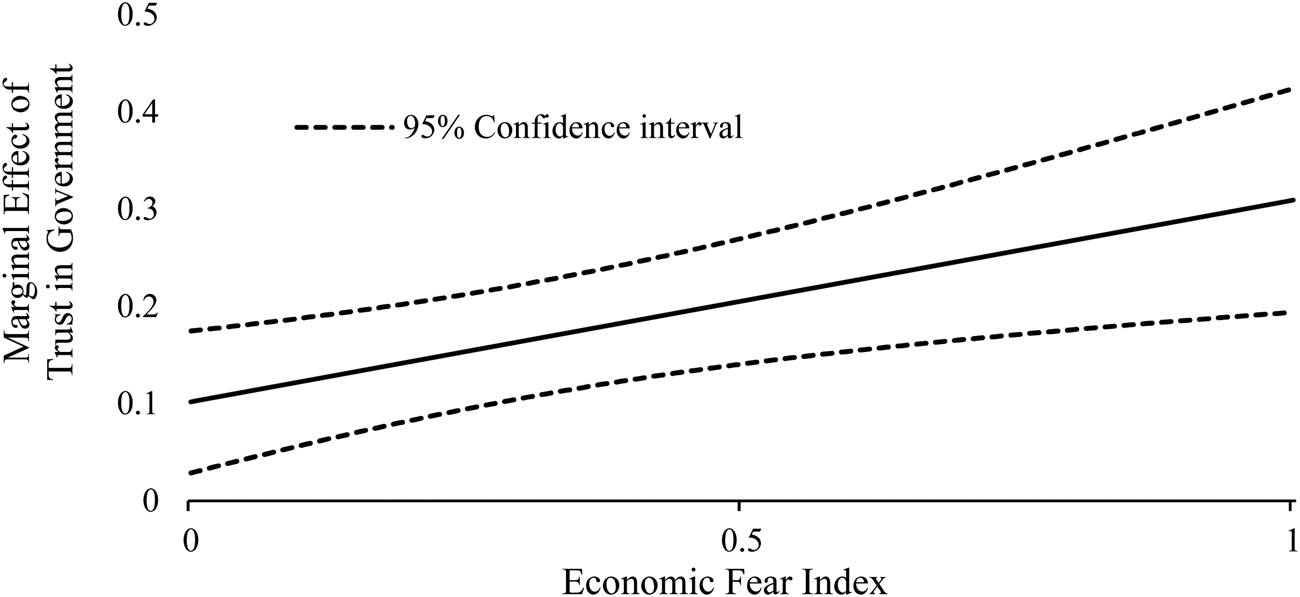
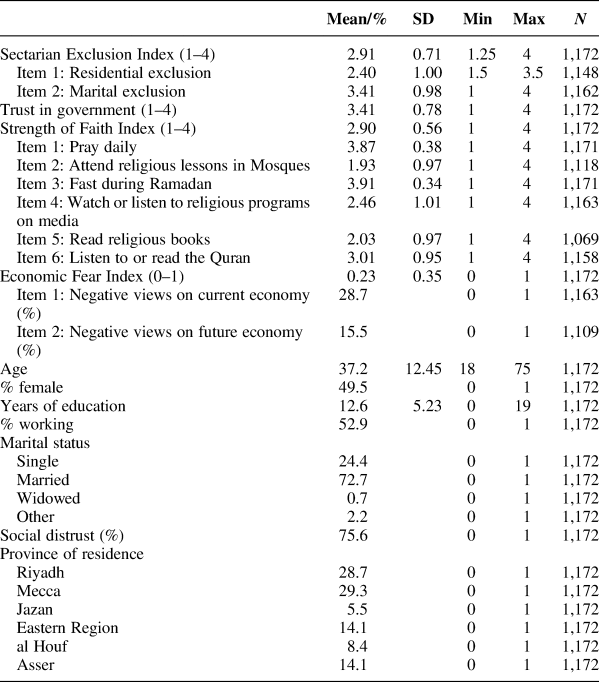
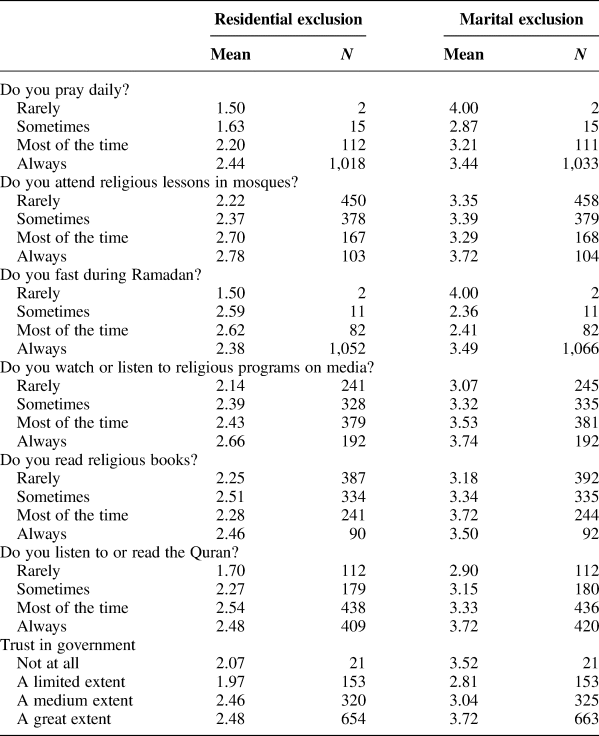
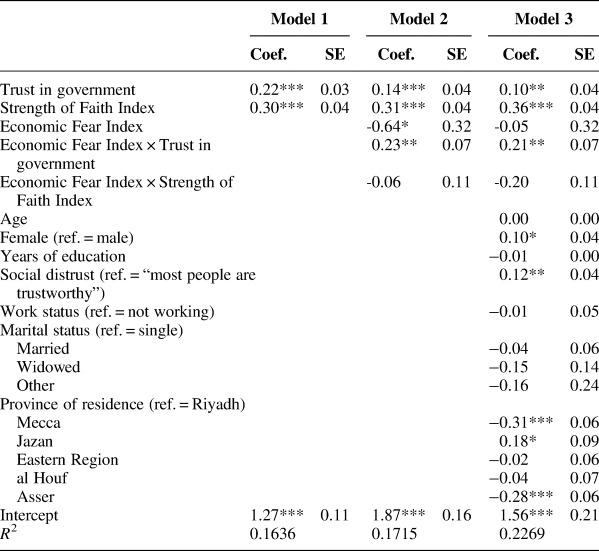
Table 1 shows the descriptive statistics of the analytic sample, including the component items of the three indices. Table 2 presents the conditional means of the sectarian exclusion variables by various items measuring the strength of belief and trust in government. These descriptive bivariate results based on sample data allow us to determine if linear models are properly motivated. Finally, we formally test the three hypotheses using linear models with interaction terms. The model results are summarized in Table 3 and Figure 1.
The marginal effect of trust in government on Sectarian Exclusion Index.

Descriptive statistics

Note: All items of the Strength of Belief Index are based on a four-point scale measuring behavorial frequency (1-rarely, 2-sometimes, 3-most of the time, 4-always).
Source: Arab Barometer 2011 (Saudi Arabia, analytic N = 1,172).
Sectarian exclusion indicators by strength of faith and political trust

Notes: Both exclusion indicators are coded on a four-point-scale with integer-scoring. Sample size varies across different bivariate contingencies in this table, but the valid N for the composite indices based on these variables is consistently 1,172.
Source: Arab Barometer 2011 (Saudi Arabia).
OLS regression models predicting the Sectarian Exclusion Index

Note: * p < 0.05, ** p < 0.01, *** p < 0.001 (based on two-tail t-tests).
Source: Arab Barometer 2011 (Saudi Arabia, analytic N = 1,172).
RESULTS
Sample Description
As shown in Table 1, our analytic sample contains 1,172 Sunni respondents. We notice that the sectarianism toward the Shi‘a minority is rather strong. Nearly half of the sample, 45%, would not accept neighbors from other religious sects, leading to an average score of 2.40 on a four-point scale. In terms of inter-sectarian marriage, 80% of the respondents objected and approximately 70% strongly objected, yielding a much higher average of 3.41. Taken together and weighted equally, they contribute to a composite average of 2.91 for the Sectarian Exclusion Index.
Overall, our Sunni respondents show a high level of trust in the Saudi government (3.41) and fairly strong religious belief (2.9). More concretely, we see that 85% of the sample trust the government while 56% trust the government very much. The strength of faith is revealed by frequencies of six behavioral indicators, among which fasting (3.91) and daily prayer (3.87) appear to be the most practiced items. The equally weighted composite index sits at a moderately high average level on the four-point scale, 2.9, and houses rich gradational variations.
Though it is not our primary concern to investigate how people's economic views influence sectarianism, we need the Economic Fear Index to construct the interaction term. As illustrated in Table 1, 28.7% of the respondents held negative views toward current economic conditions while 15.5% were pessimistic regarding the future economy. The average of these two items yields a moderately low level of overall economic fear, 0.23, on a range between 0 and 1. Thus constructed, the index provides more internal variation with stronger identification power.
Table 1 also describes the control variables. After data restrictions, the remaining 1,172 respondents in the analytic sample provide a reasonable collective Sunni adult profile in Saudi Arabia. The sample is gender-balanced, 49.5% female. The average age is 37.2 years old and the majority of respondents, 72.7%, are married. The mean years of schooling is 12.6 years, yielding an average education level of high school graduates. Over half of the sample, 52.9%, primarily men, participated in the labor force.
Sectarian Intolerance by Religiosity and Trust in Government
In Table 2 we present the conditional means of residential and marital exclusions (component items of the outcome index) by all six religiosity items and the trust in government. Based on our research hypotheses, we expect to observe higher means of the exclusion variables for those who are more religious as well as those who hold stronger trust in government.
First, we examine the contingencies between the exclusion sentiments and the strength of faith. As shown in Table 2, the mean of residential exclusion rises steadily from 1.50 for those who rarely pray daily to 2.44 for those who always pray daily. Marital exclusion shows similar dependency on the prayer variable—the highest mean (4.00) for the category “rarely” is a result of random disturbance due to the extremely small group size. It then increases, from 2.87 to 3.44, as the prayer frequency goes up. Such a pattern of positive association is consistent across all six forms of religious behavior. It is clear that as our respondents show stronger religious beliefs, their residential and marital exclusion sentiments tend to increase.
Our second hypothesis identifies the state as an independent source of sectarian intolerance. If that is true, those who trust the government more would display stronger sentiments of exclusion. According to our sample results, the residential exclusion rises from 2.07 to 2.48 as trust in government increases. Similarly, the marital exclusion also increases from 2.81 to 3.72 across “limited” to “great” trust in government. We acknowledge that the two exclusion variables are not at their lowest levels among those who do not trust the government at all, but that could be a random error because there are only 21 individuals in that category.
In sum, these findings are in favor of our first and second hypotheses—that sectarian intolerance is attributable to both religion and the state. Nevertheless, Table 2 provides only suggestive evidence as all the bivariate contingencies are based on sample data without statistical inferences. To test our hypotheses for the Sunni adult population in Saudi Arabia, we now continue to regression models.
Regression Models
Table 3 summaries the results of three regression models. The models are constructed in a progressive sequence. Model 1 estimates the observed effects due to religion and government. Model 2 further includes economic fear and its interactions with the two main effects. Model 3 is the full model that also controls for all other covariates.
Model 1 clearly shows the two independent sources of sectarianism—religion and government. The coefficients for the trust in government and Strength of Faith Index are both positive and statistically significant at 0.001 level. Specifically, as one's trust in government increases by one unit, his/her Sectarian Exclusion Index score is expected to increase by 0.22. Independent of that, a one-point increase in the Strength of Faith Index score will on average raise one's Sectarian Exclusion Index by 0.30. Taken together, they explain 16.36% of the variation in the outcome.
Model 1, however, does not represent our argument in full. We have proposed a concrete mechanism of the state-based intolerance—economic scapegoating. If the economic scapegoating has been at work, those respondents with more negative views on the economy are expected to respond more strongly to the government's incitement of sectarian intolerance. In statistical language, this means that the marginal effect of trust in government is not constant as in the additive Model 1. Rather, it depends on the perception of the economy.
Accordingly, Model 2 further considers the role of economic fear in an interactive manner. We created its interactions with both trust in government and Strength of Faith Index. As expected, the former interaction term bears a positive coefficient, 0.23, which is statistically significant at 0.01 level. This means that the state-based intolerance is indeed strengthened by fears of a bad economy. Meanwhile, Model 2 also tells us that the economic scapegoating is a political but not religious mechanism, as the interaction between Economic Fear Index and the Strength of Faith Index does not yield significant coefficient. Though not a focal finding, this is consistent with the literature and our conceptualization. Collectively, these variables account for 17.15% of the outcome variation. Compared to Model 1, there is a modest increase in model fit (0.79%), yet an F-test shows that this is a significant improvement (at 0.05 level) at the expense of three degrees of freedom.
So far, we have gained some tentative evidence for all three of our hypotheses. To access the net effects, we continue to estimate the full model controlling for all the covariates. As shown by Model 3, our key findings are independent of the influences due to demographic composition, socioeconomic conditions, social distrust, and regional differences. The main effects of religiosity and the government are both positive and significant, and so is the interaction effect between trust in government and economic fear.
Our interactive model requires careful interpretation of the marginal effect of the trust in government. The main effect coefficient (0.1) and its standard error (0.04) are valid only when the conditioning variable is 0—or substantively when there is no economic fear. The positive interaction effect (0.21) means that the marginal effect of trust in government increases as the economic fear goes up. The question is, will the increasing marginal effect continues to be significantly different from zero? In Figure 1, we plot out the marginal effect of trust in government over the entire span of Economic Fear Index. It is clear that the effect rises from 0.1 to approximately 0.3 across the span, and its lower bound of the 95% confidence interval is consistently above zero. These results provide strong support for our state-based intolerance and the economic scapegoating hypotheses.
DISCUSSION AND CONCLUSION
Religious sectarianism has deep roots in the Middle East. In lieu of the long historical wounds, its revival inflicted renewed pain in the turmoil following the Arab Spring. To better understand sectarian sentiments in the Middle East, we propose a more thorough examination of its ideational sources. This paper argues that religious sectarianism is not just a function of religiosity or religious teachings within the Saudi religious establishmentFootnote 8, rather it is politically motivated. In particular, we argue that the state often capitalizes on people's fear of economic adversities to incite sectarianism. This blame game is commonly used as a strategy to reinforce regime legitimacy among the vast majority of Saudis by creating a diversion from political mobilization and popular demands for political changes. Hence, it serves as a counter-revolution tactic for the state during times of economic insecurity.
With survey data from the Arab Barometer, we examined such political psychology in Saudi Arabia in 2011, at the onset of the Arab Spring. The empirical analysis yields favorable evidence for all our hypotheses. First, Sunni Muslim sentiments of sectarianism were indeed associated with religiosity. Second, in addition to religiosity, the Saudi government had independently provoked Sunni sectarianism. Finally, state-based sectarianism was in part incited by the blame game in which the government scapegoated the Shi‘a communities for bad economic conditions and potential economic downturns.
Theoretically, this paper makes distinct contributions to the literature on the political psychology of Islamic sectarianism. Most importantly, we highlighted the analytical distinction between the religious and political sources of sectarian sentiments. This establishes that within the Saudi context, sectarianism does not serve merely as attitudes among the population, rather it is a result of state policies invoked to encourage and increase such sentiments. The previous empirical studies that seek to account for religious sectarianism have focused chiefly on the micro-level explanations pertaining to one's religious life. This reinforces the impression that sectarianism is primarily baggage from one's religious past. This view needs to be balanced. As we have shown, sectarianism also finds its source in political institutions. Therefore, a macro-level mechanism is also at work where the state seeks to engineer a political prospect. In fact, our models indicate that the state-based sectarianism is even greater in magnitude than that based on religiosity.
This paper also makes several methodological advances. To our knowledge, it is the first quantitative analysis that directly addresses politically motivated sectarianism in a Middle Eastern society. It also provides a successful operationalization that pins down the political psychology of economic scapegoating. Due to data availability, our analysis is limited to Saudi Arabia in 2011. Nevertheless, the conceptual framework and empirical strategies proposed in this paper can be applied to understanding religious sectarianisms in other parts of the Middle East.