Once viewed as a single disease, breast cancer is now recognized as a heterogeneous disease with distinct biological subtypes (Reference Carey, Perou and Livasy1). With this nuanced recognition of tumor biology, we better understand interactions between tumor genetics and treatment response. Thus, genetic technologies are changing the landscape for breast cancer treatment.
Oncotype DX (ODX) is a twenty-one–tumor gene-profiling panel that estimates 10-year risk of recurrence and benefit of adjuvant chemotherapy among early-stage, estrogen receptor positive (ER+) breast cancer patients, thereby improving treatment decision making (Reference Paik, Tang and Shak2). Specifically, women with low risk scores are recommended to forgo, and women with high risk scores to take, adjuvant chemotherapy; research on chemotherapy benefit among women with intermediate risk scores is ongoing (3). Evidence suggests that ODX reduces adjuvant chemotherapy use among women with low risk scores, saving patients from significant costs and harms of adjuvant chemotherapy overuse (Reference Joh, Esposito and Kiluk4–Reference Henry, Stojadinovic and Swain6).
In the United States, while similar tumor gene profiling panels are available, ODX use specifically is widely available. Private insurers began reimbursing for ODX in 2005, and Centers for Medicare and Medicaid Services followed in 2006 (Reference Trosman, Van Bebber and Phillips7). Although clinical guidelines began recommending ODX in 2007 (Reference Trosman, Van Bebber and Phillips7), fewer than half of guideline-eligible women are receiving ODX testing (Reference Lund, Mosunjac and Davis8–Reference Albanell, Gonzalez and Ruiz-Borrego11). Reasons for its low use are not well understood. Because treatment decision making is a nuanced process, secondary data are unlikely to capture the complex factors related to ODX use and subsequent adjuvant chemotherapy decision making. Thus, we sought to better understand oncologists’ recommendation patterns for ODX and to identify organizational (e.g., organizational facilitators and marketing), interpersonal (e.g., peer usage), and intrapersonal (e.g., provider beliefs and attitudes) factors influencing ODX testing for treatment decision making (Reference Frambach and Schillewaert12).
METHODS
Study Design
We conducted ~30-minute semi-structured, qualitative telephone interviews with oncologists across North Carolina (NC). The interview guide was motivated by a dissemination and implementation conceptual model (Reference Frambach and Schillewaert12) in which barriers and facilitators influencing oncologists’ use of ODX occur at the organizational, interpersonal, and intrapersonal levels (Supplementary Figure 1). We conducted interviews until theme saturation was reached and no new themes emerged (n = 15). Interviews were conducted by one author (M.C.R.); a second author (A.B.) listened, identified areas for probing, and took notes. All interviews were digitally recorded, professionally transcribed, de-identified, and analyzed using Atlas.ti (Berlin, Germany).
Participants and Recruitment
We used purposive sampling to identify NC surgical and medical oncologists practicing in community or academic settings through the NC Oncology Association and NC Medical Licensure Web sites and through contacts with clinical partners. Potentially eligible oncologists were emailed or faxed a recruitment letter, asking those interested in participating to contact the researchers to confirm eligibility based on criteria included in the recruitment letter. Oncologists were eligible if they saw greater than or equal to five breast cancer patients/week to establish care, undergo treatment, or for follow-up. After scheduling a phone interview, oncologists completed an electronic informed consent and brief demographic survey. Oncologists received $100 gift cards for participating.
Data Collection and Data Analysis
We used template analysis, which permits for both inductive and deductive approaches to qualitative analysis by allowing a priori codes to be modified, removed, and augmented before coding all transcripts (Reference King, Symon and Cassell13). Template analysis follows several steps. First, our initial coding template included a priori codes reflecting the conceptual model domains (attitudes toward the innovation, organizational facilitators/internal marketing, social usage, personal dispositional innovativeness) (Reference Frambach and Schillewaert12). M.C.R. and A.B. matched these initial codes to five interview transcripts, matching a priori codes to text that corresponded with code themes. Next, the initial template was revised, and emergent codes were added in a hierarchical manner to create a final coding template (Supplementary Table 1) that was applied to all transcripts, including transcripts used for consensus building. Consensus was reached qualitatively on coding for the first five transcripts to ensure agreement across coders. Data were analyzed and organized by oncologist recommendation patterns, as well as factors that influenced ODX use at the organizational, interpersonal, and intrapersonal levels. Unadjusted proportions and means were reported for demographic data. This research was approved by the University of North Carolina Institutional Review Board.
RESULTS
Oncologist Characteristics
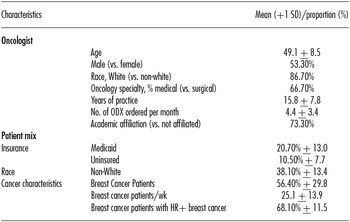
After interviewing five surgical and ten medical oncologists across ten healthcare settings, theme saturation was reached. On average, participants ordered four ODX tests/month and had practiced for 16 years (Table 1). On average, they saw 25.1 breast cancer patients/week and estimated that approximately 70 percent of their patients had hormone receptor positive breast cancer. When asked “among my peers, I am usually the first to try out new medical technologies for clinical care” on a Likert scale (1 = strongly agree; 7 = strongly disagree), most “somewhat agreed” (n = 6; 40 percent).
Participant Characteristics (n = 15)

ODX, oncotype DX; HR+, hormone receptor positive; SD, standard deviation.
ODX Recommendation and Use Patterns
Factors influencing oncologist recommendation for ODX testing crosscut organizational, interpersonal, and intrapersonal levels. Oncologists typically determined eligibility for ODX based on tumor characteristics, age, comorbidities, and patient preferences. Though variation existed, most oncologists believed that patients with human epidermal growth factor receptor 2 (HER2) negative, ER+, stage 1 and node negative breast cancer were appropriate candidates for ODX. While a few oncologists restricted their recommendations for ODX use to Stage 1 only, most considered it for Stage 2 breast cancers. Overall, this aligns with current clinical guidelines recommending ODX for HER2 negative, ER+, stages 1–2, node negative, >0.5 cm tumors (Reference Harris, Fritsche and Mennel14).
Oncologists were less likely to recommend ODX for women who may not be candidates for chemotherapy due to extensive comorbidities, advanced age, or life expectancy <10 years. Young age seemed to influence ODX test use in two ways: (i) bias toward recommending adjuvant chemotherapy in younger women, making ODX testing unnecessary and (ii) lack of validated data for ODX test use among premenopausal women, resulting in less use:
Even though the original publication of the Oncotype validation tried to say that age really wasn't a factor. . .I'm still not totally convinced. I think that there is some reason to doubt that it functions in quite the same way in younger women. Those patients oftentimes will decide to take chemotherapy anyway; not often but a handful. Provider (P) 15
While many oncologists believed that most patients are open to receiving ODX, patient preferences played a large role. The vast majority of oncologists reported being unlikely to order ODX if a patient expressed a clear preference against chemotherapy, because the test result would not provide actionable information. Several oncologists stated that before ordering ODX, they discussed patient preferences so patients understood how the ODX risk score might inform their decision about adjuvant chemotherapy. When a patient's preference toward chemotherapy was not aligned with how the ODX score could influence treatment decisions, oncologists often did not order ODX. Patient preferences may partially explain why some guideline eligible women do not receive the test.
The most variation was in node positive disease: At the time of this study, ODX testing in node positive disease was not guideline recommended; however, new evidence suggested it may be applicable. (Reference Wong, Ramsey, Barlow, Garrison and Veenstra15). Twelve oncologists reported ordering ODX for node positive patients less frequently than node negative patients. Many oncologists referenced only using ODX for node positive patients in two major ways. First, oncologists used patient enrollment into the Rx for Positive Node, Endocrine Responsive Breast Cancer (RxPONDER) clinical trial (Reference Wong, Ramsey, Barlow, Garrison and Veenstra15) to motivate the use of ODX among certain women with positive lymph nodes. While women with one to three positive lymph nodes were eligible for the RxPONDER study, some oncologists only ordered ODX for women with one to two positive nodes. Oncologists were most comfortable recommending ODX to node-positive patients with otherwise favorable histological (e.g., lobular) and tumor (e.g., low grade, small size) characteristics. Second, oncologists commonly reported ordering ODX in node positive disease to find evidence to forgo chemotherapy in elderly, sick, or frail patients. Many oncologists expressed no hesitation in using ODX among women with micro-metastases. Hesitation around using ODX testing in node positive patients largely came from lack of evidence that ODX predicts chemotherapy benefit in this population.
Organizational-Level Factors
One organizational challenge resulted from departmental silos (surgical versus medical oncology; pathology versus oncology). Oncologists mentioned that departmental silos were more common when ODX was first introduced, suggesting an organizational learning curve:
I think how it was working before is we would call the pathology department. . .my nurse would have to walk up there, get the blocks herself, get the Oncotype kit, fill out all the paperwork, and mail it. Now we just call pathology and they mail it. P9
Several oncologists indicated that having a single nurse or staff member responsible for ordering ODX might address this challenge. Furthermore, oncologist roles in ordering ODX shifted to a more organized process over time:
At present, just the medical oncologists are [ordering the test]. When the test first came out and before we formulated the multidisciplinary breast group, we had radiation doctors ordering it and surgeons ordering it. . .And so it wasn't really being used appropriately in every instance. It was nice sometimes to have the results available right then when you talk to the patient. But that wasn't appropriate in all the situations. P14
Overall, multidisciplinary teams seemed to facilitate decision making about which patients would benefit from ODX and provided an organizational structure to reduce departmental silos as a barrier to ODX use:
It's actually very simple [to order] because we have a multidisciplinary clinic where we have a medical oncologist and a surgeon working side by side all day long every day. So, we literally just walk over with the path report, say ‘Ms. X has just come back from the operating room for a return cancer operation.’ We decide what to do and move ahead. P5
Virtually all oncologists had at least one interaction with the Genomic Health Marketing team. In general, Genomic Health representatives and/or resources seemed to facilitate ODX use through: (i) training for ordering and using ODX, (ii) offering support around coverage/reimbursement for ODX, and (iii) providing educational materials and current research results around its effectiveness. Oncologists also indicated that easy online ordering, results, resources, and printable test reports facilitated use of ODX.
Ten oncologists discussed insurance coverage. In node positive patients, insurance coverage outside of clinical trials was often seen as a barrier for using ODX. Oncologists noted that insurance policies did not “keep up with the science,” referencing new observational studies that demonstrate effectiveness of ODX in node positive disease. Notably, insurance was no longer viewed as a barrier for women with node negative disease. Oncologists suggested that if evidence accumulates for using ODX in node positive disease, clinical guidelines and insurance coverage may continue to change accordingly. Until then, several oncologists noted that Genomic Health offers payment assistance programs for eligible patients for whom insurance does not fully cover the cost of ODX.
Organizational barriers to ODX use delayed, rather than prevented, receiving results from Genomic Health. One oncologist noted:
The biggest delay I've seen is from insurance companies making approval. And most end up doing it. Like I said before, very few have said “no.” But that's usually the biggest delay is them dragging their feet to approve it and it adds another week or two. . .this isn't as big anymore. P9
Another oncologist elaborated how these delays influence the patient:
So, once surgery is completed and you've got a pathology report then there's still a delay. . .and so it drags things out for the patient. And there's an anxiety associated with that. P4
While delays were not viewed as compromising treatment trajectory, they were inconvenient to patients and increased their anxiety. Two oncologists emphasized that these delays can be particularly difficult for patients living in rural areas or travelling long distances for care.
Interpersonal-Level Factors
Oncologists discussed how norms and physician roles influenced their use of ODX. Overall, oncologists believed that there was greater buy-in for ODX compared with alternative tumor gene profiling panels. Several oncologists referenced consensus around ODX use for managing early stage, ER+ breast cancer. Because medical oncologists typically ordered ODX, discussed ODX results with patients, and ordered adjuvant chemotherapy, ODX recommendations often came from them rather than surgical oncologists. While medical and surgical oncology roles were sometimes well-coordinated, discordant beliefs and disagreements occurred when they used different criteria for ODX recommendation. For example, one medical oncologist stated:
One [surgical oncologist] doesn't order it. The other one does, and it drives me nuts. . . . They order it on a four-millimeter patient. . . .It puts me in a bind. . .I never would have ordered it or even brought it up. P7
One surgical oncologist discussed introducing ODX to patients before they see their medical oncologist, because ODX is not used across the board:
I will discuss Oncotype as part of “this may play a role in determining whether you benefit from chemotherapy.” And I do that as part of my discussion as the surgeon so that it puts it out on the table and then [they] can force the issue with the medical oncologist. . . .While it's now more in the standard, it is not completely embraced across the board. P4
Some oncologists mentioned that ODX recommendations beyond node negative patients are becoming more common, but norms vary across healthcare settings:
I traditionally order Oncotype in my node negative, ER positive patients. I know across the United States there's been more of a push to use Oncotype in the node positive. P6
There are people who use it kind of emphatically in the one to three lymph node groups. I think I use it still more sparingly until we have prospective data. . . . P10
Intrapersonal-Level Factors
Attitudes and beliefs about ODX use fell into three categories: attitudes toward ODX, perceived barriers, and perceived research gaps
Attitudes Toward ODX: Overall, oncologists had positive attitudes toward ODX, because it provided clinically relevant results that they and their patients could use to make treatment decisions, saving some patients from unnecessary treatment:
Quite honestly, [they] used to be frustrating discussions for all of us, because we knew that there was a significant portion of the ER positive node negative disease that we were giving chemotherapy where we probably were not benefitting patients at all. P15
One oncologist noted that test results helped frame discussions with patients regarding their future health and survival:
It's oftentimes the case in early stage breast cancer discussion that the focus. . .very quickly, goes to the local, regional management. And that's fine to some degree. But it can't come at the cost of patients losing sight of the importance of the systemic therapy. Ultimately. . .the discussion I think helps to put the issue and the problems they need to think about in the right context. One of the strengths is [that it] quantifies their risk in a way that for most patients is quite reassuring. P15
Some oncologists mentioned that patients are increasingly familiar with ODX when they enter their offices, facilitating patient understanding of the test and results. Oncologists reported using ODX over alternative tumor gene profiling panels, because ODX does not require fresh tissue (like Mammaprint), making it more convenient and feasible, especially in small, rural communities. Two oncologists noted that the receptor status information that ODX provides is useful to ensure that patients’ tumors are properly classified.
Oncologists’ Perceived Barriers: Oncologists discussed frequent difficulty with communicating the purpose of ODX testing to patients:
I think sometimes they can confuse Oncotype DX testing with genetic testing with BRCA 1 and 2. . .Either they're very overwhelmed or I'm not explaining it clearly enough or it's not concrete enough at that point in their process of their treatment. P8
Explaining risk of recurrence and risk reduction was challenging because the nuances often led to “information overload.” One oncologist reported that low risk scores can result in misconceptions about the need for other risk reduction strategies. For example, women may interpret low ODX risk scores to mean that other adjuvant therapy is unnecessary, when endocrine therapy is still recommended. Patient misconceptions occurred not only about the test and its interpretation, but also about its perceived cost, which can be a barrier to testing. To address patients’ misconceptions, several oncologists emphasized the need to discuss ODX across multiple visits.
Overall, oncologists reported that low risk patients forgo, and high-risk patients receive, chemotherapy; discordant chemotherapy decisions were rare, and often resulted from patient preferences. However, intermediate risk results posed a challenge to oncologists. Oncologists often created rules for navigating adjuvant chemotherapy decision making in the intermediate ODX risk group. Approximately half of the oncologists created their own cut-off points within the intermediate group for recommending adjuvant chemotherapy. One oncologist stated that, as a rule, s/he recommends adjuvant chemotherapy to most patients within the intermediate risk group; another oncologist rarely did so. Approximately one-third of oncologists used “old fashioned” clinical and tumor characteristics (tumor size, grade, age, comorbidities) when recommending chemotherapy in the intermediate risk group. Because there is no definitive evidence of benefit to chemotherapy in this risk group, oncologists emphasized the importance of patient preferences in decision making and used a combination of approaches. For example:
It's a joint decision about whether or not to give chemotherapy. . .if it's towards the low end of intermediate; I'm comfortable not giving chemotherapy. If it's towards the high end, then I'm more likely to recommend chemotherapy–but add into that also such things as age. P1
Perceived Research Gaps: Oncologists thought future research should examine what patients understand about ODX and how to best communicate ODX testing and results with patients. Oncologists pointed to weaknesses in current studies, which underrepresent younger women. Because women in validation studies were taking endocrine therapy, oncologists discussed the need to understand ODX's predictive validity when patients are not prescribed or appropriately taking this therapy. Several hoped that the Trial Assigning Individualized Options for Treatment (TAILORx) trial will provide oncologists with more information about managing women with intermediate risk scores (3). They also wanted more research on ODX effectiveness in real world settings that consider additional patient outcomes (e.g., survival). Finally, oncologists voiced a need for genetic technologies that not only describe which patients would benefit from chemotherapy, but also which chemotherapy regime would be most effective.
DISCUSSION
To date, few qualitative studies examined oncologist and system-level factors that influence the use of ODX in clinical care, one of which focused more broadly on barriers common to both BRCA1/2 (breast cancer genes 1 and 2) and ODX testing (Reference Weldon, Trosman, Gradishar, Benson and Schink16). Together, those studies indicated that characteristics of the test (i.e., interpreting intermediate results) (Reference Spellman, Sulayman and Eggly17), use of multidisciplinary teams (Reference Spellman, Sulayman and Eggly17), test coordination (including reimbursement) (Reference Weldon, Trosman, Gradishar, Benson and Schink16), and patients’ out-of-pocket costs (Reference Weldon, Trosman, Gradishar, Benson and Schink16;Reference Baumbard, Rozmovits and Tredeau18) created barriers to genetic technologies in clinical practice. Furthermore, oncologists worried that testing could be used inappropriately (Reference Spellman, Sulayman and Eggly17;Reference Baumbard, Rozmovits and Tredeau18) or delay treatment (Reference Weldon, Trosman, Gradishar, Benson and Schink16). One study identified a need for decision aids to improve patient's understanding of ODX test results (Reference Baumbard, Rozmovits and Tredeau18).
We extend findings from those studies by using rigorous, theory-driven qualitative methods to examine how organizational, interpersonal and intrapersonal factors influenced ODX use, and we explored nuances across node positive and node negative breast cancer patients. Overall, our findings corroborate previous findings; however, most oncologists in our study viewed multidisciplinary teams as facilitators to ODX use. Previous studies also indicated that costs were a barrier for ODX use. While we found this to be true for node positive patients, costs were rarely reported as a barrier for node negative patients. It is possible that stage of adoption and insurance coverage of ODX varied across study settings (Reference Roberts and Dusetzina19).
Our study contributes to the literature by identifying several organizational factors that are important during the uptake of this genetic testing in a multi-payer healthcare system. Specifically, departmental structure, workflows for ordering tests and insurance policies, were discussed frequently. The extent to which these factors acted as barriers seemed to decrease over time, suggesting that organizational barriers may be especially critical to address when first adopting genetic technologies. Furthermore, oncologists’ normative beliefs have changed over time to embrace ODX in the node negative setting; with increasing evidence, beliefs are beginning to shift in node positive disease.
Research evidence was viewed as essential to oncologist acceptance of ODX. Respondents sought evidence from research among real world patients, which may be more feasible in the future using cancer registries and health information technology. Because patients demonstrate poor understanding of ODX and interpretation of results (Reference Brewer, Richman, DeFrank, Reyna and Carey20;Reference Leggett, Lorenzetti and Noseworthy21), future research should examine best practices for how oncologists communicate this information so that they can optimally use results from genetic tests to help patients make informed treatment decisions. Equally important, guideline support and insurance coverage for technologies that demonstrate comparative effectiveness relative to the status quo will be important in facilitating their use. Rapidly incorporating these technologies into insurance policies and practices may present challenges for policy makers. It will be imperative that financial barriers do not preclude low socioeconomic patient subgroups from accessing these technologies and contribute to existing disparities in access and quality care.
Finally, oncologists described attending to patient preferences for adjuvant chemotherapy and other clinical factors when determining for whom ODX was appropriate. These factors were weighed differently across oncologists (intrapersonal-level) and multidisciplinary teams (inter- and organizational-levels). By incorporating these factors, oncologists appear to be adapting for whom the test is used. These recommendation patterns along with other reported barriers may partially explain low rates of ODX uptake among guideline eligible patients (Reference Lund, Mosunjac and Davis8–Reference Albanell, Gonzalez and Ruiz-Borrego11).
The main limitation of this study is relates to recruitment: (i) we only included NC oncologists and results may differ from other states or international settings, and (ii) respondents may differ from oncologists who declined to participate.
CONCLUSIONS
ODX represents an example of the successful genetic technology that has reshaped treatment decision making for women with ER+, early stage breast cancer. As such, it presents an important model for incorporating a genetic technology into the standard of cancer care. Our findings highlight the importance of multi-level factors in the use of ODX testing. Moving forward, studies should examine how the identified organizational factors influence uptake and use of ODX, controlling for oncologist-level variation. As more genetic technologies become available, our findings can facilitate their uptake across oncologists and healthcare settings. Finally, additional evidence is needed to better understand the effectiveness of ODX in treatment decision making and outcomes (Reference Dinan, Mi and Reed22).
SUPPLEMENTARY MATERIAL
Supplementary Figure 1 and Table 1: www.journals.cambridge.http://dx.doi.org/10.1017/S026646231600060X
CONFLICTS OF INTEREST
Dr. Michaela Dinan has done consulting for Salix unrelated to this work. The remaining authors declare that they have no conflict of interest.