





Impact statement
This paper shows that contemporary biodesign has been built by highly educated yet largely self-taught practitioners who learn through DIY experimentation, informal infrastructures and improvised “kitchens-as-labs,” rather than standard bioscience curricula. It proposes an emerging biodesign framework that helps universities standardise biodesign education without erasing the experimental, craft-led and subversive practices that make the field innovative and socially relevant.
Introduction
Biodesign has emerged over the past two decades as a nascent and still loosely defined field that encompasses diverse practices such as biomaterials, bioart and biofabrication. It operates across a wide range of designer-scientist relationships and contexts, from speculative installations to applied material innovation (Gough et al. Reference Gough, Yoo, Tomitsch and Ahmadpour2021). This conceptual openness has produced fluid definitions, unclear professional identities and a lack of a standardised pathway into practice.
While biodesign holds significant potential to disrupt established design systems, it remains marginal within traditional design pedagogy (Thies Reference Thies2024). A central tension increasingly defines the field: as universities begin to formalise biodesign within curricula, many practitioners continue to enter the field through self-directed and informal pathways. Existing studies show that biodesigners frequently come from non-biological backgrounds and acquire biological knowledge through experimentation, shared protocols and improvised infrastructures (Eireiner Reference Eireiner2025; Myers Reference Myers2012; Pollini Reference Pollini2024). These trajectories challenge conventional understandings of expertise and education.
Biodesign literacy, in this sense, extends beyond the ability to describe biological concepts, requiring instead the capacity to apply knowledge across domains and contexts (Klymkowsky et al. Reference Klymkowsky, Garvin-Doxas and Zeilik2003). The Biopunk Manifesto further distinguishes scientific education from scientific literacy, defining literacy as the ability to engage in scientific practice outside formal institutional structures (Patterson, as cited in Keulartz and van den Belt Reference Keulartz and van den Belt2016).
Such forms of learning are strongly rooted in DIY-bio communities, where hands-on experimentation, low-cost tools and collaborative knowledge exchange support decentralised models of innovation (Delfanti Reference Delfanti2013; Delgado Reference Delgado2013; Roosth et al. Reference Roosth, Helmreich and Fischer2010). In these contexts, biology is approached as a material to be explored, manipulated and reconfigured through iterative and craft-based practices rather than standardised protocols (Roosth et al. Reference Roosth, Helmreich and Fischer2010; Seyfried and Schmidt Reference Seyfried, Pei and Schmidt2014). Initiatives such as Waag Society, Blue City Lab or Genspace illustrate how artists and designers engage with these environments to raise ethical, cultural and aesthetic questions around biotechnology (Keulartz and van den Belt Reference Keulartz and van den Belt2016). Many biodesign educators have emerged from these experimental and extra-institutional contexts. When entering academia, they often encounter a mismatch between their pedagogical approaches and institutional expectations related to scientific rigour, laboratory infrastructure and curricular control.
This paper examines this transition. Specifically, it asks: how can self-taught biodesign educators translate their experimental and subversive learning trajectories into university curricula in ways that preserve their defining characteristics while fostering explicit forms of biodesign literacy? In this context, subversive practices refer to pedagogical and material practices that evolve at the margins of formal design and science education, for example, in DIY labs, kitchens-as-labs and craft-based experiments, which unsettle where and how biological learning is supposed to happen. This aligns with the understanding of pedagogies as ontological, allowing space for them to become subversive: to exist in unexpected places and spaces; to take multiple and diverse forms; and to have greater capacity and reach than is often assumed (Schick and Timperly Reference Schick and Timperley2021).
Addressing both educators and institutional decision-makers, the study combines a focused literature review, a survey of 46 biodesign practitioners and autoethnographic teaching cases to analyse how biodesign is currently learned, practiced and institutionalised. Building on this analysis, it proposes an emergent framework for biodesign literate and subversive biodesign education. Marginal and improvised conditions such as DIY labs, kitchens-as-labs and craft-based experimentation have enabled alternative forms of knowledge production, fostering sensitivity to contamination, growth, decay and failure, yet as biodesign becomes institutionalised there is a risk that these qualities are lost in favour of standardised laboratory models.
Background: biodesign literacy and subversive practices
Biodesign is widely described as a rapidly evolving and often radical field positioned at the intersection of the life sciences and design practice (Myers Reference Myers2012). However, the literature also reveals a proliferation of conceptually hazy and ambiguous terms such as biofabrication, biobased materials, biomaterials, bioart, biomimicry, biologically informed and bioinspired approaches, each grounded in distinct epistemic traditions broadly connected to life and living systems. Central to many of these approaches is the notion of “livingness,” understood here as the capacity of artefacts to grow, adapt, respond and eventually decay (Huber and Müssig Reference Huber and Müssig2025; Kapsali Reference Kapsali2022; Karana et al. Reference Karana, Barati and Giaccardi2020).
Alongside these terms, emerging concepts such as bio-craft and bio-calibrated tools signal a growing interest in craft-based, material-driven and tool-making practices within biodesign education (Diniz Reference Diniz2023; University of the Arts (UAL) 2024). At the same time, these terms contribute to the field’s fragmented vocabulary. In this landscape, biodesign often operates as an umbrella concept that gathers practices ranging from speculative installations to industrial materials without clear consensus on its boundaries.
In this study, biodesign is approached as a process through which designers create materials, artefacts or systems with, from and for biology, repositioning their role from industrial problem-solvers to mediators between human and ecological systems (Ginsberg and Chieza, Reference Ginsberg and Chieza2018). Within this perspective, this presupposes human–nature interdependence and positions biodesign literacy as a way for designers to engage responsibly with living materials and local ecologies (Collet Reference Collet2020; Kim et al. Reference Kim, Zhou, Groutars and Karana2022) rather than simply manipulating biological processes. Such an approach resonates with the EU GreenComp’s emphasis on embodying sustainable values (European Commission 2022), positioning biodesign education as a key tool for cultivating designers whose everyday practice is guided by ecological responsibility rather than purely industrial logics. Across the literature, two key pillars of biodesign consistently emerge: its deep connection to life and ecological systems, and its fundamentally interdisciplinary nature (Myers Reference Myers2012; Paoliello and Bandoni Reference Paoliello and Bandoni2024a; Bandoni et al. Reference Bandoni, Almendra and Forman2022).
The first pillar, connection to nature and life, is articulated through both biomimetic and more-than-human perspectives. Biomimicry frames nature as “model, measure, and mentor” (Benyus Reference Benyus1997), emphasising the translation of biological strategies into design solutions, while other authors argue for broader visions of “design for life,” in which biodesign reconfigures human–nature relations rather than merely exploiting biological processes (Paoliello and Bandoni Reference Paoliello and Bandoni2024b). Across these perspectives, a spectrum of engagement can be identified. At one end, biodesign draws inspiration from natural forms and strategies, as proposed by Benyus. At an intermediate level, it leverages natural processes and materials within predominantly anthropocentric logics, where it risks merely substituting conventional products and reinforcing existing systems, markets and ecological footprints rather than realising its transformative potential (Paoliello and Bandoni Reference Paoliello and Bandoni2024a). At the other end, biodesign engages with ecosystems and living materials through an epistemological shift that positions humans as part of nature rather than separate from or dominant over it, moving towards a biocentric and regenerative framework of “designing with the living” (Collet Reference Collet2017, Reference Collet2020).
The second pillar, interdisciplinarity, is equally central: collaborative projects highlight the need to integrate life sciences (microbiology, biotechnology, molecular biology) with design, craft and indigenous or territorial knowledge. In this sense, biodesign can be understood as a domain that brings together scientific research, technological development and situated forms of knowledge, including craftsmanship and territorial practices (Ginsberg and Chieza Reference Ginsberg and Chieza2018).
However, achieving a balanced integration of these fields remains difficult. Roshko (Reference Roshko2010) suggests that the biodesigner should ideally combine expertise in both biology and design, but in reality, such profiles are rare. Most projects rely instead on collaboration between specialists from different disciplines. These collaborations are inherently challenging, as they involve differences in terminology, methods and goals (Kim et al. Reference Kim, Nicenboim, Martins and Karana2025).
Studies of interdisciplinary work repeatedly highlight these difficulties. Benony and Maudet (Reference Benony and Maudet2020), analysing seven designer–biologist collaborations, show that designers typically lead the process, while biologists play a crucial but adaptive role, translating and grounding design ideas in biological knowledge. At the same time, designers often approach biology more as a material resource than as a scientific discipline, framing it as a tool for sustainable innovation rather than engaging with its full complexity (Ginsberg and Chieza Reference Ginsberg and Chieza2018).
Other recurring tensions in interdisciplinary collaboration include language barriers, misaligned expectations, different standards of evidence and questions of roles and authorship. As Kapsali (Reference Kapsali2022), drawing on Gunnarsson (Reference Gunnarsson2011), points out, even terminology plays a key role: while it helps define and position the field, the vocabulary of biologically informed design remains fragmented and ambiguous.
Within this context, biodesign literacy can be understood as a shared semantic and conceptual infrastructure that enables translation across disciplinary boundaries. It involves navigating multiple registers of language, scientific, technical, artistic and territorial, while working with organisms whose “livingness” (Karana et al. Reference Karana, Barati and Giaccardi2020) challenges established design categories. Biodesign literacy thus goes beyond biological knowledge, encompassing the ability to mediate across disciplines and to situate biological concepts within material practices, ethical frameworks and territorial knowledge.
Crucially, much of this literacy has developed outside formal institutions. DIY-bio communities have promoted learning by hands-on experimentation, low-cost tools and open knowledge exchange, positioning biology as a material for exploration and transformation rather than a domain governed exclusively by scientific authority (Delfanti Reference Delfanti2013; Roosth et al. Reference Roosth, Helmreich and Fischer2010; Seyfried and Schmidt Reference Seyfried, Pei and Schmidt2014).
As emerging evidence suggests, contemporary biodesigners often follow such trajectories, assembling knowledge through experimentation and bricolage across workshops, online resources and informal networks, before or alongside engaging with laboratories and scientific collaborators. In this sense, they can be understood as hybrid practitioners, undergoing a “latency period” in which dispersed forms of knowledge are gradually absorbed and consolidated prior to full participation in lab-based work (Pollini Reference Pollini2024).
For universities seeking to integrate biodesign into formal curricula, this presents a significant challenge. Much of the field’s most influential practices have developed outside institutional frameworks, in contexts that resist standardisation and predefined learning pathways. This creates an inherent tension between academic expectations for structured, lab-based teaching and the experimental, self-directed and often subversive modes through which biodesign has historically been learned and practiced.
Recent scholarship has begun to address this by proposing structured pedagogical tools, such as matrices, toolkits and studio-based formats that aim to stabilise terminology and define learning trajectories (Vijayakumar et al. Reference Vijayakumar, Cogdell, Correa, Dade-Robertson, Danies, Edens, Forlano, George, Grushkin, Holbert, Hoover, Jalkh, Kisielewski, Obregon, Pirone, Polli, Scarpelli, Stukes, Ward, Wintermute, Balangue and Walker2024; Ward Reference Ward2024) provides students with clearer, more neutral terminology for working with living media, while calling for greater consensus on biodesign pedagogy and practice. These contributions aim to stabilise key concepts, define learning trajectories and integrate biological knowledge more coherently into design education. While such efforts are necessary, they also risk recentring laboratory-based models and formal scientific knowledge as primary markers of legitimacy.
This tension highlights the importance of subversiveness as a defining feature of biodesign. Subversive practices operate across at least three dimensions. Epistemically, subversive biodesign privileges learning by doing before theory: students and practitioners engage directly with biobased, biofabricated, bioinspired, bioengineered and biointegrated materials (Collet Reference Collet2020), often through improvised protocols, and only later connect these experiences to formal biological knowledge, thereby reversing the conventional order of scientific education.
Spatially, these practices unfold in informal or non-sanctioned environments, such as kitchens, shared studios or temporary labs, rather than in dedicated biolaboratories, lowering thresholds for participation while requiring ongoing negotiation of safety and legitimacy (Ihls and Pollini Reference Ihls and Pollini2024). Institutionally, subversive biodesign operates at the margins of formal education systems, often emerging as workshops, pilot modules or individual initiatives that lack stable funding, accreditation or clear alignment with existing curricula.
These dynamics are not unique to biodesign; similar patterns are observed in design education through DIY materials and material tinkering practices, where experimentation outside formal structures becomes a central site of learning and reflection (Parisi et al. Reference Parisi, Rognoli and Sonneveld2017; Rognoli et al. Reference Rognoli, Bianchini, Maffei and Karana2015). As Sennett (Reference Sennett2008) argues, craft itself is grounded in uncertainty and ambiguity, conditions that are not obstacles to be eliminated but intrinsic to practice. Biodesign similarly operates through open-ended experimentation and indeterminacy.
Taken together, these epistemic, spatial and institutional dimensions of subversiveness point to a central challenge for biodesign education: how to formalise curricula without neutralising the experimental, situated and craft-based practices through which the field has emerged. This tension provides the conceptual foundation for the analysis developed in this paper.
Methods
This study adopts a mixed-methods approach combining three complementary sources: a focused literature review, an online survey of self-identified biodesign practitioners and autoethnographic reflection on the first author’s teaching practice. This triangulation integrates existing research, practitioner perspectives and situated educational experiences, offering a thorough understanding of how biodesign is learnt, practised and institutionalised. The literature review focuses on sources addressing biodesign pedagogy, interdisciplinary skills and biodesigner identity formation. The survey examines educational background, complementary learning experiences, perceived essential knowledge fields and collaboration challenges linked to terminology and disciplinary gaps.
Focused literature review
The literature review was designed to map existing work on biodesign education, DIY-bio and science democratisation, and design pedagogies engaging living materials. The authors conducted a structured search using Web of Science, combining terms such as “biodesign,” “bio-design,” “biodesign education,” “bioart,” “living materials,” “bio-craft,” and “design pedagogy” across titles, abstracts and keywords.
This initial search focused on work addressing biomaterials and biodesign as design, craft or art practices, excluding work that treats biomaterials solely as a subfield of biotechnology or medicine. A second search then extended the corpus to include key research on “DIY-bio” and “biohacking” to trace how extra-institutional biological practices have informed the emergence of biodesign within the design context. This two-step search strategy was used to contrast information generated from design, craft and art practices (first search), with the information generated from the extra-institutional biological practices originating in DIY and hacker movements. After removing duplicates and screening abstracts for relevance, the final corpus comprised 68 sources: 54 addressing biodesign, materials, sustainability, synthetic biology and education, plus 14 additional sources focused on DIY-bio and biohacking.
Sources included peer-reviewed journal articles, conference papers, books, reports, educational programmes and selected grey literature (such as DIY “cookbooks”). The review followed a focused, narrative approach rather than a systematic protocol, given the field’s evolving, loosely defined boundaries. The corpus was iteratively coded for themes including biodesign literacy, DIY practice, identity, interdisciplinarity and education.
Online survey of biodesign practitioners
In parallel, an online survey targeted professionals who identify as biodesigners. Participants were recruited through the first author’s professional networks in biodesign and adjacent fields – including design educators, artists, practitioners and collaborators in DIY-bio lab contexts – and through a public call on social media.
This convenience sampling strategy likely over-represents practitioners who are visible and well connected in the emerging biodesign community and who have ties to the author´s networks. The survey collected demographic data (age, years of experience, education level) as well as information on education pathways, collaboration patterns and perceived challenges. Given the modest sample size (n = 46) and recruitment approach, the survey is not intended to yield statistically generalisable findings. Rather, it provides an indicative snapshot of active practitioners whose trajectories help contextualise and ground the educational design principles developed later in the paper.
Autoethnographic case studies
Alongside the literature review and survey, the study draws on autoethnographic reflection on the first author’s biodesign teaching practice, with a primary focus on her current role as a materials lecturer in a private higher education design university. Over the past eight years, the first author has taught biodesign across several programmes and countries, in both higher education and non-formal vocational education settings. During this period, she has also directed a public–private centre dedicated to biodesign, encountering both opportunities and institutional resistance to experimental biodesign practice.
Data sources include teaching notes, assignment briefs and assessment rubrics, course descriptions, anonymised student work, email exchanges with colleagues and retrospective reflective journals. These materials were selected as representative of recurring pedagogical situations in which tensions between subversive practice and institutional expectations became visible, for example, in negotiations over infrastructure, assessment criteria or the legitimacy of speculative work.
The analysis adopts a reflexive stance, recognising the first author’s dual role as educator and researcher. Rather than claiming neutrality, the study explicitly acknowledges that interpretations are shaped by the first author’s situated position within biodesign education, while leveraging this position to access forms of tacit knowledge and institutional dynamics that may not be visible to external observers.
Analysis
Across all three sources, the central analytical lens is the tension between institutional expectations and subversive practices. Institutional expectations are identified in requirements for professionalisation, measurable learning outcomes, safety protocols, risk management and industry relevance. Subversive practices are identified where teaching and learning rely on improvised laboratories (such as kitchens, shared classrooms or textile studios repurposed as biolabs), craft-led entry points into biodesign (e.g., patchwork, draping or leather-like biomaterials) and educator strategies for working around limited access to equipment, materials or scientific expertise. Episodes in which institutional scepticism or lack of understanding shapes what can be taught or assessed are also coded as instances of tension between institutional expectations and subversive practices.
Data from the literature review, online survey and autoethnographic teaching cases are analysed in combination to examine how experimental and subversive biodesign practices are translated into institutional educational settings. The literature review is used to identify how this tension has been described in existing research and to map its origins, including assessment regimes, safety and ethics protocols, disciplinary hierarchies and infrastructural constraints.
Empirically, the study focuses on higher education and non-formal adult or vocational biodesign teaching; references to secondary school biodesign or DIY-bio education are treated as adjacent examples rather than directly comparable contexts. The survey provides an indicative, non-representative overview of practitioners’ educational trajectories, perceived knowledge gaps and collaboration challenges. The autoethnographic information contributes situated insight into course design, assessment practices and infrastructural conditions.
Together, these datasets enable triangulation between literature, practitioner perspectives and teaching practice.
Results
The results are presented across three complementary strands: the literature review, the survey of biodesign practitioners and the autoethnographic teaching cases. Together, these strands provide a multi-layered account of how biodesign is learned, practiced and institutionalised, with particular attention to the tension between formalisation and subversive practices.
Literature review findings: biodesign education and the subversive-institutional gap
The focused literature review identified 68 sources addressing biodesign across four thematic domains: biodesign and education 54 initial sources), biodesign and materials, biodesign and sustainability and biodesign and synthetic biology, with 14 additional sources specifically addressing the DIY-bio movement. Across this corpus, most studies approach biodesign through the lenses of material innovation, speculative practice or biotechnological application. In contrast, relatively limited attention is given to how practitioners learn to engage with living systems or how biodesign is taught.
Within the biodesign and education strand, key works documented experimental, studio-based pedagogies that emphasise hands-on making and material engagement, particularly within university design programmes (Camere and Karana Reference Camere and Karana2018; Karana et al. Reference Karana, McQuillan, Rognoli and Giaccardi2023; Pollini Reference Pollini2024). These studies highlight how working with living organisms introduces new forms of material interaction that challenge conventional design processes and material relationships.
Research on biodesign and materials primarily focuses on fabrication processes, material qualities and properties, and the emergence of biobased and biofabricated materials as alternatives to conventional materials (Collet Reference Collet2020; Lee et al. Reference Lee, Congdon, Parker and Borst2020; Rognoli et al. Reference Rognoli, Bianchini, Maffei and Karana2015). The sustainability-oriented studies frame biodesign as a means to address environmental challenges and support transitions towards the circular economy and to new ways of connecting to the environment and nature through design (Collet Reference Collet2020; Kapsali Reference Kapsali2022; Paoliello and Bandoni Reference Paoliello and Bandoni2024b). The synthetic biology and DIY-bio literature emphasises the democratisation of biological tools and the role of community-based laboratories and and the subversive ethos of grassroots experimentation that resists the constraints of institutional science (Delfanti Reference Delfanti2013; Delgado Reference Delgado2013; Keulartz and van den Belt Reference Keulartz and van den Belt2016; Roosth et al. Reference Roosth, Helmreich and Fischer2010).
Across these domains, subversiveness appears in two distinct forms: first, as resistance to institutional science within DIY-bio communities; and second, as a challenge to conventional material practices within design through the use of living organisms. However, few studies explicitly connect these dimensions or examine their interactions within educational contexts. This gap indicates that the relationship between self-directed, experimental biodesign practices and formalised educational structures remains underexplored. In particular, existing literature does not sufficiently address how these forms of subversiveness might be integrated within curricula or how they shape the development of biodesign literacy. This gap informs the empirical focus of the present study.
Survey findings: who becomes a biodesigner and how?
In contrast to the literature’s emphasis on flagship university programmes and material innovation, the survey data provide insight into how practitioners who identify as biodesigners describe their learning trajectories and professional backgrounds. The analysis focuses on how these trajectories reflect engagement with biodesign, particularly in relation to informal learning pathways and interdisciplinary practice, and on where they reveal misalignments between subversive, DIY-oriented practices and more formalised educational expectations.
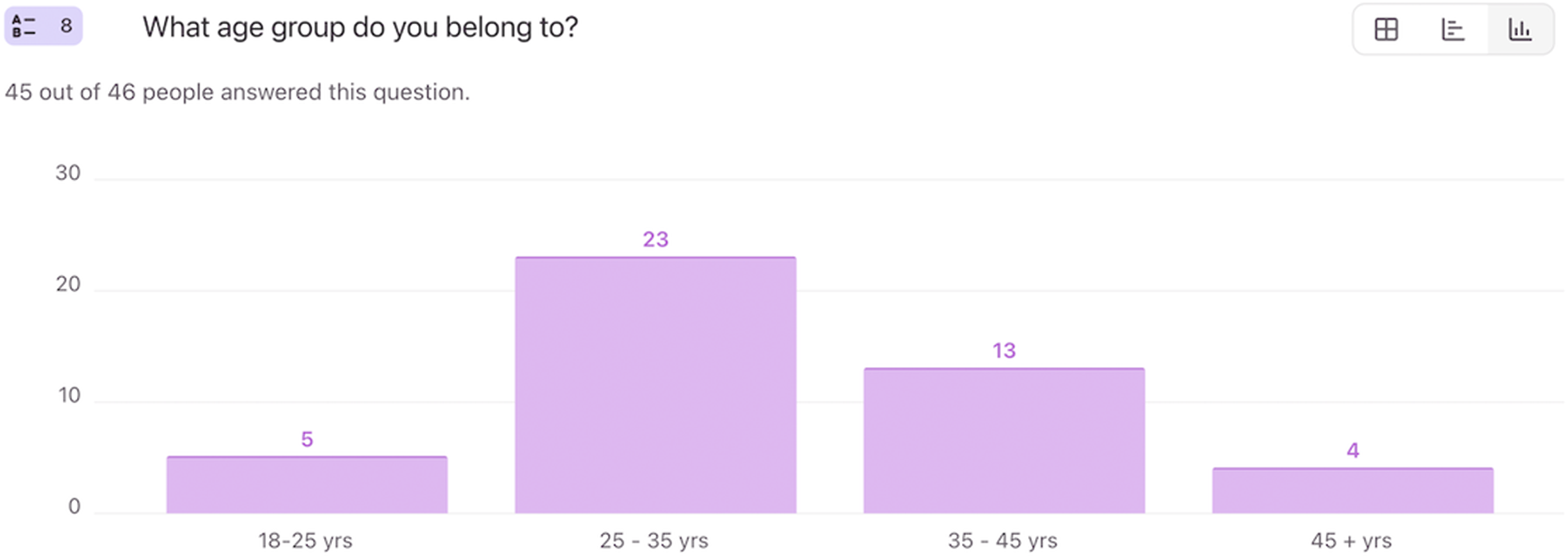
The survey received 46 responses (n = 46). Overall, the sample describes a community that is relatively young, highly educated and primarily situated within arts and design related disciplines. Most respondents fall within the 25–35 and 36–45 age brackets, with fewer participants at earlier or later career stages (Figure 1). In terms of educational attainment, many respondents (n = 45) hold postgraduate degrees (55–54%), with a large proportion at the Master’s level and a smaller but significant group pursuing or holding PhDs (30–32%). Only a limited number report undergraduate degrees as their highest qualification, and none identify vocational training as their primary educational pathway.
Age distribution of survey respondents (n = 46), showing concentration in early to mid-career stages.

Figure 1. Long description
A horizontal or vertical bar chart displaying the age distribution of 45 survey respondents. The data is grouped into age brackets, with the tallest bars concentrated in the 25–35 and 36–45 ranges, indicating that most respondents are in early to mid-career stages. Bars representing younger (under 25) and older (over 55) respondents are noticeably shorter, showing fewer participants at early or later career stages. The chart uses a single colour for all bars, with labelled axes identifying age brackets on one axis and number or percentage of respondents on the other.
Disciplinary backgrounds (n = 45) are predominantly rooted in the arts and humanities, including design, craft, architecture and related areas (80%), while respondents with formal training in the natural sciences or engineering represent a minority. This distribution indicates that many practitioners enter biodesign from design-oriented disciplines rather than from traditional bioscience pathways.
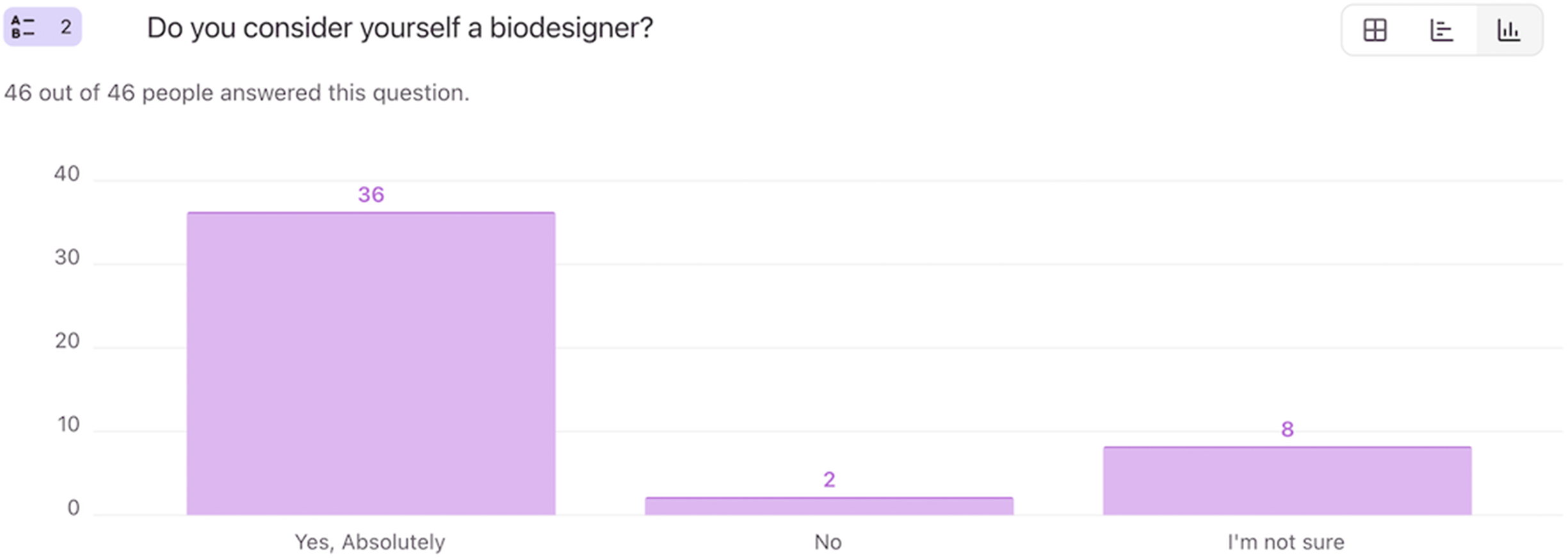
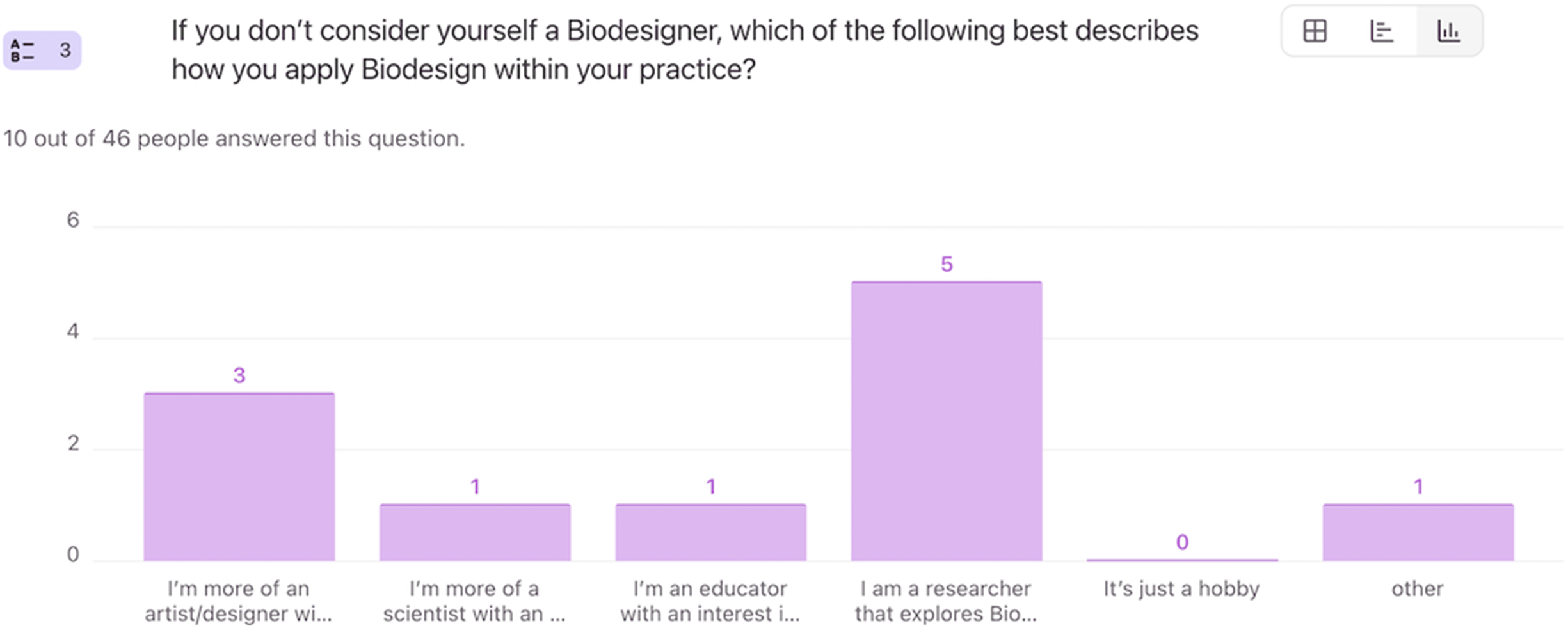
When asked to self-identify, most participants describe themselves as biodesigners or as professionals working with biodesign (Figure 2), and none characterise their engagement as “just a hobby” (Figure 3). A small minority (n = 2) explicitly declined the label “biodesigner” despite working with biological materials or life science methods in their practice. These responses indicate that the term remains fluid and contested, with some practitioners not recognising themselves within this emerging identity.
Self-identification of survey respondents as biodesigners or as professionals working with biodesign.

Figure 2. Long description
A horizontal or vertical bar chart, or pie chart, showing how survey respondents self-identified in relation to biodesign. The majority of responses fall into the categories of “biodesigner” or “professional working with biodesign.” A very small proportion, representing two respondents, declined the biodesigner label despite engaging with biological materials. No respondents described their engagement as a hobby. The chart illustrates that self-identification with the term “biodesigner” is predominant, though fluid, within the surveyed group.
Responses of participants who do not identify as biodesigners, despite engaging with biological materials or life science methods.

Figure 3. Long description
A small chart or table showing the response breakdown for the subset of respondents who did not identify as biodesigners. The group is minimal (n=2). The visual highlights that these individuals nonetheless engage with biological materials or life science methods in their work, pointing to the contested and fluid nature of the “biodesigner” label within the field.
The low proportion of respondents with formal training in the natural sciences indicates that many practitioners come from design-oriented backgrounds rather than from biology or chemistry.
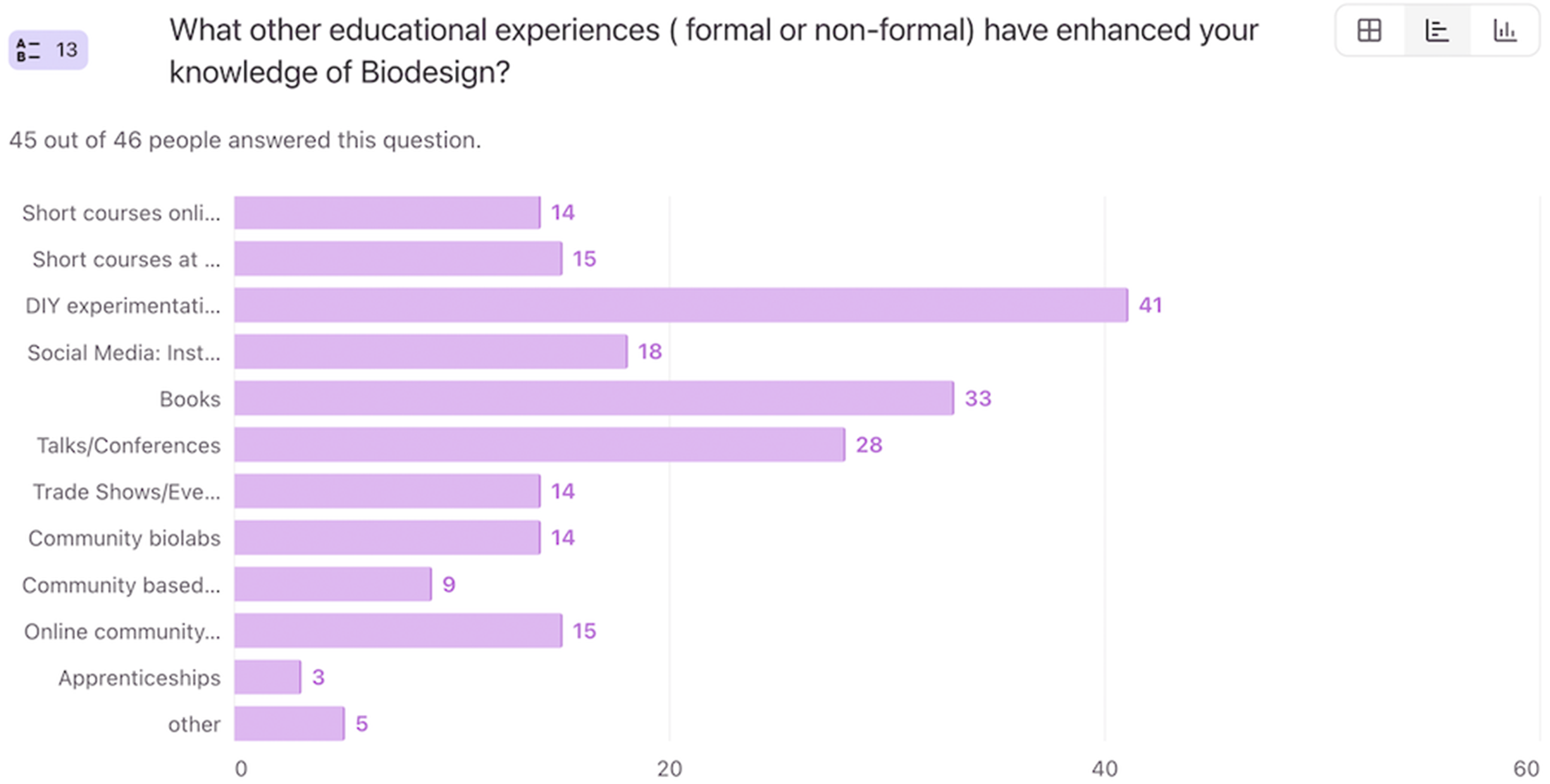
Beyond formal education, the survey highlights the importance of self-directed and informal learning. When asked which experiences contributed most to their knowledge of biodesign, respondents (n = 45) most frequently selected DIY experimentation (91.7%) and books (69.4%), ranking these above short courses, community biolabs, online learning and professional events (Figure 4). Other sources, such as social media, online communities and collaborative projects, also appear as relevant, but less central.
Reported complementary learning experiences contributing to respondents’ knowledge of biodesign, highlighting the prominence of DIY experimentation and self-directed study.

Figure 4. Long description
A bar chart showing various learning experiences selected by respondents (n=45) as contributors to their biodesign knowledge. The two tallest bars correspond to “DIY experimentation” (approx. 91.7%) and “books” (approx. 69.4%), making them the most prominently selected options. Shorter bars represent short courses, community biolabs, online learning, professional events, social media, online communities, and collaborative projects. The chart is arranged horizontally or vertically with percentage or frequency values on one axis and learning experience categories on the other.
These responses indicate that learning in biodesign is often distributed across informal networks and self-initiated practices rather than concentrated within formal educational programmes. Many respondents report engaging with materials and processes through experimentation before participating in institutional or laboratory settings.
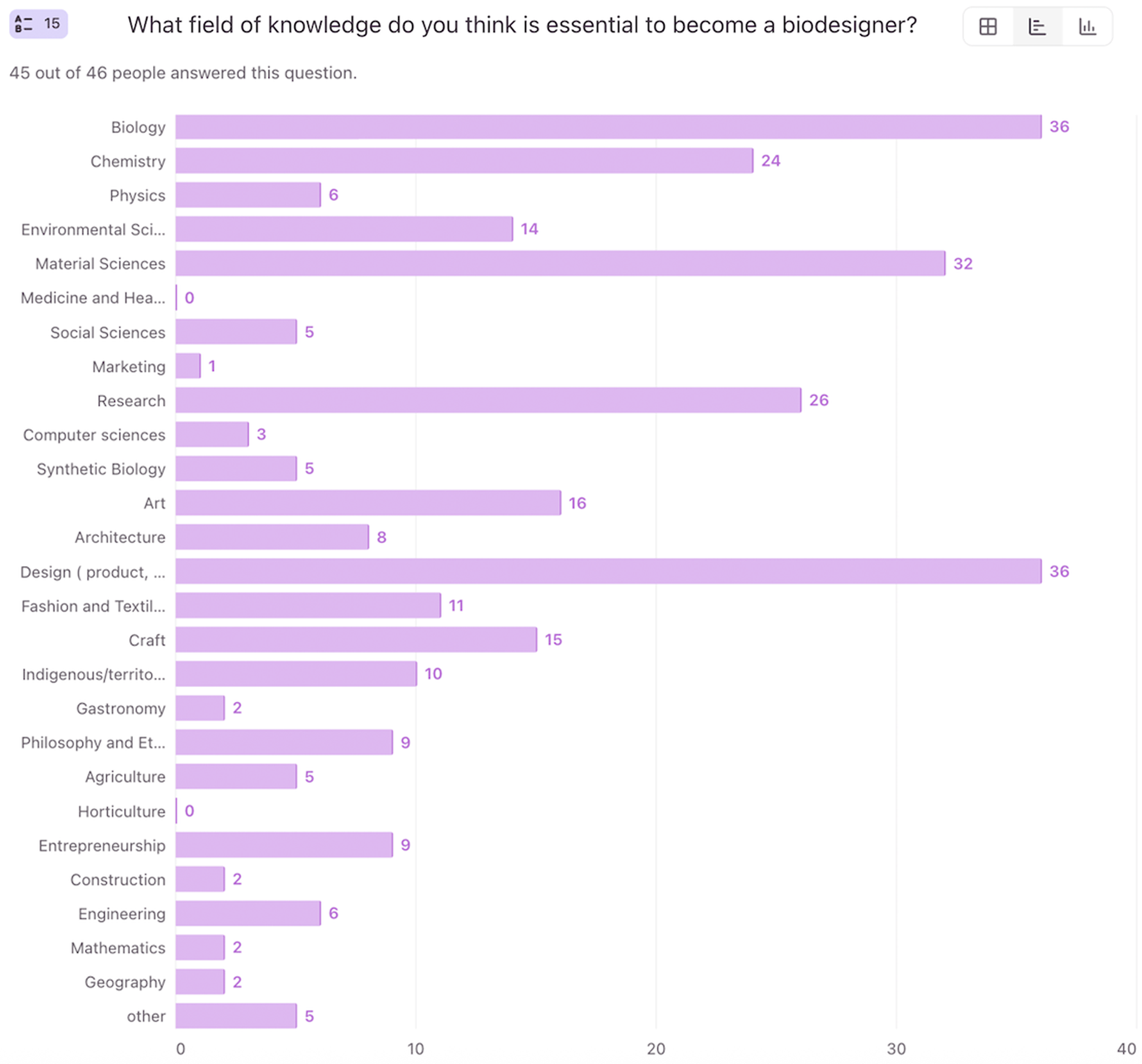
The survey provides insight into how respondents conceptualise the knowledge domains that structure biodesign. When asked which fields are essential, participants most frequently identified biology, design and materials science, followed by research, chemistry and art (Figure 5).
Fields of knowledge identified by respondents as essential to biodesign as a discipline, with emphasis on biology, design and materials science.

Figure 5. Long description
A bar chart or ranked list visualisation showing which knowledge fields respondents identified as essential to biodesign. The highest-ranking fields are biology, design, and materials science, followed by research, chemistry, and art. The chart presents multiple categories along one axis and frequency or percentage of responses on the other, illustrating that the discipline is perceived as requiring a broad, interdisciplinary knowledge base with the biological and design sciences at its core.
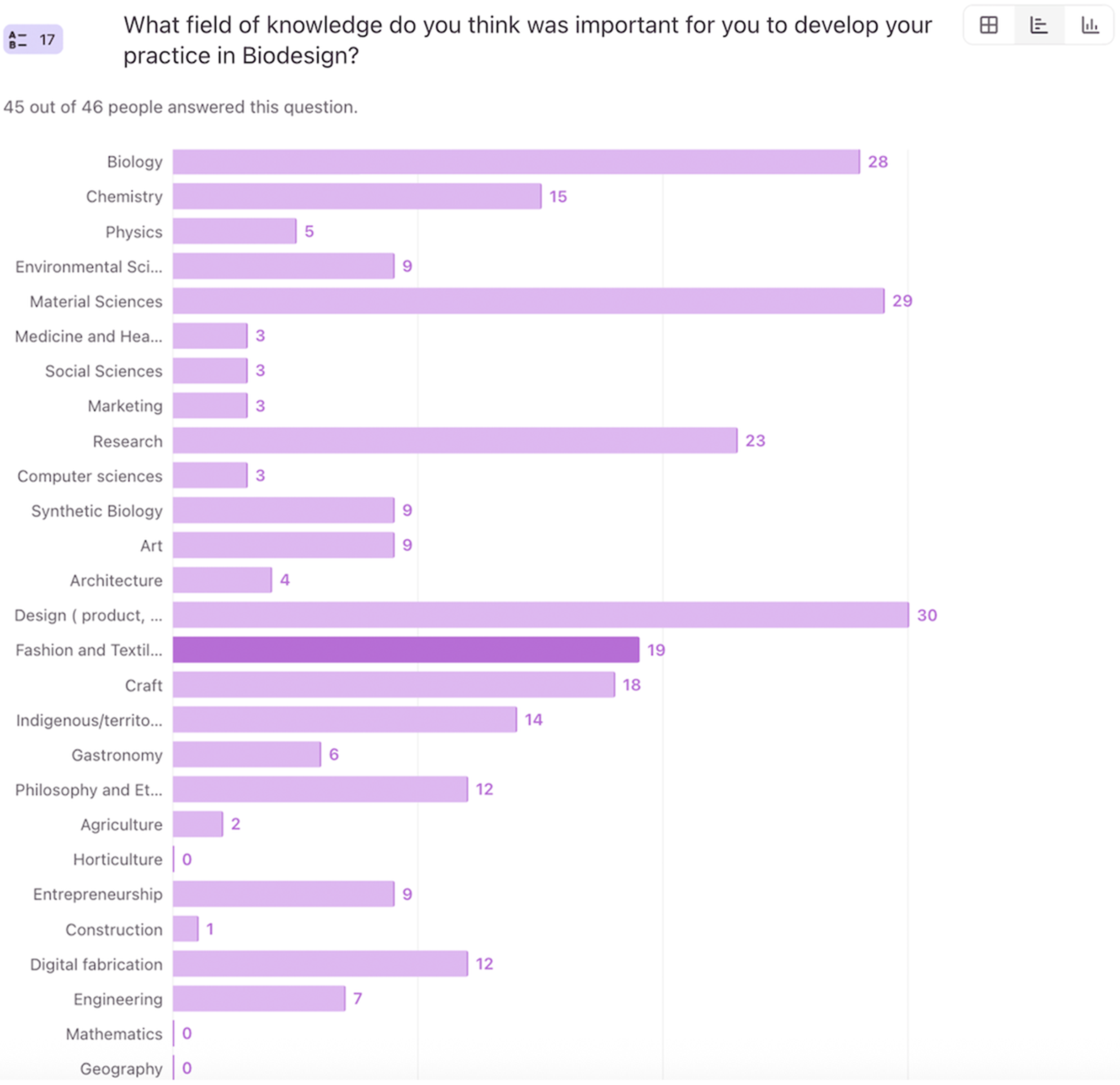
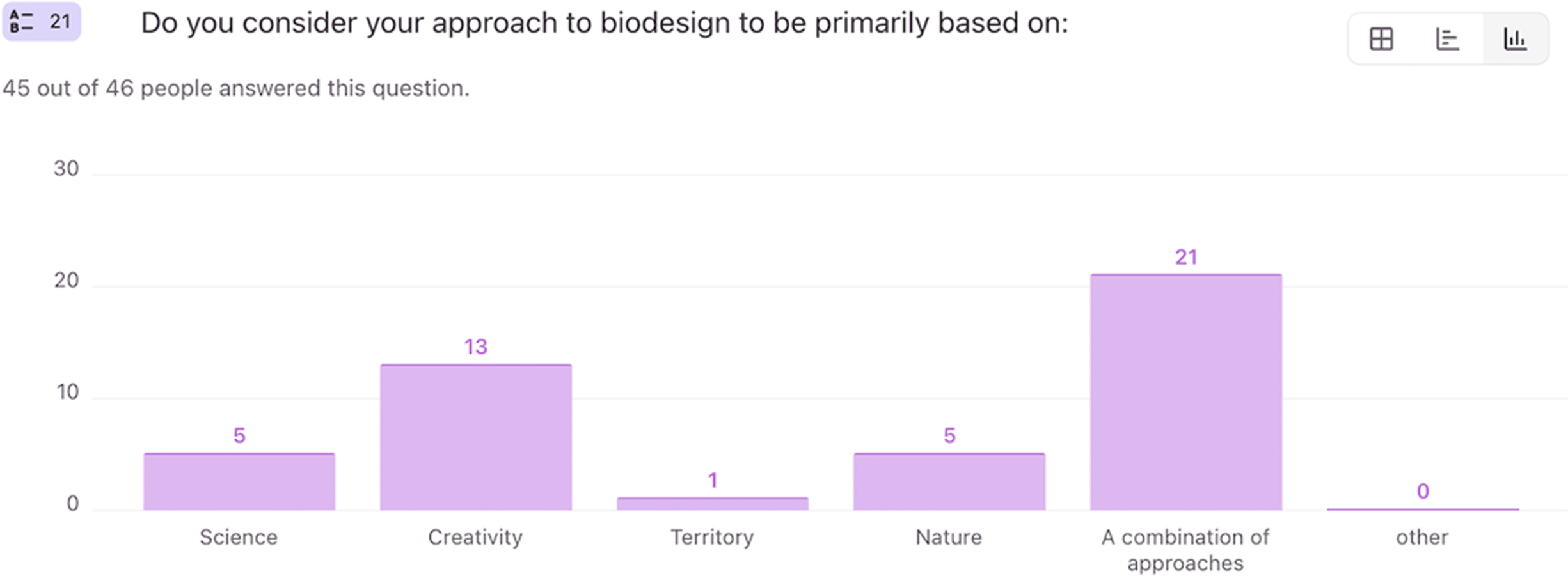
While biology and materials science dominate these formal selections, respondents also report embodied, place-based and craft-based forms of knowledge, including fashion and textile techniques, artisanal processes and territorial or indigenous understandings of living systems (Figure 6). When asked about their motivations and approaches, the most frequently selected option is “a combination of approaches” (science, creativity, territory and nature), whereas “territory” on its own receives a comparatively low score (Figure 7).
Fields of knowledge identified as relevant within respondents’ individual practices, indicating the importance of craft-based, material and context-specific expertise.

Figure 6. Long description
A bar chart showing knowledge fields that respondents consider relevant to their own personal practice, as distinct from the discipline overall. Alongside biology and design, this chart highlights craft-based areas such as fashion and textile techniques, artisanal processes, and territorial or indigenous knowledge systems. These fields appear with notably higher prominence here compared to Figure 5, underscoring that individual biodesign practice is deeply embedded in material, cultural, and place-based knowledge.
Reported approaches to biodesign practice, showing a predominance of combined scientific, creative and ecological perspectives.

Figure 7. Long description
A bar chart or multiple-choice response chart showing how respondents characterise their approach to biodesign practice. The most selected option is a combined approach integrating science, creativity, territory, and nature. Standalone options, particularly “territory” alone, receive comparatively low scores. The chart demonstrates that most practitioners do not situate themselves within a single disciplinary lens, but rather work across scientific, creative, and ecological registers simultaneously.
Nonetheless, the heightened importance of craft, fashion and territorial knowledge in personal practice indicates that biodesigners’ engagements with living systems are deeply entangled with specific materials, places and cultural techniques, even if these are not always foregrounded in theoretical accounts. These findings indicate that, although biodesign is often framed in scientific and technical terms, practitioners describe their work as grounded in multiple forms of knowledge, including material, cultural and context-specific practices.
Reading these findings through the lens of subversiveness reframes what might otherwise appear as a deficit profile. Practitioners who work with biology through craft techniques, improvised labs and small-scale experiments may lack certain forms of disciplinary mastery, but develop other literacies such as sensitivity to material behaviour, attention to growth and decay and translation between aesthetic, ethical and ecological concerns.
The survey profile (arts-based, self-taught, reliant on DIY infrastructures and oriented towards craft, fashion and territorial knowledge) suggests that subversive practices in peripheral spaces are central to how biodesigners emerge and how the field renews itself. At the same time, respondents’ calls for stronger biological, ethical and infrastructural literacy expose an educational gap, that sets up the discussion on professionalisation, biodesign literacy and the risk of neutralising these practices within formal curricula.
Autoethnographic findings: institutional and semantic frictions in biodesign education
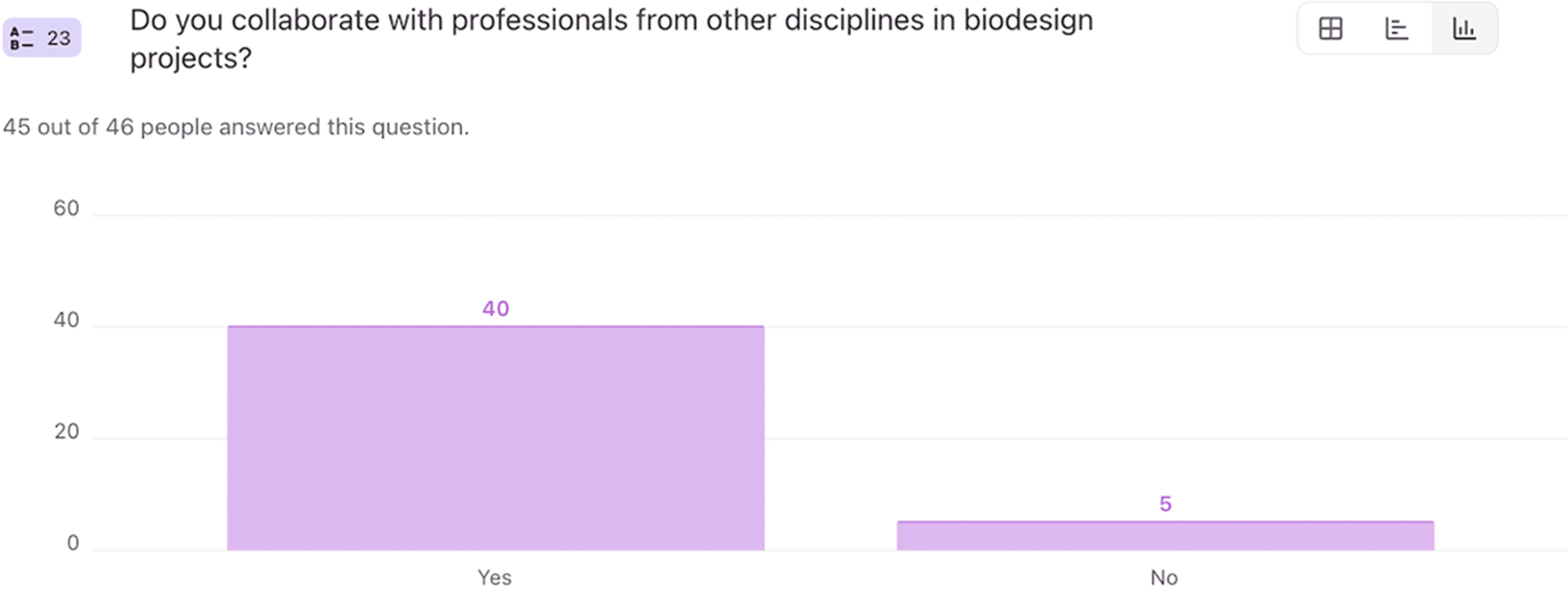
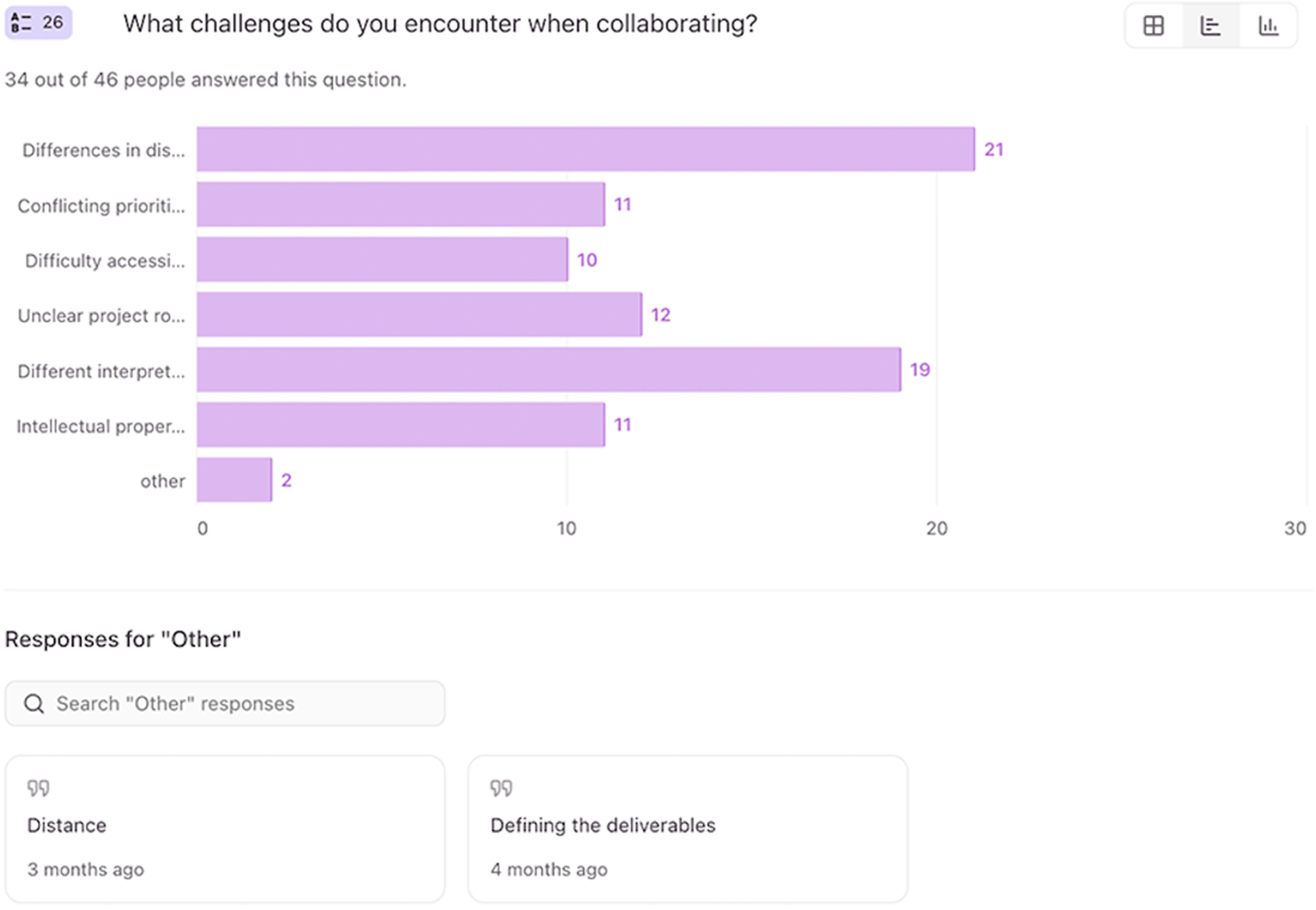
Survey responses confirm that collaboration is both central to biodesign practice and a major source of difficulty. A large majority of respondents (88.9%) report collaborating with professionals from other disciplines (Figure 8), most commonly designers, biologists, material scientists, researchers and chemists. Among those who collaborate, most also report encountering challenges. Frequently cited issues include “differences in disciplinary backgrounds and communication styles,” “different interpretations of terminology and concepts,” “unclear project roles or responsibilities” and “conflicting priorities, goals or timelines” (Figure 9).
Reported collaboration practices among survey respondents, indicating the prevalence of interdisciplinary collaboration.

Figure 8. Long description
A bar chart or pie chart showing whether survey respondents collaborate with professionals from other disciplines. A large majority, approximately 88.9%, report engaging in interdisciplinary collaboration. The chart identifies the most common collaborators as designers, biologists, material scientists, researchers, and chemists. The visual clearly conveys that cross-disciplinary collaboration is the norm rather than the exception in the surveyed community.
Reported challenges encountered during interdisciplinary collaboration, including communication, terminology and role-related issues.

Figure 9. Long description
A bar chart listing the challenges most frequently reported by respondents during interdisciplinary collaboration. The longest bars correspond to differences in disciplinary backgrounds and communication styles, different interpretations of shared terminology, unclear project roles and responsibilities, and conflicting priorities or timelines. A separate data point notes that 57.1% of respondents (n=34) identify gaps in shared language as a barrier. The chart has challenge categories on one axis and frequency or percentage of respondents on the other.
The survey also indicates that terminology represents a recurring challenge: 57.1% of respondents (n = 34) identify gaps in shared language as a barrier to collaboration. From a biodesign literacy perspective, these barriers are not only practical obstacles but also sites where new hybrid concepts and practices emerge, as practitioners negotiate shared vocabularies and conceptual anchors across disciplines.
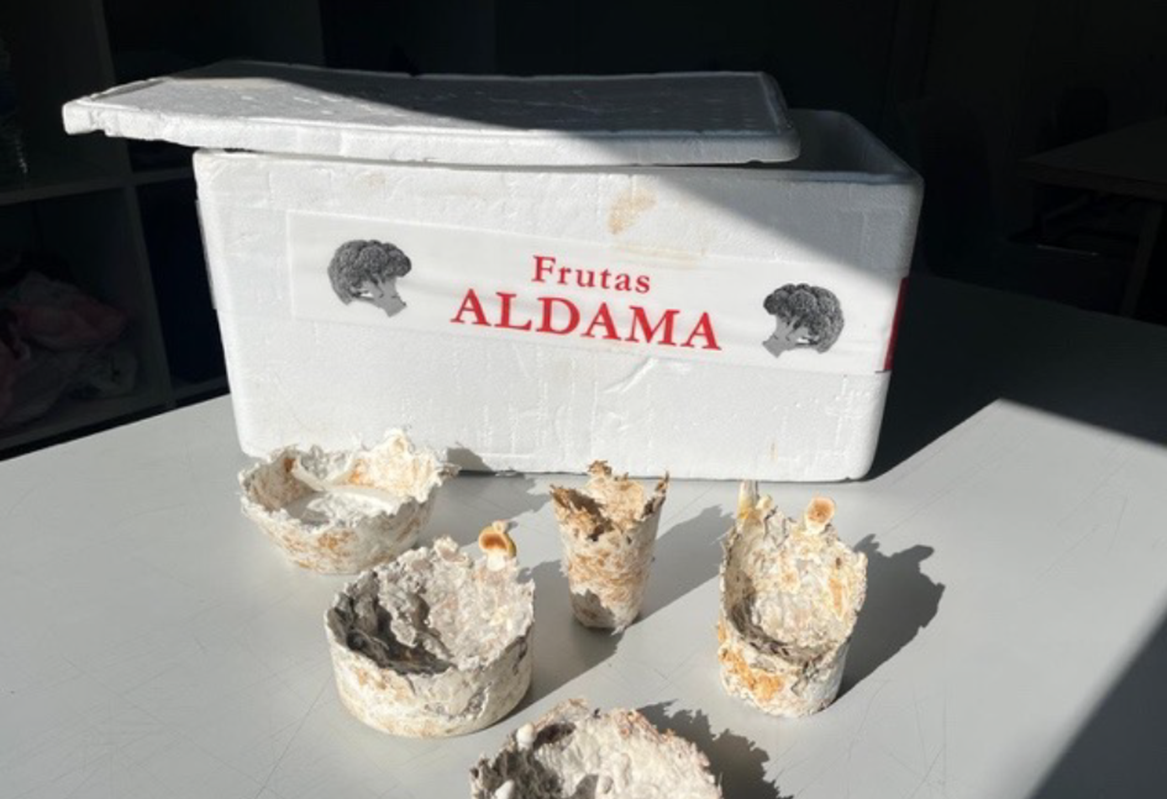
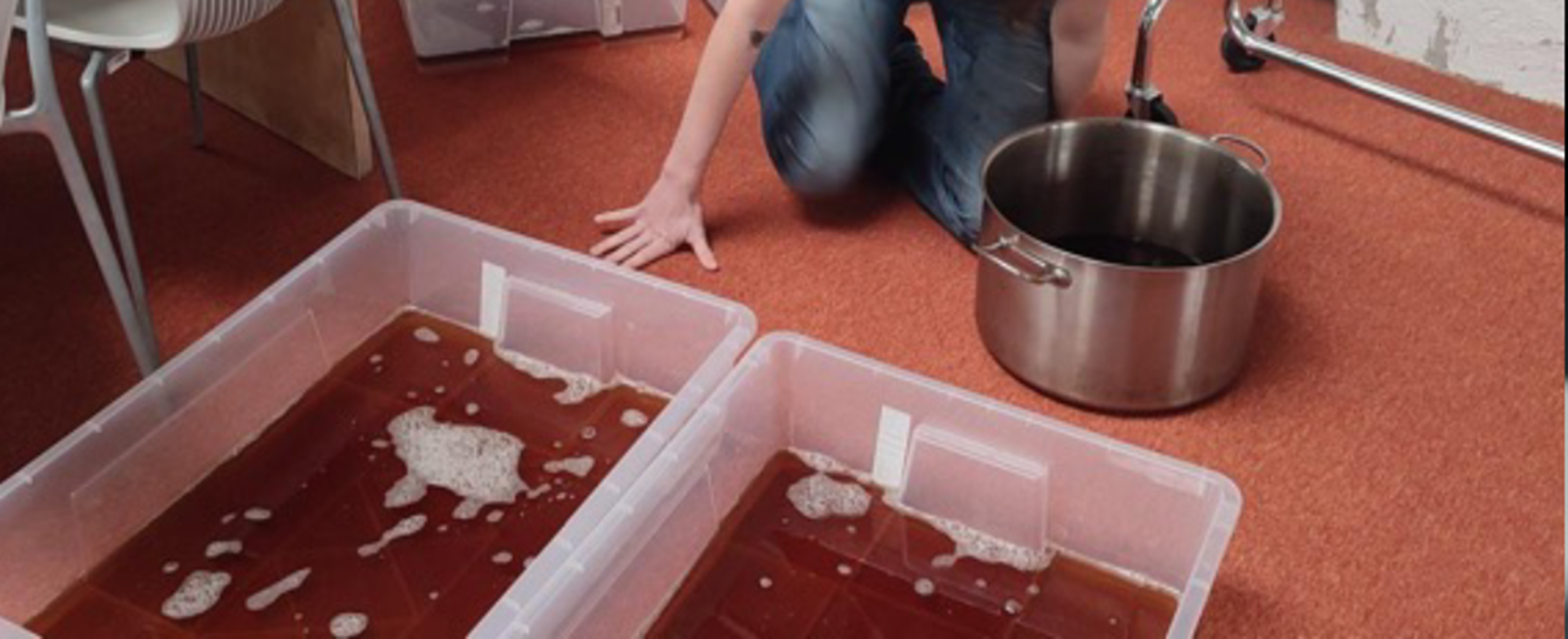
Autoethnographic material provides further insight into how these challenges manifest in educational contexts. Across the first author’s teaching practice, collaboration and communication issues often intersect with infrastructural constraints, particularly in settings where access to specialised laboratory facilities is limited. Although there are flagship spaces that pioneer biodesign within their institutions, much biodesign education still takes place in improvised classrooms and studios, relying on individual champions and informal networks of support. In such contexts, students and educators frequently work with living materials, such as mycelium and bacterial cellulose, using improvised set-ups within studios or shared classrooms (Figures 10–11), turning these environments into important arenas where both terminological and infrastructural gaps are actively negotiated.
Example of material experimentation using improvised infrastructure: recycled fruit packaging repurposed as a mycelium incubation system.

Figure 10. Long description
A photograph showing a low-tech, improvised experimental setup. Recycled plastic fruit packaging trays, the type typically used for strawberries or similar produce, have been repurposed as containers for growing mycelium. The trays are filled with a substrate material, and visible fungal growth or inoculated material can be seen inside them. The setting appears to be a non-laboratory environment such as a studio or classroom. The image illustrates how biodesign practice can take place outside conventional laboratory infrastructure.
Example of educational context: student cultivation of bacterial cellulose in a non-laboratory classroom environment.

Figure 11. Long description
A photograph showing one or more containers, placed on a carpeted floor, in what appears to be a regular classroom or studio space rather than a dedicated laboratory. The vessels contain SCOBY (symbiotic culture of bacteria and yeast) or bacterial cellulose growth medium in various stages of cultivation. The everyday domestic or studio setting, evidenced by surrounding furniture, natural light, or non-clinical surfaces, emphasises the improvised nature of the educational context.
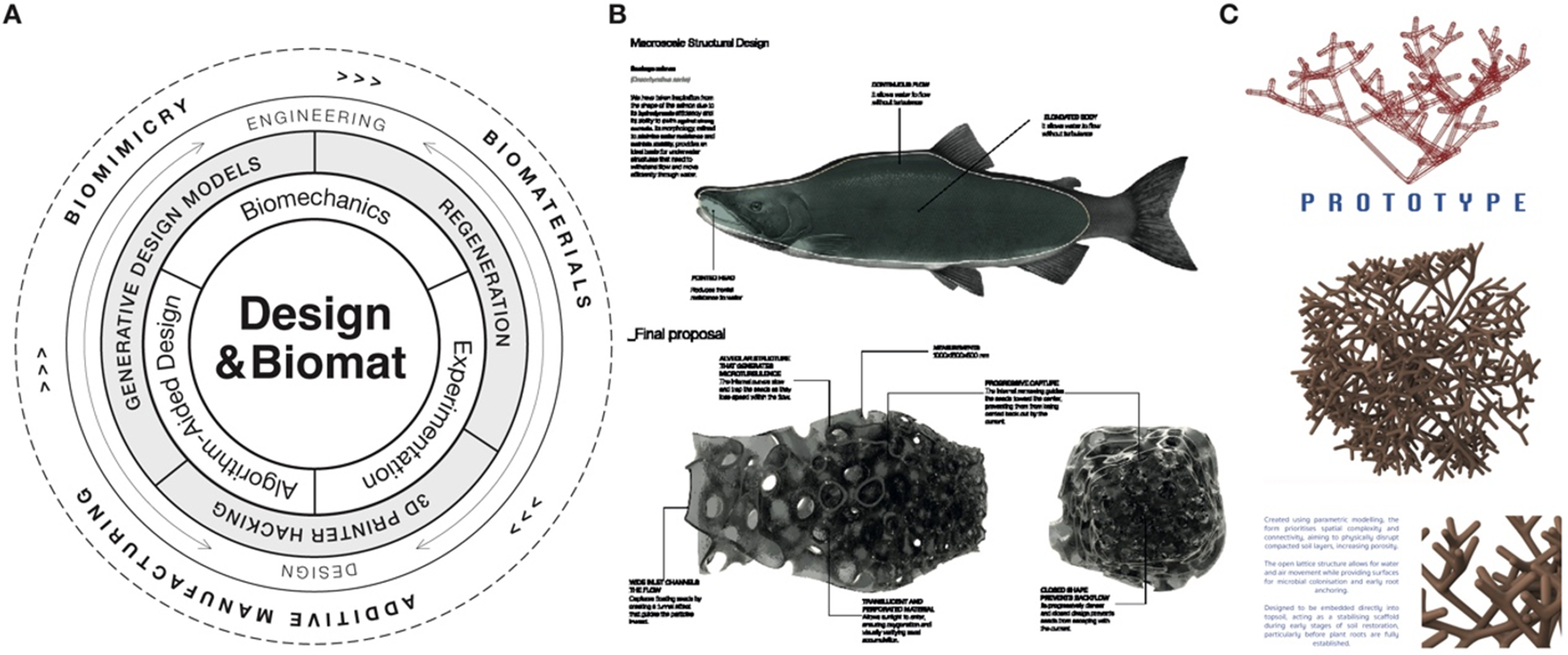
In contrast, some institutional contexts demonstrate how biodesign education can become formalised over time. For example, at ELISAVA UVIC-UCC (Barcelona), Dr. J. Crespo-Santiago introduced biodesign as an elective subject that combined biomimicry and natural patterns, with generative design and experimental additive manufacturing. Creating a framework where biological principles inform design processes and material experimentation. Following positive outcomes, the course was integrated into the Industrial Design Engineering curriculum and supported by the development of a dedicated biolab (Figure 12).
Institutional case study: Elisava UVIC-UCC, Barcelona. (a) Diagram showing the interaction between biomimicry, biomaterials and additive manufacturing over design and engineering principles. (b–c) Examples of generative design and additive manufacturing processes developed according to biomimicry principles.

Figure 12. Long description
A composite figure with three panels. Panel A is a diagram or schematic showing the conceptual relationships between three fields — biomimicry, biomaterials, and additive manufacturing — positioned over a foundation of design and engineering principles. Lines, arrows, or zones indicate how these fields interact and overlap. Panels B and C are photographs or rendered images showing physical or digital outputs: intricate, organic-looking forms produced through generative design software and 3D printing, with structures visually inspired by natural patterns such as branching, lattices, or growth geometries. The overall figure documents the formalisation of a biodesign course at Elisava.
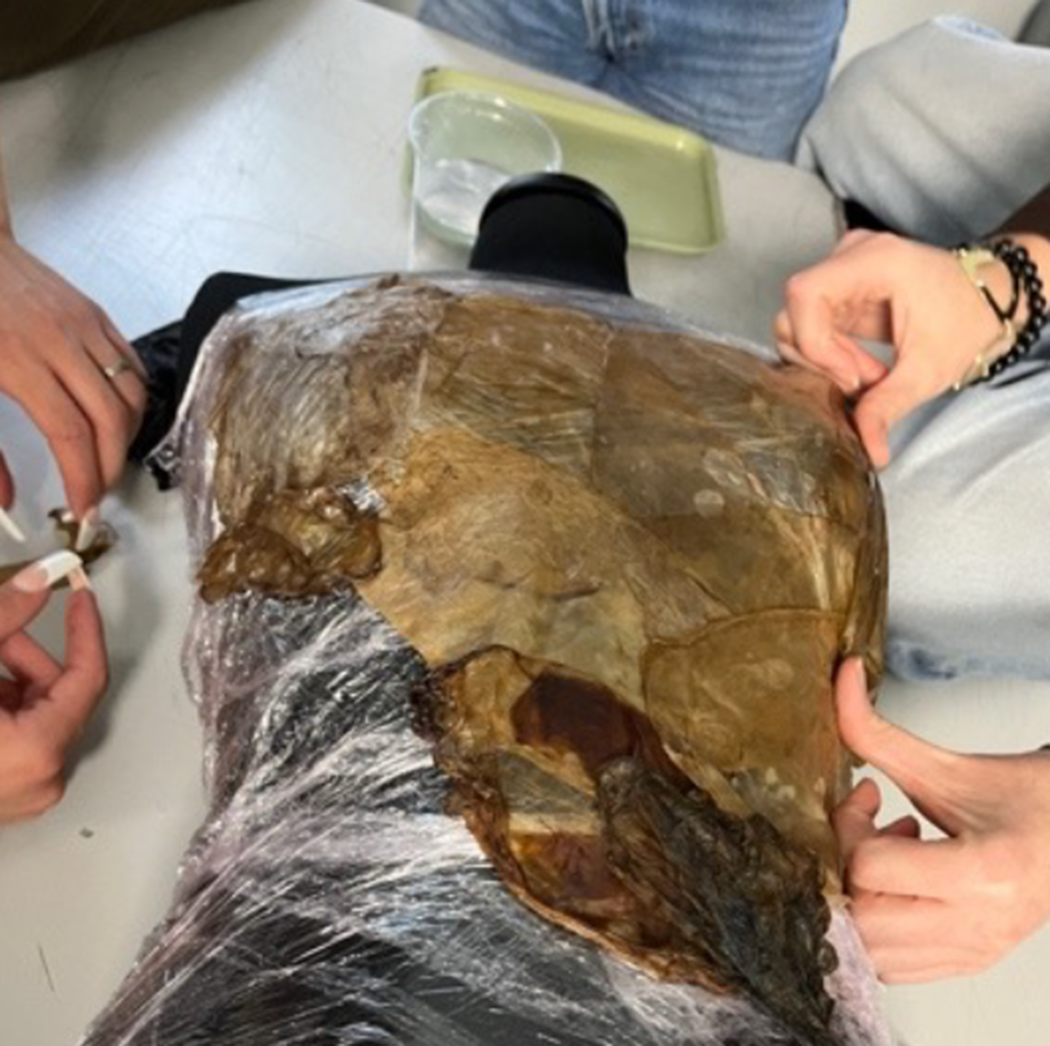
Across the first author’s teaching practice, recurring pedagogical approaches involve the use of craft-based techniques, such as patchwork, draping and the fabrication of leather-like biomaterials, as entry points for working with living systems (Figure 13). These approaches enable students to engage with biological materials using familiar tools and practices. Assignments frequently encourage students to document processes such as contamination, material failure and unexpected behaviours as part of the learning process, shifting attention from final outputs to process-oriented engagement with living materials (Figure 14) .
Example of educational practice: students draping bacterial cellulose on a mannequin as part of material exploration.

Figure 13. Long description
A photograph showing one or more students in a studio or classroom environment working with sheets of bacterial cellulose, a translucent, skin-like biofabricated material. The material is being draped, pinned, or arranged over a dress mannequin or body form, in a manner similar to textile draping in fashion education. The bacterial cellulose appears wet or semi-dry, with an irregular, organic texture. The image illustrates the use of craft-based, fashion-oriented techniques as entry points for engaging with living biomaterials.
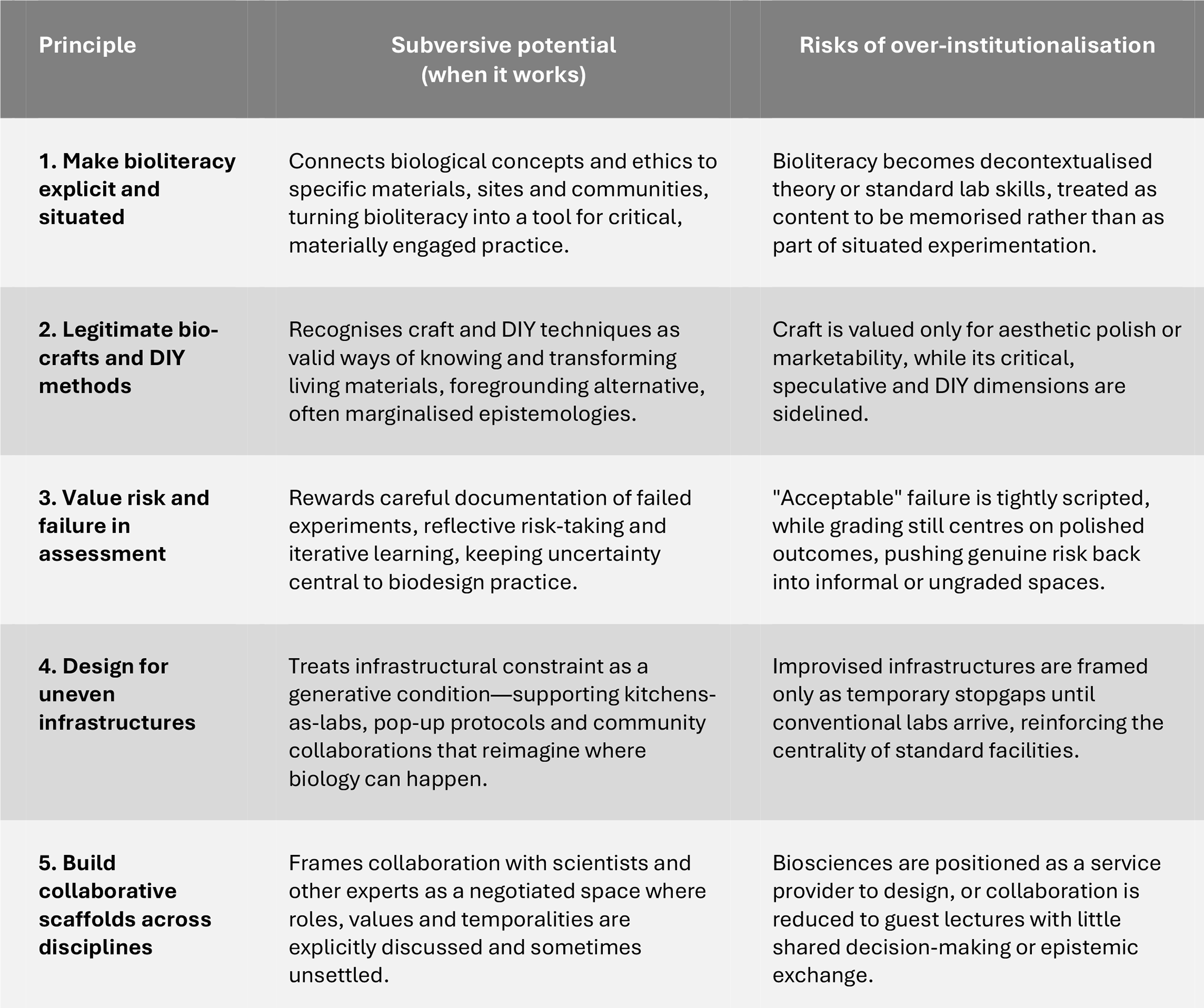
Emergent framework of five curriculum principles for biodesign literate and subversive biodesign education, outlining how each principle supports subversive practice while risking over-institutionalisation.

Figure 14. Long description
A diagram or visual framework showing five curriculum principles arranged in a structured layout. Each principle is presented with a label and descriptive text in two columns or sections: one side articulating how the principle supports subversive, experimental practice, and the other identifying how it risks becoming over-institutionalised. The five principles are: (1) Make biodesign literacy explicit but situated; (2) Legitimise bio-craft and DIY methods; (3) Preserve experimental risk and failure in assessment; (4) Design for uneven infrastructures; and (5) Structure collaboration as negotiation. The framework uses a consistent visual style with headers, body text, and likely colour coding or dividing lines to differentiate between supportive and risk dimensions.
These examples indicate that collaboration challenges, infrastructural limitations and experimental pedagogical strategies are closely intertwined within biodesign education. They highlight how learning often takes place in hybrid environments that combine formal institutional settings with improvised and experimental practices.
Discussion: towards a biodesign literate and subversive curricula
Together, the findings highlight a fundamental tension between how biodesign is currently learned and practiced, and how it is being institutionalised within formal education. Across the survey and autoethnographic material, biodesigners emerge as practitioners who construct their expertise through self-directed experimentation, informal infrastructures and interdisciplinary trajectories, often outside conventional science curricula. Learning is distributed across peer-to-peer exchange, material experimentation and situated practices, with formal education frequently occurring at a later stage.
This pattern challenges conventional assumptions about expertise and training. From the perspective of traditional science education, the predominance of arts and humanities-based pathways and the reliance on DIY learning could be interpreted as a lack of formal bioscience training. However, the findings suggest that this configuration represents a distinct mode of expertise: designers engaging with biology through craft-based practices, improvised laboratories and small-scale experimentation develop forms of biodesign literacy grounded in material sensitivity, process awareness and the ability to translate between aesthetic, ethical and ecological domains. In this sense, the process of becoming a biodesigner can be understood as inherently subversive. Rather than following established disciplinary pathways, practitioners enter the field from heterogeneous backgrounds and work at the margins of institutional structures; these trajectories are not peripheral to the field but central to its development.
At the same time, the findings reveal persistent challenges linked to collaboration, terminology and uneven access to infrastructure. The prevalence of terminology gaps and communication barriers suggests that biodesign literacy is not only a matter of biological knowledge, but also of the capacity to navigate and negotiate across disciplinary languages. Collaboration frictions, rather than being purely obstacles, can function as sites where new hybrid concepts and practices emerge, yet they also expose how existing institutional formats struggle to accommodate biodesign. Autoethnographic evidence further demonstrates how these tensions materialise in educational contexts: teaching practices often rely on improvised environments, craft-based techniques and process-oriented pedagogies that foreground experimentation, uncertainty and failure, but sit uneasily alongside institutional demands for standardisation, measurable learning outcomes and risk management frameworks designed for conventional scientific settings.
In this context, efforts to professionalise biodesign education are both necessary and problematic. On one hand, the survey and literature review show that biodesigners face significant obstacles linked to terminology, collaboration and uneven access to infrastructure, which can be partially addressed through clearer curricula and competencies. On the other hand, the same data demonstrate that the field has largely been built by self-taught practitioners who rely on DIY experimentation, books and marginal spaces such as community labs, kitchens and shared classrooms. The question is therefore not whether to professionalise biodesign, but how to do so without erasing the subversive, experimental cultures that have made it possible. High-profile research environments such as Neri Oxman’s Mediated Matter Group at the MIT Media Lab, helped give international visibility to the convergence of biology, computation, material research and digital fabrication, but they should be read as influential research-lab references rather than directly transferable templates for biodesign curricula. If professionalisation proceeds without attention to DIY cultures, craft-based knowledge and territorial practices, it risks narrowing the field’s epistemic diversity and recentring laboratory-style practices and formal scientific content as the primary markers of legitimacy.
Responding to these challenges, this paper proposes an emergent framework for biodesign literate and subversive biodesign education. The framework is derived from the synthesis of literature, survey data and autoethnographic teaching cases and aims to articulate how curricula can integrate experimental, DIY-oriented practices within institutional contexts. Rather than simply bringing biodesign up to the standards of science education, it seeks to make explicit and support the forms of expertise that have emerged from subversive, self-taught trajectories and to offer a set of curriculum principles for navigating the tension between institutional expectations (assessment, safety, accreditation, infrastructure) and the experimental, situated practices through which much biodesign expertise has developed.
First, biodesign literacy should be made explicit but remain situated. Biological concepts, ethics and terminology should be taught as core competencies, but always in relation to concrete material practices and local ecologies, so that concepts become tools for interrogating specific materials, sites and communities rather than abstract hurdles to be memorised. This principle risks becoming over-institutionalised when biodesign literacy is reduced to textbook content and standardised lab skills, detached from the situated material experiments that characterise biodesign.
Second, bio-craft and DIY methods should be legitimised as valid forms of knowledge production. Craft-based approaches such as textile manipulation, draping, dyeing, leather work or gastronomy are not preparatory steps towards “proper” laboratory work, but central modes of engaging with living materials and imagining new material futures. This subversiveness is neutralised when craft is valued only for aesthetic polish or marketability, rather than assessed for how it mobilises ecological, biological and ethical understanding.
Third, assessment criteria should preserve experimental risk and failure as core values. Working with living systems entails unpredictability and temporalities that are difficult to control, so courses should foreground process, documentation, reflection, collaboration and ethical reasoning alongside outcomes, rewarding careful records of failed cultures and iterative problem-solving. This principle is undermined when students are ultimately rewarded mainly for polished results or tightly scripted “acceptable” failures, pushing genuine risk-taking back into informal or ungraded spaces.
Fourth, curricula should be designed for uneven infrastructures. Rather than assuming access to fully equipped laboratories, educational models can accommodate low-tech environments, improvised set-ups and collaborations with community-based facilities, treating infrastructural constraint as a site for inventing alternative bio-practices, such as kitchens-as-labs and pop-up protocols. The risk of over-institutionalisation appears when such improvised infrastructures are framed only as temporary stopgaps on the way to conventional laboratory models, rather than as legitimate and enduring contexts for biodesign education.
Fifth, collaboration should be structured as a site of negotiation rather than one-way knowledge transfer. Interdisciplinary work with scientists, technicians and other experts requires explicit attention to differing epistemologies, roles and temporalities, for example through co-developed modules, joint critiques or shared glossaries that foreground mutual expectations and constraints. Subversiveness is weakened when biosciences are positioned solely as a service provider for design, or when collaboration is reduced to occasional guest lectures without shared decision-making power.
As biodesign continues to evolve, the challenge for educators and institutions will be to support this hybridity without reducing it to a standardised technical specialism. This requires ongoing reflexive engagement across programmes, institutions and communities of practice, recognising that the institutionalisation of biodesign is not a neutral process, but one that shapes what counts as knowledge, practice and expertise in the field.
Limitations and scope
This study provides a situated account of biodesign education based on a focused literature review, a small-scale online survey and autoethnographic teaching cases. The literature review is selective, focusing on work that connects biodesign, DIY-bio and education, and therefore does not aim to capture the full breadth of research on biologically informed design.
The survey findings should be interpreted with caution. The sample of 46 respondents offers an indicative snapshot of practitioners who are active within the biodesign community and connected to the networks through which the survey circulated, rather than a representative cross-section of the global field. While appropriate for identifying recurring patterns in learning pathways and perceived challenges within an emergent domain, the results should be understood as suggestive rather than statistically generalisable.
The autoethnographic material is drawn from the first author’s teaching practice across specific institutional and infrastructural contexts. These cases do not aim to represent all biodesign programmes, but to provide situated insight into the practical and pedagogical negotiations involved in implementing biodesign education under conditions of constraint.
Taken together, the convergence between literature, survey data and autoethnographic cases supports the credibility of the patterns identified. At the same time, the study’s scope and methodological choices define the limits of its claims, which are intended to be analytical and generative rather than exhaustive or universally representative.
Conclusion
Biodesign education cannot be developed by simply importing models from the life sciences, engineering or conventional design pedagogy. The field has emerged through self-directed experimentation, improvised infrastructures, craft-based practice and interdisciplinary negotiation, and these conditions are not peripheral to biodesign; they are part of its epistemic foundation.
This paper has shown that many biodesigners are highly educated yet largely self-taught in the biological practices they employ, drawing on DIY experimentation, books, peer exchange and marginal spaces as key sources of knowledge. These trajectories challenge deficit-based readings of biodesign education and instead point to a distinct form of biodesign literacy: one grounded in material sensitivity, ecological awareness, uncertainty, failure and translation across disciplines.
Framed this way, biodesign education participates in a broader paradigm shift in how designers understand their role: from experts optimising industrial manufacturing to connectors and protectors of ecosystems who must navigate biosciences, crafts and territorial knowledges. The findings presented here lay the groundwork for a more comprehensive framework for biodesign education that specifies the skills and literacies needed to work responsibly with living systems and that can be put into dialogue with emerging competence agendas in sustainability and the bioeconomy, while keeping space for subversive experimentation at the heart of the field.
The challenge for universities is therefore not to make biodesign more “scientific” by erasing its experimental cultures, but to design curricula capable of holding both rigour and subversion. Biodesign-literate curricula should make biological concepts, ethics and safety explicit while legitimising craft, DIY methods, situated knowledge and process-based assessment. In doing so, institutions can support the professionalisation of biodesign without neutralising the practices that make the field transformative.
Supplementary material
The supplementary material for this article can be found at https://doi.org/10.1017/S2977905726100390
Data availability statement
The anonymised survey data that support the findings of this study are provided as supplementary material (Survey Data PDF).
Acknowledgements
The work of the first author was carried out as part of the doctoral programme in Educational Innovation and Intervention at Elisava, University of Vic – Central University of Catalonia. The author would also like to thank all survey participants and co-authors for their invaluable support. The use of AI tools was limited to revising the text’s flow and grammar.
Author contributions
A. Orcajada: Conceptualisation, Methodology, Writing – Original Draft, Writing – Review & Editing. I. Ordoñez: Writing – Review & Editing, Supervision. V. Rognoli: Writing – Review & Editing, Supervision. J. Crespo-Santiago: Data Curation, Writing – Review & Editing.
Financial support
This research was partially funded by the Erasmus+ programme Centres of Vocational Excellence, “Transforming Education Area and Competency Hub for Sustainable Development” (project acronym: TEACH4SD). The content of this publication does not reflect the official opinion of the European Union; responsibility for the information and views expressed lies entirely with the author(s).
Competing interests
None.
Ethical standards
This study involved an online survey of adult professionals and autoethnographic reflection on the first author’s own teaching practice. No sensitive personal data were collected, and all responses were anonymised before analysis. In line with COPE-aligned guidelines, participation was voluntary and informed consent was obtained; participants could withdraw at any time without consequence. Institutional ethics approval was not required under the policies of the first author’s institution for minimal-risk, anonymised survey research of this kind and no experiments involving animals or human patients were conducted.


 Open access

