If, as Alicia Gaspar de Alba contends, the history of conquest and colonization in the Americas produces subjects defined by ‘inbetweenness’, then choreography, which mobilizes bodies in relation to intersecting vectors of time, space and force, is ideally suited to articulate such an inbetweeness by literally staging the subject-in-motion.Footnote 1 Far from a fixed script, choreography deployed as a political tactic can critique identity as a static category by capitalizing on the flux of moving bodies. This is evident in the work of four Los Angeles experimental dance artists, who destabilize rather than affirm notions of a unified identity, either in terms of gender or geography, in the programme ‘Choreographing Identity’. Rather, the programme, curated by Susan Leigh Foster, sets race, gender and national affiliation in motion along spatial axes ranging from the local to the transnational.
The artists – Taisha Paggett, Rebecca Pappas, Christine Suarez and Hana van der Kolk – answer the question of how women occupy the space of the Americas by tracing subjectivities produced by gendered and racialized embodiment, diasporic allegiance and ambivalent visibility along arcs of belonging and unbelonging in private lives and public spaces. A sense of dislocation and estrangement repeatedly surfaces in their work, whether from female sexuality, as in Suarez's solo; from the demands of cultural diaspora, as in Pappas's; or from surrounding environments, as in work by Paggett and van der Kolk. And though all are citizens of the United States, their performances demonstrate the instability of this identity category while simultaneously situating the US within the intellectual project of thinking gender hemispherically.
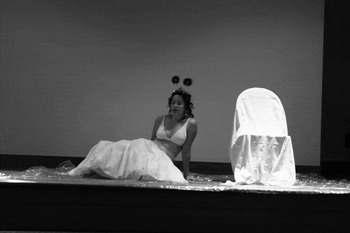
Born in Caracas, Venezuela, but raised in Baton Rouge, Louisiana, Christine Suarez teases out the disidentification that has been a core aspect of her hybrid, Cajun–Latina ethnicity. As she explained in a recent interview, being perceived as a foreigner while growing up in the American South and as a southern hick after moving to major US cities created more questions than answers about identity, problematizing the notion of any singular cultural, ethnic or place-based identity.Footnote 2 In the sex-positive solo Wet Spots (Fig. 1), Suarez translates this into an investigation of female sexuality. After setting a kitchen egg timer, Suarez embarks on a ribald gestural ode to fingers and female anatomy, a vigorous hand dance that shares an uncanny similarity to a housewife scrubbing an oven. Initially performed in a kitchen as part of a site-specific concert of the same title, Suarez invokes the spectre of a cheerful 1950s-era all-American wife and mother as well as her distance from this ‘ideal’. Donning a voluminous bridal petticoat, she journeys into self- and bodily discovery by manipulating it into the shape of a phallus that she puts to good use while writhing on the floor amidst yards of white tulle. The climax of the piece coincides with the timer ringing and the explosive uncorking of a champagne bottle. That the search for sexual satisfaction is rewarded only after Suarez re-genders her body male with her fabric prosthesis subtends the humour of her spirited, can-do enthusiasm.
Christine Suarez rests after an arduous search for sexual fulfillment in Wet Spots. (Photograph courtesy of the UCLA Center for Performance Studies.)

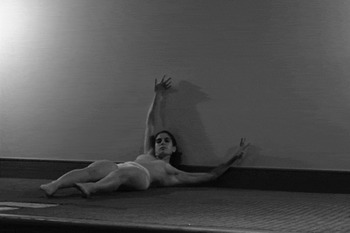
Like Suarez, Rebecca Pappas mines the complexity of cultural identifications. And like Suarez, Pappas situates her interrogation – in this instance of American Jewish cultural identity – within the intimate space of her body. Thumbnail, which premiered in 2006, was the artist's first foray into the discursive construction of Jewish embodiment. Since then, her investigations have taken shape as an interconnected series of duets, trios and ensemble pieces compiled under the rubric Monster. Thumbnail (subtitled Monster: Portrait 0), however, remains the most succinct, if surreal, enunciation of Pappas's central choreographic thesis that to live in a body marked as Jewish is to be fractured by competing social and political pressures and to be haunted by a pervasive sense of political and personal shame. Naked throughout the solo save for a pair of briefs, Pappas flails contorted limbs and wrenches herself into increasingly uncomfortable positions while an accompanying recording details a recurring dream in which she gives birth to Israel, ‘a tiny, bloody baby the size of a thumbnail’ that she proceeds to lose in the bedsheets. Just as tiny and precarious, she wedges her body against walls and floor – trying quite literally to ‘fit in’, if not belong, to her surroundings (Fig. 2). Pappas's awkward mis-shapement contrasts with the intelligent, confident and witty voice-over, with the resulting schism cracking open a gap for her critique of the trope of woman as mother of the nation.
Rebecca Pappas attempting to fit into the mother-of-the-nation trope in Thumbnail. (Photograph courtesy of the UCLA Center for Performance Studies.)

In we imitate fences, Taisha Paggett also creates dissonance between visual and aural registers by layering a soundtrack of soothing nature sounds over an anything-but-idyllic vision of the all-American suburban dream. A much-sought-after dancer who has toured in the work of choreographers David Rousseve and Victoria Marks, Paggett is also a member of the audio action collective Ultra-red and collaborates regularly with visual artist Ashley Hunt on workshops for women factory workers in Los Angeles's downtown garment district. In her installation-based solo work, however, Paggett applies her conceptual art and activist predilections to valences and issues of contemporary African American embodiment.
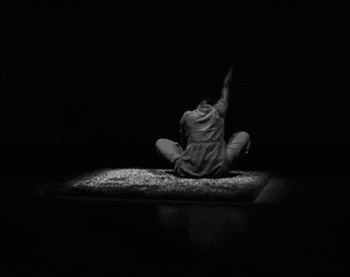
we imitate fences exploits the limitations imposed by a six-foot-by-six-foot square of emerald green artificial turf to invert and comment on the phenomenon of white flight from urban centers in the post-Second World War US. Progressing from a series of unfurling limbs and long stretches, Paggett uses the reaches of her body to measure the small patch of neatly manicured lawn, only to repeatedly fold back into herself in defeat (Fig. 3). Likewise, her military-precision patrolling of its borders serves to amplify her inability to escape from her small purchase on the world, which seems as much a refuge as a prison. In a post-performance conversation between the artists/choreographers, Paggett discussed the genesis of the piece, which developed out of the stories her mother had shared about her embittered experience living in an all-white suburban neighbourhood when Paggett was young.
Taisha Paggett performs the dystopic racializing logics of suburbia in we imitate fences. Photograph by John Reiff Williams, 2006.

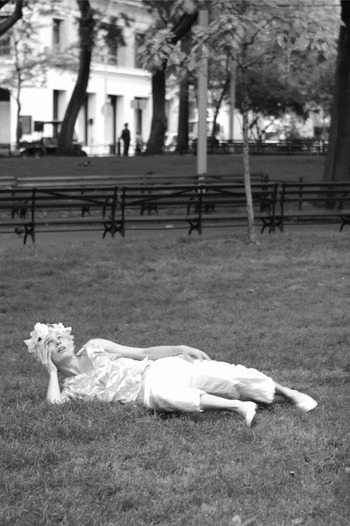
In stark contrast to the delimited spatial syntaxes of Suarez, Paggett and Pappas's gendered, racialized and diasporic bodies, Hana van der Kolk evokes expansive horizons in All at Once: Dancing ‘The Ridge’ in New York City Parks. Pairing hiccups of gesture and brief fillips of motion with a dense, convoluted narrative about her adventures during a series of site-specific performances (Fig. 4), van der Kolk moved around the lecture hall (performance space) while talking animatedly, alternately approaching and backing away from the spectators.Footnote 3 Van der Kolk has studied extensively with postmodern choreographer Deborah Hay, who conceives of the human body as an aggregate of its 73 million cells. Like Hay, she is dedicated to a daily practice of ‘inviting being seen’ in order to expand her perceptual awareness and capacity to be present in the moment. Thus, for van der Kolk, a dance does not exist as an object or single event but as a potentiality that manifests in a variety of forms and interpretations; each performance is not a culmination but the continuation of a process of collaboration between performer, environment and audience.
Hana van der Kolk whimsically ‘invites being seen’ in New York's Central Park. Photograph by John Peden, 2005.

Though externalizing cellular interiority offers a novel construction of corporeality that provokes surprising, light-hearted movement choices, its liberatory potential nevertheless evades racializing and gendering protocols that create hierarchies of value based on bodily difference, instead promoting the unity of humanity beyond (or beneath) social inscription. And while such a performance practice might be theorized as presupposing a female subject attempting to overcome the unease of being the gendered object of an audience's gaze, it does not acknowledge the ease in the world van der Kolk enjoys as a white woman (though it should be acknowledged that she is a first-generation Dutch immigrant). As the other performances on the Choreographing Identities programme more potently evidence, the power dynamics of visibility are far from equitable among all women and are not without cultural, social or political consequences. Acknowledging palimpsestic layers of social inscription as well as the capacity to reinscribe these, these choreographies disrupt taxonomical identity categories to open a space of possibility for alternate subject positions based on interesectionality, multivocality and inbetweenness.