Close to midnight on Sunday 1 July 1917 an automobile “loaded with white men” made its way north along 20th Street in Denverside, a black district of East St. Louis, Illinois. Calvin Cotton, Dr. Thomas Hunter and Reverend Thomas Wallace, three black residents standing on a street corner as they made their way home very late after church, saw the car approach. Oddly, Cotton later recalled, the vehicle's lights were not switched on. It passed them by before turning west onto Market Street. Suddenly, the car accelerated and there was a crackle of gunfire. Running to the corner, Cotton, Hunter and Wallace saw the vehicle speeding along the street. The white passengers' revolvers were flashing as they fired from both sides of the car.Footnote 1 There were “innumerable” shots, so many that it sounded “just like fire crackers popping,” and bullets tore into black homes, penetrating thin wooden walls and shattering windows. Within moments, black residents were at their windows and doorways. There was a flurry of action. Noah Parden, a prominent local black lawyer and politician who lived at 1914 Market Street, was seen “run[ning] to the door with his gun” as the white vehicle sped along the road. Others were also ready: “the negroes began to shoot,” Parden later stated in court, as the white gang passed through. This was probably more than the white gang had bargained for and they were lucky to escape with their lives. Their automobile was riddled with holes; the driver, Gus Masserang, was struck in the leg by buckshot; and another passenger was wounded by a bullet fired from a Springfield rifle.Footnote 2 The vehicle disappeared but a group of armed black residents set off on foot in pursuit. However, instead of catching the gang, they encountered an unmarked police car in an unlit street. They opened fire, killing two white detectives. It was a decisive moment. The Denverside drive-by attack had come on the heels of weeks of violence in which white thugs had beaten and harassed African Americans in the streets. For weeks, black community leaders had been demanding that the police intervene but no help came. The racist police department effectively turned a blind eye to racial violence and, after the shooting of the detectives, any pretence of impartiality was lifted. The following morning, when news spread across town, local whites became enraged at what they saw as a symbolic assault on white supremacy and, sharing that view, police officers incited reprisals and sent out word that they would not stand in the way of an attack on the black community. The city erupted in a brutal race riot, and black residents were forced to defend themselves against an all-out white onslaught. At the end of the day, dozens of black men, women and children were left dead and countless others were injured.Footnote 3
The East St. Louis race riot highlights the dilemma facing black communities in early twentieth-century America, an era of frequent outbursts of racist violence against which the law offered no protection, and in which those charged with enforcing the law were often complicit. The situation was all the more acute during the years around the First World War, years of hope and despair, of progress and setback. On one hand, rapid urbanization in the North brought about by the migration of vast numbers of black people from the South – the Great Migration – seemed to promise an optimistic future. For countless black southerners the North was a beacon of hope, seeming to offer an escape from the pervasive racism of Jim Crow.Footnote 4 And, indeed, the rules of race relations were beginning to change in the North as migration gave rise to ghetto communities, in turn opening up opportunities for black business. An emerging black middle class grew increasingly self-confident and while its members held fast to the ideas of racial solidarity, self-help and economic uplift associated with Booker T. Washington, they embraced a new political assertiveness more typical of W. E. B. Du Bois. Such businessmen anticipated building up a strong ghetto community and loosening the white monopoly on capital and power.Footnote 5
Despite high hopes and significant progress, there would be no let-up in or escape from white violence during the 1910s. Urban racial violence and police complicity underlined the continued precariousness of black communities under the white supremacist order. There had been brutal outbreaks of white supremacist mob violence in the South around the turn of the century – at Wilmington (1898) and Atlanta (1906), for example. In 1908 America was shocked when Springfield, Illinois – once the home of Abraham Lincoln – also erupted. In 1917 East St. Louis saw a repeat outbreak of mob violence in Illinois. In 1919 there was a “Red Summer” of racial killing in cities across America, including in Chicago. And, in 1921, the black community of Tulsa, Oklahoma and the city's “Black Wall Street” of Greenwood would be devastated by a further outrage.Footnote 6
Despite this, black people refused to relinquish their gains without a fight. Indeed, the established literature on the race riots of the early twentieth century reveals numerous examples of armed resistance – even if the historians who have revealed that evidence have not always focussed in detail upon self-defence, or acknowledged its important role in restraining white violence. Thus, in Atlanta (1906), the residents of the black district of Brownsville made a determined stand against white mobs. Snipers took up positions on the perimeter of their neighbourhood and kept whites out with fierce gunfire and eventually only massive intervention by the police and troops brought about the disarming of the defenders. By that time many other black residents had managed to flee to safety. In Springfield snipers slowed the progress of the mob by firing from the second-floor window of “Dandy” Jim Smith's bar, “wounding a number of rioters, some fatally” in the process. In Chicago (1919) African Americans responded to the outbreak of violence by turning sections of the ghetto into a “no-go” area for whites. Black gunmen took up positions in apartment block windows and at the border of the ghetto and harried interlopers from their streets with sniper fire. And in Tulsa (1921) blacks engaged in running gun battles with whites after confronting a lynch posse.Footnote 7
The actions of the black community of East St. Louis conformed to that pattern but, interestingly, the role of self-defence was not probed in the classic book on the 1917 outbreak, Elliott M. Rudwick's Race Riot, published in 1964. In that book Rudwick emphasized the brutality of the white mobs and the “terrified inactivity” of the black victims. While he described the pivotal shooting of the white police officers on the night of 1 July and noted that there were occasional “skirmishes” on 2 July, he presented instances of armed resistance as unorganized, sporadic and ineffective. This emphasis allowed Rudwick to refute the allegation, made by many local whites in the wake of the riot, that black residents had plotted to murder the police officers on the night of 1 July, thereby inciting white “vengeance.”Footnote 8 But in seeking – albeit for good reasons – to exonerate the black community from blame for the white attack, could it be that Rudwick underestimated the role of armed resistance? The present article will take a closer look at the compelling evidence relating to self-defence during the East St. Louis race riot.
Of course, armed resistance in East St. Louis and other cities during the early twentieth century can be located within a long-running tradition of militant self-defence. It has been over sixty years since Herbert Aptheker suggested in his pioneering study, American Negro Slave Revolts, that the white masters had been constantly haunted, and not infrequently openly challenged, by rebellion and resistance.Footnote 9 More recently, historians of the civil rights era have emphasized the continuity of a tradition of armed resistance over time – their work has tended to consider its impact upon the trajectory of the freedom struggle of the 1950s and 1960s. Timothy Tyson, for example, has identified Robert F. Williams's advocacy of self-defence in terms of a tradition “rooted in the unforgettable experiences of slave resistance and Reconstruction militancy.”Footnote 10 This is a point that Christopher Strain has made more recently in his 2005 book Pure Fire: Self-Defense as Activism in the Civil Rights Era, and it is also demonstrated by Lance Hill's work on the Deacons for Defense, a grass-roots armed organization from Louisiana.Footnote 11 We might well expect, then, that such a tradition would have fed into the events of 1917 in East St. Louis, a city where there had been significant migration from the South.
That being so, East St. Louis cannot be understood merely in the context of a linear tradition. As William M. Tuttle persuasively argued in his classic work, armed resistance during the 1919 Chicago race riot had to be understood in the context of the transformations effected by urbanization and war mobilization – experiences that Tuttle suggested turned southern migrants into militant northern “New Negroes.”Footnote 12 Admittedly, Tuttle's argument tended to place too much emphasis upon the impact of the First World War; even if this had had a radicalizing affect, it cannot account for resistance in East St. Louis, which broke out only weeks after the United States had declared war on Germany and as mobilization was still under way. Moreover, his explanation does not consider the possibility that migrants brought a tradition of self-defence with them from the South. But we need not accept that self-defence was a product of the postwar North to agree that the experience of migration radicalized black southerners or that the mood of the ghetto was one of militancy. Migrants were predominantly young men who rejected the old racial etiquette. The journey from the rural South to metropolitan Chicago was a process of liberation for many, in which the old habits of racial deference were to be – in the words of the Chicago Defender – “dropped in the Ohio river.”Footnote 13 By 2 July 1917 African Americans had yet to experience the radicalizing impact of the war, but the social transformations affecting Chicago were also being played out in East St. Louis, a city in which, as will be seen, the old pattern of racial deference was challenged by a new and assertive black community. It would seem appropriate to situate armed resistance in East St. Louis in this context. However, urbanization was important in other structural ways. Ghetto formation created new opportunities to organize collective resistance and coordinate action through community networks and institutions. This issue is key, for such considerations could prove decisive at a critical moment when mob violence loomed. Yet it is not something that historians of the race riots of the early twentieth century have hitherto scrutinized closely. The present article will therefore set armed resistance in East St. Louis in the context of ghetto formation and explore the emergence of such an infrastructure of resistance.
BLACK EAST ST. LOUIS: THE MAKING OF AN URBAN COMMUNITY
In the first decades of the twentieth century, East St. Louis was a small but rapidly growing city located in southern Illinois, across the Mississippi River from St. Louis, Missouri. As a railroad hub and an industrial centre, East St. Louis attracted large numbers of workers in search of employment. As its factories grew, so did its population, doubling almost every decade through the late nineteenth century and the early twentieth, reaching some 75,000 by 1917. Through these years, the city drew significant numbers of black migrants, a trend accelerated as the Great Migration gathered pace. There were fewer than two thousand black residents in 1900, almost six thousand by 1910, and possibly eight thousand by 1915, rising to ten thousand or more by 1917. African Americans had been about 5 percent of the overall population in 1890, and would compose over 10 percent by 1915 and possibly 15 percent by 1917.Footnote 14
No doubt many migrants arrived in East St. Louis with high hopes, perhaps similar to those voiced by one migrant whose words appeared in 1919 in the Journal of Negro History: “I want a job in a small town some where in the north where I can receive verry [sic] good wages and where I can educate my 3 little girls and demand respect.”Footnote 15 However, the reality of life in East St. Louis fell short of any such expectation. In East St. Louis African Americans faced a prejudiced white community that dominated the city economically and politically. After the 1917 riot the US Congress sent a Select Committee investigation to East St. Louis. Before that investigating panel, some local whites confessed to believing that – in their words – their city did not reflect “northern sentiment” but was instead “relatively comparable with the situation in the South.”Footnote 16 Indeed, the historian Sundieta Keita Cha-Jua has suggested that the whole region around East St. Louis was generally held to be a “hostile environments for Blacks.” Black people were “excluded from living in Granite City, Madison, and Venice” near East St. Louis, and there had been a lynching in nearby Belleville in 1903.Footnote 17 Some local whites could be found complaining that there was not enough clear segregation in East St. Louis, and that blacks were not sufficiently deferential, that they would sit next to white women on the streetcar or refuse to step off the sidewalk when passing a white person. Racial segregation was not systematic enough to meet the wishes of some, but it did shape life in the city nonetheless. There were many cinemas downtown, but only white people were welcome. Medical provision and schooling was separated by race.Footnote 18 East St. Louis was not unique in the North for this degree of informal “segregation” but it seems reflective of the mentality of local whites that they strived for more systematic separation and openly declared the South to be the place they sought to emulate in this regard.
Local whites carried their “southern sentiments” into the city's workplaces. In the years before the First World War, East St. Louis was not a particularly good place for black workers hoping to find industrial employment. In common with other cities at this time, native-born whites and “Americanized” European immigrants monopolized skilled occupations at the city's largest factories – at the Aluminum Ore plant, at Missouri Malleable Iron, and at the meatpacking plants of Armour, Swift and Morris.Footnote 19 African Americans worked in the least desirable, most arduous and least well-paid jobs, and they were effectively excluded altogether from some factories. When the Aluminum Ore plant opened in 1903, for example, it hired native-born white and European immigrants exclusively. Even into the 1910s it employed only about a dozen African Americans in a workforce of some two thousand and it seems that they worked as janitors.Footnote 20
Nevertheless, in the mid-1910s the black workers managed to establish a stronger position in local industries. When war broke out in Europe in 1914 the supply of immigrant labour dwindled as many returned to their native countries to fight, while, at the same time, American factories began to receive increased orders from the belligerent nations. Managers increasingly sought to draw upon the pool of potential black migrant labour and hired recruitment agents in the South to advertise vacancies. The result was a breakthrough for black workers across the northern labour market.Footnote 21 In East St. Louis black workers flocked to the meatpacking plants. They had composed only 15 percent of the meatpacking workforce in 1910, but were 40 percent by 1917. Black workers also gained a foothold in unskilled labour at Malleable Iron. Even at Aluminum Ore, African Americans would compose over ten percent of the workforce by the autumn of 1916.Footnote 22
At the same time as black workers were entering the factories of East St. Louis – some for the first time – the black community of the city as a whole was becoming increasingly concentrated in the southern district of Denverside. This occurred because certain districts of the city remained closed to African American residents. Middle-class whites were particularly effective in mobilizing opposition when it appeared that a black person might be poised to move in, and could present a united, hostile front through local residents' associations. In 1917, for example, the residents of Washington Park had sought to head off the possible arrival of black people by making a public declaration in the local newspaper that theirs was a “white man's part of town.”Footnote 23 The fact that such declarations had to be made, of course, reflects the fluidity of the situation: there was no formal segregation in East St. Louis. Where landlords and real-estate agents did not comply with the demands of white residents, and where those residents lacked the means of effective protest, black people moved in. Denverside was such a district.
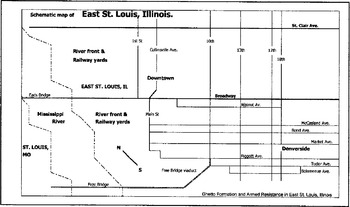
By 1917 it was increasingly possible for locals to speak of streets in Denverside that were “entirely colored” – this was true of Market Avenue between 17th and 18th Streets, where black people occupied all but one home, and of Boismenue Avenue around 15th and 16th Streets (see Figure 1). The pattern of settlement remained patchy. Walnut Street, to the west of Denverside and past 10th Street, was held to be a “real negro street” by some whites by 1917, but it was a little distance from the mainly black streets on Market and Boisemenue Avenues and was separated from them by white streets. Market Avenue itself ran along thirty blocks or so and, while some stretches were said to be “thickly” settled by African Americans, many areas of it were settled by whites. Denverside blurred into a predominantly white district by the time it reached 10th Street rather than coming to an abrupt stop at a clear dividing line.Footnote 24 The trend, though, was towards increasing black settlement and white abandonment.
Map of East St. Louis.

Like other northern cities at this time, the growth of an increasingly concentrated black urban community aided the emergence of a black middle class; black businesses took root where black workers lived in close proximity and had money to spend. Of course, even in the black metropolis of Chicago there was no decisive leap ahead in capital accumulation during these years. As was typical of the nascent northern ghettos of the 1910s, the black middle class of East St. Louis remained small and was mainly composed of professionals – teachers, lawyers and physicians. However, the increasing density of black residential settlement did provide a market for black businesses. For example, by 1917 black Denversiders could buy refreshments from the ice-cream parlour at 16th and Coultas, misspend their youth in the poolroom at 18th Street and Market Avenue, or purchase a remedy from the drugstore at 19th and Bond.Footnote 25
Regardless of its stage of development and size, it was the emerging dynamism of the nascent black middle class in East St. Louis that was most impressive. Locally that class was spearheaded by Dr. Le Roy Bundy. He was a native of Cleveland, Ohio and had set up practice as a dentist when he moved to East St. Louis. He used the money he made from his practice to build up an automobile garage, a filling station, a workshop and a rental and sales business.Footnote 26 Bundy was extremely ambitious and had hopes to make East St. Louis – in his words – “the best negro town in the United States.” Perhaps he dreamed of rivalling Chicago one day.Footnote 27 He was an outspoken man who challenged the assumptions of white supremacy by seeking power in the political arena, and frightened whites with his growing economic independence. Bundy was known to be “a strong supporter of equal rights.” He was accused by suspicious local whites of “preaching discontent among colored people” in closed, private meetings that he held at his home. He reflected the ambitious hopes for black advancement through racial solidarity and business enterprise that the Garveyite movement would soon mobilize and, indeed, Bundy would later become a member of the UNIA and would serve as first assistant to Marcus Garvey.Footnote 28 Bundy led local efforts to bring the emerging wealth and growing self-confidence of the ghetto to bear in the political arena. And, during the 1910s, the city's black community was beginning to gain some marginal influence – although real power lay some distance away. This was reflective of the general pattern across the urban North where black politicians were able to win the support of the ghetto, but still had to rely on an ability to negotiate the white-dominated power structures.Footnote 29 Electoral arithmetic and party factionalism both played a key role in advancing black political participation in East St. Louis. Comprising over 10 percent of the population by the 1910s, black voters came to hold the balance of power in closely fought municipal elections. This meant that a black party or faction was well positioned to exert pressure upon the white political machines and, by 1916, Bundy and some others were gaining political experience. Bundy himself had been elected as a county supervisor in the past and three other founding members, Dr. Lyman Bluitt (a physician), Noah Parden (a lawyer) and Thomas Wallace (an editor), had all successfully stood for city and county office previously.Footnote 30 Together these men formed a breakaway, all-black Republican League and began to negotiate with the local white factions. It helped that city politics were not contested on strictly official Republican and Democratic party lines. Mayoral tickets were essentially bi-partisan coalitions, partly determined by intra-party faction-fighting, and this made it easier for an organization like the St. Clair County Republican League to manoeuvre between the competing white factions. The municipal election of April 1917 was telling. Mayor Mollman received the key support of Bundy, Bluitt and Wallace, and his campaign held out the promise of recruiting black police officers and building a new fire station in Denverside. He defeated John Domhoff who, in contrast, seems to have done little to solicit black votes and included no black politicians on his ticket – something for which he was publicly castigated by one supporter, Captain John Robinson.Footnote 31 In the rough-and-tumble world of City Hall politics, the success of the black Republican League was always likely to be morally ambiguous at best, and there is much evidence that the organization's members were involved in corrupt and unethical behaviour. While collaborating with Mayor Mollman's party, Bundy was deeply implicated in bribery and an extensive vote-rigging system.Footnote 32 Of course, the misdeeds of these black politicians must be understood in the context of the widespread civic corruption that could be found across the United States at this time. Although of dubious long-term value, active political participation helped to change the rules of race relations. African Americans like Bundy who were improving their economic position and saw the chance to build up a strong black urban community were, at the same time, not willing to adhere to Washington's advice to stay away from the realm of politics. Their failure to articulate an overt message of liberation or mobilize a grass-roots drive for civil rights must be balanced against their successful marshalling of black political strength to challenge the assumption that whites were entitled to a monopoly on power.
By 1917, then, Denverside was beginning to emerge as distinctively African American space. In addition to black businesses, there were black churches – the True Light at Baker Avenue, and the Mount Zion at 13th and Tudor, for example. There were fraternal societies like the Odd Fellows, which had met in Denverside since 1909 and regularly held ceremonial uniformed parades through the neighbourhood. And, at the heart of the emerging ghetto, next to Le Roy Bundy's home, was a park and playground in which black residents could hold baseball games and enjoy picnics.Footnote 33 Excluded from downtown hotels and facing various restrictions because of customary segregation, African Americans could increasingly look to Denverside as a community with emerging institutions and increasing political influence. As will be seen, in 1917, this district would also offer a bulwark of resistance against racial violence.
WHITE VIOLENCE AND GHETTO RESISTANCE
East St. Louis, never a city in which African Americans were greeted on terms of equality, became a distinctly hostile environment in the summer of 1917 and then slipped into the grip of racial violence in July. Partly, that rising hostility can be attributed to white resentment towards the expansion of the ghetto. During the summer many racist attacks broke out in the area around 10th Street, an area where black Denverside blended into predominantly white streets and where – it might be surmised – further black residential expansion was both anticipated and unwelcome.Footnote 34 And, partly, hostility emerged because of white working-class fears about the growing political influence of African Americans. For example, feelings had run high when Mayor Mollman threw a barbecue for black party workers after being re-elected with their support in the spring of 1917. This was taken as a sign by some whites that his administration would be obligated in some way to the black community, and relatively less responsive to white demands.Footnote 35
Above all, though, it was the context of industrial conflict that stirred hostility. East St. Louis was a predominantly white working-class city, and the fate of labour was close to the hearts of the majority of its inhabitants. In particular, because of racism, the interests of white labour were seen as distinct from – and, in some respects, opposed to – the interests of black labour. During 1917 local white workers increasingly came to see black migration to East St. Louis, and the black community in general, as a threat to their economic interests. It was feared that black migrants were providing a pool of workers that could be used to weaken the bargaining position of white labour. Labour disputes in 1917 became entwined with race as white-dominated unions protested increasingly vociferously against black migration and the employment of black workers.Footnote 36
Two years later, in 1919, Chicago would also slide into a brutal race riot after rising white hostility over black urban expansion and political participation, and amid industrial conflict – much to the dismay of some black leaders who saw history repeating itself.Footnote 37 Yet such similarities should not lead one to conclude that racial conflict was the inevitable result of black migration and urban growth. Certainly, in East St. Louis there was nothing predetermined about the violent white response to black migration. Some whites recognized the need for interracial solidarity and, during 1916 and 1917, a wave of union organization in the city had briefly held out the possibility that black and white workers might unite. When the meatpacking workers struck in 1916, “hundreds” of African Americans had joined white workers in the walkout, and the strike at the Morris meatpacking plant at that time was led by a black worker.Footnote 38 In April 1917 black workers took part in a strike at Aluminum Ore. On that occasion the grievances of the plant's janitors – all of whom were black – were specifically itemized in the union's demands.Footnote 39
However, in response to the early successes of these unions, employers across East St. Louis began to foment racial discord, seeking to undermine the emerging interracial cooperation. Managers at Aluminum Ore and the meatpacking plants were particularly successful at this. Through autumn 1916 and over the winter, they began recruiting black migrants and sacking white workers – not all of whom were union members.Footnote 40 The new intake of black migrant workers do not seem to have joined the unions in great numbers, which angered the whites. As both James Barrett and Rick Halpern have emphasized in their work on Chicago's meatpacking plants, white-dominated unions in the North struggled to recruit black migrants during the 1910s. Some migrants were deterred by prior experience of overtly racist southern unions, while others, coming from rural areas, found a union an alien concept. Moreover, many had a genuine enthusiasm for the opportunity of industrial work in the North and employers were able to win their loyalty by building upon that goodwill by offering social welfare programs. Probably all of these reasons contributed to the poor recruitment of black workers in East St. Louis. For example, Aluminum Ore manager Charles Fox was probably seeking to cultivate loyalty when, in March 1917, he hosted a meeting of representatives of local employers and the YMCA in order to discuss ways of improving housing conditions for black migrant workers.Footnote 41 But, in addition to such factors, and surely decisively, the chauvinism of white workers in East St. Louis must have put many black migrants off. This surfaced when managers sacked white workers and employed black migrants; local union leaders began to complain that black workers “took work” that “belonged to the white man,” and that management had “put in niggers wherever they could” – sentiments that would hardly have encouraged those new African American workers, whether migrants or native East St. Louisans, to sympathize with the organization.Footnote 42
Over the course of early 1917, growing white antipathy towards black migrants soon blotted out memories of earlier interracial cooperation and, because of their prejudices, whites increasingly expressed resentment towards African Americans in general. By the summer of 1917 they were complaining that employers “encourage the negro by discriminating against the whites.”Footnote 43 Perhaps because it was the largest factory in town, a strike called at Aluminum Ore in April became a lightning rod for such resentment and racist anger. Local whites became infuriated at the presence of black workers among the strikebreaking labour force – even though they only comprised a proportion of the strikebreakers employed by managers. Through May and June sporadic racial violence flared and, ominously, in “common talk around town,” local whites began to say that they wanted to “drive the niggers out” of East St. Louis.Footnote 44 Increasingly it seemed that the whites were bent on taking such action. On 28 May a mass meeting protesting against black migration broke out into a riot. White mobs poured through downtown East St. Louis, beating any passing African Americans and smashing black-owned property in the area. In the weeks after that outbreak, as one local black resident later recalled, it seemed that “every night or every day” there were racist attacks “down by the Free Bridge [at 10th Street] and near the Aluminum Ore plant.”Footnote 45
By the summer of 1917, then, the black community of East St. Louis was facing a violent white reaction. It was uncertain at the time how much further whites would go in venting their rage, but what became increasingly clear was that the police would not offer any effective protection from attack. Not only was the police department woefully under-resourced but it was also dominated by racially prejudiced white officers. Indeed, instead of cracking down on the growing problem of white violence during May, the chief of police launched a high-profile public campaign to target supposed black “criminality.” He alleged that “notorious colored crooks” were arriving in the city from the South, and set his officers the task of stopping and searching black men in the street.Footnote 46 This campaign seems to have absorbed most of the police department's time for, despite the efforts of Le Roy Bundy and Lyman Bluitt to press the mayor and chief of police to act against the racist thugs responsible for the increasingly frequent attacks on black people, nothing was done. Worse still, when police officers did intervene in confrontations between whites and blacks, they tended to blame African Americans for provoking violence rather than defending them against white aggression.Footnote 47
As William Tuttle noted in his work on the 1919 Chicago race riot, police racial discrimination – “negligence and misperformance of duty” – in the period of rising white hostility and violence “convinced … [black residents] that they would have to provide their own protection” and arm themselves.Footnote 48 African Americans in Chicago, denied equal protection under law, turned to self-defence. Significantly, during June 1917, as East St. Louis was increasingly torn by racial violence, rumours began to circulate through the city suggesting that members of the black community were poised to fight back. Some of those rumours held that African Americans were arming themselves in preparation for a decisive confrontation with the white community or even planning a revenge “massacre” of whites on 4 July in response to the mob violence of 28 May. Le Roy Bundy, it was said, was gathering an “arsenal” in preparation for an “uprising.” Other stories told of black people “drilling,” military fashion, in Denverside.Footnote 49 East St. Louis seemed on the brink of – in the common parlance of the time – a “race war.”
Doubtless, historians of the American South would approach such rumours with considerable caution, and justifiably so. Rumours warning of impending black “uprisings” have been a recurring theme in southern history from the antebellum period to the Reconstruction and into the twentieth century. Typically, such rumours were little more than the fevered imaginings of white communities conditioned by racism. In particular, white America has long been haunted by the fear of black uprising and the idea of armed black men outside white control.Footnote 50 Rumours of black insurrection plots played to these profound fears. The results were – as Dan T. Carter notes – frequent outbreaks of “mass hysteria,” episodes in which all African Americans fell under suspicion and became associated in the minds of whites with an all-encompassing racial “threat.”Footnote 51 There was, for example, such an outbreak in 1865, when false rumours of a black uprising swept through white communities across the southern states. At that time, in Mississippi, “heavily armed freedmen” were said to be meeting at midnight in preparation for an “insurrection” and, “across the Deep South,” blacks were said to be forming “rifle companies.”Footnote 52 Similarly, when “[r]umors of secret meetings and drills” spread across Texas in 1883 there was again “a wave of fear,” which resembled age-old “panics caused by antebellum slave revolts and earlier post-Civil War fears of [black] insurrection.”Footnote 53 Interestingly, in East St. Louis, white fears also condensed around the issue of black ownership of firearms, and the emergence of rumours of a black uprising coincided with a police crackdown on supposed black “criminals” and “gun-toters.” Moreover, in this context, it seems particularly significant that the shooting of two white police detectives by African Americans touched off the fury of the July race riot, in which whites sought “vengeance” upon an entire black community.Footnote 54
Given all of these apparent similarities, it could seem possible that the rumours that swept East St. Louis in the summer of 1917 were related to the southern pattern of racial panic. Perhaps they reflected the “southern” orientation of the city's white population. There was, of course, no massacre of whites on 4 July. There was a massacre on 2 July, but one led by white mobs against black people. And, when the National Guard searched Denverside on 2 July for the “arsenal” that Bundy had allegedly been stockpiling, no such thing was found. Hysterical reports on the day of the riot that black “armies” were “mobilizing” in nearby Brooklyn, Illinois also proved groundless.Footnote 55
Clearly, the rumours of impending black “uprisings” were unfounded. However, undeniably, some weapons had found their way into the black community by the summer of 1917. Despite the police crackdown on gun ownership, some black residents were prepared enough to respond to the surprise drive-by attack on the night of 1 July – as noted at the beginning of this article. And, when mob violence broke out on 2 July, a similar pattern of defensive action was seen. For example, Thomas Canavan, a white man who was not involved in the mob attacks, became an uncomfortably close witness to such armed resistance when he strayed into a predominantly black section of McCasland Avenue on 2 July. Black residents took no chances that Canavan's vehicle was not being used for a drive-by attack and, like the residents on Market Street the previous night, they opened fire from the cover of their homes as he drove by. “It looked to me that from every door they were shooting at me,” said Canavan later, recalling the hail of bullets that he drove through, and from which, by fortune, he emerged unhurt.Footnote 56 Other reports that day of black snipers “ambushing” white rioters, or of black gunmen firing from cover in the weeds growing around vacant lots in Denverside, also seem to indicate a degree of cooperation in the armed response to the white onslaught.Footnote 57 Similarly, there was a collective response to the drive-by attack late in the night of 1 July. Black residents formed themselves rapidly into a group and pursued their assailants. Some local white witnesses later estimated that the group, armed with shotguns, revolvers and rifles, numbered between forty and seventy-five people; the police officers who encountered the group that night – significantly, at 10th Street – claimed that it was possibly 150 strong.Footnote 58 Even if the lowest estimate was accurate, it seems undeniable that there was a strong element of coordination to the response to the white attack.
The urban geography of and increased physical proximity within the emerging ghetto made a collective and cooperative response both logical and efficacious. Since the threat came largely from outside the defined border of the neighbourhood, all black residents, being equally vulnerable to racial attack, had a stake in resistance. At the same time, efforts to drive away groups of whites benefited from the pooling of strength and resources. Thus, in East St. Louis, black residents moved in groups beyond their own individual homes to protect the neighbourhood as a whole from attack by confronting whites at the borders of Denverside. For example, on 1 July, during daytime, local residents responded to reports that white racists had been gathering and attacking black people at random in the streets around 10th Street by confronting the thugs there. Importantly, they saw such action in terms of community solidarity, and spoke of “going down there [to 10th Street] and defending the colored people.”Footnote 59 By late evening it appears that black residents had organized themselves into groups and were patrolling the area of the fringe of Denverside where trouble had flared earlier in the day. These patrols contributed to the protection of the entire neighbourhood.Footnote 60
It can be surmised that the black defenders of Denverside were not novices. In Denverside, black residents had been able to catch white assailants in crossfire as they drove through their streets. This required a degree of technical knowledge for, if the gunmen were placed in the incorrect formation, they risked striking their comrades across the street with any shot that missed its target.Footnote 61 Intriguingly, a reliable source later claimed that Dr. Le Roy Bundy had approached a black Spanish-American war veteran named McDonald in July 1917 and offered him money to “drill the men” of Denverside, to ready them for a defence of the community.Footnote 62 McDonald apparently declined the offer but, if the source is to be believed, it is interesting that efforts were afoot to ready the residents of Denverside for an attack and to equip them with tactical know-how. Other small details also suggest that the armed resistance in Denverside was not solely the work of initiates. Some residents had modified their ammunition by cutting slits in the sides of their shotgun cartridges. This caused the shot, which would normally disperse, to remain closely packed together when fired. The shot was rendered more accurate and powerful, and shotguns – which might be owned for hunting rabbits or fowl – became weapons that were unmistakably for use in a confrontation with a deadly enemy.Footnote 63 Taken together, the evidence indicates that, by July, the black residents of Denverside were armed, were coordinating their actions, and had the knowledge to put strategies of armed resistance into practice.
The ghetto provided some of the key resources needed for the defence of the community. In preparing their defence, the residents of Denverside could draw strength from their successful middle class. As the attempt to purchase the services of the veteran McDonald reveals, Le Roy Bundy was willing to use his own economic resources to help prepare the community. The social institutions of the growing ghetto, founded upon the emerging economic success of the community, further aided the preparations for defence. One example of this can be seen on the night of 1 July. After the white gang drove through Market Street, shooting, the bell of the Mount Zion church at 13th and Tudor was used to sound a warning across the neighbourhood at the same time as somebody was heard running through the streets shouting, “the white people [are] coming.” Soon after the bell was heard, black people gathered in the street and set out to pursue the gang on foot.Footnote 64 In this case, it seems likely that some form of common understanding had been reached within the community that the sounding of the Tudor Street church bell would indicate danger and a need for action.
It is also possible that the Odd Fellows fraternal society had been used to help prepare residents to defend their neighbourhood. Local whites had alleged, before the July race riot, that African Americans were “drilling” in Denverside. In the wake of the riot, seeking to deny the charge that they had been plotting an “uprising,” some black residents claimed that the rumours of “drilling” were misreported white observations of the Odd Fellows fraternal society practising ceremonial processions in the neighbourhood. As noted earlier, the Odd Fellows did indeed practice ceremonial drill. However, it is possible that not all of the marching practice taking place in Denverside during 1917 was the work of that fraternal society or intended as practice for a ceremonial procession – particularly given that Bundy had already attempted to recruit the war veteran McDonald to train the local men. One white witness claimed that he had seen African Americans drilling with ceremonial swords on Market Street – which was, very likely, the work of the Odd Fellows. However, he also claimed to have seen a man drill with a gun on another occasion.Footnote 65 We might be cautious when reflecting upon the motives of a white witness testifying in the wake of a race riot but other evidence suggests that such suggestions need to be considered seriously. Noah Parden later conceded that he had seen the “Odd Fellows” practising marching at night “a number of times.” Since darkness would have offered the chance of concealment, it seems possible that some drill practice at this time was undertaken to promote self-defence and was later passed off as routine fraternal-society activities.Footnote 66 In any case, it is worth reflecting upon how the discipline required by even ceremonial drilling could have informed the efforts to coordinate a defence of the neighbourhood, and that the community links fostered by the fraternal society likely facilitated the organization of armed patrols.
There is another possible link between the social and economic development of the ghetto community and preparations for armed resistance relating, in particular, to the smuggling of firearms to East St. Louis. Although a cautious silence on the part of black witnesses largely surrounds the events relating to self-defence during the summer of 1917, some local African Americans were later forced to admit that they had responded to the embryonic 28 May riot by purchasing firearms for self-defence.Footnote 67 Although the police campaign targeting “gun-toters” made it difficult for black people to obtain firearms in East St. Louis without arousing white suspicion, it was possible to purchase weapons away from prying local eyes by travelling across the Mississippi River to St. Louis, Missouri. This was precisely what Frank Adams (a truant officer) did on 29 May, together with associates Willis Gaither (a chauffeur), Will Red (a saloon-keeper), Buddie Bell (a poolroom proprietor) and Horace Eubanks (a businessman whose premises had been destroyed in the 28 May riot). They drove to a St. Louis hardware store, bought seven.38-calibre Colt pistols and ammunition, concealed the weapons under the bonnet of their car and, as Adams later admitted in court, by this means attempted to smuggle them back to East St. Louis. However, as the smugglers approached Denverside, their car was stopped by a suspicious white police officer, searched, and all were arrested.Footnote 68 The attempt at concealment here is interesting. Adams and his associates felt compelled to risk triggering an explosion of their ammunition by placing it by the hot engine under the hood of the car. This was no casual visit to a hardware store, but a pre-planned attempt to obtain weapons in secret.
Two points are worth emphasizing here. Firstly, although ghettos existed under the ultimate control of political and municipal institutions dominated by whites, they nevertheless provided urban space within which African Americans enjoyed a greater degree of economic and social independence than had been the case in the rural South.Footnote 69 Significantly, the growth of black business in the city facilitated the smuggling scheme. The smugglers drove to St. Louis in a car hired from a black rental business in East St. Louis, and were driven there by a black chauffeur – Willis Gaither. The vehicle – it might be added – had originally been bought from Le Roy Bundy's garage. Thus the plan could be executed largely outside white purview and this surely minimized the chances of discovery. In the event, the smugglers were discovered by chance, within walking distance of home.Footnote 70
Secondly, the smuggling scheme revealed by the arrest of Frank Adams, taken together with further evidence, suggests the possibility that the existence of black-run bars and poolrooms enabled African Americans to distribute weapons smuggled from outside the city. Given the secret nature of the smuggling scheme, it is impossible to determine how common gun-smuggling was at this time. Nevertheless, evidence suggests that other black residents were smuggling weapons back to the city during the summer of 1917. The evidence can be found in the testimony of Henry Krudwig, a white man who lived above his saloon in Denverside, near the home of Le Roy Bundy and opposite a bar and pool hall run by a black man named Bayles. Krudwig claimed that, on a number of occasions in June, he had seen groups of black men and women arrive at Bayles's bar and carry rifles and shotguns inside. We must treat such evidence with great caution for, in the wake of the riot, it is conceivable that Krudwig could have sought to implicate members of the black community in the so-called insurrection “plot.” His testimony was given on behalf of the prosecution during the trial of Le Roy Bundy and was used to attempt to implicate the black politician in precisely such an alleged conspiracy. However, it seems unlikely that Krudwig fabricated his evidence for this purpose. Had he done so, he would surely have emphasized Bundy's involvement in the gathering of weapons at Bayles's pool hall. Yet Krudwig specifically stated in court that he had never seen Bundy at Bayles's bar when the weapons were allegedly being delivered. Moreover, Krudwig stated that Bundy had been a patron of both his saloon and Bayles's bar, which could be taken to imply that he had no particular quarrel with the man.Footnote 71
It is interesting that a poolhall bar – an important social gathering point – was alleged to have been at the centre of a scheme to distribute firearms. It seems additionally intriguing that Buddie Bell, Horace Eubanks and Will Red – all of whom took part in the gun-smuggling trip to St. Louis with Frank Adams – were pool hall and barroom proprietors. Of course, as property owners, they also stood to lose much in a riot – Eubanks had already lost his business – and it is unsurprising that they wished to purchase weapons with which to defend themselves. Yet this alone cannot convincingly account for Bell's involvement. As the proprietor of a saloon in the vicinity of the notoriously dangerous and gun-riddled “Valley” vice district, it was highly unlikely that Bell did not already possess at least one firearm.Footnote 72 Given that many black residents still had weapons by 1 July, despite the police campaign of disarmament, a more likely explanation is that informal community networks were being used to distribute smuggled firearms and arm the ghetto.
By the end of June an increasingly dangerous situation was developing in East St. Louis. As the city faced a rising tide of white violence, the local police force failed to offer the black community protection under the law. Instead, white officers intervened on the side of whites in street brawls, arresting African Americans who defended themselves, and failed to prevent racist attacks on the black community. A campaign to disarm African Americans made it clear that white police officers viewed black people as a threat to public safety. Worse, it sent out the message that the only role the police force would have at this time of racial conflict would be one of hindering black efforts to defend themselves against white violence. And, since the police stood in the way of self-defence, the danger was that, at some point, they would find themselves in a confrontation with members of an increasingly distrustful – and increasingly well-armed – black community. This is precisely what happened on the night of 1 July.
Minutes after the Market Street drive-by attack on 1 July, and summoned by the Tudor Street church bell, a group of black residents, forty or more strong and armed with shotguns, rifles and revolvers, set off through the neighbourhood. The sight threw some local whites into panic. Some undoubtedly thought that they were watching the beginning of the rumoured black “uprising.” One local white resident called the police with a somewhat hysterical-sounding warning: “they are coming from all directions,” he said, “[t]hey've got guns and everything”.Footnote 73 Although the police had signally failed to protect the black community from attack by racist thugs throughout the afternoon of 1 July, upon receiving a white report of armed blacks in the street they sprung into action. Two white detectives, Frank Wadley and Samuel Coppedge, two patrolmen, Officers Hobbs and Culinane, and a driver, William Hutter, were dispatched in a patrol car together with a news reporter Roy Albertson.Footnote 74
According to the officers and the reporter, they drove directly to Denverside. Suddenly, as they reached 10th Street at the border of the neighbourhood and not far from where white thugs had roamed earlier in the day, they came upon a crowd of black people. Hutter later described seeing “100 to 150 colored fellows” in front of him. He was driving fast, going “a pretty good clip,” and the crowd “kind of scattered to one side,” moving to avoid the car as it drew up. Coppedge called out to the crowd, “where are you going boys?” It was very dark in the unlit streets and perhaps the members of the crowd did not recognize the men in the car, or the plain-clothes detective Coppedge, as police officers. Perhaps the racist implication of addressing the group as “boys” angered them.Footnote 75 A member of the group of African Americans called back, “it's none of your damned business.” If the police officers and reporter are to be believed, Coppedge responded by saying, “We are officers, here to protect you, the same as the whites.” If true, it was a laughable statement, given that African Americans had pleaded for weeks for police protection from white thugs, and received none. And, if true, little wonder that it received the retort, “We don't need any of your damned protection.”Footnote 76
Discrimination and the racially motivated campaign to disarm African Americans made the police presence in Denverside that night worse than a hindrance to black residents seeking to defend their homes. The police were a potential threat. Very likely, the crowd of black residents feared that the police would seek to disarm them and thus leave them defenceless against any further white attack later that night. Some might even have suspected these officers of complicity in the drive-by shooting – their unmarked police car was the same make as that used by the white gang. There was a tense stand-off before Detective Coppedge decided to withdraw and signalled for the driver to pull away. But, as the vehicle moved off, there was sudden volley of gunfire from the African American crowd, peppering the police car. Perhaps, as one witness later suggested, one of the vehicle's thin tyres burst as it drove away, which, in the tense stand-off, some members of the crowd mistook for a gunshot, causing them to open fire.Footnote 77 Whatever the reason for the shooting, as the police car sped from the scene it carried away two stricken white detectives, one dead, another dying.
It is possible to cast the events of 1 July in a wholly pessimistic light. Perhaps, it could be said, if black residents had not armed themselves, if they had simply endured the failings of the local police department and focused upon lobbying City Hall, then maybe the shooting of the detectives could have been avoided and the race riot might never have occurred. Such a reading of history, however, would be little more than wishful thinking. By July 1917 East St. Louis was a simmering pot of hostility. A large section of the white working class was seething with hatred for black migrants. An embryonic race riot had already broken out on 28 May even without a “triggering” event of the magnitude of the Denverside shooting to set it off. Throughout June white thugs had continued to beat and harass African Americans. There was no let-up in the violence. And, besides, as events in Chicago would demonstrate two years later, white communities were capable of rousing themselves into outbursts of rage without provocation. The 1919 Chicago race riot broke out in response to rumours. In the afternoon of 27 July a black boy swimming in Lake Michigan was drowned after being stoned by whites but, by the time news of the event had circulated through the city, the story became distorted and whites had become convinced that a white youth had been killed by a black man. Rumour shaped by prejudice sufficed as a “trigger.”Footnote 78
The East St. Louis race riot broke out downtown on the morning of 2 July. Rioters turned their fury first against any black people caught downtown, then fanned out across the city. They attacked and quickly overwhelmed black streets adjacent to the downtown district. Black homes around Rock Road and along Walnut Avenue, near Broadway, were rapidly surrounded and set ablaze. Although there was some resistance here, many African Americans were shot and killed or wounded by white gunmen as they fled from their burning homes. In total, according to the official death toll, at least thirty-nine black men, women and children died in the East St. Louis race riot. The majority of the fatalities occurred downtown and in these adjacent residential streets.Footnote 79 However, east of 10th Street events took a different turn. The white mobs failed to penetrate deep into Denverside despite threatening to drive the “business negroes,” who lived there, from the city.Footnote 80 Black gunmen made such an attack too hazardous. Black snipers used crossfire tactics to harry white interlopers from their neighbourhood, and armed residents used the cover provided by weeds growing in vacant lots to ambush white vehicles at the border of Denverside or to fire into advancing mobs.Footnote 81 White rioters were able to hold sway downtown unchallenged but they faced determined opposition in Denverside. Although they appeared bold when they faced unarmed victims, most white rioters chose to retreat in the face of armed resistance rather than risk injury or death. Even so, the fighting was in deadly earnest, and black gunmen killed about eight whites and wounded an unknown number more before the day was through. Such armed resistance effectively contained the worst of the violence downtown. Many black residents of Denverside were protected from attack altogether and refugees who escaped from the fury of the riot downtown were able to find shelter in the heart of the emerging ghetto. Resistance also kept a vital escape route open: a viaduct ran from Denverside onto the Free Bridge, which linked East St. Louis with St. Louis, Missouri, and across that bridge black men, women and children – an “army of refugees,” in the words of one observer – streamed to safety.Footnote 82 In this light, it is hard to disagree with Ida B. Wells that, if the white allegations against him were true and he had armed and trained the community, Le Roy Bundy was merely anticipating the trouble lying ahead in East St. Louis.Footnote 83
CONCLUSION
The East St. Louis race riot shattered any lingering faith in the belief that the North was a promised land, and it was a tragic setback to the development of the black community. As has been seen, there had been cause for hope in East St. Louis during the 1910s. Urbanization fuelled by migration gave rise to dramatic social and economic transformations. A dynamic black ghetto emerged, composed of a growing proletariat and an increasingly independent and confident middle class. Black businesses and community institutions like churches and fraternal organizations took root. East St. Louis also offered opportunities, denied to African Americans in the South, to find industrial employment and to vote. As an increasingly significant proportion of the workforce and the electorate, African Americans emerged as a growing influence in a city hitherto dominated by whites.
However, the economic and political realities of life in East St. Louis undermined efforts to build a strong and independent black community that could engage with the white world on terms of equality or realize the migrant dream of an escape from white supremacy. The emerging black businesses of the ghetto were small-scale, service-sector enterprises. This meant that the mass of black workers were dependent upon the large local factories for work, and had to steer between the racial prejudices of white managers and the restricted opportunities left open by white labour's monopoly of skilled and semi-skilled employment. Although the ability to vote and the size of the black electorate brought some influence, the ghetto remained under the authority of the institutions of local government that were dominated by whites. Within these confines, African Americans attempted to wield what power they did possess, but experiments in interracial union organization and attempts by the middle class to navigate the corrupt local political structure foundered for the lack of a mature strategy to advance civil rights. Political influence and bargaining power was not the same as political power or community control and, particularly pertinently, the ghetto lacked control of the police force. As the white reaction grew increasingly violent during 1917, it was apparent that the police force would not uphold the right of African Americans to equal protection under the law. The businesses and institutions of the ghetto, black people's homes and their very lives were left vulnerable to white violence. The precariousness of the situation became increasingly apparent through May and June 1917 as the violence increased and, despite the best efforts of black politicians to use their leverage with City Hall, the community was left to fend for itself.
Of course, East St. Louis merely provided further confirmation that black Americans could expect no protection from mob violence under the prevailing order. But the black community was not cowed. Many of the black men and women of East St. Louis were drawn from the South, where there was a strong tradition of self-defence. Moreover, even in the face of the limits imposed by racism, black people had begun to forge a place in East St. Louis and challenge the white monopoly on work, business and politics. If the ghetto could not quite live up to the hope of black independence, the growing self-confidence that it nurtured surely promoted the determination to fight back, while its businesses, institutions and community networks aided the organization of armed resistance. Behind the veil, black people acquired firearms, arranged warning signals and readied themselves to meet violence with violence.