Introduction
Communication, i.e. exchange of information, has been the very foundation of the development of human civilization. The ever-growing communication technology starting from the use of sign languages like smoke signals, cave paintings, etc., as initial modes of communication, has reached another level by making it possible the transmission of real-time physiological data of human beings, enabling them to take crucial decisions concerning their well-being. The real-time monitoring and transmission of these data are facilitated by the use of a Wireless Body Area Network (WBAN), a network of wireless communicating devices which are either implanted into (invasive) or worn over the human body (non-invasive) [Reference Hall, Peter and Hao1]. A wide range of applications adding comforts to the lives of living beings, including smart healthcare monitoring, infotainment, smart rescue systems, GPS-enabled smart shoes, etc., are being offered by WBANs [Reference Abbasi, Qammer, Ur-Rehman, Qaraqe and Alomainy2–Reference Hadjidj, Souil, Bouabdallah, Challal and Owen4], making it a topic of interest among researchers. Researchers are working tirelessly to provide novel solutions for sensors, power requirements, and antenna systems to be employed in these smart wearable electronic devices.
The operating environment of wearable antennas makes the task of designing these antennas quite challenging. Due to the dielectric nature of human tissues, the performance of on-body antennas is likely to be affected very badly. Another important task is to minimize the electromagnetic absorption by human tissues so as to comply with the safety standards of specific absorption rate (SAR). Moreover, the antenna system needs to be conformal, flexible, and compact enough to fit into a small space over the human body surface.
A variety of flexible substrates like textiles, polyester films, polymer composites like Polydimethylsiloxane (PDMS) -coated silica nanoparticles [Reference Lin, Chang, Cheng, Member and Jou5], and polymer yarns [Reference Liao, Dulle, de Souza e Silva, Wehrspohn, Agarwal, Förster, Hou, Smith and Greiner6] have been utilized to design planar monopole antenna, planar inverted-F antenna, microstrip patch antenna [Reference Abbasi, Nikolaou, Antoniades, Nikolić Stevanović and Vryonides7–Reference Alomainy, Hao, Owadally, Parini, Nechayev, Constantinou and Hall10], etc., for employment in WBANs. But, due to a lack of proper isolation from the human body, these antennas suffer from some serious drawbacks such as impedance mismatching, frequency detuning, efficiency degradation, and distorted radiation patterns.
To overcome these drawbacks, meta-surfaces like arrays of artificial magnetic conductor (AMC)/ High Impedance Surface (HIS) unit cells are being utilized by researchers as antenna reflectors [Reference Sievenpiper, Zhang, Broas, Yablonovitch and Alexopolous11–Reference Palmeri, Bevacqua, Morabito and Isernia17]. An increase in the array size up to a certain limit results in improved radiation performance of the structure [Reference Dewan, Rahim, Hamid, Yusoff, Samsuri, Murad and Kamardin18, Reference El Atrash, Abdalla and Elhennawy19]. So one of the many challenges before researchers is also to realize novel compact AMC structures to be used as reflectors.
A CPW-fed reconfigurable folded slot antenna with a 3 × 3 AMC array as reflector [Reference Saeed, Balanis, Birtcher, Durgun and Shaman20] demonstrated gains of 6.4 dBi at 2.45 GHz and 3 dBi at 3.3 GHz. Each of the substrates used for the antenna and AMC is 1.52 mm in thickness, while the antenna and AMC are separated by a considerable gap of 6.25 mm. Thus, making the overall structure quite thick (>9 mm), which is obviously undesirable in the wearable domain. At 5.8 GHz, a sufficiently large gain of 7.47 dBi is reported in [Reference Chaouche, Nedil, Ben Mabrouk and Ramahi21] when the antenna backed by AMC surface is placed at a distance of 3 mm from the body equivalent. AMC-backed dual-band monopole [Reference Wang, Yang, Wu, Bao, Liu, Cai, Dang, Zheng and Li22] provided the gain of 5.2 and 7.7 dBi at 2.45 and 5.8 GHz, respectively. Relatively larger gains of 9.4 and 6.6 dBi at 3.5 and 5.8 GHz, respectively, are demonstrated by a dual-band (3.5 and 5.8 GHz) monopole backed by a 4 × 4 AMC [Reference El Atrash, Abdalla and Elhennawy19]. A monopole antenna with 1 × 2 textile-based AMC backing provided a gain of 4 dBi at 2.4 GHz [Reference El Atrash, Abdalla and Elhennawy23]. A multi-band antenna integrated with 5 × 5 AMC [Reference Gong, Yang, Li, Chen, Tong and Yu24] provided gain enhancements of 4.93, 5.92, 5.54, and 4.95 dB at 2.45, 3.5, 4.6, and 5.8 GHz, respectively. But, a 23 mm gap between the antenna and AMC outsizes the overall structure. At 2.45 GHz, a gain of 6.6 dBi is obtained from a monopole antenna utilizing a 3 × 3 array of textile electromagnetic band gap material as a reflector [Reference El Atrash, Abdalgalil, Mahmoud, Abdalla and Zahran25]. Sufficiently high gains of 6.71 and 7.82 dBi at 3.5 and 5.8 GHz, respectively, are obtained from a fully textile triangular monopole antenna backed by a 2 × 2 textile AMC array [Reference El Atrash, Abdalla and Elhennawy26]. [Reference Ahmad, Paracha, Sheikh, Ghaffar, Butt, Alibakhshikenari, Soh, Khan and Falcone27] Proposes a patch antenna backed by a 3 × 3 AMC array, demonstrating gains of 4.88 and 4.73 dBi at 2.45 and 5.8 GHz, respectively. Gains of 5.9 and 6 dBi are obtained at 3.5 and 5.8 GHz, respectively, from a 3 × 3 polarization rotation AMC backed dual band monopole [Reference Yang, Liu, Fan and Xiong28].
A comprehensive study of the research works discussed above suggests improvements in the design of wearable antennas so as to bring compactness to the final integrated structure. This study, therefore, also acts as a guiding light for the research work presented in this manuscript. In fact, the novelty of the presented work originates from the very objective of proposing a compact and economical antenna solution for wearable applications. In order to achieve this objective, it was thought to utilize the same substrate for both antenna and AMC array. This thought has been materialized by having a monopole antenna on one surface of the substrate while an array of fractal AMC unit cells on the other surface of the same substrate, thereby eliminating two layers, one of the expensive substrate (RO3003), while another one is of thick separator (usually foam) between AMC array and antenna. The implementation of this novel approach results in an economical and compact, low profile solution for integrated antenna systems to be utilized in the wearable domain.
Rest of the paper is organized as follows: section “Design of wearable antenna system” presents the geometry of the proposed antenna, AMC unit cell, and the integrated antenna structure. Fabricated prototype and a comparison between measured and simulated results in both flat as well as bending scenarios are presented in section “Fabrication and measurement”. Section “On body performance and comparison with recent works” discusses the performance of the integrated antenna in an equivalent human body environment and its comparison with some of the recent research works is also presented here. Finally, a conclusive summary of the research work with some of its future prospects is provided in section “Conclusion and future scope”.
Design of wearable antenna system
Designs of all the constituents of the proposed antenna system, namely the monopole, the AMC unit cell, and the final integrated structure itself, are discussed in this section. Corresponding simulated results of scattering parameter (S 11), radiation pattern, reflection phase diagram for the AMC unit cell along with conformability tests on the integrated antenna, and an analytical study to understand the effects of AMC array size and spacing between AMC unit cells in the array, on different performance parameters of the proposed antenna, are also included in this section. A flow chart depicting the design flow of the proposed wearable antenna system is presented in Fig. 1.
Design flow of wearable antenna system.

Design of monopole with extended ground
Inspired by [Reference El Atrash, Abdalgalil, Mahmoud, Abdalla and Zahran25], a CPW-fed rectangular monopole antenna with an extended ground plane is designed to have resonance in the ISM band at 5.8 GHz in order to serve for wearable biomedical applications. The layout of the proposed antenna is displayed in Fig. 2(a). The Ansys HFSS software is used to design the antenna over a substrate of RO 3003. The substrate thickness is taken to be 0.787 mm, while its relative permittivity is 3. It consists of a square patch with W patch as the length of its side; two slots of width W cut and length L cut are cut from the patch in order to facilitate inset feeding at a distance of L cut from the feed line. The ground layer of CPW is extended in such a way that the patch and ground are separated by g1, while gfeed is the separation between the ground and CPW feed line of width Wfeed. A gap of gg is maintained between the interface of the SMA connector and the feed line so that only the CPW ground plane touches the outer part of the SMA connector. The parameters used in the proposed design, along with their optimized values are tabulated in Table 1.
(a) Monopole antenna with extended ground, (b) reflection coefficient, and (c) radiation pattern.

Design dimensions of monopole with extended ground

It can be observed from the reflection profile of the proposed monopole (Fig. 2(b)) that the antenna resonates at 5.93 GHz with a bandwidth of 330 MHz, extending from 5.76 to 6.09 GHz. Figure 2(c) reveals that the antenna has a bidirectional radiation pattern with peak gain of 4.6 dBi, but a very low front-to-back ratio (FBR) of 1.6 dB.
Parametric study
Some of the key parameters affecting the resonance frequency of the antenna are W patch, g 1, and L cut. Parametric studies are performed to get the optimum values of these parameters. In order to provide an insight of the antenna design and to convey a better understanding about the effect of parameters on the resonance frequency of the antenna, readers are provided with Figs 3(a)–3(c), displaying the reflection profile of the antenna for different parametric variations. As depicted in Fig. 3(a), the resonant frequency of the antenna is inversely proportional to the width of the patch W patch. The gap g 1 between the extended ground and the patch affects the impedance matching to a large extent as illustrated in Fig. 3(b). Like in a normal microstrip patch antenna, the length of inset feed can be controlled for improving the impedance matching as shown in Fig. 3(c).
Reflection profile of the antenna with respect to parametric variations in (a) W patch, (b) g 1, and (c) L cut.

Antenna operated in equivalent human body environment
In order to test the designed monopole antenna for its employability in wearable biomedical devices, the antenna needs to be simulated in an equivalent human body environment. For this purpose, a three-layer rectangular human body equivalent model of size 90 mm × 90 mm × 33 mm [Reference El Atrash, Abdalla and Elhennawy19] is designed in HFSS, as shown in Fig. 4(a). Different layers as seen from the top are skin with a thickness of 2 mm, 8 mm thick fat layer, and lastly the muscle layer with a thickness of 23 mm. Characteristics of all the three layers of human tissues at 5.8 GHz are provided in Table 2 [29–31].
(a) Three-layer equivalent human body model, and (b) reflection profile of antenna in equivalent human body environment.

Characteristics of human tissues at 5.8 GHz

The reflection profile of the antenna when placed at variable distances from the equivalent human body model is recorded in each case and is presented for comparison in Fig. 4(b). It can be seen that the antenna retained its resonance characteristics at a distance of 12 mm from the human body model, but it would outsize the antenna system to a large extent. For any antenna to be able to qualify for employment in human body environment, the reduction of this separation between human body and antenna system is also of utmost importance along with other specific requirements like increasing its gain, FBR or achieving unidirectional radiation pattern, and to obtain a low SAR value. To achieve these objectives, placement of some sort of reflecting surface of periodically arranged AMC unit cells as a backing element to the antenna is envisaged. The subsequent section contains the design and simulation of the AMC unit cell.
Design of AMC unit cell
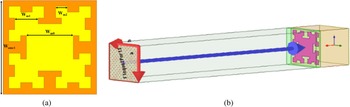
AMC structure is designed using an iterative process, where scaled versions of the central square patch are connected at all its corners. Second-order fractal geometry with a scaling factor of 0.5 is used in the proposed design. Foam of height hamc1, having a dielectric constant of 1.05, is used to separate the ground and AMC structure. A substrate area of size 6 × 6 mm2, encompassing the final geometrical structure of the unit cell, is depicted in Fig. 5(a).
(a) Proposed AMC unit cell, and (b) simulation setup.

Table 3 lists the optimized values of different design parameters. Simulation has been carried out in HFSS using a waveguide analytical model, wherein master–slave boundary conditions are applied on four walls of the waveguide, and a Floquet port is used on its top surface (Fig. 5(b)). Floquet port is de-embedded to the surface of the AMC unit cell in order to measure the reflection phase just above the AMC surface. It is to be noted here that the height of the waveguide must be at least a quarter of the wavelength of the AMC structure.
Design parameters of AMC unit cell

Reflection properties of the designed unit cell are exhibited in Fig. 6. Zero degree crossover frequency also referred to as the resonant frequency of AMC is 5.83 GHz with a wide bandwidth of 57% or 3.45 GHz (4.33–7.78 GHz). The increased height of the unit cell, i.e. the height of the foam, provides a large impedance (>65 KΩ) at zero crossover point, resulting in a broad bandwidth. Foam being inexpensive does not increase the overall cost.
Angle of reflection and impedance of AMC unit cell.

Monopole integrated with reflector
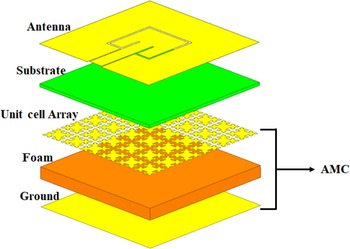
An integrated antenna system, combining monopole with a reflective surface having a 6 × 6 array of AMC unit cells, is discussed here. As stated earlier, monopole and AMC array are engraved on both sides of the same substrate, having a thickness of 0.787 mm. The final integrated structure contains a rectangular layer of foam with a thickness of 3 mm, embedded between the AMC array and a very thin copper layer of 0.03 mm thickness, attached to the lower surface of the foam to serve the purpose of the ground. The total volume of the integrated antenna structure comes out to be 36 × 36 × 3.8 mm3. The final layout (Fig. 7) displays different layers of the integrated antenna structure. The first layer (cooper) is the ground layer, the second layer (foam) acts as a dielectric for the AMC array, the third layer (copper) is of AMC array, the fourth layer is of the antenna substrate RO 3003, and the fifth layer (copper) contains antenna geometry.
Multilayer view of integrated antenna.

From parametric studies, the optimal reflector's size and optimal spacing between AMC unit cells in the array (gap) are found to be 6 × 6 and 0.7 mm, respectively. The remaining design parameters are tabulated in Table 4.
Design dimensions.

Effect of the size of AMC array/reflector
As gain and FBR are some of the vital parameters as far as the application domain of the designed antenna is considered. So, the effects of variations in the size of AMC array on these parameters at the operating frequency of the integrated antenna are studied and respective results are compiled in Table 5. Starting from a 2 × 2 AMC array, improvements in gain and FBR of the antenna are observed with an increase in the size of the reflector up to 6 × 6 array. Going beyond, 6 × 6 array size results in decreased gain and FBR. Therefore, the study provides reflector size of 6 × 6 array as the optimal one.
Effect of the size of AMC array/reflector

Effect of the spacing between AMC unit cells
Once the size of AMC array is fixed, spacing between AMC unit cells is varied from 0.5 to 0.7 mm in steps of 0.1 mm each, and corresponding changes in the reflection profile of integrated antenna are observed as shown by the graph in Fig. 8. Slight variations in resonant frequency and impedance matching are seen. Proposed design uses a gap of 0.7 mm, as desired antenna performance is achieved quite well at this gap.
Effect of the spacing between AMC unit cells on reflection profile.

Test of conformability
Investigations regarding conformability of the designed antenna are performed by wrapping it over a PVC plastic cylinder (Fig. 9(a)). A study of the impacts of bending on the reflection coefficient of the antenna (Fig. 9(b)) shows little variations in impedance matching and resonant frequency, and therefore suggests that the proposed design has a quite stable reflection profile under different bending conditions.
(a) Setup for conformability testing, and (b) effects of bending on reflection profile.

Fabrication and measurement
Fabrication of the proposed antenna structure, along with its measured performance, is presented in this section. Rogers RO 3003, a semi-flexible substrate characterized by a dielectric constant of 3 and a loss tangent of 0.0013, having a thickness of 0.787 mm is utilized to engrave monopole on one of its surfaces while AMC array on the other surface, using general lithography.
Measurement of S 11 and gain in flat scenario
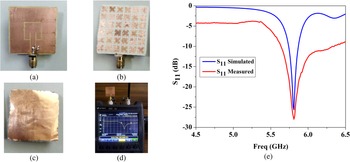
Fabricated layers of the integrated antenna are demonstrated in Fig. 10. Figure 10(a) represents the top layer of the laminate containing antenna geometry, while the AMC array printed on its bottom surface is shown in Fig. 10(b). The opposite surface of the copper foil shown in Fig. 10(c) is attached to the foam, embedded between the AMC array and copper foil in the integrated design.
(a) Top monopole layer, (b) AMC reflector surface, (c) copper foil over foam, (d) antenna in the measurement environment, and (e) comparison between simulated and measured reflection coefficient.

Setup for the measurement of reflection coefficient using Keysights' handheld Vector Network Analyzer (VNA) N9914A is displayed in Fig. 10(d). Simulated and measured results of reflection coefficients exhibiting a high degree of coherence among them are represented in Fig. 10(e). Impedance bandwidth of the structure encompasses the desired ISM band very well, from 5.74 to 5.87 GHz with center frequency at 5.81 GHz.
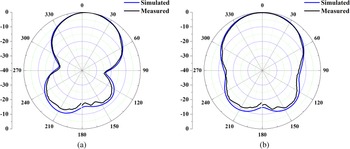
Simulated and measured radiation patterns of the integrated antenna at resonant frequency 5.8 GHz in azimuth and elevation plane are displayed in Figs 11(a) and 11(b), respectively. Incorporation of AMC array as a reflector brings unidirectivity in the radiation pattern, thereby improving the peak gain to 7.9 dBi while FBR also improves to 14.8 dB.
Radiation pattern of the integrated antenna in (a) XZ plane and (b) YZ plane.

Measurement of S 11 and gain in bending scenario
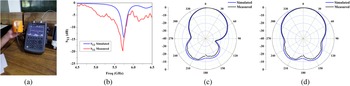
Conformability tests performed through simulation are again verified by wrapping the fabricated antenna around a PVC plastic mug having a radius of 40 mm, as shown in Fig. 12(a). Corresponding simulated and measured results of reflection coefficient and radiation patterns are displayed in Figs 12(b)–12(d). Measured results are found to be in good agreement with simulated ones, suggesting that the proposed antenna design operates well under bending conditions without sacrificing its performance. As impedance matching deteriorates to some extent with bending, so in the bending scenario, the antenna gain reduces slightly by 0.5 dB in comparison to the gain measured in flat scenario. The measured and simulated results show that the FBR is 14.5 dB.
(a) Antenna testing under bending, (b) comparison between simulated and measured reflection coefficients for bending radius, rad = 40 mm, radiation pattern of the integrated antenna under bending in (c) XZ plane, and (d) YZ plane.

On body performance and comparison with recent works
In this section, the proposed antenna design is evaluated for its performance in an equivalent human body environment. Measurement of scattering parameter (S 11) performed on a human hand, SAR results, and a comparison of the proposed design with some of the recent state-of-the-art research works are also presented in this section. Simulations have been carried out after placing the integrated antenna just over the equivalent human tissue model of Fig. 4(a), and respective results are conveyed in the subsections to follow.
On body profile of reflection coefficient
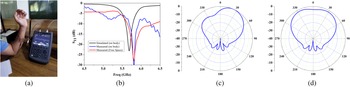
The integrated antenna is evaluated for its performance over the human body by placing it over the human hand (Fig. 13(a)). Figure 13(b) presents the comparison of these measured results with the simulated ones as well as with free space measured results. It can be concluded from these results that the effect of frequency detuning due to the presence of the human body is well sustained by the antenna, and a sufficiently large impedance bandwidth of about 190 MHz still falls in the same ISM band with resonant frequency at 5.7 GHz. Moreover, measured results in both free space and the human body environment display a high degree of agreement, with resonant frequency being 5.82 GHz in both cases. Comparing these results of reflection coefficient with those presented in Fig. 4(b), which shows that the employment of AMC array as a backing element to the antenna, results in the reduction of the separation between human body and the antenna system from 12 to 0 mm.
(a) On body measurement of reflection coefficient, (b) comparison between simulated and measured reflection coefficient, simulated radiation pattern in on body environment (c) XZ plane, and (d) YZ plane.

Evaluation of gain and FBR on the human body
The simulated radiation pattern of the integrated antenna, when placed over the human body, is recorded and represented in XZ and YZ planes in Figs 13(c) and 13(d), respectively. The total realized gain and directivity of the antenna when placed over the human body model are found out to be 7.5 and 8.9 dBi, respectively, with an FBR of 32 dB. The radiation efficiency thus calculated from the values of directivity and gain using equation (1) comes out to be 84.28%.

In equation (1), gain and directivity of the antenna are represented by G and D respectively, while η is used to represent the radiation efficiency of the antenna. The obtained values of gain, directivity, radiation efficiency, and FBR suggest the applicability of the proposed antenna for wearable applications.
SAR measurements
SAR signifies the rate of electromagnetic absorption into the human body and is expressed in the units of watts per kilogram. Looking from the point of view of human health, SAR is a very crucial parameter, and its value needs to be maintained within limits specified by Federal Communications Commission (FCC) and International Electro-technical Commission (IEC) for any antenna to qualify for WBAN applications. The permissible value of SAR according to FCC is 1.6 W/kg averaged over 1 g of human tissue, while according to the limits set by IEC, it is 2 W/kg averaged over 10 g of human tissue.
Equation (2) represents the mathematical expression of SAR in terms of electric field (E), conductivity (σ), and mass density (ρ) of the human tissue [Reference El Atrash, Abdalla and Elhennawy19].

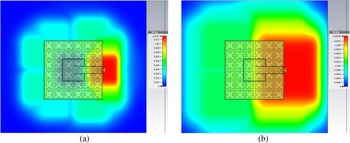
SAR values at 5.8 GHz as calculated in CST Microwave studio using IEEE/IEC 62704-1 averaging method [32] are 0.0117 W/kg, averaged over 1 g of human tissue, and 0.00244 W/kg, averaged over 10 g of human tissue. The pictorial representation of SAR results is depicted in Fig. 14.
SAR calculations (a) averaged over 1 g, and (b) averaged over 10 g of human tissue.

Comparison with recent works
Performance comparison of the proposed antenna solution for WBAN applications with some of the recent state-of-the-art works reported in the literature is presented in Table 6. Taking into account the compactness of the proposed antenna system, higher gain, improved FBR, and low SAR values obtained from it, it may be recommended as a good candidate for employment in wearable communication industry.
Comparison with state-of-the-art literature

Conclusion and future scope
A compact and economical integrated antenna, combining a CPW-fed monopole resonating at 5.8 GHz in the ISM band and a 6 × 6 array of a miniaturized AMC unit cell as a reflector surface, is presented in this article. AMC-backed monopole when placed over the human body equivalent model provided a total realized gain of 7.5 dBi with an FBR of 32 dB. The bandwidth of the proposed antenna system, when operated in the on body scenario, is measured to be 340 MHz, ranging from 5.68 to 6.02 GHz with resonance at 5.82 GHz. SAR, averaged over 1 and 10 g of human tissue, comes out to be 0.0117 and 0.00244 W/kg, respectively. The free space as well as on-body performance of the proposed design advocates strongly for its employment in wearable biomedical devices, as it conforms very well to all the performance parameters required for WBAN applications such as high gain, large FBR, low SAR, and a compact structure.
The concept of placement of the antenna element and AMC array on two different surfaces of the same substrate in order to reduce the usage of the expensive substrate and ultimately to propose an economical antenna solution for the wearable domain may be further utilized to propose multi-band antennas and MIMO antennas in future.
Acknowledgements
The authors are thankful to the supreme consciousness that pervades through each and every bit of the cosmos.
Author contributions
The concept and design of this study is envisaged by Mohit Yadav, Muquaddar Ali guided the simulation work, and R. P. Yadav supervised the experimental findings.
Financial support
This research received no specific grant from any funding agency, commercial or not-for-profit sectors.
Competing interests
None.
 Mohit Yadav received B.Tech. degree in electronics and communication engineering from Dr. A. P. J. Abdul Kalam Technical University, Lucknow, India, in 2010, and M.Tech. degree from Madan Mohan Malaviya University of Technology, Gorakhpur, India, in 2014. With 5 years of academic experience as a teacher, he is currently pursuing Ph.D. at Malaviya National Institute of Technology, Jaipur, India. His research interests include microwave devices, microstrip antennas, and slot antennas.
 Muquaddar Ali received B.Tech. degree in electronics and communication engineering from MLVTEC, Bhilwara, Rajasthan Technical University, Kota, India, in 2011, and M.Tech. degree from the Indian Institute of Technology Roorkee, India, in 2013. He earned the title of Ph.D. in the year 2022, from Malaviya National Institute of Technology, Jaipur, India. Currently he is working as an assistant professor with JECRC University, Jaipur. His research interests include microwave devices, substrate integrated waveguides, slot antennas, microstrip antennas, and beamforming networks.
 Rajendra P. Yadav is currently working as a professor with the Department of Electronics and Communication Engineering, Malaviya National Institute of Technology, Jaipur, India. Besides being an able academician and administrator (Ex Vice Chancellor of Rajasthan Technical University, Kota and Ex Chairman NWRC Chandigarh AICTE), Rajendra is actively engaged in research in communication engineering, MEMS, MIMO-OFDM, multi user detection, microstrip antenna and arrays, optical communication, and engineering education.