With the rapid evolution in cancer treatment, central venous catheters (CVC) became indispensable devices for the care of cancer patients. However, they are a leading source of bloodstream infections (BSIs).Reference Raad and Chaftari 1 When present, the CVC is considered the source of the BSI when no other source is identified and when the BSI meets the Infectious Diseases Society of America (IDSA) criteria for the diagnosis of catheter-related bloodstream infection (CRBSI).Reference Mermel, Allon and Bouza 2 In this study, we reviewed the current epidemiology of BSI and CRBSI and compared it to the previous era to investigate whether prevention and management guidelines need to be reassessed in this patient population.
MATERIALS AND METHODS
We searched the infection control database at our institution from January 2013 to March 2014 to identify all cancer patients who had simultaneous blood cultures (BCs) drawn from the central line and peripheral site that were positive for the same organism or who had a percutaneous BC and a catheter tip culture growing the same organism. A previous cohort (cohort 1) of similar cancer patients with BSIs at the same institution between September 1999 and November 2000 was compared to our current cohort (cohort 2).Reference Raad, Hachem and Hanna 3 We restricted our analysis to patients with CVC.
For the current cohort, data were extracted from the institution’s electronic medical records.
We compared patients from cohort 2 to patients from cohort 1 (previously publishedReference Raad, Hachem and Hanna 3 ) and patients with CRBSIs to those with non-CRBSIs.
We defined CRBSI according to the IDSA definition as a bloodstream infection that meets 1 of these 3 criteria: (1) paired quantitative BCs (QBCs) drawn simultaneously through the CVC and peripheral vein reveals a 3-fold greater number of colonies of the same organism from the CVC than the peripherally drawn QBC; or (2) the catheter-drawn BC turns positive for the same organisms at least 2 hours earlier than the peripherally drawn BC; or (3) the same organism is cultured from a percutaneous BC and from a catheter tip.Reference Mermel, Allon and Bouza 2
Statistical Analysis
We used the χ2 or Fisher exact test to compare categorical variables, as appropriate. We used Wilcoxon rank-sum tests to compare continuous variables because of the deviation of the data from normal distribution.
RESULTS
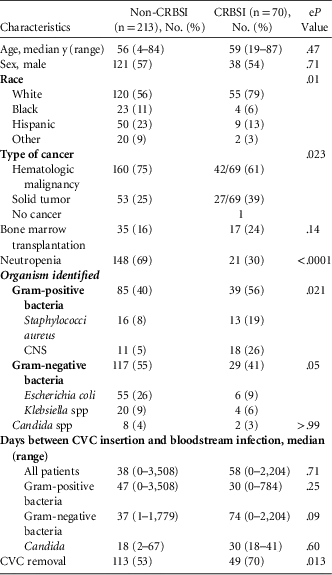
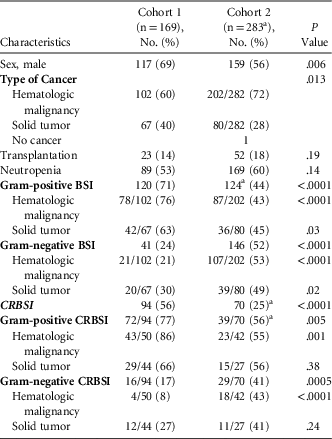
Of the 283 cancer patients identified with BSIs in cohort 2, 25% met the criteria for CRBSI. Compared to cohort 1, where 56% of all BSIs were CRBSIs, this is a significant decrease in the rate of CRBSI (P<.0001). Patient characteristics are presented in Table 1.
Comparison of Patients With and Without Catheter-Related Bloodstream Infection (CRBSI) in Cohort 2

NOTE. CNS, coagulase-negative staphylococci; CVC, central venous catheter.
Although most BSIs occurred in patients with hematological malignancies in both cohorts, BSIs were more often observed in patients with hematological malignancies in cohort 2 compared to cohort 1 (72% vs 60%, respectively; P=.013). Also, BSIs were less frequently observed in patients with solid tumors in cohort 2 compared to cohort 1 (28% vs 40%) (Table 2).
Comparing Patients With Bloodstream Infections in Both Cohorts

NOTE. BSI, bloodstream infections; CRBSI, catheter-related bloodstream infections.
a One patient had no cancer. This patient was excluded when analysis was stratified by type of cancer.
When comparing the 2 cohorts, we observed that the frequency of gram-negative organisms as etiologic agents of BSI significantly increased from 24% in cohort 1 to 52% in cohort 2 (P<.0001), while gram-positive organisms causing BSI decreased from 71% in cohort 1 to 44% in cohort 2 (P<.0001). When stratified by underlying disease, BSIs caused by gram-negative organisms significantly increased from cohort 1 to cohort 2 in both hematologic malignancy and solid-tumor patients, while BSIs caused by gram-positive organisms significantly decreased from cohort 1 to cohort 2 (Table 2). However, in patients with solid tumor, the changes were not significant.
Similarly, when considering CRBSIs, gram-negative organisms were the etiologic organisms of 17% of CRBSIs in cohort 1, and they contributed to 41% of CRBSIs in cohort 2 (P=.0005). Inversely, gram-positive organisms causing CRBSI decreased from 77% in cohort 1 to 56% in cohort 2 (P=.005) (Table 2).
Candida was the etiologic organism of 4% of all BSIs, 4% of non-CRBSIs and 3% of CRBSIs. While coagulase-negative Staphylococcus spp followed by Staphylococcus aureus were the most common etiological organisms causing CRBSI (26% and 19%, respectively), Escherichia coli is the most common gram-negative organism, causing BSI (22%) and CRBSI (9%) in cohort 2.
The rate of neutropenia was similar in both BSI cohorts (53% in cohort 1 vs 60% in cohort 2; P=.14).
In cohort 2, CRBSIs occurred at a median of 58 days after CVC insertion for all organisms; gram-positive CRBSIs and Candida CRBSIs occurred after a median of 30 days, whereas gram-negative CRBSIs occurred after a much longer median duration of 74 days (P=.06). (Table 1).
DISCUSSION
Our data show a major change in the epidemiology and microbial etiology of BSI and CRBSI in cancer patients occurring over the last 20 years. In the 1999–2000 cohort (ie, cohort 1), most BSIs were CRBSIs and were caused by gram-positive bacteria.Reference Raad, Hachem and Hanna 3 However, in the 2013–2014 cohort (ie, cohort 2), CBRSIs contributed to only 25% of all BSIs, with a significant increase in the rate of gram-negative bacteria CRBSI. Furthermore, this study is the first to demonstrate that gram-negative CRBSIs in cancer patients occurred much later after CVC insertion than did gram-positive CRBSIs.
Many studies conducted in the late 20th century showed that the catheter was the leading source of the BSI, including in those with underlying cancer.Reference Raad, Hachem and Hanna 3 , Reference Wisplinghoff, Seifert, Wenzel and Edmond 4 Furthermore, Planes et alReference Planes, Calleja and Bernet 5 showed that 56% of all BSIs were confirmed catheter related, compared to 34% in 2012.Reference Planes, Calleja and Bernet 5 This finding is similar to that of our study, in which the percentage of catheter-related BSIs dropped from 56% to 25% in a similar period. This decrease in the contribution of the catheter as the source of BSI could be related to the wide implementation of preventive interventions over the last 20 years, including the BSI bundle and the use of antimicrobial catheters at our institution and worldwide.Reference Raad and Chaftari 1 , Reference Furuya, Dick, Herzig, Pogorzelska-Maziarz, Larson and Stone 6 , Reference Chong, Lai, Apisarnthanarak and Chaiyakunapruk 7
Similarly, decreasing rates of gram-positive infections causing CRBSI were noted and occurred relatively early. Concurrently, we noted an increase in the rates of gram-negative BSI and CRBSI that occurred at a later point after CVC insertion. At our institution, this finding could be attributed to the wide use of antimicrobial CVCs (which mainly cover gram-positive organisms) with an antimicrobial durability that lasts for 30–40 days.Reference Furuya, Dick, Herzig, Pogorzelska-Maziarz, Larson and Stone 6 , Reference Darouiche, Berger and Khardori 8 The antimicrobial CVCs were introduced between the 2 periods and are mainly used in high-risk patients (eg, critically ill and recipients of hematopoietic stem-cell transplant). In addition, several components of the CVC insertion bundles were implemented including maximal sterile barrier precautions and introduction of chlorhexidine for insertion site cleaning. Furthermore, the use of cefpodoxime as antimicrobial prophylaxis in high-risk neutropenic cancer patients has increased, which may have contributed to the increase in enteric gram-negative organisms. Despite the numerous infection control precautions in current use that may have impacted the change in the predominant organisms, there is a need for improved preventive strategies (eg, antimicrobial lock and CVC) that broadly cover gram-negative organisms for months after insertion.
In conclusion, over the last 20 years, an epidemiologic shift has occurred among BSIs and CRBSIs in cancer patients. Overall, CVCs have become less of a source of BSI, and the microbial causes of BSI and CBSIs have shifted toward a more gram-negative etiology with a delayed occurrence after CVC insertion. These findings should be considered with the development of interventions that will prevent gram-negative CRBSI several months after CVC insertion.Reference Jamal, Rosenblatt and Hachem 9 , Reference Chaftari, Hachem and Szvalb 10
ACKNOWLEDGMENTS
Financial support: No financial support was provided relevant to this article.
Potential conflicts of interest: All authors report no conflicts of interest relevant to this article.