INTRODUCTION
The catadromous eels of the genus Anguilla Schrank, 1798 are widely distributed throughout the world. These eels have a catadromous life history, migrate between inland or coastal growth habitats, and have offshore spawning. Nineteen species of Anguilla have been reported worldwide, eleven of which occur in tropical regions (Ege, Reference Ege1939; Watanabe et al., Reference Watanabe, Aoyama and Tsukamoto2009). Of the eleven species found in tropical areas, seven species or subspecies occur in the western Pacific around Indonesia and Malaysia, i.e. A. celebesensis Kaup, 1856, A. interioris Whitely, 1938, A. bengalensis bengalensis Gray, 1831, A. marmorata Quoy & Gaimard, 1824, A. malgumora Kaup, 1856, A. bicolor bicolor McClelland, 1844 and A. bicolor pacifica Schmidt 1928 (Ege, Reference Ege1939; Castle & Williamson, Reference Castle and Williamson1974; Arai et al., Reference Arai, Aoyama, Limbong and Tsukamoto1999, Reference Arai, Chino, Zulkifli and Ismail2012).
The comprehensive study by Ege (Reference Ege1939) discussed species diversity, geographical distribution and abundance in the world, and revealed that the highest diversity occurs in central Indonesian waters. However, for Malaysia there has been relatively little information available on various aspects of eel biology, such as species composition, distribution, life history and migration.
Streams in Peninsular Malaysia are highly diverse ecosystems and support extensive fish diversity. Many new fish species have been discovered during the last several decades. According to the past studies, the tropical eel species of Anguilla bicolor bicolor and A. marmorata have been recorded in Peninsular Malaysia (Ng & Ng, Reference Ng and Ng1989; Ahmad & Lim, Reference Ahmad and Lim2006; Azmir & Samat, Reference Azmir and Samat2010). However, these studies did not describe the identification methods for their anguillid species. Identifications to species level using visual observations are known to be difficult because of the morphological similarities in the eels. The identifications were based on the external morphological characters of each species (Ege, Reference Ege1939; Watanabe et al., Reference Watanabe, Aoyama and Tsukamoto2004).
Recently, Arai et al. (Reference Arai, Chino, Zulkifli and Ismail2012) reported a tropical eel A. bicolor bicolor in the western parts of Peninsular Malaysia as a new distribution range in the species based on morphological characters. In the present study, a specimen collected in 2003 in the Langkawi Islands, Peninsular Malaysia (Ahmad & Lim, Reference Ahmad and Lim2006) based on the details of the external morphological characters was reexamined, and as aresult of this reexamination I describe here the first record of Anguilla bengalensis bengalensis from the Langkawi Islands, northern Peninsular Malaysia.
MATERIALS AND METHODS
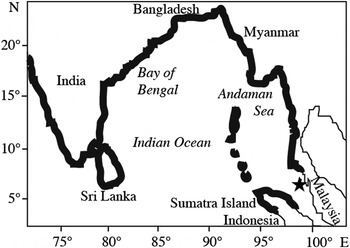
Three anguillid eels were collected by fish traps in the Temurun River in the Langkawi Islands in northern Peninsular Malaysia of Kedah State on 9 April 2003 (Figure 1), and two of them were released at that time (Ahmad & Lim, Reference Ahmad and Lim2006). A specimen was preserved in 10% formalin solution and transferred to 70% alcohol after two weeks for long-term storage (Ahmad & Lim, Reference Ahmad and Lim2006).
Map showing the new finding of Anguilla bengalensis bengalensis in the Langkawi Islands, Peninsular Malaysia in the present study (star).

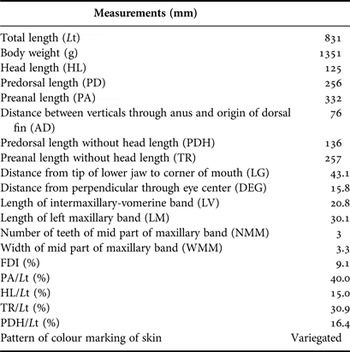
The external morphometric characters were measures following the methods of Ege (Reference Ege1939) and Watanabe et al. (Reference Watanabe, Aoyama and Tsukamoto2004), and the data are shown in Table 1. The total number of vertebrae (TV) is overlapped with a number of other species, and thus TV is not a useful taxonomic character in the anguillids (Ege, Reference Ege1939; Watanabe et al., Reference Watanabe, Aoyama and Tsukamoto2004). Thus, the counting of was not conducted in the present study.
Morphometric characters of Anguilla bengalensis bengalensis collected in the Langkawi Islands in northern Peninsular Malaysia on 9 April 2003 (Ahmad & Lim, Reference Ahmad and Lim2006).

The fin difference index (FDI), which is the distance between the verticals from beginning of the dorsal fin (Z) to the anus (ano-dorsal length) relative to the total length (L T) (Ege, Reference Ege1939), was calculated as follows:
 $$FDI=100\, Z\, L_{T}^{-1}.$$
Anguilla has been clearly divided into four different species groups based on the external morphological characters of each species: the first group (four species) has variegated skin with broad maxillary bands of teeth; the second group (four species/subspecies) has variegated skin with narrow maxillary bands of teeth; the third group (six species) has non-variegated skin with a long dorsal fin; and the fourth group (five species/subspecies) has non-variegated skin with a short dorsal fin (Ege, Reference Ege1939; Watanabe et al., Reference Watanabe, Aoyama and Tsukamoto2004). Furthermore, the information related to geographical distribution has been used as an important character for the species identification of the genus Anguilla (Ege, Reference Ege1939). Thus, the identification to species level was examined using both morphological characters and geographical distribution in Anguilla.
RESULTS
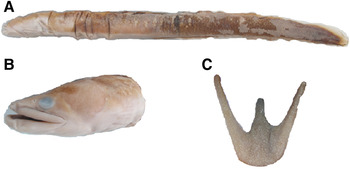
The total length and body weight of the preserved specimen were 831 (mm) and 1351 (g), respectively (Figure 2A, B). After Ege (Reference Ege1939) and Watanabe et al. (Reference Watanabe, Aoyama and Tsukamoto2004), the specimen was identified as Anguilla bengalensis bengalensis using characters of colour (variegated) markings (Figure 2A, B), narrow maxillary bands of teeth (Figure 2c) and ratio of FDI (Table 1).
Anguilla bengalensis bengalensis collected in the Temurun River in the Langkawi Islands in northern Peninsular Malaysia on 9 April 2003 (Ahmad & Lim, Reference Ahmad and Lim2006): (A) 831 mm in total length; (B) head part; (C) narrow maxillary bands of teeth.

This species is easily assigned into the second group of the genus Anguilla based on its variegated skin and narrow maxillary bands of teeth (Ege, Reference Ege1939; Watanabe et al., Reference Watanabe, Aoyama and Tsukamoto2004). Among the second group, Anguilla bengalensis bengalensis labiata and A. reinhardtii have been found in the mid-southeastern part of Africa and eastern Australia and Tasmania, respectively (Ege, Reference Ege1939), so an anguillid species of this group in northern Peninsular Malaysia could be either A. bengalensis bengalensis or A. marmorata. In FDI, A. marmorata had a significantly higher range (11 to 20: Ege, Reference Ege1939; Watanabe et al., Reference Watanabe, Aoyama and Tsukamoto2004), while the present specimen was 9 in FDI in the range of A. bengalensis bengalensis (Table 1).
DISCUSSION
Based on the examination of morphological details, this is the first description of the occurrence and distribution of Anguilla bengalensis bengalensis in Peninsular Malaysia. Recently, the anguillid eels found in the Langkawi Islands were also identified as A. bengalensis bengalensis using a morphological analysis and that identification was further validated by an analysis of the eels' mitochondrial cytochrome oxidase subunit I (COI) and 16S ribosomal RNA (16S rRNA) sequences (Arai & Wong, in press). No aquaculture or commercial fisheries are known for eels in the regions of Peninsular Malaysia including the Langkawi Islands studied here, and there have been no reports of the release of eels into natural waters in Malaysia. It seems unlikely, therefore, that A. bengalensis bengalensis is an introduced, exotic species in the country. The species is distributed in Sri Lanka, Bangladesh, India, Myanmar Sumatra Island of Indonesia and the Andaman Islands (Ege, Reference Ege1939; Watanabe et al., Reference Watanabe, Aoyama and Tsukamoto2004) (Figure 1). These results all suggest that A. bengalensis bengalensis is native to this part of Malaysia.
According to Jespersen (Reference Jespersen1942), the populations of A. bengalensis bengalensis that are distributed in Sumatra Island of Indonesia may have their spawning area situated off the south-western coast of Sumatra, close to the distribution area. The occurrence of small leptocephali in waters off Sumatra (Jespersen, Reference Jespersen1942) supports that supposition. Anguilla bengalensis bengalensis in Malaysia might originate from spawning areas situated off Sumatra. However, the distance between the spawning area and recruitment area in Peninsular Malaysia is considerably larger than the distance between the Island of Sumatra, which indicates that the abundance of specimens reaching Peninsular Malaysia might be quite low.
In previous studies, Anguilla marmorata was reported to occur in the Langkawi Islands, Peninsular Malaysia (Ahmad & Lim, Reference Ahmad and Lim2006; Azmir & Samat, Reference Azmir and Samat2010). Recently, we discovered A. bicolor bicolor in the western and northern parts of this region (Arai et al., Reference Arai, Chino, Zulkifli and Ismail2012), while there have been no reports of A. marmorata and A. bengalensis bengalensis in Peninsular Malaysia, except for the Langkawi Islands. After reexamination of the one specimen of A. marmorata by Ahmad & Lim (Reference Ahmad and Lim2006), the specimen has been identified as A. bengalensis bengalensis in the present study. Because A. marmorata and A. bengalensis bengalensis are difficult to distinguish without the details of morphological character analyses, A. bengalensis bengalensis specimens in the previous reports might have been mistakenly identified as A. marmorata. Further studies regarding distribution, biology and ecology in Anguilla with the valid species identifications in Peninsular Malaysia including the Langkawai Islands are needed to understand the species composition and biodiversity of the anguillid eels in the area.
ACKNOWLEDGEMENTS
I sincerely thank Dr Amirrudin Ahmad for giving me the opportunity to examine the eel specimen. This study was financially supported by the Ministry of Higher Education Malaysia under the Fundamental Research Grant Scheme, with reference to FRGS/1/2013/STWN04/UMT/02/3 (Vot No. 59281).