I. INTRODUCTION
Many surfaces in nature, such as lotus leaf, gecko feet, and water strider legs, are superhydrophobic.Reference Liu, Tian and Jiang1,Reference Darmanin and Guittard2 These surfaces exhibit water contact angles greater than 150°. Lotus leaf is well known superhydrophobic surface with good self-cleaning effect, and the water droplets are free to roll on the surface. Two key factors, surface chemical energy and micro/nano-rough structure, lead to this phenomenon.Reference Lu, Xu, Song, Liu, Xing and Sun3,Reference Feng, Che, Liu, Qiang and Wang4 Accordingly, some superhydrophobic surfaces were prepared in the engineering material matrix.Reference Li, Zhang, Guo, Shi, Yu, Tang and Huang5–Reference Young8 However, the hydrophobicity will be lost when these surfaces encounter lower surface energy liquid, such as peanut oil or hexadecane. This phenomenon limits the application of superhydrophobic surfaces in certain applications including oily environment or contaminated water environment. Surfaces that are oil-repellent in air are scarcely found in nature. Therefore, artificial superoleophobic surface has attracted the attention of the scientists.
Tsujii et al.Reference Tsujii, Yamamoto, Onda and Shibuichi9 first tried the superoleophobic surface in 2007, and this process was very difficult because of the low surface energy of the oil. The weak tension between the oil molecules was easily overcome by the solid–liquid interface tension and oil droplets stuck to the surface even if the plane was reversed. After a long period of research, a new breakthrough was achieved in the preparation of superoleophobic surfaces by Tuteja.Reference Tuteja, Choi, Ma, Mabry, Mazzella, Rutledge, McKinley and Cohen10 Their team made oil-repellent surfaces by electrospun technology and first proposed the importance of the re-entrant structure (this structure be also called overhang structure, cantilever structure or T-shaped structure, which can store more air that can support the droplets floating on the surface) to the superoleophobic surface. Through the analysis of the schematic diagram of the rough structures with different angles, Song et al.Reference Song, Huang, Hu, Lu, Liu and Xu11 considered that the re-entrant structure was suitable for the structure of the superoleophobic surface, and the superoleophobic surfaces were successfully prepared on the surface of Al substrates. Saifaldeen et al.Reference Saifaldeen, Khedir, Cansizoglu, Demirkan and Karabacak12 promoted the formation of nanoparticles in the sidewall of the microchannels to construct the re-entrant structure, and prepared superoleophobic surfaces with good performance on aluminum alloy substrates. These experiments and their analysis illustrated the necessity of the re-entrant structure for the superoleophobic surfaces.
Human civilization development and social progress cannot be separated from metal materials, and metal materials play an important role in the field of modern industry and agriculture. Al–Mg alloys are widely used in the field of ships because of their excellent properties such as good physical and chemical properties, good thermal conductivity, and low density properties.Reference Cheng, Yao, Yang, Wang and Xiao13–Reference Shi, Kong and Wang17 However, corrosive chloride ions in seawater can corrode the surface of the alloy and reduce the service life of the material.Reference Guan, Zhou and Zhang18,Reference Wang, Liu and Yin19 Moreover, the superhydrophobicity of the surface will be lost when it encounters the oil droplets that are leaked in the water. Therefore, the preparation of the superoleophobic surface of the Al–Mg alloy is of great significance to the application of alloy. Until now, many researchers have produced superoleophobic surfaces using different methods. Bhushan et al.Reference Peng and Bhushan20 obtained superoleophobic surfaces on an aluminum substrate by two-step chemical etching, including hydrochloric acid and nitric acid. Motlagh et al.Reference Motlagh, Birjandi, Sargolzaei and Shahtahmassebi21 prepared stainless steel superoleophobic surfaces using sandblasting technology. Al-Milaji et al.Reference Al-Milaji and Zhao22 fabricated superoleophobic surfaces with patterned multiscale roughness using a mask-assisted electrospray technique. Hsieh et al.Reference Hsieh and Wu23 used a sol–gel process to create a stable superhydrophobic and superoleophobic surface for the graded nano/submicron silica sphere stacking layer. Liu et al.Reference Liu, Li and Wang24 successfully prepared superhydrophobic and superoleophobic surfaces on magnesium alloy substrates by electrodeposition, and the surface showed good corrosion resistance. Choi et al.Reference Choi, Shin, Choo, Ryu, Kim and Lee25 fabricated hierarchical Al surfaces using three different kinds of alkaline-based chemical solutions. However, these methods were cumbersome and longer, and the strong acid and alkali used in processing is harmful to the environment. Moreover, electrodeposition is the process of adding the secondary material, which may result in the instability of the combination of the new material and the substrate, thereby affecting the service life of the surface. In addition, the method of preparing the superoleophobic surface by the features that different elements have different potentials has not been mentioned yet. In this paper, we prepared superoleophobic surfaces on the Al–Mg alloy substrate using simple, easy to control electrochemical etching and boiling water treatment method. Moreover, the electrolyte was neutral, environmentally friendly and low cost NaBr solution. The processing parameters, including current density, processing time, electrolyte temperature, electrolyte concentration, and the time of immersion in boiling water, were also studied. These parameters affected the formation of surface micro-nanostructures that determine surface wettability. Therefore, we controlled the processing parameters to achieve different surfaces which meet different requirements.
II. EXPERIMENTAL
A. Materials
All the reagents used in the experiment were of analytical grade and can be used without further purification. 5083Al–Mg alloy sheets and copper sheets that were used for electrochemical processing were purchased from the local market. Ethylene glycol and ethanol reagents were obtained from Shenyang Chemical Reagent Factory (Shenyang, China), and sodium bromide (NaBr) used as electrolyte was purchased from Tianjin BASF Chemical Co., Ltd. (Tianjin, China). Fluorosilane [FAS,C8F13H4Si(OCH2CH3)3] reagent purchased from Guangzhou fortitude Chemical Import & Export Co., Ltd. (Guangzhou, China). Hexadecane was obtained from Shanghai Daibo Chemical Technology Co., Ltd. (Shanghai, China).
B. Preparation of superoleophobic surfaces
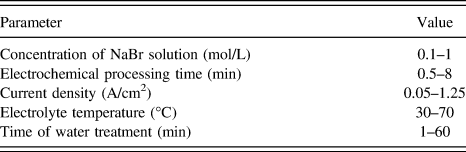
The Al–Mg alloy (20 × 20 × 2 mm) was used as the anode, and the same size of copper as the cathode. The two electrodes were placed in parallel in NaBr solution at a distance of 10 mm for electrochemical etching. The experimental parameters are shown in Table I. Then, the alloy sheet was washed with deionized water and placed in a constant temperature water bath at a temperature of 99 °C for different times (Table I). Then, the specimen was blown dry by using the blower. The alloy sheet was then placed in a 1 wt% FAS ethanol solution for 2 h and dried at 80 °C for 30 min. The superoleophobic Al–Mg alloy surface was successfully prepared.
Experimental parameters of the specimen treatment.

C. Specimen characterization
The surface topography and chemical elements of the sample were obtained by scanning electron microscopy (SEM, ZEISS SIGMA, Carl Zeiss AG, Jena, Germany) and energy dispersive spectroscopy (EDS, Oxford X-MaxN, Oxford Instruments, Abingdon, United Kingdom), respectively. Cross-sectional images were obtained by embedding the alloy sheet in an epoxy resin and grinding the cross section. The surface wettability, surface adhesion, and roll angle testing were measured using contact angle measuring instrument with a high speed camera, and the average contact angle at five different positions of the sample was taken as the final contact angle. Sliding angle was measured by tilting the sample stage, and the tilted angles of the stage were regarded as the sliding angle when the droplets began to slide from the surfaces.
III. RESULTS AND DISCUSSION
A. Surface topography
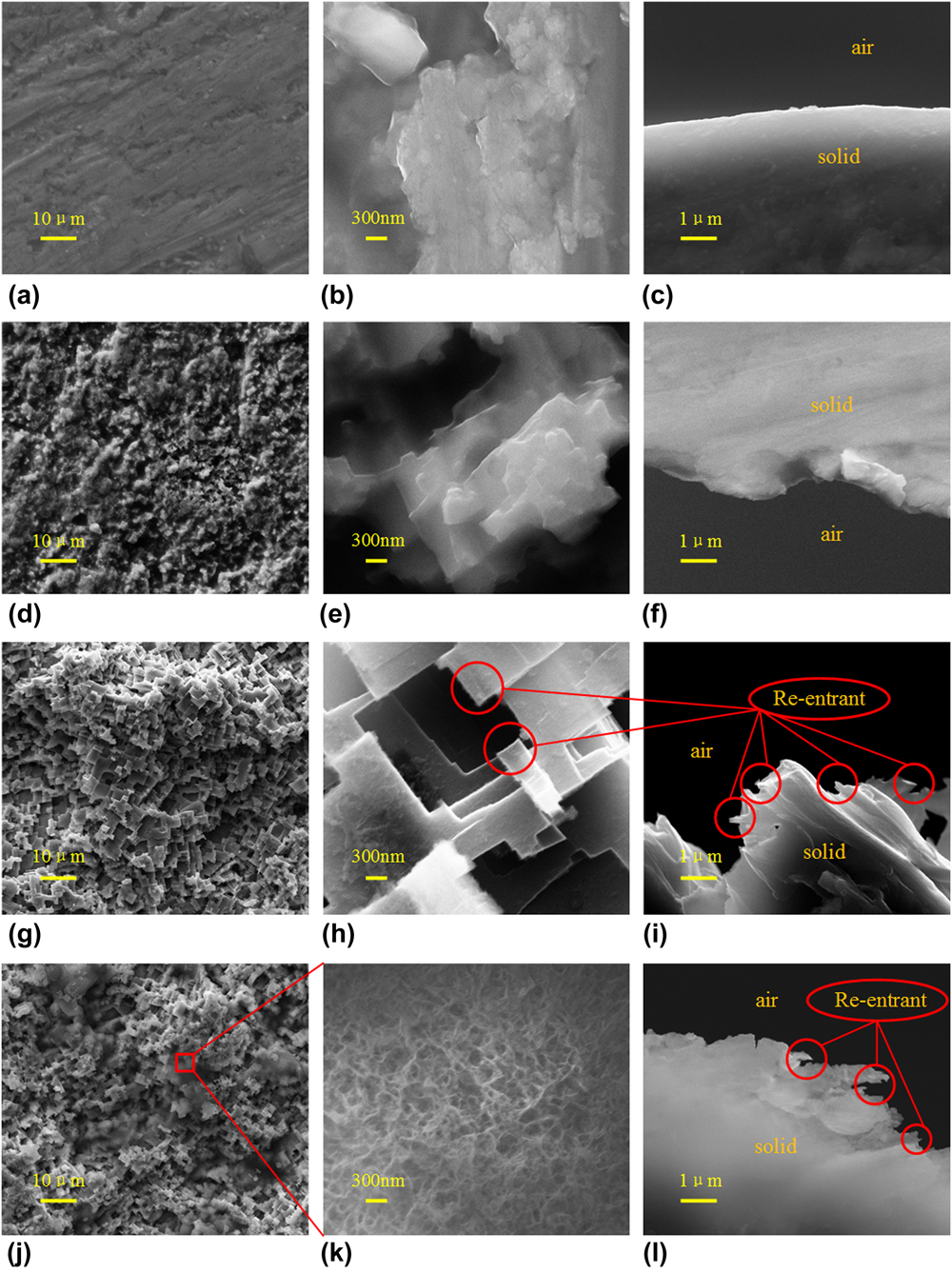
The SEM images of the surfaces under different parameters are shown in Fig. 1. Figures 1(a)–1(c) are surfaces that were sanded only. Figures 1(a) and 1(b) are SEM images with different magnifications of the top surface, and Fig. 1(c) is the image of the cross section. The surface had a large number of protrusions and pits as well as residual scratches, but the whole surface was still flat and smooth. The linear cross section without micro-nanostructures gave the surface low contact angles for water and oil.
SEM images of the (a–c) smooth surface; (d–f) superhydrophobic Al–Mg alloy surface (low current) etched for 5 min in 0.2 mol/L NaBr solution with a current density of 0.2 A/cm2 and the temperature of 60 °C; (g–i) superhydrophobic Al–Mg alloy surface (high current) etched for 5 min in 0.2 mol/L NaBr solution with a current density of 1 A/cm2 and the temperature of 60 °C; (j–l) superoleophobic surface obtained after 15 min of treatment of superhydrophobic surface (high current) in boiling water. (c), (f), (i), and (l) are cross-sectional views of the smooth surface, superhydrophobic surface (low current), superhydrophobic surface (high current), and superoleophobic surface, respectively.

Figures 1(d)–1(f) show superhydrophobic surfaces (low current) etched for 5 min in 0.2 mol/L NaBr solution with a current density of 0.2 A/cm2 and the temperature of 60 °C. Compared with the untreated surface, the superhydrophobic surface had obvious signs of being etched. A large number of micro-nanostructures from 500 nm to 2 μm were clearly visible on the surface, forming labyrinth structure which was responsible for the generation of superhydrophobic properties. The cross-sectional image [Fig. 1(f)] also shows the roughness of the surface. However, the small current density made the profile of the etched surface not particularly clear, and the contact angle of the hexadecane on the surface was still small.
Figures 1(g)–1(i) show superhydrophobic surfaces (high current) etched for 5 min in 0.2 mol/L NaBr solution with a current density of 1 A/cm2 and the temperature of 60 °C. The surface shown in Fig. 1(g) exhibited higher etching consistency and the labyrinth structures from 100 to 500 nm were more clearly visible. The re-entrant structures can be seen in the cross-sectional image [Fig. 1(i)]. However, the contact angle of hexadecane on this surface was still less than 90° due to the nonuniformity of the microstructure and the lower intrinsic contact angle of the hexadecane.
Figures 1(j)–1(l) are the superoleophobic surfaces obtained on superhydrophobic surfaces [high current, Figs. 1(g)–1(i)] after treatment in boiling water for 15 min. The surfaces were covered by a layer of nanoscale needle-like criss-cross structure, and the microrough labyrinth structures obtained by electrochemical etching were not particularly clear. As can be seen from Fig. 1(l), the surface produced a large number of re-entrant structures with smaller morphological angles. Not only the water droplets had a larger contact angle on the surface, but the contact angle of hexadecane was also 155.3 ± 2.2°, indicating that the re-entrant structure was the key factor in the formation of the superoleophobic surface.
B. Mechanism and composition
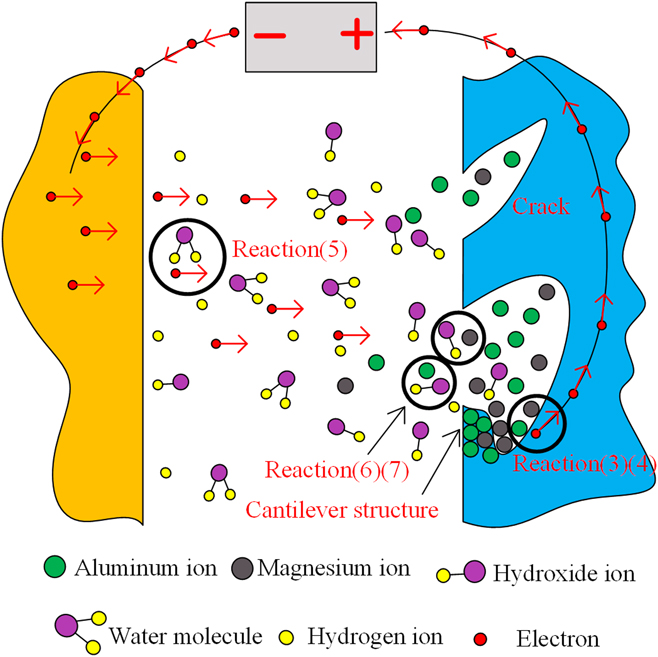
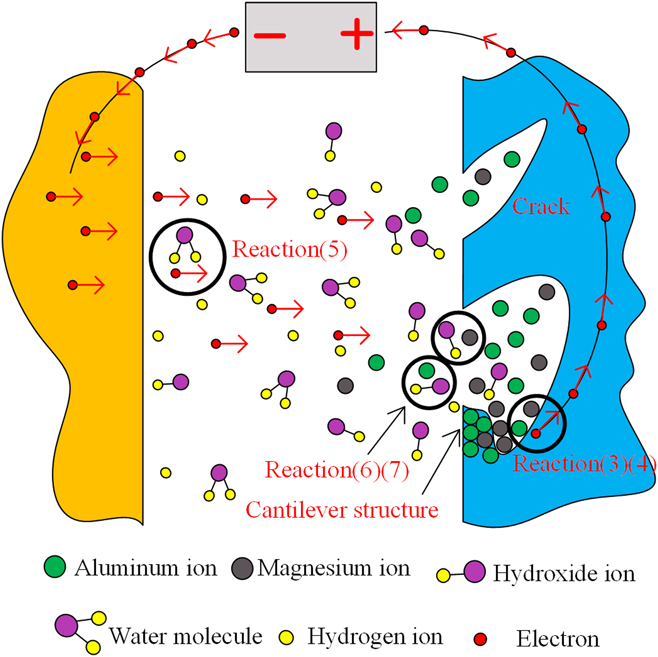
The reaction mechanism was also analyzed in detail and electrochemical etching process diagram is shown in Fig. 2. The cracks on the alloy surface accelerate the electrolysis process due to the existence of a large number of local corrosion in the alloy. The products of the electrolysis process are aluminum hydroxide, magnesium hydroxide and hydrogen, and the overall corrosion reaction can be expressed with the following reactions:
 $${\rm{Reaction}}\;\left( 1 \right){\rm{:}}\;{\rm{Mg}} + 2{{\rm{H}}_2}{\rm{O}} \to {\rm{Mg}}{\left( {{\rm{OH}}} \right)_2} \downarrow + {{\rm{H}}_2} \uparrow \quad ,$$
 $${\rm{Reaction}}\;\left( 2 \right){\rm{:}}\;2{\rm{Al}} + 6{{\rm{H}}_2}{\rm{O}} \to 2{\rm{Al}}{\left( {{\rm{OH}}} \right)_3} \downarrow + 3{{\rm{H}}_2} \uparrow \quad .$$
Electrochemical etching process diagram.
This overall reaction can be divided as the following partial reactions:
 $${\rm{Reaction}}\;\left( 3 \right){\rm{:}}\;{\rm{Mg}} \to {\rm{M}}{{\rm{g}}^{2 + }} + 2{{\rm{e}}^ - }\;\left( {{\rm{anodic\ reaction}}} \right)\quad ,$$
 $${\rm{Reaction}}\;\left( 4 \right){\rm{:}}\;{\rm{Al}} \to {\rm{A}}{{\rm{l}}^{3 + }} + 3{{\rm{e}}^ - }\;\left( {{\rm{anodic\ reaction}}} \right)\quad ,$$
 $${\rm{Reaction}}\;\left( 5 \right){\rm{:}}\;2{{\rm{H}}_2}{\rm{O}} + 2{{\rm{e}}^ - } \to {{\rm{H}}_2} + 2{\rm{O}}{{\rm{H}}^ - }\;\left( {{\rm{cathode\ reaction}}} \right)\quad ,$$
 $${\rm{Reaction}}\;\left( 6 \right){\rm{:}}\;{\rm{M}}{{\rm{g}}^{2 + }} + 2{\rm{O}}{{\rm{H}}^ - } \to {\rm{Mg}}{\left( {{\rm{OH}}} \right)_2}\;\left( {{\rm{product\ formation}}} \right)\quad ,$$
 $${\rm{Reaction}}\;\left( {\rm{7}} \right){\rm{:}}\;{\rm{A}}{{\rm{l}}^{3 + }} + 3{\rm{O}}{{\rm{H}}^ - } \to {\rm{Al}}{\left( {{\rm{OH}}} \right)_3}\;\left( {{\rm{product\ formation}}} \right)\quad .$$
Since the potential of the magnesium is lower than that of the aluminum, magnesium preferentially participates in the reaction. As the reaction progresses, the internal magnesium was also eroded, leaving the cantilever aluminum structure, which provides the necessary conditions for the formation of superoleophobic surfaces. The presence of highly active Br− could make the surface film more active and increase the film-free area, which might also accelerate the electrochemical reaction rate. Magnesium hydroxide, aluminum hydroxide, and hydrogen are all nontoxic and environmentally friendly products, and these products are widely used in industry. During the whole reaction process, the solution remains neutral, which is less harmful to the environment than acid or alkali solution. For the boiling water treatment process, some studies have been conducted, and the reaction (Al + H2O → Al2O3·xH2O + H2↑) can explain this process. Vedder et al.Reference Vedder and Vermilyea26 argued that the oxide reacted with water, then hydrolyzed, and finally the aluminum hydroxide precipitated on the surface. They determined that the membrane formed by the reaction with boiling water was pseudoboehmite, a crystal oxide layer with structure close to boehmite but containing more hydroxyl groups. McCarvill et al.Reference McCarvill and Bell27 argued that aluminum and water react to produce bayerite (β-Al2O3·3H2O) when the water temperature was below 75 °C, while the boehmite (α-Al2O3·H2O) was produced when the water temperature was above 75 °C. SaifaldeenReference Saifaldeen, Khedir, Cansizoglu, Demirkan and Karabacak12 studied the surface morphology of the aluminum alloy immersed in boiling water at different times. The results showed that the increase in the thickness of the nanograss layer was faster in the initial period and then slowed down. In general, the nanostructures produced by the reaction of aluminum and water gave the surface good oleophobic property.
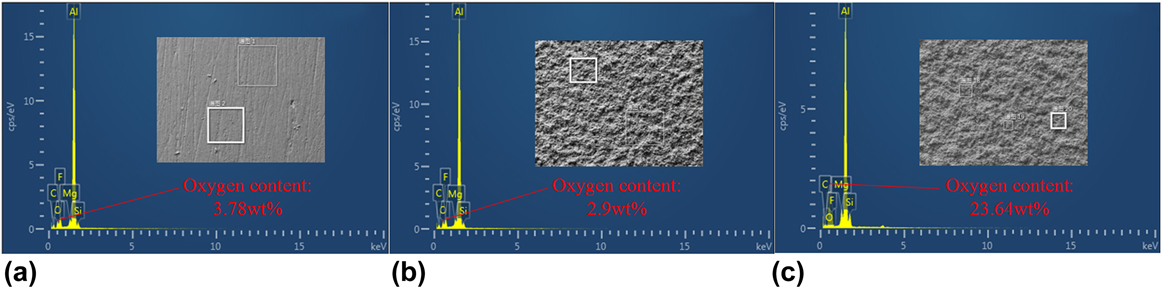
The elements of the alloy were tested by EDS as shown in Fig. 3. Figures 3(a)–3(c) are the EDS spectra of the smooth surface, superhydrophobic surface (high current), and superoleophobic surface, respectively. In addition to Al and Mg, C, F, O, and Si elements were also detected, indicating the presence of FAS on the surface. The three surfaces had the same elements, further indicating that the surface topography was the key factor affecting surface wettability. The content of oxygen on the superoleophobic surface was higher than that of other surfaces, indicating that the oxygen-containing compound was formed on the surface after boiling water treatment.
EDS spectra of the (a) smooth surface, (b) superhydrophobic surface (high current), and (c) superoleophobic surface.

C. Surface wettability analysis
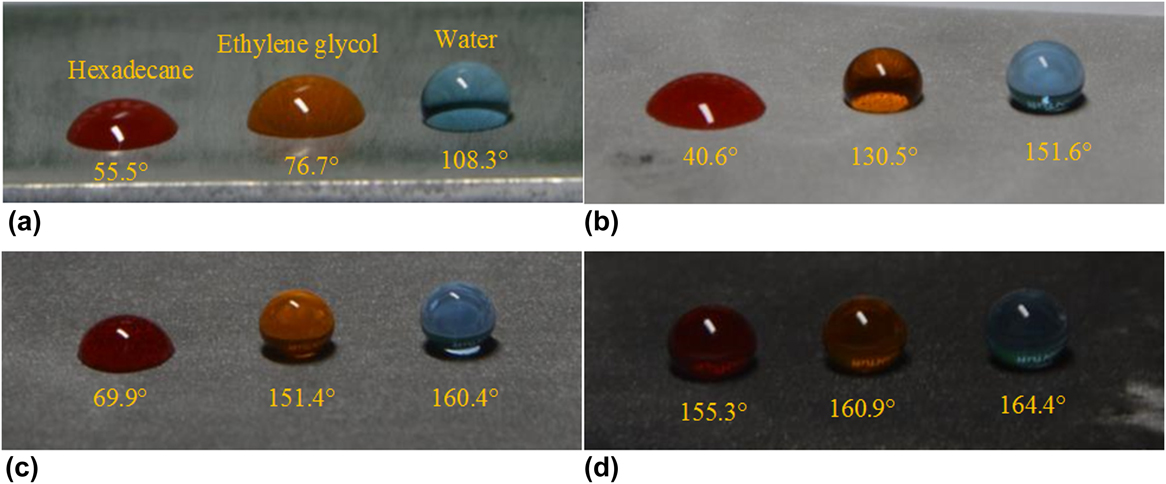
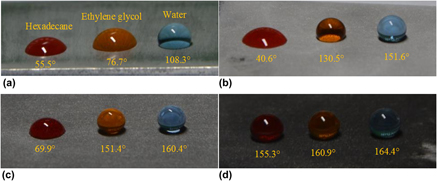
To explain the wettability of the surface, the alloy surfaces under different processing parameters and the morphologies of the liquids with different surface energies are shown in Fig. 4, wherein the liquids comprise hexadecane, ethylene glycol, and water. Figure 4(a) shows the smooth surface after FAS modification, and the contact angles of hexadecane, ethylene glycol, and water on the surface were 55.5 ± 5.5°, 76.7 ± 3.8°, and 108.3 ± 3.2°, which was consistent with the Young model. Hexadecane (27.5 mN/m) has smaller surface tension compared to water (72.3 mN/m) and ethylene glycol (45 mN/m) and is more easily adsorbed by the surface. It has been found that for any liquid, the condition of obtaining contact angle greater than 90° on the solid surface is that the solid surface energy (γs) is less than 1/4 liquid surface energy (γl).Reference Tsujii, Yamamoto, Onda and Shibuichi9 Solid surface with surface energy less than 18 mN/m can exhibit hydrophobicity, but lower solid surface energy is required for lower surface energy liquids. The Al–Mg alloy surface still had high surface energy even if it was modified by the low-energy material FAS. For this reason, a combination of low surface energy treatments with re-entrant structures was proposed as an alternative to the need for extremely low surface energies of only a few mN/m for developing superoleophobic surfaces.Reference Saifaldeen, Khedir, Cansizoglu, Demirkan and Karabacak12
The photographs of three tested liquid droplets of hexadecane (red), ethylene glycol (yellow), and water (blue) on the (a) fluorinated smooth surface, (b) superhydrophobic surface (low current), (c) superhydrophobic surface (high current), and (d) superoleophobic surface.

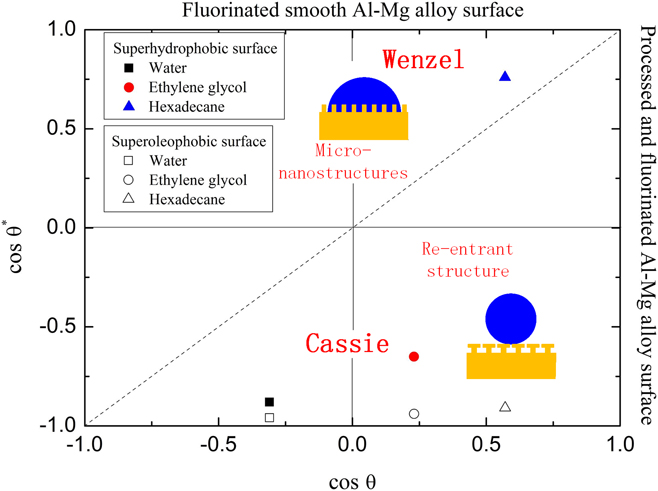
Figure 4(b) shows the superhydrophobic surface (low current) prepared at a current density of 0.2 A/cm2 and different liquids on the surface. It can be seen that the contact angle of water was greater than 150°, showing good hydrophobic effect. The surface showed good characteristics with θ* ∼ 130.5 ± 2.8° despite its low θ ∼ 76.7 ± 5.2° for ethylene glycol, which was consistent with the Cassie model that considers the complex solid–liquid–gas three-phase interface. The contact angle of hexadecane decreased compared with Fig. 4(a), which was in good agreement with the Wenzel model. According to the Wenzel model, roughness increases the lipophilicity and oleophobicity of the surface. It can be clearly seen from Fig. 1(f) that no re-entrant structure can be found in the cross-sectional SEM image. The liquid, especially droplets with lower surface energy, can easily fill the entire microstructure, and the surface showed the full wetting state. This state could also be analyzed via the general wetting diagram, shown in Fig. 5, which shows the plot of cos θ* on the rough electrochemical etched surface as a function of cos θ for the comparatively smooth fluioridized surface.
Plot of cos θ* for water, ethylene glycol, and hexadecane on superhydrophobic (low current), superoleophobic surfaces as a function of cos θ for the comparatively smooth fluioridized surface.

From Fig. 4(c), it can be seen that the contact angles of water and ethylene glycol were greater than 150°, and the contact angle of hexadecane was less than 90° but larger than that in Fig. 4(b). The Wenzel model does not explain this phenomenon, and the complex interface was formed due to the existence of re-entrant structures. Some of the contact lines immersed in the texture, and the Wenzel model and the Cassie model exist simultaneously due to the inhomogeneity of the re-entrant structures. Ethylene glycol and water droplets were free to roll on the surface while hexadecane was adhered to the surface.
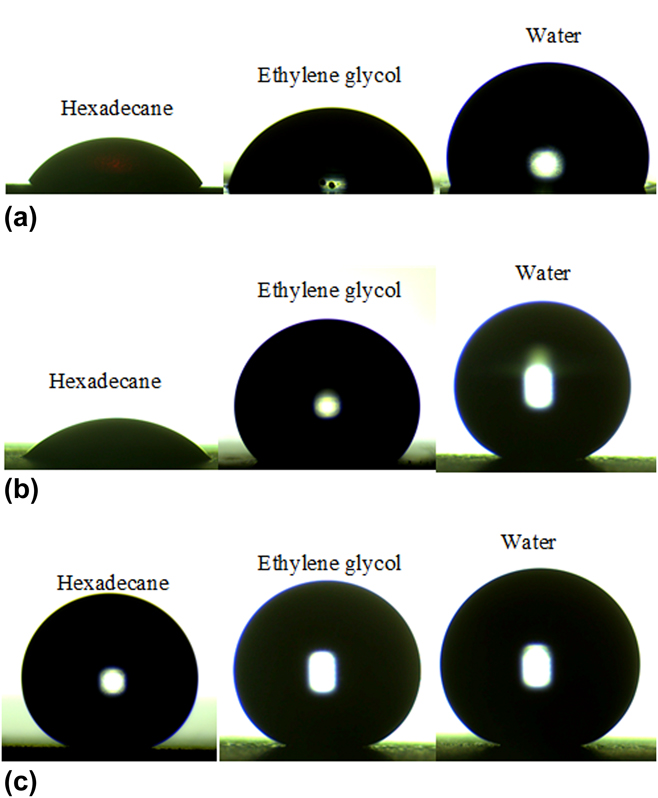
The contact angles/sliding angles of water, ethylene glycol, and hexadecane on superoleophobic surfaces [Fig. 4(d)] were 164.4 ± 1.4°/2 ± 0.3°, 160.9 ± 2.2°/4 ± 0.5°, and 155.3 ± 3.0°/10 ± 1.1°, respectively. The re-entrant structure was the key factor in the formation of the superoleophobic surface. A large amount of air was trapped by the microstructure, and the liquid was suspended on the solid and the vapor, forming a complex solid–vapor–liquid interface. Figure 5 shows that the three liquids were all in the Cassie state. The graded surface maintained high contact angle and low nonadhesive property for water and hexadecane because the superoleophobic surface provided a strong Cassie state (θ > 90° and θ* > 150°) for water and robust metastable Cassie state (θ < 90° and θ* > 150°) for hexadecane. According to the Cassie model, calculations for the values of f based on θ and θ* showed the contact rate of water, ethylene glycol, and hexadecane with the solid surface were only 5.4, 4.5, and 5.8%. These indicated that the three droplets were suspended on more than about 90% of the trapped air, which gave the surface a low adhesion. Figures 6(a)–6(c) clearly show the images of hexadecane, ethylene glycol, and water on the smooth surface, superhydrophobic surface (low current), and superoleophobic surface.
The images of hexadecane, ethylene glycol, and water on the (a) smooth surface, (b) superhydrophobic surface (low current), and (c) superoleophobic surface.

D. Effects of different experimental parameters
The effects of current density, etching time, electrolyte temperature, and electrolyte concentration and the time of boiling water treatment on the wettability of water, ethylene glycol, and hexadecane were investigated in detail.
Figure S1 shows the relationship of the current density with the contact angles and the sliding angles of water, ethylene glycol, and hexadecane. The Al–Mg alloy was etched for 5 min in 0.2 mol/L NaBr solution at a temperature of 60 °C and the current density ranged from 0.05 to 1.25 A/cm2, then immersed in boiling water for 15 min. With the increase of current density, the contact angles of water, ethylene glycol, and hexadecane increased. The mass etched away per unit time increased when the current increased, promoting the formation of surface micro-nanostructures. It can be seen from Fig. 1(i) that the etched depth of the surface increased and the re-entrant structure appeared. At the same current density, the contact angle of water was higher than that of ethylene glycol, and the contact angle of hexadecane was the smallest. The contact angle of water on the superhydrophobic surface etched with the current density of 0.2 A/cm2 was greater than 150°, while the contact angle of ethylene glycol and hexadecane did not reach 150°. In terms of sliding angle, the water can already roll on the surface while hexadecane cannot roll when the current density was 0.2 A/cm2, and the three kinds of liquid can be free to roll when the current density was greater than 0.4 A/cm2. Combined with Fig. 1, it can be concluded that the re-entrant structure is an important factor to promote the formation of the superoleophobic surface.
Figure S2 shows the relationship of the processing time with the contact angles and the sliding angles of the three liquids. The Al–Mg alloy was etched at a current density of 1 A/cm2 in 0.2 mol/L NaBr solution, and the temperature of the electrolyte was maintained at about 60 °C. The etching time ranged from 0.05 to 8 min, and the surface was then immersed in boiling water for 15 min. When the processing time was 0.5 min, the contact angle of water on the surface was close to 150° and water droplets can be rolled freely, but the contact angle of hexadecane was about 108.5°. The superhydrophobic surface was obtained when the time reached 1 min. The surface was subjected to super-oil-repellent properties when etched for 3 min, and the ideal surface was obtained when the etching time reached 5 min. At the same time, the sliding angles of water, ethylene glycol, and hexadecane were 2 ± 0.3°, 4 ± 0.5°, and 10 ± 1.1°, respectively. The etching time had little effect on the contact angles when the etching time was greater than 5 min. The electrolysis reaction does not have sufficient time to proceed when the etching time was very small. The etched depth increases with the increase of reaction time, promoting the formation of the re-entrant structure.
Figure S3 shows the relationship of the electrolyte temperature with the contact angles and the sliding angles of the three liquids. The Al–Mg alloy was electrochemically etched for 5 min in 0.2 mol/L of NaBr solution with a current density of 1 A/cm2. Electrolyte temperature changed from 30 to 70 °C, and the surface was then immersed in boiling water for 15 min. The temperature of the electrolyte had great effect on the wettability of hexadecane on the surface and had little effect on water and ethylene glycol. As the temperature of the electrolyte increased, the contact angles of the hexadecane increased from 81.3 ± 6.5° to 155.3 ± 3.2°. At the same time, the sliding angle of hexadecane was reduced from 180° to 10°. The activation energy of the metal ions in the cracks and the gap increased with the rising temperature, and the electrons were preferentially lost to form the re-entrant structure. However, the higher temperature leading large pieces to be etched was not conducive to the formation of re-entrant structure.
Figure S4 shows the relationship of the electrolyte concentration with the contact angles and sliding angles of the three liquids. The Al–Mg alloy was etched in NaBr solution at 60 °C for 5 min with a current density of 1 A/cm2. The electrolyte concentration changed from 0.1 to 1 mol/L. After being etched, the alloy was immersed in boiling water for 15 min. The concentration had little effect on the wettability of the alloy surface relative to other factors and the contact angles of three kinds of liquid were more than 145°. The sliding angles of three kinds of droplets on surfaces were less than 20°, and no droplets attached to the surface. However, the sliding angles of hexadecane were not balanced but a slight increase with the increase of concentration, which was due to the absence of the surface re-entrant structure. The high concentration of the solution will cause corrosion of the formed structure, but the surface re-entrant structure density still maintain a dynamic equilibrium finally in the solution of the specific concentration due to the continuous progress of the etching reaction, resulting in no increase in the sliding angle.
The superoleophobic surface was the superhydrophobic surface (high current) immersed in boiling water for a period of time, and the effect of immersion time on the contact angles and sliding angles of the droplets on the surface was also studied (Fig. S5). The immersion time only affected the contact angle of hexadecane on the surface and had almost no effect on the contact angles of water and ethylene glycol on the surface. The sliding angle of hexadecane decreased from 180° to 10° as the immersion time increasing, followed by an increasing trend. The surface coating thickness increases with the immersion time, and the surface cannot capture sufficient air due to the decrease in the porosity, resulting in a decrease in the contact angle and an increase in the sliding angle. Thus, the observed needle-like structure with an immersion time of 15 min can store sufficient air to have smaller sliding angle of the hexadecane on the surface.
E. Surface anti-adhesion analysis and dynamic roll angle test
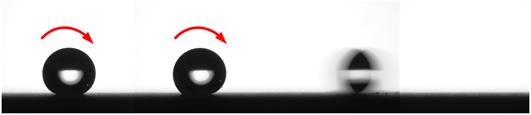
Figure 7 shows the anti-adhesion behavior of hexadecane on the super-sparse surface, and the direction of the arrow represents the direction of movement of the droplet. Through the movement of the syringe, we can make the 3 μL droplets suspended on the top of the syringe realize the approach, contact, separation, and departure with the superoleophobic surface. It can be seen that the droplet can easily and completely leave the surface after a period of contact with the surface, indicating that the surface has good adhesion resistance. Figure 8 shows the dynamic images of hexadecane rolling on the superoleophobic surface, and the platform was rotated until hexadecane rolled off the platform. It can be seen that there was contact angle hysteresis before rolling, and the advancing and retracting angles were 156.5 ± 1.1° and 145.5 ± 1.5°, respectively. The difference between the two angles was the contact angle hysteresis, which is about 11°. Moreover, the inclination angle of the platform was only 2° when the water droplets fell from the superoleophobic surface, and the surface shows good superamphiphobic characteristics.
Anti-adhesion behavior of hexadecane on the superoleophobic surface (the direction of the arrow represents the direction of movement of the droplet).

The dynamic images of hexadecane rolling on the superoleophobic surface.

IV. CONCLUSION
(1) Superoleophobic surfaces were prepared by simple and environmentally friendly electrochemical etching and boiling water treatment method in the Al–Mg alloy substrate. The contact angles/sliding angles of water, ethylene glycol, and hexadecane on the superoleophobic surface were 164.4 ± 1.4°/2 ± 0.3°, 160.9 ± 2.2°/4 ± 0.5°, and 155.3 ± 3.0°/10 ± 1.1°, respectively.
(2) SEM images showed the surface morphologies and cross-sectional shapes at different parameters, which indicated that the re-entrant structure is the key factor of superoleophobic surface formation. The EDS spectra further described the importance of surface topography to surface wettability.
(3) Water, ethylene glycol, and hexadecane conformed to the Cassie–Baxter model on the superoleophobic surface, while hexadecane conformed to the Wenzel model on the superhydrophobic surface (low current).
(4) The anti-adhesion and rolling tests showed that the prepared surface had good resistance to adhesion.
Supplementary Material
To view supplementary material for this article, please visit https://doi.org/10.1557/jmr.2018.303.
ACKNOWLEDGMENT
This work was supported by Natural Science Foundation of Liaoning Province (Grant No. 20170540709) and National Natural Science Foundation of China (Grant No. 51305281).