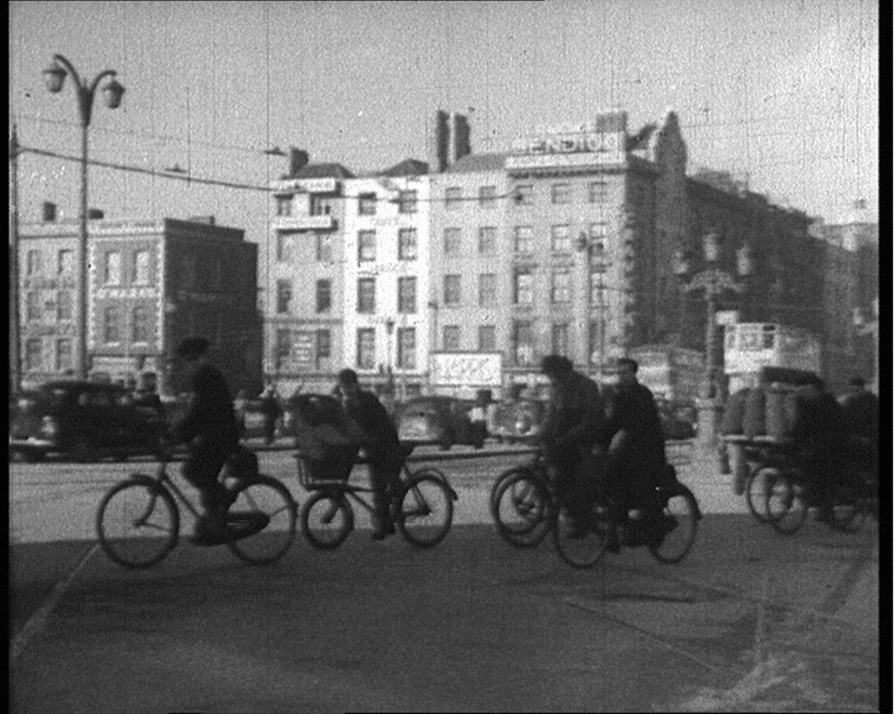
When you went around on a bicycle you knew all the back streets and all the short cuts and had a superior sense of knowing your city much better than other people. Now that knowledge is useless because all the back streets have either gone or are no longer back streets. Traffic goes up and down in streets that used to be quiet and almost empty. Regulations have sent cars into places that only the locals knew. Who would ever have imagined that Connaught street on one side of Phibsboro’, the Great Western avenue on the other would become thoroughfares? Doyle's corner, once a fixed point, is no longer Doyle’s, and even the clock has gone. In time it may become Murphy's corner, of course, but never to me and my contemporaries.Footnote 1
Writing in 1965, Elizabeth Leslie looked back on the Dublin of her youth as viewed from over the top of bicycle handlebars. For Leslie, the city had a legibility that came from repeated use. As she recorded, the sensory experience of travelling by bicycle contrasted both with the motorist's and the planner's view of the urban environment; however, her knowledge of how to negotiate the spaces of the city was becoming swiftly invalid in the 1960s, as the streets were modernized, widened and adapted to meet the demands of mass motorization. Indeed, Leslie was not the only one to experience the disjuncture between the place she had got to know by bicycle and the city she inhabited in the mid-1960s. In the early twentieth century, cycling was the most common way of getting to work in Dublin, a tendency which increased considerably due to the fuel restrictions of World War II. Bicycles were cheap to run and, within the confines of Dublin's small-scale geographies, were an efficient and practical means of travelling in the city. However, during the 1960s, cycle use collapsed. Dublin went from being a ‘bicycle city’ to a place where cycling was ‘extraordinarily unpopular’.Footnote 2
This decline in cycling was bound up with the large-scale changes to the landscape of cities after 1945, in particular the rise of mass motorization and the implementation of inner-city motorways. In the post-war years, the motorcar had become affordable for the first time for a large section of Ireland's middle class, and became a marker of success and affluence; this trend was most apparent during Ireland's relatively prosperous 1960s, when the number of motorcars on the streets of Dublin doubled.Footnote 3 As increasing numbers of cars took to Ireland's roads, the use of bicycle to get to work went through a rapid decline. Just as changes to the urban fabric matched Anglo-American processes so too was a collective cessation of cycle-commuting by Dublin's residents part of a phenomenon which was witnessed across Britain, America and parts of mainland Europe. In Britain, for example, during the the 1940s and 1950s, the bicycle was the most popular means of commuting to work; however, during the 1960s and 1970s, journeys by car and van overtook all other forms, ‘accounting for nearly as many commutes as every other mode combined’.Footnote 4 Similarly, in Stockholm, cycling accounted for 70 per cent of total traffic during World War II, but by 1970 this figure had fallen to 1 per cent.Footnote 5 However, as shown by the re-emergence of the popularity of cycling during the twenty-first century, and the maintenance of cycling levels in countries including the Netherlands and Germany, the link between the rise of the car and the decline of the bicycle was neither inextricable nor inevitable.
This article provides the first examination of the place of cycling in an Irish city during the twentieth century, and follows a recent turn to the politics and practices of urban mobility.Footnote 6 To date, the bicycle has disappeared from historians’ analysis of British and Irish cities in the period after 1945, replicating the ways of seeing of the town-planners who envisioned new urban landscapes. However, the cyclist was always present in Dublin's streets: weaving around cars and buses, like the horse and cart, a reminder of the blurriness of chronologies and the importance of seeking continuities as a way of making sense of seemingly all-encompassing change.Footnote 7 In particular, this article examines the relationship between visibility, mobility and historical writing on the post-war city; exploring how cyclists were erased from the landscape of the twentieth-century city, and how, in turn, the city became increasingly illegible to cyclists. Following James Scott, I foreground the politics of visibility as an essential constituent to the governance of the modern city.Footnote 8 Through a close reading of how the cyclist was visualized in Dublin, I explore how urban legibility was constituted through a range of bureaucratic processes, urban customs and technological practices. I show how the cyclist, despite being a ubiquitous urban traveller, was rendered largely invisible in the ways that the city was quantified and planned; tracing this absence reveals how ideals of progress, class and consumption structured urban change and reveals how these values were naturalized through mapping devices. Indeed, the only times at which the cyclist became visible in statistics or reporting relating to the city was as an accident statistic or the subject of concerns regarding their dangerous behaviour. The cyclist in turn responded with street-level devices of visibility, such as lights and reflectors, but, moreover, by misusing the city's streets and spaces. Moving the cyclist to the centre of analysis reveals how economic and social privilege informed how planners saw the city, and how these values were inscribed in reconstruction of urban space.Footnote 9 Pushing against teleologies of modernization, and continuing to seek Dublin's cyclists – on the streets, in images and planning documents – contributes to our understanding of how urban planning functioned in practice and provides an indication of the everyday complexity of the street and the city after 1945.
The bicycle is both so mundane and so ubiquitous that it has tended to stand outside historical work on Ireland which has been dominated by grand narratives of nationalism and revolution. However, this commonplace machine has a transformative impact on our understanding of the Irish twentieth century. An examination of cycling practices reveals the history of a distinctive Dublin custom which has been neglected in histories of the city and writing on the social and cultural life of the independent state. Reinserting the bicycle into the cityscape also complicates narratives of the 1960s as the ‘best of decades’ by showing how urban modernization, conceived with reference to international standards, was often blind to the distinctive practices of the city, and led to the increased marginalization of those without the economic power to participate in Ireland's affluent society. Moreover, a bicycle-led approach also interrogates received chronologies of Irish history. The twentieth century in Ireland has been traditionally demarcated by political changes, with independence, the beginning of the premiership of Seán Lemass, the joining of the EEC and the ‘Celtic Tiger’ recognized as key dates that have structured research questions.Footnote 10 However, an examination of the politics of the bicycle reveals a story which maps instead onto transnational chronologies of high modernity, and reveals how histories of everyday life in Ireland were constituted through intersections of global technologies and local customs, narratives which are often obscured by a nationally bounded and narrowly defined political history. In order to explore these interlinking themes of class, consumption and governance, this article begins with an examination of the rise and fall of cycling in Dublin in the mid-twentieth century. The second part then goes on to explore how discourses of safety and visibility operated with reference to the cyclist, while the third section then studies how cycling was conceptualized within town planning in Dublin during this period.
Seeking the bicycle in the archive
Until the 1970s, very little effort was made to collect statistical data relating to cyclists or cycling journeys in Dublin. In spite of this absence, anecdotal evidence suggests that the bicycle was a popular mode of travelling around the city centre during the middle of the twentieth century, in particular for women and working-class men.Footnote 11 In 1927, the Interdepartmental Committee on the Control and Regulation of Road Traffic reported that statistics relating to the number of pedal cycles in the Free State were ‘not available’; however, they estimated that there were ‘approximately 500,000 [bicycles], roughly one for every six persons’.Footnote 12 During lunch hour on 25 October 1934, an Irish Times reporter stood at the Ballast Office on Westmoreland Street for about 10 minutes and deduced that ‘approximately 220 cyclists passed. About fifty per cent of that number were girls, twenty per cent young men of the artisan class, while the remainder were elderly men.’Footnote 13 The same year, an Irish Press journalist described Dublin as ‘third of the cities of Europe for bicycles in proportion to the population’ after Amsterdam and Copenhagen.Footnote 14 The popularity of cycling only increased during World War II, when, due to fuel shortages, private motoring was banned. In 1944, the lord mayor, M. O’Sullivan TD, described Dublin as ‘the most cycle-minded city in Europe’ due to Emergency conditions. Even when hostilities ceased the citizens of Dublin did not immediately give up their bicycles: in 1957, the Dublin Corporation Streets Committee described the ‘heavy incidence of bicycle traffic’ as a ‘special feature of Dublin traffic’.Footnote 15
The popularity of cycling was already in decline by the time that transport engineers, with the skill to provide scientific data on traffic and commuting, arrived in Ireland in the early 1960s. Professor Karl-Heinz Schaecterle, Professor of Transport and Urban Planning at the Technical University Munich, was employed by Dublin Corporation to measure traffic flow in the city. He carried out traffic counts at 73 locations in April 1961. Of these, 35 points were located on radial routes into the centre in line with the canals, forming an inner circular cordon, while eight points were located on bridges over the River Liffey between Heuston Bridge and Butt Bridge. There was also an outer cordon formed of 26 points located on the city boundary, and four points in Dun Laoghaire. Traffic was counted at each of these points from 8 am to 8 pm in both directions.Footnote 16 Schaecterle's findings confirmed the impression of visitors regarding the high incidence of bicycle traffic: he found that the number of cyclists accounted for 27 per cent of the journeys in the inner cordon, 30.5 per cent of total journeys crossing the Liffey bridges, while bicycle journeys accounted for 27.4 per cent of all journeys in the city and Dun Laoghaire as a whole.Footnote 17 However, during the 1960s, bicycle use in Dublin collapsed. When Schaecterle's exercise was repeated in 1971, the number of bicycles passing all points had dropped by 80 per cent, from 166,000 to 34,000, and now accounted for only 4 per cent of the total traffic flow in the city.Footnote 18 Patrick O’Farrell and John Markham's survey of commuting in Dublin, conducted in April of the same year, produced similar figures. They found cycling to be the least popular mode of travel to work, accounting for only 4 per cent of journeys. Of commuters arriving inside the canal ring between 8 am and 10 am, they found that 63,000 arrived by bus, 59,300 by car, 6,900 by foot, 6,500 by rail, with only 5,700 completing their journey on a bicycle.Footnote 19
Although little data was collected regarding the age or gender profile of cyclists, and the type or distances of journeys they made, their vehicles were commonly assumed to be markers of poverty. Bicycles were relatively inexpensive. In 1937, Rudge Whitworth, which had a shop at No. 1 St Stephen's Green, sold bicycles costing between £5 16s and £8 14s.Footnote 20 However, they could be obtained for much less second hand – at a Gardaí (police) auction on 16 September 1941, prices ranged from 10s to £4 15s.Footnote 21 The Household Budget Survey of 1951–52 reinforces the image of cyclists as economically marginal: households with the lowest bracket of income (under 30s) had the highest weekly expenditure on bicycles of £1 1s 8d; this compared with the average for all income groups of 4s 6d.Footnote 22 When cyclists were debated in the Dáil, their poverty was central to how they were represented. Moreover, the perception that those who commuted by bike did so only out of hardship was central to decisions to exclude bicycles from road tax and insurance schemes. Alfred Byrne TD characterized the bicycle as ‘the workman's and the girl's method of getting to and from work’, describing how cyclists had ‘to travel long distances, right across the city, say from Fairview to the top of Grafton Street, and from the top of Grafton Street back again to Fairview’.Footnote 23 In the Seanad, the minister for local government, Patrick O’Donnell, called the bicycle ‘the vehicle of the poor man’,Footnote 24 while in 1968 Fintan Coogan TD designated it ‘the small man's motor car’ and said it made ‘the difference between having a job and not having one. . .the bicycle means a great deal to those who use it’.Footnote 25 The girl described by Alfred Byrne, slogging from her house in Fairview to the city centre and back again – three miles each way – proves instructive. From the nineteenth century, new social geographies pulled middle-class residents of the city outwards towards the suburbs, with affluent classes of Dublin retreating to enclaves outside the city's boundaries, such as Rathgar, Ballsbridge and Donnybrook. During the twentieth century, Dublin's working-class residents undertook a similar movement. The residents of the city centre tenements were cleared to locations beyond these inner suburbs, including Fairview, Ballyfermot and Finglas in the 1950s. In the 1970s, large areas of housing, alongside new industrial and retail zones, were built at new nodes approximately eight miles from the city centre at Tallaght, Lucan, Clondalkin and Blanchardstown. Thus, a long commute to work was symbolic of the traveller having ‘made it out’ of the slums, both socially and geographically. These new estates stretched the distances between home and work and made the bicycle increasingly less practical. In contradistinction, the car became the ultimate marker of social status and respectability, and became more affordable during the 1960s.Footnote 26
Motorists’ visions of the cycling ‘menace’
The history of the bicycle in the twentieth century is a constituent part of a larger narrative concerning the changing status of many different modes of urban transportation in Dublin.Footnote 27 From the late nineteenth century, privately operated trams had played an important role in moving Dublin's commuters around the city. They were, however, unable to compete with the speed and flexibility of the new buses, and the last Dublin city tram made its way to the terminus at Nelson's Pillar with some nostalgia, but not much regret, in 1949.Footnote 28 As the trams were gradually stopping, Dublin was also witness to another profound shift in urban mobility with the arrival of mass motoring in the years after World War II. In 1924, there had only been 10,947 ‘mechanically propelled vehicles’ registered in Dublin, rising to 23,364 in 1938.Footnote 29 By 1960, there were 85,297 vehicles of all kinds registered in the city; however, during the decade, this figure almost doubled, reaching 158,423 in 1970.Footnote 30 This meant that, by 1971, 42.5 per cent of households had one vehicle and 10.5 per cent had two vehicles, with 47.0 per cent having no car.Footnote 31 Furthermore, statistics relating to other forms of transport also indicate that the principle growth area was in commuting by car: the Schaechterle surveys of 1961 and 1971 show that in this decade, as bicycle use declined, the number of bus journeys remained constant while the number of journeys by motor-cycle decreased by 16 per cent.
With the increasing numbers of mechanized vehicles on the streets, Dublin's cyclists were increasingly seen by motorists as a menace and an inconvenience on the roads. This sense of disorder and unruliness was epitomized in the figure of the messenger boy, whose youth made him reckless and whose heavy loads made his trajectories unpredictable. In 1930, as car use in Ireland slowly increased, an Irish Times reporter simultaneously applauded and deplored the ‘skill, impudence and ability’ which characterized the cyclist's path through the congested city, opining that: ‘What is [the bicycle] in these days save a nuisance to legitimate traffic? The cyclist smiles. He knows perfectly well that he is a nuisance, but realises at the same time that privileges denied to drivers of more lumbering vehicles are his.’ Displaying a wry admiration of the cyclist's skilful trajectory through streets and traffic, he continued:
There is an element of ‘sneaking’, no doubt, about the bicycle's silent progress amid a cloud of cars; its rider is the freebooter of the streets, against whom all men's hands are stretched out. Yet, the freebooter of old obtained a thrill from his outlawry, and his modern counterpart enjoys something of the same satisfaction. This spirit of independence is strongest among messenger boys, whose airy insouciance drives all other users of the roads to frenzy.Footnote 32
In this report, the messenger boy displayed a masculinity, audacity and daring normally associated with a pirate or a ‘freebooter’. His ‘independence’ and ‘insouciance’ were sardonically praised by the onlooker, who recognized in the cyclist's skill and impudence a rejection of the lines, lights and signs that denoted the appropriate ways to use the city and its roads. But an appreciation of the cyclist's subversion of urban rules was not common. In a letter to the Irish Press, Gordon MacMaster from Ranelagh expressed their frustration at cyclists’ seeming disregard for the highway code. He complained that cyclists considered themselves ‘a cross between a pedestrian and a vehicle, hence their tendency to travel on the footpaths when the roads are too congested to cycle on’. But this was not the only urban regulation that cyclists ignored; they also disregarded many of the new technologies designed to impose regular and predictable movement on traffic. For MacMaster, cyclists were under the impression that ‘traffic lights do not apply to them, and they must be completely unaware that there are such things as one-way streets in this city’.Footnote 33 Concerns regarding the bicycle also manifested themselves around the unlit cyclist riding at night. In spite of an order of 1934 making it obligatory for cyclists to have a white light on the front of their vehicle and a red reflector on the back, there was a popular perception that this rule was seldom adhered to.Footnote 34 Arthur Smith wrote to the minister for justice after having killed a cyclist who had no lights on his bicycle. After this traumatic experience, he attempted to give bicycles a ‘wide berth’ but found that large numbers of cyclists in Dublin rode without lights on their vehicles, and cycled ‘three or four abreast and sometimes carry others on their handlebars or the front carrier. . .The cyclist is so insecure and so mobile that he can perform amazing feats against the traffic regulations.’Footnote 35 These concerns regarding cyclists reveal how the invisibility of the cyclist in planning for the city produced urban spaces which were profoundly irrational when the city was traversed on a bicycle. Cyclists in turn responded to this by creating their own paths which disobeyed the ever-increasing number of traffic lights and streets signs.Footnote 36 They travelled the wrong way down one-way streets; through the new pedestrianized areas; skipped red lights; and in heavy traffic cycled along the pavement. In effect, they disobeyed the urban rules which were designed to instil order among those using the roads and the pavements, disrupted the customs and practices which made the city function and instead used the urban environment in a hybrid of practices conforming neither to the planner's nor the motorist's expectations.
In response to these perceptions, from the 1940s, the state increasingly attempted to dictate to cyclists how they should use the roads. In this period, the traffic department of the Garda Síochána started a ‘safer cycling’ campaign, to improve the standard of ‘road courtesy’ among cyclists. An official of the transport department told the Irish Times that ‘during the war, when there were comparatively few vehicles on the road, cyclists developed many careless habits. Their traffic manners have steadily deteriorated since. As cars were back on the roads in greater numbers now, cyclists were a danger both to themselves and to other road users.’Footnote 37 The chief offences the Gardaí identified were: ‘riding more than two abreast, failure to keep close to the left of the road, failure to give any signal or the correct signal when turning across a road junction to turn right, and swerving and wobbling. There was also the danger of carrying too many parcels.’Footnote 38 As part of this campaign, the film ‘Safe Cycling’ was commissioned by the Department of Local Government in order to demonstrate the danger of incautious and ill-prepared cycling in Dublin (Figure 1).Footnote 39 Scripted and directed by the documentary film-maker Liam O’Laoighaire, it focused on the treacherous activity of cycling on Dublin's busy streets, and featured shots of dangerous cycling practices in Dublin, including cyclists holding on to vehicles, cyclists carrying large objects (including a ladder) and cyclists turning right across several lanes of traffic without signalling. These images were interspersed by the activities of the Careless family who demonstrated ‘what not to do’. Síle Careless’ brakes did not work, Seán Careless rode a bike that was too big and Liam Careless lit a cigarette while pedalling down O’Connell Street. The short film ended with a plea for cyclists to behave appropriately bound up with a declaration of the link between mobility and citizenship: ‘The roads exist for the benefit of the community. Make them safe!’Footnote 40
‘Safe Cycling’ (dir. Liam O’Laoghaire). Image courtesy of Irish Film Archive.

The government also attempted to use legislation to regulate how the cyclist moved and behaved in the city, in order to make the cyclist's behaviour visible and comprehensible for the city's drivers, so that they would not impede the car's speedy conduct through Dublin. The Dublin Traffic Act of 1875, renewed in 1925, had mandated that vehicles whose speed did not exceed 12 miles an hour, including bicycles, should travel within four feet of the kerb.Footnote 41 The Road Traffic Act 1933 made it illegal for a person on a bicycle to ‘take or retain hold of any other vehicle (other than a pedal bicycle on which no person is riding) which is in motion’.Footnote 42 In 1937, it also became illegal to cycle more than two abreast or to ride in a group larger than 20.Footnote 43 Although cycling with a passenger on the handlebars was not illegal, traffic police tended to charge cyclists caught doing this with dangerous cycling.Footnote 44 Children, in particular, were frequently cautioned and fined for cycling two to a bike – Ellen Casey and Kathleen Ruth were both fined £1 for riding one bicycle on Meath Street, while in 1952 Myles Mullin, a 17-year-old messenger boy, was fined 10s after his passenger Patrick Byrne had to have a leg amputated when their bicycle collided with a bus.Footnote 45 In 1963, the legislation concerning the illumination of bicycles was upgraded in line with other forms of transport, to stipulate that the bicycle had to be fitted with lights at both the front and the back during lighting up hours (although, to accommodate those with a dynamo hub, they did not have to be lit while the bicycle was stopped in traffic).Footnote 46
Despite these measures, the effective regulation of the cyclist seemed to be unresolvable. Efforts to control how cyclists used urban space were constantly undermined by the Garda Síochána's inability to match cyclist to bicycle or find an efficient way of enforcing the correct use of the city by the cyclist. Cyclists posed a problem to the Gardaí not only because they misused the city, but also because their identity was almost impossible to verify. The 1927 traffic committee heard that ‘pedal cyclists are not only the chief offenders against traffic and lighting regulations in the Metropolitan Area but that about 40 per cent of these offenders when held up by the Gardaí give wrong names and addresses’.Footnote 47 This ability to disguise their identity meant that charging cyclists who rode recklessly or without lights was often a time-wasting exercise, as cyclists gave false names and court summons were sent to non-existent addresses.Footnote 48 In response to the cyclist's evasion of the city's regulations, and seeming immunity from the laws and regulations of the road, there were frequent calls for a licensing or insurance scheme in order to render the cyclist visible within the bureaucracy of the city. The Garda Síochána suggested to the traffic committee that ‘pedal cycles should be registered and licensed to enable the Gardaí to enforce traffic and lighting regulations’.Footnote 49 In similar terms, Dublin Corporation recommended to the government that the Road Traffic Bill of 1931 contain a clause ‘requiring all pedal cyclists to carry a registration number and rear reflector on their machines, that they should be included in the State Insurance scheme’.Footnote 50 These calls for registration were renewed with every subsequent Road Traffic Act. Licence plates or insurance were never introduced. However, the tendency of cyclists to give fake names was recognized as so prevalent that the Road Traffic Act of 1961 contained a clause that if a cyclist had committed a crime or had been involved in a collision the Gardaí could demand their name: if the cyclist refused to give his name and address or gave a name and address which the Garda had reasonable grounds for believing to be implausible, they could confiscate the bicycle.Footnote 51
The city seen by planners
This ambivalence about the place of the cyclist in Dublin was particularly apparent in the way that the city was replanned for the automobile during the twentieth century. From the late 1950s, central and local government attempted to be more interventionist in directing how Dublin was evolving, in line with a new emphasis on planning and expertise which permeated all aspects of industrial and economic policy.Footnote 52 In this period, the Department of Local Government commissioned reports on the future of Dublin and its region by some of the most famous town planners of the day, including Charles Abrams, Myles Wright, Colin Buchanan and Nathaniel Lichfield.Footnote 53 The first report on the changes required to cater for the anticipated universal car ownership was Schaechterle's Traffic Investigation concerning the Future Main Road Network, commissioned in 1959.Footnote 54 The report proposed the construction of an urban motorway circling the central core and the introduction of one-way streets throughout the city centre. This approach was continued when Schachterle's proposals were updated by the Travers Morgan Partnership in the Central Dublin Traffic Plan of 1973, which set out a detailed scheme for an ‘inner tangent’ ring road, varying between four and six lanes wide, creating a loop of roads around the central core.Footnote 55 Dublin's hinterland was also reimagined for the car by Myles Wright, Professor of Planning at the University of Liverpool. As the road network would not take much more traffic, he proposed a radical remodelling of the land use and social composition of the region to create a diffuse city more suited to the demands of the car. He therefore recommended the decentralization of much industry, commerce and population to new centres at locations removed from the city centre.Footnote 56 Published in full in 1968, this report went on to be the most influential document in shaping Dublin's development until the end of the twentieth century, presaging the growth of Dublin's western suburbs and an urban transport structure based primarily on private car ownership.Footnote 57
Dublin's planners did not see any cyclists in the city. These maps were created in order to remake Dublin for the motor age and, within this schema, the cyclist was of no consequence. Although they made a third of journeys within the urban area, the cyclist was absent from the urban scene as visualized on paper; neither Schaechterle’s, Wright’s, nor Travers Morgan's proposals discussed the way in which the cyclist travelled through Dublin's streets, nor did they include efforts to plan for the use of the city by the cyclist. Moreover, the limited forms of pedestrian–vehicle segregation imposed on central Dublin were envisaged to function only in the absence of bicycles.Footnote 58 The Travers Morgan Partnership's plan for Dublin of 1973 superseded its predecessors in its attempt to explore ‘conflict’ within the urban environment; however, the only conflict examined was that between motorized vehicles and pedestrians, with cyclists unmentioned in the report.Footnote 59 These ways of seeing the city and its actors were reinforced by the new instruments of urban measurement of the 1960s. The Travers Morgan Partnership and Myles Wright both used ordnance survey maps of the city, which they then overlaid with topographical projections of the new roads and traffic flows which would be in place in twenty years time. Urban order was created by ‘T squares and slide rules’; but these instruments of urban design elided with many of the needs of the car.Footnote 60 It was straightforward for planners to draw newly widened, straight roads and tangent routes on a map of the city; however, it was much harder to visualize how these roads would operate in the face of the multiple and often contradictory demands of the city's many actors, and in particular for cyclists who moved in the same spaces as cars but at half their speed.Footnote 61 Moreover, the traffic-calming instruments proposed in these plans and subsequently introduced by the Corporation were directly antithetical to the needs of cyclists. One-way streets and tangent routes cut off the fastest route from starting point to destination, while wide, straight routes, free of pedestrians or other impediments were also designed to make cars go faster. These plans and urban adaptations had obvious and profound impacts on the cyclist, whose vehicle became swiftly less well suited to the modern urban environment.
Despite the large numbers who took to the streets by bicycle every day, the cyclists of Dublin were not an organized group, and had little traction in opposing the town plans and urban regulations that were increasingly compromising their place on the road. The leading lobbying group for cyclists in Britain and Ireland, the Cycle Touring Club, had a branch in Dublin; however, this organization was largely populated by middle-class leisure cyclists who used their bicycles for days out in the Wicklow mountains, and who had little in common with the citizens of Dublin who got to work every day by bicycle. They did, however, make a few attempts to counter the prevailing characterization of the cyclist as a danger to other road users.Footnote 62 In 1960, Catherine Collins, the secretary of the Dublin District Association, wrote to the minister for local government, Neil Blaney, with regard to proposed road traffic legislation. Collins displayed a keen awareness of the many forms of blindness which were rendering travel on a bicycle increasingly dangerous. She argued that there was a causal link between the form that road modernization was taking, decreasing levels of caution and awareness of motorists and increasing dangers to cyclists: ‘There is a real danger’, she wrote, ‘that the efforts being made to widen and straighten roads, improve surfaces and lighting &c., may be creating in motorists' minds a half-conscious idea that it is really somebody else's responsibility to create conditions in which accidents cannot happen.’Footnote 63
In direct contravention of the logic underpinning traffic legislation, Collins argued that the onus should be on the motorist to ensure that accidents did not happen, and, moreover, she put the responsibility on the person driving a car to see what was in front of them rather than on the cyclist to be seen. Her contention was ‘that every traveller on the roads should be able to see everything in front of him and not merely objects illuminated by red lights, and speed should be regulated strictly in accordance with the degree of visibility available to the traveller’. This link had, however, ‘already been weakened by the compulsory use of reflectors’ but Collins recommended the abolition of this legislation, therefore making it clear that responsibility rested unequivocally on the driver to ‘avoid running down any person using the roads in a normal and law-abiding manner’. She finished by equating the burden of safety as regards compulsory use of lights and reflectors with the compulsion for citizens to wear chain mail: ‘Cyclists who wish to carry rear lights or reflectors should be entitled to do so just as any citizen is entitled to wear a shirt of chain mail as a protection against being knifed, but it is quite a different matter to compel the citizen to take such elaborate precautions for his own safety.’Footnote 64 Collins presented the idea that chain mail should be worn at all times in order to prevent the citizens of Dublin from being knifed because it was obviously ridiculous. However, as she pointed out, locating responsibility on the cyclist to ensure they were not harmed, rather than on the motorist to avoid causing harm, was analogous with wearing armour on Dublin's streets. This metaphor raised pertinent – if unanswered – questions regarding where responsibilities for safety resided. Through a series of automated technologies, signs and white lines, urban regulations progressively mandated for a highway free from impediments to motoring, and removed responsibility for the safety of other road users from the car driver.Footnote 65 Traffic safety resided not in the caution of the driver, but in every street user following street signs and remaining in their allocated part of the street, with pedestrians confined to the pavement, cyclists nearest the kerb and the car in the middle of the road. This hierarchy of movement denoted the ethos underpinning the traffic in the city: that cars should not be impeded from travelling at speed.Footnote 66
More recently, the conclusion to this history of cycling has changed. The contingency of the urban values which led to the decline of cycling is revealed by how quickly they shifted in the period after the oil shock of 1975, when, due to changing conceptions of the ideal urban environment, the planner's inability to see the cyclist became increasingly apparent. In 1975, Desmond Moore, a lecturer in Mechanical Engineering in UCD published The Bicycle: A Study of Efficiency, Usage, and Safety. Moore discussed cycling's attributes which had been unseen in orthodox ways of understanding urban mobility. Foregrounding a range of hitherto unmeasured urban values, Moore highlighted cycling's physical and physiological benefits, the virtual complete absence of noise, the elimination of harmful engine emissions, an exposure to fresh air and ‘an opportunity to enjoy auditory communion between cyclist and his or her immediate environment’. Indeed, he grandiosely proclaimed that ‘the bicycle is the most efficient means of transportation known to man or indeed throughout the entire animal kingdom’, using a pictogram to show the favourable comparison between the bicycle and animals such as the locust in terms of energy expended, with the cyclist riding away – healthily and efficiently – along the x-axis.Footnote 67 In 1977, the ‘Bring back the Bike’ campaign, founded by the Dublin city councillor Carmencita Hederman and the architect and conservationist Uinseann MacEoin, published a cycling newssheet entitled The Bike Way which argued: ‘At present, development plans are made and roadways built as if the bicycle didn't exist. We aim to speak on behalf of the cyclist who is ignored or forgotten by the planners.’Footnote 68 In 1979, these campaigners obtained a small victory as Dublin Corporation committed to building the city's first two cycleways: on a section of the Grand Canal between Davitt Road and Basin Street, a distance of about one mile, and the other from the Bull Wall, in Clontarf, through Fairview to the East Wall Road, a distance of three miles.Footnote 69 Although these cycleways and Moore's report had a limited impact on the city during the 1970s, the values implicit in these documents presaged the popularization of cycle-culture from the early twenty-first century.
Conclusion
In the 1950s everyone seemed to ride bicycles. At five o’clock a great wave of spokes and chains would surge round College Green and up Nassau Street. Bicycle clips were not just easy to come by, they were part of the fabric of life and anyone could give you the loan of a pump. In the ’60s they became entangled in social status and self-consciousness, soon it was not sufficient to have a simple car, but one had to possess one with an ever-increasing engine, bigger and noisier than one's neighbour’s. The humble bicycle could not compete, and in their thousands they stole silently into their sheds.Footnote 70
For a long time, no one seemed to notice the absence of the bicycles which used to ‘surge round College Green and up Nassau Street’ in a ‘wave of spokes and chains’ every day at 5 pm. Just as they were ignored by planners and dismissed by statisticians, so the citizens of Dublin also rarely reflected on having upgraded their bicycles for cars and how this had changed their experience of the city. Despite the exceptional popularity of cycling in Dublin, this aspect of urban culture was never inscribed as part of the heritage or culture of the city by either contemporary commentators or historians.Footnote 71 Although it did not form part of the array of social and cultural practices which constituted national identity, like sport, music and dance, cycling played a profound role in shaping ways of understanding the city for the majority of residents of Dublin. As such, a turn towards the history of urban cycling adds to our understanding of daily life in independent Ireland. Moreover, an examination of how the cyclist was rendered invisible in planning the city after 1960 reveals how ‘modernization’ took on wholesale the forms and ideals of governance from Britain and America with little regard for the customs or practices of urban life in Ireland.
The governance of the modern city required devices for making the urban environment legible and its actors visible, but it also required the corollary: the making invisible of certain people and practices. The absence of statistical data relating to cycling, the absence of cycling provision from town planners, and the lack of interest of Irish cycling organizations in the practices or politics of cycling in cities, means that the archival evidence surrounding the history of urban cycling is limited. This archival deficit surrounding a mode of transport which was so common and played such an important role in shaping experiences of the city is significant, revealing the disjuncture between practices of everyday life and the creation of records. However, seeking the cyclist as he or she weaved a path through the post-war city serves a useful analytic function. Tracing their journey from suburban housing estate, past inner-city motorways, zebra-crossings, down one-way streets to work and back is to push against the logics underpinning urban change and to reveal the values which structured them. The cyclist was excluded from devices through which the city was made legible, and so in turn, from state-sanctioned modes of mobility. Using the streets in a way in which they were not intended, the cyclist therefore became a locus of anxieties about urban citizenship: seen as poor, dangerous, anachronistic and unable or unwilling to conform to the formal and informal practices that made the city function. In turn, cycling became an almost radical act which rendered the nexus of capital, class and gendered notions of respectability, which structured urban change, visible. The inhospitableness of multi-lane roads to the cyclist is therefore indicative of the iterative relationship between urban representations and practices. The maps, plans and statistics, through which the city was represented led to the creation of inhospitable spaces for those left out of these devices, which ultimately rendered these marginalized groups further excluded from the city.