Introduction
Pleuragramma antarctica Boulenger, also known as the Antarctic silverfish, is the dominant pelagic fish on the Antarctic continental shelf (Hubold Reference Hubold1984) and represents the majority of the ichthyoplankton of the neritic zone, sometimes accounting for more than 98% abundance (Koubbi et al. Reference Koubbi, Duhamel, Hecq, Beans, Loots, Pruvost, Tavernier, Vacchi and Vallet2009). This species is characterized by a long larval stage of more than one year and a vertical segregation pattern with larvae on the surface (0–200 m) and juveniles and adults at greater depths (>-500 m) (Granata et al. Reference Granata, Zagami, Vacchi and Guglielmo2009, Koubbi et al. Reference Koubbi, O’Brien, Loots, Giraldo, Smith, Tavernier, Vacchi, Vallet, Chevallier and Moteki2011). Pleuragramma antarctica is considered a key pelagic species on the continental shelf, acting as a direct link between herbivorous/omnivorous mesozooplankton and higher levels of the trophic web because it is consumed by a variety of predators, such as birds, fish and marine mammals (Eastman Reference Eastman1985, Koubbi et al. Reference Koubbi, Duhamel, Hecq, Beans, Loots, Pruvost, Tavernier, Vacchi and Vallet2009). This species is considered carnivorous, foraging mainly on copepods and euphausiids (La Mesa & Eastman Reference La Mesa and Eastman2012). Pleuragramma antarctica probably undergoes ontogenetic changes in diet composition and might occupy several trophic levels in the course of their life history as demonstrated for other fish species (Polis & Strong Reference Polis and Strong1996). One trophic level of difference between larvae and older stages was reported by stable isotope analysis (Giraldo et al. Reference Giraldo, Cherel, Vallet, Mayzaud, Tavernier, Moteki, Hosie and Koubbi2011), but no significant differences were found between juveniles and adults. Food resource partitioning was also documented between larval and one-year-old juveniles using gut content analysis (Kellermann Reference Kellermann1987), demonstrating that both developmental stages fed on different size fractions of zooplankton with negligible overlap. Finally, analysis of fatty acids (FA) on individuals from a single sampling station, suggested a progressive shift in diet from copepods to euphausiid larvae between P. antarctica larvae and one-year-old juveniles (Mayzaud et al. Reference Mayzaud, Chevallier, Tavernier, Moteki and Koubbi2011).
The FA composition of lipids in marine animals reflects both diet and internal biosynthetic activities (Sargent & Falk-Petersen Reference Sargent and Falk-Petersen1981, Falk-Petersen et al. Reference Falk-Petersen, Sargent and Tande1987). Fatty acid trophic markers (FATMs) have been used in marine ecosystems to follow energy transfer and to study predator–prey relationships (Falk-Petersen et al. Reference Falk-Petersen, Hagen, Kattner, Clarke and Sargent2000, Dalsgaard et al. Reference Dalsgaard, St John, Kattner, Müller-Navarra and Hagen2003). The concept of FATM is based on observations of FA patterns, characteristic for specific taxa of primary producers and some zooplankters, with the pattern being transferred relatively unchanged through the food chain (Lee et al. Reference Lee, Nevenzel and Paffenhöfer1971, Dalsgaard et al. Reference Dalsgaard, St John, Kattner, Müller-Navarra and Hagen2003). Well known combinations of FATMs are, for example, C20:5n-3, C16 polyunsaturated FA (PUFA) and C16:1n-7 for diatoms, and ∑C20:1 and ∑C22:1 monounsaturated FA (monoenes) for Calanus copepods (Dalsgaard et al. Reference Dalsgaard, St John, Kattner, Müller-Navarra and Hagen2003). Moreover, C18:1n-9 is used as a general marker of carnivores taking into account that it is a major FA in most marine animals (Sargent & Falk-Petersen Reference Sargent and Falk-Petersen1981, Reference Sargent and Falk-Petersen1988). In addition, the C18:1n-9/C18:1n-7 ratio has been used to distinguish carnivores from herbivores (Falk-Petersen et al. Reference Falk-Petersen, Hagen, Kattner, Clarke and Sargent2000).
Following a preliminary study on the trophic patterns of P. antarctica (larvae and juveniles) at a single sampling station using known trophic markers (Mayzaud et al. Reference Mayzaud, Chevallier, Tavernier, Moteki and Koubbi2011), the aims of this study were to assess the influence of spatial variability on the diet composition of different developmental stages across the continental shelf, and to enhance our knowledge on the food web structure of P. antarctica life stages and feeding strategies between juveniles and adults.
Materials and methods
Sampling
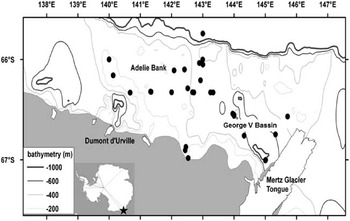
Samples were collected in the Dumont d’Urville Sea (East Antarctica) during the international Collaborative East Antarctic Marine Census (CEAMARC) surveys of the Census of Antarctic Marine Life (Hosie et al. Reference Hosie, Koubbi, Riddle, Ozouf-Costaz, Moteki, Fukuchi, Ameziane, Ishimaru and Goffart2011) and the French IPEV-ICO2TA programme (Institut Paul Emile Victor, Integrated Coastal Ocean Observations in Terre Adélie) (Koubbi et al. Reference Koubbi, O’Brien, Loots, Giraldo, Smith, Tavernier, Vacchi, Vallet, Chevallier and Moteki2011). Fish were collected during the summer in 2008 from the TRV Umitaka Maru using pelagic trawls (international young gadoid pelagic trawl (IYGPT) and rectangular midwater trawl (RMT 8+1)) (Moteki et al. Reference Moteki, Koubbi, Pruvost, Tavernier and Hulley2011). Fish larvae were collected from the French RV l’Astrolabe during the summer in 2009–11 using a double frame bongo net (500 µm) (Koubbi et al. Reference Koubbi, O’Brien, Loots, Giraldo, Smith, Tavernier, Vacchi, Vallet, Chevallier and Moteki2011). Samples were collected at 29 stations along different transects from the Mertz Glacier Tongue (MGT) to the Adélie bank and from the coast to the continental shelf (Fig. 1). Samples were collected at 50, 200, 500 and 1000 m depth. In general, larvae and juveniles were found between 50–500 m, while adults were found in deeper waters (>200 m).
Sampling stations from 2008–11. The Antarctic continent is indicated in grey and isobaths in black.

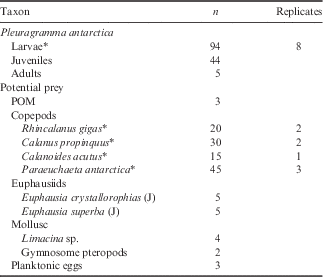
Fish were sorted and identified on board. Fish were measured to the nearest 0.1 mm with a digital calliper (standard length (SL)) at the laboratory before analysis. Fish <30 mm SL were considered as larvae, individuals 30–100 mm SL as juveniles and fish >100 mm as adults (Giraldo et al. Reference Giraldo, Cherel, Vallet, Mayzaud, Tavernier, Moteki, Hosie and Koubbi2011, Koubbi et al. Reference Koubbi, O’Brien, Loots, Giraldo, Smith, Tavernier, Vacchi, Vallet, Chevallier and Moteki2011). Potential prey (phytoplankton, copepods, euphausiids, mollusc and eggs) were collected with the RV l’Astrolabe in January 2011 with an Isaacs-Kidd midwater trawl (IKMT), bongo nets and WP2 nets. For phytoplankton, water from the deep chlorophyll maximum was collected with Niskin bottles and filtered on GF/F filters of 47 mm (Table I). All samples were immediately frozen in liquid nitrogen (-196°C) and stored at -80°C in the laboratory until analysis.
Fish and zooplankton sampling for fatty acid analysis.
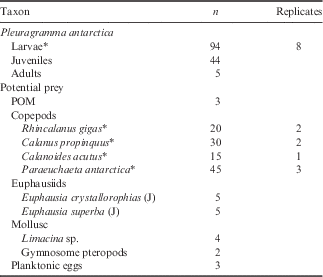
POM=particulate organic matter, (J)=juveniles.
* Pooled samples and replicates are indicated. All other samples were analysed individually.
Lipid analysis
Entire frozen specimens were placed on crushed ice and brought to 0°C. The SL and wet weight (WW) were measured prior to lipid extraction. Lipid extraction followed the method of Bligh & Dyer (Reference Bligh and Dyer1959). Samples were homogenized mechanically and extracted twice with a one-phase solvent mixture of methanol–chloroform–water (2:1:0.8 v/v/v) and the phases were separated overnight by addition of chloroform and NaCl 0.7% (w/v) with a final solvent ratio of methanol–chloroform–water of 2:2:1.8 (v/v/v). The total extract was concentrated under vacuum using a rotary evaporator. Extracts were stored in liquid nitrogen during the cruise and at -80°C at the laboratory.
Total lipid (TL) content was determined gravimetrically. Lipid classes were quantified in P. antarctica using a chromatographic separation coupled with flame ionization detection (FID) on an Iatroscan MK V TH 10. Extracts were applied to SIII chromarods using an SAS A4100 autospotter set up to deliver 1 µl of chloroform extract on each rod. Analyses were done in duplicate. Lipid classes (polar lipids (PL) and triacylglycerols (TAG)) were separated by chromatography, using a double development procedure with the following solvent systems: n-hexane:benzene:formic acid 80:20:1 (v/v/v) followed by n-hexane:diethyl ether:formic acid 97:3:1.5 (v/v/v). The FID was calibrated for each compound class using commercial standards. Lipid classes in fish were isolated by preparative thin layer chromatography with hexane/diethyl ether/acetic acid 170:30:2.5 (v/v/v); the band of PL and TAG was scraped off and eluted. Lipid classes were visualized using dichlorofluorescein, and identification was achieved by comparison with standard mixtures. Fatty acids from TL (phytoplankton and zooplankton) and of PL and TAG for fish were subsequently converted into methyl esters with 7% boron trifluoride in methanol (Morrison & Smith Reference Morrison and Smith1964).
In order to have sufficient material to analyse the FA composition of small specimens (fish larvae, copepods, eggs and mollusc), individuals were pooled according to lipid content (Table I). Gas chromatography (GC) of all FA methyl esters (FAME) was carried out on a 30 m lengthx0.32 mm internal diameter quartz capillary column coated with Famewax (Restek) in a Perkin-Elmer XL Autolab GC equipped with a FID. The column was operated isothermally at 185°C for FAME. Helium was used as the carrier gas at 7 psig. Injector and detector were maintained at 250°C. Individual components were identified by comparing retention time data with those obtained from laboratory standards (capelin/menhaden oils 50:50). In addition, FAME samples were hydrogenated to confirm FA determination. The level of accuracy is ±3% for major components, 1–9% for intermediate components and up to ±25% for minor components (<0.5% of total FA).
Statistics
The relationship between TL and SL were computed after a log-log transformation and the significance of the slope was tested using analysis of variance (ANOVA).
Correspondence analysis (Benzecri 1982) was chosen to describe the total inertia of a multi-dimensional set of data (individual FA), in a sample of fewer dimensions that is the best summary of the information contained in the data. Distances between profiles were computed with X 2 metrics. The percentage of explained variance is given for each analysis, and the size of the symbols is proportionate to the cosine2 and illustrates the quality of the representation for each point. Computation was made using SPAD 5.5 software.
The FA signature from the TAG fraction of P. antarctica (juveniles and adults) was compared to the one of their potential prey (total FA) using orthogonal projections to latent structures-discriminant analysis (OPLS-DA); a multivariate method for assessing a relationship between a descriptor matrix X and a response matrix Y (Bylesjö et al. Reference Bylesjö, Rantalainen, Cloarec, Nicholson, Holmes and Trygg2006). Here, the desired output is to predict the association of a predator (P. antarctica) to a known group of prey, using total FA as the predictive variable. Prey was categorized into six groups: i) particulate organic matter (POM), ii) eggs, iii) euphausiids (juveniles of Euphausia crystallorophias Holt & Tattersall and E. superba Dana), iv) herbivorous copepod (Rhincalanus gigas Brady), v) non-herbivorous copepods (Calanus propinquus Brady, Calanoides acutus (Giesbrecht), Paraeuchaeta antarctica (Giesbrecht)) and vi) pteropods (Limacina sp., gymnosomes). The OPLS-DA results are illustrated by a 2D graph using the discriminant functions DF1 and DF2 or DF3. However, prediction of trophic relationships of P. antarctica with prey-groups was made using all significant discriminant functions. The OPLS-DA was performed in SIMCA 12.0 (Umetrics). Data presented as percentage values were transformed by an arcsine transformation to angular values prior to statistical analysis (Zar Reference Zar1998).
Results
Lipid content and class composition
The SL varied between 8.9–29.9 mm for fish larvae, 42.3–68.7 mm for juveniles and 160–176 mm for adults. Percent TL content varied between 1.8 to 3.1%WW for larvae and juveniles, respectively. Adult tissues were lipid-rich, TL accounted for 4.8% and 21.7% of muscle and liver, respectively (Table II). The log-linear relationship (log to base 10) between SL and TL was established using pooled data of all larvae and juveniles. The regression was highly significant (R 2>0.96) corresponding to the general equation:
 $$\eqalign{{\rm Log}\,{\rm TL}=\,&{\rm 4}.{\rm 17(Log}\,{\rm SL)}\,{\hbox{-}}\,{\rm 2}.{\rm 8\,(ANOVA},\,\cr F=\,&{\rm 3328}.{\rm 9},\,P\,\lt\, 0.0{\rm 5)}.(1)$$
Fish larvae were dominated by PL that accounted for >90% of TL followed by cholesterol (Chol) and TAG representing c. 2% of TL in all individuals. Juvenile lipid composition was more variable; PL accounted for 39.6–91.3% following the differences in TAG content of 7.6–59.7%, and Chol values were 0.6–4.7%. In adults, muscle and liver were dominated by TAG with mean values 61–64% followed by Chol (22–25%) and PL (12–14%).
Standard length (SL), wet weight (WW) and total lipid content according to WW (TL) for Pleuragramma antarctica. For larvae and juveniles, the whole individual (without the stomach) was analysed. For adults, muscle and liver tissues were analysed.

Chol=cholesterol, PL=polar lipids, TAG=triacylglycerol.
Sterol esters, free fatty acids and diacylglycerols were not present or <1%.
Fatty acid signatures
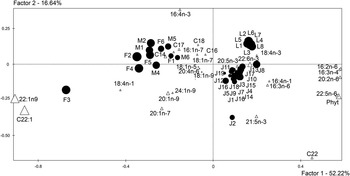
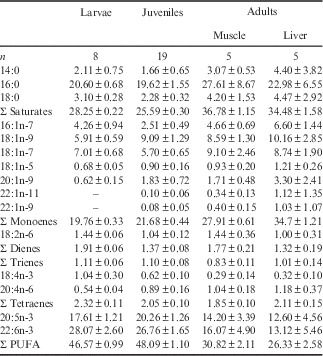
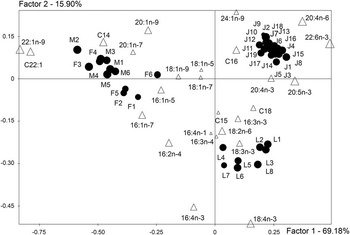
The main FA (>1%) of the PL fraction of P. antarctica life stages are presented in Table III. In fish larvae and juveniles, PUFA (>46%) and saturated FA (>25%) dominated, while saturated, monoenes and PUFA acids represented c. 30% each in adult tissues. In general, saturated acids were dominated by palmitic (C16:0) and stearic acid (C18:0). Monoenes were dominated by oleic (C18:1n-9), vaccenic (C18:1n-7) and palmitoleic acid (C16:1n-7), while PUFA were dominated by EPA (C20:5n-3) and DHA (C22:6n-3). Interestingly, C18:1n-9 increased with increasing size from 6% in fish larvae to 9% in juveniles and 10% in the adult liver. Correspondence analysis of the PL fraction (Fig. 2) explained 68.8% of the variance (first two dimensions) and differentiated all developmental stages. Adults were characterized by higher levels of monoenes ∑C22:1 and ∑C20:1 when compared to younger stages. Larvae and juveniles were both characterized by high levels of EPA and DHA.
Correspondence analysis of the fatty acid signature of polar lipids in Pleuragramma antarctica larvae (L), juveniles (J) and adults (M: adult muscle, F: adult liver).

Fatty acid composition (% of total fatty acids) of the polar lipid fraction of P. antarctica larvae, juveniles and adults (muscle and liver). Minor fatty acids (<1%) are not shown.

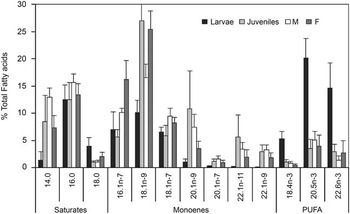
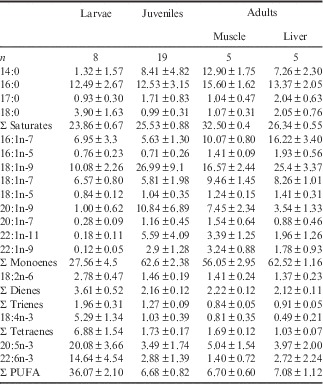
The main FA (>1%) of the TAG fraction of P. antarctica life stages are presented in Table IV. Monoenes (27.5%) and PUFA (36%) dominated in fish larvae, while saturated (25–32%) and monoenes acids (56–62%) dominated in juveniles and adults. The PUFA fraction in juveniles and adults represented only 7% of total FA. In all developmental stages, saturated acids were dominated by palmitic (C16:0) and myristic acid (C14:0). Monoenes were dominated by oleic (C18:1n-9), palmitoleic (16:1n-7), vaccenic (C18:1n-7) and erucic acid (C20:1n-9), while PUFA were dominated by EPA (C20:5n-3) and DHA (C22:6n-3) (Fig. 3). Correspondence analysis of the TAG fraction (Fig. 4) explained 85% of the variance and differentiated all developmental stages. Phytoplankton markers, such as EPA:DHA >1 and C16-C18PUFA, were present in larvae, while ∑C20:1 and ∑C22:1, considered as markers of Calanus type copepods, were present in adult tissues. Although no clear FA marker was found in juvenile stages, the carnivory index C18:1n-9/C18:1n-7 significantly increased from 1.5 in fish larvae to 4.7 and 3.0 in juveniles and adults, respectively.
Fatty acids (>1%) of Pleuragramma antartica life stages: larvae, juveniles and adults (M: adult muscle, F: adult liver).

Correspondence analysis of the fatty acid signature of triacylglycerol in Pleuragramma antarctica larvae (L), juveniles (J) and adults (M: adult muscle, F: adult liver).

Fatty acid composition (% of total fatty acids) of the triacylglycerol fraction of P. antarctica larvae, juveniles and adults (muscle and liver). Minor fatty acids (<1%) are not shown.

Potential prey
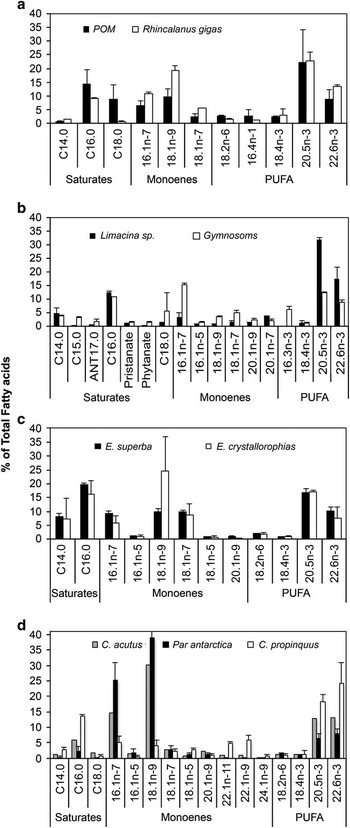
The main FA for potential prey species are presented in Fig. 5. In general, saturates were dominated by palmitic acid (C16:0), major monoenes were oleic (C18:1n-9), palmitoleic (C16:1n-7) and vaccenic acids (C18:1n7), while PUFA were dominated by DHA and EPA. The herbivore copepod R. gigas displayed FA profiles similar to POM. The presence of C16-C18PUFA and EPA:DHA >1 suggests a dominance of diatoms in POM and the diet of R. gigas (Fig. 5a). Gymnosomes presented higher levels of palmitoleic acid (C16:1n-7) when compared to Limacina sp., while EPA levels were three times more important in Limacina sp. than in gymnosomes (Fig. 5b). Euphausiid juveniles of E. superba and E. crystallorophias differed mainly by oleic acid (C18:1n-9), which was more important in E. crystallorophias than in E. superba. Diatom markers (EPA:DHA>1, C16:1n-7, C18:1n-7) and carnivory markers (C18:1n-9>C18:1n-7) suggest a more omnivorous diet for E. crystallorophias than for E. superba (Fig. 5c). Among copepods, the carnivory index (C18:1n-9/C18:1n-7) was low for R. gigas and C. propinquus, and significantly increased for C. acutus and Paraeuchaeta antarctica (Fig. 5d). High levels of ∑C20:1 and ∑C22:1 monoene alcohols were recorded in all copepods species, but were higher in Calanus copepods and Paraeuchaeta antarctica.
Fatty acids (>1%) of potential prey for Pleuragramma antarctica. a. Particulate organic matter (POM) and copepod Rhincalanus gigas. b. Pteropods, Limacina sp. and Gymnosomes. c. Juvenile stages of Euphaussids, Euphausia superba and Euphausia crystallorophias. d. Copepods, Calanoides acutus, Paraeuchaeta antarctica and Calanus propinquus.

Dietary implications
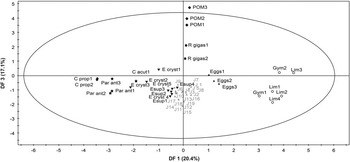
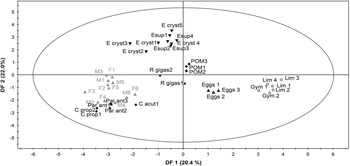
Prey-groups were discriminated at 100% using OPLS-DA, thus validating the use of these prey-groups FA in the dietary study of P. antarctica. All five discriminant functions were significant (P<0.005) and accounted for 87% of the variance. Prediction for juveniles suggested that 58% had a trophic link with the euphausiids group (juvenile E. crystallorophias and E. superba), 17% with the non-herbivorous copepods (C. propinquus, C. acutus, Paraeuchaeta antarctica) and pteropods group (Limacina sp., gymnosomes) and 5.5% with the herbivorous copepod R. gigas (Fisher’s exact test P=6.4e-18) (Fig. 6). The same analysis was performed for adults using muscle and liver tissue. Here, 100% of the individuals (regardless of the analysed tissue) were attributed to the non-herbivorous group (C. propinquus, C. acutus, Paraeuchaeta antarctica) (Fisher’s exact test P=6.1e-18) (Fig. 7).
OPLS-DA in juvenile Pleuragramma antarctica (J, in grey). C acut=Calanoides acutus, C prop=Calanus propinquus, DF=discriminant functions, E cryst=Euphausia crystallorophias, E sup=Euphausia superba, Gym=Gymnosomes, Lim=Limacines, Par ant=Paraeuchaeta antarctica, POM=particulate organic matter, R gigas=Rhincalanus gigas.

OPLS-DA in adult Pleuragramma antarctica (F: liver, M: muscle, in grey). C acut=Calanoides acutus, C prop=Calanus propinquus, DF=discriminant functions, E cryst=Euphausia crystallorophias, E sup=Euphausia superba, Gym=Gymnosomes, Lim=Limacines, Par ant=Paraeuchaeta antarctica, POM=particulate organic matter, R gigas=Rhincalanus gigas.

Discussion
The Antarctic silverfish, P. antarctica, appears as a lipid-rich species when compared to most Notothenioids (Friedrich & Hagen Reference Friedrich and Hagen1994, Hagen et al. Reference Hagen, Kattner and Friedrich2000) which might explain why it is the dominant prey for several top predators and its relevance to the energy transfer to upper levels. Larger Notothenioids, such as Dissostichus mawsoni Norman (maximum total length 175 cm), that feed heavily on P. antarctica are characterized by higher %TL (Clarke et al. Reference Clarke, Doherty, DeVries and Eastman1984). Pleuragramma antarctica stores lipids as TAG, which are short-term energy reserves and/or an alternative to achieve neutral buoyancy essential for its pelagic life mode (Eastman Reference Eastman1985).
The analysis of the PL fraction of FA clearly differentiated P. antarctica according to developmental stage, regardless of the spatial variability of the sampling. High concentrations of DHA and EPA in PL highlight the importance of these FA as essential components of membrane structure and functioning. Instead of being used for energy, PUFA (mainly DHA and EPA) are preferentially incorporated into membrane lipids (Ackman Reference Ackman1967, Sargent et al. Reference Sargent, Tocher and Bell2002, Mayzaud et al. Reference Mayzaud, Chevallier, Tavernier, Moteki and Koubbi2011). However, larvae were characterized by high levels of PUFA in both PL and TAG. At this early stage, PUFA might be also used for energy reserves as suggested by Mayzaud et al. (Reference Mayzaud, Chevallier, Tavernier, Moteki and Koubbi2011). Although PL are known to be strongly regulated in view of maintaining the membrane functions specific for each life stage (Sargent et al. Reference Sargent, Tocher and Bell2002, Dalsgaard et al. Reference Dalsgaard, St John, Kattner, Müller-Navarra and Hagen2003), adults presented a distinctive pattern of monoenes ∑C20:1 associated with Calanus type copepods. This observation might be a reflection of the influence of food sources in PL, as fish have limited ability to synthesize phospholipids de novo and assimilate ingested phospholipids (Sargent et al. Reference Sargent, Tocher and Bell2002, Tocher et al. Reference Tocher, Bendiksen, Campbell and Bell2008, Mayzaud et al. Reference Mayzaud, Chevallier, Tavernier, Moteki and Koubbi2011).
Analysis of the TAG FA signature of P. antarctica illustrated changes in the diet composition for each developmental stage. Phytoplankton and carnivorous markers in fish larvae indicated an omnivorous diet over the period (2008–11) and confirmed our first observations of omnivorous larvae collected in 2007 (Tavernier et al. Reference Tavernier, Mayzaud, Boutoute, Vallet and Koubbi2012). Previous studies have identified larvae as strictly carnivorous (Hubold Reference Hubold1985, Kellermann Reference Kellermann1987, Granata et al. Reference Granata, Zagami, Vacchi and Guglielmo2009). However, an omnivorous diet is in agreement with previous gut content analysed by scanning electron microscopy and stable isotope (δ13C, δ15N) studies (Giraldo et al. Reference Giraldo, Cherel, Vallet, Mayzaud, Tavernier, Moteki, Hosie and Koubbi2011, Vallet et al. Reference Vallet, Beans, Koubbi, Courcot, Hecq and Goffart2011a). Similarities in the FA signature of the TAG fraction for each developmental stage indicate little or no effect of spatial variability in the diet composition and suggest that trophic patterns are relatively constant along the Dumont d’Urville Sea.
The use of FATM in fish or animals at higher trophic levels is usually more difficult than in herbivorous zooplankton. Additional to the use of specific trophic markers, the use of multivariate methods allows a comparison of the total FA signature of predator and prey to solve trophic interactions for these organisms (Iverson et al. Reference Iverson, Frost and Lowry1997, Budge et al. Reference Budge, Iverson and Koopman2006). Although the number of prey in this study is not exhaustive (e.g. small copepods such as Oithona sp., polychaetes or small fish were not available), it does represent the major groups found in this area (Swadling et al. Reference Swadling, Penot, Vallet, Rouyer, Gasparini, Mousseau, Smith, Goffart and Koubbi2011) allowing us to compare the diet composition in P. antarctica and its links to lower trophic levels. Comparison of the FA signatures between juvenile and adult P. antarctica and their potential prey reflected that the dominant prey of juveniles were small euphausiids and to a minor extent copepods, while all adults fed on non-herbivorous copepods (C. acutus, Paraeuchaeta antarctica, C. propinquus). The high contribution of C18:1n-9 in the TAG of juveniles, leading to the highest carnivory index among the developmental stages of P. antarctica, might be explained by the large incorporation of this FA from the wax esters of E. crystallorophias (Mayzaud et al. Reference Mayzaud, Chevallier, Tavernier, Moteki and Koubbi2011). On the contrary, Calanus markers in adult tissues (muscle and liver) suggest that Calanus copepods dominated the diet of P. antarctica older stages. A more contemporary diet is reflected by FA of TAG in the liver than FA in muscles (Guillaume et al. Reference Guillaume, Kaushik, Bergot and Metailler2000). Given that the FA signature of adult muscle and liver was very similar, it is believed that diet was relatively constant over the period preceding the catch. The differences between juveniles and adults were surprising because larger prey were expected in the diet of the largest fish. Instead, juveniles of c. 3 cm SL might consume bigger prey than adults of 16 cm SL. Although the influence of larger prey, such as fish, in the diet of adults (reviewed by La Mesa & Eastman Reference La Mesa and Eastman2012) is not assessed by this study, a high contribution of copepods in the diet of adults is supported by recent analysis of gut contents and stable isotopes in P. antarctica (Pinkerton et al. Reference Pinkerton, Forman, Bury, Brown, Horn and O’Driscoll2013). Pinkerton et al. (Reference Pinkerton, Forman, Bury, Brown, Horn and O’Driscoll2013) showed that the diet of P. antarctica (90–151 mm SL in the Ross Sea) was dominated by mass by krill and copepods (46% and 30%, respectively) with less common prey items including chaetognathes, gastropods, isopods, ostracods, polychaeta and salps. It is possible that Calanus type markers in adults also result from bioaccumulation of FA through the ingestion of small fish species preying on Calanus copepods. Poor contribution of copepods in the diet of juveniles might be explained by a greater availability of euphausiid larvae over the period before the catch. Differences in prey availability according to the ecological niches of developmental stages might also explain differences in diet compositions: larvae are found mainly in the surface, where they can benefit from phytoplankton and small copepods during the summer, juveniles are found deeper between 200–400 m where E. crystallorophias larvae are the most abundant (Vallet et al. Reference Vallet, Labat, Smith and Koubbi2011b), and adults are found at deeper depths and relatively offshore (Radtke et al. Reference Radtke, Hubold, Folsom and Lenz1993). The dominance of copepods in adult diets suggests that it might be more advantageous (from an energetic point of view) to feed on small but abundant prey than to seek larger but rarer prey (Hopkins Reference Hopkins1987). Vertical segregation for the developmental stages (reported on the Dumont d’Urville Sea by Koubbi et al. Reference Koubbi, O’Brien, Loots, Giraldo, Smith, Tavernier, Vacchi, Vallet, Chevallier and Moteki2011) was also interpreted as an adaptation to avoid competition and cannibalistic feeding on larvae and juveniles by adults (Hubold Reference Hubold1985). The use of a more extensive prey-FA dataset should enhance our understanding in dietary patterns in P. antarctica in the Dumont d’Urville Sea. Specifically, further work is needed on the FA of potential prey of P. antarctica larvae, which are expected to prey on small cyclopoids or other copepodite stages of calanoid copepods. Stomach content analysis also indicates that the copepod Metridia gerlachei Giesbrecht is the most important prey item in P. antarctica in the Ross Sea (Pinkerton et al. Reference Pinkerton, Forman, Bury, Brown, Horn and O’Driscoll2013) and although M. gerlachei is also an important species in the Dumont d’Urville Sea (Swadling et al. Reference Swadling, Penot, Vallet, Rouyer, Gasparini, Mousseau, Smith, Goffart and Koubbi2011) no samples were available for FA analysis. Finally, the influence of small fishes as prey for larger P. antarctica should also be evaluated.
Although there were no differences in δ15N or δ13C values between juveniles and adults of P. antarctica off Adélie Land in previous studies (Giraldo et al. Reference Giraldo, Cherel, Vallet, Mayzaud, Tavernier, Moteki, Hosie and Koubbi2011) reflecting a carnivorous/zooplankton diet for both stages, the use of FA in this study successfully differentiated between juvenile and adult diets. This study, along with previous analysis of gut content and stable isotopes, suggests that P. antarctica is a generalist feeder, well-adapted to feed on a wide spectrum of zooplankton depending on seasonal availability. Given the strong spatial and temporal variability of zooplankton, possibly related to the thickness and extent of the sea ice cover over the study area (Swadling et al. Reference Swadling, Penot, Vallet, Rouyer, Gasparini, Mousseau, Smith, Goffart and Koubbi2011), feeding on different prey probably allows P. antarctica to cope in a favourable way with seasonal and spatial variations in prey abundances.
Acknowledgements
The Umitaka Maru and l’Astrolabe cruises were part of the CEAMARC which was a contribution to the Census of Antarctic Marine Life. This study was part of the ICO2TA French project supported by the French Polar Institute (IPEV) with the aim of collecting information on the composition of Antarctic communities on the Antarctic continental shelf. The authors thank the crew, captains and cruise leaders from the l’Astrolabe and Umitaka Maru who helped collect samples. The work was supported financially and logistically by the ANR Glides and ANR Antflocks. The authors also thank the editor and unknown reviewer whose comments improved the manuscript considerably.
Author contribution
Carolina Giraldo: data collection, execution, data analysis, writing and intellectual contribution. Patrick Mayzaud: experimental design and intellectual contribution. Eric Tavernier: data collection and intellectual contribution. Marc Boutoute: execution. Florian Penot: data analysis. Philippe Koubbi: experimental design and intellectual contribution.