

1. Introduction
Medical malpractice and accompanying litigation have been a topic of heated policy debates and reform proposals both in the U.S. and in Europe. Indeed, ‘[f]ew issues in health care spark as much ire and angst as medical malpractice litigation’ (Studdert et al., Reference Studdert, Mello and Brennan2004, 283). One pressing concern has been the sheer volume of medical malpractice cases adjudicated in the courts of law and consequent excessive delays in the resolution of claims (see, e.g., Hughes and Savoca, Reference Hughes and Savoca1997, Reference Hughes and Savoca1999; Grembi and Garoupa, Reference Grembi and Garoupa2013; Ancelot and Oros, Reference Ancelot and Oros2015). Delays in the resolution of medical malpractice claims come at a significant social cost. In addition to distracting healthcare providers from fulfilling their primary mission (Zuckerman, Reference Zuckerman1984) and further incentivizing them to engage in costly defensive practices (see, e.g., Kessler and McClellan, Reference Kessler and McClellan1996, Reference Kessler and McClellan2002; Roberts and Hoch, Reference Roberts and Hoch2007), a prolonged resolution process increases the victim's burden in bearing injury-related expenses, increases public and private legal expenditures, and takes an emotional toll on all involved parties. Delays in the resolution of medical malpractice cases can, therefore, inhibit both the compensation and the deterrence objectives of the institutional framework intended to ensure an effective functioning of a country's system of healthcare (Fenn and Rickman, Reference Fenn and Rickman2014, 245). Accordingly, speeding up the resolution of medical malpractice claims and facilitating early settlement has become a key policy priority for health policy-makers and economists (see, e.g., Hughes and Savoca, Reference Hughes and Savoca1997; Sohn and Bal, Reference Sohn and Bal2012).
What factors influence the timing of settlement of medical malpractice claims and what policy measures would be most effective at facilitating timely settlement? The scarce existing literature on the topic has emphasized the impact of tort law and court reforms (Hughes and Savoca, Reference Hughes and Savoca1997, Reference Hughes and Savoca1999; Grembi and Garoupa, Reference Grembi and Garoupa2013), rules concerning attorney fees (Hughes and Savoca, Reference Hughes and Savoca1999; Helland and Tabarrok, Reference Helland and Tabarrok2003), and general legal costs (Fenn and Rickman, Reference Fenn and Rickman1999). However, under a given legislative framework, the speed of resolution of a medical malpractice claim is also shaped by multiple procedural and legal events that take place as the case unfolds. For example, the process of resolution of a medical malpractice case typically involves expert assessments, several out-of-court interviews and in-court hearings, and other opportunities for formal interaction between the patient on the one side and the healthcare provider and/or their insurer on the other side. Because such events often shed novel light on the case, their incidence and timing presumably shape the dynamics of claim resolution. Indeed, in a recent important contribution using U.K. data, Fenn and Rickman (Reference Fenn and Rickman2014) demonstrate that the timing of resolution of medical malpractice claims is systematically related to the timing and nature of the experts' assessment of those claims.
Due to the overall lack of fine-grained data about the dynamics of the unfolding of medical malpractice cases, however, the role of other salient procedural and legal events that occur during the resolution process remains virtually unexplored. This is especially true in the context of the generally understudied continental European legal systems (Grembi and Garoupa, Reference Grembi and Garoupa2013, 424) where the institutional framework of healthcare provision and medical malpractice litigation can differ notably from that in the Anglo-Saxon world.Footnote 1 The absence of rigorous empirical analyses on the topic is especially troublesome from a policy standpoint because an empirically grounded understanding of how different stages in the resolution process affect the prospect of settlement of medical malpractice claims is central to formulating effective policy measures.
In this paper, we take a step towards filling the abovementioned gap in the literature by examining a novel micro-level dataset of medical malpractice cases collected from a major medical malpractice insurance company operating in Belgium, a EU member state where delays in the resolution of medical malpractice claims and civil cases, in general, have been a longstanding policy concern (High Council of Justice, 2012; Vandersteegen et al., Reference Vandersteegen, Marneffe and Vandijck2015). Our dataset is unique in that it contains detailed information about the incidence and the timing of all key procedural and legal events that occur in the process of resolution of a Belgian medical malpractice case. Much like prior studies drawing on medical malpractice liability insurance records in the U.K. and the U.S. (Hughes and Savoca, Reference Hughes and Savoca1997; Reference Hughes and Savoca1999; Fenn and Rickman, Reference Fenn and Rickman1999, Reference Fenn and Rickman2014; Helland and Tabarrok, Reference Helland and Tabarrok2003), we track the evolution of medical malpractice cases from the very moment they were first brought to the insurer's attention.Footnote 2 Our analysis is therefore not subject to the well-known sample-selection concerns that arise when the empirical inquiry focuses only on the subset of cases that have reached the stage of in-court litigation (Priest and Klein, Reference Priest and Klein1984).
Taking into account the heterogeneity in the modes of disposition of medical malpractice cases and employing a wide range of case-level controls and fixed effects, we are thus able to investigate how the incidence of thus far unexplored procedural and legal events that take place during the resolution process in one continental European jurisdiction is related to the timing of settlement of medical malpractice claims. Our analysis thereby provides direct insight into which aspects of the resolution process could be emphasized, and which de-emphasized, in order to reduce the duration of medical malpractice claims and its detrimental impact on the healthcare system.
The rest of the paper is organized as follows. We first provide a brief institutional background on the process of resolution of Belgian medical malpractice claims. We then discuss our theoretical framework and articulate our hypotheses. We next introduce our data and our empirical approach and present the results. We conclude with a discussion of the policy implications of our findings.
2. Institutional background
Belgian legal system is rooted in the continental legal tradition and has been substantially influenced by the French legal order. Accordingly, unlike in common law-based legal system, in Belgium court adjudication is inquisitorial in nature and the process of resolution of civil claims entails no pretrial discovery stage that serves as a platform for the exchange of information between the plaintiff and defendant. An important distinction between the Belgian and many other continental European legal procedures is that the Belgian civil procedure emphasizes written pleadings (see below).
The primary legal basis for medical malpractice litigation in Belgium during the period of our study is the tort law of negligence. For a medical malpractice claim to succeed, the injured party must, therefore, demonstrate health service provider's negligence as the cause of the injury. In contrast, in a no-fault compensation system, utilized by a subset of European countries (e.g., Sweden, Finland, and France since 2005), the injured party is not expected to prove the healthcare provider's fault or negligence in order to be able to claim compensation.Footnote 3
Medical malpractice litigation has been on the rise in Belgium (Vandersteegen et al., Reference Vandersteegen, Marneffe and Vandijck2017) and hence the market for professional medical liability insurance has been a thriving one. Depending on the nature of a particular case, both individual health service providers (physicians and other medical staff) and healthcare organizations (hospitals and clinics; for example, in the case of a hospital infection) can be the target of medical malpractice litigation. Healthcare organizations and their medical staff other than physicians are insured through the organization's insurance. Physicians typically choose their own professional liability insurance; only a few healthcare organizations require that the physician takes coverage with a specific insurer. Because professional liability insurance is a deontological duty imposed by the Belgian Order of Physicians, all physicians in Belgium possess professional liability insurance.
In what follows, we briefly discuss the unfolding of a medical malpractice case from the insurer's perspective. The exact type and sequencing of specific procedural and legal events that we describe applies to the insurer under consideration and takes into account the specifics of Belgian civil procedure. In the absence of academic studies explicitly contrasting procedural and legal stages in the resolution of medical malpractice claims in different countries, we have verified with Belgian industry experts that other medical malpractice insurers in Belgium and abroad rely on very similar out-of-court steps and, conditional on particularities of civil procedure in different jurisdictions, functionally analogous in-court steps for resolution of suspect malpractice cases. Consistent with this argument, Fenn and Rickman (Reference Fenn and Rickman2014), for example, observe notably fewer procedural and legal events than we do in our data; however, they likewise emphasize expert assessments as a key procedural stage in the resolution of medical malpractice claims in the U.K.
The insurer opens a file about a case after receiving a notification about an instance of potential medical malpractice. Such notification is most often issued by an individual health service provider (a physician or other medical staff) when he or she learns about a patient's complaint. The insurer, however, may also learn about the case upon receiving a writ of summons, via an individual health service provider's preventative communication about an instance where a patient suffered an injury that has not yet resulted in a complaint but that may culminate in a legal claim in the future (e.g. when a medical procedure did not go as planned), or after a patient has directly or indirectly (e.g. via the hospital ombudsman) contacted the insurer.Footnote 4 Thus, while the timing of the opening of the insurer's file will in general not precisely coincide with the timing of the injury, it is appropriate to view the timing of the opening of the insurer's file as marking the start of the process aimed at resolving the underlying instance of suspect medical malpractice.
After opening the file, the insurer upon initial internal deliberation typically appoints a medical expert to investigate the liability of the relevant physician, other medical staff or/and the healthcare organization (provider, in short). The insurer-appointed expert is paid by the insurer and owes his or her duty to the insurer. The expert is selected based on the medical specialty (e.g. neurosurgery, oncology, etc.) most relevant to the underlying case. The expert is chosen from the insurer's list of available experts employed at healthcare organizations other than the organization pertinent to the relevant case. Several factors complicate the process of expert selection and his or her investigation. First, the number of available experts that the insurer can draw on is often limited, especially for narrow medical specialties (e.g. nuclear medicine). Second, the overwhelming majority of experts are healthcare practitioners with a high workload. Third, experts frequently take on multiple cases. Fourth, experts can be delayed in assessing a case not only because the case is complex, but also because parties to the case are late in responding to the expert's query. Consequently, delays can and do arise both in the process of appointing an expert and in the timing of the availability of the appointed expert's assessment of the case.
Upon examination of available evidence and possibly the patient, the expert prepares a report on whether the provider is likely to be deemed liable. The report covers elements of negligence and causation concerning the medical incident and is made available to all involved parties. The insurer-appointed expert may revise his or her estimate of the provider's liability after any further examination or deliberation. The expert's assessment often leads to the closure of the file either because the expert finds the provider not liable and the patient decides to not pursue the matter further or because the expert deems the provider liable, an event that often results in an acceptable out-of-court settlement offer. The insurer and the patient can also agree to take part in a settlement conference that typically proceeds over a series of meetings. The timing and number of settlement conference sessions is not regulated but rather depends on the parties and thus at least in part reflects the complexity of the underlying case.
The patient may at any point file a medical malpractice lawsuit at the first-instance court of general jurisdiction. Court litigation of a medical malpractice claim then unfolds according to the Belgian rules of civil procedure. Taking into account the specifics of the case, parties' preferences, and the court's agenda, the court schedules an opening hearing to discuss the basic facts of the case and the timeline of the exchange of written pleadings. Setting up of the pleadings calendar is the prerogative of the parties. In Belgium, written pleadings have precedence over oral arguments. The court often appoints a further expert, chosen from the court's own list of suitable experts. The expert is paid for via litigants' deposit and owes his or her duty to the court. The expert conducts one or more hearings, the timing of which among others depends on the availability of all involved parties. The expert prepares and delivers first a preliminary and eventually the final report on the case. For reasons analogous to those that prolong the completion of assessments conducted by insurer-appointed experts (see above), as well as because the court-appointed expert begins the investigation only after the parties have paid the applicable deposit, the completion of court stages that involve expert participation can take a while. The court-appointed expert's advice is not binding. In practice, however, judges tend to attach considerable importance to the expert reports. Depending on case complexity, trial hearing often takes place over multiple sessions and presents the disputing parties with the final opportunity to argue matters of the case. Upon completion of the trial hearing, the judge deliberates on the merits of the dispute. The judge is expected to announce the verdict within 1 month from the completed trial hearing.
The insurer, therefore, closes a file about an alleged or verified medical malpractice case for a variety of reasons. If either out-of-court or in-court legal proceedings actually took place, the insurer closes the file once the dispute ends with an out-of-court or in-court settlement, pronouncement of a trial verdict, or if the patient at any point in this process decides to pursue no further legal action. If no legal procedural steps were taken since the opening of the insurer's file, the insurer closes the file once the threat of future litigation no longer exists, for example, because it becomes apparent that the patient has chosen not to seek legal redress or due to the expiration of the limitation period.Footnote 5
3. Theory and hypotheses
When will a legal dispute such as a medical malpractice case end in settlement? The basic rational-choice theory of litigation (see, e.g., Spier, Reference Spier, Polinsky and Shavell2007) emphasizes the importance of congruence of parties' expectations. All else equal, a case should settle (proceed to trial, respectively) whenever the patient as the plaintiff and the medical service provider and the insurer representing the provider on the defendant side have congruent (divergent) views about the merits of the case and, thus, expectations about the trial outcome. Intuitively, congruence (divergence) of parties' expectations increases (decreases) the range of mutually acceptable settlement offers. More recent theoretical contributions (for an overview, see Farmer and Pecorino (Reference Farmer, Pecorino and Anderson1996), Spier (Reference Spier, Polinsky and Shavell2007), Daughety and Reinganum (Reference Daughety, Reinganum and Sanchirico2012)) extend this basic model by stressing informational asymmetry as the reason for parties' divergent expectations and by modeling settlement bargaining.
Spier (Reference Spier1992), for example, develops a model of sequential pretrial bargaining with one-sided incomplete information that predicts that the prospects of settlement should be higher at the beginning and at the end of negotiations than in the middle; that is, settlement hazard (a measure indicative of the prospects of settlement at a given point in time, conditional on the event that the case has not been resolved until that point in time; see also Section 5) should follow a U-shaped pattern and exhibit a ‘deadline effect’. Spier's (Reference Spier1992) framework, however, does not allow for the impact of multiple procedural and legal events that take place during the unfolding of a claim, when the disputing parties are able to exchange and learn new information about the case. In particular, events that lead to the revelation of factual information, and thereby align the expectations of the patient on the one side and the health service provider and the insurer on the other side, should facilitate timely settlement. In contrast, procedural practices and legal motions that are indicative of a litigating party's commitment to bear the costs of prolonged out-of-court or in-court legal proceedings (see Boyd and Hoffman, Reference Boyd and Hoffman2013, 904) should all else equal impede settlement.
Rational cognition, however, is hardly the only driver of disputing parties' decisions: ‘Lawyers tend to think that settlement decisions are based on logic when in fact they often involve a large emotional component’ (Lurie, Reference Lurie2013). Accordingly, behavioral theories (see, e.g., Kaufmann and Stern, Reference Kaufmann and Stern1988; Huang and Wu, Reference Huang and Wu1992; Cross, Reference Cross2000; Blumenthal, Reference Blumenthal2005) augment the rational choice model by incorporating the role of emotions. For example, hostility that often develops during the process of the resolution of a claim diminishes the disputing parties' desire to settle (Lurie, Reference Lurie2013). Moreover, impacted by affective forecasting biases, disputing parties are often unable to adequately predict their own future emotional reactions, even to anticipated events, during the proceedings (Blumenthal, Reference Blumenthal2005). Consequently, disputing parties are likely to be heavily influenced by their emotional experience of the various events taking place in the course of dispute resolution (Grajzl and Zajc, Reference Grajzl and Zajc2017; Bielen et al., Reference Bielen, Grajzl and Marneffe2017). Emotional effects are likely to be particularly important in the resolution of medical malpractice cases. On the plaintiff side, many patients undergo substantial emotional distress as a result of the injury or medical event that led to legal action. On the defendant side, physicians involved in medical malpractice litigation also experience strong emotional reactions and even psychological trauma (see, e.g., Charles, Reference Charles2001; Eisenberg, Reference Eisenberg and Eisenberg2004; Reyes and Reyes, Reference Reyes and Reyes2017).
Drawing on rational-choice and behavioral theories, we assess the role of the key procedural and legal events that take place during the unfolding of medical malpractice claims in Belgium. These events either result in the revelation of factual information and, thus, in alignment of disputing parties' expectations; or signal commitment to proceed with costly legal proceedings, possibly increasing hostility among the disputing parties; or even give rise to a mixture of these effects, in which case the net impact of an event on the timing of settlement depends on the balance of the expectations-aligning, commitment-signaling, and hostility-inducing effects. Consequently, different procedural and legal events that take place in the resolution process can exhibit a different effect on the timing of settlement of medical malpractice claims.
Specifically, we expect information revelation, and thus the expectations-aligning effect, to be particularly important after the completion of an expert's investigation. Thus, all else equal, we expect the time to the settlement to decrease (equivalently, settlement hazard to increase) when the insurer-appointed expert finds the provider liable; when the court-appointed expert completes a hearing; and when the court-appointed expert turns in a completed report (Hypothesis 1). In contrast, we anticipate settlement hazard to decrease (equivalently, the time to the settlement to increase) when the insurer-appointed expert deems the provider not liable (Hypothesis 2). Intuitively, information that the patient's claim is weak incentivizes the patient to abandon the case, which in turn reduces the prospects of settlement. We also expect factual information revelation to take place, and hence the expectations-aligning effect to be strong, during early settlement conference sessions, when each disputing party is most likely to acquire new knowledge about the case. Thus, the completion of early sessions of a settlement conference should all else equally reduce the time to settlement (Hypothesis 3). In contrast, if a case has not settled during one of the early settlement conference sessions, participation in later sessions is unlikely to result in the revelation of substantively new information. Accordingly, later settlement conference sessions may induce a feeling of resentment among the involved parties, which in turn stymies settlement (Hypothesis 4).
The hostility-inducing and commitment-signaling effects are likely to be particularly strong if the medical malpractice case has reached the court. At the same time, participation in court hearings and pleadings also enables the involved parties to engage in further reflection and interpretation of the merits of the case and thereby provides them with additional opportunities to align their respective expectations. Whether court-mandated events such as the introductory hearing, the exchange of pleadings, and the trial hearing sessions increase, decrease, or even have no effect on the time to settlement then depends on the interplay of three effects. If the expectations-aligning effect associated with an introductory court hearing, the exchange of pleadings, and a completed trial hearing session dominates the respective commitment-signaling and hostility-inducing effects, then the event should decrease the time to settlement (Hypothesis 5a). If the latter effects dominate the former effect, however, the completion of the pertinent event will increase the time to settlement (Hypothesis 5b).
4. Data
4.1 Sample
Our dataset is based on the information included in the medical malpractice files of an insurance company that has been estimated to cover about 40% of the professional medical liability insurance market in Belgium.Footnote 6 For purposes of research, we have been granted confidential access to the complete set of files about suspect medical malpractice cases that the insurer opened on or after 1 January 2006 and that were either closed by or still pending on 1 September 2014. Our sample, therefore, consists of 941 instances of confirmed or potential medical malpractice. In total 750 out of these 941 cases resulted in a closure of the insurer's file and 191 were still pending at the end of our observation window.
Hypothetically, there could also exist instances of medical malpractice, committed by the healthcare providers covered by our insurance company, that the insurer never found out about and that were hence resolved without any kind of involvement of the insurer during the time period under consideration. In practice, however, cases of this kind are likely to be extraordinarily rare. Furthermore, given the wide range of detailed case-level controls that we employ in our analysis, we would not expect the potential omission of such cases from our sample to affect our estimation results.
4.2 Settlement and case durations
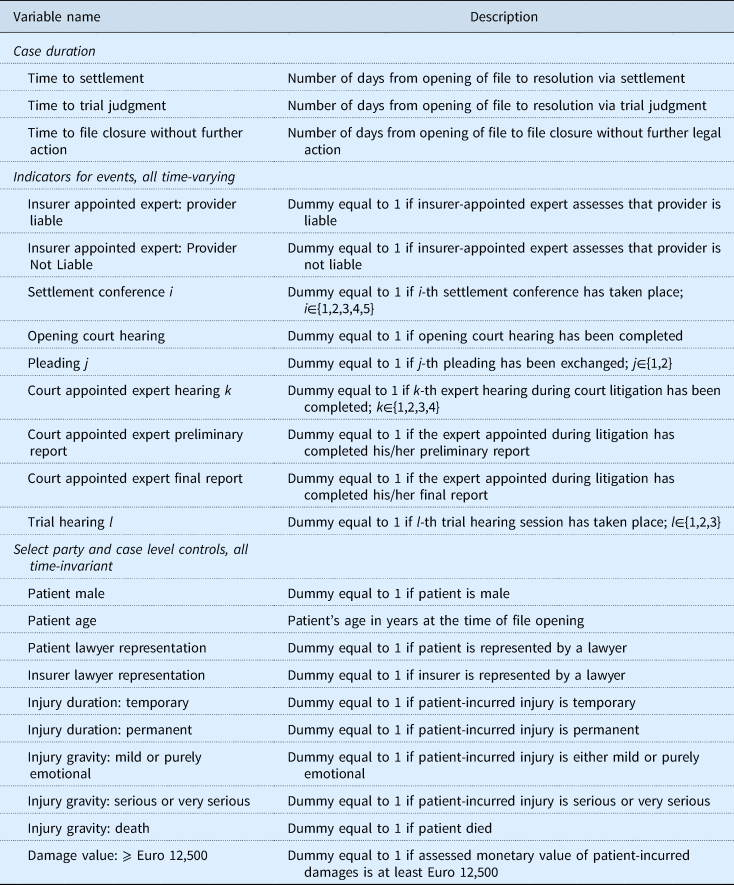
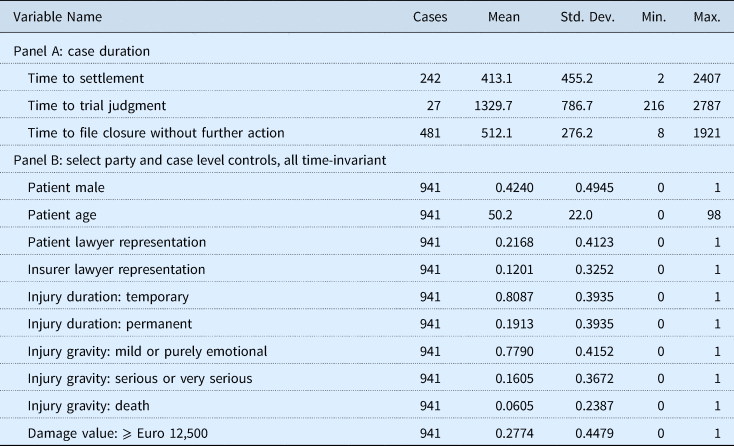
Table 1 provides variable definitions for key variables. Table 2, panel A, provides basic descriptive characteristics on case durations to settlement and other reasons for closure of the insurer's file on a medical malpractice case. From 750 cases that resulted in closure of a file, 242 were settled either out of court or in court, 27 were disposed via trial verdict, and 481 resulted in file closure without settlement or court verdict (e.g., because the patient never sought legal address or abandoned seeking legal address at some point during the resolution process).Footnote 7 It took on average 413 days to settlement, 512 days to closure of a file without a legal decision, and a substantially longer 1330 days to trial judgment.
Variable definitions and description

Notes: Select party and case level controls listed in the table are those for which hazard ratios and corresponding standard errors are reported in Table 4. Estimated empirical models, however, also include multiple sets of fixed effects (for suspect cause of malpractice, medical specialty of provider, mode of opening of insurer's file, year of file opening, and identity of the healthcare provider); see Section 4.4 and Tables 4 and 5.
Descriptive statistics: case durations and select time-invariant covariates

Notes: Out of 941 cases in the sample, 750 are completed (via settlement, trial judgment, or closure of the insurer's file without further action), and 191 are pending. Select time-invariant covariates are those reported in Table 4. Estimated empirical models, however, also control for a series of fixed effects (for suspect cause of malpractice, medical specialty of provider, mode of opening of insurer's file, year of file opening, and identity of the healthcare provider); see Section 4.4 and Tables 4 and 5.
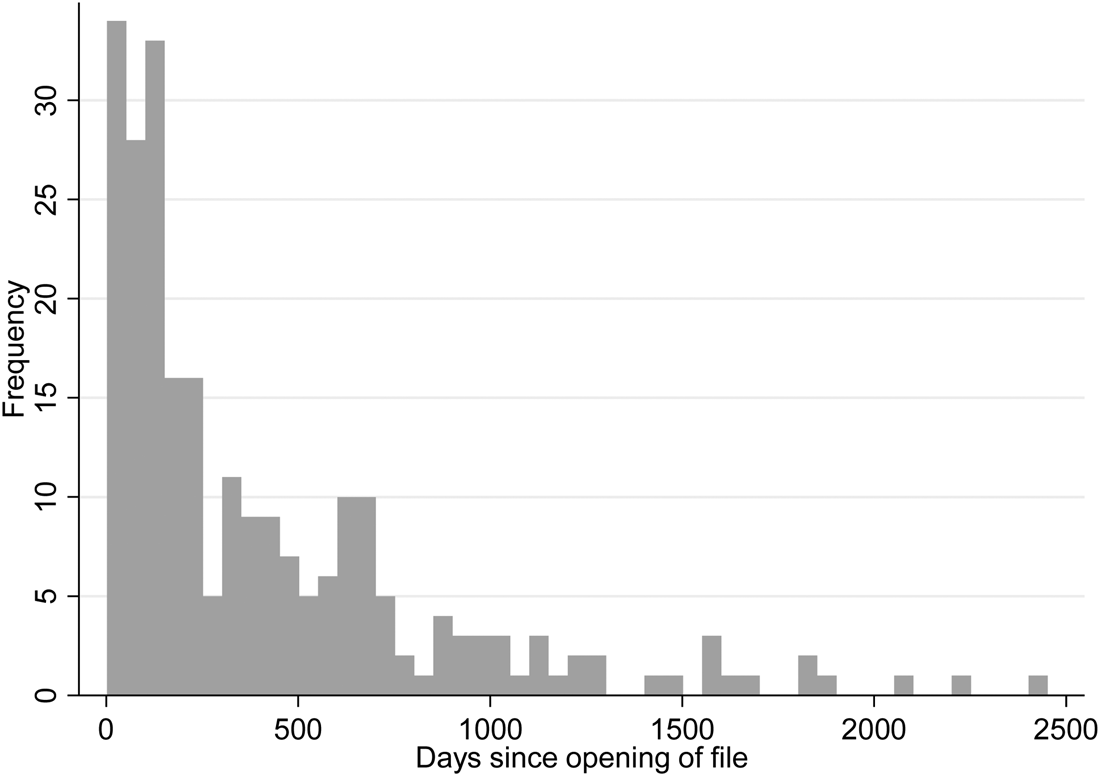
Figure 1 shows the distribution of the timing of settlement since opening of the insurer's file. As expected, the distribution of settled cases is strongly positively skewed: many medical malpractice cases (52%) are settled relatively quickly, within 250 days. Yet the unfolding of a case to settlement also often takes a long time. The time to settlement exceeds 1000 days since opening of the insurer's file for 10% of the cases.
Timing of settlement.

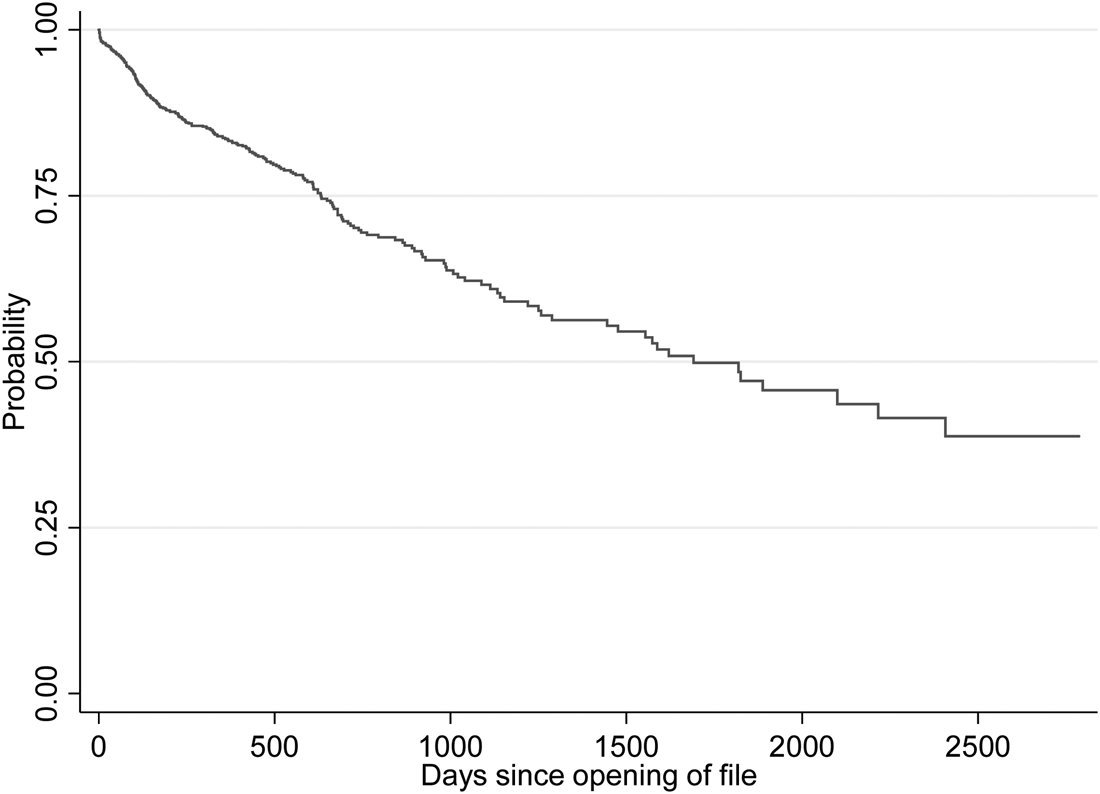
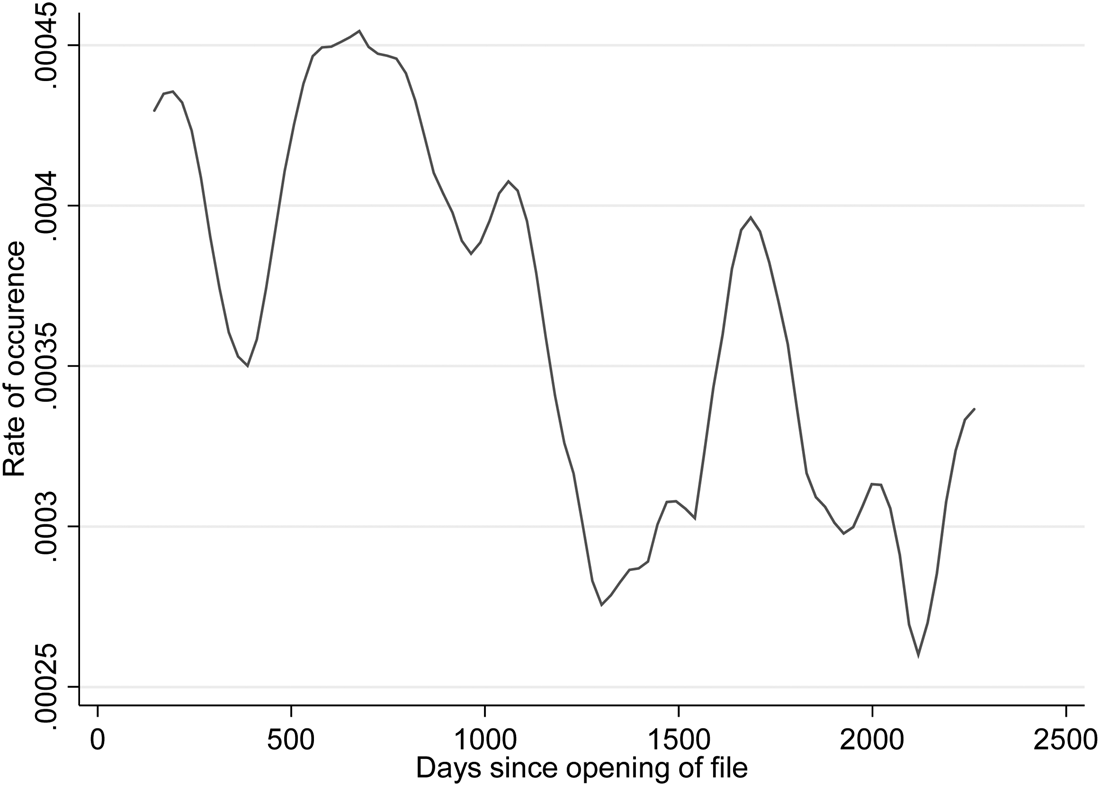
Figure 2 plots the Kaplan-Meier estimate of the survival function and Figure 3 the Nelson-Aalen estimate of the hazard function for settlement. These estimates are nonparametric in that they incorporate no covariates and make no assumptions about the underlying functional forms of the survival and hazard functions, respectively. The settlement hazard is distinctly non-monotonic and features multiple local extrema. We see some evidence of the deadline effect in that settlement hazard increases for the longest case durations. However, we see little evidence in support of the U-shaped pattern predicted by Spier's (Reference Spier1992) pretrial bargaining model. Indeed, the multimodal pattern of the settlement hazard is strongly suggestive of the existence of procedural and legal events, unaccounted for in Spier's (Reference Spier1992) modeling framework, that change the settlement hazard as the medical malpractice case unfolds.
Non-parametric (Kaplan-Meier) estimate of the survival function for settlement.

Non-parametric (Nelson-Aalen) estimate of the Hazard function for settlement.

4.3 Focal explanatory variables: indicators for procedural and legal events
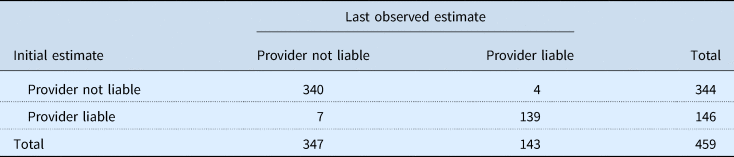
The covariates with which we model the procedural and legal events are all discrete and time-varying in that they change value during the course of case resolution in a discrete fashion. For the insurer-appointed expert's assessment of provider's liability, a key procedural event, we define two indicator variables. The first variable takes on the value one during the periods when the expert deems the provider liable; the second variable equals one during the periods when the expert deems the provider not liable. These indicator variables are not enduring because the expert's opinion may and does change during the unfolding of the case, as Table 3 illustrates. The two variables do not add up to one because each variable takes on the value of zero during the initial period when the insurer-appointed expert's assessment is not yet available.
Transition matrix for insurer appointed expert's liability assessment

Notes: For cases with a single liability estimate, the last observed estimate equals the initial estimate.
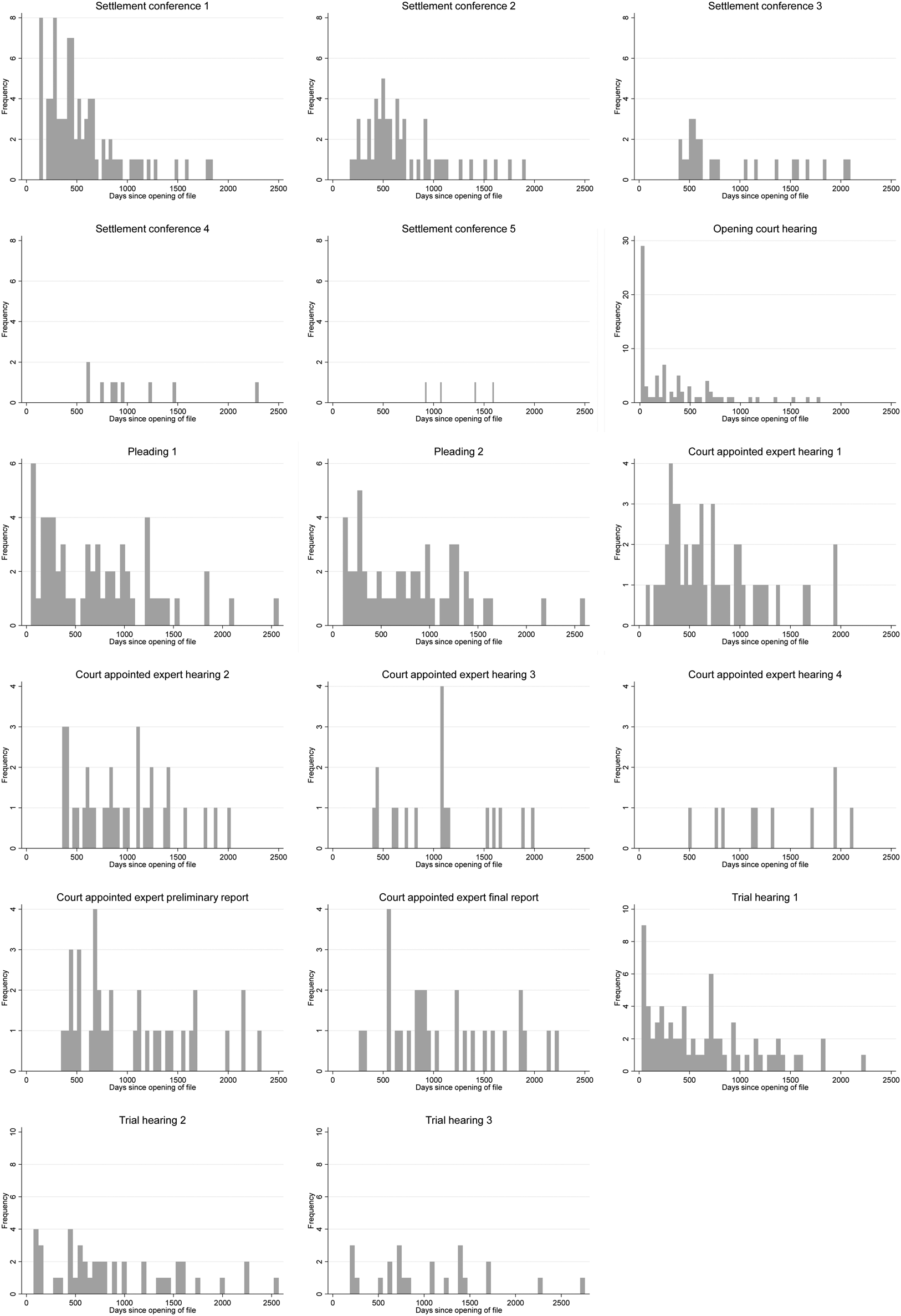
In contrast, the indicator variables for each of the remaining events (settlement conference sessions, opening court hearing, pleadings, hearings conducted by the court-appointed expert, completion of the preliminary and the final version of the court-appointed expert's report, and trial hearings) are all enduring in that each equals zero before the occurrence of the relevant event and one after the event. Figure 4 shows the distribution of the timing of occurrence of each of these procedural or legal events. For each of the events that may be spread over multiple sessions (settlement conference, the exchange of pleadings, hearing conducted by the court-appointed expert, and trial hearing), the number of cases subject to a session naturally decreases, and the modal time of incidence increases, with each subsequent session.
Timing of events.

4.4 Controls and fixed effects
We employ a wide range of time-invariant party and case controls. These variables are intended to mitigate any confounding effect of factors such as the overall complexity of a case that is plausibly correlated with both the timing of settlement and the timing of procedural and legal events of our interest. We control for the patient's age and gender. We control for whether the insurer and the patient are represented by a lawyer. We further control for multiple measures describing the patient's injury. Specifically, we include dummies for whether the estimated monetary value of the patient-incurred damage exceeds 12,500 Euro; for whether the damage is permanent (as opposed to temporary); and for the extent of damage that ranges from mild or purely emotional to patient's death. Table 2, panel B, provides the descriptive statistics for these variables.
In all of our regressions we also include an encompassing set of fixed effects. These capture further important features of a case and additionally mitigate any endogeneity bias. In our baseline specification, we include (but for brevity do not report hazard ratios associated with) the full set of fixed effects for the suspect cause of malpractice (physician, medical staff, hospital infection). Because the intricacy of medical procedures and the consequent complexity of malpractice cases can vary notably across different health domains, we include fixed effects for the medical specialty of the health service provider (cardiology, gynecology, neurology, and 26 other specialties). We further include fixed effects for the mode of opening of the insurer's file (provider's notification, court summons, patient complaint, or provider's preventative communication) and the year during which the insurer opened the case (ranging between 2006 and 2014).Footnote 8 Finally, in conducting sensitivity analysis (see below), we additionally include fixed effects for the identity of the healthcare's provider employer.
5. Empirical approach
The insurer may close the file about a given case for multiple reasons: because the parties have reached (out-of-court or in-court) settlement, because a case was resolved through a trial verdict, or because the patient either never chose to pursue damages or at some stage abandoned further legal action. Moreover, only one of these events can occur first. Settlement, trial judgment, and closure of the insurer's file for other reasons are therefore competing risk events. This feature of the data necessitates the use of the competing risks regression framework. To estimate cause-specific hazards for settlement as the reason for file closure of our interest, we treat the remaining competing risk events and pending cases as right-censored observations (see, e.g., Cleves et al., Reference Cleves, Gutierrez, Gould and Marchenko2010, Ch. 17; Andersen et al., Reference Andersen, Geskus, de Witte and Putter2012; Noordzij et al., Reference Noordzij, Leffondre, van Stralen, Zoccali, Dekker and Jager2013). The inclusion of cases that result in the closure of the insurer's file for reasons other than settlement and of pending cases mitigates the sample selection concerns. Importantly, this approach yields valid estimates of cause-specific hazards without imposing any assumptions about independence of competing risks (Andersen et al., Reference Andersen, Geskus, de Witte and Putter2012, 869; Noordzij et al., Reference Noordzij, Leffondre, van Stralen, Zoccali, Dekker and Jager2013, 2673).
Our data are observed on a daily frequency, while the length of the observed case duration spells often exceeds 1000 days and even approaches 2500 days (see Table 2). We thus use continuous-time methods. Our baseline empirical model is the extended Cox model that incorporates time-varying covariates and imposes minimal assumptions on the underlying hazard function. Specifically, we let settlement hazard as the instantaneous rate of ‘failure’ through the settlement for the j-th case take on the following general formFootnote 9:
 $$h(t \vert x_j(t),z_j) = h_0(t)\exp [x_j(t)^{\prime}{\beta} + {z_j}^{\prime}{\gamma}],$$
where t is time and h 0(t) is the baseline hazard that is given no particular parameterization and in fact need not even be estimated to ascertain the effect of a particular covariate on the settlement hazard (see Cleves et al., Reference Cleves, Gutierrez, Gould and Marchenko2010). x j(t) is the vector of time-varying covariates that capture the incidence of different procedural and legal events, z j is the vector of featured time-invariant covariates and various fixed effects (see Section 4.4), and β and γ the corresponding vectors of coefficients to be estimated. Given our focus on the role of procedural and legal events, the estimates of particular interest are the elements of the vector β.
The model is estimated using maximum-likelihood methods. Exponentiated coefficients have the interpretation of the ratio of the hazards for a unit change in the explanatory variable in question. A positive (negative) coefficient corresponds to a hazard ratio greater (smaller) than one, which in turn implies that the variable in question increases (decreases) the settlement hazard or, equivalently, decreases (increases) the time to settlement.
We base inference on heteroscedasticity-robust standard errors clustered at the case level to account for the dependencies that arise in the expanded data format suitable for survival analysis. Specifically, 941 cases (resulting in closure of insurer's file or still pending) in our sample give rise to 4209 distinct observations where an observation is defined as a time interval during which no failure event takes place and, at the same time, there is no change in the value of any of the time-varying covariates. We interpret the results as statistically significant only if they are significant at the 5% or lower significance level.
6. Results
6.1 Baseline model estimates
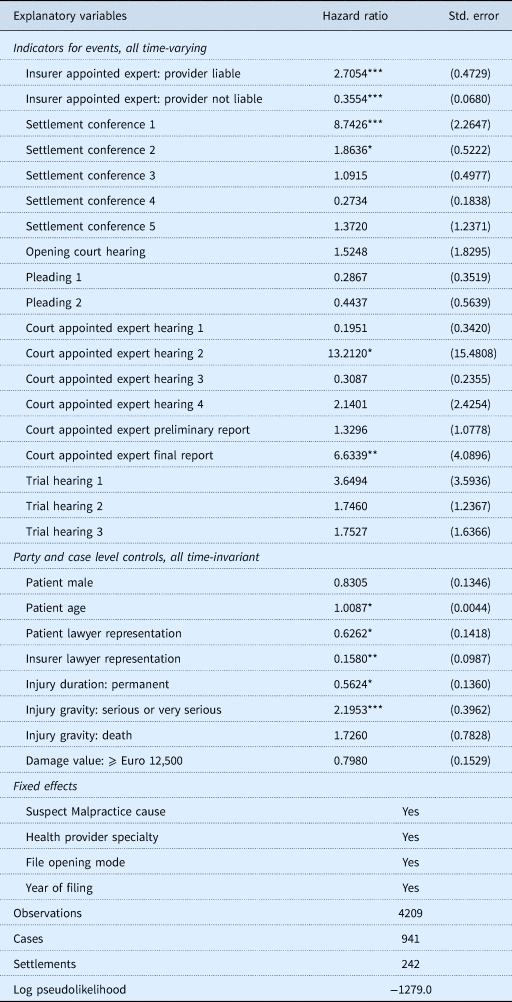
The results from our baseline Cox model are presented in Table 4. Consistent with Hypotheses 1 and 3, settlement hazard is all else equal statistically positively associated with the occurrence of those procedural or legal events that particularly successfully reveal new factual information about the case: insurer-appointed expert's assessment that the provider is liable; completion of each of the first two settlement conference sessions; the second hearing conducted by the court-appointed expert; and the arrival of the court appointed expert's final report. In line with Hypothesis 2, settlement hazard is negatively associated with the insurer-appointed expert's assessment that the provider is not liable (the relevant hazard ratio is smaller than one). Lending empirical support to Hypothesis 4, the hazard ratio for the completion of the fourth settlement conference session is smaller than one and only marginally statistically insignificant (p-value equals 0.054).
Regression results, Cox model

Notes: The table presents regression results for timing of settlement based on semiparametric Cox model. Hazard ratio greater (smaller) than one indicates that a covariate reduces (increases) the time to settlement. Competing risk events and pending cases are treated as right-censored observations. The omitted category for injury duration is temporary and for injury gravity mild or purely emotional. See Section 4.4 for detailed discussion of various fixed effects. Reported standard errors are heteroscedasticity-robust and clustered at case level. ***, **, and * indicate significance at the 0.1%, 1%, and 5% levels, respectively.
No other event in the resolution process, such as subsequent settlement conference sessions, the introductory court hearing, the exchange of pleadings, trial hearing sessions, and the completion of court-appointed expert's preliminary report, exhibit a statistically significantly effect on the timing of settlement. Note that the number of cases in our sample that are subject to the completion of these events is non-trivial (see Figure 4). Insufficient variation in the data thus cannot be the reason for the lack of statistically significant results concerning the effect of the indicator variables that capture these events. Because lawyers in Belgian medical malpractice cases charge hourly fees (see below), one could perhaps conjecture that the lack of statistically significant effect of several trial-related stages of the resolution process may be attributed to participating lawyers' incentives to slow down case resolution. We find little evidence in support of this conjecture: the effect of completion of the opening court hearing, exchange of pleadings, and trial hearing sessions on settlement hazard continue to be statistically insignificant in a specification (not reported) where we omit controlling for parties' legal representation. The most convincing explanation of our findings, therefore, is that any expectations-aligning effect of these particular court-sponsored events that tend to increase settlement hazard is more or less exactly offset by the combined commitment-signaling and hostility-inducing effects that tend to decrease settlement hazard (see Hypotheses 5a and 5b).
Among the party and case level controls featured in Table 4, settlement hazard is all else equal statistically significantly positively associated with patient's age and gravity of the injury. These results are consistent with the interpretation that injured patients all else equal prefer to settle faster when their expected lifetime is shorter and when conditional on the duration of the injury and other covariates, the injury is more severe, in which case the benefits from certain compensation due to early settlement likely outweigh the uncertain return from prolonged litigation. Conditional on the gravity of the injury and other factors, settlement hazard is statistically significantly lower when the patient's injury is permanent (as opposed to temporary), a scenario when, due to challenges in predicting future adverse effects on the patient, the uncertainty surrounding the prognosis, and hence the scope for divergence of parties' expectations, are likely particularly high (see, e.g., Fenn and Rickman, Reference Fenn and Rickman2014, 267).
Finally, settlement hazard is statistically significantly negatively associated with the patient's and the insurer's lawyer representation. These findings are consistent with the interpretation that any reduction in the divergence of parties' expectations that might take place as a consequence of lawyers' involvement is not sufficient to speed up the settlement. Instead, lawyer representation plausibly stymies settlement for two distinct reasons. First, lawyer involvement signals parties' intent to proceed with litigation. Second, given that lawyer compensation in Belgian medical malpractice cases is based on hourly (as opposed to fixed or contingency) fees, lawyers benefit from participation in a lengthy resolution process. However, since we do not observe when exactly parties appointed lawyers in the relatively small set of cases when lawyers were involved (see Table 2), our time-invariant indicators for lawyer representation are admittedly imperfect proxies for the extent of lawyer involvement. Moreover, lawyer representation is likely endogenous. We thus emphasize that the abovementioned conclusions about the implications of lawyer representation should be interpreted with caution.
6.2 Sensitivity analysis
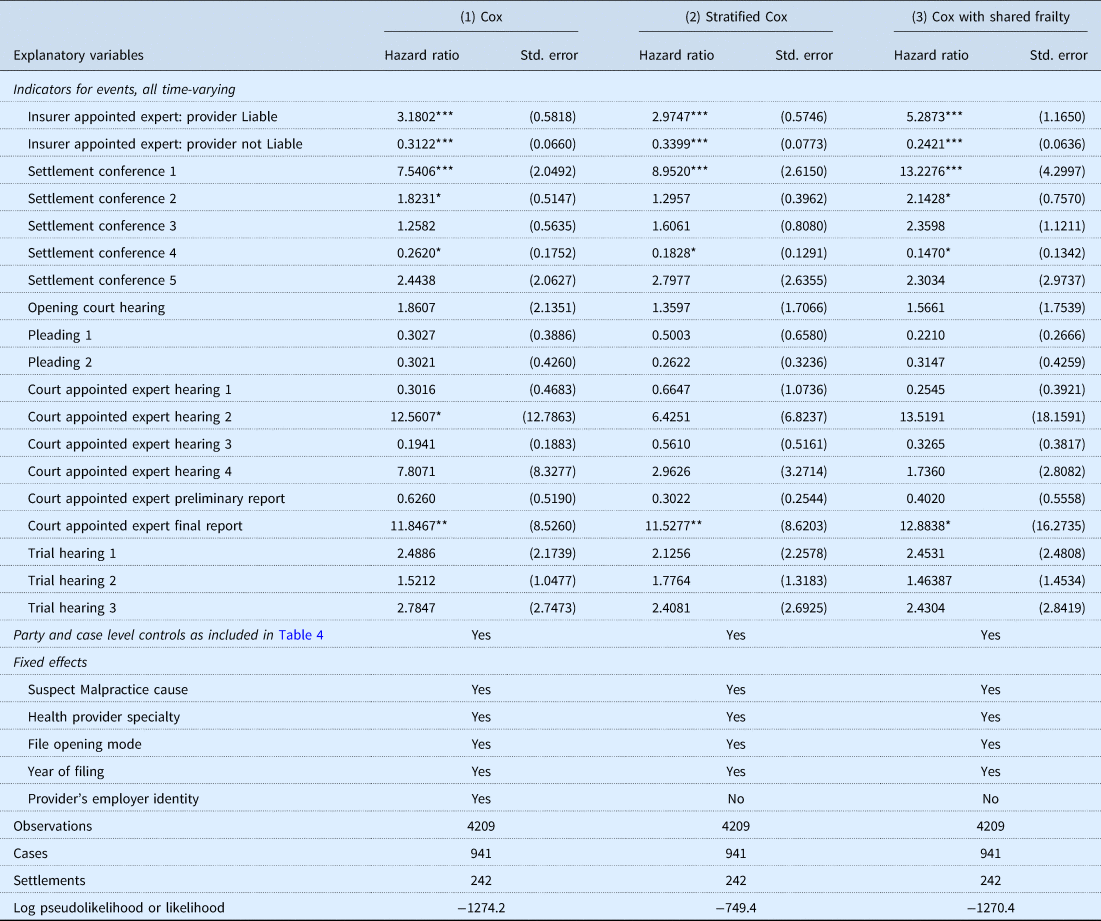
We subject our results to several robustness checks. We, first, estimate a model, analogous to that reported in Table 4, in which we additionally include fixed effects for the identity of the health service provider's employer (e.g. a particular hospital or clinic). Inclusion of these fixed effects further mitigates any endogeneity bias that may arise if the timing of procedural and legal events of interest is correlated with some unobservable case characteristic related to the identity of the healthcare provider's organization, such as for example its public versus private ownership status, that could potentially also be correlated with the timing of settlement. The results are reported in column (1) of Table 5.
Regression results, alternative model specifications

Notes: The table presents regression results for timing of settlement. Column (1) shows results based on Cox model analogous to that in Table 4, but in addition with fixed effects for provider's employer. Column (2) shows results based on stratified Cox model where baseline hazard varies by provider's organization. Hazard ratio greater (smaller) than one indicates that a covariate reduces (increases) the time to settlement. Column (3) shows results based on Cox model with case-level gamma-distributed shared frailty with mean one and variance θ. Party and case level controls are as included in Table 4. See Section 4.4 for detailed discussion of various fixed effects. Reported standard errors are heteroscedasticity-robust and clustered at case level for results in columns (1) and (2). Shared frailty model (column (3)) precludes the use of clustering. ***, **, and * indicate significance at the 0.1%, 1%, and 5% levels, respectively.
Second, we estimate a stratified Cox model that provides an alternative means of taking into account unobserved heterogeneity (see, e.g., Cleves et al., Reference Cleves, Gutierrez, Gould and Marchenko2010, 197–201). Specifically, we allow the baseline settlement hazard from expression (1) to differ by the identity of the provider's organization instead of controlling for the identity of the provider's organization with fixed effects (in which case the identity of the provider's employer exhibits a multiplicative effect on the common baseline judgment hazard). The results are reported in column (2) of Table 5.
Third, we estimate a version of the Cox model analogous to that reported in Table 4 by explicitly modeling unobserved case-level heterogeneity. To this end, we use a shared frailty model where case-level unobserved heterogeneity takes on the form of a gamma-distributed random effect with mean one and variance θ (see, e.g., Gutierrez, Reference Gutierrez2002; Cleves et al., Reference Cleves, Gutierrez, Gould and Marchenko2010). The results are reported in column (3) of Table 5.
The results of all three alternative model specifications reported in Table 5 are both qualitatively and quantitatively very similar to the baseline results reported in Table 4. Consistent with Hypotheses 1 and 3, settlement hazard continues to be statistically significantly positively associated with the insurer-appointed expert's assessment that the provider is liable; completion of at least the first and often (columns (1) and (3) of Table 5) also the second settlement conference session; and the court-appointed expert's completion of his or her final report. Consistent with Hypothesis 2, settlement hazard all else equal also continues to be statistically significantly negatively associated with the insurer-appointed expert's assessment that the provider is not liable, a finding that holds across all specifications in Table 5.
The indicator for the completion of the second hearing conducted by the court-appointed expert is statistically significant only in the model featured in column (1) of Table 5. While this variable was statistically significantly positively associated with settlement hazard in the baseline model (see Table 4), the corresponding finding is evidently not robust across specifications. In contrast, all three alternative model specifications featured in Table 5 show that consistent with Hypothesis 4, settlement hazard is statistically significantly negatively associated with the completion of a late (fourth) settlement conference session, a result that was marginally statistically insignificant in the baseline model featured in Table 4. Much like in the case of the results in Table 4, no other procedural or legal event exhibits a statistically significant effect on the timing of settlement.
Finally, based on the Cox model with shared frailty reported in Table 5, the likelihood ratio test (not reported) rejects the null hypothesis that the shared frailty variance (θ) is equal to zero. This suggests that, unsurprisingly, there exists further case-level unobserved heterogeneity that explains the timing of settlement and that is not accounted for by our covariates and fixed effects. The remaining unobserved heterogeneity need not be correlated with the timing of the highlighted procedural and legal events and thus need not confound our estimates about the effect of these events; indeed, given the wide range of included controls and fixed effects, as well as the institutional characteristics of the resolution process of Belgian medical malpractice claims, we view this as a tenable assumption. For example, while the unobserved characteristics of the presiding judge, such as his or her assertiveness, could affect the timing of settlement if a case has reached the stage of in-court litigation (see, e.g., Bielen et al., Reference Bielen, Grajzl and Marneffe2017), the judge's characteristics will in general unlikely be correlated with the precise timing of the exchange of parties' pleadings, the hearings conducted and the report prepared by the court-appointed expert, and even the opening and trial hearings, because Belgian judges are able to exert at best a modest influence on when exactly these specific events take place (see Section 2). Nevertheless, we caution against readily interpreting our results about the effect of specific procedural or legal events as purely causal.
7. Discussion
Consistent with recent law and economics literature emphasizing the overarching importance of information revelation for the timing of settlement (Boyd and Hoffman, Reference Boyd and Hoffman2013; Fenn and Rickman, Reference Fenn and Rickman2014; Grajzl and Zajc, Reference Grajzl and Zajc2017; Cooper, Reference Cooper2017; Bielen et al., Reference Bielen, Grajzl and Marneffe2017), our analysis shows that the time to settlement of medical malpractice cases is all else equal statistically significantly negatively associated with the completion of those procedural and legal events that most effectively reveal relevant factual information about the underlying case and consequently reduce the extent of divergence of parties' expectations. However, our results also show that not all procedural and legal events are negatively associated with the time to settlement and that the incidence of some procedural and legal events is even positively associated with the time to settlement.
Under the causal interpretation of our results, our analysis offers several lessons for policymakers aiming to facilitate timely settlement of medical malpractice cases. First and foremost, policymakers should emphasize early scheduling of initial settlement conference sessions, when parties are most likely to exchange valuable information, and seek to ensure timely availability of expert reports, when parties are most likely to learn new information about the case. The completion of these events reduces the extent of divergence of parties' expectations and thereby promotes settlement.
In practice, early scheduling of settlement conference sessions could be implemented either via a legislative mandate or, if there exist concerns about the availability of disputing parties, via a clear nudge about the benefits of early settlement conferences for prospects of timely case resolution. Given the shortage of suitable experts and multiple demands on their time, assuring prompt availability of expert reports may be more difficult to implement. A readily implementable measure to facilitate timely expert appointment is to create and maintain a comprehensive publicly available database of all individual healthcare providers willing to serve as experts in medical malpractice cases. Such a database has recently indeed been developed in Belgium. To further relax the constraints on expert availability, another possible policy initiative would be to establish and fund a pool of full-time medical liability experts. Implementation of such a pool should not be viewed as a panacea, however. Full-time experts who would put a hold on their careers as healthcare practitioners could be subject to a disproportionately quick depreciation of their human capital, which would in turn adversely affect the accuracy of their assessment of medical malpractice cases.
Independent of the problem of expert supply, there exist further policy measures that could improve the timeliness of availability of expert reports. Once appointed, experts could be provided with more high-powered monetary incentives to turn in their reports on time, much like, for example, some academic publishers provide external reviewers with monetary compensation if they turn in their referee reports within a specified period. At the same time, parties responding to experts' queries could be legally mandated to provide the requested information to the expert within a reasonable time period, with late responses subject to a fine.
Second, policymakers could consider eliminating the opportunity for the parties to participate in later settlement conference sessions, when the prospects for further information revelation are comparatively low and, at the same time, the settlement-impeding hostility between disputing parties is likely to grow. This could be achieved via insisting that the settlement conference be completed in, for example, at most two sessions.
Finally, at the level of court adjudication, policymakers could attempt to reduce the number of trial hearing sessions and, if applicable, the number of rounds of exchange of pleadings. While such procedural steps take time to schedule, any expectations-aligning effect from information revelation during these events is likely to be offset by settlement-stymying strategic and hostility-inducing effects. In practice, the number of trial hearing sessions could be reduced by whenever possible aiming to complete the trial hearing in one uninterrupted session. The number of pleading rounds could be decreased by imposing an upper limit and by requiring that some matters of the case (e.g., whether it is necessary to appoint an expert) be discussed in the opening hearing.
The above policy implications naturally apply best to the Belgian context. However, general lessons that follow from our empirical analysis extend well beyond Belgian borders. In particular, while details of institutional arrangements governing the resolution of suspect medical malpractice cases vary across jurisdictions, virtually all jurisdictions rely on a combination of out-of-court and in-court procedural steps (see, e.g., Fenn and Rickman, Reference Fenn and Rickman2014). Our analysis implies that policymakers striving to reduce the duration of resolution of medical malpractice claims to improve the functioning of a country's healthcare system can do so via the combination of increased emphasis on timely completion of factual information-revealing events and reduced emphasis on other procedural and legal steps during which the expectations-aligning effects from information exchange are likely to be trumped by hostility-inducing and other settlement-stymying effects. Which particular procedural and legal events in a given jurisdiction fall in the former (settlement-inducing) and which in the latter (settlement-impeding) category will, of course, vary across jurisdictions based on available dispute resolution frameworks. As a rule of thumb, however, later sessions of a given event type (e.g. a fourth or a fifth settlement-promoting meeting between parties) are, based on our empirical findings, more likely to stymie than to facilitate settlement. Future research should examine the role of procedural and legal events for the resolution of suspect medical malpractice cases in other jurisdictions as well as adopt an explicitly comparative lens to cast further light on the resolution process and the timing of settlement of medical malpractice claims.
Acknowledgements
We are grateful to the insurance company under consideration for making this project possible. We thank the company's staff and multiple research assistants for their help with data collection. Samantha Bielen further thanks the Research Foundation Flanders for postdoctoral funding, grant number 12S3117N. Valuable comments and suggestions were provided by Tim Diette, Gijs van Dijck, Nuno Garoupa, Tom Vanderstegen, participants at the second Conference on Empirical Legal Studies in Europe at KU Leuven and at the 22nd annual conference of the Society for Institutional and Organizational Economics at HEC Montreal, and two anonymous reviewers.