Personal protective equipment (PPE) serves 2 critical functions for the healthcare setting: protecting healthcare providers from occupational hazards and protecting patients from transmission of infection. PPE has come under increased scrutiny as a result of public attention to healthcare-associated infections and global experiences with emerging infectious diseases. Data suggest that despite PPE use, healthcare workers routinely contaminate their skin and clothing during patient care.Reference Casanova, Alfano-Sobsey, Rutala, Weber and Sobsey 1 – Reference Tomas, Kundrapu and Thota 3 Standardized procedures exist for donning and doffing PPE, 4 and Tomas et alReference Tomas, Kundrapu and Thota 3 have shown a potential for improvement in self-contamination rates using a training program in which participants visually observed transfer of a fluorescent dye from PPE to areas of self-contaminated skin or clothing.Reference Tomas, Kundrapu and Thota 3
Self-contamination is generally invisible, thus the downstream consequences are difficult to discern. However, high rates of self-contamination arguably defeat the purpose of PPE. In order to better evaluate PPE use at our institution, we conducted a needs assessment for a PPE training program, as measured both objectively by observation and subjectively by survey.
METHODS
A convenience sample of providers from 3 inpatient units and the emergency department were chosen because of frequent PPE use on these units. The emergency department additionally uses PPE for provider protection during trauma evaluations. An observation tool adapted from Tomas et alReference Tomas, Kundrapu and Thota 3 was used to perform real-time assessments of donning and doffing behaviors during patient care episodes. No dyes were used to simulate contamination. Observations were conducted in close proximity to the provider in order to accurately record behaviors, thus providers may have been aware of their presence; the reason for observation was provided if asked. “Correct” glove and gown removal methods were defined using the recommendations of the Centers for Disease Control and Prevention. 4
A survey was constructed using items adapted from our Ebola preparedness survey, and further revised to reflect the Information, Motivation, and Behavioral Skills Model.Reference Fisher and Fisher 5 Information component questions asked about provider understanding of transmission risks in the hospital, understanding of PPE rationale, and availability of resources. Motivation questions asked the likelihood of personally using PPE correctly and likelihood of correcting the PPE techniques of others. Skills questions asked about prior PPE training, perspectives on the need for additional training, and overall confidence in PPE skills.
Students and nonclinical staff were excluded. Survey scores were calculated for each respondent and question by model component. Associations between provider characteristics and doffing behaviors or survey responses were analyzed using the χ2 or Fisher exact tests. Partial observations and surveys with missing data were included. Investigational review board approval was obtained.
RESULTS
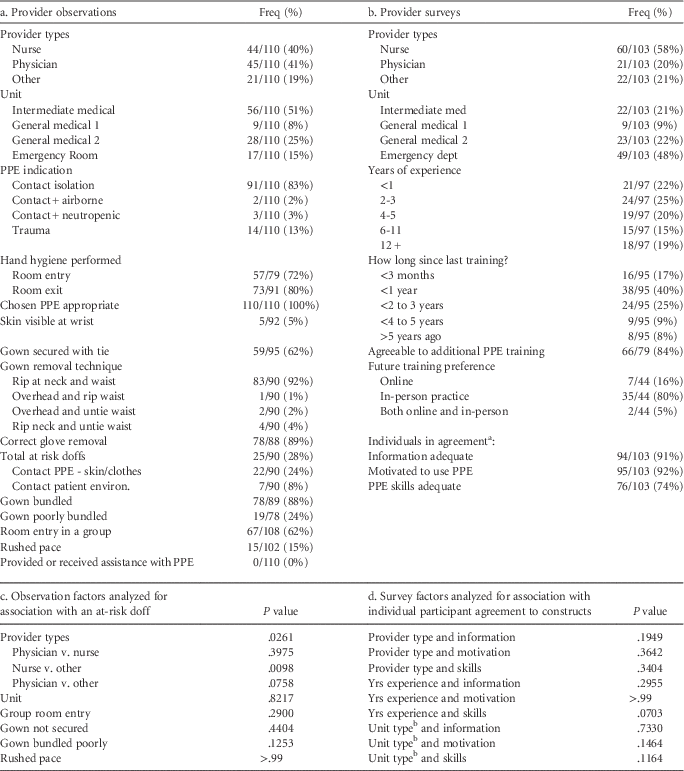
PPE observations were performed on 110 providers. Findings are presented in Table 1a. Ninety observations included doffing behaviors and 82 included donning behaviors. Physicians were the most frequently observed provider type (45 [41%]), followed by nurses (44 [40%]). Other providers included nurse’s aides, nutritionists, physical therapists, ultrasound technologists, a trauma technologist, and a respiratory therapist. Reasons for PPE were contact precautions (96 [87%]) or traumas (14 [13%]).
Characteristics of Provider Observations and Survey Participants

a Participant averaged responses for each construct.
b Unit type is inpatient vs emergency department.
The choice of PPE was appropriate in all observations. The most common order of both donning and doffing was gown first (93% and 96%, respectively) and gloves second (89% and 93%, respectively). Glove removal was correct in 78 (89%) of 88 observations; incorrect methods observed included touching skin at the wrist with “dirty” gloves and continuing to wear gloves after leaving the room. Gowns were most often removed by ripping (83/90 [92%]); however, 6 providers used a component of untying, and 3 used a component of lifting the gown over the head. Gowns were bundled into a ball to discard in 78 (88%) of 89 doffs; yet of these 78 bundles, 19 (24%) were sloppily bundled.
“Dirty” PPE was observed to contact provider skin or clothing in 22 (24%) of 90 doffing observations. Provider skin or clothing contacted the patient environment in 7 (8%) of 90 observations. Doffing behaviors at risk for self-contamination occurred more frequently in nonphysician, nonnurse providers (9/17 [53%]), followed by physicians (10/37 [27%]); nurses exhibited the best doffing practices (risk in 6/36 [17%]), P=.03 (Table 1c). An at-risk doff was more likely to occur if the gown was not bundled or was bundled loosely (42% with risk in this group vs 24% if gown tightly bundled); however, this association did not reach statistical significance (P=.13).
Surveys were collected from 103 providers; the response rate was 94%. Responses are summarized in Figure 1a; characteristics of survey participants are presented in Table 1b. Of the 103 providers, most (83 [81%]) reported previous PPE training. Most believed they possessed adequate information regarding PPE and affirmed motivation to use PPE (91% and 92%, respectively). Confidence in PPE skills was endorsed by 74%, yet 80% doubted that they personally self-contaminated during PPE use. The percentage in agreement with the statement, “I feel adequately prepared to safely don or doff all PPE specific to my patient’s condition” decreased from 82% to 40% when the scenario changed from a general patient to a patient with a highly communicable and potentially deadly disease such as severe acute respiratory syndrome or Middle East respiratory syndrome. There were no differences in composite survey responses by hospital unit or emergency department, provider type, or years of experience (Table 1d). However, on analysis of individual questions, physicians were more likely to doubt adequate preparation for PPE safety (57% vs 28% for nonphysicians, P=.02). Future training was requested as a “hands on” experience in 37 (84%) of 44 responses.
Personal protective equipment (PPE) behavior determinants: percentage responding to each level of a 5-point Likert scale by survey question. Question responses are averaged within each construct of the Information, Motivation, and Skills Model.

DISCUSSION
Observations of real-time donning and doffing practices on distinct units during patient care episodes exposed deficits in PPE technique, which is consistent with simulation reports from other institutions.Reference Casanova, Alfano-Sobsey, Rutala, Weber and Sobsey 1 – Reference Tomas, Kundrapu and Thota 3 However, provider perception of self-contamination risk was low, and most agreed they had adequate information, motivation, and skills for PPE use.
There is a notable decrease in confidence in PPE skills when the participants are presented with a hypothetical Middle East respiratory syndrome or severe acute respiratory syndrome scenario introducing a more direct personal risk. These results suggest that providers base their PPE behaviors on a perceived level of risk, with personal risk being prioritized over risk of transmission to others. The discrepancy between provider attitudes and behaviors and the scenario-dependent shift in confidence may indicate that providers understand that their PPE technique is imperfect yet perceive it “good enough” for most situations. This complacency may be an important barrier to PPE-related interventions.
Participants with interest in additional training largely preferred “hands on” practice. Nonphysician, nonnurse providers may be an important group to target on the basis of observation results, whereas physicians indicated a potential need in the survey.
This study has several limitations. The providers were not matched in the observation and survey components of the study, preventing direct comparisons between PPE attitudes and behaviors. Owing to privacy concerns, exact activities of patient care were not collected. Visible soiling was present on PPE in only 2 observations and no cultures were collected to determine whether observed breaches in PPE translated into actual self-contamination. Though providers may have been aware of being observed, this knowledge should have improved PPE techniques. Bias may exist in the subset of providers completing surveys, though this should be limited by high (93%) participation.
In contrast to a low perceived risk of self-contamination, actual observed doffing behaviors indicate a significant potential risk. Future training should allow for in-person experiential learning, should be performed to scale, and should be coupled with an ongoing program of PPE donning/doffing assessment and feedback to ensure reliability in practice.
ACKNOWLEDGMENTS
Financial support. None reported.
Potential conflicts of interest. All authors report no conflicts of interest relevant to this article.