Introduction
According to diathesis–stress models, personality may moderate the effects of stressors on the development of psychopathology (Monroe & Simons, Reference Monroe and Simons1991; Blatt & Zuroff, Reference Blatt and Zuroff1992; Ingram & Price, Reference Ingram, Price, Ingram and Price2010). Hurricane Sandy, the second costliest hurricane in US history, hit Long Island, New York as a category 1 hurricane with a record 14-foot (4.25 m) storm surge on 29 October 2012, destroying 100 000 homes. Natural disasters, such as Sandy, offer a unique opportunity to test diathesis–stress models. Studies of mental disorders after hurricanes, including Hurricane Sandy, find increased levels of depressive symptoms post-hurricane (e.g. Norris et al. Reference Norris, Perilla, Riad, Kaniasty and Lavizzo1999, Reference Norris, Friedman and Watson2002; Kessler et al. Reference Kessler, Galea, Jones and Parker2006; Bonanno et al. Reference Bonanno, Brewin, Kaniasty and La Greca2010; Neria & Shultz, Reference Neria and Shultz2012; Boscarino et al. Reference Boscarino, Hoffman, Kirchner, Erlich, Adams, Figley and Solhkhah2013; North & Pfefferbaum, Reference North and Pfefferbaum2013). However, it is unknown why some individuals and not others became symptomatic.
Much literature has suggested that individual differences in personality traits, such as negative emotionality (NE) or the very closely related construct of neuroticism, and positive emotionality (PE) or the similar construct of extraversion, may respectively confer vulnerability to, or resilience against, depression (e.g. Bagby et al. Reference Bagby, Bindseil, Schuller, Rector, Young, Cooke, Seeman, McCay and Joffe1997; De Fruyt et al. Reference De Fruyt, Van Leeuwen, Bagby, Rolland and Rouillon2006; Kotov et al. Reference Kotov, Gamez, Schmidt and Watson2010; Klein et al. Reference Klein, Kotov and Bufferd2011; Ormel et al. Reference Ormel, Jeronimus, Kotov, Riese, Bos, Hankin and Rosmalen2013; Wilson et al. Reference Wilson, DiRago and Iacono2014). NE/neuroticism is characterized by a general tendency to experience fear, anger and sadness, and a susceptibility to the effects of stress on mood. PE/extraversion is characterized by a general tendency to experience positive emotions (e.g. joy, exuberance), and being gregarious and engaged with the environment (Watson et al. Reference Watson, Kotov, Gamez, Krueger and Tackett2006). Both NE/neuroticism and PE/extraversion are higher-order factors in all Big Three (Eysenck, Reference Eysenck1991; Watson et al. Reference Watson, Wiese, Vaidya and Tellegen1999) and Big Five (McCrae & Costa, Reference McCrae, Costa, John and Robins1999) personality models.
Despite high NE/neuroticism and low PE/extraversion being conceptualized as vulnerabilities to psychopathology, only a few longitudinal studies have examined whether these traits act as diatheses that increase sensitivity to life stress (Ormel et al. Reference Ormel, Oldehinkel and Brilman2001; Kendler et al. Reference Kendler, Kuhn and Prescott2004; Hutchinson & Williams, Reference Hutchinson and Williams2007; Brown & Rosellini, Reference Brown and Rosellini2011; Vinkers et al. Reference Vinkers, Joëls, Milaneschi, Kahn, Penninx and Boks2014), and no research of which we are aware has tested whether they moderate the impact of natural disasters on depressive symptoms. The current study examined whether the personality traits of NE and PE predicted the occurrence of depressive symptoms following Hurricane Sandy and moderated the effects of exposure to stress from Sandy on subsequent depressive symptoms.
Impact of life stress and natural disasters on depression
There is considerable evidence that stress plays a causal role in the onset of depression (for reviews, see Kessler, Reference Kessler1997; Tennant, Reference Tennant2002; Hammen, Reference Hammen2005; Stroud et al. Reference Stroud, Davila and Moyer2008; Monroe et al. Reference Monroe, Slavich, Georgiades, Gotlib and Hammen2014). Much of this research has focused on relatively common hassles (e.g. arguments with a loved one) or major events (e.g. the death of a loved one). In parallel, a substantial literature shows that exposure to natural disasters, including hurricanes, confers risk for depressive symptoms (e.g. Norris et al. Reference Norris, Perilla, Riad, Kaniasty and Lavizzo1999, Reference Norris, Friedman and Watson2002; Acierno et al. Reference Acierno, Ruggiero, Kilpatrick, Resnick and Galea2006, Reference Acierno, Ruggiero, Galea, Resnick, Koenen, Roitzsch, de Arellano, Boyle and Kilpatrick2007; Weisler et al. Reference Weisler, Barbee and Townsend2006; Bonanno et al. Reference Bonanno, Brewin, Kaniasty and La Greca2010; North & Pfefferbaum, Reference North and Pfefferbaum2013).
However, regardless of the nature of the stressor, most persons do not experience a significant increase in symptoms, with stress typically accounting for only a modest percentage of variance in depressive symptoms (Monroe, et al. Reference Monroe, Bromet, Connell and Steiner1986; Coyne & Downey, Reference Coyne and Downey1991; Norris et al. Reference Norris, Friedman and Watson2002; Tennant, Reference Tennant2002; Hammen, Reference Hammen2005). The considerable heterogeneity in individual responses to stress suggests that personal characteristics may moderate the effect of stress on depression. These findings have prompted research into how personality or cognitive individual differences confer vulnerability to depression in the presence of stressful life events (e.g. Hammen et al. Reference Hammen, Marks, Mayol and DeMayo1985; Blatt & Zuroff, Reference Blatt and Zuroff1992; Segal et al. Reference Segal, Shaw, Vella and Katz1992; Ingram et al. Reference Ingram, Miranda and Segal1998; Clark & Beck, Reference Clark and Beck1999).
Personality diatheses and vulnerability to depression
Much literature has supported the possibility that personality or cognitive characteristics, such as self-criticism and dependency (Blatt & Zuroff, Reference Blatt and Zuroff1992; Kopala-Sibley & Zuroff, Reference Kopala-Sibley and Zuroff2010, Reference Kopala-Sibley and Zuroff2014), sociotropy and autonomy (Beck et al. Reference Beck, Epstein, Harrison and Emery1983; Clark & Beck, Reference Clark and Beck1999), hopelessness/helplessness (Rose & Abramson, Reference Rose, Abramson, Cicchetti and Toth1992; Iacoviello et al. Reference Iacoviello, Alloy, Abramson, Choi and Morgan2013), and perfectionism (Hewitt & Flett, Reference Hewitt and Flett1991), increase the effects of stress on depression. Other evidence has shown that the personality trait of hardiness buffers the impact of disaster stress on psychiatric symptoms (Bonanno, Reference Bonanno2004). Similarly, the personality traits of NE/neuroticism and PE/extraversion (see Watson et al. Reference Watson, Gamez and Simms2005) have received substantial attention as risk for, or protective factors against, depression, with high levels of NE/neuroticism and low levels of PE/extraversion being hypothesized as key vulnerabilities (e.g. Enns & Cox, Reference Enns and Cox1997; Gershuny & Sher, Reference Gershuny and Sher1998; Bienvenu et al. Reference Bienvenu, Samuels, Costa, Reti, Eaton and Nestadt2004; Watson et al. Reference Watson, Gamez and Simms2005; Brown, Reference Brown2007; Verstraeten et al. Reference Verstraeten, Vasey, Raes and Bijttebier2009; Kotov et al. Reference Kotov, Gamez, Schmidt and Watson2010; Klein et al. Reference Klein, Kotov and Bufferd2011).
However, the vast majority of studies of PE/extraversion and NE/neuroticism have examined only their main effects on the onset or course of depressive symptoms or diagnoses (for reviews, see Kotov et al. Reference Kotov, Gamez, Schmidt and Watson2010; Klein et al. Reference Klein, Kotov and Bufferd2011; Ormel et al. Reference Ormel, Jeronimus, Kotov, Riese, Bos, Hankin and Rosmalen2013). We are aware of only a handful of studies to date which have tested whether NE/neuroticism exacerbates the effects of stress on depression, and even fewer have examined whether PE/extraversion buffers the impact of stress. Across periods of several weeks to 1 year, evidence generally suggests that the effect of stress on subsequent depressive symptoms is greater in individuals with high levels of NE/neuroticism (Ormel et al. Reference Ormel, Oldehinkel and Brilman2001; Kendler et al. Reference Kendler, Kuhn and Prescott2004; Hutchinson & Williams, Reference Hutchinson and Williams2007; Brown & Rosellini, Reference Brown and Rosellini2011; Vinkers et al. Reference Vinkers, Joëls, Milaneschi, Kahn, Penninx and Boks2014), although some evidence has been less supportive (Spinhoven et al. Reference Spinhoven, Elzinga, Hovens, Roelofs, van Oppen, Zitman and Penninx2011). Regarding PE/extraversion, the only study (Spinhoven et al. Reference Spinhoven, Elzinga, Hovens, Roelofs, van Oppen, Zitman and Penninx2011) of which we are aware did not find that extraversion buffered the effect of stress on depression. However, other evidence has found that positive emotional states, as opposed to trait-levels of PE, may buffer the effect of stress on negative affect or depressive symptoms (Fredrickson, Reference Fredrickson2001; Compas et al. Reference Compas, Connor-Smith and Jaser2004; Wichers et al. Reference Wichers, Myin-Germeys, Jacobs, Peeters, Kenis, Derom, Vlietinck, Delespaul and van Os2007).
All studies to date have examined stressors that are relatively common and have been limited to intervals of 1 year or less between the assessments of personality and stress. As personality is conceptualized as an enduring diathesis but has not been tested as such over an interval of longer than 1 year, measuring traits well in advance of the stressor would provide a more appropriate and conservative test of personality vulnerability models of depression. In addition, examining a natural disaster as the form of stress is particularly advantageous as its occurrence is independent of personality.
Researchers have examined several factors that may moderate the effect of disasters on psychopathology, with evidence suggesting that more severe exposure, female gender, middle age, ethnic minority status, prior psychiatric problems, and weak or deteriorating psychosocial resources increase the likelihood of adverse outcomes following a natural disaster (Norris et al. Reference Norris, Friedman and Watson2002; Bonanno et al. Reference Bonanno, Brewin, Kaniasty and La Greca2010; North & Pfefferbaum, Reference North and Pfefferbaum2013). However, no research has attempted to integrate the personality diathesis literature with the literature on natural disasters and psychopathological outcomes.
Overview and hypotheses
This paper examined whether the personality traits of NE/neuroticism and PE/extraversion predict levels of depressive symptoms following Hurricane Sandy and tested whether they moderate the effects of hurricane-related stress on depressive symptoms shortly following the disaster. Given the prior literature demonstrating the effects of various demographic and psychiatric factors on outcomes following natural disasters, all analyses adjusted for participants’ age, race/ethnicity, marital status, education, household income, and lifetime history of depressive disorders. We hypothesized that higher levels of stress, higher levels of NE/neuroticism and lower levels of PE/extraversion would be related to higher levels of depressive symptoms after the hurricane. We also hypothesized that the effect of hurricane-related stress on depressive symptoms would be stronger for those high in NE/neuroticsm and weaker for those high in PE/extraversion.
Method
Procedure and participants
Our effective sample comprised 318 mothers. Between October 2004 and June 2007, 559 families with a 3-year-old child were recruited to participate in a longitudinal study of temperament. Specifically, lists of families with 3-year-old children who lived within a 20-mile (32 km) radius of Stony Brook University in Long Island, New York, were purchased from a commercial mailing list broker. Commercial mailing lists are available to those who wish to conduct marketing campaigns via direct mail or, in our case, research projects. The sample included families living in a contiguous 20-mile radius of Stony Brook University. Potential participants were screened to select families with at least one English-speaking biological parent and a 3-year old child with no significant medical problems or developmental disabilities. At wave 2, conducted when the children were 6 years old, 50 families were added to increase the demographic diversity of the sample, yielding a total sample of 609 pairs. This time point is our baseline assessment for the current study. Wave 3 was conducted between September 2010 and April 2013, when the children were 9 years old. In all, 446 mothers participated at this time point, and had completed their assessments prior to 29 October 2012, when Hurricane Sandy struck.
At 6 weeks after the hurricane, the 446 mothers were invited to complete an on-line survey about the disaster. A total of 362 of the 446 mothers (81.2%) participated. For the current analysis, we excluded 15 mothers who had moved to other parts of the country, and were therefore outside the hurricane zone as well as 29 mothers with incomplete data on the key measures used in the analysis. Thus, the final analysis sample included 318 mothers, 96.0% of whom lived in Federal Emergency Management Agency (FEMA)-declared disaster zones (see AP Danzig et al. unpublished observations).
Most mothers (96.5%) completed the on-line survey 7–11 weeks after Hurricane Sandy (mean = 8.4, s.d. = 1.48 weeks). There were no significant differences between the Hurricane Sandy participants and either non-participants or the full sample on the measures included in this report (all p's > 0.20). Demographically, the 318 mothers had a mean age of 36.1 (s.d. = 4.5) years, an average income of about $100 000, and some college education (90.9%). Most were married (>85%) and non-Hispanic Caucasian (83.02%).
The study was approved by the Stony Brook University Institutional Review Board.
Materials
Exposure to Hurricane Sandy stress
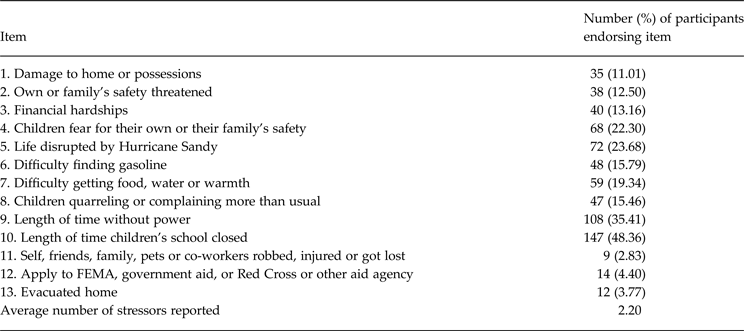
Mothers were asked to indicate to what extent their family was affected by 13 Hurricane Sandy stressors/exposures (Table 1; for details, see AP Danzig et al. unpublished observations). Participants were asked to complete this measure at their earliest, and did so an average of 8.4 (s.d. = 1.48) weeks post-Sandy. The 13 items were drawn primarily from questionnaires administered in studies of Hurricane Ike (Norris et al. Reference Norris, Sherrieb and Galea2010) and Hurricane Katrina (Galea et al. Reference Galea, Brewin, Gruber, Jones, King, King, McNally, Ursano, Petukhova and Kessler2007). Eight exposures were rated on a 1 (not at all affected) to 5 (extremely affected) scale: life disrupted by the hurricane, children fearing for their own or their family's safety, difficulty finding food or warmth, difficulty finding gasoline, children complaining more than usual, damage to home or possessions, family's safety threatened, and financial hardship. These items were dichotomized into present v. absent for ease of interpretation and analysis: the impact typically had to be rated as ‘quite a bit’ or ‘extremely’ for the event to be coded as present. Exceptions to this were made for items that were very rare (i.e. financial hardship, where ‘moderate’ ratings were included) and highly endorsed (i.e. difficulty finding gasoline, where only ‘extreme’ ratings were included) to capture an appropriate threshold for exposure. Two items, time school was closed and time without power, were rated on a five-point duration scale ranging from 0 days to 2 weeks or more, and the stressor was considered ‘present’ when lasting for 7 or more days. Three stressors were rated yes/no: having to evacuate the home; applying for FEMA assistance; and members of the immediate family, other relatives or friends and/or pets being either injured, victimized, robbed or lost. A continuous ‘total stressors’ variable was computed by summing the 13 dichotomous stressors (see Table 1).
Frequency of participant family exposure to Hurricane Sandy stressors (n = 318) a

FEMA, Federal Emergency Management Agency.
a Item scores dichotomized as present or not present.
Depressive symptoms post-Sandy
Depressive symptoms following Hurricane Sandy were assessed with the Diagnostic Inventory for Depression (DID) (Zimmerman et al. Reference Zimmerman, Sheeran and Young2004), a 22-item measure designed to assess Diagnostic and Statistical Manual of Mental Disorders, fourth edition (DSM-IV) criterion symptoms of major depressive disorder (MDD) occurring in the past week. The DID correlates well with diagnoses of MDD based on the Structured Clinical Interview for the DSM-IV (SCID), discriminates the likelihood of MDD v. other disorders, and is sensitive to clinical change in depression levels (Zimmerman et al. Reference Zimmerman, Sheeran and Young2004). Each question contains five response options, with higher scores indicating greater levels of each symptom. Scores from each item are summed, with higher total scores indicating higher levels of depressive symptoms. An example item includes ‘During the past week, have you been feeling sad or depressed?’ with response options ranging from 0 (‘no, not at all’) to 4 (‘yes, I have been extremely sad or depressed nearly all the time’). In the current study, coefficient α for the DID was 0.86, and scores ranged from 0 to 47.
PE and NE
Mothers completed the General Temperament Survey (GTS; Clark & Watson, Reference Watson and Clark1992) during the wave 2 assessment when children were 6 years old. The GTS is a 43-item factor-analytically derived measure of the Big Three personality dimensions, namely, PE and NE and disinhibition. The current paper focuses on NE and PE, which are vulnerability factors for depression. Conversely, disinhibition was not included because it is generally not considered as a vulnerability factor for depressive symptoms (Klein et al. Reference Klein, Kotov and Bufferd2011). NE and PE are clearly distinct from each other (Clark & Watson, Reference Watson and Clark1992; Watson et al. Reference Watson, Gamez and Simms2005), and are strongly related in expected directions with measures of state positive and negative affect (Watson & Clark, Reference Watson and Clark1992). NE correlates highly with measures of neuroticism, and PE correlates highly with measures of extraversion (Watson et al. Reference Watson, Gamez and Simms2005). High NE and low PE are robustly related to a range of psychopathological symptoms, including depression (Watson et al. Reference Watson, Gamez and Simms2005). Both scales also show excellent internal consistency (Watson & Clark, Reference Watson and Clark1992). In the current study, internal consistencies were 0.81 and 0.82 for NE and PE, respectively.
Lifetime history of depressive disorders
History of depressive disorders (MDD and dysthymic disorder) was determined from the non-patient version of the SCID (Williams et al. Reference Williams, Gibbon, First, Spitzer, Davies, Borus, Howes, Kane, Pope, Rounsaville and Wittchen1992; First et al. Reference First, Spitzer, Gibbon and Williams1996). The SCID was administered at two time points: initial assessment at wave 1 (lifetime version) and interval assessment at wave 3 for the prior 6 years. Lifetime depressive disorder was considered positive if a diagnosis was present at either assessment point. The SCID is among the most widely used diagnostic interviews, and its inter-rater reliability and validity have been well documented (Williams et al. Reference Williams, Gibbon, First, Spitzer, Davies, Borus, Howes, Kane, Pope, Rounsaville and Wittchen1992). The SCID interviews were conducted by master's-level clinicians and clinical psychology graduate students. Inter-rater reliability was excellent (κ = 0.93 at wave 1 and 0.91 at wave 3). In the current sample, 117 (36.8%) participants met criteria for a lifetime depressive disorder.
Data analyses
Data were analysed in SAS 9.3 (USA). Primary analyses used multiple linear regression. Given the moderate correlation between NE and PE (r = −0.39, p < 0.001), we were concerned that their mutual effects on depressive symptoms might impair statistical power or result in suppression effects. We therefore tested two separate regression models in which either NE or PE moderated the effect of Hurricane Sandy stress on post-Sandy depressive symptoms. All analyses adjusted for participants’ age, race/ethnicity (Caucasian and non-Hispanic v. non-Caucasian and/or Hispanic), marital status (married v. not), level of education (graduated 4-year college v. not), household income, and lifetime history of depressive disorders. In each model, the main effect of lifetime depressive disorder history was entered first, followed by the demographic covariates listed above, followed by the main effects of exposure and one personality variable (NE or PE). The interaction between exposure and personality was subsequently included. Non-categorical predictor variables were centered (Aiken & West, Reference Aiken and West1991). Interactions were interpreted by comparing simple slopes at high and low levels (±1 s.d.) of the moderator variable. Confidence intervals (CIs) are presented for all significant results.
Results
Descriptive statistics and bivariate correlations
Rates of exposures in the analysis sample are presented in Table 1. The most commonly reported exposures were prolonged school closing, losing electric power, life disruption, and children fearing for their own or their family's safety. The average number of stressors (out of 13) was 2.20 (s.d. = 2.19).
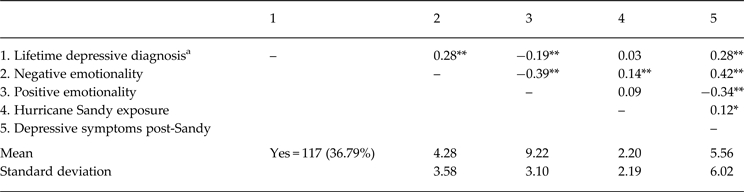
Correlations and descriptive statistics are presented in Table 2. Having had a pre-Sandy depressive episode predicted greater depressive symptoms post-Sandy. Consistent with past research, higher levels of NE and lower levels of PE were related to greater depressive symptoms post-Sandy. Higher levels of exposure to stress from Hurricane Sandy were also related to greater depressive symptoms post-Sandy.
Descriptive statistics and bivariate correlations (n = 318)

a For lifetime depressive diagnosis, 0 = no, 1 = yes.
* p < 0.05, ** p < 0.01.
Regression analyses predicting post-Sandy depressive symptoms
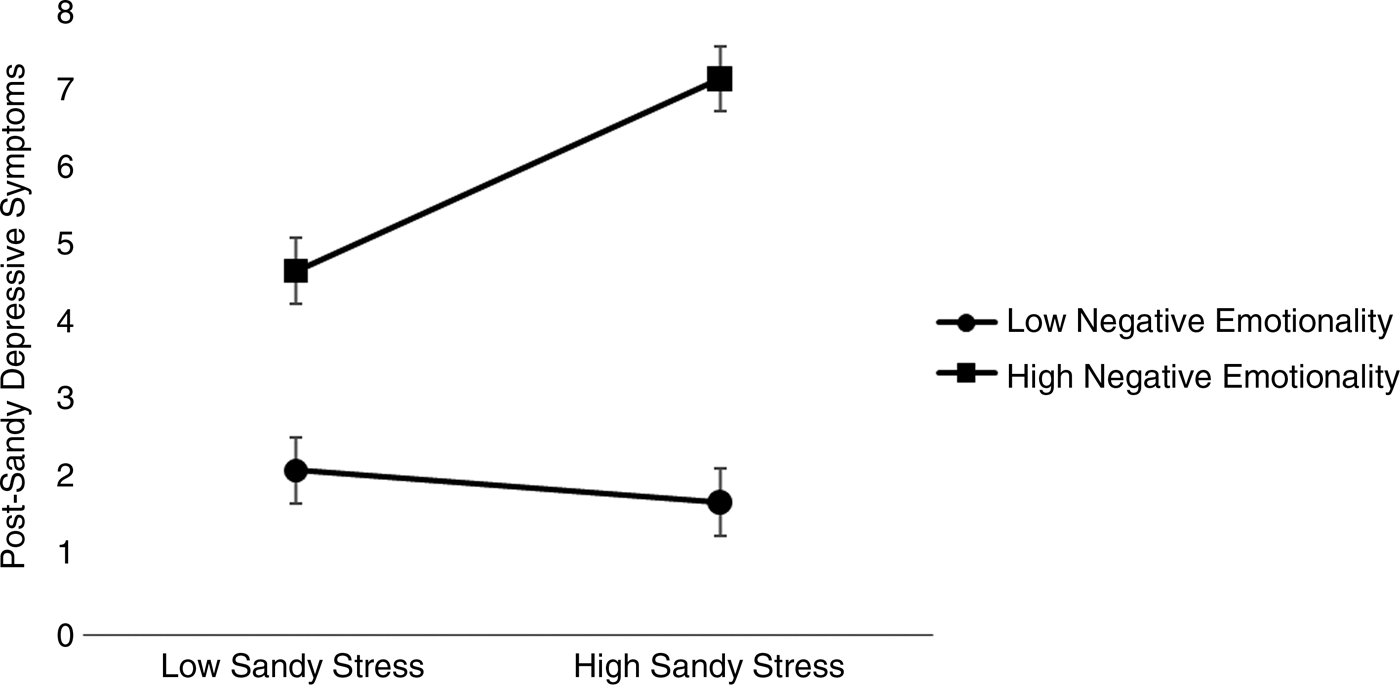
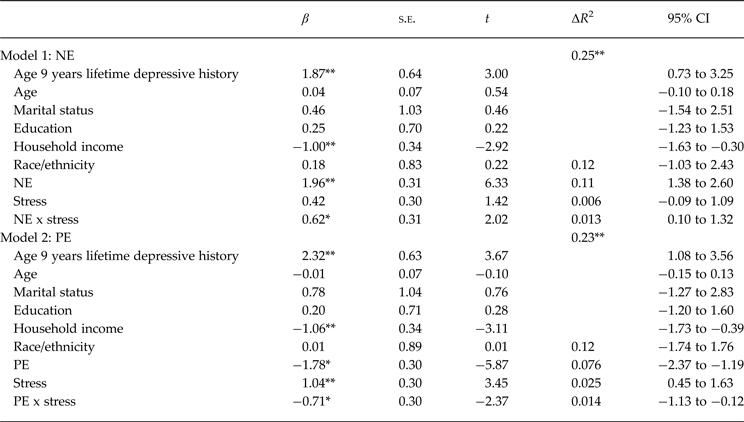
Regression results are presented in Table 3. Our first model tested the effects of NE, stress and their interaction on post-Sandy depressive symptoms. A lifetime history of depressive disorder, lower household income, and higher NE predicted greater depressive symptoms post-Sandy. In addition, there was a significant interaction between NE and Sandy-related stress (Fig. 1). The effect of exposure on depressive symptoms was significant at high levels of NE (β = 1.21, t = 2.79, p < 0.01, 95% CI 0.15–1.82), but not at low levels (β = −0.21, t = −0.49, p = 0.63, 95% CI −1.23 to 0.97). The full model explained 25.12% of variance in post-Sandy depressive symptoms.
Relationship between stress from Hurricane Sandy and post-Sandy depressive symptoms at high and low levels of baseline negative emotionality. Only the slope at high negative emotionality is significant. Error bars represent the standard error of the slope.

Results of regression models predicting post-Sandy depressive symptoms a

s.e., Standard error; CI, confidence interval; NE, negative emotionality; PE, Positive emotionality; stress, exposure to hurricane Sandy-related stress.
a Marital status coded as 1 = married, 0 = not married; education coded as 1 = 4-year college degree or more, 0 = less than 4-year college degree; ethnicity coded as 0 = Caucasian/non-Hispanic, 1 = non-Caucasian and/or Hispanic.
* p < 0.05, ** p < 0.01.
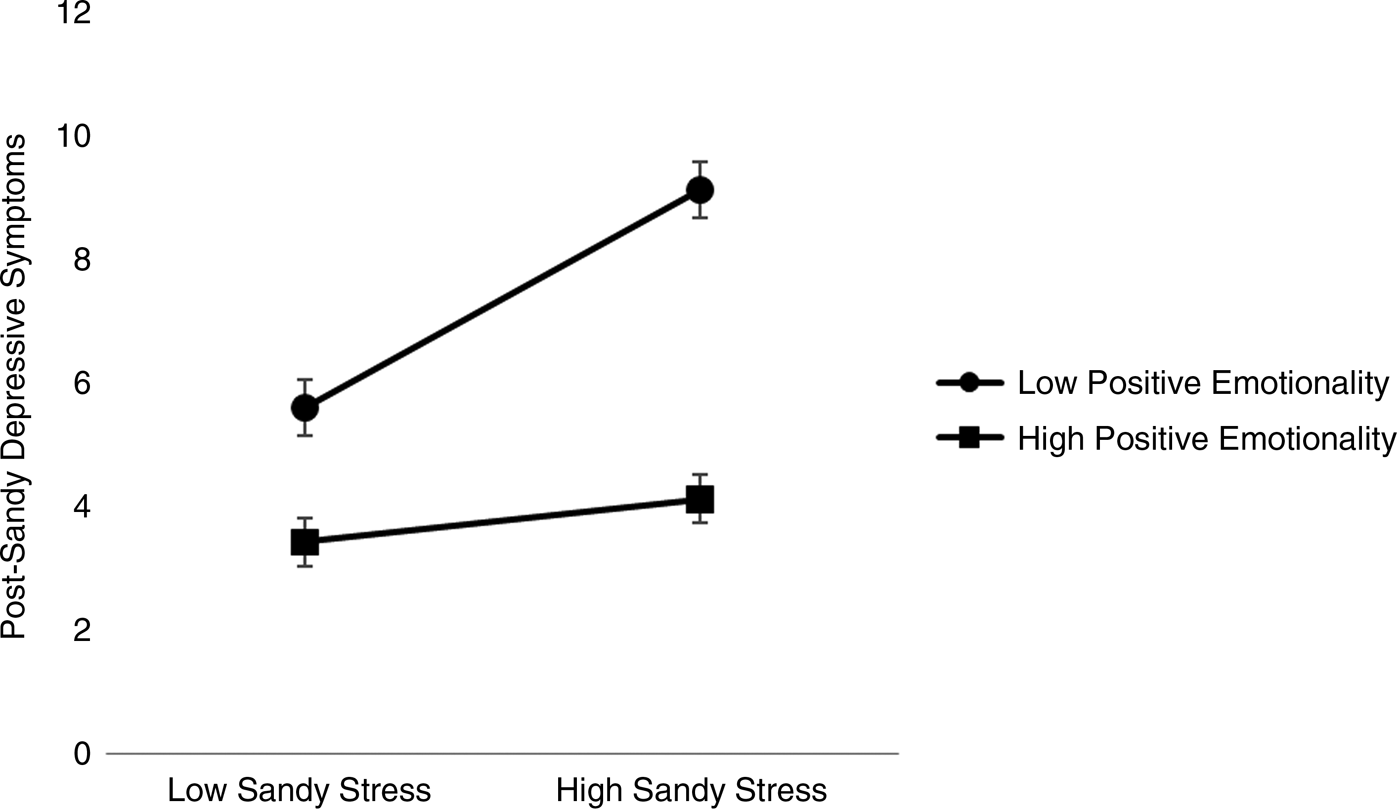
In our second model, a lifetime history of depressive disorders, lower income, lower PE and greater hurricane-related stress predicted higher depressive symptoms post-Sandy. Additionally, there was a significant interaction between PE and exposure (Fig. 2). The effect of stress on depressive symptoms was significant at low (β = 1.75, t = 3.85, p < 0.001, 95% CI 0.86–2.64), but not high PE (β > = 0.34, t = 0.86, p = 0.39, 95% CI −0.43 to 1.11). The full model explained 23.27% of variance in post-Sandy depressive symptomsFootnote 1 Footnote †.
Relationship between stress from Hurricane Sandy and post-Sandy depressive symptoms at high and low levels of positive emotionality. Only the slope at low positive emotionality is significant. Error bars represent the standard error of the slope.

Discussion
We conducted a novel test of diathesis–stress models by examining whether NE and PE exacerbated or buffered the effect of stress caused by a natural disaster, Hurricane Sandy, on subsequent depressive symptoms. Adjusting for participants’ history of depressive disorders, as well as age, race/ethnicity, marital status, education and household income, we found that both PE and NE, assessed 3–5 years prior to Hurricane Sandy, moderated the effects of disaster exposure on subsequent depressive symptoms. Specifically, greater stress significantly predicted greater depressive symptoms in those with low levels of PE, but not in those who showed high levels of PE. In addition, the effect of hurricane-related stress was significant for those high in NE, but not for those low in NE. Taken together, these results support the role of PE as a protective factor against, and NE as a vulnerability factor for, depressive symptoms following exposure to a natural disaster. Such personality diathesis x stress effects have been frequently assumed but rarely tested.
NE/neuroticism, disaster stress and depressive symptoms
The significant main effect of NE supports the contention that NE/neuroticism contributes to the development of depressive symptoms (Watson et al. Reference Watson, Gamez and Simms2005; Kotov et al. Reference Kotov, Gamez, Schmidt and Watson2010; Klein et al. Reference Klein, Kotov and Bufferd2011; Ormel et al. Reference Ormel, Jeronimus, Kotov, Riese, Bos, Hankin and Rosmalen2013). The interaction of NE and stress is also consistent with most of the limited literature available on this topic (Ormel et al. Reference Ormel, Oldehinkel and Brilman2001; Kendler et al. Reference Kendler, Kuhn and Prescott2004; Hutchinson & Williams, Reference Hutchinson and Williams2007; Brown & Rosellini, Reference Brown and Rosellini2011; Vinkers et al. Reference Vinkers, Joëls, Milaneschi, Kahn, Penninx and Boks2014). However, our findings extend this literature by demonstrating that NE moderates the effects of stressors that occur up to 5 years later, and that this personality characteristic interacts not only with common stressors such as job loss or interpersonal conflict, but also with stress ensuing from a natural disaster.
The reasons for why or how NE/neuroticism moderates the effects of disaster stress on depressive symptoms were not examined in the current study, but may be a fruitful area for future research. For instance, the emotional lability that is characteristic of high NE/neuroticism may deplete individuals’ cognitive resources, resulting in difficulties with executive functioning and self-regulation in the face of major stressors (Gomez et al. Reference Gomez, Holmberg, Bounds, Fullarton and Gomez1999). Individuals high on NE/neuroticism may also view negative events as more stressful or more hopeless than they really are (Chioqueta & Stiles, Reference Chioqueta and Stiles2005), employ less problem-focused and more avoidant coping methods (Gomez et al. Reference Gomez, Holmberg, Bounds, Fullarton and Gomez1999; Compas et al. Reference Compas, Connor-Smith and Jaser2004), and be less likely to seek out or receive instrumental social support (Borja et al. Reference Borja, Callahan and Rambo2009), all of which may ultimately result in greater depressive symptoms post-disaster.
PE/extraversion, disaster stress and depressive symptoms
Results regarding PE support the established relationship between higher levels of PE/extraversion and lower levels of depressive symptoms (Watson et al. Reference Watson, Gamez and Simms2005; Kotov et al. Reference Kotov, Gamez, Schmidt and Watson2010; Klein et al. Reference Klein, Kotov and Bufferd2011). In contrast to the effects of NE, PE protected against the effects of Hurricane Sandy exposure in that there was no effect on depressive symptoms in individuals high in this trait. There is a relative paucity of literature examining PE/extraversion from a diathesis–stress perspective. The one study of which we are aware was not supportive (Spinhoven et al. Reference Spinhoven, Elzinga, Hovens, Roelofs, van Oppen, Zitman and Penninx2011), although this may be due to its use of a clinical, rather than community, sample. Our results highlight the adaptive nature of PE by showing that it mitigates the effect of disaster-related stress on depressive symptoms.
As with NE/neuroticism, the mechanisms underlying the protective effect of PE/extraversion were not examined in this study. Individuals high in PE/extraversion may benefit from a greater ability to make decisions and plans under stressful situations given their greater cognitive resources (Gomez et al. Reference Gomez, Holmberg, Bounds, Fullarton and Gomez1999). They may also view difficult situations more optimistically (Duberstein et al. Reference Duberstein, Laurent, Conner, Conwell and Cox2001; Chioqueta & Stiles, Reference Chioqueta and Stiles2005) and be more likely to solicit more instrumental social support. Broaden-and-build models of positive affect (e.g. Fredrickson, Reference Fredrickson2001) suggest that the elevated level of positive affect characteristic of individuals high in PE/extraversion may facilitate thinking of novel and adaptive ways to cope with stress from a natural disaster. Future research will probably benefit from examining these and other potential mediators of the stress-exacerbating effects of NE/neuroticism and stress-mitigating effects of PE/extraversion.
Our results are also consistent with prior evidence of increased depressive symptoms in mothers following natural disasters (e.g. Adams et al. Reference Adams, Guey, Gluzman and Bromet2011; Goto et al. Reference Goto, Bromet and Fujimori2015), as well as evidence that mothers, relative to women without children, are particularly at risk for depression following a natural disaster (Havenaar et al. Reference Havenaar, Rumyantzeva, van den Brink, Poelijoe, van den Bout, van Engeland and Koeter1997). Our results therefore emphasize the importance of interventions geared towards mothers with high NE/neuroticism or low PE/extraversion who are caring for children, as they may be particularly at risk in the context of major stressors, such as natural disasters.
Finally, our results support vulnerability models of personality (Clark & Beck, Reference Clark and Beck1999; Compas et al. Reference Compas, Connor-Smith and Jaser2004; Klein et al. Reference Klein, Kotov and Bufferd2011) in which traits place individuals at risk for psychopathology. However, our results cannot speak to other models of the personality–depression relationship, such as stress generation (e.g. Hammen, Reference Hammen2006), scar, or pathoplasticity (see Compas et al. Reference Compas, Connor-Smith and Jaser2004; Klein et al. Reference Klein, Kotov and Bufferd2011), although our findings of trait x stress interactions are difficult to reconcile with spectrum/continuum models (Clark & Beck, Reference Clark and Beck1999; Klein et al. Reference Klein, Kotov and Bufferd2011).
Above all, however, the current results support the role of these relatively stable personality traits as factors which moderate the effect of stress on depression, even when measured 3 to 5 years prior to the stress. These results support the utility of assessing the traits of PE/extraversion and NE/neuroticism in order to identify those most vulnerable to major stressors, including natural disasters.
Limitations and future directions
Although this study had several notable strengths, including a 5-year longitudinal design and assessment of personality and lifetime history of depressive disorders prior to Hurricane Sandy, several limitations should be noted. Perhaps the most substantial concern is that depressive symptoms were assessed at the same time as stress from Hurricane Sandy. As such, it is possible that individuals with elevated levels of depressive symptoms were more likely to report greater stress from Sandy (e.g. recall bias). Our assessments of stress and depressive symptoms were also both self-report; it is not clear whether our results would extend to clinicians’ ratings of depressive symptomology or diagnoses, or whether interviews with the mothers and other informants would have provided a more accurate picture of participants’ experiences during Hurricane Sandy. However, the DID converges well with clinician ratings of depressive symptoms severity (Zimmerman et al. Reference Zimmerman, Sheeran and Young2004). Moreover, although these biases may inflate personality–depression associations, they are less likely to account for the interactions between personality and stress.
Another concern is that our measure of stress primarily reflected events that happened to participants’ families; we cannot be sure if events which were specific to the women in this study, as opposed to their family, would show similar interactions with personality. To the extent that this concern is a factor, it probably reduced effects of exposure, making our estimates conservative. Similarly, because we aimed to assess exposure to stress from Sandy as quickly as possible after the hurricane, we were unable to determine whether there were other stressors in participants’ lives that were either unrelated, secondary to, or ongoing from Sandy, but may have compounded its effects or resulted in additional enduring stress post-Sandy (e.g. Galea et al. Reference Galea, Brewin, Gruber, Jones, King, King, McNally, Ursano, Petukhova and Kessler2007; Kessler et al. Reference Kessler, Galea, Gruber, Sampson, Ursano and Wessely2008). However, it is unlikely that very many major unrelated stressors occurred in the relatively short time period between Sandy and our assessment. As well, our measure of stress from Sandy included stressors that were likely to be ongoing for a significant period of time (e.g. damage to home, evacuation, financial hardship).
It is also unclear how long the effects will persist after Hurricane Sandy. In addition, the most commonly reported stressors from Hurricane Sandy could arguably be considered to be hassles, rather than major stressors; that is, we cannot know from these data whether similar effects would be found in an even more serious disaster in which, for instance, most participants lost their homes, or there was a high rate of death and injury. If anything, the effects of such disasters are likely to be larger. Furthermore, while adjusting for participants’ lifetime depressive history is quite conservative, due to the impromptu nature of natural disasters, we were unable to assess symptoms immediately prior to Sandy. Finally, due to the time-sensitive nature of these data, we were unable to assess other psychiatric symptoms, such as post-traumatic stress disorder (PTSD) or anxiety, and do not know if the results would extend to other symptoms, or if adjusting for other symptoms would affect our results, given some evidence that neuroticism moderates the effect of stress on PTSD symptoms (Breslau & Schultz, Reference Breslau and Schultz2013).
Conclusion
This study provided a novel test of diathesis–stress models by showing that the personality traits of PE/extraversion conferred resilience, while NE/neuroticism conferred vulnerability, to the effects of exposure to a natural disaster. Results further our understanding of the role of personality in vulnerability to depression, shedding light on the origins of the robust links between these variables observed in cross-sectional studies. Such an understanding is probably critical in future efforts to identify those at risk for psychopathology prior to disorder onset as they can be targeted for additional support and preventive interventions.
Acknowledgements
The present study was supported by National Institute of Mental Health (NIMH) grant RO1 MH45757 and NIMH grant R01 MH093479.
Declaration of Interest
None.