INTRODUCTION
A common model for understanding parasite or pathogen evolution suggests that pathogens will be selected to balance their rate of transmission with their rate of host exploitation (Bremermann and Pickering, Reference Bremermann and Pickering1983; May and Anderson, Reference May and Anderson1983; Bull, Reference Bull1994; Frank, Reference Frank1996; Andre et al. Reference Andre, Ferdy and Godelle2003; Choo et al. Reference Choo, Williams and Day2003; Day and Proulx, Reference Day and Proulx2004). The crux of this optimality argument is that parasites will maximize their fitness through host exploitation, but excessive host exploitation might kill hosts too quickly, thereby reducing parasites' transmission opportunities. This trade-off model for the evolution of virulence offers a general explanation for why parasites do not always evolve towards benevolence (e.g. Ebert, Reference Ebert1998), and has provided insight regarding how pathogen evolution may thwart intervention strategies (Gandon et al. Reference Gandon, Mackinnon, Nee and Read2001).
The virulence trade-off hypothesis assumes that higher within-host replication rates lead to higher virulence, and this has been supported in some (Lipsitch and Moxon, Reference Lipsitch and Moxon1997; Ebert, Reference Ebert1998; Mackinnon and Read, Reference Mackinnon and Read1999), but not all systems (Weiss, Reference Weiss2002; Escriu et al. Reference Escriu, Fraile and García-Arenal2003; Sacristán et al. Reference Sacristán, Fraile, , and García-Arenal2005; Stewart et al. Reference Stewart, Logsdon and Kelley2005; Pagan, Reference Pagan2007). Some workers have highlighted how other factors, such as competition between parasites, need to be incorporated into the trade-off model (e.g. de Roode et al. Reference De Roode, Pansini, Cheesman, Helinski, Huijben, Wargo, Bell, Chan, Walliker and Read2005). Theoretical treatments of within-host competition have generally indicated that within-host selection will favour higher virulence, because more rapidly growing parasite genotypes may kill the host or competitively exclude prudent genotypes before the latter have achieved transmission (reviewed by Read and Taylor, Reference Read and Taylor2001). However, a number of nuances are imaginable in competition, for example, chemical warfare between combatants could alter virulence evolution if parasite genotypes suppress each other's growth. Alternatively, immune-mediated competition can alter outcomes when one genotype attracts the majority of attention from the immune system (Almogy et al. Reference Almogy, Cohen, Stocker and Stone2002). Testing the generality of the trade-off or other hypotheses requires further data on genetic relationships amongst the key life-history traits of parasites, as well as an understanding of the likelihood and consequences of within-host competition.
Our work concerns the bacterium Pasteuria ramosa, a specialist parasite of the crustacean Daphnia magna. This is a naturally co-occuring host-parasite species pair for which past studies have revealed genetic variation for resistance in hosts, genetic differences among parasite isolates, and substantial genetic specificity (e.g. Little and Ebert, Reference Little and Ebert2000; Carius et al. Reference Carius, Little and Ebert2001; Little et al. Reference Little, Watt and Ebert2006). Pasteuria ramosa is an ideal organism for estimating parasite fitness because transmission spores are only released upon host death, allowing for very accurate measurement of transmission potential or lifetime reproductive success. This feature of the system has been exploited in previous studies, and consequently P. ramosa–D. magna infections have provided rare empirical evidence of parasite fitness being maximized at an intermediate level of virulence, supporting a version of the virulence trade-off model (Jensen et al. Reference Jensen, Little, Skorping and Ebert2006).
Parasite isolates used in many previous studies on this system have simply been the parasites collected from a single wild-caught female (as opposed to a true clone based on a single bacterial cell, which is not possible to isolate because P. ramosa can only be grown in vivo). Therefore, in the absence of molecular markers, it was not known if wild females harboured multiple parasite strains. Jensen et al. (Reference Jensen, Little, Skorping and Ebert2006) performed experiments indicating the presence of strain variation within single infections, and thus the potential for within-host competition in natural populations of D. magna and P. ramosa. The present work sought to associate this variation with host fecundity and mortality to shed further light on the potential for within-host competition and its likely impact on the evolution of virulence. By also measuring parasite growth and transmission potential we tested the assumption of a positive correlation between virulence and the within-host replication rate.
MATERIALS AND METHODS
Organisms and preparation of material
Daphnia magna is a planktonic crustacean found in still, freshwater bodies in temperate regions. Like most Daphnia, D. magna is a cyclical parthenogen where reproduction is usually the apomictic (i.e. clonal) production of all-female broods, but sex is occasionally induced by particular environmental factors (changes in food levels, crowding and photoperiod, among others). The product of sex is a resting egg that requires a period of diapause before hatching. Thus, by controlling environmental conditions and discarding any resting eggs produced, genetically identical clonal lines of Daphnia can be maintained in the laboratory. Pasteuria ramosa is a bacterial spore-forming, obligate endoparasite of D. magna that greatly reduces host fecundity (Ebert et al. Reference Ebert, Rainey, Embley and Scholz1996). Transmission is horizontal, but only achieved at host death, when spores are released from the decomposing cadavers (Ebert et al. Reference Ebert, Rainey, Embley and Scholz1996). Pasteuria ramosa passes through a series of well-defined developmental stages, ending in the production of morphologically distinct transmission spores that are straightforward to quantify using a haemocytometer. The D. magna and P. ramosa used in this study were from a single pond near the village of Gaarzerfeld in northern Germany.
Pasteuria ramosa was collected from a single wild-caught infected D. magna that produced viable offspring before the parasite curtailed host reproduction. These clonally produced Daphnia offspring were collected and propagated to provide new hosts. The original infected host was also kept alive in the laboratory, and upon death her cadaver was crushed and used to infect new hosts. To accumulate parasites for experimentation, this propagation was repeated twice. Each new round of infections was performed in 200 ml jars with 10 hosts per jar and there were 10 replicate jars per passage. Infections were initiated with 1×10⁶ spores per host and infection periods were 7 days. Infected hosts were grown until they died, at which point they were pooled and frozen for use in the next passage. In the last passage, dead infected hosts were separated and stored in 2 categories: hosts that had died relatively early (days 25–37; termed early killers) or those that died relatively late (days 55–67; termed late killers).
Main experiment
An experiment was conducted using ‘early killing’ spores or ‘late killing’ spores, each applied at 3 doses (1×10⁴, 1×10⁵ or 1×10⁶ spores per jar). We established 60 replicates, each replicate being a single Daphnia maintained alone in a 60 ml jar. These replicates were kept as such for 3 generations prior to experimentation, and during this time water was changed twice in the first 10 days of life, and thereafter with every clutch (clutches are produced every 3–4 days). Daphnia were fed 5×10⁶ cells of the algae Scendesmus daily. Six newborn from the third clutch of third generation females were split into the 6 treatments (2 spore types, 3 doses each) and parasite spores were added to each jar. Daphnia were left in contact with the spores for 5 days, after which they were transferred to fresh jars and water. From here on, Daphnia were transferred to fresh water each time they had a clutch (for hosts that did not become infected) or every 3 days (for hosts that became infected and thus had few or no clutches).
For 65 days, we counted the number of offspring produced by each Daphnia and recorded mortality and infection status. Whenever a host died, it was stored frozen. All individuals that survived until day 65 were censored. Additionally, a group of 60 hosts, evenly drawn from the 6 treatments, were sacrificed on day 25 (and recorded as censored) and used to gain an estimate of parasite growth in the earlier stages of the experiment. Each dead host was crushed in 200 μl of distilled water and 8 μl of this was placed in a haemocytometer for counting of transmission spores at 40×magnification. We performed 4 transmission spore counts for each host and used a mean of these for analysis. The counting procedure also allowed us to confirm infection status.
The explanatory variables for analyses were spore type (early killing or late killing) and dose (low, medium or high). We used logistic regression to analyse if the proportion infected differed by treatment. For all other analyses, we focussed on the group of infected hosts (the fitness effects of being exposed to parasites but resisting infection are reported elsewhere (Little and Killick, Reference Little and Killick2007)). Proportional hazards were used to analyse time to death. ANOVA was used to study counts of parasite transmission spores. For analysis of transmission spores we studied 2 data sets: hosts sacrificed on day 25 and hosts sacrificed on day 65. All analyses were performed in SAS version 9.0 (SAS Institute Inc, 2002).
Reproduction was difficult to analyse because very few (11%) infected hosts reproduced. We scored each host as either reproducing or not, and used a logistic regression to relate this to dose and spore type. We also created a separate data set including only those hosts that did reproduce and used this to compare the number of (square root transformed) offspring among treatments (via ANOVA), as well as to investigate age at first reproduction, which was analysed via proportional hazards because age at first reproduction is a time to event variable.
Experiment 2
The above experiment was repeated (with some minor methodological differences) but included 2 different host genotypes (the same one used above, plus a different host clone). The second host clone was isolated from the same population at the same time as the first, and is known to differ from the first both at allozyme loci and in terms of its resistance characteristics (Carius et al. Reference Carius, Little and Ebert2001), although both clones show high overall susceptibility (these clones are labelled as ‘3’ and ‘4’ in Carius et al (Reference Carius, Little and Ebert2001) ). We focussed this experiment on testing for a host clone by spore type interaction, and the design was such that we had the most power to do so for early parasite growth. Hosts were prepared as above for 3 generations and there were 5 replicates of each host genotype (here, however, 5 Daphnia were kept in each jar, and jar size was 200 ml, but jar is still the largest unit of independent replication). On the day the experiment began, 30 newborn from each replicate were isolated and groups of 5 were placed in 200 ml jars corresponding to the 6 treatments (early and late killing spores and 3 spore doses of each, as above). When hosts died, their bodies were frozen, and on day 30 all surviving host were frozen for later counting of parasite spores.
RESULTS
Main experiment
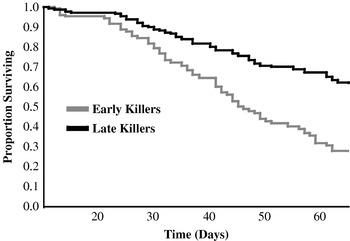
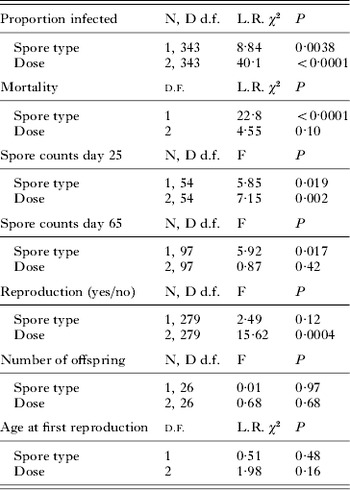
Across treatments, 82% of hosts became infected and both dose and spore type (odds ratio, early killing spores=0·48) influenced this proportion. Mortality among infected hosts was not influenced by dose, but was strongly affected by spore type (Table 1; Fig. 1). Parasite spore production at both day 25 and day 65 was influenced by spore type (Table 1; Fig. 2), while dose influenced spore counts only at the earlier time-point. In no case did we observe a dose by spore type interaction.
Mortality of Daphnia magna hosts infected with 2 spore types of the bacterium Pasteuria ramosa.

Parasite (Pasteuria ramosa) spore production after 25 (left graph) or 65 days (right graph) of growth in the host Daphnia magna.

Summary statistics for the main infection experiment involving Daphnia magna and the parasite Pasteuria ramosa
(N, D indicates numerator and denominator degrees of freedom.)

In the high, low and medium dose treatments, only 1·4, 4·2 and 5·6% of hosts, respectively, reproduced, but this was a significant difference (Table 1). Spore type (early killing or late killing) did not explain differences in whether hosts reproduced or not (Table 1). Among the 32 hosts that reproduced, the number of offspring they had was not explained by spore type or dose (Table 1; early killers, average number of offspring=16·3 (S.E.=5·3), late killers, average number of offspring=19·4 (S.E.=6·3)), and neither dose nor spore type explained age at first reproduction (Table 1; early killers, average age at first reproduction day 19·1 (S.E.=1·6), late killers, average age at first reproduction day 21·4 (S.E.=1·9)). For all reproduction traits, dose by spore type interactions were not significant.
That the number of host offspring did not differ between hosts suffering a fast-growing versus a slow growing parasite might at first seem to contradict previous studies (Ebert et al. Reference Ebert, Carius, Little and Decaestecker2004) showing an overall negative correlation between parasite growth and host reproduction. However, adding parasite spore production as a covariate (nested within spore type) to the analysis of the 32 hosts that reproduced reveals such a negative relationship (spore production [spore type], F2,28=5·64, P<0·01 r2=0·29). Thus, while differences between parasites do not account for host reproduction (presumably this is because the strong mortality differences between spore types obscures the parasite growth – host fecundity relationship), within each spore type there is a negative correlation between parasite growth and host reproduction.
Experiment 2
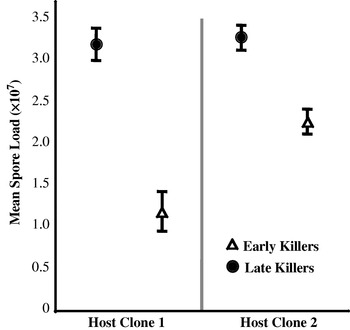
As in the main experiment, spore counts of late killing spores at a defined time-point were significantly larger (spore type main effect: F1, 46=62·57, P<0·001), and there was also a spore type by host clone interaction (Fig. 3; F1, 46=6·95, P=0·014). Regarding the other response variables, this experiment confirmed the results of the first, since early and late killing spores showed the expected differences in the proportion of hosts becoming infected (χ2=10·18, P=0·0014) and mortality (χ2=6·4, P=0·014). Although the two host clones differed in terms of the mortality suffered (clone effect: χ2=10·17, P=0·0014) and the proportion that became infected (clone effect: χ2=11·56, P=0·0007), neither of these variables showed a significant spore type by host clone interaction.
The proportion of 2 clones of Daphnia magna becoming infected in relation to 2 spore types of the bacterium Pasteuria ramosa. Clone 1 was used in the main experiment, clone 2 was the additional host clone used in Exp. 2.

DISCUSSION
The two parasite isolates studied here have markedly different life-history traits and were originally found to co-infect a single host line, indicating that multiple infections and hence within-host competition are possible in the wild (although we cannot exclude that one strain is a mutant which emerged between field sampling and experimentation). The isolates were separated based on the mortality they cause: one kills hosts relatively quickly, the other kills relatively slowly. These isolates showed additional differences, in particular the slow killing isolate showed greater infectivity and, surprisingly, a greater rate of replication. Clearly, within-host replication rate can be decoupled from mortality. While this challenges a key assumption of the virulence trade-off hypothesis, this result should be interpreted cautiously because of the small number of parasite strains studied. The trade-off theory assumes a genetic relationship between within-host parasite growth and virulence, but fully assessing this will require more substantial sampling of the genetic variation in the parasite population.
Additionally, for Daphnia–Pasteuria infections, mortality and virulence (parasite-induced fitness losses in hosts) are not strictly equivalent. The trade-off model essentially states that the rate at which parasites extract resources from their hosts equates to virulence, typically taken to be mortality. Pasteuria ramosa should follow this trade-off: prudent parasites might be out-competed while those that grow fast and rapidly extract host resources might kill their hosts before achieving maximal transmission potential. However, even living hosts suffer great parasite-induced costs because Pasteuria infections sterilize hosts. Virulence in this system can be thus sensibly accounted for by studying host fecundity instead of mortality, although both perspectives predict that parasite growth is positively related to virulence. Fecundity, however, will be determined jointly by mortality (early-dying hosts will have had less time to reproduce) and the amount of reproduction living hosts achieve prior to sterilization. The isolates under study presently actually do not differ in the virulence they cause from the perspective of host reproduction, although it is notable that only a very small fraction of hosts reproduced and so the power to detect reproductive differences was limited. Sterilization benefits Pasteuria because it liberates resources that the host might otherwise put into reproduction (Ebert et al. Reference Ebert, Carius, Little and Decaestecker2004). Thus while Pasteuria does, as expected, follow a trade-off regarding mortality (Jensen et al. Reference Jensen, Little, Skorping and Ebert2006), selection for parasites of intermediate virulence is not expected for fecundity: parasites benefit by sterilizing hosts as early as possible.
We can only speculate as to the proximate cause of higher mortality in slow-growing infections. This isolate may produce high levels of toxins. Another possibility is that the early-killing isolate has a greater propensity to induce fecundity compensation in their hosts, and it is this extra effort towards early reproduction in hosts that leads to higher mortality, but we could find no evidence of this (age at first reproduction did not differ between spore types). Conceivably, because our parasite isolates may not be pure strains, interactions between bacterial strains within a spore type could mitigate virulence; for example the late-killing spore suspension may contain mitigating strains the early-killing suspension lacks. (Unfortunately, this possibility is untestable until more advanced microbiological techniques can be applied to Pasteuria.) A further possibility is that the quick-killing isolate stimulates a stronger immune response, leading to immunopathology or a cost associated with the energetic demands of launching a strong immune response. If this were the case, we might expect hosts that did not become infected (assuming that resistance involves an immune response) to show higher mortality when resisting the quick-killing, more immunogenic strain. However, we also found no evidence that differences in survivorship between uninfected hosts were explained by spore type (data not shown).
The existence of a quick-killing, poorly infecting and slow-growing parasite isolate appears puzzling. It may be that this parasite isolate is simply a maladaptive form in decline when originally isolated. Alternatively, it may be that this slow-growing isolate does not show these features on all host genotypes. Parasite isolate by host genotype interactions are prevalent in the D. magna–P. ramosa system (Carius et al. Reference Carius, Little and Ebert2001). The Carius et al. (Reference Carius, Little and Ebert2001) study on specificity was based on measures of infectivity and host fecundity. Part of the current result indicates that genetic specificity can be extended to include parasite growth rate, although the relationship between strains was qualitatively similar across host genotypes (it was the magnitude of the difference that changed). However, again, the full effect of parasite genotype by host genotype effects can only be assessed with substantial sampling of the genetic variation in both interactors. The raises the point that fully assessing evolution of virulence models (as well as models of co-evolution) might invariably require extensive sampling of both host and parasite genetic variation (see Grech et al. Reference Grech, Watt and Read2006; Lefebvre et al. Reference Lefebvre, Sanchez, Ponton, Hughes and Thomas2007).
Alternatively, a quick-killing strategy could be successful under particular epidemiological conditions, for instance, during periods of high host density or population growth where the most successful parasites kill as quickly as possible and move on to new hosts. During summer gerbil-leishmania epidemics in Russia, for example, when the possibilities for transmission are high, a large proportion of infections are virulent, while a lower percentage of infections are virulent during other times of the year, when transmission opportunities are comparatively few (Dye and Davies, Reference Dye and Davies1990). In the laboratory, Leishmania strains that cause high virulence outcompete strains that cause less virulence, but it is thought that the former will be selected against during the low transmission periods in the wild because of the excessive mortality they cause. This highlights the fact that the frequencies of parasite strains that cause different levels of virulence may fluctuate with transmission possibilities (see also Herre, Reference Herre1995) and the epidemic state of the population, possibly leading to periods where slow-growing strains predominate. Daphnia population sizes fluctuate dramatically, and these appear to be associated with summer parasite epidemics (Duncan et al. Reference Duncan, Mitchell and Little2006; Duncan and Little, Reference Duncan and Little2007). We propose that quick-killing strains may only have an advantage during periods of high population growth and a spreading epidemic, and insight into this could be had by isolating parasites from a range of time-points. Generally, associations between virulence and patterns of epidemiological spread (which are essentially genotype by environment interactions) are a topic deserving of further study.
We thank Jaap Deroode for comments and advice. This work was supported by grants from NERC and the Wellcome Trust.