Specific Event Identifiers:
Event Type: Humanitarian Crisis/Armed Conflict
Onset Date: February 24, 2022
Location of Event: Chişinău, Republic of Moldova
Geographic Coordinates: Latitude 47.003670, Longitude 28.907089
Date of Observations Reported: June-December 2022
Response Type: Medical Relief (CUAMM Emergency Medical Team)
Introduction
The invasion of Ukraine by Russia in February 2022 resulted in the destruction of health care infrastructures and forced over nine million refugees to cross borders into neighboring countries, such as Poland, Czech Republic, Republic of Moldova, and Romania. 1–3
Since February 2022, the Republic of Moldova has received more than 850,000 Ukrainian refugees, reaching the highest number of Ukrainian refugees per capita compared to other European countries. 3 Of the refugees, approximately 110,000 have chosen to stay in the country as of June 2023. 3 Among the refugees who have remained in the country, around 4,000 have been accommodated at one point in Refugees Accommodation Centers (RACs), which were critical in the early phase of the response. 3 Initial reports indicated that most refugees were vulnerable people, including women and children, persons with disabilities, 2–4 and older people in need of care for diabetes, hypertension, and pain relief. 5
Recent scientific literature documented the actions taken by different countries to meet the needs of refugees, such as Poland, Reference Jankowski, Lazarus, Kuchyn, Zemskov, Gałązkowski and Gujski6 Germany, Reference Buchcik, Kovach and Adedeji7 and Lithuania. Reference El Arab, Urbanavice and Jakavonyte-Akstiniene8 To the best of the authors’ knowledge, there is a shortage of scientific papers concerning the refugees’ needs in the Republic of Moldova, despite the large number of people displaced in the country.
The objective of this manuscript is to report the mission of an Italian Emergency Medical Team (EMT) Type 1 deployed in the Republic of Moldova to assist Ukrainian refugees. The EMT was implemented by an Italian nongovernmental organization (NGO) named Doctors with Africa - CUAMM (Collegio Universitario per Aspiranti Medici Missionari [University College for Aspiring Missionary Doctors]; Padova, Italy).
Emergency Medical Teams Initiative
Emergency Medical Teams are defined by the World Health Organization (WHO; Geneva, Switzerland) as “groups of health professionals, including doctors, nurses, paramedics, support workers, logisticians, who treat patients affected by an emergency or disaster.” 9,10 According to the WHO Classification, EMTs can be divided into four different types based on their mobility and level of care provided. Reference Ariscain11,12 The EMT Type 1 (fixed and mobile) provides daylight-hour care for stabilization of acute presentations and ensure community-based primary health care (PHC). 9–Reference Ariscain11
Italian NGO “Doctors with Africa - CUAMM”
The Italian NGO Doctors with Africa - CUAMM (hereinafter referred to as CUAMM) 13 is the largest Italian NGO working to improve the health of communities in Sub-Saharan Africa. Recent disasters and humanitarian crises such as the COVID-19 pandemic Reference Maison, Jaworska, Adamczyk and Affeltowicz14–Reference Parotto, Lamberti-Castronuovo, Censi, Valente, Atzori and Ragazzoni16 and the Ukrainian conflict 17 raised unprecedented health emergency challenges, highlighting the need for CUAMM to strengthen its capability to assist vulnerable populations involved in disasters and humanitarian emergencies beyond the African continent. In 2022, CUAMM started the formal process needed to complete the WHO Global Classification and to be officially registered as EMT Type 1 fixed.
In May 2022, CUAMM was asked by the Moldovan Ministry of Health under the supervision of the WHO to intervene with an EMT in two RACs based in Chisiinău, named Moldexpo and Testemitanu (Figure 1). The former hosted mainly Ukrainians, while the latter hosted mainly Romani. Both the centers were set inside existing brick and mortar buildings adapted to accommodate refugees. The CUAMM EMT operated in the context of these RACs and was based in an area specifically dedicated to provide health assistance.
Timeline of CUAMM EMT Deployment.
Abbreviations: EMT, Emergency Medical Team; MoH, Ministry of Health; RAC, Refugees Accommodation Center; WHO, World Health Organization

The total pool of CUAMM health professionals involved in this initiative was constituted of 25 physicians from Italy, supported by two local nurses able to speak Italian, Ukrainian, and Russian. A local logistician was also employed to provide logistic assistance. Health professionals were combined in teams of two members (one medical doctor and one nurse) who rotated every two weeks. Medical doctors recruited had competences in different specialties (internal medicine, cardiology, infectious diseases, intensive care, pediatrics, surgery, and obstetrics) and were trained in the provision of PHC in low-resource settings. According to the WHO EMTs Standard Operating Procedures (SOPs), 10 the CUAMM EMT provided daylight-hour care for acute trauma and non-trauma presentations and ensured community-based PHC in an out-patient fixed facility. The goal of CUAMM’s activities was to help refugees in collaboration with local health authorities, working in integration and not in overlap. In case the refugees were in need of specialized care (such as maternal and obstetric care, pediatric care, or surgical care) or in case they were affected by acute life-threatening conditions, they were managed by other EMTs developed in the area and classified to provide more advanced assistance. The same strategies were adopted if the refugees needed assistance outside the daylight hours covered by the CUAMM EMT. Each EMT worked in integration with the local health system, therefore governmental health facilities were also involved to provide assistance in case of need.
Sources
Data were collected during the time of CUAMM EMT deployment in the Republic of Moldova. Data analyzed in this report covered the period from June 1 through December 19, 2022. The patients admitted to CUAMM EMT were registered with age, gender, and final diagnosis using the CUAMM EMT Clinical Record that responds also to the Minimum Data Set (MDS) record defined by the WHO. Data used for this report did not include patient personal identifiers or confidential information. In the light of these reasons, the Ethics Committee of Azienda Ospedale-Università of Padua (Italy) provided exemption and a notice for publication purposes was registered and approved (Registration number 0079213).
Observations
From the 1,173 patients admitted to CUAMM team during the period of observation (from June through December 2022), the majority were adults (70.8%) with an average age of 51.9 years. Among adult patients, 569 (68.5%) were females and 258 (31.0%) were males. Patients aged less than 18 years were 336 (28.6%); Table 1. The health issues encountered were distinguished into “diagnosis directly related” to the conflict (health issues caused directly by the conflict, such as traumatic injuries), “diagnosis indirectly related” (health issues caused by the consequences of the conflict, such as malnutrition, spread of infectious diseases, increase of mental health issues), and “diagnosis not related” to the conflict (any health issues that did not show direct or indirect relationship with the conflict). The majority of patients (88.7%; n = 1,040) had health problems not directly related to the conflict, while only 3.2% (n = 38) of patients presented diseases directly related to the event (Table 1).
Demographic and Clinical Characteristics of Patients Presented to the CUAMM EMT in the Period from June to December 2022

Note: Diagnosis not related to conflict: diagnosis referring to a medical condition that did not show any direct or indirect relationship with the conflict; Indirectly related to conflict: diagnosis referring to a medical condition caused by the consequences of the conflict, such as malnutrition, mental health issues; and Directly related to conflict: diagnosis referring to a medical condition caused directly by the conflict, such as traumatic injuries.
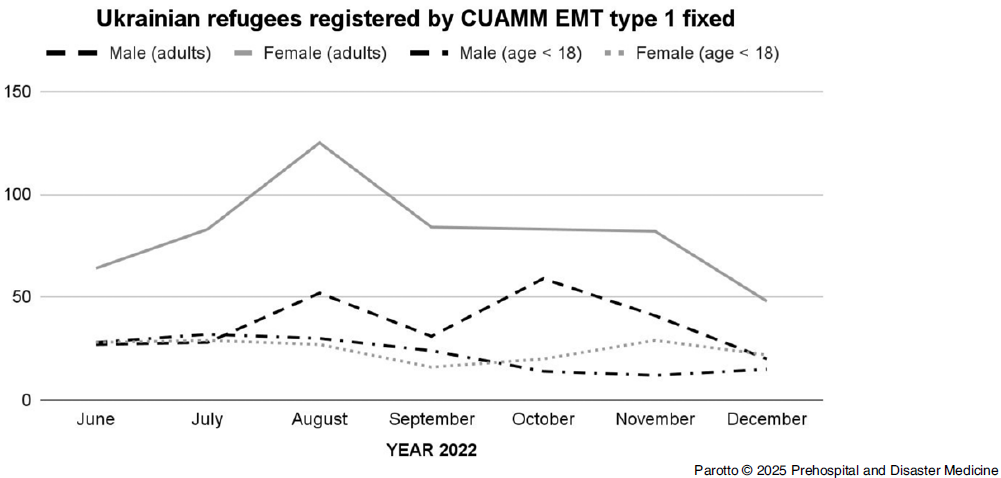
The average number of patients admitted per month was 167.6, showing a peak in August (230 patients per month) and a regular decrease in the following months (Figure 2).
Time Course of CUAMM EMT Registered Patients, Expressed in Number of Patients per Month.
Abbreviation: EMT, Emergency Medical Team

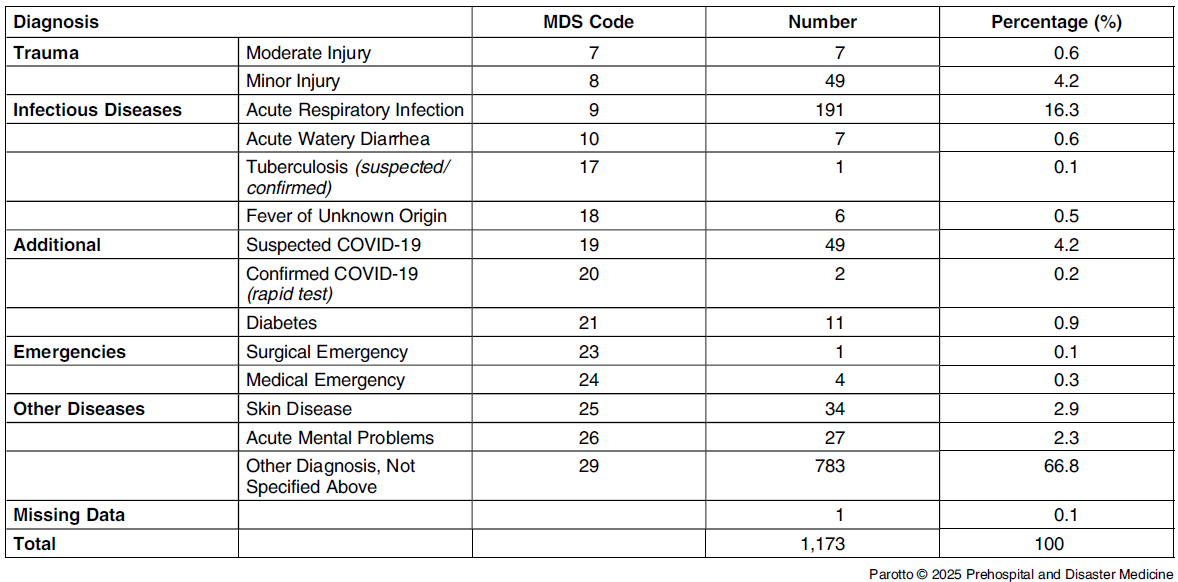
According to the framework defined by the MDS, 56 patients (4.8%) were classified as moderate or minor injury (Code 7 and 8) and 1,117 (95.2%) as non-trauma patients. The five most prevalent diagnosis (Table 2) referred to “other diagnosis, not specified above” (Code 29 and Code 22; 66.8%, n = 783), “suspected COVID-19” (Code 19; 16.3%, n = 191), “acute respiratory infections” (not COVID-19 related - Code 9; 4.2%, n = 49), “skin diseases” (Code 25; 2.9%, n = 34), and “acute mental health problems” (Code 26; 2.3%, n = 27); Table 2.
Diagnosis of Admitted Patients Defined in Accordance with the Minimum Data Set (MDS) Record

Regarding the “other diseases, not specified above” group, a more specific additional diagnosis was reported in 467 (59.6%) patients. Among them, the most prevalent conditions were related to cardiovascular diseases (37.9%; n = 177), gastrointestinal diseases (11.9%; n = 56), chronic musculoskeletal diseases (9.8%; n = 46), cancer (7.7%; n = 36), headache (5.8%; n = 27), dental diseases (5.8%; n = 27), ocular diseases (3.4%; n = 16), and chronic obstructive pulmonary disease (2.4%; n = 11); Figure 3.
Diagnoses Registered in the “Other Diseases” Group, Namely Code 29, According to the Minimum Data Set (MDS) Record.
Abbreviation: COPD, Chronic Obstructive Pulmonary Diseases

Regarding discharge, 49.9% (n = 586) of patients were discharged permanently, 44.8% (n = 526) were identified for follow-up, 0.4% (n = 5) were discharged against medical follow-up, and 3.1% (n = 36) were transferred to Moldovan hospitals.
Analysis
During the time of its deployment, CUAMM EMT targeted mainly an adult population with health issues not directly related to the Ukrainian conflict. The increase of non-disaster related diseases as time passed after disasters is largely described in scientific literature. Reference Sacchetto, Raviolo, Lovesio, Salio, Hubloue and Ragazzoni18–Reference Ladeira, Cardoso and Ribeiro20 According to the MDS, most of the diagnosis referred to “other diseases, not specified above,” namely Code 29. The high prevalence of diseases that are not included in the MDS specific diagnosis codes, such as “trauma” (Codes 1-8), “infectious diseases” (Codes 9 -18), “additional diagnosis” (Codes 19-22), “emergency” conditions (Code 23-24), or “other diseases” (Codes 25-28), suggested that the Code 29 needs to be better specified to allow an adequate analysis of EMTs clinical activity. The Portuguese EMT Type 1 pointed out the same issue in the report describing its clinical activities during the Idai Cyclone in Mozambique. Reference Ladeira, Cardoso and Ribeiro20
The diagnoses registered by CUAMM EMT as Code 29 were mainly attributable to non-communicable diseases (NCDs), such as cardiovascular diseases, non-infectious gastrointestinal diseases, chronic musculoskeletal diseases, and cancer. This result, considered together with the registered cases (10 patients; 0.9%) of diabetes (Code 21), showed a high prevalence of NCDs among the refugees.
Recent scientific literature has largely highlighted the impact of NCDs in the aftermath of disasters. Reference Ladeira, Cardoso and Ribeiro20–Reference Bausch, Beran and Hering25 Although NCDs represent an increasing global challenge during disasters and humanitarian emergencies, there is a lack of a standardized response during EMTs operations. Reference Bausch, Beran and Hering25,26 In the past few decades, EMTs have traditionally been employed to manage acute conditions such as trauma and infectious diseases in order to mitigate the immediate impact of the disaster on the health and safety of the affected community. Reference Brandrud, Bretthauer and Brattebø27–Reference McPherson, Counahan and Hall29 At the time of writing this report, the current scientific literature reports poor information regarding the role of EMTs in managing chronic health needs related to NCDs. To the best of the authors’ knowledge, the majority of manuscripts concerning EMTs and NCD treatment are focused on specific conditions, such as diabetes, Reference McDermott, Hardstaff, Alpen, Read and Coatsworth30 chronic ophthalmic diseases, Reference McMaster and Clare31 medical rehabilitation, Reference Amatya, Galea, Li and Khan32 or mental-health issues. Reference Yumiya, Chimed-Ochir and Taji33
The need to ensure a more comprehensive approach to chronic health needs of vulnerable people in humanitarian emergencies has recently been highlighted in the WHO work on NCDs in emergencies. 34 Since 2022, a joint program of work has been established between WHO’s Department of Noncommunicable Diseases, Rehabilitation, and Disability (NCD) and the World Health Emergencies Program (WHE; Geneva, Switzerland). Specific outputs of this program are aimed at strengthening policies for NCD integration across the emergency cycle and providing normative tools aimed to enhance NCD management in emergency preparedness and response. 34 Many scientific reports focused on disaster response have shed a light on the need to develop plans aimed to expand the ability of health systems in ensuring continuity of care for chronic health conditions. Reference Runkle, Brock-Martin, Karmaus and Svendsen35–Reference Armocida, Ussai and Pavlovych39
The recent escalation of the armed conflict in Ukraine reflects these observations, having caused massive civilian displacement and casualties with a heavy impact on the health system and on the population’s health. Since chronic NCDs are the leading cause of morbidity and mortality in Ukraine, accounting for 91% of total deaths, it appears fundamental to address the needs of disaster-affected populations with such pre-existing conditions. Reference Armocida, Ussai and Pavlovych39,Reference Van Hemelrijck, Fox and Beyer40
During its activities, CUAMM EMT operated as a semi-permanent cell composed of two members, including one Italian medical doctor and one local nurse per each daily shift. This team composition had multiple advantageous implications. The support from a local nurse allowed to limit the number of health professionals coming from Italy, facilitating the process of medical doctor recruitment. Moreover, working in integration with the local staff improved the positive impact of the CUAMM team on refugee health needs. The presence of a local nurse speaking Italian, Ukrainian, and Russian allowed to overcome any linguistic barriers between Italian physicians and Ukrainian refugees, facilitating the development of closer relationships with the refugees. Recent scientific literature focused on EMT missions has largely highlighted the importance of the integration of local staff members in the team composition, useful both to promote professional training and population health education, and to plan successful exit strategies. Reference Sacchetto, Raviolo, Lovesio, Salio, Hubloue and Ragazzoni18–Reference Ladeira, Cardoso and Ribeiro20,Reference McDermott, Hardstaff, Alpen, Read and Coatsworth30 The need to provide a semi-permanent service able to provide assistance between the initial emergency response and the re-establishment of local health service delivery was discussed by McMaster, et al in their recent study, focused on designing a mobile eye hospital to support health systems in disaster settings. Reference McMaster and Clare41
This report provided useful insight regarding the incidence of NCDs among Ukrainian refugees, shedding light on the need for a more precise identification of chronic health needs of vulnerable populations in disaster aftermath. However, it should be underlined that this document presented some limitations. The descriptive picture illustrated in this report might not necessarily provide a complete scenario of health needs in this population, due to the fact the population assisted by the CUAMM EMT targeted other facilities in the area when dealing with other diseases, such as acute life-threatening conditions in need of advanced medical care.
Conflicts of interest
The authors declare that there are no conflicts of interest.