Dominant Seventh: a Gift to Goethe
When Schubert wrote out a new copy of his song ‘Geistes-Gruß’ (D. 142) to send to Goethe, he softened a potential blow to the poet’s delicate musical ears.Footnote
1
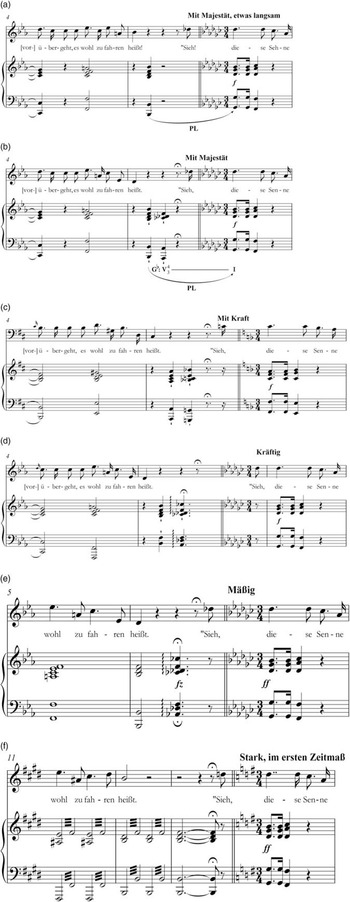
He had composed a setting of Goethe’s poem that began in E-flat major, but ended in G-flat major. The switch from one key to the next was carefully timed to accompany the shift in the poem from the narrator’s commentary to the words of the spirit. In Schubert’s first version (see Ex. 1a), the modulation was direct: the narrator’s recitative ends on the dominant of the opening key of E-flat major with a perfect authentic cadence (PAC) onto B-flat major, and after a brief rhythmically measured silence, the new key of G-flat major arrives abruptly. In the revised version (see Ex. 1b), which was intended for Goethe’s ears, Schubert inserted a dominant-seventh preparatory chord before the arrival of G-flat. He even placed the dominant seventh in bar 5 before the silence, which he then elongated with a fermata. This longer unmeasured silence would have given Goethe’s ears more time to absorb the upcoming shift in key, signalled by the dominant seventh. Additionally, Schubert made the ending of the recitative less conclusive: he altered the vocal line to land on
 $\hat{3}$
instead of
 $\hat{1}$
, which forms an imperfect authentic cadence (IAC) and which also provides an added sense of anticipation. There is no record of Goethe’s reaction to this song – or the 15 others that were sent along with it. Goethe famously returned the songs without comment, and, since there is also no mention of Schubert’s songs in his diary, it is generally believed he never looked at them.
Schubert, ‘Geistes-Gruß’ (D. 142) (a) first version, bars 4–6 (b) second version, bars 4–6 (c) third version, bars 4–6 (d) fourth version, bars 4–6 (e) fifth version, bars 5–7 (f) sixth version, bars 11–14

‘Geistes-Gruß’ contains a number of features that are hallmarks of Schubert’s modulatory practice: the modulation to the new key is abrupt – and it is abrupt whether or not the dominant-chord preparation is present, for the dominant in Example 1b is so short; the song begins and ends in a different key; the two tonics are a third apart; the song contains discrete sections, each in its own key. In this case, the song is in two sections and two keys, but many of Schubert’s songs – especially his early songs – are multi-sectional and multi-keyed. Nonetheless, no matter how many discrete sections and keys a song might contain, according to modern theoretical perspectives they are usually said to be organized around two tonal centres – the first and last, a phenomenon known variously as ‘tonal pairing’, ‘directional tonality’ or the ‘double-tonic complex’.Footnote 2
Thanks in large part to Robert Bailey’s ground-breaking work, the concept was initially associated with Wagner and late nineteenth-century practices.Footnote 3 However, a number of scholars have rightly placed the practice much earlier, through detailed studies of the music of Beethoven, Schubert, Chopin, Schumann and Brahms. Those studying Schubert’s pervasive use of it in his songs have pushed the practice back even further, readily acknowledging that Schubert must have been inspired by his eighteenth-century predecessors, such as Johann Friedrich Reichardt and Johann Rudolph Zumsteeg.Footnote 4 The common purpose amongst double-tonic studies is threefold: to illustrate how such musical structures challenge theoretical methods rooted in monotonality; to seek patterns in the overall design of the keys; to showcase how their large-scale third relations (they usually comprise thirds) deserve structural status, rather than being considered lower-level ornaments to tonic and dominate harmonic pillars.
My main focus in this study will not be on matters of large-scale design but rather on the moment of Schubert’s swift key changes. Indeed, the full range of Schubert’s methods of modulation in double-tonic or multi-sectional songs deserves a study of its own, but in this study I wish to focus on the aesthetics of momentary dominants featured between local third relations in his songs and instrumental music.Footnote 5 According to at least one early nineteenth-century theorist, there was an important difference between the two methods of key change in ‘Geistes-Gruß’: Anton Reicha argued that direct modulations are not strictly speaking ‘modulations’ – they are merely ‘changes of key’; ‘modulations’ must employ ‘intermediate chords’ (‘accords intermédiares’), of which V7 is the most potent.Footnote 6 For Reicha, then, the dominant seventh in Example 1b would have been a vital detail. It would have transformed a change of key (Ex. 1a) into a modulation (Ex. 1b). Also for Riecha, the sole presence of a V7 is usually sufficient to effect the modulation of closely related keys, although he concedes that there is never any harm in employing more intermediate chords.Footnote 7 Moreover, he added that ‘one is never risking anything by prolonging the duration of intermediate harmonies’ since it is of ‘great importance to give the ear sufficient time to take them in’.Footnote 8 Importantly, however, he welcomed equally the deployment of either the ‘key change’ in Example 1a or the ‘modulation’ in Example 1b, although again he conceded that, while silence could substitute for intermediate chords, intermediate chords are really the only means of properly threading distant keys together.Footnote 9 Bearing such historical insights in mind when listening to the range of ways that Schubert moved from one section in a musical form to the next either by changing key or modulating using an intermediary dominant helps our modern ears to recuperate the early nineteenth-century aesthetics of Schubert’s hallmark harmonic and formal junctures.
As is well known, Schubert’s modulatory practice raised eyebrows amongst his contemporary critics and, as I have argued elsewhere, they seemed to have been more perturbed by the manner of his modulations than by his choices of key.Footnote 10 In this article, I shall supplement my earlier study by scrutinizing Schubert’s modulatory practice in relation to the counsel of his contemporary theorists. I shall focus on Anton Reicha and Gottfried Weber, whose treatises were published almost exactly contemporaneously with the composition of the songs under discussion; however, their views are representative of the time.Footnote 11 To be sure, Gottfried Fink, who was the main protagonist in my earlier study, was conservative in outlook. My new cast of characters includes some of the most forward-looking theorists of the early nineteenth century. Indeed, they encouraged the use of precisely the kind of harmonic juxtapositions that are so ubiquitous in Schubert’s music. Yet, as we shall see, their aesthetic judgment of the merits of any given modulation was based on the manner in which it was handled, and they made strikingly little distinction between recommended practices for small or large forms. Many of the details in Schubert’s scores – of both the songs and sonata forms – suggest that Schubert possessed a comparable aesthetic sensibility to his contemporary music theorists. In order to draw out these similarities, it is necessary to turn once more to ‘Geistes-Gruß’ and to Schubert’s continued attention to its modulation after the disappointment of Goethe’s return of the song.
In all, there are six extant versions of ‘Geistes-Gruß’, spanning 1816–1828, which covers almost Schubert’s entire compositional career. Graham Johnson, who is one of the few commentators to have compared all six versions, argues that many of them differ ‘only in unimportant details’. He therefore concludes that they were ‘not rethinks but copies made by memory for practical use’. In his view, the first two versions – the two versions that I have discussed thus far – ‘are almost identical’ (and he does not detail any variants between them). He observes that the third version is in the bass clef and transposed to D major/F major, and he argues that ‘Apart from the transposition of a semitone downwards surprisingly little has changed in the composer’s reaction to the text in the two years since it was written’. In the fourth version, which is once again in E-flat major/G-flat major, ‘certain chords are arpeggiated and the vocal line is ornamented twice’, while in the fifth version ‘tiny details and note values have been changed, but it is difficult to see why’. By contrast, the sixth version is ‘substantially different’; now transposed into E major/G major, Schubert provided a ‘wholesale revision of the first section’ with a new piano prelude and tremolo accompaniment. ‘At last’, Johnson adds, ‘Schubert has found the ghostly atmosphere for the opening that had hitherto eluded him’.Footnote 12
Joseph Kerman, who compared only the first and final versions, agreed with Johnson that ‘though few changes were made in the notes pure and simple, Geistes-Gruss was transformed as few works ever were in their revisions’.Footnote 13 Kerman heard in the tremolo the imagery of water (although he conceded it was not without its ghostly effect), and he focused on the ‘Romantic detail’ of the chromatic X chord of the T-X-T harmonic pattern brought about by the addition of a piano prelude.Footnote 14 By contrast, John Reed was less taken with the transformation of the final version: ‘It is a pity that the [final] 1828 version is the only one which is easily available; the extended recitative with its accompaniment of tremolos in the bass adds a Romantic frisson of mystery to the song, but it may be doubted whether it adds anything of substance to the original conception’.Footnote 15
In all of these cases, the attention was on spotting changes to the vocal line and the nature of the accompaniment, with an eye to detecting any development in Schubert’s response to the text. The changes that Schubert made to the moment of modulation, however, drew no specific comment. Yet to my mind, it is striking that, from 1816 to perhaps as late as 1823,Footnote 16 Schubert increased the insistence on the intermediate dominant. What are the details, then, of these later versions?
The third version (Ex. 1c) almost matches the version sent to Goethe: it contains the two staccatissimo chords, which are followed by a rest with a fermata over it. However, Schubert added an extra note to the dominant seventh, doubling the seventh and thereby slightly thickening the sound. Thickening the chord also enabled Schubert to exploit a connection to the  –
 ${\vskip -2pt \raster="rg31"}$
♭ gesture in the piano’s right hand in bar 6. That is to say, in Example 1a the upper voice of the piano articulated the common tone between B-flat major and G-flat major, which was disrupted by the introduction of the dominant seventh in Example 1b. However, in Example 1c, the  –
 $${\vskip -2pt \raster="rg32"}$$
♭ gesture in bar 5 now mirrors the piano’s melodic line in the opening of the new section, which is reharmonized more conventionally with a tonic–dominant progression in F major.Footnote
17
This motivic play is also maintained in the next version of ‘Geistes-Gruß’, but by the fifth version it is eliminated again, as is any effort to highlight the common tone between the two main keys in the piano’s upper voice.
In the fourth version (Ex. 1d), the dominant seventh is further emphasized by being arpeggiated and elongated into a dotted crotchet. Now it is the chord – rather than the rest – that has the fermata over it. Indeed, though Johnson mentioned that this version contains ‘certain arpeggiated chords’, the only arpeggiated chord in this copy of the song is this dominant seventh. In this version, Schubert also eliminated the notated silence that was in the earlier versions: instead of the intermediate dominant ringing through the silence, Schubert now has a sounding dominant seventh resonating until just before the entry of G-flat major (of course, it is possible that performers may add a breath-mark silence at this point, but the silence is no longer specifically notated). The fifth version keeps the arpeggiated chord and the fermata, but additionally applies a forzando to the dominant seventh, thus lending yet greater emphasis to it (see Ex. 1e). In the final published version of 1828 (Ex. 1f), Schubert decided to remove the intermediate dominant, reverting thus to his original 1816 idea of direct modulation. It seems that when Schubert returned to this song sometime in the last five to seven years of his life, he changed his mind on the need for a preparatory dominant, although the new tremolo effect perhaps contributed to the decision, as it would also have made it difficult to include the dominant seventh elegantly.
The technical display at work in Examples 1a–f becomes all the more intriguing in view of contemporaneous ideas found in theory treatises about harmonic progression and changing key, some of which have been outlined above. By the late eighteenth century, theorists were already exploring all possible harmonic juxtapositions and modulations, though most would offer caveats about not being too extreme and about how to render jarring juxtapositions or remote modulations easier on the listener’s ear. Although we tend to associate the acceptance of chromatic harmony with the later nineteenth century, earlier theorists such as Vogler, Momigny, Reicha, Weber, A.B. Marx and Jelensperger (to name some of the most adventurous) all encouraged their contemporaries to explore a wide harmonic palette.Footnote 18 At the same time, their caveats reveal an aesthetic of restraint, one that, interestingly for our purposes, often has to do with introducing a dominant preparation no matter how fleetingly or slowing down the pace of a modulation.
Although all these theorists fully endorsed the kind of direct modulation to a remote key exemplified by Schubert’s initial idea for ‘Geistes-Gruß’, especially given that it appears between sections, they would also all concur that the dominant seventh inserted into the second version of ‘Geistes-Gruß’ would have been a gift to the ears of any of Schubert’s contemporaries. Moreover, a radical shift in the history of music theory at the beginning of the nineteenth century rendered the dominant seventh an even more potent chord for the ‘attunement of the ear to a key’ (to use Weber’s formulation) than it had been in the eighteenth century.Footnote 19 Beginning already with Momigny, the fundamental harmonies of the minor mode were built from the degrees of the harmonic rather than the natural minor scale, as in the eighteenth century. This meant that for nineteenth-century theorists the dominant seventh was intrinsic to both major and minor. Without this shift to the harmonic minor as the foundational scale for the minor mode, the early nineteenth-century conception of modulation would have meant that a simple i–V7–i progression in a minor key would have incurred a shift in and out of the main key (albeit to the parallel major) solely to accommodate the V7 chord.Footnote 20 Put another way, without the insistence on the harmonic minor, the very harmony that is key-defining, namely the dominant seventh, would itself have been foreign to the scale of the key it defines. The absurdity of this motivated theorists to settle on the harmonic minor scale despite other inconveniences, such as the fact that the relative major now had to be reckoned as foreign to the key. Nineteenth-century theorists recognized the dominant seventh as the strongest determiner of a (new) key because it was amongst the least ‘equivocal’ (‘mehrdeutig’) of the fundamental harmonies, belonging as it does exclusively to the fifth degree of the major and minor keys.Footnote 21
It must be remembered that the appeal of the clarity of function for the dominant seventh chord comes in the context of an increased fascination with ‘multiple meaning’ (‘Mehrdeutigkeit’), a concept closely tied to Weber but implicitly championed by all of these theorists.Footnote 22 Despite recognizing only seven fundamental harmonies, Weber calculated in their multiple meaning some 6,888 possible harmonic juxtapositions within some 46 possible key combinations. Importantly for our present purposes, Weber had no fewer than nine pieces of advice on how to soften the harshest successions amongst them.Footnote 23 Five of his suggestions are relevant to Schubert’s ‘Geistes-Gruß’.
The addition of the dominant seventh with a pause over the dominant or the rest matches Weber’s seventh piece of advice: harmonies that would be harsh to the ear if they were juxtaposed within a phrase ‘become less offensive, provided one stands at the close of a period and the other at the commencement of the following period … . This is very especially the case after a dominant pause, i.e. a pause or rest on the harmony V’.Footnote 24 Observe also that, over the course of all six versions, Schubert slows time down with the addition of fermatas and he adds dynamic force to his stark modulation. These are two techniques that correspond to Weber’s first and fifth pieces of advice respectively:
An otherwise unusual and repulsive harmonic succession may sometimes be rendered less harsh and disagreeable by introducing it in a somewhat slower grade of time; for, in this case, the ear has more time to comprehend, digest and reconcile itself to the succession, though the latter be in itself rather foreign and unnatural.Footnote 25
and
The degree of loudness or softness of performance may also have influence. The energy and decision with which a harmonic succession, not very acceptable in itself, makes its appearance, as it were takes the ear by force, whereas the very same succession, presenting itself with less boldness and decision, would be rejected by the ear. It is for this reason, that so much is admissible on the mighty organ, or in full vocal or instrumental choruses, which, presented with a less imposing power of tone, would not be received [by the ear].Footnote 26
Weber also advises that ‘one should put both harmonies of the succession in root position’, a detail that affirms both third-related keys, although observe that the intermediate dominant is not in root position in ‘Geistes-Gruß’.Footnote 27 The final piece of advice that echoes Schubert’s practice, although in a manner more camouflaged in ‘Geistes-Gruß’ than in some other songs, regards Weber’s suggestion to employ harmonies with common tones:
Many harmonic successions are rendered more agreeable by the fact that one or more intervals of the first harmony are continued in the second. … By this means the harmonic succession sounds far more soft and flowing, than it would if the two harmonies followed each other in less neighborly positions.Footnote 28
Here, Weber may be seen to be encouraging the use of third relations, although of course they range from having no common tones to two, as is made clear by the underlying principles of neo-Riemannian theory. The L and R transformations have two common tones; combined with P, they have one; the hexatonic pole has none.Footnote 29
Whether the analyst reckons the new key of ‘Geistes-Gruß’ against the opening key, which produces a PR transformation, or against the new local tonic asserted by the PAC or IAC cadence at the end of the first section, which produces PL, there is only a single common tone between either of the resulting third relations. However, Schubert did not exploit the common tone in a manner that might quell the panic of a listener. He did not, for example, place the common tone prominently in the vocal line, a voicing of the chords that would have drawn the ear to the smooth rather than the rough in the transformation or key change. Schubert’s PAC ending of the recitative in Examples 1a and 1f would have provided him with just such an opportunity, as the
 $$\hat{1}$$
at the end of the recitative could have become
 $$\hat{3}$$
of the new key (observe how the accompaniment in Ex. 1a exploits this option). Schubert’s modification in Examples 1b–e to an IAC (the piano in Exx. 1b–d could be said to effect a PAC) further emphasizes the displaced tones in the vocal line, which, moreover, he separated by an octave transfer, producing a leap of a diminished octave.
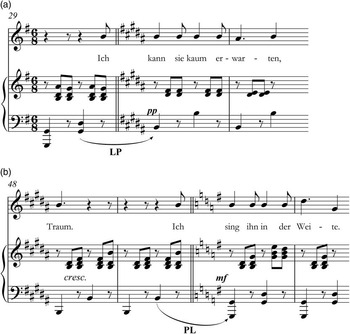
Compare, for example, the modulation in ‘Der Musensohn’ (D. 764), which Brian Newbould has so colourfully called a ‘shotgun migration’.Footnote 30 Fortuitously, the transposition of the final published version of ‘Geistes-Gruß’ shown in Example 1f shares the same harmonies across the bar line as ‘Der Musensohn’ in Example 2b.Footnote 31 As ‘Der Musensohn’ and Example 1f illustrate, Schubert did not always feel silences or pauses were necessary to prepare the entry of a new key. Nor, clearly, did he always feel that an intermediate dominant was necessary, which, as we saw earlier, contemporary theorists would have recognized not only as an appropriate means – albeit one to be used sparingly – of producing contrast or a dramatic effect but as the defining feature of the distinction between a change of key and a modulation. Despite both songs involving the same harmonies and neither containing an intermediate dominant, the effect of the two PL transformations is palpably different because of the voice-leading.Footnote 32 By placing the common tone in the voice, the juxtaposition between B major and G major in ‘Der Musensohn’ is rendered ‘more agreeable’ and ‘more soft and flowing’, as Weber advised. Moreover, Schubert treats this modulation as reversible, as shown by Example 2. I shall return to this last point shortly.
Reversible direct common-tone modulation in Schubert, ‘Der Musensohn’ (D. 764) (a) modulation from G major to B major, bars 29–31 (b) modulation from B major to G major, bars 48–51

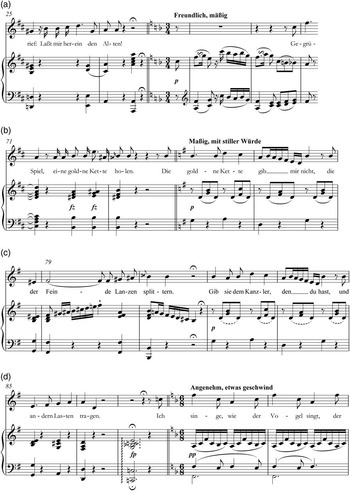
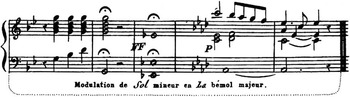
In another package that Schubert prepared for Goethe but ultimately did not send, Schubert included the ballade ‘Der Sänger’ (D. 149), composed in 1815.Footnote 33 Like ‘Geistes-Gruß’, ‘Der Sänger’ is a multi-sectional song that changes key – in fact, many more times than ‘Geistes-Gruß’. Here we see Schubert adopt a number of different modulatory strategies between the various sections in the song, all strategies that contemporary theorists showcased in their treatises as mechanisms for softening the harshness of remote keys. However, it is not until deep in the middle of the song that Schubert, as it were, seems to indulge the favourite strategy of his contemporaries. The modulation from a local D major to F major (shown in Ex. 3d) is virtually a textbook sample of how to incorporate an intermediate dominant within a pregnant pause between two remote keys. I say ‘textbook’ for it resembles Reicha’s suggestion (reproduced in Ex. 4) on how to introduce a distant key through a fortissimo dominant, which in this case Reicha demonstrates through a unison.Footnote 34
Schubert, ‘Der Sänger’ (D. 149) (a) bars 25–29 (b) bars 71–74 (c) bars 78–82 (d) bars 85–89

Reicha, Cours de composition, 60: example of an intermediate dominant between two distant keys

Earlier in the song, Schubert twice opts for a direct modulation, omitting any intermediate dominant. As shown in Examples 3b and 3c, in going from B major to G major and B minor to G major respectively, he emphasizes the common tone
 $$\raster="rg15"$$
in the voice just as we saw in ‘Der Musensohn’. However, writing ‘Der Sänger’ some seven years before ‘Der Musensohn’, he injected a long pause between the two harmonies – yet another tactic recommended at the time to mitigate the remote modulation: as Reicha put it, ‘the longer the silence, the sweeter the change of key’.Footnote
35
As mentioned earlier, the beginning of ‘Der Sänger’ is strikingly similar to ‘Geistes-Gruß’. It also modulates at the point where there is a shift from recitative to accompanied song. ‘Der Sänger’ opens in D major, and, as shown in Example 3a, the recitative ends in the dominant with a PAC cadence onto A major, which is followed by a rest with a fermata over it; F major ensues, producing another local PL transformation. In this case, it seems Schubert saw no need to provide Goethe’s ears with an intermediate dominant chord to prepare the entry of the lyrical melody in the new key of F major.
Yet, on another level, it may be inaccurate to compare the openings of ‘Der Sänger’ and ‘Geistes-Gruß’ and conclude there is no intermediate dominant at all in ‘Der Sänger’, for an apparently small detail in its melody has a subtle yet profound harmonic effect: instead of both the upbeat and downbeat of the vocal line remaining on
 $$\hat{5}$$
of the new key, as is consistently the case in all versions of ‘Geistes-Gruß’, the melody of ‘Der Sänger’ begins with an upbeat
$$\hat{5}$$
that moves to a downbeat
$$\hat{1}$$
(Ex. 3a). To be sure, on entry of the lone Ĉ a first-time listener will momentarily hear a negation of the A major sonority in favour of A minor, only to discover in hindsight – on hearing the downbeat of bar 27 – that it is in fact a brief dominant upbeat that prepares for F major. As Weber points out, subsequent hearings of moments of such ambiguity are different: familiar as the ear now is with where the Ĉ is headed, it will be perceived as
$$\hat{5}$$
earlier, rather than solely in hindsight, although the ‘Mehrdeutigkeit’ of the initial hearing can also be relished.Footnote
36
In these situations, performers invariably linger on such
 $$\hat{5}-\hat{1}$$
gestures, instinctively enacting the kind of advice given by Weber and others to take more time to render the succession more acceptable to the ear.
In sum, the repertoire of modulatory strategies examined so far mostly involves examples of PL, but also of LP and PR. Looking more broadly at Schubert’s œuvre and at the harmonic implications of the pitch content and voice-leading possibilities between other kinds of third relations brings out an additional aspect of Schubert’s aesthetics of the intermediate dominant. More specifically, looking at the details of Schubert’s modulatory strategy in a song that cycles through a descending circle of fifths, which provides, as it were, ready-made and longer-term dominant preparations, unexpectedly highlights the special quality of a coveted feature of intermediate dominants that we have not yet encountered, namely those intermediate dominants whose root forms a common tone with both harmonies in the third relation that surrounds it. This quality requires, as we shall see, special and rare harmonic and voice-leading conditions from a theoretical point of view but is desirable from an aesthetic point of view, for it satisfies the condition of connection to both the previous key and the new one, a connection widely advocated by early nineteenth-century theorists.
That song is ‘Don Gayseros I’ (D. 93), a song that has been described as ‘undeniably strange and experimental’.Footnote 37 Composed most likely before ‘Geistes-Gruß’ and ‘Der Sänger’, it contains no fewer than 14 stanzas.Footnote 38 Apart from the first two stanzas, which are both in F major, each new stanza incurs a new key. The song proceeds through two sets of a descending cycle of fifths, which are separated by a third relation – from B to G major, no less. The first cycle covers the following major keys: F, B-flat, E-flat, A-flat, D-flat, G-flat and B. A break in the pattern brings about G major, and this time the PL transformation does not emphasize the common tone (see Ex. 5e). G major launches the next cycle of descending fifths covering C major, F major, B-flat major, E-flat major, A-flat minor, which soon switches to A-flat major, where the song ends.
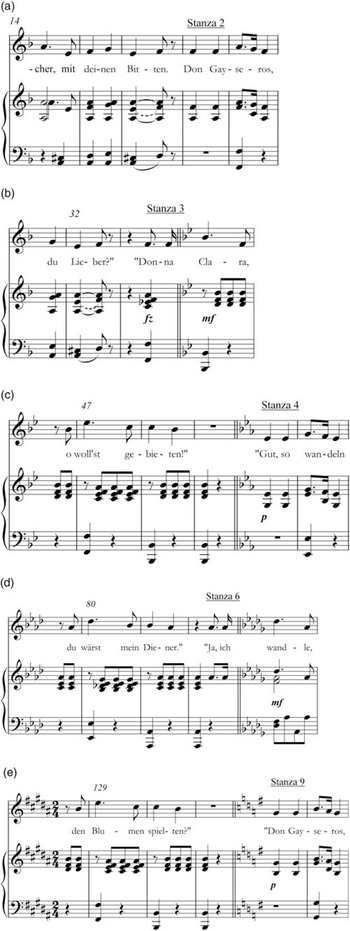
Schubert, ‘Don Gayseros I’ (D. 93), transition between (a) stanzas 1–2, bars 14–18 (b) stanzas 2–3, bars 31–34 (c) stanzas 3–4, bars 46–51 (d) stanzas 5–6, bars 79–83 (e) stanzas 8–9, bars 128–133

The main strategies that Schubert uses in ‘Don Gayseros I’ to get from one stanza to the next are given in Example 5a–e (the Example shows the types of key changes in the order in which they appear in the song and not in the order they are discussed here). The pervasive descending fifths could so easily have allowed Schubert simply to treat each key in the cycle as the dominant to the next.Footnote 39 However, it is not until stanzas 3–4 (B-flat–E-flat) that he exploits this option, simply dropping down a fifth to the new tonic after a silence, as shown in Example 5c (this procedure is repeated between stanzas 6–7, 10–11 and 12–13). A variant of this is employed only once, namely between stanzas 5–6 (A-flat–D-flat). As shown in Example 5d, the change in contour to the opening melodic line of stanza 6 makes even more explicit the fact that one key in the descending cycle serves as the dominant to the next – by drawing out the common tone.
Although Schubert avoided such straightforward fifth motion in all other junctures between stanzas, he was nonetheless attentive to preparation of the new key in a manner that again echoes early nineteenth-century theoretical thought on the use of intermediate dominants. The pattern of localized thirds within a broader descending fifth relation first appears between stanzas 2–3 and is repeated between stanzas 4–5, 7–8, 9–10, 11–12, and 13–14 (see Ex. 5b). The second stanza begins in F major, modulates to D minor, which is articulated with an IAC, and the third stanza ensues in B-flat major. Again, thus, Schubert crafts a local descending major third relation between the two sections of the song. However, this time the harmonies are not modally matched. Instead they form an L transformation, and therefore there are two common tones, not one, between the two triads. The additional common tone,
 $$\vskip -2pt \raster="rg46"$$
, possesses a powerful tonal function: it is the dominant pitch (
$$\hat{5}$$
) of the ensuing triad, B-flat major. Observe how Schubert exploits this confluence of voice-leading events and tonal function: the IAC places
$$\vskip -2pt \raster="rg44"$$
as
$\hat{3}$
of the D minor triad in the vocal line; the
$$\vskip -2pt \raster="rg47"$$
is retained in the voice to begin the next stanza, where it serves as the
$$\hat{5}$$
in the
$$\hat{5}-\hat{1}$$
melodic opening of the vocal melody; Schubert harmonizes the
$$\vskip -2pt \raster="rg45"$$
in bar 33 with a fully-fledged root-position dominant-seventh chord – emphasized by a forzando, no less.
Earlier I mentioned that I would return to my observation that Schubert treated the ‘shotgun migration’ in ‘Der Musensohn’ as reversible (Ex. 2). As observed earlier, he deployed it in both directions within the same song. However, what I wish to focus on henceforth is how certain tonal attributes that are latent in the pitch content of a transformation are not reversible. The potent use of the dominant in the L transformation of Example 5b is a case in point. To be sure, from a purely theoretical perspective, the L transformation itself is intrinsically reversible: indeed its special quality for neo-Riemannian (or transformational) theorists is that it possesses the unique feature (along with R and P) of being its own inverse because – to illustrate through the thirds in Example 5b – L applied to D minor yields B-flat major and L applied to B-flat major yields D minor. However, only in one direction – from D minor to B-flat major – is there a common tone (namely
$$\vskip -2pt \raster="rg38"$$
) that is
$\hat{3}$
of D minor but serves the vital tonal role of
$$\hat{5}$$
of the destination triad. In the other direction – major to minor –
$$\hat{5}$$
(Â) of D minor is not a common tone with the B-flat major triad.
This may seem an obvious point but it attunes us to an important compositional detail. If an intermediate dominant or rather its single pitch representative
$$\hat{5}$$
is to be introduced between two harmonies a third apart, then the smoothest option is also the rarest from a theoretical point of view. In the case of third relations, only four scenarios provide such smooth transitions. In addition to the scenario just described, R going from major to minor shares the property. That is, between, for example, C major and A minor, Ê can be both extracted from C, where it is a
$\hat{3}$
, and used to prepare A, where it serves as a
$$\hat{5}$$
. The reverse will not generate the same smooth move because Ĝ, which is
$$\hat{5}$$
of C, does not belong to A minor. There are two other chromatic-third relations with this property, neither of which is employed in the examples discussed in this article; but for the sake of completeness, I will mention them here. One is LP involving modally matched minor triads descending by major third; the other is RP involving modally matched major triads descending by minor third. For all other third relations,
$$\hat{5}$$
of the destination triad will also always be a displaced tone with respect to the first triad. The difference in the aural effect is striking. Witness (once more) the example of ‘Der Sänger’ where the
$$\hat{5}$$
(Ĉ) of F major is a displaced tone in the PL transformation from A major to F major (Ex. 3a). As a new note in the context of the transformation, its appearance would therefore have been more startling to Schubert’s contemporaries than the
$$\hat{5}$$
(
$\vskip -2pt \raster="rg39"$
) to the new key in the L transformation in ‘Don Gayseros I’ shown in Example 5b.
Indeed, the theoretical implications of this are profound. It is worth bearing Example 5b in mind and revisiting Example 5d, the lone instance in ‘Don Gayseros I’ where Schubert drew out the common tone in the descending fifth relation. Example 5d represents convention: there is a dominant–tonic relationship, whereby the root of the dominant is the fifth of the tonic;
$$\hat{1}$$
becomes
$$\hat{5}$$
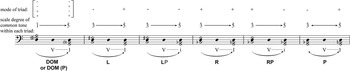
. In Example 5b (and other examples I am about to turn to), this common tone is dressed in new harmonic clothing, so that instead of a fifth relation occurring between two sections, the first chord is changed so that a third relation appears. From a theoretical point of view, we can work out all possible scenarios for this. As shown in Example 6, where DOM is the tonal model and
 $\raster="rg21"$
is our common tone, the first harmony in the other transformations is simply moved around the common tone to produce L, R, RP, LP, P.Footnote
40
The plus (+) and (−) signs above the triads in the example make clear the order of major (+) or minor (−) harmonies in the transformations. As we shall see in our next example, Schubert explores a subset of these, namely L (−+), R (+−), and P (+−), and they appear in sonata form precisely at the formal junctures where one expects a DOM (++) transformation. In an era obsessed with the enumeration of all possible harmonic juxtapositions, yet consumed by the aesthetic need to make them gentle, the L and R transformations – from minor to major and from major to minor respectively – held a special power quite apart from being the diatonic thirds: they were not only maximally smooth but also possessed a latent capacity for dominant preparation. Still, to harness this power required attention to the details in the voice-leading.
Possible transformations where
$$\hat{5}$$
of second triad is also a common tone with first triad, demonstrated with ÞD as the common tone.

The Intermediate Dominant: A View from the Medial Caesura
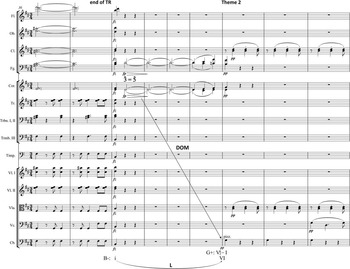
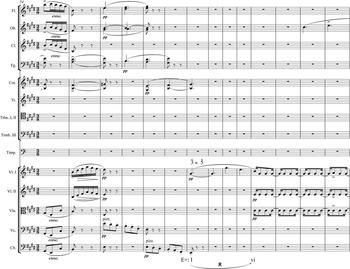
Perhaps the quintessential example of an L transformation that Schubert configured with smooth voice-leading and a pronounced use of an intermediate dominant common tone appears in the first movement of the Unfinished. As shown in Example 7, the transition (TR) ends in the tonic B minor and the secondary theme (S) – the famous lyric theme played by the cellos – enters in the key of G major. The intermediate dominant appears instead of the silence of the ‘medial caesura’ (MC), which Hepokoski and Darcy have coined the ‘caesura-fill’ (CF.).Footnote
41
The common tone changes from
$\hat{3}$
to
$$\hat{5}$$
within the tonic triadic contexts of TR and S, but the function of the common tone as DOM of the key of S is further emphasized by the cadential move into the new theme (bars 41–42), providing as it does both pre-dominant and dominant intermediary harmonies. Observe also in the details of the ending of TR and beginning of S how the voicing of the common tones emphasizes the smoothness of the overall L transformation. Most of the instruments play
$$\vskip -2pt \raster="rg40"$$
and
$\vskip -2pt \raster="rg41"$
in the B minor chord that ends the transition. The clarinets continue their common tones after the four-bar break, doubled in the violas. Only the horns and bassoons guide the ear to the displaced pitch from
$\vskip -2pt \raster="rg42"$
♯ to Ĝ, between bars 38 and 42 – but not, as mentioned earlier, until enough time has passed for the ear to absorb the common tone
$\vskip -2pt \raster="rg25"$
transform from
$\hat{3}$
of the first key into
$$\hat{5}$$
of the next, which I have also assigned the transformation label DOM in the Example 7. The following vivid description captures Charles Fisk’s sense of awe as he traces the common tone:
This D is already literally present in the fortissimo cadential B-minor triad that immediately precedes it … . By suddenly coming alone … this D also intrudes upon that cadence, giving the impression of an unprepared entrance … . Like a stimulus that activates a memory, this unison D seems to come both from outside and from within, from both near and far. Again like such a stimulus, the D changes meaning as it sounds, metamorphosing from
$\hat{3}$
of B minor into
 $\hat{5}$
of G major.Footnote
42
Schubert, Unfinished Symphony, mvt 1, bars 36–44

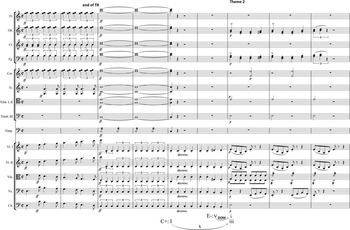
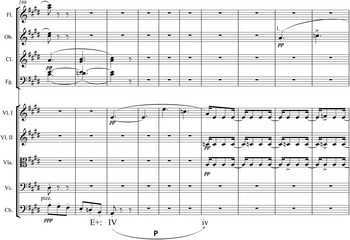
The transition in the exposition of the first movement of the Great C-Major Symphony is a perfect illustration of how the tonal implications found in the pitch material of the L transformation are not reversible. In the Great Symphony, the TR once again ends in the tonic key and S begins a third away. This time, however, the tonic is major and the new key is minor (see Ex. 8). Significantly, the transitional procedure is identical in concept to the procedure found in the Unfinished. However, as observed above, because the L transformation goes from major to minor it means that, when C major transforms into E minor, the dominant
$$\vskip -2pt \raster="rg43"$$
of the destination key is not available as a common tone (and nor does the B major triad share any other common tones with C major). However, as shown in Example 8, at the very last moment, Schubert opts to articulate the new key with its own dominant triad.
Schubert, Great Symphony, mvt 1, bars 128–136

Modern ears are less attuned to these particular details. Modern studies of Schubert’s transitions compare his habits to those of eighteenth-century composers and particularly to Mozart.Footnote 43 This is perfectly logical, as this was the music that Schubert played and grew up absorbing. However, this emphasis on an eighteenth-century formal outlook rather than the mechanics of modulation described by Schubert’s contemporary theorists has often resulted in the details of Schubert’s caesura-fills being ignored in favour of analysing the unorthodox key relationships between the TR and S formal and harmonic signposts. Webster summarized this enterprise thus:
Schubert also finds unorthodox means of preparing his unorthodox keys. Often he does not establish keys, but juxtaposes them – by a brief, frequently abrupt modulation through a common tone or pivot chord. Or he prepares some key other than the one in which the second group actually begins. Or he makes a complex progression though several remote keys, the eventual goal remaining uncertain until the last moment.
Many of his transitions are simple pivot-chord or common-tone modulations.Footnote 44
According to Webster, Schubert’s attitude towards the dominant is to blame – both in terms of its function as a preparatory harmonic and as a pole to the tonic key. As he claims, Schubert’s ‘antipathy to the dominant animates his [choice of harmonic goals for his] transitions’ and his ‘aversion to the dominant’ explains his choice of remote keys over the traditional dominant in the secondary thematic unit of major-key sonata forms.Footnote 45
Tellingly, in his seminal article on Schubert’s sonata forms, James Webster analysed the transition of the Unfinished as ‘a pure common-tone modulation’, and he observed in the details that ‘the horns reinterpret the tonic triad pitch D (
$\hat{3}$
) as
$$\hat{5}$$
of G major’.Footnote
46
By contrast, he observed that, in order to arrive in the new key in the Great Symphony, Schubert ‘simply reinterprets the tonic cadence [C major] in m. 132 as
 $$\hat{6}$$
in E minor, leading directly to the second theme’.Footnote
47
Nowhere does he mention the presence of the brief dominant before the entry of the second theme. Similarly, in her taxonomy of Schubert’s transitions, Susan Wollenberg puts these transitions in the same category, arguing that they are both cases ‘where apparently no new key is prepared’.Footnote
48
One of the reasons these dominants are so easily missed (apart from, in the case of the Great, its sheer brevity) is that modern theorists tend to focus on different harmonic and formal details, notably what key sections are in, how they begin and end, and what key-relations they exhibit, rather than on the connective tissue between them. Put simply, they are interested in the harmonic profile of TR and S, and for them it is the duty of TR to prepare for S.
According to the theories of Reicha and Weber, when two sections are in different keys, it can fall to the intermediate dominant to perform the duty of preparation for S. Therefore, in both of these symphonies, the dominant is placed precisely where it ought to go: between two sections, in the silence. In this respect, Schubert’s penchant for closed forms or self-contained lyrical structures within his sonata forms was conducive to the modulatory strategy outlined by early nineteenth-century theorists.Footnote 49 According to these theorists, a single intermediary harmony or pitch was sufficient to cushion the juxtaposition of closely related keys (both thirds in these Symphonies are diatonic).Footnote 50 Here we begin to get a sense of an early nineteenth-century hearing of these moments: certainly Schubert’s harmonic juxtapositions were novel within sonata form but the manner in which he switched from one key to the next was in line with contemporary aesthetics of dominant preparation even for symphonic music.Footnote 51
In fact, for reasons already given and having everything to do with the nature of the L transformation, Schubert’s deployment of the intermediate dominant in the caesura-fill in the Unfinished would have represented an ideal type for Reicha and Weber, in a way that his use of the dominant in the Great would not. And it is to this I now turn.
In the caesura-fills in the second movement of the Unfinished, Schubert understates the intermediate dominant in a manner that seems oddly attentive to it. The modulations in the second movement complement the L transformation of the first: Schubert explores R and P, as if to complete a kind of study on how to capitalize on transformations that satisfy the condition of having
$$\hat{5}$$
of the tonic key of S also be a common tone in the triad at the end of TR.Footnote
52
The transition in the exposition of the second movement seems at first to attempt the same modulatory tactic as the analogous place in the first movement (see Ex. 9). Weber helpfully reminds us of a truism in his treatise: ‘what the ear has once heard in a certain passage, it will not only expect again, on the recurrence of the same passage but will sometimes even perceive beforehand’.Footnote
53
On hearing the first single note Ĝ♯ listeners are likely to ‘[foresee] … the direction which the modulation will take, and where it will come out’, accustomed and familiarized as they would be to the procedures in the first movement.Footnote
54
Their predictions would be right: the Ĝ♯ in Example 9 ultimately leads to C-sharp minor. However, the caesura-fill is not without further interest. Schubert avoids an exact replica of the first movement’s procedure of
$\hat{3}$
becoming
$$\hat{5}$$
becoming V before the entry of the second theme’s new key. Let us examine the details.
Schubert, Unfinished Symphony, mvt 2, bars 54–67

As shown in Example 9, TR to S is an R transformation, E major to C-sharp minor. Within the caesura-fill, Ĝ♯ emerges initially from E major
$\hat{3}$
and immediately gathers its function
$$\hat{5}$$
. I say immediately, if only because of the memory of the treatment of the common tone in the first movement. However, instead of bringing in a cadence to shore up the sense of the intermediate dominant, as he did in the first movement, Schubert introduces Ê, the second of the two common tones between E major and C-sharp minor. This Ê ignites a flurry of ‘Mehrdeutigkeit’, seemingly putting a retrospective question mark over Ĝ♯ as
$$\hat{5}$$
by reopening its interpretation as
$\hat{3}$
, while also anticipating the C-sharp minor goal. On entry of the second theme, however, it is re-asserted in hindsight as the dominant preparation. How, therefore, should listeners manage their expectations of the next caesura-fill in the recapitulation?
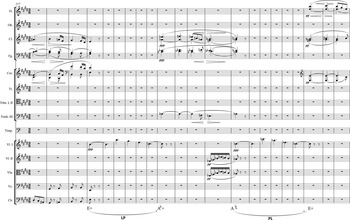
As illustrated in Example 10, the transition ends in A major. Again, the medial caesura is filled with a single line in the violins, and it seems that, as Weber put it, a listener is primed to expect a repetition of the previous strategy for the caesura-fill. A reasonable expectation, given past events, would be to anticipate a third relation and therefore the arrival of the secondary theme in F-sharp minor, which would incur the highly unusual choice of the supertonic in relation to the global tonic of the movement. However, Schubert does not extract
$\hat{3}$
of A major for the caesura-fill, which would parallel the previous caesura-fills. Instead he extracts
$$\hat{5}$$
of A major, and when Schubert makes the unusual move to A minor for the second theme, it seems that he is systematically going through the possible ways to exploit a common tone that can serve as a dominant of the key of S. Having explored L in the first movement and R in the exposition, he exhausted the possibilities that will yield third relations. And so onto P. An unusual choice, but other options shown in Example 6 would have felt like revisiting old territory and simply adjusting the mode of the destination. This caesura-fill is not a rehearsal of the procedures before either: it neither articulates a full dominant chord nor is it confined to the two common tones in the P transformation. Instead, the displaced pitch Ĉ♮ is introduced prior to the arrival of S.
Schubert, Unfinished Symphony, mvt 2, bars 199–208

Schubert does not stop there with his exploration of caesura-fill gestures in this movement, even though no more medial caesuras are expected to appear in a sonata form. The coda includes two more such gestures, although this time the caesura-fill is extended to six, rather than four, bars. As shown in Example 11, Schubert reaches the home tonic, E major, and then he swerves to A-flat major; shortly thereafter he does the reverse, A-flat to E. These LP and PL transformations respectively are, according to Weber’s tonal space, third grade relations. In the spirit of Weber’s and Reicha’s advice, the extension to six bars might be said to be an example of Schubert taking more time over a more chromatic modulation.
Schubert, Unfinished Symphony, mvt 2, bars 277–298

Now that he has two major triads a third apart on either side of the caesura-fill, we come full circle back to ‘Geistes-Gruß’: does Schubert, or does he not, devise a mechanism to incorporate an intermediary dominant between E major and A-flat major, and then A-flat major and E major? As shown in Example 11, he starts with
$$\hat{5}$$
of E major and spells out the entire E major triad, in the order
 $$\hat{5}-\hat{3}-\hat{1}$$
or
$$\vskip -2pt \raster="rg27"$$
– Ĝ♯ – Ê, before suddenly introducing Ĉ♮, which will be
$\hat{3}$
of A-flat major. There is no dominant preparation. Four bars later, he does the reverse, as if also to collapse all of the modulatory business of ‘Der Musensohn’ into a few bars. From the A-flat major in bar 290, Schubert spells out the full A-flat major triad, in the order
 $$\hat{3}-\hat{1}-\hat{5}$$
or Ĉ – Â♭ – Ê♭, followed by Ĉ♭, which serves as the enharmonic equivalent of
$$\hat{5}$$
of E major. Ah, an intermediate dominant. Nonetheless, the history of this gesture within this piece has by now disoriented the ear away from expecting any dominant preparation. More to the point, in the absence of the dominant pitch being a common tone in the transformation, Schubert sneaks it in at the very last moment, not unlike the way he did in the exposition of the Great Symphony. In both of these cases, the dominants may be fleeting, but they are there.
Structural De-V-iance: A Schenkerian Problem
Meanwhile, on the larger level, Schubert erases the dominant from all the expected formal moments in the second movement of the Unfinished Symphony in a manner that undermines the underlying structure of this sonata form from a Schenkerian point of view. There is no thematic unit in the dominant. But more troubling still, there is no dominant at the end of the development. The first theme of the recapitulation is an exact replica of the first theme of the exposition. In explaining the context of this recapitulation within the overall formal scheme of the movement, David Beach writes:
The form of that movement is a large two-part design, an exposition containing two distinct themes, the first in E major (I) and the second in C-sharp minor (vi), followed directly by a restatement, where the keys for the two themes are E major (I) and A major (IV).Footnote 55
According to Beach, the tonic restatement is ‘not real … in a structural sense’.Footnote 56 Beach’s analysis, which was based on a conversation he had with the eminent Ernst Oster, is in fact a standard Schenkerian response to the compositional features of Schubert’s Unfinished. Despite the clear return to the tonic, the problem with this tonic – the issue that makes it ‘not real’ – is the lack of a dominant to precede it: ‘There is no dominant leading to the restatement of the initial theme in the tonic, and thus no division of the structure’.Footnote 57 And it is not just a lack of a dominant immediately preceding it (in the retransition) that is the problem, but there is no structural dominant in the exposition either. Without a dominant in the second theme, closing or retransition, there is no dominant of division; without a dominant of division, there is no interruption; and without an interruption, there is no retaking of the primary tone to mark the recapitulation. Indeed, without an interruption, it becomes debatable whether the movement can even be understood to be in sonata form at all.
A reading of this movement from a Formenlehre perspective comes out differently. The lack of a dominant in the retransition does not render the recapitulation ‘not real’, although it does seem to make it appear as if by magic. Witness, for example, Brian Newbould’s view that the recapitulation is attained ‘by a magical harmonic surprise’.Footnote 58 Or, as Maurice J.E. Brown comments: ‘The horn establishes the keynote to the ear; the transition to E major is unconventional yet more satisfying than any conventional cadence’.Footnote 59 Or A. Brent Smith, who simply remarks that, after the PAC cadence in C major in bar 129:
For the next thirteen bars, Schubert is occupied with the modulation back to E major for the recapitulation of the first subject. In this passage the horn plays a great part, as it did in a similar passage in the C major Symphony (second movement). For a time the other instruments ignore the eloquent coaxing of the horn, the ’cellos and double-basses being particularly adder-like in refusing to hear the voice of the charmer. However, these instruments, perceiving that the majority are in favor of a change, move reluctantly from C to C sharp, and then, almost before we know, suddenly appear in E major.Footnote 60
Or Donald Francis Tovey: ‘The recapitulation shows every quality of freedom and life which only the greatest masterpieces can show. In choice of key, method of return to the tonic, et cetera, every technicality is individual and true’.Footnote 61 Or as Arthur Hutchings remarked upon presenting an example with only ten bars before the recapitulation: ‘among Schubert’s many modulations is the odd one belonging uniquely to this Symphony and movement’.Footnote 62 Or A. Peter Brown charts the movement as a sonata form without development, assigning the E major of the recapitulation a tonic status; the retransition draws no particular comment.Footnote 63 Or, as Susan McClary acknowledges in her famous analysis of Schubert’s construction of subjectivity in this movement of the Unfinished, the return to E major for the recapitulation is achieved through a ‘sleight-of-hand modulation’.Footnote 64
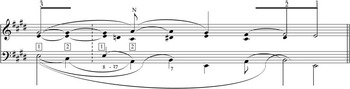
In all of these latter analyses, there is no sense that E major is undermined as an overall tonic in the form. A Schenkerian perspective of this movement is thus unique in this respect. David Beach’s analysis was really included in his article as an aside, yet to my mind it is the most radical sketch in his whole study. The other sonata forms feature non-tonic recapitulations, and although Beach considers non-interrupted interpretations for these, he explains that interrupted readings for them are possible. The second movement of the Unfinished, by contrast, must absolutely be interpreted as uninterrupted. As shown in his analysis, which is reproduced in Example 12,
 $$\hat{3}\,/\,I}$$
occupies the first theme and the
 $$\hat{2}$$
/V–
$$\hat{1}$$
/I the final cadence. In his reading, the second themes in VI and IV respectively form a descending arpeggiation, with the apparent tonic return of the first theme therefore functioning as the dominant of the subdominant. Indeed, the only structural dominant in this movement is cadential – and, curiously, Beach does not include bar numbers in his analysis, as if to leave open which cadence towards the end of the movement signals the coda.Footnote
65
Yet perhaps a lesson for Schenkerians is that seeking structural dominants in Schubert’s music can mean downplaying the apparently low-level dominants that mattered so much to his contemporaries.
Schenkerian analysis by David Beach of Schubert, Unfinished Symphony, mvt 2

Ernest Newman expressed the common wisdom that the design of Schubert’s TR to S is inappropriate for symphonic repertoire or sonata form itself: the four-bar transition in the Unfinished Symphony was ‘an evasion of the symphonist’s crucial problem of how to move convincingly from one main section of his structure to another’.Footnote 66 As I have argued in this article, far from abandoning his duties to prepare his abrupt modulations, Schubert identified in the range of diatonic and chromatic third relations that he employed a wealth of ways to insert the dominant. For the neo-Riemannian theorist, there are also powerful lessons to be learned from Schubert’s attention to detail. It is clear that there is more to transformations than the number of common and/or displaced tones that define them, and there is more to the various cycles and tonal spaces than a series of patterns of P, L and R transformations and their combinations. As we have seen, the specific voice-leading presentation between triads and the direction of a transformation (from major to minor; minor to major; or from this major triad to that etc.) can offer vital clues to a composer’s aesthetic sensibilities. In order to recapture that early nineteenth-century sensibility, it is imperative to listen out for whether or not, in the midst of Schubert’s hallmark abrupt modulations, there is an intermediate dominant – no matter how fleeting that salute to tradition may be.