Introduction
The white-chinned petrel Procellaria aequinoctialis L. is a large burrow-nesting petrel, breeding on a number of sub-Antarctic islands, with a worldwide population of some 1.2 million breeding pairs (c. three million mature birds, IUCN 2016). It comprises two subspecies: P. a. steadi breeds at the New Zealand sub-Antarctic islands and the nominate subspecies breeds on South Georgia (south-west Atlantic Ocean) and sub-Antarctic islands in the south-western Indian Ocean (Techow et al. Reference Techow, Ryan and O’Ryan2009). The nominate subspecies comprises some 681 000 breeding pairs on South Georgia (Martin et al. Reference Martin, Poncet, Barbraud, Foster, Fretwell and Rothery2009), 36 000 on the Prince Edward Islands (PEI; Ryan et al. Reference Ryan, Dilley and Jones2012), 23 600 on the Iles Crozet (Barbraud et al. Reference Barbraud, Marteau, Ridoux, Delord and Weimerskirch2008), 234 000 on the Iles Kerguelen (Barbraud et al. Reference Barbraud, Delord, Marteau and Weimerskirch2009), and<100 pairs on the Falkland Islands (Reid et al. Reference Reid, Lecoq and Catry2007). Population estimates of P. a. steadi are less accurate, but they are thought to number 153 000 pairs on Disappointment Island (Rexer-Huber et al. Reference Rexer-Huber, Parker, Sagar and Thompson2017), 22 000 on Campbell Island (Rexer-Huber et al. Reference Rexer-Huber, Parker and Thompson2016) and 59 000–91 000 on the Antipodes (range of two estimates; Sommer et al. 2010, Reference Sommer, Boyle, Fraser and Sagar2011). Populations on a number of breeding islands are thought to be decreasing, including those on South Georgia and Ile de la Possession in the Iles Crozet (Berrow et al. Reference Berrow, Croxall and Grant2000a, Barbraud et al. Reference Barbraud, Marteau, Ridoux, Delord and Weimerskirch2008). Due to these population reductions, attributed mainly to the impact of fishing activities, the white-chinned petrel is categorized as Vulnerable by the IUCN (IUCN 2016).
White-chinned petrels are the most commonly caught seabird species in the southern oceans on both pelagic (Petersen et al. Reference Petersen, Honig, Ryan and Underhill2009a, Ryan et al. Reference Ryan, Dilley and Jones2012) and demersal longlines (Barnes et al. Reference Barnes, Ryan and Boix-Hinzen1997, Nel et al. Reference Nel, Ryan and Watkins2002, Barbraud et al. Reference Barbraud, Delord, Marteau and Weimerskirch2009), with large numbers also killed in trawl fisheries worldwide (Watkins et al. Reference Watkins, Petersen and Ryan2008). Unlike many other seabird species, white-chinned petrels are active at night (Mackley et al. Reference Mackley, Phillips, Silk, Wakefield, Afanasyev and Furness2011), thus increasing their risk of being killed on longlines. Their deep-diving capabilities (mean maximum dive depth=8.9 m, Rollinson et al. Reference Rollinson, Dilley and Ryan2014) relative to albatrosses make them more susceptible to longline bycatch, as they are able to retrieve baited hooks from greater depths than shallow-diving species (Jimenez et al. Reference Jimenez, Domingo, Abreu and Brazeiro2012), and thus have been implicated in the bycatch of other shallower diving seabird species when they are displaced from the bait on returning to the surface (Jimenez et al. Reference Jimenez, Domingo, Abreu and Brazeiro2012). They frequently scavenge behind fishing vessels for discards and offal, which can form a significant component of their diet (Catard et al. Reference Catard, Weimerskirch and Cherel2000). Phillips et al. (Reference Phillips, Silk, Croxall and Afanasyev2006) found a large overlap between the distribution of white-chinned petrels from South Georgia and fishing fleets operating off South America.
White-chinned petrels undertake vast foraging trips during both the breeding and non-breeding seasons, ranging from the tropics to the ice-edge (Weimerskirch et al. Reference Weimerskirch, Catard, Prince, Cherel and Croxall1999). Birds have been tracked with both global location sensor (GLS) and global positioning system (GPS) loggers from a number of their breeding islands. Year-round movements of white-chinned petrels have been studied for birds breeding at South Georgia and Iles Kerguelen using GLS loggers. All tracked birds from South Georgia migrated to the Patagonian Shelf and shelf-break waters off South America (Phillips et al. Reference Phillips, Silk, Croxall and Afanasyev2006), whereas tracked birds from Kerguelen headed south to Antarctic waters or north-west to the Benguela current off South Africa (Péron et al. Reference Péron, Authier, Barbraud, Delord, Besson and Weimerskirch2010a). Both incubating and non-breeding white-chinned petrels from the Iles Crozet visit the South African continental shelf but are also known to venture south into Antarctic waters (Weimerskirch et al. Reference Weimerskirch, Catard, Prince, Cherel and Croxall1999). All these tracking studies are of the nominate subspecies. The only study of movements by P. a. steadi revealed that birds from New Zealand’s Antipodes Islands disperse to the west coast of South America during the non-breeding season (Sommer et al. Reference Sommer, Boyle, Baer, Fraser, Palmer and Sagar2010).
The spatial segregation of birds from different breeding colonies is not restricted to adults. By analysing DNA markers of white-chinned petrels killed as bycatch in South African and New Zealand fisheries, Techow et al. (Reference Techow, O’Ryan, Robertson and Ryan2016) concluded that all birds killed in the South African fishery were of the nominate subspecies whereas all those killed by the New Zealand fishery were P. a. steadi. This evidence, along with results of tracking studies, suggests that all age groups of the two subspecies forage in different regions, with the only potential overlap occurring between New Zealand and South Georgian birds while foraging off the west coast of South America (Phillips et al. Reference Phillips, Silk, Croxall and Afanasyev2006, Sommer et al. Reference Sommer, Boyle, Baer, Fraser, Palmer and Sagar2010).
Our study i) reports the year-round movements of white-chinned petrels from PEI by incorporating both geolocation (1019–1032 tracking days) and GPS data (14–33 tracking days), allowing us to investigate variation in foraging zones between individuals, seasons and years, and ii) determines areas of overlap between the species and trawl/longline fisheries. Given their preponderance in fisheries bycatch, an understanding of the year-round movements of white-chinned petrels has important conservation implications for the management of regional fisheries.
Methods
The GLS loggers were deployed on 20 white-chinned petrels caught in a colony close to the research station on sub-Antarctic Marion Island (46°52'S, 37°51'E) towards the end of the incubation period from 18–23 December 2009. The GLS devices (MK7, British Antarctic Survey, Cambridge) were attached to plastic leg bands and weighed 4 g (c. 0.3% body mass), well below the recommended 3% limit for flying birds (Phillips et al. Reference Phillips, Xavier and Croxall2003). Birds were sexed by measuring culmen length and depth. The breeding status of birds was inferred by examining GLS light data; continuous periods of darkness lasting 2–3 weeks during incubation were assumed to be birds incubating eggs in their burrows (see Phillips et al. Reference Phillips, Silk, Croxall and Afanasyev2006). Unfortunately we were unable to ascertain whether birds raised chicks successfully. Individuals for which no breeding activity was noted during the three year study were assumed to be pre-breeders as it is unusual for sexually mature white-chinned petrels to defer breeding for three consecutive years (Martin et al. Reference Martin, Poncet, Barbraud, Foster, Fretwell and Rothery2009). When birds were caught in 2009 they were on the surface at night, not in burrows, and subsequent examination of light traces indicated that only one was actively breeding at the time of deployment (the others were either non-breeders or had failed prior to deployment).
To retrieve the devices, tagged birds were searched for within the same colony in 2010–2012, but the birds were only recaptured during the pre-laying period in 2012 (02–20 October), when a determined effort was made to recover devices. The different breeding stages were defined as pre-breeding (October), incubation (November–December), early chick-rearing (January), late chick-rearing (February–April) and non-breeding (May–September; Cooper & Brown Reference Cooper and Brown1990).
The GLS loggers are much less accurate (c. 200 km accuracy; Phillips et al. Reference Phillips, Silk, Croxall, Afanasyev and Briggs2004) than GPS loggers or other tracking devices and only provide two location estimates per day, but they can provide long-term data on seabird movements due to their long battery life (Phillips et al. Reference Phillips, Silk, Croxall, Afanasyev and Briggs2004). They test ambient light levels every minute and record the maximum ambient light level every ten minutes. These records are used to determine local sunrise and sunset, and thus estimate location every 12 h. The loggers were calibrated at the deployment site for a minimum of 20 days before and after deployment; this was done to determine the solar elevation angle by analysing light recordings during the calibration period.
To augment the GLS tracks, GPS devices (CatTraq, 16 Mb memory, 230 mA lithium-ion battery, Mr Lee Technologies) measuring 45.7×30.5×12.7 mm and weighing 25 g (c. 2% body mass) were deployed on white-chinned petrels breeding on Marion Island during the late incubation (n=11; December 2012) and chick-rearing (n=13; January/February 2013) periods (roughly two months after GLS devices were retrieved). The GPS loggers were programmed using @trip PC (version 2.0) to sample a position every 60 min, which allowed the batteries to last several weeks, to ensure multiple foraging trips were sampled. Some of the birds also carried small temperature–depth recorder (TDR) devices (2.7 g, 35.5×9×11.5 mm) in addition to the GPS devices (one bird during incubation and six during chick-rearing; see Rollinson et al. Reference Rollinson, Dilley and Ryan2014).
Two software packages were used to analyse GLS data: BASTrack (British Antarctic Survey) was used to download and decompress the raw data, and a modified version of the R package TripEstimation (R Core Team 2015), based on Sumner et al. (Reference Sumner, Wotherspoon and Hindell2009), written specifically for the analysis of GLS data from large procellariiforms, was used to analyse the GLS tracks. All apparent outliers in the unfiltered locations were examined individually. Outliers might be generated by shading of the GLS when the bird was on water or when legs were tucked in under feathers during flight. During equinox periods latitudinal certainty is compromised, as day length depends weakly on latitude at this time. Therefore data 10 days either side of the equinoxes were excluded from analyses. Thus, kernel distributions for March and September are essentially based on the first ten days of the month, with the remainder of the month excluded. TripEstimation compensates for shading of GLS devices and uses Markov Chain Monte Carlo simulation methods in a Bayesian framework to produce the most likely path from corrected positions (Sumner et al. Reference Sumner, Wotherspoon and Hindell2009), with variables such as sea temperature, topography and speed. During the estimation process all locations which fell on land were excluded, as well as locations where the GLS recorded sea surface temperature (SST) that was outside the likely SST range (available from https://www.esrl.noaa.gov/psd/repository, accessed 28 May 2015) or included unrealistic distances between two points.
Predicted locations were examined using the AdehabitatHR package (Calenge Reference Calenge2006) to create kernel utilization distribution estimates. The smoothing parameter (h) was chosen ad-hoc based on the reference bandwidth method for unsmoothed GLS data, with grid size set as 1 km. To estimate the home range and core range of the tracked white-chinned petrels 95% and 50% of locations were encompassed, respectively (Laver & Kelly Reference Laver and Kelly2008). Recorded GPS tracks were analysed to obtain detailed information on the foraging movements of the petrels. Kernel utilization distributions were then created using ArcGIS version 10.2 (ESRI, Redlands, USA), with overlap (%) between kernels calculated by using geoprocessing tools in ArcGIS. A trip was defined as the period between leaving and returning to the colony, with only completed trips used for the analysis of trip duration (number of days) and distance (cumulative distance between positional fixes). Linear mixed-effects models with ‘individual bird’ as a random variable were used to determine whether trip duration or distance were affected by breeding stage. Values are presented as mean±standard deviation, unless otherwise stated.
Data on pelagic longline fishing effort from the Indian and South Atlantic oceans were obtained from the Indian Ocean Tuna Commission (IOTC) (www.iotc.org/data/datasets) and International Commission for the Conservation of Atlantic Tunas (ICCAT) (www.iccat.int/en/accesingdb.HTML). Demersal (toothfish) longline data for areas controlled by the Convention for the Conservation of Antarctic Marine Living Resources (CCAMLR; Indian Ocean, south of 45°S; Atlantic Ocean, south of 50°S) were provided by CCAMLR. Longline fishing effort from December 2009 to October 2012 was summarized into 5°×5° grid cells. The approximate location of the South African trawl grounds was determined based on Sink et al. (Reference Sink, Wilkinson, Atkinson, Sims, Leslie and Atwood2012). The overlap between white-chinned petrel utilization kernels and fishing effort was determined by illustrating the utilization kernels and distribution of the fishing effort.
Results
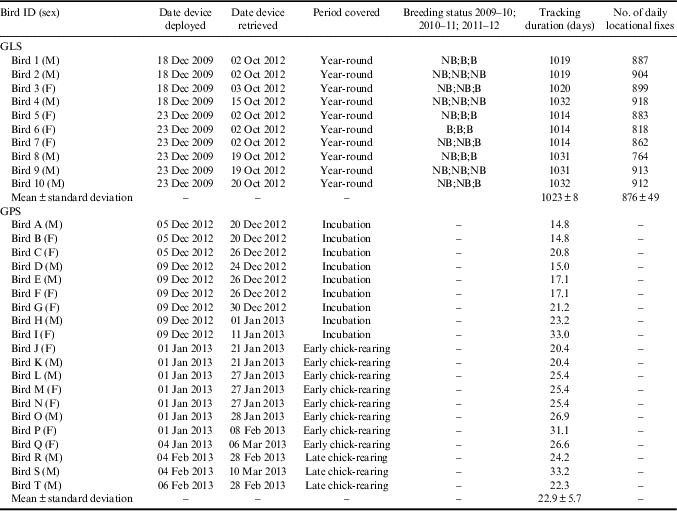
Of the 20 GLS devices deployed, ten (50%) were retrieved with useable data from six male and four female white-chinned petrels, after an average of 1023±8 days (range 1014–1032 days; Table I). Seven birds bred during the three year study period, while no breeding activity was noted for the remaining three birds, suggesting that they were either pre-breeders or failed breeders. Of the 24 GPS devices deployed, 20 devices (83%, ten females, ten males) were retrieved with useable data for an average of 22.9±5.7 days (range 14.8–33.2 days; Table I); nine during late incubation (December; 19.7±5.9 days, range 14.8–33.0 days) and 11 during chick-rearing (eight early chick-rearing in January and three late chick-rearing in February; average 25.6±4.0 days, range 20.4–33.2 days).
Summary of GLS (birds 1–10, December 2009 – October 2012) and GPS (birds A–T, December 2012 – February 2013) deployments on white-chinned petrels from Marion Island. The suspected breeding status of each GLS-tracked bird is indicated for the three successive breeding seasons as either breeding (B) or non-breeding (NB).

Foraging locations
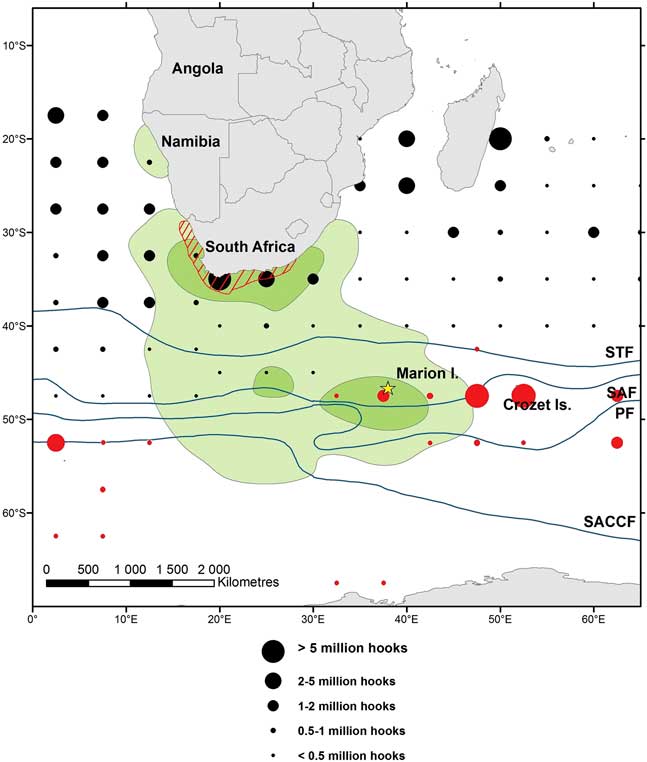
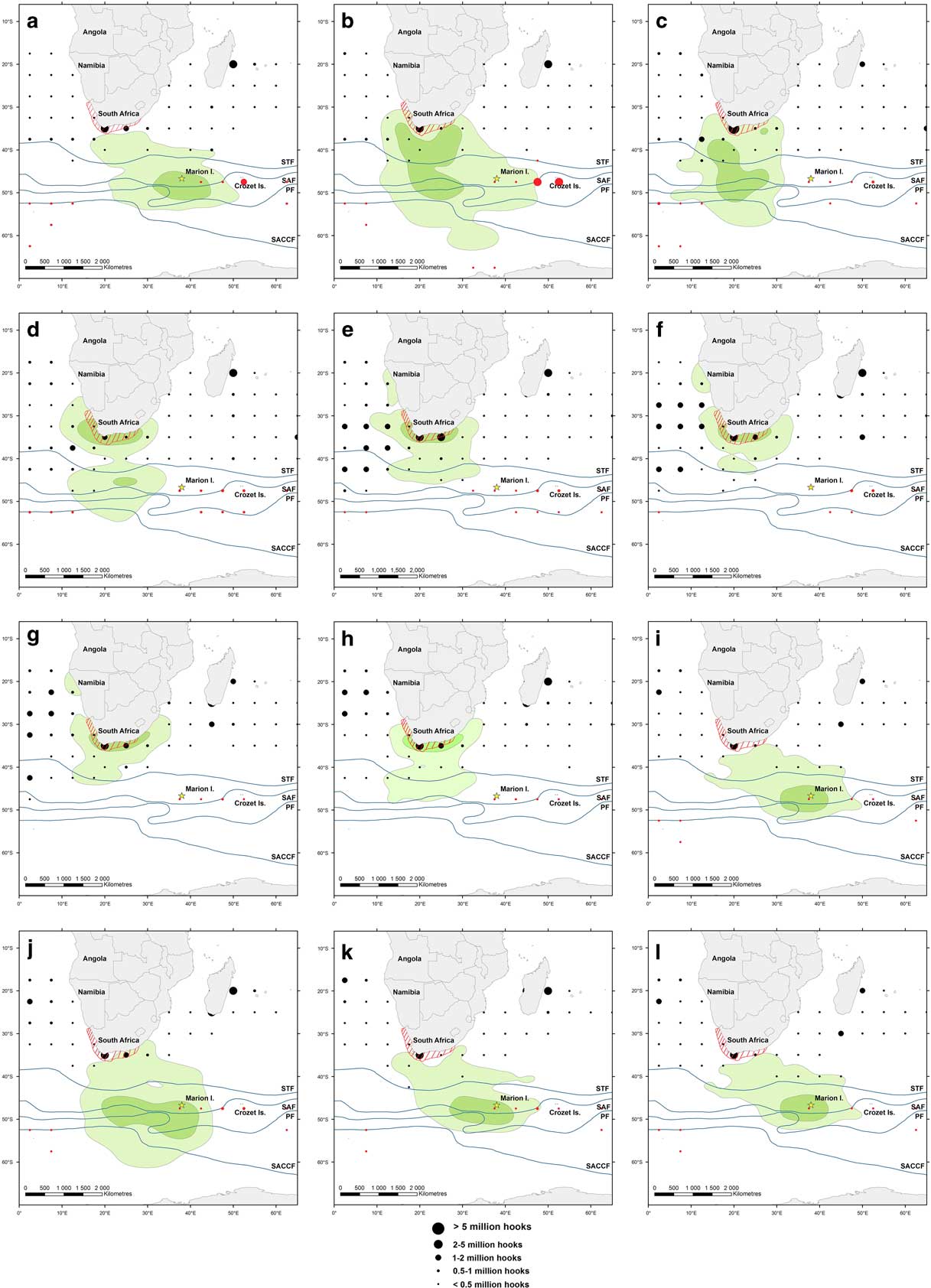
All birds (both GLS- and GPS-tracked birds) remained in the western Indian or eastern South Atlantic oceans off southern Africa or in the Southern Ocean (water masses south of the Subtropical Front and north of Antarctica), between 05–50°W. Three distinct core areas (50% use kernels) were identified for the ten GLS-tagged birds; around PEI, c. 1000 km west of PEI at c. 47°S, 25°E and along the Agulhas Bank off South Africa (Fig. 1). However, use of these core areas varied throughout the year (Fig. 2). Two individuals made foraging trips up the west coast of southern Africa as far north as southern Angola, while many of the birds foraged in areas south-west of Marion Island along the South-west Indian Ocean Ridge in the region of the Southern Antarctic Circumpolar Current Front (Fig. 1). Only one individual (bird 4) foraged in Antarctic waters as far south as 63°S.
Utilization distributions (50% density kernels=dark green, 95%=light green) of ten adult white-chinned petrels fitted with GLS loggers over a three year period (2009–12) from Marion Island overlaid with fishing effort for the same period. The total pelagic longline fishing effort (black circles) and demersal (toothfish) longline fishing effort (red circles) is presented per 5°×5° square between December 2009 and October 2012. The approximate location of the South African trawl grounds are highlighted in red. Yellow star=breeding colony on Marion Island, STF=Subtropical Front, SAF=Sub-Antarctic Front, PF=Polar Front, SACCF=Southern Antarctic Circumpolar Current Front.

Monthly utilization distributions (density kernels 50%=dark green, 95%=light green) of ten adult white-chinned petrels from Marion Island fitted with GLS loggers over a three year period (2009–12), overlaid with monthly fishing effort for the same period. The total pelagic longline fishing effort (black circles) and demersal (toothfish) longline fishing effort (red circles) is presented per 5°×5° square between December 2009 and October 2012. See Fig. 1 for differentiation between demersal and pelagic longline fishing in areas of low fishing effort. The approximate location of the South African trawl grounds are highlighted in red. Yellow star=breeding colony on Marion Island, STF=Subtropical Front, SAF=Sub-Antarctic Front, PF=Polar Front, SACCF=Southern Antarctic Circumpolar Current Front. As data around equinox periods are excluded, kernels for c. March, and i. September are based on considerably fewer location estimates.

Males and females visited similar areas (Fig. S1 found at http://dx.doi.org/10.1017/S0954102018000056), with no significant difference in 95% utilization kernels (t 9=2.78, P=0.232), despite males having slightly greater utilization kernels (5.4±0.9 million km2) than females (4.1±1.6 million km2). Both sexes utilized the same three core areas (50% kernels; Fig. S1) and had fairly high levels of overlap throughout the study (66%).
Interannual variation
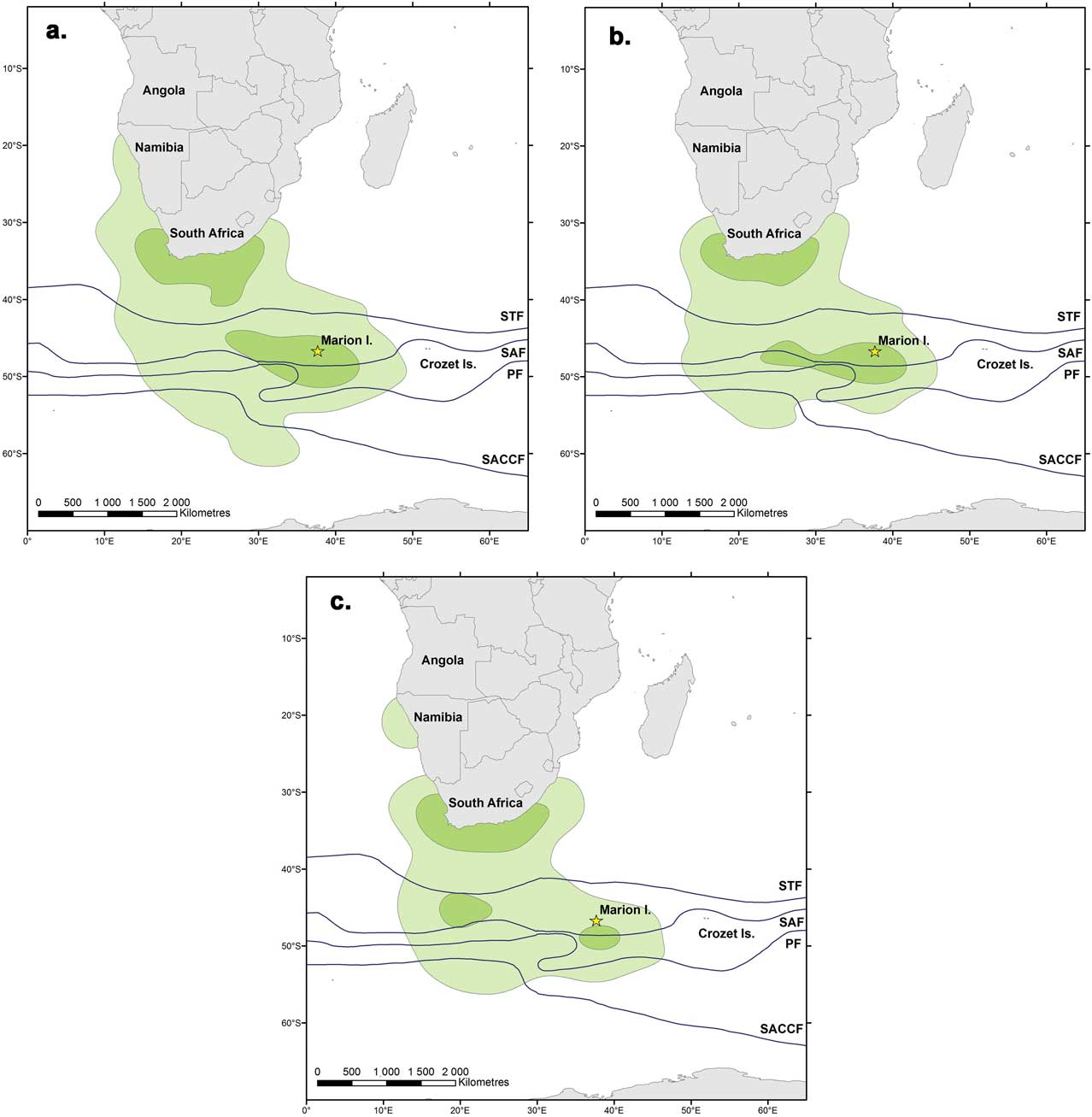
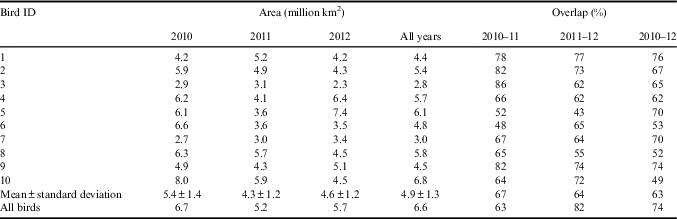
Year-round utilization areas of white-chinned petrels were similar between years (Fig. 3; Fig. S2 found at http://dx.doi.org/10.1017/S0954102018000056). Overlap in year-round 95% utilization kernels averaged 67% between 2010 and 2011, 63% between 2010 and 2012, and 64% between 2011 and 2012 (Table II). Apart from two individuals (birds 4 and 5), which visited northern Namibia/southern Angola in 2010 and 2012 but not in 2011 (Fig. S2), most individuals visited similar areas and did not differ markedly in distribution between years. Despite combined home ranges averaging larger in 2010 (5.4 million km2) than 2011 (4.3 million km2) or 2012 (4.6 million km2) (Table II), the differences between years were non-significant (ANOVA F=1.48, df=2, P=0.247).
Yearly utilization distributions (density kernels 50%=dark green, 95%=light green) of ten adult white-chinned petrels fitted with GLS loggers from Marion Island over a three year period: a. 2009–10, b. 2010–11 and c. 2011–12. Yellow star=breeding colony on Marion Island, STF=Subtropical Front, SAF=Sub-Antarctic Front, PF=Polar Front, SACCF=Southern Antarctic Circumpolar Current Front.

95% kernel distribution sizes of white-chinned petrels from Marion Island over three years (2010–12) using GLS data. Percentage overlap represents overlap of 95% contours between years.

Effect of breeding and non-breeding stages
Movement data were retrieved from two complete breeding seasons (October–April) and one near-complete breeding season (December–April) between December 2009 and October 2012. Of the ten GLS-tagged birds from which data were successfully retrieved only one bird bred in all three breeding seasons, three birds did not breed at all, with the remaining six birds breeding once or twice throughout the study period (Table I).
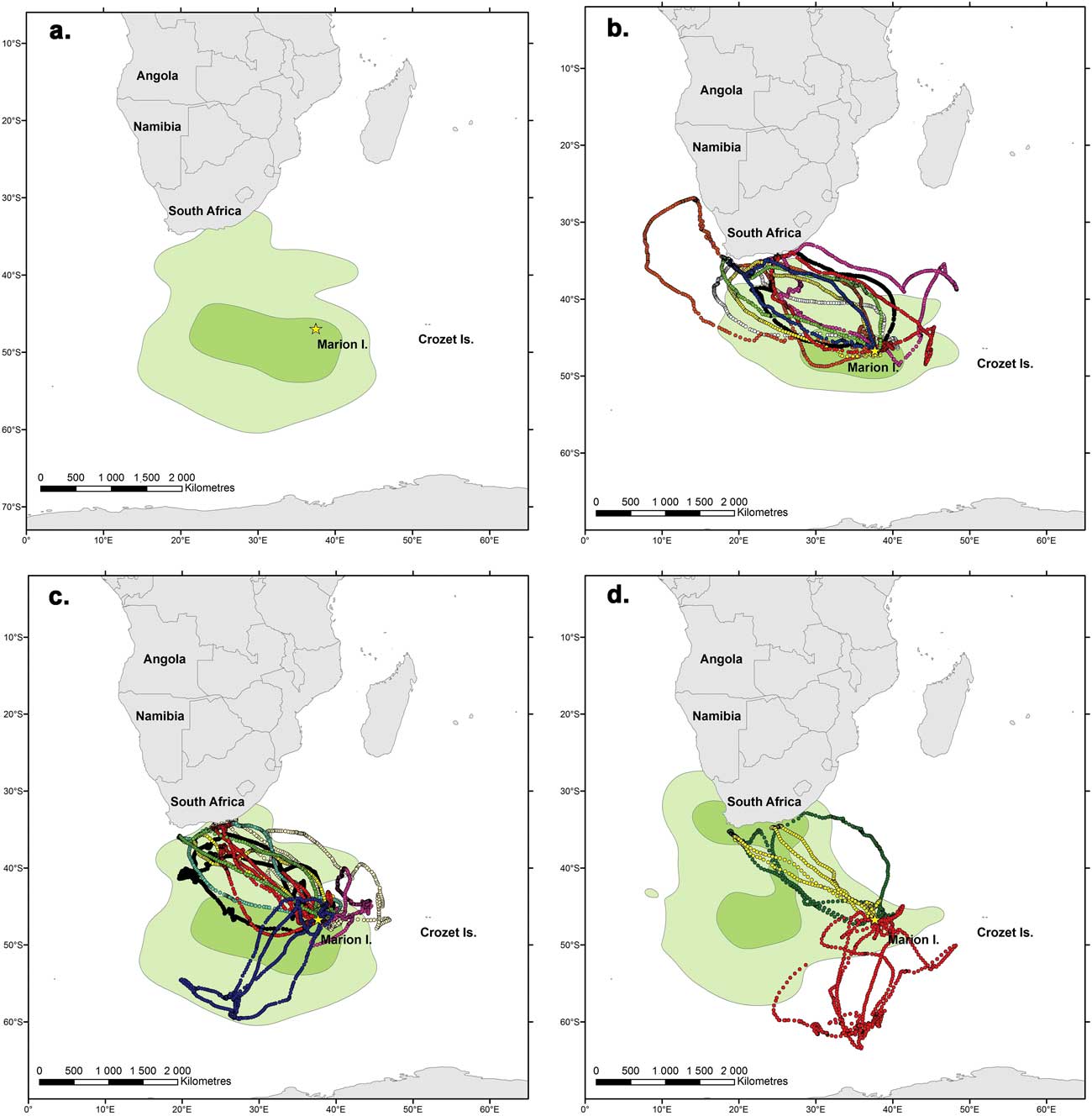
Breeding birds (combined pre-breeding, incubation and chick-rearing stages) ranged widely, with core areas (50% contours) concentrated from PEI up to 1500 km west, as well as along the south and south-west coast of South Africa. During the pre-breeding stage (October) kernel distributions were centred over PEI; however, these birds also ranged widely, as far as the south-east coast of South Africa (Fig. 4a). The core areas (50% kernel distributions) of incubating birds (November–December) were centred over PEI (Fig. 4b), with only one bird foraging off the south-east coast of South Africa. During early chick-rearing (January) birds occupied a similar range to incubating birds, centred around PEI (Fig. 4c), whereas during late chick-rearing (February–April) birds occupied a much larger range, with core areas along the South African continental shelf and c. 1500 km west of PEI (south of the Sub-Antarctic Front, Fig. 4d). Outside the breeding season (May–September), birds ranged even further afield, with most activity concentrated in waters off South Africa (Fig. 2e–i); two birds dispersed as far north as southern Angola and one bird reached southern Mozambique. Late in the non-breeding season (September), foraging activity was much further dispersed, with birds ranging from the South African coast to Antarctic waters (Fig. 2i).
Movements of white-chinned petrels at different stages of their breeding cycle. Ten adult white-chinned petrels from Marion Island (density kernels 50%=dark green, 95%=light green) fitted with GLS loggers over a three year period (2009–12). Coloured circles represent GPS tracks of other white-chinned petrels tracked from Marion Island during the 2012–13 breeding season during a. pre-breeding (October), b. incubation (November–December; GPS birds n=9), c. early chick-rearing (January; GPS birds n=8), and d. late chick-rearing periods (February–April; GPS birds n=3). Yellow star=breeding colony on Marion Island.

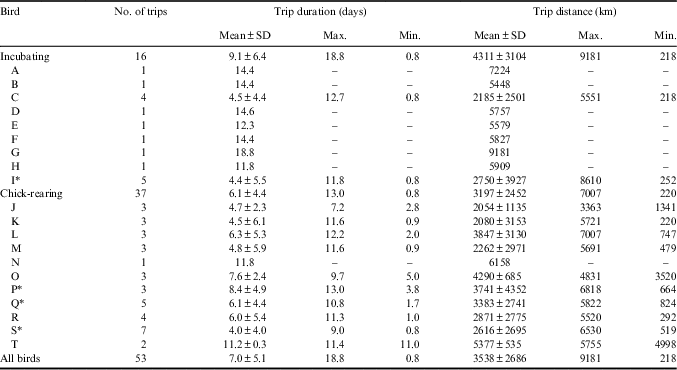
Of the GPS-tracked birds, incubating birds averaged longer trips (9.1±6.4 days) than chick-rearing birds (6.1±4.4 days; Table III), although this difference was marginally non-significant (linear mixed-effects model t 49=1.950, P=0.067). Incubating birds also covered greater distances per trip (4311±3104 km, maximum 9181 km) than chick-rearing birds (3197±2452 km, maximum 7007 km; Table III). However, this difference was also non-significant (linear mixed-effects model t 49=1.349, P=0.194). While undertaking foraging trips, distance covered per day was similar between incubating (470±82 km per day) and chick-rearing birds (501±99 km per day; t test t 20=0.746, P=0.465). During incubation all GPS-tracked birds visited South African waters, with one bird ranging up the west coast as far as southern Namibia (Fig. 4b). Chick-rearing birds either visited the south coast of South Africa or made trips south-west of Marion Island into Antarctic waters as far south as 63°S (Fig. 4c & d), with no individuals visiting both South African and Antarctic waters. Of the short trips (< 3 days duration), 65% (n=17) were to an area c. 200 km north or north-east of Marion Island. Of those birds that undertook multiple trips (n=12), nine (75%) either alternated between short (< 3 days duration) and long trips (>3 days duration) or undertook consecutive short trips, with three birds (all chick-rearing birds) undertaking consecutive long trips.
Summary of the durations and distances of white-chinned petrel foraging trips. Data from GPS loggers deployed during incubation and chick-rearing breeding stages. Trip distance refers to the cumulative trip distance per foraging trip.

* Birds undertook a trip that was not fully covered by the GPS logger.
SD=standard deviation.
Overlap with fisheries
Longline fishing effort (both pelagic and demersal combined) during the study period was greatest in the IOTC area (168.6 million hooks set, 59% of the total effort), with a maximum mean monthly effort per 5o x 5o grid cell of 0.8 million hooks set in May. Fishing effort in the ICCAT area was barely half that in the IOTC area (87.1 million hooks, 30% of total effort) and even less in the CCAMLR area (31.5 million hooks, 11% of total effort). Maximum mean monthly fishing effort per 5°×5° square in these areas occurred in April (0.5 million hooks) and February (1.4 million hooks), respectively. Overall there were low levels of overlap between white-chinned petrel 95% utilization distributions and longline fishing effort (Fig. 1). The only overlap between areas of high utilization by white-chinned petrels (50% kernel distributions) and intense longline fishing effort (>0.5 million hooks per month) occurred off the Agulhas Bank during the non-breeding season (May–September), which overlapped with intense pelagic longline fishing effort (Fig. 2). Similarly, there was large overlap between the core areas (50% kernels) used by white-chinned petrels and the South African trawl fishery, particularly during the winter months, between April and September (Figs 1 & 2).
Discussion
Our study is the first to report the year-round movements of white-chinned petrels from PEI. None of the tracked adults made any substantial east/west movements; all remained in the south-western Indian, south-eastern Atlantic or adjacent Southern Ocean between 05–50°W. The two largest core areas utilized, around PEI and the Agulhas Bank of South Africa, are highly productive waters (Kaehler et al. Reference Kaehler, Pakhomov and McQuaid2000, Shannon & O’Toole Reference Shannon and O’Toole2003) where abundant prey for white-chinned petrels is likely to occur. Several birds also visited eddies generated over the south-west Indian Ocean Ridge, south-west of Marion Island, which are key foraging areas for other large marine predators such as grey-headed albatrosses Thalassarche chrysostoma (Forster) (Clay et al. Reference Clay, Manica, Ryan, Silk, Croxall, Ireland and Phillips2016). Some birds also ventured up the west coast of southern Africa as far north as southern Angola. Here the cold, upwelling Benguela current fuels a highly productive region that supports large numbers of seabirds (Shannon & O’Toole Reference Shannon and O’Toole2003).
Both sexes occupied similar foraging areas, with little difference in home ranges between males and females. Catard et al. (Reference Catard, Weimerskirch and Cherel2000) did not find any difference in parental trip duration or in meal size between the sexes of white-chinned petrels tracked from the Iles Crozet, suggesting similar parental investment between the sexes (at least during the incubation and chick-rearing periods). They found that females spent more time searching for prey, whereas males generally made more direct commuting flights to productive areas, but this level of distinction would be hard to detect from the crude GLS estimates. Berrow et al. (Reference Berrow, Wood and Prince2000b) also reported that breeding males and females from South Georgia foraged in similar areas. Differences in home range or foraging range were not investigated in other studies on white-chinned petrel movements (Weimerskirch et al. Reference Weimerskirch, Catard, Prince, Cherel and Croxall1999, Phillips et al. Reference Phillips, Silk, Croxall and Afanasyev2006, Péron et al. Reference Péron, Authier, Barbraud, Delord, Besson and Weimerskirch2010a).
A male bias in fisheries bycatch (particularly longlining) of white-chinned petrels has been found in several studies (Ryan & Boix-Hinzen Reference Ryan and Boix-Hinzen1999, Petersen et al. Reference Petersen, Honig, Ryan and Underhill2009a, Rollinson et al. Reference Rollinson, Wanless and Ryan2017). This sex bias may be attributable to the larger size of males, which gives them a competitive advantage over the smaller females when foraging for bait and discards from fishing vessels, thus making them more likely to be caught as bycatch (Ryan & Boix-Hinzen Reference Ryan and Boix-Hinzen1999). Another possible reason for the sex bias in longline bycatch is a sexual segregation in foraging zones of white-chinned petrels; however, Ryan & Boix-Hinzen (Reference Ryan and Boix-Hinzen1999) found a very strong male bias in white-chinned petrel bycatch from vessels fishing close to breeding islands where sex ratios are assumed to be similar. The lack of sex-linked differences in foraging areas (Berrow et al. Reference Berrow, Wood and Prince2000b, Catard et al. Reference Catard, Weimerskirch and Cherel2000, this study) suggests that sexual size dimorphism and associated behavioural differences are the most plausible explanation for the sex bias in white-chinned petrel bycatch.
White-chinned petrel foraging ranges were fairly consistent between years, both across the small sample of birds tracked and within individuals. These findings are similar to those of Phillips et al. (Reference Phillips, Silk, Croxall, Afanasyev and Bennett2005), who recorded high levels of wintering site fidelity in black-browed T. melanophris Temminck and grey-headed albatrosses from South Georgia. In contrast, Dias et al. (Reference Dias, Granadeiro, Phillips, Alonso and Catry2011) found that individual Cory’s shearwaters Calonectris borealis Cory regularly shift their wintering sites between years, occasionally even alternating between the Northern and Southern hemispheres or between the Indian and Atlantic oceans.
Effect of breeding and non-breeding stages
Of the ten white-chinned petrels tracked with GLS loggers, seven bred during the study period. The three birds that did not breed at all were probably pre-breeding individuals because, although 15% of adults do not breed every year (Martin et al. Reference Martin, Poncet, Barbraud, Foster, Fretwell and Rothery2009), it is unusual for mature birds to have three consecutive breeding sabbaticals. It is thus more likely that these birds were not yet sexually mature. White-chinned petrels are thought to breed for the first time when they are c. 6 years old (Barbraud et al. Reference Barbraud, Marteau, Ridoux, Delord and Weimerskirch2008), but there is likely to be considerable variation among individuals.
Seabirds experience different foraging constraints during different stages of breeding, with chick-rearing birds under greater energy demands than incubating birds (Shaffer et al. Reference Shaffer, Costa and Weimerskirch2003). This typically restricts chick-rearing birds to forage closer to breeding colonies, especially during the early stages when chicks require small meals at regular intervals. Contrary to our results, Berrow et al. (Reference Berrow, Wood and Prince2000b) found that incubating white-chinned petrels from South Georgia ranged more widely than chick-rearing birds. Results from both GLS and GPS tracks in our study show chick-rearing birds ranging more widely than incubating birds, irrespective of chick age. GPS-tracked birds during chick-rearing visited both the South African coast and Antarctic waters; however, incubating birds only visited the South African coast. GLS tracks indicate a greater home range size during chick-rearing than during incubation. Perhaps the waters around PEI are more productive during the incubation period compared to chick-rearing and thus incubating birds do not need to range as widely to recover body condition. Previous tracking studies investigating white-chinned petrels have found that incubating birds took longer foraging trips and covered greater distances than during chick-rearing periods (Berrow et al. Reference Berrow, Wood and Prince2000b, Phillips et al. Reference Phillips, Silk, Croxall and Afanasyev2006, Péron et al. Reference Péron, Authier, Barbraud, Delord, Besson and Weimerskirch2010a). Delord et al. (Reference Delord, Cotté, Péron, Marteau, Pruvost, Gasco, Duhamel, Cherel and Weimerskirch2010) also found that incubating white-chinned petrels from Iles Kerguelen made long foraging trips (to Antarctic waters>60°S), whereas chick-rearing birds alternated shorter foraging trips over the Heard/Kerguelen shelf with longer trips to Antarctic waters, similar to some of the chick-rearing birds from our study.
White-chinned petrels from South Georgia made wide-ranging trips during the pre-laying exodus (Phillips et al. Reference Phillips, Silk, Croxall and Afanasyev2006), and our pre-breeding birds also dispersed more widely than during either incubation or early chick-rearing, with some birds reaching the South African coast. Almost all adult white-chinned petrels with enlarged gonads recorded as bycatch off South Africa were caught in the pre-breeding season (September–October; Rollinson et al. Reference Rollinson, Wanless and Ryan2017), with very small numbers caught during the incubation and early chick-rearing periods. The few birds with enlarged gonads caught during the incubation or early chick-rearing periods may have been failed breeders.
Two core areas were utilized by the non-breeding white-chinned petrels in our study, around PEI and into South African waters. All birds foraged off South Africa, whereas only three birds remained around PEI. In a study investigating non-breeding movements of white-chinned petrels, Phillips et al. (Reference Phillips, Silk, Croxall and Afanasyev2006) found that birds from South Georgia wintered along the Patagonian Shelf, in similar areas to incubating birds but generally further north. White-chinned petrels from Iles Kerguelen (Péron et al. Reference Péron, Authier, Barbraud, Delord, Besson and Weimerskirch2010a) and the Iles Crozet (Jaeger et al. Reference Jaeger, Connan, Richard and Cherel2010) wintered in similar areas to birds from Marion Island (current study), which suggests that the entire south-western Indian Ocean population may winter in the southern African region.
Overlap with fisheries
Large numbers of seabirds are killed each year by pelagic longline fisheries off South Africa, roughly two-thirds of which are white-chinned petrels (Petersen et al. Reference Petersen, Honig, Ryan and Underhill2009a, Rollinson et al. Reference Rollinson, Wanless and Ryan2017). Prior to the implementation of individual vessel limits for seabird bycatch in the South African pelagic longline fishery (in 2008), up to 1000 white-chinned petrels were killed each year (Petersen et al. Reference Petersen, Honig, Ryan and Underhill2009a), and in the 1990s an estimated 8000 white-chinned petrels were killed each year by the demersal longline fleet off South Africa (Barnes et al. Reference Barnes, Ryan and Boix-Hinzen1997). Fortunately, numbers killed on demersal longlines within the South African Exclusive Economic Zone (EEZ) are thought to have reduced considerably in recent years (Petersen et al. Reference Petersen, Honig, Ryan, Underhill and Goren2009b). There was also some overlap with pelagic longline fisheries off Namibia, where some 200 white-chinned petrels are estimated to be killed each year by both pelagic and demersal longline fisheries (Petersen et al. Reference Petersen, Honig and Nel2007). Our data show that adult white-chinned petrels from PEI overlap with pelagic longline fishing effort mainly off South Africa during the non-breeding/winter season. At this time of the year many white-chinned petrels visit South African waters (this study), which coincides with the period when pelagic longline fishing effort is at its highest in these waters (Rollinson et al. Reference Rollinson, Wanless and Ryan2017). The greatest levels of fisheries/petrel overlap occurred over the productive waters along the edge of the Agulhas Bank, where most seabirds are killed each year (Petersen et al. Reference Petersen, Honig, Ryan and Underhill2009a, Rollinson et al. Reference Rollinson, Wanless and Ryan2017).
There was very little overlap with legal demersal longline fisheries targeting Patagonian toothfish Dissostichus eleginoides Smitt; most areas of overlap were around PEI and further east towards the Iles Crozet. During the 1990s the toothfish fishery operating around PEI and adjacent islands caught birds at high rates, with white-chinned petrels the most frequently recorded bycatch species, representing c. 80% of bycatch (Nel et al. Reference Nel, Ryan and Watkins2002). White-chinned petrels were killed almost exclusively during their breeding season by toothfish vessels operating close to PEI (Nel et al. Reference Nel, Ryan and Watkins2002). As a consequence of a greatly reduced fishing effort and improved seabird mitigation measures, seabird bycatch in the PEI EEZ has declined to negligible levels in recent years, with only three birds (all white-chinned petrels) killed by toothfish fisheries in CCAMLR reporting areas between 2005 and 2014 (CCAMLR 2014). This ignores bycatch from illegal, unreported and unregulated (IUU) toothfish vessels, which is thought to be higher (Nel et al. Reference Nel, Ryan and Watkins2002). However, IUU fishing in the region has been significantly reduced in recent years (Nel Reference Nel2008).
Prior to the mid-2000s, demersal trawl fisheries killed large numbers of seabirds, including white-chinned petrels, off South Africa (Watkins et al. Reference Watkins, Petersen and Ryan2008). Fortunately, the introduction of additional mitigation measures has greatly decreased seabird bycatch by this fishery (Maree et al. Reference Maree, Wanless, Fairweather, Sullivan and Yates2014). However, white-chinned petrel mortality may be higher than recorded; the nocturnal habits of the species and difficulties of observing seabird interactions at night may result in the under-recording of this species’ bycatch (Maree et al. Reference Maree, Wanless, Fairweather, Sullivan and Yates2014). The lack of fisheries observers on-board the South African trawl fleet (c. 4% of annual effort; Maree et al. Reference Maree, Wanless, Fairweather, Sullivan and Yates2014) is also likely to result in the under-recording of white-chinned petrel bycatch.
Conservation implications
To ensure the protection of a species, particularly a wide-ranging seabird species such as the white-chinned petrel, it is important to understand its year-round movements (Lewison et al. Reference Lewison, Oro, Godley, Underhill, Bearhop, Wilson, Ainley, Arcos, Boersma, Borboroglu, Boulinier, Frederiksen, Genovart, González-Solís, Green, Grémillet, Hamer, Hilton, Hyrenbach, Martínez-Abraín, Montevecchi, Phillips, Ryan, Sagar, Sydeman, Wanless, Watanuki, Weimerskirch and Yorio2012). An understanding of seabird movements is also crucial for defining Important Bird Areas (IBAs) or Marine Protected Areas (MPAs) and assessing potential interactions with anthropogenic impacts (Lewison et al. Reference Lewison, Oro, Godley, Underhill, Bearhop, Wilson, Ainley, Arcos, Boersma, Borboroglu, Boulinier, Frederiksen, Genovart, González-Solís, Green, Grémillet, Hamer, Hilton, Hyrenbach, Martínez-Abraín, Montevecchi, Phillips, Ryan, Sagar, Sydeman, Wanless, Watanuki, Weimerskirch and Yorio2012). Our results confirm that there is little overlap in the at-sea distributions of the two white-chinned petrel subspecies. Most white-chinned petrel populations appear to disperse to different wintering regions (Techow et al. Reference Techow, O’Ryan, Robertson and Ryan2016), although there is considerable overlap between southern Indian Ocean populations (this study, Péron et al. Reference Péron, Authier, Barbraud, Delord, Besson and Weimerskirch2010a). With little or no movement between populations from South Georgia, southern Indian Ocean islands and New Zealand islands, these three populations could be regarded as separate stocks (Ryan et al. Reference Ryan, Dilley and Jones2012). White-chinned petrel bycatch off southern Africa is likely to impact populations from PEI, the Iles Crozet and Kerguelen, which together support a population of c. 294 000 breeding pairs (>1 million fully grown birds). This population can probably withstand additional mortality of c. 10 000 birds per year (e.g. Barbraud et al. Reference Barbraud, Marteau, Ridoux, Delord and Weimerskirch2008), which is far greater than the current combined bycatch estimates from fisheries off southern Africa and around sub-Antarctic islands.
Fishing mortality is not the only threat facing white-chinned petrel populations in the south-western Indian Ocean region. Another potential threat is the effect of climate change and how increasing temperatures might affect seabird species distributions. Krüger et al. (Reference Krüger, Ramos, Xavier, Grémillet, González-Solís, Petry, Phillips, Wanless and Paiva2018) predicted that climate change will cause white-chinned petrels to shift their distributions by almost 10° to the south, although surprisingly Péron et al. (Reference Péron, Delord, Phillips, Charbonnier, Marteau, Louzao and Weimerskirch2010b) predicted white-chinned petrels would shift their distributions northwards in response to climate change. White-chinned petrels are also impacted on their breeding islands by introduced predators, which occur on breeding islands supporting c. 42% of the worldwide population (see review of Southern Ocean islands with extant alien predators by Angel et al. Reference Angel, Wanless and Cooper2009). Rats Rattus spp. are significant predators of chicks at breeding sites on Ile de la Possession (Iles Crozet; Jouventin et al. Reference Jouventin, Bried and Micol2003) and cats Felis catus L. kill both adults and chicks on Iles Kerguelen (Pontier et al. Reference Pontier, Say, Debias, Bried, Thioulouse, Micol and Natoli2002). Since the eradication of cats from Marion Island in 1991 the white-chinned petrel population has increased faster than any other burrowing petrel, probably reflecting its greater resilience to attacks by introduced house mice Mus musculus L. (Dilley et al. Reference Dilley, Schramm and Ryan2017). Its increase at Marion suggests that current fishing pressure alone is unlikely to cause decreases in this population of white-chinned petrels. By comparison, the South Georgia population apparently continues to decrease, which is a major concern as it represents>50% of the global population (Martin et al. Reference Martin, Poncet, Barbraud, Foster, Fretwell and Rothery2009).
Studies on the at-sea distributions of adult white-chinned petrels from most of the species’ major breeding islands have shed more light on the foraging movements of the different populations. This information is important when considering conservation plans for the species, as well as how different populations may be affected by increased human-induced mortality and potential shifts in prey distribution related to climate change.
Acknowledgements
We thank Jaimie Cleeland for allowing us to use her modified R package to analyse GLS data. Otto Whitehead, Kim Stevens, Stefan Schoombie and Dominic Henry provided additional help with the analysis of GLS data. Kalinka Rexer-Huber provided useful insights and advice on white-chinned petrel breeding ecology. Logistical and financial support was provided by the South African Department of Environmental Affairs, through the South African National Antarctic Programme, the National Research Foundation and the University of Cape Town. We would like to thank D.W.H Walton and three anonymous reviewers for their helpful comments, which considerably improved the manuscript.
Author contributions
BJD and DD undertook deployment of the devices on the white-chinned petrels on Marion Island. DPR analysed the tracking data and took the lead in writing the manuscript. PGR supervised the project. All co-authors provided critical feedback, which helped shaped the research and manuscript.
Supplemental material
Supplemental figures showing the year-round density kernels of white-chinned petrels breeding at Marion Island will be found at http://dx.doi.org/10.1017/S0954102018000056.