Introduction
Compared with the 1986–2005 period, global surface temperature is supposed to increase by 0.3–4.8°C in 2081–2100 according to the latest IPCC synthesis report (IPCC, 2013). In addition, global temperature is rising asymmetrically with nighttime temperature rising faster than daytime temperature (Vose et al., Reference Vose, Easterling and Gleason2005). Rice, as one of the most important food crops, its production must increase continuously to meet the demand of rapid growth of population, especially for Asian countries. China is one of the most important rice-producing and consuming countries in Asia, and Yangtze River Valley is the main rice cropping area in China (Deng et al., Reference Deng, Ling, Sun, Zhang, Fahad, Peng, Cui, Nie and Huang2015). Numerous studies have reported that global warming would bring an uncertainty for rice production based on results obtained from warming facilities of greenhouses (Cheng et al., Reference Cheng, Sakai, Yagi and Hasegawa2009; Mohammed and Tarpley, Reference Mohammed and Tarpley2009), open-field warming facilities (Dong et al., Reference Dong, Chen, Zhang, Tian and Zhang2011; Shah et al., Reference Shah, Nie, Cui, Shah, Wu, Chen, Zhu, Ali, Fahad and Huang2014), model predictions (Sheehy et al., Reference Sheehy, Mitchell and Ferrer2006; Krishnan et al., Reference Krishnan, Swain, Bhaskar, Nayak and Dash2007) or summary from long-term production and meteorological data.
Rice grain-filling is a process that panicle accepts assimilates from vegetative organs and transmutes sucrose into starch in caryopsis, which directly determines grain weight and affects rice yield, and this growth stage has been proved quite sensitive to high temperature (Yamakawa et al., Reference Yamakawa, Hirose, Kuroda and Yamaguchi2007; Kim et al., Reference Kim, Shon, Lee, Yang, Yoon, Yang, Kim and Lee2011). It was widely believed that high temperature during grain-filling accelerates the grain-filling rate during early grain-filling period, and it cannot compensate for the shortening in the grain-filling duration, therefore causing a reduction of grain weight (Morita et al., Reference Morita, Yonemaru and Takanashi2005; Kim et al., Reference Kim, Shon, Lee, Yang, Yoon, Yang, Kim and Lee2011; Ahmed et al., Reference Ahmed, Tetlow, Nawaz, Iqbal, Mubin, Rehman, Butt, Lightfoot and Maekawa2015). Rice spikelets can be classified into superior and inferior according to their locations on the branch and the time of flowering. Earlier flowering superior spikelets (SS) are usually located at the upper part of the panicle with fast grain-filling rate and produce heavier grains, whereas later-flowering inferior spikelets (IS) are usually located at the lower part of the panicle, and usually produce lighter grains (Yang and Zhang, Reference Yang and Zhang2010). Previous studies about rice grain-filling mostly aimed at the mechanisms of grain-filling disparity between SS and IS from assimilating supply (Murty and Murty, Reference Murty and Murty1982; Shahruddin et al., Reference Shahruddin, Puteh and Juraimi2014) and grain sink activity (Kato et al., Reference Kato, Shinmura and Taniguchi2007; Zhu et al., Reference Zhu, Ye, Yang, Peng and Zhang2011). Although performance of SS and IS under high temperature had been reported, current studies only concerned about their grain weights at maturity under high temperature (Mohammed and Tarpley, Reference Mohammed and Tarpley2010; Dong et al., Reference Dong, Chen, Wang, Tian, Zhang, Lai, Meng, Qian and Guo2014), the response of grain-filling process of SS and IS and the related mechanisms under higher temperature were still poorly understood.
To our knowledge, previous studies about the effects of high temperature on rice growth were mostly conducted under greenhouses (Jagadish et al., Reference Jagadish, Craufurd and Wheeler2007; Lin et al., Reference Lin, Li, Lin, Yang, Huang, Liu and Lur2010; Hakata et al., Reference Hakata, Kuroda, Miyashita, Yamaguchi, Kojima, Sakakibara, Mitsui and Yamakawa2012), whereas the warming amplitudes (over 5°C) were dramatically higher than the possible warming level (0.3–4.8°C) by the end of 21st century according to IPCC (2013). Moreover, rice plants were mainly cultivated using pots, in which soil volume was limited and soil temperature was much higher than that in paddy field. Therefore, the impact of low-amplitude (below 4°C) warming on rice grain-filling under field conditions still remains unclear.
To determine the more actual performance of rice plants under global warming, a FATE (free-air temperature enhancement) facility was constructed under a paddy field at Danyang experimental site according to the design of Kimball (Kimball et al., Reference Kimball, Conley, Wang, Lin, Luo, Morgan and Smith2008; Rehmani et al., Reference Rehmani, Zhang, Li, Ata-UI-Karim, Wang, Kimball, Yan, Liu and Ding2011), which was able to simulate global warming regime with minimal alteration of plant microclimate. In this study, a 2-year field experiment was undertaken with two japonica cultivars using FATE facility to investigate the response of grain-filling of SS and IS of japonica rice to low-amplitude warming, and the related mechanisms were also explored. The results would provide more detailed information about the influence of global warming on rice production.
Materials and methods
Plant material and growth condition
This experiment was conducted at Danyang experimental station of Nanjing Agricultural University, Jiangsu Province, China (31°54′31″N, 119°28′21″E) in 2014 and 2015. The experimental site was located within the main and high-yielding rice region in Yangtze River delta and has a humid subtropical climate, which is one of the typical climates of the Yangtze River Basin. The soil was an alluvial loam, which contained 1.03 g/kg total nitrogen, 11.64 mg/kg available phosphorus, 110.92 mg/kg exchangeable potassium and the soil pH was 6.3.
Ningjing3 and Wuyunjing24, two popular high-yielding japonica rice cultivars in lower reaches of Yangtze River Basin, were used in this research. Certified seeds were sown in late May and two seedlings per hill (with hill and row spacing of 13.3 cm × 30 cm) were manually transplanted in late June. Fertilizer-N (270 kg/ha) was applied at two phases: 50% (135 kg/ha) at 1 day before transplanting, 50% (135 kg/ha) at panicle initiation. The P and K fertilizers in every plot were 120 and 180 kg/ha, respectively, and they were both applied as basal dressing 1 day before transplanting. Other field management practices followed the local high-yield cultivated scheme.
Experimental treatments
Two temperature treatments were imposed as follows: (1) natural temperature without warming (NT) and (2) elevated temperature (ET). ET treatment began at heading stage and ended at physiological maturity. The heading date of Ningjing3 and Wuyunjing24 were 4th September and 2nd September in 2014, respectively, and warming treatment started on 3rd September in 2014; whereas the heading date of Ningjing3 and Wuyunjing24 were 3rd September and 2nd September in 2015, respectively, and warming treatment also started on 3rd September in that year. This experiment used a completely randomized design with three replicates for each treatment. Every plot was separated into two equal halves in the exact centre of array, and two rice cultivars were cultivated in each array with no additional space kept between two halves except 13.3 cm hill to hill distance. The two cultivars had similar plant heights, guaranteeing no existence of shading from each other. They were also similar in heading date, so that they could be imposed warming simultaneously. FATE facility was used to increase rice canopy temperature, each warming plot was 3-m diameter hexagonal in shape, equipped with 12 infrared heaters (Model FTE-1000). Infrared heaters were placed at 120 cm above the rice canopy, temperature sensors (Model HOBO U23-001, Onset, USA) were located at the canopy height to record canopy temperature. Other detailed information about FATE facility can be acquired from our previous study (Rehmani et al., Reference Rehmani, Zhang, Li, Ata-UI-Karim, Wang, Kimball, Yan, Liu and Ding2011).
Plant sampling and measurement methods
In each plot, eight hills were harvested at maturity stage for the determination of rice yield and its components. Panicle number of each sampled hill was counted to calculate its number per hectare. The panicles were hand-threshed, then filled and unfilled grains were separated by submerging them in tap water, and they were counted respectively to calculate spikelets per panicle and seed-setting rate. From filled grains, 1000-grain weight was determined by oven-drying.
Thirty panicles were collected for grain weight measurement of SS and IS at maturity stage for each plot. SS were defined as the spikelets located at the three primary branches on the upper part of a panicle, whereas IS were defined as the spikelets located at the three secondary branches on the lower part of a panicle.
About 200 panicles that headed on the same day were chosen and marked for each plot. Twenty panicles were sampled for every 5 days from 5 days after anthesis (DAA) to 55 DAA in each plot. Each sampled panicle was classified into SS and IS, half of the sampled spikelets were dried at 75°C for grain weight determination, the other half spikelets were rapidly frozen in liquid nitrogen for about 30 s and then stored at −70°C in a refrigerator for the analysis of activity of key starch biosynthesis enzymes and hormone contents. Processes of grain-filling were analysed depending on the Richards' growth equation (Richards, Reference Richards1959; Zhu et al., Reference Zhu, Cao and Luo1988). At first, four primary parameters including a, b, c and d were determined using the Richards’ growth equation, then the secondary parameters of the grain-filling process were calculated as: A = a, B = eb, K = c and N = d.
The grain-filling parameters were calculated as follows:

The grain-filling rate (R) was calculated as the derivative of Eqn (1):

Here, W stands for the weight (mg), A means the final grain weight (mg) and t represents the days after flowering. B, k and N are the parameters set by the regression equation. R 2 is the coefficient of the fitfulness of the equation. The derivation of Eqn (1) is the growth rate equation (2).
The active grain-filing period (D) was defined when W was from 5% (t 1) to 95% (t 2) of A. The average grain-filling rate (G) during this period was calculated from t 1 to t 2. T max was the time to reach a maximum grain-filling rate. G was calculated using the below formulas:


By substituting the T max into Eqn (2), we could get the maximum grain-filling rate (G max):

Twenty typical grains were ground in a mortar and then homogenized with 10 ml of an extraction buffer containing 50 mmol/l HEPES-NaOH (pH 7.4), 4 mmol/l MgCl2, 50 mmol/l β-mercaptoethanol and 12.5% (v/v) glycerol. The resulting homogenate was centrifuged at 10 000 × g for 10 min at 4°C, and the supernatant was the crude enzyme extract for the enzyme assay according to the method reported by Yang et al. (Reference Yang, Zhang, Wang, Zhu and Liu2003). Activities of sucrose synthetase (SuSase), ADP-glucose pyrophosphorylase (AGPase) and starch branching enzyme (SBE) in grains were determined according to the method of Nakamura et al. (Reference Nakamura, Yuki and Park1989). Soluble starch synthase (SSS) was assayed by the method of Zinselmeier et al. (Reference Zinselmeier, Westgate, Schussler and Jones1995).
The contents of indole-3-acetic acid (IAA) and zeatin riboside (ZR) were tested by Zoonbio Biotechnology Co., Ltd, and the methods were generally described as follows: approximately 0.5 g dehulled grains were ground in a pre-cooled mortar that contained 5 ml extraction buffer composed of isopropanol/hydrochloric acid. The extract was shaken at 4°C for 30 min. Then, 10 ml dichloromethane was added, and the sample was shaken again at 4°C for 30 min and centrifuged at 13 000 rpm for 5 min at the same temperature. We then extracted the lower, organic phase. The organic phase was dried under N2 and dissolved in 150 ml methanol (0.1% methane acid) and filtered with a 0.22-mm filter membrane. The purified product was then subjected to high-performance liquid chromatography-tandem mass spectrometry (HPLC-MS/MS) analysis. HPLC analysis was performed with a ZORBAXSB-C18 (Agilent Technologies) column (2.1 mm × 150 mm; 3.5 mm). The mobile phase A solvents consisted of methanol/0.1% methanoic acid, and the mobile phase β solvents consisted of ultrapure water/0.1% methanoic acid. The injection volume was 2 ml. MS conditions were presented as follows: the spray voltage was 4500 V; the pressures of the air curtain, nebulizer and auxgas were 15, 65 and 70 psi, respectively; the atomizing temperature was 400°C.
Statistical analysis
Means of all parameters were calculated by using Excel 2010. Statistical package SPSS 20 (SPSS Inc., Chicago, IL, USA) was used for statistical analysis. Significant differences were considered at least P < 0.05. Analyses of variance (ANOVA) were performed by using Duncan's new multiple-range test.
Results
Warming performance
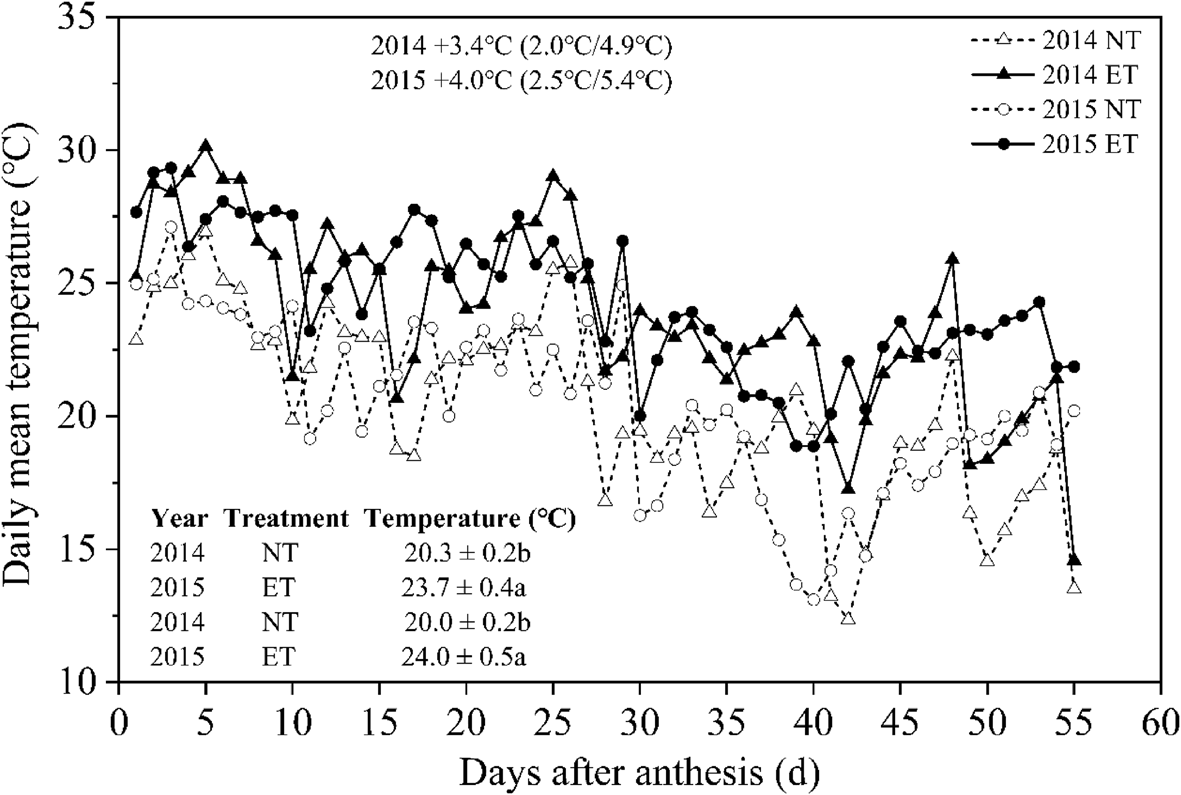
Rice canopy temperature was markedly increased by FATE facility (Fig. 1), the mean warming amplitudes were 3.4 and 4.0°C in 2014 and 2015 during the grain-filling period, respectively. Nighttime warming amplitudes (4.9°C in 2014 and 5.4°C in 2015) were obviously higher than daytime warming amplitudes (1.9°C in 2014 and 2.5°C in 2015). On the whole, warming performance was close among different replicates. Although the open-warming treatment was affected by wind and rainfall to some extent, the warming amplitude kept generally stable throughout the whole grain-filling period.
Changes of rice canopy temperature during grain-filling stage under different temperature treatments. Note: NT, natural temperature; ET, elevated temperature. The temperature values after ‘+’ is in the sequence of warming amplitudes for whole day, daytime and nighttime, respectively. Daytime temperature is the average temperature from 6:00 am to 6:00 pm; nighttime temperature is the average temperature from 6:00 pm to 6:00 am; whole day temperature is the mean value of daytime temperature and nighttime temperature.

Rice yield and its components
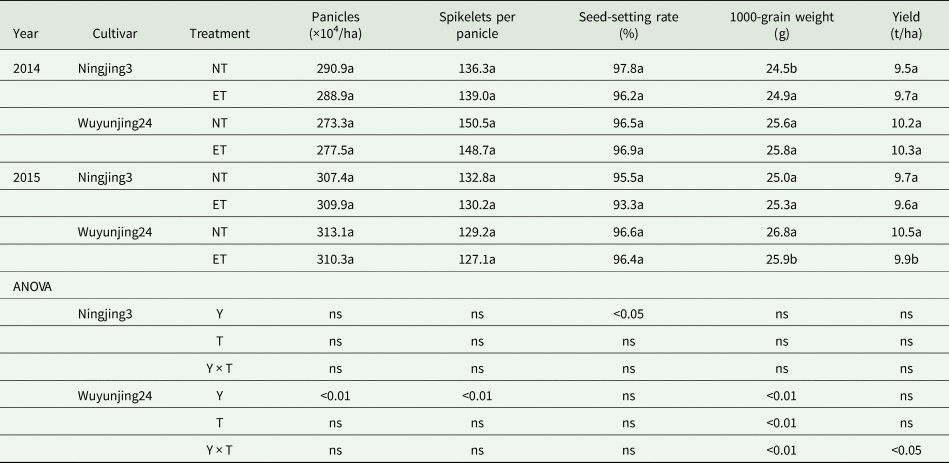
Except for seed-setting rate (P < 0.05), year, temperature and their interaction had no significant effect on rice yield and four yield components for Ningjing3 (Table 1). For Wuyunjing24, its 1000-grain weight was significantly affected by year (P < 0.01), temperature (P < 0.01) and their interaction (P < 0.01), whereas year had significant effects on its panicles (P < 0.01) and spikelets per panicle (P < 0.01).
Effects of elevated temperature during grain-filling on rice yield and its components

Note: NT, natural temperature; ET, elevated temperature. The data in the same column followed by different letters are significantly different at the 0.05 level. Y, year; T, temperature; Y × T, interaction of year and temperature treatments. ns, not significant.
In this study, temperature generally did not have a significant effect on rice yield and each yield component for both cultivars, there was only a significant yield difference for Wuyunjing24 in 2015 with a 5.7% decline under ET relative to NT (Table 1), whereas it also caused a significant decline for Wuyunjing24 in 2015.
Grain weight of SS and IS
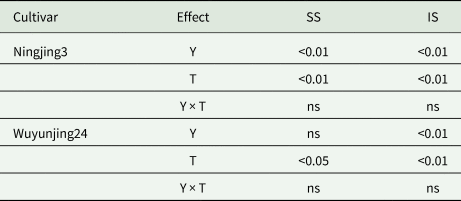
ANOVA indicated that temperature had a significant effect on grain weight of SS and IS for both cultivars. Year effect was significant for Ningjing3, whereas it was not observed in Wuyunjing24. There was no significant interaction influence on grain weight of SS and IS between year and temperature for both cultivars.
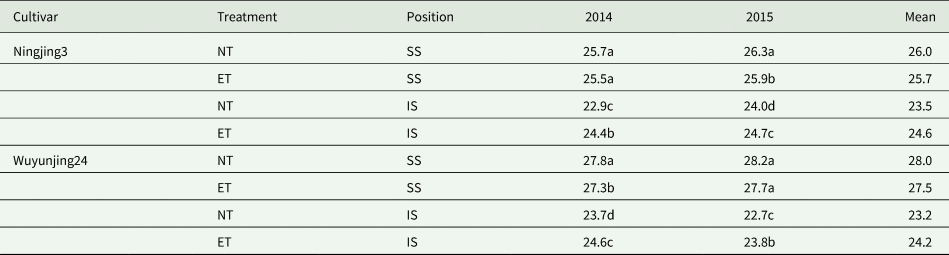
Grain weight of IS was always significantly lower than that of SS under any condition (Table 2). Generally, grain weight of SS exhibited decreasing trends under ET relative to NT, and the significant differences between temperature treatments were observed for Wuyunjing24 in 2014 and for Ningjing3 in 2015. It always significantly enhanced grain weight of IS for both cultivars in each year when compared with NT, the increasing amplitudes were 6.6% in 2014 and 2.9% in 2015 for Ningjing3, and the corresponding values were 3.8% in 2014 and 4.8% in 2015 for Wuyunjing24.
Effects of elevated temperature during grain-filling stage on grain weight (mg/grain) of SS and IS

Note: NT, natural temperature; ET, elevated temperature. Means in the same column followed by different letters are significantly different at the 0.05 level.
Grain-filling process of SS and IS
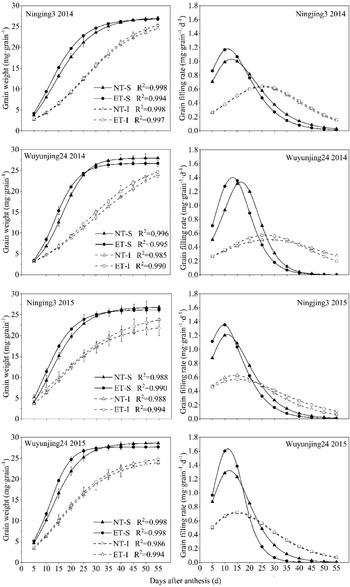
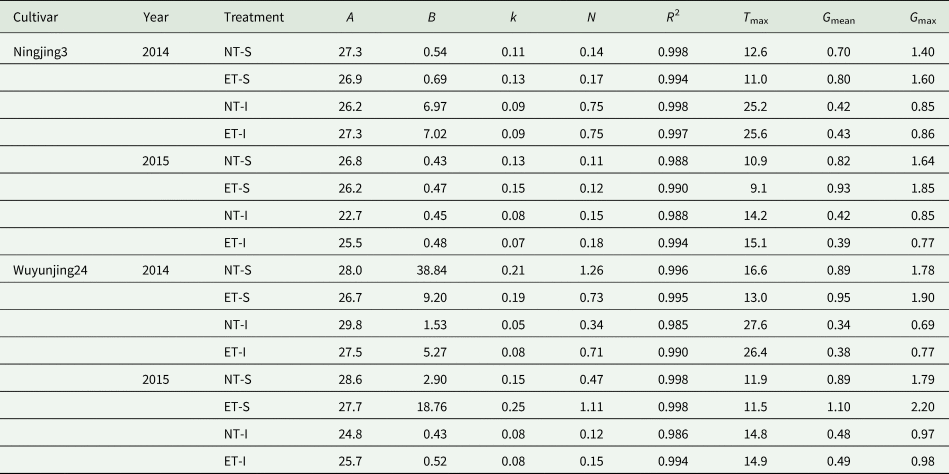
The influences of ET on the grain-filling process and grain-filling parameters were determined using the Richards’ equation (Fig. 2 and Table 3), and results showed that Richards’ equation could well describe the grain-filling process, because R 2 were more than 0.98 for both SS and IS under any condition (Table 3). The response of grain-filling to ET was similar between the two tested cultivars, whereas SS and IS showed different responses to ET. For SS, ET generally improved the grain-filling rate during the first 15 DAA for both cultivars, and increased the maximum grain-filling rate. Meanwhile, it also advanced the time reaching the maximum grain-filling rate (T max) of SS. Generally, the grain-filling rate during the first 15 DAA was higher in 2015 compared with that in 2014 for both cultivars. After reaching the G max, grain-filling rate decreased rapidly. Compared with that under NT, the grain-filling rate decreased more rapidly under ET. Since 15 DAA, the grain-filling rate under ET began to exhibit lower than that under NT, and grain-filling stopped markedly earlier under ET relative to NT.
Effects of elevated temperature on grain-filling curves of rice for SS and IS during different years. Note: SS, superior spikelets; IS, inferior spikelets; NT-S, superior spikelets under natural temperature; ET-S, superior spikelets under elevated temperature; NT-I, inferior spikelets under natural temperature; ET-S, inferior spikelets under elevated temperature. Vertical bars represent mean values ± s.e. (n = 3).

Grain-filling parameters of SS and IS under different temperature treatments

Note: NT-S, superior spikelets under natural temperature; ET-S, superior spikelets under elevated temperature; NT-I, inferior spikelets under natural temperature; ET-I, inferior spikelets under elevated temperature. A, B, k and N are the parameters set by the regression equation. R 2 is the coefficient of the fitfulness of the equation. T max, time reaching a maximum grain-filling rate; G mean, mean grain-filling rate; G max, maximum grain-filling rate.
For IS, regardless of cultivars or years, its filling started slowly, and reached T max more sluggishly, compared with SS. Moreover, the mean grain-filling rate (G mean) and G max of IS were greatly lower than those of SS, and grain-filling duration was obviously longer. The results indicated that the grain-filling rate of IS was less affected by ET during the first 10 DAA, the gaps of G max and G mean between temperature treatments were markedly lower in IS compared with those in SS. Although the grain-filling rate of IS also decreased after reaching G max similar to SS, it decreased relatively slowly. Evidently, regardless of cultivars or years, ET increased the grain-filling rate of IS for at least 15 days compared with NT, and this increasing effect was mostly observed from 20 to 35 DAA.
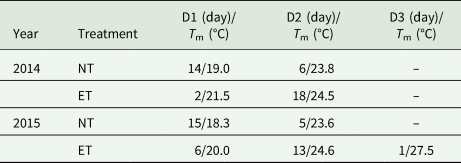
The number of days in different temperature regions from 20 to 40 DAA
The suitable temperature during the rice grain-filling period for achieving high yield is approximately 22–27°C (Gong et al., Reference Gong, Zhang, Hu, Long, Chang, Wang, Xing and Huo2013; Deng et al., Reference Deng, Ling, Sun, Zhang, Fahad, Peng, Cui, Nie and Huang2015), and this temperature region was considered as the suitable filling temperature (SFT) in this study. The daily canopy mean temperatures of 21–40 DAA were emphatically observed, since it was the main period that IS filling being improved by ET during its active filling period, and this period was further classified into three regions based on the temperatures of each region as follows: D1 (<22°C), D2 (22–27°C) and D3 (>27°C) (Table 4). D3 was only detected for 1 day in 2015 under ET. Compared with NT, ET greatly reduced the days for D1. There were 6 and 5 days belonging to D2 in 2014 and 2015 under NT, respectively, whereas 18 and 13 days belonging to D2 were found in 2014 and 2015 under ET, respectively. The results suggested that ET obviously added the days with the SFT during the period of 21–40 DAA, and also increased the daily mean temperature for D1.
Distribution of daily mean temperature (°C) for 21–40 DAA under different temperature treatments

Note: NT, natural temperature; ET, elevated temperature. D1 represents the days whose daily mean temperature were below 22°C; D2 represents the days whose daily mean temperature were among 22 and 27°C, D3 represents the days of whose daily mean temperature were above 22°C. T m represents the mean temperature of days in the corresponding temperature region.
Activities of key starch biosynthesis enzymes in developing grains
As shown in Table 5, both significant loss for SS and significant increase for IS were detected for grain weight of Wuyunjing24 in 2014; therefore, activities of key starch biosynthesis enzymes and hormone contents in developing grains were determined for this cultivar in 2014 to explore the mechanism behind the performance of grain-filling process under different temperature regimes.
Variance analysis of year (Y), temperature (T) and their interaction effect on grain weight of SS and IS

Note: SS, superior spikelets; IS, inferior spikelets; Y, year; T, temperature; Y × T, interaction of year and temperature treatments. ns, not significant.
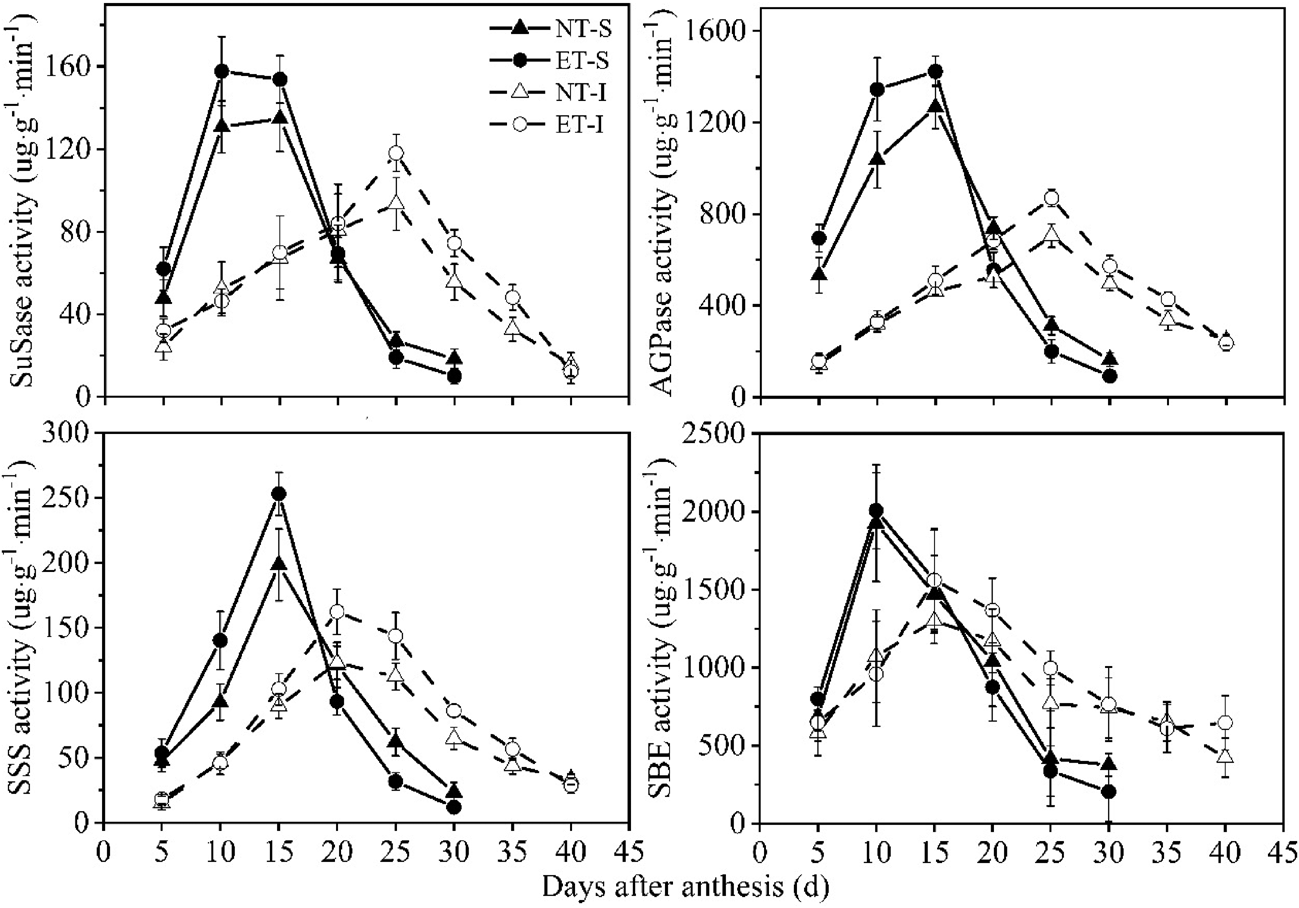
During the whole grain-filling period, SuSase activity tended to increase at first and declined later, the highest SuSase activity of IS was lower than that of SS (Fig. 3), the highest SuSase activity of SS was detected at 10 and 15 DAA under NT and ET, respectively, whereas the highest SuSase activity of IS was observed at 25 DAA. The SuSase activity of SS was lower under ET than that under NT at the same point from 20 DAA, and this difference between temperature treatments disappeared gradually as the SuSase activity decreased to a quite low level. During 25–40 DAA, SuSase activity of IS was higher under ET compared with that under NT.
Changes of activities of key starch biosynthesis in SS and IS under different temperature treatments for Wuyunjing24 in 2014. Note: SuSase, sucrose synthetase; AGPase, ADP-glucose pyrophosphorylase; SSS, soluble starch synthase; SBE, starch branching enzyme; SS, superior spikelets; IS, inferior spikelets; NT-S, superior spikelets under natural temperature; ET-S, superior spikelets under elevated temperature; NT-I, inferior spikelets under natural temperature; ET-S, inferior spikelets under elevated temperature. Vertical bars represent mean values ± s.e. (n = 3).

Evidently, elevated temperature enhanced AGPase activity of SS from 5 to 15 DAA, and AGPase activity dropped quickly after 15 DAA under both temperature regimes, whereas it declined more rapidly under ET. Generally, elevated temperature did not significantly alter AGPase activity of IS during the first 15 DAA. However, it was markedly improved by elevated temperature from 20 to 35 DAA.
As shown in Fig. 3, SSS activity of SS was significantly higher under ET than that under NT at 10 and 15 DAA, and rice SS presented lower SSS activity grown under warming regime when compared with natural temperature since 20 DAA. There was no significant difference between temperature treatments before 10 DAA and after 30 DAA, whereas ET exhibited a positive effect on SSS activity of IS from 20 to 30 DAA.
The SBE activity also increased first and dropped later for both SS and IS, whereas its peak value of SS and IS occurred at 10 and 15 DAA, respectively. During the first 15 DAA, SBE activity exhibited a little higher under ET than that under NT, whereas differences were generally not significant between temperature treatments. It presented a rapid loss after reaching the peak value under higher environmental temperature. Higher SBE activity was detected under ET compared with NT from 15 to 25 DAA for IS.
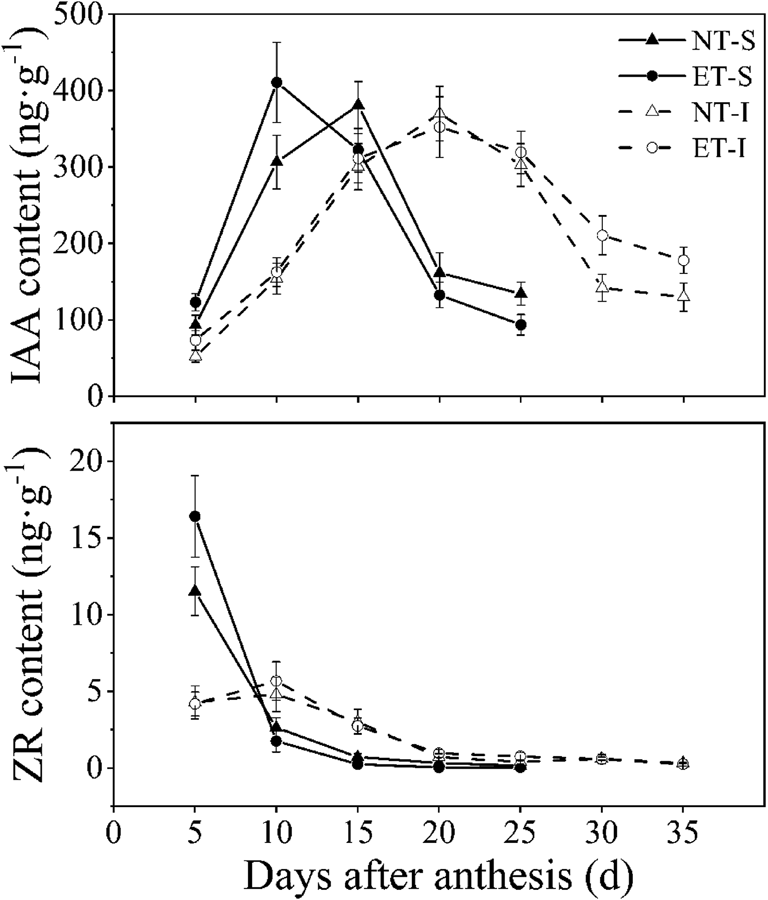
Hormone contents in developing grains
The content dynamics of IAA and ZR in rice grains during grain-filling were determined (Fig. 4). In general, IAA content increased first and then decreased as the process of grain-filling. For SS, the peak value of IAA content was detected at 15 and 10 DAA under NT and ET, respectively, illustrating the peak value of IAA content was advanced by temperature increasing. Meanwhile, IAA content was higher under ET than that under NT at both 5 and 10 DAA. After reaching the peak value, IAA content decreased quickly, and it was lower under ET than that under NT. For IS, the peak value of IAA content occurred at 20 DAA for both temperature treatments, whereas its peak value was lower than that for SS, the difference between temperature treatments was smaller before reaching the peak value, After reaching the peak value, IAA content of IS exhibited higher value under ET than that under NT.
Changes of contents of IAA and ZR in SS and IS under different temperature treatments for Wuyunjing24 in 2014. Note: IAA, indole-3-acetic acid; ZR, zeatin riboside; SS, superior spikelets; IS, inferior spikelets; NT-S, superior spikelets under natural temperature; ET-S, superior spikelets under elevated temperature; NT-I, inferior spikelets under natural temperature; ET-S, inferior spikelets under elevated temperature. Vertical bars represent mean values ± s.e. (n = 3).

The ZR content showed a decreasing trend during the grain-filling process. ZR content for SS decreased to less than 1 ng/g. The difference between temperature treatments for SS mainly occurred at 5 DAA, after that the differences almost disappeared. Compared with SS, IS exhibited lower ZR content at 5 DAA, and presented the law that increasing first and decreasing later, whereas the peak value occurred at 10 DAA under both treatments. ZR content presented higher value under ET than that under NT at the appearance time of peak value, and the differences between temperature treatments almost disappeared with their rapid decrease after 10 DAA.
Discussion
Effects of low-amplitude warming on rice yield
Rice grain-filling mainly proceeded in September and October in this study, and this was in accordance with the practical rice production site in lower reaches of Yangtze River Basin in China. The temperature values of the two months in 2014 and 2015 were quite close to the mean temperature level across the past 20 years (data not shown) according to the data provided by the local meteorological department, indicating that the natural temperature of the two experimental years could well reflect the current temperature level of this region. In this study, rice canopy temperatures were increased by 3.4 and 4.0°C in 2014 and 2015, respectively, and these warming amplitudes were consistent with the possible warming regime by the end of 21st century. Meanwhile, nighttime temperature was enhanced more greatly than that of daytime temperature, resulting in a decent simulation of the asymmetry of global warming. The greater warming performance during nighttime was linked to the lower wind speed and higher relative humidity.
There have been numerous studies focusing on the effects of elevated temperature on rice yield in the past few years (Prasad et al., Reference Prasad, Boote, Allen, Sheehy and Thomsa2006; Cheng et al., Reference Cheng, Sakai, Yagi and Hasegawa2009; Shi et al., Reference Shi, Muthurajan, Rahman, Selvam, Peng, Zou and Jagadish2013), and results indicated that high temperature would induce a serious yield loss, but the clear negative impact of increasing temperature on rice yield was not observed in this study. As shown in Table 1, panicle number and spikelets per panicle were not changed significantly by ET, since these two yield components had formed before the heading stage. It has been widely known that the decline of seed-setting rate could be a key factor for rice yield loss under high temperature during the reproductive growth stage (Cao et al., Reference Cao, Duan, Yang, Wang, Liu and Yang2009; Mohammed and Tarpley, Reference Mohammed and Tarpley2010). However, this study showed that low-amplitude warming could not induce significant loss of seed-setting, since low-amplitude warming did not cause stress on spikelet fertility and flowering (data not shown). Weather conditions during the heading stage in both years (data not shown) showed that no days with daily mean temperature over 28°C were recorded during flowering days, and the highest temperature was below 32°C during the peak flowering period (10.00 to 14.00 h), illustrating that temperature increasing could not reach the stress level with a warming amplitude below 4°C under the basic of natural temperature. The appropriate flowering temperature benefited from the proper match between the sowing time and cultivars' growth characteristics to great extent, as rice heading stage generally occurred at the end of August or the beginning of September, thereby flowering period could successfully elude high temperature which usually appeared at the end of July and the beginning of August. Besides the loss of seed-setting rate, the reduction of grain weight was considered as another main reason for yield loss under high temperature as reported by the previous studies (Cao et al., Reference Cao, Duan, Yang, Wang, Liu and Yang2009; Dong et al., Reference Dong, Chen, Wang, Tian, Zhang, Lai, Meng, Qian and Guo2014). Current studies reported that high temperature accelerated the filling rate during the early grain-filling period but could not compensate for the shortness of grain-filling period, leading to a reduction of grain weight (Morita et al., Reference Morita, Yonemaru and Takanashi2005; Ahmed et al., Reference Ahmed, Tetlow, Nawaz, Iqbal, Mubin, Rehman, Butt, Lightfoot and Maekawa2015), whereas the obvious decrease of grain weight was only detected for Wuyunjing24 in 2015 in this study. The grain-filling performance of SS and IS is discussed in the following paragraphs to explain why there was no distinct decline of 1000-grain weight affected by ET.
Although considerable yield changes were not detected for both cultivars in the two experimental years, change trends of rice yield under ET relative to NT were not consistent between different years for both cultivars. The decreasing trend of yield in 2015 under elevated temperature may be connected with the relatively higher warming amplitude.
Effects of low-amplitude warming on grain-filling process of SS and IS
SS and IS are located at different parts of a rice panicle, and differs greatly in their grain weight (Yang and Zhang, Reference Yang and Zhang2010). Recent studies have shown that SS and IS may present different grain-filling performances under elevated temperature (Mohammed and Tarpley, Reference Mohammed and Tarpley2010; Dong et al., Reference Dong, Chen, Wang, Tian, Zhang, Lai, Meng, Qian and Guo2014). Mohammed and Tarpley (Reference Mohammed and Tarpley2010) found that the grain weight of IS had a more significant loss than that of SS under high night temperature. Dong et al. (Reference Dong, Chen, Wang, Tian, Zhang, Lai, Meng, Qian and Guo2014) also reported that temperature increasing during grain-filling could reduce grain weights for both SS and IS, and IS showed a greater decreasing trend compared with SS. The performance of IS weight in previous studies was opposite to our results that grain weight of IS even showed an increasing trend under elevated temperature. It should be noted that the higher temperature treatments in the two studies were approximately at the level of 32 and 28°C, and the temperature levels kept unchanged during the whole grain-filling period (Mohammed and Tarpley, Reference Mohammed and Tarpley2010; Dong et al., Reference Dong, Chen, Wang, Tian, Zhang, Lai, Meng, Qian and Guo2014), whereas the average nighttime temperature of ET treatment was approximately 22°C in this study, indicating that low-amplitude warming exhibited a positive influence on IS, which was different from the high temperature effect. To summarize, the improvement of IS grain weight compensated the loss of SS grain weight, resulting in no significant loss for 1000-grain weight under low-amplitude warming.
The degree and rate of grain-filling in rice spikelets differ largely between SS and IS (You et al., Reference You, Zhu, Xu, Huang, Wang, Ding, Liu, Li, Chen, Ding and Tang2016), but the response of grain-filling process of SS and IS to low-amplitude warming is still not well understood. To illuminate the different performances of SS weight and IS weight under elevated temperature, the grain-filling processes of SS and IS were investigated (Fig. 2). Elevated temperature markedly accelerated the grain-filling rate of SS during the first 10 or 15 DAA but shortened their active grain-filling duration, and generally SS grain weight showed a decreasing trend, which was generally in line with the high temperature effect as reported in previous studies (Yamakawa et al., Reference Yamakawa, Hirose, Kuroda and Yamaguchi2007; Kim et al., Reference Kim, Shon, Lee, Yang, Yoon, Yang, Kim and Lee2011). Different from the performance of insufficient stamina in SS filling under low-amplitude warming regime, IS assumedly presented an active filling performance since 15 DAA under ET, especially during 20–35 DAA, and finally obtained a higher grain weight when compared with NT. Since IS filling rate during this period benefited a lot from elevated temperature, we analysed the number of days based on the different temperature regions from 20 to 40 DAA. The results showed that the number of days with the SFT was dramatically increased by ET (Table 4), indicating that low-amplitude warming provided more favourable temperature condition for IS filling in lower reaches of Yangtze River in China.
The relationship between rice grain-filling performance and sink activity under warming regime
Starch contributes approximately 90% to a brown rice grain (Duan and Sun, Reference Duan and Sun2005); rice grain-filling is actually a process of starch accumulation. SuSase, as an enzyme catalysing sucrose resolve into fructose and uridine diphosphate glucose in the first step of starch synthesis, has been considered as a rate-limiting enzyme of grain-filling, and its activity was thought to be positively correlated with the grain-filling rate (Fu et al., Reference Fu, Huang, Wang, Yang and Zhang2011; You et al., Reference You, Zhu, Xu, Huang, Wang, Ding, Liu, Li, Chen, Ding and Tang2016). In addition, AGPase and SSS also play key roles in starch biosynthesis in rice grain endosperm, as it uses the substrates glucose-1-phosphate (G-1-P) and ATP to produce ADPglucose, the sugar nucleotide utilized by starch synthase (Stitt and Zeeman, Reference Stitt and Zeeman2012), whereas SSS and SBE mainly catalyses amylopectin synthesis (Jiang et al., Reference Jiang, Dian and Wu2003). This field-warming experiment also found that the changing trends of activity of key starch biosynthesis enzymes were generally consistent with those of the grain-filling rate. On the whole, activities of key starch biosynthesis enzymes in SS were significantly higher under ET during the first 15 DAA but decreased faster under NT, leading to the weaker capacity for resolving sucrose in the cytoplasm and starch synthesis in amyloplast during middle and late grain-filling periods, thus advancing the stopping time of SS filling. On the contrary, for IS, ET showed a positive influence on the activities of SuSase, AGPase, SSS and SBE during middle and late grain-filling periods, so as to promote starch synthesis in rice grains, hence improving the IS filling level.
IAA is known as the key hormone in regulating plant growth, and its content was observed to be positively correlated with rice grain-filling rate for both SS and IS (Fu et al., Reference Fu, Huang, Wang, Yang and Zhang2011; You et al., Reference You, Zhu, Xu, Huang, Wang, Ding, Liu, Li, Chen, Ding and Tang2016). In this study, IAA content showed a similar dynamic with grain-filling rate for both SS and IS. Moreover, IAA exhibited a higher content under ET than that under NT for IS during late grain-filling period, this phenomenon indicated that low-amplitude temperature increasing could improve IAA content during 20–35 DAA and further enhance IS filling. ZR plays an important role in crop endosperm development. This study observed that ZR content was markedly increased under elevated temperature at 5 DAA for SS and 10–20 DAA for IS. This may explain the faster filling rate under ET for SS at the beginning of grain-filling, the reason for that was ZR could promote rice endosperm cell division and differentiation (Wobus and Weber, Reference Wobus and Weber1999), and the shorter filling duration of SS under ET may be linked to the more rapid decrease in ZR content after reaching G max. The relatively higher ZR content under ET improved IS filling at 10–20 DAA, whereas there were no obvious differences between temperature treatments for ZR content since 20 DAA, suggesting that the positive influence of ET on IS filling during late grain-filling had no relationship with ZR. Combined with higher activities of key enzymes involved in starch biosynthesis for IS under elevated temperature, we concluded that low-amplitude warming effectively improved IS filling level by enhancing its sink activity especially during middle and late grain-filling periods as the days with SFT greatly increased.
The gap of grain-filling level between SS and IS is larger in cultivars with numerous spikelets than those with small or medium panicles, and the poor filling level of IS usually limits the realization of these cultivars' great yield potential (Yang and Zhang, Reference Yang and Zhang2010). Therefore, it is meaningful to determine whether the positive effect of low-amplitude warming on IS could reappear in rice cultivars with numerous spikelets in this region. Furthermore, detailed physiological and molecular mechanisms behind the different responses of SS and IS to low-amplitude warming require further research.
Conclusion
Under the basis of current temperature level in lower reaches of Yangtze River Basin in China, low-amplitude warming during grain-filling did not obviously reduce 1000-grain weight and rice yield, since the increased grain weight of IS remedied the grain weight loss of SS. The improvement of rice IS filling under low-amplitude warming regime was associated with the higher sink activity during middle and late grain-filling period.
Financial support
This study was jointly funded by the National Key R&D Program of China (2017YFD0300100, 2017YFD0300107 and 2017YFD0300103), the National Natural Science Foundation of China (32071949, 31701366 and 31901446), Jiangsu Collaborative Innovation Center for Modern Crop Production (JCIC-MCP) and the Priority Academic Program Development of Jiangsu Higher Education Institutions (PAPD).
Conflict of interest
None.