Introduction
Sweetpotato is an economically important crop in the United States, with more than 66,000 ha planted in 2016 contributing $705 million to the national economy. North Carolina is the largest producer of sweetpotato in the United States, with 39,659 ha planted in 2016 having a value of over $350 million (USDA 2017). ‘Covington’ is an orange-fleshed, table-stock cultivar (Yencho et al. Reference Yencho, Pecota, Schultheis, VanEsbroeck, Holmes, Little, Thornton and Truong2008) accounting for 90% of North Carolina’s sweetpotato hectarage (Schultheis Reference Schultheis2017). sweetpotatoes in the United States are transplanted using vegetatively propagated stem tip cuttings (slips) from plants grown from small storage roots called seed roots in field propagation beds (Smith et al. Reference Smith, Stoddard, Shankle and Schultheis2009). Between late February and early April, seed roots are placed in 1-m-wide rows and covered with soil. In North Carolina, the newly formed propagation beds are covered with clear polyethylene mulch until plants emerge. Once plants emerge and the risk of frost has passed, the polyethylene mulch is removed. Plants are cut above the soil surface to avoid the spread of disease from field to field (Kemble et al. Reference Kemble, Sikora, Fields, Patterson and Vinson2006) when they reach the 7- to 8-leaf stage (Smith et al. Reference Smith, Stoddard, Shankle and Schultheis2009) and are 17 to 28 cm long (Thompson et al. Reference Thompson, Schultheis, Chaudhari, Monks, Jennings and Grabow2017). These slips are transplanted directly into production fields. Adventitious roots form very quickly after transplanting, with 86% to 89% of storage roots developing from roots formed within the first 5 to 7 d after transplanting (DAP). By 5 wk after transplanting (WAP), the developmental fate of 60% to 68% of adventitious roots has been determined (Villordon et al. Reference Villordon, La Bonte, Firon, Kfir, Pressman and Schwartz2009).
In sweetpotato plant propagation beds, weeds can reduce the number and stem diameter of slips (Monks et al. Reference Monks, Schultheis and Mills1996). The combined competition from common lambsquarters (Chenopodium album L.) and goosegrass [Eleusine indica (L.) Gaertn.] reduced sweetpotato slip density and slip weight of ‘Beauregard’ by 15% and 26%, and of ‘Jewel’ by 47% and 55%, respectively. Limited research has been conducted on tolerance of sweetpotato plants to herbicides in propagation beds. Napropamide is the only herbicide registered for application in sweetpotato propagation beds (Kemble Reference Kemble2017). It controls annual grasses including goosegrass, crabgrass (Digitaria spp.), common lambsquarters, common purslane (Portulaca oleracea L.), and redroot pigweed (Amaranthus retroflexus L.). Although DCPA is registered for use in sweetpotato production fields, previous research has shown that it causes severely stunted growth, leaf crinkling, and stem fasciation in ‘Beauregard’ (13%) and ‘Jewel’ (43%) sweetpotato when applied PRE in plant propagation beds (Monks et al. Reference Monks, Kalmowitz and Monaco1992, Reference Monks, Schultheis and Mills1996).
Flumioxazin, S-metolachlor, and clomazone are registered in sweetpotato production fields (Kemble Reference Kemble2017). Flumioxazin applied before planting is registered for control of annual broadleaf weeds including Palmer amaranth (Amaranthus palmeri S. Watson). S-metolachlor is registered for PRE control of annual grasses and broadleaf weeds including Palmer amaranth. Clomazone is registered for use post-transplant for PRE control of annual grasses and broadleaf weeds. Meyers et al. (Reference Meyers, Jennings, Schultheis and Monks2010) reported 97% and 90% control of Palmer amaranth in sweetpotato with flumioxazin and S-metolachlor, respectively, at 12 DAP. In field production, flumioxazin and S-metolachlor have the potential to injure sweetpotato if applied at incorrect timings (Meyers et al. Reference Meyers, Jennings, Schultheis and Monks2010, Reference Meyers, Jennings and Monks2013). Fluridone PRE was registered for control of Palmer amaranth in sweetpotato production fields in North Carolina in 2017 under a section 18 label. Fluridone inhibits carotenoid biosynthesis, resulting in bleaching symptoms that turn necrotic at high rates. Although these herbicides have been used in sweetpotato production fields, these herbicides have not been evaluated for crop safety in sweetpotato propagation beds.
Fomesafen, linuron, metribuzin, and pyroxasulfone are herbicides not currently registered for use in sweetpotato that have been evaluated in production fields but not in propagation beds. Fomesafen applied before planting provided ≥99% control of Palmer amaranth with little (<5%) injury to sweetpotato at 28 DAP (Barkley et al. Reference Barkley, Chaudhari, Jennings, Schultheis, Meyers and Monks2016). Linuron POST at 7 DAP did not reduce ‘Covington’ or ‘Murasaki’ sweetpotato marketable yield (Beam et al. 2016). Metribuzin POST controlled Palmer amaranth 100%, although it injured sweetpotato 10% to 15% (Meyers et al. Reference Meyers, Jennings and Monks2013). Pyroxasulfone plus flumioxazin applied before planting provided >95% control of Palmer amaranth; however, it can reduce sweetpotato yield if application is followed by heavy rain (Meyers et al. Reference Meyers, Jennings and Monks2013). A study was conducted to determine sweetpotato tolerance to herbicides applied in propagation beds and the effect of herbicides applied to propagation beds on early root initiation of sweetpotato slips.
Materials and Methods
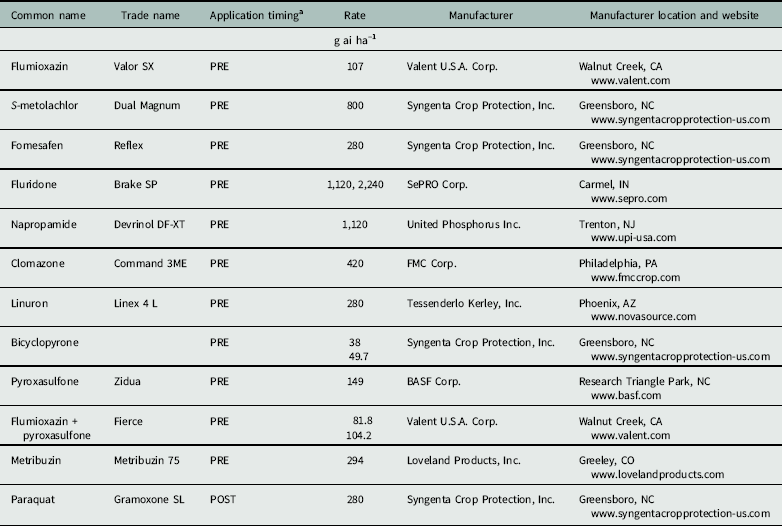
Studies were conducted on a grower’s field in Wade, NC (35.10°N, –78.67°W) in 2016 and 2017. ‘Covington’ sweetpotato storage roots were placed in field propagation beds on April 1, 2016 and March 24, 2017, then covered with 6 to 8 cm of soil. Treatments included PRE and POST (Table 1) herbicide treatments and a nontreated check arranged in a randomized complete block design with four replications. PRE herbicide treatments were applied after covering storage roots with soil but before the clear polyethylene mulch was laid (Beam et al. Reference Beam, Jennings, Monks, Schultheis and Chaudhari2017). Polyethylene mulch remained over beds until sweetpotato plants emerged. The paraquat treatment was applied immediately after mulch removal on April 28, 2016 and May 1, 2017. Herbicide treatments were applied using a CO2-pressurized backpack sprayer with 8003VS nozzle tips (TeeJet 8003, TeeJet Technologies) calibrated to deliver 187 L ha–1 at 165 kPa. Few weeds (±1 10 m–2) were present both years. Weeds that did emerge were hand pulled from all plots.
Herbicide treatments and sources of herbicides used in this study.
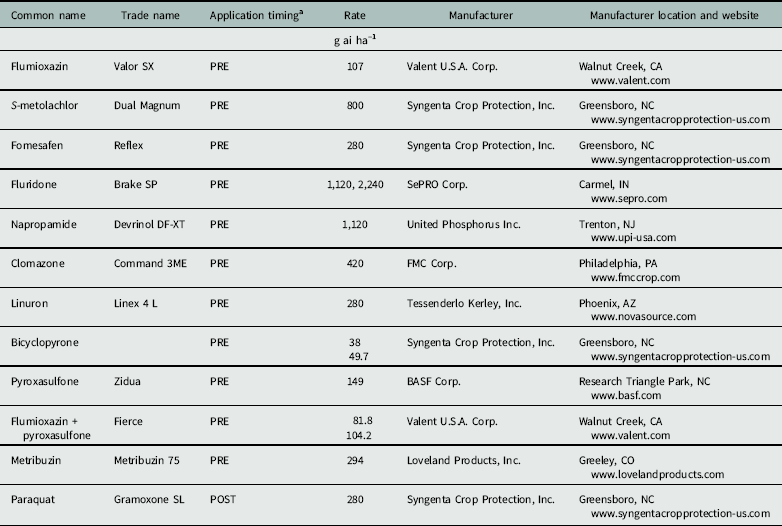
a PRE treatments were applied after storage roots were covered with soil but prior to applying polyethylene mulch. POST treatment was applied after polyethylene mulch was removed.
Soils were a Stallings loamy sand (coarse-loamy, siliceous, semiactive, thermic Aeric Paleaquults) and a Candor sand (sandy, kaolinitic, thermic Grossarenic Kandiudults) in 2016 and 2017, respectively. Organic matter content was <1%, and pH was 5.4 in 2016 and 5.5 in 2017. Plots were 1 m wide by 1.5 m long.
Eighteen representative slips were cut 2 to 3 cm above the soil surface at 8 WAP in 2016 and 10 WAP in 2017 (Kemble Reference Kemble2017). At this time, slip density was also measured by randomly placing a 0.9-m2 quadrat in each plot and counting all slips. Data collected on five slips (of 18 plants) included length (measured from base of the cutting to the growing point), node count, and fresh and dry weights. Slips were dried in a forced-air oven at 40 C until a constant weight was achieved. To determine the effect of the herbicide treatment on adventitious root initiation, slips from each plot were placed into water-filled 0.95-L glass Mason jars in the Mary Anne Fox Science Teaching Laboratory Greenhouses at North Carolina State University (35.79°N, 78.67°W) in Raleigh, NC. Water levels were checked daily, and additional water was added as needed. At 10 to 14 DAP, slips were removed from the jars and adventitious roots were severed from the shoot for analysis using WinRHIZO root scanning system (Regent Instruments Inc., Montreal, PQ, Canada) for total root volume, average root diameter, total root length, and total root surface area. Measurements from the five slips were averaged for analysis.
To determine the effect of herbicides on storage root initiation, eight slips from each plot were transplanted into 2.8-L containers (15.9 cm depth × 12.7 cm diam) containing a 50/50 mix of sterile sand and peat-perlite mix (4P, Sungro Professional Growing Mix). A single slip was transplanted into each container. Plants were grown outdoors at the Horticulture Field Lab at North Carolina State University (35.79°N, –78.70°W) in Raleigh, NC, for 5 wk. Plants were hand watered daily as needed and fertilized weekly, with each container receiving 100 ml of 24-8-16 liquid fertilizer (Scotts Miracle-Gro®, Marysville, OH). Pots were maintained weed-free by hand removal as needed. Destructive harvest of sweetpotato plants was conducted 5 wk after planting. Foliage was cut at the soil surface, and roots were removed from containers. Soil was gently removed from roots using a water bath. Roots were divided into three classes: feeder roots (fine roots that were not swollen), pencil roots (swollen roots <1 cm diam), and storage roots (swollen roots >1 cm diam). Data recorded included dry weight of aboveground biomass, vine length (measured from the soil line to the growing point of the longest vine), feeder root fresh and dry weights, pencil root count and fresh weight, and storage root count and fresh weight.
Data were checked for variance homogeneity and normality before statistical analyses by plotting residuals and were transformed when necessary. Dry weight and length of slips were subjected to log transformation. Transformed data were subjected to ANOVA using PROC MIXED (SAS 9.4, SAS Institute, Inc. Cary, NC). When a year-by-treatment interaction was found to not be significant, data were combined across years. When ANOVA indicated a significant treatment effect, means were separated with the use of Fisher’s LSD (P≤0.05). Means were back-transformed for presentation purposes.
Results and Discussion
Propagation Bed
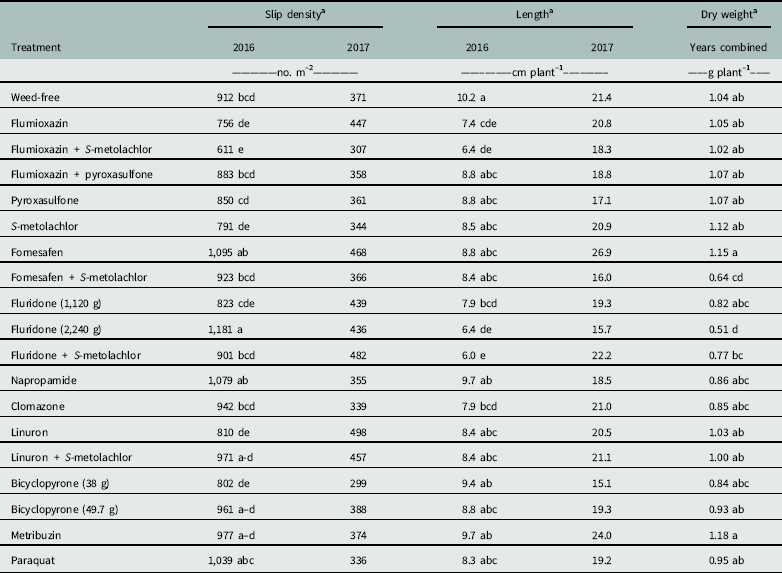
Dry weight and node count of slips was combined across years, because the treatment-by-year interaction was not significant. The herbicide treatment-by-year interaction was significant for slip density and length; therefore, analysis was conducted separately by year.
Dry weight per sweetpotato slip in most treatments did not differ from those slips in the nontreated check except for fomesafen + S-metolachlor (38%), fluridone at (2,240 g ai ha–1) (51%) (Table 2). Relative to the nontreated check, fluridone (2,240 g ha–1) and fomesafen + S-metolachlor resulted in 51% and 38% decrease in slip dry weight, respectively. Node count ranged from 3 to 17 and was not different for any treatment (data not shown).
Effect of herbicides on Covington sweetpotato at time of cutting in Wade, NC in 2016 and 2017.
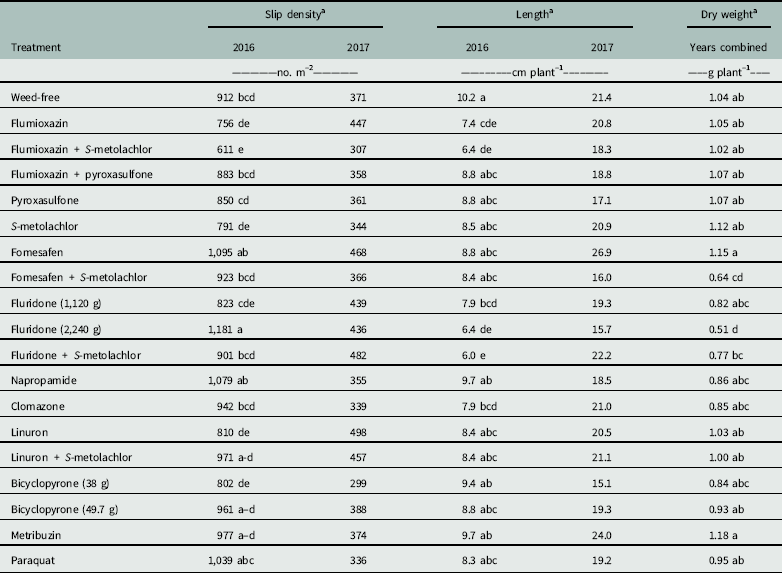
a Means within a column followed by the same letter are not different according to Fisher’s protected LSD test of P≤0.05.
Sweetpotato slip density did not differ among treatments except in 2017 when it was reduced by 33% for flumioxazin + S-metolachlor and increased by 29% by fluridone (2,240 g ai ha–1). Likewise, in potato (Solanum tuberosum L.), fluridone induced sprouting of tubers in the presence of high sucrose contents (Harvey et al. Reference Harvey, Bowden, Reavey and Selby1994); up to 92% of the sugar in sweetpotato storage roots is sucrose (Lai et al. Reference Lai, Huang, Chan, Lien and Liao2013).
Slip length was not affected by herbicides in 2017. In 2016, slip length was similar to the weed-free check except for fluridone alone or in combination with S-metolachlor, flumioxazin alone or with S-metolachlor, and clomazone. Fluridone + S-metolachlor caused the greatest reduction (41%) in slip length.
Adventitious Root Initiation
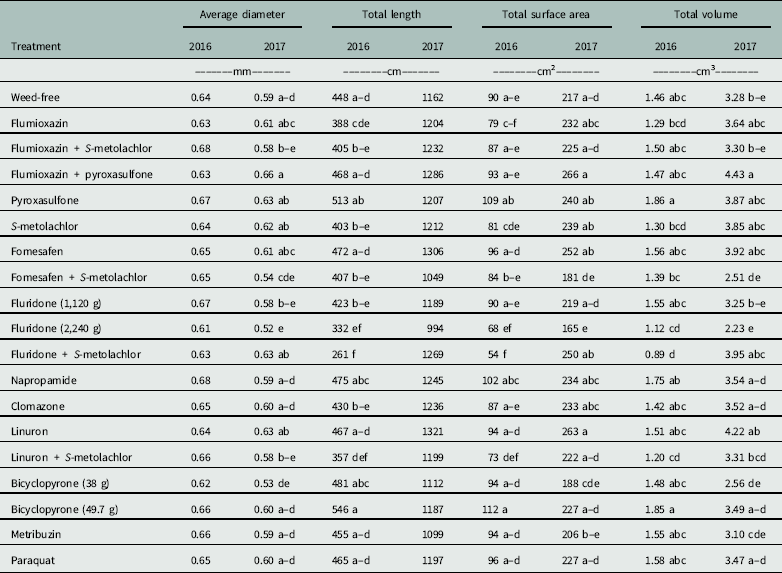
The herbicide treatment-by-year interaction was significant for average root diameter, total root length, total root surface area, and total root volume; therefore, analyses were conducted by year. Plants in most herbicide treatments did not differ in root diameter, root length, root surface area, and root volume except those in fluridone (2,240 g ai ha–1) (root diameter and surface area in 2017, root length in 2016) and fluridone + S-metolachlor (root length, surface area, and volume in 2016) (Table 3). Fluridone + S-metolachlor had the greatest effect on root initiation in 2016, with 42%, 40%, and 39% reductions in total root length, surface area, and volume, respectively. Likewise, fluridone (2,240 g ai ha–1) had the greatest effect on root initiation in 2017, with 12% and 24% reductions in root diameter and surface area, respectively.
Effect of herbicides on sweetpotato adventitious root initiation (per plant) at 2 WAP in Mary Anne Fox Greenhouse in 2016 and 2017.
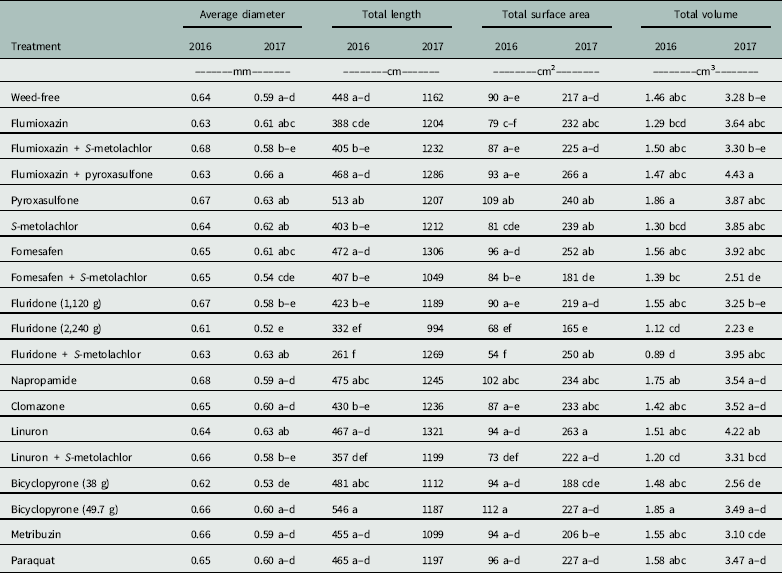
a Means within a column followed by the same letter are not different according to Fisher’s protected LSD test of P≤0.05.
Storage Root Initiation
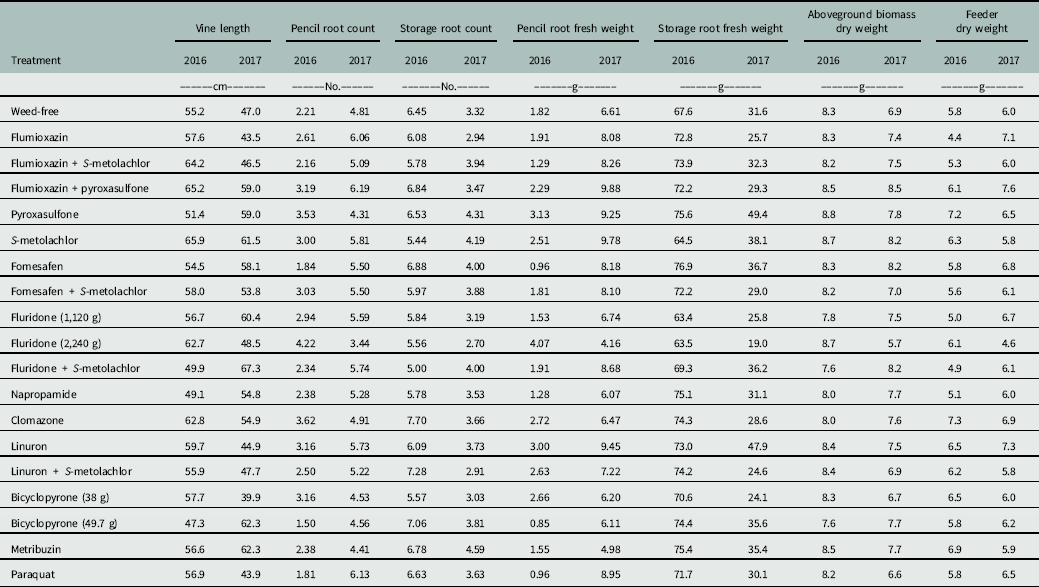
The herbicide treatment-by-year interaction was significant for vine length, pencil root count and weight, storage root count and weight, aboveground biomass, and feeder root dry weight. Therefore, analysis was conducted by year. No differences among treatments were observed for any response variable either year (Table 4).
Effect of herbicides on sweetpotato growth and storage root initiation (per plant) 5 WAP at the North Carolina State University Horticulture Field Lab, in 2016 and 2017Footnote a .
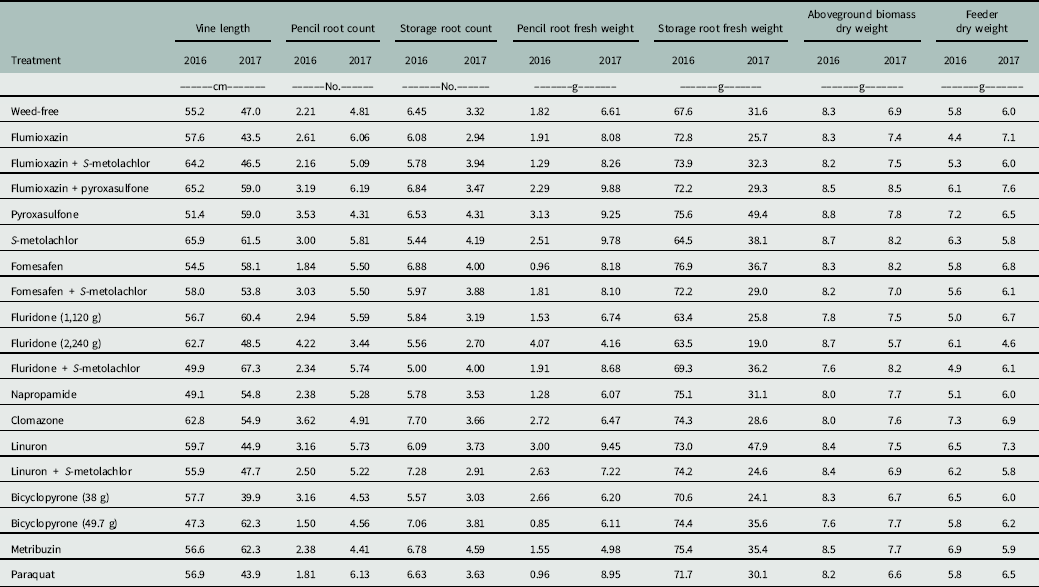
a No statistical differences was observed between treatments according to the ANOVA P≤0.05.
In summary, many of the herbicides and herbicide combinations applied to plant propagation beds did not affect number and quality of sweetpotato slips, and most did not impair root formation and development. S-metolachlor with or without flumioxazin or fomesafen, flumioxazin, all fluridone treatments, and clomazone reduced either length and/or weight of slips at cutting. Flumioxazin + S-metolachlor was the only treatment in which a reduction in slip number was observed, but this only occurred in 2016. Differences seen in years could be due to warmer weather in 2017. Fluridone (2,240 g ha–1) and fluridone + S-metolachlor were the only treatments that reduced adventitious root initiation. Though no differences were observed among treatments at 5 WAP, the inhibition of adventitious root formation in the first 2 WAP by fluridone (2,240 g ha–1) and fluridone + S-metolachlor could result in yield loss (Villordon et al. Reference Villordon, La Bonte, Firon, Kfir, Pressman and Schwartz2009).
These data suggest that pyroxasulfone with or without flumioxazin, fomesafen, napropamide, linuron with or without S-metolachlor, bicyclopyrone (38 or 49.7 g ai ha–1), and metribuzin PRE have potential for use in sweetpotato propagation beds. Future research should more closely examine injury caused by flumioxazin, S-metolachlor, and clomazone. The ability to safely use these herbicides in production fields suggests that adjusting rate or application method could allow for safe use in propagation beds.
Acknowledgments
The authors would like to thank the North Carolina Agricultural Foundation for its support in funding this research. Thanks to Dr. Cavell Brownie for statistical support. Thanks to David Godwin at Godwin Produce Company for his efforts to support this project. Thanks to Nicholas Basinger, Matthew Bertucci, Matthew Waldshmidt, and David Suchoff for assistance with study implementation and data collection. No conflicts of interest have been declared.