Well-informed professional speculation, by carrying supplies from periods of low to periods of high price, can partially, but only very partially, offset these fluctuations. Ill-informed and perverse speculation may accentuate the fluctuations in price.Footnote 1
Introduction
In the early 1970s, two concomitant changes reshaped the global trade of commodities. The first and most important was so-called financialization. Financialization has been defined by Greta Krippner as a pattern of profit making that “occurs increasingly through financial channels rather than through trade and commodity production,”Footnote 2 and by Gerald Epstein as “the increasing role of financial motives, [ . . .] markets, […] actors, and [ . . .] institutions.”Footnote 3 Recently, Jurgen Kocka stressed that the rise of financialization in the last forty years is part of the process whereby speculation overtook investments in mature capitalism.Footnote 4 In the field of commodity trade, financialization resulted in a growth spurt in the commodity futures trade.Footnote 5 Futures contracts were not a new financial tool in the 1970s: their history can be traced back to the second half of the nineteenth century, when they came to the fore as a key financial innovation in the global trade of commodities. Essentially, the trading of futures does not entail the delivery of commodities but only of the contracts representing them. By setting the price of commodities before delivery, futures aimed at hedging buyers and sellers from the risk of price fluctuations.Footnote 6 Even though it is often debated whether futures reduce or exacerbate price instability and speculation,Footnote 7 we can maintain that speculation is essential to these markets because it provides the liquidity necessary to carry out hedging operations and that, broadly speaking, it plays a key role in setting exploratory price functions.Footnote 8 For decades, futures were a fraction of physical trade and their turnover was stable; in the early 1970s, futures trade surpassed the physical market of many commodities. Their turnover exploded with a growth rate of about 20 percent per year, becoming the target of investors from outside the field of commodities.Footnote 9 The other development of some importance, which was strictly connected to the first, is found in the fact that the dramatic expansion of futures trading stimulated divergent regulatory actions. A strong governmental regulation of the commodity exchanges was put in place in the United States, thanks to the establishment in 1974 of the Commodity Futures Trading Commission (CFTC) after decades of regulatory experimentations. This did not occur in other major trading places, such as in the United Kingdom and in particular in the City of London, which was becoming a dynamic market venue for commodity futures.Footnote 10
In the United States, futures trading had a long history of regulation, first put in place in the 1920s, to regulate only national commodities, like grain, potatoes, and onions. The long-term goal of U.S. regulation was to reduce the impact of speculation on the futures markets and to provide a legal framework against the abuses of big speculators, the impact of which was considered detrimental to the interests of the farmers and national agricultural businesses.Footnote 11 In the early 1970s, a shift occurred in the United States through the CFTC, which extended regulations to all commodities traded in the country, including imports such as cocoa, coffee, and sugar. Up until this time, these commodities were unregulated.Footnote 12 In contrast to United States, the City of London’s exchanges continued their self-regulation by so-called self-regulated organizations, which became the model for the entire European Economic Community (EEC).Footnote 13 At the EEC level, no agency was created to supervise futures markets, and since the 1970s an approach based on national regulations has prevailed over a communitarian approach. This article illustrates the rise of financialization in commodity trading and the importance of regulation, focusing on the factors that influenced the emergence of regulatory divergence. It shows that the London commodity exchanges were crucial to this outcome because they retained their self-regulation model in futures trading, even after the United Kingdom joined the EEC.
In the aftermath of the global economic crisis of 2008, scholarly studies have increasingly focused their attention on the broader theme of financial regulation, which emerged as a major feature of our current globalization after the end of the Bretton Woods era.Footnote 14 In the field of commodities, the lack of a consistent global regulatory framework—thus, fragmentation—has often been emphasized as a main issue for international trade.Footnote 15 Regulatory fragmentation was also considered a threat for global financial stability and a main source of shocks and financial crises.Footnote 16 Moreover, regulatory fragmentation can result in inefficient markets in which resources are not optimally allocated.Footnote 17 Some scholars, like Calomiris and Haber, maintained that infective and fragmented financial market regulation often arise from deals among regulators, politicians, and special interests.Footnote 18 Laffont and Tirole also shed light on the issue of regulatory capture, which is the ability of business interests to shape regulations and to impose their views on regulatory bodies.Footnote 19 However, aside from these macro-economic downsides, regulatory fragmentation is also central for competition between market venues. According to Gehrig, markets compete on indirect factors, such as the integrity of the underlining financial centers and especially their regulations. Divergences in terms of regulation could help one market venue to emerge over others.Footnote 20 As we shall see, the regulatory framework of the City’s futures market has been an important factor in the competitiveness of this market venue. Although this framework existed in past decades, it was strengthened by a constant dialogue between the City’s actors and the European authorities during the 1970s, a period of global regulatory experimentation.
At the European level, scholarly studies have often focused their attention on the rise of a communitarian regulation for banking and financial services. Since the mid-1960s, there has been increasing harmonization of European member-state banking legislation, cooperation of supervising authorities, and convergence of clearing methods. As shown by Mourlon-Druol, European institutions, through the European Commission’s Directory General (DG) II (economic and financial services) or the DG XV (financial institutions), started processes of harmonization with the goal of encouraging greater market integration.Footnote 21 Futures trading has until now been disregarded by historiography. It followed a different path: The initiative was taken by private actors and focused not on harmonization but on conserving the status quo of a specific trading venue. Moreover, the European Commission was involved only via the DG IV: the competition policy authority. In fact, the City’s futures traders and European regulators started an ongoing dialogue in June 1973 in the aftermath of the U.K.’s accession to the European Treaty, and six commodity exchanges in London simultaneously notified the DG IV of their rules and structures and applied for a negative clearance.Footnote 22 In the jargon of the European antitrust legislation, a negative clearance is the request for authorization regarding trade agreements or market rules that the antitrust authorities provide when these agreements do not fall within articles 85 and 86 of the Treaty of Rome. Four exchanges—the Coffee Terminal Market Association of London, the United Terminal Sugar Market Association, the London Cocoa Terminal Market Association, and the Rubber Terminal Market Association of London—obtained negative clearance in 1985, while another two (wool and vegetable oils) withdrew their request before the DG IV undertook a decision.Footnote 23
At the European level, the outcome was also different from banking legislations. Instead of creating the foundation for harmonization, the two most important trading places in Europe took very different paths—London avoided adopting the U.S. model of regulation while Paris adopted it, producing a striking divergence inside the EEC about futures trading regulation. This article aims to fill the gap in the literature about the regulation of futures by showing the importance of the dialogue between business players and regulators in this outcome. During the twelve-year period extending from notification through to final decisions, the London terminal markets carried on with their business organizations without any interference from European authorities. Before the issuance of a decision, the applicants could continue using these agreements without legal consequences.Footnote 24 Because of this legal action, the EEC ended up trusting the City’s commodity markets organizations and eventually authorized London’s futures industry to keep its “self-regulatory organizations,” as the decision openly stated.Footnote 25
Despite occurring only a few months after the United Kingdom joined the EEC, the notifications that the London terminal markets sent to the European Commission in 1973 were not a consequence of that political event but instead were the result of a broader goal that can be understood by looking at the confrontation between London commodity markets and its main competitors, New York and Paris. Like other British businesses, London’s commodity exchanges and the firms that operated in those markets aimed to avoid economic and political risks arising from the new institutional context and new regulation that might have arisen from European institutions.Footnote 26 Although it has received scant scholarly attention, those legal actions contributed to maintaining the London market self-regulation model and spreading it into the European framework. The literature about European antitrust and market regulation almost exclusively focused on cartels, mergers and acquisition, and abuses of dominant positions.Footnote 27 More recently, Rollings and Warlouzet emphasized the role of European antitrust regulation in determining the strategies of firms not only in terms of legal constraint but also in the opportunities and macro-economic development of markets.Footnote 28 In some cases, the European Commission played a performative role in framing the architecture of markets. In the case of the aluminum industry, for instance, in the late 1970s, the European Commission openly helped settle futures trading for this metal to curb the industry’s price fixing.Footnote 29 In other cases, scholarly studies have shown that economic actors were able to shape economic regulations at the communitarian level.Footnote 30
This article examines the system at work behind the notifications of the City’s commodity exchanges toward Brussels, putting it into the context of the global commodity trade from the late 1960s, when London started to emerge again as a major center for commodity futures, to the mid-1980s, when the European Commission ruled on the authorization of London’s markets. The notifications of the London exchanges to the European antitrust authorities should be analyzed in the broader framework of the rising financialization of commodity trading. By shedding light on the nexus between U.K. commodity markets and European institutions, this research shows the importance of regulation in the global competition among market venues. In the same years in which the London exchange defended its self-regulatory model, other approaches emerged as an answer to the financialization of commodity markets. Regulatory approaches became key factors in shaping the global working of markets. The article is organized as follows: the next section defines and describes the financialization of commodity trading in the early 1970s; this is followed by a discussion of the City’s futures exchange model and its self-regulation. The third section analyzes the regulation outside the United Kingdom and, in particular, focuses on the U.S. system and its impact on the modification the French took in regulation of its own futures markets. The fourth section looks at how fragmentation occurs, spotlighting its causes within the competitive framework in which terminal markets were placed. Finally, the fifth section accounts for the agreement between the City’s traders, their exchanges, and the European authorities, and explains how the European Commission considered self-regulation as an optimal model for the governance of this kind of financial market.
Futures and the Global Commodity Trade in the 1960s and 1970s
The literature on the history of futures trade focuses mostly on the birth of commodity exchanges and futures contracts during the second half of the nineteenth century, when market integration, trade openness, and globalization made them important tools in the global trade of primary commodities.Footnote 31 By contrast, relatively little is known about futures after World War II.Footnote 32 In a retrospective publication from 1953, the International Chamber of Commerce reported that, in the interwar period, futures exchanges experienced a massive decline globally because of the general fragmentation of global trade following the 1929 economic crisis.Footnote 33 After a lukewarm recovery at the end of the 1950s, futures fully recovered by the late 1960s, and by the mid-1970s they dramatically expanded, becoming decisive tools in the governance of global trade in commodities.Footnote 34 According to Simon, from 1968 to 1983, futures contracts grew on average by 20 percent per year, passing from 9.3 million contracts in 1968 to about 59 million in 1974 and finally to a staggering 140 million in 1983.Footnote 35
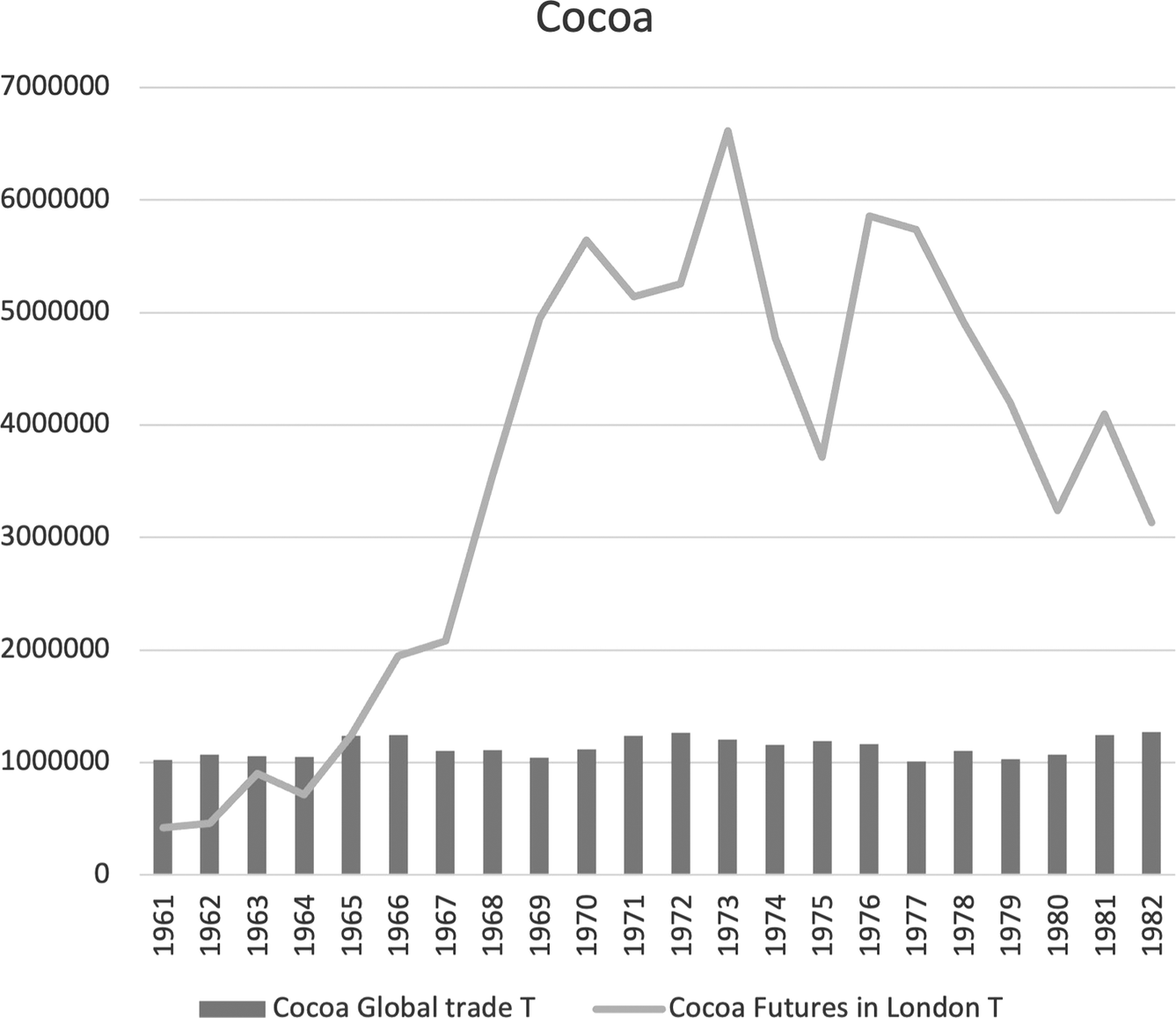
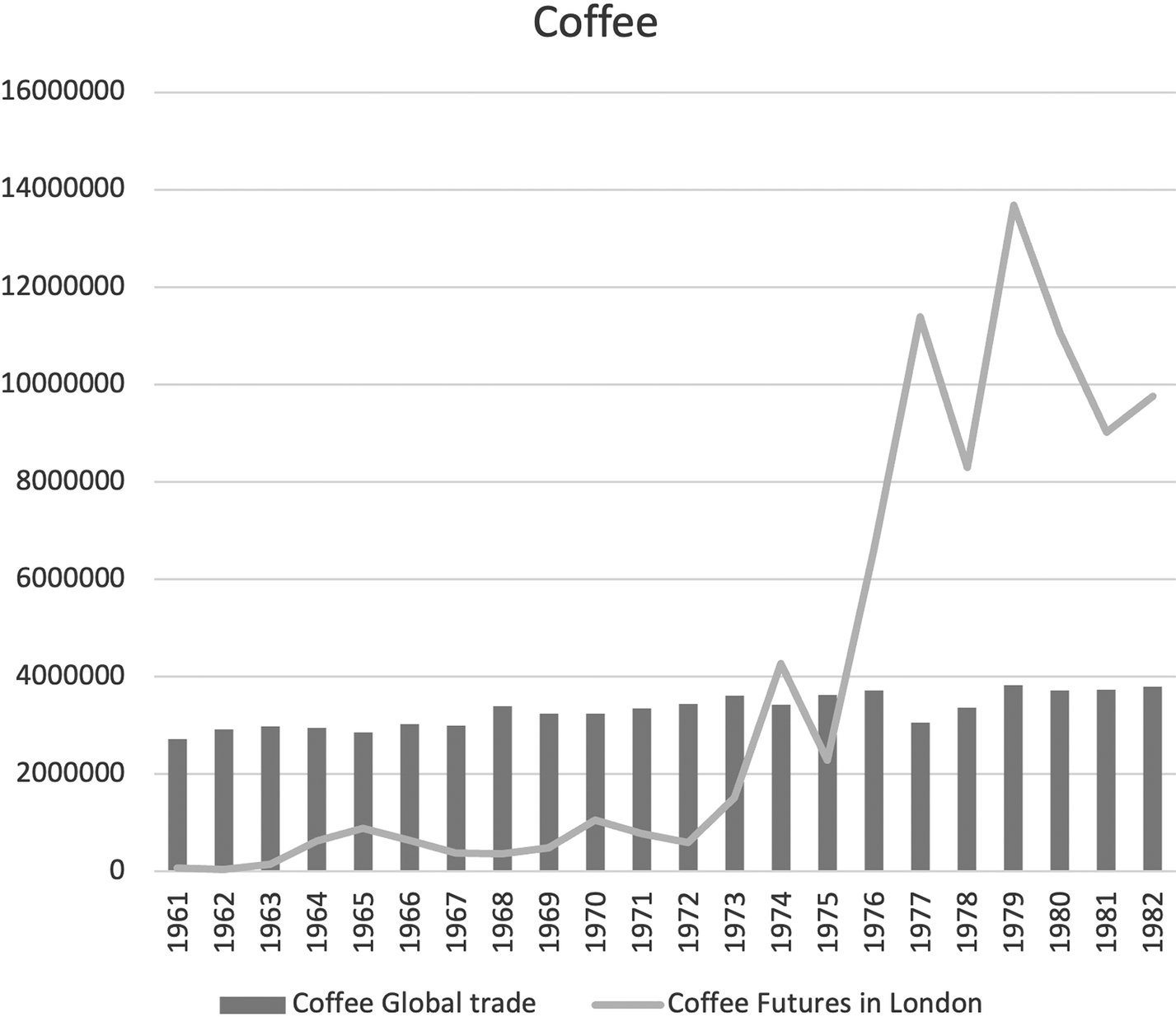
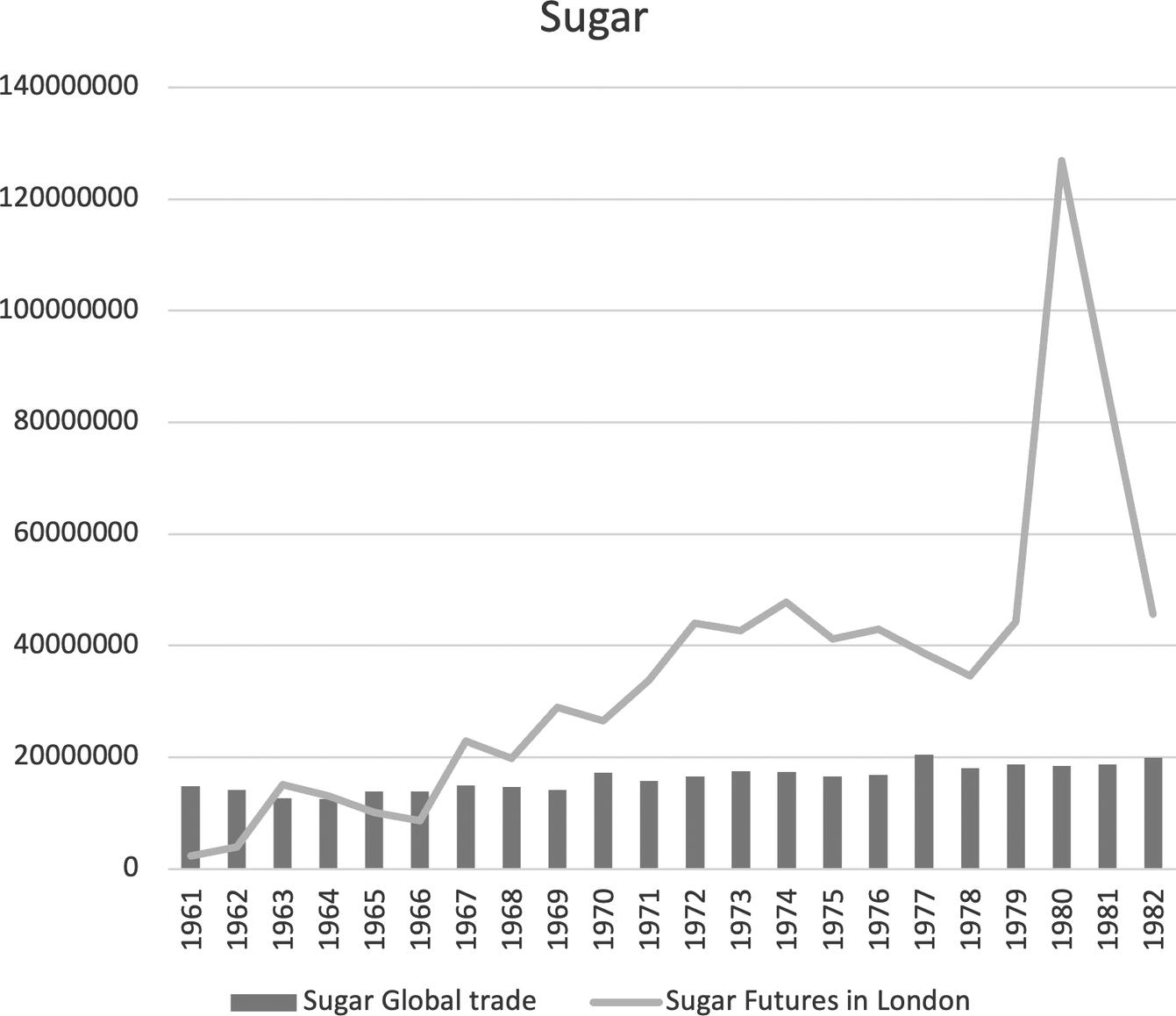
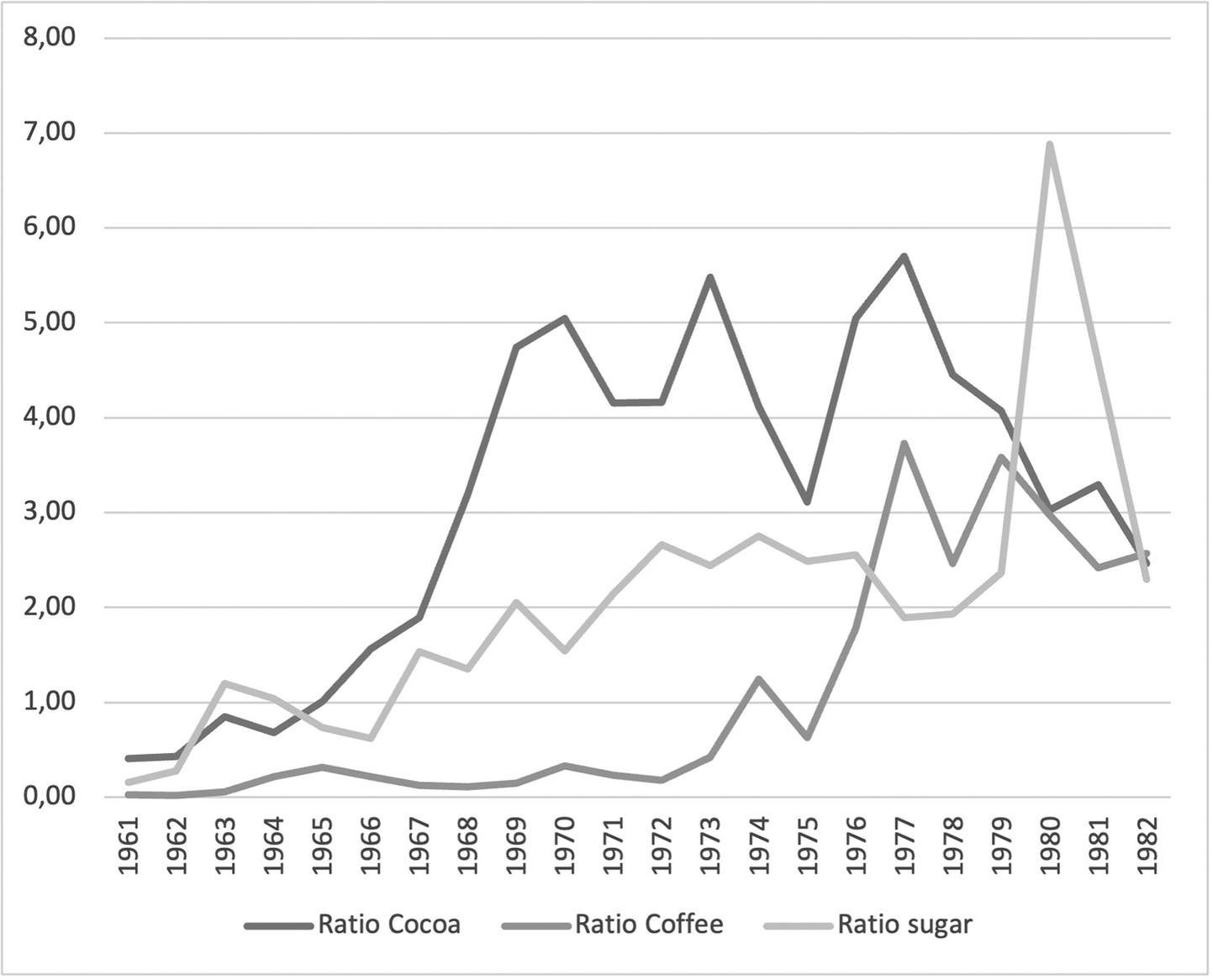
This growth did not match the much smaller growth of global output. In the 1970s, the global economy was characterized by a great expansion in so-called financialization, which in the trade of commodities is often measured as a ratio between physical trade and futures.Footnote 36 From Figures 1a–1c, we can observe that this ratio has reversed since the late 1960s in the relationship between the global physical trade in cocoa, coffee, and sugar, and the futures trading for these commodities in London terminal markets. During the early 1960s, futures were a fraction of the physical trade (ratio about 0); by the mid-1960s, futures reached physical trading (obtaining a ratio of 1) and then surpassed it, arriving at a ratio of about 4 for coffee, 6 for cocoa, and 7 for sugar (Figure 2).
Financialization in cocoa—the position of the London Terminal markets, 1961–1982
Source: Figures 1a-1c and Figure 2 are elaborations of the author. Quantities are in metric tons. Table 1 includes futures contracts; statistics about physical trade are from the Food and Agricultural Organization of the United Nations for annual production (see https://www.fao.org/faostat/en/#home).

Financialization in coffee—the position of the London Terminal markets, 1961–1982

Financialization in sugar—the position of the London Terminal markets, 1961–1982

Ratio of financialization in cocoa, coffee, and sugar, 1961–1982

There are many explanations for the influence the boom had in the demand for futures. According to Goss, for example, four conditions for successful futures trading are (1) the significant variations in prices, (2) the presence in the market of economic agents with a high commitment in futures operations, (3) the high standardization of commodities traded in futures exchanges, and (4) a high demand for risk hedging facilities.Footnote 37 The trade in futures soared in the 1970s when prices recorded severe fluctuations, but trade had already seen firm growth in the 1960s when price fluctuations were not sharp. Other scholars, such as Stein and Streit, linked the growth of that market to the ability of the exchanges to disseminate information: terminal markets came to the fore as decisive tools for pricing commodities, thanks to their transparency, to data gathering, and to the standardization of contracts.Footnote 38 Slade also pointed out that a certain degree of market openness is necessary to the work of futures exchanges, suggesting that they work better in periods of rising globalization and reduced trade barriers.Footnote 39 The opening up of markets following the General Agreement on Tariffs and Trade Kennedy Round negotiations in the 1960s, and their increasing instability from the dollar gap and from the disintegration of the Bretton Woods system after 1971, set the stage for the global instability that also affected primary commodities.Footnote 40 By the early 1970s, the decline of cartels and intergovernmental commodity agreements also stimulated a rise of futures that replaced them in the global price governance of commodities, which allowed the extensive adoption of futures exchanges in the fixing of commodity prices.Footnote 41 As Maier put it, the rise of futures can be linked to the decades-long paradigm of instability being replaced with the paradigm of stability in the 1970s (Table 1).Footnote 42
The Expansion of the London Terminal Market Association, post–World War II

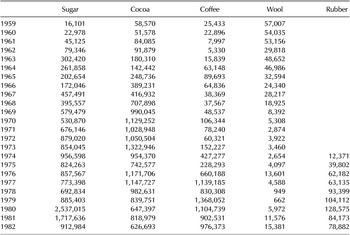
Source: Number of lots (5 tons for cocoa, 10 tons for coffee, 50 tons for sugar) of futures contract cleared at the London Produce Clearing House. Only 1 percent of the futures were delivered. For data to 1974, see Rees and Jones, “International Commodities Clearing”; for data from 1975 onward, see International Commodities Clearing House, Yearbook.
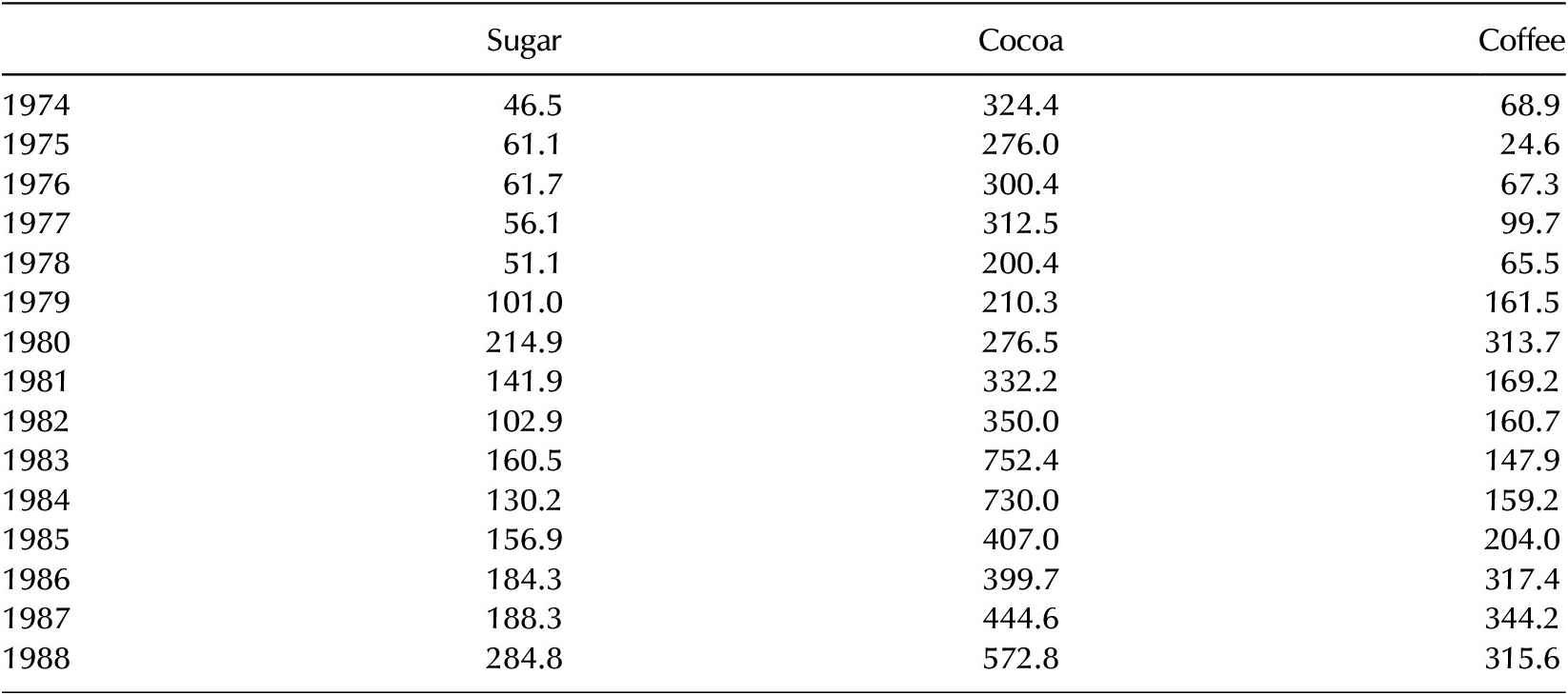
The rise of London commodity exchanges was part of this global process. Since the mid-1960s, all “soft” commodities, a term that traders often used to identify cocoa, coffee, and sugar, have undergone staggering expansion. The only exception to this is trading in wool, which declined because of the opening in 1969 of a terminal market in Sydney (Australia is the main wool-producing country). Between 1959 and 1974, raw sugar futures contracts cleared by the London clearing house increased from sixteen thousand to about one million; cocoa increased from fifty-eight thousand to about one million; and coffee increased from twenty-five thousand to about half a million.Footnote 43 As Table 1 shows, the contracts for coffee, cocoa, and other commodities grew rapidly during the 1960s and the 1970s, especially after 1974. According to global data on global sugar output, in the early 1960s, future contracts covered a mere 1 percent; by 1989, futures accounted for more than 500 percentFootnote 44 (Table 2). Before the 1970s, futures trading was secondary to the activity of economic actors (e.g., producers, consumers, traders, and brokers); afterward, it became crucial.Footnote 45 One reason for the rise of futures can be seen in a decisive change in the users of commodity markets. By the early 1970s, the terminal markets increasingly moved to providing services only to the commodity industry (e.g., commodity producers and traders), which allowed investors not directly involved in commodities (e.g., institutional investors and hedge funds) to diversify their portfolio in commodities.Footnote 46
Commodity futures contracts at the New York Coffee, Sugar and Cocoa Exchange (in percent of world output)

Source: LeClair, International Commodity Markets, 88–89.
The Self-Regulatory Model of the City’s Commodity Futures Exchanges
The specific institutional framework of London’s futures exchanges made these market venues quite attractive for investors in the 1970s. The City’s terminal markets were not young institutions. A futures market for raw sugar and coffee (robusta variety) was created in 1888; for rubber in 1889; and for cocoa in 1928. Although these markets rose in the global economy of the belle époque, they declined during the interwar period, and endured a slow recovery after World War II. They were fully recovered by the mid-1960s, along with greater market openness and integration, and boomed in the 1970s. Until the end of the 1980s, these terminal markets were independent and autonomous because each commodity belonged to a specific exchange.Footnote 47 According to Rees, while they had formal autonomy, the City’s commodity exchanges used a kind of self-regulation model based on three common traits: specialization of the exchanges, membership of brokers to these exchanges, and the clearing system that was adopted.Footnote 48
Specialization of the exchanges was at the core of the City’s model, unlike other commodity exchanges outside the United Kingdom. Those in the United States, for instance, were usually multicommodity trading centers. The second feature of the City’s exchanges—membership—was decided by the committee of the exchange itself on the basis of the reputation and reliability of the traders and merchant firms. Each exchange had a chairperson who represented the interest of the exchange with public powers. There were eventually three groups of memberships. One was the “floor brokers,” and there only so many in these markets: fourteen brokers in rubber, eighteen in sugar, thirty-five in coffee, and forty-six in cocoa. The number allowed was according to each exchange’s rules on the “open outcry” on the floor. Another group was the “home members,” who were the traders and brokers who specialized in the specific commodity traded in the exchange.Footnote 49 Until the 1970s, they were required to reside in London and be employees of the major London merchant companies, such as Czarikow; Golodetz; ACLI; Pacol; Wolff; Bache; Rayner; Dalgety; EDF Man; and Ralli Brothers.Footnote 50 The third group was “associated” or “overseas” brokers, who were mainly large producers, consumers, and global traders (e.g., Coca-Cola; Nestlé; Hershey; Tobler; Cadbury; Suchard; Leibig; Goldman Sachs; Merrill Lynch; Billington; Cargill; Louis Dreyfus; Mitsui; and Mitsubishi).Footnote 51
The third feature—a common clearing house—refers to the London Produce Clearing House (LPCH), which later became the International Commodities Clearing House (ICCH). The LPCH was founded in 1888 concomitantly with London’s first futures exchanges; it was not owned by the exchanges or their members but acted as an autonomous institution to offset the daily operations of the exchanges.Footnote 52 According to Rees and Jones, the LPCH and the reputation of the traders together created the cornerstone for self-regulation of the City’s terminal markets.Footnote 53 The LPCH avoided systemic risks, making governmental control over the terminal markets unnecessary. The LPCH was under nonstatutory control by the Bank of England, which received information directly from the LPCH (then from the ICCH) but had no power of inspection.Footnote 54 For instance, according to a report by the Bank of England about a meeting of the Sugar Liaison Committee that supervised London’s sugar terminal market, statistical data on sugar futures were provided thanks to the “club atmosphere” of the sugar market and to the traders’ commitment without any rules established by the government.Footnote 55
It was not unusual for some interlocking relationships to exist among the City’s exchanges, which helped spread similar approaches among themselves. In many cases, the same brokerage firms were in each exchange, while in other cases the associate members of one exchange were also home members of another. This occurred with Merrill Lynch, an associate member in most of the exchanges but a home member only in cocoa. Two more examples are Czarnikow and Bache: both were associate members in all terminal markets, but Czarnikow was a home member only in sugar and Bache was a home member only in cocoa. Frequently, the actors involved in one exchange determined the global trade for those types of commodities. Chalmin epitomizes this in the adage that “when the analyst of Merrill Lynch coughs, the market catches a cold.”Footnote 56 Global firms trading in one type commodity, such as Cargill or Louis Dreyfus for wheat,Footnote 57 also held positions, respectively, as associate members in cocoa and coffee exchanges, showing an aptitude for diversification in their commodity investment portfolios. Both members and nonmembers could hold positions on the exchanges, but their fees, linked to market operations, were quite different: members paid small fees while nonmembers were charged with extra fees. According to Rees and Jones, the nonmembers’ higher fees were aimed at avoiding venturing behaviors and speculation by those outside the industry.Footnote 58
Soft Commodities Exchanges and Regulations Outside the United Kingdom: New York and Paris
New York, and to a lesser extent Paris, contended London’s “leading” role in global futures trading in soft commodities.Footnote 59 These two trading venues shared similar origins and timelines, being set up in the late nineteenth century, a period characterized by an increase in international trade and a rise in globalization. U.S. grains and cottons represented the most important commodities in futures trading,Footnote 60 and so New York City emerged over time as an important trading place for coffee (arabica), raw sugar, and cocoa. The New York Coffee Exchange started its operations in 1882, and in 1914 it launched a trade in raw sugar, becoming the New York Sugar and Coffee Exchange.Footnote 61 In 1925, a terminal market for cocoa was also opened in New York.Footnote 62 In 1979, the New York Sugar and Coffee Exchange merged with that of cocoa, giving birth to the New York Coffee, Sugar, and Cocoa Exchange.Footnote 63
Paris already had coffee and raw sugar contracts by the end of the nineteenth century, and it opened a “white sugar” contract in the 1960s, thereby gaining importance in the global trade of this commodity.Footnote 64 Despite similar origins to London, New York and Paris showed important differences in relation to their clearing systems, specializations of the trading venues, and role of government surveillance. In the United States, each commodity exchange had its own clearing house owned by the members themselves. The U.S. clearing system model has often been referred to as a “mutual clearing” without guarantees. This was the same in Paris. Their mutual clearing system could become unstable if one or more members were in a weak position within the exchange, which could in turn trigger a domino effect resulting in a lack of liquidity for the entire terminal market. This model clearly represented a systemic risk for these markets.Footnote 65
The United States has a long history of governmental regulations for futures trading, yet regulations evolved inconsistently until the CFTC. Before World War I, U.S. markets were unregulated, like those in London. After World War I, the U.S. government increasingly enacted controls and regulations to reduce speculation, which was frequent in the exchange of commodities (i.e., grains or cotton) in Chicago, New York, and New Orleans.Footnote 66 Grain was the first commodity to be regulated with the adoption of the Grain Futures Act in 1922 and the creation of the Grain Futures Administration, a specific regulatory body that operated on a daily basis. Governmental controls led to the public authorities providing licenses to brokers and traders, inspecting contracts, monitoring the exchanges, and putting their operations on hold when fluctuations in prices were too wide. Regulations were extended to all U.S. produce (cotton, grains, and onions, for instance) via the Commodity Exchange Act of 1936 and the creation of the Commodity Exchange Authority under the U.S. Department of Agriculture (USDA), which replaced the Grain Futures Administration.Footnote 67 The U.S. government had to regulate domestic produce because it was not uncommon for commodity “kings” to corner markets of the exchanges. Another reason was because of structural weaknesses within the U.S. exchanges. There was no differentiation in fee prices, and the absence of rules on membership drew poorly informed speculators into the market, making the mutual clearing system a source of permanent risk for the exchanges.Footnote 68
Before creation of the CFTC in 1974, U.S. futures regulation was inconsistent. National commodities, like grains, onions, and cotton, were strictly regulated on a day-to-day basis by the Commodity Exchange Authority, while other commodities, and especially imported commodities, like cocoa, coffee, and sugar, were either unregulated or not surveyed by government agencies. In the 1950s and 1960s, the U.S. government made attempts to apply the same regulations to all futures exchanges because the unregulated markets were cyclically hit by cornering or untrained speculation.Footnote 69 According to Markham, an expert in the history of U.S. futures and a former CFTC regulator, the unregulated soft commodities exchanges made them attractive for the most speculative of players of the U.S. commodity markets. Despite ongoing attempts to regulate them, the sugar, coffee, and cocoa futures markets remained self-regulated until they came under the control of the CFTC in 1974.Footnote 70
In the early 1970s, the USDA extended the powers of the Commodity Exchange Authority; and in March 1973, Congress amended the Commodity Exchange Act so as to regulate all remaining unregulated commodities.Footnote 71 This amendment was welcomed by Clayton Yeutter, then an assistant secretary in the USDA and later the secretary of Agriculture, who called it “one of the most important agricultural bills to emerge from the Congress in a long time.”Footnote 72 The newly created CFTC was a concern for market actors, and regulations eventually ended the spectacular (if uneven) growth of futures trading. As reported in 1975 in the first annual report of CFTC, the number of contracts stagnated in 1974. Meanwhile, before 1973 (when congressional debate started and first drafts on futures regulations were published) and after 1975 (when the regulations came into full operation), the number of contracts grew by about 25 percent a year.Footnote 73 In the in-between year, 1974, there was a swift switch from an unregulated model to strong CFTC regulation. Traders perceived this as dangerous for futures trading, because all the exchanges and brokers (in 1973, there were approximately twenty-five thousand brokers operating on the U.S. unregulated exchanges) were required to obtain authorization from the CFTC. If they did not, they “must either discontinue operation or they will [ . . .] be operating in violation of the law [ . . .]; must either cease business [ . . .] or operate in violation of the law.”Footnote 74 Shortly after the CFTC regulated New York’s coffee, cocoa, and sugar markets, Paris’s terminal market was also reformed. As mentioned earlier, before 1974, the French market was like the U.S. market, with poor regulations on membership and a mutual clearing system. During the commodity boom of 1973 and 1974, the Paris market was hit by severe speculation, leading to a quick, dramatic drop in prices that drove Central Clearing House of Paris markets to fail, as most people had anticipated.Footnote 75 After this failure, futures trading underwent regulation and the Commission des marchés à terme (COMT), designated to control the operation of markets, was set up with similar features to the CFTC.Footnote 76
A Global Competition Among Trading Venues: The Role of Regulation as a Competitive Edge
While futures trading was expanding in the global economy of the 1970s, few market venues competed to attract investors and expand their relative turnover. In sugar, coffee, and cocoa futures trading, some competition existed among New York and London, and to a smaller extent with Paris. Scholarly studies often underline the cooperation among terminal markets. According to Chalmin, until the 1960s, a certain “division of labour” existed among the futures markets.Footnote 77 For instance, in the case of coffee, New York was historically the center for arabica quotations, while London was the base for the robusta variety.Footnote 78 With sugar, New York and London were important markets for raw sugar while Paris specialized in refined white sugar.Footnote 79 Such cooperation was, however, replaced by ongoing competition. For example, the Coffee Terminal Market Association of London tried several times to open futures trading on arabica to take market quotas from New York,Footnote 80 and the United Terminal Sugar Market Association of London developed a white sugar contract when the terminal sugar market of Paris was in turmoil in 1974.Footnote 81 In retaliation, Paris developed a market for robusta coffee and cocoa to respond to London’s white sugar contract.Footnote 82
Scholars have shown that, from a theoretical standpoint, terminal exchanges usually compete on a two-dimensional basis founded on the (1) geographical proximity of the markets from production sites, and (2) the maturity and reliability of their contracts related to market competitiveness. Neither London nor New York had decisive advantages in terms of distance from production sites to places of consumption, and both offered similar contracts in terms of reliability and maturity. Similar considerations can also be applied to Paris, at least before the failure of its clearing house. Gehrig, after studying the competition among these commodity terminal markets, emphasized that indirect factors became central to their competitiveness. In particular, he discusses the attractiveness of market venues, which could emerge from either fiscal authority (in reducing transactional costs on the exchanges) or from the financial center where the exchange is located. Either of these factors could reduce the cost of borrowing money for market operations.Footnote 83 This approach was recently advanced by Hautcoeur and Riva in their study of stock exchanges, who show that not only fiscal policies and financial power but also regulation have played determining roles throughout history in setting competition among markets.Footnote 84
The revolution in regulation of U.S. futures markets, represented by the creation of CFTC in 1974, both threatened U.S. exchanges, in particular those involved in cocoa, sugar, and coffee, and created an opportunity for London to improve its competitiveness in attracting new actors to those markets. Traders who had relied on the relative freedom of the U.S. market for soft commodities now started to look for other marketplaces.Footnote 85 The attractiveness of the London terminal markets in the global scene largely depended on the City being a financial center that contributed to the provision of capital and the necessary liquidity for futures operations.Footnote 86 The more relaxed and self-regulated environment of the City gave a competitive edge to London, where U.S. financial actors found better opportunities, thanks to the growth of Eurodollar markets.Footnote 87 Many U.S. banks opened branches in London, and U.S. traders gradually invested in the City’s markets. For example, Merrill Lynch had a strong position in City commodity exchanges. A study by Seddon on the London Metal Exchange provides insight into U.S. investments made in this terminal market of the City.Footnote 88 The Bank of England was aware of the appeal of the City’s soft commodity futures market venues, which drew increasingly large numbers of investors from hedge funds and institutional investors.Footnote 89
London was no longer the only self-regulated market, but it was the largest for futures in the world.Footnote 90 The notification of the City’s exchanges to the EEC antitrust division should be seen against this backdrop: the self-regulatory model of the City’s exchanges was perceived in the first half of 1973 as a competitive edge in the promising field of futures trading, which were expanding not only in commodities but also to other fields of activity, such as currencies and public debts. This is the same time when the U.S. Congress was debating on extending regulations over its commodity futures exchanges. The goal of the notification was to increase London’s competitiveness as an international financial center, which was the same goal of the British government.Footnote 91 The Bank of England clearly understood this. In 1975, the governor of the Bank of England, which, remember, had nonstatutory control of the commodity exchanges, was convinced by the strong performance of the soft commodity exchanges and of the Bank’s “approach to supervision [that] encourage[d] the markets to regulate themselves and to respond promptly to the Bank’s persuasion when necessary.”Footnote 92 Many actors, both in the United States and Europe, looked to London as the most efficient market to perform hedging operations because of its relative freedom from statutory controls and the security of its clearing house, especially after the failure in Paris. Additionally, the City’s main financial actors were looking for growth and a sharp competitive edge in order to open new futures contracts in the financial sector.Footnote 93 The International Commodity Clearing House, which secured the clearing operation of the London terminal markets, sought to establish a financial futures exchange in London, such as for currencies and interest rates. According to a report by the ICCH in the late 1970s, “the introduction of a market for interest rate futures took place in Britain with less administrative difficulty than was the case in America. This was because the supervision of commodity markets in Britain was carried out by one agency, the Bank of England, which operated a largely informal system not subject to juridical review.”Footnote 94
London’s Exchanges Meet the European Commission: Crafting a European Model
The U.K.’s accession to the Treaty of Rome in 1973 and the new regulations of the EEC could be seen as threats for the growing position of London’s exchanges in the global economy of the futures trade.Footnote 95 Thus, the Federation of Commodity Associations, which represented all of London’s commodity exchanges, coordinated a common action with regard to the European Commission. Each exchange was to notify the antitrust authorities of the Commission—the DG IV—of their rules and ask for a negative clearance. All notifications were represented by a single party: Coward Change, a leading law firm in the City.Footnote 96 In 1973, the same year of the notifications, Coward Change opened an office in Brussels and boasted expertise on the new European legal framework.Footnote 97 After the first set of applications for negative clearance was submitted in 1973, other London commodity exchanges followed suit, including: Grain and Feed Trade Association, Soya Meal Futures Association, London Grain Futures Market, London Potato Futures Association, London Meat Futures Exchange, and International Petroleum Exchange of London Ltd. The decision on the negative clearance asked by these exchanges arrived in 1986, one year after the decision on the original applicants.Footnote 98
The officers of the European Commission were aware of the importance of these notifications, not only for the European market but also for the global regulatory framework of commodities. A member of the DG IV, who was in charge of a particular case, wrote an internal note: “toute intervention de notre part sur la situation existante risque d’avoir des répercussions sensibles à l’échelle mondiale” (our intervention on the existing situation risks relevant impacts on the global scale).Footnote 99 This statement extends the idea recently noted by Drach about EEC banking regulations: in the regulation of futures trading, the EEC played a pivotal role, following a very different direction from the U.S. approach so as not to disturb the functioning of markets.Footnote 100 The commissioners had neither previous experience nor sufficient knowledge to regulate futures trading. Meanwhile, the expertise of the DG IV, which received the notifications from the futures markets, was in antitrust and law, and its core activity was breaking up cartels, so it too knew nothing about the complex financial services of futures.Footnote 101 These limitations clearly surfaced in the types of questions that Marco Piccarolo, the DG IV official handling the notifications, asked of the British Office of Fair Trading in obtaining information about the work and scope of futures markets. The British Office of Fair Trading provided him only basic information about terminal markets:
Do not set themselves up to trade in their actual commodities; instead, they each trade in futures—to use a technical term [ . . .]. What this exactly means is difficult to explain in a few words [ . . .]; a terminal market is not a market to which one goes when wishing to buy or sell a commodity. It is rather a market to which buyers or sellers of a commodity, which is subject to considerable price fluctuations because of variable production and demand, have recourse if they wish to limit possible losses regarding their actual transaction in the commodity.Footnote 102
Piccarolo had no knowledge of what futures market did, how they functioned, and their technical needs. His experience was in political science and law, not finance.Footnote 103 In the early 1970, futures were understood only within a narrow circle of commodity traders. A few theoretical studies existed on their working and a general approach to futures was still expanding.Footnote 104 The Black-Sholes model for derivatives pricing was published in 1973, and only later became the basis for understanding pricing behaviors in futures and options.Footnote 105 The first attempt made by the European Commission to regulate futures was via public servants with no knowledge of futures trading and its abuses. This was the reason behind the massive difference in regulatory frameworks. In the United States and France, CFTC and COMT, respectively, were specific agencies created to supervise the working of futures markets. They were separate agencies from those doing antitrust work and, especially in the United States, the officials had the practical experience of supervising regulated commodities. The European Commission seemed keen to avoid the creation of new agencies, which could interfere with the working of markets at the continental level. It never attempted to create a regulatory body as in France and the United States. The European Commission limited assessments to whether the rules of the futures exchanges fell within European antitrust laws.Footnote 106
Against this background, the London terminal markets tried to impose their own preferences on the commissioners. In February 1974, the Futures Commodity Association of London, which coordinated the notifications sent to the Commission, invited the EEC to visit the London terminal markets. The visits were not limited to cocoa, sugar, and coffee exchanges; it also included the London Metal Exchange (which had not sent any notification to the Commission) and its common clearing house (which was not directly involved in notifications anyway).Footnote 107 The approach taken by the European Commission was based on the information that applicants provided, which resulted in a general leniency in the market. After the visit to London, the Commission’s officials remained in contact with the head of the Merrill Lynch agency of London, L.A. Brighton, who provided them reports on the working of futures and trading in commodities.Footnote 108 The London commodity exchanges then updated the Bank of England on the evolution of their talks with the European antitrust authorities (i.e., DG IV).Footnote 109
After all of this, the commissioners still showed no inclination to regulate futures trading. Rather, their sole preoccupation was to ascertain whether this trading went against the competition policies of the European Economic Community. The Commission simply wanted to understand whether the terminal markets were a direct or indirect form of price fixing. Significantly, throughout 1974, the only questions that Brussels asked the U.S. authorities were related to antitrust and price fixing, not about broader regulations. From the information gathered from the markets and the U.S. Federal Trade Commission, the Commission understood that, even though futures prices had some relationship to real market prices, they were “fully competitive elements of the markets.”Footnote 110 The Commission gradually understood that futures markets were an alternative to anticompetitive pricing systems, such as cartels and other commodity agreements, because they did not limit production, markets, or investments. Furthermore, these markets did not set production or market quotas. The DG IV of the European Commission began to associate that the development of futures markets could improve free market forces and curb the influence on market prices of the commodity schemes operating in the 1970s.Footnote 111
According to internal notes, it seemed that the Commission officials did not comprehend the significance of some actors in the commodity markets (both for physical commodities and futures), such as Merrill Lynch in cocoa or Czarinow in sugar.Footnote 112 They not only disregarded an investigation of the market power of the biggest players in the City but also considered them a reliable and impartial source of information to understand the working and regulation of futures trading. For instance, information about the meaning of futures trading was taken from “the attached photocopy from the booklet we received from Mr. Brighton [head of Merrill Lynch in London] dealing with cocoa [that] is a very good illustration or example.”Footnote 113 This item was Cocoa, by Merrill Lynch, a short booklet designed to inform investors in cocoa futures, which was sent to the Commission after the visit to London with How to Buy and Sell Commodities, a promotional booklet that the firm gave to investors. These were not scientific publications but promotional papers intended to attract investors in commodity futures in the U.S. terminal markets. They provided scant information about the actual working of futures. Moreover, because these were published before the establishment of the Commodity Futures Trading Commission, they inaccurately portrayed the self-regulatory system of soft commodities futures in the U.S. as efficient and safe.Footnote 114 Without seeming to question this tilted information about the nature of futures, the Commission agreed to futures trading self-regulation. An official who inspected futures notifications in 1979 wrote in a note: “In view of the particular nature of the markets, their worldwide importance, and their undoubted price stabilizing effects, the Commission sees benefits in business being channeled through these selfregulating [sic] markets.”Footnote 115
It is safe to conclude that the Commission considered futures trading exclusively from an antitrust perspective because this market lacked the typical anticompetitive characteristics (price fixing, market sharing, and the like). A specific form of supervision or regulation was not proposed because futures were not considered a dangerous financial tool, but had only positive effects on markets. Creation of a regulatory body would have required a different and broader approach to futures, which was incompatible with the DG IV’s approach to the market, the antitrust perspective adopted for notifications, and the entire Commission’s agenda. A different approach might have also been in contention with the U.K. government, which fostered the growth of markets in the City of London.Footnote 116
An interesting point came from the nexus of relationships between national and European regulations. In banking regulations, the principle of the “home country control” prevailed, but in futures trading any interference on the functioning of the market was avoided. The Commission preferred to let each nation-state be responsible for their own regulation in the futures market, considering it as a strictly national matter. As a result, the creation of the COMT in France did not change the attitude of the European Commission toward the City of London or the Bank of England’s noncompulsory control. Moreover, it believed that futures markets were instrumental in keeping price stability, which was a goal of the international policies regarding commodities and raw materials. Meanwhile in the United States, futures were perceived as potentially risky, at least without some regulation. The European Commission instead adopted the optimistic view about the reliability of these markets in self-regulating themselves. According to the DG IV, futures were aligned with both the broader European agricultural policies and the policies Europe had adopted from former colonies, both of which had the goal of stabilizing commodity prices.Footnote 117 The officials also seemed to think that futures markets, instead of having simultaneous hedging and speculative goals with ambivalent outcomes on the global economy, were simply aligned with the price stabilization policies of the United Nations Conference on Trade and Development. Indeed, a report compiled for the general commissioner stated that “futures trading could provide some forms of price stabilization.”Footnote 118
Despite this general optimism toward futures and futures exchanges, the European Commission tried to change the operating mechanisms of the London terminal market, which contributed to delays in the delivery of negative clearances requested in 1973 until 1985. The DG IV was concerned about some of the specific rules of the terminal market related to the differing fee rates to distinguish members from nonmembers. As already seen, this differentiation in the City of London terminal markets was a specific feature of that market venue, which the U.S. exchanges did not have. In accordance with this U.K. rule, a trader who often used these markets was prompted to become a member, thus paying smaller fees to trade in futures. The London terminal markets considered members as being more reliable than nonmembers, who only occasionally used these markets based on little information. A clause about differentiation in fees, however, according to DG IV officials, was market discrimination; to provide authorization to the negative clearance, they asked for it to be eliminated.Footnote 119 This change made the U.K. exchanges more like the U.S. market but without changing the self-regulation model of the City’s exchanges.Footnote 120
Conclusions
The legal actions undertaken by the London terminal markets simultaneously were linked to the expansion of global commodity futures trading and responded to the European regulatory framework that risked becoming more like the U.S. model. From the 1960s through the 1980s, London’s commodity exchanges experienced rapid growth through several competitive advantages over other markets. Starting in the mid-1960s, London’s commodity markets emerged as key players in the global futures trading of sugar, cocoa, and coffee. In the early 1970s, London was a large, if not the major, financial center for futures operations in commodities; and it competed with other terminal markets, in particular those in the United States, to take advantage of a dramatic expansion in futures trading. London’s self-regulatory approach was central to its competitiveness with global competitors. Through the notification of futures market rules to the European Commission, the City of London successfully established financial tools and rules for commodity exchanges at the EEC level, to which European authorities had a positive attitude. These notifications were equally crucial from economic and regulatory standpoints. At the same time, they played a performative role in crafting the rules of trade in Europe and had a deep impact on global futures trading.
By the 1960s and 1970s, London’s markets were no longer only of national interest. They had attracted non-UK traders, who found in the City of London a reliable market location in which to operate. The stability of its financial center was crucial in London’s appeal and reputation as a reliable market, which was also related to its history. These were some of the factors behind the rise of London in the futures global trade. Self-regulation was also essential in making London an attractive market venue for both domestic and international investors. Self-regulation has clearly been linked to London’s competitiveness as a financial center.Footnote 121 The main difference between the United States and the United Kingdom was the relationships between political powers and trading actors. While U.S. political powers adopted supervision of markets and its actors, U.K. leaders organized the markets to be self-regulatory—and their reliability was considered sufficient to avoid needing governmental interference. Domestic self-regulation was based on a nonstatutory survey by the Bank of England, whose task was not comparable with the day-by-day survey of the U.S. CFTC. Any new market regulations from the EEC might represent a threat in this context.
In this interplay, the concomitant strengthening of U.S. regulation via Congress occurred in the same year that the United Kingdom joined the European Economic Community. The United States followed a model of particularly tough governmental supervision, which hindered the development of U.S. futures trading. The U.K. exchanges, on the other hand, acted preemptively to secure a different outcome and save their long-established self-regulation. The adoption of the U.S. model by the French commodity exchange is proof that U.K. financial markets could have been affected by new regulations outside of the United States, although the evolution of French regulations was also based on serious concerns within the sugar terminal market of Paris. Paris futures exchanges, unlike those in the United Kingdom, showed weakness after the failure of their clearing system; as a result, the exchanges were put under strong governmental regulation.
One inference of this article is that the approval of futures trading rules by European authorities was a key step toward the EEC’s (among other organizations) de-regulation of markets during the 1970s.Footnote 122 The EEC’s approach to futures trading had a global impact because the City of London was becoming a leading center for financialized and dematerialized commodity markets. Financialization of commodity trading was concomitant with the emergence of a large, unregulated market for soft commodity futures based in London, which became the model for the European Commission. Future research should analyze whether the European Commission helped establish futures trading in London for certain political or economic goals. For instance, after the United Kingdom joined the Common Market, London was perceived as a strong financial center on which both EEC and the United Kingdom could rely. According to Ionescu, in her critical study on European market integration, a common goal of the EEC and the Bank of England (the agency with nonstatutory control over the City of London’s terminal markets) was to take back control from New York and the Eurodollar markets to make London the global center of the commodity market.Footnote 123 Following this idea, the process for London terminal markets to obtain negative clearances from the European Commission was most likely intended to help London develop its markets with a global reach. This was the same goal as the U.K. political and monetary authorities.
In the context of futures trading regulation, the Commission preferred to hold each nation-state as responsible for their own regulations to avoid serious confrontations with member-states’ governments. The notifications by trading interests to antitrust European authorities was an entrepreneurial measure, inasmuch as it endorsed a model of self-regulation and avoided friction among different national market specialties. The result was a global market with regional (and national) fragmented regulation that nonetheless was functional and led to the explosion of futures trading in the global economy. One conclusion of this research is that the United Kingdom and the United States diverged not only in terms of regulation but also in approaches, because the actors involved influenced outcomes. The regulatory fragmentation in the 1970s in expanding futures markets led to two very different views of futures as financial tools and two very different regulatory models.
In the United States, the regulation of futures trading was not linked to antitrust issues but to the ambivalent nature of these financial tools. Futures markets consisted of both untrained speculators and knowledgeable actors hedging against the risk of severe price fluctuations. The spectacular growth of futures trading sharpened U.S. regulation to reduce negative behaviors and enhance best practices. The new regulations and their associated administrative burden shocked the trading community. By contrast, in Europe, market regulation was only related to antitrust because European antitrust authorities had a poor understanding of the technicalities and potential problems in futures trading. According to documents produced by European officials in the antitrust division (i.e., DG IV) and used for this research, futures markets were tantamount to free markets; however, a free market approach did not automatically guarantee financial stability, price stability, and economic development. The self-regulatory model in the United Kingdom could have helped create new development opportunities for global trade, and global financial actors could have counted on a diversified architecture of markets. Self-regulation by futures exchanges was instrumental in making the City of London emerge as the center for global trade of commodity futures, as was the coordinated action of the business actors involved in these exchanges.
Acknowledgment
I would like to thank Neil Rollings and Pierre Eichenberger for inviting me to start the inquiry that led to this article; it began with the research network “Transnational Business Encounters in the Twentieth Century,” started at Zurich University in 2018 and continued at the World Economic History Congress in Boston. Thomas Davis, Matthieu Leimbruger, and Glenda Sluga offered me fruitful comments on these occasions. Early versions of this article benefitted from the reading by Carlo Fumian, Giovanni Gozzini, and Luciano Segreto. Valerio Cerretano deserves special mention: His attentive reading made my arguments stronger and clearer. The anonymous reviewers of Enterprise & Society provided invaluable suggestions that significantly improved the original manuscript. This research would be impossible without the work of the archivists at the Bank of England, in London; at the National Archives and Record Administration, in College Park, Maryland; at the Archives Nationales, in Pierrefitte sur Seine; and at the of European Commission, in Brussels. As usual, I am solely responsible for all mistakes.
This work was supported by the program “Rita Levi Montalcini” of the Italian Ministry for Education, University and Research (Grant MIUR–DM 352–01.06.2016).