Introduction
Edges wherever and however defined, except for in New Zealand, Australia and the Antarctic, are frequently occupied by the genus Vaccinium (Ericaceae) either sensu latissimo (Vander Kloet, Reference Vander Kloet2004), or sensu lato (Sleumer, Reference Sleumer1941), or sensu stricto (Klotzsch, Reference Klotzsch1851). Whether it is Vaccinium gaultheriifolium (Griff.) Hook.f. growing on a razor-back ridge leading to Fan Xi Pan, northern Vietnam, or V. myrtoides (Blume) Miq. thriving in fire-induced grasslands that form the summit of Mt Pulog in Luzon, or V. reticulatum Sm. shrouded in the sulphurous mists of the Halemaumau Crater on Hawaii, or V. ovatum Pursh precariously tethered in the crowns of the giant sequoias in northern California, or V. horizontale Sleumer growing on goldmine tailings near Wau, Papua New Guinea, or V. macrocarpon Aiton anchored in chinks of deformed slates that are part of the coastal headlands of Nova Scotia, or V. uliginosum L. on the edges of frost polygons on the Cumberland Plateau of Baffin Island, it is, at best, life on the margins. Capable of surviving the onslaught of fumes, fires, salt spray, and cold winds, or anchored in mine tips, water-logged soils or peat, the genus Vaccinium is an excellent example of a stress-tolerant taxon sensu Grime (Reference Grime1979). Indeed, both Warming (Reference Warming1909) and Polunin (Reference Polunin1960) classified the genus as an oligotrophic, holarctic sour-ground plant (oxylophyte): a northern bias possibly derived from the protologue which is based on material that was collected in Lapland by Linnaeus (Reference Linnaeus1737) – or, as Walters (Reference Walters1961) would have had it, the shape and form of any genus depends on the source of the initial material. Therefore, had this been tropical, our concept of Vaccinium would have been radically different: possibly epiphytic in habit or a calcicole with 5-merous flowers and 10 stamens versus a terrestrial oxylophyte with 4-merous flowers and 8 stamens.
That this holarctic opinion has persisted, especially in the ecological literature, is not due to a lack of knowledge: Sleumer (Reference Sleumer1941), Wulff (Reference Wulff1943), Good (Reference Good1947), Croizat (Reference Croizat1952) and Stevens (Reference Stevens1969) have all promoted a tropical origin and centre of diversity for Vaccinium. Nonetheless the ecological literature is replete with phenological observations of flowering and fruiting as well as habitat descriptions and floristic depictions of such holarctic species as Vaccinium uliginosum (Bliss, Reference Bliss1966; Jonasson, Reference Jonasson1981; Foster & Glaser, Reference Foster and Glaser1986) among others, but scarcely any ecological data about tropical species. Very few offer the details on floristics, soils and foliar mineral levels as Tanner (Reference Tanner1977, Reference Tanner1985) did for the Jamaican Vaccinium meridionale Sw. Usually brief notes must suffice, for example on the ecotypic variation (van Steenis, Reference Steenis1940) and pollination ecology (Doctors van Leeuven, Reference Doctors van Leeuwen1933) of Vaccinium varingiifolium (Blume) Miq., a ubiquitous species on the edges of active volcanoes in Java. None, however, compare and contrast life-history strategies of arctic-alpine species or boreal species with those that occur in more temperate or tropical regions.
For every publication that marginally deals with the habitat or ecology of tropical Vaccinium species there are at least 23 that treat some aspect of holarctic or temperate species which, in turn, leads to erroneous conclusions such as the one made by Stiles (Reference Stiles and Fenner2000): ‘Very small hard seeds, such as those of … Vaccinium … are eaten with fruit pulp and defecated intact, even by the smallest seed predators’.
Whether the genus Vaccinium is monophyletic or not remains controversial (Vander Kloet, Reference Vander Kloet2004). Molecular data are, at best, ambiguous (Powell & Kron, Reference Powell and Kron2002). Indeed, Kron et al. (Reference Kron, Powell and Luteyn2002) have argued that the generic limits of Vaccinium may have to be expanded to include such segregate genera as Agapetes D.Don ex G.Don and Cavendishia Lindl., among others, or alternatively that it should be reduced only to the type species, V. uliginosum (Kron, pers. comm.). Therefore, lacking a well-resolved molecular phylogeny of the Vaccinieae, it makes sense to go forward with a well-founded phenetic concept of the genus instead. Consequently, were the concept of the genus as proposed by Copeland (Reference Copeland1926), Sleumer (Reference Sleumer1941), Stevens (Reference Stevens1969), Fang (Reference Fang1986) and Vander Kloet & Dickinson (Reference Vander Kloet and Dickinson2009) to be adopted, as we wish to do for this phenological study, then Vaccinium has at least 500 species distributed among 30 sections (Vander Kloet & Dickinson, Reference Vander Kloet and Dickinson2009). Two of these sections, namely Vaccinium sect. Nesococcus Copel. and Vaccinium sect. Euepigynium Schltr., found only in Malesia, not only contain about half of the species in the genus, but also have seeds with a thin testa and often green embryos. Indeed, only 25 species, mostly from northern latitudes, have small seeds with a hard testa (Hill & Vander Kloet, Reference Hill and Vander Kloet2005).
To loosen the strictures that bind us to this tundra paradigm for Vaccinium, an analysis of worldwide phenological data that the senior author has accumulated since 1967 from both in vivo and in vitro studies might demonstrate either some distinct differences or similarities that are germane to life on the edge wherever it occurs and not just in the tundra, barrens, and bogs of the northern hemisphere. In short, are phenological traits a function of the habitat regardless of latitude or vice versa?
Materials and Methods
Character coding
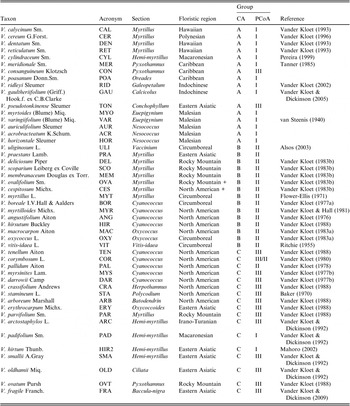
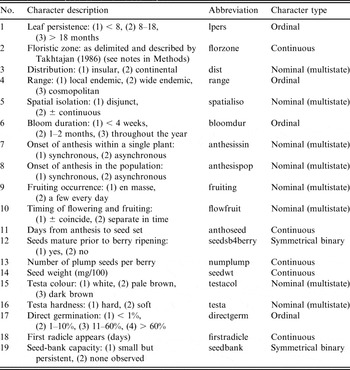
Sufficient data had been accumulated for 48 species (Table 1) that these could be scored for 19 phenological features (Table 2). As these features are subject to interpretation, the rational for coding is outlined below.
List of species scored for life-history features, and the corresponding Vaccinium operational taxonomic units (OTUs). Acronyms as used in Figs 2 and 3; sectional status according to Vander Kloet & Dickinson (Reference Vander Kloet and Dickinson2009); grouping locations are cluster analysis (CA) and principal coordinates analysis (PCoA)

Life-history features scored for the numerical analysis of 48 OTUs of Vaccinium (see text for details)

(1) Leaf persistence. Three patterns were observed: taxa with short-lived leaves (e.g. Vaccinium scoparium Coville; see below), or which stand leafless for about four months during the unfavourable (dry or cold) season; taxa that keep their leaves during the unfavourable season, but discard them shortly after the first flush in spring (e.g. V. darrowii Camp); and taxa which keep their leaves for at least two years, usually 2–5 years (e.g. V. acrobracteatum K.Schum.).
If, as Chabot & Hicks (Reference Chabot and Hicks1982) would have it, leaf lifespan relates most closely to carbon gain, then Vaccinium has evolved three strategies to capture this carbon: (i) long-lived leaves that store carbon and nutrients for future use, often found in plants in nutrient-poor habitats (e.g. V. acrobracteatum, an epiphyte on Nothofagus, retains its leaves for at least three years); (ii) short-lived leaves that have high photosynthetic capacity (e.g. V. scoparium, an alpine species, retains its leaves for only 60–90 days); and (iii) an intermediate stage where the plant retains its leaves for about a year (e.g. V. darrowii, a species subjected to periodic fires in the pine forests of the southeastern USA, flushes erratically from February to November, is dormant during December and January, but loses all its leaves on resuming growth in February). In short, leaf lifespan determines the allocation of carbon moieties which, in turn, influences floral exuberance and, to a certain extent, fruit set.
(2) Floristic zone. As delimited and described by Takhtajan (Reference Takhtajan1986). If the distribution of the taxon under consideration occurred throughout the zone it was given a full score; if less, a partial score; but if its distribution covered more than one zone, the scores were added.
(3) Distribution. Restricted to islands (regardless of size) or not, for example Borneo and Luzon (insular); Borneo and Sumatra and the Malay Peninsula (continental).
(4) Range. Local endemic (restricted to small islands < 100 km2 or just a few isolated loci); wide endemic (restricted to a single continent or a large island, e.g. Sumatra); or cosmopolitan (found on more than one continent).
(5) Spatial isolation. Disjunct with populations more than 300 km apart; for example, Vaccinium ovalifolium Sm. This taxon has a Pacific Rim distribution from Japan to Oregon and disjunct populations in South Dakota, on the shores of Lake Superior, in the Gaspe Peninsula, on the north shore of the St Lawrence River, as well as Cape Breton to Newfoundland (Vander Kloet, Reference Vander Kloet1988) – a classic case of incipient vicariance versus the dispersal explanation which holds for V. cereum G.Forst. in as much as all its populations are restricted to a few volcanic habitats on even fewer isolated islands throughout the South Pacific (Skottsberg, Reference Skottsberg1933).
(6) Bloom duration. Bloom duration or continuity is defined as having, at anthesis, a minimum of two new flowers every day.
(7) Onset of anthesis within a single plant. All inflorescences in a single plant expand simultaneously and come into bloom simultaneously versus floral expansion that is staggered over several months or longer.
(8) Onset of anthesis in the population. All members of the local population have inflorescences that bloom in concert versus very few, if any, members of the local population that bloom simultaneously (asynchrony).
(9) Fruiting occurrence. Whenever flowering occurs sporadically throughout the year on a given shrub, then there is apt to be a few ripe berries produced every day versus a gap of several days, or even weeks, when the last flower is at anthesis and the first berry ripens on a given shrub.
(10) Timing of flowering and fruiting. If flowering is en masse in the local population then fruiting is en masse as well, but if flowering is sporadic so is fruiting.
(11) Days from anthesis to seed set. The number of days between pollination and seed set is based on cross-pollination studies in greenhouse-grown plants and was verified by field observation.
(12) Seeds mature prior to berry ripening. If a seed matures prior to berry ripening, seed predation by frugivores may be less destructive than if the berry matures prior to seed maturation.
(13) Number of plump seeds per berry. Wet weather during anthesis preventing normal visitation rates by pollinators, and possible droughts during berry maturation, cause vagaries in seed set, hence these data were supplemented wherever possible by pollination experiments performed with greenhouse-grown plants. Potential seed set is limited to the number of ovules per locule, which ranges from 20–25 in Vaccinium sect. Cyanococcus A.Gray to 2–5 in Vaccinium sect. Ciliata Nakai.
(14) Seed weight. Weight may be a function of the number of seeds per berry; only plump, well-formed seeds were weighed.
(15) Testa colour. Opaque, testa ridges white, endosperm and green embryo visible or ridges and valleys of testa pale brown, endosperm not visible or testa ridges closely appressed and very dark brown.
(16) Testa hardness. Soft and easily cut by a new razor blade, or difficult to impossible to cut with a new razor blade (Crouch & Vander Kloet, Reference Crouch and Vander Kloet1980). The latter are the very small, hard seeds sensu Stiles (Reference Stiles and Fenner2000).
(17) Direct germination. Direct germination is defined as follows: when seeds taken directly from ripe fruit, and sown immediately following the experimental protocol of Vander Kloet (Reference Vander Kloet1983b), begin to germinate.
(18) First radicle appears. The appearance of the first radicle as observed in direct germination trials only.
(19) Seed-bank capacity. Seed-bank data were taken from the literature and from experimental burial trials. To qualify for a small, but persistent, seed bank, seeds had to survive for at least five years in the soil column.
Analytical methods
Computing of all pairwise dissimilarities (distances) was carried out using the ‘daisy’ function in the package CLUSTER (Mächler, Reference Mächler2009), as it handles mixed data types, in R (R Development Core Team, 2005). The distance matrix was calculated using the Gower dissimilarity index (Gower, Reference Gower1971) for mixed data. Four character states were coded: symmetric binary, ordinal, nominal (multistate) and continuous (Table 2). Cluster analysis (CA) was performed by plotting the distance matrix as a dendrogram using the ‘hclust’ function of the R-package STATS.
Principal coordinates analysis (PCoA; Gower, Reference Gower1966) – classical multidimensional scaling (CMDS) – was used to determine the distance relationships among characters using the R-packages STATS for ‘cmdscale’ and ‘labdsv’ (Roberts, Reference Roberts2009). Set membership from PCoA was obtained by partitioning among medoids using the ‘pam’ function of the CLUSTER package on the distance matrix values and displayed on the PCoA figure. Partitioning among medoids is a more robust function of the traditional k-means function for partitioning groups and uses silhouette plots to determine the optimal number of sets.
If the distance matrix is not semi-definite (no negative eigenvalues), which it was not, two choices are presented: (i) ignore the negative eigenvalues, or (ii) add an appropriate constant. Only 21 of the 47 eigenvalues were positive yet the total variation accounted for by negative eigenvalues was only 2%. According to Cox & Cox (Reference Cox and Cox2001) CMDS is good for exploratory analysis and little is lost if negative eigenvalues are small. Rather than decide on what constitutes a ‘large’ negative eigenvalue (largest negative eigenvalue was –0.17 compared with the largest positive eigenvalue of 2.3), and considering the rather small proportion of the variation within negative eigenvalues, CMDS utilising a constant was deemed appropriate.
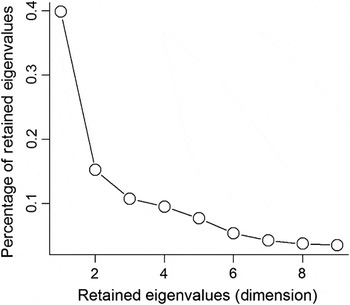
Kaiser's rule was used to determine the number of dimensions (principal coordinates) to retain (Kaiser, Reference Kaiser1960). Kaiser's rule states that the minimum eigenvalue should be the average of all eigenvalues and is considered a good rule of thumb for determining whether a component is interpretable (Legendre & Legendre, Reference Legendre and Legendre1998). Jolliffe's rule, in which the minimum eigenvalue is 0.7 times the average eigenvalue, will usually give one or more extra coordinates than Kaiser's rule (Jolliffe, Reference Jolliffe1972). Kaiser's rule suggests nine dimensions and Jolliffe's rule 12. Since Jolliffe's rule is considered more conservative, we chose to use the number of dimensions calculated from Kaiser's rule for PCoA and produced a scree plot accordingly (Fig. 1; Cattell, Reference Cattell1966).
Results and Discussion
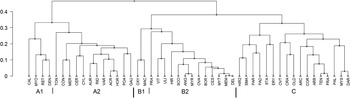
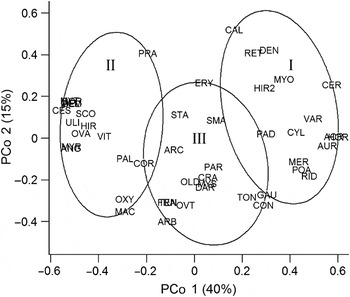
Principal coordinates analysis and the scree plot (Fig. 1) showed that at least two dimensions are required to account for significant variation (55% of the total) between the 48 taxa in our sample. Silhouette plots indicated optimal clustering into two, five or three sets, in order. Whereas two clusters (A1+A2 vs. B1+B2+C) can be defined by the dendrogram (Fig. 2), B1+B2 are confounded by C creating a miasma of temperate, boreal and arctic taxa. Conversely, five clusters (A1, A2, B1, B2 and C) are rigorous, but uninformative. Therefore, and because the dendrogram splits meaningfully into three clusters as well, three medoids were deemed appropriate for creating the sets in the space of the first two principal coordinates which demonstrate the considerable heterogeneity of the sample taxa (Fig. 3; I–III).
Scree plot for 48 OTUs of Vaccinium species scored for 19 characters and subjected to principal coordinates analysis.

UPGMA clustering of 48 OTUs of Vaccinium species using Gower's dissimilarity index and indicating group structure. Clusters are indicated as (A) ‘Tropical’, (B) ‘Boreal-Arctic’ and (C) ‘Temperate’. Numbers indicate subgroups as discussed in the text.

Principal coordinates plot of the first two principal coordinates with OTUs labelled. Partitioning around medoid sets is indicated by ovals: (I) ‘Tropical’, (II) ‘Boreal-Arctic’ and (III) ‘Temperate’, corresponding to clusters (A–C, respectively) in Fig. 2.

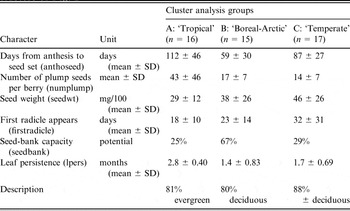
It is recognised that clusters are generally determined by cutting the dendrogram at some level. In this instance, clusters were determined by visual inspection of the dendrogram to determine cluster correspondence with traditional biogeography (see below) which suggests three principal clusters (Fig. 2; A–C) reflected in PCoA as three fuzzy sets (Fig. 3; I–III), and although these three clusters and three sets do not contain identical taxa, there is a sufficient congruence to suggest that frost tolerance is the driving force behind these groupings – despite the fact that none of the 19 features listed in Table 2, with the possible exception of floristic region, are, a priori, a function of the climatic regime. Nonetheless, the significant differences that set these three groups apart (Table 3) may be an adaptation (a response) to the frequency and intensity of frost. Thus cluster A (Fig. 2) contains 16 ‘Tropical’ taxa that occur in regions where even a hint of frost is rare (e.g. Vaccinium meridionale, which is common on Sir John's Peak, the highest point in Jamaica at 1250 m, may be subjected to a 20-minute snow fall every 10 years; similarly V. reticulatum Sm. on Red Hill, which at 2500 m is the highest remnant of the Haleakala Crater on Maui, may experience the occasional hint of frost as occurred on 24 February 1991 when the temperature descended to 0°C for 2 hours – Vander Kloet, pers. obs.). It is not surprising, therefore, that the features that define cluster A (Fig. 2), such as leaves with long lifespans, flowering and fruiting occurring throughout the year (often simultaneously), ovules that require about 18 weeks to mature after pollination, and berries that contain many small, recalcitrant seeds which germinate quickly but have a poor survival rate in the soil column (Table 3), are all features that are indicative of an absence of seasonality.
Comparison among selective phenological features that define the clusters of Fig. 2

Conversely, cluster B (Fig. 2) delineates 15 winter-hardy ‘Boreal-Arctic’ species. Often deciduous, these taxa complete their annual sexual reproductive cycle quickly and in synchrony. Berries require only about eight weeks to ripen and set seed. These berries contain fewer, but heavier, seeds than tropical berries; seeds germinate in about three weeks and have good seed-bank potential (Table 3). Most of these taxa are widespread, often cosmopolitan, occurring in a wide range of habitats in the boreal-alpine-arctic regions of the northern hemisphere, and fit into the Stiles (Reference Stiles and Fenner2000) concept of Vaccinium.
Cluster C (Fig. 2) includes 17 ‘Temperate’ taxa that may tolerate some frost, but do not require it for bud break; northern populations of Vaccinium pallidum Aiton and V. corymbosum L. need only to accumulate about 650 hours below 7°C to resume growth, but all will die when temperatures fall below –30°C (Darrow, Reference Darrow1942; Baily, Reference Baily1949; Vander Kloet & McRae, Reference Vander Kloet and McRae1998). Nevertheless, most of these taxa are ± deciduous, but flowering and fruiting may exhibit some asynchrony; fertilised ovules require about 12 weeks to develop into about 14 mature seeds per berry (Table 3). This group of shrubs has the heaviest seeds in the genus and the slowest direct germination (Table 3). However, few of these large seeds accumulate in the soil column to form a persistent seed bank (Hill & Vander Kloet, Reference Hill and Vander Kloet2005).
In short, the principal coordinates analysis (Fig. 3; I–III) corroborates, with a concordance of 88%, the groups delineated in the cluster analysis (Fig. 2; A–C). Only six taxa have doubtful standing and possibly have a better fit in another group. Thus the PCoA places Vaccinium pallidum and V. corymbosum at the periphery of the ‘Boreal-Arctic’ set, as both taxa possess two features that fit the profile of this cluster as depicted in Table 3 (i.e. days to set seed after successful pollination and the capacity to form a small but persistent seed bank), and furthermore the northern populations of V. corymbosum are tolerant of hard frosts (Vander Kloet & McRae, Reference Vander Kloet and McRae1998).
Similarly, the shift of Vaccinium pseudotonkinense Sleumer and V. consanguineum Klotzsch from the ‘Tropical’ cluster (Fig. 2; A) to the periphery of the ‘Temperate’ set (Fig. 3; III) on the basis of seed weight and number of seeds per berry (Table 3) may seem trivial except that both taxa may have some tolerance to frost. Indeed, some populations of Vaccinium consanguineum occur in an area of Costa Rica referred to as ‘Cerro de la Muerte’ and where frosts have been recorded (Janzen, Reference Janzen1983). The shift of Vaccinium hirtum Thunb. and V. padifolium Sm. from the ‘Temperate’ cluster to the ‘Tropical’ suggests that tropical features such as testa colour and hardness, as well as berries that ripen prior to seed maturation, have a greater effect in PCoA sets than in clustering.
Nonetheless, the high standard deviation (SD) values associated with the means of the quantitative features given in Table 3 imply that these PCoA sets (as delimited in Fig. 3) might be rather ephemeral. However, large SD are either indicative of a small sample size where, by chance, one ‘outlier’ is present, or an inherent function of the data set. Since 80% of the taxa known to occur in the boreal-arctic region were included in this analysis, it would be a pious hope that adding the few remaining taxa would decrease the SD for this group; in fact, it may increase. Thus the three clusters identified by Fig. 2 and sets delimited in Fig. 3 should be considered robust, i.e. not likely to change context with the addition of more taxa to the matrix if that were possible. Indeed, the absence of chaining in Fig. 2 enhances the concept of three distinct phenological clusters, each of which contains taxa that co-exist with its congeners within a given climatic ambiance, whilst diminishing the possibility of expanding the boundaries of Vaccinium as in Stiles (Reference Stiles and Fenner2000).
In short, Vaccinium is not an accretional concept into which a few more outliers could be crammed with a large shoe-horn, but rather three distinct phenological groups that cut across taxonomic circumscriptions. Several taxa belonging to Vaccinium sect. Cyanococcus (the blueberries) were assigned to cluster B and others to cluster C (Table 2); similarly the bilberries Vaccinium sect. Myrtillus sensu Powell & Kron (Reference Powell and Kron2002) are distributed throughout the phenogram (Fig. 2; Table 3). To accommodate such a tripartite division of Vaccinium based on three distinct phenological strategies should not overwhelm the main argument which is Vaccinium on the edge.
Living on the edge by definition is precarious, whether as an epiphyte or epipetric on a ledge in a caldera. The habitat is ephemeral, therefore dispersal and recruitment strategies are essential to survival. As for the epiphytic Vaccinium species, seeds that fall on the forest floor are non-starters; in order to remain in the canopy sticky seeds and sloppy birds are the essential components. Rather than saturate the epiphytic mosses with a mass of seeds once a year, these epiphytes produce a few ripe berries every day for several months. These berries contain many small, sticky seeds with a thin testa and, frequently, a green embryo. Any bird that gobbles up these berries usually digests all these seeds except for the few that are caught along the edge of the bill which the bird wipes off on the epiphytic mosses from time to time, thus depositing a few rapidly germinating seeds in a suitable habitat (Hill & Vander Kloet, in prep.).
Conversely, most temperate Vaccinium species are terrestrial shrubs and are therefore subjected to quite a different environment than epiphytes. Once they are established, the shadow of succession will gradually reduce their fecundity since Vaccinium species are not shade tolerant (Eck, Reference Eck1988). Therefore, in order to persist, they must be able to tolerate the vicissitudes of periodic fires, volcanic eruptions, earthquakes and storms such as hurricanes, tornadoes and typhoons. Fire and volcanic ash rejuvenate their rhizome and root systems (Menges & Kohfeldt, Reference Menges and Kohfeldt1995; Zobel & Antos, Reference Zobel and Antos1986). Massive storms not only restructure coastlines, but also uproot large numbers of trees in their paths allowing recruitment from seeds to occur. Berries of Vaccinium species in the temperate regions ripen either quickly and en masse (as in V. parvifolium Sm., which ripens all its fruits in June but dispersal is not completed until December) or slowly, a few at a time, but for a long period (as in southern populations of V. corymbosum, which produces the first ripe berries in early April and the last in mid-November). Seeds from these berries are dispersed in mammal and bird excreta. Bear gardens (i.e. dumps of seedlings that have emerged from bear excreta) have been found along streams in northern British Columbia, Canada and Alaska, USA; bird depositions are often found at the base of trees or on natural perches such as stumps and rotting logs. Seeds contained within these deposits germinate during the winter (usually from November until March) and tiny Vaccinium seedlings are quite common on or below perches in early spring, especially along the Pacific Rim from Japan to northern California (Vander Kloet, pers. obs.).
These temperate taxa also have the fewest, but heaviest, seeds per berry (Table 3); these seeds are usually covered with a thick, hard testa (Crouch & Vander Kloet, Reference Crouch and Vander Kloet1980). In greenhouse-grown plants, these seeds germinate rather slowly (Table 3), and some have the potential to remain viable in the soil column for many years (Hill & Vander Kloet, Reference Hill and Vander Kloet2005); nonetheless, reports of naturally occurring seed banks for these Vaccinium species are rare (see table 1 in Hill & Vander Kloet, Reference Hill and Vander Kloet2005). Indeed, Hill & Vander Kloet (Reference Hill and Vander Kloet2005) found a significant correlation between the duration of dispersal and persistence of seeds in the soil column; the longer ripe fruit remains on the shrubs, the shorter the longevity of seeds in the soil column.
In addition to the changing conditions that befall temperate Vaccinium species, albeit in an attenuated form, the boreal-alpine-arctic Vaccinium species (Fig. 2B) must by necessity be winter hardy not only during the dormant season but also to some degree during the growing season – especially north of 70° latitude where the season is truncated to perhaps 30–35 days and furthermore none of these days is predictably frost free. Although all Vaccinium flowers in this region can tolerate some frost, usually 1 hour at –2°C, mortality is significant at –6°C and complete at –10°C (Reader, Reference Reader1979; Lipp et al., Reference Lipp, Goldstein, Meinzer and Niemczura1994). Furthermore, at high latitudes, the effects of altitude are also significant (e.g. in Tromsø [69°40′N, 19°E] at sea level on 1 August 1995 Vaccinium myrtillus had ripe berries, but at 770 m on the slopes of Mt Böntuva the last of the snowpack was melting and V. myrtillus was just flushing and only the occasional flower was at anthesis; the chances of this population producing ripe berries are small to nil). Further north most Vaccinium species may flush normally and may, on occasion, flower, but do not bear fruit even at sea level. Indeed, Regel (Reference Regel1935) found that populations of Vaccinium uliginosum grow in Novaya Zemlya, Russia, but neither flower nor bear fruit.
Given sufficient snow cover and few if any late spring or early summer frosts, Vaccinium species south of 70°N, but north of 45°N, will produce ample fruit in synchrony so that frugivores will be able to saturate the local area with excreta containing many small, hard Vaccinium seeds, some of which are incorporated into the soil column and become part of a small but persistent seed bank (Vander Kloet & Hill, Reference Vander Kloet and Hill1994, Reference Vander Kloet and Hill2000; Hill & Vander Kloet, Reference Hill and Vander Kloet2005). Seedlings are ubiquitous especially along the edges of barrens, below power lines, on rocky ledges along seashores and even in cemeteries at the base of headstones. In short, the colder the climate (south of 70°N), the more likely a seed bank will develop as a bet-hedging strategy (Hill & Vander Kloet, Reference Hill and Vander Kloet2005).
In conclusion, were the edges of the tropical canopy to the edges of the polar desert to circumscribe the distribution of Vaccinium, then a gradual transition in phenological traits might have been expected. However, the distinctness of the three groups isolated in the various analyses strongly argues against any sort of continuum. Indeed, the reverse is true: strong selection against plants with weak frost tolerance appears to separate group B (‘Boreal-Arctic’) from group C (‘Temperate’), whilst selection against strictly terrestrial shrubs separates them from group A (‘Tropical’) and its members’ propensity towards the epiphytic habit. Those Vaccinium species incapable of making this transition, either to cold tolerance or to the epiphytic habit, form the core of the temperate group – a group that nevertheless remains the source for further adaptations as it occupies the largest number of distinct habitats, each of which may engender a unique phenological response.
Acknowledgements
We wish to thank all those intrepid sherpas who not only guided the senior author to those precarious edges where Vaccinium thrives, but also were willing participants in making useful collections.