1. Introduction
In collision-poor plasmas from the heliosphere, in-situ measurements of the velocity distributions of particles reveal a variety of non-thermal features, such as suprathermal populations and anisotropies with respect to the magnetic field direction, mainly anisotropic temperatures and field-aligned beams (Maksimovic et al. Reference Maksimovic, Zouganelis, Chaufray, Issautier, Scime, Littleton, Marsch, McComas, Salem and Lin2005; Marsch Reference Marsch2006; Wilson et al. Reference Wilson, Chen, Wang, Schwartz, Turner, Stevens, Kasper, Osmane, Caprioli, Bale, Pulupa, Salem and Goodrich2019a). Physical mechanisms that can maintain these states of non-equilibrium are mainly triggered by the small-scale (kinetic) wave turbulence and fluctuations, which are also confirmed by observations (Alexandrova et al. Reference Alexandrova, Chen, Sorriso-Valvo, Horbury and Bale2013). If resonant wave–particle interactions can preferentially energize plasma particles leading to kinetic anisotropies (Isenberg & Vasquez Reference Isenberg and Vasquez2019), stochastic acceleration by plasma turbulence may generate more diffuse suprathermal populations enhancing the high-energy tails of velocity distributions (Bian et al. Reference Bian, Emslie, Stackhouse and Kontar2014). The same wave–particle interactions are also responsible for the excitation of instabilities (Wilson et al. Reference Wilson, Koval, Szabo, Breneman, Cattell, Goetz, Kellogg, Kersten, Kasper and Maruca2013; Bowen et al. Reference Bowen, Mallet, Huang, Klein, Malaspina, Stevens, Bale, Bonnell, Case and Chandran2020), or further relaxation of anisotropic particles under the diffusion effect of the enhanced fluctuations (Bale et al. Reference Bale, Kasper, Howes, Quataert, Salem and Sundkvist2009; Tong et al. Reference Tong, Vasko, Artemyev, Bale and Mozer2019). These fluctuations are mainly powered by the solar outflows inducing large-scale perturbations and wave turbulence, which are transported by the expanding solar wind, and decay nonlinearly toward smaller (kinetic) scales where a perpetual exchange of energy between plasma waves and particles ultimately takes place (Leamon et al. Reference Leamon, Smith, Ness and Wong1999; Verscharen, Klein & Maruca Reference Verscharen, Klein and Maruca2019a, and references therein). Representative are not only the mechanisms of resonant dissipation (damping) of waves leading to the heating of particles, but also the instabilities that can transfer (free) energy from anisotropic and suprathermal particles to waves and fluctuations (Lazar et al. Reference Lazar, López, Shaaban, Poedts and Fichtner2019; Shaaban et al. Reference Shaaban, Lazar, Yoon and Poedts2019; Verscharen et al. Reference Verscharen, Chandran, Jeong, Salem, Pulupa and Bale2019b; Shaaban, Lazar & Schlickeiser Reference Shaaban, Lazar and Schlickeiser2021b).
Locally, small-scale fluctuations can be markedly enhanced by the kinetic instabilities, sometimes rather than a turbulent cascade (Gary et al. Reference Gary, Jian, Broiles, Stevens, Podesta and Kasper2016; Tong et al. Reference Tong, Vasko, Artemyev, Bale and Mozer2019; Woodham et al. Reference Woodham, Wicks, Verscharen, Owen, Maruca and Alterman2019). However, in the absence of energetic events (e.g. flares or coronal mass ejections) the wave fluctuations measured in-situ in space plasmas have wide bandwidths and small amplitudes, such that, their properties and effects on particles can be addressed in the frame of linear and quasilinear (known as QL) theories (Gary Reference Gary1993; Gary et al. Reference Gary, Jian, Broiles, Stevens, Podesta and Kasper2016; Yoon Reference Yoon2017, Reference Yoon2019). However, if the fluctuations are a superposition of nonlinear structures or fluid-like turbulent eddies, then linear and quasilinear theory do not apply. Revealing these linear and quasilinear properties of waves and instabilities in the solar wind, already perceived as a truly natural laboratory, has therefore acquired a special motivation. To do that, we need to derive the dispersion and stability relations, and, implicitly, the dielectric tensor of the plasma system relying directly on the shape of underlying velocity distributions (Stix Reference Stix1992). The observed velocity distributions of plasma particles combine kinetic anisotropies, relative to the magnetic field direction, e.g. anisotropic temperatures (Kasper et al. Reference Kasper, Lazarus, Gary and Szabo2003; Štverák et al. Reference Štverák, Trávnıček, Maksimovic, Marsch, Fazakerley and Scime2008) or field aligned beams (Pilipp et al. Reference Pilipp, Miggenrieder, Montgomery, Mühlhäuser, Rosenbauer and Schwenn1987; Marsch Reference Marsch2006), and suprathermal tails well reproduced by the Kappa distribution functions (Pierrard & Lazar Reference Pierrard and Lazar2010; Lazar et al. Reference Lazar, Pierrard, Shaaban, Fichtner and Poedts2017). The picture can be clarified by pointing out the details in the velocity distributions. For instance, the electrons show a low-energy core, well reproduced by a bi-Maxwellian distribution function, a suprathermal halo and an electron strahl, both of them well described by bi-Kappa distribution functions with relative drifts parallel to the magnetic field (Maksimovic et al. Reference Maksimovic, Zouganelis, Chaufray, Issautier, Scime, Littleton, Marsch, McComas, Salem and Lin2005; Lazar et al. Reference Lazar, Pierrard, Shaaban, Fichtner and Poedts2017; Wilson et al. Reference Wilson, Chen, Wang, Schwartz, Turner, Stevens, Kasper, Osmane, Caprioli, Bale, Pulupa, Salem and Goodrich2019a,Reference Wilson, Chen, Wang, Schwartz, Turner, Stevens, Kasper, Osmane, Caprioli and Baleb). The relative drift between core and halo is in general modest (Wilson et al. Reference Wilson, Chen, Wang, Schwartz, Turner, Stevens, Kasper, Osmane, Caprioli, Bale, Pulupa, Salem and Goodrich2019a) allowing the incorporation of these two components by another bi-Kappa, which is nearly bi-Maxwellian at low energies but decreases as a power law at high energies (Vasyliunas Reference Vasyliunas1968; Lazar et al. Reference Lazar, Pierrard, Shaaban, Fichtner and Poedts2017). It is thus obvious that Kappa models, including anisotropic variants like bi-Kappa, with or without relative drifts, are widely invoked for their success in modelling the observed distributions, not only for electrons, but also for protons and heavier ions (Collier et al. Reference Collier, Hamilton, Gloeckler, Bochsler and Sheldon1996; Pierrard & Lazar Reference Pierrard and Lazar2010; Mason & Gloeckler Reference Mason and Gloeckler2012).
Despite these observational evidences, in the dispersion and stability analysis the velocity distributions are still reduced to idealized bi-Maxwellian representations (Verscharen et al. Reference Verscharen, Chandran, Jeong, Salem, Pulupa and Bale2019b; López et al. Reference López, Lazar, Shaaban, Poedts and Moya2020; Shaaban & Lazar Reference Shaaban and Lazar2020; Shaaban et al. Reference Shaaban, Lazar, López and Wimmer-Schweingruber2021a), for which the dielectric tensor is already explicitly derived (Stix Reference Stix1992). In the context of drifting bi-Kappa plasmas, the analysis so far is limited only to the propagation parallel to the magnetic field (Shaaban, Lazar & Poedts Reference Shaaban, Lazar and Poedts2018; Shaaban et al. Reference Shaaban, Lazar, López and Poedts2020), because the complete expression of the dielectric tensor, and, implicitly, the general dispersion relation for an arbitrary direction of propagation, are not trivial, but rather complicated, and have not been derived yet. Therefore, numerical solvers capable of resolving the full spectrum of waves and instabilities of this configuration do not yet exist. In the present paper we provide the full expression of the dielectric tensor and general dispersion relation for magnetized plasma particles described by drifting bi-Kappa distribution functions. Thus it becomes possible for an advanced analysis to characterize, in a more realistic manner, the dispersion and stability of plasma populations revealed by the in-situ observations. For instance, the suprathermal halo, and strahl electrons carrying the main heat flux in the solar wind (Lazar et al. Reference Lazar, Scherer, Fichtner and Pierrard2020a), whose evolution with increasing the heliospheric distance (Hammond et al. Reference Hammond, Feldman, McComas, Phillips and Forsyth1996; Maksimovic et al. Reference Maksimovic, Zouganelis, Chaufray, Issautier, Scime, Littleton, Marsch, McComas, Salem and Lin2005) are expected to be controlled by the self-generated instabilities (Verscharen et al. Reference Verscharen, Chandran, Jeong, Salem, Pulupa and Bale2019b; Jeong et al. Reference Jeong, Verscharen, Wicks and Fazakerley2020; López et al. Reference López, Lazar, Shaaban, Poedts and Moya2020; Micera et al. Reference Micera, Zhukov, López, Innocenti, Lazar, Boella and Lapenta2020).
Also reported here is a new generalized Dispersion Solver for Kappa-distributed plasmas (abbreviated DIS-K), which implements the new dispersion tensor and numerically resolves the dispersion and (in)stability properties for all directions of propagation with respect to the magnetic field. Chronologically speaking, the first numerical solvers were built for Maxwellian plasmas, such as WHAMP (Roennmark Reference Roennmark1982) and PLADAWAN (Viñas, Wong & Klimas Reference Viñas, Wong and Klimas2000), or the more recent variants, PLUME (Klein & Howes Reference Klein and Howes2015) and NDHS (Verscharen & Chandran Reference Verscharen and Chandran2018). Progress has also been made for other models, such as the Kappa distribution, which introduces new analytical and numerical challenges. Of major importance were the detailed studies of the new dispersion function for Kappa distributions (Summers & Thorne Reference Summers and Thorne1991; Mace & Hellberg Reference Mace and Hellberg1995), on which most of the codes developed later are based. Initially, efforts were dedicated to unmagnetized plasmas or reduced configurations in magnetized plasmas, such as electrostatic approximation or parallel propagation (Hellberg & Mace Reference Hellberg and Mace2002; Lazar & Poedts Reference Lazar and Poedts2009; Viñas et al. Reference Viñas, Gaelzer, Moya, Mace and Araneda2017). Earlier approaches to describe perpendicular and oblique propagation (Summers, Xue & Thorne Reference Summers, Xue and Thorne1994; Cattaert, Hellberg & Mace Reference Cattaert, Hellberg and Mace2007; Basu Reference Basu2009) have more recently been complemented by rigorous mathematical calculations of the general dielectric tensor providing compact and closed forms of its components (Liu et al. Reference Liu, Liu, Dai and Xue2014; Gaelzer & Ziebell Reference Gaelzer and Ziebell2016; Gaelzer, Ziebell & Meneses Reference Gaelzer, Ziebell and Meneses2016; Kim et al. Reference Kim, Schlickeiser, Yoon, López and Lazar2017). A relatively recent numerical implementation of the dielectric tensor for non-drifting bi-Kappa plasmas is DHSARK (Astfalk, Görler & Jenko Reference Astfalk, Görler and Jenko2015), a pioneer solver for studying kinetic electromagnetic instabilities (Astfalk Reference Astfalk2018). Other similar codes (not named yet) were also developed in the last few years, in order to extend the spectral analysis in bi-Kappa plasmas (Lazar et al. Reference Lazar, López, Shaaban, Poedts and Fichtner2019; López et al. Reference López, Lazar, Shaaban, Poedts, Yoon, Viñas and Moya2019), and pave the way for a more elaborated tool, as our new solver DIS-K. In this paper we present the first numerical results obtained with this solver, which is capable of resolving more complex dispersion relations for plasma populations with drifting bi-Kappa populations, and the full spectrum of stable or unstable modes, of any nature, e.g. electrostatic or electromagnetic, periodic or aperiodic.
Our paper is organized as follows. In § 2 we start by introducing the general (linear) dispersion tensor, and the drifting bi-Kappa parameterization for a plasma of electrons and ions. Explicit expressions of the newly derived components of the dispersion tensor are presented in § 3. We also show the agreement with different limit cases, e.g. Maxwellian, and non-drifting bi-Kappa, from previous studies. In § 4 we solve numerically the dispersion relation for some illustrative cases specific to these limits, which allows us to compare with the previous results and test our numerical solver. Finally, our results are summarized in § 5.
2. Theoretical formalism
Space plasmas are subject to multiple sources of inhomogeneities and temporal variations, such as wave turbulence, the interaction of fast and slow streams, or even the solar wind expansion. However, to describe the small-scale wave fluctuations and instabilities we can assume these plasmas are sufficiently homogeneous, especially because linear and quasilinear theories seem to explain quite well the kinetic properties of plasma particles revealed by in-situ observations (Kasper et al. Reference Kasper, Lazarus, Gary and Szabo2003; Štverák et al. Reference Štverák, Trávnıček, Maksimovic, Marsch, Fazakerley and Scime2008; Verscharen et al. Reference Verscharen, Klein and Maruca2019a). These are waves and instabilities which mainly depend on the nature of particle velocity distributions, and their analysis requires a kinetic approach.
2.1. General dispersion relation
Without loss of generality we assume Cartesian coordinates ($x,y,z$ ) with the $z$
 axis parallel to the magnetic field $\boldsymbol {B}$
 , and with the wavevector $\boldsymbol {k}$
 in the ($x$
 –$z$
 ) plane, such that

where $\parallel , \perp$ are defined with respect to the magnetic field direction. From the Vlasov–Maxwell equations one can derive the general expression of the dispersion relation (Stix Reference Stix1992)

in terms of the electric field of the wave fluctuation $\boldsymbol {E}(\boldsymbol {k},\omega )$ and the dispersion tensor $\boldsymbol{\varLambda}$
 . For arbitrary (but still gyrotropic) velocity distribution functions $F_a (v_\perp , v_\parallel )$
 of plasma species of sort $a$
 (e.g. $a = e,p,i$
 for electrons, protons and ions, respectively) the components of the dispersion read as follows:

Here

where $\textrm {J}_n(b)$ is the Bessel function with $\textrm {J}'_n(b)$
 its first derivative, $\textrm {i}$
 is the imaginary unit, $c$
 is the speed of light, $\omega _{\textrm {pa}}=\sqrt {4{\rm \pi} n_a q_a^2/m_a}$
 is the plasma frequency, $\varOmega _a=q_aB_0/(m_ac)$
 the gyrofrequency, $q_a$
 the charge, $m_a$
 the mass and $n_a$
 the number density of species $a$
 , respectively.
2.2. Drifting bi-Kappa distribution
For magnetized plasma particles in space environments, realistic models able to reproduce the main departures from thermal equilibrium, i.e. anisotropies and suprathermal populations, are drifting bi-Kappa velocity distribution functions

where $\kappa _a$ is the power law index, $\varGamma (x)$
 is the Gamma function, $U_a$
 is the drift speed, and the parameters $\alpha _{\parallel ,\perp }$
 , known as the most probable speed (Vasyliunas Reference Vasyliunas1968),

correspond to the thermal speeds of the Maxwellian limit that approximately describe the low-energy core out of the Kappa distribution (Lazar, Poedts & Fichtner Reference Lazar, Poedts and Fichtner2015; Lazar, Fichtner & Yoon Reference Lazar, Fichtner and Yoon2016). Here $k_B$ is the Boltzmann's constant. The thermal speeds are related to the kinetic temperature through the second-order moment of the distribution,


requiring $\kappa _a>3/2$ . These kinetic temperatures are greater than the corresponding temperatures of the Maxwellian limit, introduced in (2.6a,b), through $T_{\parallel ,\perp }=\lim _{\kappa \to \infty }T_{\parallel ,\perp }^{(\kappa )}< T_{\parallel ,\perp }^{(\kappa )}$
 .
3. Dispersion tensor
We substitute the drifting bi-Kappa distribution function (2.5) in the general expression (2.3) of the dispersion tensor, and after integration obtain for each element of the dispersion tensor the following expressions:


Here we have used the following definitions (Gaelzer & Ziebell Reference Gaelzer and Ziebell2016; Gaelzer et al. Reference Gaelzer, Ziebell and Meneses2016; Kim et al. Reference Kim, Schlickeiser, Yoon, López and Lazar2017):


A list of the specific expressions required in (3.2)–(3.7) are provided in Appendices A and B.
From (2.2), the dispersion relation for non-trivial solutions ($E \ne 0$ ) requires the determinant of the dispersion tensor to satisfy $\textrm {det}\{\boldsymbol{\varLambda} \} = 0$
 , which can be written explicitly as

In order to optimize the performance of the dispersion solver, we can further simplify the expressions of the dispersion tensor components in (3.2)–(3.7), to minimize the number of integrals that need to be performed. These components can be written as follows:


Now, each component of the dispersion tensor depends on a single integral of the form


with the following functions:


In this way, we only need to implement the modified plasma dispersion function $Z_\kappa ^{(1,2)}$ . This function can be directly evaluated using (B7) for integer values of $\kappa$
 , or (B1) for real values of $\kappa$
 . Integrals in (3.23)–(3.28) are evaluated using an adaptive numerical quadrature based in the routine QUADPACK (Piessens et al. Reference Piessens, de Doncker-Kapenga, Ueberhuber and Kahaner1983).
3.1. Maxwellian limit
In the limit $\kappa _a\to \infty$ we recover the dispersion tensor for a drifting bi-Maxwellian plasma (Stix Reference Stix1992), by using the following limits:


Here $\varLambda _n(x)=\textrm {I}_n(x)\textrm {e}^{-x}$ , with $\textrm {I}_n(x)$
 the modified Bessel function, and $Z(x)$
 is the plasma dispersion function for Maxwellian distributed plasmas (Fried & Conte Reference Fried and Conte1961). Thus, the elements of the dispersion tensor reduce to


These expressions are equivalent to those provided in Stix (Reference Stix1992, pp. 258–260).
3.2. Non-drifting bi-Kappa
For components (3.2)–(3.7) of the dielectric tensor, in the non-drifting limit $U_a=0$ we recover the results for bi-Kappa plasmas (Gaelzer et al. Reference Gaelzer, Ziebell and Meneses2016; Kim et al. Reference Kim, Schlickeiser, Yoon, López and Lazar2017),


4. Numerical results
In this section we present the results obtained with our new solver DIS-K, which implements the new dispersion tensor for plasmas with drifting bi-Kappa distributions. This solver can also be used for any of the bi-Maxwellian or non-drifting limits discussed above.
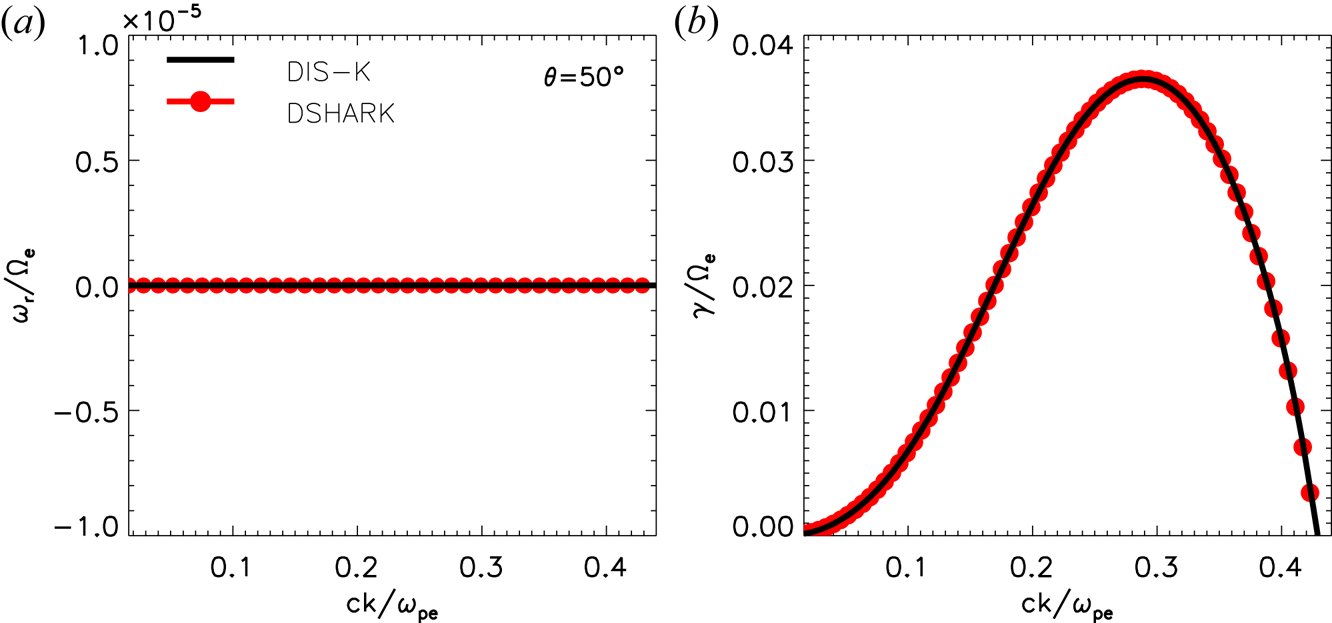
Here we show a number of illustrative examples of stable and unstable solutions obtained with the new solver DIS-K. As this is the first reported solver for drifting bi-Kappa plasmas, for its testing we can choose only from the limit configurations discussed above, and which can also be resolved by other solvers. As we know, DHSARK (Astfalk et al. Reference Astfalk, Görler and Jenko2015) is programmed to derive the unstable electromagnetic solutions of anisotropic plasma populations described by bi-Kappa distributions (Astfalk Reference Astfalk2018). We will use the aperiodic electron firehose instability, as described in Shaaban et al. (Reference Shaaban, Lazar, López, Fichtner and Poedts2019) and López et al. (Reference López, Lazar, Shaaban, Poedts, Yoon, Viñas and Moya2019), as a first test case. We consider an anisotropic electron distribution with $T_{\perp e}/T_{\parallel e}=0.5$ , and with $\beta _{\parallel e}=8{\rm \pi} n_e T_{\parallel e}/B_0^2=4.0$
 , $\omega _{\textrm {pe}}/\varOmega _e=100$
 , $\theta =50^\circ$
 , $\kappa _e=4$
 , and protons are modelled using an isotropic Maxwellian distribution with $\beta _p=4.0$
 . Figure 1 displays the unstable solutions obtained solving the set of equations presented in § 3.2. Panel (a) shows the real part of the normalized frequency, $\omega _r/\varOmega _e$
 versus the normalized wave number $ck/\omega _{pe}$
 . As expected from the aperiodic nature of this instability, the wave frequency is zero for the entire range of unstable modes. Panel (b) of this figure shows the growth rate, $\gamma /\varOmega _e$
 versus $ck/\omega _{pe}$
 , which coincides with that obtained using DSHARK in Shaaban et al. (Reference Shaaban, Lazar, López, Fichtner and Poedts2019), plotted here with red dots. The solutions of both codes show a perfect match for this case, validating our new solver DIS-K in the non-drifting bi-Kappa limit, $U_a=0$
 , discussed in § 3.2.
Unstable solutions of the aperiodic electron firehose instability at $\theta =50^\circ$ . In black are the solutions obtained with the new code, DIS-K, while red dots are obtained with DSHARK. Panel (a) shows the normalized (real) frequency, $\omega _r/\varOmega _e$
 versus the normalized wavenumber $ck/\omega _{\textrm {pe}}$
 , and panel (b) shows the normalized growth rate, $\gamma /\varOmega _e$
 versus $ck/\omega _{\textrm {pe}}$
 .

We now discuss damped solutions in order to test the analytical continuation of our modified plasma dispersion function. Expression in (B1) for arbitrary $\kappa$ or (B7) for integer $\kappa$
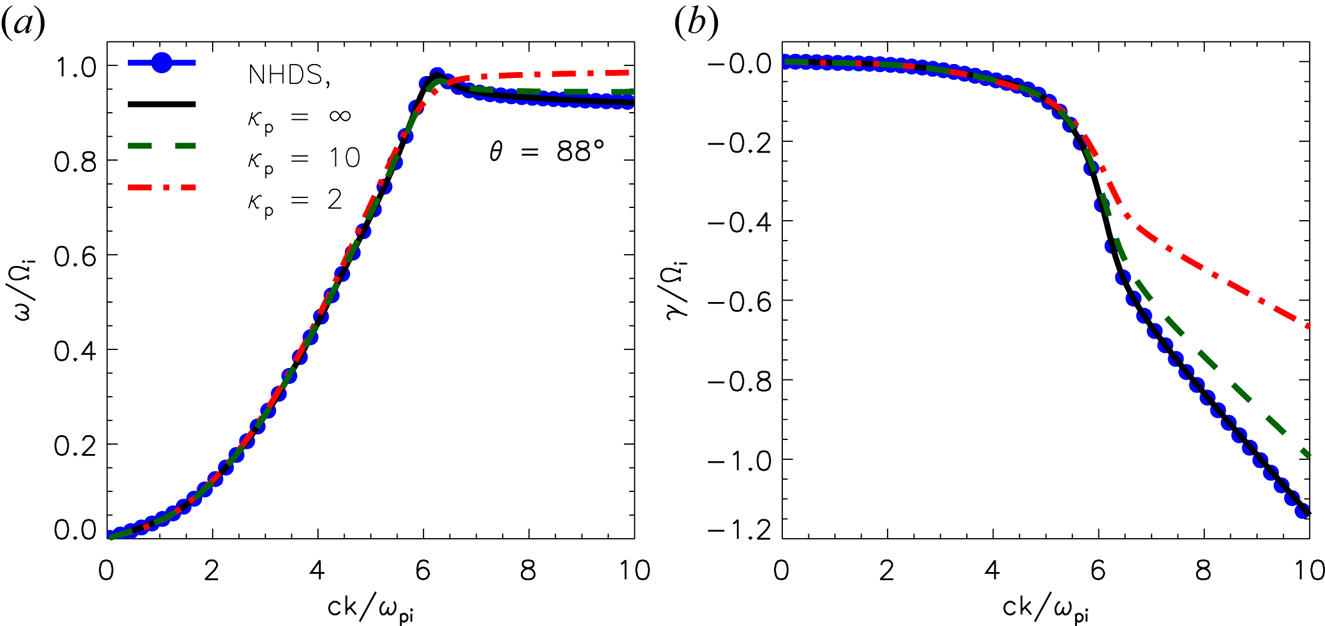
 , already satisfy the Landau prescription, being analytically continuous through the entire complex frequency plane (Summers & Thorne Reference Summers and Thorne1991; Mace & Hellberg Reference Mace and Hellberg1995; Gaelzer & Ziebell Reference Gaelzer and Ziebell2016). In this case we study a damped kinetic Alfvén wave (KAW) propagating at highly oblique angles, $\theta =88^\circ$
 . We use $\beta _e=\beta _p=2.0$
 , $v_A/c=2.33\times 10^{-4}$
 (or $\omega _{\textrm {pe}}/\varOmega _{\textrm {ce}}=100)$
 , where $v_A=B_0/\sqrt {4{\rm \pi} n_pm_p}$
 is the Alfvén speed. In figure 2 we compare our results with those obtained with another solver, NHDS (Verscharen & Chandran Reference Verscharen and Chandran2018) providing solutions in the Maxwellian limit. Blue dots correspond to the solution obtained with NHDS, while the black line is our solution in the Maxwellian limit, $\kappa _p=\infty$
 . We have also included solutions for $\kappa _p=10$
 (green dot–dashed lines) and $\kappa _p=2$
 (red dotted lines), to show the behaviour of our code in the Kappa regime. In the Maxwellian limit both codes show a perfect agreement. For finite but large values of $\kappa _p$
 the solution is similar to the Maxwellian case, but differences start appearing at large wavenumbers. Overall, suprathermal particles reduce the damping of KAWs at large wavenumbers (Kim et al. Reference Kim, Lazar, Schlickeiser, López and Yoon2018).
The damped KAW solutions at $\theta =88^\circ$ : blue dots are obtained with NHDS; those obtained with the present code, DIS-K, are black lines for $\kappa _p=\infty$
 (Maxwellian limit); green dot–dashed line for $\kappa _p=10$
 ; red dotted line for $\kappa _p=2$
 . Panel (a) shows $\omega _r/\varOmega _i$
 versus $ck/\omega _{\textrm {pi}}$
 and panel (b) $\gamma /\varOmega _i$
 versus $ck/\omega _{\textrm {pi}}$
 .

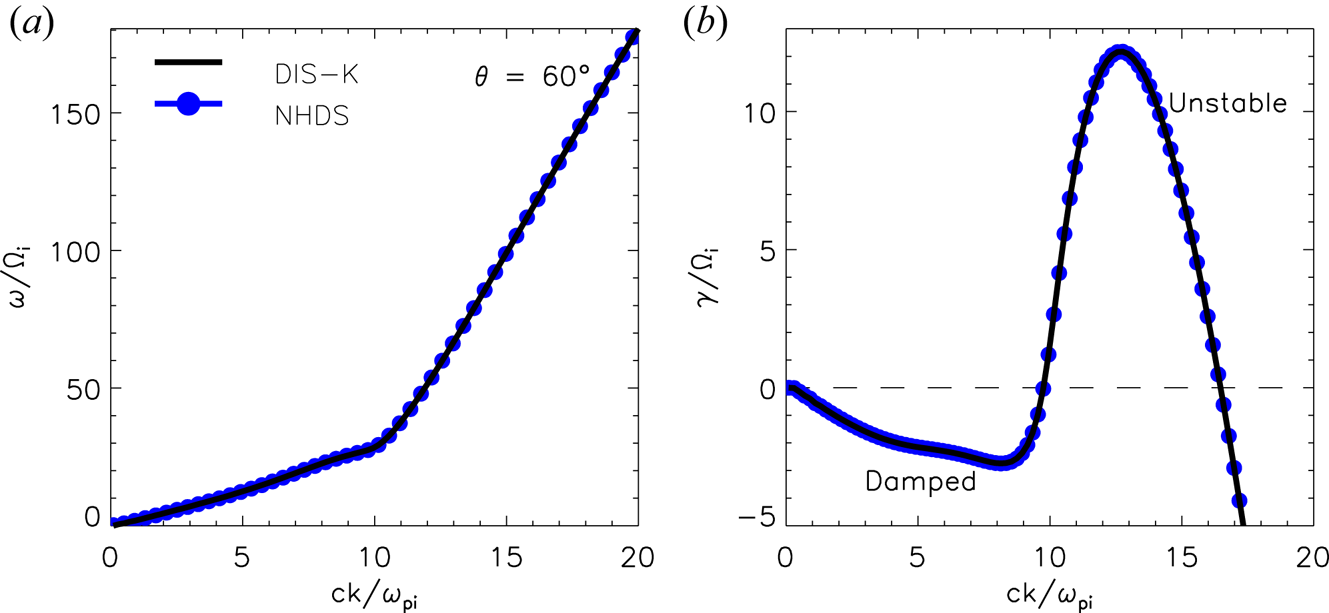
In the following, we test the drifting case. Now, DSHARK is not programmed to solve the dispersion relation for drifting bi-Kappa distributions, and the NHDS solver is only foreseen to operate with drifting bi-Maxwellian distributions, as described in § 3.1. Therefore, we have to settle for this limiting case. For this comparison we choose conditions for the oblique whistler heat-flux instability, as described in López et al. (Reference López, Lazar, Shaaban, Poedts and Moya2020). We consider a plasma composed of two electron populations, a dense central core (subscript c) and a tenuous suprathermal beam (subscript b), with a relative drift along the background magnetic field, with the following properties: $n_c/n_0=0.95$ , $n_b/n_0=0.05$
 are the core and beam normalized number density, respectively, $T_{\parallel b}/T_{\parallel c}=4.0$
 , $T_{\perp j}/T_{\parallel j}=1.0$
 , $\omega _{\textrm {pe}}/\varOmega _e=100$
 , $\beta _c=8{\rm \pi} n_0T_c/B_0^2=2.0$
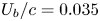
 and $U_b/c=0.035$
 (or $U_b/v_A=150$
 ). Figure 3 shows the dispersion relation obtained for $\theta =60^\circ$
 . This time we plot the solution obtained using the NHDS solver as a blue dots. In the range of wavenumbers resolved we show both damped and unstable modes. We can clearly observe the agreement between both codes, in the real and imaginary parts of the frequency, for damped and unstable modes.
The oblique whistler heat-flux instability at $\theta =60^\circ$ : black lines are solutions obtained with the present code, DIS-K; blue dots correspond to NHDS. Panel (a) shows $\omega _r/\varOmega _i$
 versus $ck/\omega _{\textrm {pi}}$
 and panel (b) $\gamma /\varOmega _i$
 versus $ck/\omega _{\textrm {pi}}$
 .

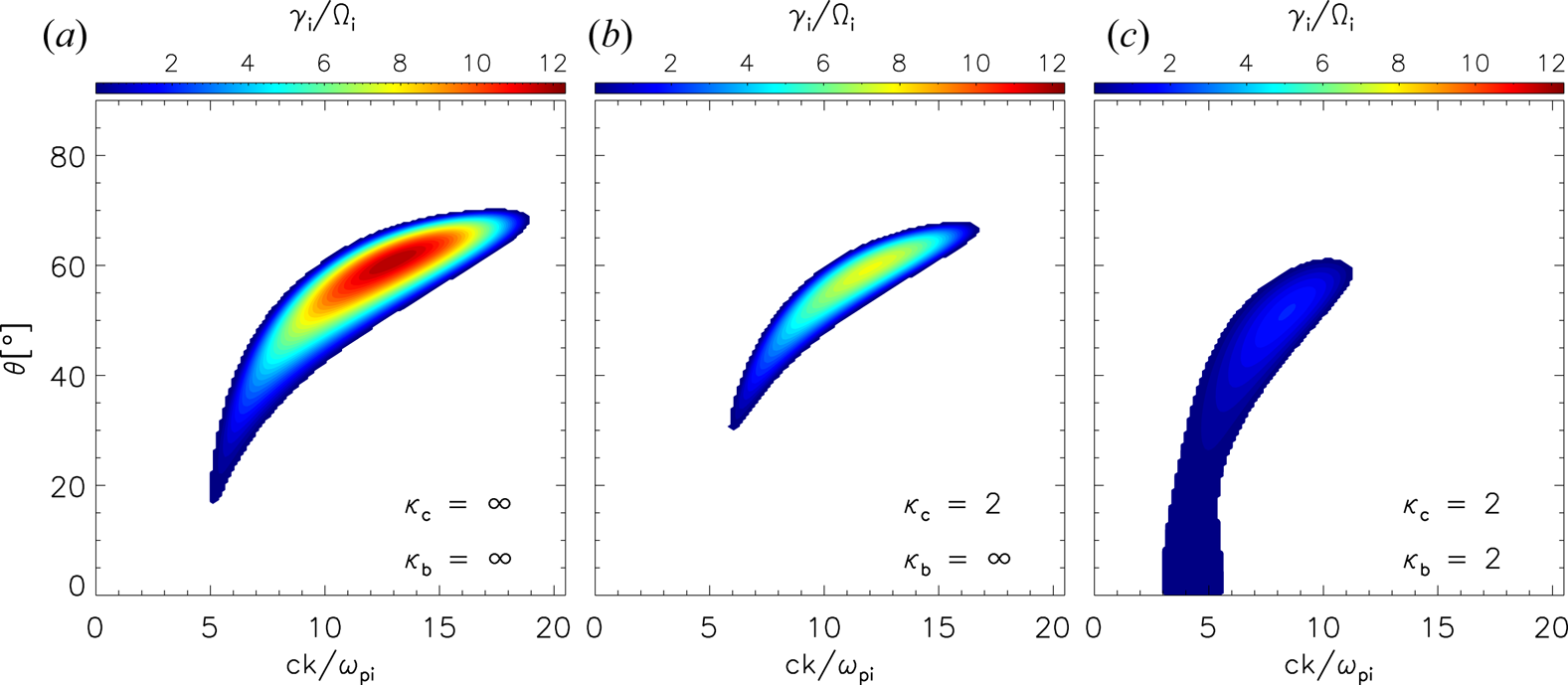
Finally, assuming the same plasma conditions, we explore the same instability under the influence of suprathermal electrons, showing the results obtained with DIS-K for drifting bi-Kappa electrons. Figure 4 shows, comparatively, three different cases. For comparison, panel (a) shows the solution for drifting Maxwellian electrons, as in figure 3, but this time for the entire range of angles of propagation. Panel (b) displays a new case, when core electrons are modelled by a Kappa distribution with $\kappa _c=2$ , while the beam remains Maxwellian ($\kappa _b=\infty$
 ). Panel (c) shows the case when both, core and beam populations are modelled by a Kappa distribution with the same kappa index, $\kappa _c=\kappa _b=2$
 . We observe that suprathermal electrons suppress the oblique whistler heat-flux instability. When the core is Kappa distributed, the range of unstable angles and wavenumbers is reduced, as well as the level of the unstable modes. The suppressing effect is even more prominent when both populations are Kappa distributed, reaching lower growth rates and shifting to lower angles. We can identify some possible explanations of these inhibiting effects, either in the core damping, which counteracts the strahl-driving of the oblique whistler instability, but also by a change in resonance conditions (populations involved, etc.), in this case, implying both Landau and cyclotron resonances. On the other hand, the enhanced suprathermal tails reduce the effective excess of free energy in parallel (drifting) direction (with increasing the tails the core and beam electrons tend to merge and combine with each other, reducing the relative drift between them). Indeed, in the last case, we also obtain unstable modes in parallel and quasi-parallel (low angles) directions, specific to lower drifts.
The oblique whistler heat-flux growth rates for all angles of propagation, and for various core-beam configurations described in the text.

5. Conclusions
We have presented the full set of components of the dielectric tensor for magnetized plasma populations modelled by drifting bi-Kappa distributions. This extended dielectric tensor has been implemented in a new dispersion solver, named DIS-K, and capable of resolving the full spectrum of stable and unstable modes of these complex plasma distributions. In order to validate our results and our code, we carried out illustrative cases enabling comparison with limiting conditions, e.g. non-drifting bi-Kappa and drifting bi-Maxwellian plasmas, resolved by the existing solvers. For comparison, the the aperiodic electron firehose solutions driven by (non-drifting) bi-Kappa electrons are obtained with DSHARK, and we found a perfect agreement for both the wavenumber dispersion of the wave frequency and growth rate. The same remarkable agreement has been obtained with the stable and unstable whistler-like modes triggered by drifting bi-Maxwellian electrons populations and described by another solver, NHDS. We have also shown the capabilities of our code to handle damped solutions, as shown for the KAW dispersion curves, showing a perfect agreement when compared with NHDS in the Maxwellian limit. Further, we have explored the influence of suprathermal electrons on the oblique whistler heat-flux instability, showing that the instability is inhibited, i.e. growth rates are diminished (and the range of unstable wavenumbers is reduced), when core and beam electrons are modelled by drifting bi-Kappa distributions. We plan make this new code, DIS-K, publicly available in the near future.
These are new theoretical and numerical tools, which extend and improve the existing capabilities of analysis of the wave fluctuations, stable or unstable modes, specific to the complex particles configurations unveiled by the in-situ observations in space plasmas. Thus, applications can be considered in the context of solar wind and planetary environments, where all plasma species (electrons and ions) exhibit multiple drifting components, namely, core, halo and strahl, populated by suprathermals and with intrinsic anisotropies (i.e. anisotropic temperatures).
Acknowledgements
We thank J.A. Araneda for his valuable contribution to the development of this code. We also thank the anonymous reviewers for their insightful comments.
Editor Thierry Passot thanks the referees for their advice in evaluating this article.
Funding
R.A.L. acknowledges the support of ANID Chile through FONDECyT grant no. 11201048. We also acknowledge the support of the projects SCHL 201/35-1 (DFG-German Research Foundation), C14/ 19/089 (C1 project Internal Funds KU Leuven), G.0A23.16N (FWO-Vlaanderen) and C 90347 (ESA Prodex). S.M. Shaaban acknowledges the Alexander-von-Humboldt Research Fellowship, Germany.
Declaration of interests
The authors report no conflict of interest.
Appendix A. Summary of necessary functions


Appendix B. Some useful functions
The modified $Z_{\kappa }^{(\alpha ,\beta )}$ function can be calculated in terms of the hypergeometric function as (Gaelzer & Ziebell Reference Gaelzer and Ziebell2016)

Then, using

we have

Also, a useful expression is obtained from Gaelzer & Ziebell (Reference Gaelzer and Ziebell2016):

We can obtain a simpler expression if $\kappa$ is assumed integer, as in Summers & Thorne (Reference Summers and Thorne1991). Then we have

Let us take a look to some particular values:

Also, we are also interested in

For the derivative, we have