Introduction
WHAT is the lasting impact of colonial pressure on states under threat? Even in the absence of outright colonization and implementation of colonial institutions, external empires can still have significant influence on a state’s internal politics for survival. Understanding the relationships between external threats, centralization processes, and subsequent economic development warrants various case studies at the state and regional levels, especially given the context-specific and path-dependent nature of the subject. Seminal works by Timothy Besley and Torsten Persson, and Charles Tilly, for example, look at modern state transformation in Europe and discuss state capacity-building as facilitated by both common interests and external threats.Footnote 1 Regarding regions outside Europe, Nicola Gennaioli and Ilia Rainer, and Stelios Michalopoulos and Elias Papaioannou discuss the effect the lack of centralized governments in Africa had on the continent’s colonization outcomes.Footnote 2 Noel Johnson and Mark Koyama offer a comparative discussion of Europe and Asia and the processes of state building and economic development as gradual and path dependent,Footnote 3 whereas Koyama, Chiaki Moriguchi, and Tuan-Hwee Sng discuss the divergence in development paths of China and Japan due to different centralization efforts under the threat of Western colonial powers.Footnote 4
Siam, as Thailand was known in the nineteenth century, provides an invaluable study for centralization under colonial threat in Southeast Asia without outright conquest.Footnote 5 Unlike other countries in the region, such as modern-day Myanmar, Laos, Vietnam, and Indonesia, Siam remained independent throughout this period of colonial expansion. This independence was achieved by maintaining its status as a buffer state between the British and French,Footnote 6 establishing geographic administrative borders in accordance with Western practicesFootnote 7 and transforming its highly decentralized governance system into a centralized state.Footnote 8 Colonial encroachment by the British and French precipitated political responses to maintain control of the peripheral population centers and to establish Siam’s sovereignty in the Western sense.Footnote 9
Siam’s centralization effort provides an important structural break from traditional Southeast Asian statecraft,Footnote 10 which was primarily characterized by a tributary system known as the mandala state.Footnote 11 This traditional structure involved a central polity maintaining tributary relations with the peripheries, loosely based on their locations in a circle of influence emanating from the central polity. Its emphasis on control of the people rather than the land and boundaries demarcated on maps, remained distinct from the territorial state system in Europe. Territories in Siam prior to centralization were locally administered by local hereditary leaders, often in a tributary relationship and with little direct control from the government in Bangkok.
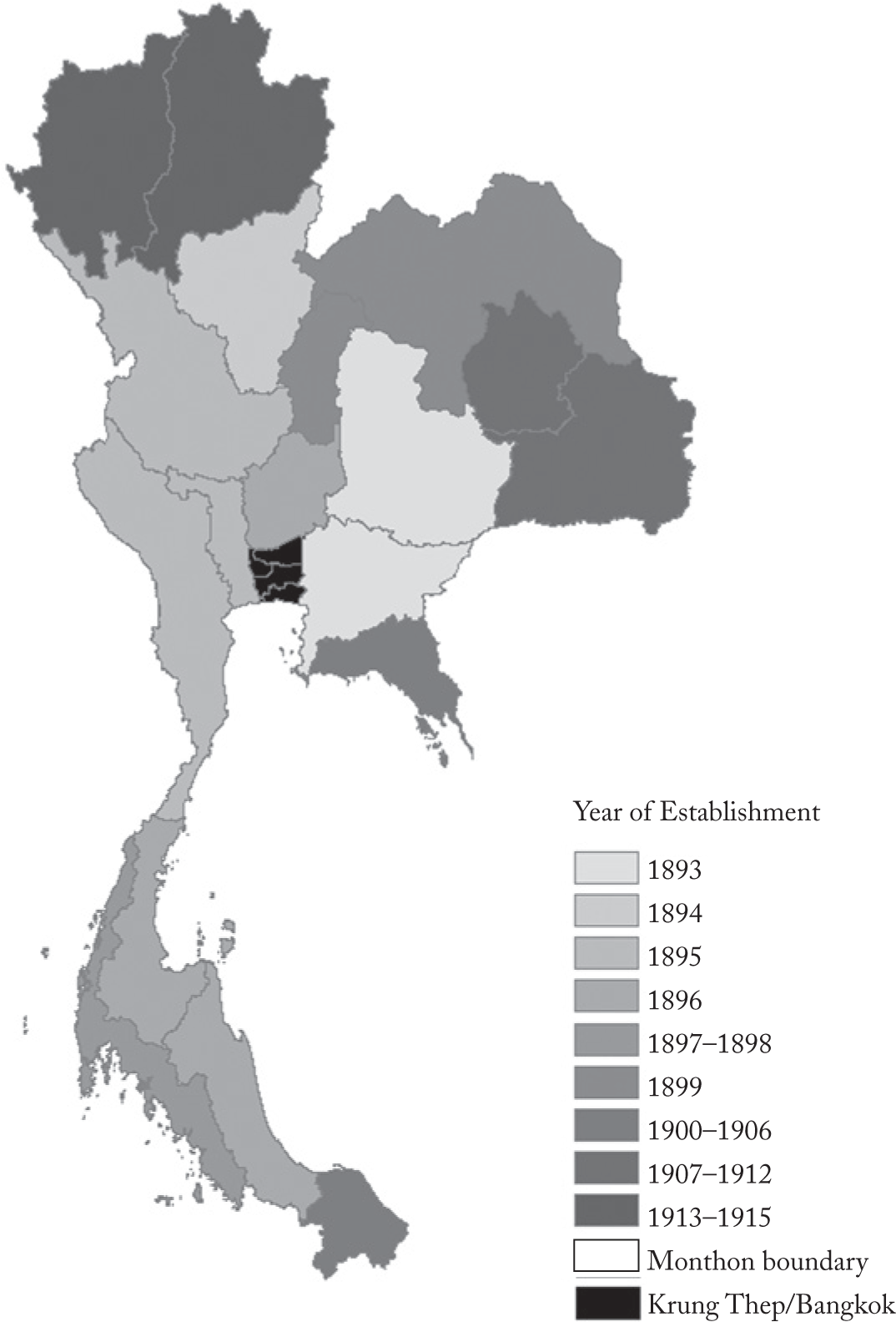
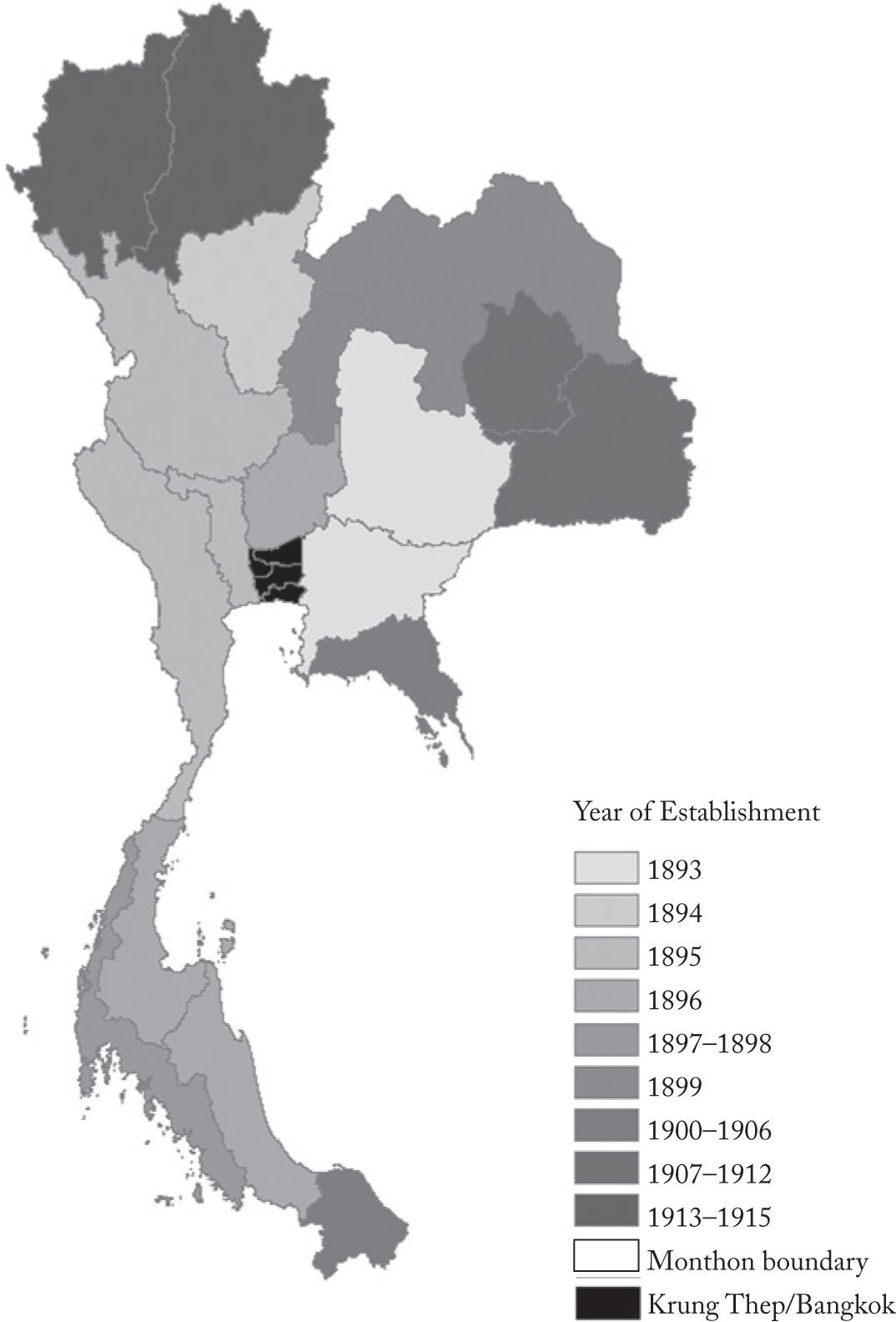
Toward the end of the nineteenth century, King Chulalongkorn of Siam introduced efforts to install permanent Bangkok government representatives in Siam’s peripheries, to develop a civil service system in the region, and to disseminate policy from Bangkok through the creation of second-level administrative units called monthon under the Thesapiban (local government) system that eventually reached all the provinces outside of Bangkok.Footnote 12 The implementation of the centralized Thesapiban system spanned a total of twenty-three years, from 1893 to 1915. Figure 1 presents the timing of monthon establishment.
As the centralization process unfolded, the central government invested in public goods and infrastructure in the newly centralized areas. But diplomatic concessions made to maintain Siam’s independence limited the government’s ability to raise revenues and resources over time, which resulted in substantial investments in the areas centralized early on and limited investments in the areas integrated later in the process. The effect was uneven long-run development outcomes across provinces in Thailand.
In this article, we first show that Siam’s internal centralization process was mainly an outcome of external colonial pressure interacted with the preexisting mandala governance structure. Geographically, Siam benefitted from being a buffer state between British Burma and French Indochina, as well from being targeted for imperialist expansion a decade or two after Burma and French Indochina, essentially allowing King Chulalongkorn enough time to centralize the government.Footnote 13 Controlling for potential underlying economic factors, we find that both proximity to French or British territorial claims and position within the traditional polity system significantly influenced the timing of provinces’ centralization. During the twenty-three-year centralization process, Siam centralized the core inner provinces closest to Bangkok first. On average, Siam took five years to centralize the inner provinces, nineteen years for the external provinces, and twenty-one years for the tributary states. Although the traditional governance structure and ease of integration clearly influenced the timing of centralization, among the external provinces, areas adjacent to colonial territorial claims were centralized on average nine years earlier than their counterparts were. Furthermore, we provide supporting historical narratives to show that the choice of areas to centralize early on critically depended on strategic, not economic, concerns.
Timing of Monthon Establishment
Second, we find that provinces centralized earlier enjoy better development outcomes decades later. In 1970, for example, a province centralized under the Thesapiban system ten years later than another province experienced on average a 6 percentage point lower proportion of homes with electrification, a 4 percentage point lower proportion of homes with access to piped water, and a 2 percentage point lower proportion of residents over the age of fourteen who completed primary school. For reference, the average proportion of homes with access to electricity and piped water in 1970 was 22 percent and 14 percent, respectively, while the average primary education attainment rate stood at 7 percent. These figures suggest a significant divergence in the levels of public infrastructure that is related to the timing of centralization during the colonial era. In an additional analysis we show that on average, a province centralized ten years later than another province saw 32 percent lower real gross provincial product (gpp) per capita in 1973. Third, in looking at the decades after the 1970s, we find the relationship persisted into the 2000s, suggesting a long-lasting legacy of Siam’s internal political reforms on public goods and income levels.
In exploring the link between centralization and Thailand’s uneven development in the long run, we find evidence of higher levels of public goods provision and infrastructure investment by the 1910s in the monthon that were centralized first. These early investment efforts were a response to colonial threats in the late-nineteenth and early-twentieth centuries. Due to the government’s limited fiscal capacity and its prioritization of Bangkok over the provinces after the end of the colonial era, provinces that experienced early centralization would continue to see better long-run economic outcomes than provinces centralized later. The country would thus witness uneven development across its provinces for decades to come.
This study of Siam contributes to the growing literature on colonization as it offers a new testing ground for the effect of colonial threat on a state that maintains its sovereignty. In particular, our work sheds light on the colonization process in Southeast Asia, a region that experienced much colonization and has yet to be studied in depth in the literature.Footnote 14 Our research provides a telling example of centralization in Asia as part of state building under external threats including colonization, adding to the literature that discusses centralization as a key determinant for diverging economic outcomes.
In the next section, we briefly describe the historical background of how the traditional Siamese governance structure differed from the Western system and how the impending imperialist threat of the British and the French pushed Siam to redefine its geographic boundaries, create centralized administrative units, and make productive investments. We draw a parallel comparison between the cases of Siam and Japan, both of which faced similar colonial threats and implemented centralization policies with varying outcomes. We explain why, relative to Japan, Siam was limited in expanding its fiscal capacity and witnessed uneven development outcomes across the country as a result. In the penultimate section, we present our main empirical results, followed by a discussion on potential caveats. We conclude by summarizing our findings and encouraging future scholarship on the region.
Historical Background
To understand how the impending imperialist threat of the British and the French pushed Siam to centralize its administration at the end of the nineteenth century, we must first understand the historical background, including how the traditional Siamese governance structure and concepts of administrative boundaries differed from the Western system. One of the challenges of protecting peripheral areas under Siamese authority was the mismatch between Siamese and Western concepts of space. Throughout much of the nineteenth century, boundaries in Siam were based on the mandala social hierarchy and tribute system, not on the Western concept of geography and boundaries.Footnote 15 In a mandala hierarchy, the periphery consists of satellite principalities in a tributary relationship with the core kingdom, and the political structure does not revolve around control of land by the core, but rather by its control of the population.Footnote 16 Importantly, geographical boundaries are not fixed, and the authority’s influence on its peripheries expands roughly in concentric circles from the center.Footnote 17 Tej Bunnag notes that even as late as 1892, officials in Siam’s Ministry of Interior likely could not locate the towns they were governing on a map because location was conceptualized as a placement within the bureaucratic hierarchy rather than a geographic space.Footnote 18
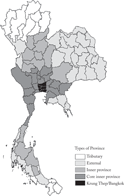
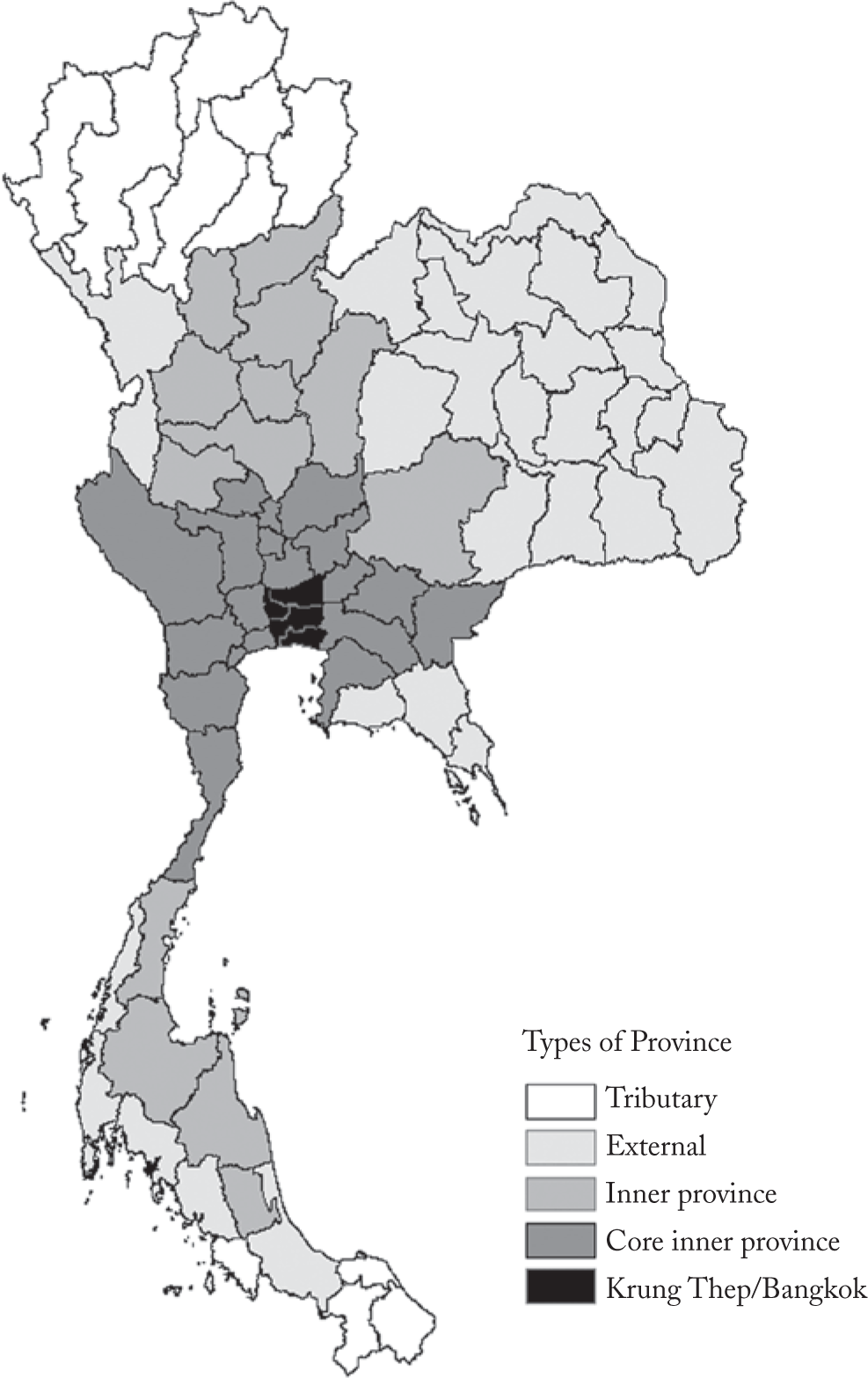
Bangkok, established as the capital of Siam in 1782 after the fall of Ayutthaya, maintained direct control over provinces adjacent to it (core inner provinces) and strong control over the rest of the inner provinces—areas in close geographic proximity to it that had formed the core of Siam since the fifteenth century.Footnote 19 Between the inner provinces and the Laotian tributary states were the mueang, or major towns with surrounding villages, which were designated as external provinces. The mueang maintained a degree of independence from Bangkok in terms of choosing leaders, tax collection, and the judiciary.Footnote 20 In the mid-nineteenth century, the tributary states included the Kingdom of Luang Prabang in the northeast; the principalities of Chiang Mai, Lampang, Lamphun, Phrae, and Nan in the north; the Kingdom of Cambodia in the east; and the sultanates of Pattani, Trengganu, Kelantan, and Kedah in the south.Footnote 21 The tributary states functioned independently of Bangkok. They chose their own royal families/hereditary leaders, governments, and laws, but they regularly paid tribute and ceremonially declared their loyalty to Bangkok. By 1909, with the exceptions of Pattani, Chiang Mai, and Siam’s other northern principalities, all of the tributary states were colonized by Western powers. Figure 2 shows, within the modern borders of Thailand, the different province classes that existed in 1892, just before the government embarked on implementing the Thesapiban system.Footnote 22
The 1855 Bowring Treaty between Britain and Siam, signed less than forty years before the centralization process began, proved pivotal in Siam’s bid to remain independent. This treaty and subsequent similar treaties with other Western powers allowed the free entrance of foreigners into trade previously monopolized by the government, introduced low fixed import and export duties, abolished other duties related to trade, and introduced extraterritorial rights to foreign nationals residing in Siam. This effectively ended the royal monopoly on Siam’s foreign trade and significantly reduced the government’s ability to raise revenues.Footnote 23 Given Siam’s decentralized governance structure, this lost revenue could not be easily replaced by other forms of taxation.
Siam’s Provinces Prior to the Establishment of the Thesapiban System in 1892a
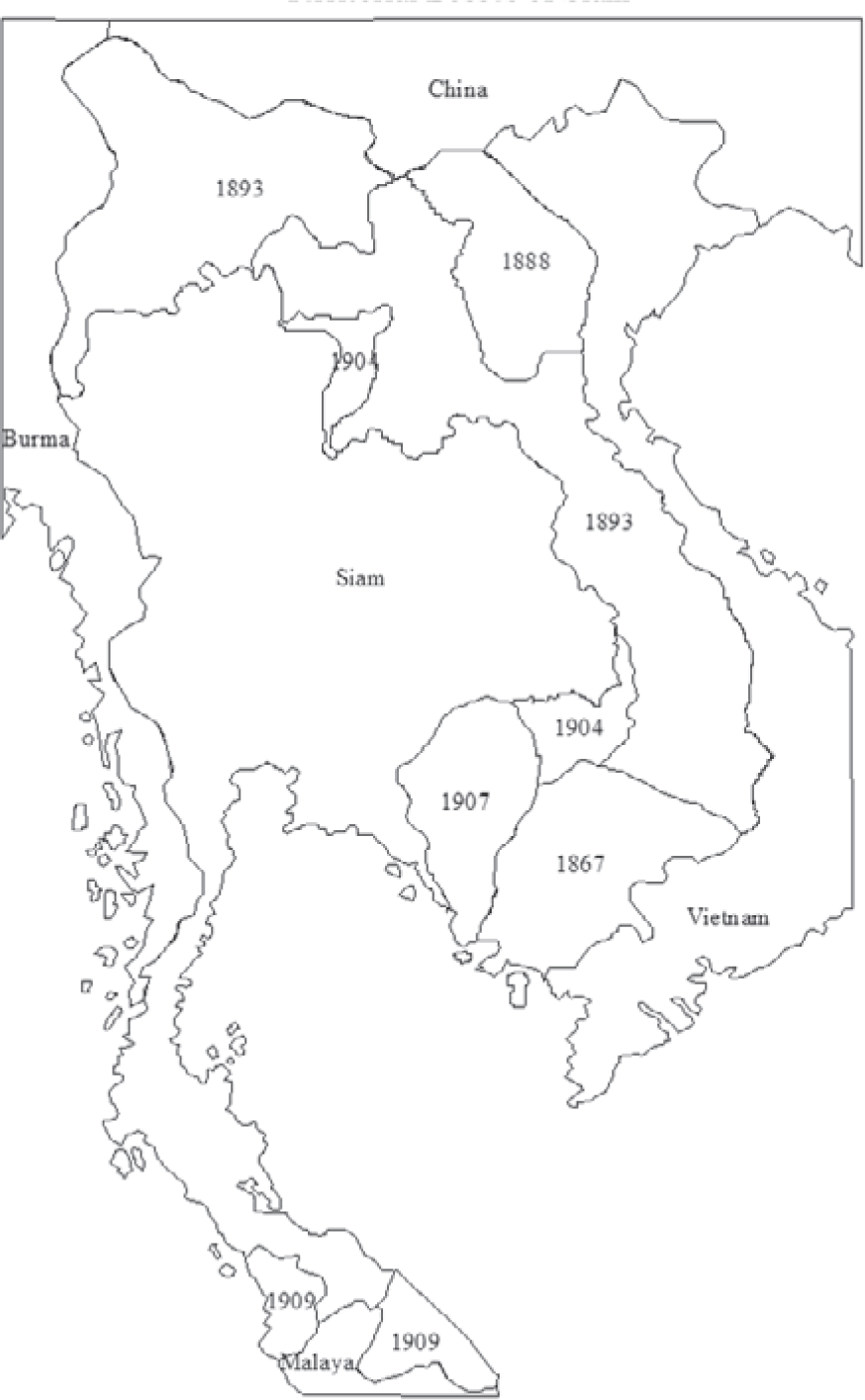
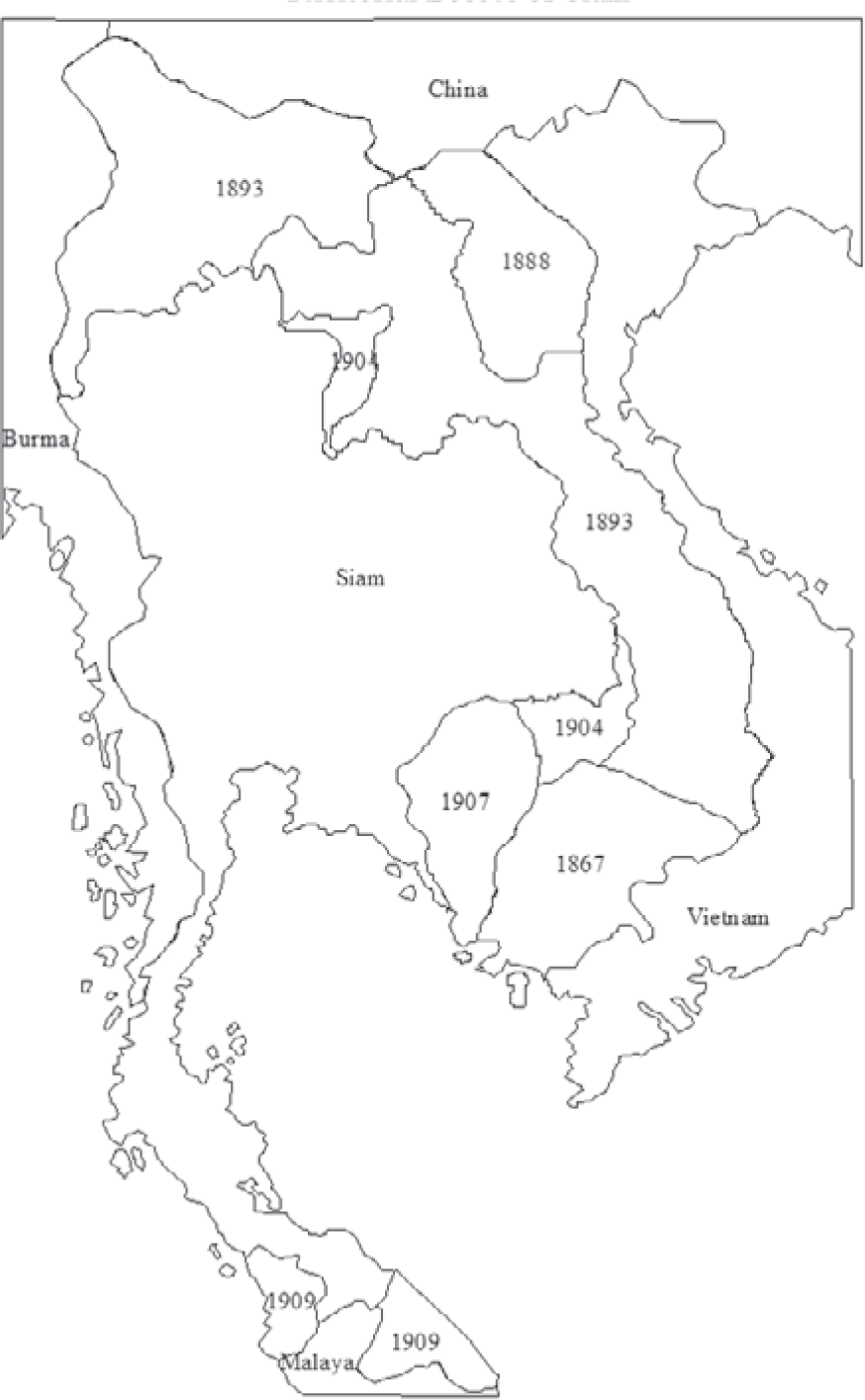
From the mid-nineteenth century, the French and the British exerted pressure on Siam internally through business interests and extraterritorial rights and externally by encroaching on nearby territories. Both colonial powers were interested in gaining access to Siam’s natural resources, markets, and trade routes. The French encroached from the east, taking over Siamese territory in current-day Vietnam, Cambodia, and Laos, while the British claimed territory in the west and south in current-day Myanmar and Malaysia. Figure 3 indicates the extent and pattern of territorial gains by the French and British between 1867 and 1909.
To summarize, during the second half of the nineteenth century, several factors limited Siam’s ability to assert itself against territorial encroachment by the French and British, including its traditional decentralized system of governance, diminished government revenue as a result of the Bowring Treaty, and poorly defined borders at its frontiers. In addition, Siam had no standing professional military and relied instead upon commoners who were obliged to serve when called to action by the government via their local patrons.Footnote 24 This situation was compounded by Siam’s lack of transportation and communications infrastructure, which limited its capacity to gather intelligence and to quickly disseminate government representatives, troops, and supplies to frontier areas.
Against this backdrop, it is widely recognized in the literature that King Chulalongkorn introduced sweeping government reforms in 1892 to defend Siam against further colonial territorial encroachment.Footnote 25 The goals of these reforms were to: (1) increase tax revenues to finance a more costly centralized administration, the newly formed civil service, and infrastructure projects; (2) establish Bangkok representatives in provincial administrations; (3) implement policy dictated by Bangkok throughout Siam’s territory; and (4) gain direct control over human resources for defense purposes. The king made official visits to areas remaining under Siam’s influence to personally solicit loyalty and consolidate support from the periphery.Footnote 26 The centralization of Siam between 1893 and 1915 was a direct response to colonial threats and importantly, allowed Siam to increase its tax base, which in turn funded the expansion of the central administration into the peripheries and the infrastructure development critical for subsequent economic growth.
Territorial Losses of Siam, 1867–1909
This centralization process closely follows the steps discussed in theoretical and empirical works that uncover the link between fiscal capacity, investment in public goods, and economic growth.Footnote 27
Siam versus Japan
In his highly influential work, Victor Lieberman discusses parallel chronologies of historical state formation and political integration for polities found in the “protected zone,” which were geographically isolated polities largely sheltered from external threats.Footnote 28 Areas in the protected zone, including mainland Southeast Asia and Japan, were generally sparsely populated, ruled by indigenous elites, adopted both cultural and political institutions from other major civilizations in the region (India and China in particular), and steadily achieved territorial consolidation before 1830.Footnote 29
Prior to the nineteenth century there were broad similarities in historical state formation between Siam and Japan as states in the protected zone, but there were also major differences. For example, Siam’s polity system differed markedly from the system developed in Japan, which, by its location and geography, was much more isolated and had clearly defined territorial boundaries. Against the historical similarities in state formation as polities in the protected zone and notable differences due to geography, it is instructive to compare the outcomes of Japan and Siam’s nineteenth-century centralization efforts in response to Western colonial threats.
During the mid-nineteenth century, like Siam, Japan faced increasing colonial threats by Western powers. On the eve of signing unequal treaties with Western powers in 1858, Japan was a collection of autonomous local domains that were “fiscally and militarily fragmented.”Footnote 30 The threat of Western colonial encroachment was the impetus to organize the population under a unified central government and in a sense, to pool resources to counter the foreign threat. That Japan was relatively compact, with naturally defined territorial borders and an existing road network that connected most of the territory, aided its centralization effort.Footnote 31
Japan’s centralization process led to fiscal innovation and increased fiscal capacity, which in turn led to administrative innovation and productive government investments. These investments included raising a strong, modern military equipped with Western weapons, establishing a public education system, instituting a domestic banking system, and pursuing import-substitution industrialization by investing in domestic industrial production.Footnote 32 Fiscal innovations, investments in infrastructure, and the provision of public goods as a result of centralization are credited with laying the foundation for Japan’s unprecedented economic growth in the twentieth century.
To reiterate, Siam, like Japan, was a collection of semiautonomous polities in the mid-nineteenth century. The Bangkok-based government embarked on centralizing its administration as a response to external threat by Western powers.Footnote 33 At first glance, Siam’s experience was similar to Japan’s in several important ways. One of the primary objectives of the Siamese centralization program that started in 1892 was to centralize its fiscal administration.Footnote 34 Prior to that, taxation had been the domain of each locality, with most of the collected taxes going directly to the local nobility and a portion sent to Bangkok. The amount forwarded to Bangkok was often less than the amount agreed upon or was sent intermittently. By taking over taxation in the peripheries, Bangkok nearly doubled its domestic tax revenues in six years, growing from 15,378,119.19 baht in 1892 to 28,496,029.33 baht in 1898.Footnote 35
Increasing government revenue and bringing the peripheries under a centralized administration were believed to be essential for Siam to maintain its territorial integrity. Increased tax revenue allowed the government to make significant transportation and communications infrastructure investments in the late-nineteenth and early-twentieth centuries. To illustrate the difficulties in communicating with the peripheries without telegraph, in 1890 it took forty-two days to travel 700 kilometers from Bangkok to Chiang Mai during the dry season.Footnote 36 Three of the early priorities of the Bangkok government were to invest in building railways that went toward frontier areas, to launch a domestic postal service, and to establish telegraph lines.Footnote 37 In addition, Siam introduced centralized, Western-style education with a curriculum dictated by Bangkok,Footnote 38 and modernized and centralized its military by procuring modern weaponry and instituting national conscription rather than relying on soldiers procured through the corvée system, in which Siamese men provided labor to the Siamese government for up to six months each year.Footnote 39 In addition, Siam overhauled and centralized much of its legal system,Footnote 40 introduced new property-rights laws, and adopted a Western-style land code with the goal of maintaining territorial integrity.Footnote 41
Given that Siam and Japan had similar experiences in expanding fiscal capacity and making productive investments, Siam’s resulting economic growth was notably less impressive than that of Japan and was largely uneven across the country. Why were Siam’s economic outcomes different from those of Japan? Despite the increased ability of the government to raise domestic revenues through centralized tax collection in the peripheries, Siam faced challenges in raising revenues through other channels, such as foreign trade and borrowing. Provisions in the Bowring Treaty limited revenue from foreign trade. This and other treaties, signed in quick succession with other Western powers, set low tariff rates and abolished the government’s former trade monopolies, thus severely limiting trade as a source of government revenues. In addition, Siam was wary of borrowing from abroad because debt to foreign powers—Britain and France in particular—may have put it at risk of outright colonization.Footnote 42 As such, it adopted a balanced-budget policy—a policy it maintained through the 1950s—that severely limited the investment capacity of the government.Footnote 43 By contrast, Japan did not face these constraints and was able to capture revenues from foreign trade and to use deficit financing to make productive investments.Footnote 44
In Siam, restricted channels for raising revenue severely limited the funds available to the government to invest in infrastructure consistently over the long run. Given these constraints on government expenditures, public infrastructure expansion outside Bangkok slowed significantly after the 1920s. Regions excluded from the initial centralization phase remained without access to basic infrastructure and only experienced government investments starting in the 1960s and accelerating significantly in the 1970s.Footnote 45 For these excluded regions, not receiving the benefits of early centralization inevitably hampered the ensuing provision of public services, as public schools, electricity, and piped water were all preconditioned on the expansion of both infrastructure and administrative capacity.Footnote 46 In the following section, we show that the uneven path to centralization, due to initial government investment followed by limited spending over time, led to a lasting divergence in development outcomes across Thailand’s provinces.
Empirical Findings
Here, we show that external threats and the preexisting political structure in nineteenth-century Siam shaped the path of centralization and that these centralization efforts are strongly correlated with subsequent socioeconomic outcomes at the provincial level in Thailand. The province is currently the second-level administrative unit below the state itself. We chose the province as the unit of analysis because decisions on public goods provision and the allocation of public funds have been made at this level since 1933. Monthon, the second layer of the central administration for only a short time, were dissolved by the Provincial Administration Act of 1933, which devolved second-level administration to the provinces.
In all our regressions, we exclude Monthon Krung Thep, which comprises areas in and around Bangkok, including the present-day provinces of Bangkok, Nonthaburi, Pathum Thani, and Samut Prakan. These areas were always under centralized control and were not a part of the Thesapiban provincial administration introduced in 1892 under the Ministry of Interior.
Table 1 presents summary statistics for the seventy-two provinces in the data set and data sources.Footnote 47 During the twenty-three-year period of centralization from 1893 to 1915, the average year of monthon establishment was 1901, indicating that the integration process is skewed slightly toward the earlier period. At the start of centralization, in 1893, Siam had nonexistent or very low levels of development in terms of our outcome variables of interest, including household electrification, access to piped water, and completed primary education. As stated above, by the 1970s, the mean household electrification at the provincial level stood at 22 percent, the mean proportion of households with access to piped water was 14 percent, and completed primary education remained low, with an average of 7 percent. By 2000, the mean proportion of households with piped-water access increased to 52 percent and the mean proportion of completed primary education increased significantly to more than 50 percent.Footnote 48 Real per capita gpp also increased over a forty-year period from 36,814 baht in 1973 to 119,136 baht in 2010.Footnote 49
Summary Statistics a
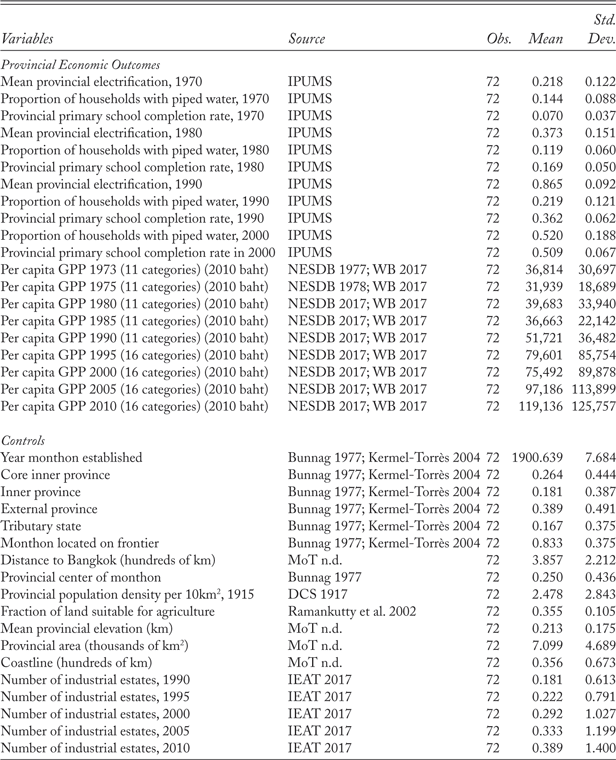
a ipums (Integrated Public Use Microdata Series); nesdb (National Economic and Social Development Board); wb (World Bank); mot (Information and Communication Technology Center, Office of the Permanent Secretary, Ministry of Transport [Thailand]). dcs (Department of Commerce and Statistics, Ministry of Finance); ieat (Industrial Estate Authority of Thailand).
We argue that Siam’s decision to centralize a province earlier or later through the Thesapiban system was determined by whether the region was under the direct threat of colonial encroachment by Western powers due to its location and its precentralization political relationship with Bangkok. Skirmishes with the French in 1892–1893 that culminated in the Paknam Incident resulted in the loss of a large swath of land in present-day Laos and Cambodia, and hastened the need for Bangkok to gain direct control not only over frontier areas bordering French claims, but also over areas bordering British claims. In addition, precentralization governance structure, or class of province, likely influenced the timing of centralization; provinces varied in terms of the reach of Siam’s rule over them, which in turn determined the extent to which Siam could implement centralization.
To explore whether colonial threat was critical to the timing of monthon establishment and how it had differential effects across different types of provinces, we regress the year that the province became part of the Thesapiban system on a relevant set of determinants. We run the following ordinary least square (ols) regression:
 $$MonthonYr = {\alpha _0} + {\alpha _1}Frontier + Class\beta + \left( {Frontier*\,Class} \right)\gamma + X\delta + \varepsilon.$$
The variable MonthonYr is the year that the province was assigned to a monthon and its government structure was fully incorporated into the Thesapiban system.Footnote 50 The variable Frontier is a dummy variable with a value of 1 for provinces located in monthon adjacent to French and British claims in 1893. The vector Class contains indicators for the precentralization province classes, including core inner province, inner province, external province, and tributary state, with core inner province being the excluded category. We categorize the provinces that comprised the Chiang Mai Kingdom, for example, as belonging to a tributary state. Although economically important due to their thriving teak trade and threatened by their location along the border between Siam and British holdings (and hence, considered frontier), the provinces in this kingdom were the last to be fully centralized (in 1915) because Siam’s control over Chiang Mai was not absolute and aggressive centralization efforts would have jeopardized their relationship.Footnote 51 At the same time, the core inner provinces were considered easiest to integrate given that much of the government structure was already under Bangkok’s centralized control. Geographically, inner provinces lay beyond the core inner provinces, but much of their government structure was also under centralized control. By the 1890s, external provinces largely formed Siam’s periphery. These provinces had been more recently (seventeenth century) incorporated into the Siamese Kingdom and Bangkok’s reach was limited by the existence of independent governments, distance, and naturally difficult terrain.
The vector X includes controls associated with economic potential, such as fraction of land suitable for agriculture, provincial population density in 1915, distance from province centroid to Bangkok, provincial area, provincial mean elevation, and length of coastline. Fertile regions for agriculture, the main economic activity in Siam throughout most of the twentieth century, with large populations would have been likely targets for early centralization due to their importance to the kingdom’s economy and its desire to establish sovereignty over its subjects. It is also plausible that the timing of centralization depended on a province’s commercial viability, especially in terms of its size and connectivity to Bangkok. Large provinces that were closer to Bangkok were more likely to be commercially viable, and those located at a low elevation had waterways that were more navigable and that provided the main transportation means throughout Siam. Table 2 reports the regression results.
Determinants of Centralization Timing
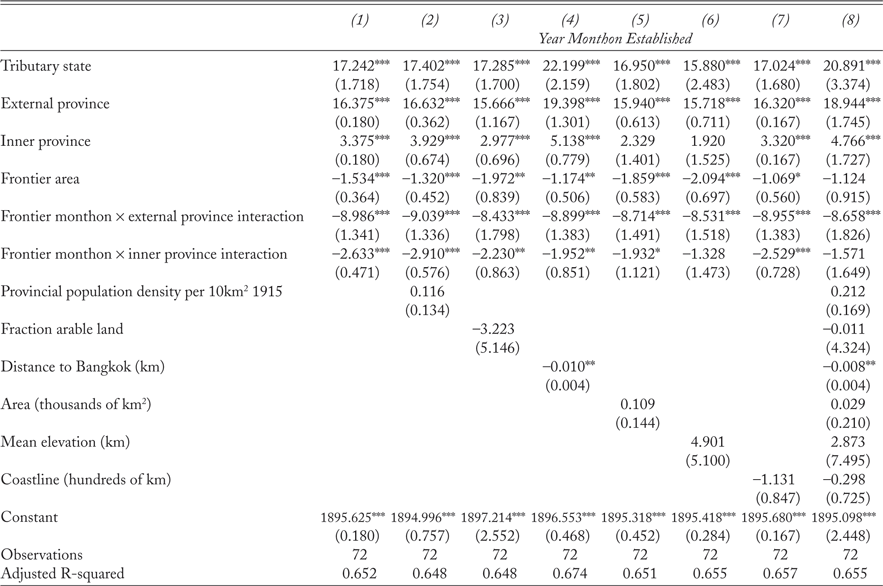
***p < 0.01, **p < 0.05, *p < 0.1; robust standard errors in parentheses
Table 2, column 8, with a full set of economic covariates as controls, shows that relative to core inner provinces under the direct control of Bangkok (our baseline category), tributary, external, and inner provinces were more likely to witness delays in centralization by twenty-one, nineteen, and five years, respectively. Throughout different specifications, we also find that relative to other external provinces, those located in areas adjacent to colonial territorial claims were in general likely to have been centralized nine years earlier.Footnote 52 Importantly, the frontier effect interacted with the external province class appears to be statistically significant throughout different specifications that include various indicators of economic potential. Furthermore, except for the distance to Bangkok, none of these variables have an impact on the timing of monthon establishment. The results suggest that a province’s economic and commercial viability during this period was unlikely to be the main determinant of the timing of incorporation into the centralized system.
In addition to the findings in Table 2, we present further support of our argument in the historical narrative. It suggests that the decision to establish a monthon was not driven by factors that are likely to be correlated with subsequent public goods provision or economic development. Bunnag claims that the order in which territories were organized as monthon was mainly based on the strategic location of territories vis-à-vis colonial advances by France in the east and northeast, and Britain in the north, northwest, and south, as well as on the political relationship between Bangkok and its territories before 1893.Footnote 53 While the French and British had economic interests in the Siamese territories, the colonial powers first targeted areas adjacent to their existing holdings rather than the most economically important areas of Siam, which were arguably in the central rice-growing region. Figure 3 indicates the extent and pattern of territorial gains by the French and British between 1867 and 1909, which shows the natural encroachment of lands along Siam’s frontiers over time.
For further contextual evidence, we note that directly following the Paknam Incident, which resulted in significant territorial losses in present-day Laos and Cambodia, Bangkok endeavored to gain direct control over areas bordering French holdings. Thus, in 1893, Nakhon Ratchasima and Prachinburi were established as the first two monthon due to their militarily important locations on the eastern frontier.Footnote 54 The third monthon, Phitsanulok, was established in 1894. It was located on the northern frontier and, according to Bunnag,Footnote 55 strategically closed the gap between the Principality of Chiang Mai and Udon, the latter having gained administrative importance after the French attained control of the left bank of the Mekong River under the provisions of the Franco-Siamese Treaty signed in 1893 following the Paknam Incident.Footnote 56 Nakhon Sawan and Ratchaburi formed the next two monthon in 1895 to demarcate and close the western frontier with British Burma.
In comparison, areas with relatively independent local governments were generally integrated more slowly, even when located on land bordering British and French holdings. For example, although the Principality of Chiang Mai directly bordered the frontier with British holdings in the northwest, Bangkok did not immediately target it for full integration into the Thesapiban system. Since Chiang Mai had its own independent government, Bangkok was concerned that overtures to take direct control would result in open rebellion. This gradual approach was also used in the external provinces of Nongkhai and Ubon Ratchathani because there was a need to integrate the existing governments into the new Bangkok structure without alienating the hereditary nobility.Footnote 57 In sum, the order in which monthon were created appears to have been dictated by a balance of strategic location and ease of integrating the prevailing traditional government system into the new, centralized system dictated by Bangkok.
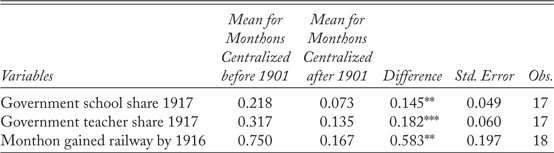
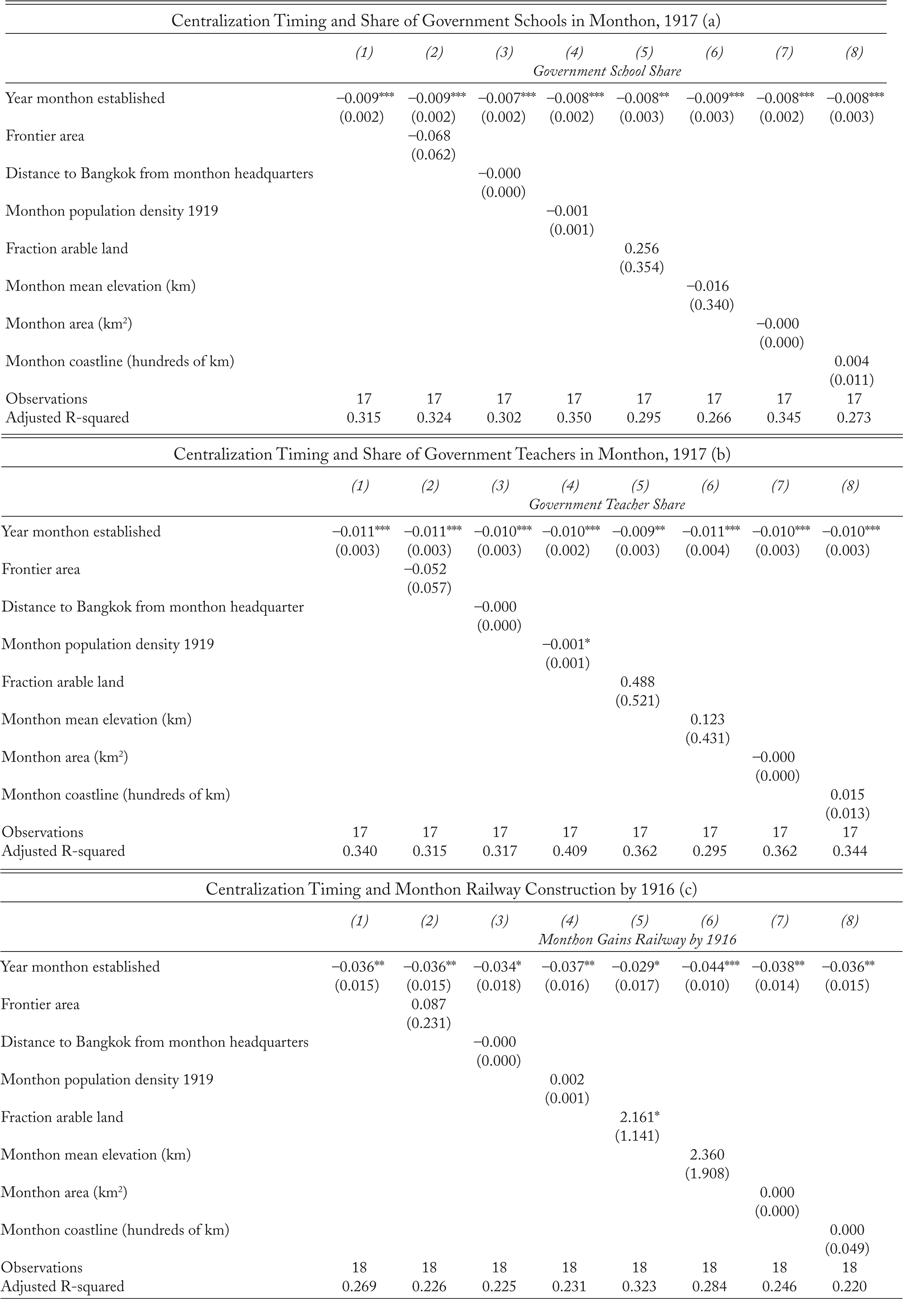
The next part of the analysis attempts to identify whether the timing of integration into the centralized Thesapiban system correlates with public goods development and economic indicators at the subnational level over the following century. Our hypothesis is that early exposure to the centralized institutional structure and accompanying infrastructure investments has a consistent and lasting association with better public goods provision and economic performance in the long run. To determine whether this is the case, we first explore infrastructure and public goods provision in the years just after the centralization process was completed in 1915. Due to data limitations in terms of development measures and disaggregated data at the provincial level, we first compare public goods provision and infrastructure development between monthon that were centralized prior to 1901 and those that were centralized after 1901, where 1901 is the mean year of centralization. Specifically, we analyze the mean differences in the proportion of government-provided schools and teachers in the monthon in 1917, as well as the difference in the proportion of monthon that gained a rail line by 1916. Table 3 presents the tests of mean and proportional differences across the three measures.
Tests of Mean and Proportional Differences for Public Goods and Infrastructure Measures at the Time of Centralization a
*** p < 0.01, ** p < 0.05, * p < 0.1
a Monthon Phetchabun was reported with Monthon Phitsanulok in 1917, resulting in only seventeen monthon observations.
The simple t-tests of mean and proportional differences show that monthon that were centralized earlier had significantly higher proportions of central government–funded schools and teachers in 1917 (as opposed to locally funded secular or religious education), and were much more likely to have gained a rail line before 1916.Footnote 58 These results are consistent with our supposition that areas integrated into the centralized governance system early benefitted from an initial injection of government spending on public goods and infrastructure.
Next, we regress provincial-level development indicators—specifically, household electrification, household access to piped water, primary education attainment rates, and gpp—measured at various intervals between 1970 and 2010 on the year the provinces were integrated into monthon. For the long-run outcomes, we specifically look at early 1970s levels of development as a benchmark. Prior to the 1970s, economic development initiatives had largely been focused on Bangkok. Starting in the late-1970s and early-1980s, the Thai government actively pursued economic development targeted at the outlying regions. In particular, the Fourth National Economic and Social Development Plan (1977–1981) was the first plan to specifically emphasize the development of infrastructure outside the central region to facilitate economic development in rural areas and regional urban centers.Footnote 59 The Fifth National Economic and Social Development Plan (1982–1986) specifically spells out development goals in underdeveloped areas outside of Bangkok and the Central Plain, including the eastern seaboard, the western region, the lower northeast, three upper northern provinces, and the southern border provinces.Footnote 60
Thailand also began to pursue export-led growth in the mid-1980s, which was a departure from its traditionally agrarian economy. This shift resulted in the rapid development of manufacturing and the establishment of industrial zones in provinces outside Bangkok, especially from the late-1980s through the first decade of the twenty-first century. We argue that development outcomes before 1977 are the result of a highly centralized provincial government system that can trace its origins directly to the Thesapiban system implemented between 1893 and 1915, while outcomes in the later years are influenced by recent government development policies targeting areas outside Bangkok.
For the empirical analysis, we employ the following regression to test the relationship between the timing of centralization and recent public goods provision:
 $$PublicGood = {\alpha _0} + {\alpha _1}\,MonthonYr + Class\beta + Location\gamma + Z\delta + \varepsilon.$$
The variable PublicGood is one of various measures of provincial-level infrastructure and human capital development in 1970, including the proportion of households with electrification and access to piped water, and the proportion of individuals over fourteen years old who have completed primary school. These provincial-level development indicators are constructed using Thailand’s 1970 census microsamples archived in the Minnesota Population Center’s Integrated Public Use Microdata Series.Footnote 61
The main variable of interest is MonthonYr. To understand why a difference of only twenty-three years in exposure to state centralization may lead to long-run disparities across provinces, we note that it is the order of centralization rather than the short time span that matters for long-run development outcomes. As explained above, the need to centralize within a short time span due to colonial threats combined with Siam’s fiscal constraints meant that Siam had limited capacity to fund its centralization efforts. Thus, the centralization process and subsequent government investments were prioritized based on ease of integration and the most urgent need for direct rule.
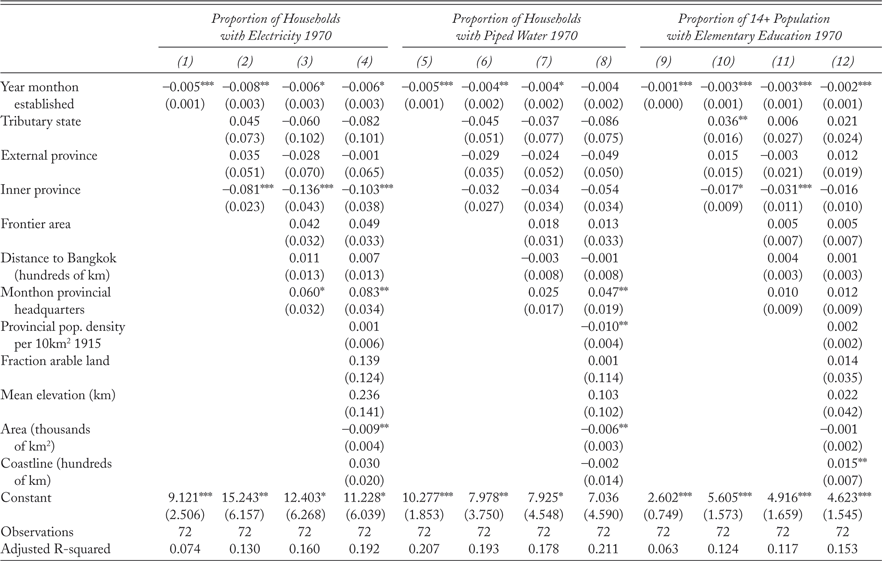
Prereform political relationships in each area may also have had long-term effects on the levels of public goods provision independent of the timing of centralization. Such can be the case if, for example, after centralization there continues to be internal resistance against the central administration from the peripheral regions that historically were associated with tributary states and external provinces. The vector Class controls for this possibility. The vector Location is a set of controls for a province’s proximity to the frontier, Bangkok, and the center of monthon administration. The frontier variable is the same as in equation (1); provinces in former frontier monthon may continue to witness different levels of public goods provision relative to other provinces for reasons other than centralization, such as a higher likelihood of interstate competition and increases in trade across borders. The distance to Bangkok captures the distance from the central administration and access to the country’s main commercial center. In addition, whether the province was designated as the administrative center of a monthon may continue to matter for the level of public goods provision in the long run. Finally, Z is a vector of standard location and geographic controls that capture economic potential. These include provincial population density in 1915, fraction of arable land, area, mean elevation, and length of coastline. We report the results for the public goods regression in Table 4.
OLS Regressions: Centralization and Public Goods Provision, 1970
*** p < 0.01, ** p < 0.05, * p < 0.1; robust standard errors in parentheses
The results in Table 4 indicate that the timing of centralization is negatively correlated with the levels of all three development indicators in 1970. Controlling for the full set of precentralization polity types and economic indicators, a province that was centralized under the Thesapiban system ten years later than another experienced on average a lower proportion of homes with electrification by 6 percentage points, a lower proportion of homes with access to piped water by 4 percentage points, and a lower proportion of residents over the age of fourteen who completed primary school by 2 percentage points. At first glance these differences may seem small, but the magnitudes compared to the mean levels of public goods provision in 1970 are large. For comparison, as reported above, in 1970 the mean levels of electrification, piped-water access, and completed primary schooling were 22 percent, 14 percent, and 7 percent, respectively.
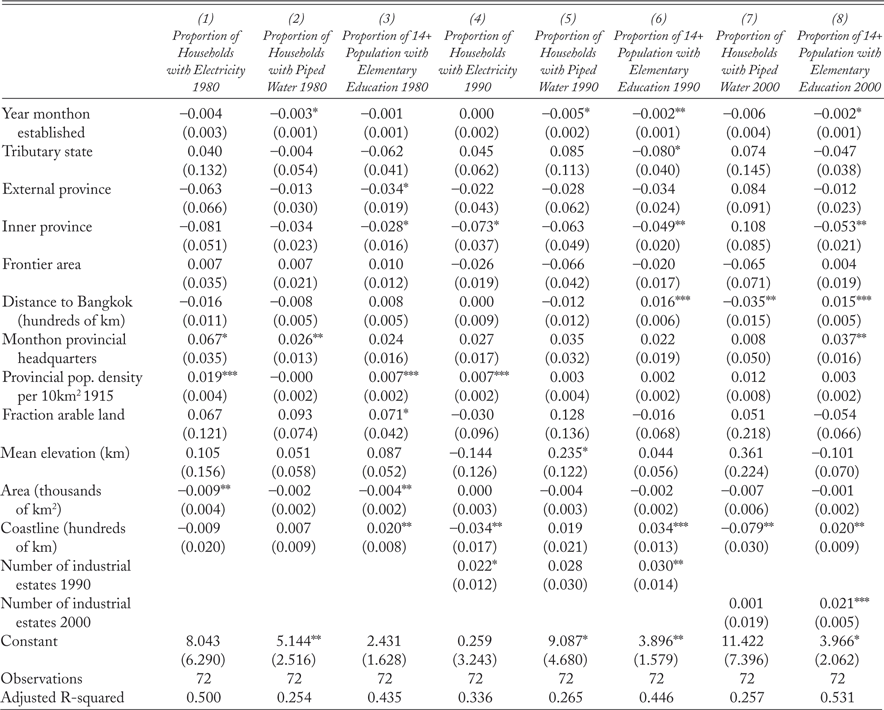
To investigate whether the timing of centralization still matters for public goods provision after government-pursued provincial development initiatives from the late-1970s onward, we replicate the previous public goods regressions for the years 1980, 1990, and 2000. In addition to the controls outlined above, we add a control for the number of industrial estates under the Industrial Estate Authority of Thailand for the 1990 and 2000 regressions. This variable represents province-specific, targeted, economic-development projects pursued as a part of Thailand’s export-led growth strategy of the 1980s and 1990s that could have affected the provision of infrastructure and the supply of education. The eastern seaboard province of Rayong, for example, saw the establishment of seven industrial estates between 1989 and 2001 alongside complementary infrastructure development, including a deep-sea port and a railway line. Table 5 reports the public goods regression results for 1980, 1990, and 2000.
OLS Regressions Centralization and Public Goods Provision, 1980–2000
*** p < 0.0l, ** p < 0.05, *p < 0.1; robust standard errors in parentheses
Table 5 shows that the impact of centralization timing remains negative in most cases, although the magnitudes (compared to the means) and statistical significance decrease over time. These results suggest that targeted provincial development has led to convergence of public goods provision but that the negative impact of late centralization persists.
Our next analysis determines whether the timing of centralization is related to long-run provincial economic performance. The unit of observation is the province and the dependent variable is the natural log of real per capita gpp measured in 1973.Footnote 62 The following regression relates the timing of centralization to per capita gpp, with the same set of control variables as in equation (2):
 $$Inpcgpp = {\alpha _0}{\rm{ + }}{\alpha _1}MonthonYr + Class\beta + Location\gamma + Z\delta + \varepsilon.$$
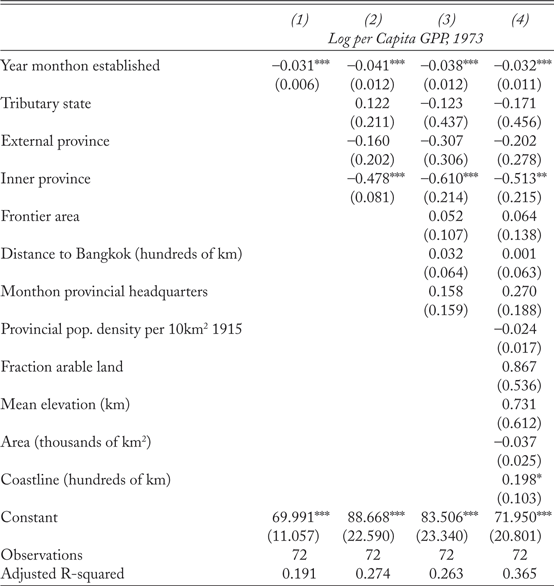
Regions that were incorporated into monthon early in the centralization process experienced better infrastructure development and an earlier introduction of central administration–mandated modern educational institutions, which presumably would lead to better conditions for economic development. A negative coefficient on MonthonYr would therefore suggest that earlier centralization (over a century ago) had positive lasting impacts on provincial-level economic performance, as measured by real per capita gpp. Table 6 presents the association between monthon timing and log per capita gpp in 1973.
OLS Regressions: Centralization and Gross Provincial Product, 1973
*** p < 0.01, ** p < 0.05, * p < 0.1; robust standard errors in parentheses
The results indicate that provinces that were centralized later, holding all else constant, have lower levels of real per capita gpp. In fact, the coefficient estimate from the fully controlled specification suggests that on average, a province centralized ten years later than another experienced 32 percent lower gpp per capita in 1973.
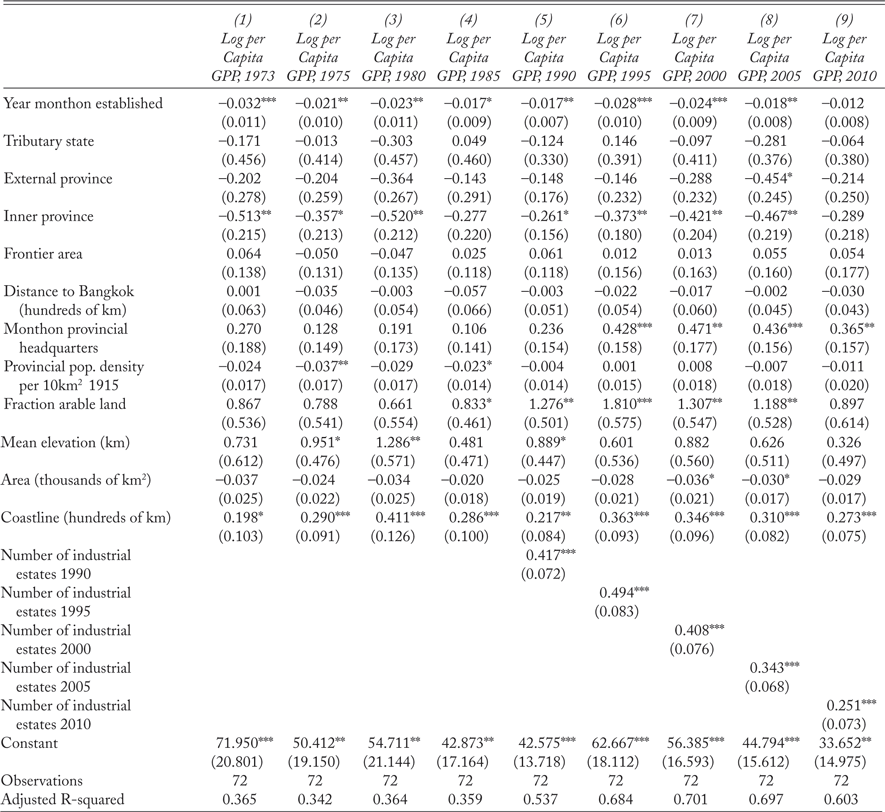
We replicate the gpp analysis for the years 1975 to 2010 in five-year intervals to see whether the relationship between centralization timing and gpp per capita holds in subsequent years after the government introduced targeted development projects that complemented the government’s economic liberalization strategy outlined in the five-year economic and social development plans. The establishment of industrial estates in the provinces to attract manufacturing firms was one such targeted policy. To account for this policy, we add a control for the number of government-sponsored industrial estates for the relevant years, 1990 to 2010. We report the results in Table 7.
OLS Regressions: Centralization and Gross Provincial Product, 1975–2010
*** p < 0.0l, ** p < 0.05, *p < 0.1; robust standard errors in parentheses
Like the results for 1973, the coefficient on MonthonYr remains negative and statistically significant in most years with a magnitude falling from 3.2 to 1.2 percent for a one-unit change over the period of 1975 to 2010.Footnote 63
Discussion
Our empirical study is first and foremost limited by the relatively few observations in our data. As is common in other studies looking at historical processes in Southeast Asia, we are also limited in finding data for potential confounders. In place of these shortcomings, we supplement our analysis with the qualitative evidence and relevant historical anecdotes presented below.
A criticism of our findings may be that the colonial threat led to divergent development outcomes across Thailand through channels other than centralization. Two alternative channels through which colonial threat led to uneven development outcomes in Thailand have been discussed in the literature. These include the colonization of the Siamese economy through forced integration into the global colonial economy and the colonization of political structures through the adoption and selective implementation of Western institutions. Chris Dixon and Michael Parnwell argue that although Siam was not colonized, the Bowring and related nineteenth-century treaties caused the kingdom’s economy to develop similarly to colonies, in the sense that it increasingly concentrated on primary product exports, especially rice, teak, and tin.Footnote 64 This integration into the global economy in turn had uneven impacts on economic development across Siam.
Although rice quickly became Siam’s dominant export after opening its economy to global trade, the rice trade largely affected only Bangkok and surrounding rice-growing areas in the Central Plain, much of which was included in Monthon Krung Thep and thus excluded in our analysis. This contention is supported in recent work by Thanyaporn Chankrajang,Footnote 65 which shows that households outside the Central Plain were largely not integrated into the export rice market, which spared them from much of the negative effects of the Great Depression in the early 1930s. Other primary export products found outside of the central region, such as teak and tin, were progressively controlled by British firms, but Dixon and Parnwell argue that the development of these enclave industries had little impact on the local economies.Footnote 66 Thus, the integration of Siam’s economy into the colonial economy contributed to divergent development paths between Bangkok and the periphery, but cannot explain varying levels of development between areas outside of Bangkok.
The adoption and uneven implementation of Western institutions has also been recognized as a source of uneven development in Thailand. A clear example discussed extensively by David Feeny and Tomas LarssonFootnote 67 is the implementation of the 1901 Land Title Deed Act. This act bestowed full private property rights to owners who held deeds issued through the newly implemented Torrens system, a Western land-titling code. The land act also restricted landownership by foreign nationals, a stipulation seen as a political response to the growing issues surrounding extraterritoriality rights.Footnote 68 Although the adoption of Western land institutions was a political response to colonial threat and was credited with helping Siam to maintain its sovereignty, implementation was uneven across the kingdom. In fact, by 1909, only 10 percent of the surveyed land was located outside of Bangkok and the central region.Footnote 69 Peter Vandergeest and Nancy Peluso argue that the uneven implementation of the land code led to ambiguity and property rights insecurity outside the center.Footnote 70 Land rights insecurity as a result of uneven and incomplete implementation of the Torrens system is a factor related to the economic underdevelopment in areas other than Bangkok, as demonstrated by Gershon Feder and colleagues and Chankrajang.Footnote 71 The conclusion here is that again, the impact of imperfectly adopting a Western land code explains some of the differences in economic development between Bangkok and the rest of the country, but not differences between provinces outside Bangkok.
Conclusion
The threat of colonization by the British and the French during the second half of the nineteenth century led Siam’s King Chulalongkorn to adopt the Thesapiban system—a centralized government structure— as a defensive strategy. Under the traditional system, the government in Bangkok had little direct control over territories located outside the center, and limited ability to select local rulers, collect taxes, and implement policies. With increasing colonial pressures in the frontier areas, it was necessary to create a centralized government system that would allow the administration in Bangkok to appoint its own government officials, to gain control over tax revenues, and to develop infrastructure to help move people and information between the frontier and Bangkok. The degree of colonial threat combined with the ease of political integration meant that some areas were integrated into the centralized system sooner than others were. The central government’s fiscal constraints also meant that the areas integrated earlier received significant initial injections of infrastructure investment and public goods provision compared with areas integrated later. In this article, we explore whether the timing of centralization implementation is associated with long-term development outcomes in Thailand.
The results of this study show that an area’s historical political relationship with Bangkok and the threat of colonial encroachment in the late nineteenth century indeed have long-run associations with uneven development across several measures at the provincial level between 1970 and 2010, including infrastructure, human capital, and gpp. Although the Thesapiban system and the monthon were disbanded by the 1930s, the legacy of Siam’s centralization strategy survives through the varying levels of public infrastructure provided at the monthon level in the early twentieth century. The direct influence of centralization appears to persist even after concerted efforts by the government, starting in the late-1970s, to develop the outlying regions through targeted government development projects and economic liberalization policies. These efforts have partly overcome the long-run effects of unequal distribution of infrastructure and exposure to centralized government policy, but the results of Siam’s strategic response to colonial threats in Southeast Asia remain.
Siam’s modernization endeavors through the adoption of a centralized governance structure made it possible to maintain its sovereignty through the decades of Western colonial threat. Its unique history as the only country in Southeast Asia to never have been formally colonized draws much interest from scholars in social sciences, and yet the literature finds few empirical works on the country’s transformation from a mandala state to a modern state. Given the rising interest in the impact of colonization and dynamics of modern state formation, further studies are warranted for Thailand, and more broadly for Southeast Asia, a region that offers rich ground for testing existing hypotheses and exploring new ones.
Data
Replication data for this article is available at https://doi.org/10.7910/DVN/AE2FHZ.
Acknowledgements
We thank seminar participants at Chulalongkorn University Faculty of Economics, Seoul National University Economics Department, Nanyang Technological University, Kyoto University, the 2016 Asian Historical Economic Conference, the 2017 Economic History Society Conference, and the 2018 American Political Science Association Annual Meeting, as well as Narisara Murray, for helpful comments. The paper benefitted immensely from the constructive reviews of three anonymous reviewers and the editors of World Politics. We thank Pannee Cheewinsiriwat, Chulalongkorn University Department of Geography; and the Information and Communication Technology Center, Office of the Permanent Secretary, Ministry of Transport, for providing access to the Thai GIS files. Finally, we acknowledge Fitra Jehwoh, Keshar Shahi, and Tanyalak Srisirisup for providing excellent research assistance.
Appendix
OLS Regressions: Divergence in Government-Provided Public Goods and Infrastructure at the Time of Centralizationa
*** p < 0.01, ** p < 0.05, * p < 0.1; robust standard errors in parentheses
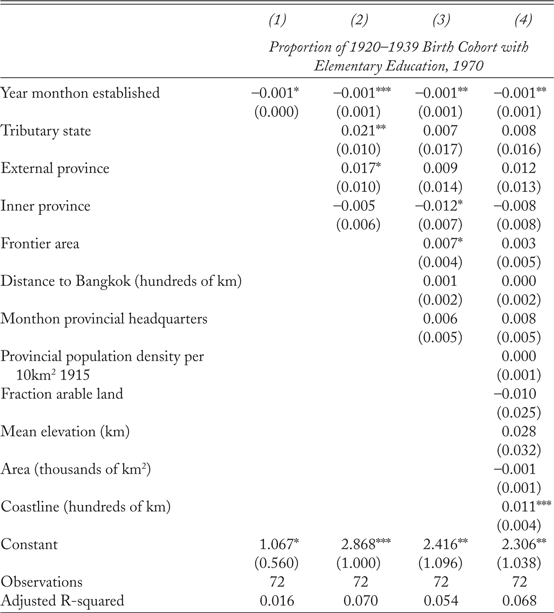
Centralization Timing and Primary Education Attainment in the 1920–1939 Birth Cohort
*** p < 0.01, ** p < 0.05, * p < 0.1; robust standard errors in parentheses
Authors
Christopher Paik is an assistant professor of political science in the Division of Social Science at New York University Abu Dhabi. His main research interests are comparative political economy and economic history. He can be reached at christopher.paik@nyu.edu.
Jessica Vechbanyongratana is an assistant professor of economics in the Faculty of Economics at Chulalongkorn University in Bangkok, Thailand. Her main research interests are nineteenth- and twentieth-century Thai economic history and contemporary Thai labor markets. She can be reached at jessica.v@chula.ac.th.