INTRODUCTION
Frugivory and seed dispersal are crucial for maintaining the structural and dynamic properties of diverse tropical ecosystems (Howe & Miriti Reference HOWE and MIRITI2000, Jordano Reference JORDANO and Fenner2000). Primates are among the major groups of frugivores in the tropics (Lambert & Garber Reference LAMBERT and GARBER1998, Stiles Reference STILES and Fenner2000); almost all diurnal primate species include fruit and seeds in their diet (Hladik Reference HLADIK, Harding and Teleki1981, Stiles Reference STILES and Fenner2000). With their often high biomass and relatively large home ranges, primates are able to harvest considerable proportions of fruit crops (Chapman & Chapman Reference CHAPMAN and CHAPMAN1996, Kunz & Linsenmair Reference KUNZ and LINSENMAIR2007, Peres Reference PERES1991). They may disperse high numbers of seeds over wide areas (Link & Di-Fiore Reference LINK and DI-FIORE2006, McConkey Reference MCCONKEY2007, Wrangham et al. Reference WRANGHAM, CHAPMAN and CHAPMAN1994), thereby influencing the spatial and genetic structure of plant populations and contributing to plant community dynamics (Chapman & Onderdonk Reference CHAPMAN and ONDERDONK1998, Nuñez-Iturri & Howe Reference NUÑEZ-ITURRI and HOWE2007, Pacheco & Simonetti Reference PACHECO and SIMONETTI2000). Some species are considered particularly important for the dispersal of large-seeded fruit, that many other frugivores cannot swallow, at least not without serious damage of the seeds (Chapman & Onderdonk Reference CHAPMAN and ONDERDONK1998, Nuñez-Iturri & Howe Reference NUÑEZ-ITURRI and HOWE2007, Peres & van Roosmalen Reference PERES, VANROOSMALEN, Levey, Silva and Galetti2002; but see Dominy & Duncan Reference DOMINY and DUNCAN2005).
Primates vary in their effectiveness (sensu Schupp Reference SCHUPP1993) as seed dispersers due to differences in morphology, physiology, feeding and ranging behaviour (Kaplin & Moermond Reference KAPLIN and MOERMOND1998, Rowell & Mitchel Reference ROWELL and MITCHEL1991). As most primate species inhabit forests, studies to date on the interplay between primates and their fruit plants focused mainly on forest ecosystems. Several primate species, however, range within drier and more open habitats, such as the savannas of Africa. These ecosystems cover about 65% of the African continent (Tischler Reference TISCHLER1993). Africa's savannas are highly vulnerable to land degradation with considerable impacts on land cover and biodiversity (UNEP 2007). The Guinea savanna-forest mosaic of West Africa is particularly rich in plant species the seeds of which are dispersed by animals. In the Comoé National Park (CNP) in north-eastern Ivory Coast, 70% of the woody plant species provide fleshy fruit for dispersal by animals (Hovestadt et al. Reference HOVESTADT, YAO and LINSENMAIR1999). At least nine diurnal non-human primate species inhabit the area (Fischer et al. Reference FISCHER, GROSS and KUNZ2000). The role of primates for natural plant regeneration and biodiversity in West African savanna systems, however, remains largely unexplored (but see Hovestadt Reference HOVESTADT1997, Lieberman et al. Reference LIEBERMAN, HALL, SWAINE and LIEBERMAN1979, Refisch Reference REFISCH1995).
The most widely distributed non-human primate in sub-Saharan Africa is the olive baboon (Papio anubis Lesson) (Rowe Reference ROWE1996, Wolfheim Reference WOLFHEIM1983). Its range extends from Mali to Ethiopia, Kenya, and north-western Tanzania (Groves Reference GROVES2001). Groups comprise one, or several males, and several females with their offspring. Group size across African study sites averages 42 individuals, yet tends to be smaller in West Africa than elsewhere (Kunz & Linsenmair Reference KUNZ and LINSENMAIR2008). Groups occupy home ranges of about 100 to over 2000 ha (reviewed in Kunz & Linsenmair Reference KUNZ and LINSENMAIR2008). In West Africa the olive baboon spends 40–60% of feeding time eating fruit and seeds (Depew Reference DEPEW1983, Kunz & Linsenmair Reference KUNZ and LINSENMAIR2008, Warren Reference WARREN2003) and disperses seeds of 31 to 51 dicotyledonous species per study site (Hovestadt Reference HOVESTADT1997, Lieberman et al. Reference LIEBERMAN, HALL, SWAINE and LIEBERMAN1979). Fruit of both forest and savanna species are consumed (Kunz & Linsenmair Reference KUNZ and LINSENMAIR2008, Warren Reference WARREN2003). Due to the high abundance of fruit species and the baboon's high degree of frugivory in West Africa, we presumed previous lists totalling 31 plant species (Hovestadt Reference HOVESTADT1997, Refisch Reference REFISCH1995) dispersed by the olive baboon in the CNP to be incomplete. We hypothesized that the olive baboon is an effective seed disperser in the savanna-forest mosaic of the CNP, both quantitatively and qualitatively, dispersing intact seeds of a higher number of woody plant species than previously recorded. We expected that a large frugivore like the olive baboon disperses seeds of a wide range of sizes undamaged, including large ones. The specific aims of the study were to (1) identify the species and number of intact seeds dispersed by the olive baboon in CNP, (2) determine whether the olive baboon disperses particularly seeds of a certain range of sizes, (3) analyse whether seed size and seed damage during ingestion are correlated and (4) test for effects of baboon gut passage upon viability of dispersed seeds. We compare our data to other studies on primate seed dispersal, notably in Africa, and discuss the baboon's potential role for plant regeneration in the savanna-forest mosaic of West Africa.
METHODS
Study site
The first author conducted field research over 24 mo from November 1997 to July 2000. The study included each month of the year at least once. The Comoé National Park (CNP) (08°30–09°36′ N, 003°07′–004°25′ W) comprises an area of 11 500 km2 at an average altitude of 250–300 m asl (Poilecot Reference POILECOT1991). The southern part of the CNP, where research took place in an area of approximately 145 km2, is situated within the Guinea-Congolia/Sudania regional transition zone (sensu White Reference WHITE1983). The climate in the study area is characterized by a dry season from November to March/April. Mean annual precipitation from January 1994 to December 1999 was 1053 mm, and mean annual temperature was 26.3 °C. The vegetation consists of a mosaic of different savanna formations (∼91%), forest islands (7%), and gallery forest (2%) (FGU-Kronberg 1979) and is described in more detail elsewhere (Hovestadt et al. Reference HOVESTADT, YAO and LINSENMAIR1999, Poilecot Reference POILECOT1991, Porembski Reference POREMBSKI1991, Reference POREMBSKI, Gottsberger and Liede2001). Seventy per cent of the 292 woody plant species recorded in the study area produce fleshy fruit for consumption by animals (Hovestadt Reference HOVESTADT1997). So far, 498 bird species (Rheindt et al. Reference RHEINDT, GRAFE and LINSENMAIR2002, Salewski Reference SALEWSKI2000, Salewski & Göken Reference SALEWSKI and GÖKEN2001) and 152 mammal species have been recorded (Fischer et al. Reference FISCHER, GROSS and LINSENMAIR2002, Mess & Krell Reference MESS and KRELL1999, Poilecot Reference POILECOT1991). Among the nine recently recorded diurnal primate species, the olive baboon is the most abundant (Fischer et al. Reference FISCHER, GROSS and KUNZ2000). Ten different baboon groups inhabited the study area, comprising on average 15 individuals per group (range = 4–44) (Kunz & Linsenmair Reference KUNZ and LINSENMAIR2008).
Analysis of faecal samples
Faecal samples were collected opportunistically from the 10 baboon groups in the area. Two of these groups were habituated to the presence of the first author and were observed regularly. Faeces of the other groups were collected during fortnightly monitoring of the baboon population, and when crossing varying parts of the area by foot or car (about every other day). A detailed description on how the baboon population was studied is given in Kunz & Linsenmair (Reference KUNZ and LINSENMAIR2008).
Faeces were only collected when they were whole. Samples were bagged and stored at the field station in a dry place at ambient temperature, until analysed within 3 d of collection. To extract seeds, we thoroughly mixed each sample with water and rinsed it through sieves with decreasing mesh width (4, 2, 1 mm). All seeds remaining in the first two sieves were counted. To estimate the number of very small seeds (<2 mm) we evenly stirred the material remaining in the sieve with the smallest mesh width and counted the number of seeds in subsamples. We identified seed species using a reference collection established in previous years by T. Hovestadt and P. Poilecot, supplemented by seeds taken from fresh fruits of identified plants during the present study. Plant nomenclature follows the African Flowering Plants Database (Conservatoire et Jardin Botaniques de la Villle de Genève and South African National Biodiversity Institute, Pretoria, <http://www.ville-ge.ch/cjb/bd/africa/index.php>).
We were unable to distinguish seeds of different Ficus species and pooled them for further analyses. The focus of the study was on woody plant species, hence we only collected presence-absence data on pooled seeds of grasses and sedges and did not include them into further analyses.
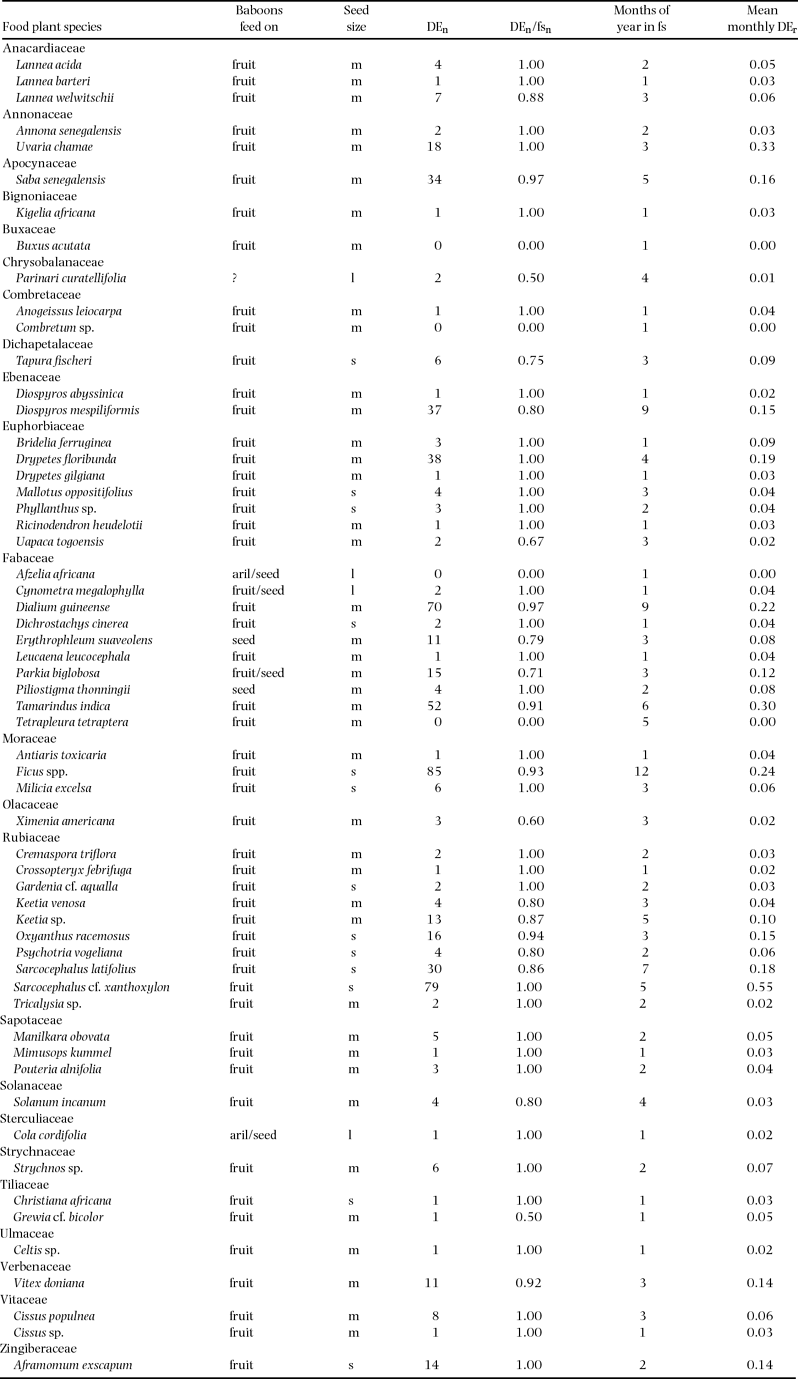
To avoid a bias towards small seeds, which are usually dispersed in greater quantities than large seeds, we calculated the number of dispersal events (DE) for each plant species (following Knogge & Heymann Reference KNOGGE and HEYMANN2003). A dispersal event for a given species was defined as the occurrence of one or more ripe intact seeds of the species in a sample. Because plant species have different fruiting periods and we did not retrieve faecal samples in equal quantities across all months of the year (mean ± SD = 33 ± 13.5 samples per month of year, range = 6–54), we calculated a monthly DE-ratio (DEr) for each species: for each month in which one or more seeds of the species occurred in one or more faecal samples we divided the number of DE of the species by the number of faecal samples collected in that month. Subsequently, we calculated the ‘mean monthly DEr ‘ for each species by dividing the sum of DEr by the number of months of the year in which the seeds of the species appeared in faecal samples. Instead of DEr, other studies often quote separately the seed number that includes only seeds larger than a certain minimum size (e.g. >2 mm, Wrangham et al. Reference WRANGHAM, CHAPMAN and CHAPMAN1994; >3 mm, Link & Di-Fiore Reference LINK and DI-FIORE2006). For reasons of comparison we also provide figures of seed numbers with and without very small seeds (>2 mm).
We examined the seeds visually for damage, using a lens (10× magnification) for small seeds. Each seed checked for damage was classified into one damage category: (0) = ‘intact seed’ (completely undamaged or ≤5% of the testa damaged); (1) = ‘medium damage’ (seed with >5% to ≤25% damage of the testa and/or ≤5% damage of the endosperm and cotyledons); (2) = ‘heavy damage’ (>25% damage of the testa and/or >5% damage of the endosperm/cotyledons). Generally, we checked more than 90% of the seeds from each species, except species with very small seeds (e.g. Ficus spp., Sarcocephalus spp.). For each identified species that occurred in six or more faecal samples, we calculated the percentage of seeds in each damage category, referring to the number of seeds checked per species as 100%. For statistical analyses we calculated the mean seed damage per species.
To identify whether the olive baboon predominantly disperses seeds of a certain range of size we measured length and width of fresh, fully turgescent seeds in damage category 0 (and 1 when dimensions of the seed were undamaged), using a sliding calliper (0.1 mm accuracy). Seeds ≤2 mm size were difficult to measure accurately, hence for these species we used a value of 2 mm in all calculations. We classified seed species according to their mean maximum diameter (length or width, whichever larger) into different size categories: small (≤5 mm), medium (>5 – <20 mm), and large (≥20 mm) (following Lambert & Garber Reference LAMBERT and GARBER1998, Wrangham et al. Reference WRANGHAM, CHAPMAN and CHAPMAN1994). We compared the frequency of occurrence of the three size classes among the seed species dispersed by the olive baboon to the frequency of occurrence of the size classes among the woody plant species in CNP. Data on seed sizes of species that did not occur in faecal samples were taken from Hovestadt (Reference HOVESTADT1997).
Germination experiments
At the field station, we undertook germination viability experiments on the ingested seeds from 19 plant species. The species were a regular part in baboon diet, as judged from direct observations and/or seeds retrieved from dung. In 14 out of the 19 species we conducted comparative experiments between seeds from faecal samples and from fresh ripe fruits. Generally, we obtained fresh seeds from six or more fruits from each of four to 10 individuals per plant species. Most crops of Lannea acida trees (Anacardiaceae) were depleted before maturity (Kunz, unpubl. data); hence we sampled only two trees. We cleaned fresh seeds from pulp mechanically and briefly rinsed the seeds with water.
An important benefit of ingestion, however, might be the removal of fruit pulp, which otherwise can delay or inhibit germination (Barnea et al. Reference BARNEA, YOM-TOV and FRIEDMAN1991, Engel Reference ENGEL2000, Yagihashi et al. Reference YAGIHASHI, HAYASHIDA and MIYAMOTA1998). Seeds of Tamarindus indica (Fabaceae) occur with and without the glutinous pulp in baboon faeces, hence we tested germination of fresh and ingested seeds, both with and without pulp. In contrast, the coat of dry pulp around Dialium guineense (Fabaceae) seeds is removed during ingestion. We compared germination of fresh D. guineense seeds with pulp, fresh seeds without pulp, and ingested seeds without pulp.
We stored undamaged seeds from baboon faeces and from fresh ripe fruit in a dark, dry place at ambient temperature until we obtained sufficient seeds for the trials. For germination, we placed the seeds in Petri dishes on a double layer of filter paper. Based on the number of seeds available in a given species, we tested germination under one to three different light conditions: shade (provided by a dense reed coverage), semi-shade (loose, translucent reed coverage), sun (no coverage). When seeds of a species were sparse, or the species had already been tested during this study for effects of light upon seed germination, priority was given to trials in semi-shade and shade, as these conditions had proved the most promising. We watered seeds as necessary, checked them daily for penetration of the seed coat by the radicle, and removed germinating seeds. When experiments extended throughout and beyond the dry season, we stopped watering of the seeds as long as rains ceased, and restarted with the onset of the next rainy season. We repeated germination experiments upon availability of fresh and ingested seeds.
Statistical analyses
We calculated the median and 25% (q1) and 75% (q3) percentile instead of the mean and standard deviation when data were not normally distributed, but for reasons of comparison with other studies, the mean and standard deviation (SD) may also be given. We used mean seed size and mean seed damage per species in a linear regression model. Values of mean seed damage were fitted to the normal distribution using a Box–Cox-transformation. We tested for variation in the frequency distribution of seed size classes between woody plant species dispersed by the olive baboon and woody plant species in the local plant pool of the CNP, using χ2 test with Yates correction. We analysed germination data using non-parametric life-time analysis which takes into account germination ratios as well as times to germination and considers seeds that did not germinate until the end of the experiment as right-censored data points (Fox Reference FOX, Scheiner and Gurevitch1993). We focused on variation across fresh and ingested seeds. We performed all tests in SPSS version 15.0 or ssS version 1.0. Tests were two-tailed and the level of significance set at 95%. We adjusted the level of significance for multiple testing following the sequential Bonferroni technique (Rice Reference RICE1989).
RESULTS
Analysis of faecal samples
In 99.0% of the faecal samples (N = 396) we were able to determine the number of seed species. Seeds from grasses and/or sedges, which are henceforth excluded from further analyses, were present in 14.7% of the faecal samples. Dispersal events occurred in 88.9% of all faecal samples, and in 91.9% of all samples that contained seeds.
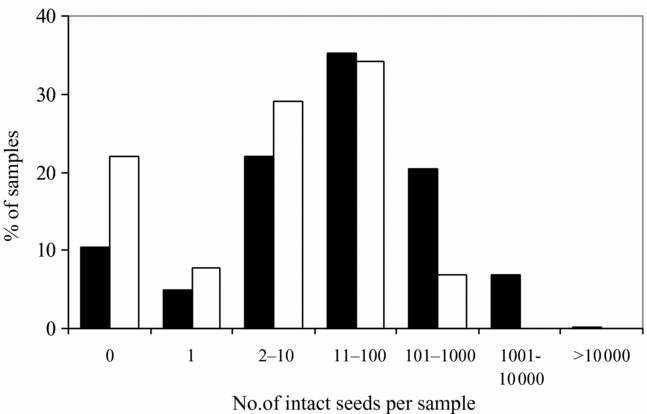
Seventy-three per cent of the seeds in faecal samples (n = 171 736) were intact and 26.6% were damaged. In addition, 13% of the faecal samples contained an indeterminate number of seed fragments. The median number of intact seeds per sample was 20.5 (q1 = 5, q3 = 115.3, mean ± SD = 322 ± 1188, max = 13,258, n = 392). If very small seeds (≤2 mm) are excluded, the median seed number is 7 (q1 = 1, q3 = 22, mean ± SD = 28.2 ± 70.5, range = 0–734). Figure 1 displays the frequency distribution of seed numbers in faecal samples.
Distribution of the number of intact seeds in faecal samples (n = 396). Black columns represent the frequency distribution of seed numbers in faecal samples when seeds of all sizes are included. White columns represent the frequency distribution of seed numbers in faecal samples when very small seeds (<2 mm) are excluded.

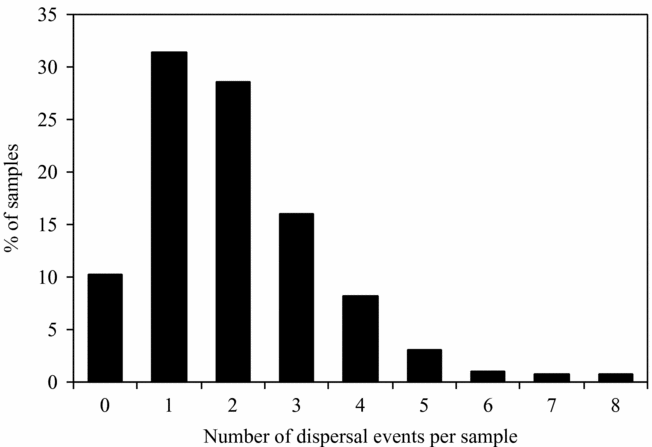
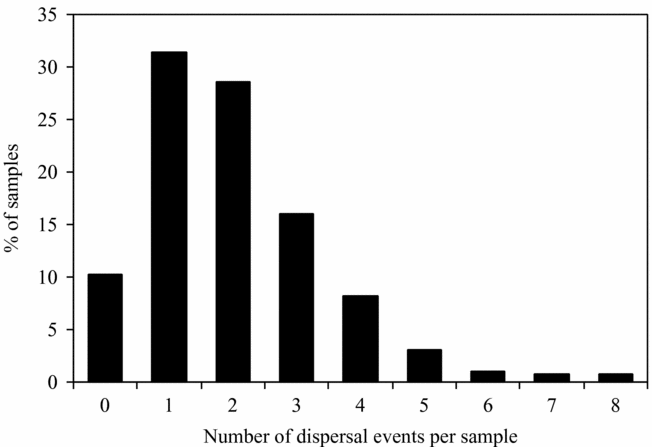
We extracted a total of 69 species, of which 58 species from 23 families were identified (Appendix 1). On average (mean ± SD), a sample comprised intact seeds from 2.0 ± 1.5 species (range = 0–10, n = 392) (Figure 2). The five taxa with the highest mean DEr were Sarcocephalus xanthoxylon (Rubiaceae), Uvaria chamae (Annonaceae), T. indica (Fabaceae), Ficus spp. (Moraceae) and D. guineense (Fabaceae) (Appendix 1). However, dispersal events for most other plant species were rare. Species with no recorded dispersal of intact seeds were Afzelia toxicaria and Tetrapleura tetraptera (Fabaceae), Combretum sp. (Combretaceae), and Buxus acutata (Buxaceae). The mean (± SD) monthly DEr across all identified species was 0.08 ± 0.10.
Distribution of the number of dispersal events in faecal samples (n = 396). A dispersal event is defined as the occurrence of one or more ripe intact seeds of a given species in the sample.
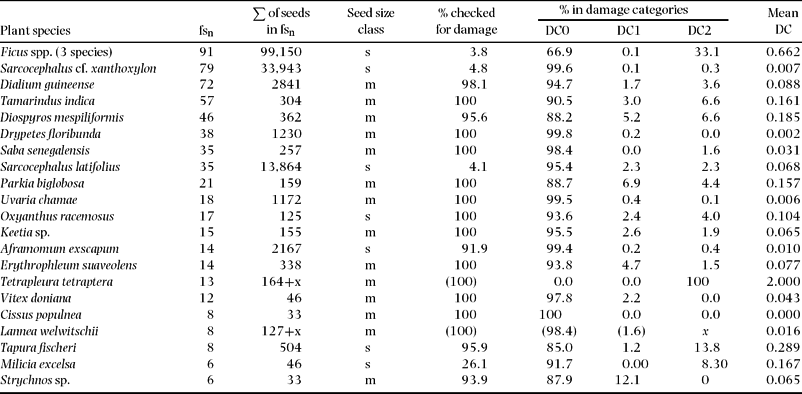
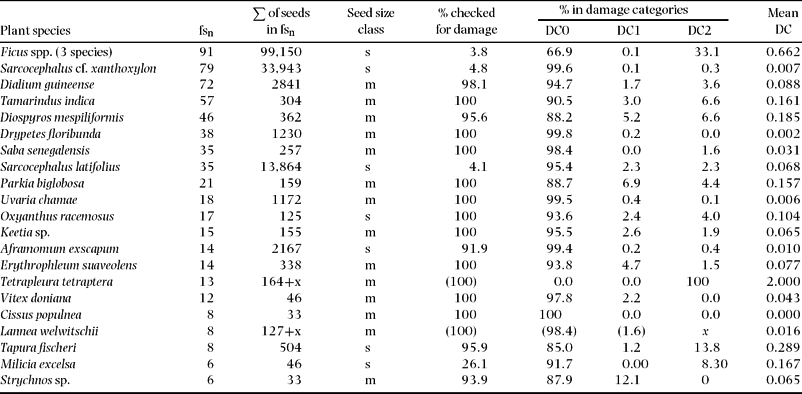
In 19 out of the 21 taxa occurring in six or more faecal samples at least 85% of the seeds checked for damage were intact (mean ± SD = 88.8% ± 21.7%) (Table 1). Across species, there was no linear correlation between seed size and damage of seeds (r2length = 0.049, F = 0.974, P > 0.05; r2width = 0.017, F = 0.321, P > 0.05).
Damage and size of seeds extracted from faeces of the olive baboon at Comoé National Park (n = 396 faecal samples). Only identified taxa with seeds occurring in ≥ 6 faecal samples are presented. Fsn = total number of faecal samples (fs) containing a given species; x = indicates an indeterminate number of seed fragments. Seed size classes: s = (small) mean maximum diameter ≤5 mm, m = (medium) >5–≤20 mm. DC (damage category), DC0 = intact seeds, DC1 = medium damage, DC2 = heavy damage. % of seeds in damage categories: in each species 100% correspond to the total number of seeds checked for damage.
The seeds of species in baboon faeces ranged in size from ∼1 mm (Ficus spp. and Sarcocephalus spp.) to 24.6 mm (mean length of Cola cordifolia (Sterculiaceae) seeds). The longest intact seed was 27.0 mm (Parinari curatellifolia, Chrysobalanaceae), and the largest intact seed regarding both length and width was 24.8 × 21.8 mm (Vitex doniana, Verbenaceae). Overall, 5.7% of the dispersed species had large seeds (≥20 mm), 71.7% were of intermediate seed size (>5–<20 mm), and 22.6% had small seeds (≤5 mm) (Appendix 1). Data on seed size classes were available for 49% (n = 142) of the woody plant species in CNP. Ten per cent had large seeds, 64.8% medium-sized seeds and 25% small seeds. Variation in the distribution of seed size classes between the local plant pool of woody species and the faecal samples of the baboons were statistically not significant (χ2 = 1.04, df = 2, P > 0.05).
Germination experiments
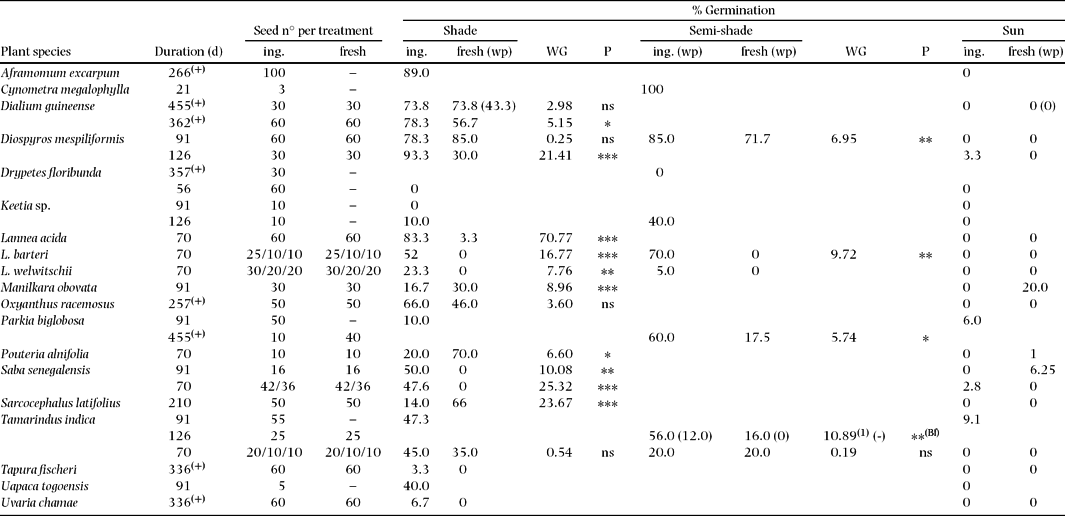
Germination of seeds was highly variable (Table 2). Only in D. guineense did seeds also germinate in the second rainy season (∼65% of the germinating seeds). All 18 species tested under different light conditions generally performed better in the shade or semi-shade than in the sun. Only six species germinated in the sun, of which five species had <10% of seeds germinating. Of five species that were each tested in the shade and semi-shade simultaneously, germination was improved in the semi-shade in three species. In Diospyros mespiliformis, however, only ingested but not fresh seeds performed better in the semi-shade. Due to the low germination success in the sun, statistical comparisons focus on variation across ingested and fresh seeds under semi-shaded and shaded conditions.
Germination of seeds from olive baboon faeces and from fresh fruits. Light conditions were: shade, semi-shade, sun. Ing: ingested; wp: with pulp (D. guineense and T. indica only); per cent germination of seeds with pulp is given in parentheses. WG: Wilcoxon–Gehan statistics; df = 1 in all tests except for D. guineense under shaded conditions, where df = 2. (1): test statistics are given for the comparison of fresh and ingested seeds, both without pulp. (Bf): level of significance after applying sequential Bonferroni technique. When a varying number of seeds were used under different light conditions, numbers are given separately for shade/semi-shade/sun. Otherwise, seed numbers were similar in each light condition. (+) indicates that experiments included the following dry season during which watering of seeds ceased.
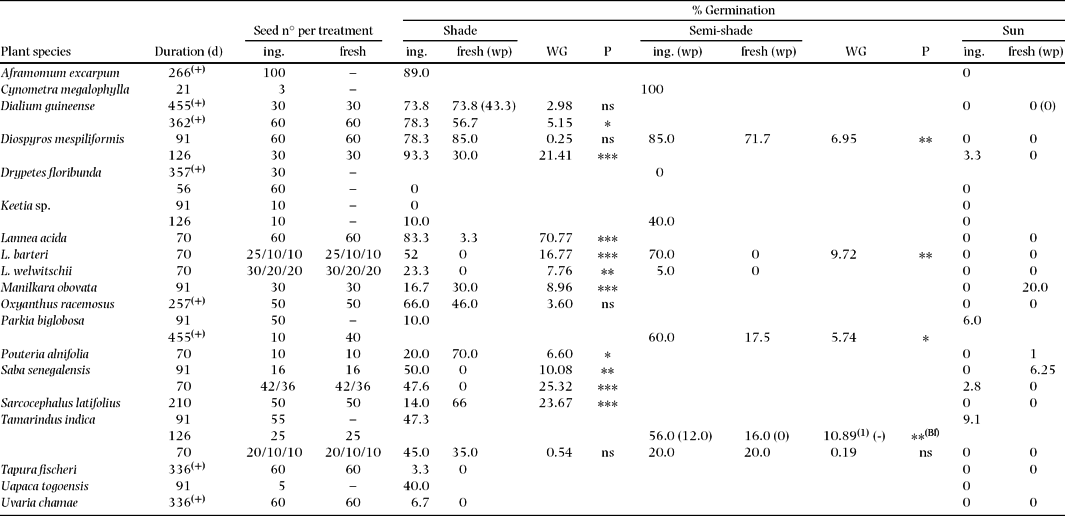
Baboons dispersed viable seeds of all species tested except Drypetes floribunda. In five of the 14 species for which we compared germination of fresh and ingested seeds (Table 2), gut passage enhanced germination significantly. In three additional species, germination of ingested seeds was improved in one out of two experiments under the same light conditions. Fresh seeds germinated better than ingested seeds in three species, and in one species, differences in germination between fresh and ingested seeds were not statistically significant. Two species were not compared statistically, due to low germination in both ingested and fresh seeds.
The effect of pulp upon seed germination varied among species. In D. guineense, differences in germination between ingested seeds without pulp, fresh seeds without pulp, and fresh seeds with pulp were not significant (Table 2). In T. indica, ingested seeds without pulp performed significantly better than ingested seeds with pulp (Wilcoxon–Gehan = 10.9, P = 0.01), better than fresh seeds without pulp (Wilcoxon–Gehan = 10.2, P = 0.01) and better than fresh seeds with pulp (Wilcoxon–Gehan = 18.4, P = 0.01). However, ingested seeds with pulp did not germinate better than fresh seeds without pulp (Wilcoxon–Gehan = 0.139, P > 0.05) (df = 1, P values after applying sequential Bonferroni technique, n = 25 seeds in each treatment). Germination success of T. indica seeds with pulp, whether ingested or from fresh fruit, was too low for statistical comparisons of these two classes.
DISCUSSION
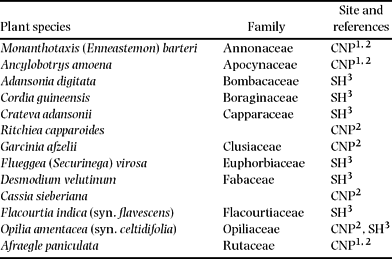
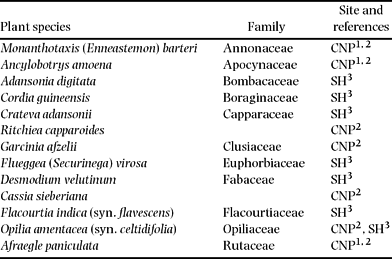
The study corroborates the hypothesis that the olive baboon is an effective seed disperser, both quantitatively and qualitatively, for a large number of woody plant species in the savanna-forest mosaic of West Africa. Noteworthy is the fact that the results from this study are similar to outcomes of studies in tropical forests where the proportion of primate faeces that contain intact seeds often seem to be high, e.g. 78.5% in the chimpanzee (Pan troglodytes) and 33.7% to 100% in several Cercopithecidae (Kaplin & Moermond Reference KAPLIN and MOERMOND1998, Poulsen et al. Reference POULSEN, CLARK and SMITH2001). Intact seeds of at least 85% of the species of which baboons consumed fruits and/or seeds (n = 79, Kunz & Linsenmair Reference KUNZ and LINSENMAIR2008) occurred in the faecal samples. Assuming that Ficus seeds pooled in faecal analyses represented the three species (F. glumosa, F. ingens, F. platyphylla) on which we observed baboons feeding (Kunz & Linsenmair Reference KUNZ and LINSENMAIR2008, Kunz unpubl. data), at least 19% of the woody plant species in the local plant pool (n = 292, Hovestadt Reference HOVESTADT1997) had one or more dispersal event (unidentified species not included). Two previous studies in CNP (Hovestadt Reference HOVESTADT1997, Refisch Reference REFISCH1995), add seven species to the list (Table 3). In the Shai Hills in Ghana, the olive baboon dispersed viable seeds from at least 51 dicotyledonous species (Lieberman et al. Reference LIEBERMAN, HALL, SWAINE and LIEBERMAN1979), including six woody plant species that can be found in CNP but for which evidence for consumption by baboons is lacking (Table 3) (Hovestadt Reference HOVESTADT1997, Kunz & Linsenmair Reference KUNZ and LINSENMAIR2008, Refisch Reference REFISCH1995). The number of plant species dispersed by the olive baboon in CNP corresponds to findings from studies on great apes in Africa: chimpanzees and gorillas (Gorilla gorilla) dispersed 59 and 65 species, respectively (Tutin et al. Reference TUTIN, WILLIAMSON and FERNANDEZ1991, Wrangham et al. Reference WRANGHAM, CHAPMAN and CHAPMAN1994).
Woody plant species occurring in the Comoé National Park whose seeds were found in faecal samples of the olive baboon in Ghana and during previous studies in CNP, but not during the present study. Site: CNP = Comoé National Park (Ivory Coast), SH = Shai Hills (Ghana). References: 1 = Refisch (Reference REFISCH1995), 2 = Hovestadt (Reference HOVESTADT1997), 3 = Lieberman et al. (Reference LIEBERMAN, HALL, SWAINE and LIEBERMAN1979). Synonyms are given in parentheses when names of species deviate from the nomenclature in the original articles.
Following Hovestadt (Reference HOVESTADT1997), 40% of the species dispersed by the olive baboon in CNP were restricted to gallery forest, forest islands, or both. Thirty-one per cent can be found in forest islands and savanna, 7.3% only in savanna, and 12.7% are habitat generalists. (Habitat preference for five dispersed taxa remained unidentified.) However, the olive baboon dispersed most species infrequently (low mean monthly DEr values). Species with the highest mean monthly DEr produce large fruit crops and/or are common in CNP. Most of these species have extended fruiting periods (e.g. D. guineense, D. mespiliformis) or fruit that persist over a long time on the tree (e.g. T. indica) (Hovestadt Reference HOVESTADT1997, Kunz unpubl. data).
Mean numbers of species occurring in faecal samples of the olive baboon in CNP conform to numbers in faecal samples of Cercopithecidae elsewhere (1.0–3.0, Kaplin et al. Reference KAPLIN, MUNYALIGOGA and MOERMOND1998, Poulsen et al. Reference POULSEN, CLARK and SMITH2001). Similar values were also found for chimpanzees (1.7) and gorillas (2.8) (Poulsen et al. Reference POULSEN, CLARK and SMITH2001, Wrangham et al. Reference WRANGHAM, CHAPMAN and CHAPMAN1994), as well as for several primate species outside Africa (1.9–2.4; Link & Di-Fiore Reference LINK and DI-FIORE2006, McConkey Reference MCCONKEY2000, Otani Reference OTANI2003, Wehncke et al. Reference WEHNCKE, HUBBELL, FOSTER and DALLING2003).
To estimate the number of seeds dispersed d−1 per baboon, data on baboon defecation rate is required. In the literature only an anecdotal remark on an infant that defecated four times d−1 is available (Rhine et al. Reference RHINE, NORTON, ROERTGEN and KLEIN1980). Defecation rates of other Cercopithecinae and the chimpanzee range between 3–7 d−1 per individual (Poulsen et al. Reference POULSEN, CLARK and SMITH2001, Wrangham et al. Reference WRANGHAM, CHAPMAN and CHAPMAN1994). Taking four defecations d−1 per baboon as an estimate and the mean number of seeds per faecal samples, each baboon would disperse 1288 seeds d−1 (112 seeds > 2 mm). Based on a total of 167 baboon individuals inhabiting the study area of 145 km2 (Kunz & Linsenmair Reference KUNZ and LINSENMAIR2008), the baboon population dispersed 1483 seeds d−1 km−2 (129 seeds > 2 mm).
Mean seed numbers per baboon faecal sample seem high compared with other frugivorous primates (Link & Di-Fiore Reference LINK and DI-FIORE2006, Poulsen et al. Reference POULSEN, CLARK and SMITH2001, Wrangham et al. Reference WRANGHAM, CHAPMAN and CHAPMAN1994), though Yakushima macaques (Macaca fuscata yakui) might on average have similar seed quantities per faeces (Otani & Shibata Reference OTANI and SHIBATA2000). Comparisons to other studies, however, are hampered by different methods applied in faecal analyses, e.g. different cut-offs of seed sizes below which seed numbers are estimated or seeds are excluded from analyses, and whether or not seed numbers include only undamaged seeds.
In our study, the vast majority of seeds in faecal samples seemed intact. Yet, the proportion of seeds damaged heavily by baboons inevitably is an underestimate, because completely digested seeds do not turn up in faeces. In particular, legumes whose large, soft, unripe seeds are part of baboon diet in CNP (i.e. Daniellia oliveri, Craibia atlantica, Isoberlinia doka, Kunz & Linsenmair Reference KUNZ and LINSENMAIR2008, Kunz pers. observ.) were not retrieved during faecal analyses. Likewise, ripe seeds of Piliostigma thonningii and Erythrophleum suaveolens seem to escape chewing only occasionally. Contrary to findings by Gautier-Hion (Reference GAUTIER-HION1984) for five African monkey species, seed size and seed damage during ingestion by baboons were not positively correlated, whether or not large legume seeds were included in the analyses. As expected, the olive baboon in CNP dispersed seeds of a wide range of sizes. The largest seed (27 mm) was of similar maximum size as dispersed by the chimpanzee (Wrangham et al. Reference WRANGHAM, CHAPMAN and CHAPMAN1994). Seeds larger than this size were generally discarded by the olive baboon while feeding on the pulp (Kunz pers. observ.). The proportion of species with medium-sized to large seeds (77% ≥ 5 mm) dispersed by the olive baboon is high in comparison with other Cercopithecinae (30–40% > 2 mm, Kaplin et al. Reference KAPLIN, MUNYALIGOGA and MOERMOND1998) and chimpanzees (51% ≥ 5 mm, Wrangham et al. Reference WRANGHAM, CHAPMAN and CHAPMAN1994) and does not confirm that baboons swallow particularly small seeds (Lambert Reference LAMBERT, Levey, Silva and Galetti2002). Gorilla and tamarins (Saguinus spp.) may disperse similar and higher proportions, respectively, of seeds ≥ 5 mm (gorilla: 71%, Tutin et al. Reference TUTIN, WILLIAMSON and FERNANDEZ1991; tamarins up to 100%, Garber Reference GARBER1986, Oliveira & Ferrari Reference OLIVEIRA and FERRARI2000). Yet, the frequency of occurrence of species with different seed sizes in faecal samples of a primate might – below a maximum threshold – simply reflect seed size distribution of plant species at the study site.
The olive baboon in CNP dispersed viable seeds from all but one of the plant species tested in germination experiments. Like in other studies on primate seed dispersal, effects of gut passage upon germination varied widely across plant species (Idani Reference IDANI1986, Julliot Reference JULLIOT1996, Lieberman et al. Reference LIEBERMAN, HALL, SWAINE and LIEBERMAN1979, Otani & Shibata Reference OTANI and SHIBATA2000). The results show that effects can vary across study sites and experiments within the same plant species. Drypetes floribunda did not germinate in our study, but baboons dispersed viable seeds in Ghana (Lieberman et al. Reference LIEBERMAN, HALL, SWAINE and LIEBERMAN1979). Fresh seeds of Sarcocephalus latifolius (Rubiaceae) germinated better than seeds dispersed by the olive baboon in CNP, whereas in Ghana seeds had improved germination after baboon gut passage (Lieberman et al. Reference LIEBERMAN, HALL, SWAINE and LIEBERMAN1979). Like Lieberman et al. (Reference LIEBERMAN, HALL, SWAINE and LIEBERMAN1979) and Refisch (Reference REFISCH1995), we did not find significant differences between ingested and fresh D. mespiliformis seeds in one experiment. However, germination of ingested seeds was enhanced when trials were repeated. Results from repeated trials of two other species also varied. Variation in the number of seeds used in successive trials of the same species cannot always account for the different outcomes, since fewer seeds sometimes revealed significant results while larger numbers did not. Slight changes in experimental conditions (e.g. light regime, humidity) might reveal differences that otherwise remain undetected (Engel Reference ENGEL2000). Moreover, fruit ‘choice’ in both primates and researchers could influence outcomes of experiments. As a result of a variable overall fruit availability, primates might predominantly feed on some species prior to full maturation in one season, while otherwise ripe fruits of the species might be preferred. Fruit that researchers consider ripe may still not have reached full maturity. We suggest that experiments designed to compare germination of ingested and fresh seeds should be repeated when possible, or otherwise interpreted cautiously as results from just one fruiting season might yield an incomplete picture of disperser effectiveness (Engel Reference ENGEL2000).
The results emphasize that the olive baboon is likely to play a major role in seed dispersal in the savanna-forest mosaic of West Africa. In CNP, the olive baboon is the most abundant primate (Fischer et al. Reference FISCHER, GROSS and KUNZ2000). It depletes entire fruit crops of individual plants (Kunz & Linsenmair Reference KUNZ and LINSENMAIR2007), and disperses large quantities of undamaged seeds from a high number of different plant species. Quantitatively, baboon seed dispersal potential seems comparable to that of great apes in African forests. The long gut retention time of the olive baboon (>24 h for seeds of wild fruits fed to captive individuals, Kunz, unpubl. data) in combination with the use of all kinds of habitats in its relatively large home ranges (Kunz & Linsenmair Reference KUNZ and LINSENMAIR2008) enables this species to transport seeds over wide distances within and between habitats. As the olive baboon in CNP dispersed many woody plant species that grow only in forests, it might be particularly important for seed transfer between distant forest islands (Hovestadt Reference HOVESTADT1997). All other diurnal primates species in CNP occur in much lower densities, and most are more restricted to forest habitats (Fischer et al. Reference FISCHER, GROSS and KUNZ2000, Poilecot Reference POILECOT1991, Kunz, unpubl. data). Other large, long-distance seed dispersers like the African elephant (Loxodonta africana) and species of hornbill (Bucerotidae) (Hovestadt Reference HOVESTADT1997, Lieberman et al. Reference LIEBERMAN, LIEBERMAN and MARTIN1987) have become rare in CNP (Fischer et al. Reference FISCHER, GROSS and LINSENMAIR2002, Lauginie Reference LAUGINIE1995, Kunz pers. observ.). Baboons (Papio spp.) are widely distributed across sub-Saharan Africa and are still relatively abundant in many areas. Considering the large extent of African savannas, the effect of baboons on natural plant regeneration and population dynamics of these ecosystems merits further study.
ACKNOWLEDGEMENTS
We thank J. Korb, K. Kouadio and N. Reintjes for their help with faecal sample collection and germination experiments. Y. Warren and two anonymous reviewers made helpful comments on the manuscript. The Ministère de l'Agriculture et des Resources Animales and the Ministère de l'Enseignement Supérieure et de la Recherche Scientifique, Abidjan, kindly granted research permission for the CNP. PhD scholarships of the German Academic Exchange Service (DAAD) and the University of Wuerzburg (HSP III) funded this study. The research camp in CNP was constructed with generous funds from the Volkswagen-Foundation.
Appendix 1.
Dispersal events of identified seed species in faecal samples of the olive baboon in the Comoé National Park. Seed size classes: s = (small) mean maximum diameter ≤5 mm, m = (medium) >5–≤20 mm, l = (large) > 20 mm. Seed size taken from seeds extracted from baboon faeces, otherwise from Hovestadt (Reference HOVESTADT1997) or fresh seeds. N = 396 faecal samples. Fsn = total number of faecal samples (fs) containing a given species; DEn = total number of dispersal events (≥1 ripe intact seed in a faecal sample) for a given species across all samples; DEr = monthly ratio of dispersal events in a given species; Mean monthly DEr = all DEr of the species were added and divided by the number of months of the year in which the seeds of the species appeared in faecal samples.