Introduction
Political theorists concerned with social justice often make claims about the social conditions under which redistributive principles may be implemented in policies. And often, this involves making claims about the kinds of community that are conducive to social cohesion, and trust and solidarity in particular. According to this line of thought, redistribution requires individuals to have sufficient levels of solidarity with other members of society, and requires individuals to trust other members, and not least trust that they will reciprocate contributions to the welfare state; avoid tax evasion, not cheat with benefits, etc. (Miller, Reference Miller2004: 27, 2006: 328). Trust and solidarity, in turn, require certain kinds of bonds between community members, where such bonds are often thought threatened by increasing levels of religious and cultural diversity.
When specifying the kinds of bonds between community members thought to be conducive to social cohesion, political theorists tend to invoke shared values (Kymlicka, Reference Kymlicka2001; Miller, Reference Miller2004; Miller and Ali, Reference Miller and Ali2014). For example, according to the so-called ‘national identity argument’, ‘societies whose members are united by means of … [national identities] are able to achieve a range of desirable ends that would otherwise be unobtainable’ (Miller and Ali, Reference Miller and Ali2014: 1), not least trust, solidarity and social justice. However, political theorists differ on the specific content of the value-set that is to serve as a basis for identification with fellow community members. Nationalists suggest that sharing a national culture is required for (sufficient levels of) trust and solidarity, liberals that we need only share a commitment to some basic liberal principles of justice, whereas multiculturalists suggest that we need to share a commitment to the recognition of difference. We shall refer to such value-sets as ‘community values’, as they are values thought to bind community members together in ways that are conducive to social cohesion. Such specific sets we shall refer to as ‘nationalist community values’, ‘multicultural community values’, etc. to highlight their basis in specific political doctrines. Nationalist community values, then, are the values nationalist political theorists consider necessary for social cohesion at adequate levels, etc.
In this article, we empirically investigate the claim that community values form a basis for social cohesion – a claim assumed in the argument for why redistribution relies on such values. More specifically, we investigate a particular way in which community values may impact social cohesion, namely the idea that commitments to specific shared values tend to increase social cohesion at the individual level. This idea is at the heart of the national identity argument. On the basis of a survey conducted in Denmark in 2014, we study the correlation between, on the on hand, commitments to the community values of respectively conservative nationalism, liberal nationalism, liberal citizenship, and multiculturalism, and on the other, trust and solidarity. This does not allow us to draw conclusions about causal directions in the correlations we find. Nevertheless, when, for example, nationalists hypothesize that a commitment to the national culture will tend to increase trust and solidarity among co-nationals (Miller, Reference Miller1995: Chs 4, 5), this gives rise to an expectation that individuals who have such commitments will exhibit higher levels of trust and solidarity toward co-nationals than individuals who do not. By looking at the correlation between commitments to the national culture and trust and solidarity, we are able to determine whether this expected relation holds or not. Similarly, we are able to determine whether hypothesized relations between the other community values mentioned above and trust and solidarity hold.
However, an individual’s trust and solidarity may be a function not just of her own values, but also of the extent to which she is a member of a community in which these values are shared (Miller and Ali, Reference Miller and Ali2014: 18, 19). Thus, as pointed out above, political theorists often claim that social cohesion rests on shared values. There may be different explanations of why the sharing of values matters, but one such explanation that is frequently invoked is this: the belief that others share one’s values such that one is a member of a community with a common identity tends to generate trust in, and solidarity with, co-members of that community. Therefore, we also test whether the belief that others share one’s values is correlated to trust and solidarity among, for example, nationalists, as would be predicted if the above explanation of the impact of shared values is true.
The concept of social cohesion is contested, multidimensional (refers to several aspects such as trust, networks, reciprocity, stability, inter-group co-operation, solidarity, and belonging) and figures as a common catchphrase in the general public (Hooghe, Reference Hooghe2007; Ariely, Reference Ariely2014; van der Meer and Tolsma, Reference van der Meer and Tolsma2014). Trust and solidarity are selected because of their key role in the national identity argument and, more generally, in theories about the social conditions required for implementing redistributive justice. To allow for differential impact on different kinds of trust, we distinguish between in-group, out-group, and generalized trust. This is because specific community values may have different impacts regarding different kinds of trust. Similarly, we use different measures of solidarity to capture both general and out-group solidarity.
State of the art
In recent years, there has been an extensive scholarly debate within the social sciences on whether ethnic diversity reduces trust and solidarity within a welfare state. The empirical findings point in rather different directions and seem inconclusive at present (Putnam, Reference Putnam2000; Alesina and Glaeser, Reference Alesina and Glaeser2004; Torpe and Lolle, Reference Torpe and Lolle2011; Torpe, Reference Torpe2012; Uslaner, Reference Uslaner2012; van der Meer and Tolsma, Reference van der Meer and Tolsma2014).
However, the question of whether certain community values or shared identities impact trust and solidarity has received very limited attention. This is so in spite of the fact that, in particular, nationalist political theorists have argued that diversity is a threat to the shared (national) values underpinning social cohesion and redistributive justice. While this national identity argument has received a great deal of attention in academic debates, the impact of national identity on social cohesion has only been tested in a few studies (Citrin et al., Reference Citrin, Wong and Duff2001; Martinez-Herrera, Reference Martinez-Herrera2004, Reference Martinez-Herrera2010; Shayo, Reference Shayo2009; Theiss‐Morse, Reference Theiss-Morse2009; Johnston et al., Reference Johnston, Banting, Kymlicka and Soroka2010; Wright and Reeskens, Reference Wright and Reeskens2013). Whether a national identity can actually serve the assumed function is therefore very much an open question. Furthermore, as we pointed out in the introduction, several other community values are by various political theorists claimed to bind community members together in ways that are conducive to social cohesion. These other sets of values have more or less been neglected in empirical studies and insofar as they have been studied, they have primarily been included in studies measuring the impact of such values at the level of policy (Crepaz, Reference Crepaz2006; Torpe, Reference Torpe2012) and at the country level (Hjerm and Schnabel, Reference Hjerm and Schnabel2012).
The results from the handful of studies testing the national identity argument are rather inconclusive and contradictory (Miller and Ali, Reference Miller and Ali2014: 2). In one of the few cross-national studies testing this argument, Shayo (Reference Shayo2009) finds not only a negative correlation between national identification (measured as national pride) and support for redistribution at the individual level, but also a strong negative correlation between national identification and levels of actual redistribution on the country level. In a Canadian study in which national identity is measured as ‘closeness’ to the nation, Johnston et al. (Reference Johnston, Banting, Kymlicka and Soroka2010) find partial support for the argument put forward by liberal nationalists, as ‘national identity contributes to a sense of belonging and solidarity that transcends economic interest and cultural differences’, but only when it comes to certain sub-domains of the welfare state (Johnston et al., Reference Johnston, Banting, Kymlicka and Soroka2010: 350). A British study calls the liberal nationalist hypothesis into question as it finds no impact of national identification (measured as ‘support for the political community’) on support for the welfare state (Martinez-Herrera, Reference Martinez-Herrera2004). Furthermore, a couple of US studies find that national identity at the individual level has no significant impact on beliefs about social justice in terms of spending on health, education, and welfare (Citrin et al., Reference Citrin, Wong and Duff2001; Theiss-Morse, Reference Theiss-Morse2009).
Hjerm and Schnabel (Reference Hjerm and Schnabel2012) use xenophobia as a proxy for individual national identity and find that ethnically based national identities have a positive impact on support for the welfare state. And Wright and Reeskens (Reference Wright and Reeskens2013) distinguish between ethnic national identity, cultural national identity, and civic national identity, and find that (only) ethnic national identity is conducive to redistribution and that all three national conceptions induce welfare chauvinism against immigrants.
These studies illustrate some of the difficulties in testing the national identity argument. Thus, the contradictory nature of the results may to some extent reflect different analytical frameworks, statistical approaches, and measures applied. Furthermore, these studies rely on different notions of national identity. This raises the question of exactly what it means to have a shared national identity. As Miller and Ali (Reference Miller and Ali2014) argue, national identity can be measured in several ways, including as national attachment, national pride, and uncritical/critical patriotism, where results may very much depend on how it is measured.
A further complication is that these studies tend not to appropriately distinguish between different community values. This is due to the fact that national attachment, national pride, etc. do not tell us anything about what aspects of the nation it is that individuals feel attached to or proud of. So when, for example, Shayo (Reference Shayo2009) measures national identity in terms of national pride, it is not clear whether his results tell us anything interesting about the national identity argument as it is usually conceived by nationalists. To illustrate this point, suppose that French citizens generally identify with their nation in virtue of the French republican model. In that case, correlations between national identification and trust and solidarity may say more about the impact of republican community values than about the impact of what are strictly nationalist community values. The latter will, after all, emphasize cultural aspects of the nation.
Wright and Reeskens (Reference Wright and Reeskens2013) do go some way toward accommodating different notions of national identity. However, we would argue that their operationalization of ethnic, cultural, and civic national identity is fragile, not least because each national identity relies only on a single measure. For example, cultural national identity is measured as the importance respondents ascribed to ‘speaking the country’s national languages’. While they find this measure to be the closest available to capturing commitments of liberal nationalists (Wright and Reeskens, Reference Wright and Reeskens2013: 1450), it only rather weakly approximates liberal nationalist commitments.
The study of the relation between community values and social cohesion is in many ways still in its infancy and this study differs from those mentioned above in several ways. First, it explicitly differentiates between four different sets of community values, where each of them is based on a broad range of measures in order to strengthen reliability and approximation to the values claimed by political theorists to foster social cohesion. Second, we study not only correlations between specific values and trust and solidarity, but between sharing these values with others and these two aspects of social cohesion. Third, we use a wider range of measures of trust and solidarity than the studies discussed above. And finally, we study the relation between community values and social cohesion in a country where this has so far not been tested, namely Denmark.
Theory
Political theorists arguing for, for example, nationalism, liberalism, or multiculturalism will often have views not just about the justice of social arrangements, but also (empirical) views about the social conditions required for implementing justice. Indeed, they will often hold that the values they propose as the basis for just social arrangements will furthermore, insofar as they are shared among citizens, tend to promote social cohesion and in particular, trust and solidarity, and so make feasible the implementation of social justice. The sharing of values fosters identification with other members of one’s community, which again tends to facilitate positive attitudes toward them such as trust and solidarity (Miller, Reference Miller2004). Of course, the idea that shared values promote social cohesion is not unique to political theorists, as it is widely held in the social sciences (Hooghe, Reference Hooghe2007: 717), but political theorists tend to argue for more specific views about what these values consist of.
Let us briefly say a little about each of the specific sets of community values we examine in this study. Conservative nationalists hold that social cohesion is best promoted by sharing an entire, or at least large part of a, national culture (Burke, Reference Burke1790; Scruton, Reference Scruton1990). The idea is that stable, democratic political institutions require a thick, pre-political community, where community members identify with each other on the basis of a common history, common culture, and (more generally) common way of life, underpinning a sense of a shared fate. In particular, liberal democratic principles are thought too thin and abstract to foster the emotional attachments required for social cohesion.
Liberal nationalists share with conservative nationalists the commitment to a national culture, insisting that, for example, trust ‘is much more likely to exist among people who share a common national identity, speak a common language, and have overlapping values’ (Miller, Reference Miller1998: 48). However, liberal nationalists suggest that national identities are not static but transformed over time and need to be sufficiently open so that, for example, immigrants can realistically access them. Furthermore, they stress the importance of a shared commitment to liberal political structures as a basis for social cohesion (Miller, Reference Miller1995: Chs 4, 5; Kymlicka, Reference Kymlicka2001: 258). This means that there are aspects of national cultures that liberal and conservative nationalists may disagree about; for example, liberal nationalists may be wary of including a particular religion in the national identity (Miller, Reference Miller1995: 92), whereas conservative nationalists may be more inclined to do so (Scruton, Reference Scruton1990: 300, 315).
Liberal citizenship, as we construe this set of community values here, has both liberal and republican elements. The republican element pertains to ‘active citizenship’ and more specifically to democratic participation and being an active member of one’s community. Thus, according to republicans, solidarity is grounded in ‘a reflective acceptance of certain obligations and in practical engagement’ (Honohan, Reference Honohan2010: 94). Along similar lines, Putnam (Reference Putnam2000: 136, 137) suggests that civic engagement, trust, and solidarity may tend to mutually reinforce one another.
The liberal element in liberal citizenship involves a commitment to a set of basic (liberal) principles of justice. Such principles may include freedom of speech, freedom of religion, toleration, and equality of opportunity. For example, Rawls (Reference Rawls1971: 498, Sections 69, 76) argues that a society in which his liberal principles of justice are widely shared and (known to be) implemented in its basic structure will generate its own support, where a sense of justice and trust in one’s fellow citizens will tend to mutually support each other, and where trust in others to comply with the requirements of justice will tend to affirm one’s commitment to this value and the institutions in which it is realized. Furthermore, Uslaner (Reference Uslaner2002: 2, 3) argues that trust and solidarity are part of – and fostered by – a larger package of (roughly) liberal values, including equal standing, equality of opportunity, and opposition to hierarchy, and based on the belief that other people share these values.
Finally, according to multiculturalism, social cohesion is best (or adequately) promoted by sharing a commitment to the recognition of difference. In particular, such recognition may tend to promote the allegiance of minorities who would otherwise feel they receive insufficient opportunities to express their religious and cultural identities (Kymlicka, Reference Kymlicka1995: 184, 185), an allegiance that may again increase majority trust in, and solidarity with, minorities. Furthermore, multicultural commitments may raise majority sensitivity to minority concerns and in this way foster trust and solidarity across groups (Murphy, Reference Murphy2012: 117).
Here, we aim to investigate a particular mechanism through which community values may affect social cohesion, namely that commitments to specific values lead to trust and solidarity at the individual level. The arguments of conservative and liberal nationalists outlined above are clearly of this kind, since they rely on the idea that identifying with others on the basis of a shared nationality generates trust in – and solidarity with – them. It is less clear that, for example, the multicultural argument that recognition promotes the allegiance of minorities is of this kind, and so predicts an association of specific values and trust and solidarity at the individual level. Nevertheless, both the argument that multicultural commitments raises sensitivity to minority concerns and the argument that liberal values and trust and solidarity mutually reinforce each other at the individual level are of the relevant kind.
Note also a further respect in which explanations of the impact of community values on social cohesion may differ. Sharing a particular set of values may impact trust and solidarity simply because individuals who have these values are more likely to exhibit trust and solidarity, or because sharing these values makes an independent contribution to these aspects of social cohesion (Holtug, Reference HoltugForthcoming). In case of the former, we would expect effects to turn up in correlations between individual values and trust and solidarity. In case of the latter, we would expect effects (or at least full effects) to turn up in correlations between individual values in conjunction with the belief that these values are shared by other community members on the one hand, and trust and solidarity on the other. At least a standard explanation of why shared identities matter is that it is easier to extend sympathy and trust toward individuals with whom we identify, where identification is based on beliefs about common attributes (Miller, Reference Miller2014: 13, 14). Indeed, this particular explanation of the significance of shared identities finds support in social identity theory, according to which in-group favoritism and out-group prejudice can result from identifying with the former group (Voci, Reference Voci2006).
Therefore, in the following, we test correlations not only between commitments to the four sets of community values listed above and trust and solidarity, but also between commitments to each of these sets in conjunction with the belief that these values are shared with other community members and trust and solidarity.
Operationalization, data, and methods
The representative sample in our survey includes 1282 respondents above 18 years of age. Data for the survey were collected in October to December 2014 by Statistics Denmark (pilot study in September 2014). The survey sample was drawn from Danish registry data, covering all of the adult population in Denmark. Responses were collected both via internet and phone (log-in and password for the survey sent by letter, phone follow-up if respondents had not replied after 2 weeks). With a response rate of 57.0, the final survey sample is representative of the population in terms of gender, age, income, education, and socio-economic status (labor market position).Footnote 1
To keep different reasons for identifying with a particular community apart, we have constructed value-indexes for each of the four sets of community values outlined in the last section in order to measure individual commitments to them. The main independent variables in our study are the four indexes expressing community values: conservative nationalism, liberal nationalism, multiculturalism, and liberal citizenship. The value-indexes are based on 25 different variables consisting in value-statements, which are listed in Appendix 1. All variables are Likert scale questions with five categories on which respondents have been asked to indicate their degree of agreement or disagreement (agree strongly, agree somewhat, neither agree nor disagree, disagree somewhat, disagree strongly). The resulting indexes are computed to range from 0 to 100, where a score of 0 means that the respondent disagrees completely with all variables included in the index, whereas a score of 100 means that the respondent completely agrees with all statements.
Briefly, the conservative nationalist index includes values such as believing that everyone in Denmark should follow Danish traditions and that Danish culture and history and Christianity should be fundamental in schools. The liberal nationalist index includes values such as holding that a commitment to Denmark and Danish culture is important for being a part of Danish society and that citizenship requires knowledge of Danish history, culture, and society. The liberal citizenship index indicates an emphasis on the importance of voting, equality of opportunity, freedom of religion and speech, and active participation in society. Finally, the multiculturalism index emphasizes that it is best if a country has a mix of religions and that different religions should be on an equal footing in school curricula and in terms of state support, that Muslim women should be able to wear a headscarf on the job and that mother tongue instruction should be available.
The three indexes of conservative nationalism, liberal nationalism, and multiculturalism are robust indexes with Chronbach’s α of 0.745, 0.626, and 0.740, respectively. This indicates that the variables making up each of these indexes correlate sufficiently with each other. The index of liberal citizenship is somewhat weaker with Chronbach’s α at 0.495. The median of the index of liberal nationalism is 75.0 (relatively high agreement with this index in the population in general), whereas the medians of the three other indexes are 50–57 (not shown). With a std. dev. of 36 (68% of the survey sample score up to 36 points above or below the index mean), the index of liberal citizenship has a relatively high degree of variance, whereas the three other indexes all have std. dev. between 20 and 23 (not shown).
The indexes are somewhat interrelated. Unsurprisingly, conservative nationalism and liberal nationalism are positively correlated, while both are negatively correlated with multiculturalism (not shown here). The index of liberal citizenship, however, is positively correlated with all the other three indexes, but most strongly with multiculturalism (Pearson’s correlation of 0.240). In other words, the index of liberal citizenship to some extent captures respondents with strong value orientations regardless of the content of these values (at least in relation to the three other indexes).
Presumably, the interrelation of the indexes reflects both that a commitment to more than one index is sometimes to be expected for theoretical reasons, but also that people’s commitments often do not track theoretical positions tightly. As regards the former, we would expect conservative nationalists to also endorse the attitudes of the liberal nationalism index and so, for example, hold that Danish culture is important for being a part of Danish society. Likewise, we would expect liberal nationalists to endorse liberal values.
We should emphasize that our selection of variables is based on the theoretically motivated hypotheses we want to test, and so that the empirical interrelations between the indexes does not threaten the theoretical coherence of the distinctions between them. Furthermore, as it turns out, the indexes produce interestingly different results suggesting that important differences between people are in fact captured by these indexes. Nevertheless, the indexes of conservative and liberal nationalism are highly correlated with a Pearson’s correlation of 0.635. Cross-validation with confirmatory factor analysis shows that it is acceptable to distinguish between the two nationalisms looking only at conventional standards for goodness-of-fit measures, but confirms that the two are highly correlated (not shown).Footnote 2 This suggests that the scores on these two indexes are quite similar to each other for many respondents, raising the question of whether the two nationalisms are meaningfully different empirically.
The main worry is that many people with high scores on the liberal nationalism index also have high scores of conservative nationalism and so that correlations to trust and solidarity of the former index may be unduly influenced by conservative attitudes. On this basis, we also conduct a separate analysis of liberal nationalists with low scores of conservative nationalism.
A final concern is the issue of multicollinearity when both indexes are included in the same regression model. Multicollinearity means that highly correlated predictor variables (the two indexes) can produce unreliable coefficients and inflate variance (large standard errors). Therefore, all relationships between our four indexes have been checked for variance inflation (not shown here). The variance inflation factor is at no point above 2.0. Multicollinearity should therefore not be an issue.
Besides the four indexes of community values, the belief that one’s values are shared by other community members is also included as an important independent variable. The question put to respondents was this: ‘Generally – to what degree do you believe that your values are shared by other Danes?’. In the survey, the great majority of respondents perceive values to be shared to some degree. In total, 27% believe that values are shared to a ‘high degree’, whereas 62% reply ‘to some degree’. Only 10% reply ‘to a lesser degree’ and 1% say ‘not at all’.
As pointed out above, the dependent variables consist in different measures of trust and solidarity (three measures of each). What the best way is to measure generalized trust has been widely discussed (Delhey et al., Reference Delhey, Newton and Welzel2011, Reference Delhey, Newton and Welzel2014; Torpe and Lolle, Reference Torpe and Lolle2011). In particular, researchers have raised doubts about the classic, dichotomous measure of trust in ‘most people’. Based on these observations, Delhey et al. (Reference Delhey, Newton and Welzel2014) argue that, for example, trust in people you meet for the first time is a better proxy for generalized trust than the classic, dichotomous measure. In this study, we apply three different measures of trust, namely in-group trust (trust in ‘ethnic Danes’), generalized trust (trust in people you meet for the first time), and out-group trust (trust in immigrants). (For the exact wording of our three measures, see online appendix Table 2A.)
We operationalize solidarity as support for redistribution and employ three different measures thereof. The first concerns the extent to which one believes that, on the whole, the state should ensure that people have adequate living conditions. The second concerns the extent to which one believes that the state should increase its efforts for the worse off, even if it means higher taxes. And the third concerns the extent to which one believes that the state is responsible for securing adequate living conditions for immigrants and refugees (see online appendix Table A2). Here, the second measure responds to a concern, expressed by Miller (Reference Miller2006), that a strong sense of national identity is particularly important for sustaining support for welfare state policies targeted at the poor (see also Johnston et al., Reference Johnston, Banting, Kymlicka and Soroka2010: 352).
Linear regression is used to investigate the degree to which we can identify associations between the four indexes of community values on the one hand and trust and solidarity on the other. Standardized regression coefficients (ranging from −1 to 1) will be reported since they are better suited for comparing the correlations of different variables within the same model. These coefficients are standardized according to the different variances for each variable, that is, the regression coefficients should be read as the change, measured in standard deviations, on the dependent variable (trust and solidarity) given a change of 1 std. dev. in the independent variable. Besides the main dependent and independent variables explained above, we control for a range of variables typical to the literature on attitudes, including socio-economic background and ideological orientation (Svallfors, Reference Svallfors2010). These are gender, age, education, and ideological self-placement on a left-right scale. In addition, we include the aforementioned variable on the degree to which the respondent believes that his or her values are shared by other Danes.
Results
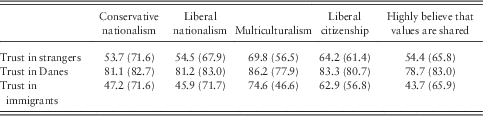
Tables 1 and 2 depict the simple associations between the four indexes and each of the six measures of trust and solidarity according to whether respondents are above the median on each index. For example, 53.7% of those who score above the median on the index of conservative nationalism indicate that they somewhat or completely trust people they meet for the first time. Of those who score at the median or below, 71.6% are trusting of people they meet for the first time. In other words, there is a negative correlation between conservative nationalism and trust in strangers.
The association between community values/perceived shared values and trust

For the four indexes, responses from people scoring above the median of each index are indicated (median or below in parentheses).
For perceived share values, responses from people replying that values are perceived to be shared with other Danes ‘to a high degree’ indicated (‘to some degree’, ‘to a lesser degree’, or ‘not at all’ in parentheses).
For the three trust variables, ‘trust wholly’ or ‘trust somewhat’ is indicated.
Results have been weighted by gender, age, income, education, employment status, and regional home address.
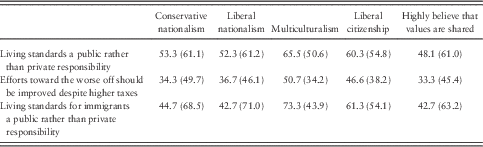
The association between community values/perceived shared values and solidarity

For the four indexes, responses from people scoring above the median of each index are indicated (median or below in parentheses).
For perceived share values, responses from people replying that values are perceived to be shared with other Danes ‘to a high degree’ indicated (‘to some degree’, ‘to a lesser degree’, or ‘not at all’ in parentheses).
For the three solidarity variables, the share of respondents indicating 6–10 on the 0–10 scales (see online appendix) is reported.
Results have been weighted by gender, age, income, education, employment status, and regional home address.
Furthermore, Tables 1 and 2 also reveal the trust and solidarity of those who perceive their values to be shared by other Danes ‘to a high degree’. For example, 54.4% of these respondents also indicate that they trust people they meet for the first time. Among respondents indicating any other of the three response categories on this variable, 65.8% trust people they meet for the first time.
The general pattern is that conservative and liberal nationalism are negatively associated with trust (except for trust in people of Danish origin), whereas the opposite is true of liberal citizenship and (in particular) multiculturalism.
Across all indexes, trust in people of Danish origin is higher than trust in immigrants. However, the difference between trust in immigrants and trust in people of Danish origin is relatively low for respondents scoring high on multiculturalism, whereas there is a big gap between these two forms of trust for respondents with high scores on conservative and liberal nationalism. Furthermore, for these two indexes, there is no significant difference between people above and below the median when asked about trust toward people of Danish origin.
As regards solidarity, the two nationalisms are negatively correlated to it, whereas the opposite is true of liberal citizenship and particularly multiculturalism. The four indexes have a stronger correlation with solidarity toward those at the bottom of society in comparison to their correlation with attitudes toward public responsibility for general living standards. In other words, the difference in solidarity between people who are above and below the median on each index is larger when asked specifically about support for the worse off. Differences become even larger when asked about solidarity with immigrants. In addition, differences in solidarity across the four indexes are larger in the case of attitudes toward efforts for the worse off and larger still when asked about immigrants, with people endorsing liberal citizenship and multiculturalism exhibiting higher levels of solidarity in each case.
Interestingly, the correlation of perceived shared values with trust and solidarity appears to be negative This may be puzzling if the expectation is that shared values promote social cohesion. However, if we investigate the content of the values perceived to be shared, we may get closer to an explanation. Simple bivariate correlations between this variable and the four indexes were made. Especially, conservative and liberal nationalists perceive values to be shared (Pearson’s correlations of 0.239 and 0.280, respectively, with ‘shared values’), whereas there is a negative correlation between this variable and multiculturalism (−0.281). The association with liberal citizenship is not significant.
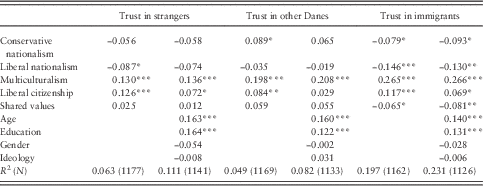
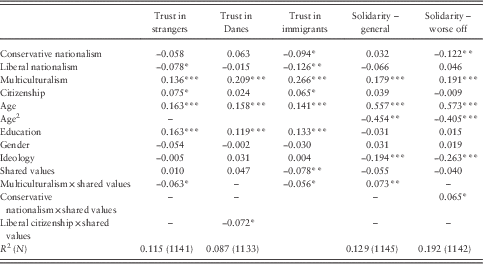
Table 3 reveals the results of linear regression with each of the three measures of trust as the dependent variable. In each case, two models are shown; the first is multivariate regression with the four indexes and perceived shared values included. This means we sort out correlations for each index ceteris paribus the other indexes in the first model. The second model includes further controls for age, education, gender, and ideological self-placement. This means that the final model assures us that the correlations between the indexes and trust and solidary do not just reflect individual differences in the control variables, such as ideology. However, it does not fully address the issue of empirical overlap between the nationalisms, which we will return to later.
The correlation between community values and trust (with controls)

Standardized correlation coefficients.
***Significant at the 0.001 level; **significant at the 0.01 level; *significant at the 0.05 level.
Multiculturalism has a relatively strong and significant association with all three measures of trust after control for all other variables, that is, multicultural attitudes are associated with higher levels of trust. The same positive correlation applies to liberal citizenship, but it is weaker and it is not significant in the case of trust toward people of Danish origin.
Conservative and liberal nationalism remain significant only when investigating trust specifically toward immigrants (with a negative correlation). It may be the case that these two indexes are to some extent ‘explained away’ when we include the socio-economic control variables. At least, conservative and liberal nationalism are associated positively with age and negatively with education (not shown here). The opposite associations apply to multiculturalism, but the strength of the correlations are weaker.
Looking at R 2, it is evident that the indexes are best attuned to explain variance in trust toward immigrants. Before including the other control variables, the indexes (along with perceived shared values) explain 20% of the variance on this measure of trust. When all variables are included, the figure increases somewhat to 23%. And ‘perceived shared values’ remains significant only in the case of trust toward immigrants, and the correlation is negative.
In terms of the control variables (as expected), we find that education and particularly age are positively correlated with trust, especially trust toward strangers.
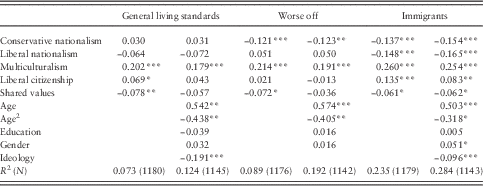
Table 4 presents the results with the three indicators of solidarity as dependent variables. Unsurprisingly, the indexes are better suited to explain solidarity with immigrants (explained variance of 24% which increases to 28% in the final model). Once again, multiculturalism remains significant across all models with positive correlations, where the correlation is particularly strong in the case of solidarity with immigrants. Conservative nationalism is significantly and negatively correlated with solidarity toward the worse off and immigrants, whereas liberal nationalism remains significantly related only to less solidarity with immigrants.
The correlation between community values and solidarity (with controls)

Standardized correlation coefficients.
***Significant at the 0.001 level; **significant at the 0.01 level; *significant at the 0.05 level.
In terms of the control variables, age squared has been included for the three measures of solidarity since the relationship between age and solidarity is not linear. The correlations for age and age squared simply express that the relationship is curvilinear with the oldest and the youngest age cohorts being least in favor of public responsibility for living standards. Education matters less for solidarity, whereas ideological orientation is very important (as expected, respondents on the left incline toward public responsibility, whereas the right inclines toward personal responsibility).
We still need to fully validate that conservative and liberal nationalism do not just describe the same variation in individual attitudes. Therefore, we did an independent analysis of individuals who are liberal nationalists, but not conservative nationalists. We singled out those who fall at or above the median on the liberal nationalism index but below the median on the conservative nationalism index. These individuals may simultaneously be at or above the median on the liberal citizenship and even the multiculturalism index, but theoretically this is fine because liberal nationalists will, by definition, have liberal attitudes and may well have some multicultural attitudes as well [e.g. Kymlicka (Reference Kymlicka2001) combines multiculturalism and liberal nationalism is this way]. We compared these liberal nationalists with individuals who score at or above the median on the conservative nationalism index.
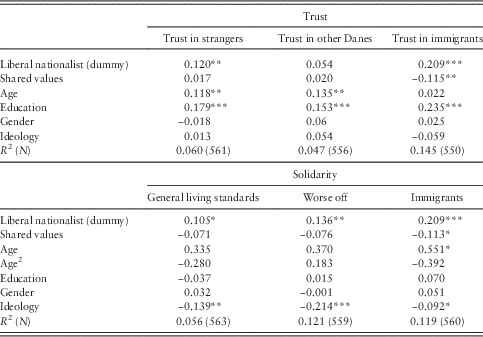
In Table 5, we compare trust and solidarity among respondents belonging to these two conceptions of nationalism. Belonging to the above definition of liberal nationalism is simply indicated by a dummy variable, that is, conservative nationalists become the reference category. Included are the same socio-demographic control variables as before.
Trust and solidarity of conservative and liberal nationalists

Only respondents belonging to one of the following two categories:
‘Conservative’ nationalism defined as scoring at the median or above on conservative nationalism (regardless of whether the respondent is also at the median or above on liberal nationalism and liberal citizenship).
‘Liberal’ nationalism defined as scoring at the median or above on liberal nationalism, but not conservative nationalism (regardless of whether the respondent also scores at the median or above on multiculturalism and/or liberal citizenship).
Standardized correlation coefficients.
***Significant at the 0.001 level; **significant at the 0.01 level; *significant at the 0.05 level.
The results show that, on this new index of liberal nationalism, liberal nationalists are significantly more trusting and solidaristic across all measures than conservative nationalists. The control variables generally show the same correlations as before, even if they are not always significant in this case. Note, however, that these two groups of nationalists also differ in their commitments to liberal citizenship (to which some respondents in both groups are committed) and multiculturalism (to which some liberal but no conservative nationalists are committed). Naturally, this may affect the trust and solidarity of both groups. The important thing is that there is a group of respondents for whom conservative and liberal nationalism is not the same thing, and that this has implications for trust and solidarity.
Finally, Table 6 reveals some interesting interactions between the indexes and the perception that personal values are shared by others. When we include this interaction term, we ask ourselves not only how much perceived shared values matters for trust and solidarity, but whether the combination of perceived shared values and specific sets of community values is independently associated with trust and solidarity.
Interactions between community values and the belief that others share one’s personal values

Standardized correlation coefficients.
***Significant at the 0.001 level; **significant at the 0.01 level; *significant at the 0.05 level.
This appears to be the case, but the interaction is not significant in all cases. One explanation for this could be that there are extremely few respondents saying that their values are shared only to a limited degree. Hence, there is not much variation on this variable in the Danish context. Nevertheless, the interaction emerges in some cases.
Shown in Table 6 are only the significant interaction terms. In all cases, the index variables and the variable on perceived shared values have been centered around their mean.
As can be seen, when significant, the interaction term generally has the opposite direction of the original index variable. For example, while conservative nationalism is negatively correlated with solidarity toward the worse off, the interaction term is positively correlated. In other words, conservative nationalists exhibit higher solidarity than they otherwise would have if they perceive that their values are shared by others to a high degree. This positive interaction is not as strong as the negative correlation from conservative nationalism itself, but it is there. Similarly, highly multicultural orientations are associated with lower trust in strangers when values are perceived to be shared (more precisely, such respondents are not quite as highly trusting as other highly multicultural respondents who do not, to the same extent, perceive their values to be shared). However, in one of the five cases listed, the interaction goes in the same direction as the original index variable. Highly multicultural respondents express even higher general solidarity when they perceive their values to be shared.
Discussion
According to the national identity argument, sharing a commitment to a national identity tends to promote trust and solidarity among community members. Here, the notion of a national identity is to be understood at least in part in cultural terms. On this basis, it may be predicted that individuals who have such commitments to the nation will have higher levels of trust and solidarity than individuals who do not, everything else being equal.
However, this is not what we find. Both conservative and liberal nationalism is negatively correlated to trust and solidarity. In fact, of the six measures of trust and solidarity we use, it is only trust in people of Danish origin that does not correlate negatively with these two forms of nationalism (and even here, there is no positive correlation). When we control for socio-economic factors and ideology, some of these correlations drop to insignificance, but for trust in – and solidarity with – immigrants the correlation remains negative, as does the correlation between conservative nationalism and solidarity with the worse off.
Lower levels of trust in – and solidarity with – immigrants may reflect that respondents attracted to nationalism tend not to see immigrants as co-nationals. What is perhaps more worrying for proponents of the national identity argument is that not even in-group trust and solidarity seem to be positively impacted by commitments to the cultural nation.
It is not only nationalist political theorists who make claims about the significance of community values for social cohesion, so do liberals and multiculturalists. And indeed, consistently with these claims, both the liberal citizenship and multiculturalist index correlates positively with all our measures of trust and solidarity, although multiculturalism more so. When we impose controls for socio-economic status, ideology, etc., liberal citizenship remains positively correlated to trust in strangers and in immigrants, as well as to solidarity with immigrants. Furthermore, multiculturalism remains positively correlated to all six measures. In fact, it is striking that multiculturalist respondents not only have higher levels of trust in immigrants than nationalist respondents (which may have been expected), but also have higher levels of trust in people of Danish origin.
To some extent, the positive relationship between multicultural values and trust and solidarity challenges a worry that has been articulated by a number of theorists, namely that multiculturalism drives down social cohesion by emphasizing difference at the expense of commonalities between citizens (Barry, Reference Barry2001; Uslaner, Reference Uslaner2012). Thus, according to Uslaner (Reference Uslaner2012: 59), generalized trusters see their society as united by common values and tend to oppose multicultural policies because of their potentially divisive effects. We, on the other hand, find a positive relationship between multicultural values and generalized trust. Nevertheless, there may of course be effects on social cohesion of, for example, multicultural policies that we do not pick up in a study such as this, which focusses on individual attitudes only (however, for studies on the effects of multicultural policies, see Banting et al., Reference Banting, Johnston, Kymlicka and Soroka2006; Hooghe et al., Reference Hooghe, Reeskens and Stolle2007).
Now, as pointed out above, an individual’s trust and solidarity may be a function not just of her own values but also of the extent to which she is a member of a society in which these values are shared by others. Indeed, political theorists tend to consider social cohesion a function of shared values. Therefore, we have also tested the relationship between particular community values and the belief that these values are shared by others, on the one hand, and trust and solidarity on the other.
While it is not in general the case that individuals who believe that others share their values have higher levels of trust and solidarity, interestingly, this belief works in different ways when associated with different community values. Conservative nationalists have higher levels of solidarity with the worse off if they believe that others share their values than if they do not, whereas multiculturalists have lower trust in strangers and immigrants (but higher general solidarity) if they have this belief. The first of these findings is in accordance with what nationalist theory would lead us to expect. Thus, the more you believe that other people share your (thick, cultural) values, the more you will identify with them, where such identification tends to promote trust and solidarity. Nevertheless, these effects of perceived sharing do not fully compensate for the negative correlations of the indexes themselves, and our results contradict the national identity argument irrespective of whether it is based on liberal or conservative nationalism, at least in a Danish empirical setting.
The fact that we find the opposite relationship between the belief in shared values and trust in the case of multiculturalism is more surprising. After all, multicultural theorists have emphasized the importance of a shared recognition of difference for social cohesion. However, a possible explanation may be this. For people who hold multicultural values, these values may be in part a response to their perception of living in a diverse society. Alternatively, it may just be the case that multiculturalists are more inclined to emphasize the diversity they find in their society than others are. In either case, scoring highly on the multiculturalism index is associated with a reduced belief in other people sharing one’s values, and since it is also associated with higher levels of trust, this would explain why multiculturalists are more trusting if they are less inclined to believe that their values are shared.
Does this mean that multiculturalist political theorists are mistaken in thinking that a shared recognition of difference tends to foster social cohesion? Not necessarily (Holtug, Reference HoltugForthcoming). First, if multiculturalist respondents are less inclined to consider their values shared because they recognize the religious and cultural diversity of the society they inhabit, this need not say anything about whether they perceive their political (including multicultural) values to be shared. Second, shared identities may have effects that our research design cannot capture. For example, it is sometimes argued that multicultural policies tend to foster a sense of being treated equally and belonging to a common political project among minorities.
The point that shared identities may impact social cohesion in ways that our study is not designed to pick up pertains more generally to all the community values considered here. Sharing an identity with other community members and believing that one shares such an identity is not the same thing, and sharing may causally impact social cohesion in ways that are not reflected in individual beliefs. Nevertheless, the idea that shared identities impact social cohesion on the basis of individuals identifying more strongly with other members of their society because they are united with them in terms of common values is widespread in political theory and social science, and it relies on a causal account that seems to presuppose that individuals perceive of other community members as sharing their own values. And this, of course, is precisely the kind of pattern our study is designed to pick up.
Acknowledgments
The authors thank Lars Torpe for his significant contribution to the survey on which this article is based and for his comments on various drafts. Thanks also to David Miller and Matthew Wright for comments on the survey.
Supplementary material
To view supplementary material for this article, please visit https://doi.org/10.1017/S1755773916000266