Introduction
Heart rate and blood pressure are two crucial physiological indicators and haemodynamic parameters in the human cardiovascular system, Reference De Vente, Olff, Van Amsterdam, Kamphuis and Emmelkamp1 which can promptly reflect the functional status of the human cardiovascular system and have irreplaceable clinical significance in disease diagnosis, treatment, condition monitoring, and health assessment. Although heart rate and blood pressure are two independent indicators, there is a close interrelationship between them. In evaluating the prognosis of patients with cardiovascular diseases, the combined indicators of heart rate and blood pressure (such as the heart rate and blood pressure product) have a certain reference value. Cardiovascular disease patients with an increased rate and blood pressure product have an increased risk of cardiovascular events and a poorer prognosis. Reference Al Rifai, Ahmed, Nayfeh, Nabi and Al-Mallah2 It can be seen that heart rate, blood pressure and rate and blood pressure product are of great significance in clinical practice.
Postural orthostatic tachycardia syndrome is a clinical syndrome characterised by increased heart rate and orthostatic intolerance symptoms due to prolonged standing or changes in body position. It is a common haemodynamic type of neurally mediated syncope. Reference Wang, Liao and Wang3 The prevalence rate of pediatric postural orthostatic tachycardia syndrome is 6.8%, Reference Bai, Chen, Jin and Du4 with the onset age mainly concentrated between 15 and 25 years old, and it is more common in females. Reference Sheldon, Grubb and Olshansky5 When postural orthostatic tachycardia syndrome occurs, clinical symptoms such as general weakness, dizziness, blurred vision, hypotension, tachycardia, and pale complexion may appear. These symptoms can return to normal in a short time. In severe cases, syncope may occur, and even physical accidental injuries may happen. Reference Liao and Du6 The pathogenesis may be related to autonomic nerve dysfunction, insufficient blood volume, high adrenergic levels, underlying autoimmune or inflammatory process, abnormal vascular endothelial function, peripheral vascular dilation and contraction dysfunction, Reference Liao and Du6,Reference Moak, Ramwell, Gordish-Dressman, Sule and Bettini7 etc. When there is insufficient blood volume, autonomic nervous system dysfunction, etc., haemodynamic changes may occur in the upright position. Reference Habek, Ruška, Crnošija, Adamec, Junaković and Krbot Skorić8,Reference Wells, Elliott and Mahajan9 The head-up tilt test is an important method for diagnosing postural orthostatic tachycardia syndrome. Reference Bogle, Goodman and Barrs10 head-up tilt test induces changes in heart rate, blood pressure and clinical symptoms by passively altering the patient’s position. This article will review the predictive value of heart rate and blood pressure in the diagnosis and prognosis of pediatric postural orthostatic tachycardia syndrome.
The value of biomarkers in the diagnosis and prognosis prediction of pediatric POTS
Clinical observations have shown that the same treatment plan may yield different therapeutic effects for different pediatric postural orthostatic tachycardia syndrome. Research shows that based on haemodynamic parameters (such as flow-mediated vasodilation response, Reference Liao, Yang and Zhang11 changes in heart rate and blood pressure in head-up tilt test, Reference Deng, Liu and Liu12 etc.) and biological markers (such as erythrocytic hydrogen sulphide, Reference Yang, Zhao and Du13 plasma midregional pro-adrenomedullin, Reference Zhang, Li and Ochs14 salivary cortisol, Reference Lin, Zhao, Shen and Jiao15 plasma C-type natriuretic peptide, Reference Lin, Han and Li16 orthostatic plasma norepinephrine Reference Zhang, Chen, Li and Du17 24-hour urine sodium, Reference Zhang, Liao, Tang, Du and Jin18 etc.) have a good effect on the diagnosis and prognosis estimation of pediatric postural orthostatic tachycardia syndrome, and can effectively guide individualised treatment. However, due to the difficulty in obtaining certain biomarkers in clinical practice and the high cost of testing, it is hard to promote them to primary hospitals.
HR, BP, and RPP are associated with many diseases
The literature indicates that heart rate, blood pressure, and rate and blood pressure product are associated with the prognosis of various diseases.
HR
Heart rate is a decisive factor in determining myocardial oxygen demand, coronary blood flow and myocardial performance. It is crucial for adapting cardiac output to metabolic needs. Heart rate is regulated by the autonomic nervous system and is susceptible to various diseases. In certain disease conditions (such as heart failure), heart rate has evolved from a biomarker to a truly controllable risk factor for change. Regulating heart rate can improve disease prognosis. Reference Sabbah, Ilsar, Zaretsky, Rastogi, Wang and Gupta19–Reference Palatini22 Epidemiological studies have shown that heart rate is directly related to the survival rate of the general population and patients with cardiovascular diseases, Reference Dyer, Persky and Stamler23–Reference Singh26 and this association is reverse (the higher the heart rate, the lower the survival rate), and is not related to background risk. Reference Gillum, Makuc and Feldman24,Reference Kannel, Kannel, Paffenbarger and Cupples25 Heart rate is an independent cardiovascular risk factor in the general population. Reference Palatini and Julius27 In most cardiovascular diseases, there is a correlation between increased resting heart rate and mortality. Reference Diaz, Bourassa, Guertin and Tardif28,Reference Cowie, Wood and Coats29
BP
Blood pressure refers to the lateral pressure exerted by blood on the vessel wall. The pumping function of the heart, vascular elasticity and resistance, and sufficient blood volume are the three elements that form blood pressure. Blood pressure is one of the important vital signs of the human body. Together with heart rate, respiration and body temperature, it constitutes the core indicators reflecting the basic life state of the body. Its clinical significance runs through multiple links such as disease diagnosis, treatment monitoring and prognosis assessment. Ghali et al. Reference Ghali, Kadakia, Bhatt, Cooper and Liao30 conducted a prospective study on patients with decompensated acute heart failure and found a negative correlation between blood pressure and mortality. Lip et al. Reference Lip, Skjøth, Overvad, Rasmussen and Larsen31 reported cohort study data and found that patients with elevated initial systolic and diastolic blood pressure have a higher risk of adverse cardiovascular events.
RPP
The Rate and blood pressure product can reflect the synergistic effect of heart rate and systolic blood pressure on changes in the body. It is more significant than using heart rate or blood pressure alone to predict cardiovascular events. At present, the rate and blood pressure product has become an alternative indicator reflecting myocardial oxygen demand and cardiac workload. Reference Myers, Tobe and McKay32 The rate and blood pressure product within 24 hours has a circadian rhythm, with the average rate and blood pressure product being greater during the day than at night. An increase in rate and blood pressure product indicates that the body needs to meet metabolic requirements by enhancing myocardial oxygen consumption, which can predict possible cardiac damage in patients with hypertension Reference Li, Liu, Shi, Wang and Liu33 and reflect the potential myocardial insufficiency in patients with coronary atherosclerotic heart disease during rehabilitation exercises. Reference Kitamura, Jorgensen, Gobel, Taylor and Wang34 Kowalczys et al. Reference Kowalczys, Bohdan and Gruchała35 reported that during a 6-month follow-up of patients with chronic heart failure, a higher rate and blood pressure product was associated with a lower risk of aggravated heart failure. The Rate and blood pressure product can also reflect the severity of cardiovascular diseases in patients. As the rate and blood pressure product continuously increase, they can, respectively, indicate that patients have myocardial ischaemia and angina pectoris, and even predict a positive reaction in exercise tests in patients with coronary artery injury. Reference Fornitano and Godoy36
Estimation of the diagnosis and prognosis of pediatric POTS using HR, BP and RPP
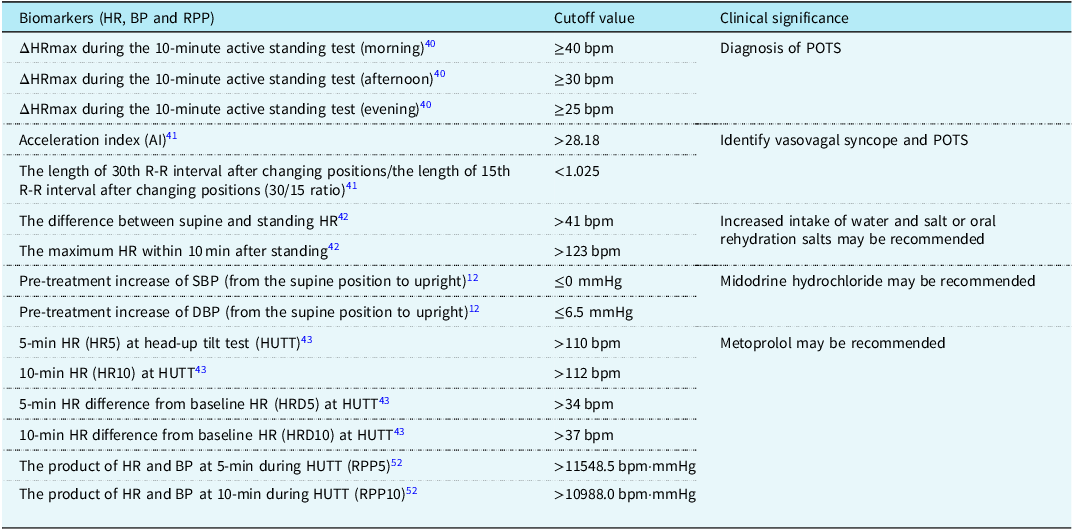
Research on the diagnosis of pediatric postural orthostatic tachycardia syndrome—utilising heart rate, blood pressure, and rate and blood pressure product parameters—as well as on the assessment of prognosis following pharmacological intervention, has advanced significantly (Table 1).
HR, BP and RPP for predicting the diagnosis and treatment outcome of pediatric postural orthostatic tachycardia syndrome

Table 1. Long description
The table presents biomarkers related to heart rate, blood pressure, and rate and blood pressure product parameters for diagnosing and treating pediatric postural orthostatic tachycardia syndrome. It includes three main columns: biomarkers, cutoff value, and clinical significance. The biomarkers column lists various measurements such as HR max during active standing tests at different times of the day, acceleration index, and HR differences during position changes. The cutoff value column provides specific thresholds for each biomarker, while the clinical significance column offers recommendations based on these values. Notable trends include the use of HR max changes for diagnosis and specific HR and BP differences for treatment recommendations like increased water and salt intake or medication such as midodrine hydrochloride and metoprolol.
HR
Heart rate is mainly regulated by the autonomic nervous system. Excitation of the sympathetic nerve accelerates heart rate, while excitation of the parasympathetic nerve slows it down. In healthy adults, the sympathetic and parasympathetic nervous systems are in a balanced state. However, in children, the main manifestation is the increased excitability of the sympathetic nerve, which leads to an increase in heart rate. Swai et al. Reference Swai, Hu, Zhao, Rugambwa and Ming37 found through meta-analysis that heart rate and heart rate variability time-domain indicators are reliable indicators for differentiating healthy individuals from postural orthostatic tachycardia syndrome patients, but there is a lack of studies on sensitivity and specificity. Zhao et al. Reference Zhao, Han and Zhang38 reported that the changes in pediatric heart rate were not affected by age, sex, height, weight or body mass index, indicating that the same heart rate changes could be used to evaluate children of different age groups. Tao et al. Reference Tao, Lu and Lin39 reported the long-term efficacy of pediatric postural orthostatic tachycardia syndrome after receiving conventional intervention and following up for 18.7 (14–74) months. They found that the cumulative asymptomatic rate gradually increased over time, reaching 48.4% at the 1-year follow-up and 85.6% at the 6-year follow-up. The duration of symptoms before treatment and the maximum upright heart rate in the active standing test were taken as independent indicators of long-term prognosis. For every one-month extension of the duration of symptoms before treatment, the cumulative asymptomatic rate decreased by 1.2%. In the active standing test, for every increase of 1 bpm in the maximum upright heart rate, the cumulative asymptomatic rate increased by 2.1%. The long-term prognosis of postural orthostatic tachycardia syndrome patients with conventional intervention is good, and the cumulative asymptomatic rate gradually increases over time. Prolonged duration of symptoms before treatment and reduced maximum upright heart rate in the active standing test are independent risk indicators. Cai et al. Reference Cai, Wang and Zou40 reported that there were daily rhythm variations in the increase of heart rate (ΔHR) after standing in children with postural orthostatic tachycardia syndrome. Through the analysis of 43 cases of postural orthostatic tachycardia syndrome (ΔHR ≥40 bpm) and 35 cases of non-postural orthostatic tachycardia syndrome group aged 9–14 years (ΔHR <40 bpm) and 26 healthy children completed three active standing tests in the morning (7:00 am–9:00 am), afternoon (3:00 pm–5:00 pm), and evening (8:00 pm–10:00 pm) respectively. It was found that the increments of standing heart rate in the postural orthostatic tachycardia syndrome group and the non-postural orthostatic tachycardia syndrome group significantly increased in the morning (P < 0.05). However, the increment of upright heart rate in the healthy group showed no difference within one day. The proportion of patients meeting the postural orthostatic tachycardia syndrome diagnostic criteria was 100% in the morning, 44.2% in the afternoon and 27.9% in the evening. 51.2% of postural orthostatic tachycardia syndrome patients only showed positive results in the morning active standing test. Compared with the non-postural orthostatic tachycardia syndrome group and the healthy group, in the three active standing tests at different times, ΔHR and maximum ΔHR (ΔHRmax) at 1–10 minutes after standing were the highest in the postural orthostatic tachycardia syndrome group (P < 0.05). The ΔHR and ΔHRmax at 5 minutes and 10 minutes after standing in the afternoon and evening have predictive value for the diagnosis of postural orthostatic tachycardia syndrome. External validation tests showed that the sensitivity, specificity and accuracy of diagnosing postural orthostatic tachycardia syndrome with ΔHRmax ≥30 bpm in the afternoon were 85.0%, 71.4% and 78%, respectively, and those with ΔHRmax ≥25 bpm in the evening were 85.0%, 76.2% and 80.5%, respectively. The increments of upright heart rate in children with postural orthostatic tachycardia syndrome show diurnal rhythm changes, suggesting that in clinical diagnosis of pediatric postural orthostatic tachycardia syndrome, the criteria based on diurnal rhythm variations can be considered. Tao et al. Reference Tao, Chen and Li41 also reported that the immediate heart rate changes in children from supine position to upright position have predictive value in the differential diagnosis of vasovagal syncope and postural orthostatic tachycardia syndrome. They found that when the acceleration index is ≥28.18, the sensitivity for diagnosing postural orthostatic tachycardia syndrome is 79.2%, and the specificity is 73.1%. 30/15 ≤1.025, the sensitivity for diagnosing postural orthostatic tachycardia syndrome is 87.5%, and the specificity is 61.5%. When the acceleration index or 30/15 is used in combination, the sensitivity for diagnosing postural orthostatic tachycardia syndrome is 95.8%, and the specificity is 80.8%. In terms of predicting the therapeutic response to pharmacologic interventions in pediatric postural orthostatic tachycardia syndrome, Lin et al. Reference Lin, Liu and Wang42 reported that the increase in heart rate in pediatric postural orthostatic tachycardia syndrome before oral rehydration salts treatment was 41 bpm (with a sensitivity of 72% and a specificity of 70%), or the ΔHRmax during standing within 10 minutes before treatment was 123 bpm (with a sensitivity of 48% and a specificity of 56%). When these two indicators were used together, the efficacy of predicting a response to oral rehydration salts treatment significantly increased (with a sensitivity of 84% and a specificity of 56%). Wang et al. Reference Wang, Zou and Cai43 reported the prediction of heart rate and heart rate difference of pediatric postural orthostatic tachycardia syndrome during head-up tilt test for 96.0 (40.5, 134.5) days of follow-up after metoprolol treatment. It was found that the increase in heart rate at 5 minutes (HR5) and 10 minutes (HR10) during the head-up tilt test, as well as the increase in heart rate at 5 minutes (HRD5) and 10 minutes (HRD10) in the postural orthostatic tachycardia syndrome group, was significantly higher than that in the healthy group (P < 0.01). When HR5, HR10, HRD5 and HRD10 were ≥110, 112, 34 and 37 bpm, respectively, the sensitivity and specificity for predicting the effectiveness of metoprolol were 82.50% and 69.23%, 84.62% and 69.70%, 85.29% and 89.47%, 97.56% and 64.86% respectively. It is believed that heart rate and heart rate difference are helpful in predicting the effect of metoprolol in the treatment of pediatric postural orthostatic tachycardia syndrome.
BP
Low blood volume, elevated acetylcholine levels in plasma and abnormal vascular tension are the main causes of postural orthostatic tachycardia syndrome, all of which can affect blood pressure. Reference Raj, Biaggioni and Yamhure44,Reference Stewart and Weldon45 Gu et al. Reference Gu, Wang and Wang46 reported the relationship between pediatric postural orthostatic tachycardia syndrome and blood pressure variability in healthy children It was found that the standard deviation of 24-hour diastolic blood pressure (24hDSD), the standard deviation of daytime diastolic blood pressure, the standard deviation of nighttime systolic blood pressure, the coefficient of variation of daytime diastolic blood pressure, and the coefficient of variation of nighttime systolic blood pressure in the postural orthostatic tachycardia syndrome group were higher than those in the healthy group (P < 0.05). 24hDSD, standard deviation of daytime diastolic blood pressure, standard deviation of nighttime systolic blood pressure, coefficient of variation of daytime diastolic blood pressure and coefficient of variation of nighttime systolic blood pressure are potential risk factors for postural orthostatic tachycardia syndrome. When the standard deviation of daytime diastolic blood pressure, the standard deviation of nighttime systolic blood pressure and the coefficient of variation of nighttime systolic blood pressure increase by 1 mmHg, 1 mmHg and 1%, respectively, the risk of postural orthostatic tachycardia syndrome increases by 48%, 53% and 49% respectively. It is believed that pediatric postural orthostatic tachycardia syndrome may have abnormal circadian blood pressure rhythms and increased blood pressure variability. Deng et al. Reference Deng, Liu and Liu12 retrospectively analysed the clinical data of pediatric postural orthostatic tachycardia syndrome patients who received midodrine hydrochloride treatment and were followed up. They found that the increase in systolic and diastolic blood pressure from the supine position to the upright position in those who responded to midodrine hydrochloride treatment was significantly lower than that in those who did not respond. They predicted that the preoperative increase in systolic blood pressure in pediatric postural orthostatic tachycardia syndrome treated with midodrine hydrochloride would be ≤0 mmHg. It is effective when the preoperative diastolic blood pressure increase is ≤6.5 mmHg (from supine position to upright position), with a sensitivity of 72% and a specificity of 88%. It indicates that the changes in blood pressure during the head-up tilt test are helpful for predicting the effect of midodrine hydrochloride in pediatric postural orthostatic tachycardia syndrome. Zhao et al. Reference Zhao, Han and Zhang38 reported that there was no significant difference in systolic blood pressure changes between pediatric postural orthostatic tachycardia syndrome and healthy children from the supine position to the upright position, but there was a significant difference in diastolic blood pressure changes. It is speculated that diastolic blood pressure is more significant for the diagnosis of postural orthostatic tachycardia syndrome.
RPP
The Rate and blood pressure product is the product of resting heart rate and systolic blood pressure, reflecting the synergistic effect of the two on changes in the body. As a mixed indicator, any minor change in the composition of rate and blood pressure product (such as a 1 mmHg increase in blood pressure or a 1 bpm increase in HR) will multiply the impact on rate and blood pressure product, amplifying the influence of physiological indicators. Compared with the results of single indicators (HR, BP), the changes are more stable and provide a more comprehensive judgment of cardiovascular events. The cardiovascular effects of the head-up tilt test process are influenced by the tilt angle and duration. Vijayalakshmi et al. Reference Vijayalakshmi, Veliath and Mohan47 reported that the rate and blood pressure product of 18–20-year-old volunteers would change at different tilt angles during the head-up tilt test, and gradually increased with the increase of the tilt angle. Cai et al. Reference Cai, Wang, Zou, Wang and Wang48 reported that there were circadian rhythm changes in rate and blood pressure product in children aged 9–14 with postural orthostatic tachycardia syndrome and the healthy group. Both groups showed a phenomenon of a higher rate and blood pressure product during the day and a lower rate and blood pressure product at night. However, the rate and blood pressure product in the postural orthostatic tachycardia syndrome group significantly increased from 2 hours before waking up to 3 hours after waking up, indicating that the increase in sympathetic nerve activity in pediatric postural orthostatic tachycardia syndrome mainly occurred in the early morning. Whitman et al. Reference Whitman, Jenkins, Sabapathy and Adams49 found that when using exercise stress echocardiography to test cardiovascular function in coronary artery disease, the maximum rate and blood pressure product’s ability to predict prognosis was superior to the maximum heart rate predicted by age. However, when using dobutamine stress echocardiography to predict cardiovascular events, the maximum rate and blood pressure product could not predict cardiovascular events. Mereu et al. Reference Mereu, De Barbieri, Perrone, Mugellini, Di Toro and Bernardi50 found that the ratio of heart rate to systolic blood pressure can serve as a predictor of neurally mediated syncope. In addition, the rate and blood pressure product can non-invasively monitor the improvement or deterioration of physical functions in real time, serving as a real-time standard for evaluating survival rates. Reference Kunig, Tassani-Prell and Engelmann51 Wang et al. Reference Wang, Zou, Cai and Wang52 reported that children aged 5 to 15 with postural orthostatic tachycardia syndrome were followed up after 3 months of treatment with metoprolol, and heart rate and blood pressure indicators were collected at baseline and during the head-up tilt test. It was found that the heart rate (HR5 and HR10 respectively), heart rate difference (HRD5 and HRD10 respectively), and rate and blood pressure product (RPP5 and RPP10 respectively) at 5 minutes and 10 minutes of the head-up tilt test process in the postural orthostatic tachycardia syndrome group were significantly higher than those in the healthy group (P < 0.01). HR5, HR10, HRD5, HRD10 and RPP10 were less than those in the poor prognosis group of postural orthostatic tachycardia syndrome in the good prognosis group (P < 0.01). The area under the curve of the four combined indicators (HR5, HR10, HRD5, and HRD10) was 0.925, with a sensitivity of 99.99% and a specificity of 75.00% for predicting a good prognosis. It is believed that HR5, HR10, HRD5, HRD10, RPP10 and the four combined indicators (HR5, HR10, HRD5 and HRD10) have predictive value for the prognosis of pediatric postural orthostatic tachycardia syndrome. The predictive value of the four combined indicators for the prognosis of postural orthostatic tachycardia syndrome is better than that of HR5, HRD5 and RPP10 alone.
Conclusions
Pediatric postural orthostatic tachycardia syndrome is one of the common functional cardiovascular diseases in clinical practice. The active standing tests and/or head-up tilt test are important methods for the diagnosis of postural orthostatic tachycardia syndrome. Heart rate, blood pressure and rate and blood pressure product are non-invasive detection indicators, which have certain predictive value for the diagnosis of pediatric postural orthostatic tachycardia syndrome and the intervention effect of such as oral rehydration salts, midodrine hydrochloride and metoprolol, providing a basis for clinicians to implement individualised treatment strategies for pediatric postural orthostatic tachycardia syndrome.
Acknowledgements
Thank the authors for their cooperation and support in this review work.
Authors’ contributions
SW and CW conceived and designed the study. RZ and HC were responsible for the collection and assembly of data. SW writing the manuscript. SW and CW revised the manuscript. All authors contributed to the article and approved the submitted version.
Financial support
None.
Competing interests
The authors declare no competing interests.
Ethical standard
This manuscript is a review article and does not involve a research protocol requiring approval by the relevant institutional review board or ethics committee.