Nationalism insists on the uniqueness of each nation. So, too, does the study of nationalism. For example, Ernest Renan, a cheerleader of nationalism, used the imagery of each nation “hold[ing] one note in the concert of humanity.” Elie Kedourie, who abhorred the excesses of nationalism, similarly identified its essence as a commitment to “the excellence of diversity.” Whether focused on political borders or social solidarity, the concept of the nation necessarily marks insiders with a special status, distinct from all others.1
Ernest Renan, “Qu'est-ce qu'une nation?” (What Is a Nation? [1882]), in Nationalism, ed. John Hutchinson and Anthony D. Smith (Oxford: Oxford University Press, 1994), 18; Elie Kedourie, Nationalism, 4th ed. (Oxford: Blackwell, 1993), 44–55.
At the same time, scholars have long recognized the homogeneity implicit in the global multiplication of nationalisms: each nation is unique, just like all the others. A century ago, Gilbert Murray noted the irony that “in almost every nation in the world from the Americans to the Chinese and the Finns, the same whisper from below the threshold [of consciousness] sounds incessantly in men's ears. ‘We are the pick and flower of nations: the only nation that is really generous and brave and just.”’ In recent years, scholars have begun to emphasize the shared qualities of nationalisms—not just the expression of local claims in “internationally recognizable terms,” writes Craig Calhoun, but also the construction of each nation as “a token of a global type…equivalent to other nations.” This equivalence is situated within a global framework, Michael Billig has argued: “if ‘our’ nation is to be imagined in all its particularity, it must be imagined as a nation amongst other nations. The consciousness of national identity normally assumes an international context, which itself needs to be imagined every bit as much as does the national community.”2
Gilbert Murray, “National Ideals; Conscious and Unconscious,” International Journal of Ethics 11 (1900): 21; Craig Calhoun, Nationalism (Minneapolis: University of Minnesota Press, 1997), 94; Michael Billig, Banal Nationalism (London: Sage Publications, 1995), 83.
Studies of globalization, starting from contrary premises, have reached similar conclusions. One of the founding observations of the field was the rise of global cultural homogeneity—“elements of commonality,” in the cautious phrase of Wilbert E. Moore, who helped to found this field.3
Wilbert E. Moore, “Global Sociology: The World as a Singular System,” American Journal of Sociology 71 (1966): 481.
Yet a number of recent theories of globalization have come to emphasize the contemporaneous, and seemingly paradoxical, rise of national and other particularistic identities worldwide. The two phenomena are related, these theorists argue, because the insistence on such identities is itself a product of globalization.
4 Influential proponents of this position include Arjun Appadurai, Modernity at Large: Cultural Dimensions of Globalization (Minneapolis: University of Minnesota Press, 1996); Manuel Castells, The Information Age, vol. 2: The Power of Identity (Malden, Mass.: Blackwell, 1997).
Despite the considerable theoretical attention devoted to the international isomorphism of particularistic identities, few studies have sought to explore evidence of the global within the national.5
On global isomorphism, see John W. Meyer, John Boli, George M. Thomas, Francisco O. Ramirez, “World Society and the Nation-State,” American Journal of Sociology 103 (1997): 144–81.
But it would it be a mistake to conclude from this oversight that the link is inherently implicit. In at least one country, Iran, references to the global underpinnings of nationalism have been numerous and overt. This paper collects evidence from three registers: visual material from a carpet woven in Kerman, Iran, in 1907; textual material from modernist and conservative political, literary, and religious figures in Iran in the late 19th century and early 20th century; and cross-regional material from the modernist Islamic movement of the same period. These varied forms of evidence point consistently toward the conclusion that concern for national distinctiveness may be expressed in terms of global conformity. Iranian nationalism looked to the world as the embodiment of social and political ideals and sought to remodel Iranian institutions to stake a claim to membership in the world of nations. Membership was only partially achieved in the early 20th century, but the development of the membership claim helped to forge images of national identity for Iran, casting the country as unique, just like every other country.
A TREE OF NATIONS
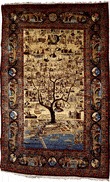
A rug hangs in the Carpet Museum of Iran, in Laleh Park, Tehran, showing Muhammad
Ali Shah (r. 1907–1909) at the top of a large tree, surrounded by Queen Victoria, Sultan Abdülhamid II, President Grover Cleveland, and dozens of other political leaders (Figure 1). Created in Iran in early 1907, just after the promulgation of the Iranian constitution and Muhammad
Ali's accession to the throne, the carpet weaves the shah into a world of leaders. The design flatters the new monarch by placing him at center stage, larger than the other figures, but it also implies that the ruler is one among many in the imagined community of rulers.
Untitled carpet (1907). Photograph courtesy of the Carpet Museum of Iran; drawing by Lynn Owens. For legend to Figure 1, please see Appendix.
According to its inscriptions, the carpet was woven “in the workshop of master weaver [ustād]
Ali Akbar Kirmani,…at the request of Mr. Muhammad Riza Khan,…on the orders of Commander
Abd al-Husayn Mirza Farmanfarma in the year 1324,” the lunar year ending 13 February 1907.
6 I thank Carl Ernst and Mohamad Tavakoli-Targhi for their assistance with the carpet inscriptions and Lynn Owens for preparing the legend.
Kirman, where Farmanfarma was governor in the 1890s and again from mid-1906 until March 1907,
7 Cyrus Mir et al., “Farmanfarma,
Abd-al-Hosayn Mirza,” in Encyclopaedia Iranica, vol. 9, ed. Ehsan Yarshater (New York: Bibliotheca Persica Press, 1999), 196–99; Mihrmah Farmanfarma
iyan, Zindigi-namah-yi
Abd al-Husayn Mirza Farmanfarma (Biography of
Abd al-Husayn Mirza Farmanfarma) (Tehran: Intisharat-i Tus, 1998), 1:97–144, 208–25.
underwent a carpetmaking boom during this interval, as did other regions of Iran. In the mid-1890s, a visiting British consul noted: “there is but little trade at present in any of the Kerman carpets,” many of which “are taken by the Governor and sent as presents to the Shah, the Sadrazam [prime minister], and other notables and friends.”
8 J. R. Preece, British consul in Isfahan, “Report of a Journey Made to Yezd, Kerman, and Shiraz, and on the Trade, &c., of the Consular District of Ispahan,” 27 February 1894, in Great Britain, House of Commons, Sessional Papers, Cd. 1719 (1894), 32. I thank Rudi Matthee for sharing this source with me.
A decade later, Kirman's carpet trade had developed into an extensive export sector,
9 Robert Joseph Dillon, “Carpet Capitalism and Craft Involution in Kirman, Iran: A Study in Economic Anthropology” (Ph.D. diss., Department of Anthropology, Columbia University, New York, 1976), 285–93; Leonard M. Helfgott, Ties That Bind: A Social History of the Iranian Carpet (Washington, D.C.: Smithsonian Institution Press, 1994), passim; Annette Ittig, “The Kirmani Boom: A Study in Carpet Entrepreneurship,” in Oriental Carpet and Textile Studies, ed. Robert Pinner and Walter B. Denny (London: ICTS and Hali Magazine, 1985), 1:111–23; A. Seyf, “The Carpet Trade and the Economy of Iran,” Iran 30 (1992): 99–105.
“the staple industry of Kerman and its chief mainstay,”
10 Major (Percy Molesworth) Sykes, British consul in Kirman, “Report on the Trade of the Kerman Consular District for the Year 1904–05,” received by the British Foreign Office on 26 April 1905, in House of Commons, Sessional Papers, Cd. 2236–118 (1905), 6.
feeding European and North American demand that had been spurred in part by the display of carpets at world's fairs and museums.
11 Helfgott, Ties That Bind, 85, 104, 167; Annette Ittig, “Ziegler's Sultanabad Carpet Enterprise,” Iranian Studies 25 (1992): 108. See also Donald Quataert, “Machine Breaking and the Changing Carpet Industry of Western Anatolia, 1860–1908,” Journal of Social History 19 (1986): 474.
Master weavers such as
Ali Akbar of Kirman retired with great wealth,
12 A. Cecil Edwards, The Persian Carpet (London: Gerald Duckworth, 1953), 211.
while women and child workers at the looms earned pittances and developed a variety of health problems.
13 Helfgott, Ties That Bind, 249–71; A. Seyf, “Carpet and Shawl Weavers in Nineteenth Century Iran,” Middle Eastern Studies 29 (1993): 679–89.
The 1907 carpet drew on a long Iranian tradition of pictorial carpets, especially images of kings and legends.
14 Kurt Erdmann, Seven Hundred Years of Oriental Carpets, ed. Hanna Erdmann, trans. May H. Beattie and Hildegard Herzog (London: Faber, 1970), 71–75; Karl Schlamminger and Peter Lamborn Wilson, Weaver of Tales: Persian Picture Rugs (Munich: Callwey, 1980); Parviz Tanavuli, Qalichah
ha-yi tasviri-yi Iran (Pictorial Rugs of Iran) (Tehran: Surush, 1989), much of which appears in Parviz Tanavoli, Kings, Heroes and Lovers: Pictorial Rugs from the Tribes and Villages of Iran, trans. John Wertime (London: Scorpion Publishing, 1994). This tradition continued throughout the 20th century. For example, during a visit to Washington, D.C., in 1977, Shah Muhammad Reza Pahlavi gave U.S. President Jimmy Carter a carpet from Isfahan depicting George Washington: see Carter's thank-you note of 28 November 1977, reproduced in Declassified Documents Reference System (Farmington Hills, Mich.: Gale Group, 2003), doc. no. CK3100327474.
Kirmani weavers, beginning in the mid-19th century, developed this tradition into a sideline of foreign-derived pictorials,
15 Ernest Ayscoghe Floyer, Unexplored Baluchistan (London: Griffith and Farran, 1882), 278, cited in Ittig, “The Kirmani Boom,” 122.
“spectacular…curiosities depicting kings of England, Emperors, figures from the Bible, etc.”
16 P. R. J. Ford, The Oriental Carpet: A History and Guide to Traditional Motifs, Patterns, and Symbols (New York: Harry N. Abrams, 1981), 159.
Farmanfarma apparently took an interest in promoting these designs. Two examples from 1895, inscribed with Farmanfarma's name, displayed several Chinese men conversing on one carpet and, on the other, the ancient Gallic warrior Vercingétorix.
17 Farmanfarma
iyan, Zindigi-namah, 1:126–27.
In 1909, Farmanfarma commissioned a particularly famous carpet that included an adaptation of the painting
Les fêtes vénitiennes (The Venetian Feasts) by Jean-Antoine Watteau (1684–1721), completing a full circle of cultural references, since Watteau's painting itself included Iranian-inspired costumes. This carpet, later donated to the Victoria and Albert Museum in London, contained virtually identical inscriptions to the 1907 carpet, including the names of Farmanfarma, his deputy Muhammad Riza Khan, and the master weaver
Ali (Akbar) Kirmani.
18 Edwards, The Persian Carpet, 201; Ittig, “The Kirmani Boom,” 111–13.
Farmanfarma was not the only sponsor of foreign-themed carpets: Mirza Husayn Khan (
Adl al-Sultanah), a Kirmani landowner and government official, commissioned a carpet picturing representatives of the “races of the world.”
19 Ittig, “The Kirmani Boom,” 112, 114–15.
Unknown patrons commissioned another carpet, woven in several versions between 1907 and 1919, that offered “a picture of world leaders who have performed great accomplishments,” including Moses, Cyrus (sometimes Darius), Confucius, Muhammad,
Umar, Napoleon, and George Washington among the fifty-four personalities depicted.
20 A version dated 1337 (1918–19) is pictured and discussed in Layla Dadgar, Farsh-i Iran: majmu
ah-i az muzih-yi farsh-i Iran (The Iranian Carpet: A Collection from the Carpet Museum of Iran) (Tehran: Muzih-yi Farsh-i Iran, 2001), 130–31. Dadgar notes that another copy of this carpet held by the Niavaran Palace Museum in Tehran weaves Nasir al-Din Shah and Muhammad
Ali Shah into the top of the image, which would suggest production during Muhammad
Ali's reign (1907–1909). The argument developed in this article about the carpet in Figure 1 might apply to the Niavaran carpet, as well. Christie's auction house offered another version for sale on 9 April 1988: Fine Oriental Rugs and Carpets (New York: Christie's, 1988), 106–107; see also Farmanfarma
iyan, Zindigi-namah, 1:129–30.
The first British consul in Kirman, Percy Molesworth Sykes, an enthusiastic promoter of the local carpet industry, objected to such designs, preferring the “ancient” patterns of “conventional flowers” that “make almost any other carpet appear tawdry and common.” European designs, “at my instance, were given up, and by rigorously insisting on adhesion to the old patterns, as well as by opening out new markets, I have assisted in bringing the industry to a thoroughly healthy condition, the carpets only requiring to be more widely known to become the fashion, especially for drawing-rooms and dainty boudoirs.”21
Percy Molesworth Sykes, Ten Thousand Miles in Persia or Eight Years in Iran (New York: Charles Scribner's Sons, 1902), 199. See also idem, “Report on the Trade and Commerce of the Consular Districts of Kerman and Persian Beluchistan from March, 1894, to March, 1895,” 31 December 1895, in House of Commons, Sessional Papers, Cd. 2109 (1896), 5.
In this way, an agent of global economic integration encouraged Kirman to preserve and profit from cultural isolation.
22 At the same time, Sykes favored spiritual transcendence of cultural difference: “my heart approved when he [a local Sufi teacher] repeated again and again that all religious fanaticism was the result of ignorance, and that it must be swept away to make place for universal Love” (Antony Wynn, Persia in the Great Game: Sir Percy Sykes, Explorer, Consul, Soldier, Spy [London: John Murray, 2003], 120).
By contrast, Farmanfarma and other Qajar nobility were sponsors of cultural hybridity, the mixture of foreign-identified themes with locally identified practices.
23 Jan Nederveen Pieterse, “Globalization as Hybridization,” in Global Modernities, ed. Mike Featherstone, Scott Lash, and Roland Robertson (London: Sage Publications, 1995), 45–68.
By 1905, at the end of his decade as consul in Kirman, Sykes was once more bemoaning the adoption of “hideous semi-European patterns.”
24 Percy Molesworth Sykes, “Report…for the Year 1904–05,” in House of Commons, Sessional Papers, Cd. 2236–118 (1905), 5.
The symbolism of the Kirman carpet of 1907 encapsulated this hybridity. It followed the Persian tradition of producing images of the shah for the shah—since Farmanfarma presumably ordered the carpet as a personal gift to the monarch—complete with kingly accoutrements expressing recognition of and fealty to royal authority.
25 Abbas Amanat, “The Kayanid Crown and Qajar Reclaiming of Royal Authority,” Iranian Studies 34 (2001): 17–30; Layla S. Diba, “Images of Power and the Power of Images: Intention and Response in Early Qajar Painting (1895–1834),” in Royal Persian Paintings: The Qajar Epoch, 1785–1925, ed. Layla S. Diba (New York: Brooklyn Museum of Art; London: I. B. Tauris, 1998), 30–49; Julian Raby, Qajar Portraits (London: I. B. Tauris, 1999), 9–19. This tradition was transposed into the photographic medium in the mid-19th century: see Ali Behdad, “The Power-ful Art of Qajar Photography: Orientalism and (Self)-Orientalizing in Nineteenth-Century Iran,” Iranian Studies 34 (2001): 141–51.
In addition, it followed recently established tradition—adopted from abroad in the previous century—by treating the shah's image as representative of the country, as on coins, a practice introduced to Iran by Fath
Ali Shah in the 1820s, and royal-portrait postage stamps, pioneered by Nasir al-Din Shah in 1876.
26 Priscilla Soucek, “Coinage of the Qajars,” Iranian Studies 34 (2001): 69–70; Mehrdad Sadri, Persiphila Standard Philatelic Catalogue: Iran—Qajar Dynasty (Glendora, Calif.: Persiphila, 2002).
The carpet presented the shah in a pose and outfit conforming to the European-inspired norms adopted by Muhammad Shah in the 1830s.
27 B. W. Robinson, “Persian Royal Portraiture and the Qajars,” in Qajar Iran: Political, Social and Cultural Change, 1800–1925, ed. Edmund Bosworth and Caroline Hillenbrand (Edinburgh: Edinburgh University Press, 1983), 298.
At the same time, the carpet broke with tradition by juxtaposing the royal portrait with foreign images—not just Iranian material presented in foreign styles, but images appropriated from abroad and transcribed into an Iranian medium.
28 The carpet's border also mixes and matches cultural traditions. In addition to repeated images of Nasir al-Din Shah and Thomas W. Palmer, president of the World's Columbian Commission, the border includes a Kirmani floral design and mirror images of an Iranian-looking bridge. I have been unable to identify the bridge, which also appears in mirror images in another carpet design from Kirman from approximately 1908. See Muhammad Danishvar, Tarikhchah-yi mahallah va-masjid-i Khwajah-Khazar-i Kirman (Brief History of the Neighborhood and Mosque of Khwajah-Khazar in Kirman) (Kirman, Iran: Intisharat-i Markaz-i Kirman-Shinasi, 1996), 213. The bridge's pointed shape, array of arches, and double buttresses resemble the Pul-i Dukhtar (Daughter's Bridge) near the town of Mianah in Iranian Azerbaijan. However, the Pul-i Dukhtar lacks the lush vegetation and adjacent townscape shown on the carpet. See Muhammad
Ali Mukhlisi, Pul
ha-yi qadimi-yi Iran (Ancient Bridges of Iran) (Tehran: Sazman-i Miras-i Farhangi, 2000), 152, 248–52.
The images that inspired the Kirman carpet of 1907 were almost all borrowed from half the globe away, and from fourteen years earlier. With only a few exceptions, the political leaders pictured were all in office in 1893. The exceptions present further clues to the source of the imagery: three U.S. presidents (George Washington, Abraham Lincoln, and Ulysses S. Grant) are displayed with Grover Cleveland and Benjamin Harrison, who were both in office in 1893, just below Muhammad
Ali Shah. At the root of the tree is “[Christopher] Columbus, the discoverer of America” and “the queen [Isabella] who protected Columbus, the discoverer of America.” In the water below the tree, the three ships from Columbus's first transatlantic voyage can be identified by anybody who attended grade school in the United States in the 20th century.
The weavers faithfully reproduced the iconography of the World's Columbian Exposition of 1893, held in Chicago in commemoration of Columbus's first voyage across the Atlantic Ocean. The cult of Columbus developed to vast proportions in 19th-century North America. One of the instigators of this cult, the author Washington Irving, contrasted Columbus with earlier Arab navigators who lacked “the judgment to divine, and the intrepidity to brave, the mysteries of this perilous deep.”29
Washington Irving, The Life and Voyages of Christopher Columbus, Abridged and Arranged by the Author, Expressly for the Use of Schools (New York: N. and J. White, 1834), iii–iv.
By the late 1860s, the cult was so widespread, Mark Twain joked, that stone fragments collected by American tourists from Columbus's birthplace “would suffice to build a house fourteen thousand feet high.”
30 Mark Twain, “The American Vandal Abroad [1868],” in Mark Twain's Speeches, ed. Albert Bigelow Paine (New York: Harper and Bros., 1923), 22.
The Columbus cult grew to include a national holiday in his honor, and virtually every school in the United States teaches about the voyage of the
Niña, the
Pinta, and the
Santa María.
31 James W. Loewen, Lies My Teacher Told Me: Everything Your American History Textbook Got Wrong (New York: New Press, 1995), 29–65; Frances FitzGerald, America Revised: History Schoolbooks in the Twentieth Century (Boston: Little, Brown, 1979), 77. Columbus's exploits began to be de-emphasized in schoolbooks of the 1980s, according to Robert Lerner, Althea K. Nagai, and Stanley Rothman, Molding the Good Citizen: The Politics of High School History Texts (Westport, Conn.: Praeger, 1995), 95–96.
The World's Columbian Exposition made Columbus's voyage the centerpiece of yet another emerging cult: the cult of international society. Since ancient times, scholars and visionaries have periodically appealed to the idea of the world as a single place, with occasional blooms of long-distance networks of education, writings, and commodities. A new burst emerged in the 19th century, following in the tracks of European colonial expansion. International organizations began to claim large regions of the world, or even the entire world, as their field of action. Universalizing social movements—from socialism to eugenics, to pick just two examples—began to coordinate their activities across continents, meeting periodically at international congresses to share the latest developments and strengthen weak ties.32
Hedley Bull and Adam Watson, ed., The Expansion of International Society (Oxford: Clarendon Press, 1984); John Boli and George M. Thomas, ed., Constructing World Culture: International Nongovernmental Organizations since 1875 (Stanford, Calif.: Stanford University Press, 1999).
World's fairs were the public face of this new international society.33
Paul Greenhalgh, Ephemeral Vistas: The Expositions Universelles, Great Exhibitions and World's Fairs, 1851–1939 (Manchester: Manchester University Press, 1988); Maurice Roche, Mega-Events and Modernity: Olympics and Expos in the Growth of Global Culture (London: Routledge, 2000), chaps. 1–3; Robert W. Rydell and Nancy E. Gwinn, ed., Fair Representations: World's Fairs and the Modern World (Amsterdam: VU University Press, 1994); see also numerous recent country-specific works.
These events, in conjunction with their official directories and voluminous memorabilia, self-consciously attempted to represent the world in microcosm. The World's Columbian Exposition, for example, devoted sections to manufacturing, commerce, and technology; fine arts, folk cultures, and national architectures; and women, who had their own auxiliary organization and separate building. Each country—and each state of the United States—was allotted space for a building, constructed in its own purportedly distinctive style, housing exhibitions designed to establish the place's brand name and associate it with export industries or tourism opportunities. This and other world's fairs embodied an “existential irony” of international society, in the phrase of Mauricio Tenorio-Trillo: cosmopolitan participation in the enactment of globality competed with each nation's attempts to present itself as “unique and, presumably, superior.”
34 Mauricio Tenorio-Trillo, Mexico at the World's Fairs: Crafting a Modern Nation (Berkeley: University of California Press, 1996), 9.
Iran did not have a full-scale exhibit in Chicago. Nasir al-Din Shah, when asked by the U.S. ambassador to appoint a commission for the fair and allocate it a budget, agreed only to the first of the two requests, naming the U.S. ambassador himself to head the commission.35
Clarence Andrews, “Foreign Nations at the World's Fair. I. Persia,” North American Review 156 (May 1893): 611–13. Iranian commissioners included Mirza Iskender Khan, Archaque Khan, and Dr. John H. Besharian, who signed The World's Columbian Exposition: Memorial for International Arbitration (Chicago: n.p., 1893).
The Iranian regime had sponsored buildings at three previous world's fairs: Paris in 1867 and 1878, and Vienna in 1873.
36 Zeynep Çelik, Displaying the Orient: Architecture of Islam at Nineteenth-Century World's Fairs (Berkeley: University of California Press, 1992), 119–20.
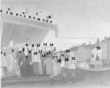
However, private individuals sponsored the Iranian concession at the 1893 fair in Chicago: a “Persian Palace” (labeled “F” in
Figure 1) in the commercialized “Midway” area of the fairgrounds, with artisanal workshops downstairs and a café upstairs. To boost attendance, the café followed the precedent of recent world's fairs in Paris, which offered female erotic dancers as part of their (mis)representation of Islamic culture, spurring a fad of
danse du ventre throughout Europe and, from there, to Istanbul, at the same time that traditional “belly dancing” was on the decline in the Middle East.
37 Zeynep Çelik and Leila Kinney, “Ethnography and Exhibitionism at the Expositions Universelles,” Assemblages 13 (December 1990): 35–60.
The Persian Palace in Chicago presented dancing French women dressed in Iranian costumes, whom the (male) Iranian workers considered inappropriate and went on strike to protest. The concessionaire changed the women into Parisian clothes, but this did not much mollify the workers.
38 Hajj Mirza Muhammad
Ali Mu
in al-Saltanah, Safar-namah-yi Shikagu (Travelogue of Chicago) (Paris: Georges Meunier et Cie., 1902), 170; Nasrin Rahimiyeh, Missing Persians: Discovering Voices in Iranian Cultural History (Syracuse, N.Y.: Syracuse University Press, 2001), 63. On the “dancing girls, who were nothing more nor less than young women of Paris,” see The Dream City: A Portfolio of Photographic Views of the World's Columbian Exposition (St. Louis, Mo.: N. D. Thompson Publishing, 1893). See also the photographs in Hubert Howe Bancroft, The Book of the Fair (Chicago: Bancroft Company, 1893), 858; and Edward B. McDowell, “The World's Fair Cosmopolis,” Frank Leslie's Popular Monthly 36 (October 1893): 416.
American critics also considered the dancing lewd, and the exposition's director-general, George R. Davis (bust number 80 in
Figure 1), tried unsuccessfully to shut it down.
39 Donna Carlton, Looking for Little Egypt (Bloomington, Ind.: IDD Books, 1994), 49.
As in Paris, the Persian Palace and similar performances along the Midway launched a North American craze for “belly dancing” and other faux–Oriental entertainment.
40 Ibid., passim. The Arabian horses brought to the exposition also spurred a craze for Arabian pure-breeding in North America: see Ben Hur, “Arabs at Chicago, 1893,” Western Horseman 15 (May 1950): 10–11, 34–37.
In contrast to the Persian Palace, the Ottoman government had an official building inside the fairgrounds, plus an elaborate “Turkish village” in the Midway featuring a mosque, a bazaar, a theater, a restaurant, a tent said to have been the property of an unidentified shah of Iran, and a bedouin camp.41
Condensed Catalogue of Interesting Exhibits with Their Locations in the World's Columbian Exposition (Chicago: W. B. Conkey Company, 1893), 129.
The Ottoman commissioner at the fair worked to maintain a stately presence. “As this is an event at which all the civilized nations of the world are represented,” he wrote to the Ottoman Ministry of Trade and Public Works, “and even obscure states such as the Kingdom of Johore from the Malaca peninsula, and some small Central American republics whose very names are unknown,
42 Note that the Iranian carpet also omits the names of the Latin American countries, although they appear in the original image on which the carpet is based.
make great sacrifices to show themselves, it would be unthinkable for the Sublime [Ottoman] State not to do the same.”
43 Selim Deringil, The Well-Protected Domains: Ideology and the Legitimation of Power in the Ottoman Empire, 1876–1909 (London: I. B. Tauris, 1998), 160.
Iran's small, scandalous entry was enough to earn the country a place in Chicago's conception of the world. A bearded man with a tall red hat and an Iranian flag is included, for instance, in a newspaper illustration showing a crowd of people from different countries shown advancing on the fairgrounds under the headline, “All Nations are Welcome to the World's Columbian Exposition, Chicago 1893.”44
Supplement to the World's Columbian Exposition Illustrated, 1 May 1893; black-and-white reproduction in Neil Harris, Wim de Wit, James Gilbert, and Robert W. Rydell, Grand Illusions: Chicago's World Fair of 1893 (Chicago: Chicago Historical Society, 1993), 111.
“There are exhibits from Persia, from Burmah, from Congo and from Mashona Land, the home of Rider Haggard's heroes, from China, and even from close-shut Korea,” wrote the president of the Chicago exposition, appealing to exoticism to demonstrate the globality of the event:
In fact, in this great muster of the nations, there is scarcely an absence to be noted. They are all here, each with her own story, each with her lesson, each doing her share in the great work of fulfilling the prophet's aspiration, the poet's dream, the statesman's strong desire to usher in the time when—
“The war-drums throb no longer, and the battle flags are furled,
In the parliament of man, the federation of the world.”45
Thomas W. Palmer, “Introduction,” in William E. Cameron, The World's Fair, Being a Pictorial History of the Columbian Exposition (Philadelphia: Home Library Publishing, 1893), 13.
Similarly, the carpet of 1907 includes Iran in the “great muster of the nations.” The tree depicted in the carpet includes the leaders of fourteen named countries, five Latin American figures identified only as “leader[s] of the countries of America” (sadr-nashīn-i mamālik-i Amrīkā), and—crowded amid the branches of the tree—the governors of forty-nine U.S. states and territories, plus the mayor of Chicago, all as of 1893 and all pictured next to their country or state building at the World's Columbian Exposition, with a few exceptions. Leader and building stand synechdochally as representatives for polity.
The U.S. governors and state buildings are arranged in rough geographic order. Florida's building, for example, is perched in a peninsula formed by two branches in the lower right of the tree. Yet the weavers had no need for familiarity with North American geography. Rather, they reproduced, with tremendous precision, a broadside published in Chicago at the time of the exposition.
46 F. Harold Hayward, “The Columbus Genealogical Tree of the World's Columbian Exposition, Chicago, Ill., 1893” (Chicago: E. S. Farah and Company, 1893). I thank the Chicago Historical Society for locating this image. The name Farah suggests that the publisher may have been an immigrant from the Ottoman Levant; this background might explain why Abdülhamid II was placed on the top row of the broadside. E. S. Farah does not appear in Chicago city directories for 1892–94 or in the U.S. census (Soundex #F600) for 1880 or 1900 (the records for 1890 were damaged by fire and firefighters in 1921, then discarded in the 1930s). Illinois marriage records, now available on the Internet, show an Arab Farah in the Chicago area just before the exposition: one Tanous Farah was married in Cook County on 17 January 1892 (marriage license #00178380).
This broadside was a collage of busts and buildings, along with the tree image and a bird's-eye view of the exposition grounds. The carpetmakers made only a handful of changes in the design. Muhammad
Ali Shah's dominant location in the carpet was devoted, in the broadside, to crossed U.S. flags and a Liberty Bell. Nasir al-Din Shah traded places with Tsar Alexander III of Russia, giving the Iranian monarch the corner location. Muzaffar al-Din Shah was added in place of Khedive
Abbas of Egypt, who was moved down to the spot occupied by Queen Victoria of Britain, who was moved up to replace the Chinese emperor (labeled “Tung Chu,” possibly a cross between Tung Chih [r. 1862–74] and Kuang Hsu [r. 1875–1908]), who was removed entirely. One person, the viceroy of India, was simply omitted, though India's building at the exposition was retained.
We do not know who brought the broadside to Kirman, but the motivation for weaving it into a carpet hardly seems mysterious. Muhammad
Ali's accession to the Iranian throne on 31 December 1906 made him the country's first constitutional monarch, his father having signed the constitutional declaration shortly before dying. Pro-constitutional forces had frequently stressed the idea that a constitution would allow Iran to take its rightful place among the “civilized” countries of the world. Now, they argued, that moment had arrived: “[s]ince the day when the Decree of the blessed King of Kings [Muzaffar al-Din Shah], may God illuminate his proof, received the honor of issuance, and the establishment of the National Consultative Assembly was commanded, Iran has been included among the constitutional (mashrūṭah) states which possess a constitution (kunstīṭūsiyūn).”
47 Hajj Mahdi Quli Hidayat (Mukhbir al-Saltanah), open letter of 11 February 1907, in Khatirat va-khatarat (Memories and Fears) (Tehran: Shirkat-i Chap-i Rangin, 1950), 149, translated in Abdul-Hadi Hairi, Shi
ism and Constitutionalism in Iran (Leiden: E. J. Brill, 1977), 187.
The carpet reflected this ideology in full color.
48 The carpet's inclusion of the Ottoman Sultan Abdülhamid II is a tricky case in terms of the constitution, as the sultan had suspended the constitution in 1878 and did not reinstate it until 1908. In addition, Britain had, and has, no written constitution, and Ceylon's first constitution dates from the 1920s.
Observers at the time characterized this transition as a “turn toward the global wave” (īn gardish rū bih auj-i
ālam).
49 Muhammad Husayn Furughi, Sarmayah-yi sa
adat ya
ilm va-azadi (Investment for Prosperity, or Science and Freedom) (Tehran: Matba
ah-yi Dar al-Khilafah-yi Tihran, 1909), 14.
(The Firm Cord), an influential Iranian newspaper published in Calcutta, India, reproduced a story from an unnamed European newspaper on this subject, with apparent approval. The constitutional revolution, according to the story, was evidence of “the mind-boggling progress of this ancient and upright nation and state. Now it is clear that the pride of this people was the product of self-deception, counting the whole world as insignificant in their view. They considered their own principles and laws the best principles and the most stable laws, and they did not view change and alteration as allowable.” Now, the article continues, “the sun of civilization has shone upon them, and the battery of events has awakened them.” As a result, “this nation-state
50 The text reads “nation and state” (millat va-daulat), but the corresponding verbs and possessives are all singular, not plural.
… has set its foot to the path of progress and will not sit down again until it takes first place.”
51 Habl al-matin (The Firm Cord; Calcutta) 14, 3 (17 August 1906), 8.
MODELING MODERNITY
First place and last place were common themes in Iranian discourse of the early 20th century, as elsewhere at this time. By the end of the 20th century, it was second nature to rank order the world on various axes—for example, the World Bank's influential annual ranking of countries by gross domestic product per capita.52
World Bank, World Development Report (Washington, D.C.: World Bank; New York: Oxford University Press, 1978–present).
But a century earlier, this was a novel conception. Part of global consciousness involved the linear mapping of societies, either up and down or fore and aft.
53 Linear mapping complemented spatial mapping of the world, which Iranians also engaged in at this time. See Firoozeh Kashani-Sabet, Frontier Fictions: Shaping the Iranian Nation, 1804–1946 (Princeton, N.J.: Princeton University Press, 1999), and the theoretical tradition sparked by Benedict Anderson, Imagined Communities, 2nd ed. (London: Verso, 1991), 170–78; and Thongchai Winichakul, Siam Mapped: A History of the Geo-body of a Nation (Honolulu: University of Hawaii Press, 1994). For a recent review of this literature, see John Pickles, A History of Spaces: Cartographic Reason, Mapping, and the Geo-Coded World (London: Routledge, 2004), 107–23.
An early example is the 1893
World Almanac's ranking of countries by population, beginning with the British Empire and China and finishing with the Orange Free State and Hawaii.
54 The World Almanac (New York: Press Publishing, 1893), 259.
Some Iranians had access to similar compendia, though none was produced in Iran until decades later.
55 The first world almanac published in Iran may have been
A. Ayatullah Tabataba
i, Nakhustin salnamah-yi dunya (The First World Yearbook) (Tehran: Salnamah-yi Dunya, 1946), which included no comparative statistics.
Muhammad
Ali Furughi (Zuka
al-Mulk), a political-science instructor and newspaper editor, noted in 1906 that Iran was next to last in the world in per capita trade, ahead of only China.
56 Tarbiyat (Training; Tehran), no. 403 (21 June 1906), 2139.
And rank ordering was on the minds of many who did not have access to statistics. “In this day and age the situation has become such that one must assert one's presence and keep up with one's peers. If one shows negligence once, one can fall fifty years behind in one's affairs,” wrote a reformer in the 1870s.
57 Mirza Husayn Khan to Nasir al-Din Shah, letter of May 1876, translated in Guity Nashat, The Origins of Modern Reform in Iran, 1870–1880 (Urbana: University of Illinois Press, 1982), 138.
An Iranian newspaper of the early 20th century expressed concern that “this sacred homeland, begotten of holies, remains behind other countries, and has fallen backwards.”
58 Shahanshahi (Imperial; Tehran) 1, 2 (2 January 1906), 2.
Another newspaper exhorted Iranians along the same lines: “oh, you stragglers of the caravan of civilization! And oh, you laggards of the road of world progress!”
59 Musavat (Equality; Tehran) 1, 12 (9 February 1908), 3–4, translated in Mohammad Tavakoli-Targhi, “From Patriotism to Matriotism: A Tropological Study of Iranian Nationalism, 1870–1909,” International Journal of Middle East Studies 34 (2002): 229.
“Cast a glance around you, and behold how the world has become civilized,” an Iranian preacher railed in 1906. “All the savages in Africa and negroes in Zanzibar are marching towards civilization, knowledge, labor, and riches.”
60 British Foreign Office translation, as quoted in Ervand Abrahamian, Iran Between Two Revolutions (Princeton, N.J.: Princeton University Press, 1982), 82–83.
“Australian apes administer their huts in accordance with some unknown system of law,” wrote a newspaper in Tehran, “but the unfortunate people of Iran are waiting for Gabriel to descend from heaven again before they become human and demand the rights of humanity.”
61 Sur-i Israfil (The Clarion of Israfil; Tehran) 1, 2 (6 June 1907), 1.
As in Europe and North America, racism was commonplace.
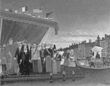
The 1907 carpet renders the rank ordering graphically: with the exception of Iran and the Ottoman Empire, the top row is devoted to European and North American countries, while other regions are represented primarily along the sides. As noted earlier, the weavers moved Britain's Queen Victoria (bust number 3) from a mid-level position on the side of the carpet, where the original source image had placed her, to a top-level position, in place of a Chinese emperor. The Chinese and British buildings were left in their original locations. Compare the carpet with another representation of the world of nations, also dating from 1907: the painting The Representatives of the Foreign Powers Coming to Salute the [French] Republic as a Sign of Peace (Figure 2) by Henri “Le Douanier” Rousseau of France. Europe and North America dominate the scene, with eight of thirteen identifiable flags and seventeen of twenty-three persons. Five of the six non-Europeans are depicted as small and marginal.62
Roger Shattuck et al., Henri Rousseau (New York: Museum of Modern Art, 1985), 178–80; Götz Adriani, Henri Rousseau (Cologne: DuMont, 2001), 196–201. I thank Oleg Grabar for drawing my attention to this painting.
“Equality” is missing from the series of vases in the foreground labeled “Liberty” and “Fraternity”—instead, Rousseau offered “Peace” and “Labor.”
Henri Rousseau, “Les représentants des puissances étrangères venant saluer la République en signe de paix” (The Representatives of the Foreign Powers Coming to Salute the [French] Republic as a Sign of Peace, 1907). For legend to Figure 2, please see Appendix.
Both of these images reflect the perception, then as now, that international society was constituted primarily by Europe and North America. Most of the international conferences were held there; the ideology of globality was most highly developed there; and the most powerful states in the world were based there. The institutions and ideals of modernity presented themselves as universal in scope—all peoples could and should eventually adopt them, though some would take longer than others—but they were not universal in origin. They emerged in a particular geographic location and were associated with that region's military ascendancy.
Even non-European models had become powerful, it was widely thought, because they had adopted European ways. Japan was the prime example for Iranians and many others, especially after its military forced Russia out of Korea and Manchuria in 1904–1905, the first time in centuries that an Asian country had so soundly defeated a European country.63
Abdul-Hadi Hairi, “European and Asian Influences on the Persian Revolution of 1906,” Asian Affairs 62 (1975): 155–64; Klaus Kreiser, “Der japanische Sieg über Russland (1905) und sein Echo unter den Muslimen” (The Japanese Victory over Russia [1905] and Its Echo among the Muslims), Die Welt des Islams 21 (1981): 209–39; Renée Worringer, “‘Sick Man of Europe’ or ‘Japan of the Near East’? Constructing Ottoman Modernity in the Hamidian and Young Turk Eras,” International Journal of Middle East Studies 36 (2004): 207–30. Before the war with Russia, Iranians attributed Japan's strength in large part to domestic cultural factors. See Hashem Rajabzadeh, “Japan as Seen by Qajar Travelers,” in Society and Culture in Qajar Iran, ed. Elton L. Daniel (Costa Mesa, Calif.: Mazda Publishers, 2002), 285–309.
“Three thousand Japanese youths are busy studying today in Paris,” according to an Iranian student in Europe, “and not one of them can be found in coffee houses or is seen in a
majlis-i sayr va tamāshā [dinner theater?], or spending one dinar out of place, and with complete contentment they pursue the study of science. But the Iranians spend their time in wasteful places unrelated [to study] and have become the proverbial spenders and squanderers.”
64 Habl al-matin 14, 24 (28 January 1907), 17. I thank Mahmoud Sadri and Mohamad Tavakoli-Targhi for translation assistance with this passage. The Egyptian nationalist Mustafa Kamil reported similar impressions of Japanese students, quoting a Russian student in Paris who disliked the Japanese for their studiousness but admired the results of their dedication. Kamil also credited constitutionalism for Japan's strength. See Michael Laffan, “Mustafa and the Mikado: A Francophile Egyptian's Turn to Meiji Japan,” Japanese Studies 19 (1999): 275, 283.
Japan's Western-style constitution, too, deserved credit in Iranian eyes: “because of constitutionalism (
mashrūtagī), Japan turned great, so that it defeated such a large enemy [that is, Russia]…. Constitutionalism is the condition of justice and equity.”
65 Mirza Husayn-
Ali Tajir Shirazi, Mikadu-namah (The Book of Mikado) (Calcutta: Matba
-i Habl al-Matin, 1907), 110, as quoted in Faridun Adamiyat, Idi
uluzhi-yi Nahzat-i mashrutiyat-i Iran (Ideology of the Constitutionalist Movement of Iran), vol. 1 (Tehran: Intisharat-i Payam, [1976]), 342.
An Iranian newspaper featured a cover portrait of “His Highness Mutsuhito, the mikado and king of Japan, who personally overturned the 2,000-year-old customs and conventions of his country and stepped into the field of civilization, recognizing that the constitution and parliament would assure the survival and solidity of his monarchy.”
66 Shahanshahi 1, 39 (20 November 1906), 1.
Muzaffar al-Din Shah also acknowledged the connection. A confidant recalled that the king, strolling on a palace veranda, “came close to me and slowly asked, ‘Does Japan have a parliament?’ I said, ‘For the past eight years.’”
67 Hidayat, Khatirat va-khatarat, 142. The Japanese Parliament was founded in 1890.
Notwithstanding the example of Japan, the discourse of modernization in Iran, as elsewhere, was thoroughly Eurocentric—embarrassingly so to 21st-century sensibilities. Not all went as far as the leftist intellectual Muhammad Amin Rasulzadah, who argued that “our sole solution is to accept European principles willingly”—specifically, science and industry—since the house of Iran is too “old and decayed” to be repaired and would otherwise be rebuilt by foreign conquerors;68
Muhammad Amin Rasulzadah, “Yik mulahazah-yi asasi” (A Fundamental Observation), Iran-i no (New Iran) 2, 7 (29 October 1910), 1. I thank Hossein Abadian for directing me to this article and Mohamad Tavakoli-Targhi for providing me with a copy. A similar image appeared at a March 1905 meeting of the revolutionary constitutionalists: “the house of Iran is ruined…. If you don't knock it down completely and then build a new one, other people will come and do it for you” (Nazim al-Islam Kirmani, Tarikh-i bidari-yi Iraniyan [History of the Awakening of the Iranians], ed.
Ali
Akbar Sa
idi Sirjani [Tehran: Intisharat-i Bunyad-i Farhang-i Iran, 1967], 1:43).
or Hasan Taqizadah, the nationalist intellectual who paradoxically urged “the adoption and promotion, without condition or reservation, of European civilization, absolute submission to Europe, and the assimilation of the culture, customs, practices, organization, sciences, arts, life, and the whole attitude of Europe, without any exception save language; and the putting aside of every kind of self-satisfaction, and such senseless objections as arise from a mistaken, or, as we prefer to call it, a false patriotism.”
69 Kavah (Kavah [an ancient Iranian hero]; Berlin) 5, 1 (22 January 1920), 2, translated in Edward G. Browne, A Literary History of Persia (Cambridge: Cambridge University Press, 1928), 4:486. See also Ali Mirsepassi, Intellectual Discourse and the Politics of Modernization: Negotiating Modernity in Iran (Cambridge: Cambridge University Press, 2000), 54.
The most obvious instances of “Westoxification” were easily mocked, such as the young, Western-educated Iranians who adopted European-style clothing for no reason other than its association with Europe.
70 The term “westoxification” (gharbzadigī) was popularized in the 1960s by Jalal Al-i-Ahmad's book of the same name, but the idea can be found in the late 19th century.
In the words of the 19th-century Iranian diplomat Majd al-Mulk, “The Iranian chameleons who have returned home from St. Petersburg and other cities and for whose sake the state had to suffer great losses, of all the sciences at their disposal [they] have learned two things: contempt for the people [of their own country] and dishonor to their nation.”
71 Maryam D. Ekhtiar, “The Dar al-Funun: Educational Reform and Cultural Development in Qajar Iran” (Ph.D. diss., Department of Near Eastern Languages and Literatures, New York University, 1994), 203.
Yet respect for global norms, and particularly their European manifestations, went beyond the circles of Western-educated radicals. This discussion uses the example of constitutionalism, though analogous evidence can be provided for other modern institutions, such as science. Three senior religious scholars of Najaf, Iraq—Muhammad Husayn (Tihrani), Muhammad Kazim al-Khurasani, and
Abdullah Mazandarani—sent an open telegram in late 1908 noting that Muhammad
Ali Shah's abrogation of the constitution involved “the lamentable suppression of the glorious word of God and other Islamic rites, which even the un-Islamic states respect.”
72 Muhammad Mahdi Sharif-Kashani, Vaqa
at-i ittifaqiyah dar ruzgar (Events of the Day), ed. Mansurah Ittihadiyya (Nizam Mafi) and Sirus Sa
dvandiyan (Tehran: Nashr-i Tarikh-i Iran, 1983), 1:245.
The following year, Ahmad Shah's message of welcome to the second Parliament urged the Parliament and cabinet to “commit themselves first of all to [bringing] the administrative order and its forms of organization gradually into accord with the principles of civilized countries.”
73 Majlis (Parliament; Tehran) 3, 37 (28 October 1909), 1. A freer translation of these comments appears in Amin Maalouf, Samarkand: A Novel, trans. Russell Harris (New York: Interlink Books, 1996 [1989]), 263. I thank Mohamad Tavakoli-Targhi for providing me with the Persian original.
Ayatollah Muhammad Tabataba
i told the first sessions of the Iranian Parliament that European institutions were the root of all good things: “I'd never seen the constitutional countries myself. But what I'd heard, and those who had seen the constitutional countries told me, the constitution is the cause of the security and flourishing of the country.”
74 Fereydun Adamiyat, Fikr-i dimukrasi-yi ijtima
i dar nahzat-i mashrutiyat-i Iran (Social Democratic Thought in the Constitutionalist Movement) (Tehran: Intisharat-i Payam, 1975), 4.
Similarly, Ayatollah
Abdullah Bihbihani praised European legislation and urged Parliament only to be subtle about isomorphism: “I have a request to make. Never argue that in such and such a country they have done this or that, so let us do likewise! For the common people would not understand, and we would be offended. We now have laws, and we have the Qur
an. I do not mean that you should not mention this; you certainly should. But if you analyse the matter, you will find that what they [the foreigners] have done is based on wisdom and derived from the laws of the sharī
a.”
75 Majlis 1, 67 (8 April 1907), 2–3, translated in F. R. C. Bagley, “New Light on the Iranian Constitutional Movement,” in Bosworth and Hillebrand, Qajar Iran, 54. Members of Parliament frequently invoked European and global models: see, for example, Muzakarat-i majlis (Parliamentary Proceedings) (Tehran: Chapkhanah-yi Majlis, 1946), 1:128, 207, 237, 367, 415.
Anti-modernists such as Shaykh Fazlullah Nuri derided such positions as inauthentic: “this National Assembly, liberty and freedom, equality and parity, and the principle of the present constitutional law [are] a dress sown for the body of Europe (Farangistān).”
76 Mohamad Tavakoli-Targhi, Refashioning Iran (Houndsmills, U.K.: Palgrave, 2001), 141.
Nuri, the chief clerical opponent of parliamentarism in Iran at the time, charged that constitutionalists “want to make Iran's Consultative Assembly the Parliament of Paris…. We see today that in the Majlis-i Shura [Consultative Assembly] they have brought the legal books of the European parliament[s] and have deemed it necessary to expand the law…whereas we the people of Islam have a heavenly and eternal Sacred Law.”
77 Said Amir Arjomand, “The Ulama's Traditionalist Opposition to Parliamentarism, 1907–1909,” Middle Eastern Studies 17 (1981): 180.
The Imam Jum
ah of Tehran rejected a plan in Parliament on the grounds that “the people of this country are not like the people of other countries.”
78 Muzakarat-i majlis, 12 June 1907, 1:188.
Similarly, Aqa Shaykh Isma
il Mahallati argued that liberty in Iran “will be liberty from all kinds of oppression and injustice as understood by the religion of Islam, not by the religion of Buddha and the country of Japan, or by Christianity (madhhab-i Naṣārī) and the European countries…. Those laws will differ according to the particularities of the countries and the differences in religions, so that [the laws] are not mysterious to the people [of each land].”
79 Aqa Shaykh Isma
il Mahallati, open letter of 11 February 1909, in Sharif-Kashani, Vaqa
at-i ittifaqiyah, 1:250. I thank Hossein Abadian for drawing my attention to this open letter.
But even Muhammad
Ali Shah, who derided constitutionalism as ruinous anarchy and sought to reassert absolute monarchical power, adopted global references: “I have announced to all states that Iran is constitutional (mashrūṭah) and is to be counted among the constitutional states (duvval-i kunstītūsiyūn).”
80 Mahdi Malikzadah, Tarikh-i inqilab-i mashrutiyat-i Iran (History of the Constitutional Revolution of Iran), 4th ed. (Tehran: Intisharat-i
Ilmi, n.d.), 3:676.
And, of course, Muhammad
Ali Shah made use of European institutions when they suited his purposes, most glaringly a Russian military unit, the Cossack Brigade, that shelled Parliament and dispersed its members and supporters on his behalf. One might also see global references in Muhammad
Ali Shah's frequent equation of the terms “Iran” and “the nation” (millat), words that, over the course of the 19th century, had come to represent an identity equivalent to the identities of European and other nations.
81 Tavakoli-Targhi, Refashioning Iran, 96 and passim; Kashani-Sabet, Frontier Fictions, 240 and passim; Mostafa Vakili, Iran as Imagined Nation: The Construction of National Identity (New York: Paragon House, 1993), 95 and passim.
“Whatever one may think of it, one sees that these are not the same people as last year,” wrote a Tehran newspaper. “Everyone you see is speaking of Iran.”
82 Sur-i Israfil 1, 1 (30 May 1907), 3.
“Everyone” included the monarch.
IN SEARCH OF NATIONAL IDENTITY
Nationalism claims that each nation has a unique, ancient genius. Conformity in diversity is often enforced by nationalist hostility to elements of local culture that are shared with other nations and thus considered to be insufficiently distinctive. For example, the Pahlavi regime and associated academic organizations worked to purge certain Arabic-derived words from the Persian language, beginning in the 1920s, and to replace them with “pure” Iranian words.83
M. A. Jazayery, “The Modernization of the Persian Vocabulary and Language Reform in Iran,” in Language Reform: History and Future, ed. István Fodor and Claude Hagège (Hamburg: Buske, 1983) 2:241–68; Ahmad Karimi-Hakkak, “Language Reform Movement and Its Language Use: The Case of Persian,” in The Politics of Language Purism, ed. Björn Jernudd and Michael Shapiro (Berlin: Mouton de Gruyter, 1989), 81–104; Mehrdad Kia, “Persian Nationalism and the Campaign for Language Purification,” Middle Eastern Studies 34 (1998): 9–36; John R. Perry, “Language Reform in Turkey and Iran,” International Journal of Middle East Studies 17 (1985): 295–311.
Calls for linguistic purification emerged during the 18th and 19th centuries, aiming to restore the “simple” Persian of classical texts.
84 Kia, “Persian Nationalism,” 11–17; Tavakoli-Targhi, Refashioning Iran, 104–12.
Over the course of the 19th century, these calls came to identify linguistic purity with global norms of national identity. Jalal al-Din Mirza, a Qajar prince educated at the first Western-style academy in Tehran, argued that his writings, using “the language of our ancestors which like everything else has been violated and plundered by the Arabs,” were modeled after the works of Europeans, the most “learned people on earth.”
85 Kia, “Persian Nationalism,” 12.
Mirza Aqa Khan Kirmani, a nationalist activist with similarly negative views of Arabs and Arabic, disagreed with the revival of dead languages, proposing instead to “gather the various Persian languages and stories and words from the tribes and villages of Iran and strive to revive them, so as to demonstrate the dignity of the Iranian race (
jins)”—a dignity that Kirmani compared negatively with “all of the neighboring nations and other states” that “are striving to reform public conditions in their own republics.”
86 Mirza Aqa Khan Kirmani, A
inah-yi Sikandari: tarikh-i Iran (Alexandrine/Stumbling Mirror: The History of Iran), ed. Mirza Jahangir Khan Shirazi (Tehran: n.p., 1906), 577, 629. See also Kia, “Persian Nationalism,” 12–13.
Indeed, this was the usual pattern for European nationalists of the 19th and early 20th centuries, who conducted intensive research into the folkways of the putative nation, which were then heralded as the basis for state sovereignty. Czech nationalists, for instance, were obsessed with identifying “pure” Czech language and customs, which the nationalists—many of whom were themselves cosmopolitan German-speakers—then adopted in stylized forms.
87 Miroslav Hroch, “From National Movement to the Fully-Formed Nation: The Nation-Building Process in Europe,” in Becoming National, ed. Geoff Eley and Ronald Grigor Suny (New York: Oxford University Press, 1996), 60–77.
Iranian nationalism did not act on Kirmani's interest in popular folkways until the 1920s.
88 Ulrich Marzolph, “Folklore Studies. i. Of Persia,” in Yarshater, Encylopaedia Iranica, 10: 71.
A second pillar of Iranian national identity was the land's pre-Islamic heritage. It was common for European states of the 19th and early 20th centuries, as part of the nation-building movement, to invent traditions—flags, anthems, rituals, and the like—that linked the contemporary nation with its ancient precursors.
89 Eric Hobsbawm and Terence Ranger, ed., The Invention of Tradition (Cambridge: Cambridge University Press, 1983).
In Egypt, too, nationalists of this period embraced the legacy of their land's ancient civilizations; even a conservative Islamic newspaper put pyramids on its masthead in 1913.
90 Donald M. Reid, Whose Pharaohs? Archaeology, Museums, and Egyptian National Identity from Napoleon to World War I (Berkeley: University of California Press, 2002), 296–97 and passim. Cf. Youssef M. Choueiri, Modern Arab Historiography: Historical Discourse and the Nation-State, rev. ed. (London: RoutledgeCurzon, 2003); Allen J. Frank, Islamic Historiography and “Bulghar” Identity among the Tatars and Bashkirs of Russia (Leiden: E. J. Brill, 1998), esp. chap. 6; Wendy M. K. Shaw, Possessors and Possessed: Museums, Archaeology, and the Visualization of History in the Late Ottoman Empire (Berkeley: University of California Press, 2003), esp. chaps. 6 and 9; and Neil Asher Silberman, Between Past and Present: Archaeology, Ideology, and Nationalism in the Modern Middle East (New York: Henry Holt, 1989).
So, too, did certain Iranian noblemen give their sons ancient Iranian names and applaud efforts to link the Qajar dynasty with ancient Iranian rulers. Farmanfarma, for example, sponsored the publication of Kirmani's versified history of the ancients
91 Tavakoli-Targhi, Refashioning Iran, 98–103, 175; Edward G. Browne, Materials for the Study of the Babi Religion (Cambridge: Cambridge University Press, 1918), 225.
and commissioned a carpet of Ahura Mazda, the ancient god, as depicted in a French book reproducing a bas-relief at Persepolis.
92 Schlamminger and Wilson, Weaver of Tales, 106–7; see also Preece, “Report of a Journey,” 31, on Farmanfarma's commission of “carpets with designs after some of the processions in the Hall of One Hundred Columns at Persepolis.”
Muhammad
Ali Shah identified himself with a 6,000-year tradition of Iranian monarchy, 3,500 years more than Muhammad Riza Shah later claimed during his notorious celebration at Persepolis in 1971.
93 Jashn
ha-yi 2,500 salah-i shahanshahi bih rivayat-i asnad-i SAVAK va-darbar (The Celebrations of 2,500 Years of Monarchy, According to SAVAK and Royal Court Documents), 2 vols. (Tehran: Markaz-i Barrasi-yi Asnad-i Tarikhi-yi Vizarat-i Ittila
at, 1998).
Disorder, Muhammad
Ali Shah declared in 1908, “is weakening the foundations of the 6,000-year-old Iranian monarchy, and on the basis of extensive personal duty I do not consider it permissible to endure this in silence.”
94 Jahangir Qa
im-Maqami, Asnad-i tarikhi-yi vaqa
i-yi mashrut-i Iran: namah
ha-yi Zahir al-Daulah (Historical Documents of the Constitutionalist Events of Iran: The Letters of Zahir al-Daulah) (Tehran: Kitabkhana-yi Tahuri, 1969), 38; see also Malikzadah, Tarikh, 3:675.
I have pledged, he stated the following year, to protect “this 6,000-year-old country that is our house and home (
manzalah-yi khānah-yi maskūnī) and cherished homeland (
vaṭan-i azīz). There is no remedy [for present problems] except the combined forces of national strength with state and royal strength; there is no way to care for and serve this compassionate mother [that is, Iran], other than the assistance and remedy-seeking of the whole family of this pure land (
umūm-i ahl-i īn khāk-i pāk).”
95 Sharif-Kashani, Vaqa
at-i ittifaqiyah, 1:305. On gendered images of Iran, see Tavakoli-Targhi, Refashioning Iran, 123–27, and idem, “From Patriotism to Matriotism,” passim; Afsaneh Najmabadi, “The Erotic Vatan (Homeland) as Beloved and Mother: To Love, to Possess, and to Protect,” Comparative Studies in Society and History 39 (1997): 442–67.
Muhammad
Ali Shah's words suggest that territory—home, homeland, land—was widely accepted “as forming the basis of statehood or of political identity and allegiance” in the early 20th century.
96 The quote is from Bernard Lewis, who claims that “at no time were these [ethnic, cultural, or regional identities] seen as forming the basis of statehood or of political identity and allegiance” in the Islamic world. In the pages that follow, Lewis appears to contradict the phrase “at no time” by discussing the rise of nationalism in Muslim societies over the past two centuries: Bernard Lewis, What Went Wrong? Western Impact and Middle Eastern Response (New York: Oxford University Press, 2002), 102.
Some constitutionalists offered an alternative version of national identity, criticizing the current monarchy for failing to live up to Iran's long-standing traditions of glorious kingship. A newspaper poem in 1908, for example, compared the autocratic rule of Muhammad
Ali Shah unfavorably with that of Nadir Shah, founder of the Afshar dynasty in the 18th century:
The state can befriend the nation. Never say it cannot, sob sob.
It can sympathize with the country. Never say it cannot, sob sob.
It can be like Nadir Afshar. Never say it cannot, sob sob.97
Nasim-i shimal (The Breeze of the North; Rasht, Iran) 1, 22 (18 June 1908), in Edward G. Browne, The Press and Poetry of Modern Persia (Los Angeles: Kalimát Press, 1983 [1914]), 199.
Reaching farther back into history, the constitutionalist activist Malik al-Mutakallimin inverted the royal reference to a 6,000-year legacy, claiming this heritage for constitutionalism. “In our several thousand years of life, we have never been without law. And like other nations, we have [never] lived without religious law (
sharīa) and religion. Before the appearance of the sacred religion of Islam, we were monotheistic and God-worshiping for thousands of years.”
98 Sur-i Israfil 1, 3 (13 June 1907), 7. Yet this newspaper could also mock ancient Iran for its conceit and ambition, even as it used the ancients to mock the present regime. See Sur-i Israfil 1, 2 (6 June 1907), 9–10, translated in Browne, A Literary History of Persia, 4:479–80.
Another author invoked Iran's pre–Islamic legacy even more enthusiastically and was jailed for insulting Islam:
The nation of Iran took precedence in the history of world civilization. From the beginning of history, it was counted among the great countries of the world in civilization and state power…. But the worst event to destroy the preeminence of the people and independence of Iran was when the savage people of the Arabian peninsula, the Bedouins, and the lizard-eating Arab race99
Iranians have used the epithet “lizard-eating” for Arabs for a millennium: see Roy P. Mottahedeh, “The Shu
ubiyah Controversy and the Social History of Early Islamic Iran,” International Journal of Middle East Studies 7 (1976): 162.
invaded Iran. For 1,300 years now, the Iranian race has tried to remove the weight of their superstitions. Whenever a worthy descendant of Iran rises up and succeeds for a time, however partially, in rescuing the ancient nation from the onerous burden of bondage and slavery and the shackles of superstition, a stone falls again to block the path of Iran's progress.
100 Habl al-matin (Tehran) 3, 6 (1909), in Malikzadah, Tarikh, 6:1289–90. On the author's arrest, see Browne, The Press and Poetry, 74. On similar themes in the work of Mirza Fath
Ali Akhundzadah, see Tavakoli-Targhi, Refashioning Iran, 102.
References to the world appear throughout these invocations of Iran's ancient identity.
101 Juan R. I. Cole, “Marking Boundaries, Marking Time: The Iranian Past and the Construction of the Self by Qajar Thinkers,” Iranian Studies 29 (1996): 41.
Recovering national history is part of what proper nations do, argued Muhammad Hasan Khan (I
timad al-Saltanah), a modern-educated government minister of the 19th century, “for a civilized people and a great nation…no imaginable flaw is more severe than ignorance of the history of their country and a total forgetting of events of the former times.”
102 Tavakoli-Targhi, Refashioning Iran, 100.
THE GLOBALITY OF AUTHENTIC ISLAM
The Iranian constitutionalist movement was particularly interested in the Iranian flag as a symbol of the nation. In 1907, the design of the flag was specified in the fifth article of the supplement to the constitution.103
A. Shapur Shahbazi, “Flags. i. Of Persia,” in Yarshater, Encyclopaedia Iranica, 10:24–25.
Several years earlier, the first meeting of the Constitutionalist Revolutionary Committee adopted a previous version of the flag as an important icon:
Sayyid Jamal al-Din [Va
iz, a clerical activist] pulled out of his cloak an Iranian flag on which was written, in large letters, “Law—Justice,” and put it [on the table] next to the glorious Qur
an. Then each confederate went up respectfully, enthusiastically, ecstatically, and raised the glorious word of God with one hand, and the flag of Iran with the other. In front of God, represented by the Qur
an, and the homeland, understood to be manifested in the flag of Iran,
104 The Turkish-derived term “parcham” may be an anachronism, as it came into widespread usage only in the 1920s: see ibid., 10:26.
they pledged to keep the secrets of the group and to strive united in heart and soul for the achievement of law and justice and the downfall of the oppressive and unjust regime.
105 Malikzadah, Tarikh, 2:239–40.
One might view the flag and the Qur
an as a marriage of the two symbols of nation and faith. But Mahdi Malikzadah, the author of this account and son of one of the key organizers of the constitutionalists' meeting, urged readers to view the two symbols separately. The nation was said to be represented only by the flag, and not by the Qur
an. This reluctance to identify the nation with Islam was elaborated later in the meeting. Malikzadah's father, Malik al-Mutakallimin, argued that Islam was—at least, institutionally—on the side of the monarchy, not the nation. “Power in this country is in the hands of two classes, the state officials and the religious scholars, and up to now they have colluded with one another to rule the country.”
106 This concern may have been overstated, since religious scholars had on numerous occasions over the previous century resisted various policies of the Qajar regime, if not the existence and structure of the regime itself.
107 Hamid Algar, Religion and State in Iran, 1785–1906: The Role of the Ulama in the Qajar Period (Berkeley: University of California Press, 1969).
In any case, the constitutionalists so mistrusted Islamic scholars that they hoped to win them over “without letting them know of our real goals,” according to Article 7 of the bylaws ratified at the meeting.
108 Malikzadah, Tarikh, 2:242.
Article 10 urged activists not to publish material “related to the laws of Islam, or anything that would hand the weapon of excommunication (
takfīr) to ill-wishers.”
109 Other constitutionalists were even more careful not to identify the nation exclusively with Islam. A second group of activists, the Secret Society, stipulated in Article 2 of its bylaws, “Disciples of four religions can be accepted in this organization: first, those who are under the word of the community (dar taḥt-i kalamah-yi jāma
ah) of ‘There is no god but God, and Muhammad is the prophet of God’; second, the community (ṭāyifah) of Zoroastrians; third, the Jew; fourth, the Christian (Naṣārī)—on condition that they be of Iranian origin and Iranian race (Īrānī al-aṣl va-Īrānī nizhād).”
110 Nazim al-Islam Kirmani, Tarikh-i bidari-yi Iraniyan, 1:46–47.
This list includes multiple faiths in the “Iranian race.” Indeed, the roundabout reference to Muslims, avoiding the terms “Muslim” and “Islam,” may have been intended to include Azali Babis, the persecuted sect considered heretical by Islamic authorities. Several Azali Babis were active constitutionalists.
111 Browne, Materials, 221; Nikki R. Keddie, “Religion and Irreligion in Early Iranian Nationalism,” Comparative Studies in Society and History 4 (1962): 273–74; Mangol Bayat, Iran's First Revolution: Shi
ism and the Constitutional Revolution of 1905–1909 (New York: Oxford University Press, 1991), 53–75; Janet Afary, The Iranian Constitutional Revolution, 1906–1911 (New York: Columbia University Press, 1996), 44–47. In addition to Azali Babis, at least one Baha
i participated in the founding of the Constitutionalist Revolutionary Committee—namely, Abu al-Hasan Mirza (Shaykh al-Ra
is), who “unlike some Baha
is…had an ability to get along with Azali Babis”: Juan R. I. Cole, “Autobiography and Silence: The Early Career of Shaykh al-Ra
is Qajar,” in Iran im 19. Jahrhundert und die Entstehung der Baha
i-Religion (Iran in the 19th Century and the Emergence of the Baha
i Religion), ed. J. Christoph Bürgel and Isabel Schayani (Hildesheim, Germany: Olms, 1998), 104. The leader of the Baha
is supported the Constitutional Revolution in its early stages: idem, “Iranian Millenarianism and Democratic Thought in the 19th Century,” International Journal of Middle East Studies 24 (1992): 2, 23.
Nevertheless, constitutionalists frequently held up early Islamic history as a model for the contemporary Iranian nation, both privately and publicly. Virtually all of the movement's public documents, even when they chastised religious leaders, appealed to Islamic ideals and precedents, beginning with Mirza Yusuf Khan (Mustashar al-Daulah), whose influential tract Yik kalamah (One Word; 1870) held up French-style law—“law” being the one word referred to in the title—as both the solution to Iran's contemporary problems and the true expression of Islam. “I have found proofs and verses from the glorious Qur
an and the hadith for all the means of progress and civilization,” Mustashar al-Daulah wrote to a colleague, “so that they [shall] no longer say that such and such thing is opposed to the principles of Islam, or that the principles of Islam prevent progress and civilization.”
112 Mehrdad Kia, “Constitutionalism, Economic Modernization and Islam in the Writings of Mirza Yusef Khan Mostashar od-Dowle,” Middle Eastern Studies 30 (1994): 763.
Similarly, an early meeting of the Secret Society engaged in a lengthy discussion of Imam Husayn, concluding that he was the first person ever to organize a secret revolutionary group to overthrow an evil ruler.
113 Nazim al-Islam Kirmani, Tarikh-i bidari-yi Iraniyan, 1:44–45; Bayat, Iran's First Revolution, 74.
The insistence on Islamic precedent went hand in hand with the adoption of foreign models of constitutional rule. The connection lay in the trope of “revival,” also called rebirth or renewal.
114 Charles Kurzman, “Introduction: The Modernist Islamic Movement,” in Modernist Islam, 1840–1940: A Sourcebook, ed. Charles Kurzman (New York: Oxford University Press, 2002), 17.
There was a happy coincidence, certain religious scholars held, between the original ideals of Islam and modern European institutions. By adopting European models, one could at the same time be true to one's faith. This was the argument of Ayatollah Muhammad Husayn Na
ini, assigned by several leading Shi
i religious scholars in 1908 to write a defense of constitutionalism:
[Europeans] appropriated the principles of civilization and politics implicit in the Islamic holy books and traditions, and in the edicts of
Ali [son-in-law and fourth successor of the Prophet] and other early leaders of Islam, as they have justly acknowledged in their earlier histories, as they have admitted that learning such principles and sciences conducive to such spectacular advances in such a short period of time would be impossible for unaided human reason. Therefore the progress and perseverance of the West in translation, interpretation, and application of these principles on the one hand, and the concomitant regression of the people of Islam and their subjugation at the hands of unbelievers [the Mongol conquerors] resulted in such a state that Muslims gradually forgot the principles of their own historical origins and even supposed that abject subordination is a necessity of Islamic life. Therefore they thought that the commandments of Islam are contrary to civilization, reason, and justice—the fountainhead of progress—and as such, they equated Islam with slavery and savagery.
115 Muhammad Husayn Na
ini, Tanbih al-ummah wa-tanzih al-millah ya hukumat az nazar-i Islam (Exhortation of the Faithful and Purification of the Nation, or Government from the Perspective of Islam [1909]), 6th ed. (Tehran: Shirkat-i Sahami-yi Intishar, 1960), 1–3, trans. Mahmoud Sadri, in Kurzman, Modernist Islam, 116.
Various other texts by religious scholars in support of constitutionalism and other reforms also praised global standards in addition to Islamic ideals. For example, Sayyid
Abd al-
Azim
Imad al-
Ulama
Khalkhali wrote:
In this age, especially in our time, sovereignty is founded on justice, fairness, and the principle of equality, as is obvious from the Europeans. As a result of contacts with foreign countries and of association with civilized nations, and of studying political books and articles, reading foreign and domestic journals, acquiring knowledge of the relationship between the civilized rulers and their respective subjects, and being informed of the desirability and benefits of constitutional government, the eyes of the Iranians have been opened, their ears alerted, and their tongues unleashed. They do not tolerate tyrannical actions or unruly behavior. They now have their opinions about internal and external affairs, have become a “people of loosening and binding” [those who are called to consult in the affairs of state, according to longstanding Islamic jurisprudence], supervising their mutual affairs, and capable of acceptance or rejection.116
Sayyid
Abd al-
Azim
Imad al-
Ulama
Khalkhali, “A Treatise on the Meaning of Constitutional Government,” trans. Hamid Dabashi, in Authority and Political Culture in Shi
ism, ed. Said Amir Arjomand (Albany: State University of New York Press, 1988), 339–40.
And Ayatollah Tabataba
i pronounced:
God commands that men follow the path of justice. The prophets and saints have called men to justice. Justice and equality are the first duty of humanity, and survival of the [human] race depends on justice. In the Qur
an and the stories of the innocent ones [Fatima,
Ali, and the twelve Imams], there is an insistence on justice. “God enjoins that you render to the owners what is held in trust with you, that when you judge among people, do so with justice. Noble are the counsels of God, and God hears all and sees everything” [Qur
an, sura 4, verse 58]. “Oh, believers! Be responsible to God and bear witness to justice. Do not let [your] hatred of others turn you toward injustice. Be just, as this is closer to piety. Fear God, as God knows your actions” [Qur
an, sura 5, verse 8]. Today, the non-believers and foreign nations have adopted the path of justice. We Muslims have deviated from the path of justice.
117 Muhammad Tabataba
i, sermon of 6 July 1906, in Nazim al-Islam Kirmani, Tarikh-i bidari-yi Iraniyan, 2:204. I thank Eli Alshech and Sait Özervarli for translation assistance.
Appreciation of global norms, as embodied in European practices, was not limited to Iranian Shi
ism of this era. Some of the most influential Sunni Muslim writers of the early 20th century expressed great admiration for European models on matters such as constitutionalism. “The greatest benefit that the peoples of the Orient have derived from the Europeans was to learn how real government ought to be,” wrote Rashid Rida of Egypt. “Do not, O Muslim, say that this type of government is one of the basic foundations of our religion, so that we have simply inferred it from the Qur
an and the life stories of the rightly guided caliphs, and not as a result of associating with the Europeans and being acquainted with the conditions of Westerners.”
118 Rashid Rida, “al-Istibdad” (Oppression), al-Manar (The Beacon; Cairo) 10, 4 (11 June 1907), 279–84, translated in Youssef M. Choueiri, Islamic Fundamentalism, rev. ed. (London: Pinter, 1997), 46.
Similarly, Muhammad Iqbal of India wrote that democracy “is the most important aspect of Islam regarded as a political ideal. It must, however, be confessed that the Muslims, with their ideal of individual freedom, could do nothing for the political improvement of Asia.” Only the British Empire deserved credit for this improvement. “Democracy has been the great mission of England in modern times…. England, in fact, is doing one of our own great duties, which unfavorable circumstances did not permit us to perform. It is not the number of Muhammadans which it protects, but the spirit of the British Empire that makes it the greatest Muhammadan Empire in the world.”
119 Muhammad Iqbal, “Islam as a Moral and Political Ideal,” Hindustan Review 20 (August 1909): 169, in Kurzman, Modernist Islam, 312.
Both Rida and Iqbal stressed that contact with Europeans has encouraged Muslims to respect global norms of governance. This privileging of external models may be surprising, given these authors' later reputations as proponents of Islamic authenticity, but it was hardly unusual among Islamic modernists of the early 20th century. Ziya Gökalp of Ottoman Turkey, for example, argued that “Islam is not contrary to a modern state, but, on the contrary, the Islamic state means a modern state. But how did it happen that the modern states came into existence only in Christendom?”120
Ziya Gökalp, “İslamiyet ve Asrî Medeniyet” (Islam and Modern Civilization), İslam Mecmuasi (Islam Journal; Istanbul) 3, 52 (1 March 1917), 1038–39, trans. Niyazi Berkes, Turkish Nationalism and Western Civilization: Selected Essays of Ziya Gökalp (London: George Allen and Unwin, 1959), 222, in Kurzman, Modernist Islam, 197.
Rizaeddin ibn Fakhreddin of Russian Tatarstan opined that “civilization in its real meaning” had not yet “appeared in the Muslim world,” due to the loss of the inventive and entrepreneurial spirit of the early Islamic era. Had this spirit not been lost, he continued, “schools, teachers and students in these schools, scholars and artisans, inventors, factories, architects, engineers, doctors, and professors—all those people the Europeans have today would have come from the Muslim world.”
121 Rizaeddin ibn Fakhreddin, Ibn Taymiyya (Orenburg, Russia: Vaqt Matba
asï, 1911), 130, trans. Ahmet Kanlidere, in Kurzman, Modernist Islam, 239.
(The Leader), a prominent Islamic journal of Southeast Asia, called on Malays to “to arise and emulate [civilized] humanity,” to adopt “a ‘parliament’ [word transliterated from English] under the direction of the people.”
122 Al-Imam (The Leader; Singapore) 3, 4 (27 September 1908), 146, trans. Abu Bakar Hamzah, al-Imam: Its Role in Malay Society, 1906–1908 (Kuala Lumpur: Media Cendekiawan, 1991), 190, ed. Michael F. Laffan, in Kurzman, Modernist Islam, 343.
Global imagery was itself a global phenomenon at this time. Iranian modernists were aware of this widespread movement to adopt global norms and linked themselves to modernists elsewhere. Their newspapers reported on developments in other countries—indeed, some of the leading Iranian newspapers prior to 1907 were published in Calcutta, Istanbul, Cairo, and London. These journals frequently urged Iranians to join other nations in becoming both global and authentic, as in a letter from Russia published in Habl al-matin. “Oh respected Muslims, take hold of the firm handle of the true faith and adopt the peoples of Russia as a model so that you may attain your goals.”
123 Habl al-matin 14, 4 (24 August 1906), 9.
In an instance of Iranians watching outsiders watching Iranians, Iranian newspapers in Calcutta and Tehran ran Persian versions of an Arabic “Letter from Tehran” that had been published in
al-Manar, the Islamic newspaper based in Cairo.
124 Ibid., 14, 25 (4 February 1907), 2–3; Sur-i Israfil 1, 2 (6 June 1907), 4–6; ibid., 1, 3 (13 June 1907), 6–7; original in al-Manar 9 (15 January 1907), 930–32.
Iranian modernists reached across the Shi
i–Sunni divide on other occasions, as well. For example, a Tehran newspaper praised Sayyid Jamal al-Din al-Afghani as “among the first to raise the issue of constitutionalism and freedom,” using his adopted Sunni identity (Afghani) rather than his Iranian Shi
i identifier (Asadabadi).
125 A
inah-yi ghayb-nima
(Mystery-Displaying Mirror; Tehran) 1, 27 (23 February 1907), 1. This seems to contradict suggestions that Jamal al-Din had little following in Iran: see Adamiyat, Idi
uluzhi, 148, fn. 1.
At least one Iranian modernist religious scholar urged Shi
is to codify Islamic law, citing the precedent of the Sunni Ottoman Mecelle-i Ahkâm-i Adliye (Compendium of Judicial Statutes) of 1876,
126 Shaykh Asadullah Mamaqani, Maslak al-imam fi-salamat al-Islam (The Imami Religion and the Welfare of Islam) (Istanbul: Matba
ah-yi Shams, 1910), 40. See also Said Amir Arjomand, “Ideological Revolution in Shi
ism,” in Arjomand, Authority, 183.
which equated itself with the civil legal codes of the “civilized nations.”
127 Brinkley Messick, The Calligraphic State: Textual Domination and History in a Muslim Society (Berkeley: University of California Press, 1993), 55.
Iranians urged Sunnis to imitate Shi
is, as well. Three hundred million Muslims are watching, one newspaper wrote. “In this way one can say that the movement of the Iranians is preliminary to the movement of all the Muslims of the world.”
128 Habl al-matin 14, 3 (17 August 1906), 9.
THE IMPORTANCE OF NATIONHOOD
The Columbus carpet offers a beautiful microcosm of the prevailing discourse of globalism in early 20th century Iran. It literally wove Iran into the tree of nations, while numerous political, literary, and religious figures did so figuratively. Invoking Iran's pre-Islamic past, as well as its Islamic and multi-religious identities, these authors sought to create a national identity equivalent to other countries' identities. Equivalence, they felt, would solidify Iran's claims to membership in the world polity, with all the rights commonly associated with membership. “When Iran has a parliament,” one statesman wrote, “the other states of the world will take steps to remedy the encroachments and trespasses of [Iran's] neighbors.”129
Mirza
Ali Khan Amin al-Daulah, Khatarat-i siyasi-yi Mirza
Ali Khan Amin al-Daulah (The Political Memoirs of Mirza
Ali Khan Amin al-Daulah), ed. Hafiz Farmanfarma
ian (Tehran: Kitabha-yi Iran, 1962), 270.
Similarly, a newspaper editorialized, “A civilized state that [conducts] its internal affairs on the basis of legality has equal relations with other states, and is never trampled upon by foreigners.”
130 Shahanshahi 1, 27 (31 July 1906), 3.
These wishes matched the prevailing understandings of the day. In international law, countries were considered to have rights only if powerful European states accepted them as being “civilized” enough to belong to the “Family of Nations.” Notwithstanding the aspirations of Iranian nationalists, Iran enjoyed only semi-sovereign status in this system in the early 20th century. “Persia, Siam, China, Abyssinia, and the like were certainly civilised states, and Abyssinia is even a Christian State,” an important treatise on international law noted in its 1905 and 1912 editions, but “their civilisation has not yet reached that condition which is necessary to enable their Government and their populations in every respect to understand and to carry out the command of the rule of International Law.” As a result, “such States are International Persons only in some respects—namely, those in which they have expressly or tacitly been received into the Family of Nations.”131
L. Oppenheim, International Law: A Treatise (London: Longmans, Green, 1905), 1:33, 148, quoted in Gerrit W. Gong, The Standard of “Civilization” in International Society (Oxford: Oxford University Press, 1984), 57. See also ibid., 2nd ed. (1912), 1:33, 155; ibid., 3rd ed., ed. Ronald F. Roxburgh (1920), 1:35, 181; and ibid., 4th ed., ed. Arnold D. McNair (1926), 1:41. The third edition noted that the League of Nations would likely lead to changes in the system, and the fourth edition said “it is impossible to deny that [these countries] are now international persons and members of the Family of Nations.”
One of the ways in which Iran was expressly received into this family was its participation in the Hague International Peace Conferences of 1899 and 1907, along with only a handful of non–European states.
132 Conférence internationale de la paix: La Haye, 18 mai-29 juillet 1899 (International Peace Conference: The Hague, 18 May–29 July 1899) (The Hague: Imprimerie National, 1899); Deuxième conférence internationale de la paix: La Haye, 15 juin–18 octobre 1907 (Second International Peace Conference: The Hague, 15 June–18 October 1907) (The Hague: Imprimerie Nationale, 1907).
In public, powerful countries sometimes recognized Iran as a member of the “civilized” world. For example, George Nathaniel Curzon, the influential British colonial official, asked in 1892, “Is Persia about to enter, nay, has she already entered, the comity of civilised nations, or does she still sit a contented outcast without the gate?”133
George N. Curzon, Persia and the Persian Question (London: Longmans, Green, 1892), 1:464.
In 1911, Curzon answered his question in the affirmative, to the delight of Iran's British supporters, noting that Muslims, being monotheists, were qualified for membership in international society: “[t]he Mahomedan countries of the world are as much entitled as the Christian countries to the full benefits of the law of nations (cheers). With them equally with European peoples, treaties ought to be kept (loud cheers).”
134 Idem, Persian Autonomy (London: Persia Society, 1911), 10. On Iran's British supporters, see David McLean, “English Radicals, Russia, and the Fate of Persia,” English Historical Review 93 (1978): 338–52; Mansour Bonakdarian, “The Persia Committee and the Constitutional Revolution in Iran,” British Journal of Middle Eastern Studies 18 (1991): 186–207.
However, in practice Iran was accorded only limited benefits of the law of nations at this time. As is well known, Great Britain and Russia disregarded Iran's sovereignty only months after the country gained a constitution, signing an accord that divided Iran into spheres of influence. The accord renounced British prerogatives in the north of Iran and Russian prerogatives in the south, claiming these areas as regions of Russian and British “special interest,” respectively, even as the accord explicitly pledged “to respect the integrity and independence of Persia.” The accord was transmitted to the Iranian Foreign Ministry several weeks after its signing, with an understated cover letter acknowledging that “this agreement has treated matters that may be of interest to the Persian government.”
135 Cecil Spring Rice, British minister in Tehran, to Sa
d al-Daulah, foreign minister of Iran, memorandum of 24 September 1907, in
Ali Akbar Vilayati, Tarikh-i ravabit-i khariji-yi Iran (History of the Foreign Relations of Iran), vol. 1 (Tehran: Daftar-i Mutala
at-i Siyasi va Bayn-al-milli, 1991), 17. A copy of the accord is appended on pp. 18–22.
At the same time, Britain used the discourse of Iranian sovereignty as a cover, when convenient. Within a year of dividing Iran into spheres of interest, the British ambassador instructed consuls in Iran to avoid assisting the constitutional movement, if asked to do so, and to offer the explanation “that England, as a Constitutional country, must always look with sympathy on a constitutional movement; but that it was not fitting or right that she should interfere in the internal affairs of a free and independent people.”
136 Charles M. Marling, British minister in Tehran, to Edward Grey, British foreign minister, memorandum of 17 June 1908, in House of Commons, Sessional Papers, Cd. 4581 (1909), 142.
Again in 1911, soon after Curzon's speech, the British government used similar language to justify acquiescence in the Iranian coup d'état that Russia was supporting. “We certainly cannot encourage [a] coup d'état,” wrote the British foreign minister, “but [we] have no more intention of interfering with a Bakhtiari coup d'état than with previous coups d'état in Persia.”
137 Edward Grey to G. Barclay, British minister in Tehran, telegram of 24 November 1911, in British Documents on the Origins of the War, 1898–1914, vol. 10, pt. 1, ed. G. P. Gooch and Harold Temperley (London: His Majesty's Stationery Office, 1936), 841.
Ironically, the British government was at the same time engaged in preventing a coup d'état by Muhammad
Ali, the former shah.
138 Firuz Kazemzadeh, Russia and Britain in Persia, 1864–1914 (New Haven, Conn.: Yale University Press, 1968), 601, 607, 641; Rose Louise Greaves, “Some Aspects of the Anglo-Russian Convention and Its Working in Persia, 1907–1914,” Bulletin of the School of Oriental and African Studies 31 (1968): 293.
In 1919, Curzon negotiated a treaty with Iran whose goal, he told colleagues in London, was to maintain “British supervision” and “general political dominance” in Iran.
139 Shaul Bakhash, “The Origins of the Anglo-Persian Agreement of 1919,” Asian and African Studies 25 (1991): 27; Houshang Sabahi, British Policy in Persia, 1918–1925 (Portland, Ore.: F. Cass, 1990), 7.
The tsarist government in Russia, for its part, schemed openly to subvert the sovereignty of Iran, sending troops toward Tehran and making public demands that even the Russian ambassador considered specious. The Russian foreign ministry rebuked the ambassador for his objections.
140 Kazemzadeh, Russia and Britain in Persia, 613–19; Jennifer Siegel, Endgame: Britain, Russia, and the Final Struggle for Central Asia (London: I. B. Tauris, 2002), 108.
Throughout the constitutional period, the Ottoman government continued to send troops across the Iranian border with impunity in search of suspected brigands.
141 Richard N. Schofield, ed., Iran–Iraq Border, 1840–1958, vol. 4: Ottoman Encroachments across Northern Border and Recurrence of Muhammara Dispute, 1903–1911 (Farnham Common, U.K.: Archive Editions, 1989).
In short, Iranians could weave their country into a figurative tree of nations, but it took somewhat longer to bring this image to life. Eventually, Iran came to be accepted as a unique but isomorphic unit in the community of nations, just like all the others. It was granted founding-member status in the League of Nations and the United Nations. It was occupied several times by foreign powers but never colonized. Monarchs were overthrown, and the country's name changed, but Iran's sovereign status in the world system remained. These developments cannot be attributed entirely to the intertwined ideologies of globality and nationalism, but they could not have come to pass without persistent mobilization in Iran around the global idea of nationhood. This mobilization stands as evidence that ideologies of national distinctiveness may rely explicitly on a basis of cross-national similarity.
APPENDIX
Legend to Figure 1
People
(1) Muhammad
Ali Shah [of Iran, 1907–09], our monarch and sacrificer for our spirits; (2)
Abdülhamid [II], Ottoman sultan [1876–1909]; (3) [Victoria] English queen [1837–1901; image replaces Tong Zhi or Guang Xu, emperors of China, 1862–74 and 1875–1908]; (4) Franz Josef I, emperor of Austria [1848–1916]; (5) Muzaffar al-Din Shah [of Iran, 1896–1906; replaces Khedive
Abbas II]; (6) Alexander III, emperor of Russia [1881–94; image switched with Nasir al-Din Shah]; (7) Nasir al-Din Shah [of Iran], 1278 [1861–62; r. 1848–96; image switched with Alexander III]; (8) Oscar II, king of Sweden [1872–1907]; (9) [Tatanka Iyotanka (Sitting Bull), chief of the Lakota, c. 1868–90]; (10) [Abraham Lincoln, U.S. president, 1861–65]; (11) [Ulysses Grant, U.S. president, 1869–77]; (12) [Pomiuk, “prince” of the Labrador Eskimos, c. 1882–97]; (13) [Lord Aberdeen] Canadian governor[-general, 1893–98]; (14) [George Washington, U.S. president, 1789–97]; (15) [Grover Cleveland, U.S. president, 1885–89, 1893–97]; (16) [Benjamin Harrison, U.S. president, 1889–93]; (17) [Levi Knight Fuller, governor of Vermont, 1886–88, 1892–94]; (18) [John Butler Smith, governor of New Hampshire, 1893–95]; (19) [Edwin Chick Burleigh, governor of Maine, 1889–93]; (20) [Victor George, Earl of Jersey, governor of New South Wales, 1891–93]; (21) [Roswell Keyes Colcord, governor of Nevada, 1891–95]; (22) [John E. Rickards, governor of Montana, 1893–97]; (23) Leader of the countries of America [Joaquín Crespo, president of Venezuela, 1884–98]; (24) [John H. McGraw, governor of Washington, 1893–97]; (25) [Eli C. D. Shortridge, governor of North Dakota, 1893–95]; (26) [Knute Nelson, governor of Minnesota, 1893–95]; (27) [George W. Peck, governor of Wisconsin, 1891–95]; (28) [John Tyler Rich, governor of Michigan, 1893–96]; (29) [Robert Emory Pattison, governor of Pennsylvania, 1891–95]; (30) [D. Russell Brown, governor of Rhode Island, 1892–95]; (31) [Luzon B. Morris, governor of Connecticut, 1893–95]; (32) [William Eustis Russell, governor of Massachusetts, 1891–94]; (33) [William John McConnell, governor of Idaho, 1893–97]; (34) [George T. Werts, governor of New Jersey, 1893–96]; (35) [Roswell Pettibone Flower, governor of New York, 1892–95]; (36) Leader of the countries of America [José J. Rodríguez Zeledón, president of Costa Rica, 1890–94]; (37) Wilhelm II, emperor of Germany [1888–1918]; (38) [Sylvester Pennoyer, governor of Oregon, 1887–95]; (39) [Charles Henry Sheldon, governor of South Dakota, 1893–97]; (40) [Horace Boies, governor of Iowa, 1890–94]; (41) [Carter Henry Harrison, mayor of Chicago, 1879–87, 1893]; (42) [John Peter Altgeld, governor of Illinois, 1893–97]; (43) [Claude Matthews, governor of Indiana, 1893–97]; (44) [William McKinley, governor of Ohio, 1892–96]; (45) [Robert John Reynolds, governor of Delaware, 1891–95]; (46) [Frank Brown, governor of Maryland, 1892–96]; (47)
Abbas [II], khedive of Egypt [1892–1914; image replaces Queen Victoria]; (48) [Henry Harrison Markham, governor of California, 1891–95]; (49) [John E. Osborne, governor of Wyoming, 1893–95]; (50) [Arthur Lloyd Thomas, governor of Utah Territory, 1889–93]; (51) [Lorenzo Crounse, governor of Nebraska, 1893–95]; (52) [William Joel Stone, governor of Missouri, 1893–97]; (53) [John Young Brown, governor of Kentucky, 1891–95]; (54) [William A. MacCorkle, governor of West Virginia, 1893–97]; (55) [Phillip Watkins McKinney, governor of Virginia, 1890–94]; (56) [Elias Carr, governor of North Carolina, 1893–97]; (57) [Davis Hanson Waite, governor of Colorado, 1893–95]; (58) [Lorenzo Dow Lewelling, governor of Kansas, 1893–95]; (59) [William Meade Fishback, governor of Arkansas, 1893–95]; (60) [Peter Turney, governor of Tennessee, 1893–97]; (61) Leader of the countries of America [Rafael Núñez, president of Colombia, 1880–82, 1884–94]; (62) King of Japan [Mutsuhito Meiji, 1867–1912]; (63) [Nathan O. Murphy, governor of Arizona Territory, 1892–93]; (64) [Abraham Jefferson Seay, governor of Oklahoma Territory, 1892–93]; (65) [Murphy J. Foster, governor of Louisiana, 1892–1900]; (66) [John Marshall Stone, governor of Mississippi, 1876–82, 1890–96]; (67) [Thomas Goode Jones, governor of Alabama, 1890–94]; (68) [William Jonathan Northen, governor of Georgia, 1890–94]; (69) [Benjamin Tillman, governor of South Carolina, 1890–94]; (70 and 71) Leader[s] of the countries of America [Floriano Peixoto, president of Brazil, 1891–94, and Louis Mondestin Florvil Hyppolite, president of Haiti, 1889–96]; (72) Leader of France [Marie-François Sadi Carnot, 1887–94]; (73) [L. Bradford Prince, governor of New Mexico Territory, 1889–93]; (74) [James Stephen Hogg, governor of Texas, 1891–95]; (75) King of Spain [Alfonso XIII, 1886–1931]; (76) Governor of Ceylon [Arthur Elibank Havelock, 1890–95]; (77) The queen [Isabella of Castile and Aragon, 1474–1504] who protected Columbus, the discoverer of America; (78) [Christopher] Columbus, discoverer of America [1451–1506]; (79) Leader of the countries of America [José María Reyna Barrios, president of Guatemala, 1892–98]; (80) [George R. Davis, director-general of the World's Columbian Exposition of 1893]; (81) [Mrs. Potter Palmer, president of the World's Columbian Exposition Board of Lady Managers]; (82) [Harlow N. Higginbotham, president of the World's Columbian Exposition of 1893]; (83) [Thomas W. Palmer, president of the World's Columbian Commission].
Buildings
(A) Austrian Village; (B) Chinese Joss House; (C) Ottoman Empire; (D) Temple of Luxor; (E) Russia [switched with Persian Palace]; (F) Persian Palace [switched with Russia]; (G) Sweden; (H) American Indian Village; (I) Esquimaux Village; (J) Canada; (K) India [image of H. C. K. Petty-Fitzmaurice, Marquess of Lansdowne, viceroy of India, 1888–94, omitted]; (L) Montana; (M) Vermont; (N) New Hampshire; (O) Maine; (P) New South Wales; (Q) Venezuela; (R) Washington; (S) North Dakota; (T) Minnesota; (U) Wisconsin; (V) Michigan; (W) Pennsylvania; (X) Rhode Island; (Y) Connecticut; (Z) Massachusetts; (AA) Costa Rica; (BB) Idaho; (CC) Oregon; (DD) Wyoming; (EE) South Dakota; (FF) Iowa; (GG) Illinois; (HH) Indiana; (II) Ohio; (JJ) New Jersey; (KK) Delaware; (LL) New York; (MM) Maryland; (NN) Germany; (OO) California; (PP) Utah; (QQ) Nebraska; (RR) Missouri; (SS) Kentucky; (TT) West Virginia; (UU) Virginia; (VV) Great Britain; (WW) Colombia; (XX) Colorado; (YY) Kansas; (ZZ) Arkansas; (AAA) Japan; (BBB) Combined territories (Arizona, Oklahoma, New Mexico); (CCC) Louisiana; (DDD) Brazil; (EEE) Haiti; (FFF) France; (GGG) Texas; (HHH) Florida; (III) Spain; (JJJ) Ceylon; (KKK) Guatemala; (LLL) In the workshop of master weaver [ustād]
Ali Akbar Kirmani; (MMM) At the request of Mr. Muhammad Riza Khan; (NNN) On the orders of Commander
Abd al-Husayn Mirza Farmanfarma [1858–1939] in the year 1324 [1906–07].
Legend to Figure 2
People
(1) unidentified Scotsman; (2) Edward VII, king of England, 1901–10; (3) Marianne, icon of the French Republic; (4) Armand Fallières, president of France, 1906–13; (5) Sadi Carnot, president of France, 1887–94; (6) Emile Loubet, president of France, 1899–1906; (7) Jules Grévy, president of France, 1879–87; (8) Félix Faure, president of France, 1895–99; (9) Jean Casimir-Périer, president of France, 1894–95; (10) Nicholas II, tsar of Russia, 1894–1917; (11) Peter I, king of Serbia, 1903–18; (12) Franz Josef, emperor of Austria-Hungary, 1848–1916; (13) Wilhelm II, king of Germany, 1888–1918; (14) George I, king of Greece, 1863–1913; (15) Leopold II, king of Belgium, 1865–1909; (16) Menelik II, emperor of Ethiopia, 1889–1910; (17) possibly Amir Kabir, prime minister of Iran, 1848–51 (misidentified in books on Rousseau as Muzaffar al-Din, Shah of Iran, 1896–1906); (18) Victor Emmanuel III, king of Italy, 1900–46; (19) figure representing the French colony of Madagascar; (20) figure representing the French colonies of Equatorial Africa; (21) figure representing the French colony of Indochina; (22) figure representing the French colonies of North Africa; (23) statue of Étienne Dolet, French free thinker, 1509–46, by Ernest-Charles-Démosthène Guilbert, French sculptor, 1848–1913, erected at Place Maubert, Boulevard St. Germain, Paris, 1889, destroyed by German occupying forces, 1940s.
Flags
(A) England; (B) France; (C) United States; (D) possibly Haiti, with horizontal stripes turned diagonal; (E) unknown; (F) unknown; (G) unknown; (H) Italy; (I) possibly Japan, with colors inverted; (J) possibly El Salvador, with nine stripes reduced to three, swallowtailed; (K) possibly Austria-Hungary, with the green corner symbolizing Hungary removed, swallowtailed; (L) Serbia; (M) possibly Ethiopia, with stripes turned vertical; (N) Germany; (O) Iran; (P) Russia.
Author's note: I extend sincere gratitude to Hossein Abadian, Eli Alshech, Ali Banuazizi, Houchang Chehabi, Juan Cole, Carl Ernst, Oleg Grabar, Michael Laffan, Rudi Matthee, Lynn Owens, Sait Özervarli, Mahmoud Sadri, Mohamad Tavakoli-Targhi, the Carpet Museum of Iran, the Chicago Historical Society, the Institute for Advanced Study, and the University Research Council at the University of North Carolina at Chapel Hill, audiences at the Institute for Advanced Study, the Middle East Studies Association Annual Meeting, Princeton University, and the Society for Iranian Studies Biennial Meeting; and the anonymous reviewers of this journal.