INTRODUCTION
Essential tremor (ET) is a disease whose hallmark feature is kinetic tremor (Louis, Reference Louis2009). Research over the past decade has revealed the presence of non-motor features, especially cognitive impairment, in some ET cases (Bermejo-Pareja, Reference Bermejo-Pareja2011; Thawani, Sujata, Schupf, & Louis, Reference Louis2009). In several studies, ET patients have been shown to be at increased risk for mild cognitive impairment (MCI) (Benito-Leon, Louis, Mitchell, & Bermejo-Pareja, Reference Benito-Leon, Louis, Mitchell and Bermerjo-Pareja2011; Janicki, Cosentino, & Louis, Reference Janicki, Cosentino and Louis2013) and dementia (Thawani et al., Reference Thawani, Schupf and Louis2009). With regard to the nature of cognitive changes in ET, clinic-based and population-based studies have consistently shown deficits in attention, executive function, and memory in ET cases, and these are greater than expected for age (Benito-Leon et al., Reference Benito-Leon, Louis, Mitchell and Bermerjo-Pareja2011; Gaspirini et al., Reference Gasparini, Bonifati, Fabrizio, Fabbrini, Brusa, Lenzi and Mecom2001; Higginson et al., Reference Higginson, Wheelock, Levine, King, Pappas and Sigvardt2008; Kim et al., Reference Kim, Song, Shim, Park, Yoo, Kim and Lee2009; Lacritz, Dewey, Giller, & Cullum, Reference Lacritz, Dewey, Giller and Cullum2002; Lombardi, Woolston, Roberts, & Gross, Reference Lombardi, Woolston, Roberts and Gross2001; Sahin et al., Reference Sahin, Terzi, Ucak, Yapici, Basoglu and Onar2006; Sinoff & Badarny, Reference Sinoff and Badarny2014; Troster et al., Reference Troster, Woods, Fields, Lyons, Pahwa, Higginson and Koller2002) Studies have also reported deficits in visuospatial perception and processing speed (Benito-Leon et al., Reference Benito-Leon, Louis, Mitchell and Bermerjo-Pareja2011; Gaspirini et al., Reference Gasparini, Bonifati, Fabrizio, Fabbrini, Brusa, Lenzi and Mecom2001; Higginson et al., Reference Higginson, Wheelock, Levine, King, Pappas and Sigvardt2008; Lombardi et al., Reference Lombardi, Woolston, Roberts and Gross2001; Sahin et al., Reference Sahin, Terzi, Ucak, Yapici, Basoglu and Onar2006; Sinoff & Badarny, Reference Sinoff and Badarny2014; Troster et al., Reference Troster, Woods, Fields, Lyons, Pahwa, Higginson and Koller2002).
Although the heterogeneity of cognitive deficits in ET has been acknowledged, impairment in executive functioning, attention, and verbal retrieval are perhaps the most frequently noted deficits (Higginson et al., Reference Higginson, Wheelock, Levine, King, Pappas and Sigvardt2008; Sinoff & Badarny, Reference Sinoff and Badarny2014; Troster et al., Reference Troster, Woods, Fields, Lyons, Pahwa, Higginson and Koller2002). It is generally proposed that the anatomical basis of such deficits is a disconnection between cortical and cerebellar regions (Lombardi et al., Reference Lombardi, Woolston, Roberts and Gross2001; Troster et al., Reference Troster, Woods, Fields, Lyons, Pahwa, Higginson and Koller2002), sometimes referred to as a frontal-subcortical syndrome (Higginson et al., Reference Higginson, Wheelock, Levine, King, Pappas and Sigvardt2008).
However, four of six studies that evaluated recognition memory, a measure of memory storage, document impairment in patients with ET (Kim et al., Reference Kim, Song, Shim, Park, Yoo, Kim and Lee2009; Lacritz et al., Reference Lacritz, Dewey, Giller and Cullum2002; Lombardi et al., Reference Lombardi, Woolston, Roberts and Gross2001; Sahin et al., Reference Sahin, Terzi, Ucak, Yapici, Basoglu and Onar2006; Sinoff & Badarny, Reference Sinoff and Badarny2014; Troster et al., Reference Troster, Woods, Fields, Lyons, Pahwa, Higginson and Koller2002). This type of deficit is often considered a primary component of an amnestic syndrome and is not typically expected in the context of cortico-cerebellar or fronto-subcortical syndromes (Daum & Ackerman, Reference Daum and Ackermann1997; Neau, Arroyo-Anllo, Bonnaud, Ingrand, & Gil, Reference Neau, Arroyo-Anllo, Bonnaud, Ingrand and Gil2000). Recognition memory deficits would be more consistent with hippocampal dysfunction, a cardinal feature of AD (Beyer et al., Reference Beyer, Bronnick, Hwang, Bergsland, Tysnes, Larsen and Apostolova2013; Deweer, Lehericy, & Pillon, Reference Deweer, Lehéricy and Pillon1995; Hamilton et al., Reference Hamilton, Salmon, Galasko, Delis, Hansen, Masliah and Thal2004; Lekeu et al., Reference Lekeu, Van der Linden, Dequeldre, Lemaire, Luxen, Franck and Salmon2003; Manns, Hopkins, & Squire, Reference Manns, Hopkins and Squire2003; Pillon, Deweer, Agid, & Dubois, Reference Pillon, Deweer, Agid and Dubois1993; Rémy, Mirrashed, Campbell, & Richter, Reference Rémy, Mirrashed, Campbell and Richter2005). The presence of this cognitive deficit in a subset of ET cases is consistent with the increased risk of developing AD reported in epidemiologic studies of ET (Benito-Leon et al., Reference Benito-Leon, Louis, Mitchell and Bermerjo-Pareja2011; Thawani et al., Reference Thawani, Schupf and Louis2009). Given the evidence from cognitive studies reporting recognition memory deficits and epidemiological studies suggesting an increased risk of ET cases developing AD, we believe that the proportion of ET cases with cognitive impairment indicative of early AD may be unappreciated in the literature.
MCI, often considered an intermediary stage preceding the development of dementia, has been conceptualized as four distinct subtypes: amnestic impairment occurring alone (a-MCI) or with impairment in other cognitive domains (a-MCI+), or non-amnestic cognitive impairment in a single domain (na-MCI) or multiple cognitive domains (na-MCI+) (Petersen, Reference Petersen2004). Questions about trajectories associated with MCI subtypes have begun to be addressed in PD cases with MCI (PD-MCI) (Aarsland et al., Reference Aarsland, Bronnick, Williams-Gray, Weintraub, Marder, Kulisevsky and Emre2010; Goldman, Weiss, Stebbins, Bernard, & Goetz, Reference Goldman, Weis, Stebbins, Bernard and Goetz2012; Janvin, Larsen, Aarsland, & Hugdahl, Reference Janvin, Larsen, Aarsland and Hugdahl2006), but only one study thus far has examined MCI subtypes in ET (Park et al., Reference Park, Oh, Lee, Yang, Song, Park and Kim2015). Park and colleagues found that a disproportionate number of ET-cases met criteria for non-amnestic (56%) as opposed to amnestic MCI, whereas the vast majority of non-ET cases met criteria for amnestic MCI (72%). The authors interpreted these findings as consistent with the notion that ET results primarily in executive dysfunction due to impaired connections between the cerebellum, thalamus, and prefrontal cortex. However, the cognitive assessment in that study, executive functioning in particular, relied on intact motor functioning, raising the question of whether rates of non-amnestic MCI would be as high with a motor-free protocol.
The current study used a comprehensive battery of motor-free neuropsychological tests to examine the proportion of individuals with ET that meet criteria for MCI subtypes, and to examine the cognitive, demographic, and clinical characteristics of these subtypes. Although the cognitive phenotype of ET has historically been described as dysexecutive, we believe that the rate of amnestic deficits in ET has been underrepresented and we expect to see a higher proportion of amnestic MCI than has been reported in a previous study. Furthermore, while we define the amnestic MCI group according to convention based on the presence of impaired memory retrieval, we seek to understand the extent to which the amnestic MCI group also demonstrates impaired information storage potentially suggestive of early AD.
METHODS
Study Design and Cases
A total of 128 ET cases were enrolled in a longitudinal study of cognitive function in ET (Clinical Pathological Study of Cognitive Impairment in Essential Tremor, NINDS R01NS086736), which commenced enrollment in July 2014. Three assessments (baseline, 18 months, 36 months) are planned. Cases also enrolled as brain donors. Cases were recruited using an advertisement posted on a study website and other websites (International Essential Tremor Foundation) that described a study whose purpose is “to learn more about brain functioning in patients with ET” and that listed the following eligibility criteria: (1) diagnosis of ET; (2) ≥ 55 years old; (3) did not have deep brain stimulation surgery for ET; (4) willingness to perform “pencil and paper tests in several areas including reading comprehension, problem-solving, planning, attention, language, and perception”; and (5) willingness to become a brain donor.
Cases received an in-person, in-home clinical assessment during which a trained research assistant (K.C., B.R., and S.M.) administered an extensive neuropsychological test battery and a videotaped neurological examination. The entire assessment required approximately 4 hours to complete and typically was broken into two 2-hr sessions to minimize fatigue. Cases also designated an informant, who participated in a short telephone interview consisting of questions about each case’s behavior.
Of 222 potential participants who expressed interest in the study, 128 cases were enrolled, meaning these “enrollees” received the in-person clinical assessment. The additional 94 “non-enrollees” were comprised of people who either were not eligible based on the aforementioned eligibility criteria (n=62) or ultimately decided against receiving the in-person assessment (n=32). The mean age, gender, education level, and ethnicity did not differ significantly between enrollees and non-enrollees (data not shown).
Diagnosis of ET
Each case underwent a videotaped neurological examination, which included a detailed assessment of postural tremor, five tests for kinetic tremor, and the motor portion of the Movement Disorder Society revision to the Unified Parkinson’s Disease Rating Scale (MDS-UPDRS) (Goetz et al., Reference Goetz, Fahn, Martinez-Martin, Poewe, Sampaio, Stebbins and LaPelle2007). A senior movement disorders neurologist (E.D.L.) reviewed all videotaped examinations. Rest tremor, dystonia, and other movements were noted as present versus absent, and the severity of postural and kinetic tremors were rated (0–3), resulting in a total tremor score [range 0–36 (maximum)], a measure of the severity of the action tremor. Based on the videotaped examination, ET diagnoses were confirmed using reliable (Louis, Ford, & Bismuth, Reference Louis, Ford and Bismuth1998) and valid (Louis et al., Reference Louis, Wendt, Albert, Pullman, Yu and Andrews1999) diagnostic criteria (moderate or greater amplitude kinetic tremor on ≥3 tests or head tremor, in the absence of another known cause).
Cognitive Assessment
The neuropsychological test battery was designed specifically for the study by a neuropsychologist (S.C.). Tests were selected to require minimal motor activity so as to reduce the effect of tremor on performance. The battery included measures of global cognition [Montreal Cognitive Assessment (Nasreddine et al., Reference Nasreddine, Phillips, Bédirian, Charbonneau, Whitehead, Collin and Chertkow2005), Mini-Mental State Exam (Folstein, Folstein, & McHugh, Reference Folstein, Folstein and McHugh1975)], pre-morbid intelligence [Wechsler Test of Adult Reading (Wechsler, Reference Wechsler2001)], and specific cognitive domains, including attention [Digit Span Forward (Wechsler, Reference Wechsler1997), Symbol Digit Modalities Test (Smith, Reference Smith1982)], executive function [Digit Span Backward (Wechsler, Reference Wechsler1997)], Delis-Kaplan Executive Function System [D-KEFS (Delis, Kaplan, & Kramer, Reference Delis, Kaplan and Kramer2001)]: Verbal Fluency, Color-Word Interference, Sorting Test, and Twenty Questions subtests), visuospatial ability [Benton Judgment of Line Orientation (Benton, Sivan, des Hamsher, Varney, & Spreen, 2004), Benton Facial Recognition Test (Benton & Van Allen, Reference Benton and Van Allen1968), Wechsler Adult Intelligence Scale IV (WAIS-IV)]: Visual Puzzles subtest (Wechsler, Reference Wechsler1997), and language [Multilingual Aphasia Examination: Token Test (Benton, des Hamsher, Rey, & Sivan, Reference Benton, des Hamsher, Rey and Sivan1994), Boston Naming Test (Kaplan, Goodglass, & Weintraub, Reference Kaplan, Goodglass and Weintraub1983)] and memory [California Verbal Learning Test (Delis, Kramer, Kaplan, & Ober, Reference Delis, Kramer, Kaplan and Ober2000), Wechsler Memory Scale Revised (WMS-R)]: Logical Memory (Wechsler, Reference Wechsler1987) and Verbal Paired Associates subtests (Wechsler, Reference Wechsler2008). (It should be noted that the WMS-R version of the Logical Memory subtest was selected as it is included in the uniform battery of tests implemented by the National Alzheimer’s Coordinating Center in Alzheimer’s Disease Centers throughout the country, data from which will be used as control data in planned autopsy comparisons. For all other tests, the most recent versions of the tests were selected.) Test scores were converted to scaled scores using published normative data.
Measures of recognition memory included the California Verbal Learning Test (CVLT-II) recognition discriminability index and the total recognition score from the WMS-IV Verbal Paired Associates (VPA) subtest. The recognition discriminability index on the CVLT-II is a percentage score representing the accuracy with which participants were able to discriminate between words that were on the studied list versus words that were not. The VPA recognition score represents the sum of “hits” (correctly identified word pairs from the studied list) plus “true negatives” (correctly identified word pairs not on the studied list).
The assessment also included measures of personality [NEO Personality Inventory (McCrae & Costa, Reference McCrae and Costa2010)] and depression [Geriatric Depression Scale (Yesavage et al., 1986)]. Raw scores were adjusted using normative data available for each test and converted to Z-scores. Z-scores ≤−1.5 were considered indicative of test impairment; this cutoff was chosen as a mid-point between relatively conservative (−1.0) and liberal (−2.0) cutoff scores, and because of its frequent use in the MCI literature (Jak et al., Reference Jak, Bondi, Delano-Wood, Wierenga, Corey-Bloom, Salmon and Delis2009; Litvan et al., Reference Litvan, Goldman, Tröster, Schmand, Weintraub, Petersen and Emre2012; Petersen, Reference Petersen2004).
We also collected demographic information such as age, gender, ethnicity, education, and current medication use. All research activities were approved by Yale’s Institutional Review Board and Human Research Protection Program.
Informant Interview
Informants completed the Neuropsychiatric Inventory (Cummings et al., Reference Cummings, Mega, Gray, Rosenburg-Thompson, Carusi and Gornbein1994) and the Frontal Behavioral Inventory (Kertesz, Davidson, & Fox, Reference Kertesz, Davidson and Fox1997). In addition, the examiner queried informants regarding the participant’s level of everyday functioning in the six domains (memory, orientation, judgement and problem solving, community affairs, home and hobbies, personal care) outlined by the Clinical Dementia Rating [CDR (Morris, Reference Morris1993)] to determine a global CDR score. (Observation and interview with the participant during the examination also informed the CDR score; the formal CDR interview was not administered.)
MCI and Dementia Classification
Together the test scores, informant interview, and examiner impressions informed a diagnostic case conference in which trained experts (S.C., and E.H.) reviewed the CDR assigned by the examiner, the neuropsychological test results, and mood based inventories to come to a consensus cognitive diagnosis (e.g., normal cognition, MCI, or dementia). Cases with a CDR score of 0 and no test impairment, or impairment on only one test, were considered normal cognition (ET-NC). Cases with impairment in multiple cognitive domains and a CDR ≥1 were considered demented (ET-D). Cases were considered MCI (ET-MCI) if they had a CDR score of 0.5, and impairment on at least half of the tests in one domain (single domain MCI) OR impairment on at least half of the tests in ≥2 domains (multi-domain MCI). Due to the uneven distribution of tests in the executive function domain, two impaired executive function tests were required to consider that domain impaired, while only one test was required in all other domains.
Specific “criterion” tests within each domain were selected to operationally define impairment for the diagnosis of MCI. Criterion measures were selected based on: (1) the relative purity of measurement for the construct under evaluation (e.g., Judgment of Line Orientation for the spatial domain given its relatively lesser demand on executive functioning than Visual Puzzles); (2) the demonstrated utility of measures in previous studies; and (3) the general availability of the measure to researchers who may wish to replicate the current findings. Two tests per domain were used based on the recommendation of the Movement Disorder Society Task Force on PD-MCI (Litvan et al., Reference Litvan, Goldman, Tröster, Schmand, Weintraub, Petersen and Emre2012). The domain of executive functioning was an exception, wherein we evaluated four different scores of executive functioning given the heterogeneous nature of this domain and its known role in ET. To meet criteria for single domain impairment, impairment was required on at least 50% of the tests in that domain (i.e., one of the two memory criterion tests, and two of the four executive functioning criterion tests).
The selected tests were as follows: CVLT-II long-delay, and the Logical Memory delay (memory), Digit Span Forward total score and Symbol Digit Modalities Test total oral score (attention), Verbal Fluency letter fluency score, Color-Word Interference inhibition score, Sorting Test free sorting description score, and Twenty Questions total weighted achievement score (executive function), Judgment of Line Orientation total score and Benton Facial Recognition total score (visuospatial ability), and Boston Naming Test total score and Token Test total score (language).
ET-MCI cases were further stratified into subtypes of MCI. MCI subtypes were assigned based on the guidelines set forth by Petersen (Reference Petersen2004), in which MCI is considered either primarily amnestic or primarily non-amnestic, and then further characterized by impairment in a single domain or multiple domains. The resulting subtypes are single-domain amnestic MCI (a-MCI), multi-domain amnestic MCI (a-MCI+), single-domain non-amnestic MCI (na-MCI), and multi-domain non-amnestic MCI (na-MCI+). A composite score for each cognitive domain was calculated by averaging the Z-scores of all the tests in each domain.
In addition to assigning diagnoses of MCI, we examined the frequency of impairment in specific domains. Impairment on any test was defined as z≤−1.5 on that test. A composite Z-score score was then created for all domains by averaging the Z-scores of the specific subtests selected for MCI diagnosis.
Finally, given our interest in evaluating the integrity of memory storage, we created a composite recognition memory score. Z-scores for each individual recognition score (CVLT-II discriminability index score and VPA recognition score) were standardized against the mean and SD scores of our ET-NC group. The resultant individual Z-scores were then averaged to compute the composite recognition memory score. It is necessary to keep in mind that recognition memory scores are generally not normally distributed, as is the case in the current sample. As such, the calculated Z-scores in the current study are used solely as a means of collapsing different memory metrics and enabling comparison across groups, and are not intended to indicate the absolute level of recognition memory performance in each group.
Statistical Analysis
All analyses were computed using SPSS version 21. The prevalence of MCI subtypes was described using frequency estimates in addition to 95% confidence intervals (CI). The prevalence of particular domain impairments was also described using frequency estimates. Continuous demographic variables were compared between MCI subtypes, ET-NC and ET-MCI cases, and enrollees and non-enrollees, using either the Mann-Whitney test or the Kruskal-Wallis test. Categorical demographic variables were compared between groups using the chi-square test, or when applicable, Fisher’s exact test. The number of participants taking cognitive enhancing medication (medication whose sole purpose is to enhance cognition or prevent cognitive decline, e.g., donepezil), cognitive impairing medication (medication whose side effects include cognitive impairment, e.g., mysoline), and mood medication (including antidepressants and anxiolytics) in each group were compared between groups using the chi-square test. Statistical significance was set at p<.05 for all analyses.
For exploratory purposes, cases were divided into groups that could potentially indicate subtypes of ET based on clinical features. The clinical features we explored were age of tremor onset [earlier onset tremor (<65 years old) vs. later onset tremor (≥65 years old)], presence versus absence of head tremor on examination, presence versus absence of family history of ET as indicated by self-report, presence versus absence of family history of any non-PD tremor (ET or undiagnosed tremor suspected to be ET) as indicated by self-report, and tremor duration (longer duration vs. shorter duration as indicated by length above or below the sample’s median tremor duration of 37.0 years). These groups were compared between ET-NC and ET-MCI cases using Fisher’s exact test.
RESULTS
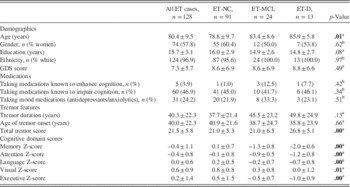
The 128 ET cases had a mean age of 80.4 (median, 82; range, 55–96) years; 123 (96.1%) were age 65 and older (Table 1). The sample was 96.9% white and 57.8% female. They were a highly educated sample with a mean of 15.7 (median, 16; range, 12–26) years of education. None of the cases had PD, and none had undergone any surgery to treat their tremor. They had a relatively long history of tremor, with a mean tremor duration of 40.3 years (median, 37.0; range, 3–86 years), and a mean total tremor score of 21.5 (median 21.6; range 10–36) of a maximum possible score of 36. Twenty-one (16.4%) cases had a tremor onset ≥65 years of age.
Clinical and cognitive characteristics of cohort

Note. GDS=Geriatric Depression Scale. Values are mean±SD or number (percentage). Significant values are bold.
a Kruskal-Wallis between ET-NC, ET-MCI, and ET-D.
b Chi-square between ET-NC, ET-MCI, and ET-D.
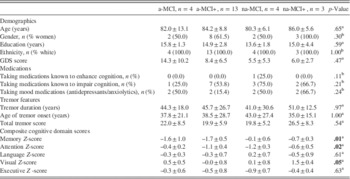
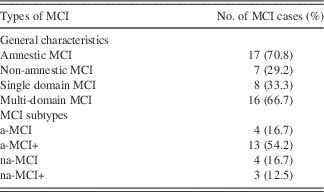
Ninety-one (71.1%, 95% CI [63.3, 79.0]) cases were ET-NC, 24 (18.8%, 95% CI [12.0, 25.6]) were ET-MCI, and 13 (10.2%, 95% CI [5.0, 15.4]) were ET-D. Within the ET-MCI cases, all four subtypes were present (Table 2). From most to least common, 13 (54.2%, 95% CI [34.3, 74.1]) had a-MCI+, 4 (16.7%, 95% CI [1.8, 31.6]) had a-MCI, 4 (16.7%, 95% CI [1.8, 31.6]) had na-MCI, and 3 (12.5%, 95% CI [−0.7, 25.7]) had na-MCI+. The majority of cases with MCI were amnestic MCI (n=17/24, 70.8%), indicating the presence of a memory impairment either alone or in addition to other impairments (a-MCI and a-MCI+). The majority of cases were also multi-domain MCI (n=16/24, 66.7%), indicating impairment in more than one domain (a-MCI+ and na-MCI+) (Table 3).
Clinical and cognitive characteristics of MCI subtypes

Note. GDS= Geriatric Depression Scale. Values are mean±SD or number (percentage). Significant values are bold.
a Kruskal-Wallis.
b Chi-square.
Distribution of domains impaired in ET-MCI cases

The mean age, education, gender distribution, ethnicity distribution, GDS score, tremor severity, age of tremor onset, and tremor duration did not differ significantly between subtypes of MCI. There were differences between MCI subtypes in memory, attention, and visual composite domain scores. While significantly different, only memory had mean scores that met criteria for test impairment (z≤−1.5). Because it is intuitive that a-MCI (−1.6±1.0) and a-MCI+ (−1.7±0.5) cases would have lower memory scores than na-MCI (−0.1±0.6) and na-MCI+ (−0.7±0.3) cases (p=.01), composite domain score differences are not highlighted in the discussion. Age did differ significantly between ET-NC (78.8±9.7), ET-MCI (83.4±8.6), and ET-D (85.9±5.8) (p=0.01).
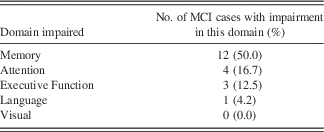
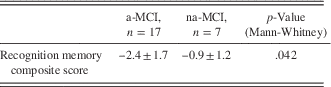
The most commonly impaired cognitive domain in ET-MCI cases was memory (n=12/24, 50.0%), followed by attention (n=4/24, 16.7%), executive function (n=3/24, 12.5%), language (n=1/24, 4.2%), and visuospatial (n=0/24, 0%) (Table 4). Cases with amnestic MCI demonstrated lower recognition memory Z-scores (−2.4±1.6) than non-amnestic groups (−1.0±1.2) (p=.042) (Table 5). Using a criterion of z<−1.5 for impairment, 64.7% of individuals in the amnestic group had both retrieval and recognition deficits as opposed to retrieval deficits alone.
Distribution of domains impaired in ET-MCI cases

Note. Impairment indicated by Z≤−1.5 on any test within the domain, based on composite domain scores.
Recognition memory analyses in ET-MCI cases

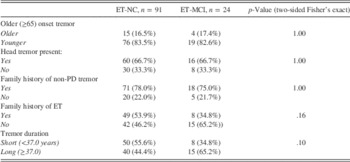
Several interesting trends were apparent in our exploratory analyses, though none proved statistically significant (Table 6). There was a smaller proportion of cases with a familial history of ET in the ET-MCI group (8 of 23 who reported family history information, 34.8%) than the ET-NC group (49/91, 53.9%) (p=.16), suggesting that perhaps familial ET is less likely to be accompanied by MCI. There was also a greater proportion of cases with longer duration tremor in the ET-MCI group (15/23, 65.2%) than the ET-NC group (40/90, 44.4%) (p=.10), suggesting that cases with a tremor duration of greater than 37.0 years could be more likely to be accompanied by MCI.
Clinical features of ET-NC vs ET-MCI

DISCUSSION
A growing number of studies are documenting cognitive impairment in ET (Benito-Leon et al., Reference Benito-Leon, Louis, Mitchell and Bermerjo-Pareja2011; Bermejo-Pareja, Reference Bermejo-Pareja2011; Gaspirini et al., Reference Gasparini, Bonifati, Fabrizio, Fabbrini, Brusa, Lenzi and Mecom2001; Higginson et al., Reference Higginson, Wheelock, Levine, King, Pappas and Sigvardt2008; Janicki et al., Reference Janicki, Cosentino and Louis2013; Lacritz et al., Reference Lacritz, Dewey, Giller and Cullum2002; Lombardi et al., Reference Lombardi, Woolston, Roberts and Gross2001; Kim et al., Reference Kim, Song, Shim, Park, Yoo, Kim and Lee2009; Park et al., Reference Park, Oh, Lee, Yang, Song, Park and Kim2015; Sahin et al., Reference Sahin, Terzi, Ucak, Yapici, Basoglu and Onar2006; Sinoff & Badarny, Reference Sinoff and Badarny2014; Thawani et al., Reference Thawani, Schupf and Louis2009; Troster et al., Reference Troster, Woods, Fields, Lyons, Pahwa, Higginson and Koller2002). The basis for this impairment is unclear, although several mechanisms could be responsible. It has been hypothesized that these impairments may be conceptualized as an ET-specific syndrome resulting from compromise to networks linking cerebellar, thalamic, and frontal regions that are affected in ET (Kim et al., Reference Kim, Song, Shim, Park, Yoo, Kim and Lee2009; Passamonti et al., Reference Passamonti, Novellino, Cerasa, Chiriaco, Rocca, Matina and Quattrone2011; Troster et al., Reference Troster, Woods, Fields, Lyons, Pahwa, Higginson and Koller2002). However, cognitive deficits might also reflect concomitant neurodegenerative diseases that appear to be associated with ET, including AD, PD, Lewy body dementia, or progressive supranuclear palsy (Louis et al., Reference Louis, Honig, Vonsattel, Maraganore, Borden and Moskowitz2005; Louis, Babij, Ma, Cortes, & Vonsattel, Reference Louis, Babij, Ma, Cortés and Vonsattel2013; Louis, Clark, & Ottman, Reference Louis, Clark and Ottman2016; Pan et al., Reference Pan, Lee, Honig, Vonsattel, Faust and Louis2014). The current study implemented a motor-free protocol to examine the presence of specific MCI subtypes in older adults with ET, and the extent to which amnestic MCI is associated with ineffective memory storage, which is potentially indicative of early AD.
In the current sample, most ET cases were diagnosed as cognitively normal (71%). Approximately 10% met criteria for dementia, and nearly 19% met criteria for MCI. While our goal was not to estimate the absolute prevalence of MCI in ET, it is worth noting that recent population-based studies reported the frequency of MCI to be 15–20% (Benito-Leon et al., Reference Benito-Leon, Louis, Mitchell and Bermerjo-Pareja2011; Roberts & Knopman, Reference Roberts and Knopman2013) in samples with a mean age comparable to our sample (76.0±5.9 and over 65, respectively). This similar prevalence of cognitive deficits in population samples suggests that the deficits may represent a dual pathology rather than an ET-specific cognitive syndrome.
Of interest, the frequency of MCI in the current study is less than half of that reported in the only other known study to investigate MCI subtypes in ET (48.4%) (Park et al., Reference Park, Oh, Lee, Yang, Song, Park and Kim2015). This discrepancy partially reflects differences in the applied diagnostic criteria for MCI. In the current study, we considered tests impaired when scores were Z ≤−1.5 (≤7th percentile), whereas Park et al. considered impairment as z≤1.0 (16th percentile) (Kang & Na, Reference Kang and Na2003). Discrepancies in proportions of MCI have been demonstrated in PD (Goldman et al., Reference Goldman, Holden, Bernard, Ouyang, Goetz and Stebbins2013), where the MCI proportion increased from 73.7% to 90.8% when using Z ≤−1.0 instead of Z ≤−1.5. Such diagnostic differences could account for why Park et al. showed more than double (48.4%) the proportion of MCI than we did (18.8%) despite the fact that their ET-MCI sample was younger (68.8±7.4) than ours (83.4±8.6). However, this discrepancy also likely reflects the fact that several of the measures in the study by Park and colleagues were motor-based, which the authors acknowledge.
Irrespective of the absolute prevalence, the current study examined the relative proportion of non-amnestic and amnestic MCI in an effort to understand potential etiologies of cognitive impairment in ET. All four subtypes of MCI were present in our sample. The majority of MCI cases in the current study were amnestic (n=17, 70.8%) and nearly one-third (n=5, 27.8%) of these amnestic ET-MCI cases had no accompanying impairment in other domains.
In contrast, Park and colleagues (2015) previously reported a disproportionate number of ET-cases meeting criteria for non-amnestic (56%) as opposed to amnestic MCI, whereas the vast majority of non-ET cases met criteria for amnestic MCI (72%). The difference between the results of the Park study and the current study may reflect the influence that motor-based tests may have on cognitive testing results. The frontal executive test implemented in the prior study was described as a “frontal motor function” test, and was reported to be significantly lower in the ET-cases than controls and the most common form of cognitive impairment among MCI cases. It is thus possible that a proportion of ET-cases were characterized as non-amnestic MCI partially based on poor motor performance, which shifted the relative distribution of amnestic versus non-amnestic cases.
As amnestic MCI is typically defined based on recall memory, and was operationalized as such in the current study, it is possible that the prevalence of memory deficits in this sample reflects an underlying executive dysfunction that compromises memory retrieval (Lafo et al., Reference Lafo, Jones, Okun, Bauer, Price and Bowers2015). To determine the extent to which amnestic MCI was characterized by memory storage deficits and not solely memory retrieval deficits, we compared a composite recognition memory score between a-MCI and na-MCI groups, finding that the amnestic groups had significantly lower scores (with the qualification that raw recognition scores were not normally distributed, thereby likely inflating the absolute level of impairment).
However, when examining the proportion of individuals simply falling below a z≤−1.5, 65% of the amnestic group demonstrated a recognition score lower than −1.5, with only 35% showing impaired retrieval alone. The presence of recognition impairment in the amnestic MCI subgroups supports the idea that memory impairment in this subgroup includes a deficit in information storage, and not only a retrieval deficit that might be expected in the context of an ET-specific dysexecutive syndrome. This recognition impairment in the amnestic subgroup may provide the first glimpse into the presence of dual pathology, in which prodromal AD is present alongside an ET-specific cognitive syndrome. Of course, it is also possible that in some individuals, cognitive impairment may reflect only the effects of early AD. Neuropathological data acquired from this cohort after death is needed to definitively determine whether memory storage deficits are indicative of co-morbid AD.
Consistent with the finding that a-MCI+ was the most common subtype, memory was the most frequently impaired domain in ET-MCI cases, as indicated by number of ET-MCI cases with an impaired composite memory domain score (12/24, 50.0%). Contrary to expectations, executive functioning impairment was relatively infrequent (3/24, 12.5%). This finding contradicts patterns found in previous studies of ET in which executive impairments predominate (Higginson et al., Reference Higginson, Wheelock, Levine, King, Pappas and Sigvardt2008; Sinoff & Badarny, Reference Sinoff and Badarny2014; Troster et al., Reference Troster, Woods, Fields, Lyons, Pahwa, Higginson and Koller2002), and highlights the fact that the basis of executive deficits in ET has not been definitely established. Based on the similarity between the cognitive deficits in ET and those exhibited with lesions to the cerebellum (e.g., cerebellar cognitive affective syndrome), in conjunction with evidence of the cerebellum’s role in cognition (Hart, Reference Hart2011; Noroozian, Reference Noroozian2014), the cognitive deficits in ET are generally believed to reflect damage to either the cerebellum itself (Bhalsing et al., Reference Bhalsing, Upadhyay, Kumar, Saini, Yadav, Gupta and Pal2014) or its connections to the frontal cortical areas (Pauletti et al., Reference Pauletti, Mannarelli, Locuratolo, Vanacore, De Lucia, Mina and Fattapposta2013; Troster et al., Reference Troster, Woods, Fields, Lyons, Pahwa, Higginson and Koller2002).
However, even within ET, there are heterogeneous factors which may contribute to executive dysfunction. Recent pathological evidence from Louis and Vonsattel (Reference Louis and Vonsattel2007) shows that ET may consist of at least two distinct neural subtypes: while approximately 75% of ET cases have cerebellar degeneration, a smaller proportion have brainstem Lewy bodies without cerebellar degeneration. These findings suggest that ET is a more complex disorder than previously believed. Future post-mortem work from the current study will be able to examine the extent to which cognitive phenotypes map onto specific pathological phenotypes in ET.
Our exploratory analyses of MCI in relation to ET-disease features found that there was a slightly smaller proportion of cases with a familial history of ET in the ET-MCI group than the ET-NC group, and a slightly greater proportion of cases with longer duration tremor in the ET-MCI group than the ET-NC group. While the association between these features needs to be solidified with future research, these preliminary findings indicate that there are potential links between subtypes of ET patients and the likelihood of developing MCI.
Our study had several limitations, the first being that this is not a population-based study. This was a highly selected group of participants who contacted us about the study of their own volition. It is possible that people with subjective cognitive complaints, or people who are concerned about developing cognitive impairment, were more likely to participate; conversely, it is possible that we over-selected individuals who were cognitively intact enough to respond to an email advertisement. Our results should be interpreted with this in mind.
A second limitation is that we have only collected baseline data at this point in time, and were thus only able to report cross-sectional data. Moreover, we did not enroll control subjects, but rather used normative data available for each cognitive test to evaluate test performance. At present we were unable to assess the rate of progression from ET-NC to ET-MCI, or from ET-MCI to ET-D. We intend to investigate the question of progression rates after conducting follow-up assessments with this cohort.
A final limitation is that we do not currently have neuropathological data from this cohort. A key piece missing from the current dialogue is the relationship between emerging cognitive profiles in ET and their neural substrates. It is presently unclear if cognitive impairments seen in ET represent a single ET-specific cognitive syndrome, if there are several ET-specific cognitive syndromes (e.g., one primarily dysexecutive and one marked by memory storage issues), or if the subset of cases with relatively greater recognition memory deficits represent ET cases with a comorbid neurodegenerative disease. We are hopeful that we can address such questions after follow-up assessments in conjunction with neuropathological data from this cohort.
In summary, our results challenge the idea that cognitive deficits in ET can be generalized as a dysexecutive syndrome that is purely fronto-subcortical or cortico-cerebellar in nature. The presence of disproportionately impaired recognition memory in the a-MCI cases argues for the possibility that a significant subset of MCI cases in ET have a comorbid degenerative disease, and that not all MCI in ET reflects an ET-specific cognitive syndrome. This has implications for diagnosis and treatment, as careful cognitive assessment early on could potentially identify ET patients with early AD. Continued investigation of the specific nature of cognitive impairment in ET cases is needed before these subtypes can be considered predictive of distinct forms of dementia and distinct trajectories and prognoses.
Acknowledgments
This work was supported by the National Institutes of Health (NINDS R01NS086736). This funding body played no role in the design of the study, the collection, analysis, and interpretation of data, or the writing of the manuscript. None of the authors have conflicts of interest or competing financial interests.