Movement appears to be specific to natural-language grammars. Thus, processing moments that reflect the computations of traces—specifically intermediate traces left by cyclic movement—signal a parsing mechanism specialized for language. Likewise, constraints on binding in English are unlike binding in formal systems: They seem to reflect computations in a specialized grammatical organization. Hence, binding-theoretic computations mediated by cyclic movement chains in the resolution of anaphors and pronouns during processing can be seen as privileged signatures of this grammatical architecture. Adult second language (L2) learners produced reading time asymmetries that reflect binding-theoretic constraints on the logical form reconstructions of anaphors and pronouns along movement chains in real time. These suggest that the processing of English as a L2 is structurally driven.
A growing body of second language (L2) sentence processing studies argues that nonnative speakers (NNS) overuse meaning-based information (e.g., thematic, pragmatic, and contextual knowledge) and fail to exhibit the structural strategies deployed by native speakers (NS; Felser & Roberts, Reference Felser and Roberts2007; Felser, Roberts, Gross, & Marinis, Reference Felser, Roberts, Gross and Marinis2003; Felser, Sato, & Bertenshaw, Reference Felser, Sato and Bertenshaw2009; Marinis, Roberts, Felser, & Clahsen, Reference Marinis, Roberts, Felser and Clahsen2005; Papadopoulou & Clahsen, Reference Papadopoulou and Clahsen2003). In view of this, Clahsen and Felser (Reference Clahsen and Felser2006a, Reference Clahsen and Felser2006b) articulated the shallow structure hypothesis (SSH) according to which NNSs—in stark contrast to NSs—do not compute detailed syntactic representations in real time. This accounts for a general lack of first language (L1) effects in L2 sentence processing. A second research paradigm introduced by Juffs and Harrington (Reference Juffs and Harrington1995) had hitherto sought to characterize L2 sentence processing in terms of the properties of the universal sentence processor. It had documented evidence of sensitivity to argument structure (Frenck-Mestre & Pynte, Reference Frenck-Mestre and Pynte1997; Juffs, Reference Juffs1998) as well as evidence that L2 sentence processing is guided by an instinct to structure the input immediately. For example, in the processing of wh-dependencies, the active-filler strategy is followed (Hoover & Dwivedi, Reference Hoover and Dwivedi1998; Juffs & Harrington, Reference Juffs and Harrington1995; Williams, Möbius, & Kim, Reference Williams, Möbius and Kim2001). According to this line of research, target language (TL) input is processed by a—largely—universal parsing mechanism, which consists of (a) Universal Grammar (UG), (b) language-specific information provided by a parameterized lexicon, and (c) general parsing principles, which drive the incremental interpretation of the input and require quick resolution of dependencies subject to structure minimization (Crocker, Reference Crocker1996; Dekydtspotter, Reference Dekydtspotter2001; and Fodor & Inoue, Reference Fodor, Inoue, de Vincenzi and Lombardo2000, as discussed by Schwartz, 1999). This universal parser mediates L2 acquisition: UG-constrained representations of the TL input that cannot be licensed by the current state of grammar trigger the development of a (interlanguage) parameterized lexicon that allows the required structure. Differences between L1 and L2 sentence processing are thought to reside in distinct computing speeds and in the failure of L2 learners to recover from misanalyses or to revise initial analyses in the limits of fixed resources. Dekydtspotter and Sprouse (Reference Dekydtspotter, Sprouse, Liceras, Zobl and Goodluck2003) reinterpreted various data sets in this light. Thus, Dekydtspotter, Schwartz, and Sprouse (Reference Dekydtspotter, Schwartz, Sprouse, Grantham O’Brien, Shea and Archibald2006) argued that divergences from L1 sentence processing result from slower lexical access and less efficient reading strategies as well as differences in prosody, semantic fields, and aspects of lexical representations induced by the L1 grammar. If L2 sentence processing deviates from L1 sentence processing, the principles driving the analysis of input and the knowledge base for L1 and L2 sentence processing are nevertheless fundamentally similar.
The debate, to date, has focused on the nature of the representations computed incrementally by NNSs. For NSs, the processing of long-distance wh-dependencies across bridge verbs as in (1a) crucially implicates traces (i.e., silent copies) and includes an intermediate trace left by cyclic movement at the edge of the embedded clause (1b). Gibson and Warren (Reference Gibson and Warren2004) show that the intermediate wh-trace in (1b) at the edge of the embedded clause significantly diminishes processing costs in the thematic position. This is because traces of moved expressions reactivate the referents with which they are associated.
(1) a. Who did the consultant claim that the proposal had pleased?
b. [Who did the consultant claim [<who> that [the proposal had pleased <who>]]]?
Indeed, if new activations compete for resources with the previously activated referent linked to the wh-expression, reactivations due to intermediate traces refresh the referent in memory (Gibson, Reference Gibson1998, Reference Gibson, Miyashita, Marantz and O’Neil2000; Gibson & Warren, Reference Gibson and Warren2004). In an adaptation of Gibson and Warren (Reference Gibson and Warren2004) for L2 English, Marinis and colleagues (2005) replicated the results for NSs but did not find evidence of diminished processing costs in bridge verb contexts for NNSs across a range of L1 backgrounds. They consequently argued for the direct association of the filler with the subcategorizing verb as in (1c), in which the indices reflect a theta-grid linking without the mediation of syntax.
(1) c.Whoi did the consultant claim that the proposal had pleasedi ?
However, not finding a processing advantage in bridge verb contexts does not unambiguously argue for the absence of cyclic movement. Crucially, no such advantage will appear if the benefits of reactivations are lost by the time the complement position of the embedded verb is computed. Weak (re)activations of referents in L2 sentence processing could, therefore, confound the results because the benefits of intermediate trace-induced reactivations may be lost sooner in NNSs than in NSs (Dekydtspotter & Miller, Reference Dekydtspotter, Miller, Bowles, Ionin, Montrul and Tremblay2009).
Conditions on the resolution of anaphors (i.e., expressions that are lexically specified as referentially dependent on another) are also prima facie indicators of domain specificity. An anaphor like himself or herself in (2a)–(2b) must be bound—that is, it must be dependent on another noun phrase (NP) for its semantic evaluation—in a local domain containing a subject matching in referential (ϕ-)features (see Chomsky, Reference Chomsky1986, binding theory principle A).
(2) a. *Johni argued that the professors had criticized himselfi.
b. *The doctors believed that Maryi’s son had neglected herselfi.
Example (2a) is thus ungrammatical because the only possible antecedent, John, is nonlocal, whereas (2b) is ungrammatical because the matching expression, Mary, is not in a structural relation allowing binding of herself (see O’Grady, Reference O’Grady2005, for a theta-grid approach to the structural requirement). For NSs, nonreferents are quickly filtered out (Nicol & Swinney, Reference Nicol and Swinney1989), although other gender-matched referents excluded by principle A can induce an increase in processing load, showing that they are considered (Badecker & Straub, Reference Badecker and Straub2002). In discourse, therefore, a range of possibilities are considered subject to ϕ-feature matching, whereas structural computations mediate between the discourse-semantic representations and the lexical representations of morphologically complex English anaphors. For L2 acquisition, Felser and colleagues (2009) noted that, although L1 Japanese–L2 English speakers offered targetlike offline judgments on (2a) and (2b) consistent with results in the L2 literature (Thomas, Reference Thomas1991), speeded judgments and ocular movements revealed that NNSs incrementally entertained nonlocal construal in a manner that NSs did not. Felser and colleagues concluded that discourse prominence drove coreference in the absence of structural computations. This, however, is not the only conclusion possible. If the resolution of anaphors requires autonomous processing in discourse and syntax as a function of language design in which syntax mediates between lexical specifications and discourse representation, such experimental differences between NSs and NNSs may result from delays in the syntactic computations induced by slower lexical retrieval, leading to possible time-outs, in a single theory. If so, reflexes of binding-theoretic computations may appear in L2 processing under other conditions.
Given the centrality of binding theory principle A and of intermediate traces as arguments for a domain-specific grammatical architecture, the present study focuses on intermediate traces as conduits for the reconstruction of anaphors (Chomsky, Reference Chomsky1995) in L2 sentence processing. Specifically, the study focuses on the processing of sentences such as those in (3a)–(3c) in which himself can be bound by John in the matrix clause or by Bill in the embedded clause, although principle A is not satisfied in surface position.
(3) a.Stories about himself, John insists that Bill likes.
b.Which stories about himself does John insist that Bill likes?
c.It’s stories about himself that John insists that Bill likes.
Processing involves a syntactic reflex to parse quickly, according to which expressions are integrated and dependencies are computed at the first opportunity, subject to a principle of representational economy that bars superfluous operations incrementally (Fodor & Inoue, Reference Fodor, Inoue, de Vincenzi and Lombardo2000). If L2 learners compute UG-governed representations during sentence processing, the interpretation of (3a)–(3c) will involve a process of reconstruction whereby movement chains mediate the licensing of the anaphor at the logical form (LF) interface with the conceptual-intentional system. Thus, himself in (3a)–(3c) can be interpreted as locally bound by either John or Bill by virtue of a chain dependency involving clause edge and thematic positions in which the local binding by John or Bill, respectively, is satisfied (Barss, Reference Barss1986). Focusing on topicalizations as in (3a), this article examines evidence that (cyclic movement) chain computations (Hypothesis 1) mediate binding-theoretic computations (Hypothesis 2) in real-time anaphora resolution in L2 acquisition. We discuss the representations computed and the performance principles that determine what is computed and how these computations arise. We then consider the degree to which L2 sentence processing reveals this type of organization for nonprimary language acquisition, if at all, in an effort to better understand its exact nature.
ON THE DISTRIBUTION OF ANAPHORS AND PRONOUNS
In Chomsky’s (Reference Chomsky1986) canonical binding theory, an anaphor such as himself must be bound by a c-commanding antecedent under an indexing in a relevant local domain, whereas a pronoun such as him must be locally free—that is, unbound—in the same domain. This relevant local domain is the least projection containing the anaphor or pronoun in which the complement and subject are realized. This captures the complementary distribution of anaphors and pronouns in (4a)–(4b).
(4) a.Billj said Johni likes himselfi/*j.
b.Billj said Johni likes him*i/j.
In Chomsky’s (Reference Chomsky1995) Minimalist Program, the binding theory reduces to a grammatical architecture in which syntax mediates between lexical specifications and the conceptual-intentional system. Syntax interfaces with a discourse-semantic representation. The referential expressions Bill and John in (4a)–(4b) have fixed semantic values. In contrast, him and himself function as variables that are either semantically bound as part of the structuring of discourse or assigned semantic values as part of the evaluation of discourse in context (e.g., logophoric anaphors, among others). With himself in (4a), a lexical identification requirement on self induces a local (ϕ-feature-based) syntactic dependency forcing a bound variable interpretation. Movement mediates the checking of ϕ-features: The anaphor—or part of it—cliticizes by the LF as shown in (5a).
(5) a. Bill insists that John self-likes tself.
b. Bill insists that John likes him.
Locality of binding reduces to locality of movement. Distinct flavors of minimalism allow different syntactic computations (Hicks, Reference Hicks2009; Hornstein, Reference Hornstein2000; Reuland, Reference Reuland2001, Reference Reuland, Broeckhuis, Corver, Huybergts, Kleinhenz and Koster2006). However, in the architecture of grammar, the pattern of anaphora in (4a)–(4b) seems to reflect the lesser cost of binding over keeping track of multiple value assignments as well as the benefits of syntactic over discourse-semantic computations. This reflects the advantage of resolving variables at the first opportunity (Reinhart, Reference Reinhart1983; Reinhart & Reuland, Reference Reinhart and Reuland1993; Reuland, Reference Reuland2001).
Chomsky (Reference Chomsky1995) argues that the copy and deletion theory of movement dependencies explains the ambiguity of (6a), in which himself can be bound by John or Bill. The derivation of (6a) involves two copies (6b). Redundant information contained in the chain is deleted. Deletions can apply at the foot of the chain (6c) or at the head of the chain (6d).
(6) a. John wondered which picture of himself Bill saw.
b. [John wondered [which picture of himself [Bill saw <which picture of himself>]]].
c. [John self-wondered [which x picture of t self [Bill saw x]]].
d. [John wondered [which x [Bill self-saw x picture of t self]]]. (pp. 205–209; Ex. 36a; 37a; 45a; 45b)
The NP environment presents an interesting problem because the complementary distribution of anaphors and pronouns seems to collapse, as in (7a) and (7b). Either an anaphor (7a) or a pronoun (7b) can be found in the same position on a construal in which the stories are about John. Chomsky notes that (7b) is somewhat degraded but is “still reasonably acceptable” (1995, p. 103).
(7) a. John likes stories about himself. (p. 102, Ex. 221)
b. John likes stories about him. (p. 103, Ex. 224)
Crucially, Chomsky warns that the “apparent overlap in distribution in (7a), (7b) is only illusory. In (7b), where him is construed as John, the stories are not taken as John’s” (p. 103). Given that (7a) and (7b) do not have the same range of interpretations, Chomsky argues that the construal of him with John in (7b) is allowed because NPs optionally allow a null pronominal element. Chomsky (Reference Chomsky1986) identifies it as a (NP-subject) PRO generated in the specifier position of the nominal projection, which then becomes the relevant domain.
Given the movement structure in (8a), in which the pronoun him is construed with John, Chomsky’s theory of grammar provides three LF analyses, as shown in (8b)–(8d), at the interface.
(8) a. Stories about himi, Johni insists that Mary likes.
b. [CP Top x [TPJohni insists [CPx PRO stories about him ithat [TPMary likes x]]]].
c. [CP Top x [TPJohni insists [CPthat [TPMary likes x stories about him i]]]].
d. [CP Top x [TPJohni insists [CPthat [TPMary likes x PRO stories about him i]]]].
In (8b), the pronoun can be construed with John via reconstruction in the complementizer (C)–domain due to the optional computation of an empty pronominal that fixes the nominal projection as a binding domain that allows the pronoun. In (8c), the pronoun him in the embedded clause can enter into a construal with John because it is free in the smallest clausal projection in which the embedded clause subject is generated. In (8d), the pronoun him in thematic position can enter into a construal with John because it is again free in the NP domain.
Grammar allows three options, (8b)–(8d), for (8a). However, it is not incumbent on the parser to compute all grammatically possible representations; he or she need only compute just one. Under structure minimization, whereby at each stage of processing no structure is computed unless it is strictly necessary (Fodor, Reference Fodor1998; Fodor & Inoue, Reference Fodor, Inoue, de Vincenzi and Lombardo2000; Frazier, Reference Frazier and Coltheart1987), these options are reduced to just (8c). Thus, (8d) is not computed at the LF because the computation, which makes the NP the relevant domain for the resolution of the pronoun, is not strictly necessary. In a similar manner, given the need for a chain dependency, there is no need for the computation in (8b) because the pronoun can be resolved—as in (8c)—merely on the basis of a structure that is independently required. Thus, positing a PRO NP-subject—as in (8b) or (8d)—in the processing of (8a) involves a superfluous operation given that an interpretation is obtained without PRO, as in (8c). Positing a PRO subject is, therefore, a last resort operation, which is sometimes necessary to salvage an interpretation, as in (7b).
Consider, however, the topicalization in (9a) under the construal of the pronoun him with John, in the light of Chomsky’s example in (7b). The severe degradation of (9a) versus (9b) is prima facie evidence of structure minimization. The parser first derives a representation with the embedded clause as a binding domain, just as in (8c), which makes the construal illicit.
(9) a. Stories about himi, Mary insists that Johni likes.
b. Stories about himselfi, Mary insists that Johni likes.
Structure minimization creates an interpretive garden path that appears severe, although not impossible to overcome. Upholding the syntax requires updating the context with some completely new referent for the pronoun. Positing a PRO subject comes with an inferable referent bearing the agent or possessor semantic role to the NP referent, depending on the specifics. However, as Crocker (Reference Crocker1996) notes, revisions that create snowball effects in a modular grammatical organization induce significant processing load increases. More generally, Crocker describes commitment to a syntactic analysis as a result of convergence across modules.
MODULARITY IN ANAPHORA RESOLUTION UNDER RECONSTRUCTION
The human sentence processor involves distinct modules that concomitantly compute representations in the limits of their UG-sanctioned interfaces (see Patson & Ferreira, Reference Patson and Ferreira2009, for early use of conceptual semantic information). For pronouns, Rigalleau and Caplan (Reference Rigalleau and Caplan2000) argue for an automatic construal with accessible referents subject to feature matching followed by a disengagement process. Thus, a pronoun that disagrees in gender with one of two accessible referents induces longer naming latencies, which suggests immediate use of gender information. This effect was also found when only one of two potential referents is highly accessible (Rigalleau, Caplan, & Baudiffier, Reference Rigalleau, Caplan and Baudiffier2004). For complex anaphors, studies by Badecker and Straub (Reference Badecker and Straub2002), Runner, Sussman, and Tanenhaus (Reference Runner, Sussman and Tanenhaus2003, Reference Runner, Sussman and Tanenhaus2006), and Sturt (Reference Sturt2003) show interference from gender-matched—but binding-theoretically illegitimate—referents during the processing of anaphors. Anaphora, therefore, clearly involves automatic processing under feature (gender) matching in the structuring of discourse that is independent of binding-theoretic licensing. Similar processing for anaphors and pronouns is expected at the discourse-semantic level because differences between anaphors and pronouns involve the independent computations of referential dependencies in syntax.
Aspects of discourse-semantic and syntactic computations and their interactions in processing are examined in (10a)–(10d), in which either an anaphor or a pronoun can appear inside a topicalized indefinite followed by a gender-matched or gender-mismatched referential (R)–expression.
(10) a. Stories about himself, John insists that Bill likes.
b. Stories about himself, Mary insists that Bill likes.
c. Stories about him, John insists that Bill likes.
d. Stories about him, Mary insists that Bill likes.
In discourse-semantic structure, both himself in (10a) and him in (10c) are represented by variables that enter in a construal with John due to a ϕ-features match. In (10b) and (10d), however, the referent of the subject NP Mary does not match the anaphor or pronoun in gender; therefore, such a construal is delayed until an appropriate referent is introduced. By virtue of language design in which syntax mediates between lexical specifications and semantic representation, referential dependencies established in the structuring of discourse can be thought of as an indexing that requires binding-theoretic licensing. The parser computes partial phrase structure analyses: A clause is projected up to the complement to the verb, as in (11a)–(11d). Encountering the verb insist, which selects a clausal complement, induces the projection of a complementizer phrase (CP), allowing the computation of a movement chain subject to LF deletions. As the complementizer that is encountered next and integrated into the C-domain, effects of reconstruction can be expected, as movement theory requires a trace that includes the anaphor or pronoun.
(11) a. [CP Top x [IPJohni selfi-insists [CPx stories about t self [C. . . ]]]].
b. [CP Top x [IPMary insists [CPx stories about himself [C. . . ]]]].
c. [CP Top x [IPJohn insists [CPx stories about him [C. . . ]]]].
d. [CP Top x [IPMary insists [CPx stories about him [C. . . ]]]].
As soon as the relevant phrase structure is available, binding-theoretic computations apply on movement chains. Thus, in (11a) the indexing established in discourse is binding-theory compatible, and the ϕ-features of the (reconstructed) anaphor himself in the C-domain are automatically checked in syntax. Gender mismatch in (11b) disallows identification, and therefore binding-theoretic computations are held off in the C-domain. In (11c), the anaphoric dependency is also unresolved in the C-domain; that is, the reinterpretation of the domain needed for a binding-theoretic licensing is superfluous at this level. Differences between (11c) and (11d) are expected in the embedded clause because (11d) requires the PRO NP-subject option as a last resort operation, with its consequences for discourse representations.
In this grammatical architecture, aspects of anaphora computations in discourse and syntax required by language design are blind to knowledge of speakers’ intentions, as in (12a)–(12d).
(12) Intended interpretation: Stories about John a. Stories about himself, John insists that Luke likes.
b. Stories about himself, Luke insists that John likes.
c. Stories about him, John insists that Luke likes.
d. Stories about him, Luke insists that John likes.
Foreknowledge that the relevant stories are about John in (12a)–(12d) provides a contextual assignment to the variable introduced by the pronoun or anaphor. This initial assignment to variables is notated with the subscript a. However, as a result of the automatic computations in discourse structuring as referential expressions are encountered, a construal with Luke in processing (12b) and (12d) will be fleetingly entertained. Second language learners will have to retreat from this automatic process. In the type of grammatical architecture detailed here, syntactically driven referential dependencies will need to be computed as soon as conditions are met (13a)–(13d), even if the outcome is the same as the original contextual assignment. These costs cannot be avoided.
(13) Intended interpretation: Stories about John
a. [CP Top x [IPJohni selfa → i insists [CPx stories about t self [C. . . ]]]].
b. [CP Top x [IPLuke insists [CPx stories about himselfa [C. . . ]]]].
c. [CP Top x [IPJohn insists [CPx stories about hima [C. . . ]]]].
d. [CP Top x [IPLuke insists [CPx stories about hima [C. . . ]]]].
Thus, in (13a), the initial assignment to John is revised under reconstruction in the C-domain to satisfy the lexical identification requirement of the anaphor. Therefore, it becomes syntactically bound by the expression John. The resulting change is represented with a → i, where i represents the binding by John. In (13b), no change is triggered in the C-domain because binding conditions are not met. Logical form interpretation is delayed until the foot of the chain, where the LF interpretation of pronouns (13c) and (13d) can only be obtained in the embedded clause by structure minimization. Differences between (13c) and (13d) are expected during the processing of the embedded clause because (13d) involves an interpretive garden path. In sum, these computations are indicative of a highly specialized grammatical organization.
According to the full transfer–full access model (Schwartz & Sprouse, Reference Schwartz, Sprouse, Hoekstra and Schwartz1994, Reference Schwartz and Sprouse1996) extended to the lexicon (Sprouse, Reference Sprouse, Lefebvre, Jourdan and White2006), L2 learners are expected to analyze English anaphors as pronoun + self (White, Reference White, Eckman, Highland, Lee, Milcham and Rutkowski Weber1995). As a direct consequence of this analysis and language design, the processing of (10a)–(10d) and (12a)–(12d) is expected to require automatic computations of referential dependency that rely on ϕ-feature matching in the semantic structuring of discourse (Claim 1) for anaphors (Hypothesis A) and pronouns (Hypothesis B) alike because binding theory does not enter into play in discourse. As a reflex of language design, this referential dependency is syntactically licensed by binding-theoretic computations motivated by the checking of ϕ-features and mediated by chain theory. Specifically, complex anaphors construed with matrix clause subjects are locally bound at the LF via reconstruction in the C-domain (Claim 2). In other cases, reconstruction in the verbal (V)-domain is required: Crucially, structure minimization predicts extra costs for pronouns construed with embedded clause subjects (Claim 3). These claims arising at the interaction of chain theory (Hypothesis 1) and binding-theoretic computations (Hypothesis 2) are first verified by cost increases matching these computations in NSs. The degree to which processing in English as a L2 is profitably characterized by these computations is examined in this study.
THE STUDY
Stimulus Development
Learners from various language backgrounds have been shown to be sensitive to the weak-versus-strong island distinction, a presumed movement effect (Belikova & White, Reference Belikova and White2009; Epstein, Flynn, & Martohardjono, Reference Epstein, Flynn and Martohardjono1996; Martohardjono, Reference Martohardjono1993). Still, evidence of cyclic movement across bridge verbs is missing from the published record. This could perhaps be because slower computations combined with weak activation of referents obscure relevant aspects of processing. Anaphora resolution under reconstruction provides an alternative test of (intermediate) trace computations. Multiclause dependencies present a significant experimental challenge due to processing load whereby length becomes a deleterious factor. Thus, a stimulus that involved topicalizations was selected because less structure is involved.1Indeed, processing steps associated with chain mediation of anaphora resolution make specific predictions of distinct processing steps: identification of anaphors and pronouns in discourse representations as well as C-domain and V-domain computations relying on movement chains in syntax. Such processing reflexes are an empirical matter. Second language learners may show discourse-level identification of variables with matching referents without mediation by LF representations, but binding-theoretic reflexes—mediated by intermediate traces in real-time anaphora reconstruction—would threaten the hypothesis that L2 learners’ processing is semantically, but not syntactically, informed.
Materials
The experiment reported in this study included two self-paced reading tasks. Task 1 included sentences such as the examples found in (10), and Task 2 included sentences such as those in (12). Each sentence was read in segments at a computer monitor, and reading times (RTs) were measured using PsyScope (Cohen, MacWhinney, Flatt, & Provost, Reference Cohen, MacWhinney, Flatt and Provost1993). Task 1 relied on knowledge of gender, whereas Task 2 did not. Respondents sat at a computer monitor and completed a reading task in a moving window format. Each sentence started at the left side of the screen, and respondents pressed a button to continue reading. The experimental tasks were kept relatively short to avoid fatigue. Respondents read 40 sentences: 20 critical items with topicalizations, and 20 distracters with the anaphor or pronoun in situ. This achieved complete balance in (a) the number of anaphors versus pronouns, (b) gender, (c) the number of potential coreferences, and (d) sentence length. Comprehension questions after each sentence ensured that respondents read for meaning and that they focused on the value of the pronoun or anaphor. Respondents were instructed to move quickly and to consider only referents mentioned in the sentence. Crucially, distracter items also ensured balance in the number of yes/no responses in the task. This rendered the tasks seamless from the perspective of respondents, who could not identify the nature of the task in debriefings.
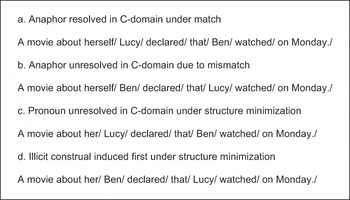
In Task 1, 20 quadruples, as in Figure 1, crossed an anaphor or a pronoun with a potential antecedent and were distributed over four versions in a Latin square. The task followed a 2 × 2 design in which either an anaphor or a pronoun had a matching antecedent in the matrix or embedded clause. For items in Figure 1, respondents answered the following question:Can her(self) refer to Lucy?
Example of test items in Task 1.

In Item (a), a possible antecedent Lucy is immediately encountered, so that the anaphor is resolved in the C-domain and Lucy binds the reconstructed anaphor. In Item (b), because the subject NP Ben and the anaphor mismatch, the resolution is delayed until the V-domain. In Item (c), the subject NP Lucy is not yet a licit antecedent given the matrix clause as binding domain, so that the resolution of the anaphor is postponed to the V-domain. In Item (d), a construal with Lucy is illicit on first pass because the embedded clause constitutes the default domain relevant for binding theory under structure minimization. However, the binding domain can be recalculated by a last resort PRO NP-subject strategy. The acceptability of the construal in final judgments should, nevertheless, be severely degraded.2
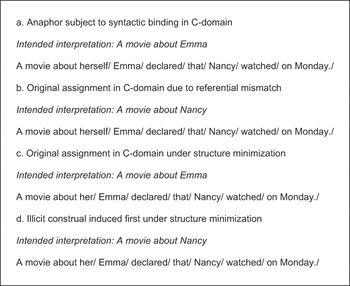
Task 2 was performed a week later. The central differences between Task 1 and Task 2 were twofold: (a) the respondents were given the intended interpretation before they read the sentence so that the value of the anaphor or pronoun was known, and (b) there was no role for gender. Otherwise, it also included 20 quadruples that crossed an anaphor or a pronoun with a potential antecedent in a Latin square. They then answered the following question: Is this a possible interpretation? Consider the sample quadruple in Figure 2, in which the intended value of anaphors and pronouns was given.
Example of test items in Task 2.

Although the context may provide assignments to variables contributed by anaphors or pronouns, aspects of processing are blind to it. Automatic computations in discourse mean that referential dependencies that defy speech intentions will be fleetingly entertained. A syntactic binding configuration will change this initial assignment, even if the outcome is the same. Thus, in Item (a), the subject Emma syntactically binds the anaphor as soon as the C-domain is accessed during processing. The variable, first valued as Emma in context, now becomes syntactically bound. In Item (b), the subject NP Emma and the anaphor are referentially disjointed, so the anaphor retains its original assignment. In Item (c), the subject NP Emma is not yet a licit binder under reconstruction in the C-domain, so the original assignment is retained. Again, Item (d) provided evidence that the embedded clause is first incorrectly taken to the relevant binding domain followed by a last resort reanalysis. Thus C-domain processing provides crucial evidence of syntactically driven processing with additional evidence for structure minimization in the resolution of pronouns—versus anaphors—in the V-domain.
Respondents
A total of 21 American English NSs participated in Task 1 and 18 NSs in Task 2. All were undergraduate students, in their late teens and early twenties, enrolled in a general introductory language course. They had received no prior instruction on anaphora or movement and were completely naïve with respect to the structures investigated. They received class credit for their participation in a linguistic experiment and were typical of young adults.
In the SSH under examination here, L2 learners are reputed not to compute detailed syntactic information in real time irrespective of language background and an advanced proficiency. We, therefore, elected to examine undergraduate students in need of language remediation so that their intermediate proficiency would be clear. The L2 group (n = 28) involved intermediate learners of English—also in their late teens and early twenties—enrolled in English language support courses for matriculated students from diverse L1 backgrounds: Korean (n = 16), Kazakh (n = 2), Hindi (n = 2), Mandarin (n = 2), Arabic (n = 1), Cantonese (n = 1), Tajik (n = 1), Indonesian (n = 1), Uzbek (n = 1), and Chinese-Korean bilingual (n = 1). Their exposure to English was an average of 10 years (range: 6–14). Their mean length of stay in English-speaking communities was 2 years. They received class credit for their participation. There was one additional Korean-English learner in Task 2.
Given that L2 learners seem to be guided by a L2 instinct (Schwartz, 1999), according to which expressions of the TL are treated as exponents of the feature bundles of their closest L1 correspondents and modifications to L1 feature bundles are made within the constraints of UG (Lardiere, Reference Lardiere2009a, Reference Lardiere2009b; Schwartz & Sprouse, Reference Schwartz, Sprouse, Hoekstra and Schwartz1994, Reference Schwartz and Sprouse1996), it is theoretically expected that (all) learners will be able to analyze English complex anaphors as pronoun + self. Indeed, the L1s with long-distance simplex anaphors also have complex anaphors. For instance, Korean has two simplex anaphors caki and casin “self” and two complex anaphors ku-casin (pronoun + self) as well as caki-casin. Both simplex (14a) and complex (14b) anaphors in the complement of a picture noun scrambled to the sentence-initial position allow a construal with John. The feature bundles will, however, have to be modified to include gender.
(14) a. Caki-uyi sacin-ul, John-ii Mary-ka thaywu-ess-ta-ko cwucangha-ess-ta. self-of picture-acc, John-nom Mary-nom burn-past-decl-comp claim-past-decl “A picture of himselfi, Johniclaimed that Mary burned.”
b. Ku-casin-uyi sacin-ul, John-ii Mary-ka thaywu-ess-ta-ko cwucangha-ess-ta. himself-of picture-acc, John-nom Mary-nom burn-past-decl-comp claim-past-decl “A picture of himself, John claimed that Mary burned.”
Evidence that learners can analyze complex anaphors comes from White (Reference White, Eckman, Highland, Lee, Milcham and Rutkowski Weber1995), who showed that L1 Japanese–L2 English learners were very accurate on person, number, and gender agreement, much like L1 French–L2 English learners. We, therefore, also expect on empirical grounds that learners across L1 backgrounds will be able to identify relevant ϕ-features bundles, analyzing English anaphors as pronoun + self, as White (Reference White, Eckman, Highland, Lee, Milcham and Rutkowski Weber1995) points out. Such anaphors require a local binding domain by shortest move and force binding under reconstruction in the C-domain in the case of construal with the matrix clause subject, and reconstruction in the V-domain in the case of construal with the embedded clause subject.
Because L1 preferences can affect L2 behavior, a SSLA reviewer notes that Korean learners (half of the learner pool) may alternatively process English anaphors as strict counterparts to the simplex anaphor caki “self,” which has high frequency (Kang, Reference Kang2001). Thus, Kim, Montrul, and Yoon (Reference Kim, Montrul and Yoon2009) found that L1 English–L2 Korean learners and English-Korean heritage speakers accessed long-distance construal of caki an average of 20% less frequently than NSs from Korea. In White’s (Reference White, Eckman, Highland, Lee, Milcham and Rutkowski Weber1995) truth-value judgment task for L2 English, no L1 effects were found; French and Japanese learners were equally accurate on local binding, and long-distance binding was restricted to nonfinite contexts such as in Hindi, echoing previous results for L1 Korean, L1 Japanese–L2 English acquisition (Broselow & Finer, Reference Broselow and Finer1991; Hirakawa, Reference Hirakawa1990; Wakabayashi, Reference Wakabayashi1996) and for L1 Spanish–L2 English acquisition (Thomas, Reference Thomas1989, Reference Thomas1991, Reference Thomas1993). The fact that finiteness generally blocks long-distance binding in L2 English is important for C-domain reconstruction, which relies on local binding. Long-distance binding, which gets around the shortest move, requires distinct morphologically driven syntactic computations (Cole, Hermon, & Sung, Reference Cole, Hermon and Sung1990; Cole & Sung, Reference Cole and Sung1994; Huang & Tang, Reference Huang, Tang, Koster and Reuland1991; Reuland, Reference Reuland2001) or a logophoric treatment (Huang & Liu, Reference Huang and Liu2001), or both (Kim et al., Reference Kim, Montrul and Yoon2009). Long-distance binding in any guise voids the need for clause edge computations. Thus, if L2 learners resorted to long-distance binding to a significant degree, then C-domain predictions based on local binding would be invalidated.
As a proficiency measure, the learners were given a cloze test (C-test) that consisted of 100 gaps organized in four exercises of 25 gaps each. In a C-test exercise, after the first sentence, every other word is partially eliminated, except for the first part of the word. For small words, only the first letter remains. Respondents must retrieve the complete words. Scores ranged from 26/100 to 75/100. A cut score of 50/100 was adopted, and the learners were thus split into two proficiency groups: the lower group (n = 13) and the higher group (n = 15). The mean score for the lower group was 37 (SD = 6.39), whereas the mean score for the higher group was 58 (SD = 7.76). An independent-samples t test revealed that the two groups selected indeed differed significantly, t(26) = 7.862, p < .0005.
Analytical Methods
Aspects of three theoretical claims are independently examined in two tasks and with two populations. We first report NSs’ results as validations of theoretical expectations. We then consider the degree to which NNSs’ results match these expectations. Claim 1 affirms automatic computations of referential dependencies subject to gender matching in the discourse-semantic component, even if they immediately require disengagement (Rigalleau & Caplan, Reference Rigalleau and Caplan2000; Rigalleau et al., Reference Rigalleau, Caplan and Baudiffier2004). Task 1 examines the cost of gender matching, and Task 2 examines the cost of disengagement after an automatic misstep needs correcting. Claim 1 leads to two similar cost hypotheses for anaphors (Hypothesis A) and pronouns (Hypothesis B) because the computations yielding binding constraints A and B do not enter into play in discourse. An ANOVA should, therefore, reveal a main effect of antecedent.
Claim 2 states that this referential dependency is syntactically licensed via reconstruction in the C-domain for matrix-clause-bound anaphors (only). Reading times on the complementizer segment may reflect the costs of binding-theoretic computations in the C-domain. Thus, longer RTs are expected for matrix-clause-bound anaphors (Condition a) than for anaphors unbound in the matrix clause (Condition b). This is due to the mediation of anaphora by the cyclic movement chain (Hypothesis 1). Furthermore, longer RTs are expected for matrix-clause-bound anaphors (Condition a) than for matrix-clause-bound pronouns (Condition c), as a result of binding-theoretic computations (Hypothesis 2). An ANOVA may, therefore, reveal an interaction of antecedent and anaphora type.
Claim 3 states that binding-theoretic computations and movement chains interact in the V-domain. Thus, RTs on the verb segment will be longer when anaphors are bound in the embedded clause (Condition b) than when they are matrix clause bound (Condition a), due to the mediation of anaphoric binding by cyclic movement (Hypothesis 1). Furthermore, RTs on the verb segment should be longer for pronouns construed in the embedded clause (Condition d) than for anaphors construed in the embedded clause (Condition b) by virtue of binding-theoretic computations (Hypothesis 2). These trends may result in an interaction of antecedent and anaphora type.
Each claim constitutes a separate test of the processing mechanism, but much is to be gained from a comprehensive examination. Predicted main effects and interactions are examined with ANOVA models. Significance for few planned (theoretically motivated) comparisons is traditionally set at .05 as the reward of design. Power to detect differences comes with an increased possibility of declaring significance erroneously. Relinquishing such power, however, comes with an increased possibility of falsely declaring nonsignificance. Greater noise in NNSs’ data—even when theoretically relevant asymmetries are found (see Martohardjono, Reference Martohardjono1993, for weak vs. strong island effects across L1 backgrounds)—makes it clear that instruments with plenty of experimental power for NSs lose power for NNSs. Falsely declaring nonsignificance is, therefore, a risk to the development of L2 acquisition theory that should not be ignored in our view. To balance the risks of errors, we avail ourselves of the power available from design but rely on the two-tailed p value of the t test, even though processing expectations justify one-tailed significance. This yields the very same significance declarations as Bonferroni corrections for each test (α = .05/2) with one-tailed significance. Thus, theoretically relevant trends in NNSs’ data with relatively low probability of error can offer revealing additional evidence in the greater context of observed differences of unimpeachable statistical reliability.
RESULTS
Reconstruction in Real Time in English NSs
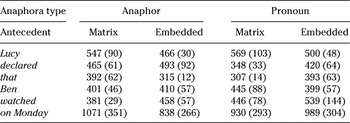
Task 1 Results. The results from Task 1 are given in Table 1. Predictions of cost increases for matching potential antecedent under Claim 1 were verified. Reading times for the matrix subject NP showed main effects of anaphora type, F1(1, 20) = 13.747, p < .001; F2, ns, and, crucially, of antecedent, F1(1, 20) = 24.330, p < .0005; F2(1, 19) = 44.308, p < .0005. Thus, for anaphors (Hypothesis A; Figure 1, Item a vs. Item b), RTs on the matrix subject NPs were significantly longer when the gender of the NP matched the gender of the anaphor, t1(20) = 4.733, p < .0005; t2(19) = 4.819, p < .0005. For pronouns (Hypothesis B; Figure 1, Item c vs. Item d), RTs on the matrix subject NPs were significantly longer when the gender of the matrix subject matched the gender of the pronoun, t1(20) = 3.777, p = .001; t2(19) = 3.102, p < .01. These statistics suggest that gender matching is required for identification in discourse representation.
NSs’ mean reading times on crucial segments in Task 1 (in ms)

Note
SD in parentheses.
Predictions of cost increases on the complementizer for matrix-bound anaphors under Claim 2 were verified. On the complementizer that, RTs exhibited a crucial interaction of anaphora type with antecedent, F1(1, 20) = 46.731, p < .0005; F2(1, 19) = 261.290, p < .0005. Hypothesis 1 about chain mediation (Figure 1, Item a vs. Item b) was supported. Anaphors matching matrix subject NPs induced longer RTs, t1(20) = 5.702, p < .0005; t2(19) = 9.956, p < .0005. Hypothesis 2, about binding-theoretic constraints (Figure 1, Item a vs. Item c), was also supported. Anaphors matching matrix clause subject NPs induced longer RTs than pronouns, t1(20) = 6.962, p < .0005; t2(19) = 9.079, p < .0005.
In the V-domain, predictions of Claim 3 were verified. Reading times on the embedded clause verb segment exhibited main effects of anaphora type, F1(1, 20) = 17.363, p < .0005; F2(1, 19) = 24.992, p < .0005, and of antecedent, F1(1, 20) = 34.540, p < .0005; F2(1, 19) = 37.875, p < .0005. Hypothesis 1 (Figure 1, Item a vs. Item b), about chain mediation, was supported by the cost of anaphoric binding in the embedded clause. For anaphors, a matching antecedent in the embedded clause induced longer RTs on the embedded clause verb, t1(20) = 7.211, p < .0005; t2(19) = 8.852, p < .0005. Hypothesis 2 (Figure 1, Item c vs. Item d), about structure minimization that affects the manner in which binding-theoretic domains are computed, was also supported. Reading times on the embedded clause verb were longer with pronouns matching the embedded clause subject in gender than with anaphors, t1(20) = 4.228, p < .0005; t2(19) = 3.449, p < .005. This was as expected, if the relevant local domain is the embedded clause, before the NP can be considered.
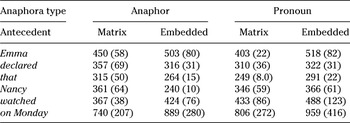
Task 2 Results. Task 2 provided a test of these hypotheses, modulo the fact that the context provided an (initial) value of the pronoun or anaphor. Claim 1 found support in the results in Table 2. Reading times on matrix subject NPs produced a theoretically significant main effect of antecedent, F1(1, 17) = 35.938, p < .0005; F2(1, 19) = 34.136, p < .0005. An interaction between antecedent and anaphora type was also found, F1(1, 17) = 6.194, p < .05; F2(1, 19) = 7.072, p < .05. Shorter latencies were induced when the referent of the matrix clause subject NPs matched the intended value of anaphoric expressions: For anaphors, t1(17) = 2.603, p < .05; t2(19) = 2.835, p < .05; and for pronouns, t1(17) = 7.630, p < .0005; t2(19) = 7.831, p < .0005. This supports nonstrategic computations of referential dependencies, even though disengagement induces a cost.
NSs’ mean reading times on crucial segments in Task 2 (in ms)

Note
SD in parentheses.
Again, we turn to the complementizer segment for support for Claim 2. On the complementizer segment, an ANOVA revealed a theoretically significant interaction of anaphora type with antecedent, F1(1, 17) = 47.612, p < .0005; F2(1, 19) = 118.977, p < .0005. There was also a main effect of anaphora type, F1(1, 17) = 13.991, p < .005; F2(1, 19) = 14.850, p = .001. Hypothesis 1 was supported. Thus, RTs were longer when matrix clause subjects matched intended values of anaphors (Figure 2, Item a vs. Item b), t1(17) = 4.555, p < .0005; t2(19) = 4.465, p < .0005. Hypothesis 2 was also supported. In conditions in which the subject matched the intended value of anaphoric expressions (Figure 2, Item a vs. Item c), RTs for anaphors were again significantly longer than for pronouns, t1(17) = 5.841, p < .0005; t2(19) = 7.822, p < .0005.
Finally, we examine the verb segment in support of Claim 3. Reading times on the embedded verb revealed a main effect of anaphora type, F1(1, 17) = 13.229, p < .005; F2(1, 19) = 26.428, p < .0005, and a theoretically significant interaction of anaphora type with antecedent, which was only significant on the subject analysis, F1(1, 17) = 16.005, p = .001; F2, ns. A main effect of antecedent was found in the item analysis, F2(1, 19) = 13.017, p < .005. Hypothesis 1 was supported. In the anaphor conditions (Figure 2, Item a vs. Item b), a construal with the matrix clause subject induced longer RTs than a construal with the embedded clause subject, t1(17) = 3.861, p = .001; t2(19) = 4.136, p = .001. Hypothesis 2 was also supported. The conditions exploring the relative costs of construal with the embedded clause subjects revealed longer RTs for pronouns (Figure 2, d) than for anaphors (Figure 2, b), t1(17) = 2.840, p < .05; t2(19) = 3.847, p = .001. This was as expected, if the embedded clause is the domain considered on first pass, before the NP can be considered as the domain of evaluation for the pronoun.
Reconstruction in Real Time in English NNSs
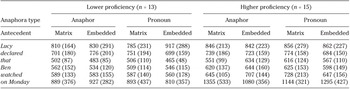
Task 1 Results. We now turn to the evidence provided by L2 learners in Table 3 for Task 1. Claim 1 did not find support. No significant asymmetries could be found in the subject or item analyses before the complementizer segment. Claim 2—on the binding of anaphors by matching matrix clause subjects in the C-domain—found support. Hence, on the complementizer segment, there was a theoretically crucial interaction of antecedent with anaphora type, F1(1, 26) = 11.525, p < .005; F2, ns, which was further qualified by proficiency, F1(1, 26) = 5.581, p < .05; F2, ns. There was also an interaction of antecedent with proficiency, F1(1, 26) = 4.735, p < .05; F2, ns, and a main effect of proficiency, F1(1, 26) = 10.525, p < .005; F2(1, 19) = 11.402, p < .005. The higher group (n = 15) produced revealing asymmetries. In the anaphor conditions (Hypothesis 1, Figure 1, Item a vs. Item b), RTs on the complementizer were faster when the anaphor matched the matrix clause subject, t1(14) = 3.372, p = .005. When pronouns and anaphors matched the matrix clause subject in gender (Hypothesis 2, Figure 1, Item a vs. Item c), pronouns induced longer RTs on the complementizer than anaphors did, although this did not quite reach significance, t1(14) = 1.997, p = .066. The lower group (n = 13) did not produce statistically reliable asymmetries. Nonnative speakers’ processing on the complementizer is thus different from the processing detected in NSs. On the verb segment, a main effect of proficiency, F1(1, 26) = 5.270, p < .05; F2, ns, and an interaction of anaphora type and antecedent relevant to Claim 3, F1(1, 26) = 4.255, p < .05; F2, ns, were found. The interaction signals computations in the V-domain. Their nature cannot be further described, as planned t tests did not yield significance.
NNSs’ mean reading times on crucial segments in Task 1 (in ms)

Note. SD in parentheses.
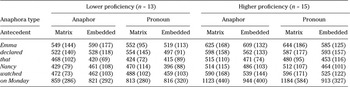
Task 2 Results. The results of Task 2 are shown in Table 4. Claim 1 could not be confirmed. Reading times on the complementizer produced asymmetries relevant to Claim 2. In the anaphor conditions (Hypothesis 1, Figure 2, Item a vs. Item b), RTs on the complementizer were longer when (the referents of) the matrix clause subjects matched the intended values of anaphors, t1(28) = 3.032, p = .005; t2(19) = 2.339, p < .05. When (the referents of) matrix clause subjects matched the intended values of the anaphors or pronouns (Hypothesis 2, Figure 2, Item a vs. Item c), anaphors induced longer RTs than pronouns, t1(28) = 2.324, p < .05; t2(19) = 2.044, p = .055. These patterns matched the asymmetries that arose on the complementizer in NSs in Task 2 but did not produce a significant interaction. There were main effects of antecedent, F1(1, 27) = 8.419, p < .01; F2(1, 19) = 10.630, p < .005, and anaphora type, F1(1, 27) = 4.338, p < .05; F2(1, 19) = 4.940, p < .05. On the embedded clause verb, there was a main effect of proficiency, F1(1, 27) = 4.656, p < .05, which, however, did not interact with other variables, and a main effect of antecedent, F1(1, 27) = 8.304, p < .01; F2(1, 19) = 8.506, p < .01. No effects directly relevant to Claim 3 were found.
NNSs’ mean reading times on crucial segments in Task 2 (in ms)

Note
SD in parentheses.
Judgment Data
In addition to RTs, increased computational complexity can be expected to have an effect on relative rates of acceptance. This should be found on pronouns. We first consider English NSs. Acceptance rates showing anaphors and pronouns construed with matrix and embedded clause subjects on Task 1 are provided in Table 5. An ANOVA conducted on acceptance rates revealed a main effect of antecedent, F1(1, 20) = 10.240, p < .005; F2(1, 19) = 6.303, p < .05, and an interaction of anaphora type and antecedent, F1(1, 20) = 9.340, p < .01; F2(1, 19) = 12.735, p < .005. A main effect of antecedent was also found in the item analysis, F1, ns; F2(1, 19) = 18.870, p ≤ .0005. The acceptance rates for anaphors construed with matrix clause subjects and embedded clause subjects were similar at around 70%. The effect of first postulating a clausal domain during processing was reflected in acceptance rates for pronouns.
NS’s mean acceptance rates in Task 1 (%)

Note
SD in parentheses.
Native speakers’ acceptance rates for anaphors and pronouns identified as coreferential with matrix clause and embedded clause subjects on Task 2 are shown in Table 6. In this task, the acceptance rates for anaphors construed with matrix clause subjects and embedded clause subjects hovered around 50%. Knowledge of the intended interpretation still does not prevent the calculation of alternative interpretations. Depending on the interpretation that is selected by the respondent, he or she will accept or reject the proposed value of the anaphor. Acceptance rates on pronouns construed with matrix clause and embedded clause subjects again appear to be linearly dependent. ANOVAs revealed a significant interaction of anaphora type and antecedent, F1(1, 17) = 6.457, p < .05; F2(1, 19) = 9.417, p < .01. English NSs’ acceptance rates for pronouns were consistent with a binding-theoretic violation on first pass during processing, even when an alternative is grammatically possible.
NSs’ mean acceptance rates in Task 2 (%)

Note. SD in parentheses.
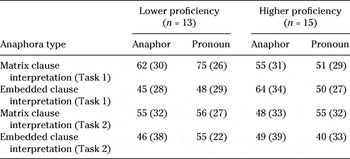
For L2 learners of English, acceptance rates are shown in Table 7. Task 1 yielded a main effect of antecedent, F1(1, 26) = 5.006, p < .05; F2, ns, which was qualified by proficiency, F1(1, 26) = 11.236, p < .005; F2(1, 19) = 11.565, p < .005. There was an interaction of anaphora type and proficiency in the item analysis, F1, ns; F2(1, 19) = 5.075, p < .05. The acceptance rates for anaphors agreeing with matrix clause subjects (58%, SD = 30) and anaphors agreeing with embedded clause subjects (56%, SD = 32) were clearly flat. For the pronoun conditions, however, a post hoc test suggests that the acceptance rates for pronouns agreeing with matrix clause subjects (62%, SD = 30) versus embedded clause subjects (49%, SD = 27) differ, t1(27) = 2.131, p < .05; t2(19) = 2.125, p < .05.
NNSs’ mean acceptance rates (%)

Note. SD in parentheses.
Task 2 did not provide statistically significant differences. Given the character of NSs’ acceptance rates on this task, the lack of effects for learners is not very surprising. The need to juggle both the intended meaning and the processing of the sentence in the second experiment seemed to have rendered the task of providing acceptability judgments more complex and less probative of the computations involved. Response patterns in Task 1 provide asymmetries that are in line with the RT evidence, however.
DISCUSSION
Native speakers’ RTs first revealed costs associated with ϕ-feature matching (Task 1) and disengagement (Task 2) for anaphors and pronouns alike. These asymmetries reflect automatic computations of referential dependencies in the structuring of discourse. Native speakers’ RT asymmetries on the complementizer and verb segments in Task 1 and Task 2 revealed differentiated costs that support the reconstruction of pronouns and anaphors involving binding-theoretic computations mediated by movement chains. Thus, English NSs’ processing of anaphors and pronouns under reconstruction produced RT asymmetries that revealed automatic computations in discourse-semantics and in syntax. These asymmetries seem to be reflexes of the very design of language.
Nonnative speakers produced a different profile. In Task 1, there was no evidence of the computation of referential dependencies as matching referents were introduced. However, interactions of antecedent with anaphora type on the complementizer and verb segments suggest binding-theoretic computations at these levels. On the complementizer, NNSs’ RTs on that were the shortest for bound anaphors, whereas NSs’ RTs on that were the longest for bound anaphors. Does this difference suggest distinct processing mechanisms? Both profiles are relatable to the computations under investigation. If anaphoric binding induces a local cost increase in the C-domain associated with the additional syntactic computations involved, once this is done, a processing advantage is obtained with respect to processing in which resolution is ongoing. In Task 2, the automatic processing of referential dependencies in discourse-semantics was again not in evidence. However, on the complementizer segment, the NNSs produced RT asymmetries that strongly supported Hypothesis 1, the mediation of anaphora resolution by movement chains, and offered support for Hypothesis 2, binding-theoretic calculations.
Our working hypothesis, according to which referential dependencies established in discourse-semantics are subject to binding-theoretic licensing under reconstruction at LF under structure minimization, not only is highly predictive of the effects observed in NSs but also captures those effects found in NNSs. Chain mediation of binding-theoretic computations predicts precisely where interactions occurred in Task 1—that is, in the C- and V-domains. In Task 2, specific asymmetries predicted by chain-mediated LF reconstruction were found. Still, undeniable behavioral differences between NSs and NNSs were found: NNSs were slower and produced far fewer asymmetries. Claiming on that basis that certain computations did not arise in L2 sentence processing because the relevant asymmetries went undetected in NNSs runs the risk of a comparative fallacy. Thus, we prefer the approach of examining (a) the compatibility of the L2 data with the theory of anaphora resolution motivated by NSs and (b) the degree to which they are amenable to other treatment to see if any asymmetries in explanatory adequacy arise. In the case at hand, the RT asymmetries produced by NNSs are compatible with a theory of incremental application of binding principles under the mediation of movement chains. On this view, the NNSs’ results constitute prima facie evidence of syntactic mediation between lexical and discourse by virtue of language design. Failure to register the effects of computations of referential dependencies in the structuring of discourse does not mean that they did not take place.
We now consider the RT data produced by NNSs in the light of SSH assumptions. If the effects on the matrix clause subject—and yet again at clause edge—in NSs are suggestive of processes in different modules, their absence in NNSs may be seen as evidence for a single process of anaphora resolution solely dependent on the prominence of referents and on lexical information. Second language anaphora resolution would obey lexical stipulations to resolve anaphors as quickly as possible but to delay resolving pronouns. This ersatz theory, however, begs the question of the representation and the implementation of these differing lexical requirements. The classical theory of representations enjoys greater explanatory adequacy. Indeed, the details of the RT asymmetries obtained from NNSs seem far from theory neutral. First, in the absence of mediation by structural computations, coreference is more safely resolved when all the referents are introduced and the plausibility of various scenarios can be determined (Greene et al., Reference Greene, McKoon and Ratcliff1992). This, however, was not found. Effects arose in RTs on the complementizer segment in NNSs’ processing in advance of the embedded clause subject NP. Second, the contours of these results are highly surprising on SSH assumptions. Discourse-semantics processing as referents are introduced in advance of syntactic computations found in L1 processing was not in evidence in L2 sentence processing. Asymmetries arose that point, rather, to syntactic computations.
CONCLUSION
Nonnative speakers’ processing of anaphors and pronouns under LF reconstruction lacked the reflexes of automatic computations of referential dependencies involved in the structuring of discourse found in NSs’ processing but was suggestive of chain-mediated binding theory application. This provides evidence suggestive of structural constraints on L2 anaphoric binding. These results seem fundamentally at odds with SSH expectations, which suggest that computations in any processing module—not uniquely syntax—may go undetected in L2 sentence processing. Indeed, RT asymmetries induced by the reconstruction of anaphors and pronouns in the C-domain at LF point to highly specific computations. These signal an architecture according to which referential dependencies in discourse-semantics are accompanied by binding-theoretic computations mediated by movement chains by virtue of language design. Anaphora reconstruction in real time threatens, therefore, a view of L2 sentence processing.