I. DESIRES AND VALUE
Desire-satisfactionist theories of value are premised on the idea that it is better that a desire be satisfied than that a desire be frustrated. As stated, the theory is silent on the status of absent desires. Here I address the question: what difference does it make to matters of value, for a desire-satisfactionist, if a given desire is absent, rather than present? I will be arguing that it is most plausible to hold that the state in which a given desire is satisfied is, other things being equal, incommensurate with the state in which that desire does not exist at all.
II. THREE RELEVANT STATES OF AFFAIRS
Consider a possible agent A and a possible desire that p. There are three relevant states of affairs with respect to this agent – desire pair, from the perspective of a desire-satisfaction ethics.
Frustration: A desires that p, and p is false.
Satisfaction: A desires that p, and p is true.
Absence: Neither Frustration nor Satisfaction is the case.
I take it as axiomatic that it is better that a desire be satisfied than that it be frustrated. With respect to all agents A and all propositions p, it is, other things being equal, better that A desires p and p, rather than A desires p and not-p. Another way to put this is: for all possible agent – desire pairs, it is better that Satisfaction obtains than that Frustration obtains.
This is a particularly strong desire-satisfactionist claim. Weaker views, whereby Satisfaction is better than Frustration only for some desires, might focus on self-regarding desires or on fully informed desires, or some other suitably refined subset. For simplicity, I will focus on this pure form, which is intended to be completely neutral on the content of our desires. So all claims about the relative value of Satisfaction, Frustration and Absence are intended to be understood as universally quantified claims over all possible agent–desire pairs. Many of the conclusions drawn should apply, mutatis mutandis, to weaker forms of desire-satisfactionism also.
So Satisfaction is better than Frustration. In order to develop a complete desire-based axiology, though, we need to know the relative value of Absence.
Note that, as I have defined it, for a given agent–desire pair, Absence can obtain in two very different ways. First, it could be that A exists, but does not desire that p. Alternatively, it could simply be that A does not exist, now or ever.Footnote 1 Many philosophers are inclined to think that these are importantly different, from the point of view of axiology. I believe a desire-satisfactionist ought to resist that thought. Desire-based theories of value are grounded in the thought that all matters of good and bad, better and worse, etc. are, ultimately, settled by what Satisfactions and Frustrations there are. In other words, all facts of value supervene on what Satisfactions and Frustrations obtain in a world. Having settled what Satisfactions and Frustrations there are, it is settled what Absences there are – as I have defined them – but it is not settled whether or not, for any given Absence, it is due to an existing agent A not desiring p or if it is due to agent A not existing at all. So if an axiologist claims that, in order to settle questions of value, we need to know how an Absence obtains, then that axiologist denies that all facts of value supervene on what Satisfactions and Frustrations obtain, and thereby has lost her claim to be a desire-satisfactionist.
I intend to argue that, (for all agent–desire pairs) Absence is, like Satisfaction, better than Frustration. However, this does not entail that Absence and Satisfaction are equal in value. Indeed, I maintain that these two states of affairs are incommensurate. Despite some surprising implications, this is the most plausible version of desire-based ethics.Footnote 2
Before proceeding, one important caveat: when I consider the relative value of Satisfaction, Frustration and Absence, I will be concerned only with impersonal value. I will be concerned to determine for instance whether it is better that, for a given agent–proposition pair, Satisfaction, Frustration or Absence obtains. I will leave untouched the personal value of these states. That is, I am silent on whether it is better for the agent if one or other of these states obtain.
It is very appealing to think that something like the following principle is true:
Person-affecting supervenience: One state of affairs can be (impersonally) better than another only if that state of affairs is (personally) better for at least one person.
This principle is akin to an axiological version of the person-affecting principle in normative ethics – the idea that an action can only be wrong because it harms a person, or because it deprives a person of a benefit.
But this principle, conjoined with the even more appealing principle:
Actualism: A state of affairs can be better for a person A only if A exists
leads to trouble. There are presumably some possible persons such that, were they to exist, things would be (impersonally) worse, because their lives would be so wretched. Given this possibility, we conclude that it is impersonally better that the possible persons in question do not exist. By the person-affecting supervenience claim, it must be better for someone. Intuitively, the persons for whom it must be better are those who have been spared a wretched existence. But by actualism, this state of affairs cannot be better for the merely possible wretched people, for they do not exist.
In recent literature, a variety of ingenious attempts have been made to address these issues by denying one or other of these principles, and in many cases attempting to provide a similarly plausible alternative principle that does not lead to immediate difficulty. For instance, Melinda Roberts and Nils Holtug effectively deny my version of actualism – though they both believe that there are weaker actualist principles which they can satisfy.Footnote 3 Jens Johansson denies my person-affecting supervenience claim, and replaces it with a counterfactual version: one state of affairs can be better than another only if that state of affairs would be better for at least one person.Footnote 4
Though I take this to be an important issue which warrants further debate, I will simply avoid it for the remainder of this article by focusing solely on impersonal value. Despite this narrowness of focus, I anticipate that there are some interesting further implications to be drawn for various theories of welfare that are not strictly desire-satisfactionist. A welfare theory that stresses the importance of achieving one's goals, for instance, must similarly address the relative value, not only of the states in which a goal is achieved or not, but also the state in which one never adopts the goal in the first place.Footnote 5 Although I doubt that the view advocated here is equally plausible as a theory of the personal value of ‘absent goals’, the relevant dialectical moves are likely to have some important similarities.Footnote 6
A. Incommensurability
What is it for two things to be incommensurate in value? Following John Broome, I define incommensurability as follows:Footnote 7
A is incommensurate with B if and only if:
• A is not better than B.
• B is not better than A.
• It is not the case that, for any third thing C, C is better than A iff C is better than B. Nor is it the case that, for any third thing C, A is better than C iff B is better than C.Footnote 8
The last clause is a mouthful, so focus on merely one implication of it: it is not the case that, for all things C, if C is better than A, then C is better than B. It is facts like this which crucially distinguish incommensurability from equality. If two things, A and B, are equal in value, then for any third thing C which is better than A, it is better than B.
Broome illustrates incommensurate values using Sartre's famous dilemma:
During the Second World War, one of Sartre's students had to make a choice between staying in France to look after his mother, and leaving to join the Free French Forces in Britain. His mother very much needed him to stay, because his father had been revealed to be a traitor and his brother had been killed by the Nazis. Staying with her was a way to meet her needs. On the other hand, leaving for Britain was a way to promote the honour and freedom of France. The student was unable to weigh up determinately the values promoted by his two alternatives. The question ‘Which is better: to stay or to leave?’ seemed to him to have no right answer.Footnote 9
To illustrate the idea that these two options are not equal in value, but rather incommensurate, Broome invites us to imagine small changes in the options that render them better, relative to the original option. So, for instance, suppose that the passage to Britain becomes somewhat safer. This makes the option of leaving for Britain better than it had been – if the student had a choice between leaving for Britain with a more or less dangerous passage, it is clear that the less dangerous passage is better.
But this change would not necessarily tip the scales in favour of going to Britain as opposed to staying to look after his mother. If the two options had been equal in value, such a small improvement in one option, combined with the transitivity of betterness, would entail that the improved option is the better. Where two options are incommensurate, this is not entailed.
III. ARGUING FOR THE INCOMMENSURABILITY OF SATISFACTION AND ABSENCE
I propose first to argue for the incommensurability of Satisfaction and Absence. The argument proceeds by a four-way disjunctive syllogism.
It is either the case that:
• Absence is better than Satisfaction,
• Satisfaction is better than Absence,
• Absence and Satisfaction are equal in value, or
• Absence and Satisfaction are incommensurate in value.
Elsewhere, Christoph Fehige has persuasively argued that both the first two disjuncts are false.Footnote 10 I shall first rehearse Fehige's arguments against the first two disjuncts, before going on to try to establish that the claim of incommensurability is more plausible than the equality claim.Footnote 11
A. Absence better than satisfaction?
Consider the possibility that, for all agent–desire pairs, Absence (the agent's being indifferent with respect to p) is better than Satisfaction (the agent's desiring p, and p being true). And note, we are interested here in the claim that, other things being equal, Absence is intrinsically better – not merely extrinsically, or contingently better – than Satisfaction.
Suppose that a particular proposition, p, is true. Suppose, moreover, that I am indifferent to whether or not p. Hence with respect to the possible agent–desire pair 〈Handfield, p〉, we have a state of Absence. Now suppose that I come to desire that p, and nothing else changes. If Absence is better than Satisfaction, then this is a change for the worse! Imagine: the sun is shining, and I am indifferent to it. But I change. I come to like the fact that the sun is shining. Surely this is not a change for the worse.Footnote 12
If this does not convince, consider Fehige's claim that, if Absence were better, then at least some desires would resemble diseases, in that they would be things which are not merely better cured, but are things which it would be better never to have, simpliciter. This seems implausible. Being in a state where one's desire is satisfied is not intrinsically of disvalue in the way that having a disease – even a successfully treated disease – may be intrinsically of negative value.
That is not to say that there may not be various side-effects and extrinsic matters that could lead us to prefer Absence. In particular, having a desire – even a satisfied one – brings with it the risk of frustration in future. So for reasons like this, to do with risk, you might think that Absence is better than Satisfaction. But this is not what is at issue here. We are examining the proposition that, other things being equal, Absence is intrinsically better than Satisfaction. The risk associated with having a Satisfied desire is not intrinsic to that desire, so not relevant to the evaluation.
B. Satisfaction better than Absence?
On the other hand, consider the possibility that Satisfaction is intrinsically better than Absence. At first glance, this might seem to be true. Consider a state in which, having previously been indifferent to sports cars, you come to desire a sporty Ferrari and you are given one. Is that state not better than your earlier indifference? In particular, surely you get more pleasure from being a Ferrari-owning-and-loving type than you would from the alternative?Footnote 13
But if we allow ourselves to imagine there is additional pleasure accompanying the satisfaction of the desire, then this constitutes a distorting factor. It is extremely tempting to suppose that such pleasure is itself a good. If we are supposing that pleasure is good, independently of whether it satisfies our desires, however, then we have rejected the assumption of desire-based ethics. And if we believe pleasure is good because it satisfies another desire we have – such as a desire for pleasure – then the combination of Ferrari-desire and Ferrari is instrumentally valuable: it is good because it facilitates the satisfaction of another, previously existing desire. But that does not show that Satisfaction is intrinsically better than Absence. It merely shows that, for creatures who already have other, frustrated desires, Satisfaction can be an instrumentally valuable way of satisfying those other desires.
So we must either imagine that we are indifferent to pleasure – a somewhat difficult thing to do; or we must imagine that we get no additional pleasure from having the satisfied Ferrari-desire, as compared with the state in which we had no such desire. In cases like this, Fehige maintains, there is no reason to think that Satisfaction is better than Absence.
There is a resonance here – which Fehige welcomes – with Stoic ethics. He asks us to disregard the empirical arguments the Stoics had for recommending that we disdain the cultivation of extra desires. (Arguments about the discomforts associated with frustrated desires, the risk we run of having frustrated desires, etc.) Rather, pay attention to this question: even if having a desire did not have any of its contingently bad features, and even if satisfaction were guaranteed, what's the point of having a satisfied desire?
Consider another of Fehige's examples, which may help to get the force of this thought across:
[S]uppose we paint the tree nearest to Sydney Opera House red and give Kate a pill that makes her wish that the tree nearest to Sydney Opera House were red – have we really done her a favour?Footnote 14
Supposing such examples to be compelling, Fehige does seem to have a good case that Satisfaction is not better than Absence.Footnote 15
At this point, you might be concerned about the methodology being employed here. The desire-satisfactionist view is notoriously a counter-intuitive one, because it supposes that there is value in satisfying any desire, even if it is for something that we tend to regard as objectively ‘undesirable’. Desires for the good and virtuous are just as significant in the axiological calculus as desires for the wicked and vicious. Given this, appealing to intuitions about the relative value of desire satisfaction cannot be a very reliable way of clarifying and elaborating desire-satisfactionism. If we really thought intuitions were a good guide to value, we would – by virtue of sheer methodological consistency – be required to reject the very view we were considering.
A related objection might be,
In attempting to show that Satisfaction is not better than Absence, you are using examples in which the desire is for something trivial and not intrinsically desirable. It would be much fairer if you used an example of a desire for something that was intrinsically desirable, such as a good education, or to appreciate fine literature, or to be with one's beloved.
But the desire-satisfactionist is likely to have some independent account of why it is that we think that some things are inherently desirable. Any such account will entail that beliefs of this sort are in error. Hence, to draw upon intuitions about the value of things we believe to be intrinsically valuable is fraught with epistemic risk. One thought might be that the source of this error lies in our higher-order desires: we might think that some things are inherently desirable, merely because we desire that we desire them. Again, this is a reason to think that our intuitions about the value of satisfying such desires is a poor guide to what is of value. We wish to know the intrinsic value of Satisfaction versus Absence, and that is something we can only clearly identify where there are no other desires which become satisfied or frustrated by the introduction of a new desire.
All this said, I concede that not everyone shares the broadly Stoic attitude to satisfied desires which Fehige and I recommend. So I suggest one final strategy by which you might be persuaded to abandon the thought that Satisfaction is better than Absence. If that were so, then it might give rise to reasons for us to frustrate some of our desires in order to create new, satisfied desires. Suppose, for instance, that one could initiate new desires by some sort of neurosurgery. I offer you the following: I will smash your favourite vase, and in exchange I will give you a new vase – to which you were previously indifferent – and also create a very strong desire in you to own the new vase. Your original desire for the old vase remains, and will be frustrated, but because having a satisfied desire that p is pro tanto better than being indifferent whether p, then perhaps your newly created and satisfied desire to own the new vase will constitute enough reason for you to accept this offer.
Of course, for this to be the case, we would need to appeal to some way of weighing up Frustrations versus Satisfactions. And it remains to be seen whether such a weighing would ever deliver this result. But the very possibility of such a result seems like an unwelcome implication of the view. I take this to be further evidence that it is not the case that Satisfaction is better than Absence.
IV. ALARMING IMPLICATIONS
On the basis of the above, we can conclude either that Satisfaction is equal in value to Absence, or that Satisfaction is incommensurate in value to Absence.
This is enough to entail some potentially alarming claims. One can argue as follows (again, for all possible agent–desire pairs):
(1) Satisfaction is better than Frustration. (This is an axiom of desire-satisfactionism.)
(2) If Frustration is better than Absence, then, by transitivity of betterness and (1), Satisfaction is better than Absence.
(3) But it is not the case that Satisfaction is better than Absence. (By argument of the previous section.)
Therefore,
(4) it is not the case that Frustration is better than Absence.
Now, consider a world devoid of preferrers, W 0. In W 0, every possible agent–desire pair is absent. For any possible world W, the only way in which W could differ in value from W 0 is in virtue of facts about one or more desires which are absent in W 0 being either satisfied or frustrated in W. By virtue of (3) and (4) any such facts will not be grounds for saying that W is pro tanto better than W 0. Because we are assuming a desire-based axiology, there are no other grounds for W to be better than W 0.Footnote 16
Therefore:
(5) No world is better than a world in which no preferrers exist.
As indicated above, I am not directly concerned with questions of personal value – questions of what is better and worse for an individual. But assuming we can overcome difficulties related to things being better or worse for non-existent individuals, it is worth noting in passing that an analogous argument,Footnote 17 premised on the idea that the only facts relevant to the value of an individual life are facts about the satisfaction and frustration of desires held by the individual, goes to show that:
(6) No life is better for an individual than not existing.
A. Implications of equality
At this stage, we have only reached the conclusion that Satisfaction and Absence are either equal in value or incommensurate. If they are equal in value, what follows?
It follows that:
(7) The actual world is worse than W 0, a world empty of preferrers.
Why does this follow?
As has already been assumed, Satisfaction is better than Frustration. If Absence and Satisfaction are equal in value, then by the transitivity of the ‘better than’ relation, Absence is better than Frustration.
The actual world contains some satisfied desires and some frustrated desires. W 0 contains only absent desires. Therefore, compared to W 0, the actual world contains some differences for the worse (i.e. frustrations rather than absences), some differences that are equal in value (i.e. satisfactions rather than absences), and no differences for the better. By any plausible application of Pareto-style reasoning, W 0 is therefore better than the actual world. (Note: this only requires the very weak assumption that Pareto superiority is sufficient for betterness.)Footnote 18
Note that none of this constitutes a good argument for ending all our lives now. Now that we exist, mass suicide will not bring it about that we never existed. By preventing people from having desires in the future, we will make some possible desires absent, but we will also ensure that some actual desires are frustrated (by frustrating desires of those who live now, or those who lived in the past, for future states of affairs). So any scenario of mass-extinction would not be Pareto superior to business as usual. It would require a substantive welfare function, capable of weighing trade-offs among frustrations, satisfactions, and absences, to get any conclusion about the value of eliminating preferrers.Footnote 19
B. Rejecting equality
Of the alarming conclusions canvassed above, while the idea that no world is better than a world empty of preferrers may be a little affronting, the stronger claim – that the actual world is worse than an empty world – is far less plausible.
The closest Fehige comes to dealing with this concern is when he says ‘[i]t would . . . be interesting to know how many happy lives on earth you think have sufficed to outweigh Auschwitz. How obvious is it that the whole thing – famines, world wars, gas chambers – is “better than nothing”?’ (p. 522). Note, however, that this reply assumes that someone who rejects (7) is endorsing the view that the actual world is better than, or at least commensurate with, the empty world. But like Fehige, I agree that no world is better than the empty world – the important possibility that Fehige neglects is that the actual world is incommensurate with an empty world.
How might this difference in valuation be of relevance in practical decision? Here it is necessary to assume some normative theory. I will assume the following maximizing consequentialist principles:Footnote 20
• A possible act alpha is permissible if and only if there is no possible act whose consequences are better than the consequences of alpha.
• A possible act alpha is obligatory if and only if the consequences of alpha are better than the consequences of all other possible acts.
Assuming our choice to conceive has no causal impact except on the creature conceived, given Fehige's view, it is wrong to conceive, because any organism we conceive will no doubt have some frustrated desires. Therefore, there is a possible act which has a better outcome: not conceiving, thereby not creating those frustrated desires.
If Satisfaction and Absence are incommensurate, however, then it does not follow that, other things being equal, adding to the population is wrong.
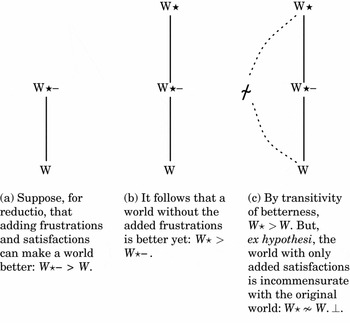
It may not be immediately obvious how to aggregate the impact of adding both satisfied and frustrated desires to a world. In effect, it requires one to ‘add’ a negative change and a change that, other things being equal, makes the two alternatives incommensurate. Although it is not possible to conclude exactly what the overall impact of this will be, we can narrow the possibilities somewhat: by ‘adding’ a change for the worse and an incommensurate change, we cannot get a world which is better than the first world; nor can we get a world which is equal in value. This can be shown as follows (see also Figure 1).
The argument which shows that adding both Satisfactions and Frustrations to a world cannot make a better world. A solid line represents a better-than relation, with the better item at the top.

Start with a given world, W. Now consider an alternative, W*−, which differs by some quantity of desires that were absent in W being satisfied (think of the ‘*’ as representing these satisfactions), and some further quantity of desires that were absent in W being frustrated (hence the ‘–’). Suppose for reductio, that W*− is better than W. Now consider a third world, W*, which differs in the following way only: those desires which are frustrated in W*− but absent in W, are absent in W*. Because Absence is better than Frustration, W* is better than W*−. By the transitivity of the better than relation, W* must also be better than our original world, W. But now we strike trouble, because the only difference between W and W* is that some desires which were absent in W are satisfied in W*. Consequently, these two worlds must be incommensurate. Contradiction.
A similar argument shows that adding Satisfactions and Frustrations cannot make an equally good world. But there is no contradiction in supposing that the resulting state of affairs is either incommensurate with the original, or worse than the original.
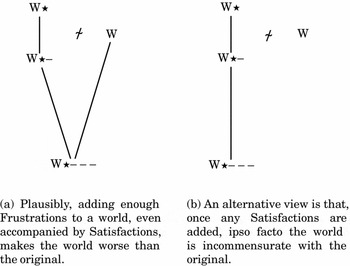
So we can suppose that the possible outcomes of adding new desires to the world are related as in either of the illustrations in Figure 2. The first option entails that adding sufficiently many Frustrations to the world, even accompanied by some Satisfactions, makes a world that is outright worse than the original. The second option is to suppose that any two worlds which differ by the addition of Satisfactions will thereby be incommensurate, regardless of how many Frustrations there are in either. I suggest that the first option is more plausible, but note that – regardless of which of these options is correct – the maximizing principles suggested above are enough to show why it would be wrong to bring about a world like W*− (and a fortiori why it would be wrong to bring about a world like W*−−−). Because W* is better than W*−, it fails to maximize to bring about W*−, and would be wrong to do so.
Two ways that worlds which contain both additional Satisfactions and additional Frustrations could be related to our initial world, W.

So when we add a new life, ignoring effects of that process on others, the resultant world may be incommensurate with the alternative, or it may be worse. If it is worse, of course creating that life is impermissible. But if it is incommensurate, it may be permissible, provided no better world is possible.
The upshot is – putting aside effects on other people – having children is never obligatory, but either impermissible or permissible, depending upon the life the child will have. This fits much better with intuitive beliefs about the permissibility of having children.Footnote 21
Even if one can join Fehige in his extreme pessimism about the actual world, it is important to see that his pessimism extends much further than this. The claimed equality of Satisfaction and Absence entails that every world which contains at least one frustrated desire is worse than W 0. Consider a world in which all but one preferrer is perfectly satisfied: we have all of our desires met at all times. Only one person suffers a frustrated desire, and it is only a very insignificant desire at that. Is the world really worse, in virtue of this lone frustrated desire, than a world in which none of us exist?Footnote 22
I take these points to be reasonably strong evidence against the claim that Satisfaction is equal in value to Absence. That leaves the incommensurability claim as the only standing disjunct.
C. Completing the view
I have claimed that Satisfaction is incommensurate with Absence. What about the relationship between Frustration and Absence?
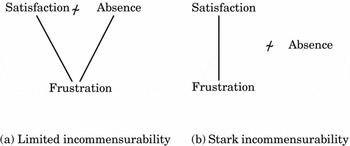
There are two possible views available: Frustration might be worse than Absence, or Frustration and Absence might be incommensurate. I call the former view ‘limited incommensurability’. The latter view I call ‘stark incommensurability’.Footnote 23 See Figure 3 for an illustration of the views.
Diagrammatic representation of the two possible views. Lines represent ordering by the better-than relation: for any given pair of items joined by a line, the upper state of affairs is better than the lower.

Limited incommensurability is similar to the idea rejected above – that Satisfaction and Absence are equal in value. Indeed, one might fear that the same argument can be used, from limited incommensurability, to derive (7). (Whereas, from stark incommensurability it follows that (7) is false.)
But this fear is baseless. The argument for (7) – the claim that the actual world is worse than the empty world – crucially trades on the commensurability of Satisfaction and Absence. Here is how we might try to evaluate the actual world, compared to W 0, on the limited incommensurability view:
• Compared to the empty world, W 0, the actual world contains some frustrations rather than absences. These are differences for the worse.
• Compared to the empty world, W 0, the actual world contains some satisfactions rather than absences. These are incommensurate in value.
• Compared to the empty world, W 0, the actual world contains no satisfactions rather than frustrations, nor does it contain any absences rather than frustrations. Thus the actual world contains no differences that are for the better.
From the claim that world X differs from world Y in some respects for the worse, in some respects that are incommensurate and in no respects that are better, it does not follow that X is worse than Y. That is because of the differences that are incommensurate. They block any straightforward ‘summing’ of any other differences.
That said, it does not follow that X is not worse than Y. The matter remains open, in much the same fashion as was discussed in the text accompanying Figure 2. So a conclusion that we can draw from limited incommensurability is:
(8) It is possible that the actual world (being a world that contains frustrated desires) is worse than the empty world, W 0.
Things are importantly different for stark incommensurability. On that view, all worlds that contain desires are incommensurate with the empty world. For take an arbitrary world W, which contains some satisfied and some frustrated desires. Compared with the empty world, W contains no differences for the better, and no differences for the worse. It contains only differences that are incommensurate with the empty world. So we can conclude that these worlds are indeed incommensurate. Stark incommensurability entails that (8) is false.
Before attempting to identify reasons to accept either limited or stark incommensurability, in the next section I formulate the views in more precise terms.
D. Formulating some principles for application
I suggest the following formalization of the claims made so far.
The set of possible agent–desire pairs can be partitioned, for any possible world W, into those which are absent (AbsW), those which are frustrated (FruW) and those which are satisfied (Sat W).
Using these sets, a notion of Pareto-superiority for worlds can be defined. The intuitive idea is that, for any two worlds Y, Z that differ only in that some desires frustrated in Z are satisfied in Y, Y is better than Z.
T1. For any two worlds Y and Z, if AbsY=AbsZ and Sat Y ⊇ Sat Z, then Y Z.
T2. For any two worlds Y and Z, if AbsY=AbsZ and Sat Y ⊃ Sat Z, then Y≥Z.
These claims should be accepted by any desire-satisfactionist.
For the stark incommensurability theorist, for any two worlds, Y, Z, which do not differ in virtue of desires frustrated in one being satisfied in the other, if there is a difference in what desires are absent, then Y and Z are incommensurate.
T3. For any two worlds Y and Z, if (Fru Y ∩ Sat Z = ∅) and (Fru Z ∩ Sat Y = ∅) and (AbsY≠AbsZ), then Y ≁ Z.
For the limited incommensurability theorist, T3 is false. Rather, she endorses the claim that, for any two worlds Y, Z, that differ only in that desires frustrated in Z are absent in Y, then Y is better.
T4. For any two worlds Y and Z, if Sat Y = Sat Z and AbsY⊃AbsZ, then Y > Z.
T5. For any two worlds Y and Z, if Sat Y = Sat Z and AbsY⊇AbsZ, then Y≥Z.
The limited incommensurability theorist also requires a weaker version of T3, which states that two worlds which differ only in that desires absent in one world are satisfied in the other, are incommensurate:
T3′. For any two worlds Y and Z, if (FruY=FruZ) and (Sat Y ∩ Abs Z ≠ ∅), then Y ≁ Z.
It is also important to register what remains unsaid, on both views. Suppose we take the actual world history, and we make two sorts of changes: first, we frustrate some desires that were satisfied in the actual world. Call that change ‘actual frustration’. Second, we add some desires, making some of them frustrated and some of them satisfied. In the actual world, these were all absent, so call the change ‘addition’. Both views are silent on the relative value of the actual world and the new world created by actual frustration plus addition. These worlds may be incommensurate. They may be equal in value. The newly generated world may be worse. The only option that is eliminated is that the world that differs by some combination of addition plus actual frustration is better than the actual world.
V. AGAINST STARK INCOMMENSURABILITY
In this section, I consider some applications of the two incommensurability accounts developed so far. In the course of doing so, I argue that limited incommensurability emerges as the more plausible view.
A The repugnant conclusion
Much of the interest in Fehige's position is that it gives straightforward answers to various paradoxical or puzzling questions about population ethics. As Derek Parfit has influentially argued, a wide variety of plausible ethical theories have problems giving sensible judgements of moral choices that involve different numbers of people.Footnote 24
The most notorious of these, perhaps, is the repugnant conclusion. Parfit attempts to show that, for any reasonably plausible consequentialist view, if there is a world that contains a relatively small population, each life in which is of very high quality, then there is a second possible world, one that contains many more lives, where these lives are of vastly lower average quality – they might be only barely worth living – and that this second world is better than the first. This is not obviously absurd, thinks Parfit, but it is certainly repugnant.
The reasoning is easiest to see on a total utilitarian view. Total utilitarians evaluate actions by the total utility the action brings about, relative to the alternatives. Add up enough small quantities of utility in the second world, and you will get a larger total than in the first world. But beyond total utilitarianism, Parfit's argument is impressive for the way it purports to show that many other, related theories fall foul of the repugnant conclusion, or are subject to even stronger objections.Footnote 25
The repugnant conclusion does not follow on Fehige's anti-frustrationist view.Footnote 26 One possible way for there to be a smaller population with very high-quality lives is for there to be no frustrated desires at all. The repugnant conclusion requires that, for any high-welfare small population, a better, larger, population is possible with barely tolerable lives. But for a population without any frustrated desires, no better population is possible, according to Fehige. So the repugnant conclusion is false. Beyond this highly idealized refutation of the repugnant conclusion, moreover, for almost any realistic scenario in which these populations might be brought about, it will be very plausible to suppose that the less populous world contains fewer frustrated desires, and thus will be better.
Having eschewed Fehige's view, must a limited or stark incommensurability theorist embrace the repugnant conclusion? Not at all. Rather, nothing follows about the relative value of the more populous world versus the smaller, happier population, except that the more populous world is not better. Nothing follows, because these choices involve choices between worlds that differ with respect to both ‘actual frustration’ and ‘addition’. (Nor do we see any significant difference between the two views, in application to this case.)
This can hardly be chalked up as a major victory, but it is at least a promising beginning.Footnote 27 There are other matters, however, which give rise to greater trouble.
B. Wrongful life
Is it possible to wrong someone, merely by bringing them into existence? Are there some lives that are sufficiently bad for the individual living them, that we harm them as a result?
As alluded to earlier, questions about whether existence can harm or benefit someone have been much debated in connection with attempts to analyse the concept of harm, and also in connection with the concern that this leads to the paradoxical idea that someone can be benefited while never existing. If harm involves making someone worse off, it seems not to make much sense to say that someone is harmed by being brought into existence. Had they not been brought into existence, they would not have had any level of well-being at all.Footnote 28
That said, it certainly seems plausible that some lives are so wretched that it would be wrong intentionally to bring such lives into existence. If that is right – notwithstanding the difficulty in explaining the attendant concept of harm – then is either of the views under consideration here compatible with that idea?
Stark incommensurability has trouble accounting for the idea of wrongful life. Take an extreme case where the creation of the new life has no effect on the satisfaction, frustration or absence of the other desires in existence (one such example would be the creation of life in a world otherwise absent of agents with desires). And suppose the life created is maximally wretched: the agent has a large number of very strong desires, and none of them are satisfied. Stark incommensurability, in virtue of T3, would conclude that the world in which the agent exists is incommensurate with the world in which the agent does not exist. Therefore, it is not worse that this life has been created.
In more realistic cases, where the creation of a life does have an effect on the satisfaction or frustration of desires held by others, it might be possible for the stark incommensurability theorist to maintain that it is worse that the wretched life be created. But the explanation which can be given seemingly draws on the wrong facts: it relies upon the frustration of the desires of others to explain what makes it wrong to create the life. I take it that this is an inadequate explanation.
Limited incommensurability fares much better. Indeed, in the scenario described above, whereby a life is created such that the only effect of that life is to create frustrated preferences, then by T4, the world in which the wretched life exists is worse. Moreover, this can be explained by pointing to the existence of the frustrated preferences of the individual who is born into the wretched life. Although it remains difficult to explain the sense in which this individual has been harmed by her existence, it is at least encouraging to be directed towards her frustrated desires to provide such an explanation.
So stark incommensurability cannot explain the apparent possibility of wrongful life. Limited incommensurability perhaps can.
C. Greedy neutrality
In a somewhat different context, John Broome has suggested that incommensurability is a form of ‘greedy neutrality’ – it swallows up other factors of negative or positive value, and neutralizes them.Footnote 29 Broome's objection could perhaps be translated into this context like this: ‘You might be attracted to the idea that changing the world by adding a new satisfied desire is a change that is “neutral”. You might then suppose that by “neutral”, you mean the two possible outcomes – one in which the desire is absent, one in which it is satisfied – are incommensurate. But incommensurability is not like neutrality as we typically understand it, so your intuitive attraction to the idea of neutrality does not support your claim of incommensurate value.’
The reason why Broome thinks incommensurability is not like neutrality is because, intuitively, a bad thing plus a neutral thing should constitute, together, a change for the worse. But a bad thing plus an incommensurate thing do not necessarily constitute, together, a change for the worse. Hence it is a ‘greedy’ form of neutrality.
In the context in which he is considering this idea, it appears to be a serious problem for a particular sort of incommensurability claim. Without dwelling on the details of Broome's discussion, I will here attempt to adapt Broome's scenario to be directly relevant to desire-satisfactionists, and to determine whether it is has objectionable consequences for either the Stark or limited incommensurability views.
Suppose we begin with a very simple world, W 1, which contains only one small population, F. To make matters as simple as possible, we will suppose that the entire population F has only six desires: f 1 through f 6. Suppose that in W 1, all of these desires are satisfied, and no other desires exist.
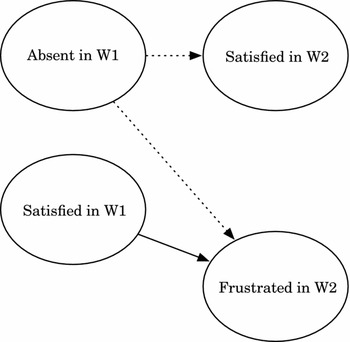
Now consider a second world, W 2, which differs from W 1 in two ways. First, a second population, G, exists in W 2. Population G also has only six desires. The existence of G means that some desires which were absent in W 1 are present in W 2. For a stark incommensurability theorist, this sort of difference is not a difference for the better, nor a difference for the worse. The second difference is that some of the desires of population F that were satisfied in W 1 are now frustrated. For all desire-satisfactionists, this is a difference for the worse. (See Figure 4.)
Changes involved in moving from W 1 to W 2. The downward-pointing solid arrow indicates a change for the worse. The dotted arrows indicate changes that are – according to stark incommensurability – incommensurate.

On stark incommensurability, for these worlds as described, it does not follow that W 1 is better than W 2. It is possible that the two worlds are incommensurate. But it is plausible that for some cases like this, a world like W 2 will indeed be worse than a world like W 1.Footnote 30
So we will suppose that this is such a case, where W 1 is better than W 2.
Now consider a third world W 3, that differs from W 2 in two ways. First, all those desires of population F which are frustrated in W 2 but were satisfied in W 1 are ‘restored’ to a state of satisfaction. This is a change for the better. Second, we also frustrate some desires of population G that were satisfied in W 2. This is a change for the worse. See Figure 5 for an illustration.
Changes involved in moving from W 2 to W 3. The solid upward arrow represents a change for the better. The solid downward arrow represents a change for the worse.

We have made no commitments to how trade-offs of satisfactions versus frustrations are to be evaluated. Presumably, there are some trade-offs like this which are changes for the better. We would reject, for instance, a principle such as
Strong Paretoism for desires: One world A is at least as good as another world B only if no desires that are satisfied in B are frustrated in A.
This principle makes Pareto superiority, with respect to individual desires, a necessary condition of one world being better than another. So a change involving any desire-frustration for one individual – however trivial – would be sufficient to show that the change is not for the better, even if it were accompanied by massive improvements in desire-satisfaction for others. This is much less credible than the plausible idea that Pareto superiority is a sufficient condition of one world being better than another.
So if we allow that views like Strong Paretoism are false, the stark incommensurability theorist presumably will agree that, for at least some world like W 3, it is worse than W 2.
For the sake of concreteness, here are three worlds, described in terms of their desire-sets, which might plausibly meet the constraints described above.

In this case, it is plausible that W 3 is worse than W 2, because W 3 involves more frustrated desires and fewer satisfied desires. Moreover, if distributive matters are of any concern, W 3 involves a less equal distribution of desire satisfaction and desire frustration.
But now a problem follows for the stark incommensurability theorist. She has agreed that, for some worlds like these,
S1. W 1 > W 2, and
S2. W 2 > W 3.
Therefore, by transitivity of the ‘better than’ relation,
S3. W 1 > W 3.
But T3 states that worlds which do not differ in virtue of desires satisfied in one being frustrated in the other, but do differ in which preferences are absent, are incommensurate in value. W 1 and W 3 are two such worlds:
S4. W 1 ≁ W 3
But if they are incommensurate, then neither world can be better than the other. Contradiction. (This is allegedly an instance of incommensurability being greedy: it has ‘swallowed up’ the evaluative difference between W 1 and W 3.)
The point of this argument is not that the particular worlds, with the sets described above, must be a counterexample. For those particular worlds, the stark incommensurability theorist may deny S1 or S2. The point is that it is overwhelmingly plausible that there are some worlds which differ in the respects identified, and which stand in the betterness relations described by S1 and S2. The only principled way to maintain that no such worlds exist would apparently require embracing the weak repugnant conclusion or embracing something akin to Strong Paretoism.
How does limited incommensurability fare? The limited incommensurability theorist rejects T3, and instead embraces T3′, T4 and T5. But none of these principles entails that W 1 is incommensurate with W 3. The limited incommensurability theorist can agree that W 2 is worse than W 1, the changes involved are either for the worse or are incommensurate. She can also agree that W 3 is worse than W 1. And consequently she must concede that W 1 is better than W 3. But this is no objection, because she is not committed to such worlds being incommensurate.
So the greedy neutrality objection makes stark incommensurability look a lot less plausible. It seems to require an implausibly strong commitment to Pareto improvement as a necessary condition of betterness, or it reinvites a weak form of the repugnant conclusion. Limited incommensurability handles the case with ease.
So although both versions of incommensurability views handle the repugnant conclusion, limited incommensurability emerges as more plausible in its handling of wrongful life cases and Broome's greedy neutrality case. Consequently, I recommend the limited incommensurability view.
VI. CONCLUSION
The chain of argumentation has become somewhat complex, so I briefly review it below.
1. It was initially assumed that Satisfaction is better than Frustration. (Again, all such claims are tacitly understood to be universally quantified over all possible agent–desire pairs.)
2. I then examined the relative value of Absence and Satisfaction.
(a) Absence > Satisfaction? — This view was rejected as absurdly pessimistic.
(b) Satisfaction > Absence? — This view was rejected because it conflicted with Stoical intuitions. (Moreover, it is worth mentioning here that those who endorse this claim are liable to derive a strong version of the repugnant conclusion, whereby we will be morally obliged to bring about more populous worlds with lower average welfare.)
(c) Satisfaction ≡ Absence (Fehige's view)? — I rejected this because it implies both that the actual world is worse than an ‘empty’ world, and that any world which contains a single frustrated preference is worse than an empty world.
(d) Satisfaction ≁ Absence — Retained as the least implausible alternative. This implies that no world is better than an empty world, but it is open that some worlds that contain frustrated preferences are worse.
3. What then is the relation between Frustration and Absence? The two possibilities are:
(a) Absence ≁ Frustration (stark incommensurability)
(i) Objection: Stark incommensurability entails that there is no such thing as wrongful life.
(ii) Objection: Broome's greedy neutrality objection purports to show that, to avoid contradiction, the view must embrace an implausibly strong Paretoism, or must invite a weak version of the repugnant conclusion.
(b) Absence > Frustration (limited incommensurability). This view is not vulnerable to the above objections.
To my mind, limited incommensurability emerges as a clearly superior view. It is perhaps a somewhat more pessimistic view than we are accustomed to entertaining, in light of its implication that no world is better than a world devoid of desires. But I suggest this might be a claim we should learn to accept.Footnote 31