





A striking feature of UK mental health practice is how often the pivotal clinical work is not ‘finding the right label’ but finding a language that both parties can recognise. Reference McCabe1,Reference Parker, Byng, Dickens, Kinsey and McCabe2 In diverse clinics and services, patients may describe distress through bodily metaphors, moral language, relational disruption, spiritual frames or culturally specific fears. Reference Qiu, Tay and Watson3 Clinicians, however, are trained to translate narratives into system-legible forms such as diagnoses, risk formulations, care pathways and evidence-based interventions. When translation works, classification becomes a bridge to care. When it fails, classification can inadvertently become a barrier: the patient feels unseen, the clinician feels unclear and the service struggles to act.
This tension is not a reason to reject diagnostic systems. It is a reason to determine what diagnostic systems are for. Mental health services run on classification. Whether the framework is DSM, ICD, a national diagnostic system or local clinical tradition, classificatory guides exist to make distress legible for professional and institutional action: shared terminology across practitioners, consistent documentation, service thresholds and referral pathways, research case definitions, and (in many systems) eligibility for benefits, leave or accommodations. Reference Kapadia, Desai and Parikh4,Reference Clark, Cuthbert, Lewis-Fernández, Narrow and Reed5 This ‘system-facing’ function is not incidental: it is the point. Classification provides clinicians with reliable ‘glasses’ to identify patterns and coordinate care in complex environments.
However, classification is not a neutral mirror of lived suffering. Mental symptoms are not simply biological signals waiting to be named; they are shaped by the interpretive, social and cultural contexts through which distress becomes recognisable as a symptom. By design, classification privileges what can be operationalised within clinical workflows, such as symptom clusters, thresholds, time course and decision rules. Reference Clark, Cuthbert, Lewis-Fernández, Narrow and Reed5,Reference Marková and Berrios6 What is gained in standardisation is often lost in meaning: the moral, relational and cultural significance through which individuals understand distress, assess threat and decide whether help is needed. Reference Byng, Groos and Dowrick7 Problems arise when we treat a diagnostic category as if it were the experience itself. At that moment, the same glasses that help clinicians to recognise disorders can also filter out the particular ‘colour’ of a patient’s illness narrative.
Locating DSM (and other systems) within Kleinman’s frame
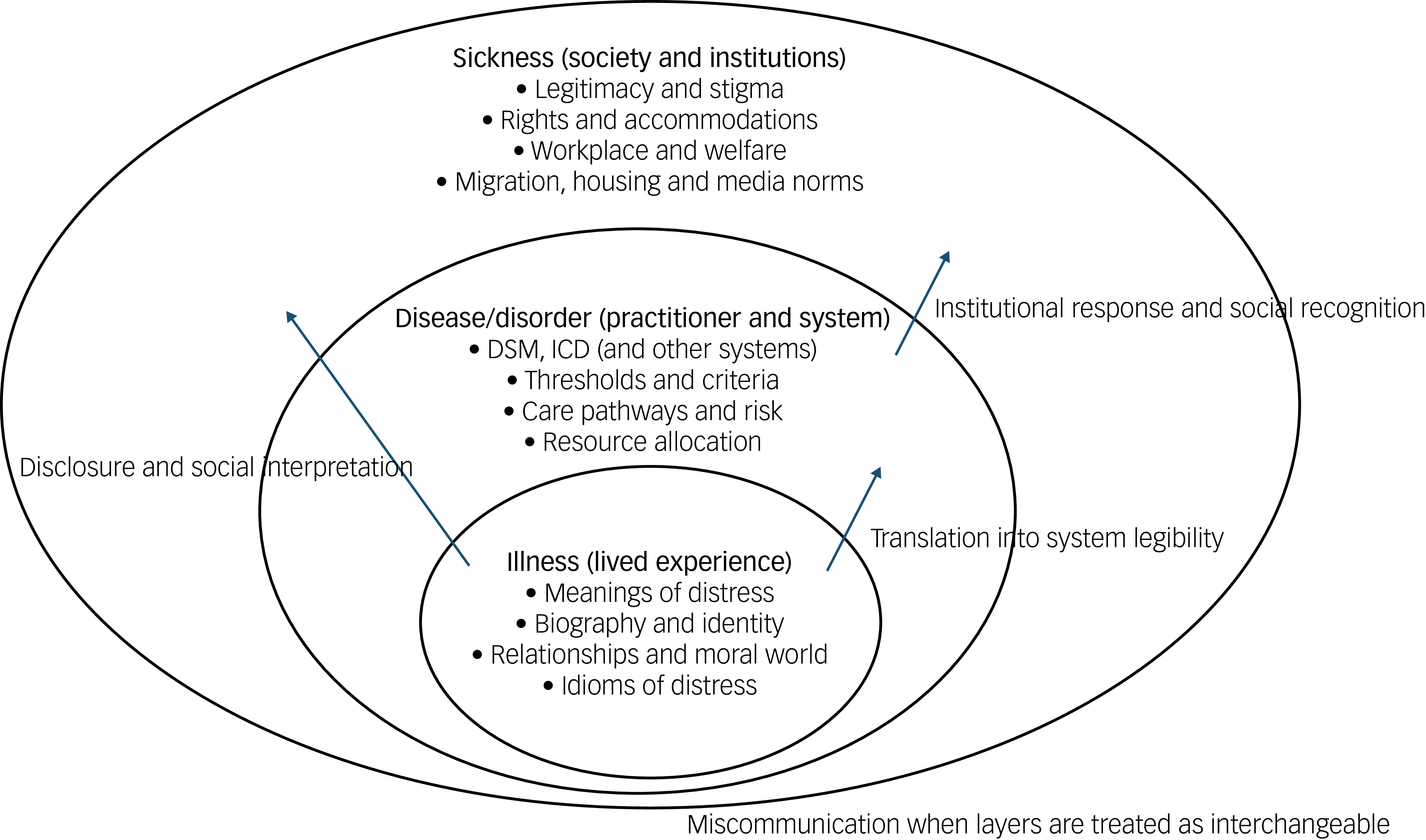
Earlier clinical formulations have already distinguished between different components of sickness. Taylor’s account of diseases, illnesses and predicaments separated biomedical abnormality, subjective experience and the wider life difficulties in which suffering becomes embedded. Reference Taylor8 Kleinman’s later distinctions among illness, disease and sickness remain a precise and influential way to map this problem. Reference Kleinman9 ‘Illness’ refers to how the person (and their close network) experiences and interprets distress: what it threatens, how it is narrated, how it reshapes identity and roles. Illness is never only symptom count; it is suffering as meaning, embedded in biography and relationship. ‘Disease’ refers to the practitioner-defined object: what clinicians identify as the underlying condition within their professional framework.
In contemporary psychiatry, DSM-style disorders function largely at the practitioner/system layer: a shared language that triggers specific actions and allocates resources. This is equally true of other classificatory guides, including those outside Western psychiatry: Reference Dai, Yu, Xiao, Xu, Zhao and Correia10 any diagnostic tradition creates legibility for its own institutions and practices. ‘Sickness’ captures the social status of a condition: whether society regards it as legitimate, shameful, blameworthy, dangerous, or deserving of care and accommodation. Reference Kleinman9 Sickness is shaped by institutions and power: Reference Grue11 workplaces, welfare systems, immigration contexts, housing, social media cultures of credibility and local stigma regimes.
Figure 1 summarises these three layers. These layers interact, but they are not the same thing. Cross-cultural clinical failures often reflect the assumption that they are interchangeable: Reference Jarvis and Kirmayer12 that a disorder label exhausts illness meaning, or that a diagnosis guarantees sickness legitimacy, or that social disapproval indicates clinical pathology. Reference Jutel13
Illness, disorder and sickness: a three-layer model.

To prevent this discussion being read as ‘DSM versus culture’, it will help to state plainly what this paper is not claiming. This is not an argument against diagnosis or evidence-based interventions. It is an argument about location: diagnostic classification sits primarily at the system/practitioner layer. Equity and engagement improve when services systematically engage with illness meanings and sickness barriers alongside classification. Diagnostic systems remain essential for coordination and access; the risk is treating them as equivalent to lived meaning and social legitimacy.
A simple typology of misalignment
Cross-cultural miscommunication in mental healthcare is often less about ‘Western versus non-Western’ and more about whether these layers align in a given consultation and context. Reference Kirmayer and Jarvis14,Reference Krystallidou, Temizöz, Wang, de Looper, Di Maria and Gattiglia15 Three misalignments are especially common.
Illness present, disorder absent (invisibility in the clinic)
In these cases, a person experiences substantial suffering, but the clinician’s disorder lens does not ‘see’ it. This occurs when distress is expressed through culturally patterned idioms or meanings that do not map neatly onto diagnostic thresholds. The patient may present with bodily metaphors (‘pressure’, ‘blocked chest’, ‘ants in the head’), ‘loss of energy’, relational shame or fears of harming others: forms of suffering that can be clinically significant yet hard to translate into a checklist. The clinical risk is invalidation (‘nothing is wrong’) or misdirection (‘it must be something else’), leading to disengagement and delayed care.
Illness present, sickness denied (invisibility in society)
Here, the person experiences distress (and may even have a diagnosis), but their social world does not grant legitimacy or support. Distress may be moralised (‘weakness’, ‘lack of will’), privatised (‘keep it within the family’) or stigmatised in ways that discourage disclosure. The harm pathway here is social rather than diagnostic: poor help-seeking, concealment, isolation, and reduced access to workplace adjustments or community support. Debates about attention-deficit hyperactivity disorder show this problem: even with distress and diagnosis, public anxieties about ‘over-diagnosis’ can weaken legitimacy and support. In practice, the illness is real, but the sickness status is withheld.
Consider a person with panic symptoms and insomnia (illness) who meets criteria for a recognised disorder (disease), but whose employer treats mental distress as an individual failing and whose family discourages disclosure (sickness). In this scenario, the person’s suffering is present (illness) and may be diagnosable (disorder/disease); yet there is a legitimacy problem (sickness) with respect to whether the person can disclose safely, attend appointments or access adjustments. Therefore, the service can feel ‘stuck’ despite correct diagnosis, because the binding constraint is sickness-layer recognition and institutional friction, not symptom identification.
Illness absent, sickness imposed (coercion and mistrust)
In these cases, the person does not experience their state as a problem, yet institutions or communities define it as such. This can happen when behaviour violates local norms, threatens collective functioning, or is interpreted through a moral or political lens. Soviet ‘sluggish schizophrenia’ represents an extreme case, in which political dissent could be pathologised as psychiatric disorder. Reference van Voren16 Even when intervention is clinically justified, outcomes are likely to be poorer if legitimacy is not negotiated. Patients are less likely to engage when the ‘problem definition’ belongs entirely to others.
In some contexts, intense introversion, unusual spiritual interpretations or atypical identity expression may be treated as sickness by family or community, even when the individual does not experience distress. Conversely, the same traits might be accepted (or even valued) in another setting. Reference Kotera, Ronaldson, Takhi, Felix, Namasaba and Lawrence17 Here, the central cultural question is not ‘which label is correct’, but ‘who has the authority to define suffering, risk, and acceptable personhood?’ Mishandling this misalignment can quickly erode trust and increase avoidance of services.
This typology is useful because it avoids a sterile debate about whether any classification system is ‘right’. The issue is whether the disorder framework, the illness narrative and the sickness context are aligned enough to support communication and care.
Illustration: taijin kyofusho (TKS) as translation loss
TKS offers a practical example of why alignment matters. Reference Kotera and Taylor18 TKS is often described as an interpersonal fear grounded in concerns that one’s presence, bodily functions or behaviour will offend or discomfort others. In many accounts, the ‘core problem’ is other-focused and moral-relational: ‘I will harm others socially’, rather than ‘I will be judged negatively’. DSM materials acknowledge cultural concepts of distress such as TKS, and DSM framings of social anxiety have evolved to better capture concerns about offending others. Yet a recurring argument in the literature is that TKS cannot be reduced to standard social anxiety with minor adjustments. If the clinician’s lens defaults to a self-focused model (i.e. fear of embarrassment or negative evaluation of the self), the patient’s illness meaning can be mistranslated.
The consequences are clinical and immediate. The clinician may interpret the presentation as unclear, ‘subthreshold’ or ‘something else’, whereas the patient insists that the ‘something else’ is not what they mean. Treatment rationales may miss the moral–relational centre of distress. In practice, the patient may feel unseen, and the clinician may experience the case as resistant or confusing. The problem is not whether DSM can mention TKS; it is whether routine clinical translation can retain the meanings that make the experience coherent and treatable for the person.
A cultural reflections lens adds one further point: what is ‘central’ is not only symptom form but what the symptom is about in the person’s moral world. Reference Kirmayer and Ryder19 For some patients, distress is organised around embarrassment and self-image; for others, it is organised around responsibility, burdening, contamination or harm to others. Those meanings are not decorative. They shape avoidance patterns, disclosure decisions, family involvement and what types of help are experienced as respectful.
Chronicity: how meaning and relationships constitute care
These issues are intensified in chronic and recurrent mental health difficulties. Over time, distress becomes woven into biography: confidence in one’s mind and body processes erodes; and daily life becomes reorganised around appointments, medication systems, waiting lists, assessments, benefits rules and workplace negotiations. Patients and families engage in continuous meaning-making, domesticating a threatening, disordered occurrence into something named and manageable.
Therefore, consultations are not simply information exchanges. Tone, gaze, posture and history of prior responses bear importance. Some patients present with stoicism or a ‘stiff upper lip’; others with tears, anger or despair. A disorder-first approach that sidelines meaning risks missing the patient’s lay experiential model: how they interpret causation, responsibility, shame, threat and hope, and what they believe would count as ‘getting better.’ Reference Slade20
For Cultural Reflections, it is worth stating explicitly that ‘meaning’ is often produced relationally. Reference Conrad and Barker21 Families and social circles co-construct what counts as illness, what counts as weakness, what can be spoken and what must be endured. In chronic mental ill-health, care is not only the application of interventions; it is also the ongoing negotiation of legitimacy, identity and belonging.
Five pragmatic steps to reduce miscommunication
The solution is not to abandon diagnostic systems but to place them at the right layer and build reliable translation across layers. The following steps are feasible in routine UK practice.
Elicit the patient’s explanatory model early and briefly
Ask: what do you call this problem? Why now? What worries you most? What do you think would help? These questions turn illness into shareable clinical information without forcing premature categorisation.
Translate idioms into meanings, not only symptoms
When patients use culturally patterned expressions (bodily metaphors, energy loss, relational language), clarify what the expression signifies (e.g. fear, shame, moral threat, relational rupture), then link interventions to those meanings. This reduces the risk that clinicians ‘correct’ the language rather than understanding it.
Formulate at three layers alongside diagnosis
In one paragraph, document: (a) working disorder classification (DSM/ICD where relevant); (b) illness meaning/biography; and (c) sickness constraints (e.g. stigma, migration stressors, workplace realities, benefits barriers, family expectations). This takes little time and prevents the disorder label from becoming the whole case.
Check alignment explicitly at the end of the encounter
Ask: does my explanation fit your experience? What would your family and/or community call this? What might make it harder to seek help? These checks surface divergence before it becomes disengagement.
Design services for cultural safety, not only cultural competence
Cultural safety here means structures that reduce translation loss: interpreter and/or mediator routes, training on idioms of distress and stigma dynamics, and outcomes that capture functioning and relational well-being (i.e. not symptom scales alone). Reference Curtis, Jones, Tipene-Leach, Walker, Loring and Paine22 For diverse UK communities, sickness-layer barriers (legitimacy, rights, institutional friction) can be as decisive as symptoms. Reference Bansal, Karlsen, Sashidharan, Cohen, Chew-Graham and Malpass23
Clinical implications
Diagnostic systems are essential tools for professional coordination, research and equitable access to services. Yet their categories are system-facing, and they are not synonymous with lived illness or social recognition as sickness. Cross-cultural misunderstandings arise when we treat disorder labels as if they exhaust what matters. Kleinman’s framework offers a pragmatic correction: keep classification but systematically engage with meaning and context. In an increasingly diverse UK mental health landscape, reducing translation loss across disorder, illness and sickness is a practical route to clearer communication, better engagement and fairer care.
About the author
Yasu Kotera is an associate professor at University of Nottingham, UK; collaborative researcher at University of Osaka, Japan; and honorary professor at Azerbaijan University, Azerbaijan.
Data availability
Not applicable.
Funding
This research received no specific grant from any funding agency, commercial or not-for-profit sectors.
Declaration of interest
None.

 Open access


eLetters
No eLetters have been published for this article.